
A complete issue · 16 pages · 1901
Judge — July 6, 1901
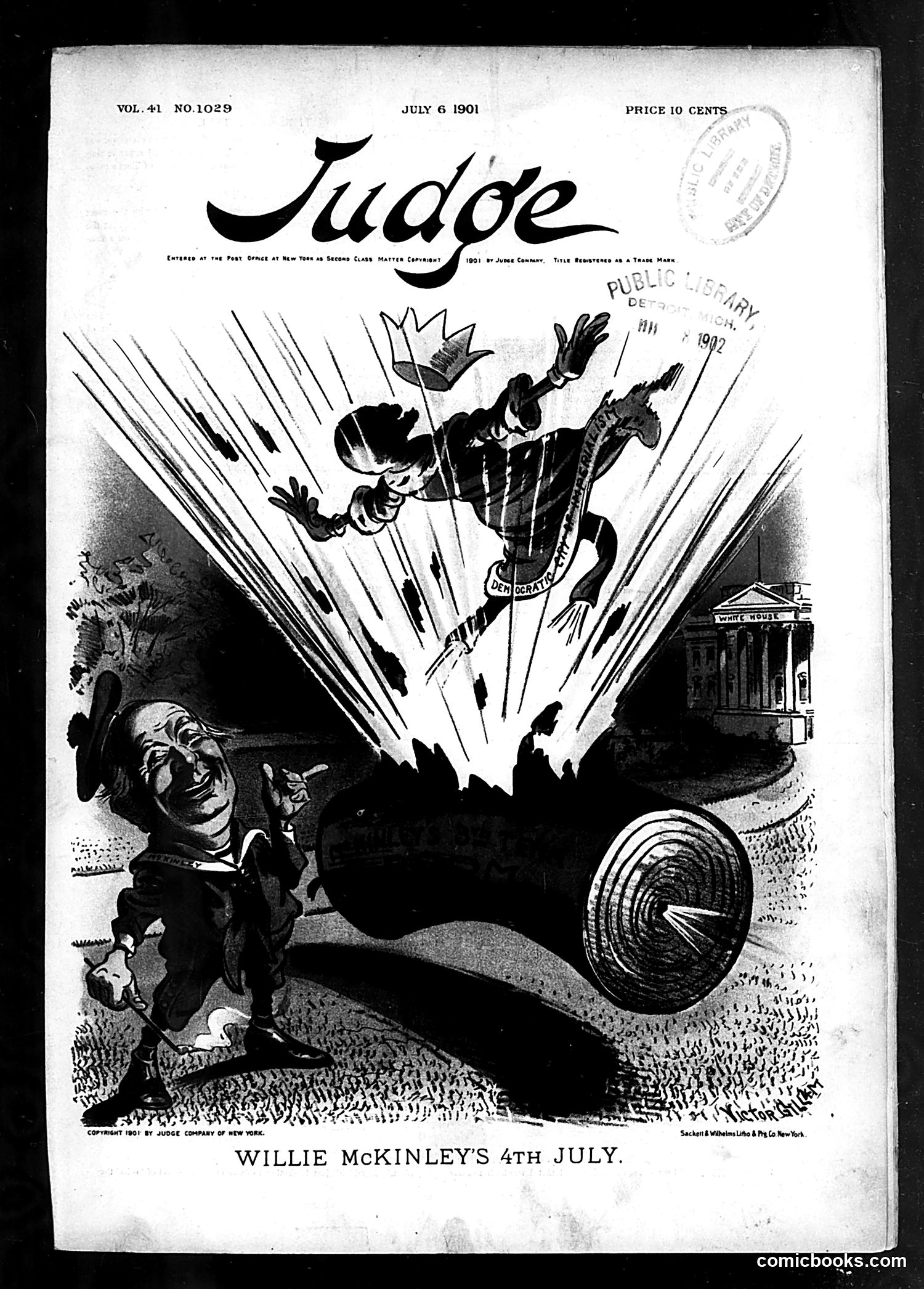
This Judge magazine cover from July 6, 1901 satirizes President William McKinley's Independence Day celebration. The central figure labeled "DEMOCRACY" is explosively ejected skyward by a cannon labeled "PROSPERITY," while a caricatured McKinley watches with apparent delight from the left. The White House appears in the background. The cartoon critiques McKinley's administration by suggesting that while prosperity and economic success (the cannon blast) appear triumphant, they come at democracy's expense—literally blowing it apart. The satirical point seems to be that McKinley's policies prioritized business interests and imperial expansion over democratic principles, particularly relevant given American involvement in the Philippines during this period.
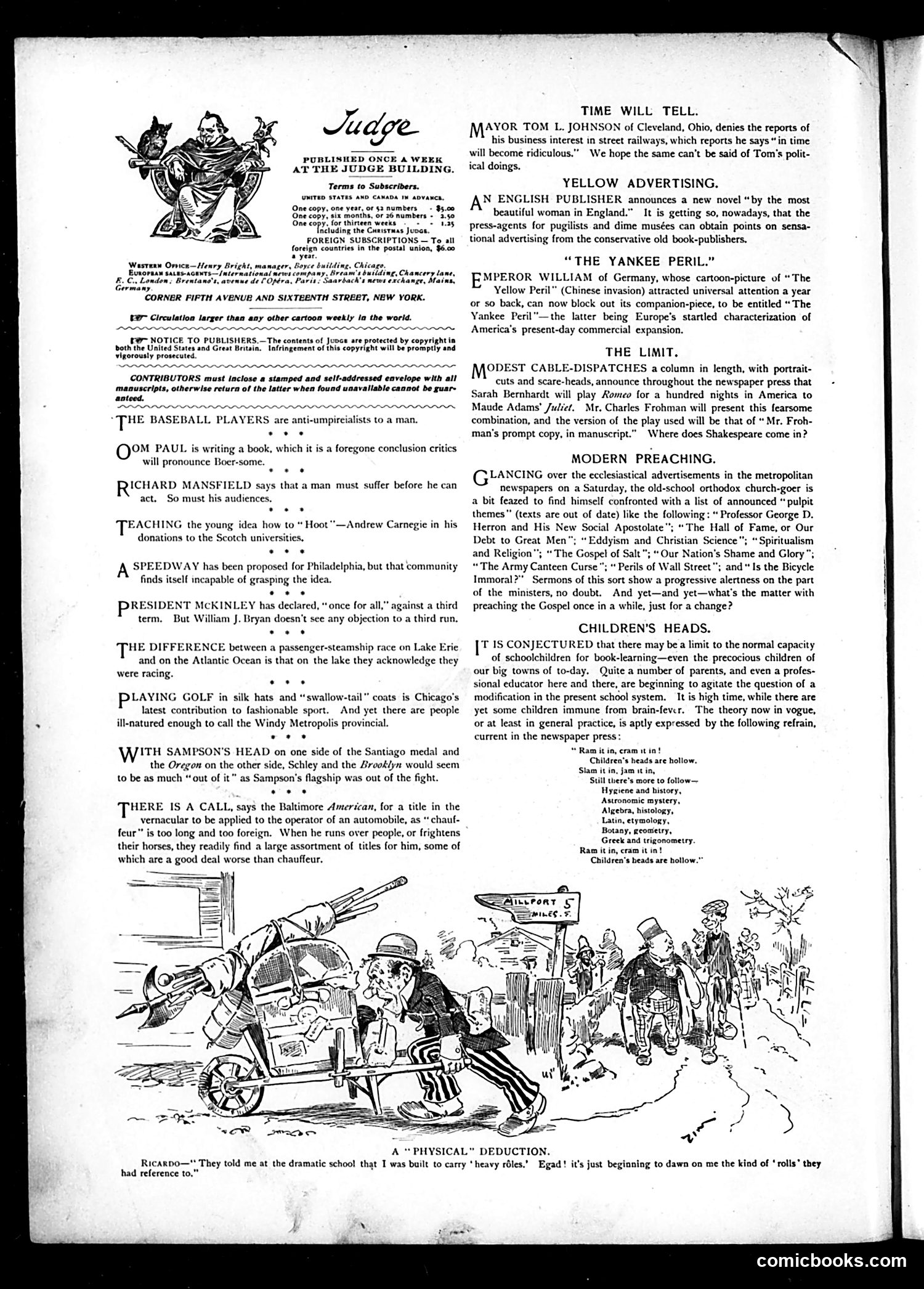
This page combines editorial commentary with satirical cartoons. The main cartoon titled "A 'PHYSICAL' DEDUCTION" depicts a figure at an airfield with various contraptions and luggage, apparently illustrating someone who has misunderstood instructions about carrying "heavy roles" (likely a pun on theatrical roles versus physical weight). The satirical point mocks confusion between dramatic training and practical absurdity. The editorial sections address contemporary issues: Mayor Tom L. Johnson's street railway business interests, theatrical advertising practices, and ecclesiastical advertisements in newspapers featuring outdated sermon titles. Another note critiques the "Yellow Peril" trope regarding Chinese immigration and European commercial competition. The "Children's Heads" section satirizes educators' theories about children's learning capacity, suggesting their explanations are overly complex jargon masking simple concepts.
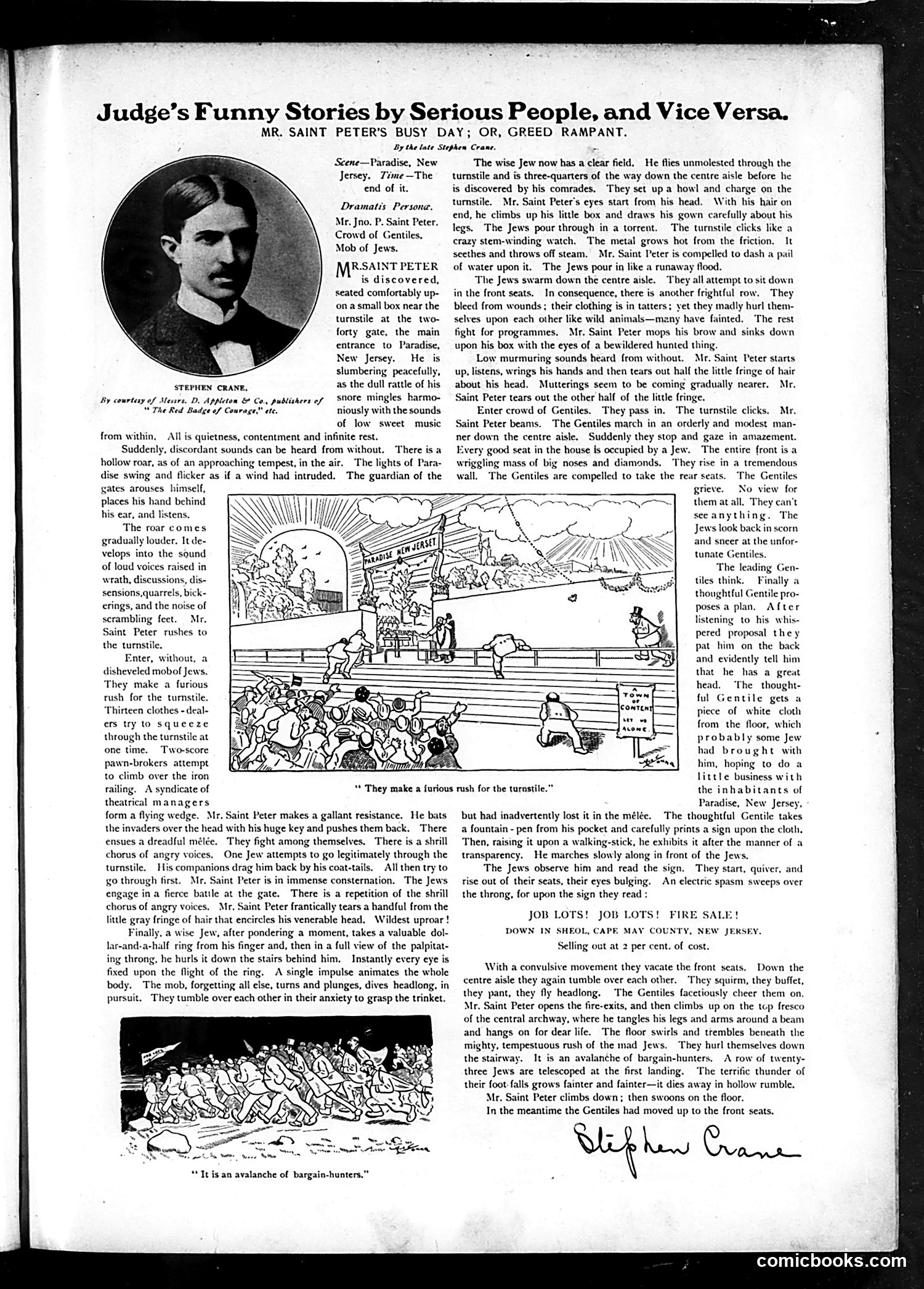
This satirical story by Stephen Crane uses religious allegory to mock social conflict. Saint Peter guards Paradise's entrance while a chaotic crowd of Jews and Gentiles (identified by their clothing) fight over seating in heaven's theater. The satire targets **ethnic and religious prejudice** of the era. The "wise Jew" and Gentiles engage in absurd conflicts—bargaining, rushing, fainting—over celestial accommodations. Crane ridicules the notion that religious groups would maintain their earthly animosities even in paradise, suggesting such prejudices are ridiculous and petty. The humor is biting: by depicting heaven as another venue where groups squabble over status and seating, Crane critiques American society's rigid ethnic hierarchies as fundamentally foolish and spiritually bankrupt.
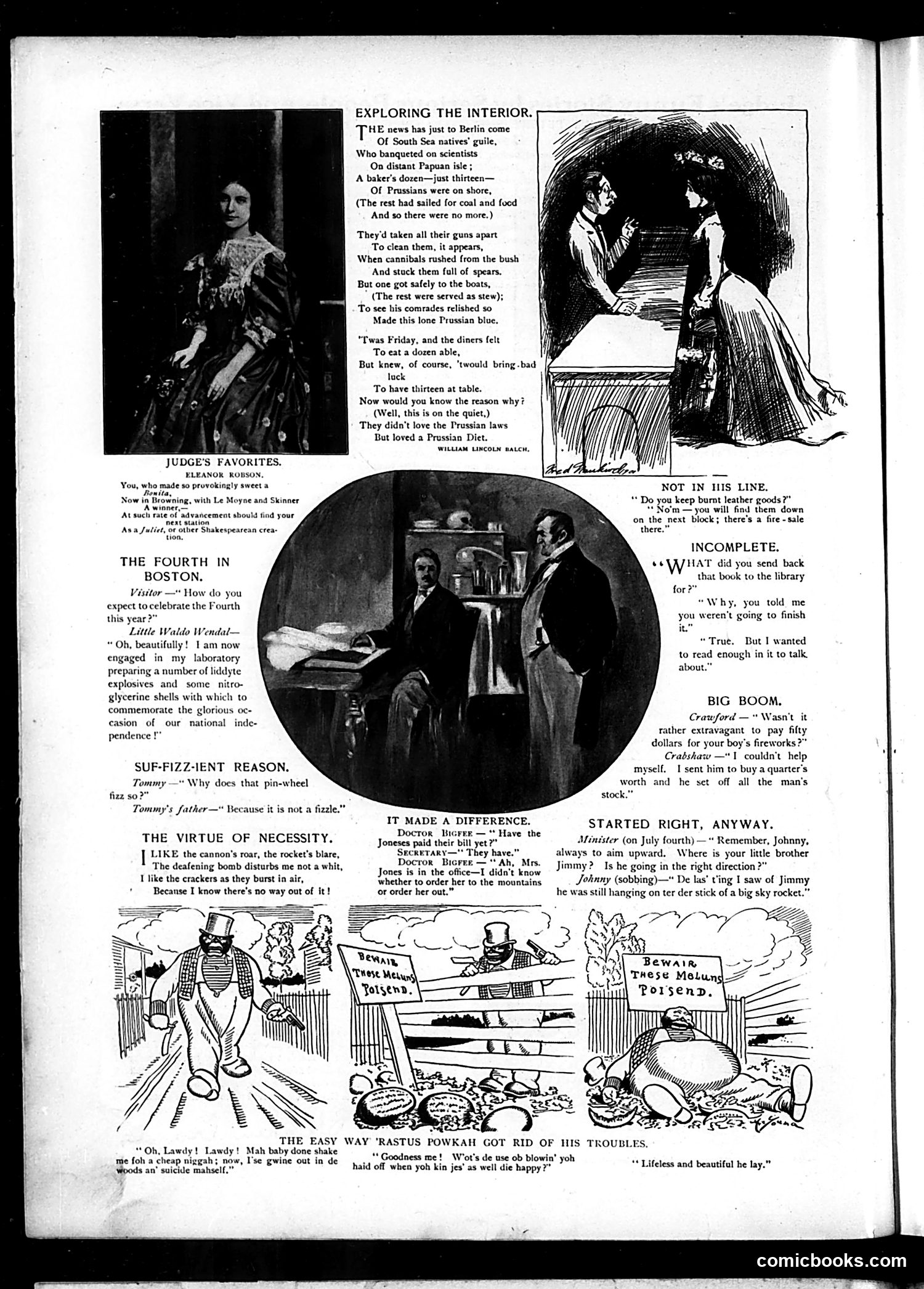
This page contains several unrelated humorous sketches and verses typical of Judge's format. The content includes: **"Exploring the Interior"** - A poem about South Sea natives, Prussians, and colonial encounters, illustrated with a sketch of what appears to be an expedition scene. **"Judge's Favorites"** - Brief comedic dialogue exchanges on various topics (Fourth of July preparations, pin-wheels, necessity). **"The Virtue of Necessity"** - A cartoon showing figures discussing practicality. **"The Easy Way Rastus Fowkah Got Rid of His Troubles"** - A three-panel cartoon using racial caricature (common in early 20th-century American humor) showing someone solving problems through poison. The page reflects Judge's satirical approach mixing literary humor, social commentary, and illustrations, though most content appears domestically focused rather than explicitly political. The racial imagery is period-typical but offensive by modern standards.
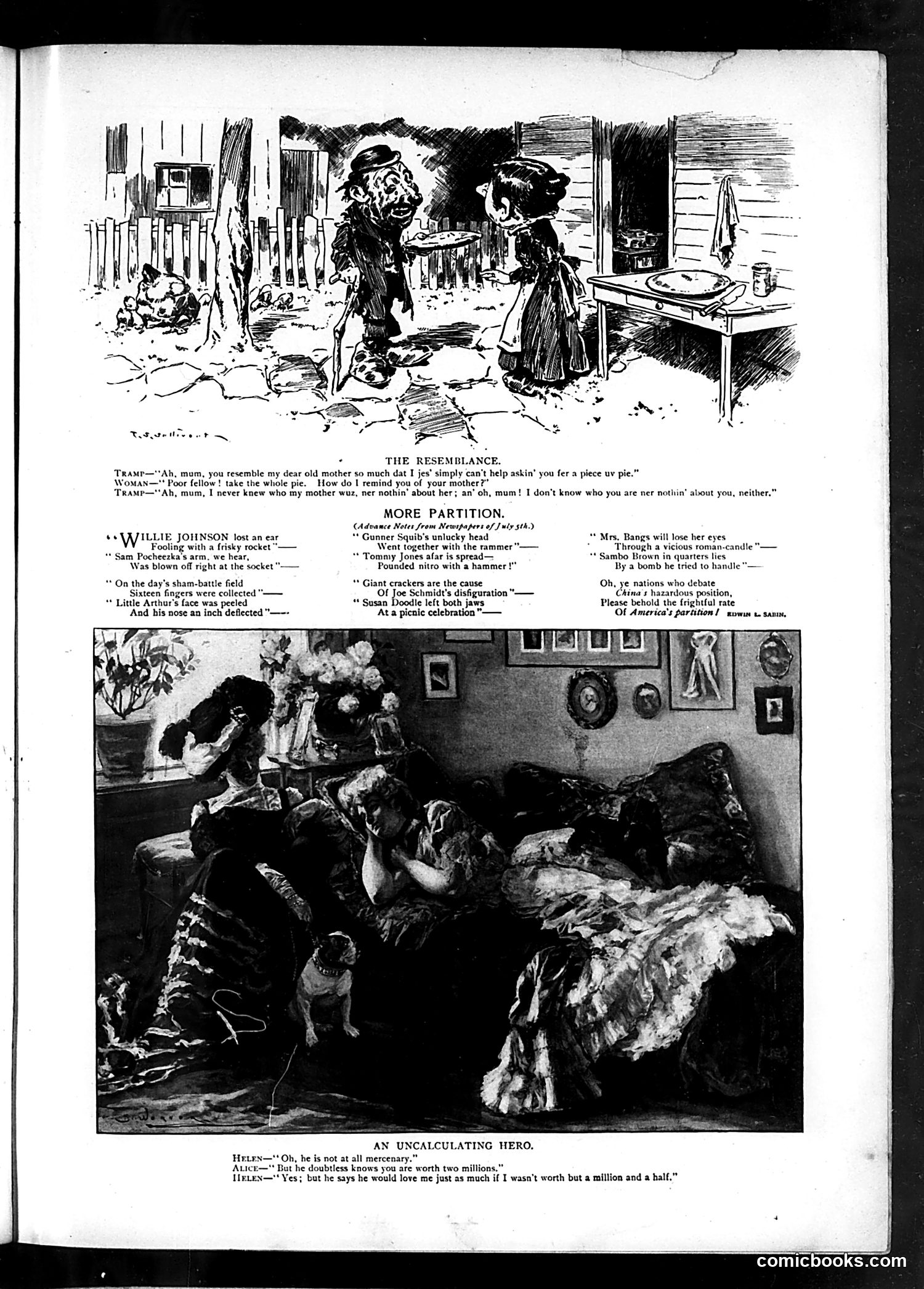
The page contains three distinct pieces of satire: **"The Resemblance"** (top sketch): A comedic dialogue where a vagrant appeals to a woman for pie by claiming she resembles his unknown mother. The joke's irony: he knows nothing about either woman, making the "resemblance" entirely fabricated flattery. **"More Partition"** (middle section): Dark humor about Fourth of July fireworks injuries. The "advance notes" satirize newspapers' predictable coverage of holiday accidents—listing anticipated casualties from firecrackers, rockets, and explosives with named victims. The closing lines mock political debates over "China's hazardous position" and "America's partition," suggesting American political divisions are as reckless as celebrating with dangerous explosives. **"An Uncalculating Hero"** (bottom photograph): Satire of romance and materialism. A woman claims her suitor isn't mercenary, yet he'd accept marrying her for only "a million and a half" instead of two million—mocking both his supposed idealism and the wealthy woman's self-deception about his motivations. All pieces employ irony to critique human nature and social pretense.
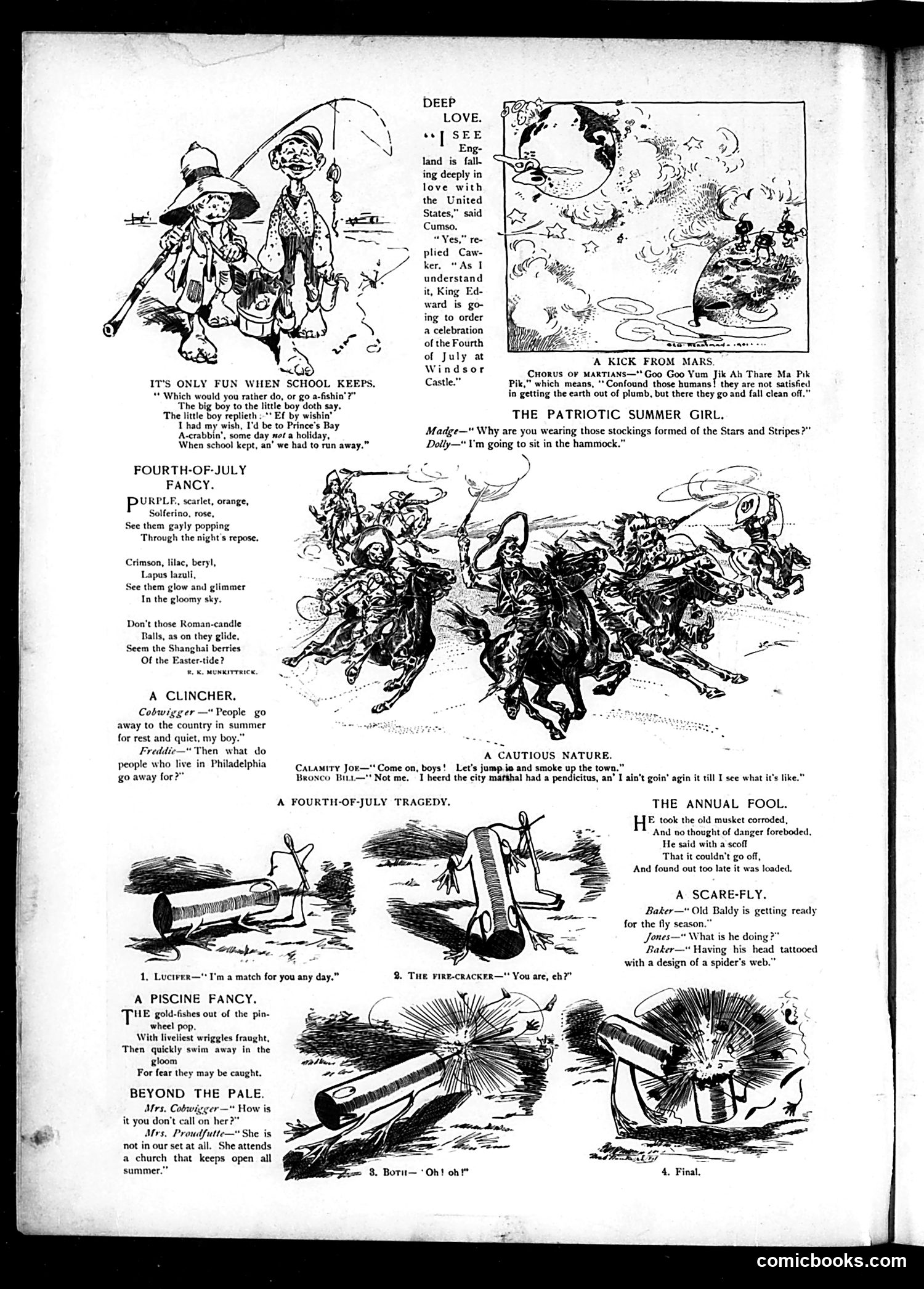
This page from Judge magazine (date unclear from image) contains multiple satirical cartoons and humorous pieces typical of early 20th-century American humor: **"Deep Love"** jokes about England and America growing closer—likely referencing Anglo-American diplomatic relations of the era. King Edward's mentioned Fourth of July celebration at Windsor Castle suggests warmth between nations. **Fourth of July content** dominates: cartoons mock holiday mishaps (a firecracker tragedy), patriotic affectation (a girl wearing stars-and-stripes stockings), and holiday foolishness (a corroded musket accident). **Social satire** appears in brief exchanges mocking Philadelphia residents, class distinctions ("She attends a church that keeps open all summer"), and rustic dialect humor ("I ain't goin' agin it"). **Martian cartoon** appears to reference contemporary fascination with Mars/extraterrestrial life—aliens critique humans for planetary incompetence. The page is primarily humorous verse and jokes rather than political commentary, reflecting Judge's mix of gentle social mockery and absurdist humor.
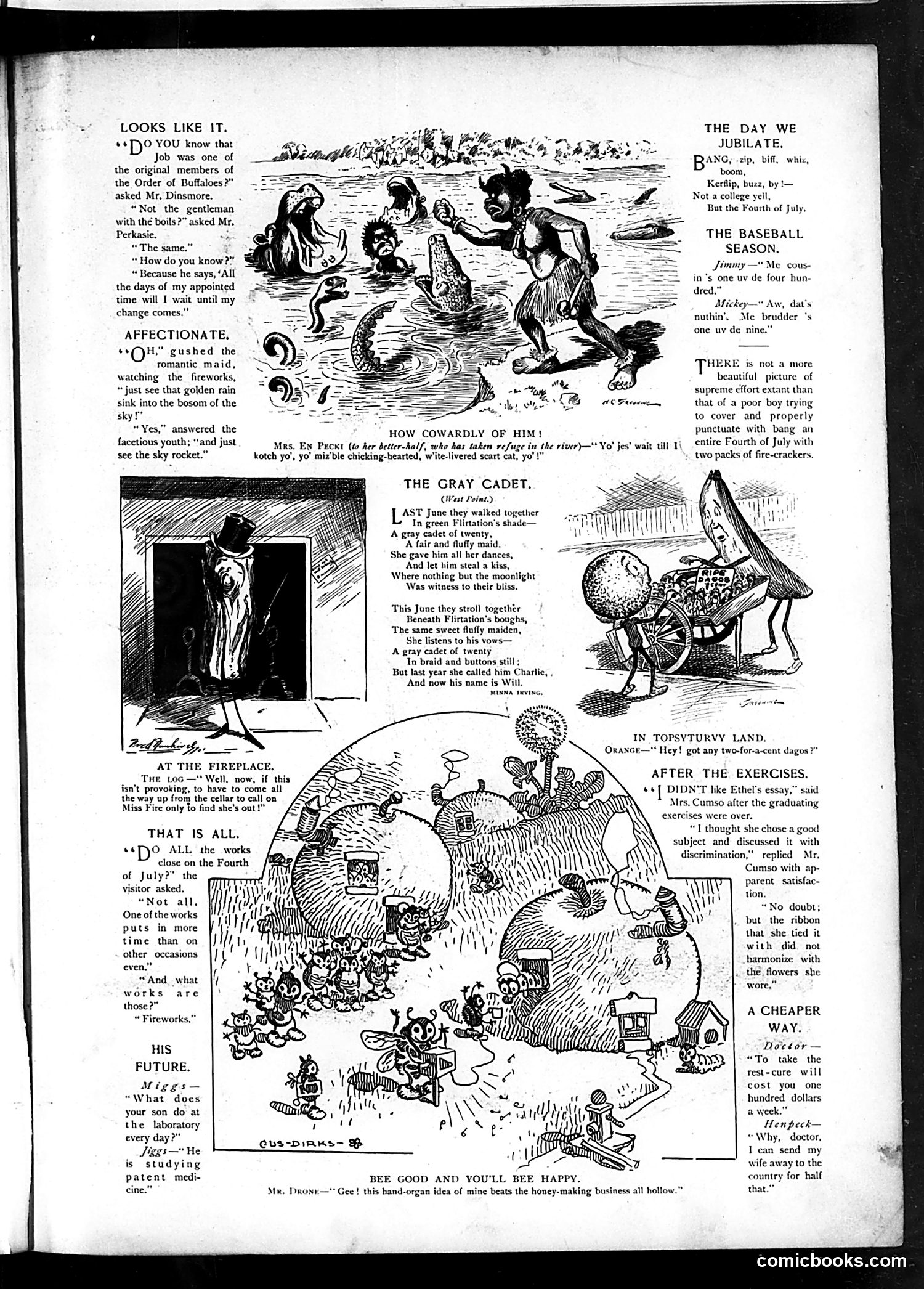
This early 1900s satirical page mixes short humor pieces with social commentary typical of the era. Key sections: **"The Gray Cadet"** satirizes fickle romance—a West Point cadet courts a girl one summer, then returns the next year engaged to someone else. She called him "Charlie" before; now his name is "Will." The joke: women are superficial, caring only about status markers (his uniform). **Fourth of July humor** mocks the holiday's excess—one cartoon celebrates that fireworks factories work overtime even on Independence Day. Another shows a poor boy struggling to properly use two packs of firecrackers to make noise. **"Topsyturvy Land"** uses offensive dialect humor (typical of the period) to create absurdist comedy about racial stereotypes. **Other pieces** include light romantic banter and domestic humor about husbands and wives. The page reflects period attitudes: casual racism, gender stereotypes, and class-based humor that would be considered inappropriate today. The satire targets mostly social conventions and personal foibles rather than politics.
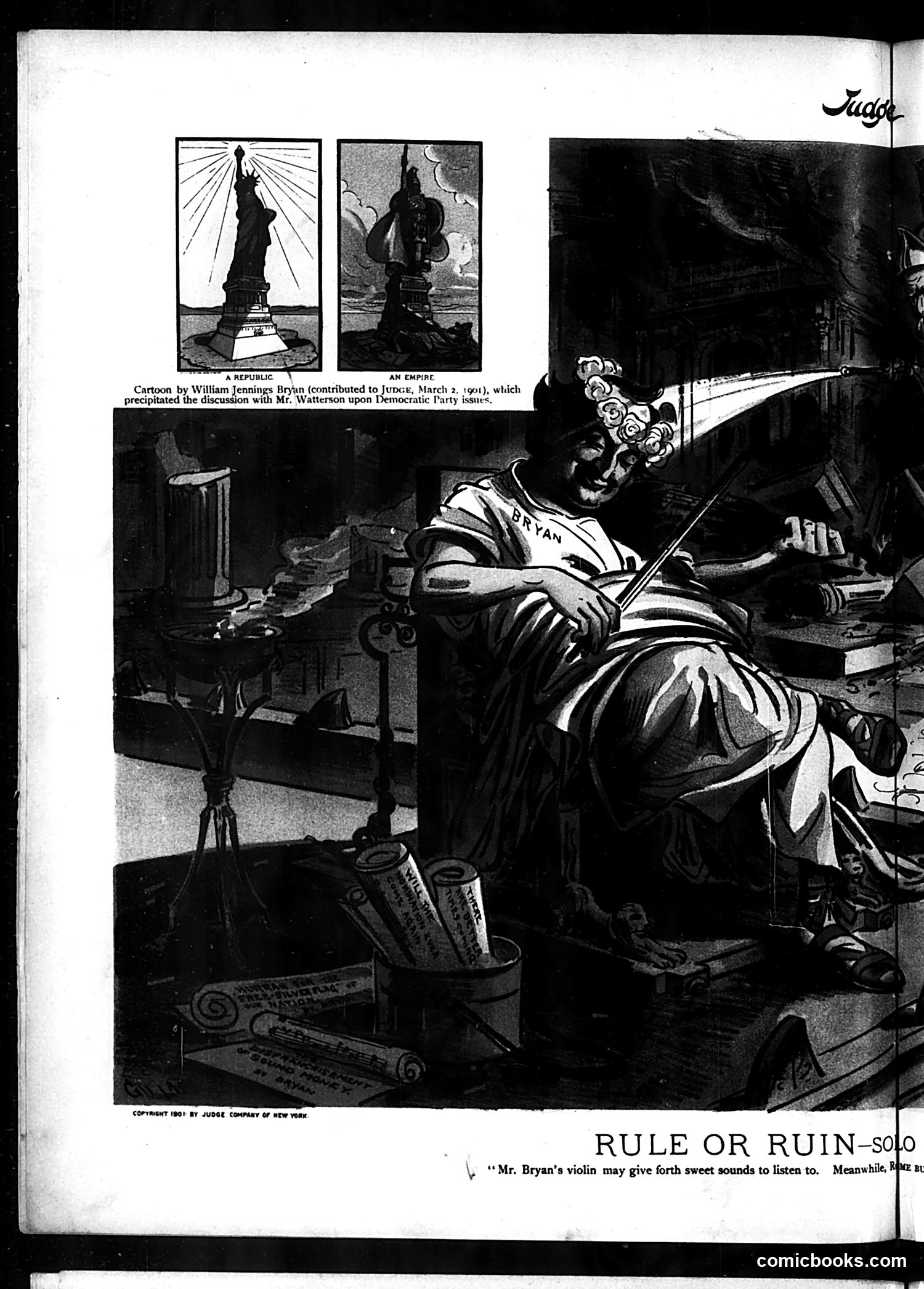
This 1901 Judge cartoon satirizes William Jennings Bryan, the Democratic presidential candidate who lost to McKinley in 1900. The top panels contrast "A Republic" (Statue of Liberty in daylight) with "An Empire" (statue in darkness, suggesting American imperialism following the Spanish-American War). The main illustration shows Bryan as a musician playing violin labeled "BRYAN," depicted as rotund and foolish. The caption's bitter tone—"Mr. Bryan's violin may give forth sweet sounds to listen to. Meanwhile..."—suggests his rhetoric about opposing American empire-building is pleasant but ineffectual or dangerous. The cartoon criticizes Bryan for his anti-imperialist stance while McKinley's expansionist policies dominated. It mocks him as a mere entertainer unable to prevent America's imperial trajectory. The imagery conveys Judge magazine's pro-Republican, pro-expansion editorial position.
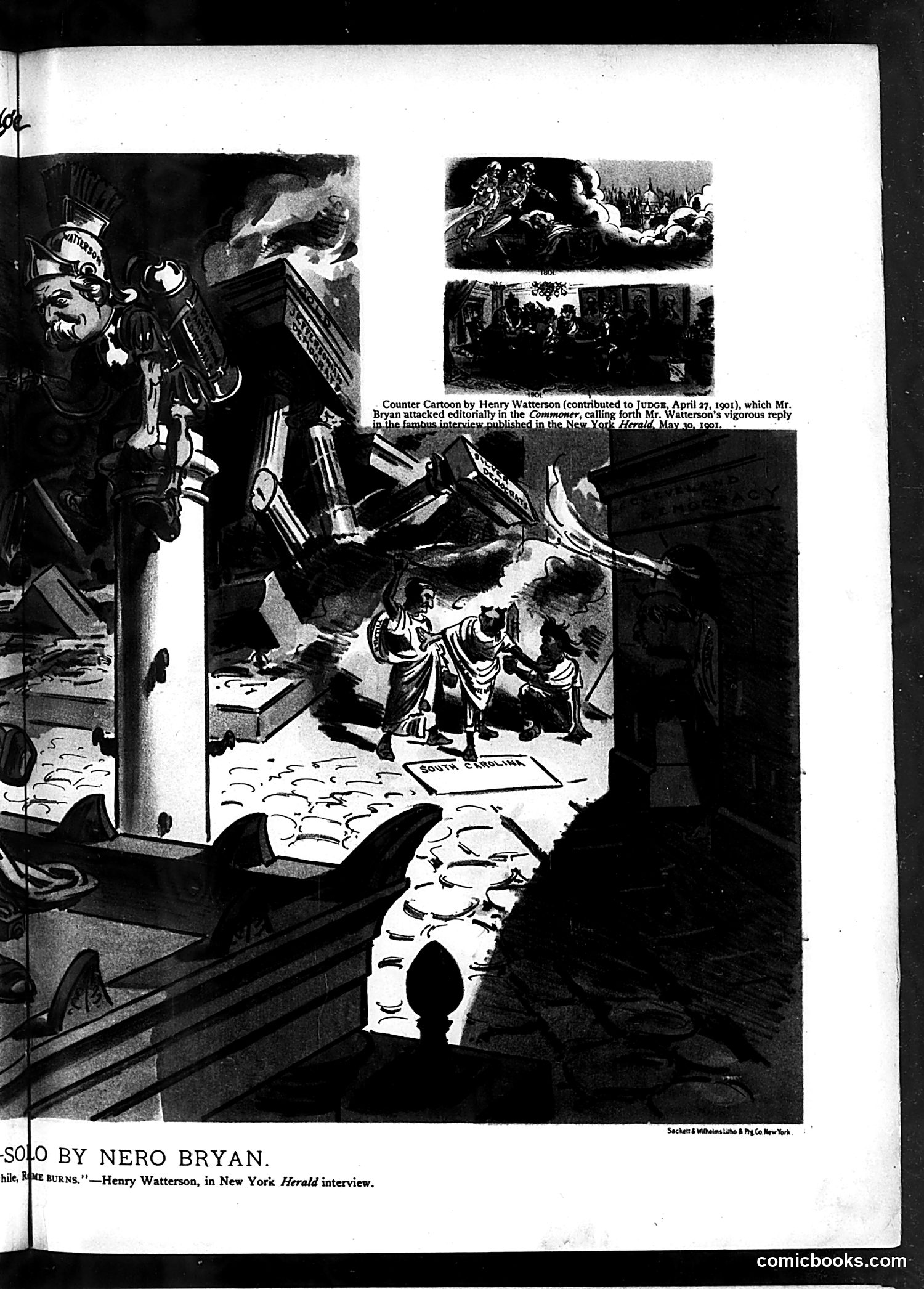
This page shows a political cartoon by Henry Watterson responding to criticism from William Jennings Bryan. The OCR text is fragmentary, but indicates this "Counter Cartoon" was contributed to Judge magazine on April 27, 1901, and prompted Bryan's vigorous reply in the Commoner (his publication). The cartoon appears to depict figures in classical/allegorical style, though specific identities are unclear from the image quality. The reference to "Nero Bryan" in the caption suggests Watterson was comparing Bryan unfavorably to the Roman emperor Nero—a harsh political insult. The quoted line about "burns" likely references caustic criticism exchanged between these political figures during the post-1900 election period when Bryan remained a prominent Democratic voice.
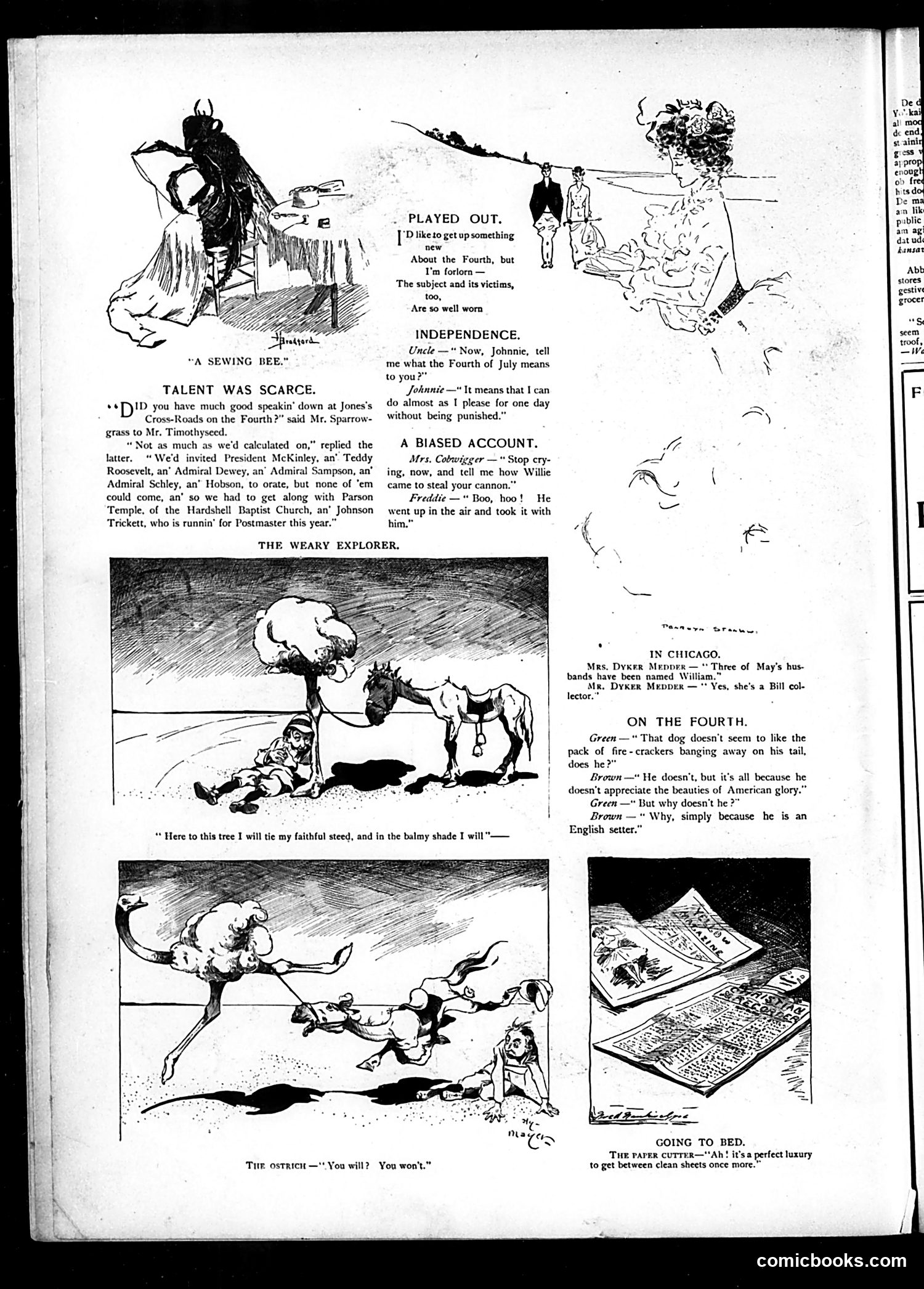
This page satirizes American Independence Day celebrations around 1900 (the McKinley administration era). **"Played Out"** mocks the exhausted state of Fourth of July rhetoric—the editorial voice admits the holiday's themes are worn thin. **"Talent Was Scarce"** jokes that a rural Fourth of July celebration invited major political figures (President McKinley, Teddy Roosevelt, Admirals Dewey and Sampson, Hobson) but had to settle for local clergy and a postmaster candidate instead—satirizing both rural aspirations and political unavailability. **Other jokes** mock children's understanding of Independence Day (freedom to misbehave), marriage ("Bill collector"), and national identity (an English dog dislikes American fireworks). **"The Weary Explorer"** and "Going to Bed"** offer unrelated satirical vignettes about exhaustion and domestic comfort. The cartoons criticize how Fourth of July celebrations had become predictable civic rituals, while poking fun at American pretensions and character stereotypes.
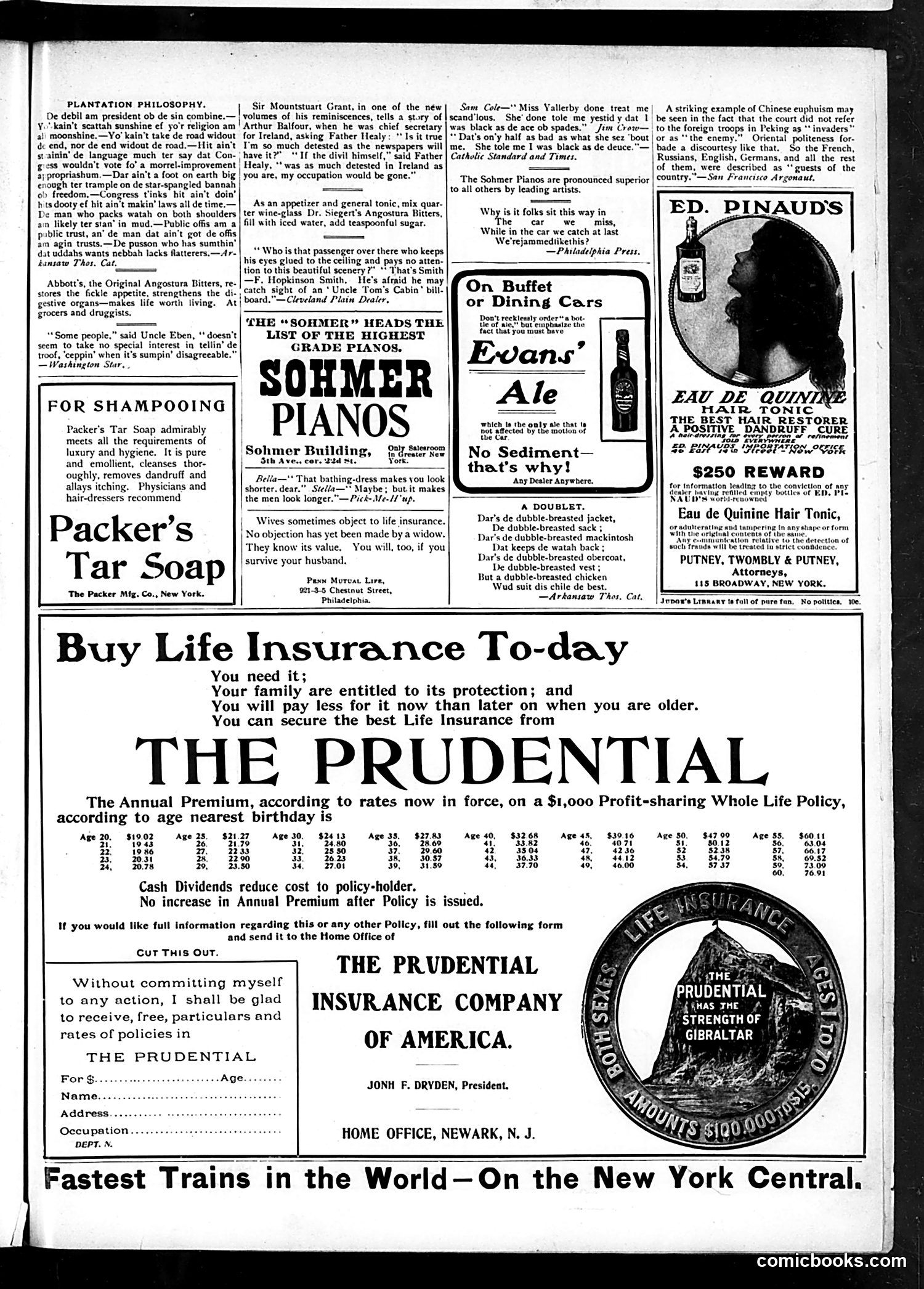
This is primarily an **advertising page** from Judge magazine, not a political cartoon page. The dominant content consists of period advertisements for products like Packer's Tar Soap, Sohmer Pianos, Evans' Ale, and The Prudential Insurance Company. The only satirical content appears in scattered **"Plantation Philosophy" columns** and brief humorous items. These feature dialect humor attributed to "Uncle Eben" and "Arkansaw Thos. Cat"—stock characters using stereotypical African American vernacular common to era satire. The jokes are mild observations about human nature (e.g., "Public offis am a public trust"). A brief anecdote mocks Arthur Balfour's unpopularity as chief secretary for Ireland, comparing him unfavorably to the devil. The page reflects Judge's mix of genteel satire, product promotion, and period-typical racial caricature rather than focused political commentary.
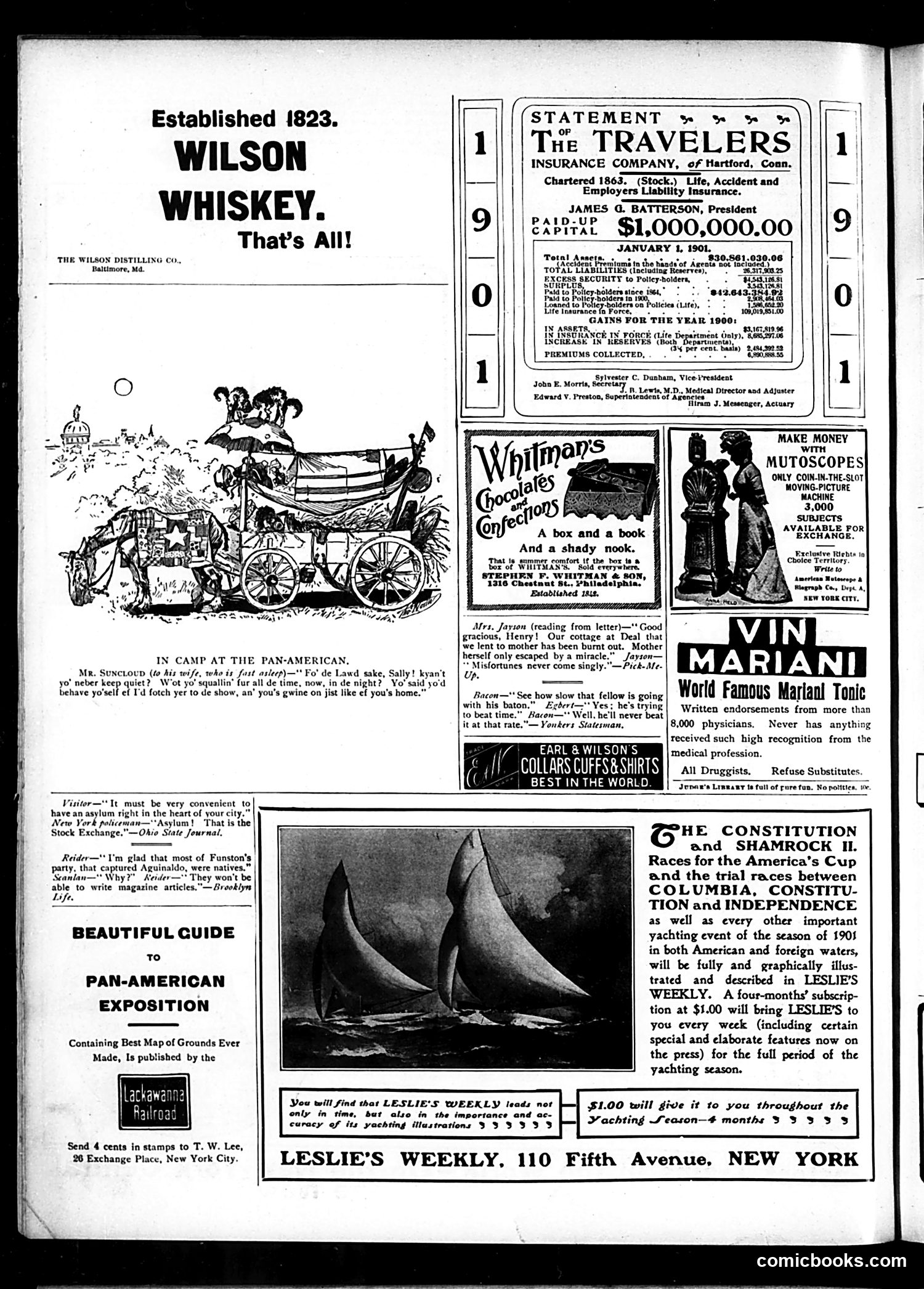
This page is primarily **advertising and announcements** rather than editorial cartoons, though it contains several short humorous vignettes. The notable comic content includes: **"In Camp at the Pan-American"**: A dialect-heavy joke about an African American couple at the 1901 Pan-American Exposition, with stereotypical speech patterns typical of early 1900s "humor." **Short jokes** about: - A cottage fire ("misfortunes never come singly") - Stock Exchange as an "asylum" - General Funston (military figure) being unable to write magazine articles **Major advertisements** include Wilson Whiskey, The Travelers Insurance Company financial statement, Whitman's Chocolates, Mutoscopes (early motion picture devices), Vin Mariani tonic, and Leslie's Weekly (which promotes coverage of the 1901 America's Cup yacht races). The page reflects **turn-of-century advertising aesthetics** and humor conventions that relied heavily on ethnic stereotypes and contemporary references (Pan-American Exposition, General Funston's military campaigns) now requiring historical context to understand.
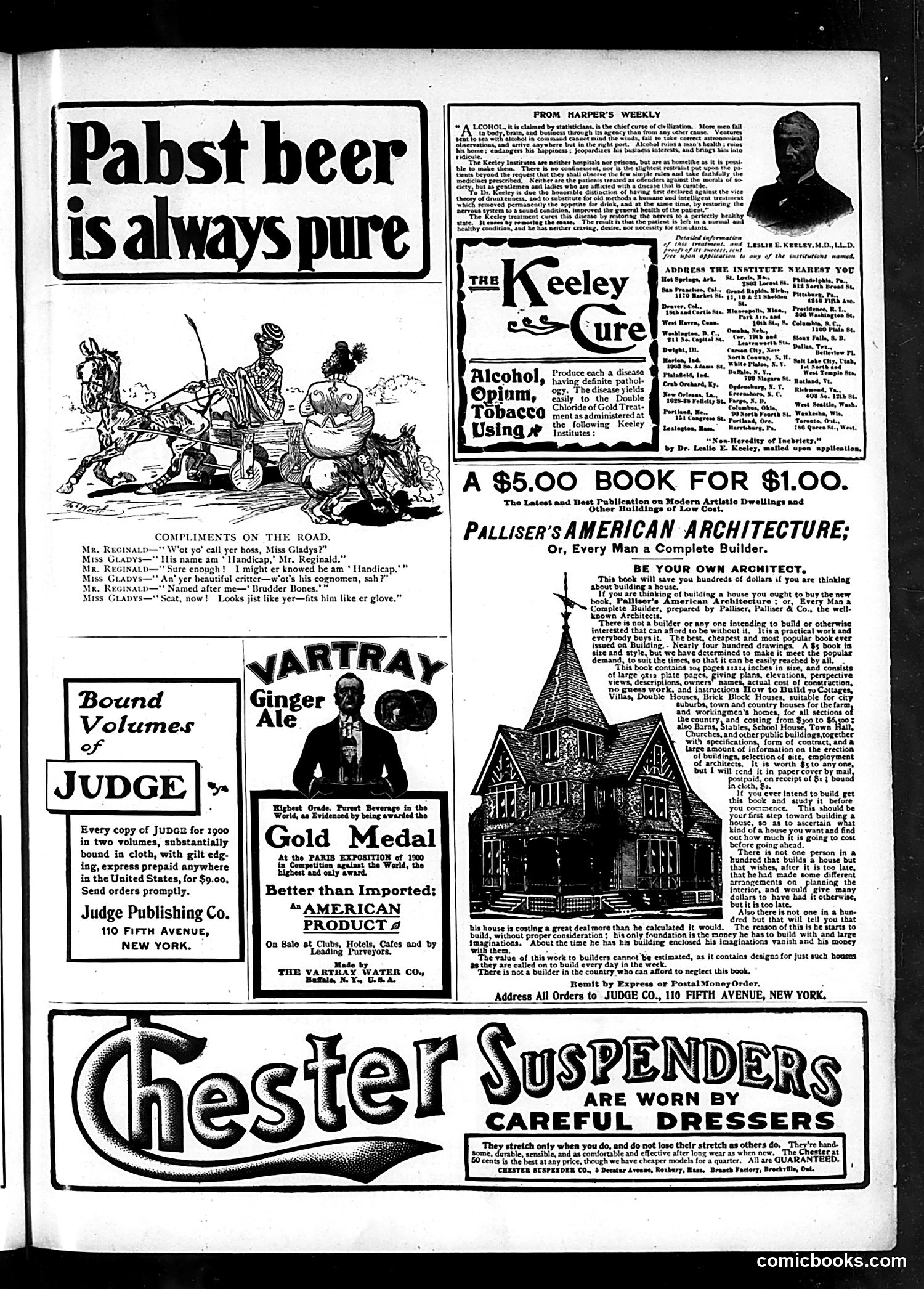
This page is primarily **advertising**, typical of late-19th/early-20th century magazines. The main satirical content is the small cartoon "Compliments on the Road," depicting two figures (appearing to be from the American South, based on dialect) discussing horses named "Handicap" and "Brother Bones." The joke plays on racial stereotypes and regional speech patterns common to period satire—the humor relies on phonetic dialect and supposed witticisms. The bulk of the page features product advertisements: Pabst beer emphasizing purity, the Keeley Institute (treating alcohol and drug addiction), Judge magazine bound volumes, Vartray Ginger Ale, Palliser's architecture book, and Chester Suspenders. A Harper's Weekly excerpt promotes Dr. Leslie Keeley's addiction treatment using "Double Chloride of Gold," reflecting period medical claims. These ads reveal contemporary consumer concerns and dubious "cures" now recognized as pseudoscience. The page reflects American commercial and social attitudes of approximately 1900.
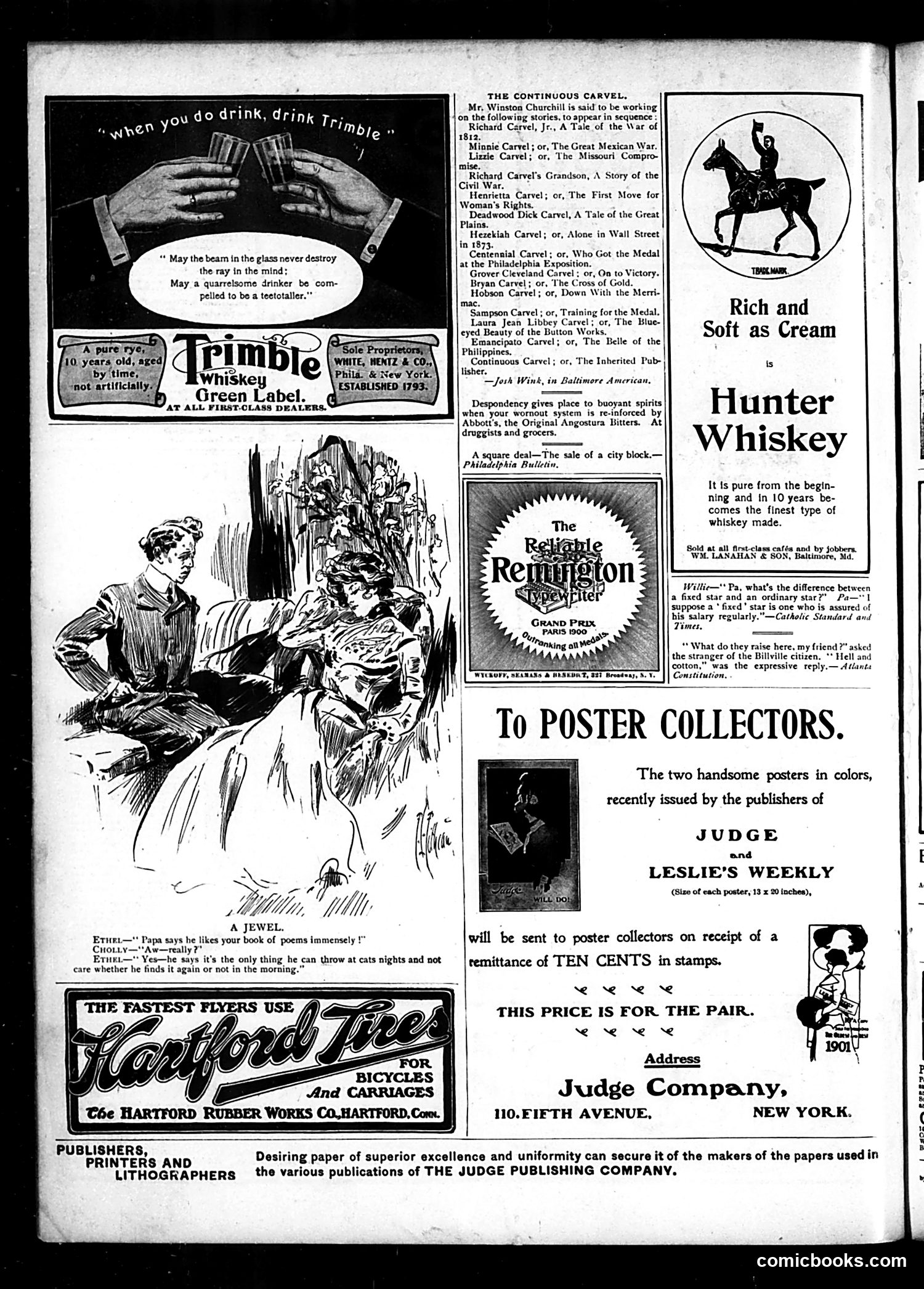
This page contains several distinct satirical pieces: **"The Continuous Carvel"** mocks novelist Winston Churchill by listing an absurdly endless series of sequels to his novel *Richard Carvel*, each tied to major American historical events (War of 1812, Mexican War, Civil War, Wall Street crash, etc.). The satire suggests Churchill is milking the same character formula for every conceivable American historical moment—a commentary on formulaic, commercially-driven writing. **"A Jewel"** is a brief joke where a father praises the son's poetry book—not for its literary merit, but because it's the only object he can throw at cats at night that won't cause permanent damage. It's absurdist humor mocking bad poetry. The remainder is **advertising** for whiskeys, typewriters, bicycle tires, and a poster collection offer. The page reflects Judge magazine's typical mix: sharp literary satire targeting contemporary popular authors, domestic humor, and commercial advertisements.
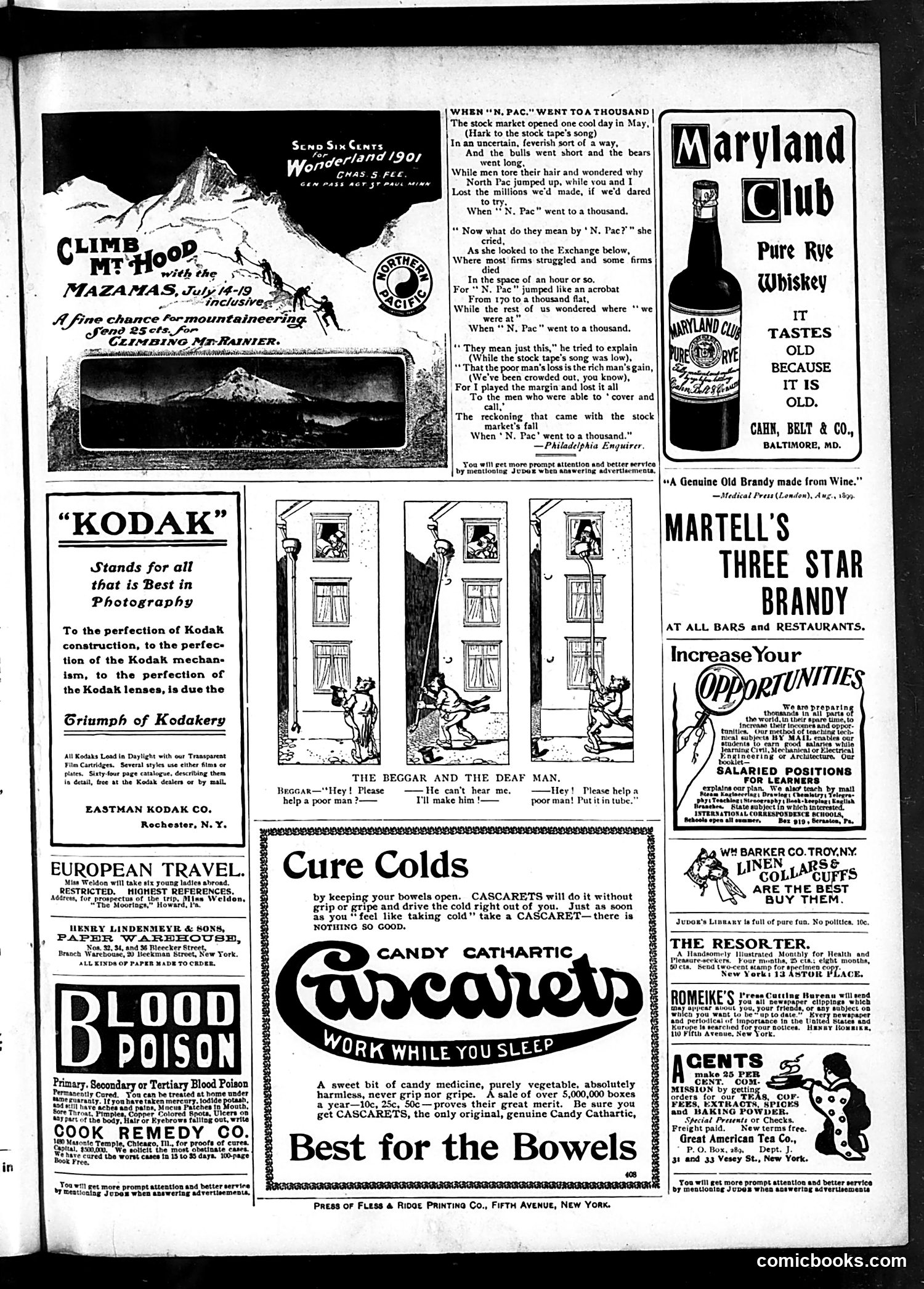
This page primarily contains **advertisements and light humor** rather than political satire. The main content is: **"When 'N. Pac.' Went to a Thousand"** — a verse about Northern Pacific Railroad stock spiking dramatically in May 1901. The poem satirizes the **stock market's volatility and social inequality**: while wealthy speculators profit from margin trading and price swings, ordinary working people ("the poor man") lose their savings. The "rich man's gain" comes directly from common investors being "crowded out." The accompanying cartoon **"The Beggar and the Deaf Man"** shows a deaf man who cannot hear a beggar's plea—a straightforward sight gag about communication failure, not political commentary. The rest of the page is typical early-1900s advertising: Kodak cameras, European travel, blood poison cures, Cascaret laxatives, whiskey, and brandy. The ads reflect period medical quackery and consumerism typical of Judge's revenue model. **Context: Northern Pacific's 1901 stock surge was a real financial event**, making the satire timely for contemporary readers.
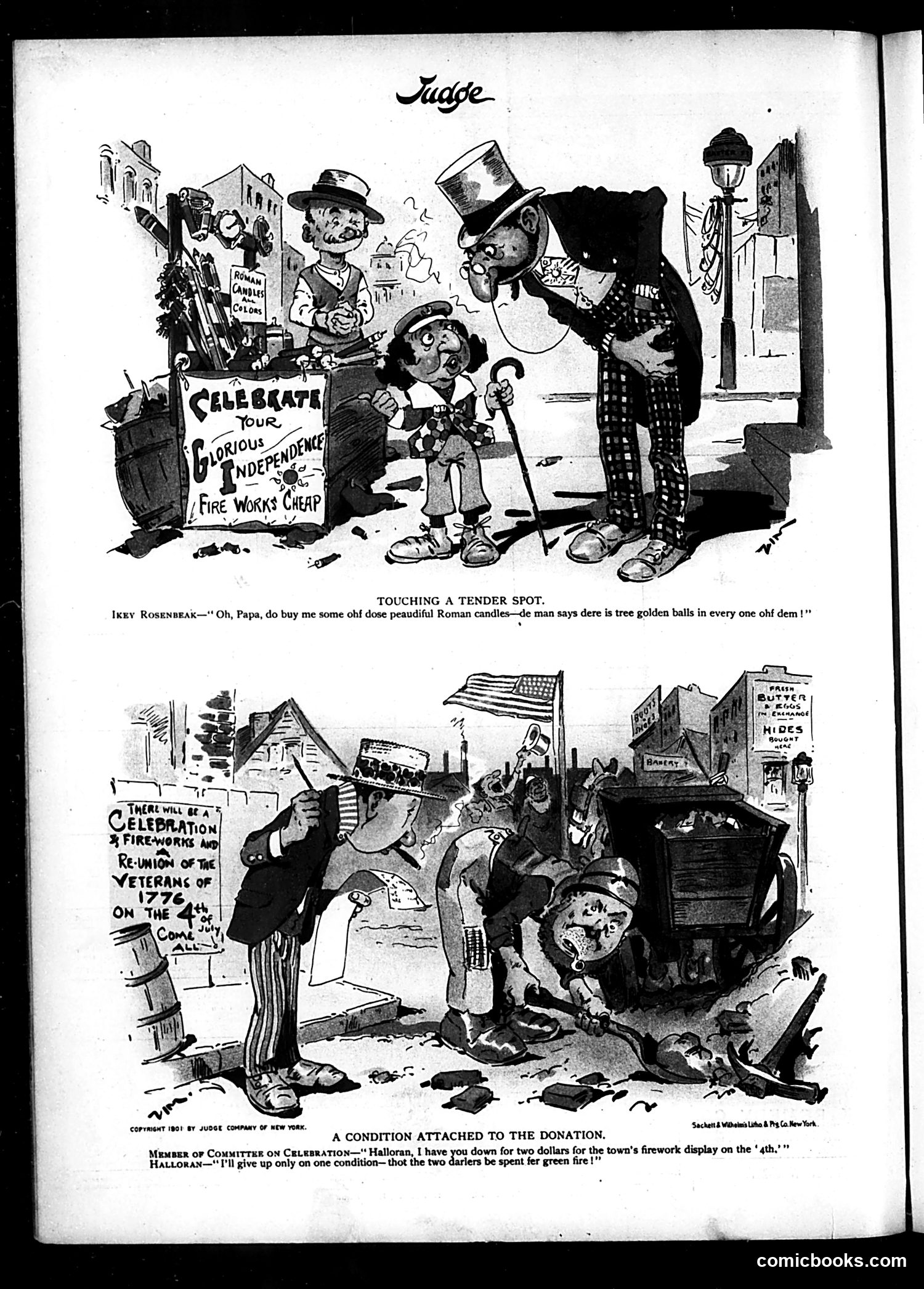
These two cartoons satirize Fourth of July Independence Day celebrations and ethnic stereotypes circa 1901. **Top cartoon ("Touching a Tender Spot"):** A child with a Yiddish accent asks his father to buy "Roman candles" containing "golden balls"—a crude reference to Jewish people and financial stereotypes. The joke relies on antisemitic caricature: the exaggerated features and dialect mock Jewish immigrants. **Bottom cartoon ("A Condition Attached to the Donation"):** A man named Halloran (Irish surname) donates two dollars for the town's Fourth of July fireworks but demands the money be spent on "green fire"—a reference to Irish identity and the color green. The satire mocks how ethnic communities use patriotic celebrations to assert their own cultural identity while nominally celebrating American independence. Both cartoons use ethnic caricature and dialect to mock immigrant communities' relationship to American patriotism, reflecting the xenophobic attitudes common in early-20th-century American humor magazines.