
A complete issue · 21 pages · 1901
Judge — June 29, 1901
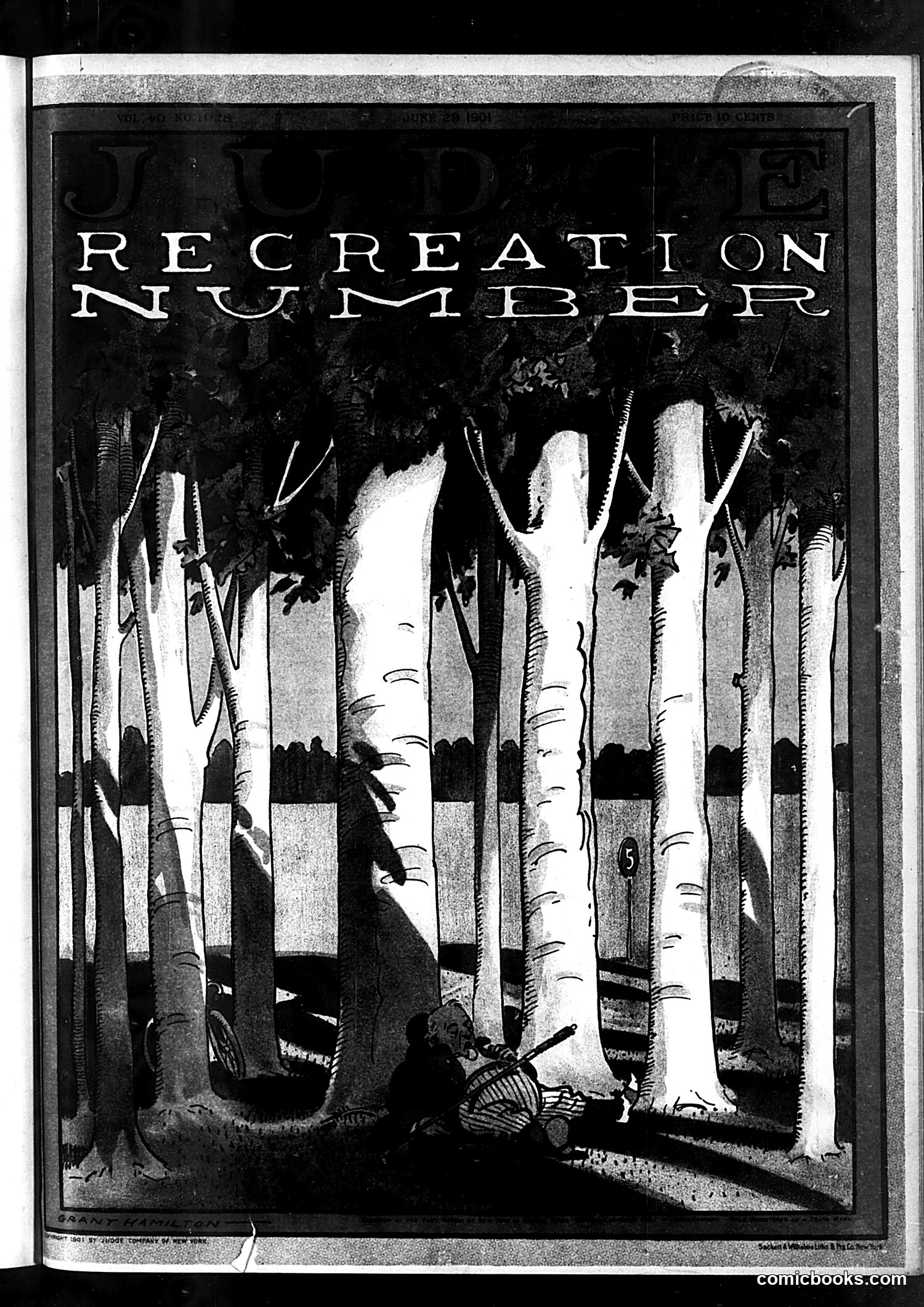
This appears to be a cover or title page from Judge magazine featuring an illustration of tall trees with human figures dwarfed beneath them. The image carries the heading "RECREATION NUMBER," suggesting this is a special issue focused on leisure and outdoor activities. The artistic style—with elongated white tree trunks dominating the composition and tiny human silhouettes for scale—emphasizes the grandeur and majesty of nature. This likely reflects early 20th-century Progressive Era enthusiasm for conservation, national parks, and outdoor recreation as beneficial to public health and morality. The satire or specific political commentary, if any, is unclear from the image alone. Without additional OCR text or context, the intended joke or criticism remains ambiguous.
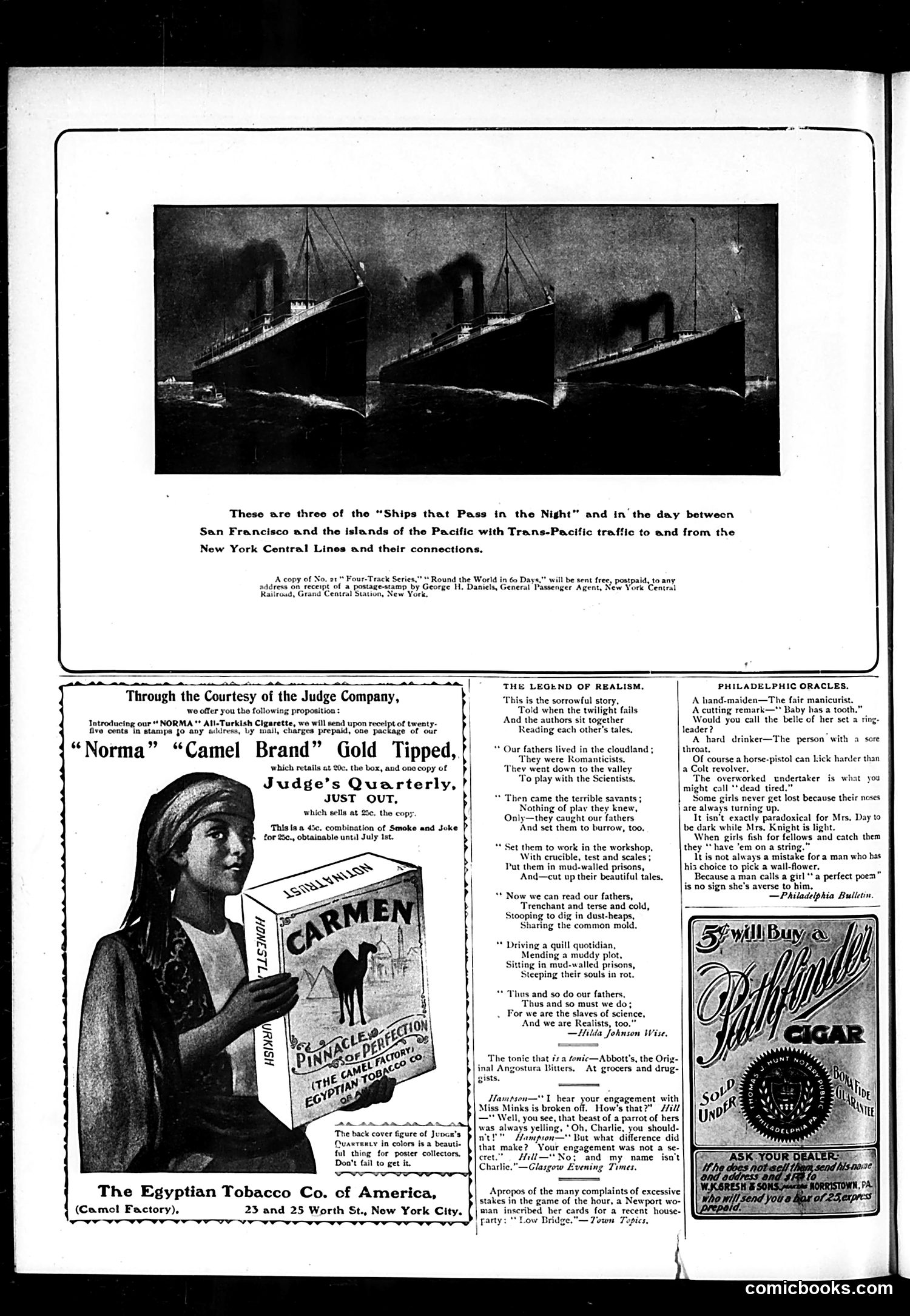
**Top Image:** Three steamships photographed in sequence, captioned as vessels operating between San Francisco and the Pacific islands with New York Central Lines connections. This appears to be promotional material rather than satire. **Main Content:** The page is predominantly **advertising**, not political satire. It features: 1. **Camel Cigarettes ad** - A woman holding a Judge's Quarterly magazine and a Camel box, advertising "Norma" and "Camel Brand" cigarettes as "mild, stamped, [and] piped." 2. **Tobacco Company notice** - Egyptian Tobacco Co. of America promoting their Camel Factory product. 3. **Poetry/Literary content** - Sections titled "The Legend of Realism" and "Philadelphia Oracles" appear to be humorous verse rather than political commentary. The page reflects early 20th-century magazine advertising practices and literary humor rather than political cartoons.
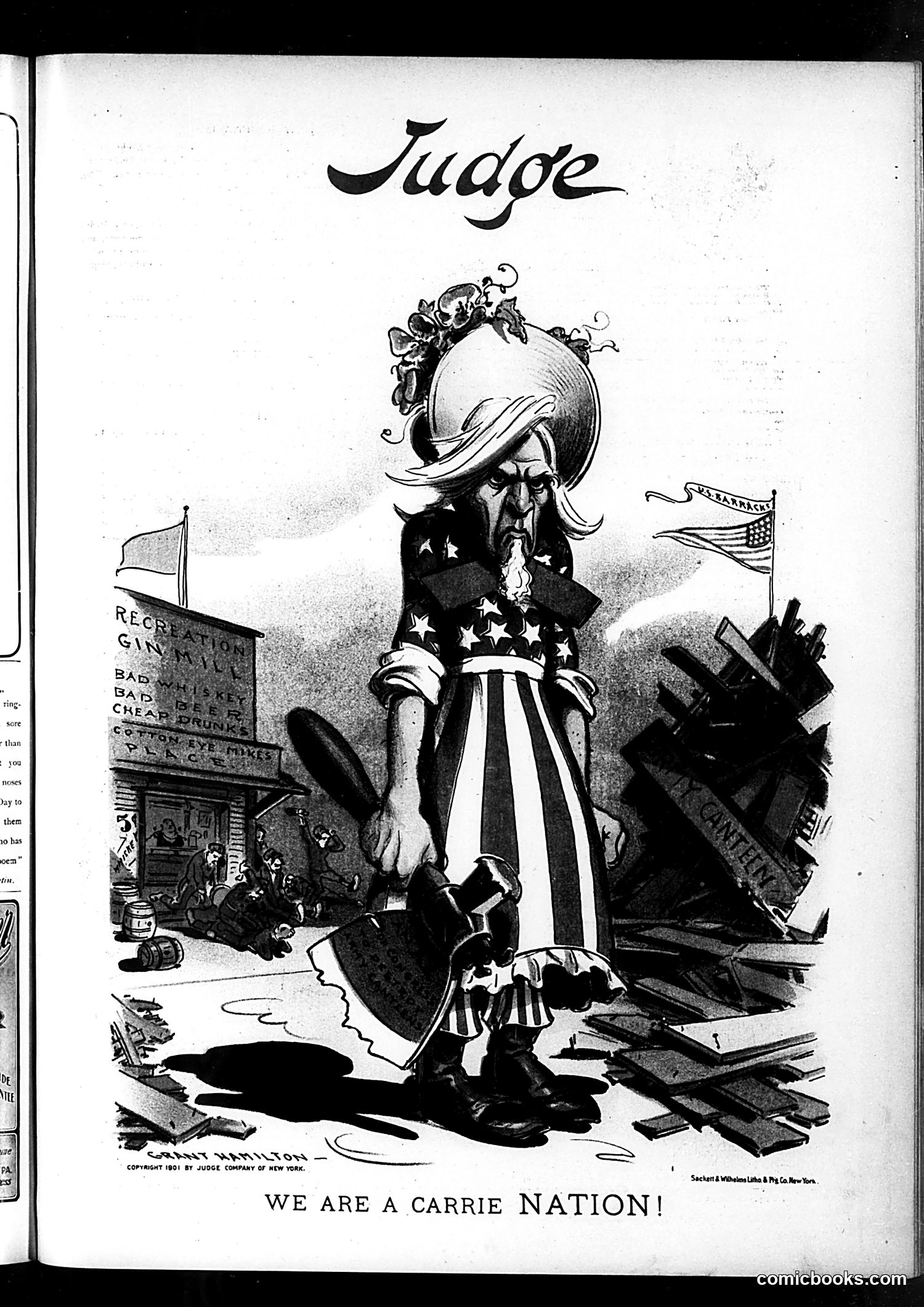
This Judge magazine cartoon satirizes **Carrie Nation**, the prominent temperance activist known for her violent saloon-smashing campaigns in the early 1900s. The figure wears an exaggerated costume with a large hat adorned with grapes/vines and patriotic symbols, dressed as "Uncle Sam" in stars and stripes. The joke plays on Nation's name: "We are a Carrie Nation"—suggesting America itself has become characterized by her zealous, destructive approach. The storefront on the left displays "Recreation" and alcohol-related products being demolished, while wreckage surrounds the figure, illustrating the chaos of prohibition efforts. The cartoon mocks both Nation's extreme methods and Americans who share her zealousness, presenting her as a destructive force disguised in patriotic garb.
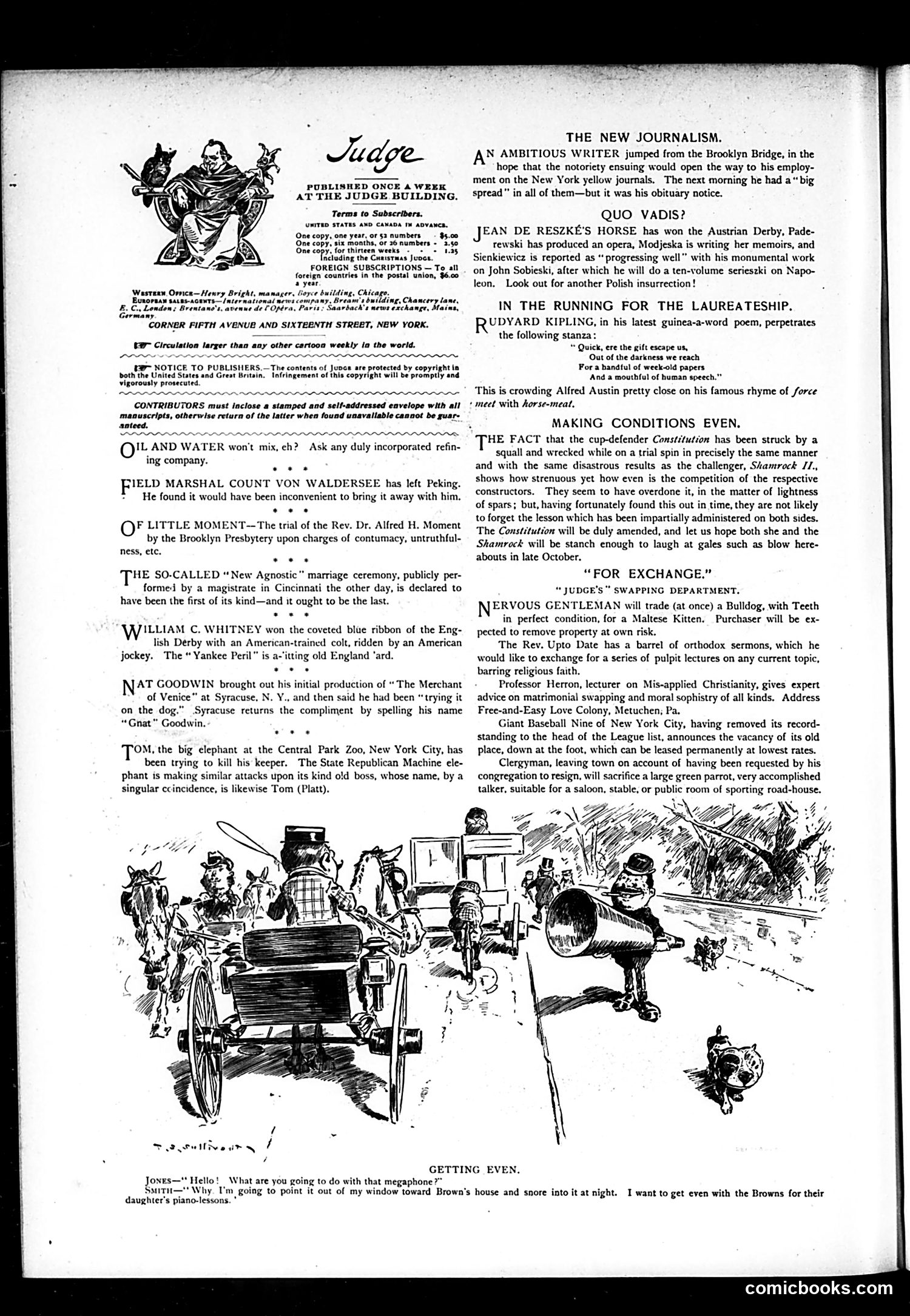
This page contains satirical commentary and a cartoon titled "Getting Even." The main illustrated piece depicts someone ("Jones") planning to paint a megaphone at a neighbor's window to annoy them in retaliation for the neighbor's daughter's piano lessons disturbing Jones's household. The joke reflects a common urban frustration: noise complaints between neighbors. It satirizes the cycle of escalating petty revenge—Jones wants to "get even" by creating even louder noise directed at the Browns' house. The upper portion includes brief humorous items about various topics (horses, ship names, religious debates), typical of Judge's miscellaneous satirical content. The cartoon mocks how everyday disputes can devolve into increasingly absurd retaliatory schemes.
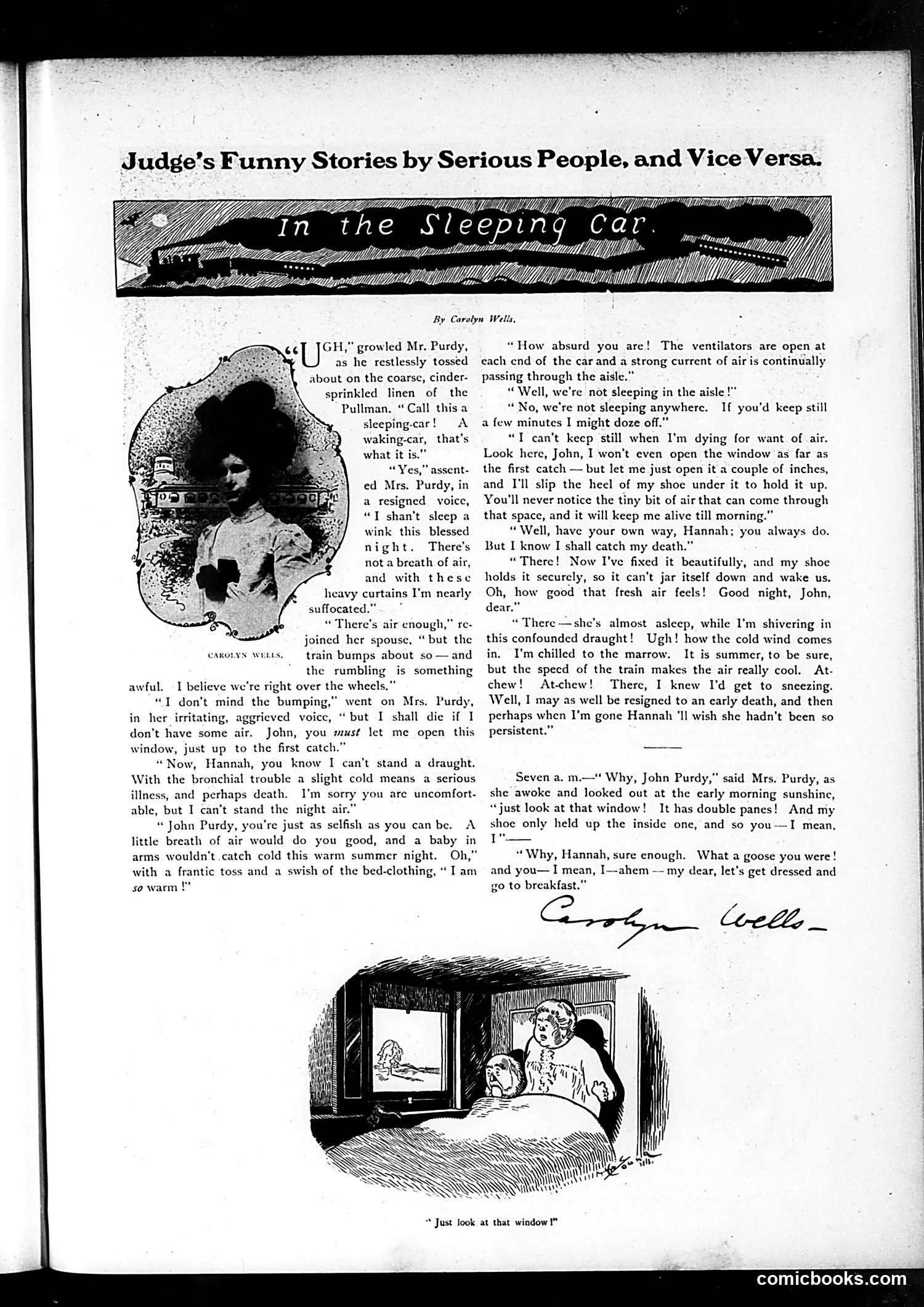
This humorous domestic sketch depicts a married couple's argument during a train journey—a relatable scenario for Judge's early 20th-century readers accustomed to rail travel. Mr. Purdy refuses to open the window, citing his fragile health and fear of drafts causing bronchitis. Mrs. Purdy, desperate for air in the stuffy Pullman car, eventually props open the window with her shoe, allowing air through only the inner pane. The satire targets marital dynamics and hypochondria: Purdy's exaggerated health anxieties contrast with his wife's practical needs. The joke's payoff comes at dawn when they discover the window has a double pane—the open inner pane let air through harmlessly, rendering his all-night suffering pointless. The cartoon mocks both masculine anxiety about trivial ailments and the comedy of domestic compromise, a typical Judge theme.
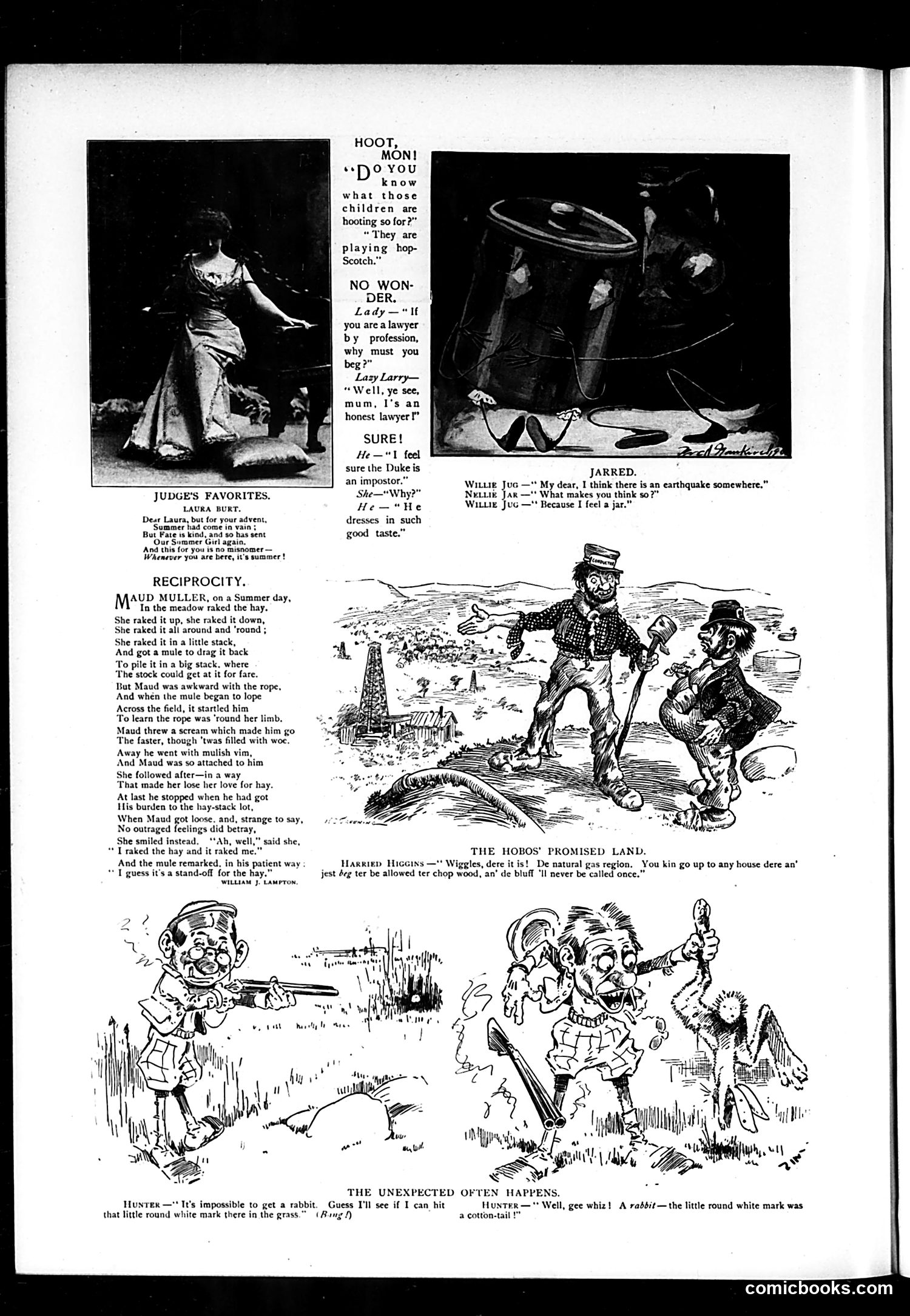
This page contains several short humorous pieces typical of late 19th/early 20th-century American satire: **"Judge's Favorites"** and **"Reciprocity"** are light domestic humor featuring wordplay and physical comedy—a woman gets dragged by a mule while raking hay, leading to her quip about mutual consequence. **"The Hobos' Promised Land"** satirizes natural gas regions (likely Pennsylvania/Ohio boom areas), depicting homeless men discussing how they can exploit wealthy homeowners by offering to chop wood, knowing locals won't call their bluff due to social obligation. **"The Unexpected Often Happens"** shows hunters mistaking a rabbit for a golf ball—simple visual gag humor. The page also includes theatrical imagery ("Judge's Favorites" featuring actress Laura Burt) and social commentary on lawyers and class pretension, common Judge targets. Overall, this represents the magazine's mix of domestic comedy, social satire, and visual gags aimed at middle-class readers.
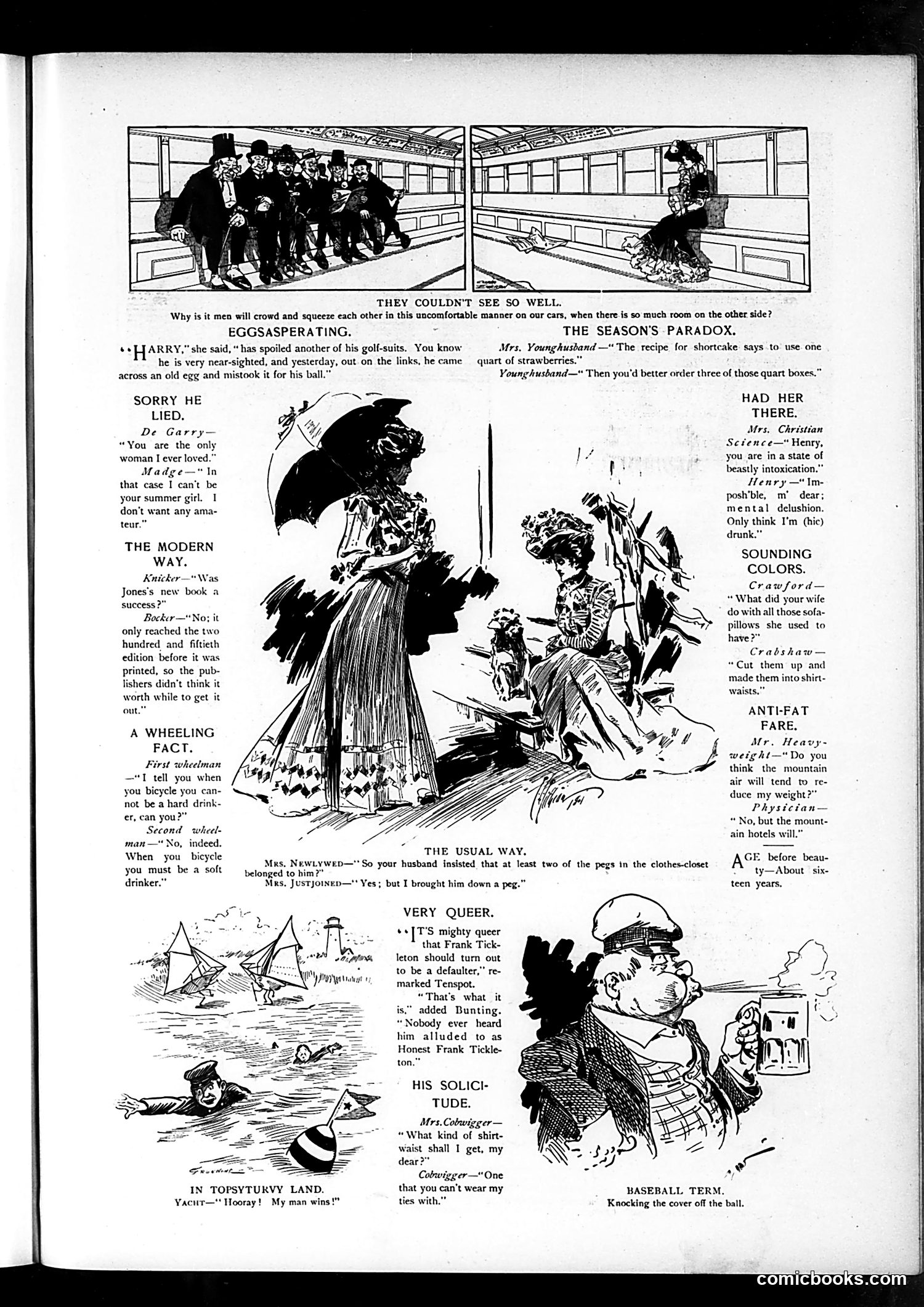
This page contains **multiple unrelated short jokes and cartoons** typical of Judge magazine's format—a collection of brief satirical vignettes rather than a coherent narrative. **Key content:** - **"They Couldn't See So Well"**: Critiques overcrowding on streetcars despite available space elsewhere - **"Eggsasperating"**: A near-sighted golfer mistakes an egg for a golf ball—visual humor - **"The Season's Paradox"**: A wife asks for strawberries for shortcake; the husband orders three times the recipe's amount—absurdist domestic humor - **"Sorry He Lied"** and other romantic/marital exchanges: Mock relationship dynamics and deception - **Christian Science reference**: Mocks the religious movement by having an intoxicated man deny drunkenness as "mental delusion" - **Social commentary**: Includes jokes about bicycling, weight-loss treatments, and everyday domestic life The page exemplifies early 20th-century American humor: domestic situations, mild social satire, and gentle mockery of contemporary fads (Christian Science, anti-fat remedies). The tone is lighthearted rather than politically charged.
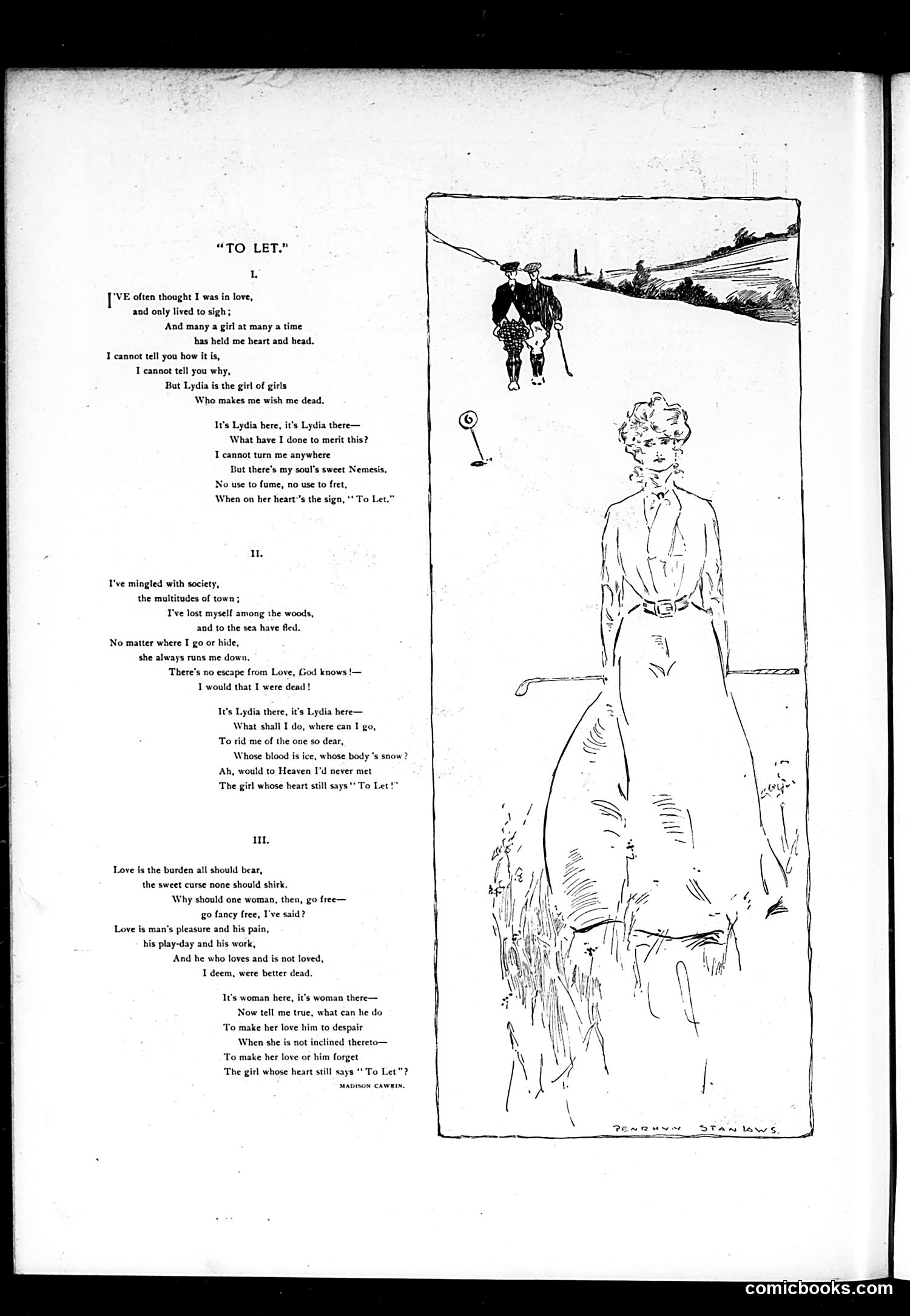
This page combines a three-part romantic poem by Madison Cawein with an illustration depicting unrequited love. The central figure is a woman labeled with the phrase "To Let" (meaning "available for rent"), a property-letting term used satirically here. The poem's satire targets the melodramatic desperation of a lovesick man obsessed with "Lydia," a woman who remains emotionally unavailable ("her heart's the sign, 'To Let'"). Each section escalates the complaint—from personal anguish, to universal entrapment, to philosophical questioning of whether women should be "free" from love's obligations. The illustration shows the woman as an object of desire—literally standing like property for lease—with her suitor and companion in the landscape above. The satire mocks both the speaker's overwrought suffering and society's tendency to treat women's affections as commodities to be acquired rather than freely given emotions.
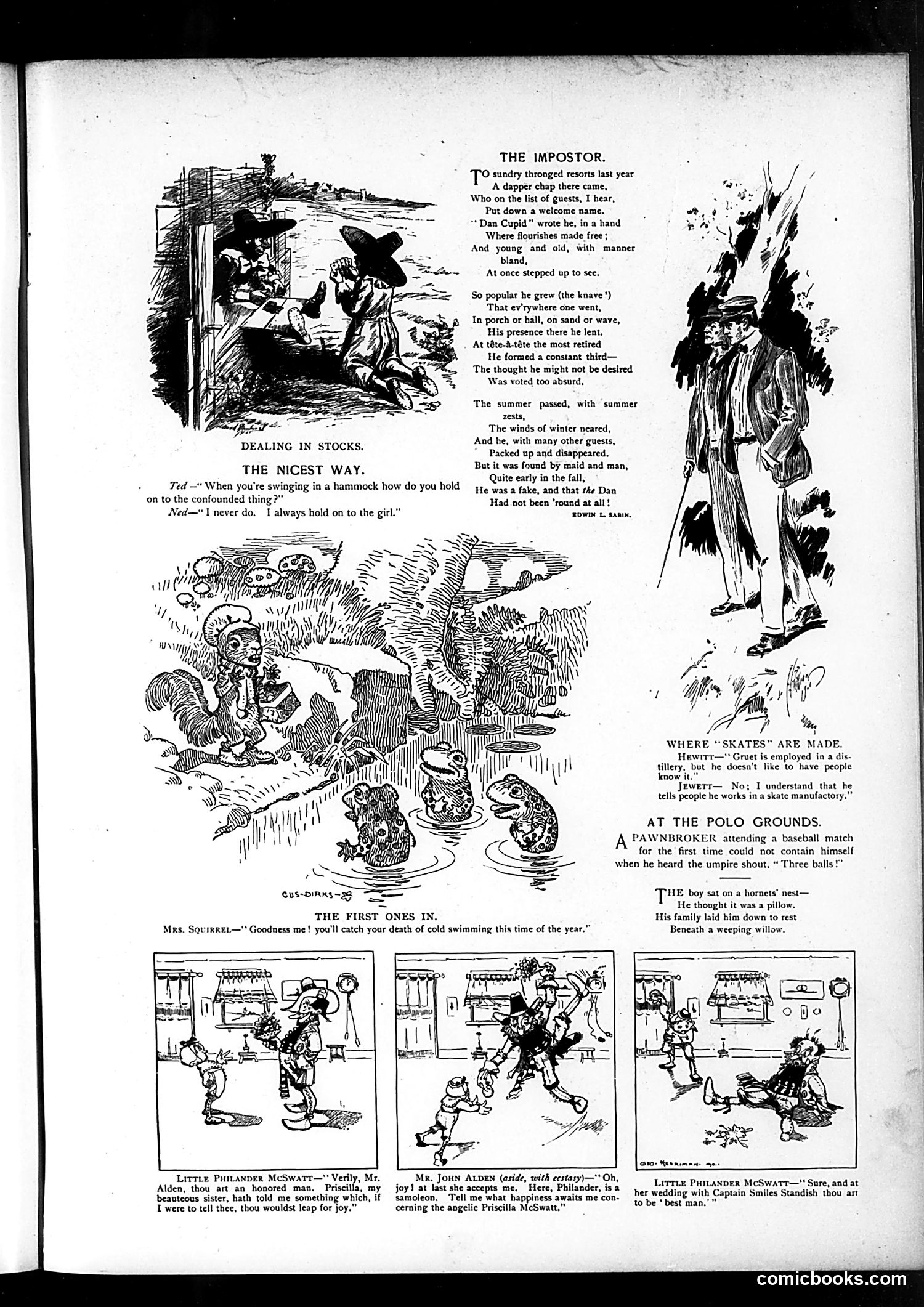
This page contains multiple unrelated satirical pieces typical of Judge's format: **"Dealing in Stocks"** mocks flirtation: a young man admits to holding "the girl" rather than the hammock when swinging—stock romantic banter. **"The Impostor"** is a narrative poem about a man who impersonated "Dan Cupid" (personified love/romance) at social gatherings all summer, ingratiating himself everywhere, then disappeared in fall—exposed as a fraud who was never actually present. **"Where Skates Are Made"** is a joke about euphemism: a man tells people he works in a "skate manufactory" rather than admitting he works in a distillery, considering it more respectable. **"At the Polo Grounds"** plays on a pawnbroker's profession: hearing "three balls" (the umpire's call), he excitedly thinks it references the pawnbroker's traditional three-ball symbol. The remaining items are minor social humor, including a Thanksgiving reference to "John Alden" (Pilgrims legend) and a boy sitting on a hornets' nest.
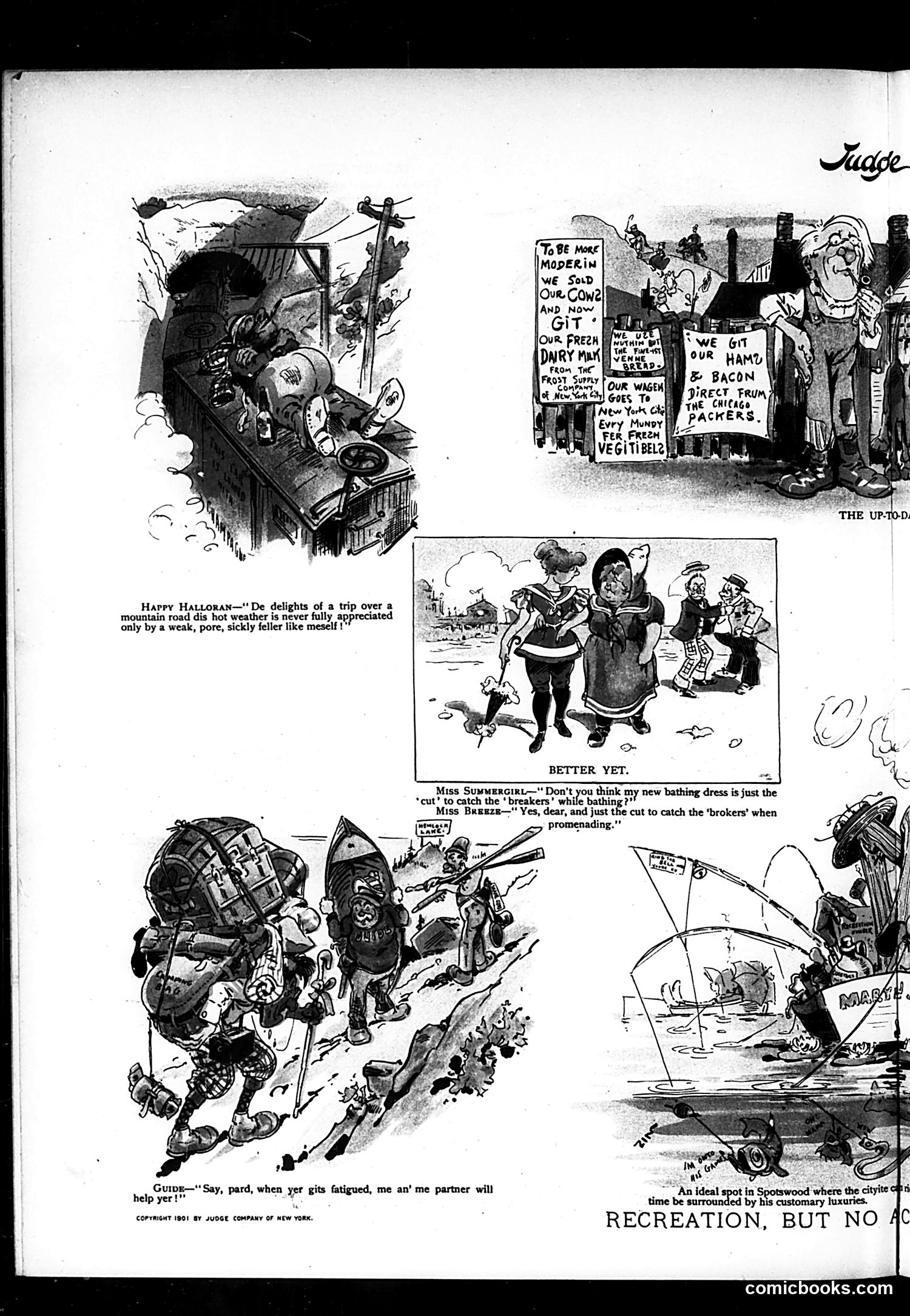
This 1901 page contains multiple satirical cartoons mocking contemporary social trends and pretensions. **"The Up-To-D" (top right):** Urban consumers boast about purchasing "modern" conveniences—canned goods, fresh dairy, and bacon from Chicago packers—presenting themselves as sophisticated while actually buying mass-produced items. **"Happy Halloran":** A working-class man complains about mountain travel hardships, satirizing how only the infirm appreciate such trips—a jab at wealthy tourists seeking "rustic" experiences. **"Better Yet":** A double-entendre joke about bathing dresses—Miss Summergirl's outfit supposedly catches "breakers" (waves) while bathing, but Miss Breeze quips it will catch "brokers" (wealthy men) during promenading—mocking both female fashion and class-conscious matchmaking. **Bottom cartoons:** Appear to satirize vacation culture and camping, suggesting that urban leisure activities are performative rather than genuinely restorative. The overall theme critiques 1900s consumer culture and social climbing.
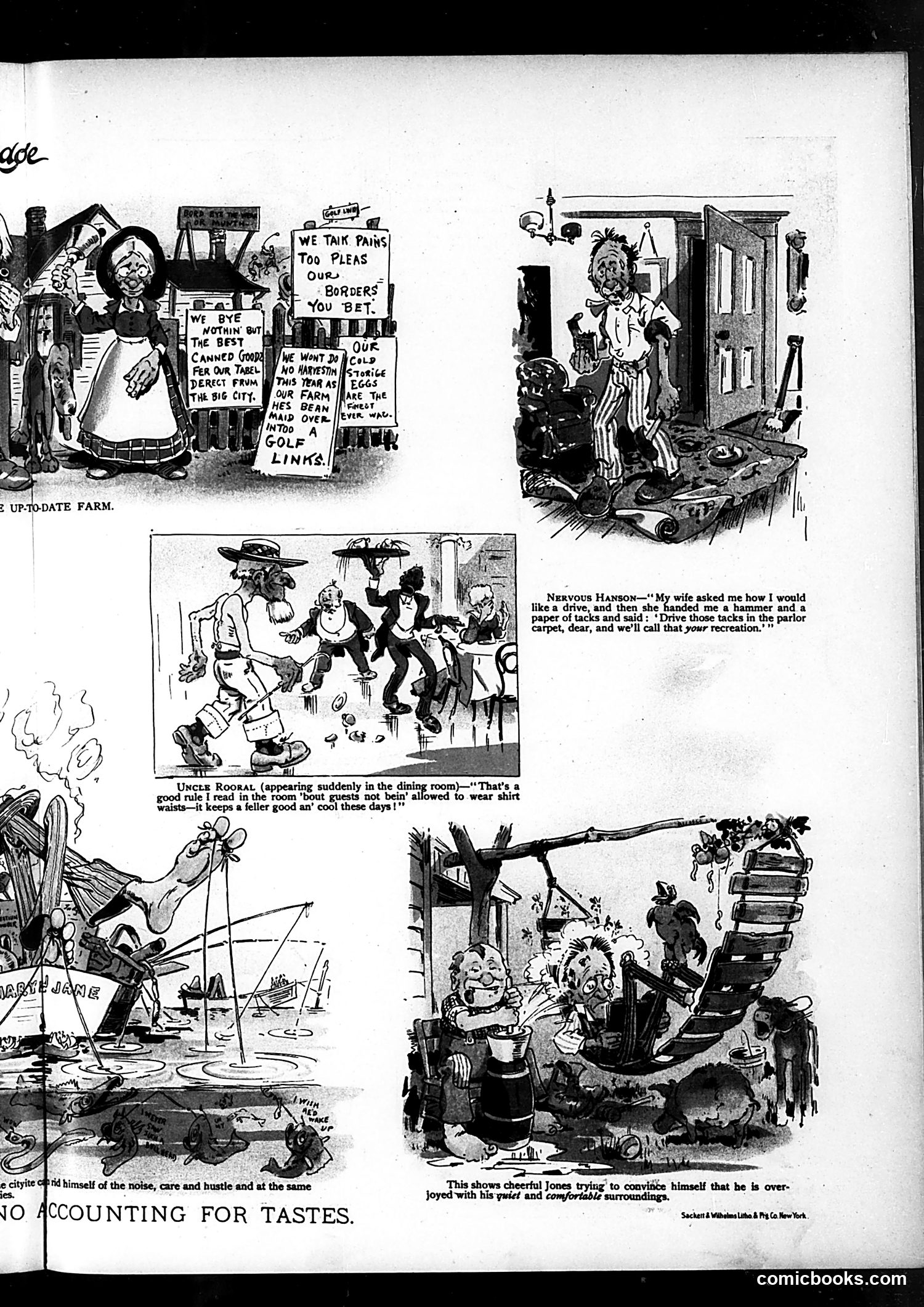
This page contains several domestic humor cartoons satirizing early 20th-century urban life and changing social roles. The top-left cartoon mocks "up-to-date farm" life, showing rural people adopting city affectations and consumer goods, suggesting rural communities were awkwardly imitating urban culture. The central cartoon titled "Nervous Hanson" jokes about a wife redefining "recreation"—she sends her husband to hammer carpet tacks instead of taking a leisurely drive. This satirizes how married domestic life involves unpaid labor disguised as leisure time. The bottom illustration captioned "Accounting for Tastes" appears to show contrasting attitudes: one figure seems distressed while another (Jones) attempts self-deception about his situation, suggesting people rationalize unhappy circumstances differently. Overall, these cartoons humorously critique domestic drudgery, the gap between rural and urban life, and how individuals cope with unwanted responsibilities through rationalization.
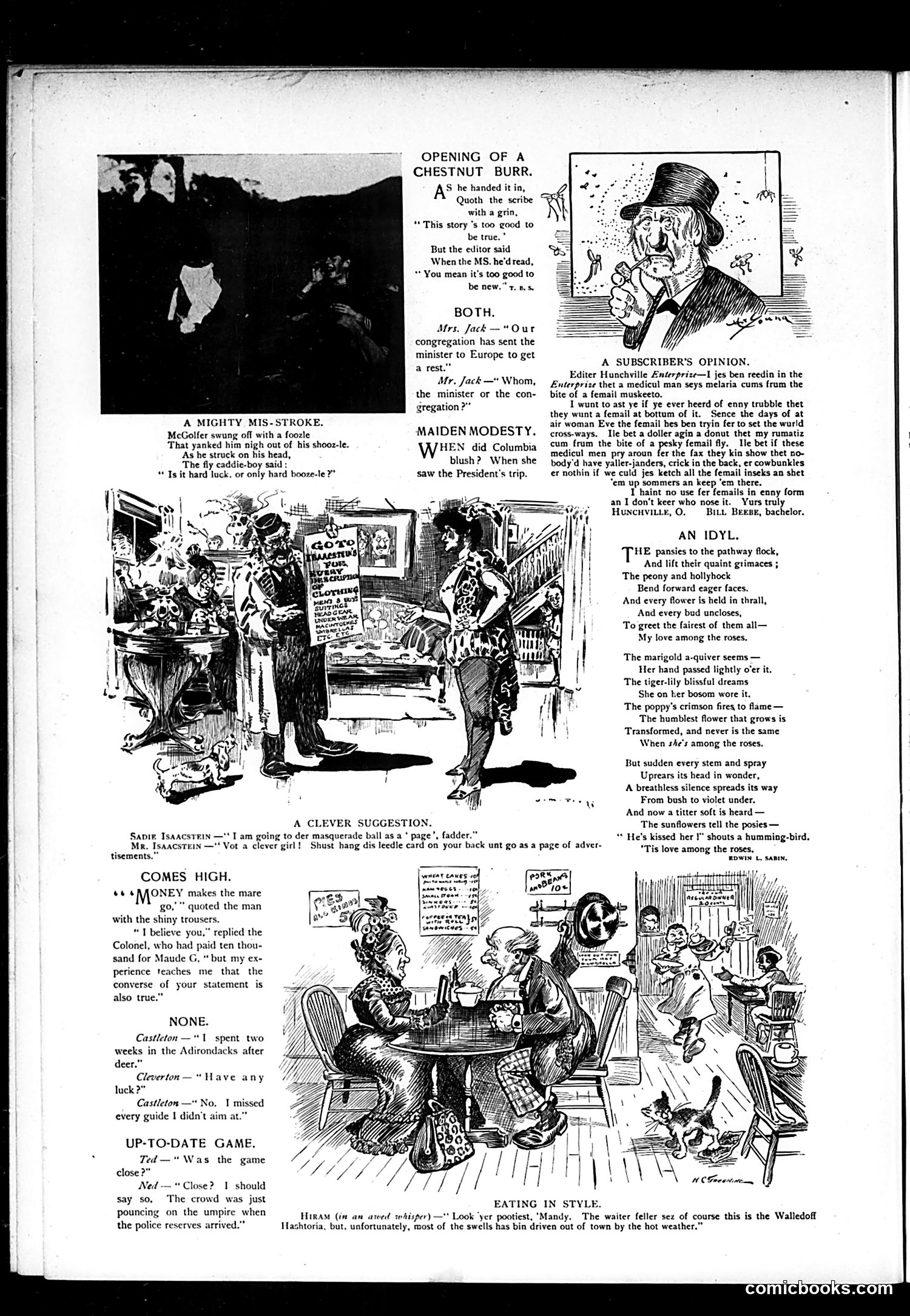
This page contains multiple short humorous pieces typical of Judge magazine's satirical format: **Main cartoons:** - "A Mighty Stroke" mocks golf incompetence - "Opening of a Chestnut Burr" jokes about editors rejecting stories as unoriginal - "Maiden Modesty" satirizes President Theodore Roosevelt's popularity (the "President's trip" reference suggests his travels embarrassed the nation) - "A Clever Suggestion" uses ethnic humor with Yiddish-inflected speech ("der masquerade," "Vot a clever girl") - "Eating in Style" depicts rural characters attempting sophistication at a fancy hotel **Social commentary:** The pieces mock contemporary concerns: golf culture, journalistic clichés, female gender roles (multiple jokes blame women for problems), urban pretension, and incompetent guides. **Recurring elements:** Ethnic/dialectal humor (German, rural) was standard Judge fare. The "Subscriber's Opinion" letter blames women for disease, reflecting period misogyny disguised as humor. The page reflects early 1900s American middle-class anxieties and prejudices presented as lighthearted satire.
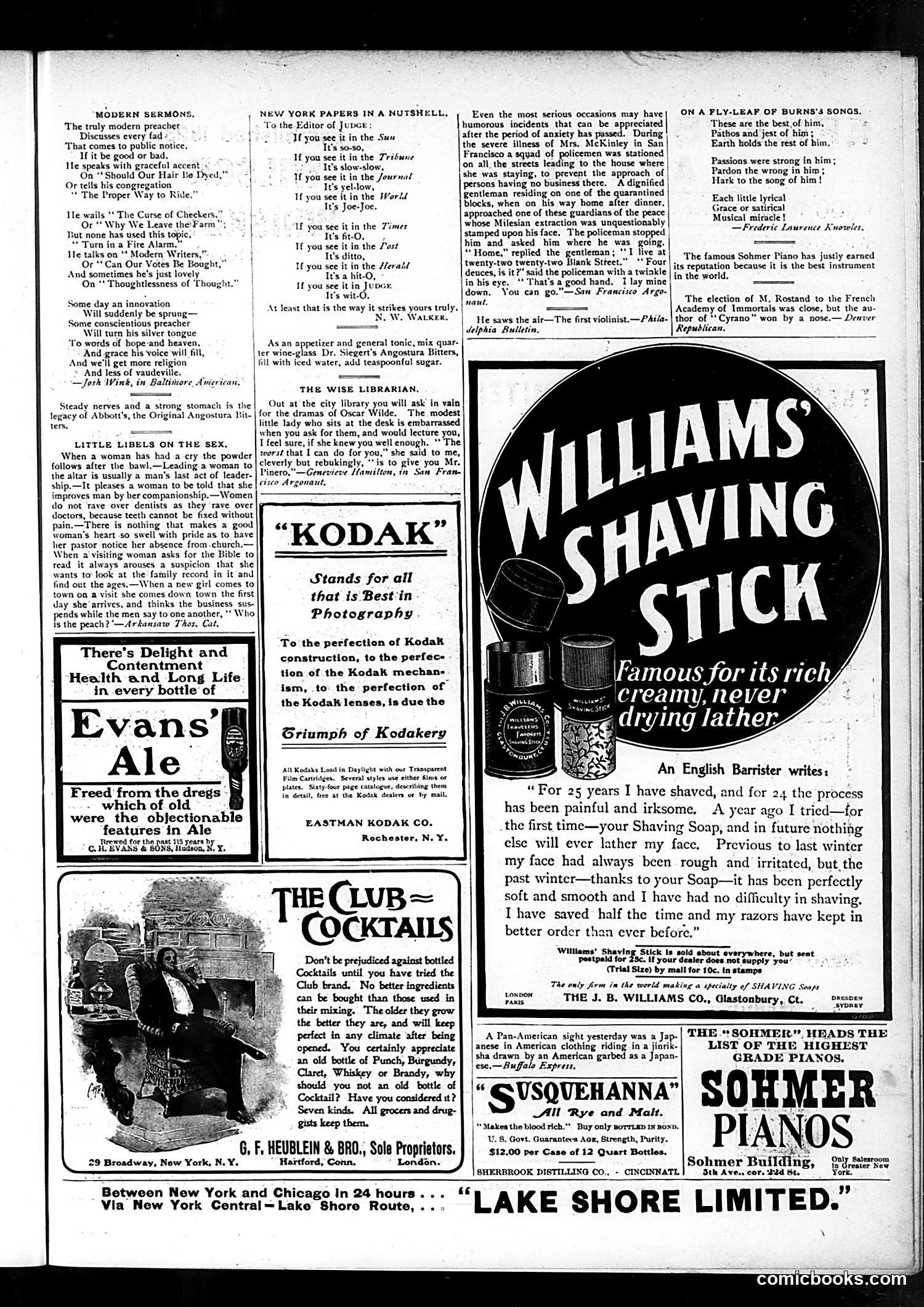
This page from Judge magazine is primarily **advertising with light satirical commentary**—not a political cartoon per se. The satirical pieces include: **"Modern Sermons"** mocks contemporary preachers who discuss trendy social topics (hair-dyeing, proper riding) instead of substantive religious material. The joke: a "truly modern" minister has never preached on "Turn in a Fire Alarm"—suggesting even the most fashion-conscious preacher hasn't reached peak absurdity. **"New York Papers in a Nutshell"** satirizes competing New York newspapers by assigning each a dismissive characterization (Sun = "so-so," Journal = "yel-low," etc.), playing on their reputations for sensationalism and quality variations. **"Little Libels on the Sex"** offers brief, comedic observations about women's behavior—typical period humor about vanity, romance, and social conventions. The remainder consists of advertisements for Evans Ale, Kodak cameras, Angostura Bitters, Club Cocktails, Williams Shaving Stick, Sommer Pianos, and train service—the magazine's revenue source.
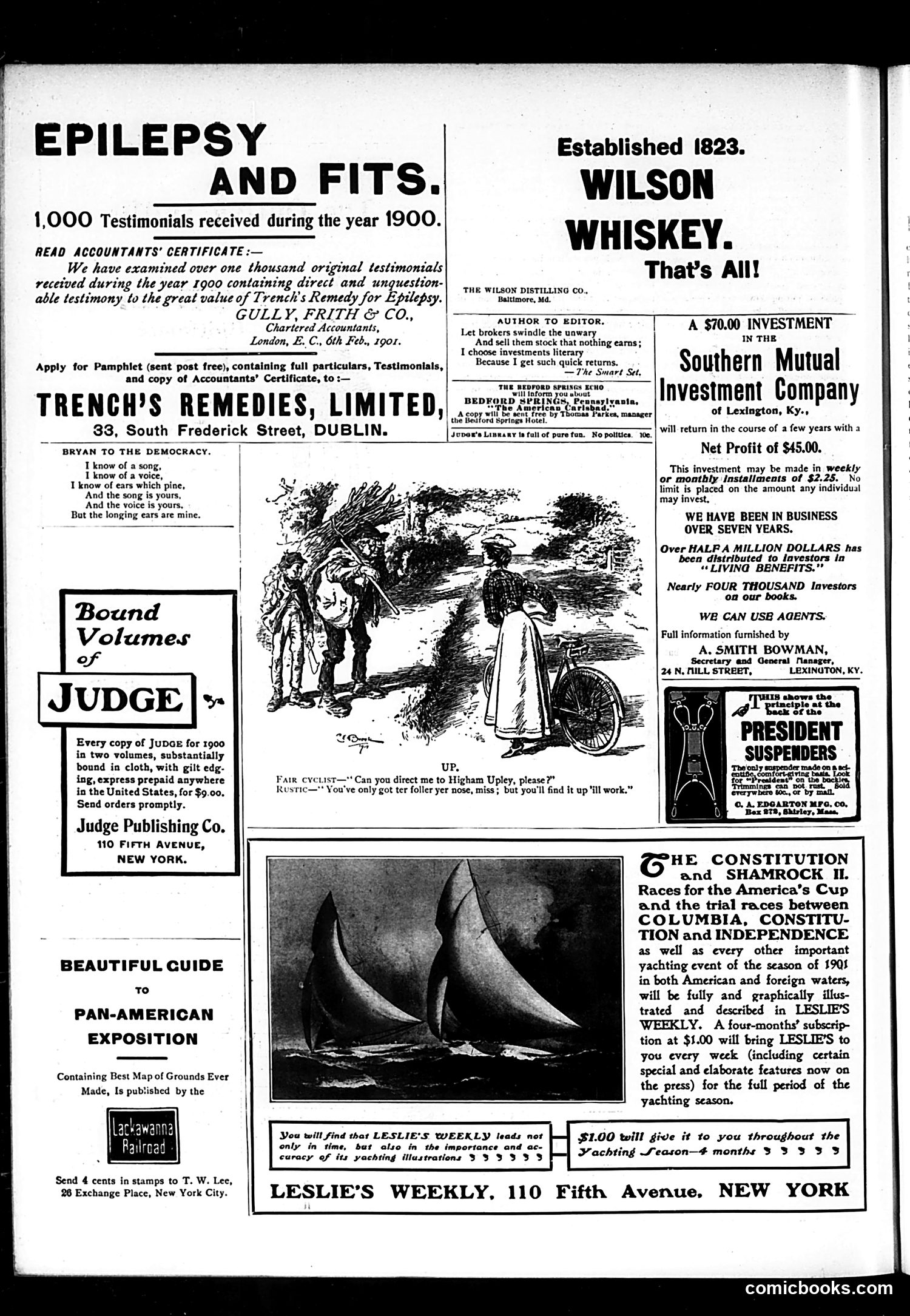
This page is primarily **advertising**, with one notable cartoon. The main satirical content is the "UP" cartoon: a woman cyclist asks a rustic directions to "Higham Upley," and he responds she should "foller yer nose" uphill, but doubts she'll "find it up 'ill work"—a crude pun playing on her difficulty navigating the terrain and the colloquial double meaning. The page also includes a poem titled "BRYAN TO THE DEMOCRACY," likely referencing **William Jennings Bryan**, the Democratic presidential candidate who ran in 1900. The poem's sentiment about unrequited longing for "the voice" and "the song" appears to express the Democratic Party's nostalgia for Bryan's leadership. The remainder consists of period advertisements for patent medicines (Trench's Remedy for epilepsy), whiskey, investment schemes, and publications like Leslie's Weekly covering the 1901 America's Cup yacht races.
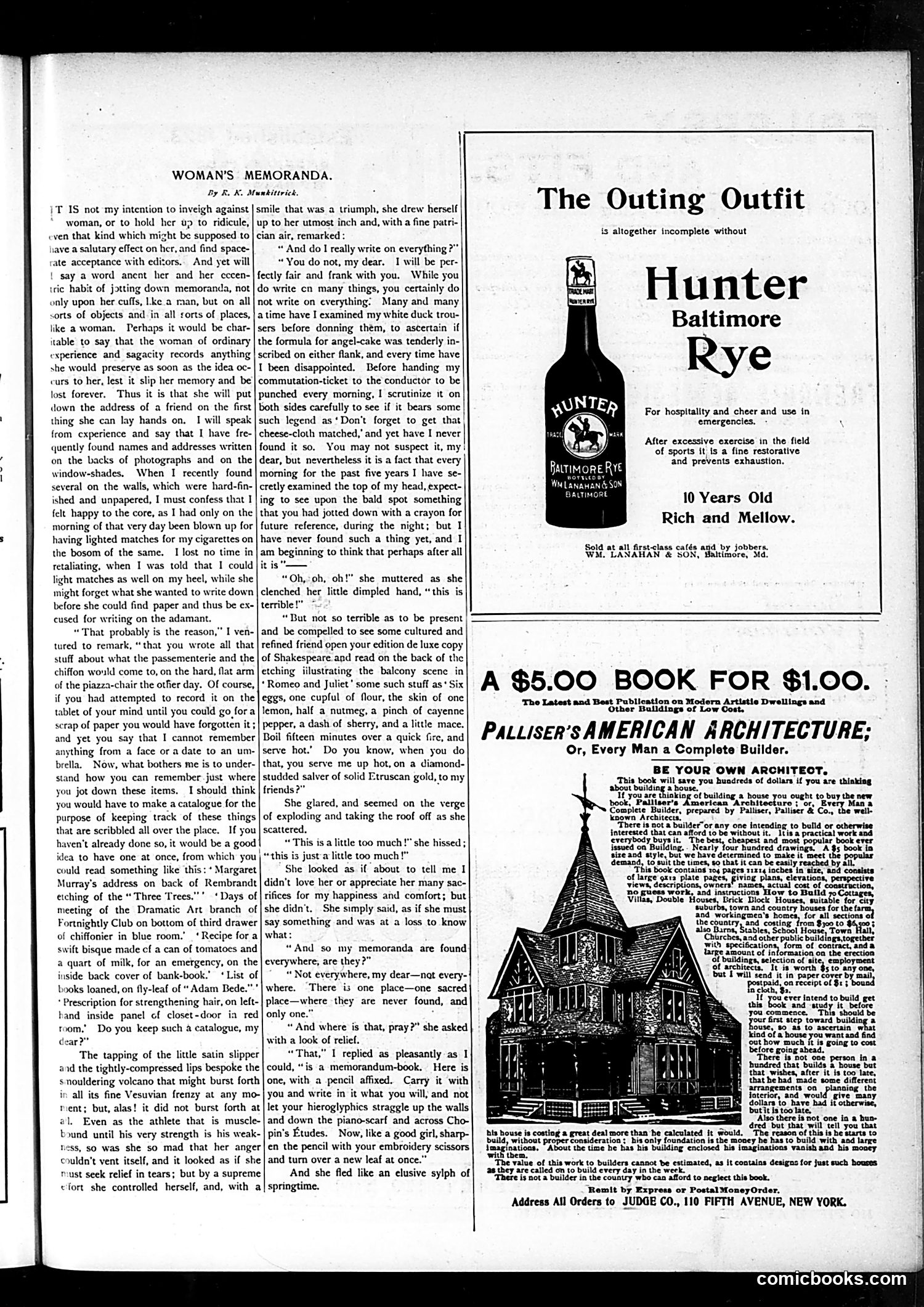
This is not a cartoon but a humorous essay by R.B. Munkittrich that satirizes women's habit of writing notes on unconventional surfaces due to poor memory. **The Setup:** A husband complains that his wife writes memoranda everywhere—on photograph backs, window-shades, even walls—because she fears forgetting things if she doesn't immediately jot them down. He facetiously suggests she maintain a "catalogue" to track where she's written various reminders. **The Satire:** The piece gently mocks a supposed female character flaw: scatterbrained forgetfulness and disorganization, contrasted with the husband's superior memory. The wife's angry but controlled response at the end suggests she's both offended and unable to deny the charge. **Historical Context:** This reflects early 20th-century gender stereotypes portraying women as emotionally volatile, absent-minded, and domestically disorganized—humor directed *at* women rather than at social absurdities. The piece exemplifies the magazine's satirical approach to gender relations.
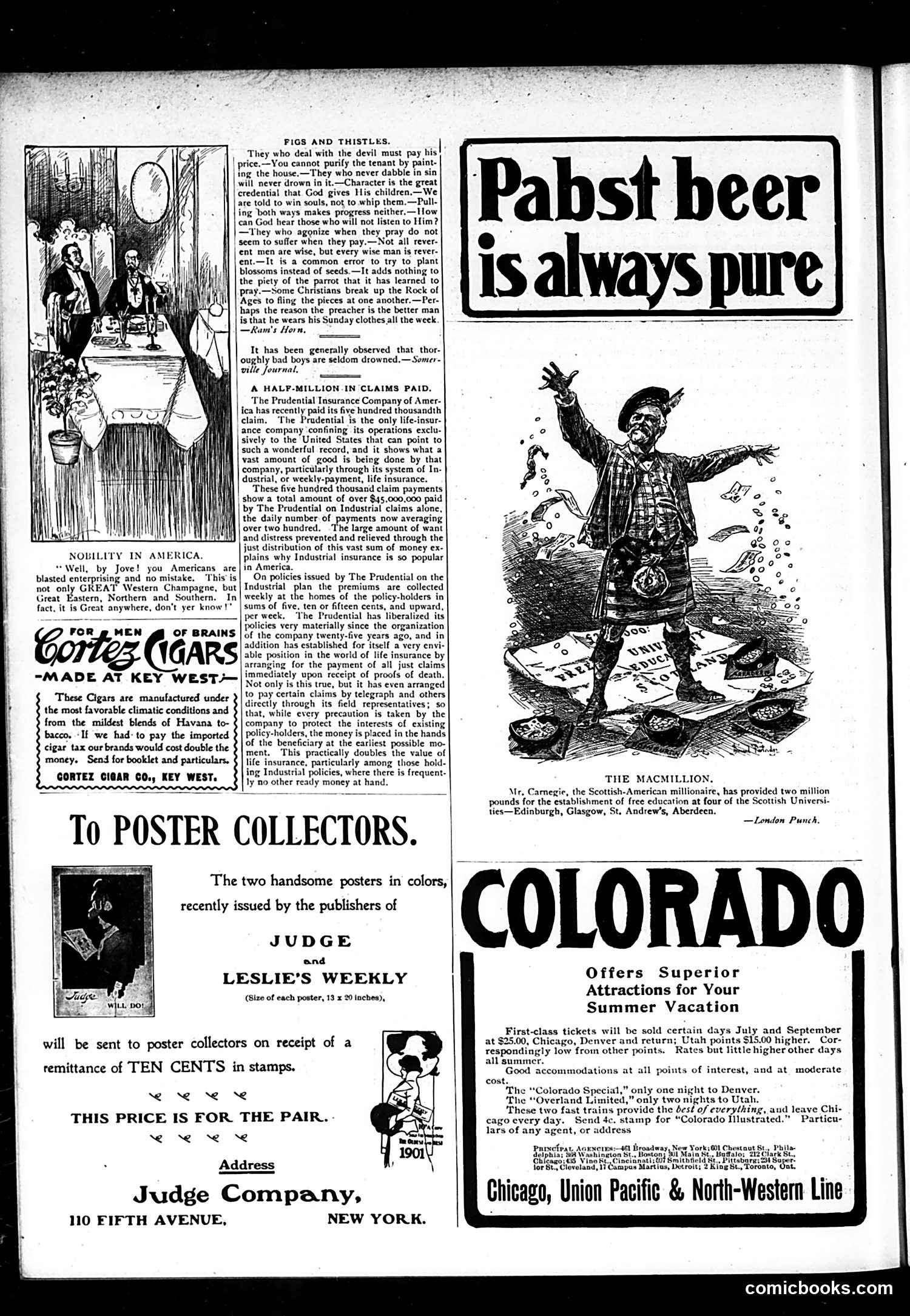
This page combines advertising with satirical commentary typical of early 1900s Judge magazine. **"Figs and Thistles"** presents moral aphorisms mocking religious hypocrisy—criticizing those who perform piety without substance ("pray" without "pay," wear Sunday clothes only on Sundays, break up faith to weaponize it against others). **"Nobility in America"** features a cartoon dialogue between an American and a British character. The Britisher sarcastically praises American enterprise, noting they've branded champagne as "Great Western," "Great Eastern," "Northern and Southern"—essentially marketing the same product under multiple regional names. The joke satirizes American commercialism and marketing deception, suggesting Americans will slap any geographic label on products to boost sales. The page otherwise contains insurance company advertising (Prudential) and cigar advertisements, typical of the period's commercial content.
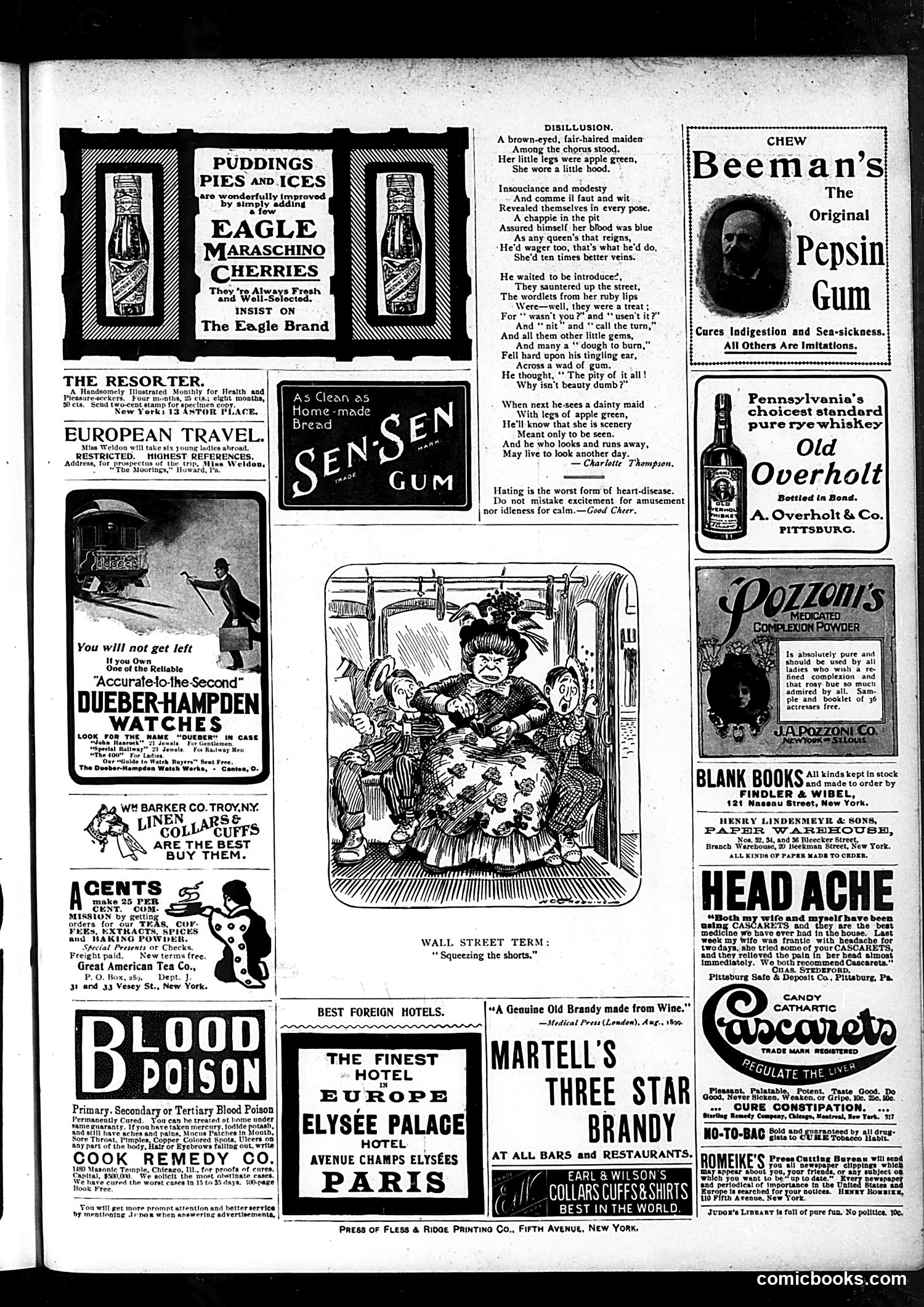
This page is primarily **advertising** with one notable **satirical poem** titled "Disillusion." ## The Main Cartoon/Poem: "Disillusion" tells the story of a man in a theater pit who becomes infatuated with a chorus girl, imagining her to be refined and well-bred based on her appearance ("legs were apple green," fair hair). When they meet, she speaks in common slang, crude language, and reveals herself to be superficial—crushing his romantic illusions. The final stanza's moral: when he next sees a pretty chorus girl, he'll recognize her as mere "scenery / Meant only to be seen." **The satire targets:** the gap between appearance and reality, male romantic delusion about women (particularly chorus girls), and the commodification of female beauty in theater. It's a cynical commentary on turn-of-the-century courtship and theatrical culture. ## Advertisements: The page is dominated by product ads: patent medicines (blood poison cures, headache remedies), alcohol (whiskey, brandy), watches, and various household goods—typical of Judge magazine's revenue model.
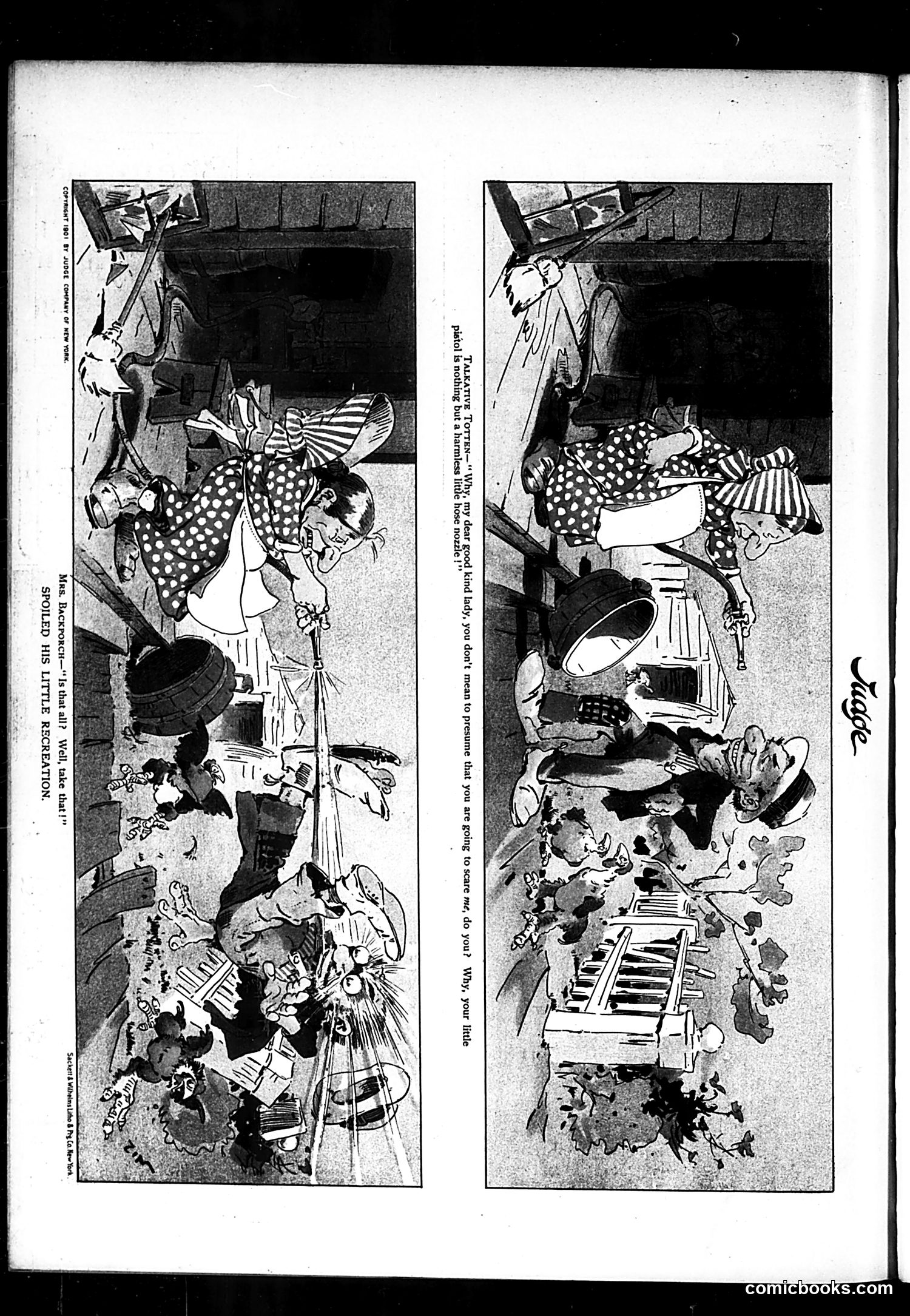
This appears to be a domestic violence satire from *Judge* magazine. The cartoon depicts a woman confronting a man (labeled "S. Backporch") who claims his pistol is "nothing but a harmless little hose nozzle." The woman's response—"Is that all? Well, take that!"—suggests she's attacking him in retaliation, titled "Spoiled His Little Recreation." The satire mocks men who minimize threats or weapons while engaging in domestic abuse, presenting their claims as absurd excuses. By having the woman violently respond, the cartoon ironically illustrates how such "harmless" threats are actually dangerous provocations. The work critiques both the normalization of domestic violence and men's defensive rationalizations of their behavior.
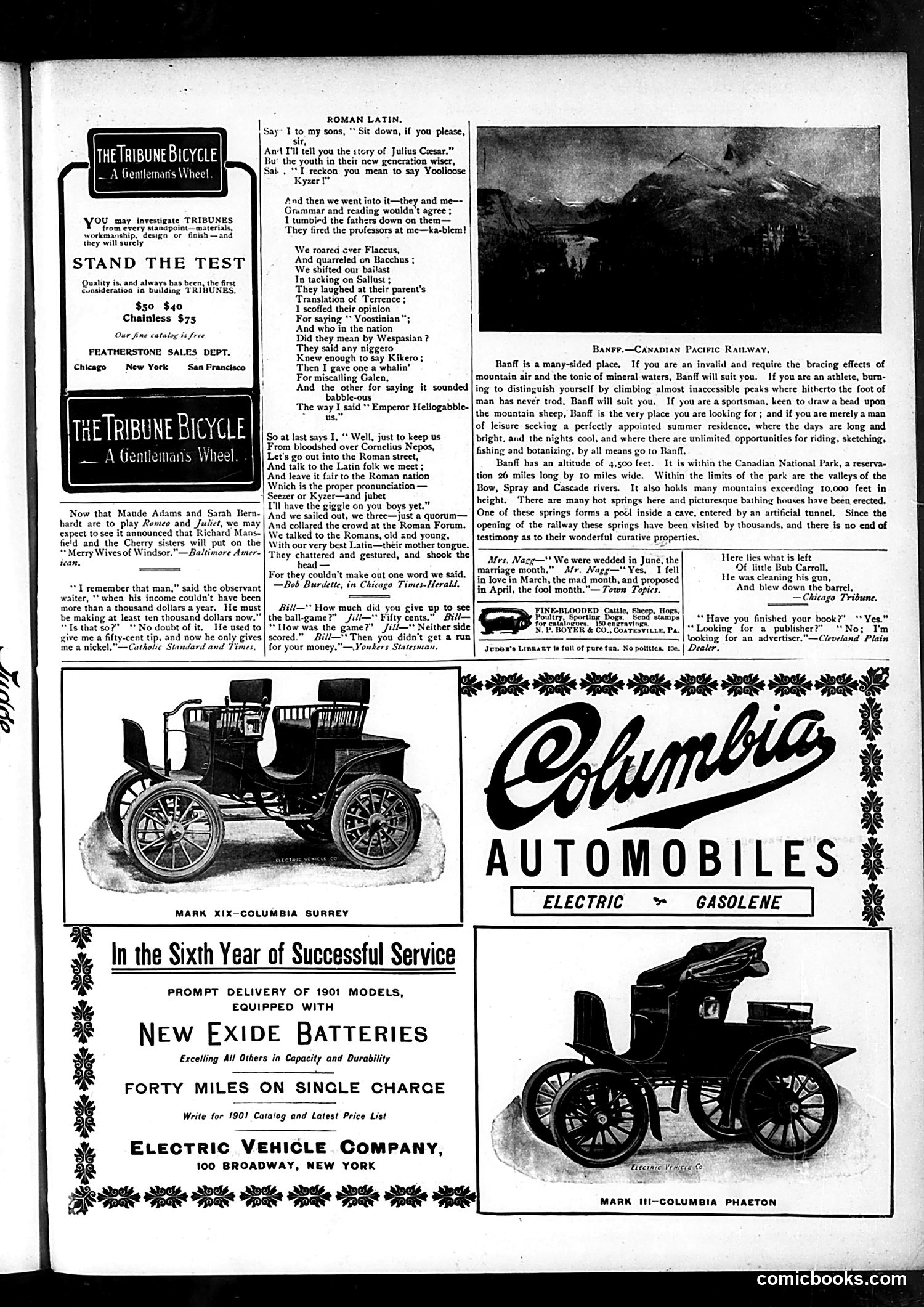
This page contains mostly **advertisements and humorous literary content** rather than political cartoons. The main text piece, "Roman Latin" by Bob Burdette, is a **dialect humor story** satirizing how American youth mispronounce classical Latin names. A father attempts to educate his sons about Julius Caesar and Roman literature, but they insist on anglicized pronunciations ("Kyzer" instead of "Caesar," "Yoolioose Kyzer"). The satire mocks generational conflict and the decline of classical education among young Americans, who prefer casual American speech to proper pronunciation. The father's frustrated attempts to correct them escalate until they settle the dispute by consulting actual Romans—who themselves cannot understand the father's "proper" Latin, exposing the absurdity of all parties involved. The page also includes period **advertisements** for bicycles, electric automobiles, and the Canadian Pacific Railway's Banff resort. The humor relies on class-conscious linguistic pretension and educational anxiety—themes resonant in early 1900s America.
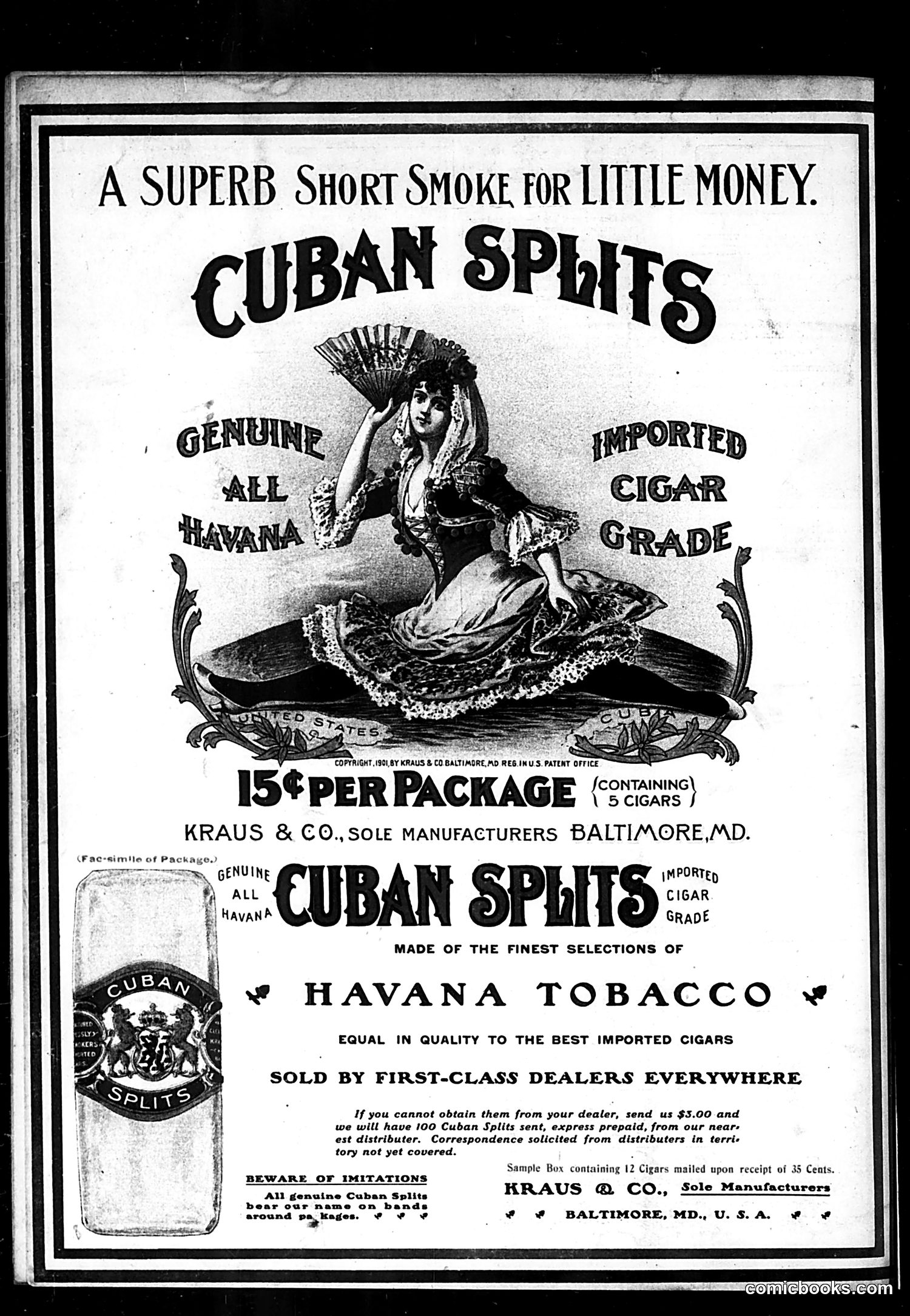
This is a **commercial advertisement**, not satire. It promotes Cuban Splits cigars manufactured by Kraus & Co. in Baltimore, Maryland, priced at 15¢ per package of five cigars. The ad features a romanticized illustration of a woman in Spanish/Cuban costume (fan, elaborate dress) sitting on a cigar—a common marketing trope of the era that exoticized Cuban products. The text emphasizes the product's authenticity ("Genuine All Havana," "Imported Cigar Grade") and affordability for working-class smokers ("a superb short smoke for little money"). A notable element: the warning against imitations, suggesting counterfeit Cuban cigars were a commercial problem. The ad offers mail-order options, indicating distribution challenges outside major cities in 1901. This reflects the cigar industry's boom in early 20th-century America and the prestige associated with Cuban tobacco.

I can see this is a page from *Judge* magazine, but the image is almost entirely black with only minimal visible detail—primarily some decorative border elements on the left and right edges and the comicbooks.com watermark at the bottom. The OCR text provides only the website URL with no article text, headlines, or cartoon captions to analyze. Without legible visual content or accompanying text, I cannot identify specific figures, political references, or the satirical point of any cartoon on this page. This appears to be either a blank page, a title page, or a heavily degraded scan where the content is not readable. To provide accurate historical analysis, a clearer image would be necessary.