
A complete issue · 16 pages · 1901
Judge — March 23, 1901
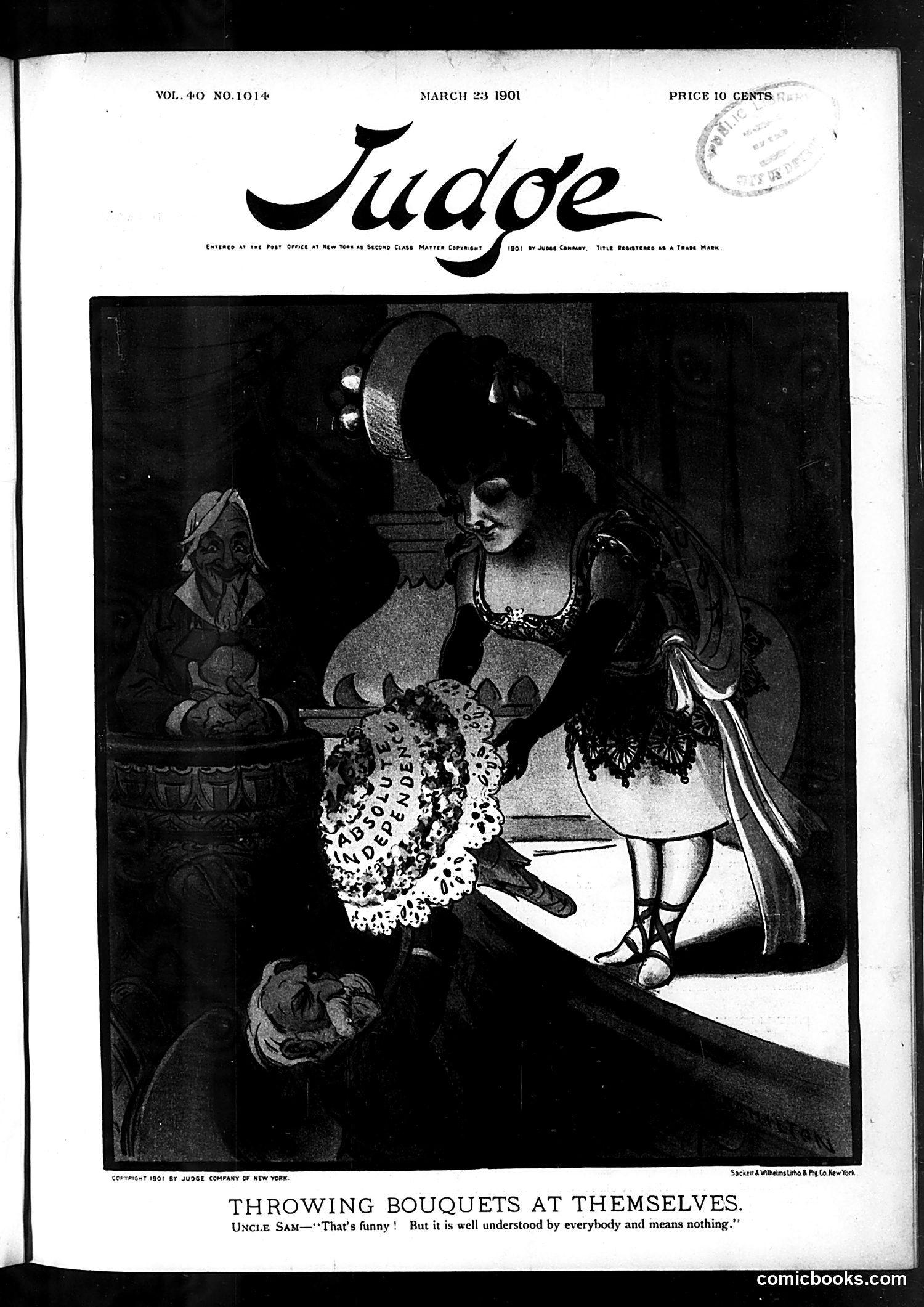
This satirical illustration, titled "Throwing Bouquets at Themselves," depicts a woman in elaborate period dress examining a decorative bouquet. The caption quotes Uncle Sam saying "That's funny! But it is well understood by everybody and means nothing." The satire appears to mock insincere flattery or empty praise—the phrase "throwing bouquets" meant offering compliments. The woman's self-admiring pose while holding the bouquet suggests self-congratulation or mutual back-patting among a particular group (likely political or social figures of 1901). Uncle Sam's dismissive comment underscores that such praise is hollow and meaningless to outside observers. The specific target remains unclear without additional historical context from this issue.
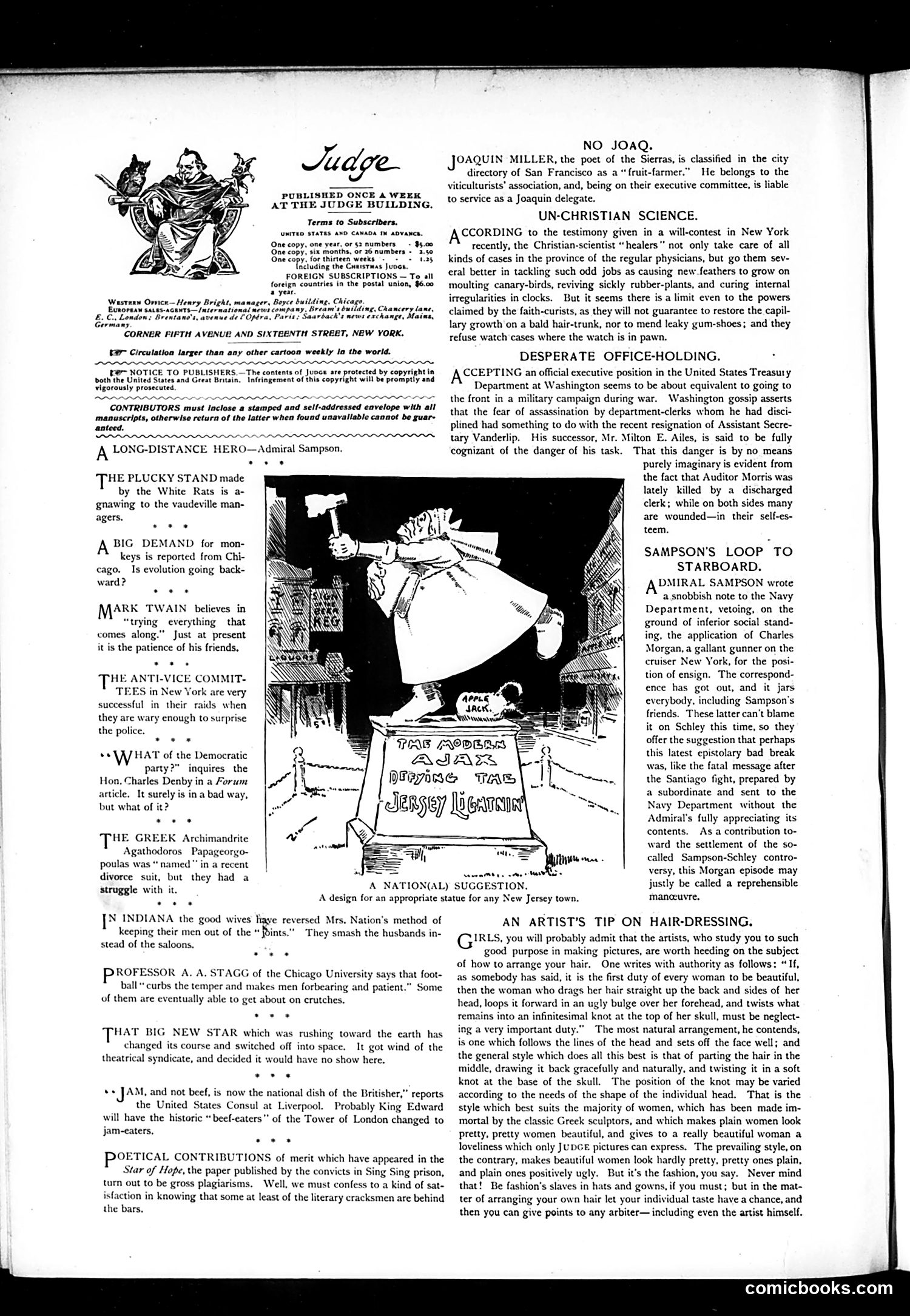
This cartoon satirizes New Jersey municipal governance. The central figure appears to be a rotund politician or official labeled as representing New Jersey civic leadership. He's depicted in an undignified pose atop what looks like a pedestal or monument, with the text suggesting this is "a design for an appropriate statue for any New Jersey town." The satire mocks New Jersey's political corruption or incompetence by sarcastically proposing this unflattering caricature as a suitable public monument. The exaggerated physicality and absurd positioning ridicule local officials' behavior and character. Without more specific context, the exact target remains unclear, but the cartoon clearly expresses contempt for New Jersey's political establishment through visual mockery.
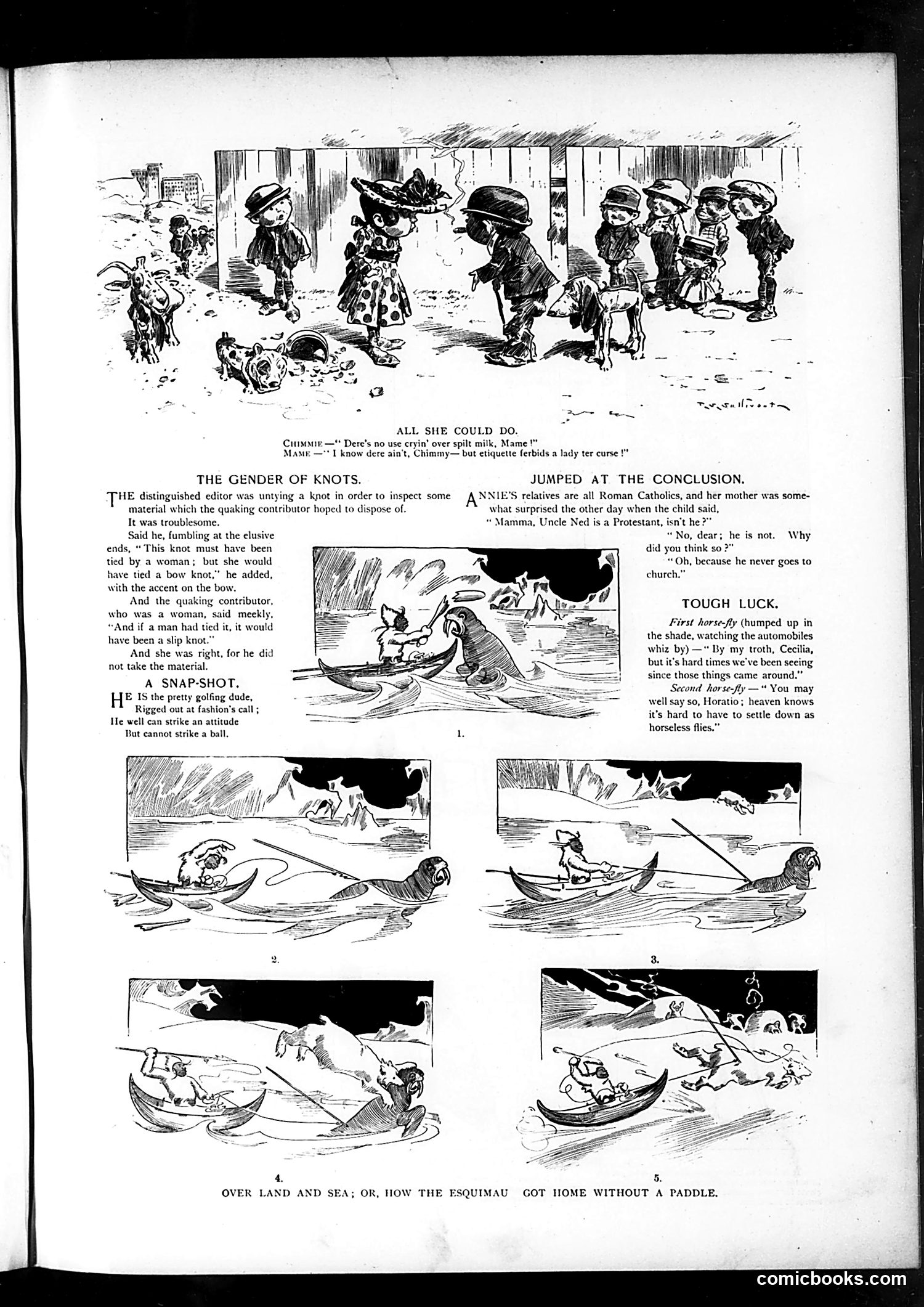
This Judge magazine page contains three separate satirical pieces: 1. **"All She Could Do"** (top): A visual gag about gender and etiquette. The joke contrasts a woman's practical solution (not crying over spilled milk) with expectations that ladies should be more refined in their responses to mishaps. 2. **"The Gender of Knots"** (left column): Wordplay satire about a distinguished sailor inspecting knots tied by women versus men. The humor derives from suggesting that knots—and perhaps other things—have inherent gender characteristics, mocking contemporary ideas about masculine/feminine distinctions. 3. **"Over Land and Sea"** (bottom panels): A sequential comic strip titled "How the Esquimau Got Home Without a Paddle," showing absurdist humor through illustrated mishaps involving boats and water travel. The overall page reflects turn-of-the-century American humor focused on gender roles, class distinctions, and wordplay.
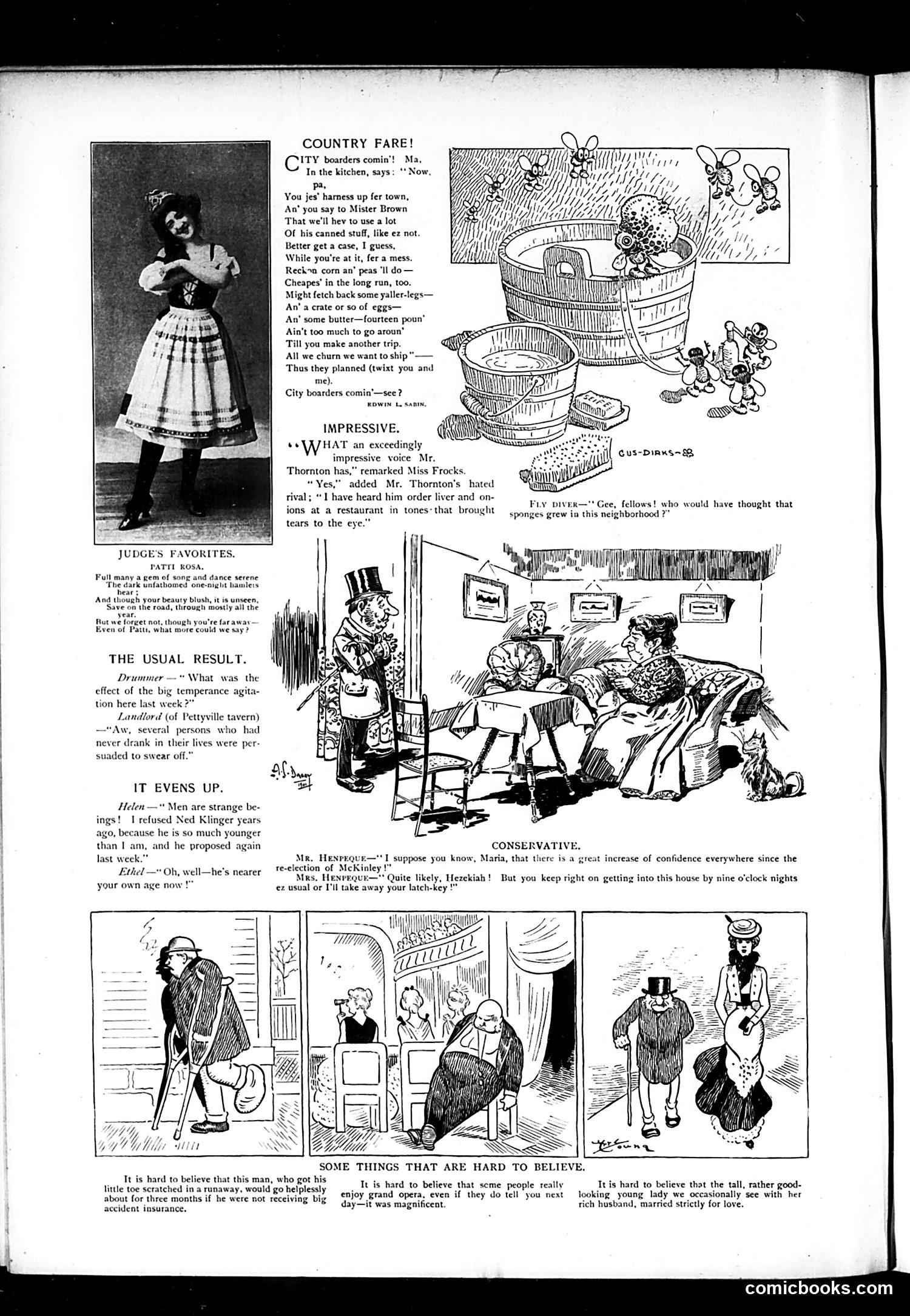
This page contains several unrelated humor pieces typical of early 20th-century Judge magazine: **"Country Fare"** satirizes the contrast between urban and rural life, mocking a city visitor's unfamiliarity with farm tasks and food preparation. **"Judge's Favorites"** is a poem about Patti Rosa (likely a performer of the era), praising her singing voice. **Other sections** include brief comedic anecdotes ("The Usual Result," "It Evens Up," "Conservative," "Some Things That Are Hard to Believe") depicting domestic situations and social observations. The accompanying illustrations are generic character sketches rather than political cartoons—they depict everyday scenarios meant to amuse through relatable humor about marriage, temperance, and social class distinctions rather than commentary on specific current events.
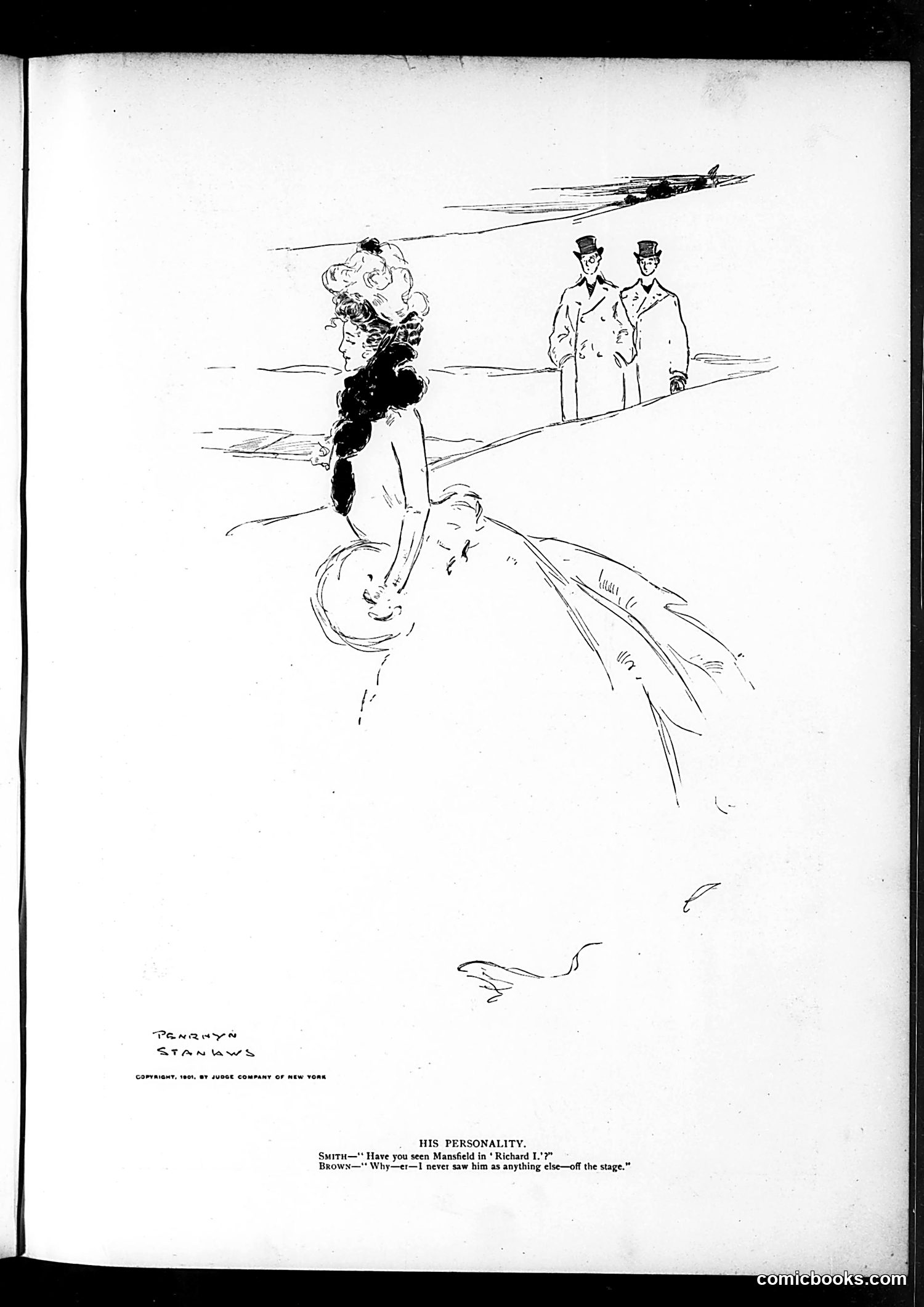
This cartoon satirizes an actor named Mansfield, likely Richard Mansfield, a prominent late-19th-century performer. The joke hinges on a double meaning: Smith asks Brown if he's seen Mansfield perform in "Richard I.I" (likely "Richard II" or "Richard III"), but Brown's reply suggests Mansfield *is* Richard I.I in real life—that his theatrical persona is inseparable from his actual personality. The illustration shows a mermaid-like figure (representing Mansfield's theatrical artifice or affectation) with two formally-dressed men observing. The satire mocks the actor for being unable to separate his theatrical mannerisms from his everyday behavior, implying his "personality" is entirely constructed performance rather than authentic character.
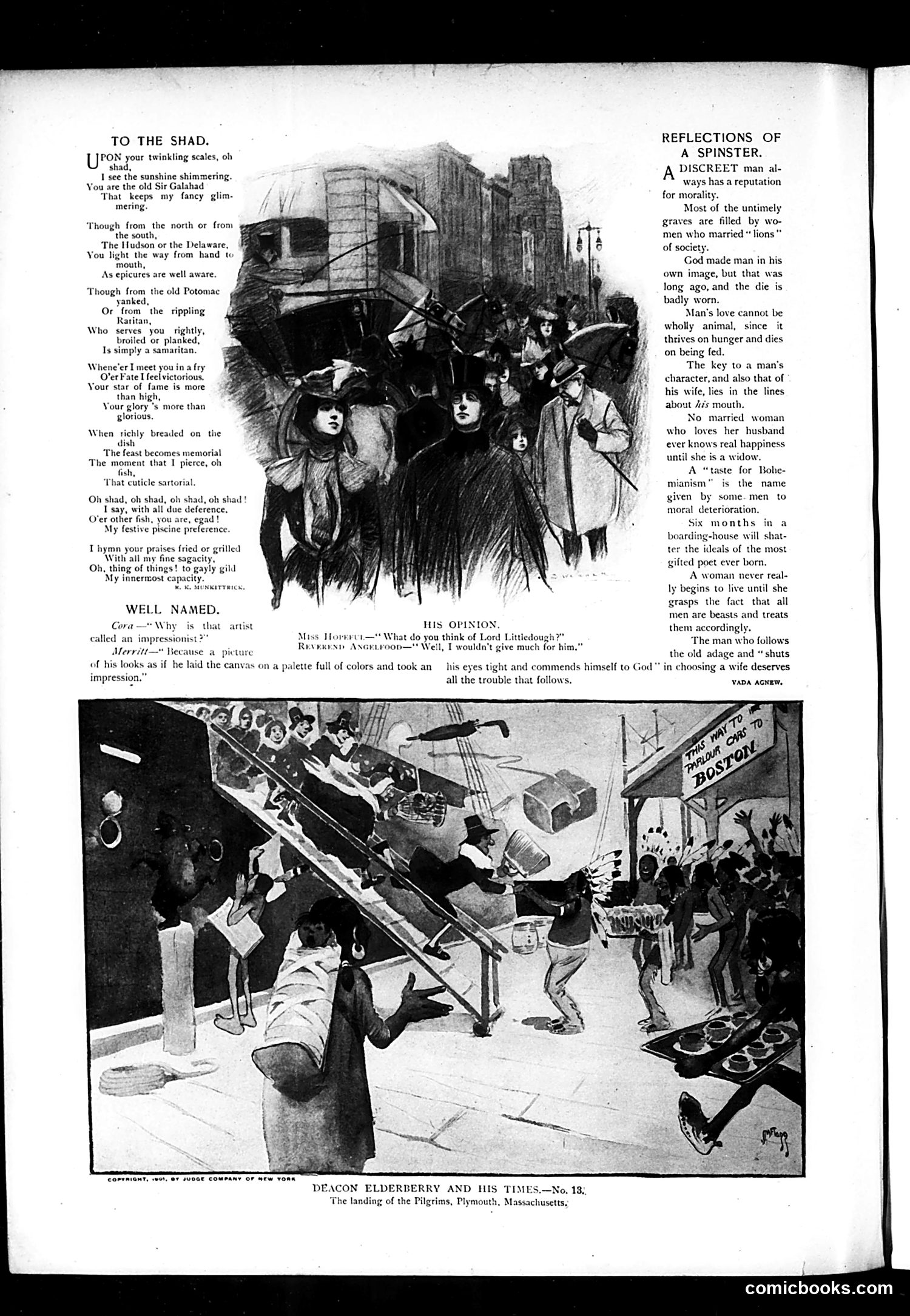
This page contains three distinct satirical pieces typical of early 20th-century humor: **"To the Shad"** is a humorous poem celebrating shad fish as a delicacy, using overwrought romantic language ("old Sir Galahad," "memorial feast") to mock both the fish and diners' pretentious appreciation of it. **"Well Named"** is a brief joke mocking Impressionist artists, suggesting their technique amounts to randomly slapping paint on canvas—a common criticism of the art movement at the time. **"Reflections of a Spinster"** presents cynical observations about marriage and gender relations, delivered with biting wit. The commentary suggests women marry poorly, that men are inherently bestial, and that divorce or widowhood represents liberation—reflecting period anxieties about evolving gender roles. **"Deacon Elderberry"** (bottom) illustrates a historical vignette about the Pilgrims landing at Plymouth, likely providing comedic commentary on American origins through the "Deacon" character series. The page reflects Judge's satirical approach: poking fun at artistic pretension, food snobbery, and contemporary social attitudes toward marriage and gender.
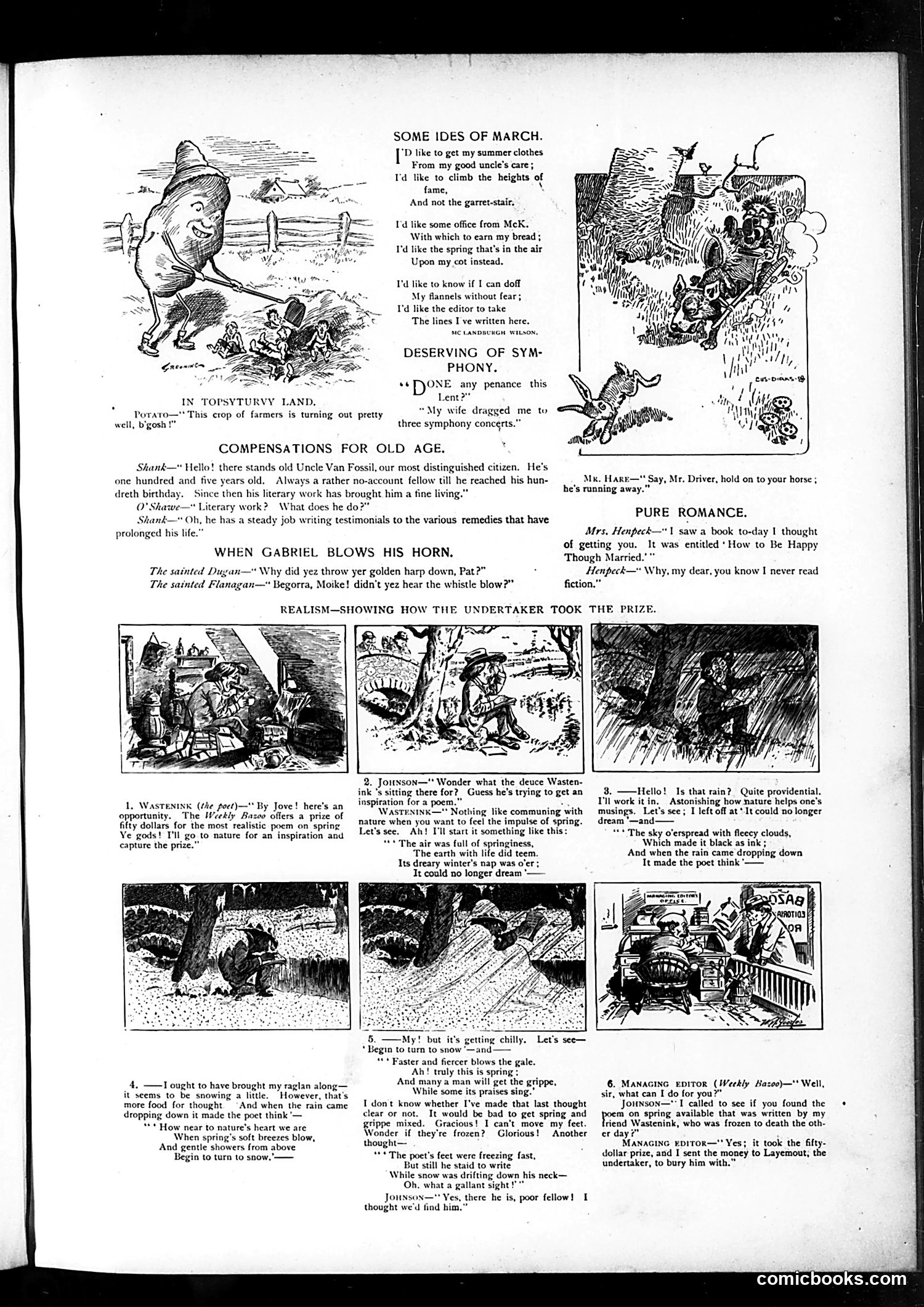
This multi-panel cartoon satirizes romantic poets and their affected relationship with nature. The unnamed poet "Wastenink" seeks inspiration for a spring-poetry competition (fifty-dollar prize from the *Weekly Bazoo*) by communing with nature outdoors. However, the joke is that he becomes so absorbed in composing verses—standing in increasingly harsh weather—that he freezes to death while still writing. The satire mocks two things: (1) the clichéd "poet in nature" trope, showing how absurdly impractical it is, and (2) the irony that the *Weekly Bazoo* (a satirical magazine) awards the prize posthumously, with the prize money sent to the undertaker for his burial. The cartoon suggests that such overwrought Romantic sentimentality is literally fatal—a dark joke about artistic pretension detached from reality.
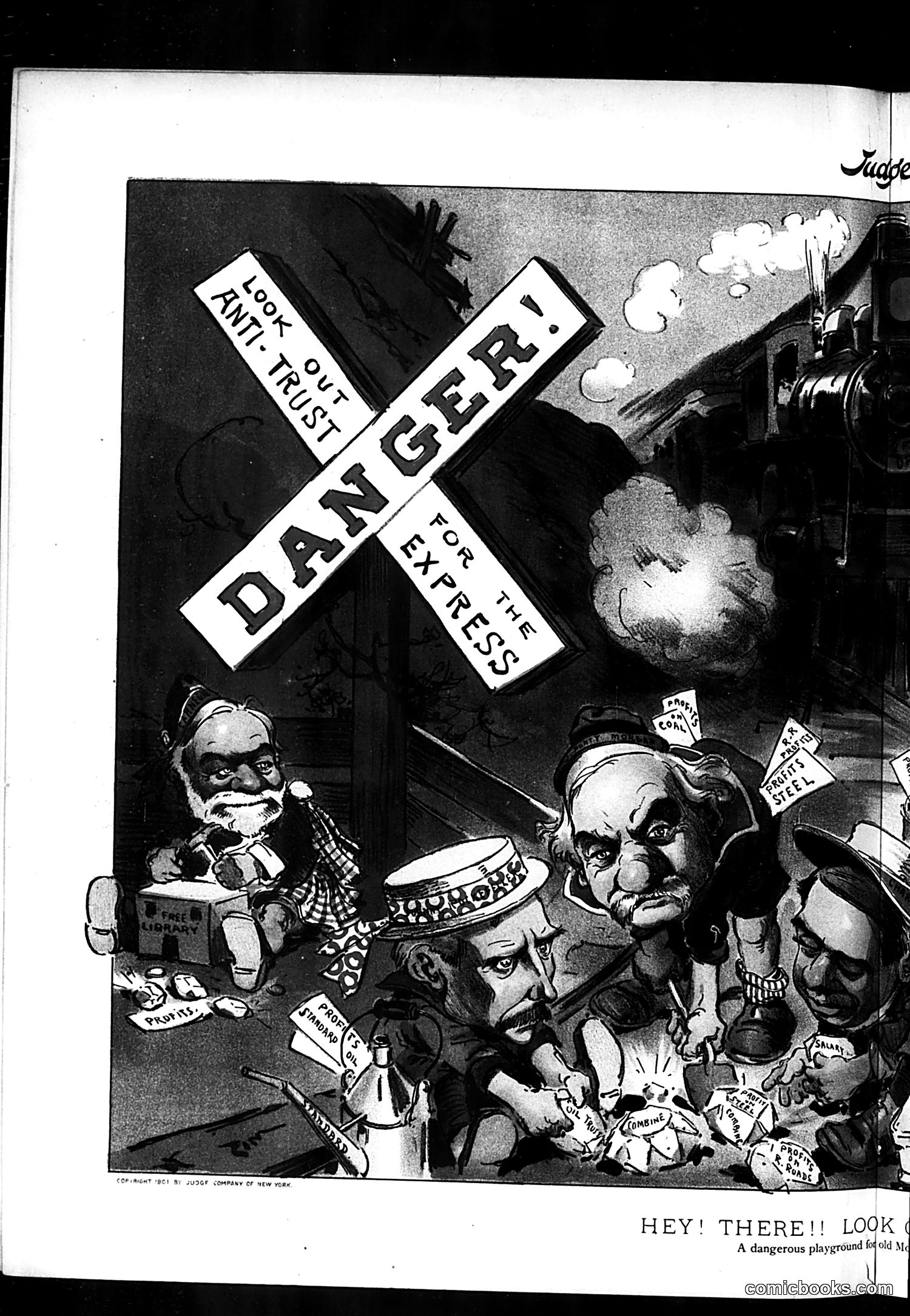
This Judge magazine cartoon depicts a large cross labeled "DANGER! KEEP FOR THE EXRESS" (likely "EXPRESS") positioned over a group of caricatured figures below. The cross's arms bear signs reading "LOOK OUT! ANTI-TRUST" and "DANGER." The cartoon appears to criticize dangerous business practices or monopolistic behavior, using the cross as a warning symbol. The grouped figures below—depicted in exaggerated caricature style typical of early 20th-century satirical art—likely represent businessmen, industrialists, or financiers engaged in problematic commercial activity. The title "A dangerous playground" suggests the cartoon is sarcastically commenting on how large corporations treat risky or unethical business practices as casual activities. The specific references to "anti-trust" indicate this critiques antitrust law enforcement or corporate consolidation during America's Progressive Era.
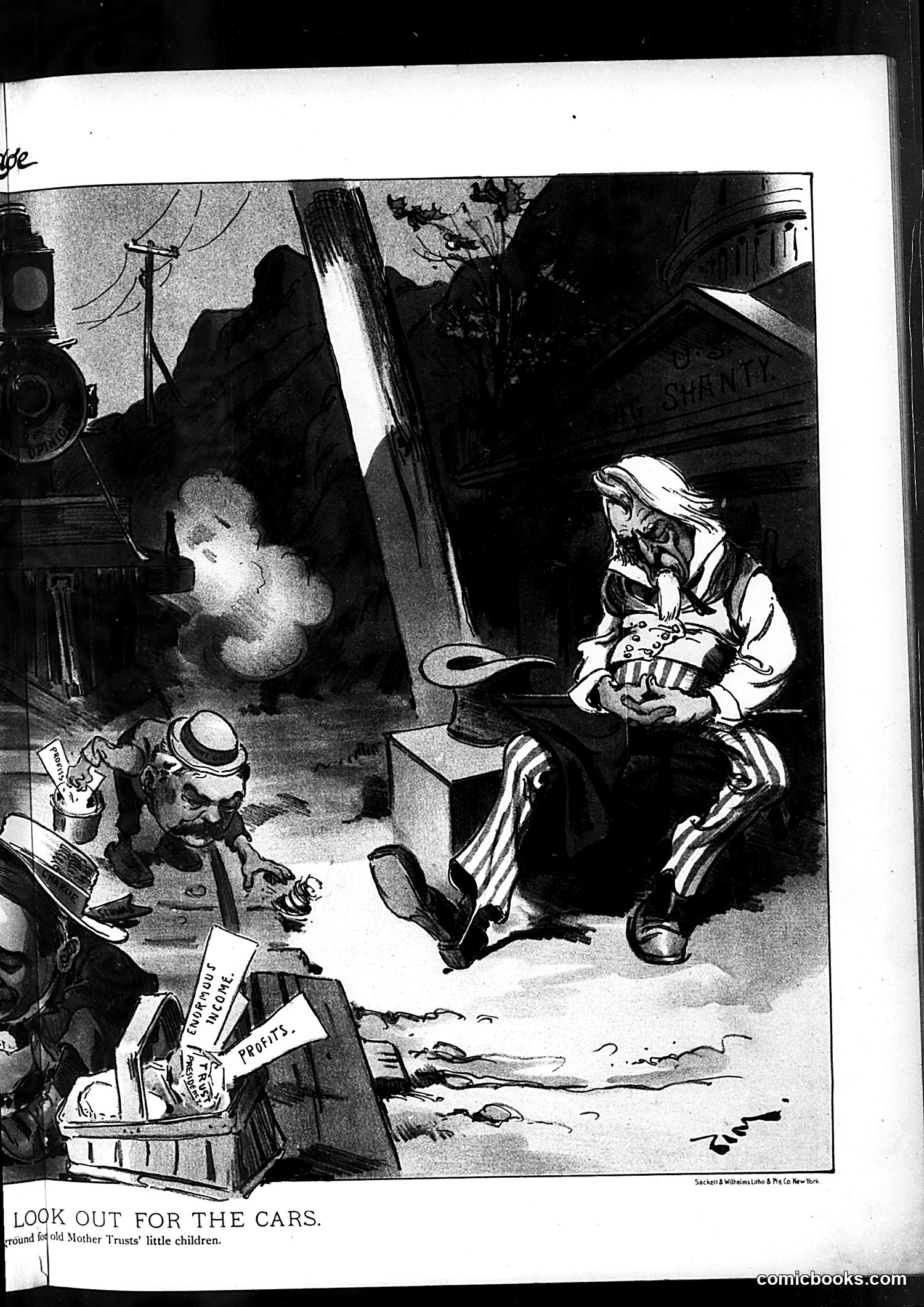
This Judge magazine cartoon satirizes child labor exploitation during the Industrial Age. The caption "Look Out for the Cars" warns of danger to "old Mother Trusts' little children"—a reference to corporate trusts (large monopolistic corporations). The image depicts an elderly, sinister figure (representing a Trust or corporate magnate) with small caricatured children carrying boxes labeled "PROFITS" and "CHILD LABOR." The children appear in danger near industrial equipment and traffic, suggesting they're being exploited and put at physical risk for corporate gain. The cartoon critiques how wealthy trusts profited from child labor while endangering children's safety and welfare. "Mother Trusts" is ironic—these entities cared nothing for the welfare of vulnerable workers. This reflects Progressive Era concerns about unregulated corporate practices and child exploitation.
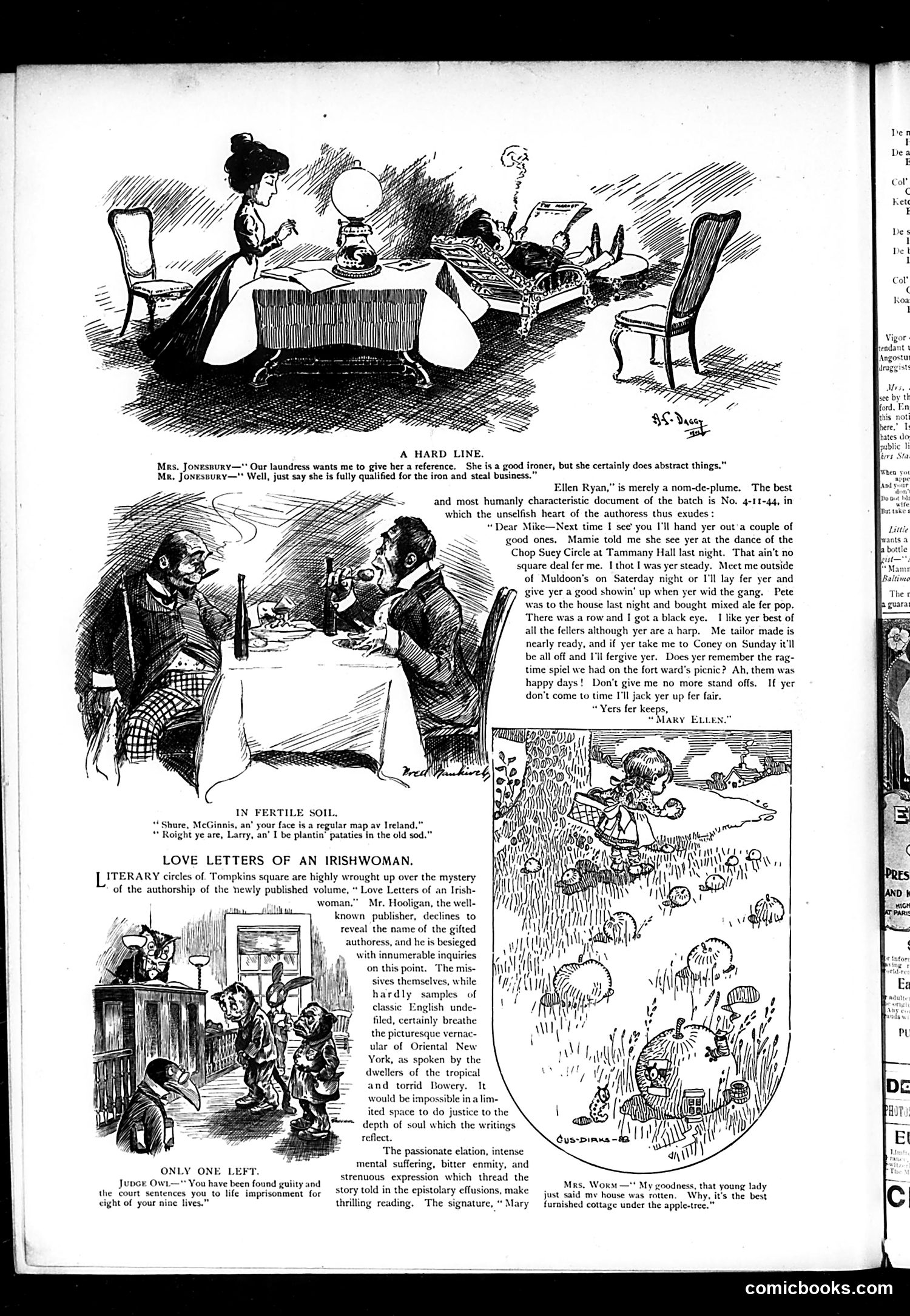
**"A Hard Line"** (top): A joke about a dishonest laundress. Mrs. Jonesbury seeks a reference for her laundress, noting she's good at ironing but "abstracts things"—a euphemism for stealing. Her husband quips she's "fully qualified for the iron and steal business," punning on her ironing skills and actual theft. **"Love Letters of an Irishwoman"** (main feature): A satirical piece mocking both a sensationalist book and Irish-American working-class culture. The excerpt showcases deliberately crude dialect and melodramatic, misspelled content (a "young lady" named Ellen Ryan's passionate letter to "Mike"). The satire targets literary pretension—publishing houses marketing crude materials as serious literature—while also stereotyping Irish immigrants through exaggerated vernacular and references to Tammany Hall politics and ethnic social venues. **"In Fertile Soil"** (sidebar): A brief ethnic joke playing on Irish stereotypes about potatoes and Ireland ("the old sod"). The overall tone reflects *Judge* magazine's urban, establishment perspective mocking working-class immigrant culture.
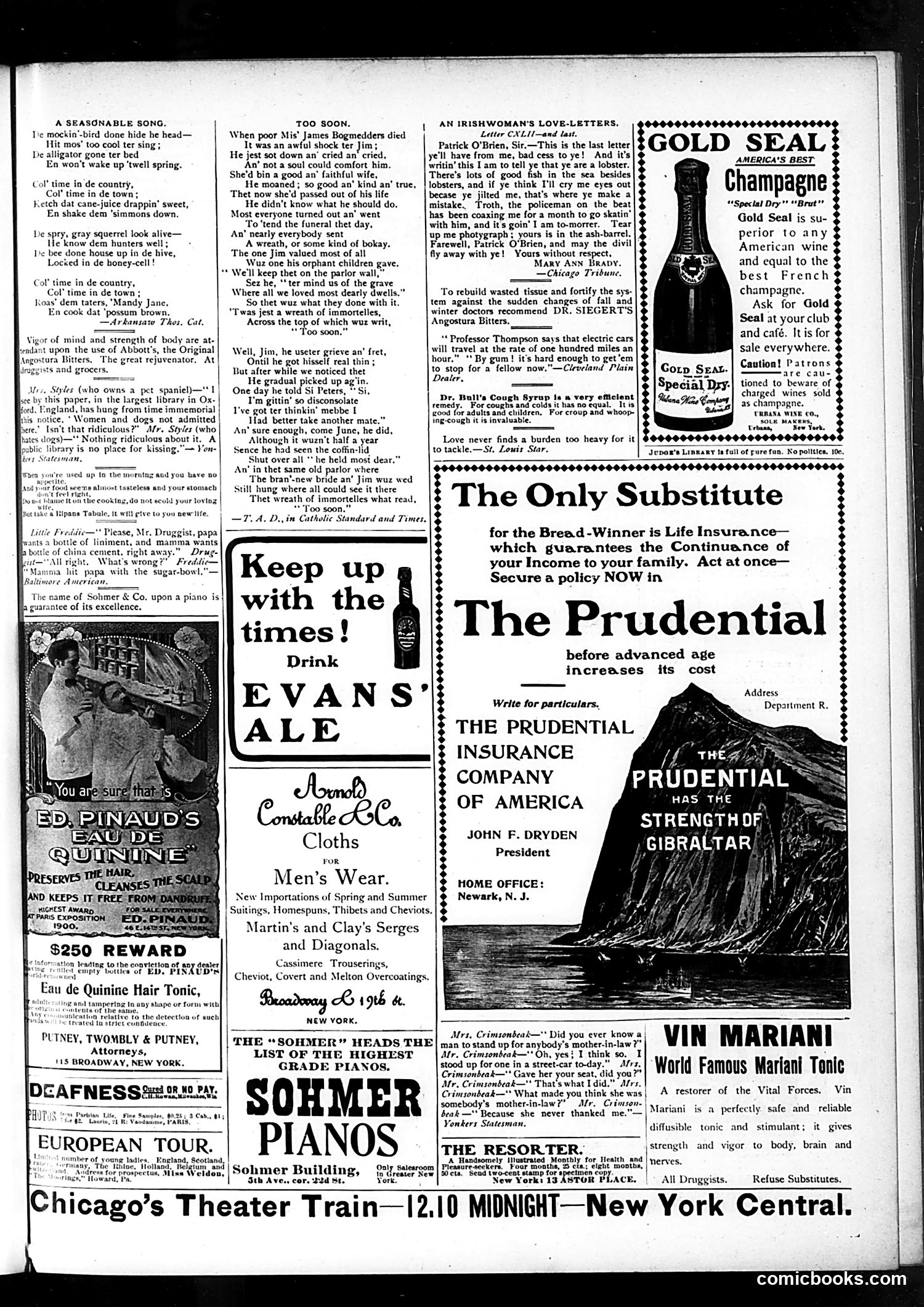
This page from *Judge* magazine is primarily **advertising and light humor** rather than political satire. The content includes: **Literary pieces**: "A Seasonable Song" (dialect verse about Southern seasonal life), "Too Soon" (sentimental story of a widower), and "An Irishwoman's Love-Letters" (humorous Irish dialect letter breaking up with "Patrick O'Brien"). **Advertisements**: The page is dominated by product ads—Gold Seal Champagne, Evans' Ale, Sohmer Pianos, Prudential Life Insurance, and various patent medicines (Dr. Siegert's Angostura Bitters, Dr. Tall's Cough Syrup). **Social humor**: The Irish letter parodies working-class dialect and romantic melodrama common in period humor; the Southern dialect poems reflect era-typical (if problematic) racial caricature humor. The satire is **gentle and commercial**—mostly selling products via amusing content rather than critiquing politics or major social issues.
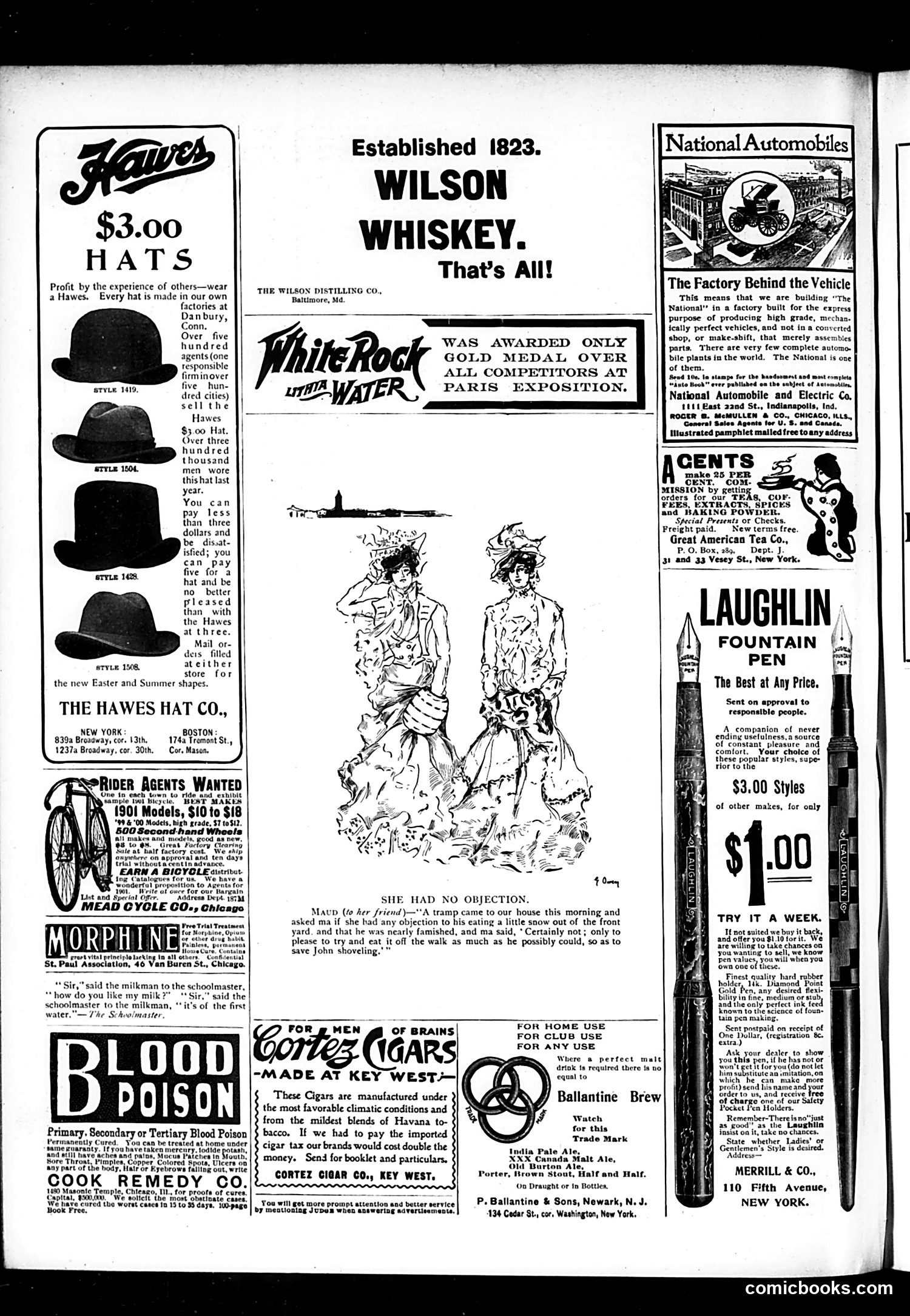
This page is primarily **advertising** rather than editorial content, comprising multiple product ads typical of early 1900s Judge magazine. The only cartoon present is titled **"She Had No Objection,"** a brief domestic humor sketch showing a woman telling her friend how her mother allowed a hungry tramp to eat snow from their yard—but only the snow he shoveled off the walk himself, to save her son John from that chore. The joke plays on genteel Victorian logic: appearing charitable while actually extracting labor and avoiding household work. The ads reflect the era's commercial culture: whiskey, hats, bicycles, cigars, blood poison cures, fountain pens, automobiles, and brewing products. The "Blood Poison" cure ad is notably alarming by modern standards, advertising treatment for sexually-transmitted infections—a common but now-shocking medical advertisement of the period.
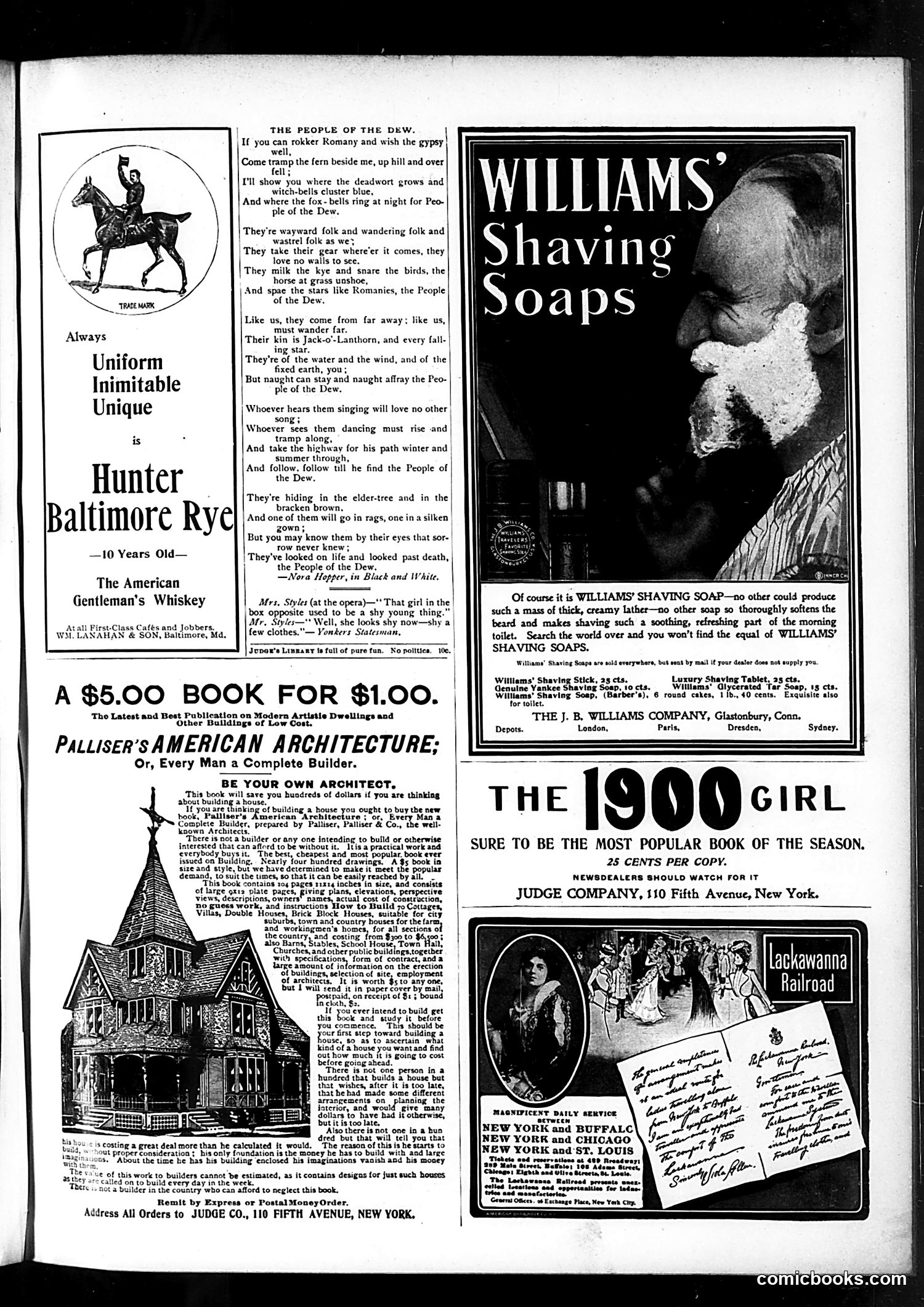
This page is primarily **advertisements and poetry**, not political satire. The main content includes: 1. **"The People of the Dew"** — a romantic poem by Nora Hopper about gypsies/Romani people, presented as whimsical wanderers living in harmony with nature. This reflects late-Victorian Romantic idealization of Romani culture. 2. **Hunter Baltimore Rye whiskey ad** — marketing a 10-year-old American whiskey as "uniform," "inimitable," and "unique." 3. **A brief joke** about Mrs. Styles at the opera — a woman once shy is now dressed provocatively ("shy a few clothes"), a mild critique of changing female behavior/fashion. 4. **Architectural book advertisements** and **Williams Shaving Soaps ad** — standard period marketing. 5. **"The 1900 Girl"** book promotion — suggesting this title will be the season's most popular book. The page contains **no significant political cartoon or satire** — it's a commercial/literary miscellany typical of Judge's advertising-heavy format from this era.
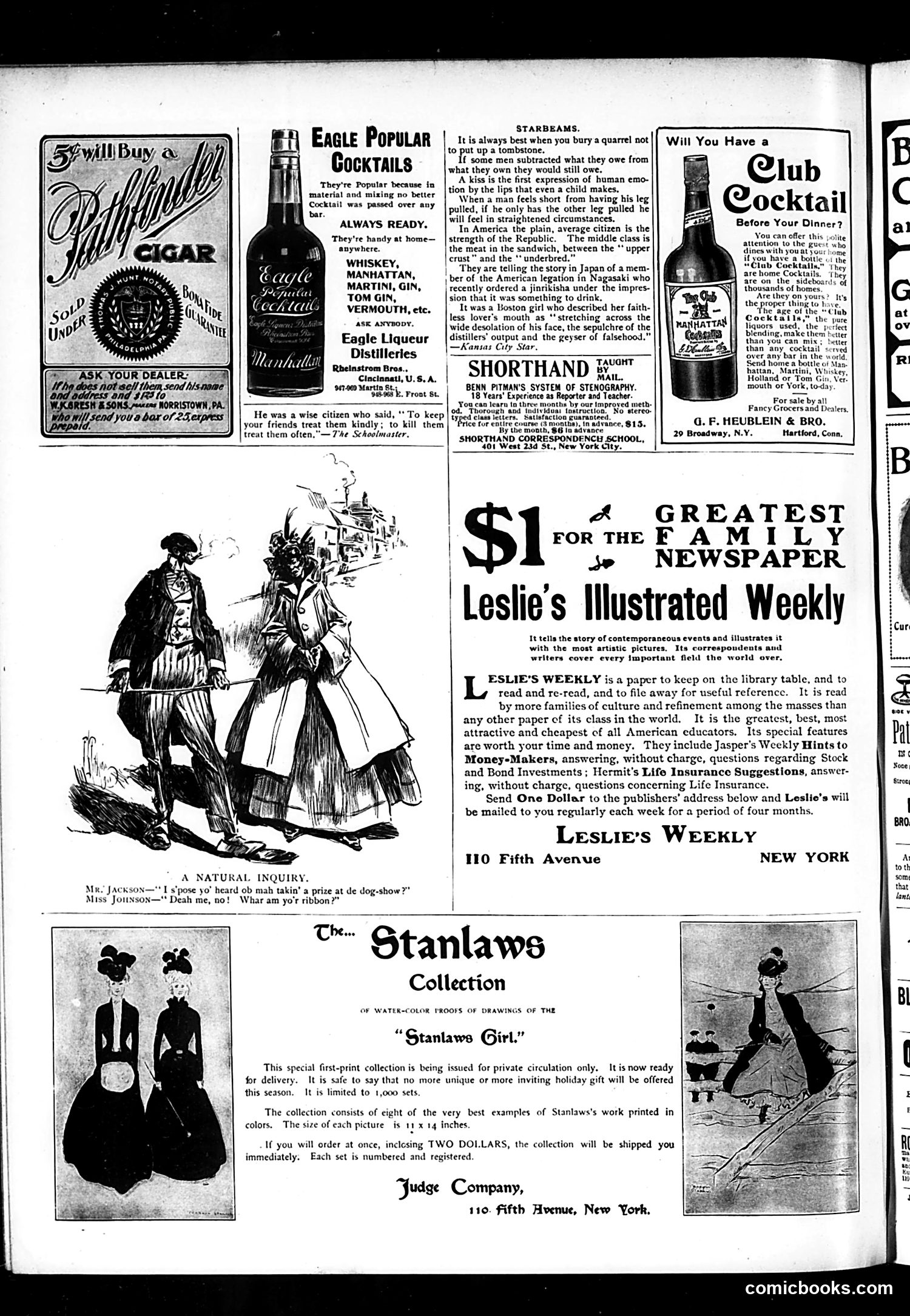
This page is primarily **advertising and announcements**, not political satire. The single cartoon—"A Natural Inquiry" (bottom left)—is a mild **racial joke** in the style typical of early 20th-century publications. It depicts two women, one in blackface dialect ("s'pose yo' heard ob mah taki'"), the other responding with exaggerated surprise. The humor trades on racial caricature and presumed ignorance, reflecting dated entertainment standards of the era. The rest of the page consists of liquor advertisements (Eagle Popular Cocktails, Eagle Liqueur, Heublein drinks), a subscription offer for Leslie's Illustrated Weekly magazine, and a sales announcement for "The Stanlaws Collection"—water-color artwork by the artist Stanlaws, limited to 1,000 sets at two dollars. The "Starbeams" section offers brief aphorisms on citizenship and behavior—unremarkable social commentary for the period.
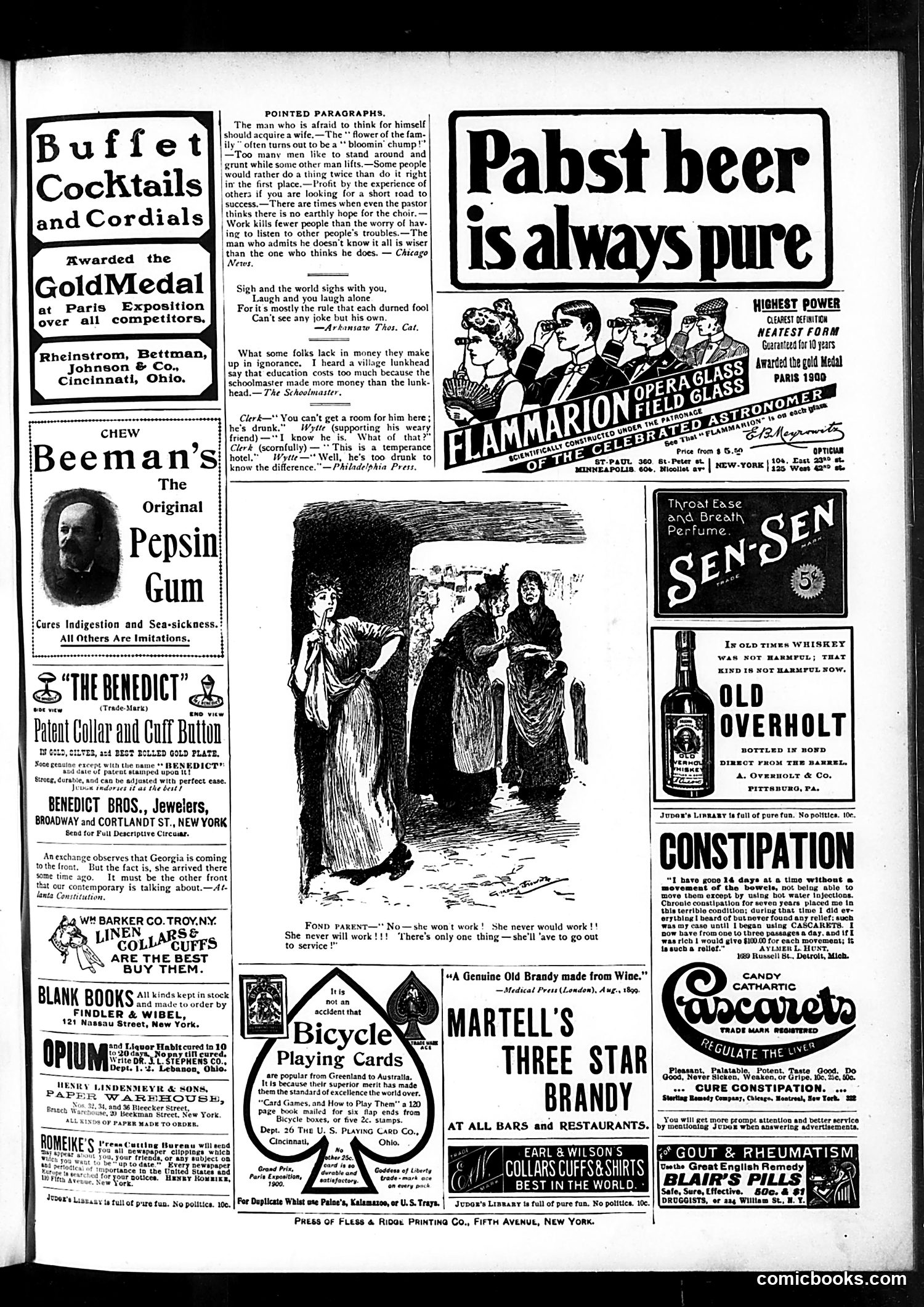
This page is primarily **advertising**, with minimal editorial cartooning. The small illustrated cartoon shows a "Fond Parent" confronting a young woman about employment, with dialogue suggesting she refuses to work. The joke appears to be social commentary on idle, privileged young women—a common Gilded Age concern about the leisure class. The bulk of the page consists of patent medicines, liquor advertisements, and consumer goods typical of early 1900s Judge magazine: Pabst Beer, Martell's Brandy, Old Overholt whiskey, Beeman's Pepsin Gum, and various nostrums claiming to cure constipation and other ailments. The "Pointed Paragraphs" section offers moralistic aphorisms about self-reliance, education, and foolishness—typical Judge humor aimed at middle-class readers concerned with propriety and work ethic. **No major political figures or events are referenced.** This represents Judge's standard editorial mix: light social satire combined with lucrative advertising.
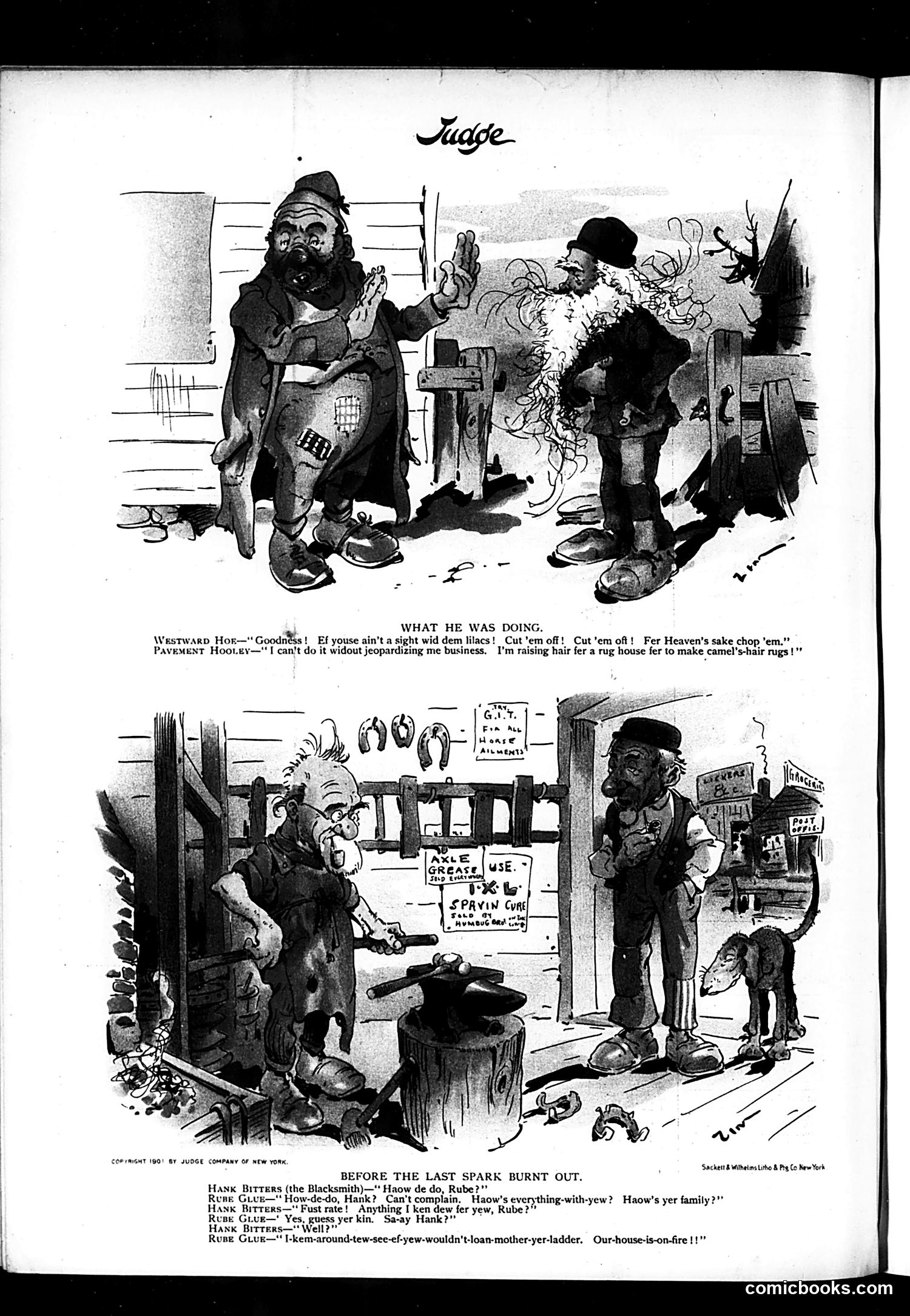
This page contains two satirical cartoons commenting on urban poverty and homelessness. The top cartoon, titled "What He Was Doing," depicts two impoverished men arguing—one defending his unconventional hair-raising business (making camel-hair rugs) against criticism about his appearance. The bottom cartoon, "Before the Last Spark Burnt Out," shows two poor men in what appears to be a makeshift shelter or boarding house, discussing their dire circumstances and family situations. The dialogue emphasizes their desperate economic conditions. Both cartoons use exaggerated caricature and ethnic stereotyping (common to the era) to satirize working-class poverty, homelessness, and the desperation of immigrants or marginalized populations in industrial America. The satire appears sympathetic yet somewhat condescending toward these struggling figures.