
Judge, 1901-03-23 · page 6 of 16
Judge — March 23, 1901 — page 6: what you’re looking at
What you’re looking at
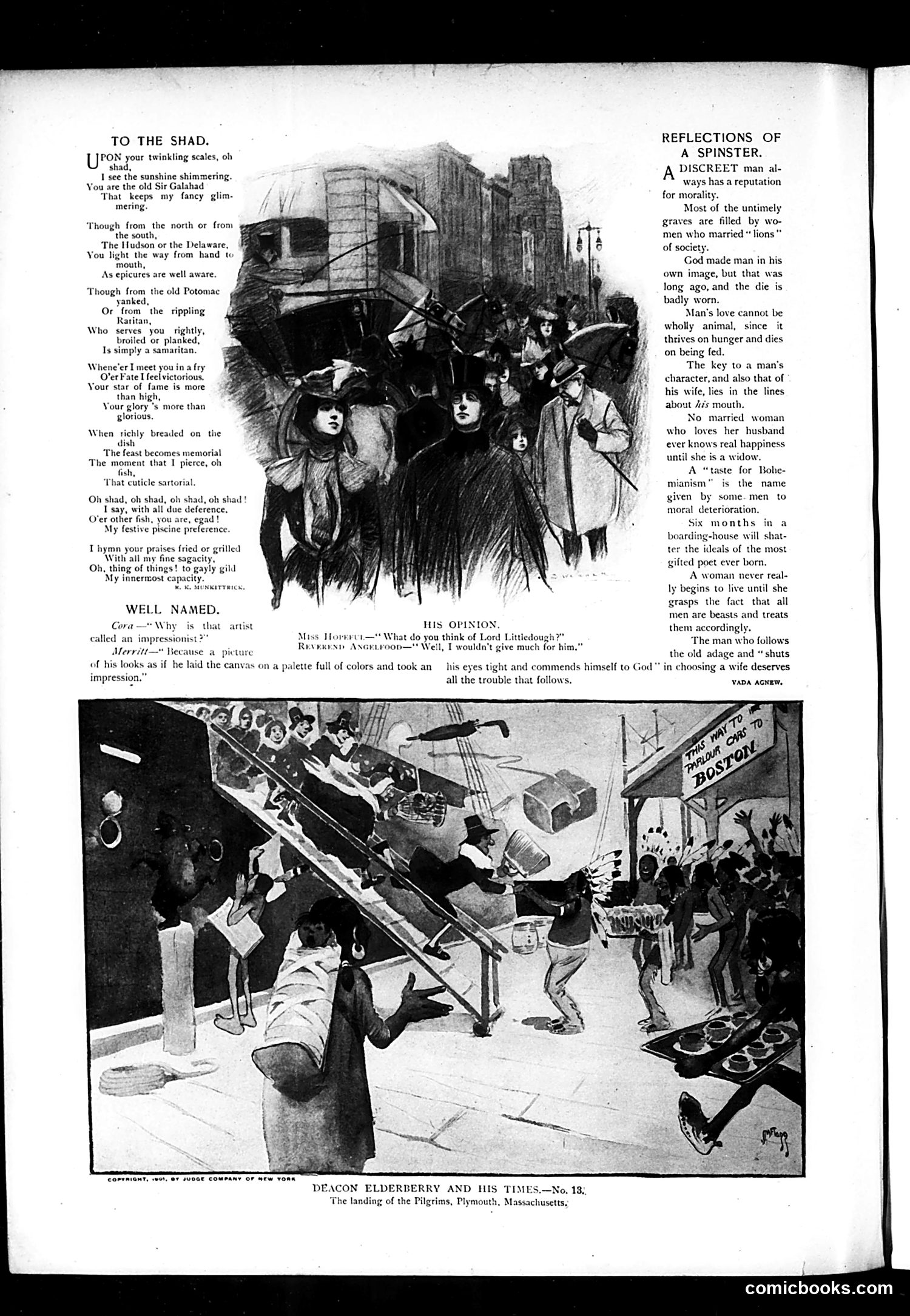
This page contains three distinct satirical pieces typical of early 20th-century humor: **"To the Shad"** is a humorous poem celebrating shad fish as a delicacy, using overwrought romantic language ("old Sir Galahad," "memorial feast") to mock both the fish and diners' pretentious appreciation of it. **"Well Named"** is a brief joke mocking Impressionist artists, suggesting their technique amounts to randomly slapping paint on canvas—a common criticism of the art movement at the time. **"Reflections of a Spinster"** presents cynical observations about marriage and gender relations, delivered with biting wit. The commentary suggests women marry poorly, that men are inherently bestial, and that divorce or widowhood represents liberation—reflecting period anxieties about evolving gender roles. **"Deacon Elderberry"** (bottom) illustrates a historical vignette about the Pilgrims landing at Plymouth, likely providing comedic commentary on American origins through the "Deacon" character series. The page reflects Judge's satirical approach: poking fun at artistic pretension, food snobbery, and contemporary social attitudes toward marriage and gender.
📄 Transcribed text from this page (OCR, searchable)
Machine-transcribed from the original scan — historical spelling and the odd misread are preserved.
TO THE SHAD. [PON your twinkling scales, oh shad, I see the sunshine s You are the old Sir Galaha That keeps mering. ‘Though from the north or fron the south, The Hudson or the Delaware, You light the way from hand mouth, As epicures are well aware, Though from the old Potomac yanked, Or from ‘the rippling Raritan, Who serves you rightly, broiled or planked, Is simply a samaritan. Whene’er I meet you ina fry O'er Fate I feel victorious. Your star of fame is more than high, Your glory ’s more than glorious. When richly breaded on the dish The feast becomes memorial The moment that I pierce, oh fish, That cuticle sartorial, Oh shad, oh shad, oh shad, oh shad! I say, with all due deference. er other fish, you are, egad ! My festive piscine T hymn your praises fried or grilled With all my fine sagacity, Oh, thing of things! to gayly gild My innermost capacity. WELL NAMED. Cora —" Why is that artist called an impressio Merritt— Vecause a picture of his looks as if he laid the canvas on a palette full of colors and took an impression.” my fancy glim- Miss Horeretr—" What do you think of Lord Littiedoug Revexesn ANcriroop—* Well, I wouldn't give much for him.” HIs OPINION, all the trouble that follows. DEACON ELDERBERRY AND HIS TIMES.—No. 13; ‘The landing of the Pilgrims, Plymouth, Massachusetts. REFLECTIONS OF A SPINSTER. DISCREET man al- ways has a reputation for morality. Most of the untimely graves are filled by wo- men who married “ lions” of society. God made man in his own image, but that was long ago, and the die is badly worn. Man's love cannot be wholly animal, since it thrives on hunger and dies on being fed. The key to a man's character, and also that of his wife, lies in the lines about 47s mouth. No married woman who loves her husband ever knows real happiness until she is a widow. A “taste for Bohe- nism" is the name given by some. men to moral deterioration, Six months boarding-house will shat- ter the ideals of the most gifted poet ever born. A woman never real- ly begins to live until she grasps the fact that all men are beasts and treats them accordingly. The man who follows the old adage and “ shuts his eyes tight and commends himself to God" in choosing a wife deserves VADA AGNEW, comicbooks.com