
Judge, 1901-03-23 · page 2 of 16
Judge — March 23, 1901 — page 2: what you’re looking at
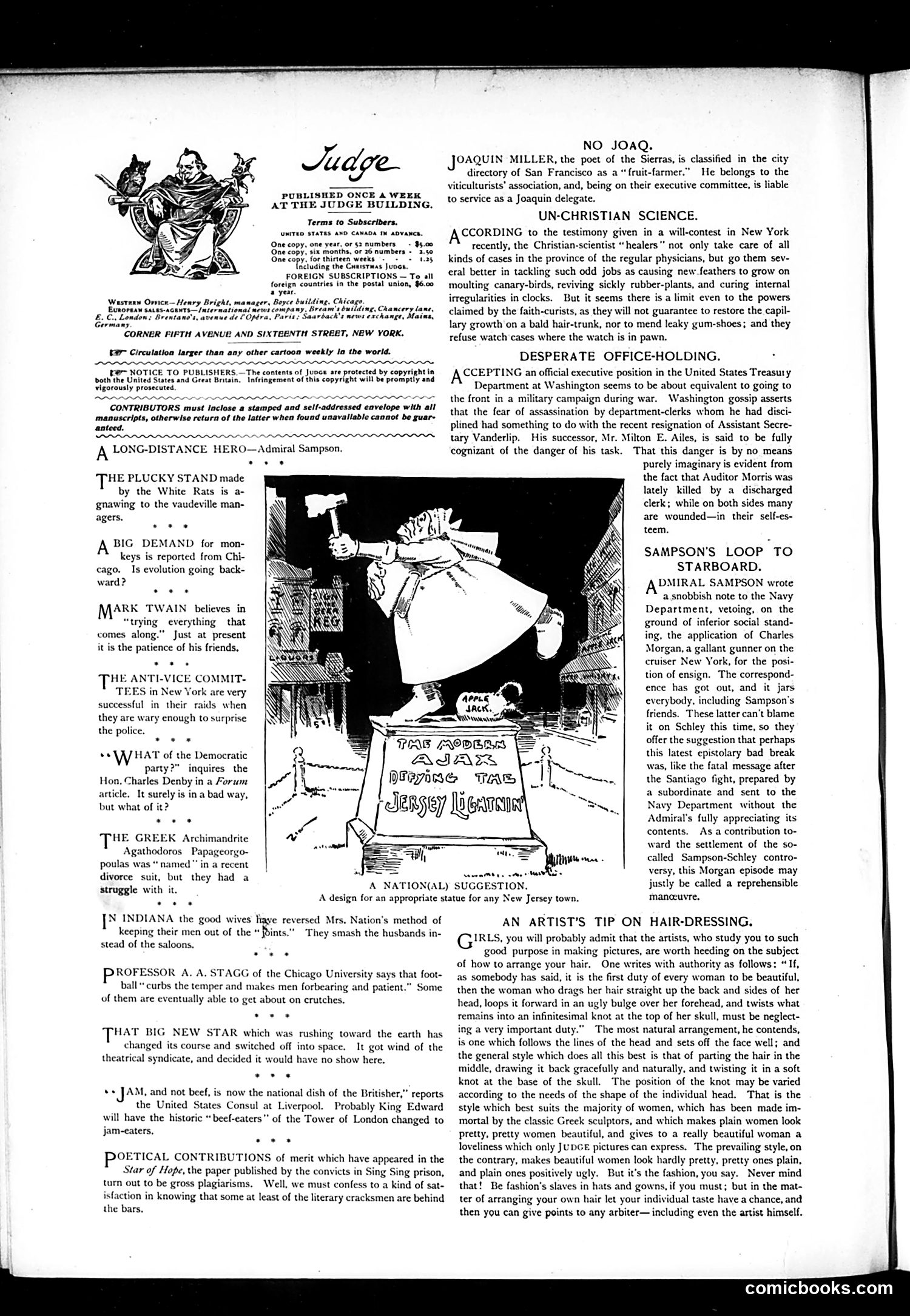
What you’re looking at
This cartoon satirizes New Jersey municipal governance. The central figure appears to be a rotund politician or official labeled as representing New Jersey civic leadership. He's depicted in an undignified pose atop what looks like a pedestal or monument, with the text suggesting this is "a design for an appropriate statue for any New Jersey town." The satire mocks New Jersey's political corruption or incompetence by sarcastically proposing this unflattering caricature as a suitable public monument. The exaggerated physicality and absurd positioning ridicule local officials' behavior and character. Without more specific context, the exact target remains unclear, but the cartoon clearly expresses contempt for New Jersey's political establishment through visual mockery.
📄 Transcribed text from this page (OCR, searchable)
Machine-transcribed from the original scan — historical spelling and the odd misread are preserved.
Sudge PUBLISHED ONCE 4 WEEK AT THE JUDGE BUILDING, Terms to Subscribers. UNITED STATES AND CANADA IM ADVANCS, ‘One copy, one year. or 52 numbers ‘One copy, six months, or 26 num! One copy, for thirteen weeks - facluding the Cunistmas Ju FOREIGN SUBSCRIPTIONS — To all foreign countries in the postal union, $6.09 ayer. Wasteaw Orrice—Henry Bright, manager, Boyce building, Chicago. Eunoream saies-acents—/nternational mews company. Bream’ s building, Chancery l E, Cu Londons Brentanc's, avenue de Optra, Parts; Saarbach's mews exchange, Ma Germany CORNER FIFTH AVENUE AND SIXTEENTH STREET, NEW YORK. (27 Circulation larger than any other cartoon weekly Ia the world. Te™ NOTICE TO PUBLISHERS,—The contents of Juocu are protected by copyright in both the United States and Great Britain. Infringement of this copyright will be promptly and vigorously prosecuted. CONTRIBUTORS must taclose a stamped and self-addressed envelope with all manuscripts, otherwise return of the latter when found unavailable cannot be guare anteed. A LONG-DISTANCE HERO—Admiral Sampson, ‘THE PLUCKY STAND made by the White Rats is a- gnawing to the vaudeville man- agers. BIG DEMAND for mon- keys is reported from Chi- cago. Is evolution going back- ward? ARK TWAIN believes in “trying everything that comes along.” Just at present it is the patience of his friends. ork are very aids when they are wary enough to surprise the polic successful in their oe HAT of the Democratic party?” inquires the Hon, Charles Denby in a Forum article, It surely is in a bad way, but what of it? THE GREEK Archimandrite Agathodoros Pap; poulas was “ named" in divorce suit, but they had a struggle with it. ATION(AL) I‘ INDIANA the good wives have reversed Mrs, Nation's method of keeping their men out of the “fbints.”” They smash the husbands in- stead of the saloons. PROFESSOR A. A. STAGG of the Chicago University says that foot- ball“ curbs the temper and makes men forbearing and patient.” Some of them are eventually able to get about on crutches. THAT BIG NEW STAR which was rushing toward the earth has \ged its course and switched off into space. It got wind of the ‘al syndicate, and decided it would have no show here. thea ++ JAM, and not beef, is now the national dish of the Britisher,” reports the United States Consul at Liverpool. Probably King Edward will have the historic “beef-eaters” of the Tower of London changed to jam-eaters. POETICAL CONTRIBUTIONS of merit which have appeared in the Star of Hope, the paper published by the convicts in Sing Sing prison, turn out to be gross plagiarisms. Well, we must confess to a kind of sat- isfaction in knowing that some at least of the literary cracksmen are behind the bars. “PAB ACODER AIA NPaiRe TAS SERGEY Ligaenet A design for an appropriate statue for any New Jersey town. NO JOAQ. JOAQUIN MILLER, the poet of the Sierras, is classified in the city directory of San Francisco as a“*fruit-farmer.” He belongs to the viticulturists' association, and, being on their executive committee, is liable to service as a Joaquin delegate. UN-CHRISTIAN SCIENCE. CCORDING to the testimony given in a will-contest in New York recently, the Christian-scientist “healers” not only take care of all kinds of cases in the province of the regular physicians, but go them sev- eral better in tackling such odd jobs as causing new-feathers to grow on moulting canary-birds, reviving sickly rubber-plants, and curing internal irregularities in clocks. But it seems there is a limit even to the powers claimed by the faith-curists, as they will not guarantee to restore the capil- lary growth on a bald hair-trunk, nor to mend leaky gum-shoes; and they refuse watch'cases where the watch is in pawn. DESPERATE OFFICE-HOLDING. : ACCEPTING an official executive position in the United States Treasury Department at Washington seems to be about equivalent to going to the front in a military campaign during war. Washington gossip asserts that the fear of assassination by department-clerks whom he had disci- plined had something to do with the recent resignation of Assistant Secre- tary Vanderlip. His successor, Mr. Milton E. Ailes, is said to be fully cognizant of the danger of his task. That this danger is by no means purely imaginary is evident from the fact that Auditor Morris was lately killed by a discharged clerk; while on both sides many are wounded—in their self-es- teem. SAMPSON’S LOOP TO STARBOARD. ADMIRAL SAMPSON wrote a snobbish note to the Navy Department, vetoing, on the ground of inferior social stand- ing, the application of Charles Morgan, a gallant gunner on the cruiser New York, for the posi- tion of ensign. The correspond- ence has got out, and it jars everybody, including Sampson's friends. These latter can’t blame it on Schley this time, so they offer the suggestion that perhaps this latest epistolary bad break was, like the fatal message after mi the Santiago fight, prepared by ~ a subordinate and sent to the oA Navy Department without the Admiral’s fully appreciating its contents. As a contribution to- ward the settlement of the so- called Sampson-Schley contro- versy, this Morgan episode may justly be called a reprehensible manauvre, Aten neue tal SUGGESTION. AN ARTIST’S TIP ON HAIR-DRESSING, GIRLS. you will probably admit that the artists, who study you to such good purpose in making pictures, are worth heeding on the subject of how to arrange your hair. One writes with authority as follows: “If, as somebody has said, it is the first duty of every woman to be beautiful, then the woman who drags her hair straight up the back and sides of her head, loops it forward in an ugly bulge over her forehead, and twists what remains into an infinitesimal knot at the top of her skull, must be neglect- ing a very important duty.” The most natural arrangement, he contends, is one which follows the lines of the head and sets off the face well; and the general style which does all this best is that of parting the hair in the middle, drawing it back gracefully and naturally, and twisting it in a soft knot at the base of the skull. The position of the knot may be varied according to the needs of the shape of the individual head. That is the style which best suits the majority of women, which has been made im- mortal by the classic Greek sculptors, and which makes plain women look pretty, pretty women beautiful, and gives to a really beautiful woman a loveliness which only JUDGE. pictures can express. The prevailing style, on the contrary, makes beautiful women look hardly pretty, pretty ones plain, and plain ones positively ugly. But it’s the fashion, you say. Never mind 's and gowns, if you must; but in the mat- t your individual taste have a chance, and then you can give points to any arbiter— including even the artist himself. comicbooks.com