
A complete issue · 12 pages · 1901
Judge — March 2, 1901
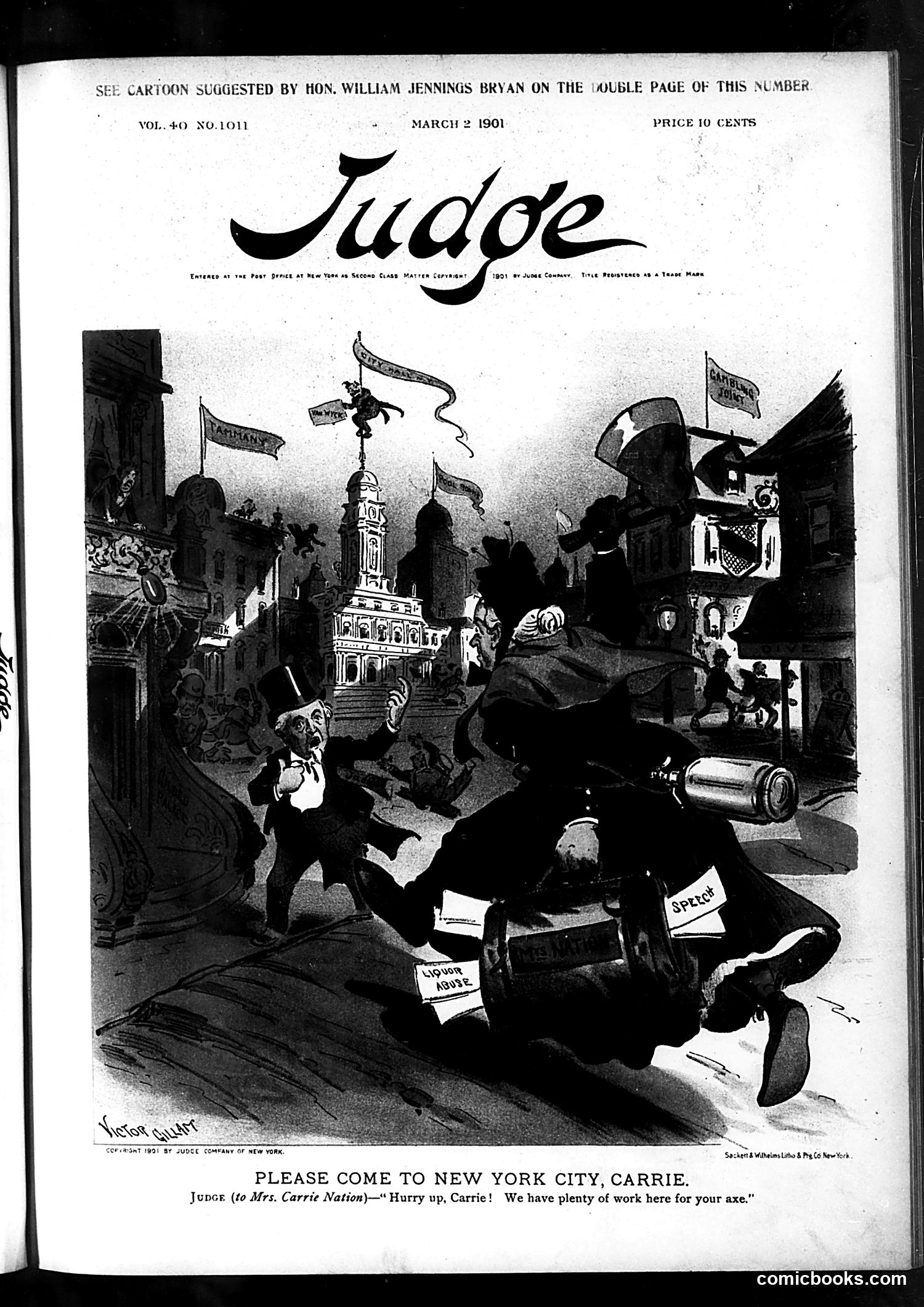
This March 2, 1901 *Judge* cartoon satirizes Carrie Nation (identified in the caption as "Mrs. Carrie Nation"), the famous temperance activist known for her violent anti-alcohol crusades. The illustration depicts a chaotic street scene in New York City with overturned bottles labeled "Liquor" and "Spirits," suggesting alcohol-fueled disorder. The cartoon invites Nation to New York, implying the city desperately needs her destructive brand of reform to combat rampant drinking and associated social problems. The scene's chaos—with buildings and figures in disarray—humorously suggests that only Nation's extreme methods could restore order. This reflects contemporary debates over Prohibition and women's reform movements, positioning Nation as both a feared and mockingly necessary force for moral cleanup.
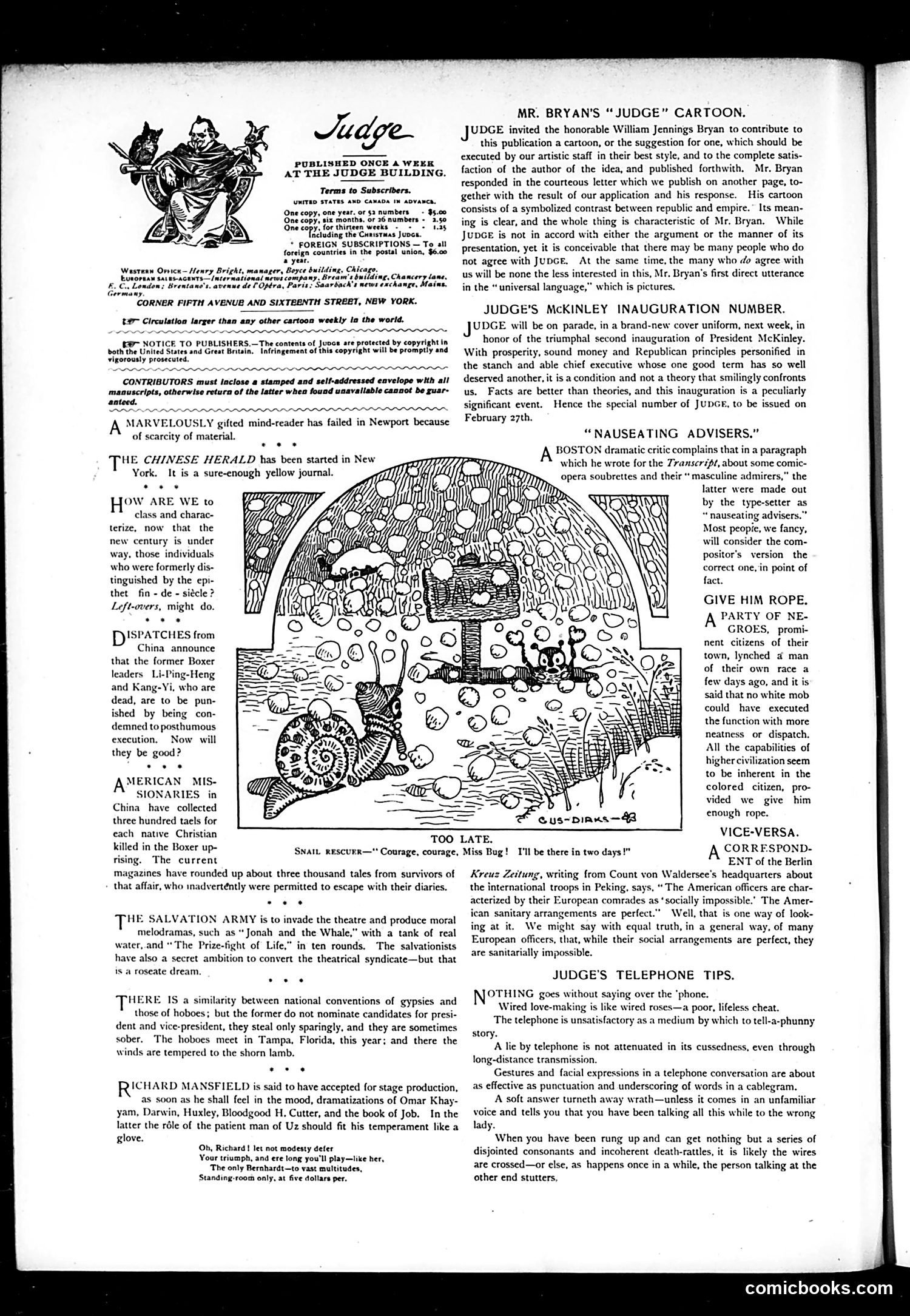
The main cartoon, titled "TOO LATE," depicts a snail rescuer scene. A figure labeled "Miss Bug" appears trapped in a snail shell amid bubbles, with dialogue "Courage, courage, Miss Bug! I'll be there in two days!" The satire mocks slow rescue efforts or ineffectual aid—the snail's notorious slowness making the rescue absurdly delayed and therefore useless. The page also contains editorial commentary on various topics: China's turmoil (Li Hung-chang's execution), the Salvation Army's theatrical productions, and gypsies versus hoboes. The specific historical context of these references is unclear without additional dating information, but the cartoon exemplifies *Judge*'s typical approach: using anthropomorphic animals and visual absurdity to critique contemporary events and social institutions.
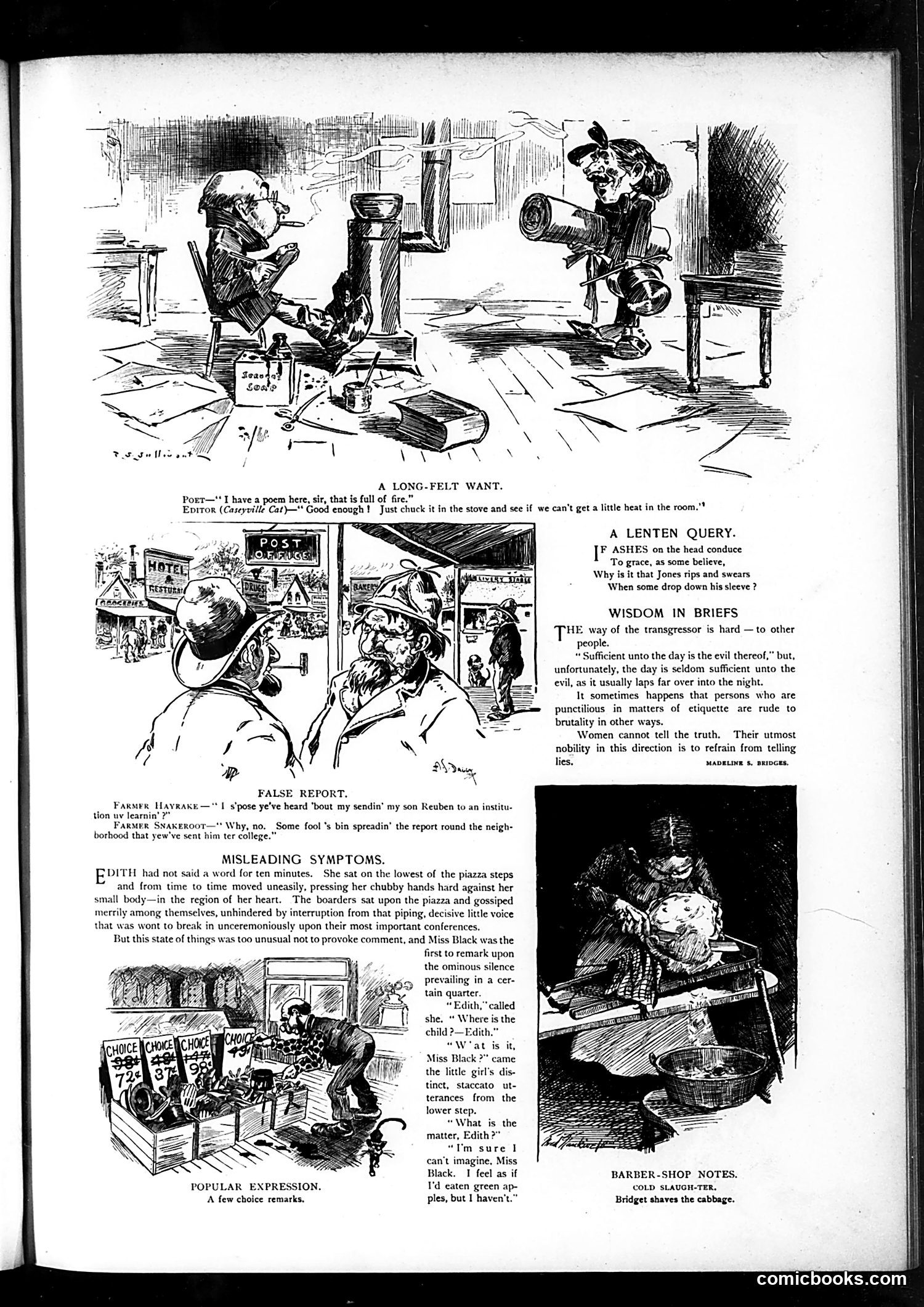
This page contains several satirical sketches and brief humorous pieces typical of Judge magazine's format: **"A Long-Felt Want"** (top): A poet and editor discuss submitting work to a publication. The editor's dismissive suggestion to "chuck it in the stove" is a joke about editorial rejection and the poor prospects for poets. **"False Report"** and **"Misleading Symptoms"**: These sketch anecdotes about rural communication mishaps and a woman's unexplained silence, using misunderstanding for humor. **"Wisdom in Briefs"**: A column offering cynical observations about social behavior—noting that "transgressors" find excuses and that women inherently cannot "tell the truth." **"Popular Expression"**: Shows a grocer's display with competing brands, likely satirizing commercial rivalry. The page exemplifies Judge's style: genteel, class-conscious humor targeting everyday social pretensions and human foibles rather than specific political events.
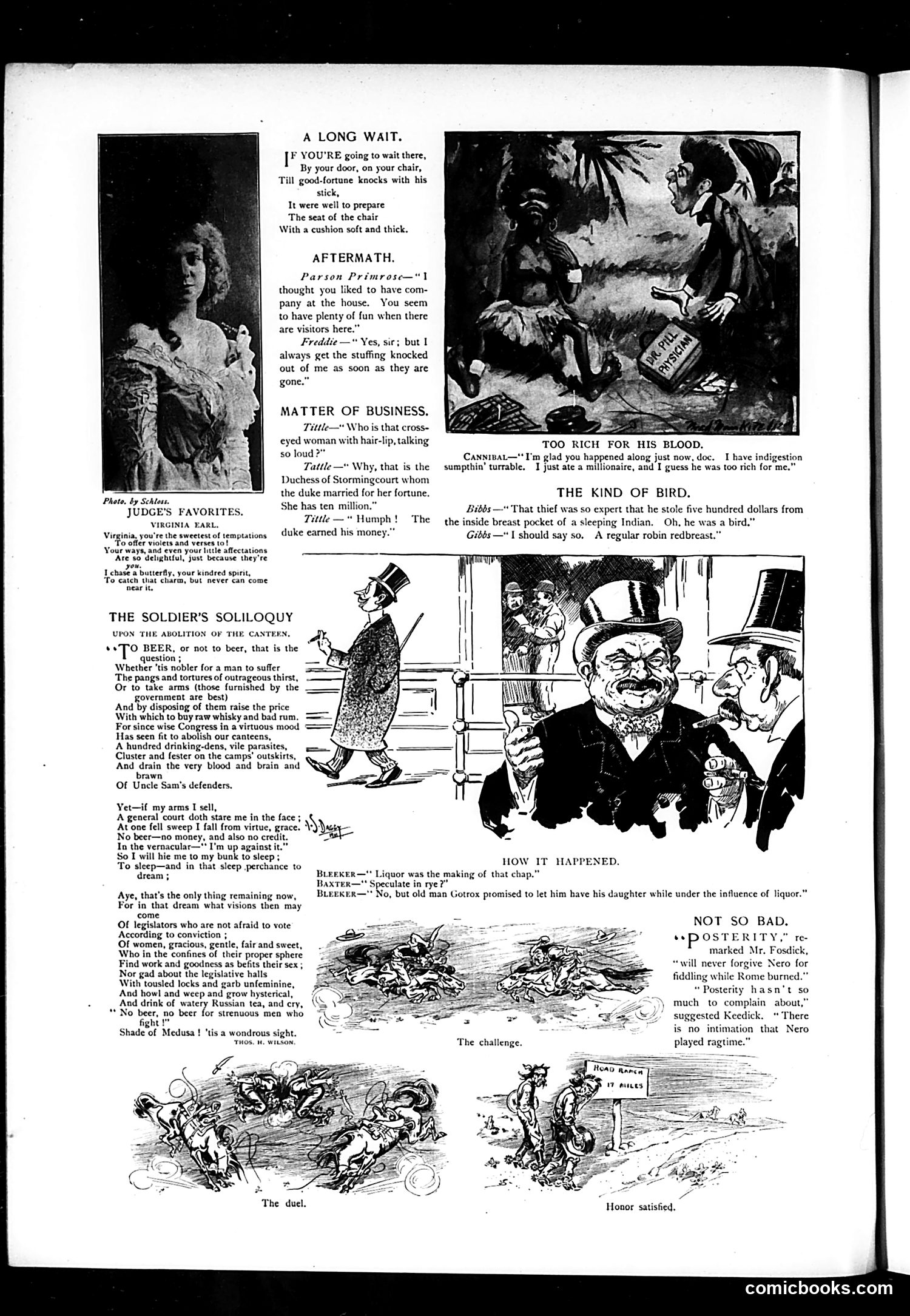
This page contains several satirical pieces from Judge magazine. The main cartoons include: **"Judge's Favorites"** features Virginia Earle, a theatrical performer, with accompanying verse praising her talents. **"The Soldier's Soliloquy"** presents a lengthy poem debating whether soldiers should drink alcohol, reflecting turn-of-the-century debates about military discipline and temperance. **"How It Happened"** depicts a dialogue about liquor's corrupting influence, with the caption suggesting a man named Gorox promised his daughter to someone while intoxicated. **"Not So Bad"** references "Posterity" not forgiving someone (unclear who) for "fiddling while Rome burned"—likely a classical allusion to Nero, adapted for contemporary scandal. The page emphasizes morality tales about alcohol's dangers and theatrical entertainment, typical of Judge's satirical approach to American social issues.
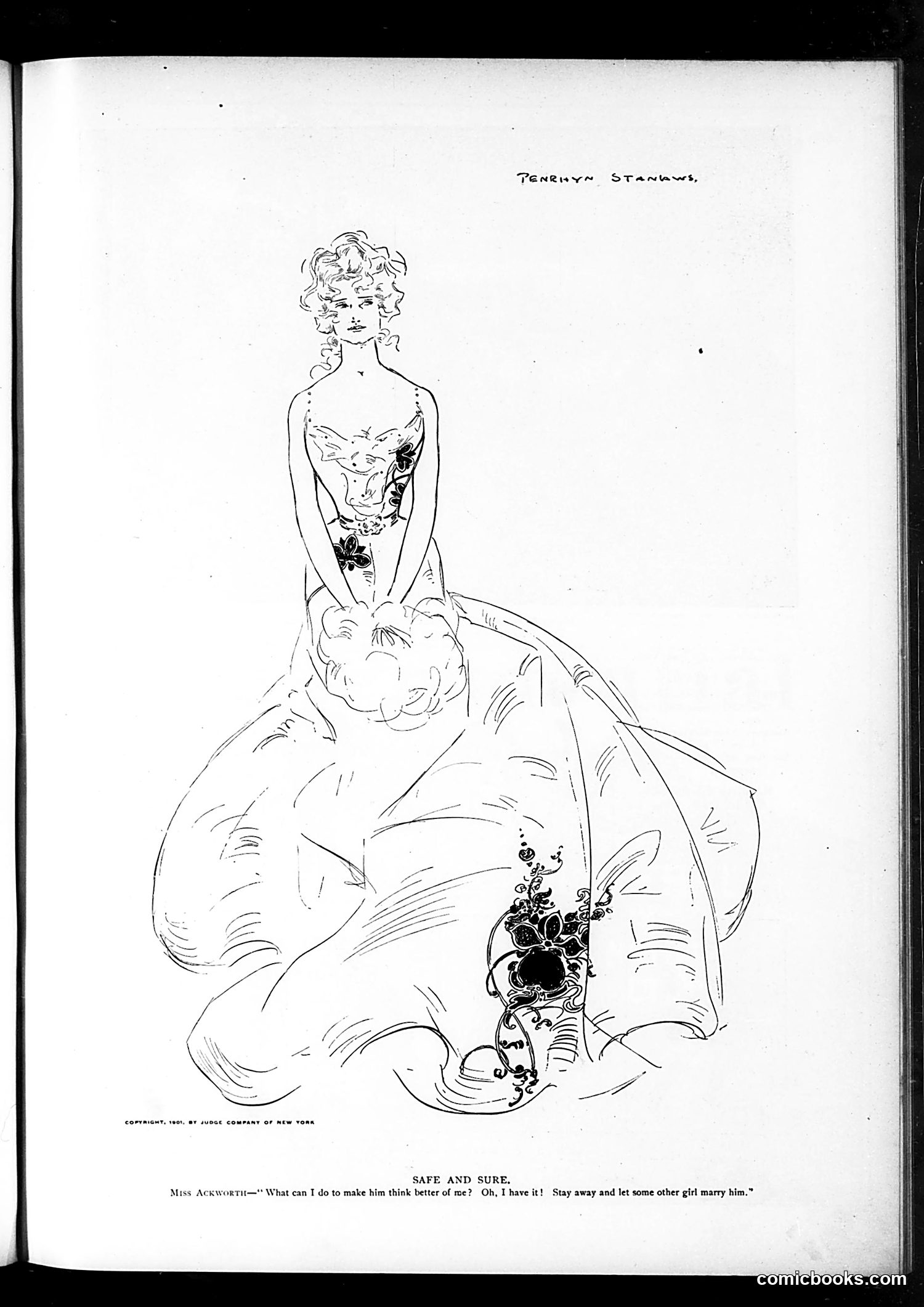
This Judge magazine cartoon presents a fashion illustration titled "Terribly Stanwyx" (the OCR garbled the name, likely referring to a contemporary actress or fashion figure). The satire appears to mock women's fashion extremes of the era—specifically the enormous, voluminous skirts characteristic of early 20th-century haute couture. The caption's dialogue—"What can I do to make him think better of me? Oh, I have it! Stay away and let some other girl marry him"—suggests ironic commentary on how excessive fashion might actually repel romantic suitors rather than attract them. The joke targets the absurdity of prioritizing elaborate, impractical clothing over genuine relationship appeal, satirizing both fashion excess and women's perceived priorities through male-centered humor typical of Judge's period.
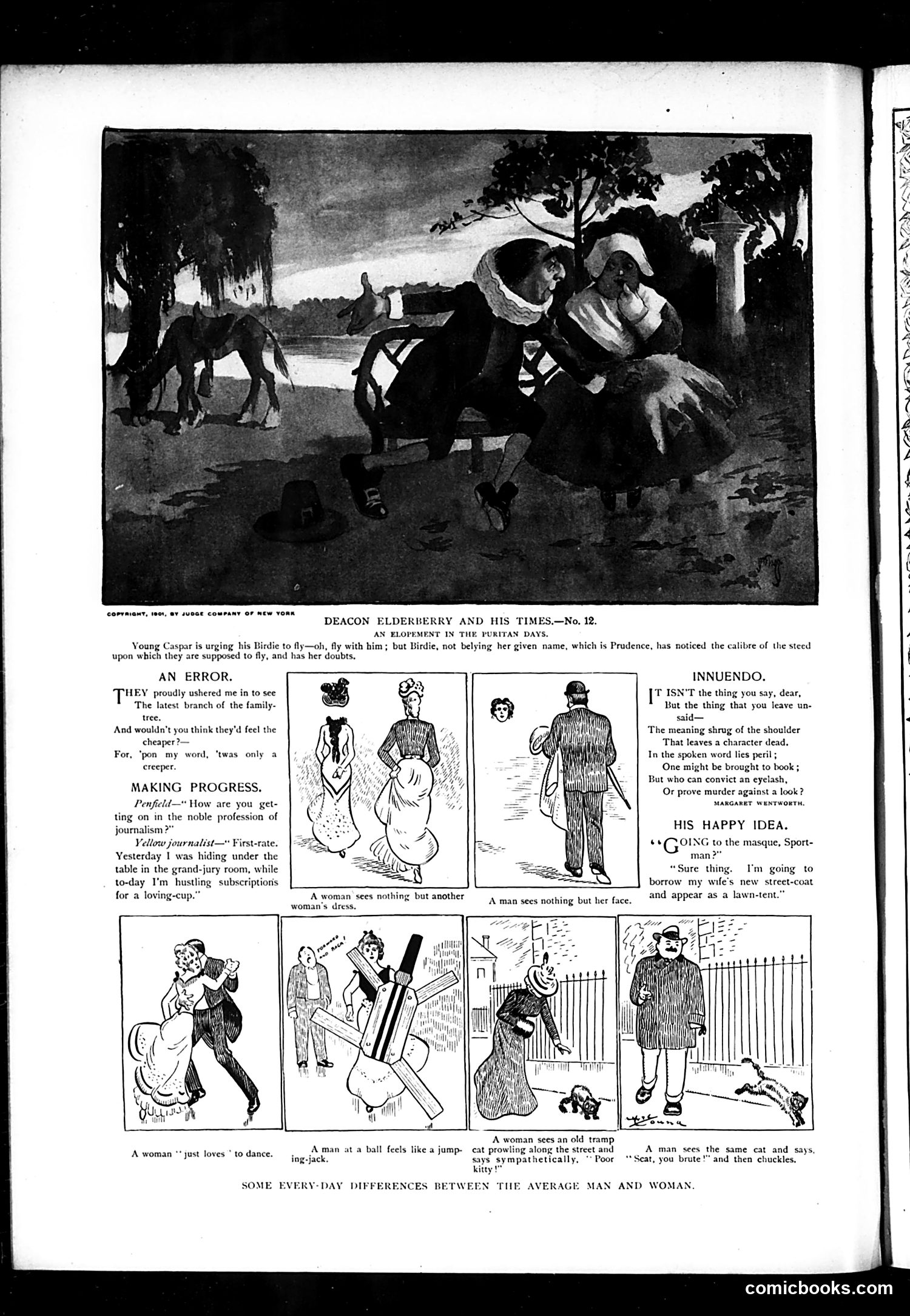
This page contains multiple satirical pieces mocking gender differences and social behavior of the era: **Top illustration**: An elopement scene from "Puritan Days" where a young man urges his reluctant bride to flee on horseback. The joke: she's named "Prudence" and lives up to it, doubting the horse's quality. **Main comics below** satirize contrasts between men and women: - Women notice clothing and fashion details; men notice only a woman's face - A woman's emotional response to a tramp cat versus a man's dismissive cruelty ("Scat, you brute") - A woman loves dancing; a man at a ball feels like a jumping toy - A man plans to wear his wife's coat to a masquerade as a "lawn-tent" (joke about her dress size) **Side items** mock journalism ethics (hiding under tables for stories) and family pride in "creepers" (climbing plants, implying inferior relatives). The satire reflects early 1900s gender stereotypes: women as emotional, fashion-conscious, and sentimental; men as superficial, callous, and crude.
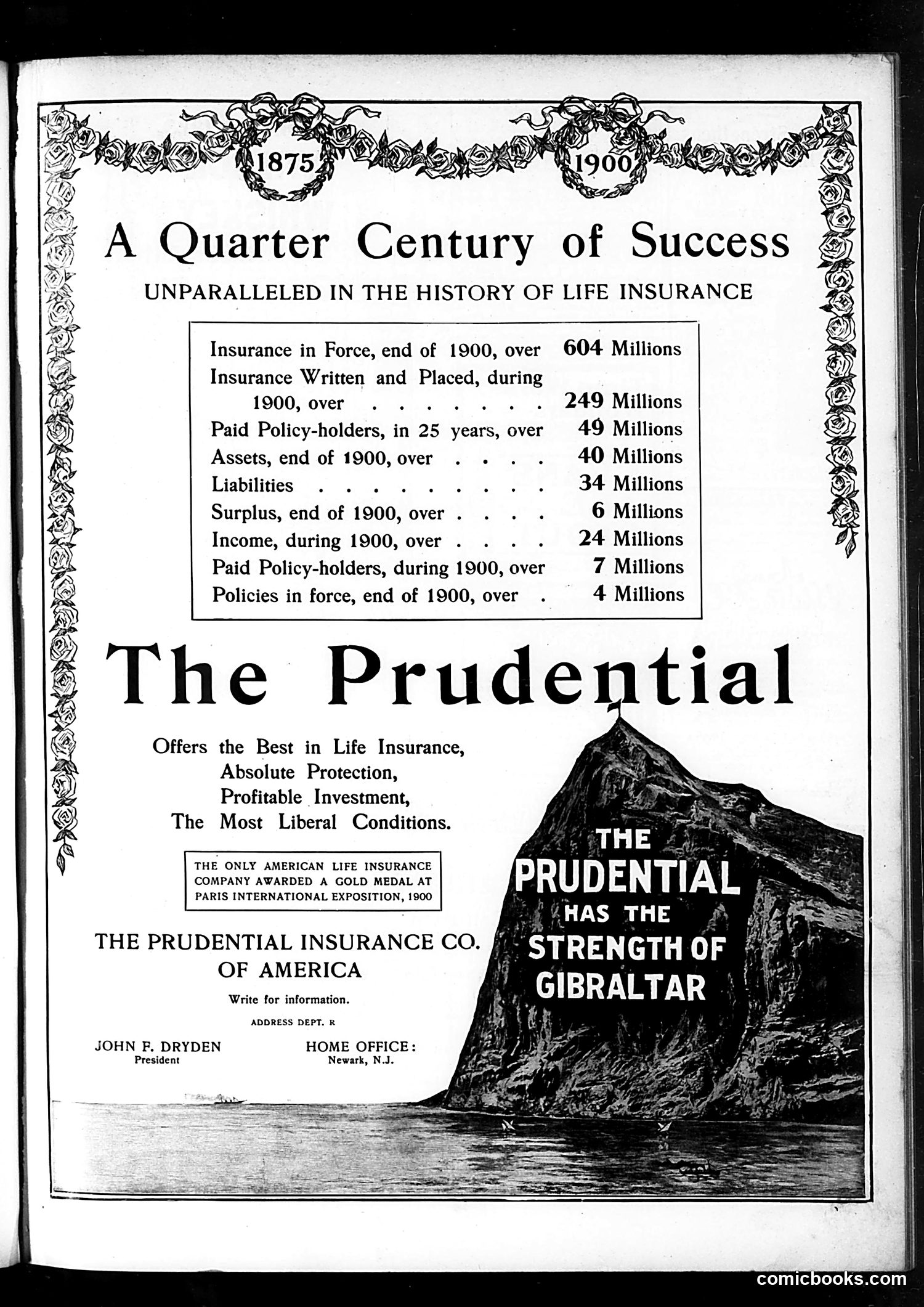
This page is primarily **advertising, not satire**. It's a promotional insert for The Prudential Insurance Company of America, celebrating 25 years of business (1875-1900). The content emphasizes Prudential's financial strength through impressive statistics: over 604 million in insurance in force, 249 million written in 1900 alone, and 49 million paid to policyholders over 25 years. The company highlights its gold medal from the 1900 Paris International Exposition. The symbolic image of **Gibraltar**—the famous Rock of Gibraltar—serves as a metaphor for stability and unshakeable strength. The tagline "THE PRUDENTIAL HAS THE STRENGTH OF GIBRALTAR" reinforces that the company is as solid and enduring as the famous fortification. This reflects the insurance industry's early-1900s marketing strategy: using financial figures and symbolic imagery to build consumer confidence in an industry many Americans still viewed with suspicion. President John F. Dryden's name appears for credibility.
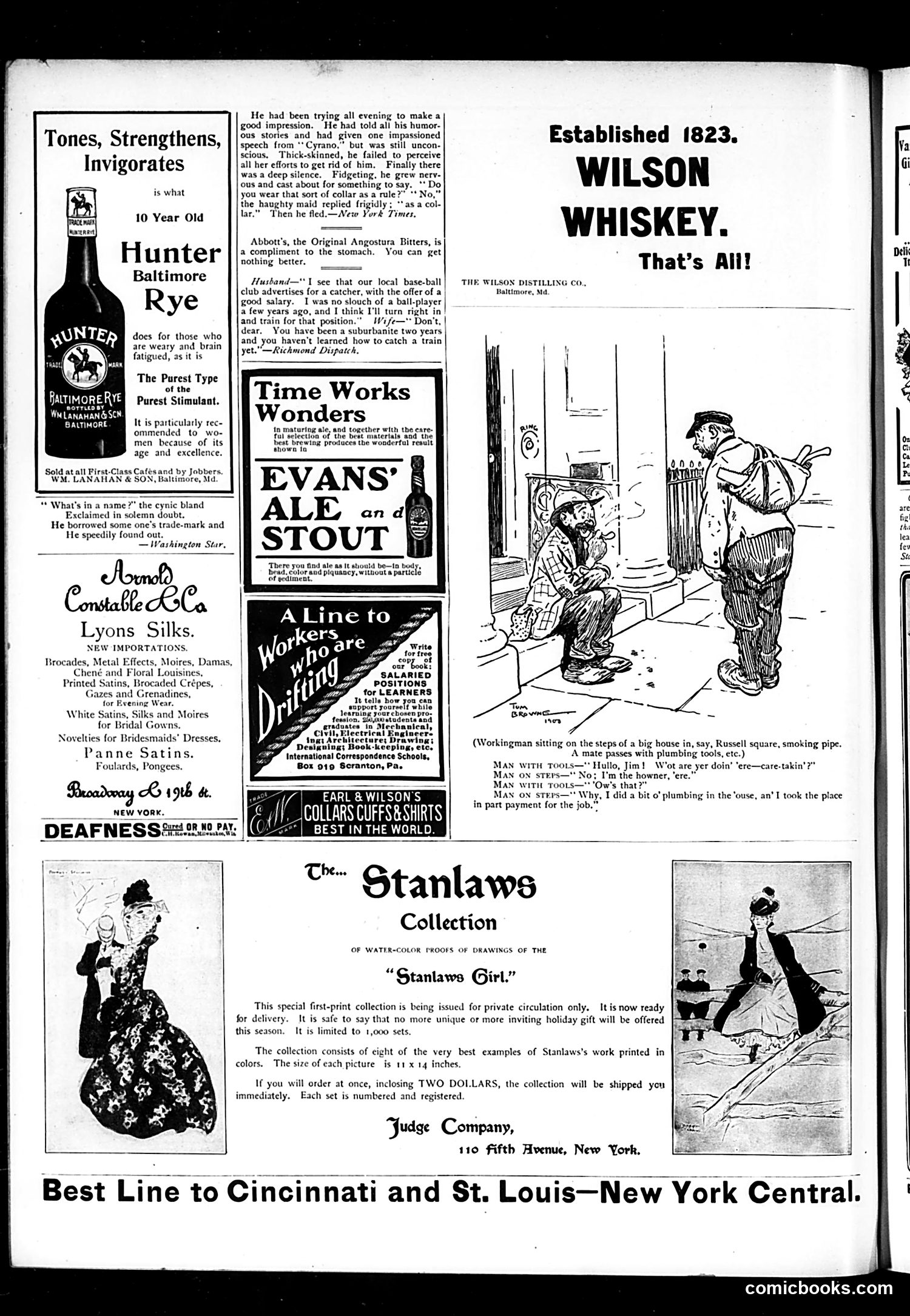
This is primarily an **advertising page** from Judge magazine (circa 1910s), with two brief humorous anecdotes and social commentary embedded among commercial advertisements. The main content features two short comic scenarios typical of Judge's humor: 1. **"The Silent Suitor"**: A young man fails to impress a woman and, after awkward silence, asks about her collar. She responds coldly that she wears it "as a collar"—a cutting dismissal suggesting he's socially inept. 2. **"The Workingman's Windfall"**: A man smoking on a house's steps reveals he now owns the house because he did plumbing work there and the owner paid him with the property rather than money. The humor lies in this improbable social reversal. Both jokes reflect **class consciousness and social anxiety** common to the era—concerns about courtship etiquette, social climbing, and economic instability. The advertisements surrounding them (whiskey, silks, correspondence schools) suggest the magazine's middle-class readership and aspirational messaging typical of early-20th-century American consumer culture.
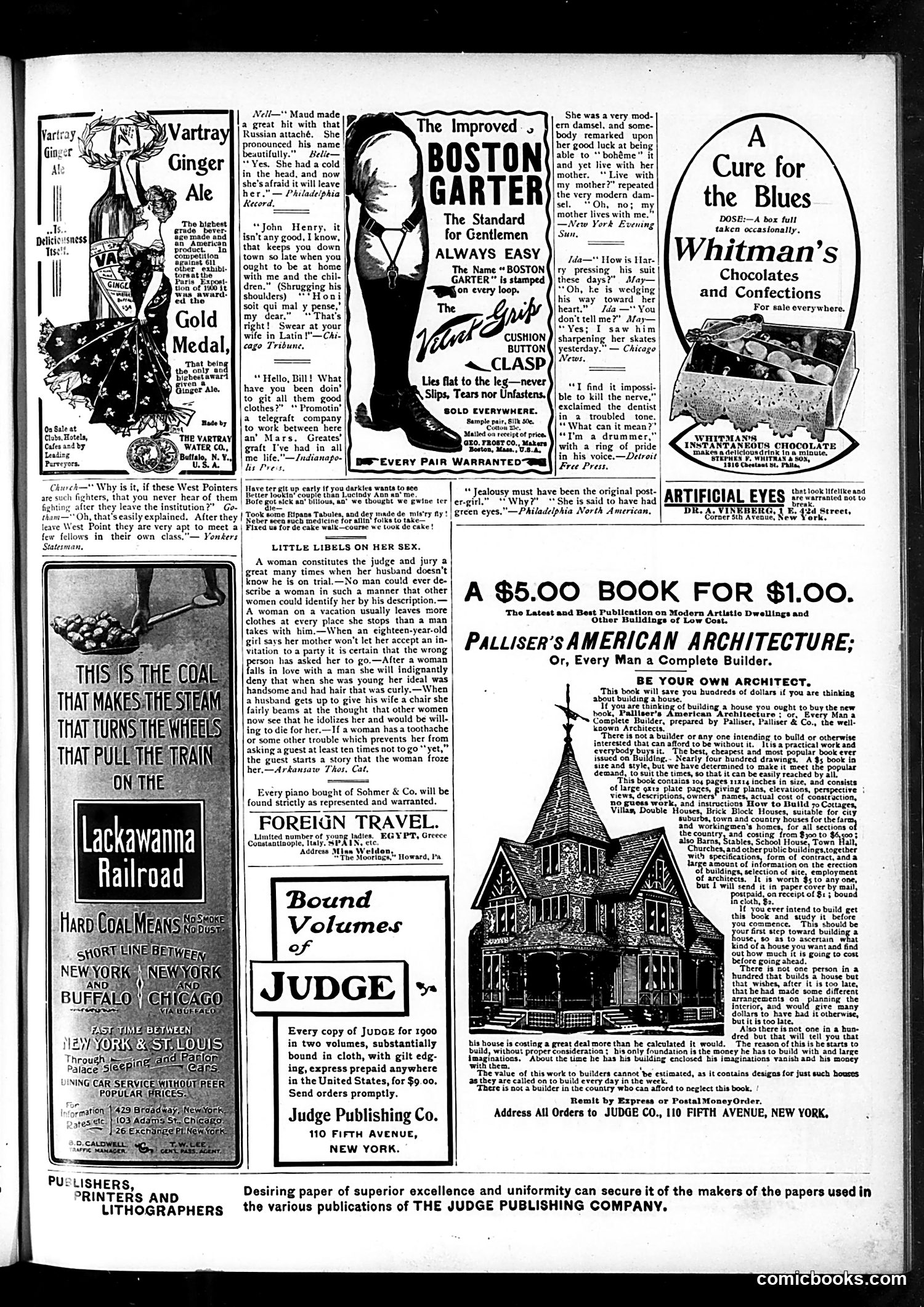
This is primarily an **advertising page** from an early 1900s satirical magazine, though it contains some comic content. The visible cartoons include brief domestic humor sketches ("Little Libels on Her Sex")—satirizing women's behavior, typical of the era's stereotypical comedy. One depicts a woman impressing a Russian diplomat merely by having a cold; another jokes about modern women living bohemian lifestyles with their mothers. The **main content is advertisements** for products like Boston Garters (men's suspenders), Whitman's Chocolates, artificial eyes, the Lackawanna Railroad, and architectural books. One notable ad features a large house illustration promoting *Palliser's American Architecture*—a mail-order building guide marketed to middle-class homeowners wanting to design their own houses affordably. The page reflects **early 20th-century consumer culture**: mass-produced goods, mail-order businesses, and the aspirational middle-class ideal of homeownership. The humor relies on dated gender stereotypes common to the period.
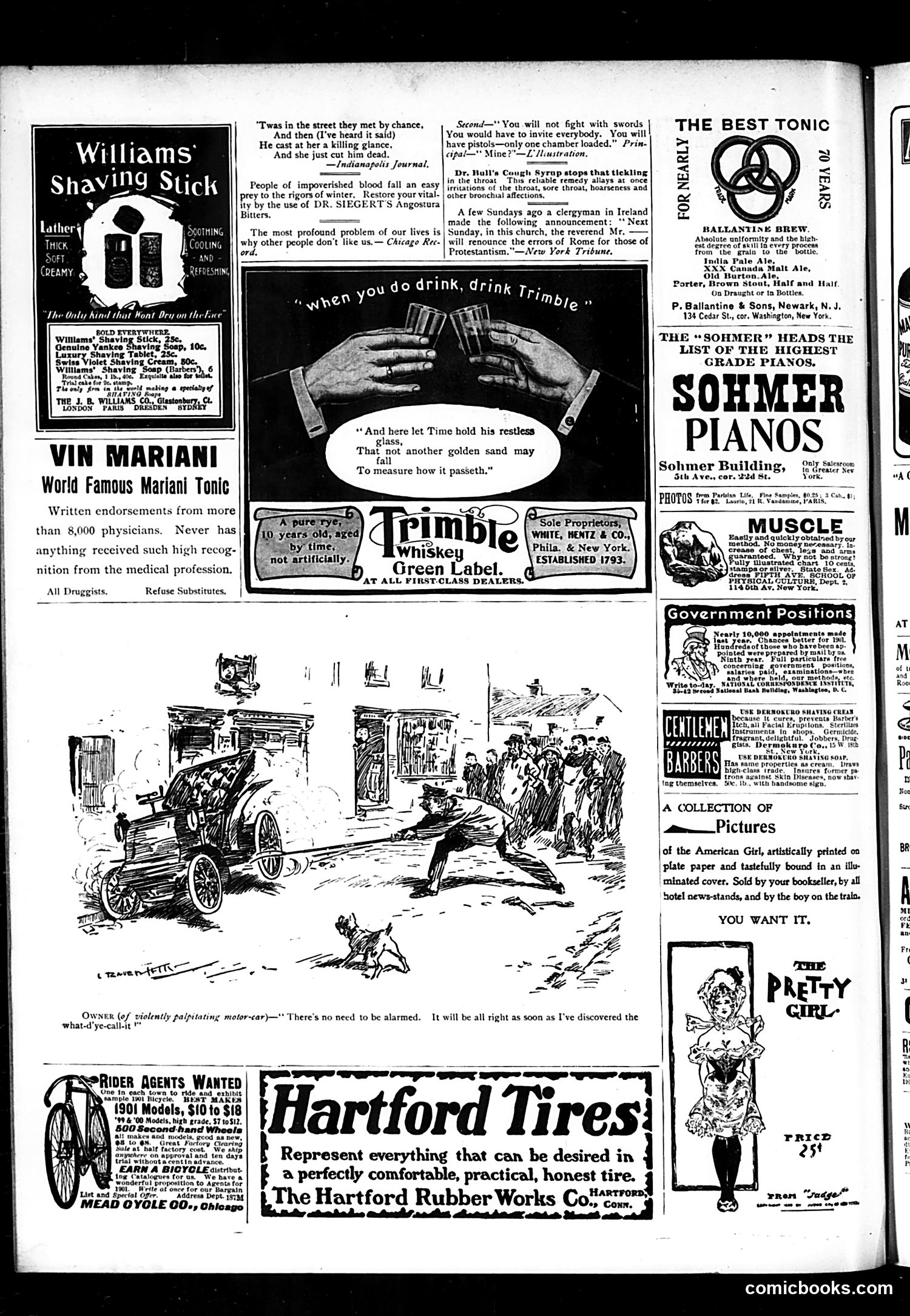
This page is primarily **advertising**, with one small cartoon about early automobiles. The main cartoon depicts a motorist whose car has broken down in the street, causing pedestrians to scatter. The owner assures onlookers there's "no need to be alarmed"—he just needs to figure out what's wrong. The joke reflects **early 1900s anxieties about automobiles**: these unreliable, unpredictable machines were still novelties that frequently malfunctioned in public, creating chaos and danger. The page otherwise contains period advertisements for patent medicines (shaving products, "Mariani Tonic," cough syrup), pianos, tires, and beer—typical of Judge magazine's revenue model. Small textual jokes appear in the snippets at top, including one about a clergyman in Ireland renouncing Catholicism, reflecting sectarian tensions of the era. The ads themselves are historically interesting: they make medical claims (like "8,000 physicians" endorsing wine tonics) that would now violate FDA regulations.
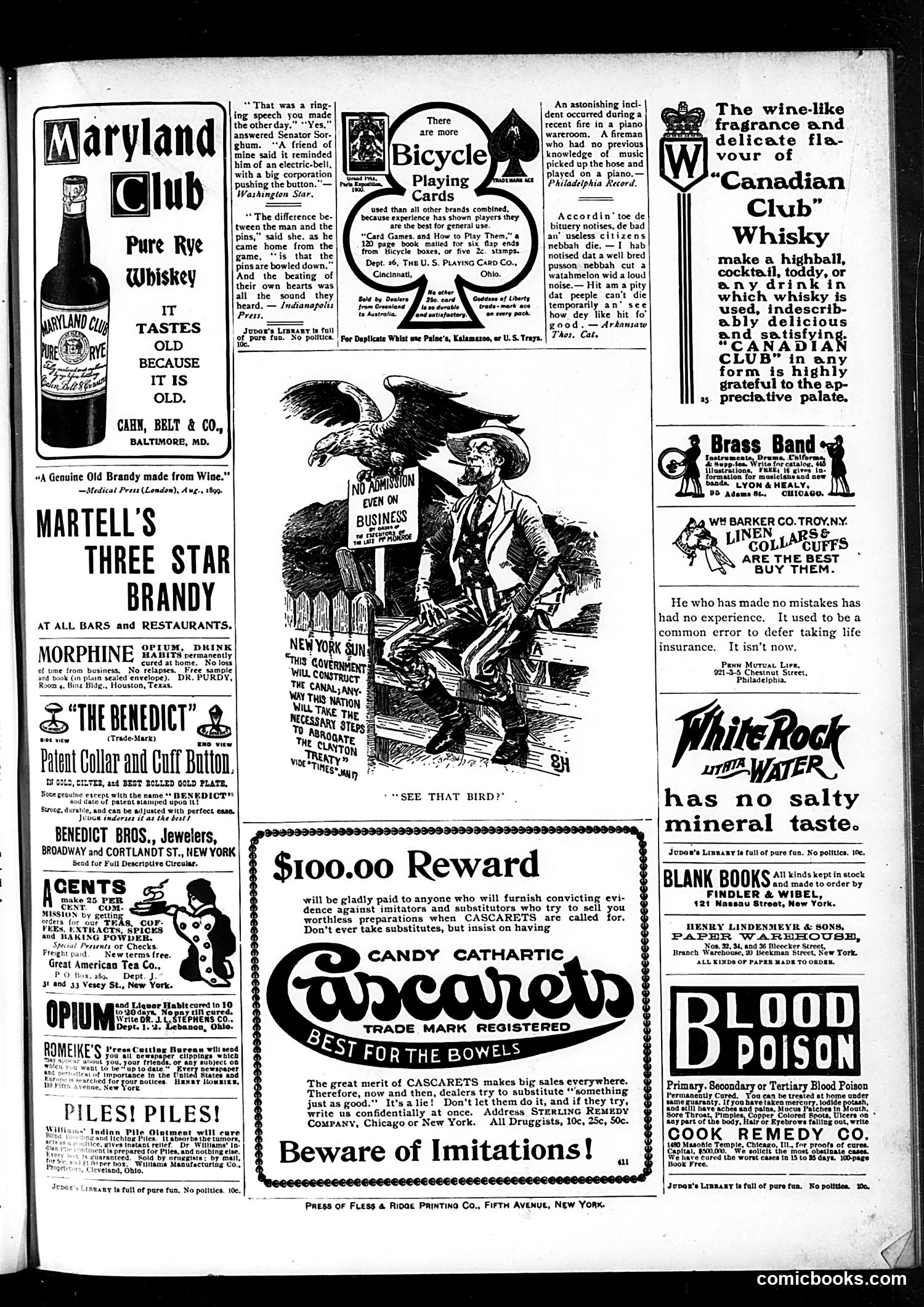
This page centers on a large political cartoon titled "See That Bird!" depicting an eagle confronting a man at a sign reading "No Admission Even for Business." The eagle appears to represent American sovereignty or national interests, while the man likely represents a politician or businessman being excluded or challenged. The cartoon satirizes **protectionism or trade barriers** — a major political debate of the era (circa 1899, based on the medical ads). The "bird" (eagle/America) confronts someone trying to restrict access, suggesting criticism of tariff policies or monopolistic business practices that blocked fair competition. The surrounding advertisements (morphine, opium cures, blood poison treatments) reflect the era's unregulated patent medicine industry — context modern readers need: these were legal, widely-advertised products before food and drug regulations existed. The page primarily functions as a **satirical editorial mixed with period advertising**, with the cartoon critiquing exclusionary business or political practices through the symbolic eagle confrontation.
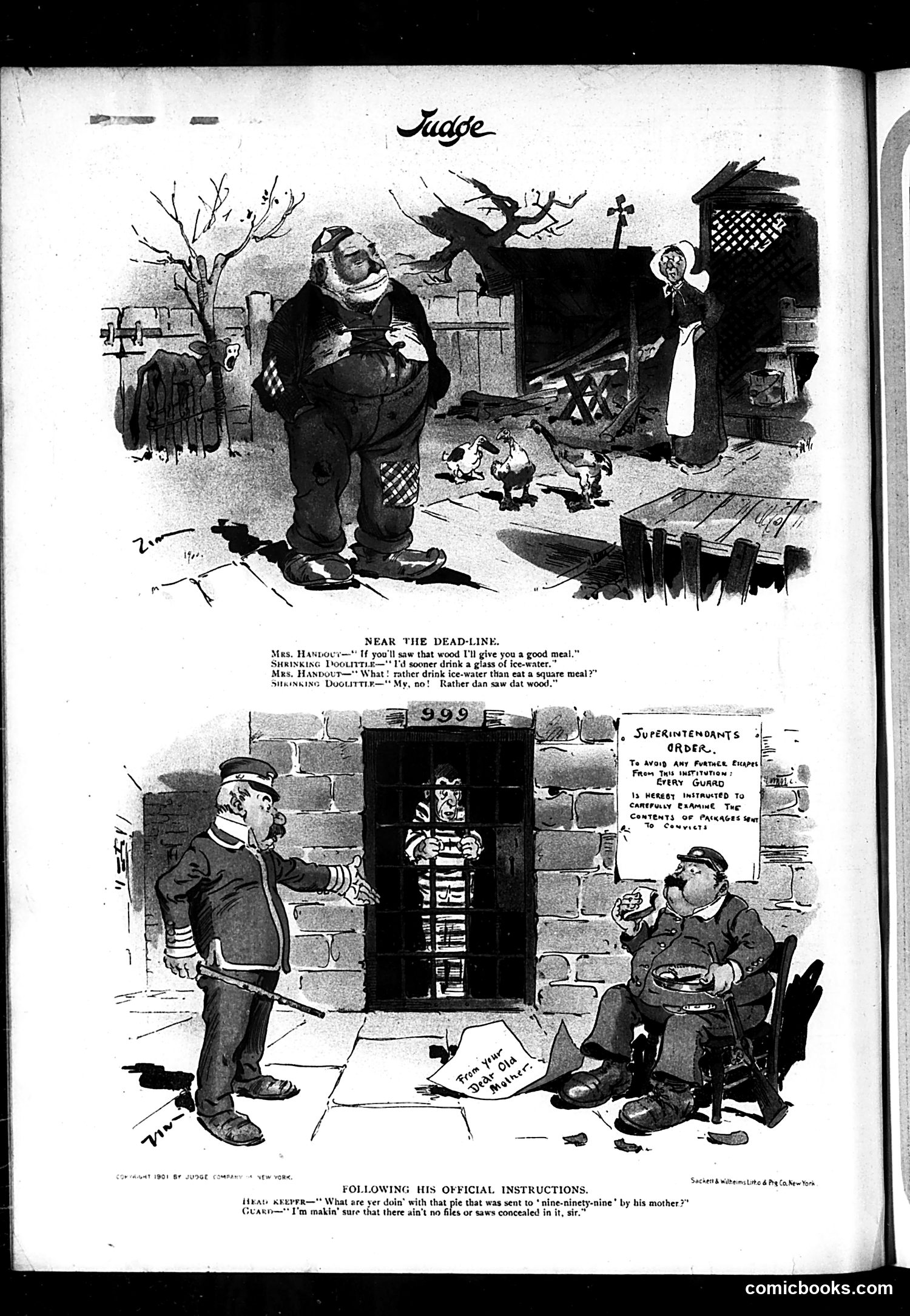
**Top Cartoon ("Near the Dead-Line"):** Satirizes a vagrant or prisoner's illogical priorities. "Shinkling Doolittle" refuses a meal in exchange for work, preferring ice water instead—mocking laziness or perverse stubbornness. The joke targets those who seem deliberately self-destructive. **Bottom Cartoon ("Following His Official Instructions"):** References prison contraband inspections. A guard meticulously examines a pie sent to inmate "999," ostensibly searching for hidden tools or weapons that might aid escape. The satire critiques either overzealous bureaucratic compliance or the absurdity of security theater—the guard's literal interpretation of inspection orders produces comical results. Both cartoons employ exaggerated character types common to late 19th/early 20th century Judge humor, targeting working-class behavior and institutional incompetence through visual caricature and dialogue.