
A complete issue · 16 pages · 1901
Judge — January 19, 1901
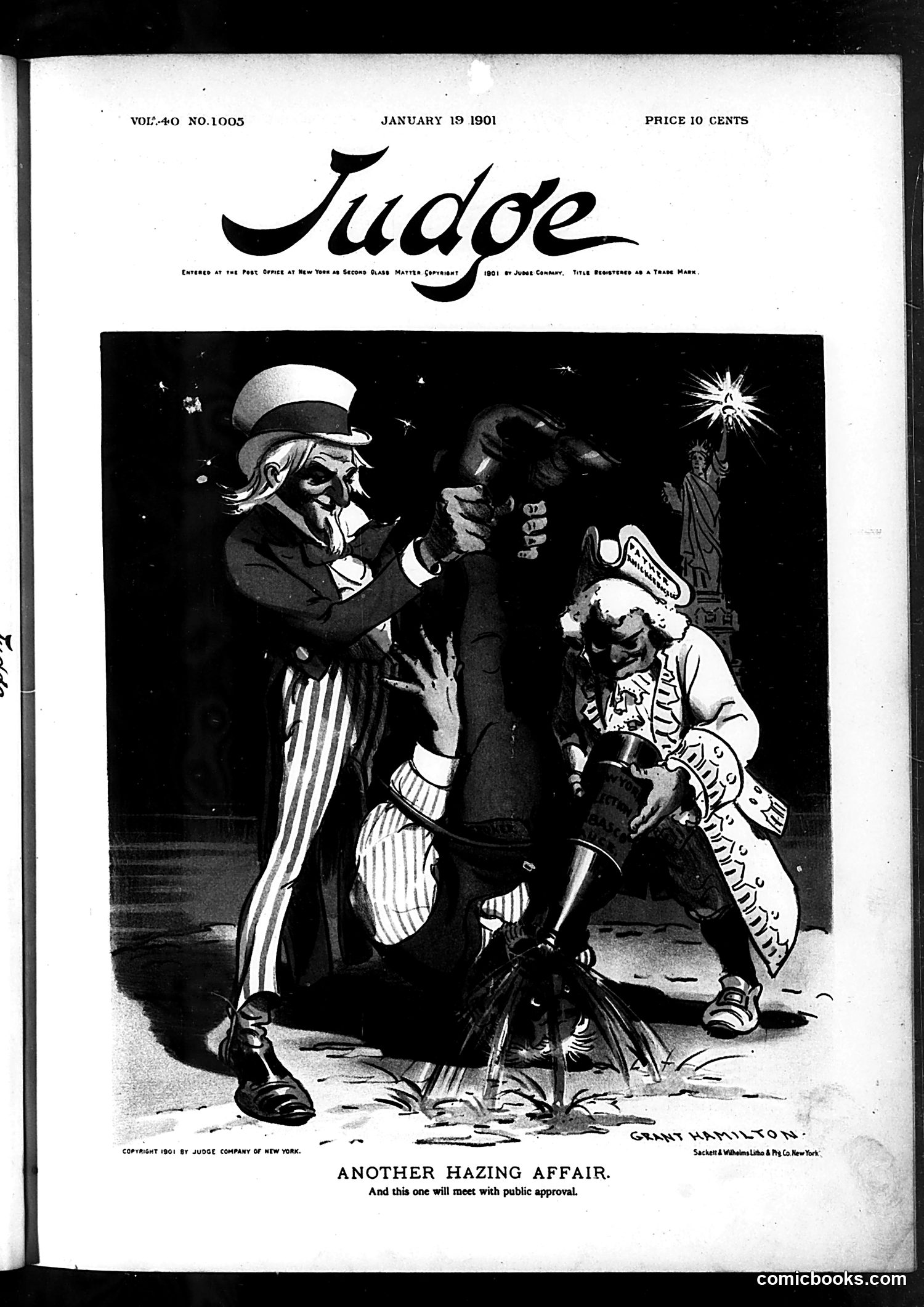
This cartoon satirizes college hazing practices through exaggerated caricature. Uncle Sam (identifiable by the striped pants and top hat on the left) appears to be subjecting a dark-figured character to rough treatment, while Liberty (the winged female figure on the right, referencing the Statue of Liberty) observes with apparent disapproval, holding her torch aloft. The caption states the depicted hazing "will meet with public approval," likely meant ironically. The cartoon critiques both college hazing rituals and, through the Uncle Sam figure, suggests American institutions or authorities engaged in similar abusive practices—possibly referencing contemporary military or imperial contexts. The satire condemns these violent initiation practices as fundamentally un-American, despite any claimed justification.
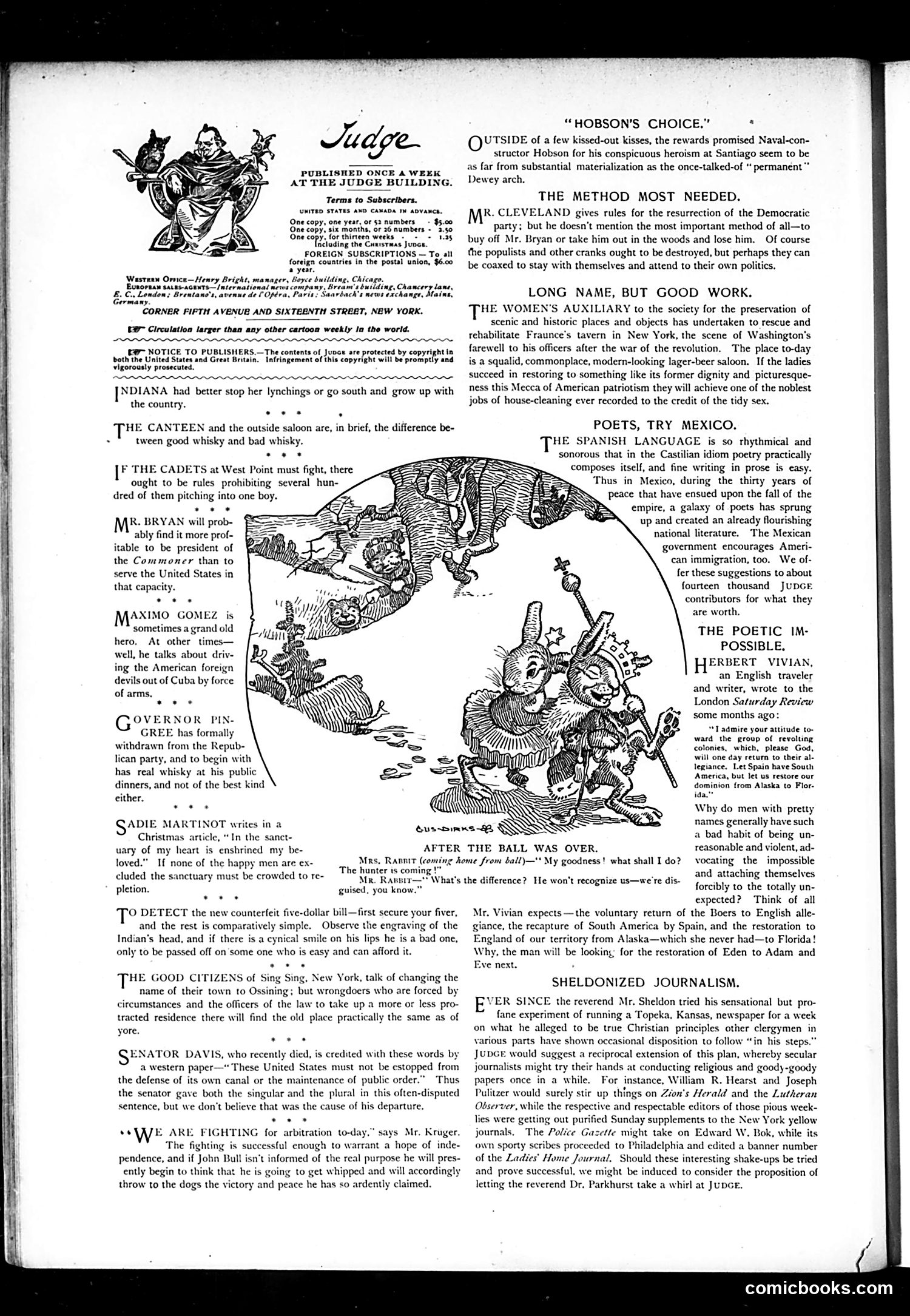
This cartoon depicts a hunter and dog confronting what appears to be an exhausted or defeated animal. The caption reads: "My goodness! what shall I do? The hunter is coming!" followed by dialogue about not recognizing "us"—we're disguised." The accompanying text references **Mrs. Rabbit** (home from ball), suggesting this is political satire using animal characters. Given Judge magazine's format, this likely satirizes political figures or parties in disguise or hiding their true identities/positions. The "ball" and subsequent exhaustion suggest a political event or campaign. Without clearer identification of the specific figures or dated context, the exact targets remain unclear, though the satire appears to mock politicians caught in compromising or hypocritical situations.
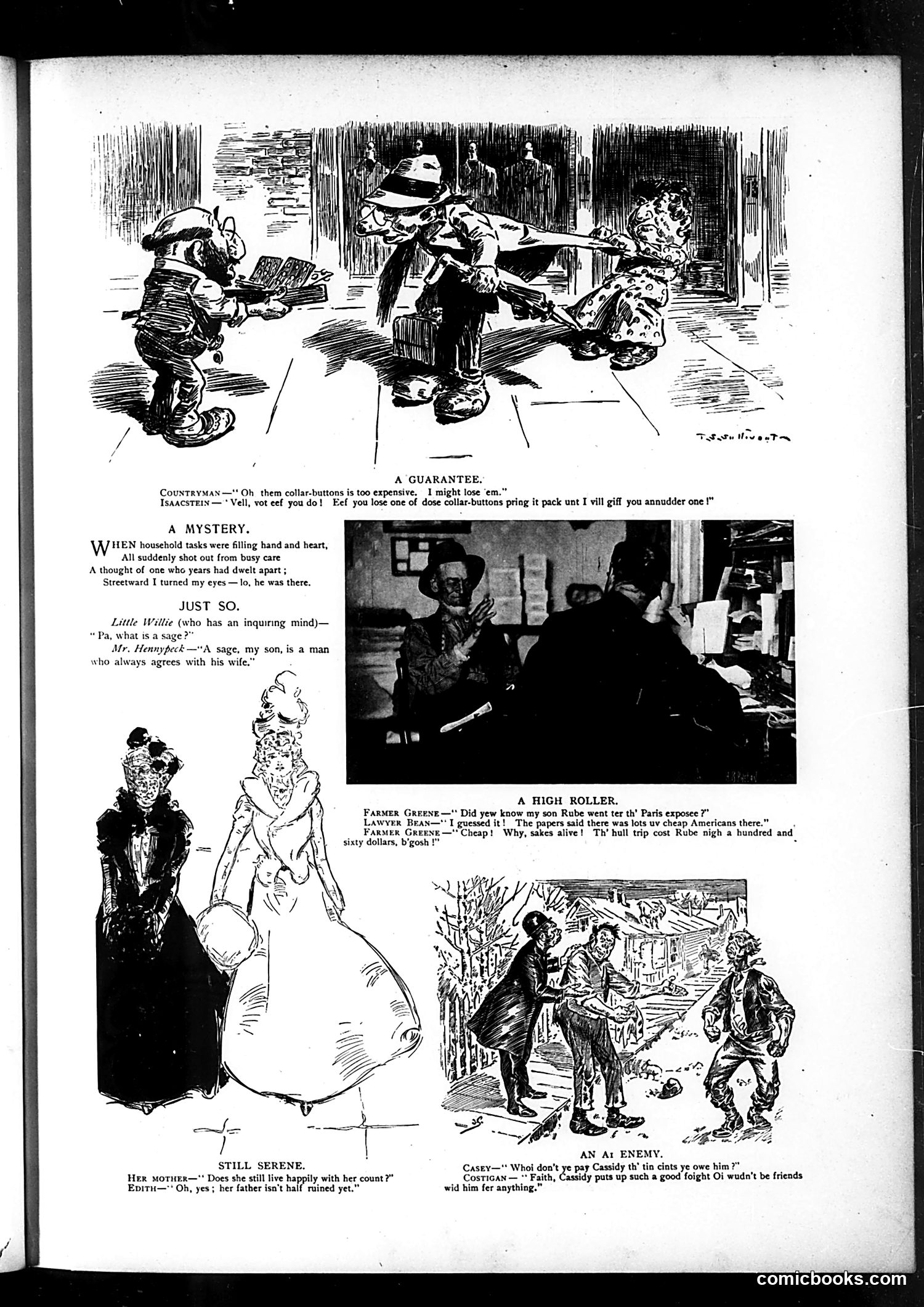
This page contains several unrelated satirical sketches and jokes typical of Judge's format: **"A Guarantee"** (top): A cartoon mocking men's frugality, where a man haggling over collar-button prices is threatened with being "swindled" if he doesn't accept the dealer's terms—satirizing penny-pinching customers. **"A Mystery"** and **"Just So"**: Brief humorous dialogues about domestic life and the nature of a "sage," presented as wordplay jokes. **"A High Roller"** and **"Still Serene"**: Vignettes about wealthy socialites and family relationships, likely satirizing upper-class pretension and marital dynamics. **"An A1 Enemy"**: A rural sketch involving characters named Casey and Corrigan discussing friendship and fighting—appears to be local-interest humor rather than political satire. The page also includes a photograph labeled "A High Roller," suggesting this issue mixed illustrations with documentary photography.
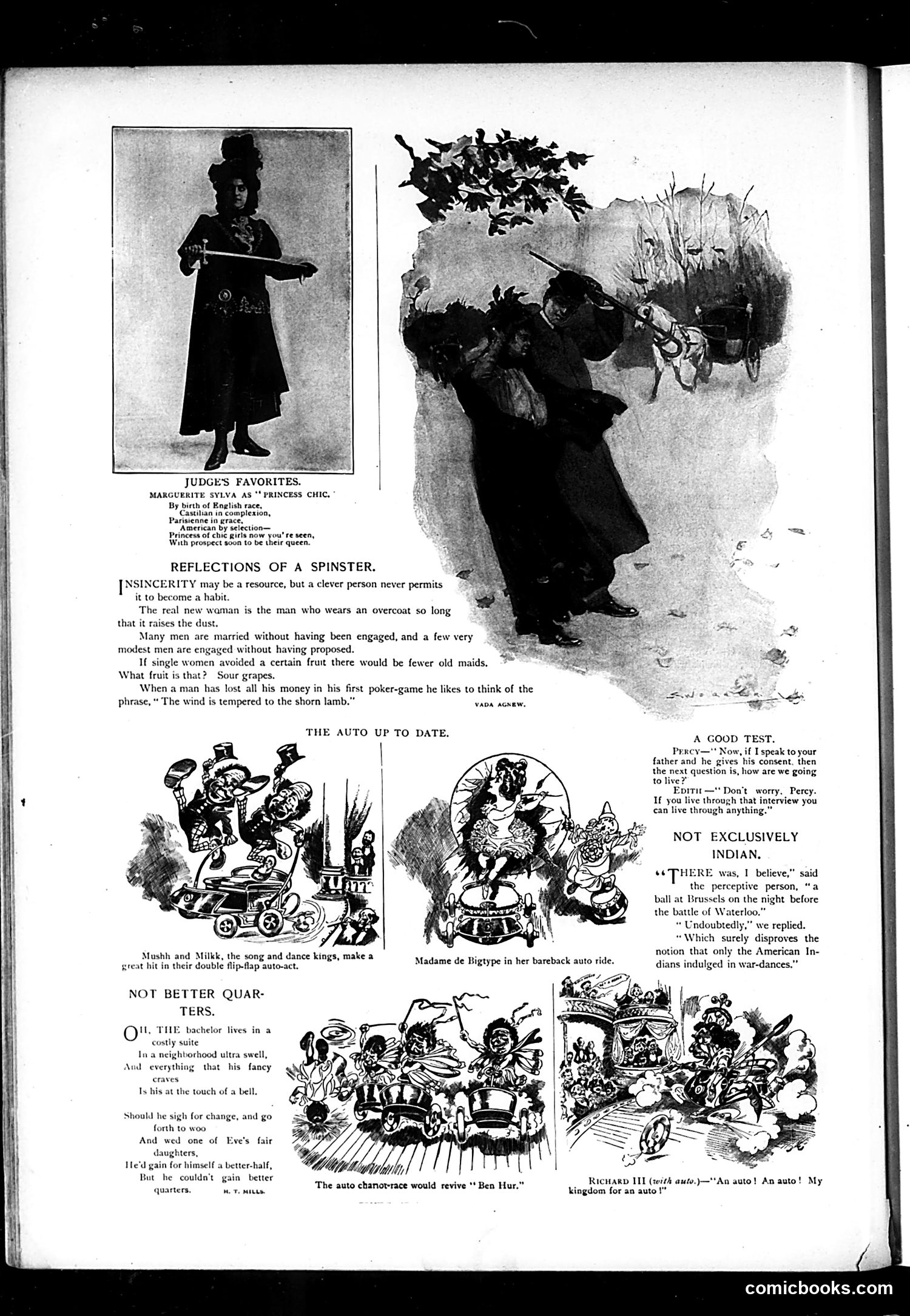
This page contains several satirical pieces about early 1900s social topics: **"Judge's Favorites"** shows Marguerite Sylva as "Princess Chic," likely referencing a contemporary opera or theatrical performer. **"Reflections of a Spinster"** offers social commentary on unmarried women and marriage customs of the era, with cynical observations about engagement practices and single women—typical Judge magazine humor mocking social conventions. **Automobile-themed cartoons** ("The Auto Up to Date," "Not Better Quarters," "A Good Test") satirize the then-novel automobile as a status symbol and its social implications. References to "Madame de Higgypse" and "Ben Hur" suggest wealthy society figures enjoying cars. **"Not Exclusively Indian"** appears to discuss war-dances, likely satirizing contemporary attitudes toward Native American culture. The page reflects Judge's focus on mocking upper-class pretensions and modern social changes of the early 20th century.
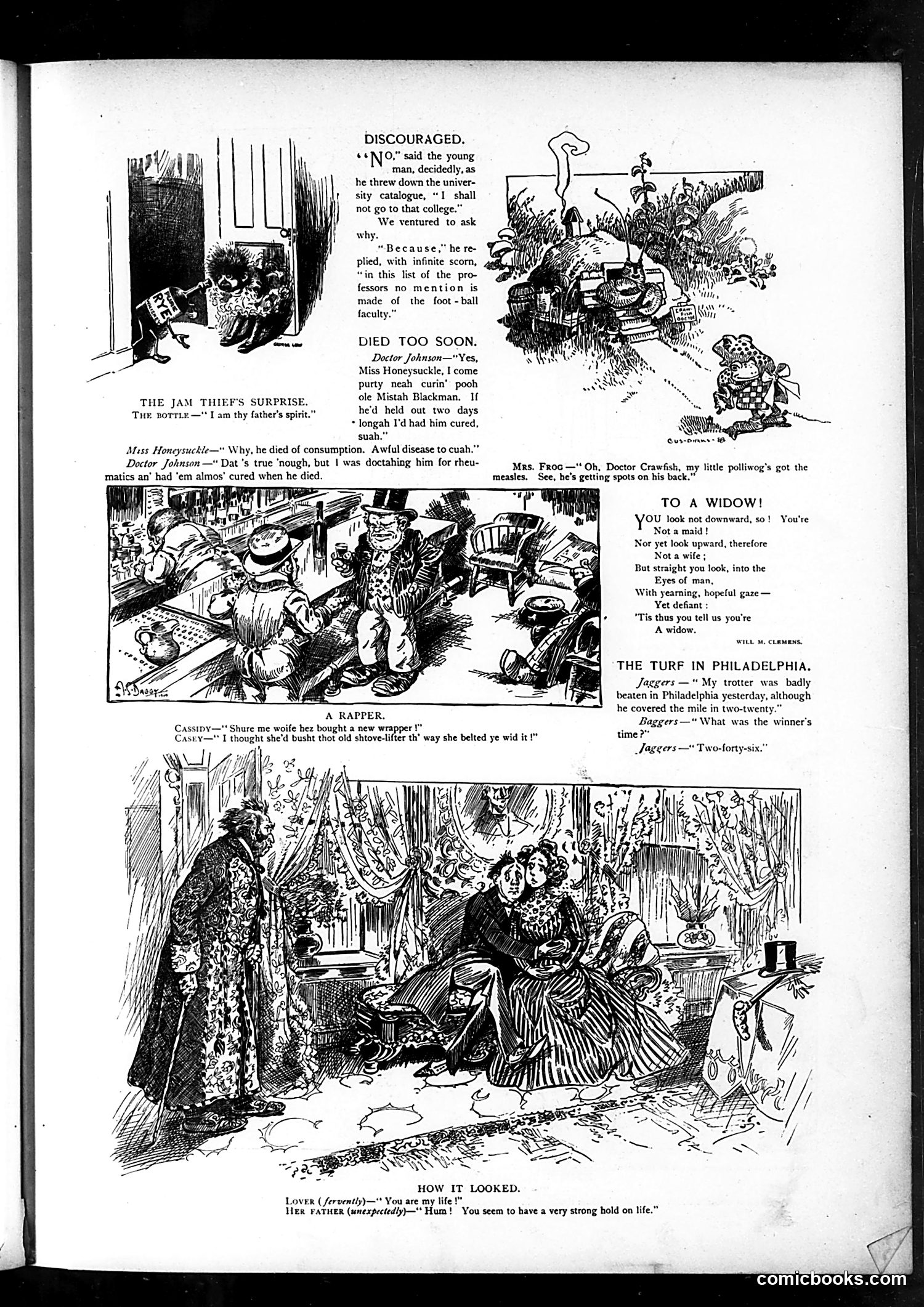
This page contains several short satirical pieces typical of Judge magazine's humor: **"Discouraged"** mocks college priorities: a young man refuses university attendance because the catalog lists no "foot-ball faculty"—satirizing Americans' obsession with college sports over academics. **"Died Too Soon"** depicts a stereotyped Black doctor ("Doctor Johnson," rendered in dialect) who ironically cured a patient's rheumatism but failed to treat the consumption that killed him—mocking medical incompetence. **"The Jam Thief's Surprise"** and **"A Rapper"** appear to be domestic humor sketches about household theft and marital disputes. **"To a Widow"** is a sentimental poem about recognizing widowed women by their distinctive gaze—hopeful yet defiant. **"The Turf in Philadelphia"** jokes about horse-racing times that seem absurdly slow. **"How It Looked"** shows a father sardonically interrupting a lover's declaration, suggesting the young man is only interested in the woman for inheritance or security. The page reflects period attitudes including racial stereotyping and class-based domestic humor.
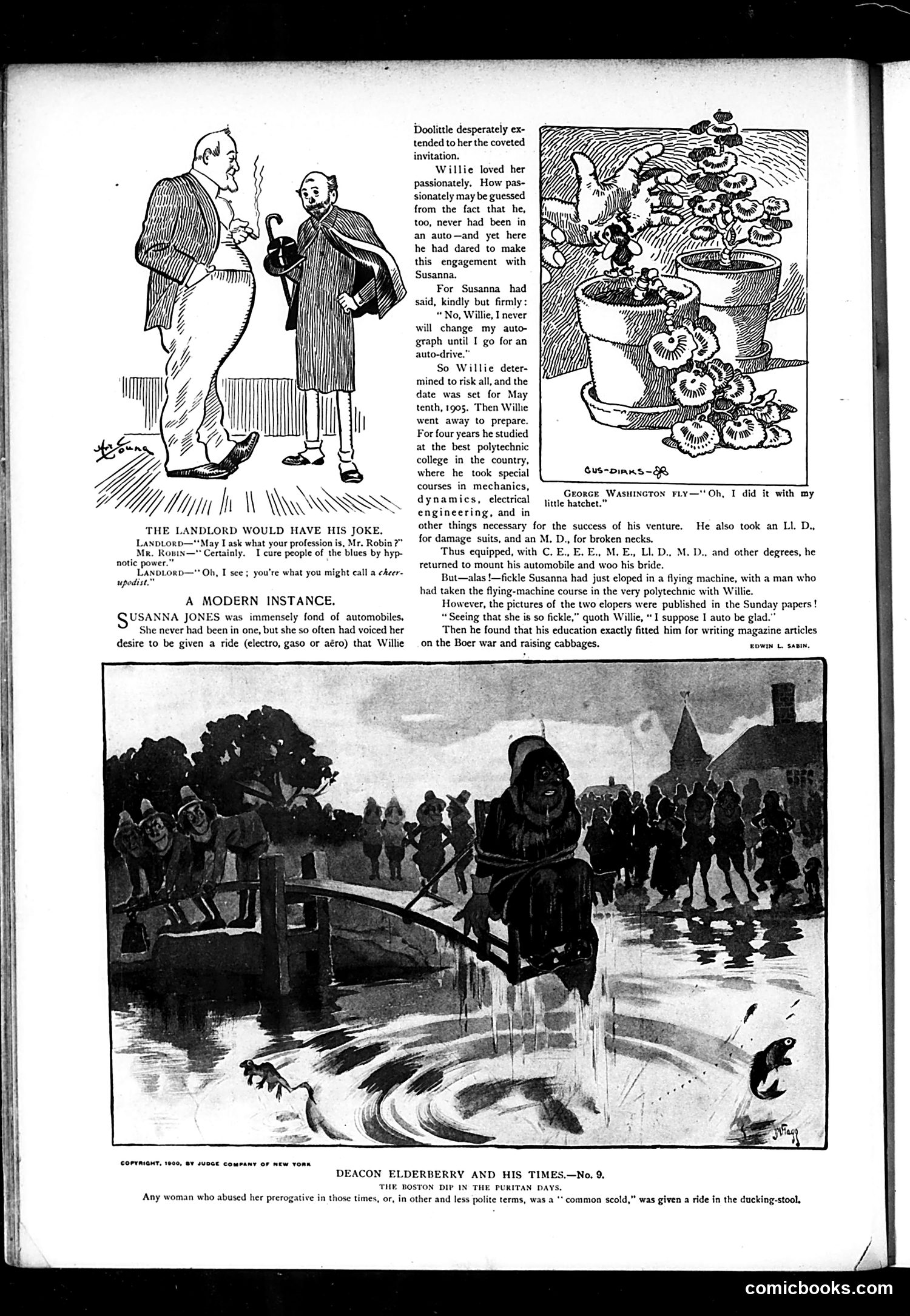
This page contains three separate satirical pieces typical of 1900s American humor: **"The Landlord Would Have His Joke"** is a simple pun: a landlord mistakes a hypnotist (who "cures people of the blues") for a "cheerupodist"—a made-up word playing on "chiropodist." **"A Modern Instance"** satirizes the automobile craze and courtship rituals of early 1900s America. Willie Doolittle must gain an engineering degree just to safely take his beloved Susanna on a car ride after she demands an "auto-drive" before changing her name (marrying him). The joke mocks both the newfangled automobile's danger and female fickleness—Susanna elopes with another man via flying machine instead, leaving Willie with degrees useful only for writing magazine articles. **"Deacon Elderberry and His Times"** illustrates historical Puritan punishment: the ducking-stool, used against "common scolds" (outspoken women). The image shows this public humiliation device in action. The page reflects contemporary anxieties about new technology, gender roles, and Americana nostalgia.
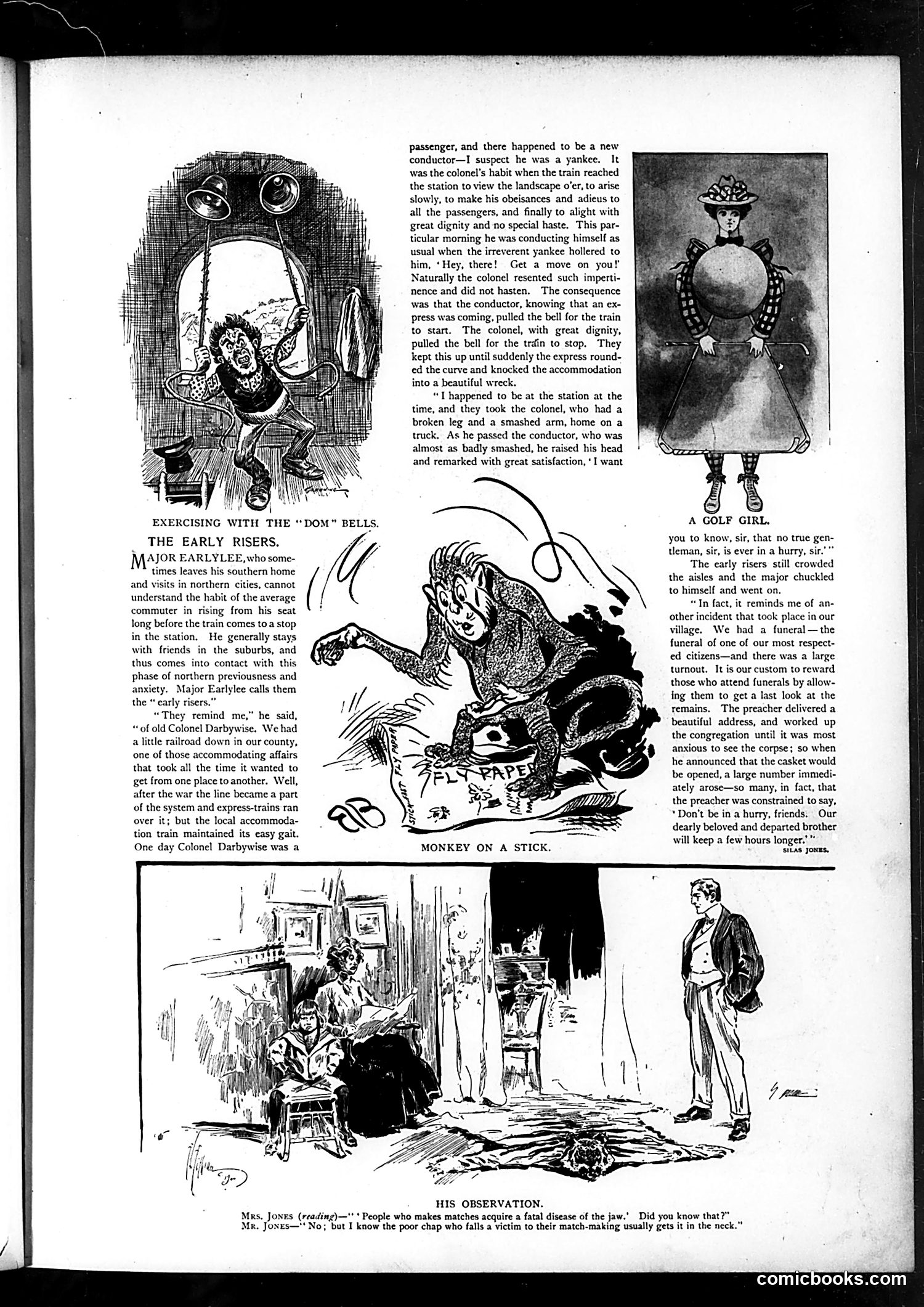
This page satirizes Northern impatience versus Southern leisurely manners during the post-Civil War period. Major Earlylee, a Southern visitor, complains about commuters rushing off trains before they stop—a behavior he finds crude and ungentlemanly. He illustrates this through two anecdotes: Colonel Darbywise, a dignified Southerner, refuses to hurry when ordered by a "yankee" conductor, resulting in a train wreck that injures both men. Yet even mangled, the Colonel maintains that "no true gentleman is ever in a hurry." A second story about a funeral preacher asking mourners not to rush toward the casket reinforces the theme: Southern dignity demands slowness and ceremony, contrasted with Yankee rudeness and haste. The cartoon mocks both extremes—Southern stubbornness that causes actual harm, and Northern impatience—while ultimately sympathizing with antebellum Southern values of decorum and deliberation. The humor relies on post-war sectional stereotypes and nostalgia for the Old South.
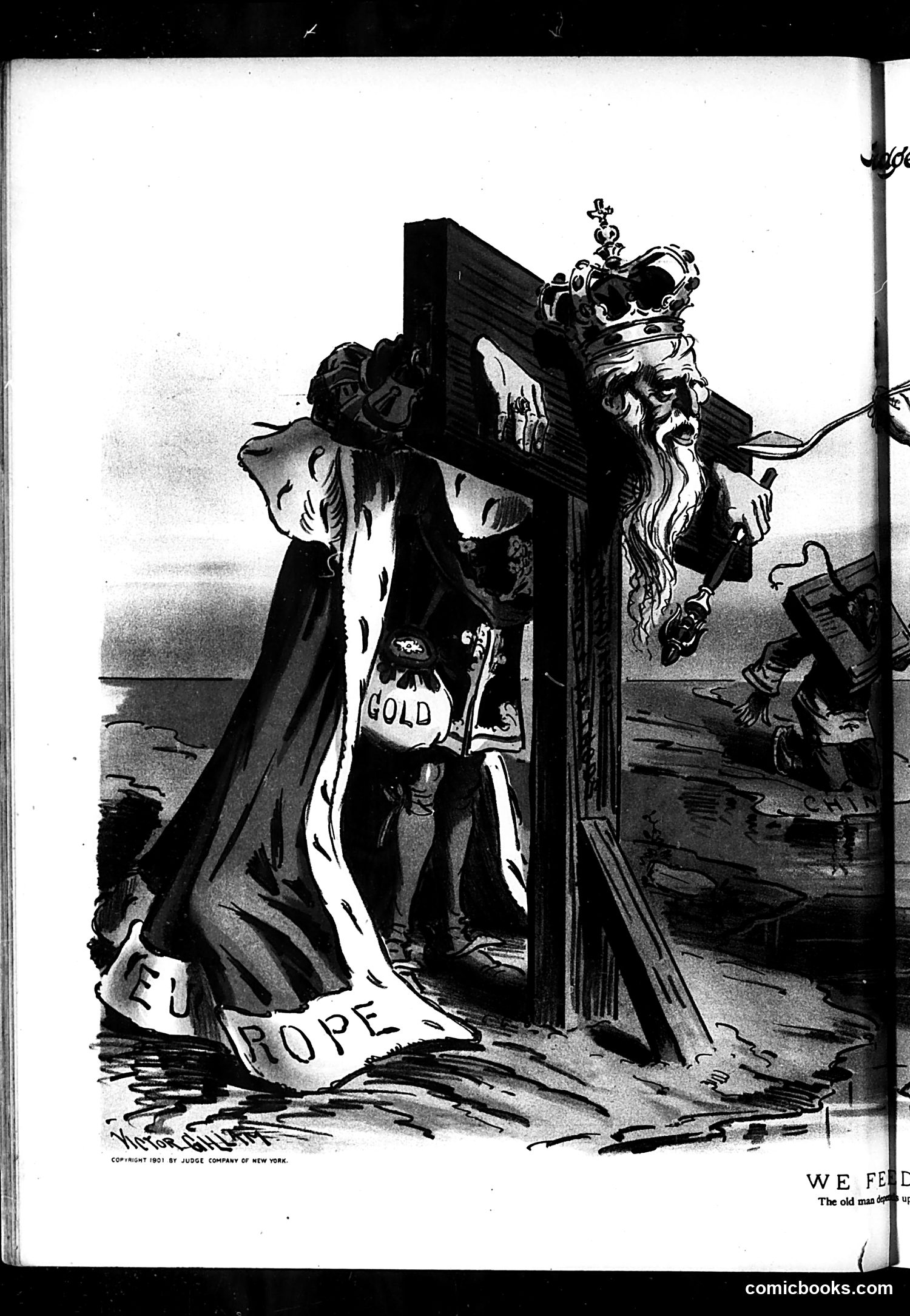
This is a satirical cartoon from *Judge* magazine (copyright 1901 by Judge Company of New York). The image depicts two figures in royal robes and crowns beside a gallows. The figure on the left wears ermine-trimmed robes labeled "GOLD" and "ROPE," while the bearded figure on the right holds a scepter. The gallows structure dominates the center. The cartoon appears to criticize wealthy or powerful figures (likely representing aristocracy or monopolistic industrialists of the Gilded Age) standing beside instruments of execution and symbols of wealth. The label "ROPE" alongside "GOLD" suggests commentary on how excessive wealth or greed may lead to downfall or justice. The partial text "WE FED" at bottom remains unclear without the complete caption, but the overall message seems to warn of consequences for the corrupt elite.
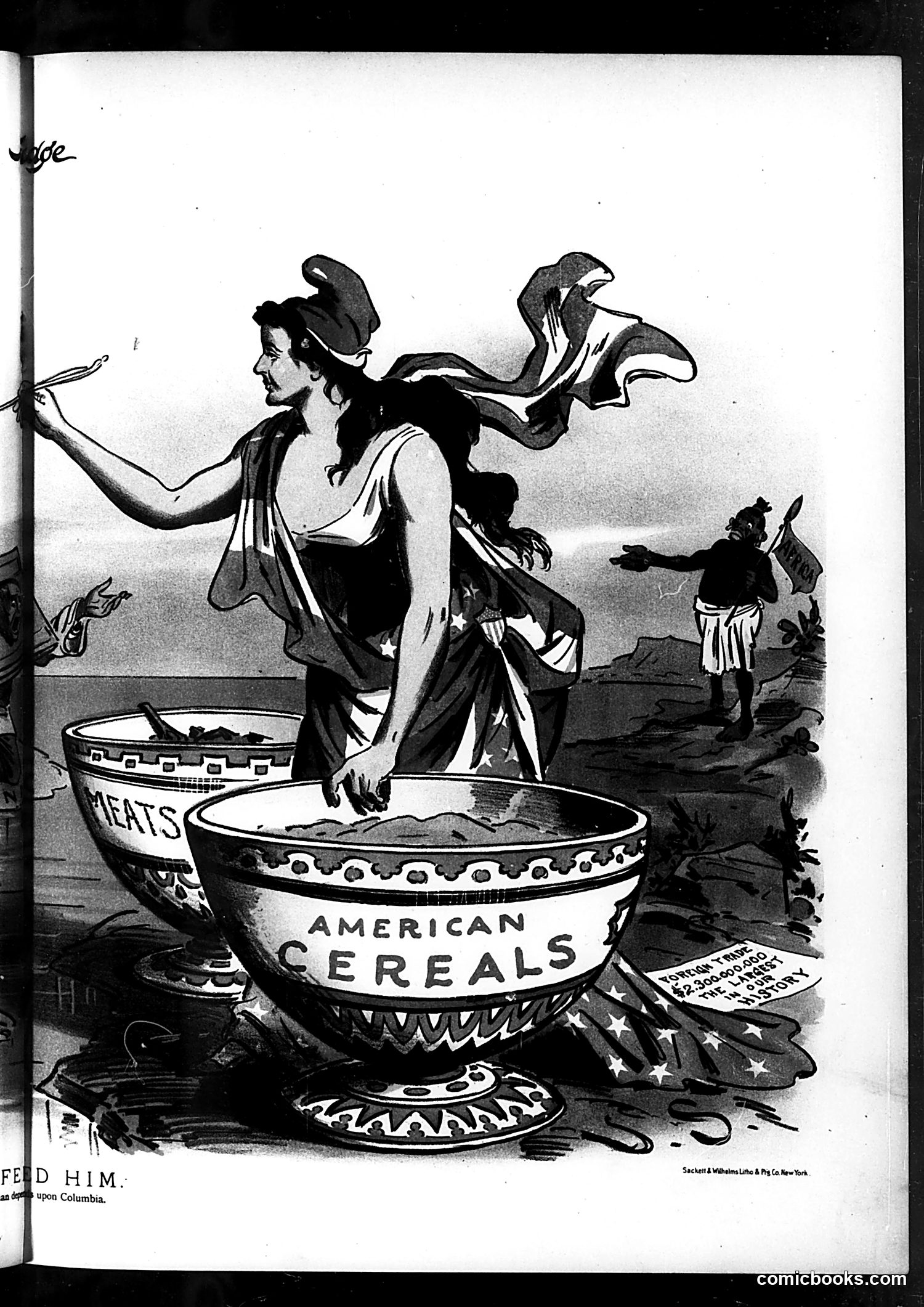
This satirical cartoon depicts a classical allegorical female figure (representing America or Liberty) stirring a large bowl labeled "American Cereals" while feeding a smaller figure on the right. A second bowl labeled "Meats" sits nearby. The imagery suggests the cartoon critiques American food production or agricultural policy, likely from the early 20th century. The classical presentation contrasts sharply with the mundane subject matter—cereal and meat—creating satirical humor through mock-heroic treatment. The figure being fed appears to represent either a dependent nation, a citizen, or possibly a political figure. Without the magazine's date or accompanying article text clearly visible, the specific political target remains unclear, though it likely addresses debates about American agricultural exports, protectionism, or food policy during that era.
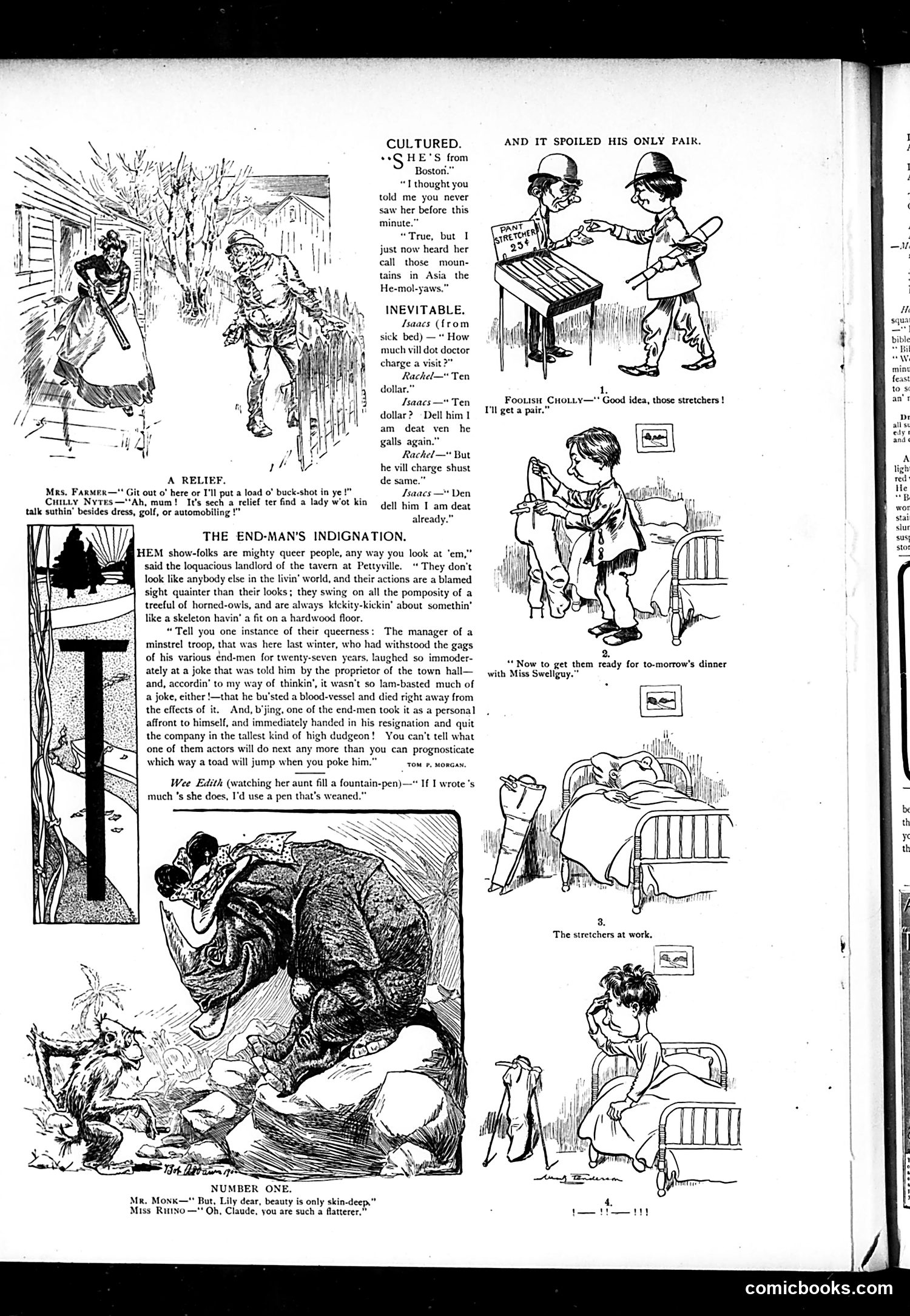
This page contains multiple comic sketches satirizing turn-of-the-century American society: **"Cultured"**: Mocks Boston pretension—a woman displays false sophistication by mispronouncing "Himalayas" as "He-mol-yaws," yet the speaker claims she's cultured simply for using affected language. **"Inevitable"** and **"Foolish Cholly"**: Ethnic humor (Yiddish-accented Jewish characters) playing on stereotypes—a sick man haggling over doctor fees, and another character humorously suggesting stretchers to move furniture. **"The End-Man's Indignation"**: A longer narrative mocking theatrical performers' vanity and volatility. A minstrel-show manager dies laughing at a joke, and an offended cast member quits dramatically—satirizing actors' supposed oversensitivity and ego. **"Number One"**: Features a man sarcastically complimenting a woman's beauty, only to have her misinterpret his insult as flattery, suggesting female vanity. The page reflects period stereotypes about immigrants, show business personalities, and gender relations.
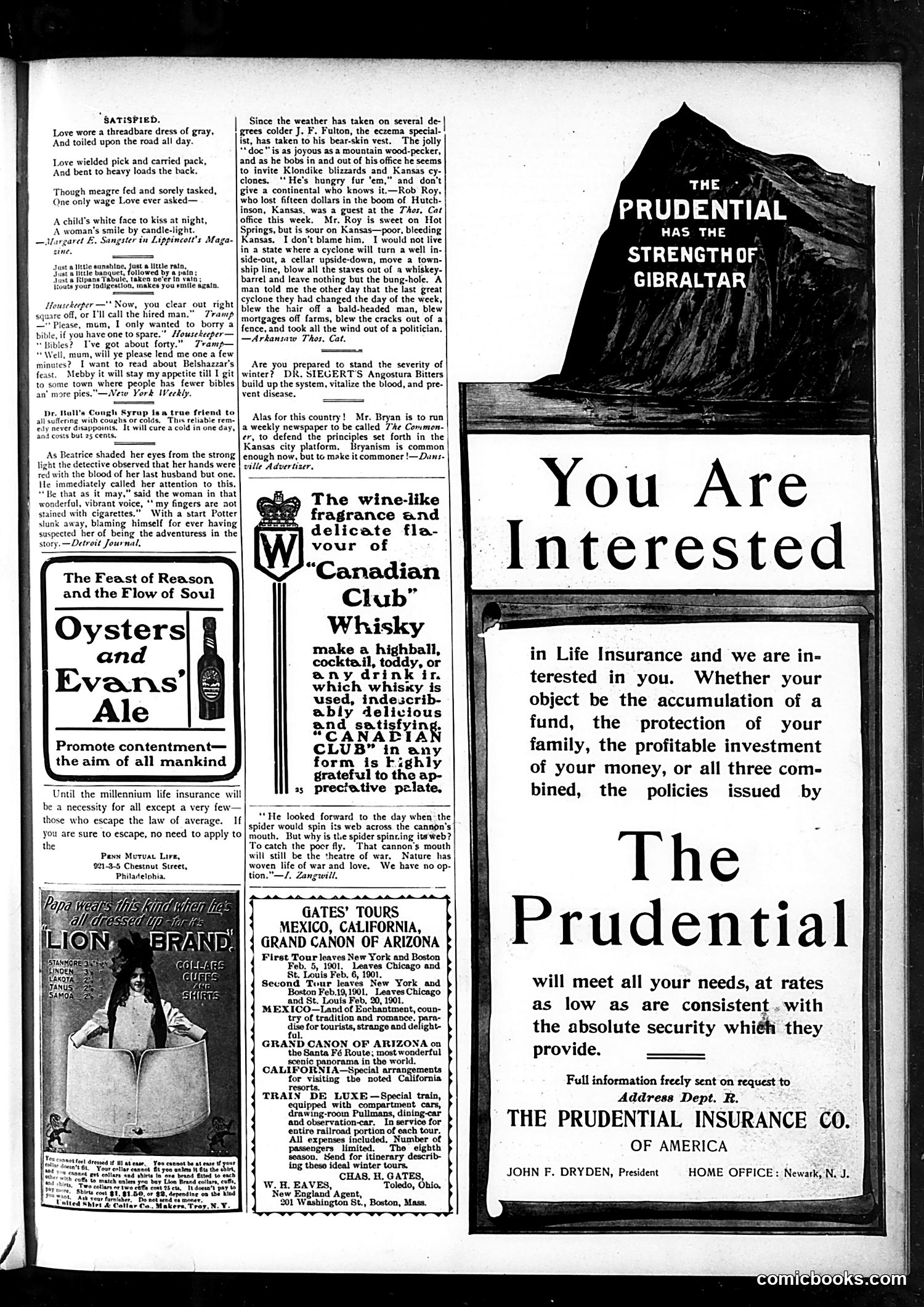
This page contains mostly **advertisements and light humor pieces**, with no prominent political cartoons. The notable content includes: **"Satisfied" poem** (top left): A sentimental verse about Love enduring hardship for modest rewards—typical of the era's melodramatic magazine poetry. **Comic anecdotes**: Brief humorous exchanges, including a tramp asking a housekeeper to borrow a Bible (she claims to have "about forty"), suggesting poor people owned few religious texts but many practical items. Another jokes about Kansas cyclones' destructive power in exaggerated terms. **"The Detective Story" (bottom)**: A satirical parody of melodramatic detective fiction, where a detective accuses a woman of murder based on bloodstained hands, but she deflects by proudly noting her fingers aren't stained with cigarettes—mocking overwrought Victorian morality tales. **Advertisements** dominate: life insurance, whisky, patent medicines, and tours occupy significant space. The page reflects *Judge's* mix of genteel humor, advertising revenue, and mild social commentary typical of early 1900s American magazines.
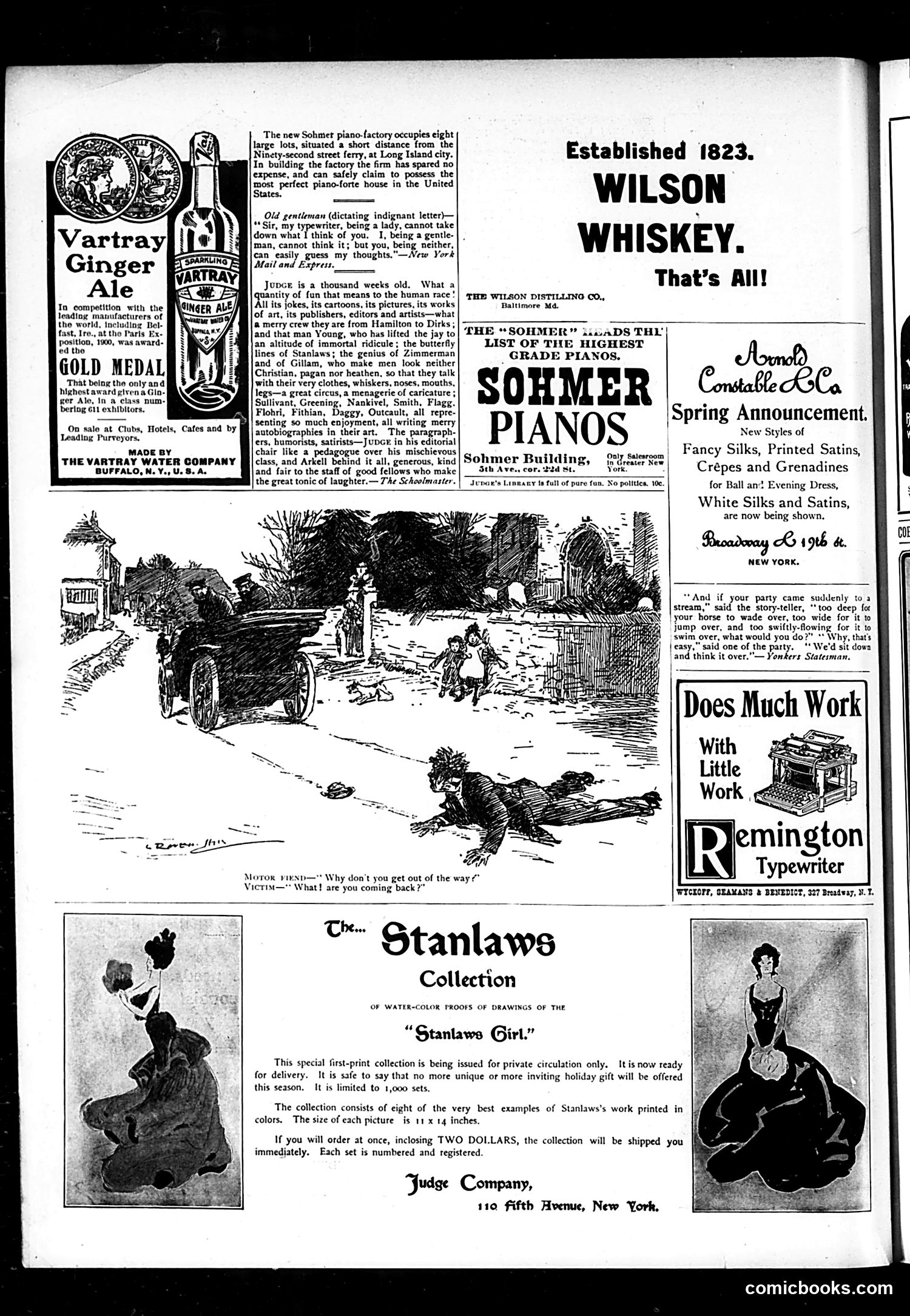
This page is primarily **advertisements and promotional content** rather than editorial cartoons requiring political analysis. The main cartoon depicts a "Motor Fiend" scenario—a motorist stuck in mud addressing a stranded pedestrian with dark humor about who should help whom. This reflects early 1900s anxieties about automobiles as dangerous, unreliable novelties that endangered both drivers and pedestrians. The page otherwise features ads for Wilson Whiskey, Vartray Ginger Ale, Sohmer Pianos, and Remington Typewriters, plus a lengthy self-promotional piece celebrating Judge magazine's contributors (cartoonists Stanlaws, Gillam, Outcault, etc.). Most notably, Judge advertises a **Stanlaws Girl collection**—eight watercolor prints of the "Stanlaws Girl" figure for two dollars. This represents early merchandising of cartoon art and pin-up style illustrations, which were popular commercial products of the era. The page demonstrates how satirical magazines monetized their content and artistic brand.
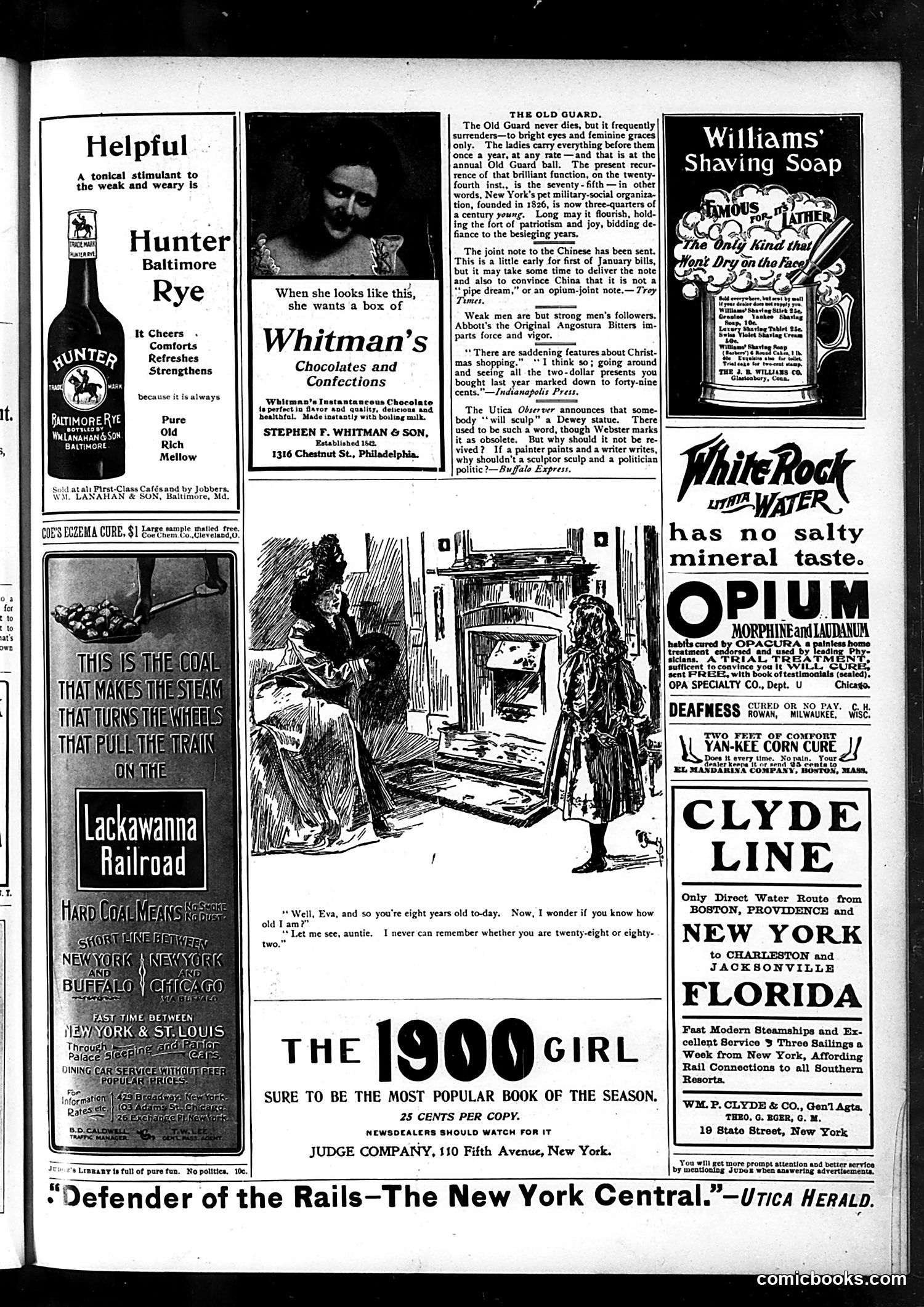
This Judge magazine page (appears to be from around 1900, based on "The 1900 Girl" book advertisement) is primarily an advertising page with brief satirical commentary. The main cartoon depicts a domestic scene with caption humor about aging: an aunt asks her eight-year-old niece how old the aunt is, and the child admits she cannot remember whether the aunt is "twenty-eight or eighty-two"—a jab at women's vanity about their age. A small article titled "The Old Guard" humorously notes that New York's elite Old Guard military-social organization, founded in 1826 and traditionally austere, surrenders annually to women at their ball. It's gentle satire about masculine pride yielding to feminine charm. Another brief item mocks the recent diplomatic note to China during the Boxer Rebellion era, suggesting it might be dismissed as a "pipe dream, or an opium-joint note"—cynically implying diplomatic efforts were unreliable. The page is otherwise dominated by period advertisements for whiskey, chocolates, shaving soap, medical nostrums (opium treatments), and steamship lines—typical of Judge's commercial content.
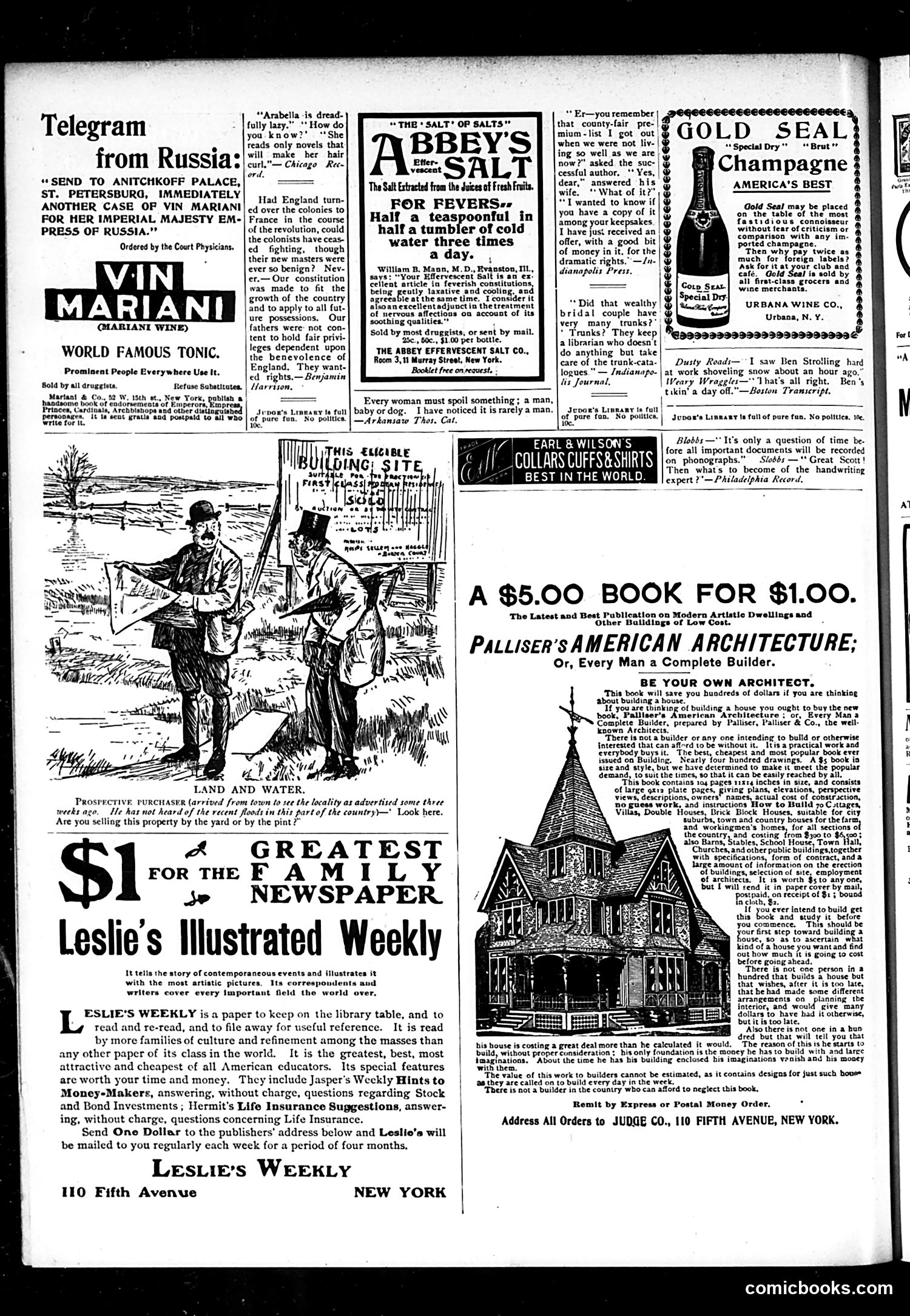
This page contains multiple satirical elements typical of early 20th-century Judge magazine: **Top Section - "Telegram from Russia"**: A joke about the Russian Empress reportedly ordering Vin Mariani wine (a patent medicine/tonic), implying she needs it to maintain her composure—a subtle dig at Russian imperial stability during the revolutionary period. **"Land and Water" Cartoon**: Shows a prospective property buyer discovering the advertised land is waterlogged from recent floods. He sarcastically asks if the property is sold "by the yard or by the pint"—mocking deceptive real-estate advertising common to the era. **General Content**: The page is primarily **advertising**, featuring Vin Mariani tonic, Abbey's Salt, champagne, collars, and an architecture book. The satirical cartoons are minimal and serve mainly as editorial padding between ads. The humor reflects period concerns: patent medicine reliability, real-estate fraud, and the Russian political situation—themes resonant with early 1900s American readers.
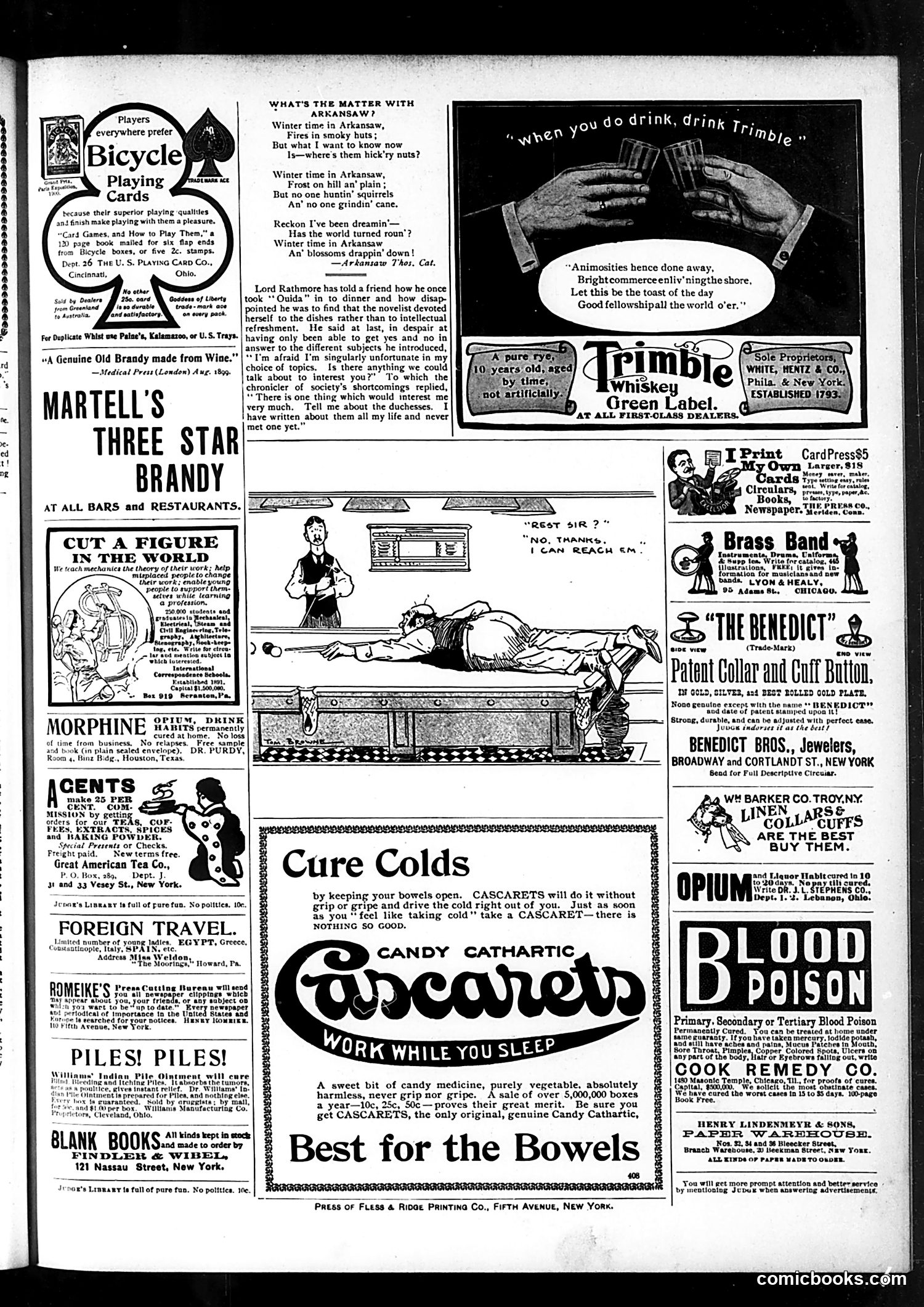
This page is primarily **advertising**, typical of Judge magazine's revenue model. Notable content includes: **Main Cartoon**: The central illustration shows a man lying prone on what appears to be a train or vehicle, seemingly intoxicated or incapacitated. The caption "REST SIR?" and "NO, THANKS, I CAN REACH 'EM" suggests social satire about drinking behavior or public intoxication—a common Judge subject. **The Arkansas Poem**: "What's the Matter with Arkansaw?" satirizes rural Southern life, using dialect ("hick'ry nuts," "huts") to mock Arkansas as backwards or economically depressed. The imagery of blossoms appearing in winter suggests the region's confusion or disorder. **The "Ouida" Anecdote**: This society gossip piece ridicules novelist Ouida for caring more about food than intellectual conversation—typical period satirizing of women writers and social pretension. **Advertisements**: Prominent are patent medicines (morphine cures, opium treatments), Cascaret laxatives, and various dubious remedies—reflecting the largely unregulated patent medicine industry of the era. The page reflects Judge's satirical focus on American social foibles, regional stereotypes, and consumer culture.
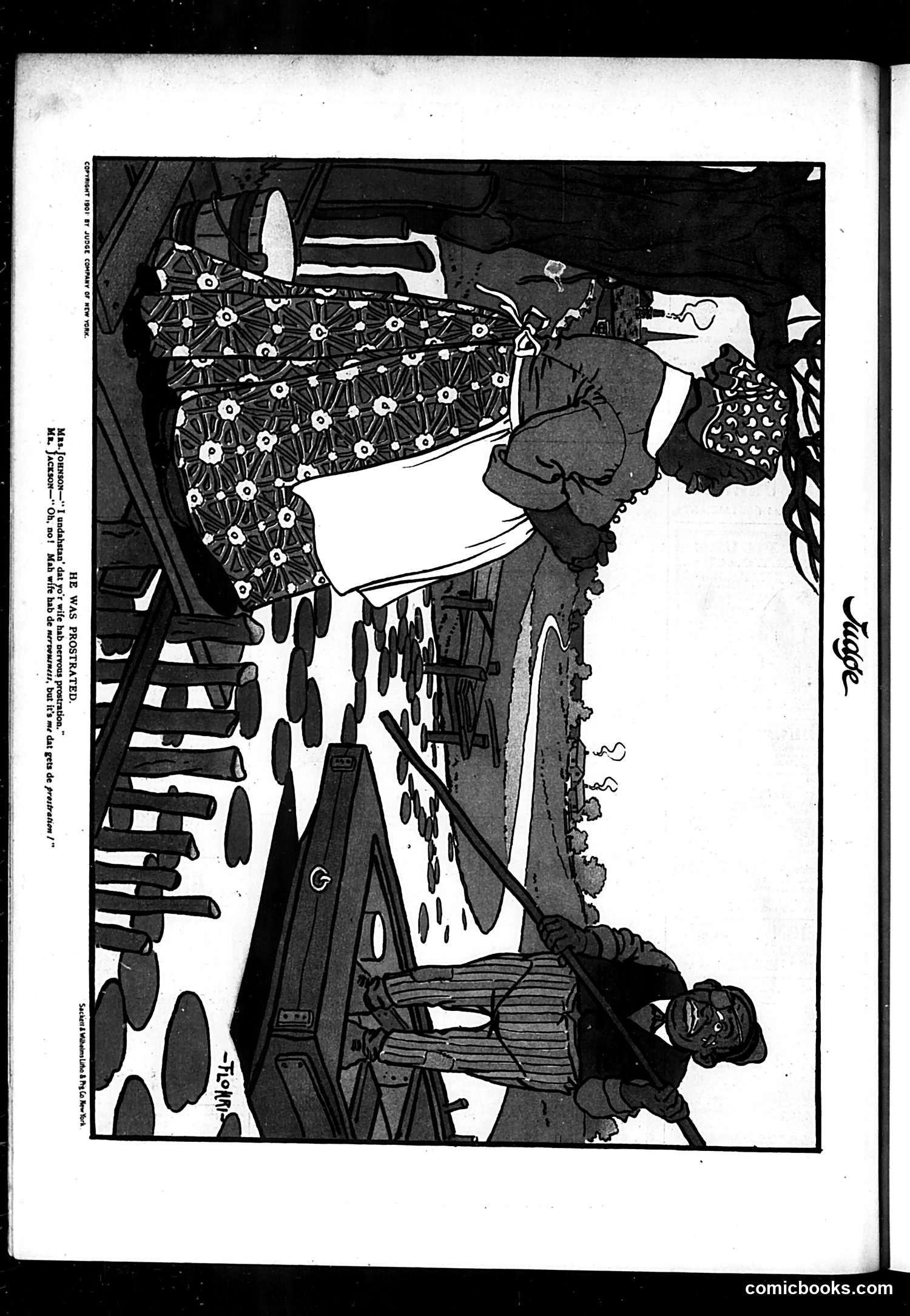
This is a joke playing on the term "nervous prostration" (a Victorian-era diagnosis roughly equivalent to nervous breakdown or depression). The cartoon depicts two men in conversation. Mrs. Johnson mentions that Mr. Jackson's wife has "nervous prostration," but Mr. Jackson corrects her: his wife has the nervousness, but *he* gets the prostration—meaning he's the one who ends up exhausted and worn out dealing with her condition. The humor relies on the stereotype of wives as emotionally high-strung and demanding, with husbands bearing the physical/mental burden of managing them. The dialect suggests working-class characters, typical of Judge's satirical approach to domestic relations and gender dynamics of the early 1900s.