
Judge, 1901-01-19 · page 7 of 16
Judge — January 19, 1901 — page 7: what you’re looking at
What you’re looking at
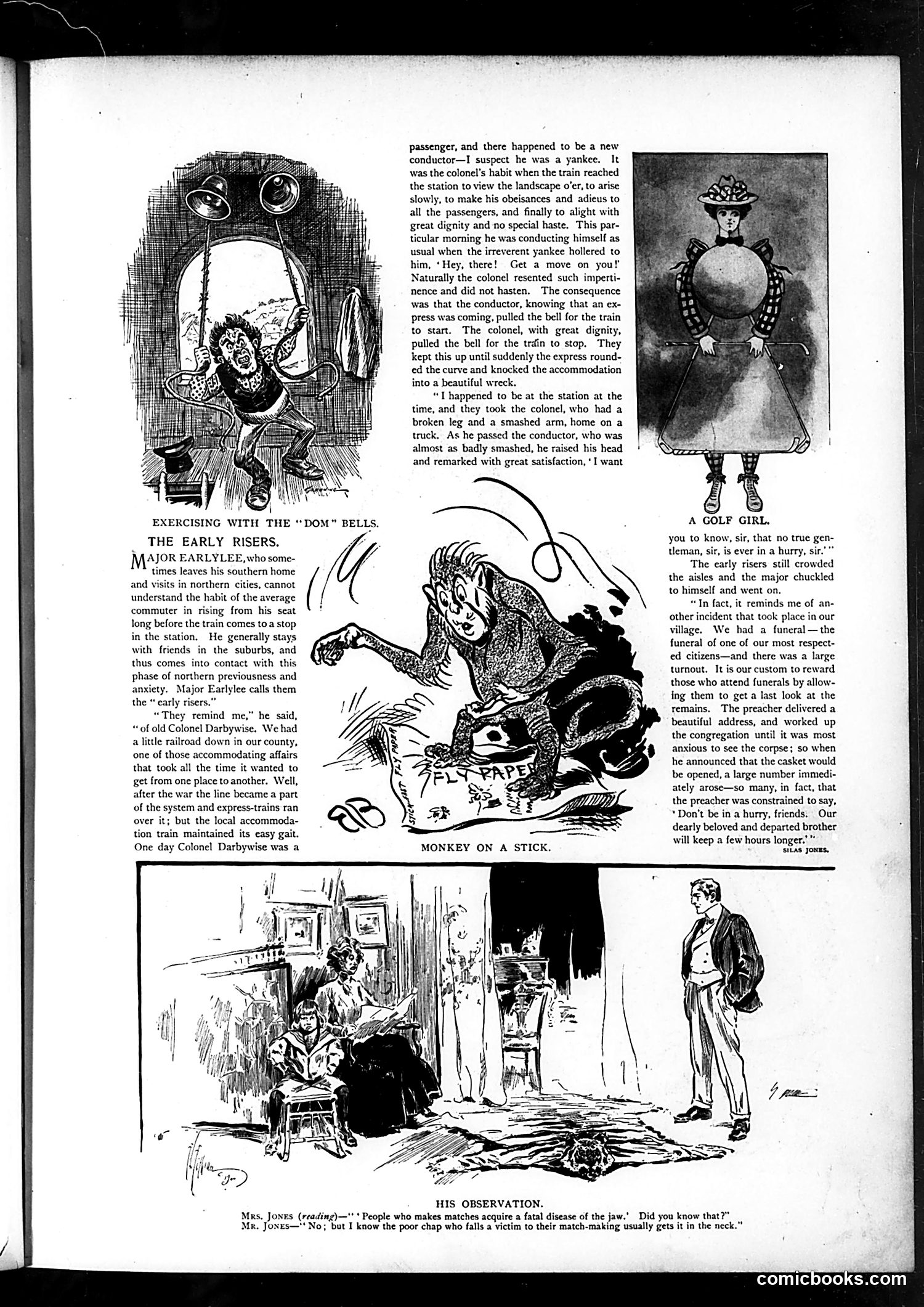
This page satirizes Northern impatience versus Southern leisurely manners during the post-Civil War period. Major Earlylee, a Southern visitor, complains about commuters rushing off trains before they stop—a behavior he finds crude and ungentlemanly. He illustrates this through two anecdotes: Colonel Darbywise, a dignified Southerner, refuses to hurry when ordered by a "yankee" conductor, resulting in a train wreck that injures both men. Yet even mangled, the Colonel maintains that "no true gentleman is ever in a hurry." A second story about a funeral preacher asking mourners not to rush toward the casket reinforces the theme: Southern dignity demands slowness and ceremony, contrasted with Yankee rudeness and haste. The cartoon mocks both extremes—Southern stubbornness that causes actual harm, and Northern impatience—while ultimately sympathizing with antebellum Southern values of decorum and deliberation. The humor relies on post-war sectional stereotypes and nostalgia for the Old South.
📄 Transcribed text from this page (OCR, searchable)
Machine-transcribed from the original scan — historical spelling and the odd misread are preserved.
THE EARLY RISERS. MAaloR EARLYLEE, who some- times leaves his southern home and visits in northern cities, cannot understand the habit of the average commuter in rising from his seat long before the train comes toa stop in the station, He generally stays with friends in the suburbs, and thus comes into contact with this phase of northern previousness and anxiety. Major Earlylee calls them the “early rise “They remind me,” he said, “of old Colonel Darbywise. We had a little railroad down in our county, ‘one of those accommodating affairs that took all the time it wanted to get from one place to another. Well, after the war the line became a part of the system and express-trains ran over it; but the local accommoda- tion train maintained its easy gait. One day Colonel Darbywise was a passenger, and there happened to be a new conductor—I suspect he was a yankee. It was the colonel’s habit when the train reached the station to view the landscape o’er, to arise slowly, to make his obeisances and adieus to all the passengers, and finally to alight with great dignity and no special haste. This par- ticular morning he was conducting himself as usual when the irreverent yankee hollered to him, ‘Hey, there! Get a move on you! Naturally the colonel resented such imperti- nence and did not hasten, The consequence was that the conductor, knowing that an ex- press was coming, pulled the bell for the train to start. The colonel, with great dignity, pulled the bell for the trdin to stop. They kept this up until suddenly the express round- ed the curve and knocked the accommodation into a beautiful wreck. “T happened to be at the station at the time, and they took the colonel, who had a broken leg and a smashed arm, home on a truck. As he passed the conductor, who was almost as badly smashed, he raised his head and remarked with great satisfaction, ‘I want HIS OBSERVATION. Mrs. Jones (reading)—"* * People who makes matches acquire a fatal disease of the jaw.’ Mr. Jones—"* Ni A GOLF GIRL, you to know, sir, that no true gen: tleman, sir, is ever in a hurry, sir.’ The early risers still crowded the aisles and the major chuckled to himself and went on. “In fact, it reminds me of an- other incident that took place in our village. We had a funeral—the funeral of one of our most respect- ed citizens—and there was a large turnout. It is our custom to reward those who attend funerals by allow- ing them to get a last look at the remains. The preacher delivered a beautiful address, and worked up the congregation until it was most anxious to see the corpse; so when he announced that the casket would be opened, a large number immedi- ately arose—so many, in fact, that the preacher was constrained to say, ‘Don't be ina hurry, friends. Our dearly beloved and departed brother will keep a few hours longer.’ ” SILAS JONES, Did you know that?” ; but I know the poor chap who falls a victim to their match-making usually gets it in the neck.” comicbooks.com