
A complete issue · 16 pages · 1901
Judge — January 12, 1901
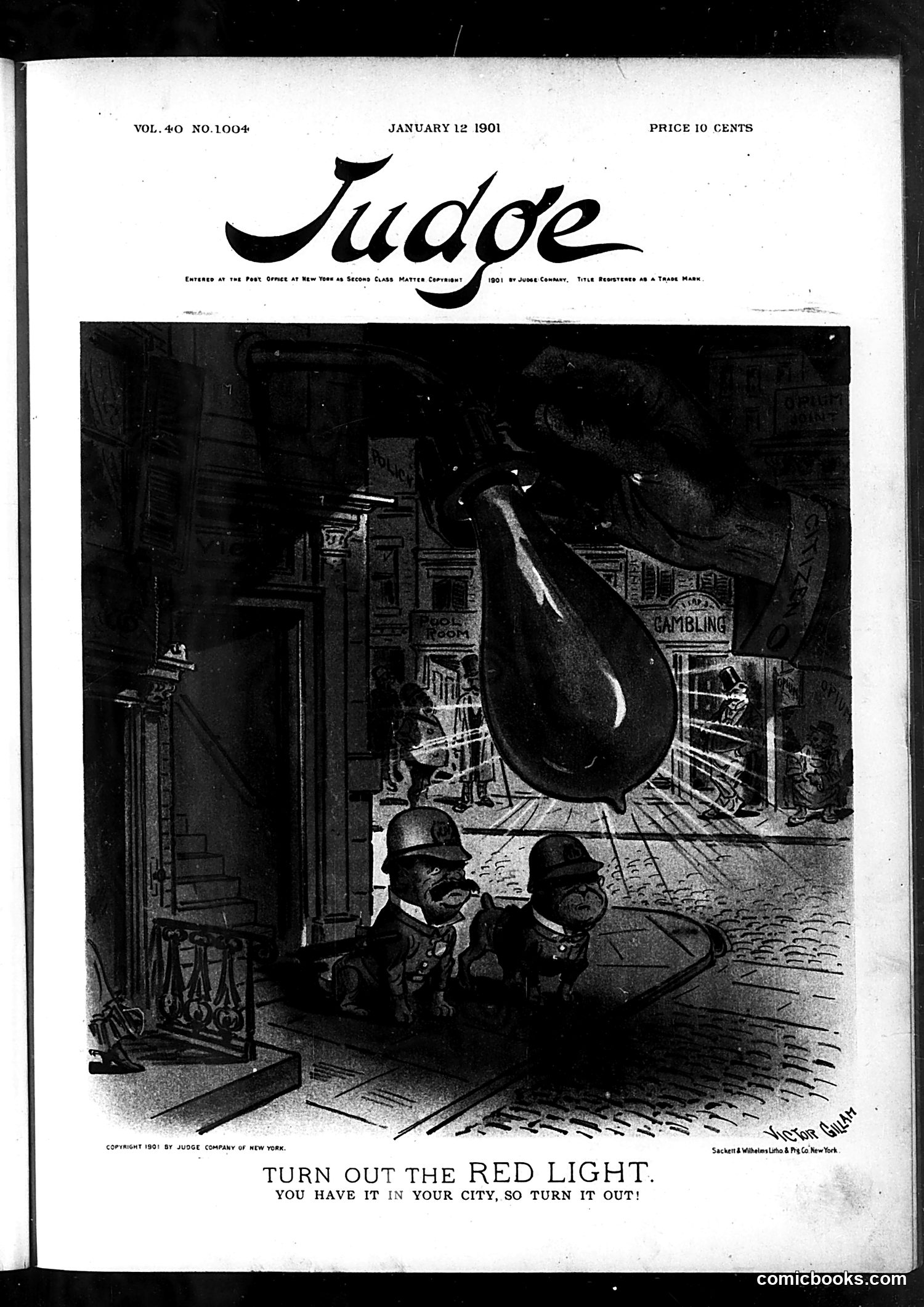
This January 1901 *Judge* cartoon satirizes a campaign to shut down red-light districts in American cities. Two German military officers (identifiable by their Prussian spiked helmets) stand bewildered in a street as a massive, deflating balloon marked "GAMBLING" descends upon them—representing moral reform efforts sweeping U.S. cities. The caption "TURN OUT THE RED LIGHT. YOU HAVE IT IN YOUR CITY, SO TURN IT OUT!" calls for civic action against vice districts. The German figures appear as foreign observers shocked by American moral reformism, possibly mocking either progressive reform zeal or suggesting ironic contrast with less-regulated European cities. The cartoon critiques urban vice through comedic exaggeration and international comparison.
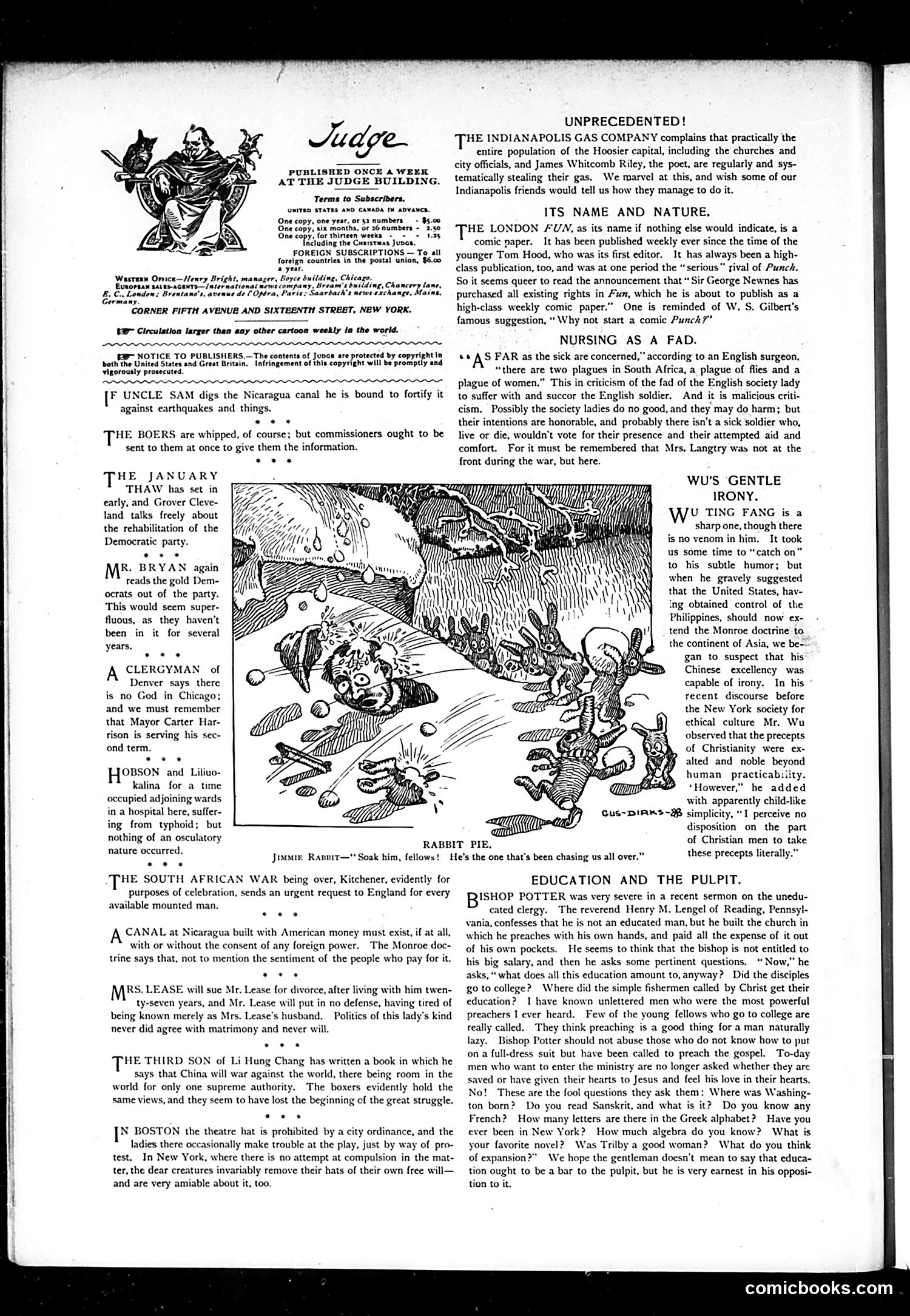
The main cartoon, titled "Rabbit Pie," depicts anthropomorphic rabbits in a chaotic scene with the caption: "Soak him, fellows! He's the one that's been chasing us all over." This appears to be a political allegory about predatory behavior or pursuit. The rabbits—typically prey animals—have turned tables to attack their hunter. The cartoon likely comments on a contemporary political figure or policy being "chased" or pursued, now facing retaliation from those victimized. The accompanying text discusses Bishop Potter's criticism of uneducated clergy, advocating for better theological training. The page also addresses various topics including the South African War and social issues. Without clearer historical context about the specific 1890s-1900s political figure referenced, the exact target of satire remains uncertain, though the cartoon's message about victims retaliating against a pursuer is evident.
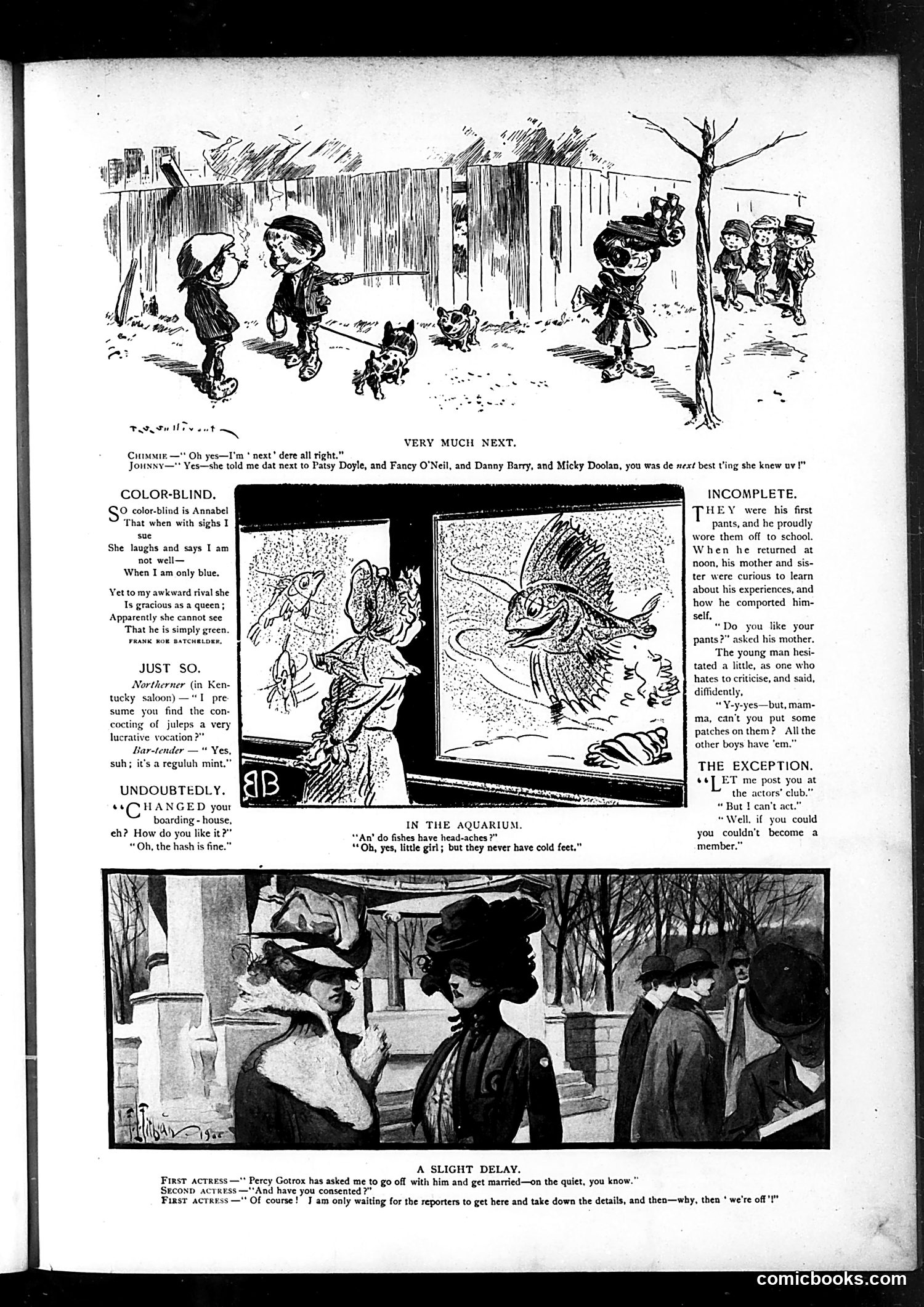
This page contains three separate humorous sketches rather than political cartoons: **"Very Much Next"** depicts children playing, with one boasting about being "next" in a game. **"Color-Blind"** is a brief comedic poem about a woman named Annabel who cannot distinguish colors properly, laughing when wearing only blue. **"Just So"** features a Northerner and Southerner discussing mint juleps as a regional drink. **"In the Aquarium"** shows a young boy's first visit to an aquarium with his mother discussing fish. **"The Exception"** briefly mentions exclusion from an actors' club. **"A Slight Delay"** depicts two actresses discussing a marriage announcement and reporters needing details—likely referring to theatrical gossip. The page is primarily light entertainment and social humor rather than political satire, typical of Judge's mixed content.
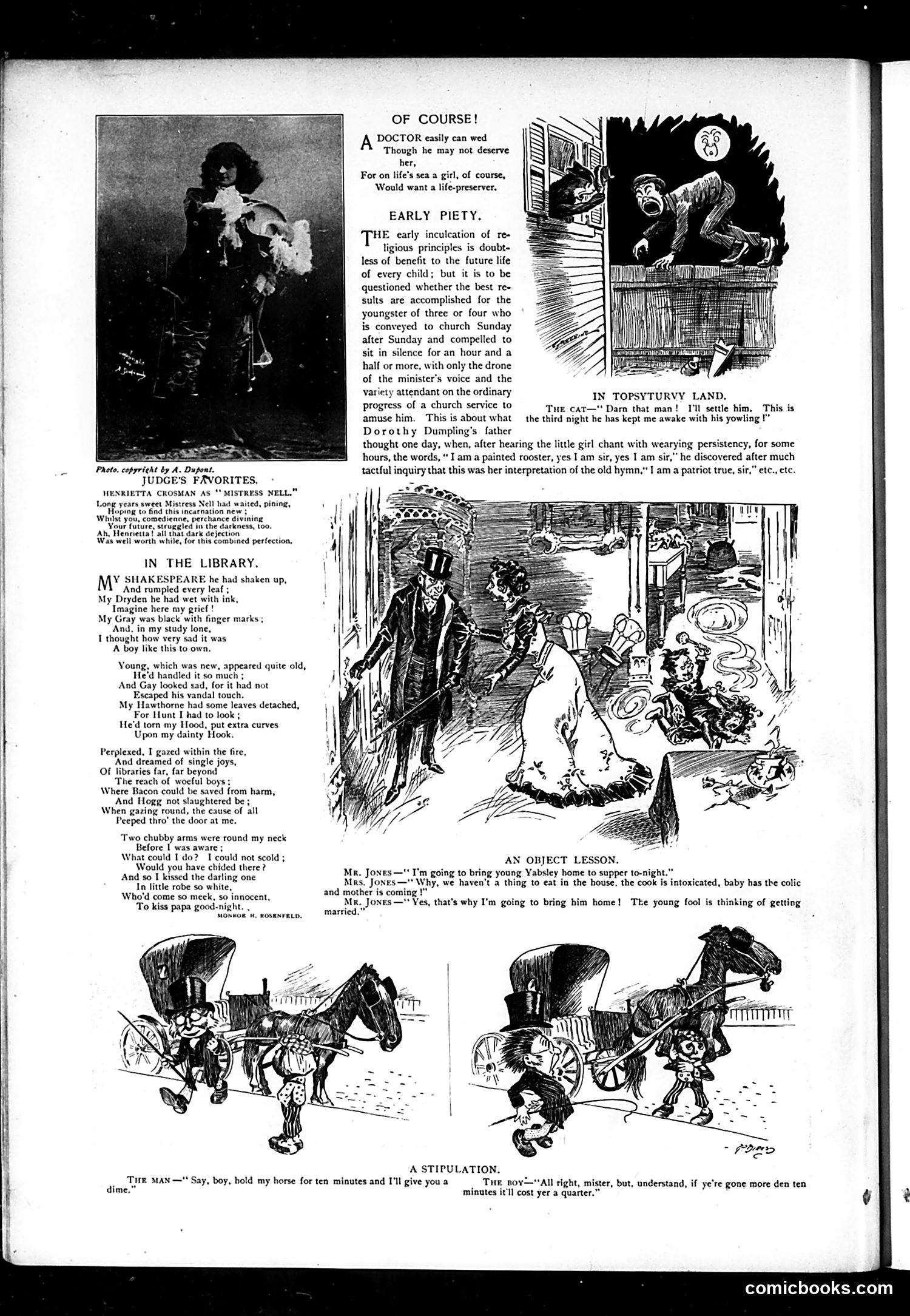
This page contains several unrelated satirical pieces typical of Judge's format: **"Of Course! A Doctor's Duty"** mocks hypocritical doctors by suggesting they'd naturally want to "preserve" attractive women patients—a commentary on medical ethics and gender. **"Early Piety"** critiques forcing young children into lengthy church services, suggesting the practice contradicts its religious purpose. **"In Topsyturvy Land"** appears a humorous fable about a rooster's identity confusion. **"An Object Lesson"** shows a domestic negotiation where a man brings home a sick child as leverage to obtain a cooked meal—satirizing marriage dynamics and domestic priorities. **"A Stipulation"** depicts haggling over horse-holding fees, mocking petty commercial transactions. The illustrations are by various artists. These are general-audience humor pieces without specific political references, focusing on domestic life and social hypocrisy.
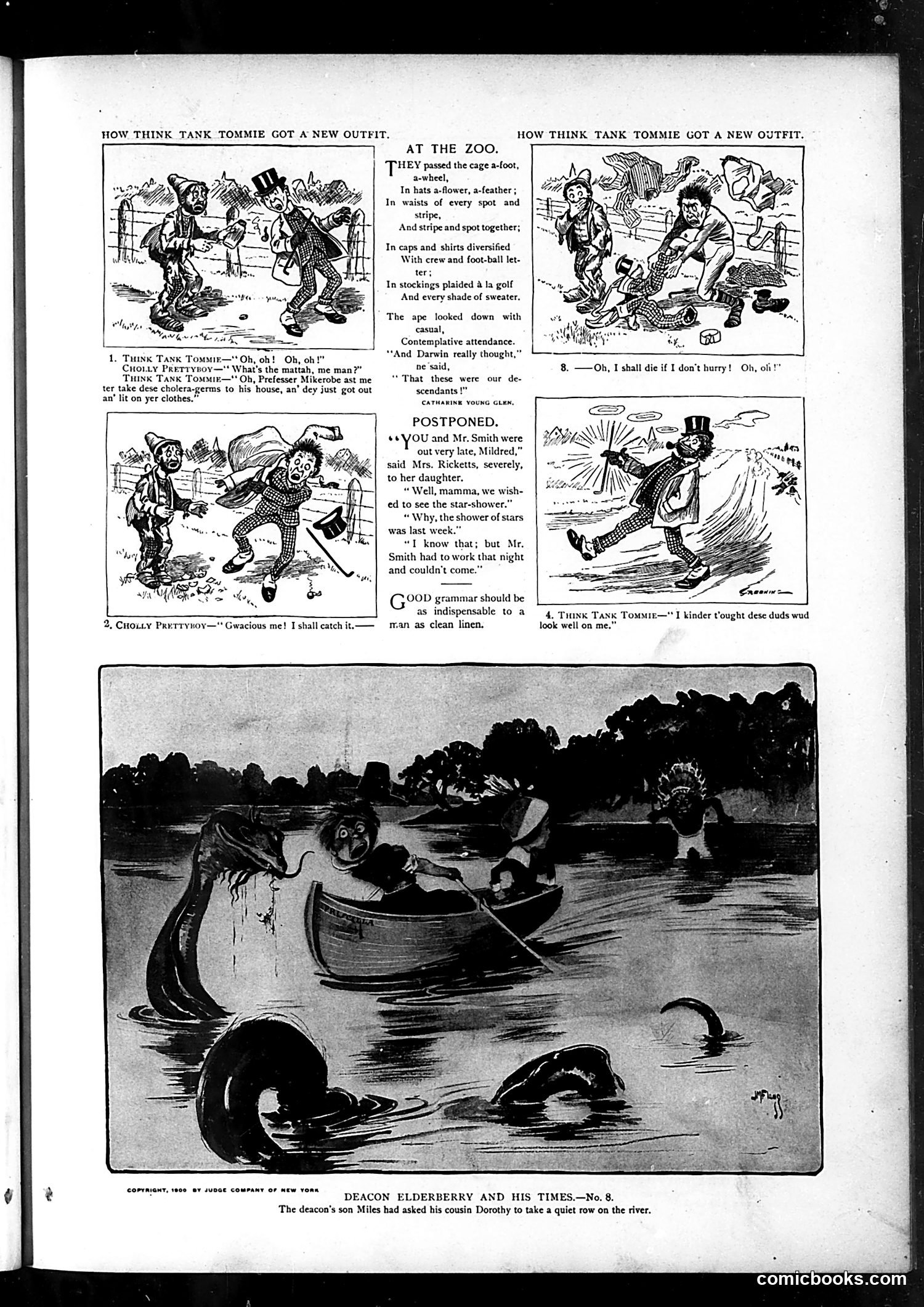
This page contains several satirical cartoons typical of late 19th-century American humor. **"Tank Tommie's New Outfit"** cartoons mock working-class immigrants, particularly those with Irish accents (indicated by dialect spelling like "mattah" and "dese"). The humor relies on the period's popular racist trope comparing non-white people or "lower classes" to apes, referencing Darwin's evolutionary theory. Tommie obtains fancy clothes but remains socially inferior—the satire targets both class pretension and immigrants aping their "betters." **"Postponed"** is a brief romantic joke about a couple delayed from stargazing due to work obligations. **"Deacon Elderberry"** (bottom) appears to be a serialized narrative—this issue shows the deacon's son inviting his cousin Dorothy for a river outing, likely setting up romantic or comedic complications in subsequent installments. The cartoons reflect Judge's characteristic mockery of immigrants, class anxieties, and courtship conventions of the Gilded Age.
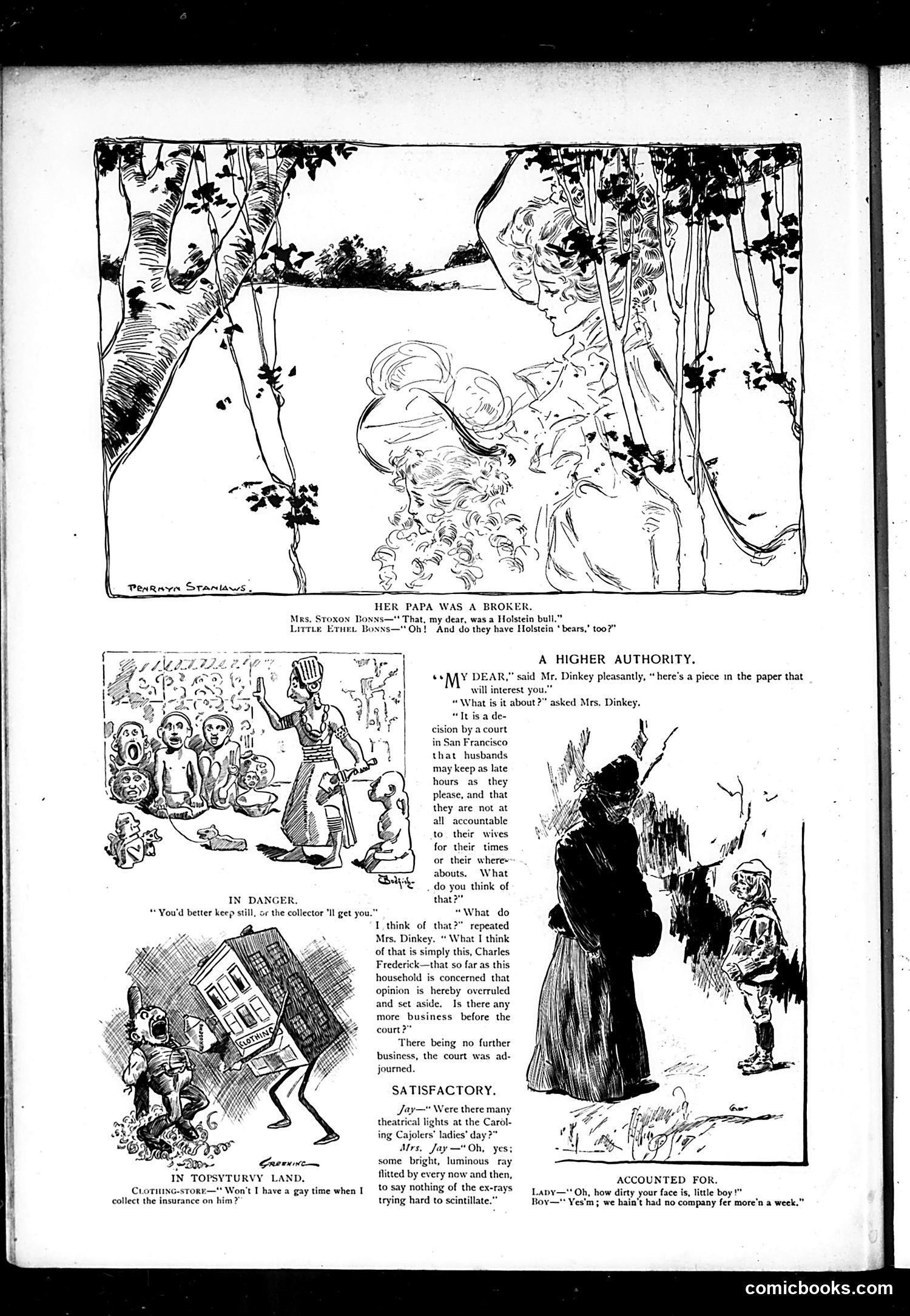
This page contains multiple satirical vignettes typical of early 20th-century American humor: **"Her Papa Was a Broker"**: A child misunderstands "Holstein bull" (cattle breed) as "Holstein bears," mocking wealthy families' pretentious knowledge and children's innocent confusion. **"A Higher Authority"**: Mr. Dinkey reads his wife a court ruling allowing husbands unrestricted late hours. Mrs. Dinkey humorously "overrules" it, asserting her domestic authority supersedes legal authority—satirizing the tension between emerging women's rights and traditional marital power dynamics. **"In Topsyturvy Land"**: A clothing store clerk anticipates profiting from insurance after "collecting" from a client, inverting normal business logic. **"Satisfactory" and "Accounted For"**: Minor domestic humor pieces about theatrical lighting and a dirty child. The page satirizes class pretensions, marital dynamics, and working-class perspectives through simple joke structures typical of Judge's humor circa 1900s-1920s.
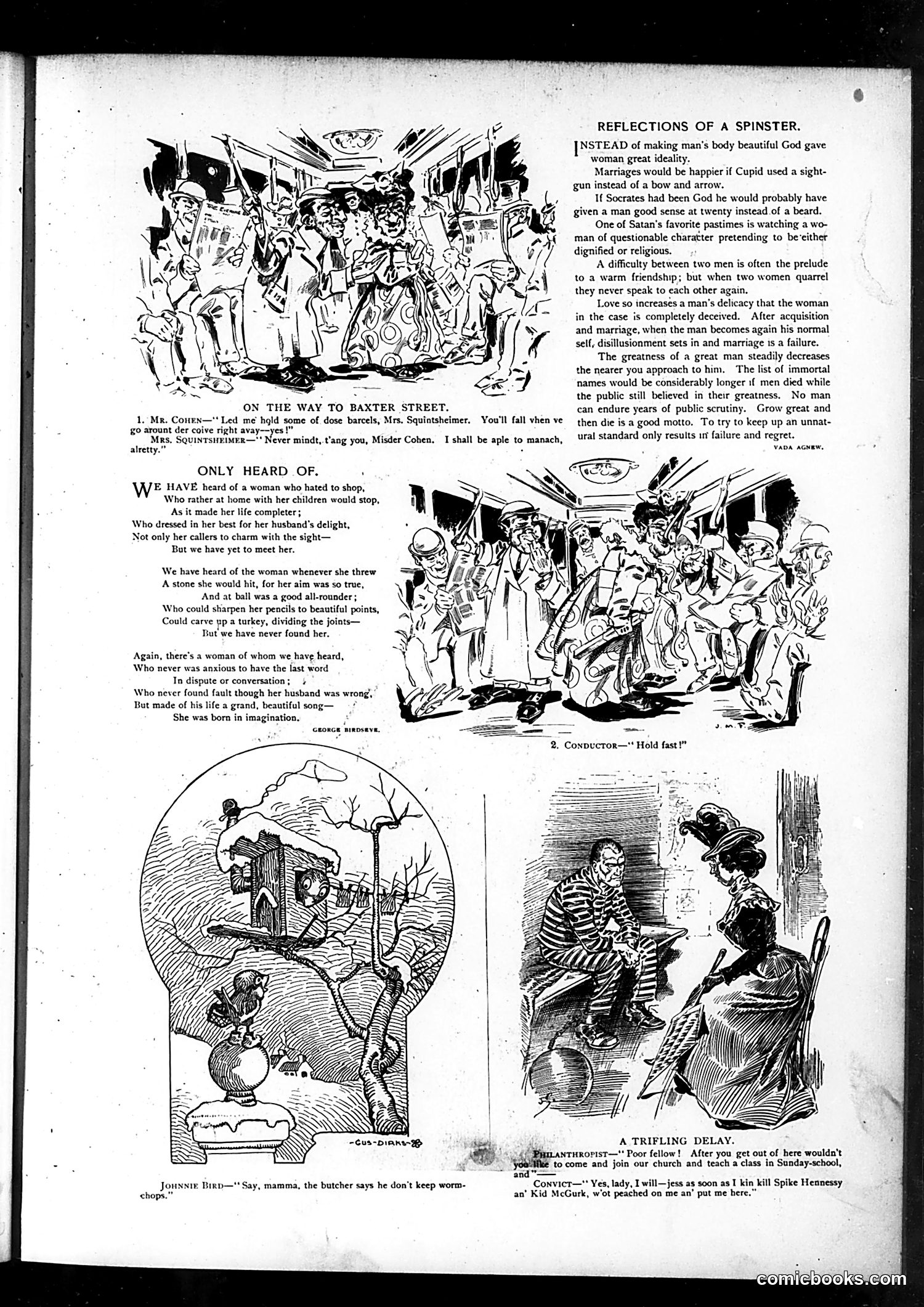
This page presents cynical observations about women and marriage through satirical text and cartoons, typical of early 20th-century American humor. **"Reflections of a Spinster"** offers biting commentary on gender relations—suggesting marriages fail because men deceive women with false delicacy before marriage, then reveal their true nature after. The piece satirizes both genders: women's quarrels are permanent while men's conflicts become friendships; great men lose mystique upon close inspection. **"Only Heard Of"** uses irony to mock the "ideal woman" (domesticated, skilled, selfless, never wanting the last word)—claiming she exists only in imagination. This criticizes both unrealistic male expectations and the impossibility of meeting them. The cartoons show street characters, a conductor scene, and notably **"A Trifling Delay,"** depicting a convict (likely imprisoned for violent crime) telling a philanthropist he'll join church once he finishes killing rivals who betrayed him—dark humor mocking both criminal culture and charitable do-gooders' naiveté. The humor reflects early 1900s attitudes: cynicism about gender, class, and urban life.
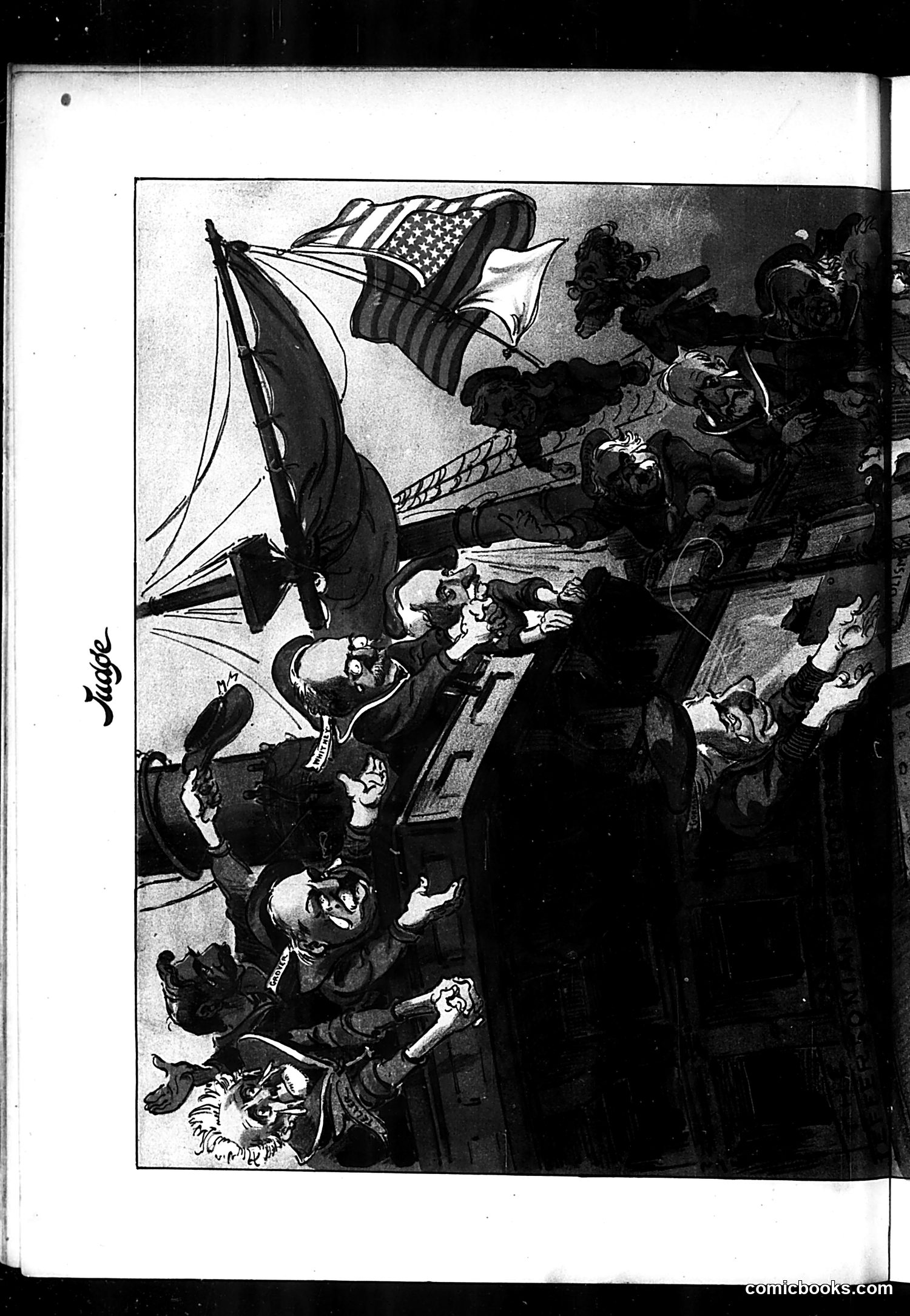
This political cartoon depicts a boat scene with American flags prominently displayed. The image shows multiple figures in formal dress on what appears to be a vessel, with some appearing distressed or animated in their gestures. The style and composition suggest this is commentary on American politics or diplomacy. However, without a visible title, caption, or clearer OCR text identifying specific political figures or the historical moment referenced, I cannot definitively explain which politicians or events this satirizes. The formal attire, flags, and boat setting suggest themes of diplomacy, naval affairs, or national politics from Judge magazine's era, but the specific satire's target and point remain unclear from the image alone. More contextual information would be needed for accurate interpretation.
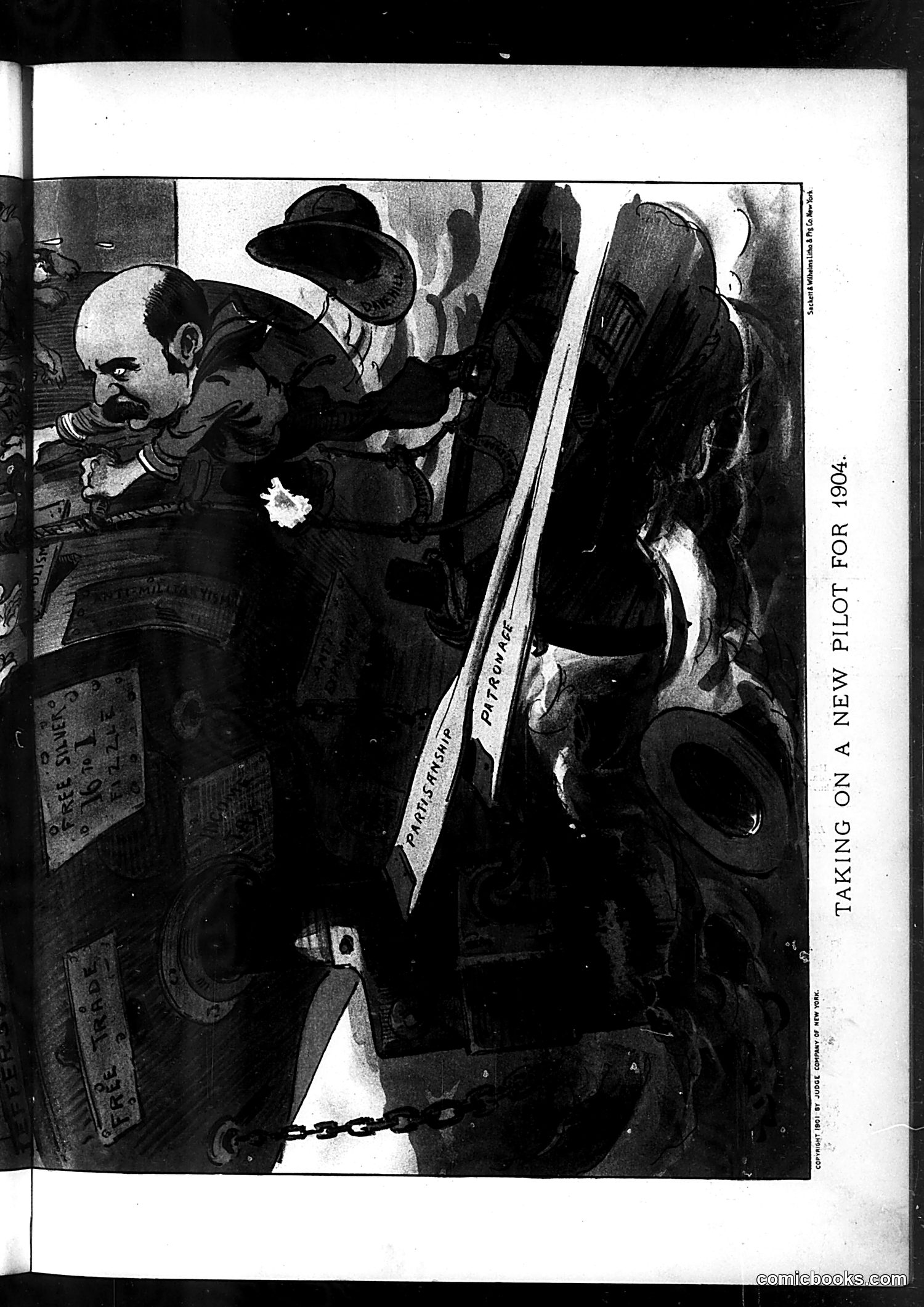
This political cartoon depicts what appears to be a pilot or helmsman being forcibly removed from a ship's wheel, with a replacement waiting to take control. The exaggerated caricature and formal dress suggest this represents a significant political transition. The caption indicates this relates to 1904, likely referencing that year's U.S. presidential election or a major political shift. The nautical metaphor—the ship of state—was common in political satire. The violent, chaotic nature of the transfer suggests commentary on turbulent political change or contested succession of power. Without clearer identification of the figures or additional context, the specific political figures or event referenced remains unclear from the image alone.
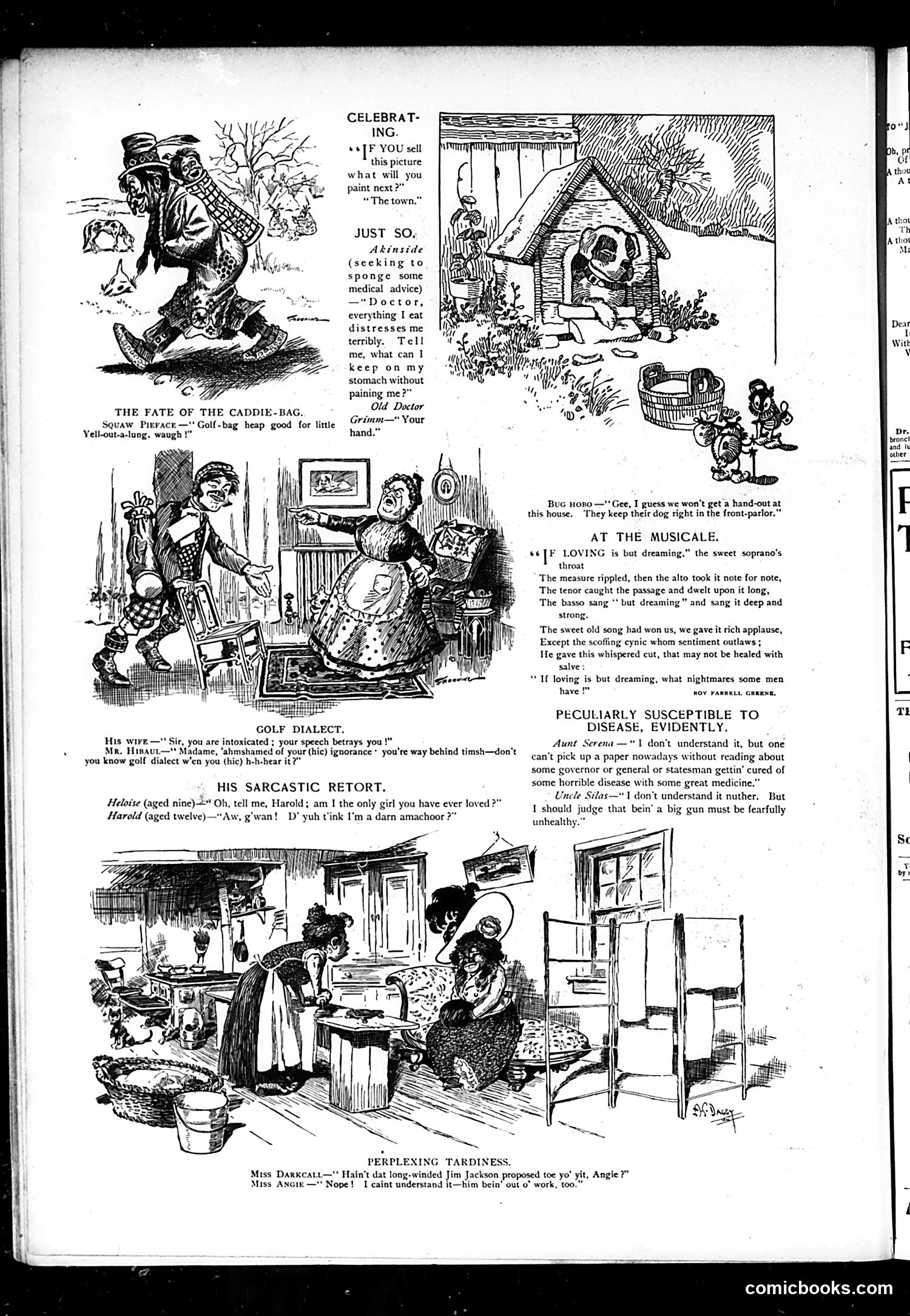
This page contains multiple comic vignettes satirizing American social life. The top cartoon mocks a painter's ambitions—when asked what he'll paint after selling his current work, he jokes "The town," suggesting mediocre artists lack imagination beyond their immediate surroundings. "The Fate of the Caddie-Bag" features a squaw (Native American woman) using a golf bag as a papoose carrier, playing on the period's casual racial stereotyping and class humor about working-class people repurposing wealthy people's possessions. "At the Musicale" satirizes sentimental Victorian culture through a cynic's crude joke: if "loving is but dreaming," then some men must have nightmares—mocking both romantic sentimentality and men's marriage dissatisfaction. Other sketches mock hypochondria among the wealthy, working-class courtship delays, and exaggerated "golf dialect" speech affectation among golfers. The humor assumes readers' familiarity with period social hierarchies and Victorian etiquette norms now largely obsolete.
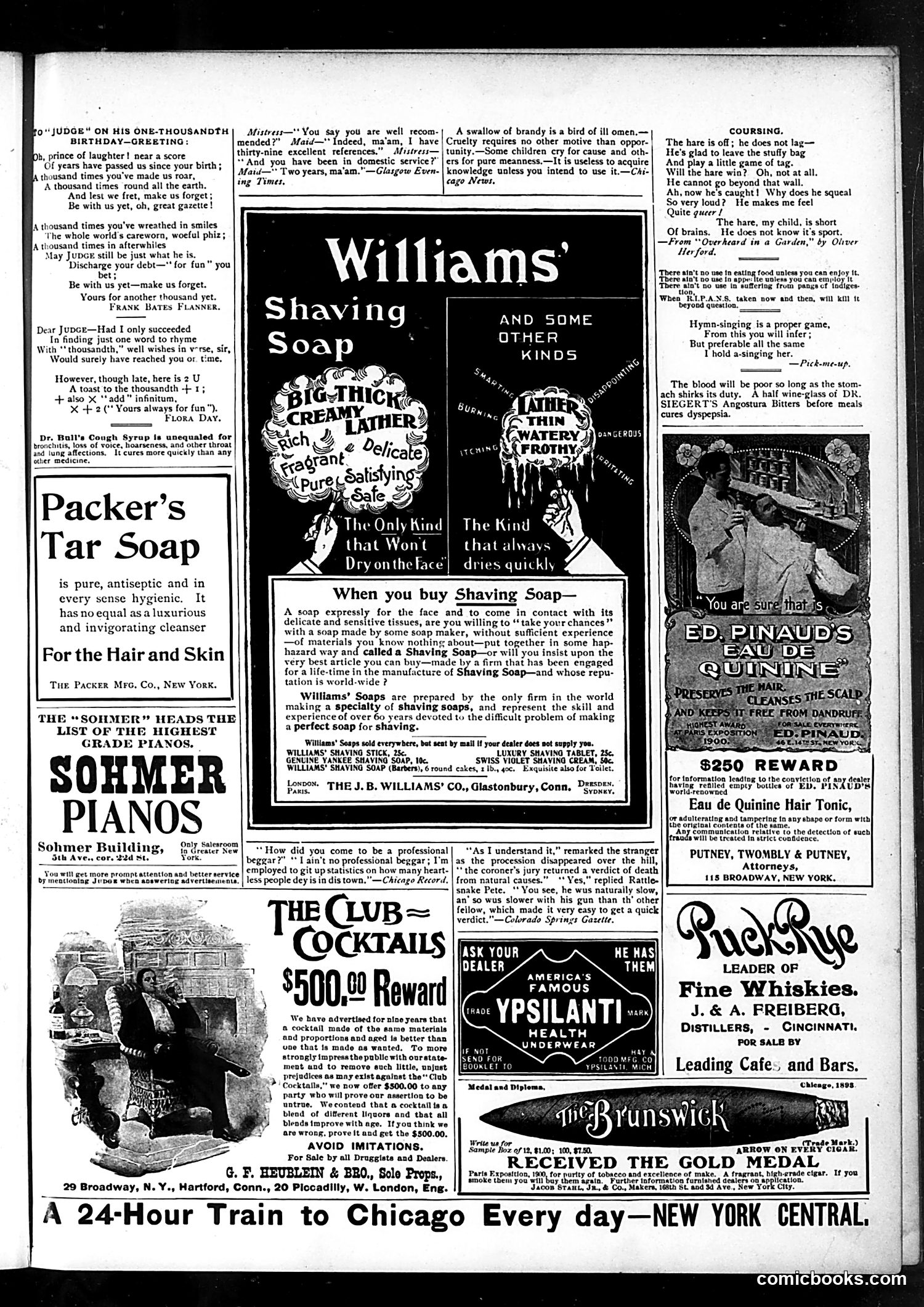
This page from the satirical magazine **Judge** is primarily a **birthday tribute to the magazine itself** on its one-thousandth issue, composed of congratulatory poems and jokes submitted by readers—not political cartoons. The opening section features humorous verse celebrating Judge's longevity and comedic impact. Below are scattered joke columns and various product advertisements typical of the era (shaving soaps, pianos, whiskeys, tonics). The one substantive cartoon appears mid-page: **"Coursing,"** depicting a hare being chased, which serves as a gentle moral lesson for children about animal fear and sport—the hare doesn't understand hunting is "sport" and experiences genuine terror. The page contains **no identifiable political figures or references**. Instead, it functions as a **miscellaneous humor and advertising compilation**—common for Judge's format. The satire is mild and domestic rather than politically pointed.
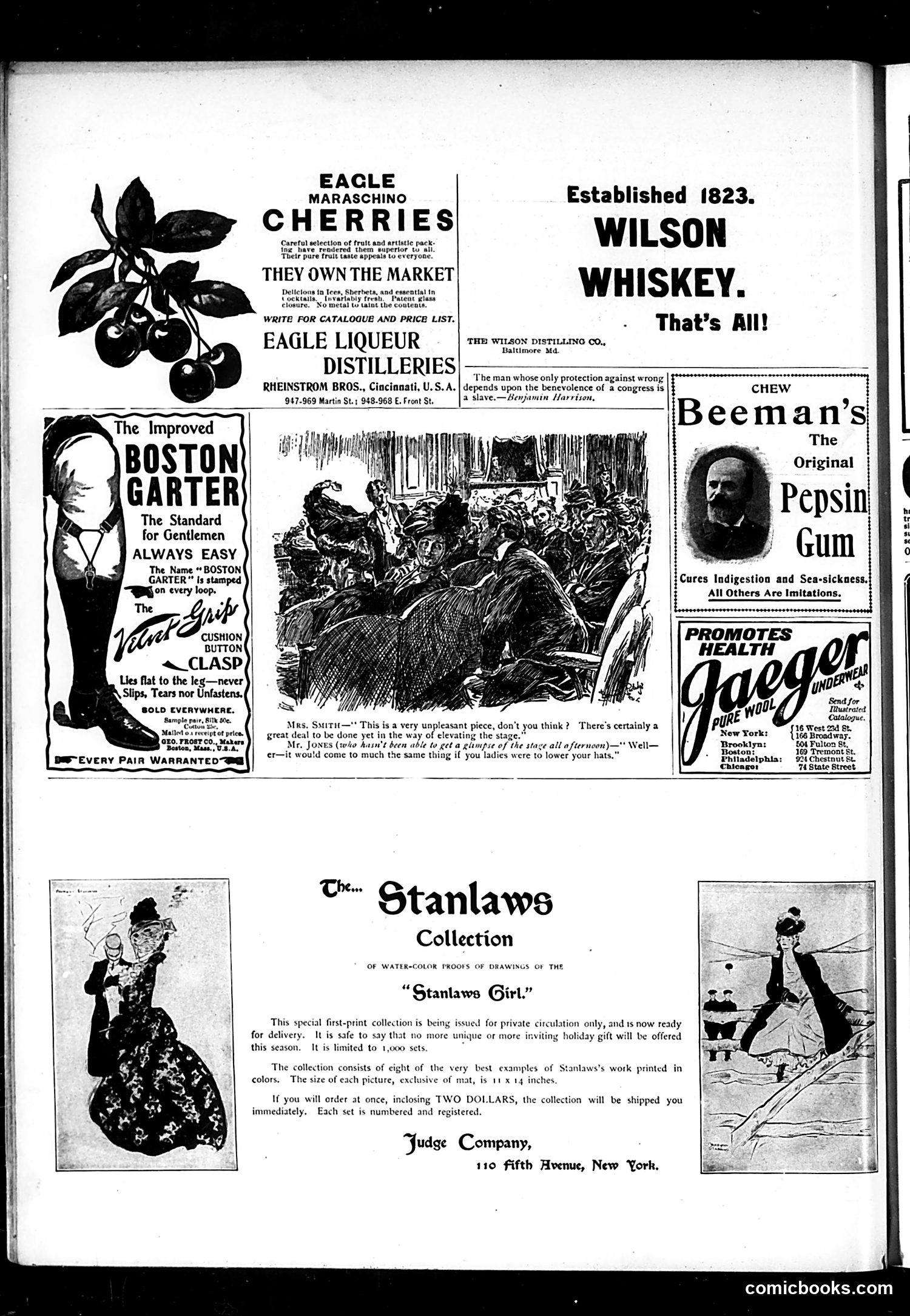
This page is primarily **advertising and promotional material** rather than political satire or comics. The content includes: **Advertisements:** - Eagle Maraschino Cherries and liqueurs (Rheinstrom Bros.) - Wilson Whiskey (established 1823) - Boston Garter (men's garters) - Beeman's Pepsin Gum (claims to cure indigestion and sea-sickness) - Jaeger Pure Wool Underwear **One visible cartoon/joke** (center): Mrs. Smith complains about an unpleasant stage performance to Mr. Jones, who admits he hasn't seen it because ladies' hats block his view—a common theater complaint of the era about women's large, elaborate hats. **Lower section:** Promotion for a Stanlaws Girl art collection (water-color prints), available for two dollars. The Benjamin Harrison quote about congressional protection appears decorative rather than satirical commentary. Overall, this is a typical Judge magazine page mixing humor with period advertisements.
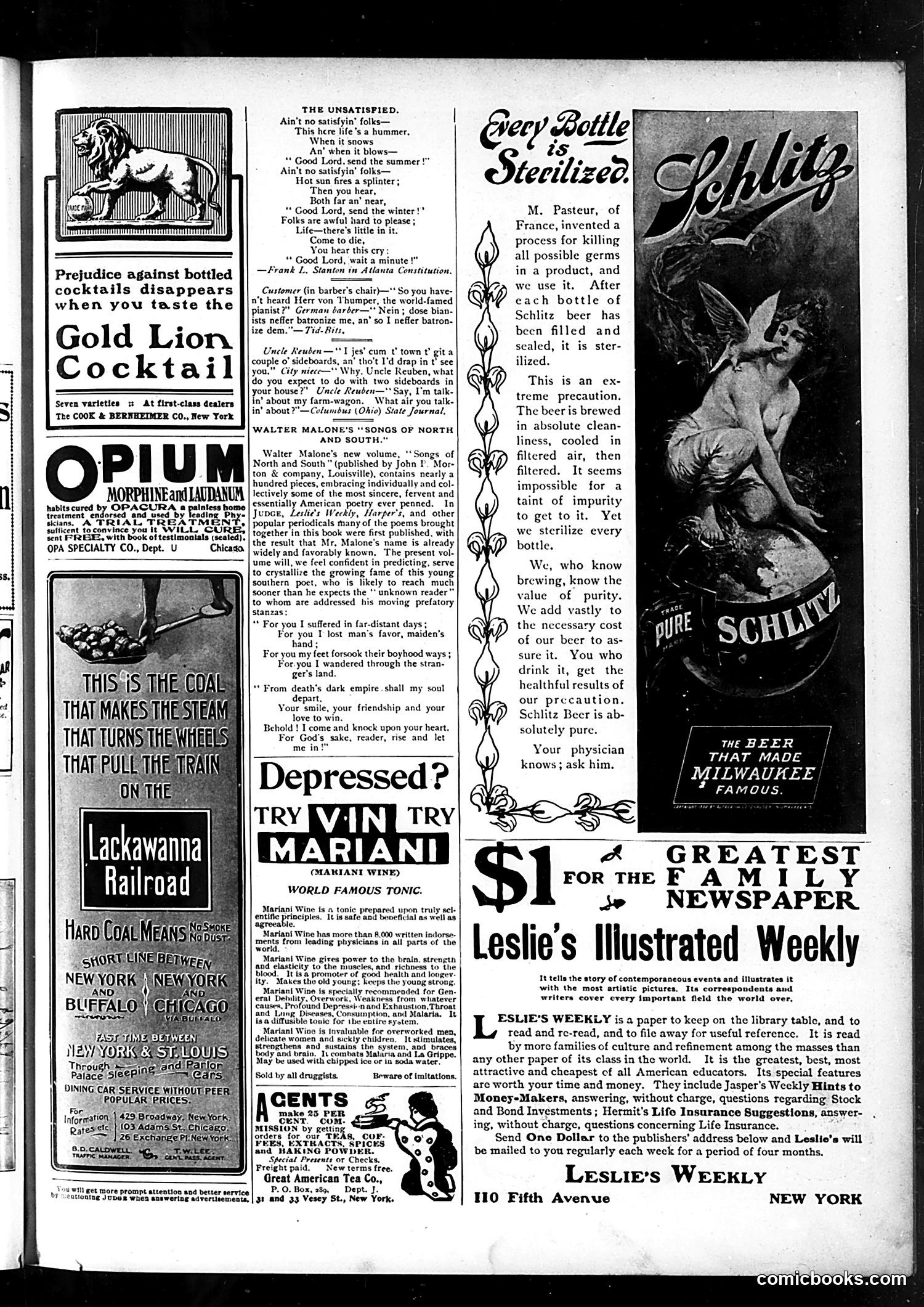
This page is primarily **advertising**, with some light satirical poetry and humor interspersed. The main advertisements include: - **Gold Lion Cocktail** - promoting bottled cocktails to urban consumers - **Opium addiction treatment** (Opacura) - a "painless home treatment" - **Lackawanna Railroad** - coal and rail transport - **Mariani Wine** - a patent medicine tonic wine claiming health benefits - **Vin Mariani** - marketed for depression and exhaustion - **Leslie's Illustrated Weekly** - subscription offer - Various other patent medicines The satirical content is minimal: a poem called "The Unsatisfied" mocks people's perpetual complaining about weather, and brief jokes about musicians and farm wagons show typical early-1900s rural/urban humor. The **Mariani Wine** advertisement is notable as Prohibition-era patent medicine marketing—cocaine-laced wine legally sold as a medicinal tonic. This reflects pre-regulation America when such substances were openly advertised as cure-alls. Overall, this is a typical Judge magazine page blending light satire with commercial appeals to middle-class readers.
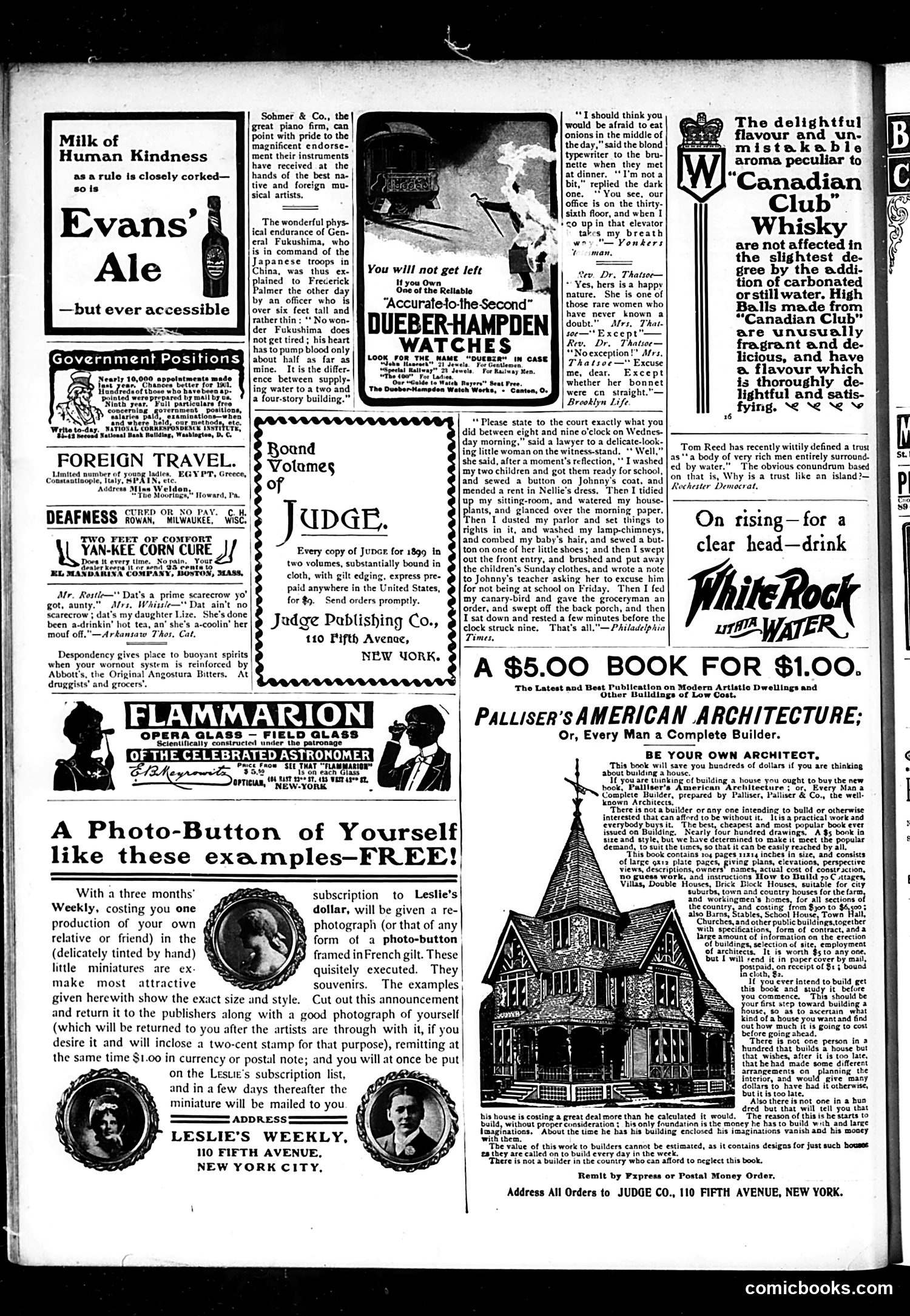
This page is primarily **advertising and miscellaneous content** rather than political cartoons. The main satirical elements are brief: **The "Milk of Human Kindness" ad** for Evans' Ale uses a common metaphor—that kindness, like ale, is "closely corked" (kept bottled up) but should be accessible. It's gentle wordplay rather than sharp satire. **The Fukushima anecdote** presents a racist "joke" about Japanese General Fukushima's supposed physical superiority, based on pseudoscientific reasoning about heart size and blood-pumping distance. This reflects early-1900s attitudes toward Japanese militarism during the Russo-Japanese conflict era. **The Arkansas dialect piece** about a woman cooling her mouth with her daughter's body is crude regional humor typical of the era. The remainder consists of book offers, watch advertisements, and subscription promotions—standard magazine filler of the period. The page lacks the sharp political commentary Judge magazine was known for.
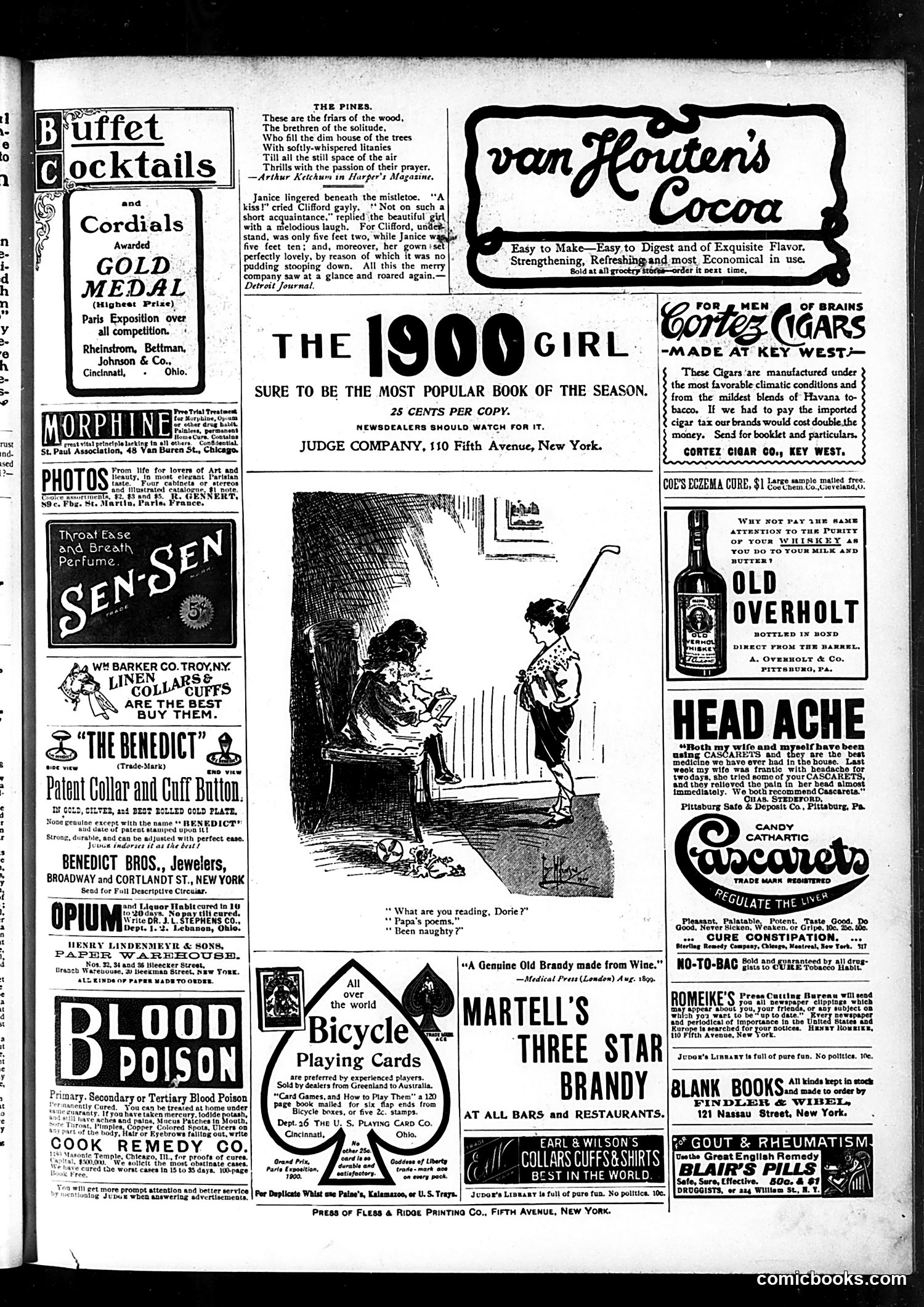
This page is primarily **advertising**, typical of Judge magazine's revenue model. The central feature is a large advertisement for "The 1900 Girl," a book published by Judge Company priced at 25 cents—positioned as "sure to be the most popular book of the season." The small cartoon illustrating the ad shows a domestic scene: a woman seated while a child approaches, with caption dialogue about reading "Papa's poems" and being "naughty." This appears to satirize sentimental Victorian domesticity—the "1900 Girl" likely representing contemporary ideals of feminine behavior and propriety. The surrounding advertisements (Cocoa, whiskey, patent medicines, cigars, playing cards) reveal the magazine's target demographic: affluent men. The juxtaposition suggests Judge's readers were wealthy enough to purchase luxury goods and recreational reading, reinforcing the era's class divisions and consumer culture.
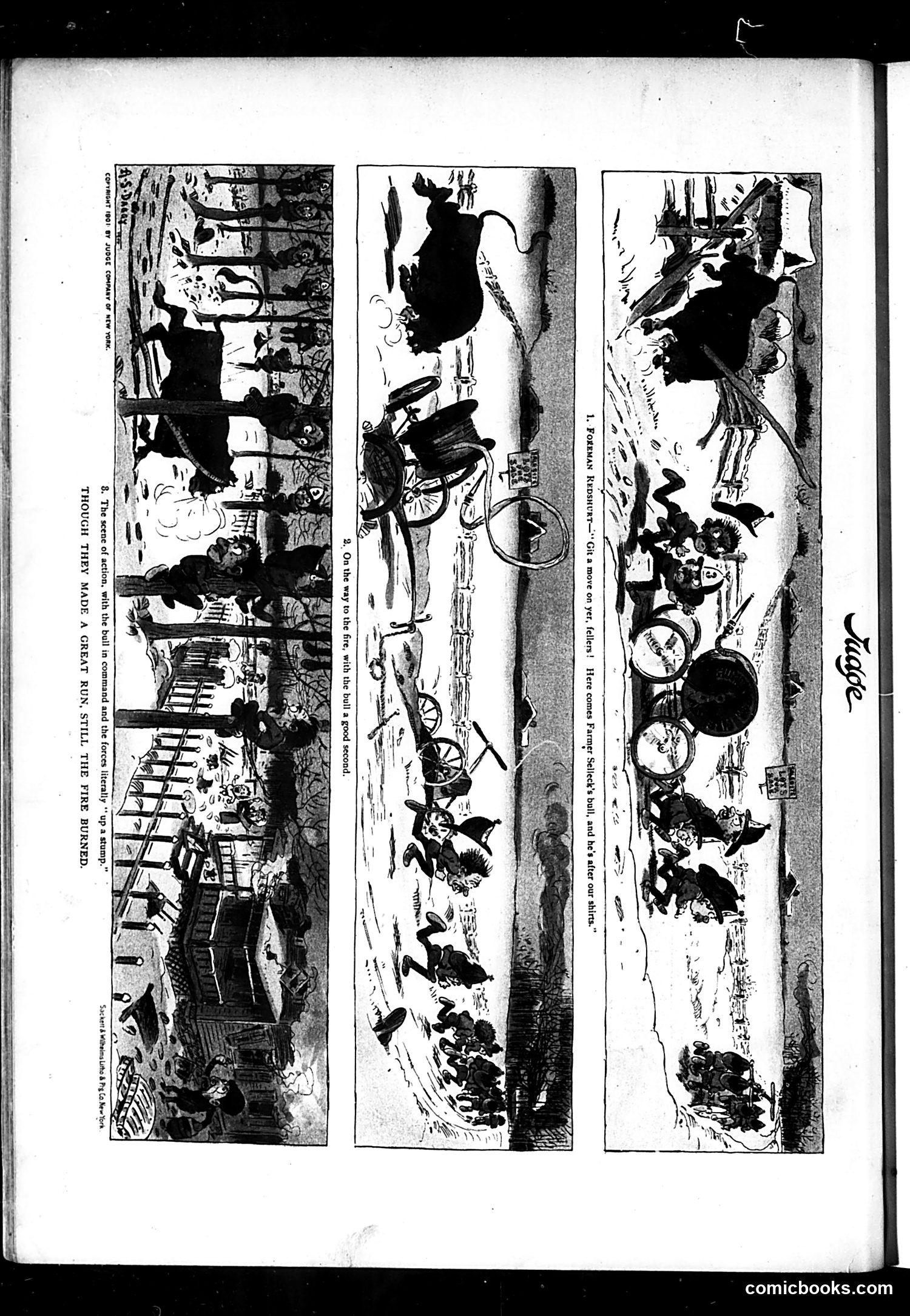
This page contains three horizontal comic strips, all appearing to be rotated 90 degrees in the original publication. The cartoons use silhouette figures in black against white backgrounds, a common technique in early 1900s satirical comics. Without being able to read the captions clearly due to image quality and rotation, the specific political or social references remain unclear. The silhouette style suggests these may be satirizing contemporary public figures or social situations from 1901, but I cannot reliably identify which ones without readable text. The page is marked as copyrighted 1901 by Judge Company of New York, confirming this as authentic period material from the prominent American satirical magazine.