
A complete issue · 16 pages · 1901
Judge — January 5, 1901
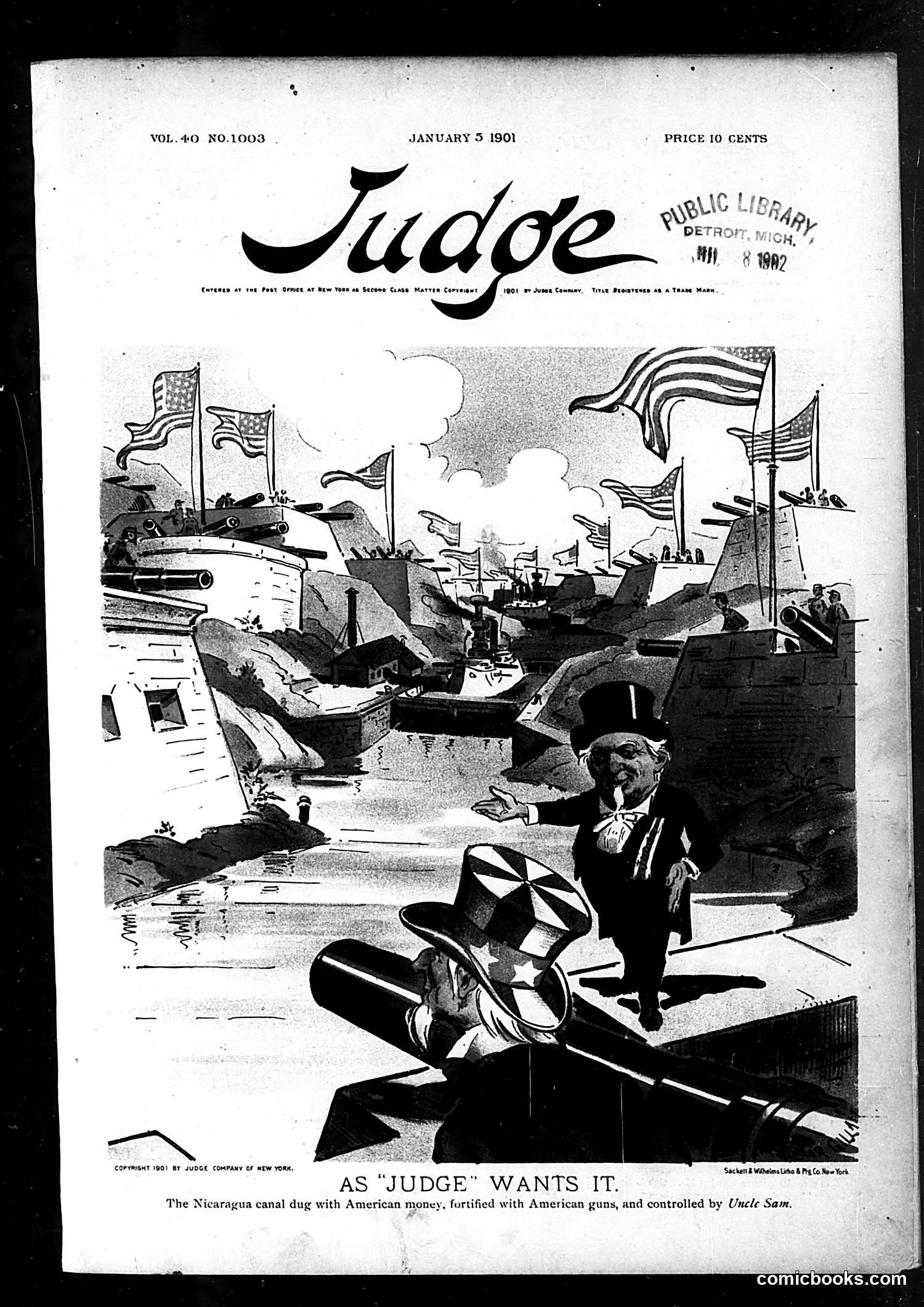
**The Cartoon:** The cover depicts Uncle Sam (identifiable by his top hat and stars-and-stripes clothing) surveying a fortified canal construction site with American flags and military presence. A caricatured figure in the foreground appears to represent a foreign power or rival nation. **The Context:** This satirizes American ambitions to build the Nicaragua Canal, a major geopolitical project of the era. The caption "As 'Judge' Wants It" indicates the magazine's editorial position supporting American control of the canal—backed by military force and American financing ("dug with American money, fortified with American guns"). **The Satire:** The cartoon advocates for American imperial expansion and military-enforced dominance over Central American infrastructure, reflecting turn-of-the-century American expansionism.
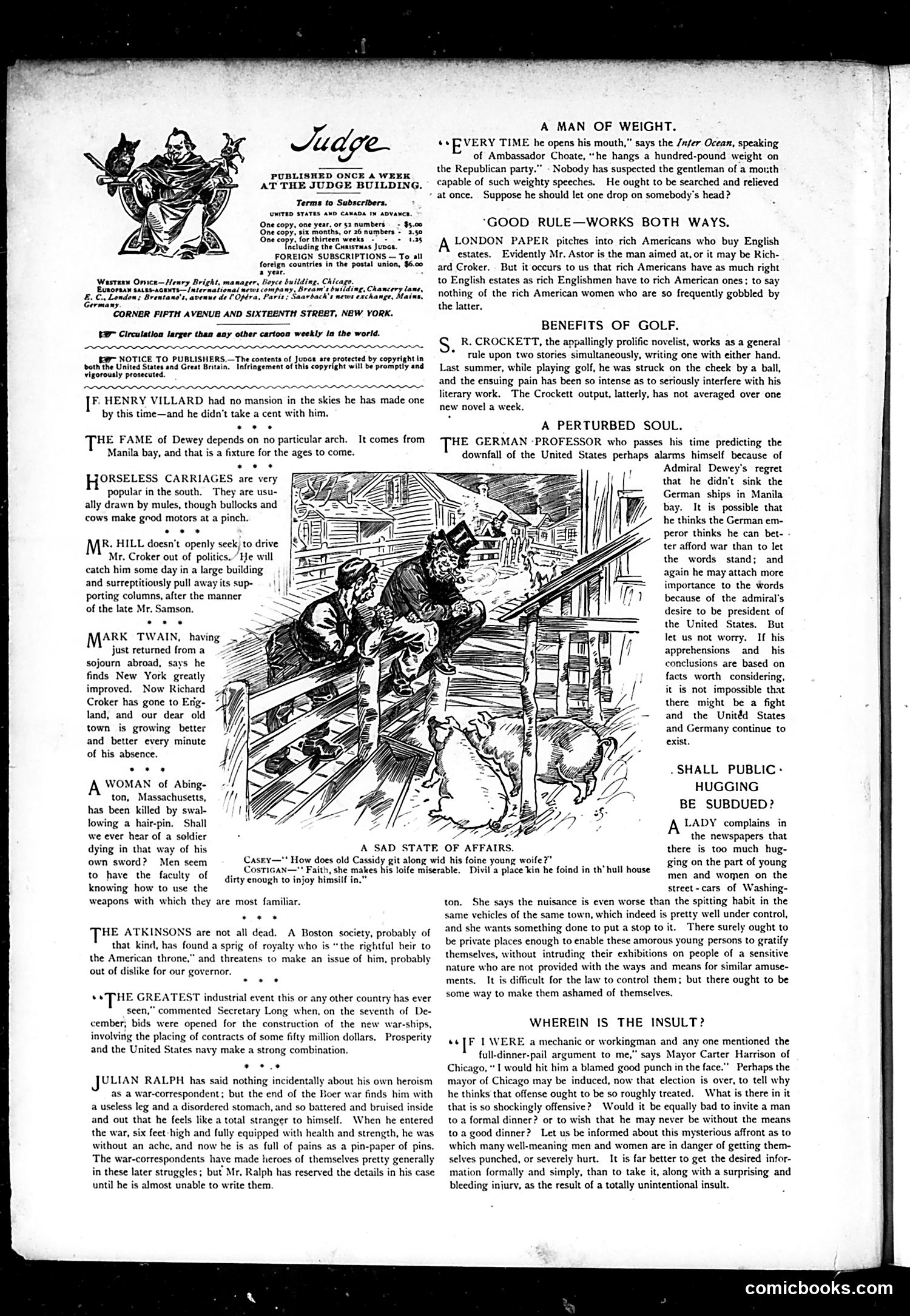
This page contains several brief satirical items rather than a single cartoon. The main illustration depicts "A Sad State of Affairs" — a chaotic street scene with what appears to be a collision or accident involving a horse-drawn carriage and pedestrians. The text items mock various topics: wealthy Americans imitating English estates, novelist S.R. Crockett's golf injury, Admiral Dewey's alleged regrets about not sinking German ships, and complaints about public displays of affection on Washington streetcars. The final piece satirizes workplace etiquette, suggesting a Chicago mechanic should punch a businessman who insulted him at a formal dinner — mocking class tensions and differing standards of conduct between social groups. Without dated context, the specific references to current events remain unclear, though the general satire targets wealth disparity, social pretension, and behavioral norms.
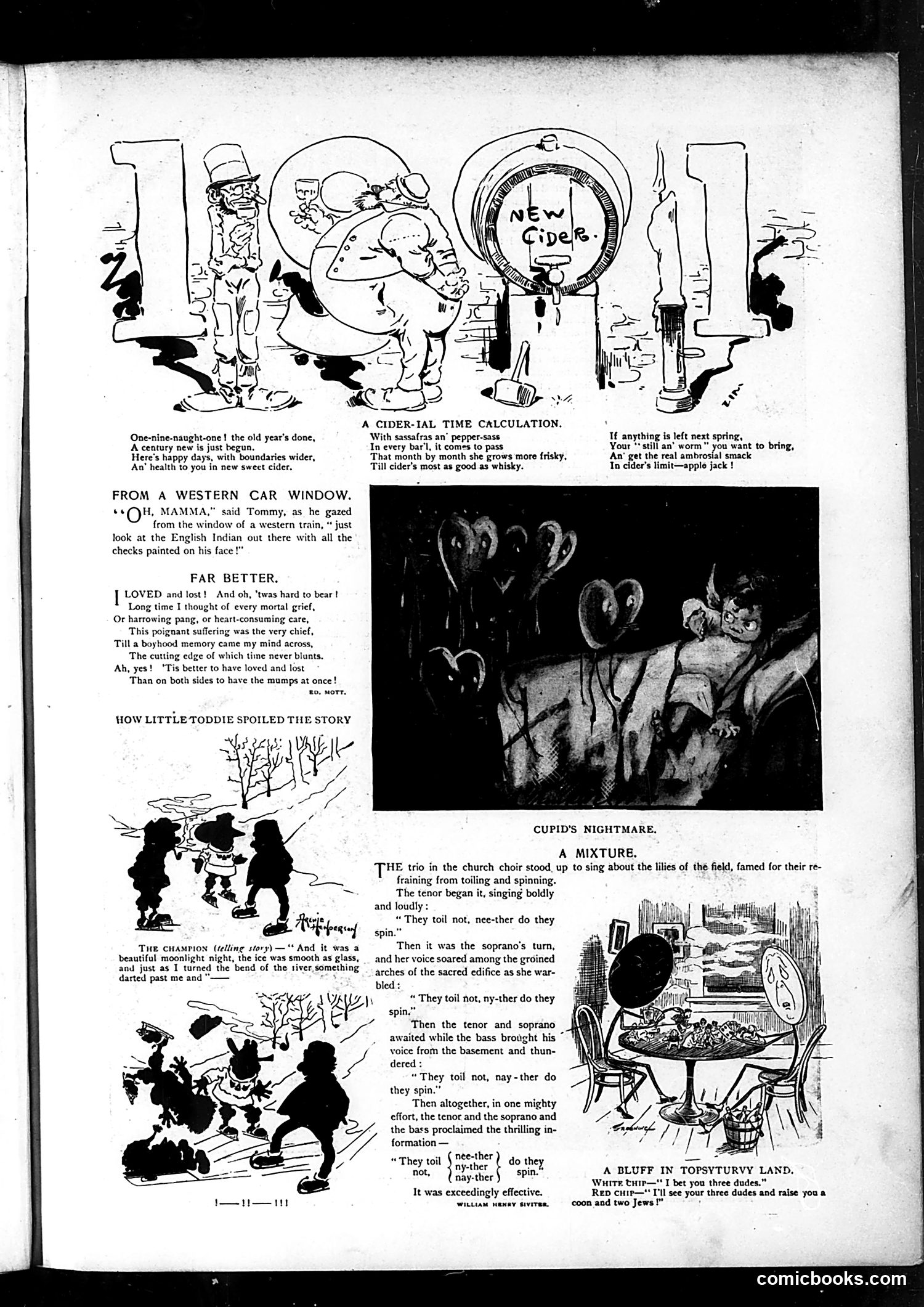
This page contains several humorous pieces unrelated to politics. "A Cider-ial Time Calculation" jokes about aging—suggesting that as months pass, one grows "more frisky" and develops health issues, culminating in drinking cider as a remedy. "From a Western Car Window" presents a brief anecdote about a child observing an "English Indian" (likely a Native American performer or representation). "How Little Toddie Spoiled the Story" shows silhouetted figures disrupting a narrative, emphasizing comedic interruption. "Cupid's Nightmare" depicts a church choir singing off-key, with repeated lines emphasizing their inability to "spin" (or sing properly). The remaining sketches appear to be domestic humor without clear political content. The page is primarily light social satire rather than political commentary.
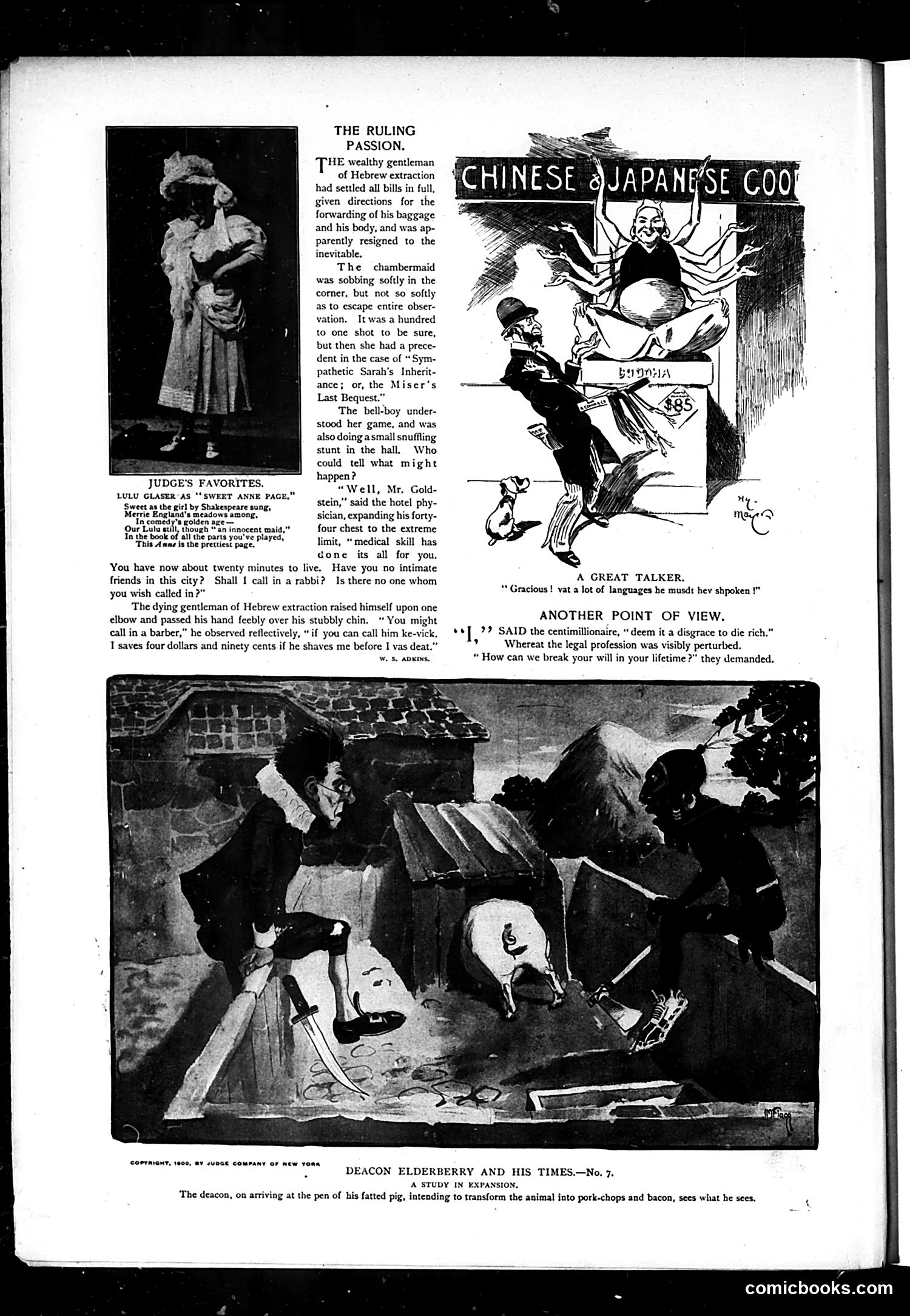
This page contains three separate items: 1. **"The Ruling Passion"** (left): A theatrical scene featuring Lulu Glaser as "Sweet Anne Page," illustrating how actors remain devoted to their craft even in mundane situations. 2. **"Chinese & Japanese Cook"** (top right): A caricature cartoon with exaggerated Asian facial features, depicting ethnic stereotyping common to the era. The dialogue suggests humor based on language barriers and cultural differences. 3. **"Deacon Elderberry and His Times, No. 7"** (bottom): A narrative illustration about a deacon attempting to transform a pig into pork chops and bacon—apparently a humorous story about rural or small-town life and ambition exceeding capability. The page reflects early 20th-century American humor standards, including now-offensive ethnic caricatures alongside theatrical and domestic comedies.
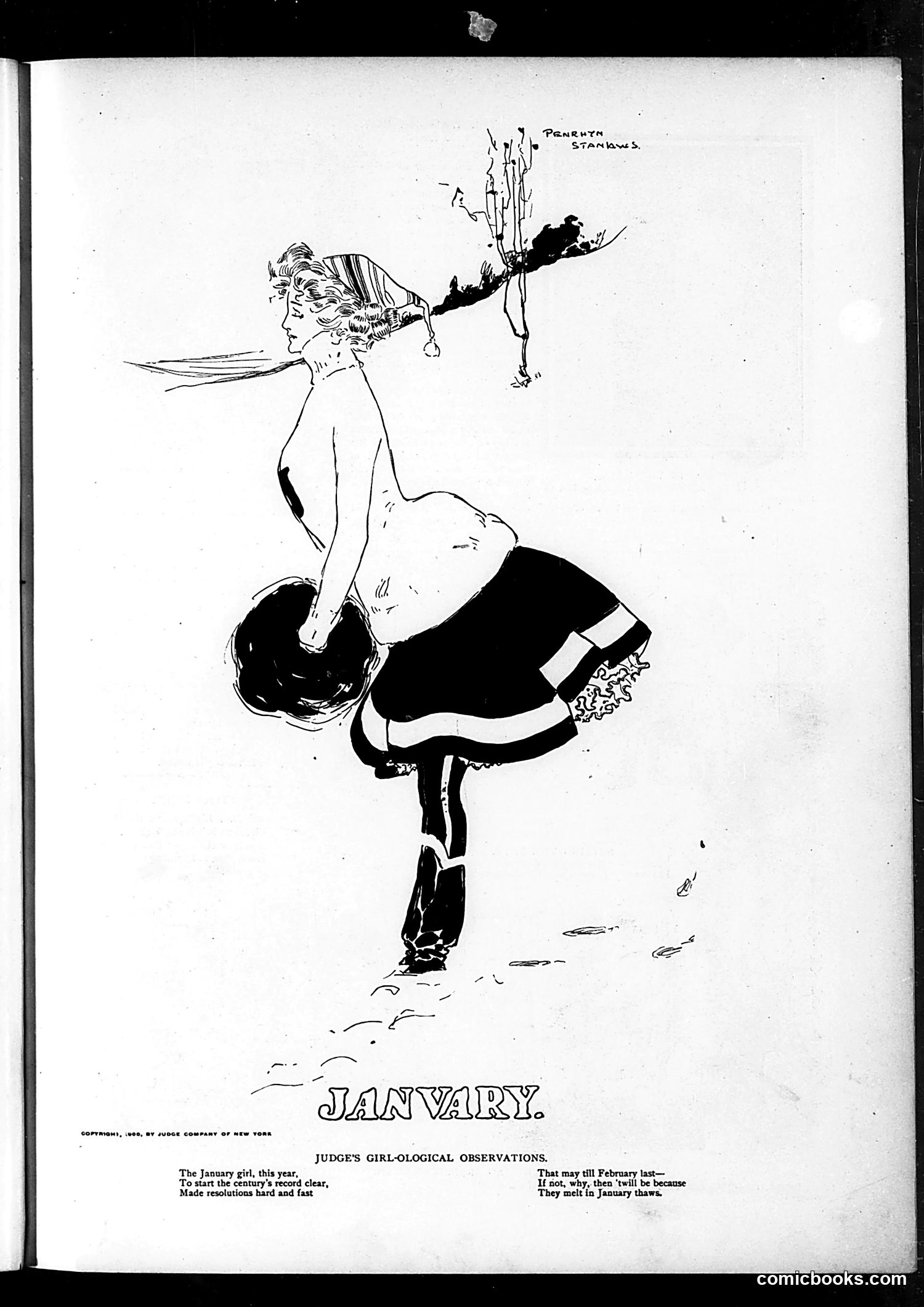
This is a January 1900 illustration from *Judge* magazine satirizing New Year's resolutions, specifically targeting women. The cartoon depicts a scantily-clad "January girl" making firm resolutions to "start the century's record clear" with determination "hard and fast." The accompanying verse mocks this resolve, suggesting her resolutions will likely fail by February—they'll "melt in January thaws." The humor relies on the period's sexist assumption that women lack willpower and self-discipline, particularly regarding appearance and behavior. The figure labeled "Panrern Stanianes" (possibly a fashion or persona reference) represents idealized femininity. The overall satire reflects early-1900s attitudes about women's New Year's resolutions being frivolous and short-lived, contrasting their stated intentions with expected failure—a common trope in contemporary satirical magazines.
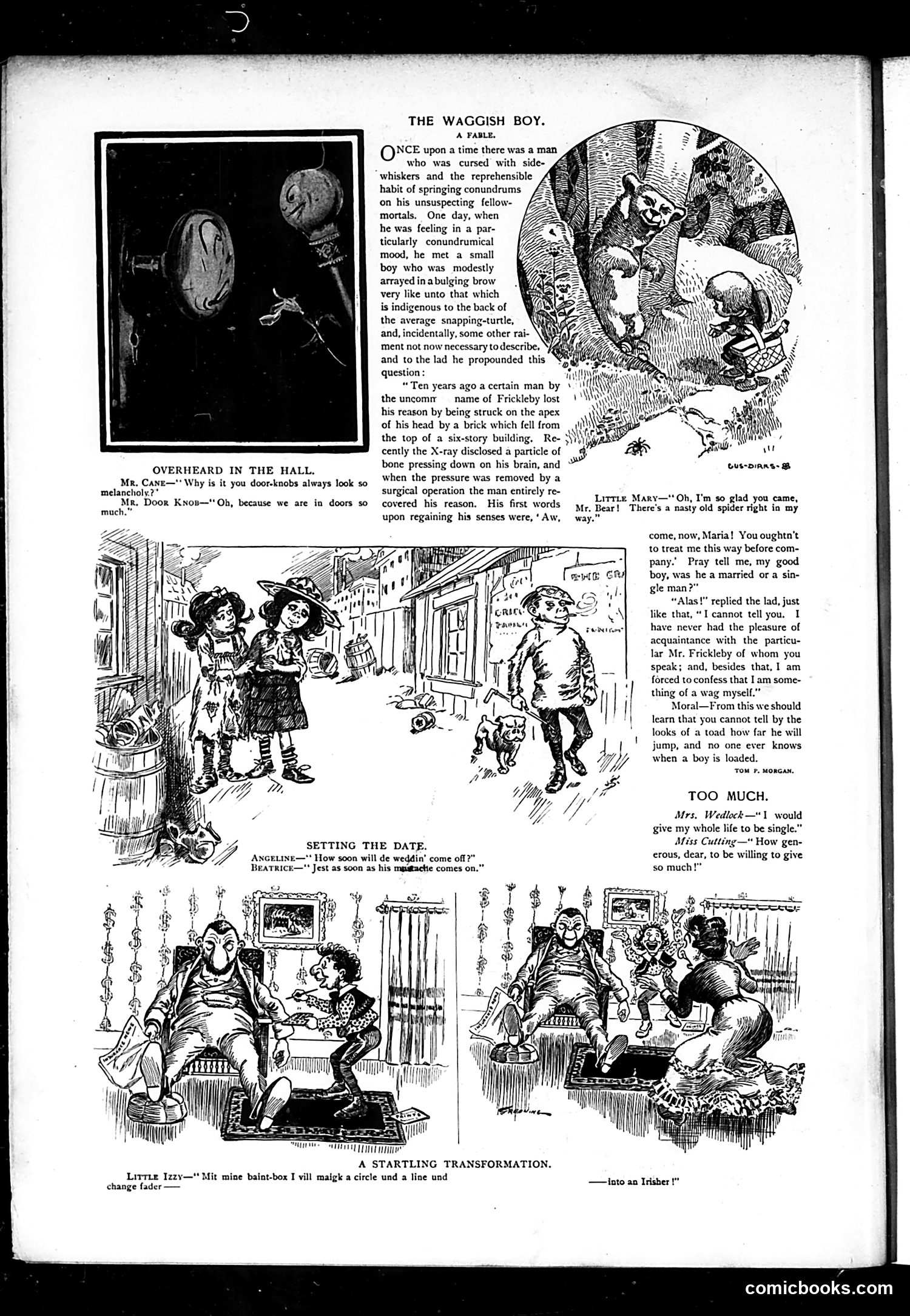
This page contains multiple satirical sketches typical of *Judge* magazine's humor. **"The Waggish Boy" (main fable):** A pompous man with side-whiskers poses a riddle to a clever boy, who responds by admitting he's "something of a wag himself"—a self-aware joke about pranking. The moral mocks pretension: you can't judge someone by appearances. **Other sketches on the page:** - "Overheard in the Hall": A pun about melancholy door-knobs in doors - "Setting the Date": A bride-to-be's vanity joke about waiting for her fiancé's mustache - "Too Much": A widow's sardonic quip about sacrificing her life for single status - "A Startling Transformation": An ethnic humor sketch with a Yiddish-accented character ("Inisher" likely mocking Irish stereotypes) The page exemplifies *Judge's* mix of gentle social satire, wordplay, and period-typical ethnic stereotyping that modern readers would find dated or offensive.
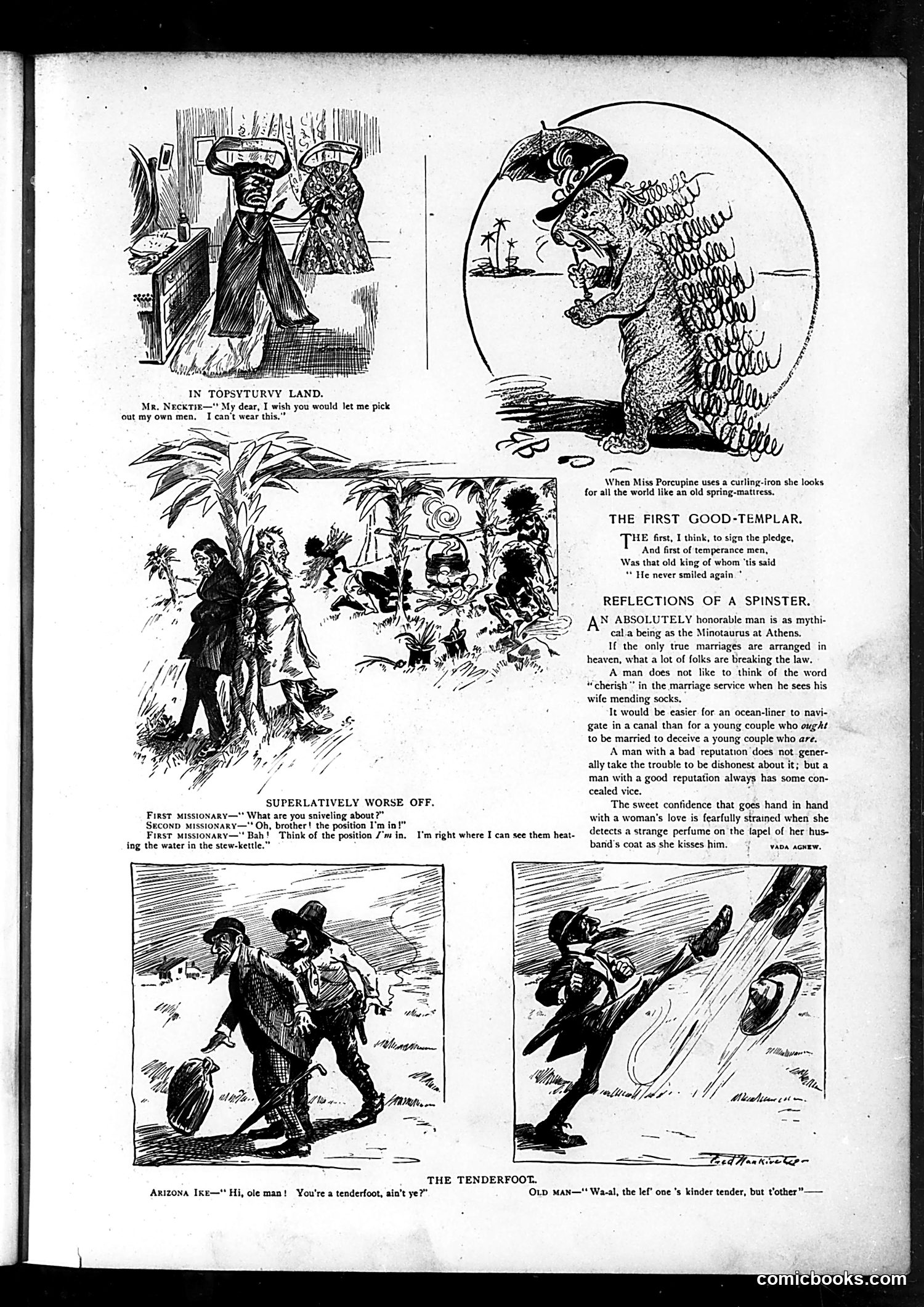
This page contains several satirical pieces typical of late-19th/early-20th-century American humor: **"In Topsyturvy Land"** mocks gender role reversal—a man complaining he can't choose his own clothing, inverting the era's typical complaint about women's fashion constraints. **"The First Good-Templar"** is a temperance joke referencing an ancient king (likely biblical) who "never smiled again," sarcastically suggesting extreme sobriety as virtue. **"Reflections of a Spinster"** offers cynical observations on marriage and male character—suggesting honorable men don't exist, marriages fail, and respectable men hide secret vices. **"Superlatively Worse Off"** depicts two missionaries in an impossible situation, joking about discomfort during their work. **"The Tenderfoot"** shows a frontier scene where "Arizona Ike" mistakes an injured leg for inexperience, with the old man's reply playing on the term's double meaning. The cartoons reflect Victorian-era anxieties about gender roles, temperance movements, marriage skepticism, and frontier life. The humor relies on wordplay and situational irony rather than explicit political commentary.
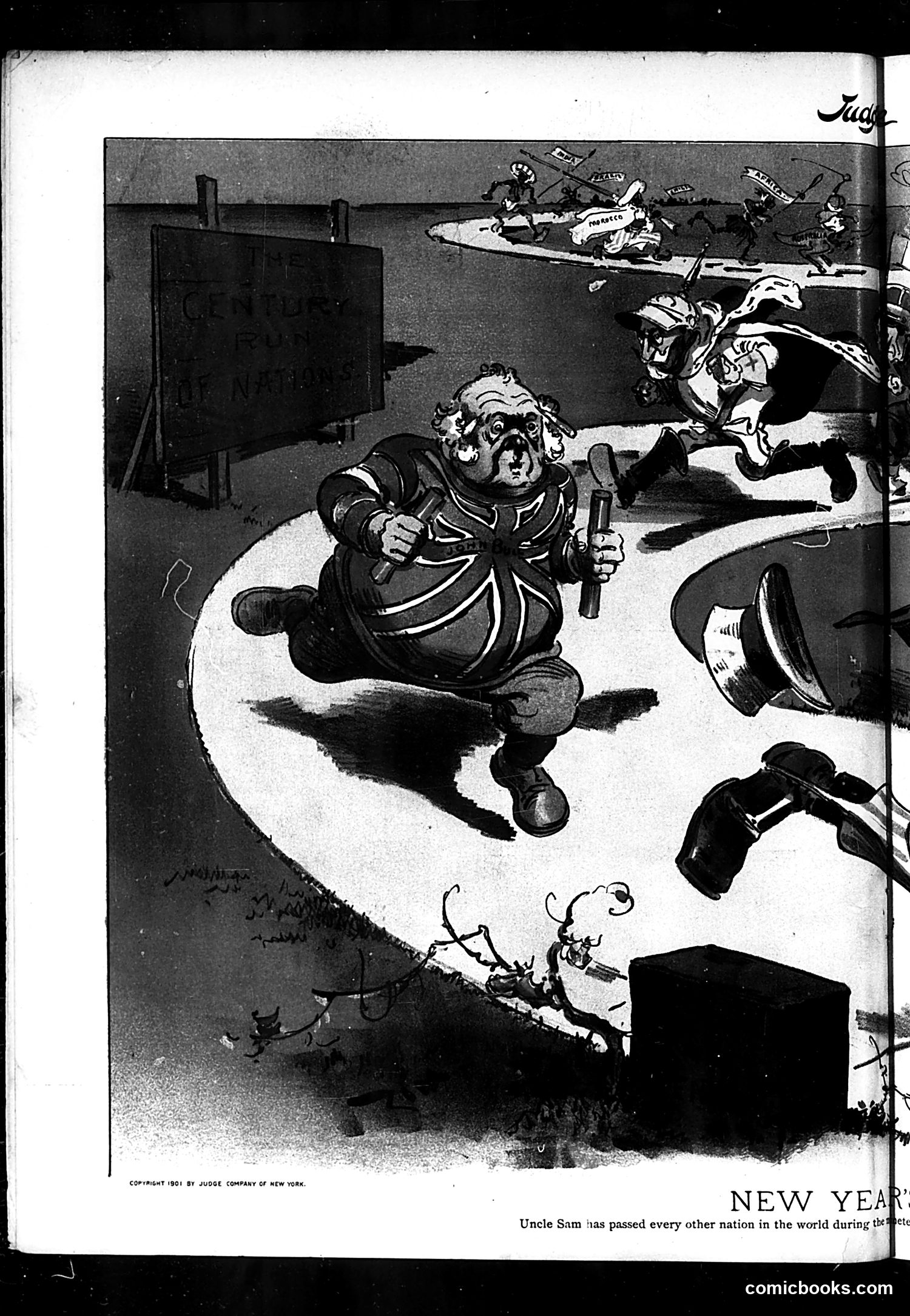
This is a "New Year" themed political cartoon depicting **Uncle Sam** (personified America, recognizable by his distinctive clothing and top hat) as a rotund, aggressive figure brandishing weapons and a club. He's positioned centrally on a globe, with other nations shown fleeing or retreating in the background. The caption states "Uncle Sam has passed every other nation in the world during the..." (text cuts off, but likely references economic or military superiority). The satire celebrates American dominance and exceptionalism—a common Judge magazine theme. The caricature emphasizes America's aggressive, expansionist posture during what appears to be the early 20th century period. Other nations are depicted as smaller, weaker figures scrambling away, reinforcing the message of American supremacy. The tone is nationalist and satirical, mocking both America's confidence and rival nations' relative weakness.
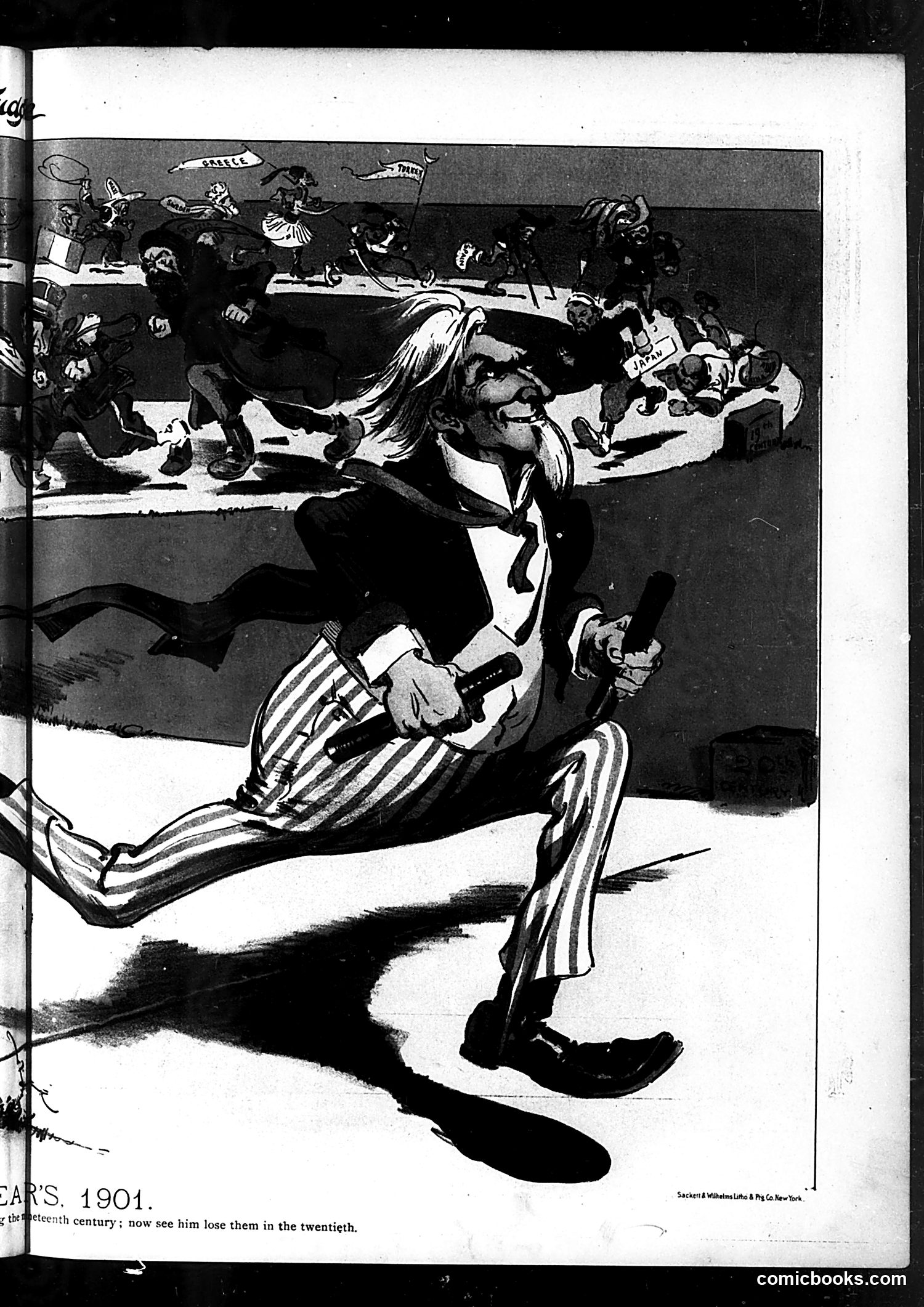
This 1901 Judge magazine cartoon depicts a caricatured figure in formal attire with exaggerated facial features, running or leaping energetically while holding what appears to be a torch or staff. The figure wears striped pants and a flowing cape or scarf. The text references "the nineteenth century; now see him lose them in the twentieth," suggesting the cartoon comments on century transition and societal change or loss. The dynamic pose and theatrical costume suggest commentary on political leadership or public figures entering the new 1900s era. Without clearer context or caption identification, the specific political figure or referenced event remains uncertain, though the satire appears to concern governmental or social transformation anticipated during this period.
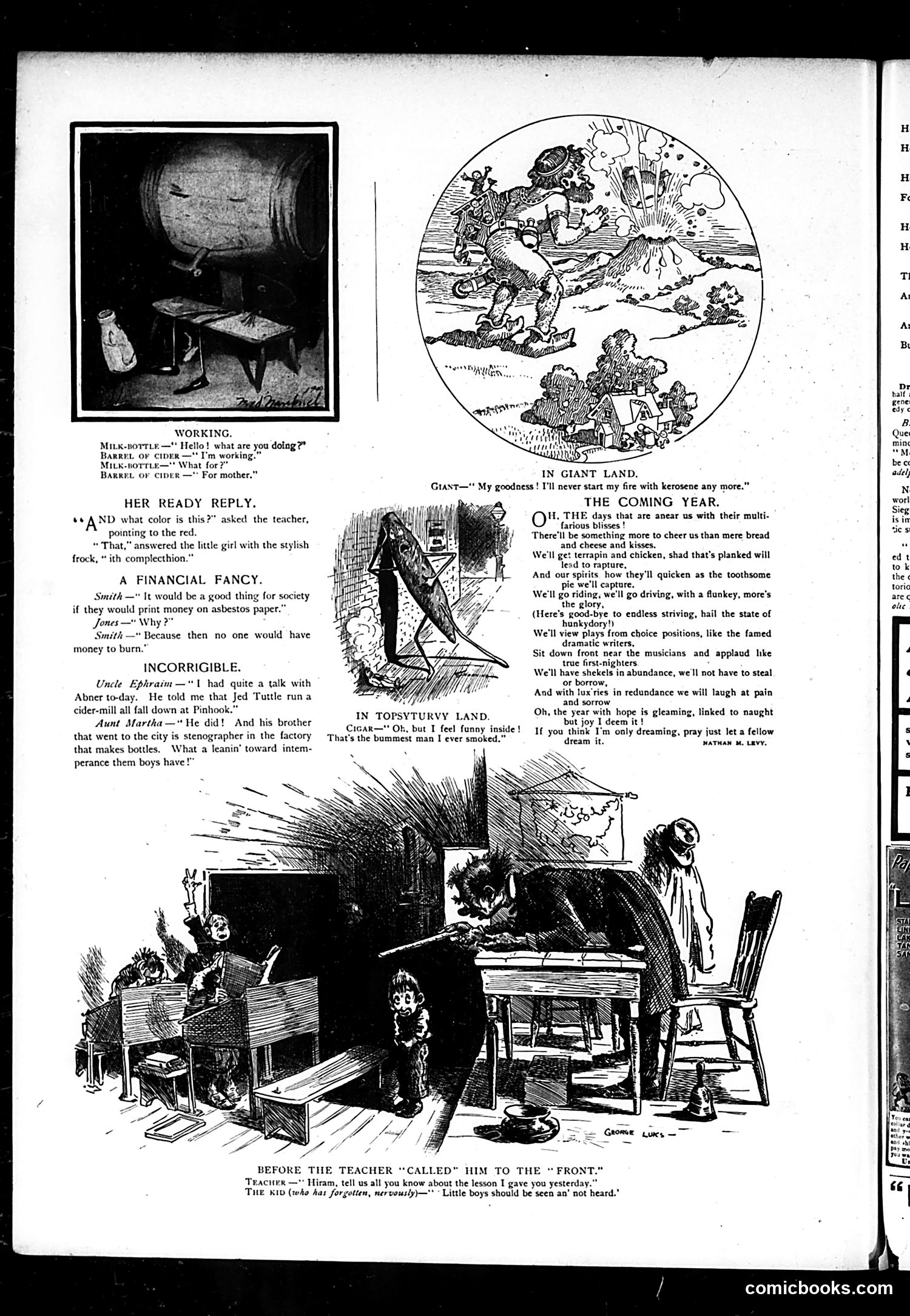
This page contains several brief satirical jokes typical of late 19th/early 20th-century American humor: **"Working"** and **"Her Ready Reply"**: Light social comedy about children and class pretension—a milk bottle and barrel discuss "working for mother," while a stylishly dressed girl mistakes "red" for her own complexion, mocking nouveau riche affectation. **"A Financial Fancy"**: A pun about printing money on asbestos so people literally couldn't "burn" it—wordplay on the idiom "have money to burn." **"Incorrigible"**: Rural humor where relatives debate whether running a cider mill (producing alcohol) represents a family tendency toward intemperance. **"In Giant Land" and "In Topsyturvy Land"**: Whimsical fantasy panels with minimal satire—a giant rejecting kerosene, a cigar commenting humorously on its smoker. **"The Coming Year"**: A sentimental poem about anticipated pleasures—food, entertainment, wealth, leisure—reflecting middle-class aspirations. **"Before the Teacher Called"**: A classroom joke where a student avoids answering by quoting propriety ("children should be seen and not heard"). The page mixes social satire, puns, and gentle humor without clear political content.
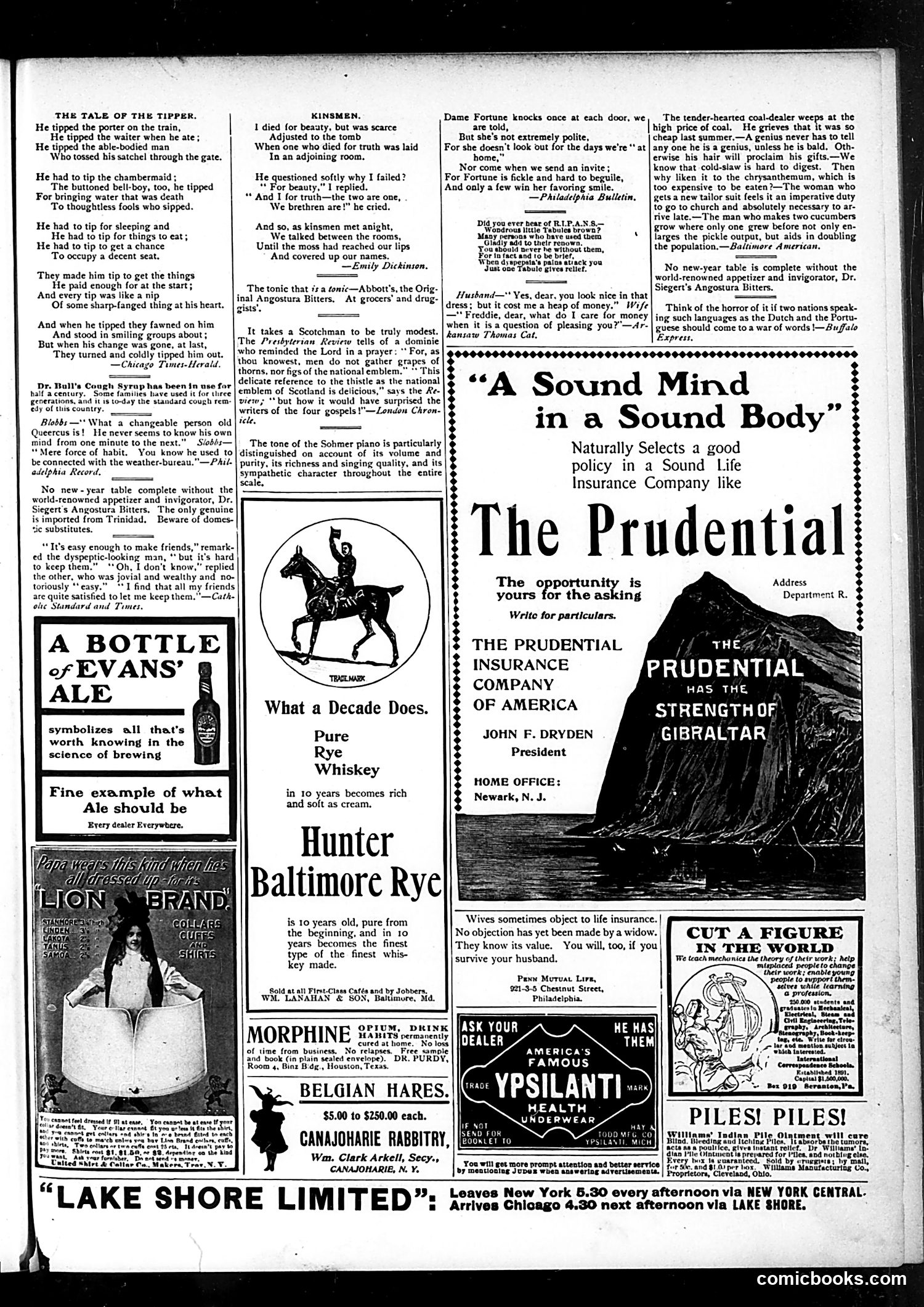
This page is primarily **advertisements and light verse**, not political satire. The content includes: **Literary Content:** Poems attributed to Emily Dickinson about tipping culture and philosophical kinship, plus miscellaneous humorous quips about Scottish modesty and changeable people. **The Central Cartoon:** A silhouette of a horse and rider (artist credit "TRADE MARK" visible) illustrates the Sohmer piano advertisement—unrelated to satire. **Social Commentary:** The opening poem "The Tale of the Tipper" critiques American tipping culture as exploitative—workers fawn over tippers but coldly dismiss customers once money stops flowing. This reflects genuine Progressive-era resentment of the tipping system. **Advertisements:** The page is dominated by product ads (Evans' Ale, Hunter Rye Whiskey, morphine treatments, Belgian hares, Prudential Insurance, Ypsilanti health underwear, and railroad services). The page lacks partisan political content. Its satire targets social customs (tipping) and human nature rather than political figures or parties.
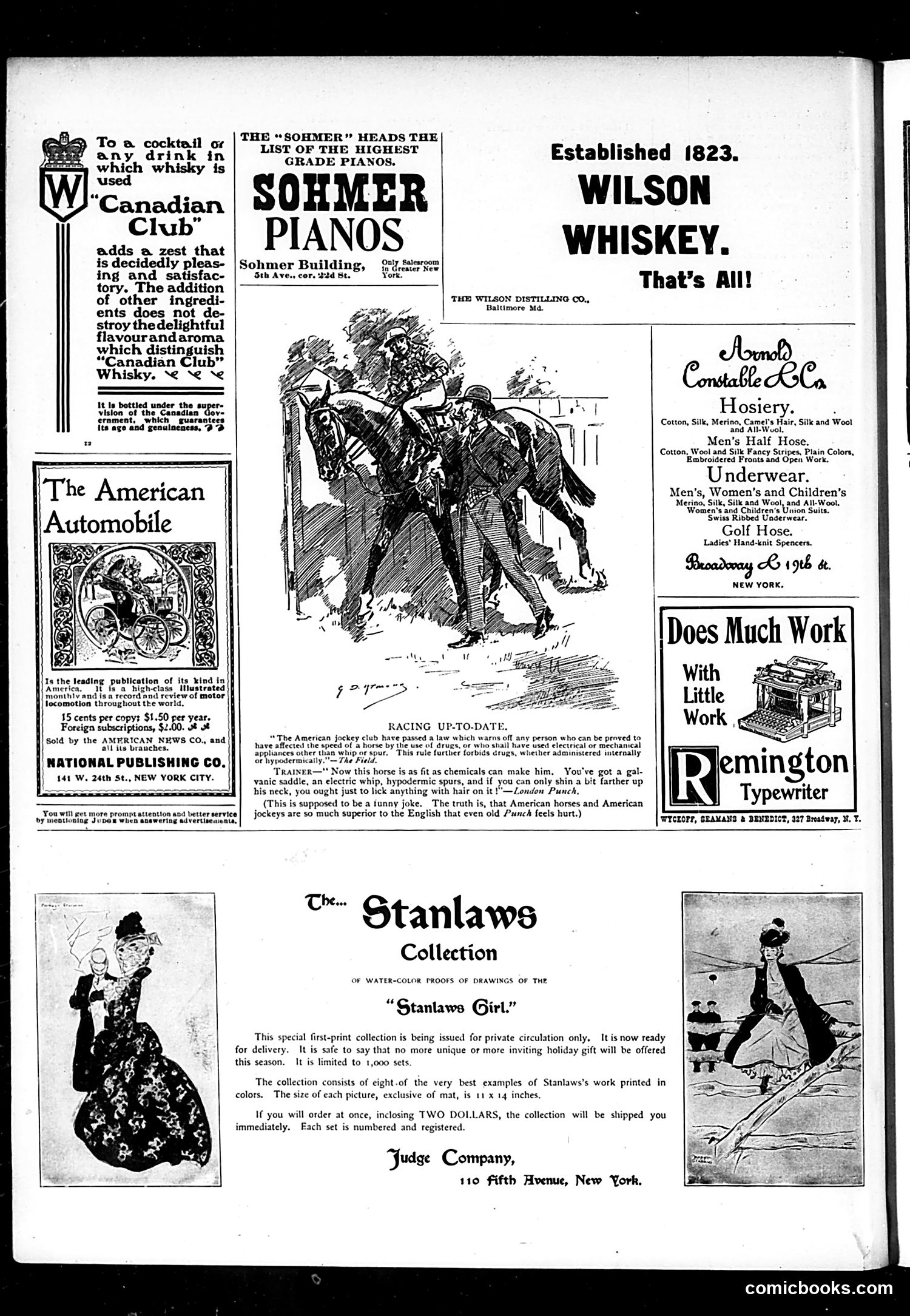
This page is primarily **advertising and promotional material** with one small satirical cartoon. The main cartoon, titled "Racing Up-To-Da'," mocks **British vs. American horse racing**. It shows a trainer giving advice about a racehorse, referencing a new American Jockey Club rule banning performance-enhancing drugs and electrical/mechanical devices. The joke suggests American horses are so superior that even with primitive methods (whip and spur only), they outperform English horses using advanced technology. The final parenthetical remark—"the truth is, that American horses and American jockeys are so much superior to the English that even old Punch feels hurt"—indicates this is satirizing *British* publication *Punch* for being envious of American superiority. The cartoon represents **turn-of-the-century American chauvinism**, humorously asserting dominance over Britain in sporting achievement. The remainder of the page contains **period advertisements** for whiskey, pianos, automobiles, hosiery, typewriters, and art prints—typical Judge magazine revenue sources.
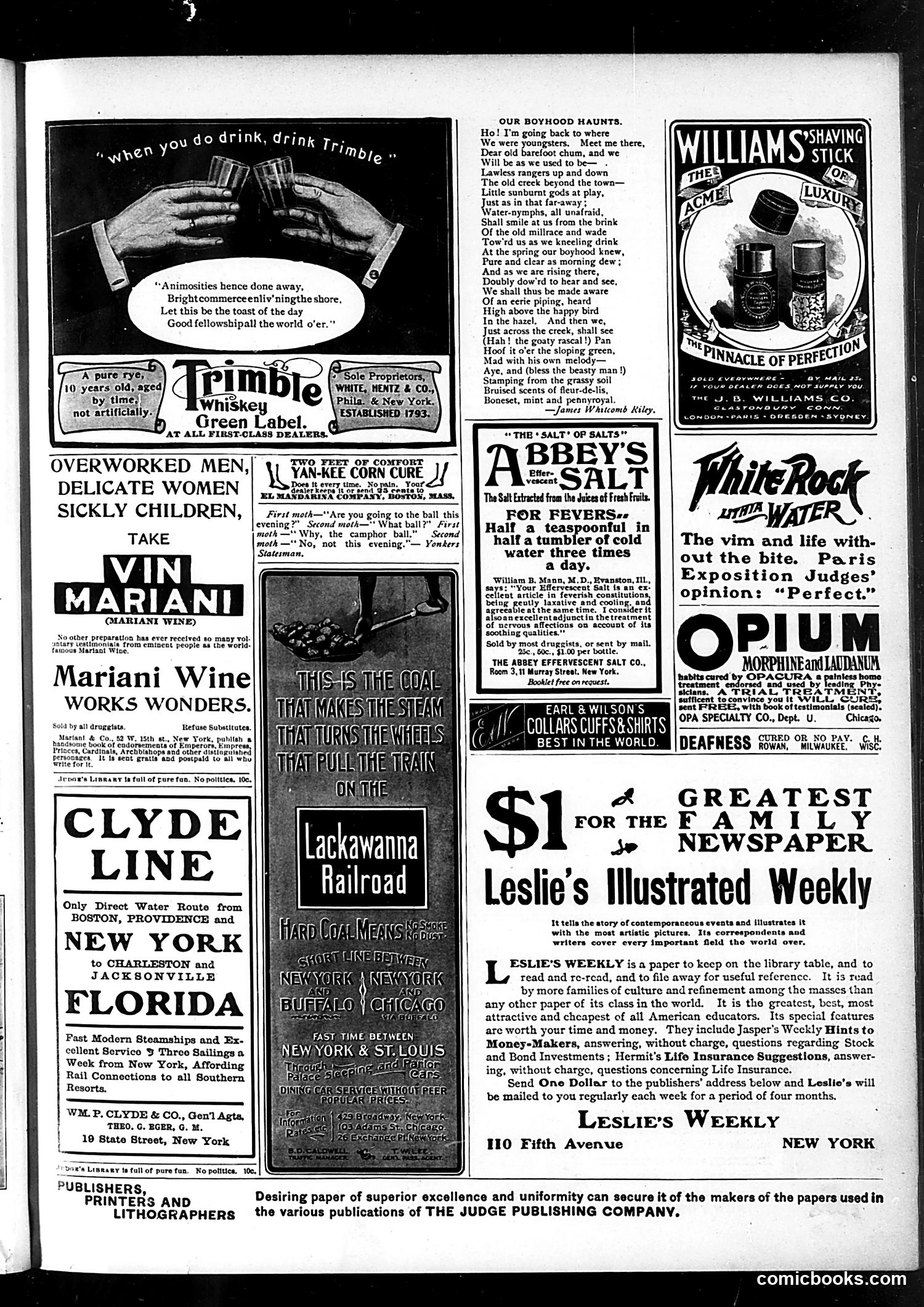
This page is primarily **advertising**, typical of Judge magazine's revenue model. The content includes: **Main Advertisement Focus:** - Mariani Wine (cocaine-laced tonic wine, legal then) - Abbey's Salt (fever treatment) - Opium/morphine addiction cures - Collar/shirt manufacturer - Transportation and shipping lines **The Satire:** The small cartoon at top shows two moths discussing a "camphor ball"—a pun playing on the double meaning (a dance vs. the insect repellent). This is mild wordplay humor. **Historical Context Modern Readers Need:** These ads reveal what's shocking to us: unregulated patent medicines containing cocaine, opium, and morphine were openly advertised as cure-alls for "overworked men, delicate women, sickly children." The page also features a poem by James Whitcomb Riley (credited), suggesting the magazine balanced crude advertisements with literary content. The page shows pre-FDA America where dangerous substances were marketed without regulation or warning labels.
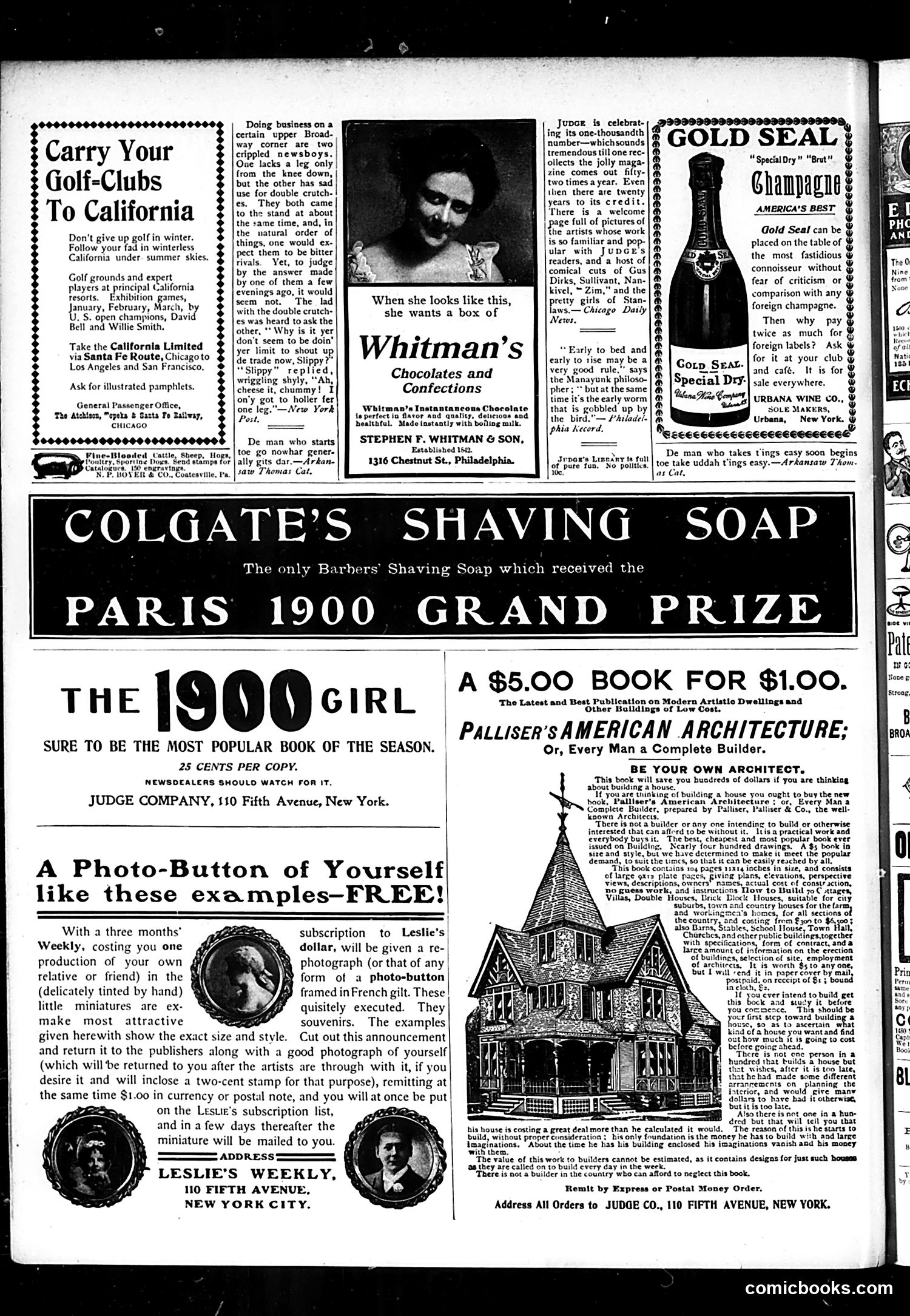
This page from *Judge* magazine consists primarily of **advertisements and promotional content rather than satirical cartoons**. The layout includes: **Notable Elements:** - A Whitman's Chocolates ad featuring a woman's photograph with the caption "When she looks like this, she wants a box of Whitman's"—typical early 1900s gendered advertising - Colgate's Shaving Soap promotion highlighting a Paris 1900 Grand Prize award - Gold Seal Champagne ad - Leslie's Weekly subscription offer for photo-button portraits - Multiple book advertisements including *The 1900 Girl* and *Palliser's American Architecture* **Small Comic Snippets:** Brief humorous dialogue appears scattered throughout (about "Slippy" and one-legged men doing business), but these are minor fillers rather than the page's focus. **Historical Context:** This reflects early 1900s advertising conventions, with heavy emphasis on luxury goods (champagne, chocolates, shaving products) and emerging consumer culture targeting both men and women. The page is fundamentally a **commercial vehicle disguised as editorial content**—characteristic of magazine monetization in this era.
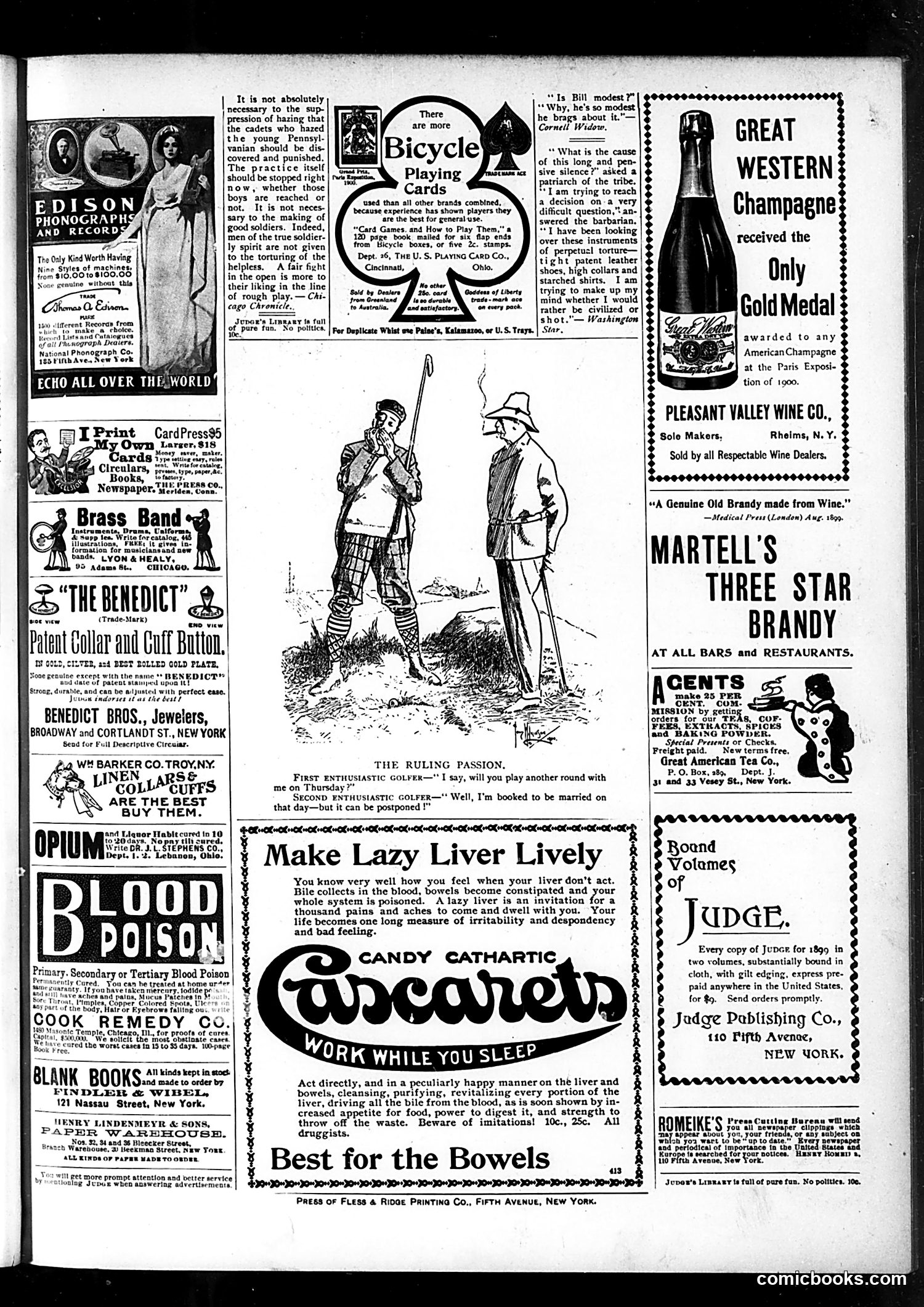
The central cartoon depicts two male golfers in conversation. The first enthusiastically proposes playing another golf round on Thursday. The second replies that he's scheduled to be married that day but offers to postpone the wedding. **The Satire:** This is a gentle joke about the obsessive leisure culture of the wealthy Gilded Age. The humor relies on the absurdity that a man would casually reschedule his own wedding—presumably a significant life event—rather than miss a golf game with a friend. **Context for Modern Readers:** Golf was an elite, fashionable pursuit among wealthy American men in this era. The cartoon satirizes how thoroughly this recreational activity had captured the priorities of the upper class, suggesting that social commitments and even major personal milestones could be subordinated to sporting pursuits. The page is primarily advertisements for patent medicines and products, typical of *Judge* magazine's revenue model.
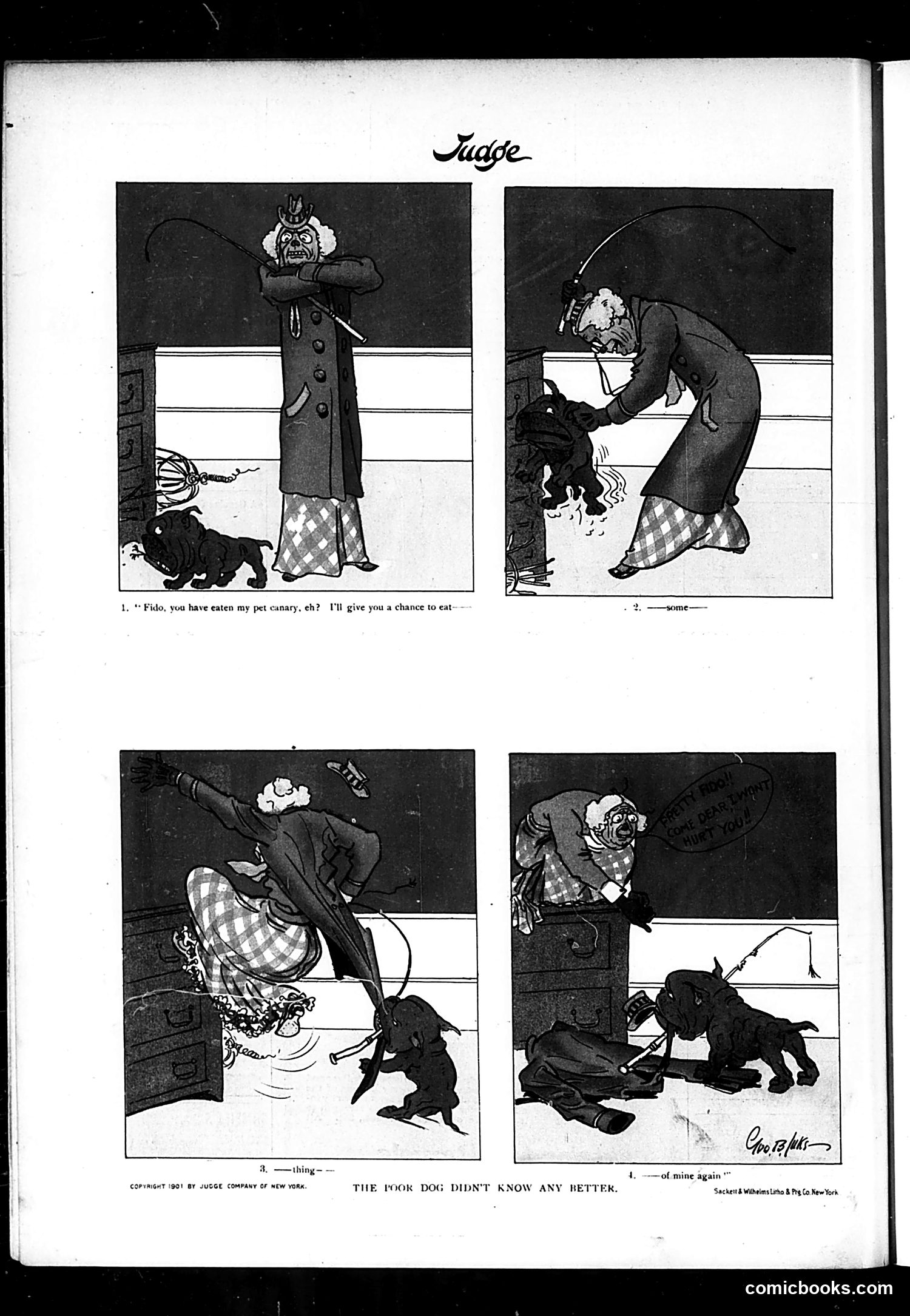
This is a four-panel comic strip from Judge (1901) depicting a darkly humorous domestic scene. A well-dressed man with an exaggerated face discovers his dog has eaten his pet canary. In retaliation, he offers the dog increasingly larger animals to eat—progressing from a cat to what appears to be a chicken or larger fowl. The final panel shows the dog with the man's belongings, suggesting the revenge has escalated absurdly. The satire plays on the phrase "the poor dog didn't know any better"—a common excuse for animal misbehavior. The joke inverts this: the man, supposedly civilized and rational, responds to the dog's innocent transgression with escalating, irrational cruelty disguised as "giving the dog a chance." It's commentary on how supposedly rational people justify disproportionate revenge or punishment, blaming circumstances rather than acknowledging their own poor judgment.