
Judge, 1901-01-05 · page 2 of 16
Judge — January 5, 1901 — page 2: what you’re looking at
What you’re looking at
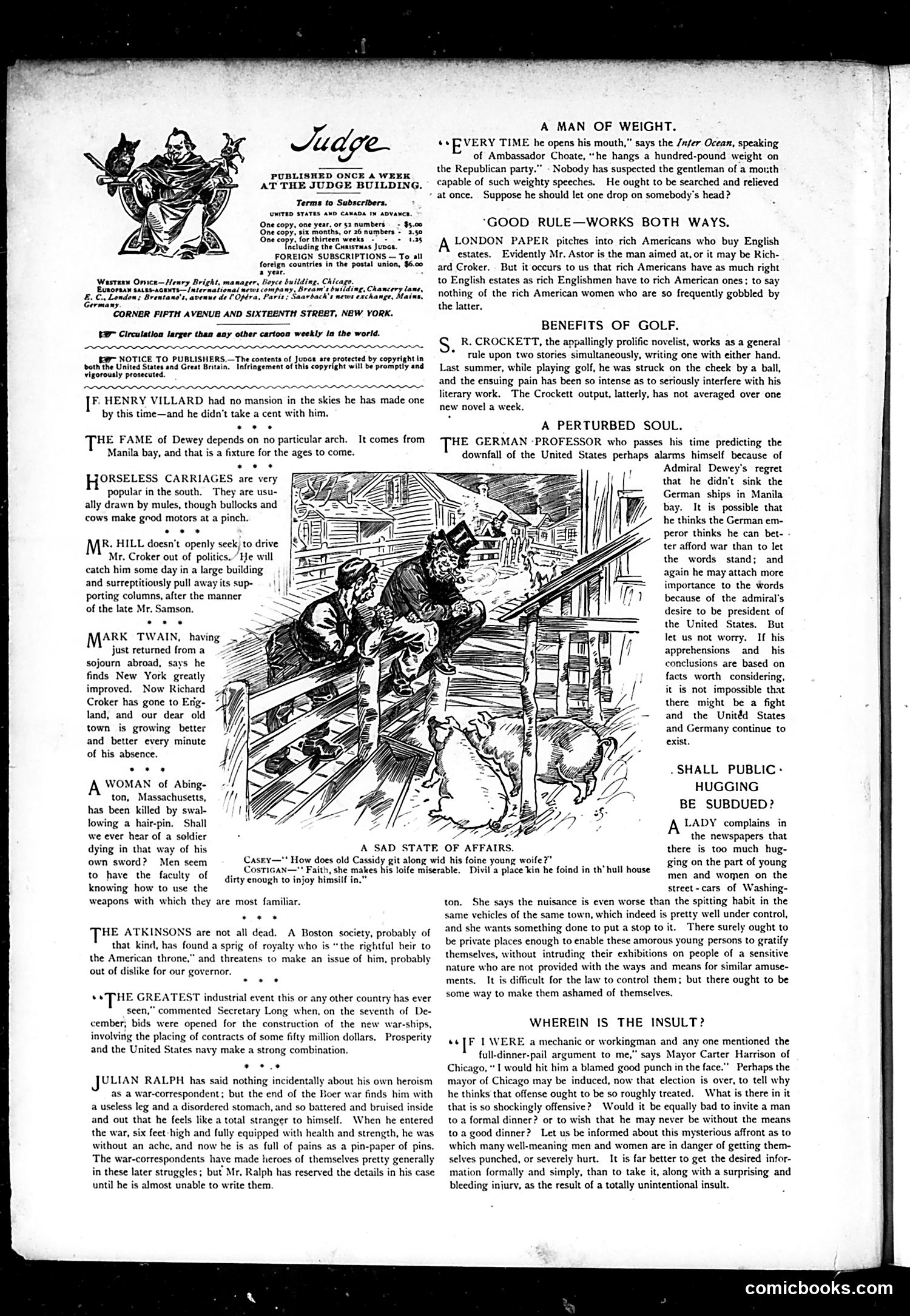
This page contains several brief satirical items rather than a single cartoon. The main illustration depicts "A Sad State of Affairs" — a chaotic street scene with what appears to be a collision or accident involving a horse-drawn carriage and pedestrians. The text items mock various topics: wealthy Americans imitating English estates, novelist S.R. Crockett's golf injury, Admiral Dewey's alleged regrets about not sinking German ships, and complaints about public displays of affection on Washington streetcars. The final piece satirizes workplace etiquette, suggesting a Chicago mechanic should punch a businessman who insulted him at a formal dinner — mocking class tensions and differing standards of conduct between social groups. Without dated context, the specific references to current events remain unclear, though the general satire targets wealth disparity, social pretension, and behavioral norms.
📄 Transcribed text from this page (OCR, searchable)
Machine-transcribed from the original scan — historical spelling and the odd misread are preserved.
Sage PUBLISHED ONCE A WEEK AT THE JUDGE BUILDING. Terms to Subscribers. UNITED STATES AXD CANADA DH ADVAMCR. One copy, one year, or $2 numbers - $5.00 One copy, six months, or 36 numbers = ‘One copy, for thirteen weeks = = 1.35 Including the Cnaistmas Juoce FOREIGN. SUBSCRIPTIONS — To all foreign countries in the postal union, $6.00 a year. é Wastasw Onice—Henry Bright, manager, Boyce building, Chicago. Eutoraan saiss-acuwts—/nternational news company, Bream's building, Chancery lane, E. C, London; Brentano's, avenue de [Opdra, Paris: Saarback's mews exchange, Mains, Germany. CORNER FIFTH AVENUE AND SIXTEENTH STREET, NEW YORK. (7 Circulation larger than any other cartoon weekly In the world. f9- NOTICE TO PUBLISHERS.—The contents of Juocs are protected by copyright in ‘both the United States and Great Britain. Infringement of this copyright will be promptly and vigorously prosecuted. F. HENRY VILLARD had no mansion in the skies he has made one by this time—and he didn’t take a cent with him. THE FAME of Dewey depends on no particular arch. It comes from Manila bay, and that is a fixture for the ages to come. HORSELESS CARRIAGES are very popular in the south. They are usu- ally drawn by mules, though bullocks and cows make geod motors at a pinch. eee MB: HILL doesn’t openly seek, to drive Mr. Croker out of politics. /He will catch him some day in a large building and surreptitiously pull away its sup- porting columns, after the manner of the late Mr. Samson. ARK TWAIN, having just returned from a A sojourn abroad, says he finds New York greatly improved. Now Richard Croker has gone to Erig- land, and our dear old town is growing better and better every minute of his absence. see A WOMAN of Abing- ton, Massachusetts, has been killed by swal- lowing a hair-pin. Shall we ever hear of a soldier dying in that way of his own sword? Men seem to have the faculty of knowing how to use the weapons with which they are most familiar. dirty enough to injoy himsilf in.” cee THE ATKINSONS are not all dead. A Boston society, probably of that kind, has found a sprig of royalty who is “the rightful heir to the American throne,” and threatens to make an issue of him, probably out of dislike for our governor. * “THE GREATEST industrial event this or any other country has ever seen,” commented Secretary Long when, on the seventh of De- cember, bids were opened for the construction of the new war-ships, involving the placing of contracts of some fifty million dollars, Prosperity and the United States navy make a strong combination. eeu ULIAN RALPH has said nothing incidentally about his own heroism as a war-correspondent; but the end of the Boer war finds him with a useless leg and a disordered stomach, and so battered and bruised inside and out that he feels like a total stranger to himself. When he entered the war, six feet-high and fully equipped with health and strength, he was without an ache, and now he is as full of pains as a pin-paper of pins. The war-correspondents have made heroes of themselves pretty generally in these later struggles; but Mr. Ralph has reserved the details in his case until he is almost unable to write them. * at once. A SAD STATE OF AFFAIRS. ** How does old Cassidy git along wid his foi GAN—"* Faith, she makes his loife miserable. Divil a place kin he foind in th’ hull house A MAN OF WEIGHT. +s EVERY TIME he opens his mouth,” says the /n/er Ocean, speaking of Ambassador Choate, “he hangs a hundred-pound weight on the Republican party.” » Nobody has suspected the gentleman of a mouth capable of such weighty speeches. He ought to be searched and relieved Suppose he should let one drop on somebody's head? ‘GOOD RULE—WORKS BOTH WAYS. LONDON PAPER pitches into rich Americans who buy English estates. Evidently Mr. Astor is the man aimed at, or it may be Rich- ard Croker. But it occurs to us that rich Americans have as much right to English estates as rich Englishmen have to rich American ones: to say nothing of the rich American women who are so frequently gobbled by the latter. BENEFITS OF GOLF. G,, B- CROCKETT, the appallingly prolific novelist, works as a general * rule upon two stories simultaneously, writing one with either hand. Last summer, while playing golf, he was struck on the cheek by a ball, and the ensuing pain has been so intense as to seriously interfere with his literary work. ‘The Crockett output, latterly, has not averaged over one new novel a week. A PERTURBED SOUL. THE GERMAN ‘PROFESSOR who passes his time predicting the downfall of the United States perhaps alarms himself because of Admiral Dewey's regret that he didn’t German shi bay. It is possible that he thinks the German em- peror thinks he can bet- ter afford war than to let the words stand; and again he may attach more importance to the words because of the admiral's desire to be president of the United States. But let us not worry. If his apprehensions and his conclusions are based on facts worth considering, it is not impossible that there might be a fight and the Unitéd States and Germany continue to exist. . SHALL PUBLIC- HUGGING BE SUBDUED? A EADY complains in the newspapers that there is too much hug- ging on the part of young men and women on the street-cars of Washing- ton. She says the nuisance is even worse than the spitting habit in the same vehicles of the same town, which indeed is pretty well under control, and she wants something done to put a stop to it. There surely ought to be private places enough to enable these amorous young persons to gratify themselves, without intruding their exhibitions on people of a sensitive nature who are not provided with the ways and means for similar amuse- ments. It is difficult for the law to control them; but there ought to be some way to make them ashamed of themselves. young woife?” WHEREIN IS THE INSULT? 46] F I WERE a mechanic or workingman and any one mentioned the full-dinner-pail argument to me,” says Mayor Carter Harrison of Chicago, “I would hit him a blamed good punch in the face.” Perhaps the mayor of Chicago may be induced, now that election is over, to tell why he thinks that offense ought to be so roughly treated. What is there in it that is so shockingly offensive? Would it be equally bad to invite a man to a formal dinner? or to wish that he may never be without the means toa good dinner? Let us be informed about this mysterious affront as to which many well-meaning men and women are in danger of getting them- selves punched, or severely hurt. It is far better to get the desired infor- mation formally and simply, than to take it, along with a surprising and bleeding injury, as the result of a totally unintentional insult. comicbooks.com