
A complete issue · 17 pages · 1900
Judge — December 29, 1900
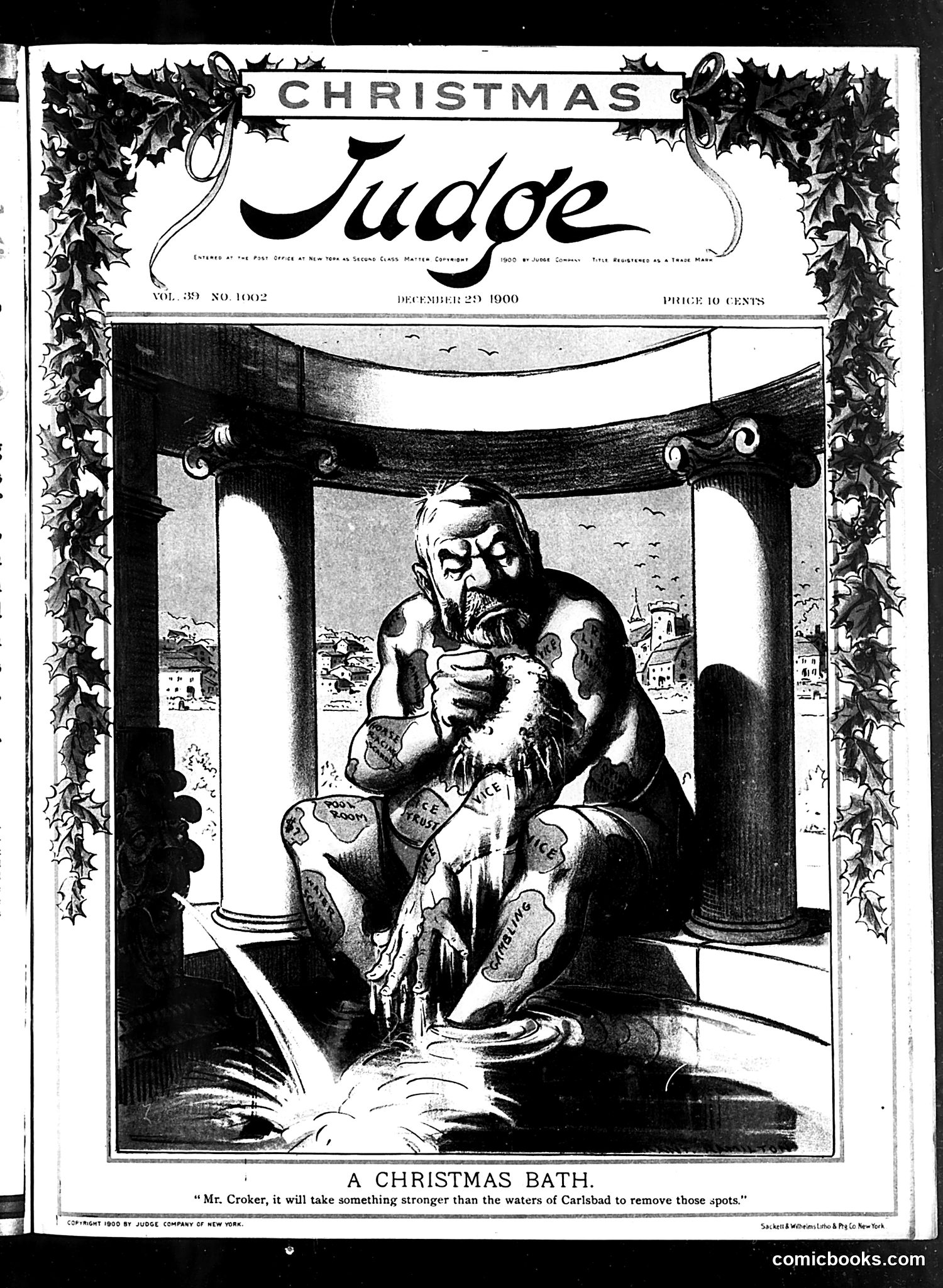
This December 29, 1900 *Judge* cartoon satirizes **President William McKinley** (the bearded figure) addressing corruption scandals, particularly regarding the **Boxer Rebellion** in China and American military conduct there. The caption quotes McKinley saying to "Mr. Croker" (likely Richard Croker, Tammany Hall boss), "It will take something stronger than the waters of Carlsbad to remove those spots." The satire suggests that McKinley's administration is stained by scandals—depicted as spots on the child figure—that mere cosmetic efforts ("Carlsbad waters," a famous spa) cannot cleanse. The figure's tattooed labels (partially legible) likely reference specific controversial actions or officials. The cartoon criticizes the administration's inability to address serious moral failings through superficial measures.
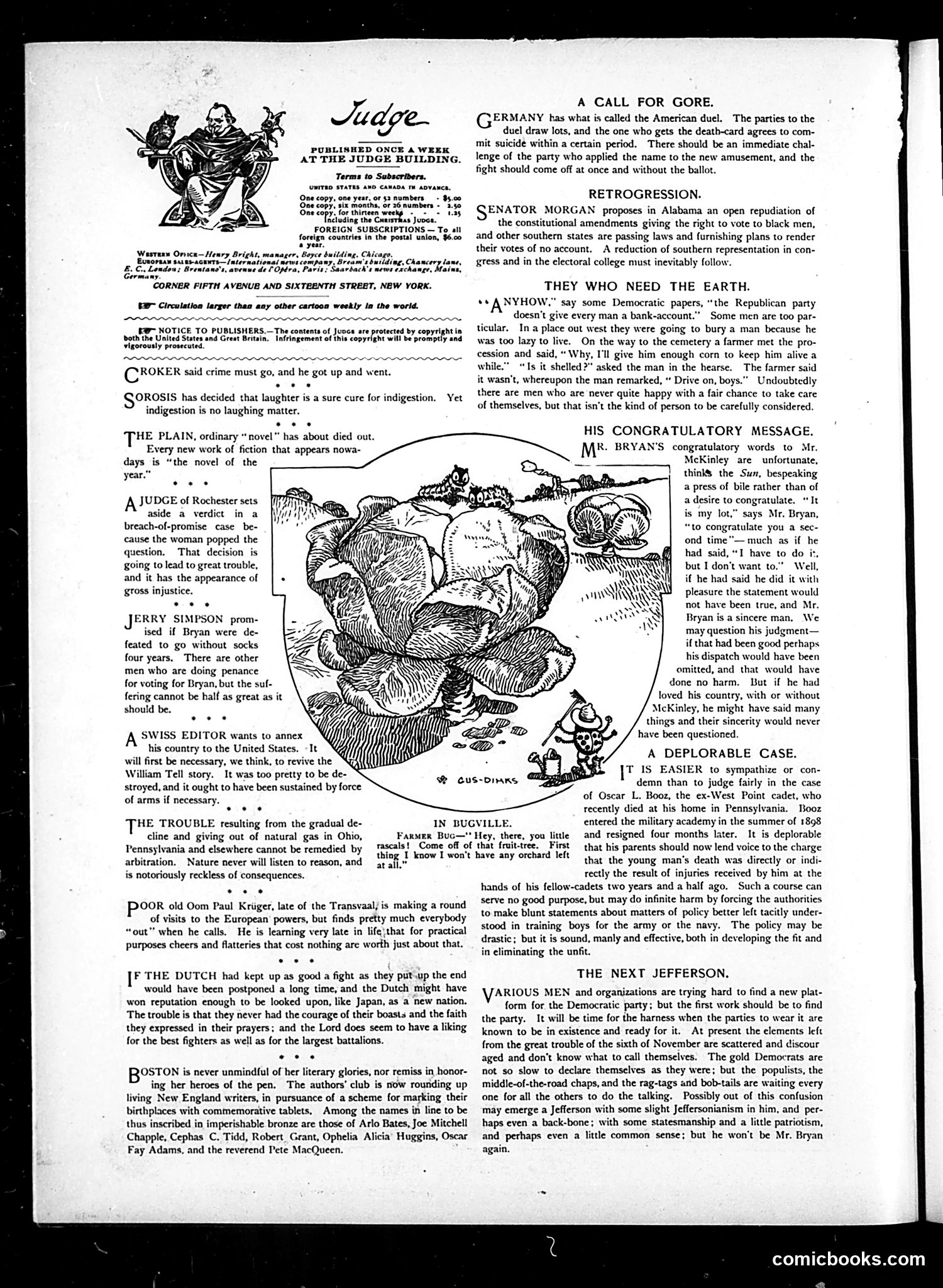
The main cartoon "IN BUGVILLE" depicts anthropomorphic insects (bugs) in a farming scene. A large bug addresses smaller ones, saying "Hey, there, you little rascals! Come off of that fruit-tree. First thing I know I won't have any orchard left at all!" This is political allegory: the large bug represents authority/government, while the smaller bugs represent citizens or a particular group (possibly immigrants or the working class, common Judge targets). The satire critiques how those in power accuse subordinates of consuming/exploiting shared resources, while the larger system itself causes the actual damage. The surrounding text columns discuss various contemporary political issues including voting rights, military academy scandals, and the search for a presidential successor to Bryan—typical Judge content from the Progressive Era.
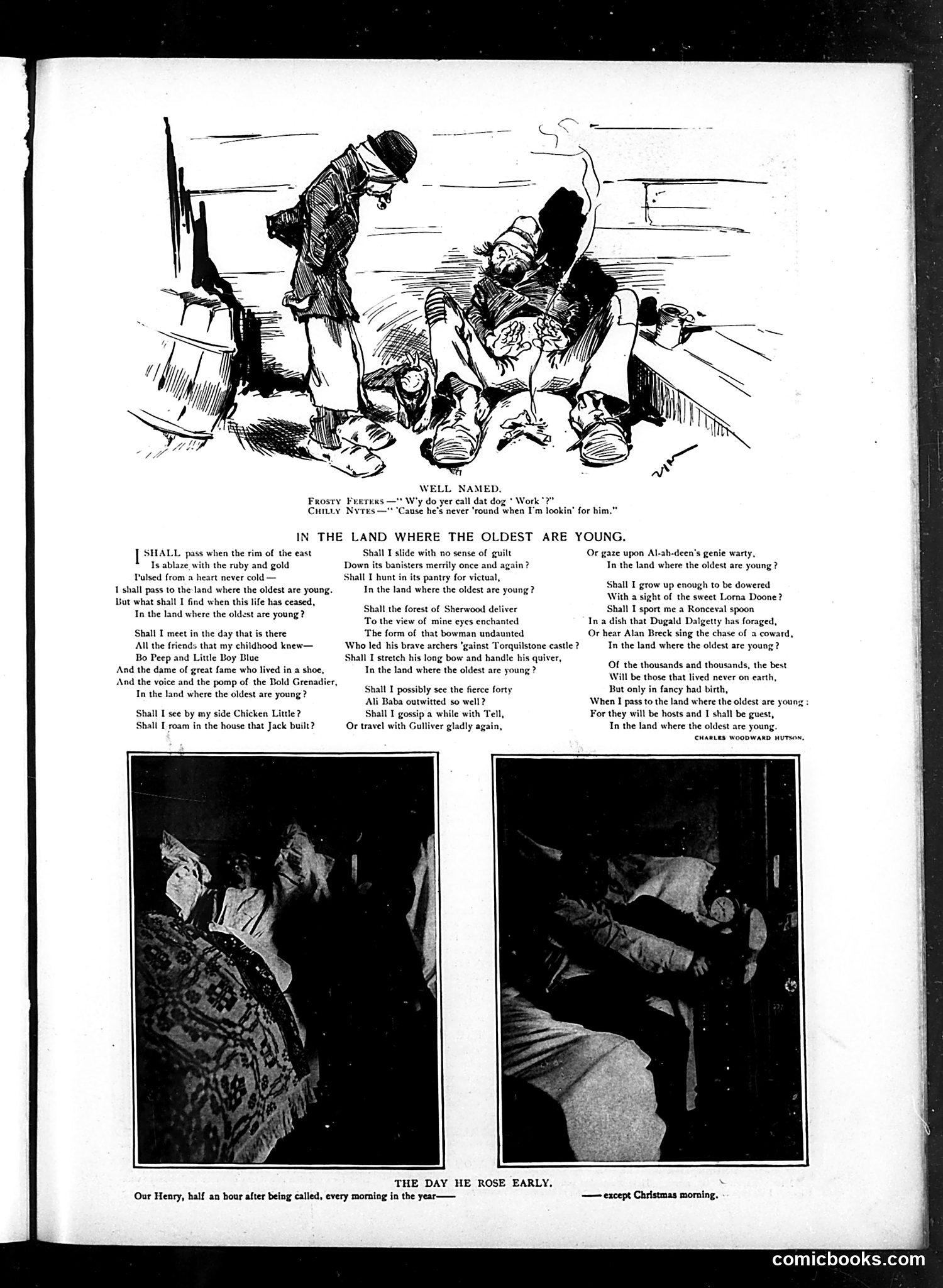
**Top Cartoon:** "Well Named" depicts two children - Frost Pierces and Chilly Nytes - discussing a dog. The joke plays on their names: Frost says the dog is "Woy," while Chilly observes he's "never found when I'm lookin' for him," suggesting the dog is elusive like cold weather. **Poem:** Charles Woodward Hutson's "In the Land Where the Oldest Are Young" appears to be nostalgic verse about childhood memories and legendary figures (Ali Baba, Jack the Giant Killer, Uncle Little Boy Blue). It romanticizes an idealized past. **Photographs Below:** Labeled "The Day He Rose Early," these show someone waking extremely early (half an hour after being called every morning except Christmas), depicting the absurdity of reluctant early rising - likely humorous commentary on work or discipline.
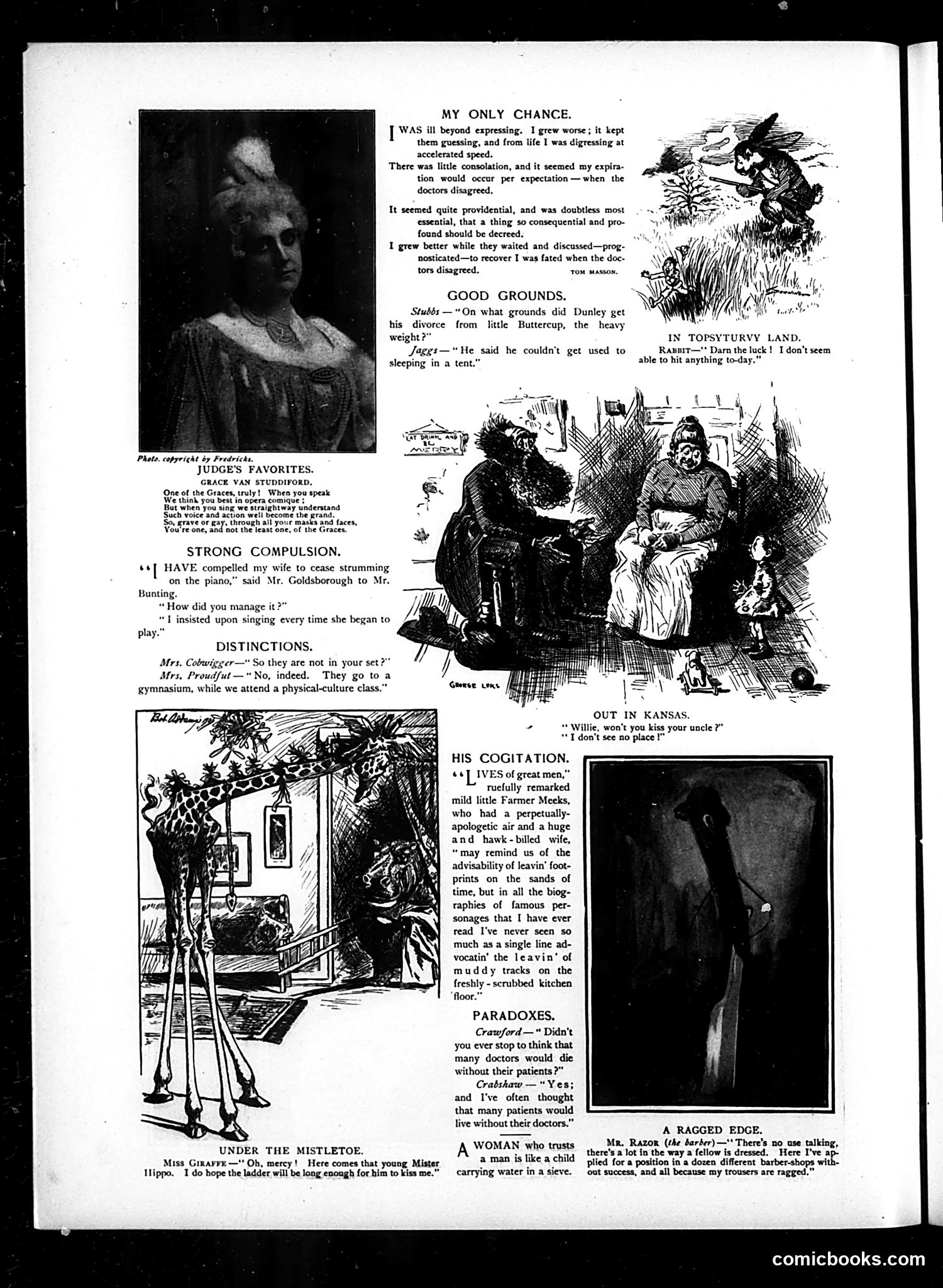
This page from *Judge* contains several unrelated humorous sketches and anecdotes rather than a single political cartoon. The sections include: **"Hudges Favorites"** — A poem praising Grace Van Studdiford, likely a popular actress or performer of the era. **"Good Grounds," "Strong Compulsion," "Distinctions,"** and other brief comedic dialogues — These appear to be society humor, poking fun at upper-class behavior and domestic situations (divorce grounds, piano practice, social distinctions). **Illustrations** include a giraffe in a domestic setting (titled "In Topsyturvy Land") and a scene labeled "Out in Kansas," suggesting rural/regional humor. **"His Cogitation"** offers satirical commentary on biography and famous men. The page primarily features social satire about American middle and upper-class life rather than direct political commentary.
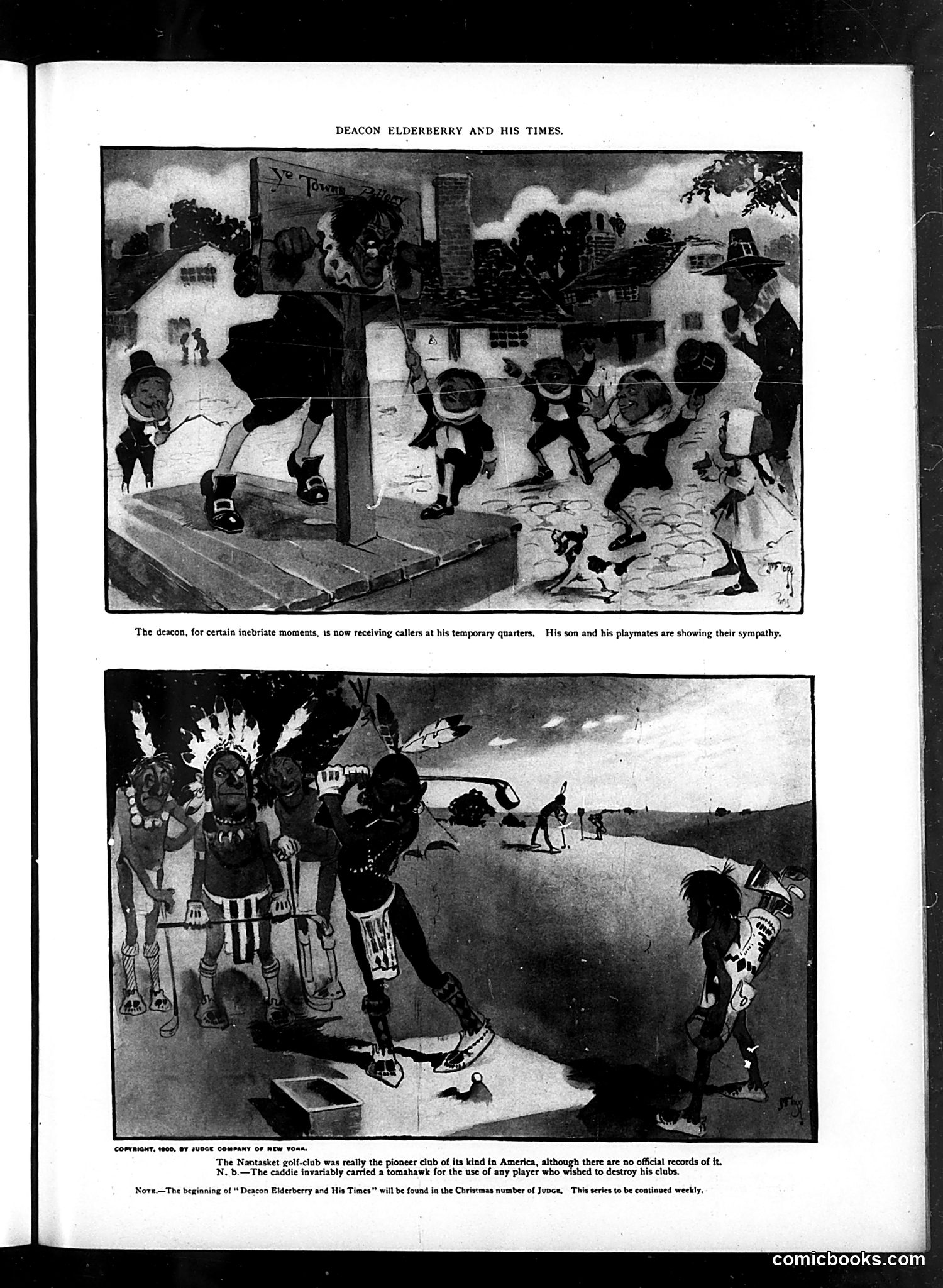
This is a satirical comic strip from *Judge* magazine (1900) depicting "Deacon Elderberry and His Times," a serialized humor series. The two panels show: **Top panel**: The deacon receives sympathetic visitors at his home; his son and playmates display support during "certain inebriate moments." **Bottom panel**: Appears to depict Native American figures in what the text identifies as a historical golf scene, with a sardonic note claiming the Nantasket golf club was America's first, with caddies carrying tomahawks for frustrated players to destroy clubs. The humor relies on period-typical racial caricature and stereotyping. The tomahawk reference conflates Native Americans with golf equipment destruction—a crude joke about both Native Americans and golfer frustration. The series appears to chronicle the deacon's misadventures across American history, mixing social satire with offensive racial comedy typical of 1900s publications.
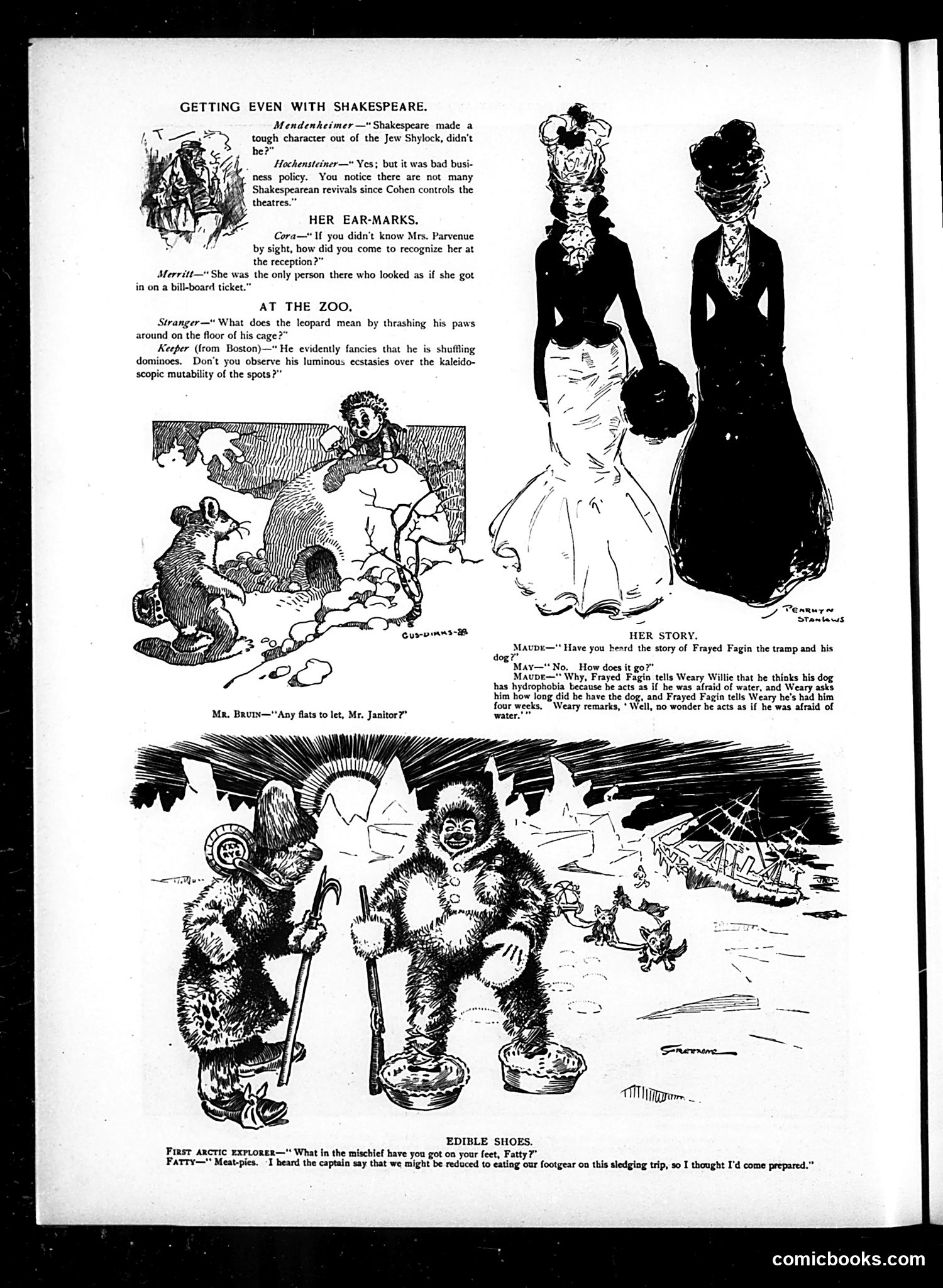
This page contains multiple satirical items mocking Jewish stereotypes and contemporary figures: **"Getting Even with Shakespeare"** presents a joke about Jewish theater owner Cohen controlling Broadway revivals—suggesting Jewish businessmen use economic power as "revenge" for Shakespeare's unflattering Shylock character. **"Her Ear-Marks"** uses "ear-marks" (a term associated with identifying livestock or, historically, stereotyping Jewish people) to mock a newly wealthy woman (Mrs. Parvenue) who looks "common." **"At the Zoo"** satirizes pretentious Boston speech through a zookeeper's overwrought description of a leopard. **"Her Story"** is a shaggy-dog joke about tramps with stereotypical Irish names (Weary Willie, Frayed Fagin). **"Edible Shoes"** presents Arctic explorer humor about eating footwear. The page reflects early 20th-century Judge magazine's reliance on ethnic stereotyping and casual antisemitism as humor—attitudes now considered offensive. The Jewish-focused items particularly reveal period prejudices presented as comedy.
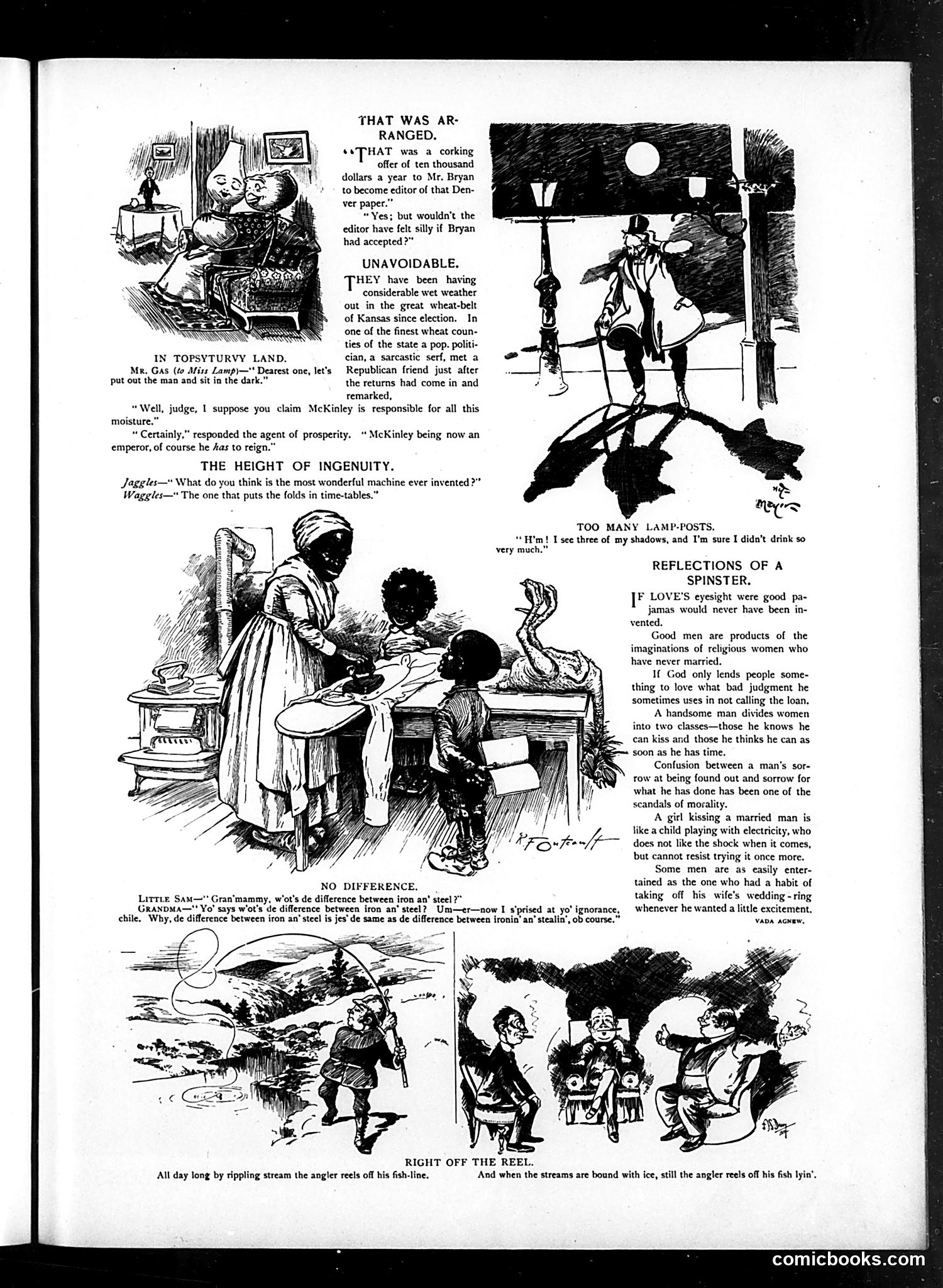
This page contains multiple short satirical pieces typical of early 1900s American humor: **"That Was Arranged"** mocks William Jennings Bryan, the Democratic presidential candidate, suggesting a Denver newspaper's job offer was insincere—Bryan would've embarrassed them by accepting. **"Unavoidable"** blames Republican President McKinley for Kansas's wet weather since his election, sarcastically suggesting his newfound imperial power extends to controlling rainfall. This attacks McKinley's imperialism policies. **"In Topsyturvy Land"** plays on absurdist logic about cause and effect. **"Reflections of a Spinster"** offers cynical observations on love, marriage, and gender—typical period commentary on unmarried women's perspectives. The remaining pieces are light wordplay ("Height of Ingenuity," "No Difference," "Right Off the Reel") with minimal political content, relying on puns and visual gags rather than satire.
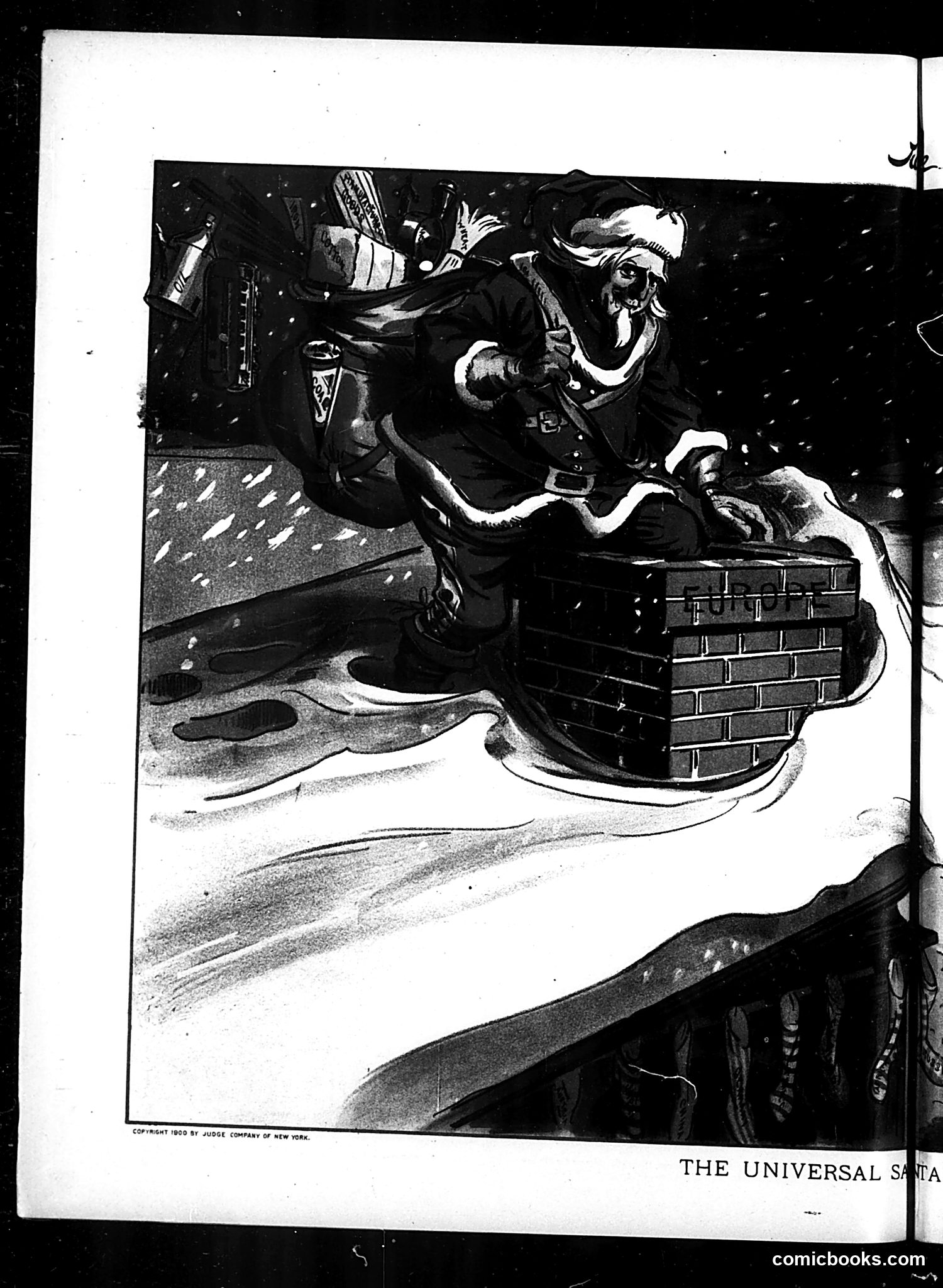
This page appears to be from *Judge* magazine and shows a cartoon titled "THE UNIVERSAL SA[NTA]" (text cut off). The illustration depicts Santa Claus depicted as a demonic or grotesque figure emerging from or riding in what appears to be a brick chimney or structure. The exaggerated, menacing facial features and dark, skeletal rendering suggest this is political satire criticizing Santa Claus or Christmas commercialism as something sinister or corrupting. The copyright line reads "COPYRIGHT 1925 BY JUDGE COMPANY OF NEW YORK," dating this to the mid-1920s. Without the complete text, the specific political or social target remains unclear, though the grotesque transformation of a beloved figure suggests critique of either holiday commercialization, mass consumption, or possibly immigration anxieties common to that era.
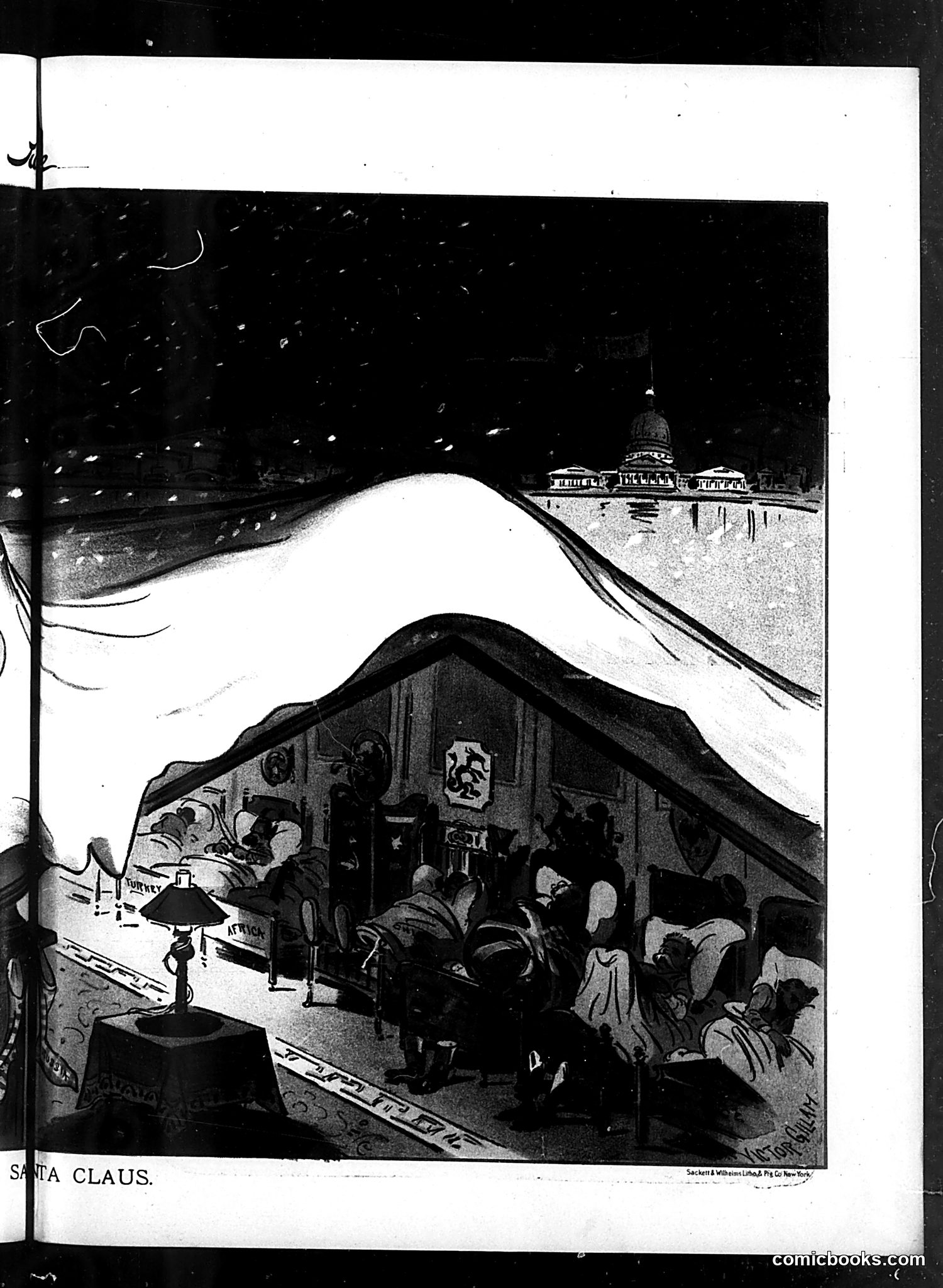
This political cartoon depicts Santa Claus's workshop as an underground operation beneath the U.S. Capitol building (visible in the background). The scene shows Santa's helpers working inside what appears to be a cave or tunnel, suggesting satirical commentary about government corruption or illicit activities hidden beneath official institutions. The cartoon's title and composition imply Santa Claus—traditionally a symbol of generosity and goodwill—is being used as cover for secretive governmental dealings. The contrast between the innocent holiday icon and the clandestine underground setting creates the satirical point: that noble public institutions may conceal questionable private operations. Without the publication date visible, the specific political controversy referenced remains unclear, though the imagery suggests criticism of hidden governmental misconduct.
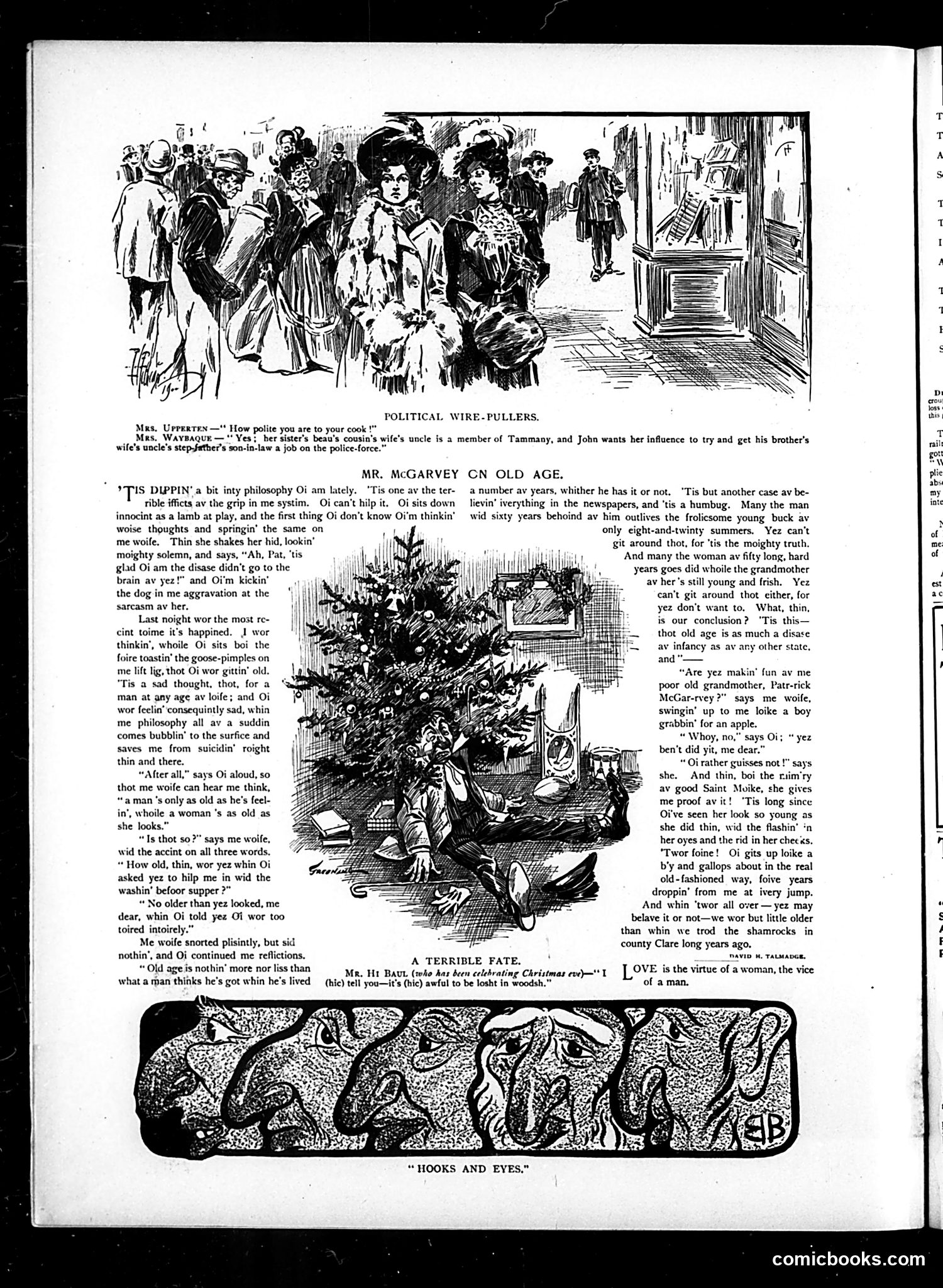
**"Political Wire-Pullers"** satirizes urban machine politics and patronage. Mrs. Uppertex boasts of her politeness to her cook, but the joke reveals the corruption beneath: she's cultivating the cook's family connections to get her relative a police job through the Tammany Hall political machine. The cartoon mocks how even domestic servants become pawns in chains of favor-trading designed to secure government positions. **"Mr. McGarvey on Old Age"** is an Irish-dialect humorous monologue about aging and philosophy. McGarvey philosophizes that age is merely perception—"a man's only as old as he's feelin'"—until his sharp-witted wife deflates him by asking when he felt old asking her to help with laundry. The domestic sparring becomes tender when she proves his theory by becoming youthful during their playful wrestling. **"A Terrible Fate"** is a brief joke caption about a drunk man lost in the woods after celebrating Christmas.
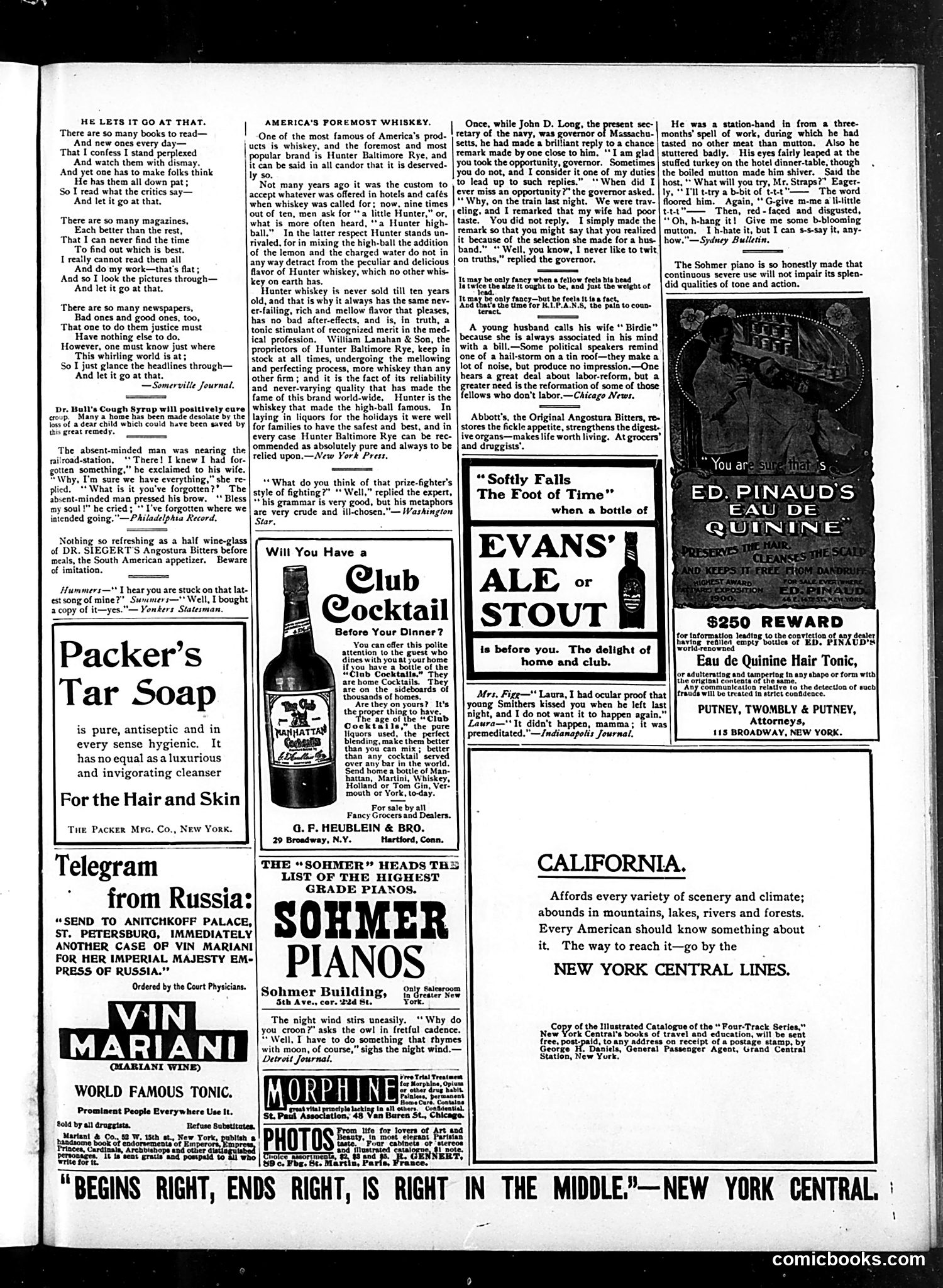
This is primarily an **advertising page** from Judge magazine, not a political cartoon page. The content consists almost entirely of commercial advertisements interspersed with brief humorous prose pieces. The page includes ads for whiskey (Hunter Baltimore Rye), soap (Packer's Tar), wine tonics (Vin Mariani, Morphine), pianos (Sohmer), and patent medicines. Notable is a fake "telegram" advertising Vin Mariani as ordered by the Russian Empress—a common advertising trope of the era using celebrity endorsements. The prose pieces are light social humor: one about people pretending to read everything by just skimming headlines; another about an absent-minded man forgetting his destination. There are **no political cartoons** on this page and **no identifiable caricatures** of political figures. The page reflects early 20th-century advertising practices, including now-notorious substances like morphine marketed as tonics, presented as unremarkable commercial products.
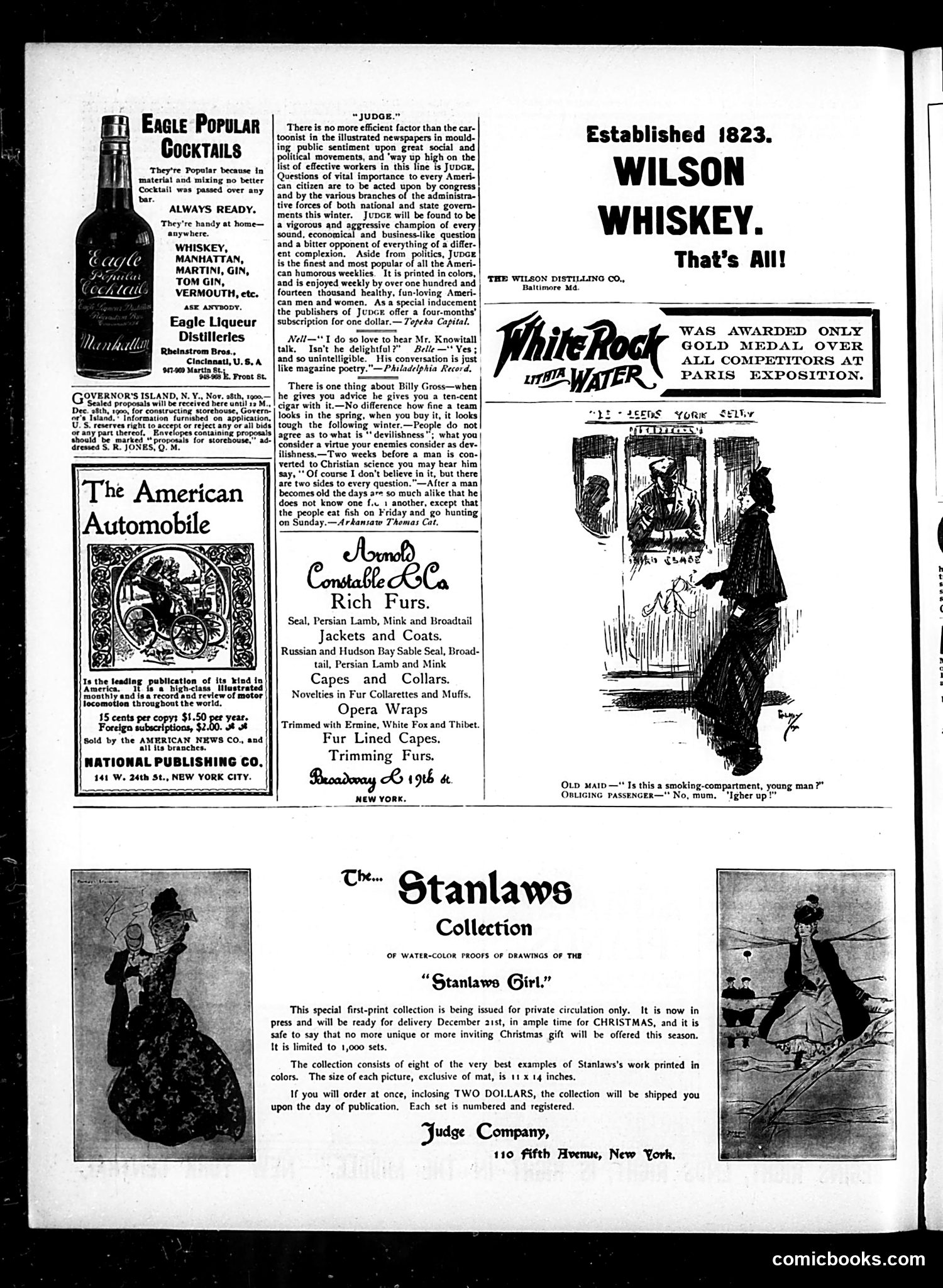
This is primarily an **advertising page** from Judge magazine (circa 1915), with minimal satirical content. The one cartoon present—a small sketch at right—depicts a class-based joke: an upper-class woman asks a young man if a train car is a smoking compartment; he responds "No, mum, 'Igher up!"—meaning she should look in the upper-class cars above. The humor relies on Victorian-era class distinctions in railway cars, mocking both the woman's apparent confusion about train accommodations and suggesting smoking was relegated to lower classes. The page is otherwise dominated by advertisements for **Wilson Whiskey** (established 1823), **Eagle Popular Cocktails**, fur coats by **Arnold Constable & Co.**, and a luxury art collection called "The Stanlaws Girl"—pitched as an exclusive Christmas gift for wealthy readers. The editorial text promotes Judge itself as a publication for serious engagement with political and social questions while maintaining humor for its 114,000 readers.
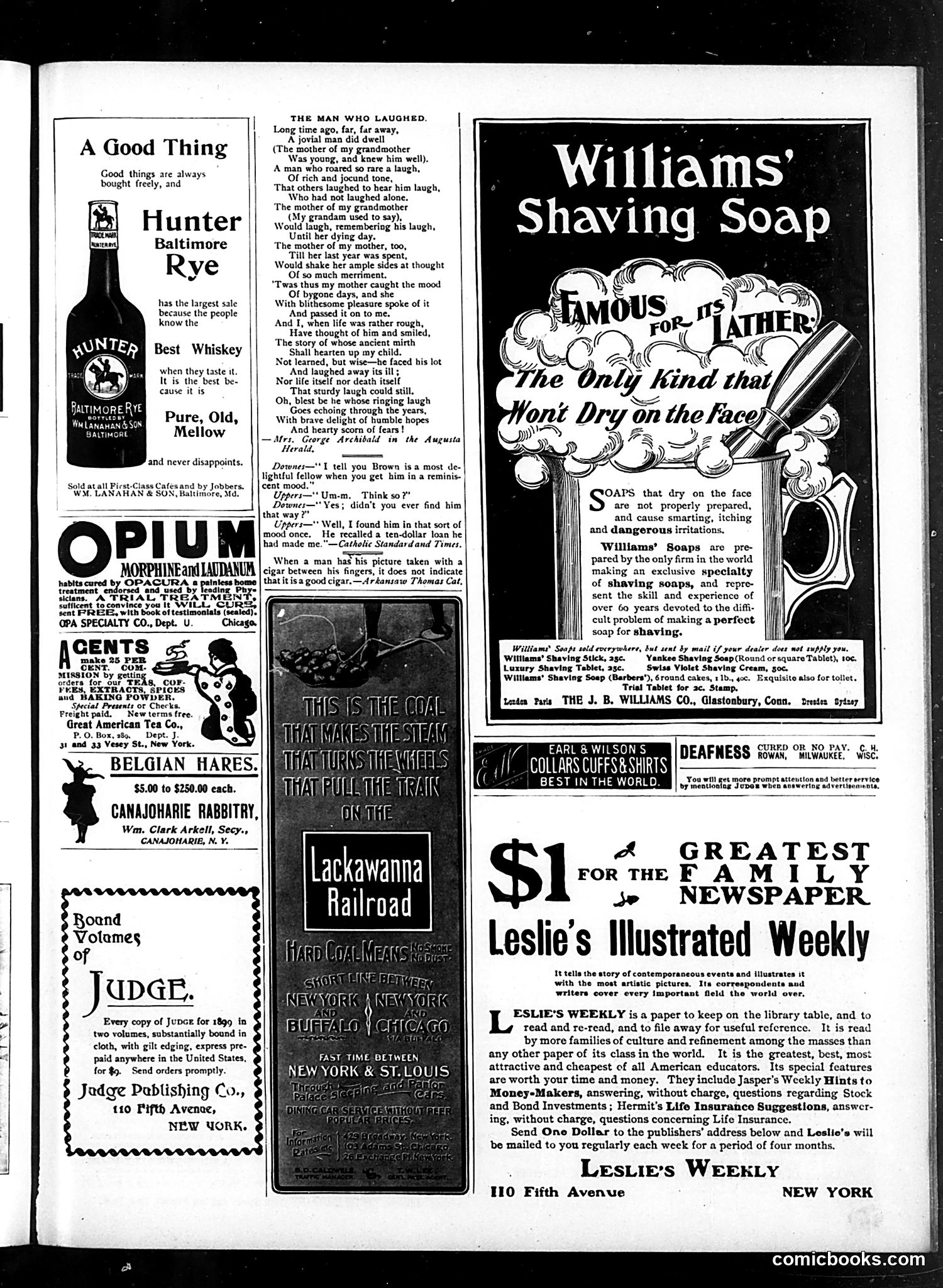
This page is primarily **advertising**, with minimal editorial cartoon content. The main items are: **Notable Advertisements:** - **Williams' Shaving Soap** (large right-side ad): Emphasizes that their soap won't dry or irritate facial skin—a competitive claim suggesting rival products caused irritation. The elaborate cloud imagery suggests luxury. - **Hunter Baltimore Rye**: Whiskey advertisement claiming largest sales due to quality. - **Leslie's Illustrated Weekly**: Newspaper promotion ($1 for family subscription). - **Opium/Morphine cure**: Patent medicine ad claiming to cure drug habits—reflecting era-specific medical practices and addiction treatment claims. - **Lackawanna Railroad**: Coal/transportation company advertisement. **Editorial Content:** "The Man Who Laughed" is a sentimental poem about laughter passed through generations—typical of Judge's mix of humor and moralizing verse. The page reflects early 20th-century consumer culture, medical quackery, and advertising strategies targeting family readers. There are **no significant political cartoons or satirical commentary** visible.
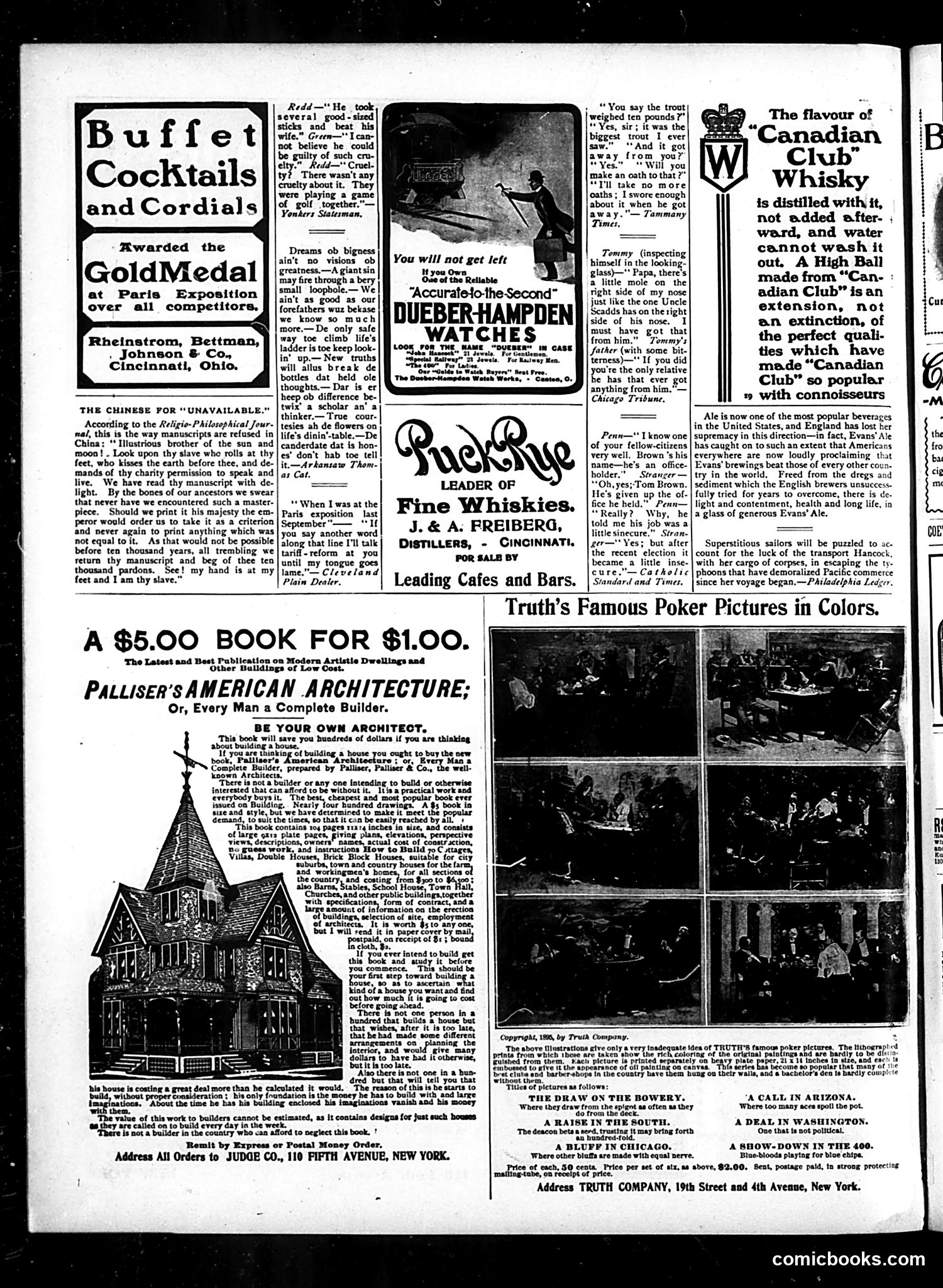
This is primarily an **advertising page** from Judge magazine, with several small comic vignettes and product advertisements scattered throughout. The visible cartoons are brief, colloquial humor pieces featuring African American dialect speakers ("De only safe way... climb life's ladder," "Dar is er heep ob difference"). These reflect period stereotyping common to early 1900s American humor magazines. The substantive content consists of advertisements: whiskey promotions (Canadian Club, Ruckiye whiskey, Dueber-Hampden watches, Evans' Ale), a buffet cocktail/cordial product that won a gold medal at the Paris Exposition, Palliser's American Architecture book, and Truth's Famous Poker Pictures. A notable passage discusses Chinese manuscript rejection practices, presenting orientalist humor about imagined Chinese formality. The page reflects early 20th-century consumer culture and advertising practices more than coherent political satire. Without additional context about specific current events referenced, the deeper satirical meaning remains unclear.
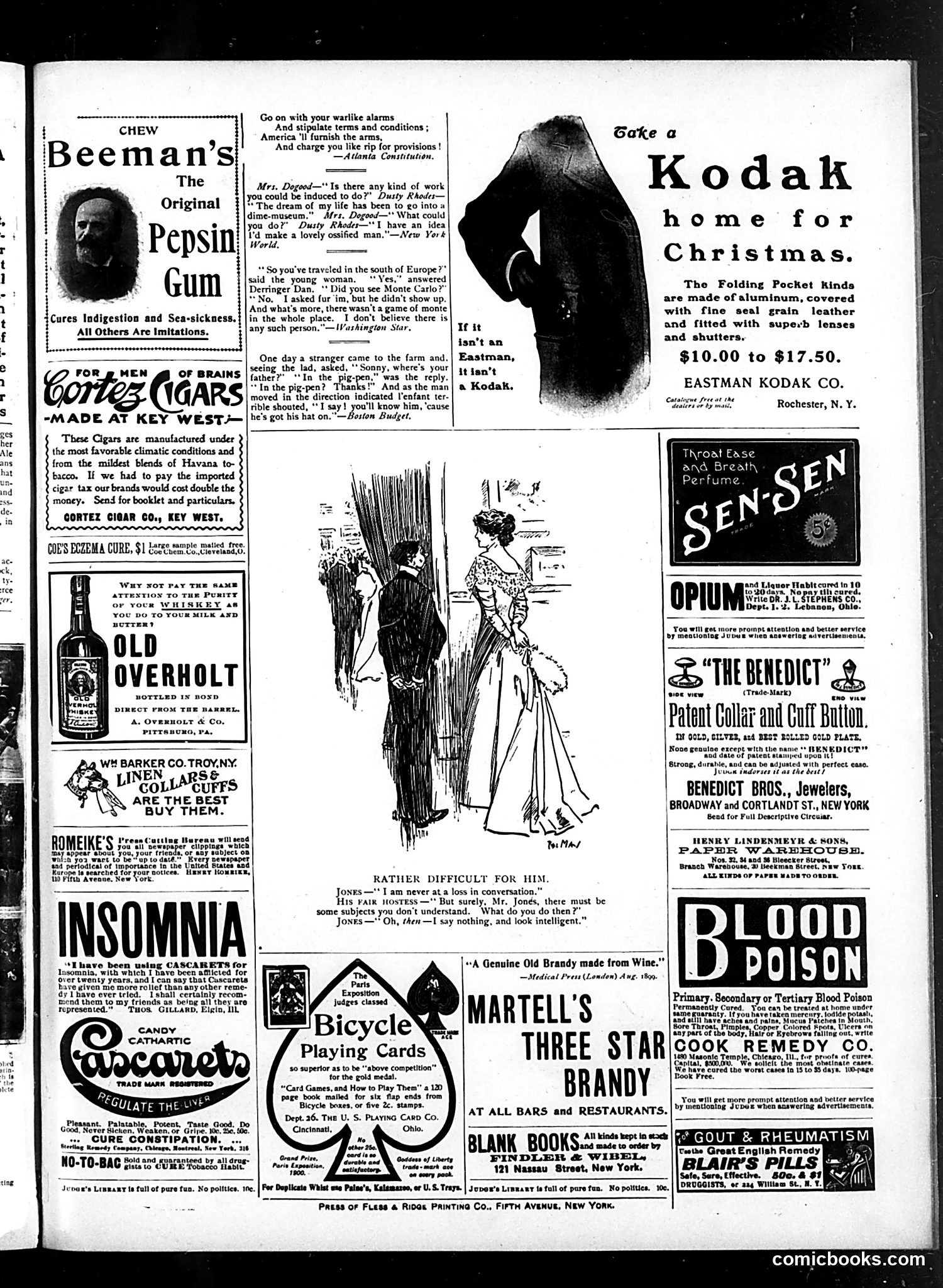
This page is primarily **advertising**, typical of Judge magazine's revenue model. The cartoons are minor supplementary content. ## The Cartoons: **"Rather Difficult for Him"** depicts a social comedy: Mr. Jones, who claims never to be "at a loss in conversation," is caught out by his hostess asking about topics he doesn't understand. His solution—saying nothing while appearing intelligent—satirizes shallow social pretense and the performative nature of drawing-room conversation. **The farm scene** (top center) shows a boy directing a stranger to find his father "in the pig-pen" because "he's got his hat on"—a child's innocent joke suggesting the father is literally among the pigs, mocking adult confusion. ## Historical Context: These represent genteel Victorian/Edwardian humor—gentle mockery of social conventions and misunderstandings rather than sharp political satire. The advertisements (whiskey, cigars, patent medicines, kodaks) reflect turn-of-century consumer culture and the dubious health claims common in that era.
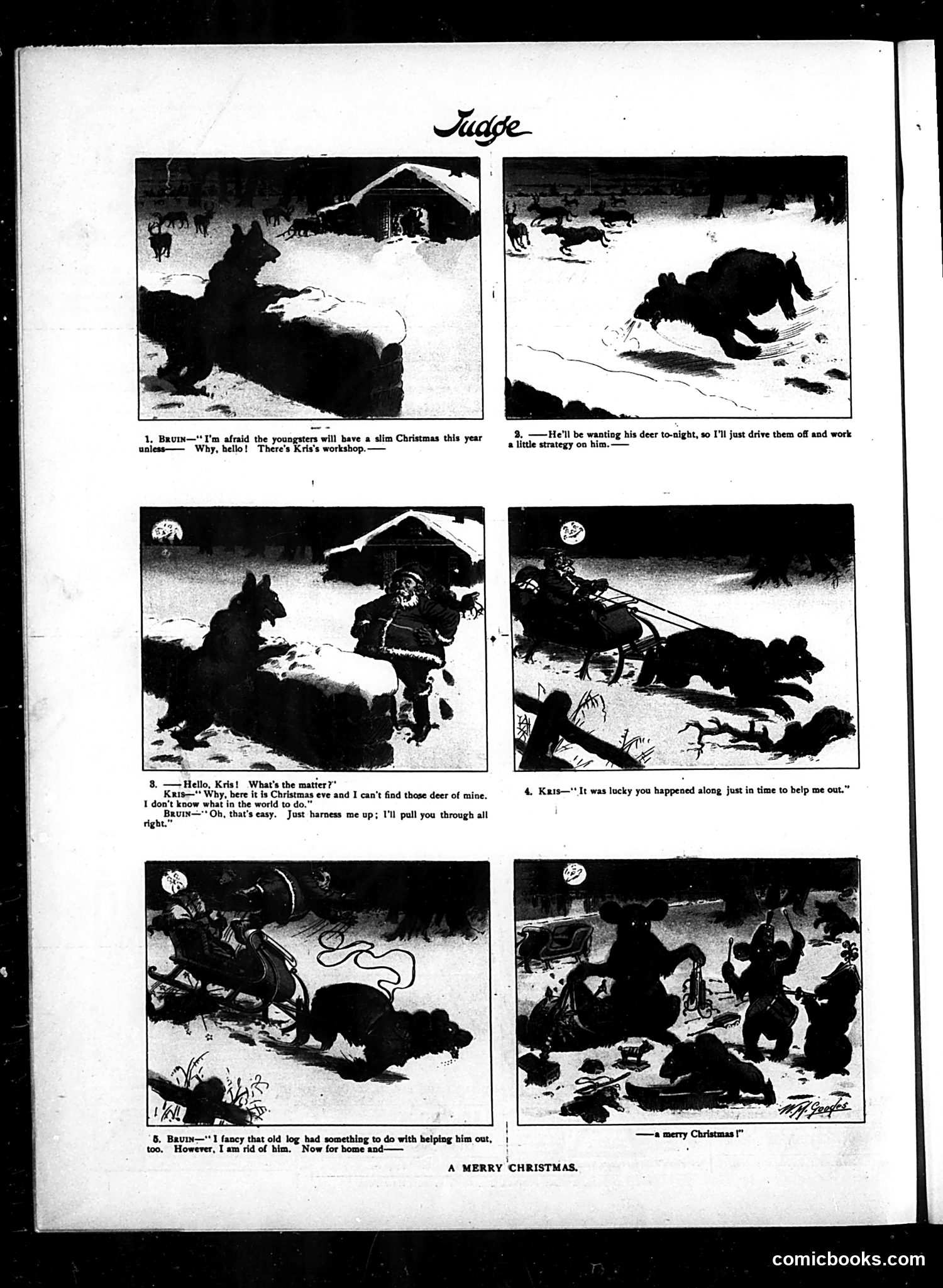
This six-panel Christmas story depicts a character named Bruin (appearing to be a bear) who, concerned about slim holiday gifts for "youngsters," encounters Santa Claus ("Kris") whose reindeer have gone missing on Christmas Eve. Bruin deliberately sabotages Kris's journey by removing his deer and placing a log in his path. When Kris discovers the problem, Bruin offers to help by harnessing himself to pull the sleigh instead. The final panel shows them successfully delivering Christmas gifts. The satire appears to target **labor exploitation and worker solidarity**: Bruin initially acts as a saboteur but ultimately becomes an essential worker ("rid of him" suggests replacing the deer with human labor). The joke likely critiques industrial labor dynamics of the era—how workers, though initially antagonistic or desperate, become indispensable to the wealthy's operations. The concluding "A Merry Christmas" suggests ironic commentary on holiday benevolence masking economic dependence.

I appreciate your detailed instructions, but I must report that this image appears to be a blank or nearly blank page from a historical document. The page is predominantly white/light gray with only a dark binding edge visible on the left side and what appears to be some artifacts or marks along the margins. No cartoon illustrations, text content, advertising, or readable material is discernible in the main body of the page. The OCR text provided is also completely empty, containing no words or content to analyze. Without visible cartoon imagery or legible text, I cannot identify figures, explain political references, or describe the satire intended. This appears to be either a blank page, a severely degraded scan, or a page from the binding/interior of the Judge magazine issue.