
Judge, 1900-12-29 · page 2 of 17
Judge — December 29, 1900 — page 2: what you’re looking at
What you’re looking at
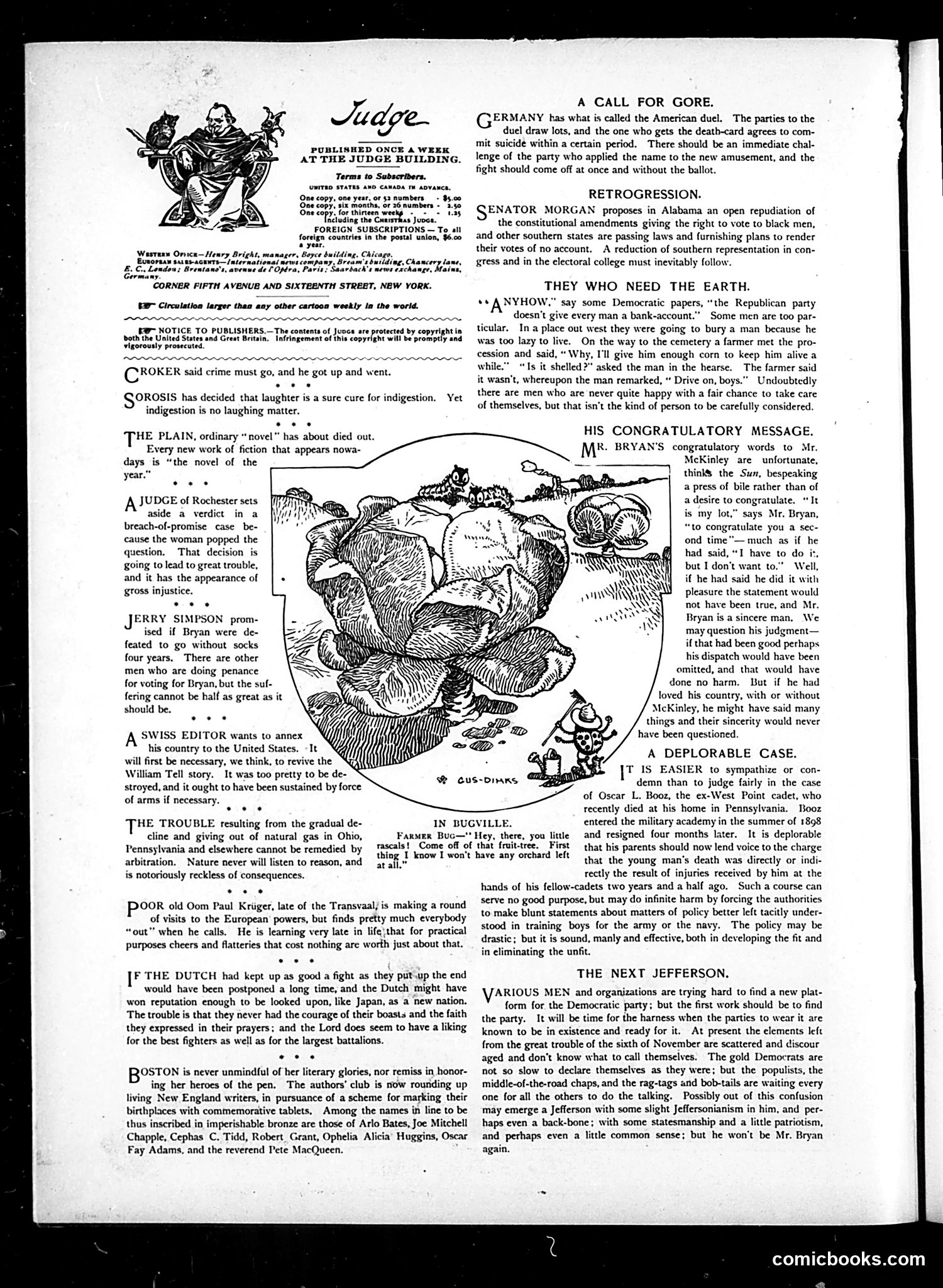
The main cartoon "IN BUGVILLE" depicts anthropomorphic insects (bugs) in a farming scene. A large bug addresses smaller ones, saying "Hey, there, you little rascals! Come off of that fruit-tree. First thing I know I won't have any orchard left at all!" This is political allegory: the large bug represents authority/government, while the smaller bugs represent citizens or a particular group (possibly immigrants or the working class, common Judge targets). The satire critiques how those in power accuse subordinates of consuming/exploiting shared resources, while the larger system itself causes the actual damage. The surrounding text columns discuss various contemporary political issues including voting rights, military academy scandals, and the search for a presidential successor to Bryan—typical Judge content from the Progressive Era.
📄 Transcribed text from this page (OCR, searchable)
Machine-transcribed from the original scan — historical spelling and the odd misread are preserved.
PUBLISHED ONCE A WEEK AT THE JUDGE BUILDING. Terms to Subscribers. UWITRD STATES AND CANADA MH ADVANCE, One copy, one year, or $2 numbers - $5.00 ‘One copy, six months, or 26 numbers One copy. for thirteen weekp == Plaediog the Cansrias Juce FOREIGN SUBSCRIPTIONS — To alt foreign countries in the postal unlon, $6.00 ayer. Wastamn Onice—Henry Bright, manager, Boyce Evroraam satas-acewts— [aterm nsw com Cu London nave lding. Chicago. tional mews ny, Bream's butiding, Chancer aris; Saarback's mews exchange, CORNER FIFTH AVENUE AND SIXTEENTH STREET, NEW YORK. (2 Circulation larger than any other cartoon weekly ta the world. Fa NOTICE TO PUBLISHERS.—The contents of Juoce are protected by copyright in th the United States and Grest Britain. Infringement of this copyright will be promptly and igorously prosecuted. CROKER said crime must go, and he got up and went, SoRosis has decided that laughter is a sure cure for indigestion. Yet indigestion is no laughing matter. THE PLAIN, ordinary “novel” has about died out. Every new work of fiction that appears nowa- days is “the novel of the year.” . JUDGE of Rochester sets aside a verdict in a breach-of-promise case be- cause the woman popped the question. That decision is going to lead to great trouble, and it has the appearance of gross injustice. J ERRY SIMPSON prom- ised if Bryan were de- feated to go without socks four years. There are other men who are doing penance for voting for Bryan, but the suf- fering cannot be half as great as it should be. . A SWISS EDITOR wants to annex his country to the United States. -It will first be necessary, we think, to revive the William Tell story. It was too pretty to be de- stroyed, and it ought to have been sustained by force of arms if necessary. HE TROUBLE resulting from the gradual de- cline and giving out of natural gas in Ohio, Pennsylvania and elsewhere cannot be remedied by arbitration. Nature never will listen to reason, and is notoriously reckless of consequences. rascals! at all.” OOR old Oom Paul Kriger, late of the Transvaal; is making a round of visits to the European’ powers, but finds pretty much everybody “out” when he calls. He is learning very late in life\that for practical purposes cheers and flatteries that cost nothing are worth just about that. [F THE DUTCH had kept up as good a fight as they putsup the end would have been postponed a long time, and the Dutch might have won reputation enough to be looked upon, like Japan, as a new nation. The trouble is that they never had the courage of their boasts and the faith they expressed in their prayers; and the Lord does seem to have a liking for the best fighters as well as for the largest battalions. eee OSTON is never unmindful of her literary glories, nor remiss in honor- ing her heroes of the pen. The authors’ club is now rounding up living New England writers, in pursuance of a scheme for marking their birthplaces with commemorative tablets. Among the names in line to be thus inscribed in imperishable bronze are those of Arlo Bates, Joe Mitchell Chapple, Cephas C. Tidd, Robert Grant, Ophelia Alicia’ Huggins, Oscar Fay Adams, and the reverend Pete MacQueen. IN BUGVILLE. Farmer Buc—'* Hey, there, you little Come off of that fruit-tree. First thing I know I won't have any orchard left A CALL FOR GORE. GERMANY has what is called the American duel, The parties to the duel draw lots, and the one who gets the death-card agrees to com- mit suicide within a certain period. There should be an immediate chal- lenge of the party who applied the name to the new amusement, and the fight should come off at once and without the ballot. RETROGRESSION. SENATOR MORGAN proposes in Alabama an open repudiation of the constitutional amendments giving the right to vote to black men, and other southern states are passing laws and furnishing plans to render their votes of no account. A reduction of southern representation in con- gress and in the electoral college must inevitably follow. THEY WHO NEED THE EARTH. 'YHOW," say some Democratic papers, “the Republican party doesn’t give every man a bank-account.” Some men are too par- Ina place out west they were going to bury a man because he was too lazy to live. On the way to the cemetery a farmer met the pro- cession and said, “Why, I'll give him enough corn to keep him alive a while.” “'Is it shelled?” asked the man in the hearse. The farmer said it wasn't, whereupon the man remarked, “* Drive on, boys.” Undoubtedly there are men who are never quite happy with a fair chance to take care of themselves, but that isn’t the kind of person to be carefully considered. ticular, HIS CONGRATULATORY MESSAGE. M®- BRYAN'S congratulatory words to Mr. McKinley are unfortunate, thinkS the Sun, bespeaking a press of bile rather than of a desire to congratulate. “It is my lot,” says Mr. Bryan, “to congratulate you a sec- ond time”— much as if he had said, “I have to do it, but I don’t want to.” Well, if he had said he did it with pleasure the statement would not have been true, and Mr. Bryan is a sincere man, We may question his judgment— if that had been good perhaps. his dispatch would have been omitted, and that would have done no harm. But if he had loved his country, with or without McKinley, he might have said many things and their sincerity would never have been questioned. A DEPLORABLE CASE. T IS EASIER to sympathize or con- demn than to judge fairly in the case of Oscar L. Booz, the ex-West Point cadet, who recently died at his home in Pennsylvania. Booz entered the military academy in the summer of 1898 and resigned four months later. It is deplorable that his parents should now lend voice to the charge that the young man’s death was directly or indi- rectly the result of injuries received by him at the hands of his fellow-cadets two years and a half ago. Such a course can serve no good purpose, but may do infinite harm by forcing the authorities to-make blunt statements about matters of policy better left tacitly under- stood in training boys for the army or the navy, The policy may be drastic; but it is sound, manly and effective, both in developing the fit and in eliminating the unfit. THE NEXT JEFFERSON. ARIOUS MEN and organizations are trying hard to find a new plat- form for the Democratic party; but the first work should be to find the party. It will be time for the harness when the parties to wear it are known to be in existence and ready for it. At present the elements left from the great trouble of the sixth of November are scattered and discour aged and don’t know what to call themseives. The gold Democrats are not so slow to declare themselves as they were; but the populists, the middle-of-the-road chaps, and the rag-tags and bob-tails are waiting every one for all the others to do the talking. Possibly out of this confusion may emerge a Jefferson with some slight Jeffersonianism in him, and per- haps even a back-bone; with some statesmanship and a little patriotism, and perhaps even a little common sense; but he won't be Mr. Bryan again. comicbooks.com