
A complete issue · 16 pages · 1900
Judge — December 8, 1900
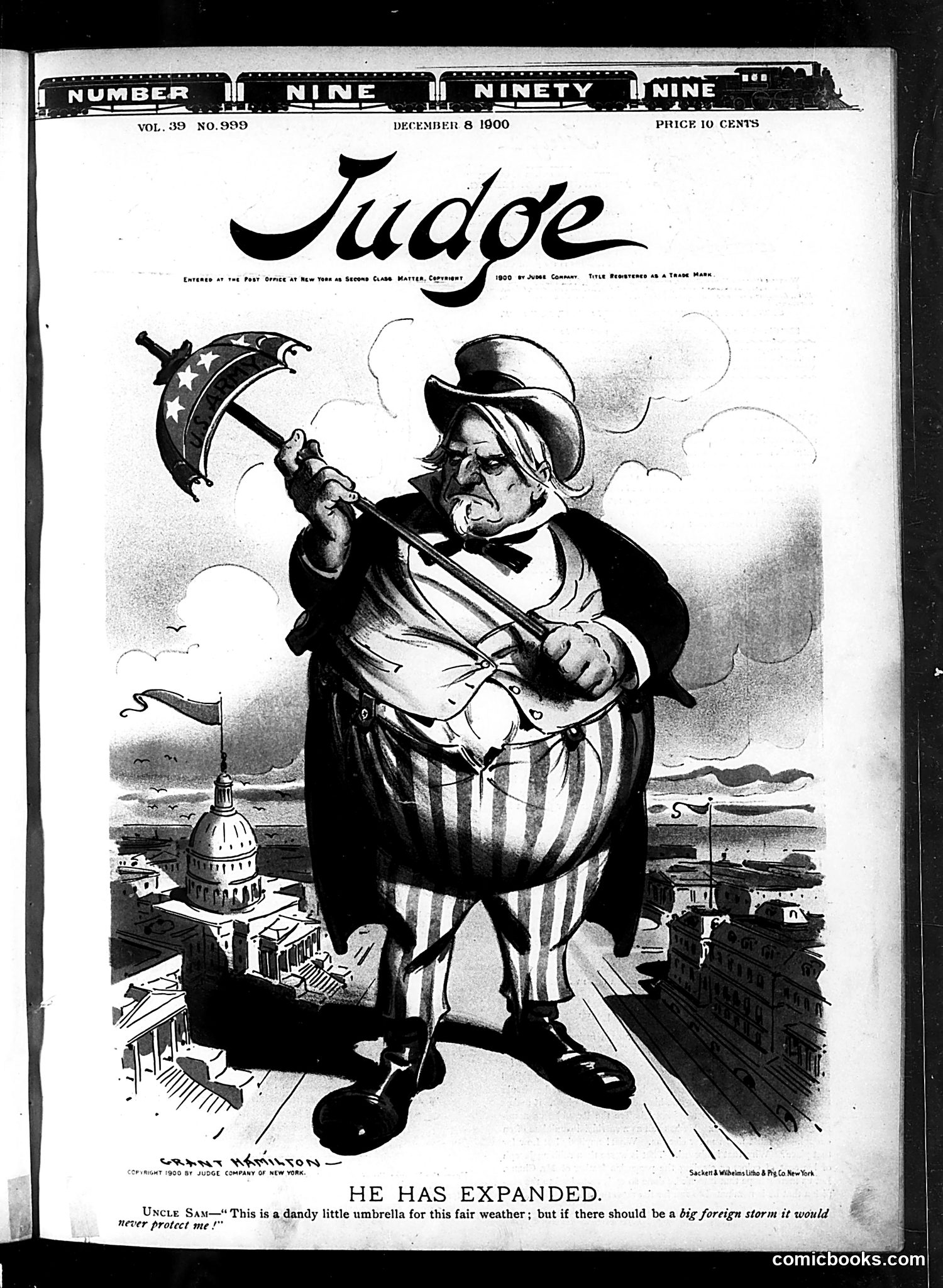
This Judge magazine cover (December 8, 1900) depicts Uncle Sam as an overweight figure struggling with an oversized umbrella labeled with stars and stripes, standing above Washington D.C.'s Capitol building. The caption reads: "This is a dandy little umbrella for this fair weather; but if there should be a **big foreign storm it would never protect me!**" The cartoon satirizes American territorial expansion around 1900—likely referencing the Philippine-American War and recent U.S. imperial acquisitions. Uncle Sam has "expanded" (grown fat) from acquiring overseas territories, but the satire suggests this growth leaves America vulnerable. The small umbrella represents inadequate military/diplomatic protection for these new far-flung possessions during uncertain international times. The artist is Grant Hamilton.
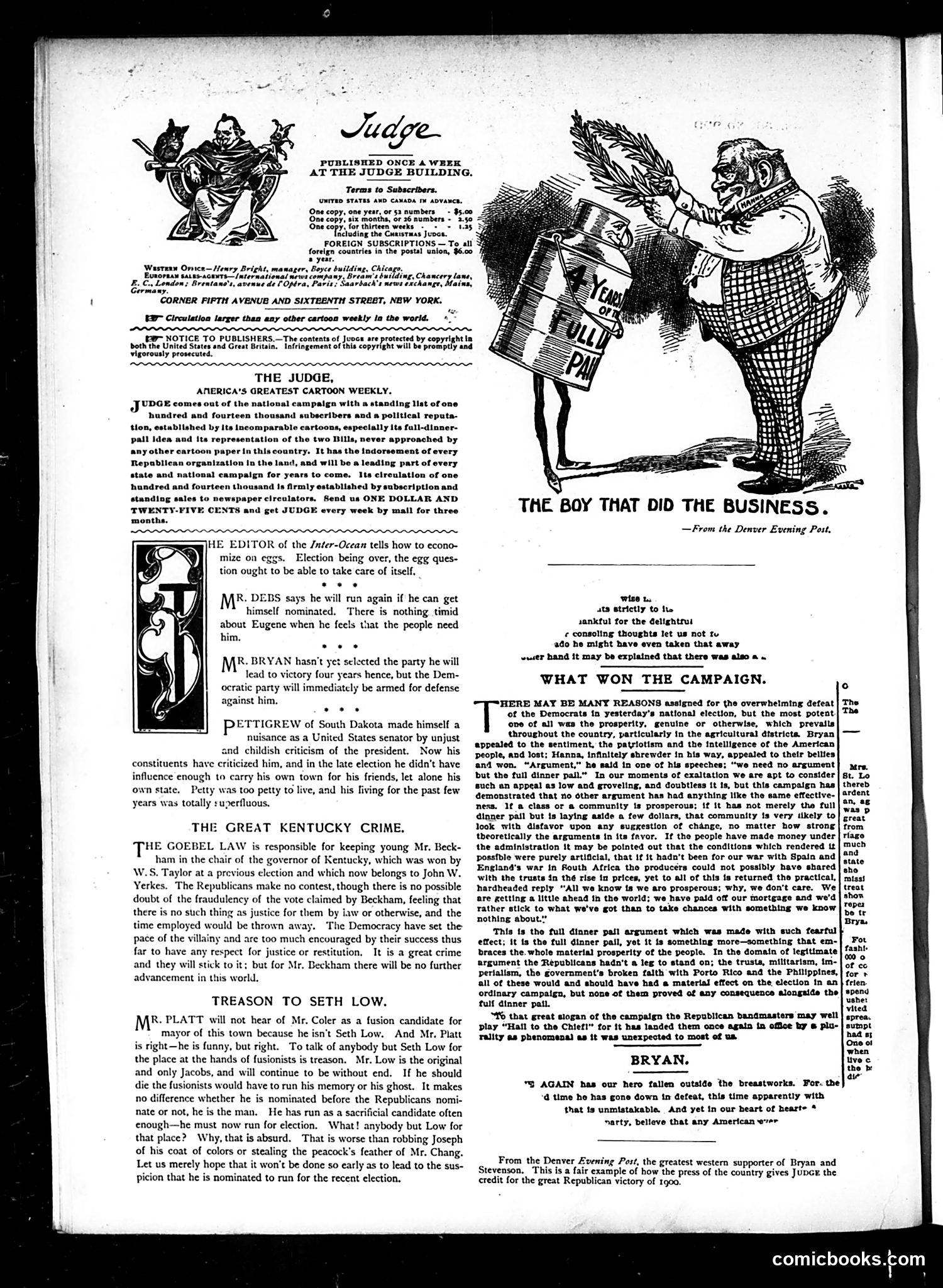
This political cartoon satirizes William Jennings Bryan's 1896 presidential campaign. The figure on the left represents Bryan as a boy, depicted as a shady businessman or charlatan, literally "doing business" by selling what appears to be fraudulent goods labeled "FREE SILVER" to an older, gullible man (likely representing the American public or Democratic Party voters). The satire mocks Bryan's central campaign platform—free coinage of silver—as a deceptive scheme. Republican Judge magazine presents Bryan as a con artist exploiting voters' economic anxieties with promises he cannot deliver. The cartoon's title suggests Bryan's youthful inexperience and untrustworthiness made him dangerous to the nation's interests.
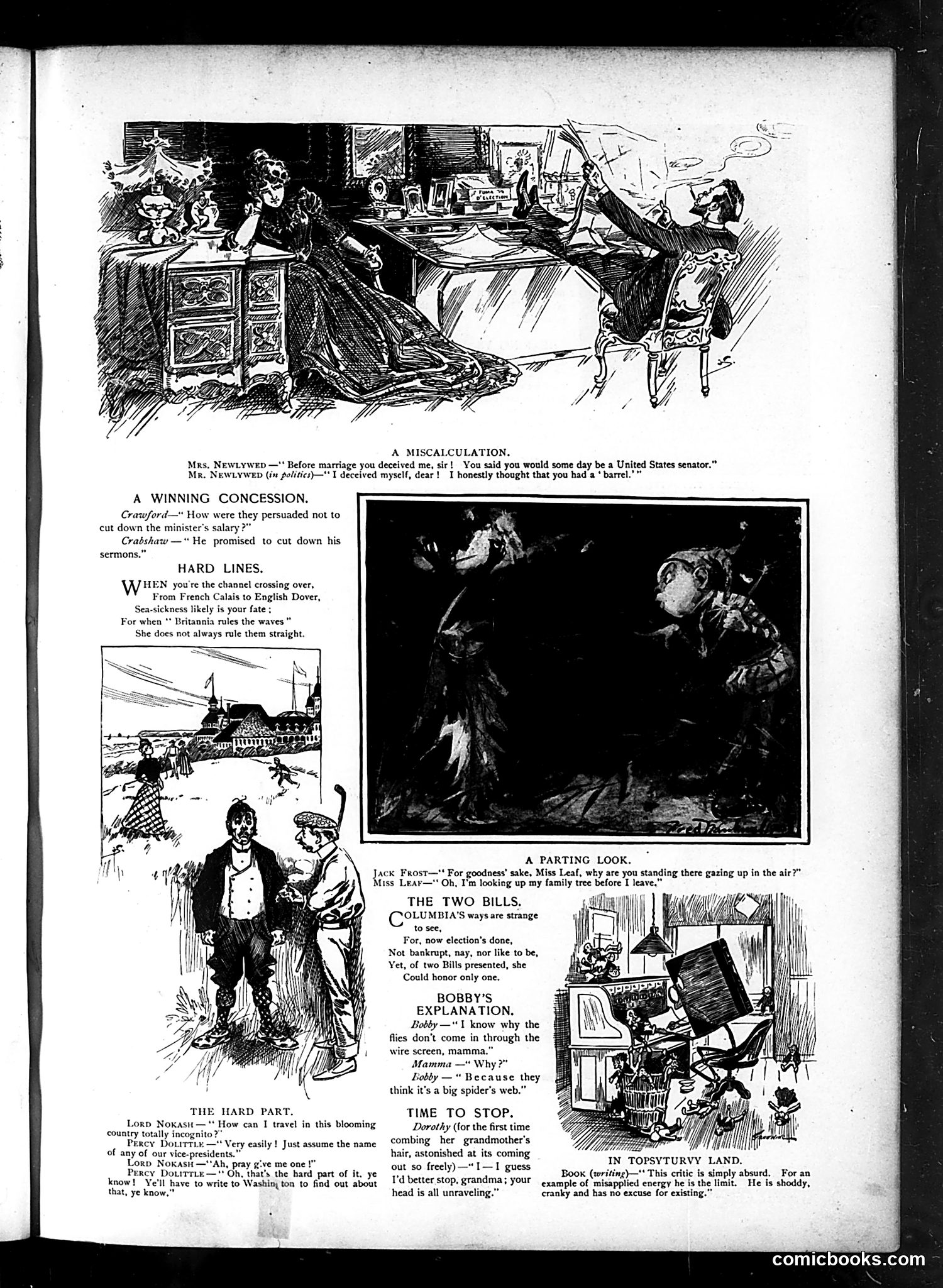
This page contains several short satirical pieces and illustrations typical of Judge's humor: **"A Miscalculation"** mocks a newlywed couple's marital expectations—the husband boasted he'd become a U.S. senator, but the wife reveals he actually said he'd be a "barrel" (likely meaning a drunk or failure). **"Hard Lines"** and accompanying illustration joke about sea-sickness during the English Channel crossing, playing on the stereotype of British vulnerability to rough waters despite ruling the seas. **"A Winning Concession"** and **"The Hard Part"** appear to be brief political quips, though specific references are unclear without additional context. The remaining items—**"The Two Bills,"** **"Bobby's Explanation,"** **"Time to Stop,"** and **"In Topsyturvy Land"**—are domestic humor pieces about family life, appearing unrelated to current events.
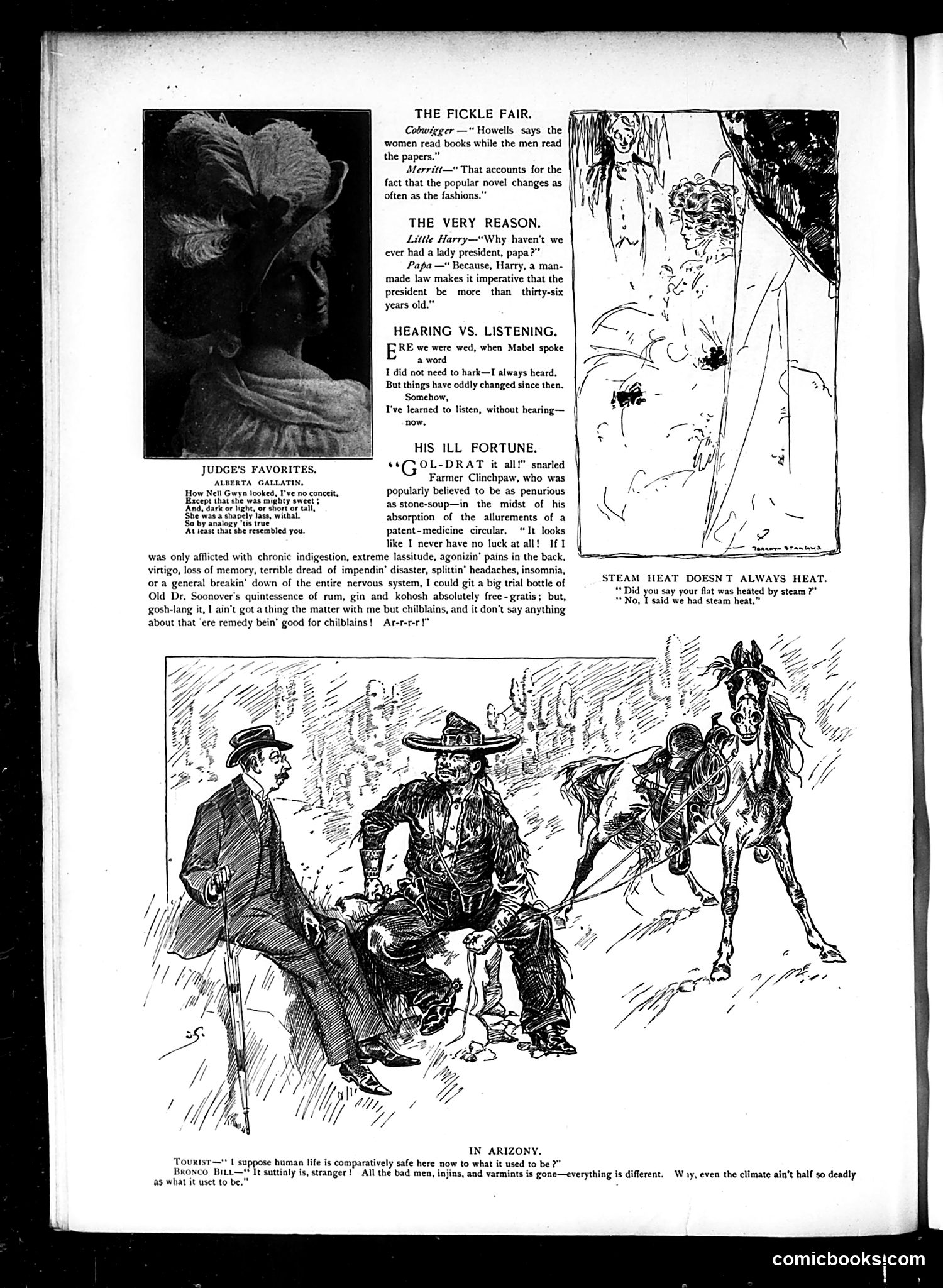
This page contains several brief satirical pieces and illustrations typical of Judge's humor: **"The Pickle Fair"** and **"The Very Reason"** are short joke exchanges about gender differences—women reading novels versus newspapers, and why there's never been a female president (a man-made law requiring candidates be over 35). **"Judge's Favorites"** features a poem about Alberta Gallatin, praising her beauty with Victorian language. **"Hearing vs. Listening"** reflects on aging—how hearing ability has declined while listening skills have somehow improved. **"His Ill Fortune"** describes a farmer's misery from digestive troubles. **"In Arizona"** shows a Western scene where a tourist remarks that life seems safer than before, but everything else—climate, terrain—has become more dangerous. The humor relies on wordplay, gender stereotypes, and period-specific references rather than political satire.
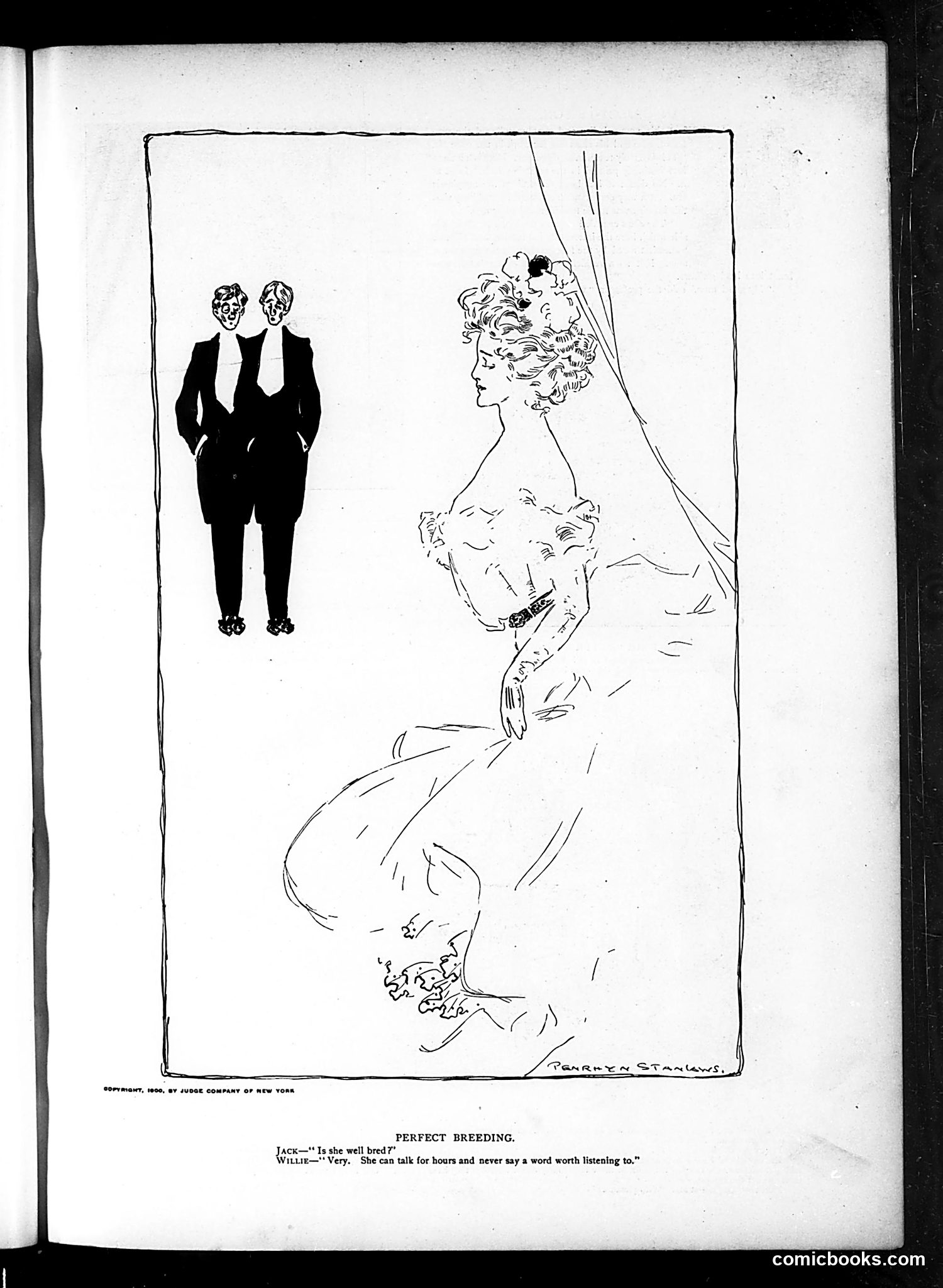
This early 20th-century satire mocks upper-class social conventions through dialogue between two men (Jack and Willie) observing an elegant woman. The cartoon's humor targets the period's definition of "good breeding" in aristocratic circles. The punchline equates refinement with a woman's ability to talk incessantly without saying anything worthwhile—a common sexist jab at both female chattiness and the superficiality of high society. The well-dressed men and the woman's elaborate gown and coiffure emphasize the wealthy social sphere being ridiculed. The satire suggests that "perfect breeding" among the elite involves empty conversation and aesthetic presentation rather than substance or intelligence—a critique of both class pretension and gendered expectations of women in that era.
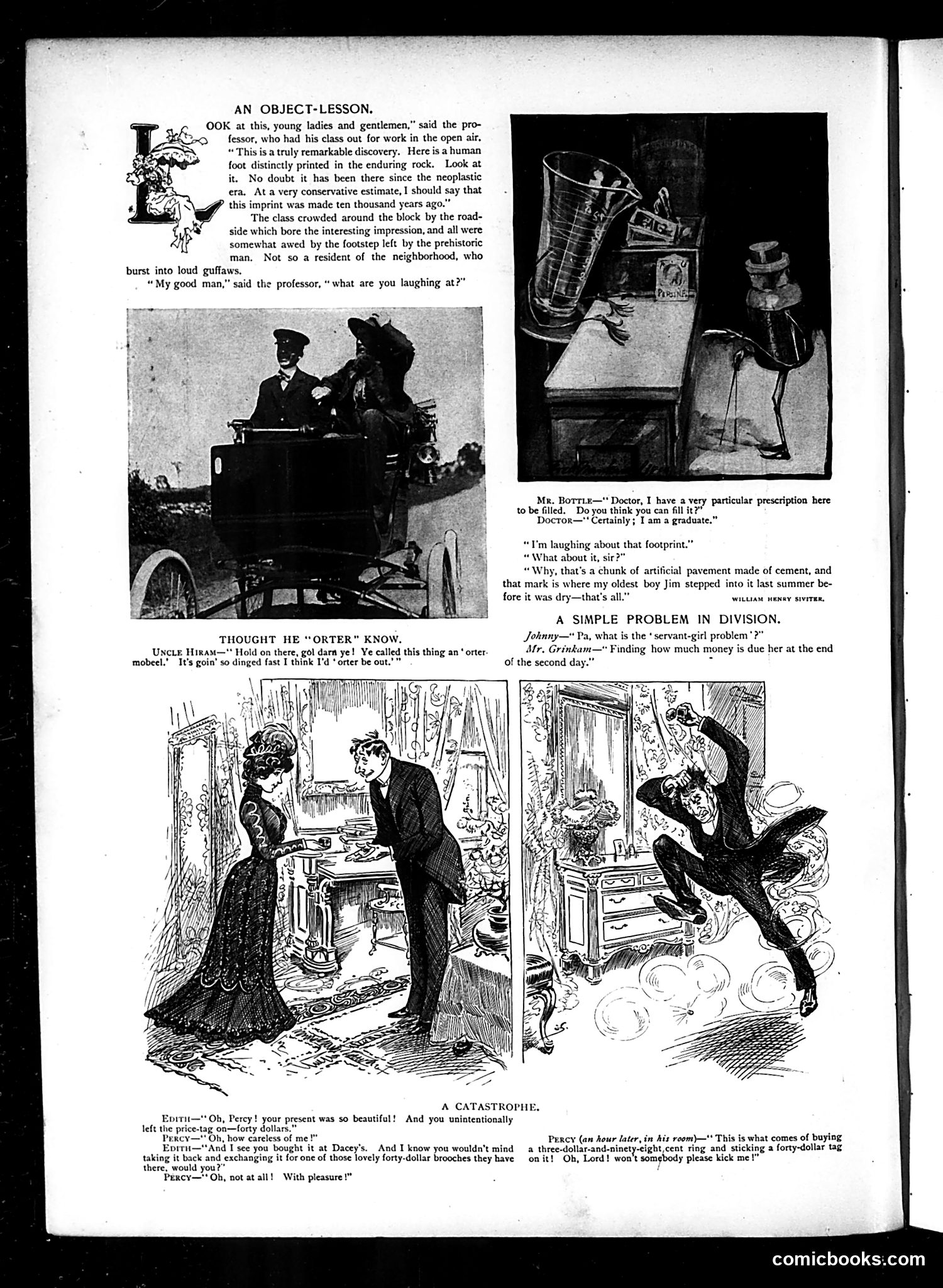
This page contains three humorous sketches satirizing various social situations: **"An Object-Lesson"**: A professor lectures his class on a "prehistoric" human footprint in rock, claiming it's 10,000 years old. A local man laughs, revealing the "ancient artifact" is actually just a footprint his son Jim made in wet cement pavement the previous summer. The satire mocks pseudo-intellectual pomposity and academia's overconfidence in interpreting evidence. **"Thought He 'Orter' Know"**: A rural character misunderstands "motor" as "orter" (ought-er), creating wordplay humor about rural dialect and the confusion caused by new automobile technology. **"A Catastrophe"**: Percy buys a cheap ring ($3.98) but fraudulently attaches a $40 price tag from an expensive store. When his girlfriend discovers his deception and demands he exchange items at the store, his scheme backfires—he's exposed as dishonest. The satire condemns male deception and materialism in courtship. All three sketches target pretension, ignorance, and dishonesty across social classes.
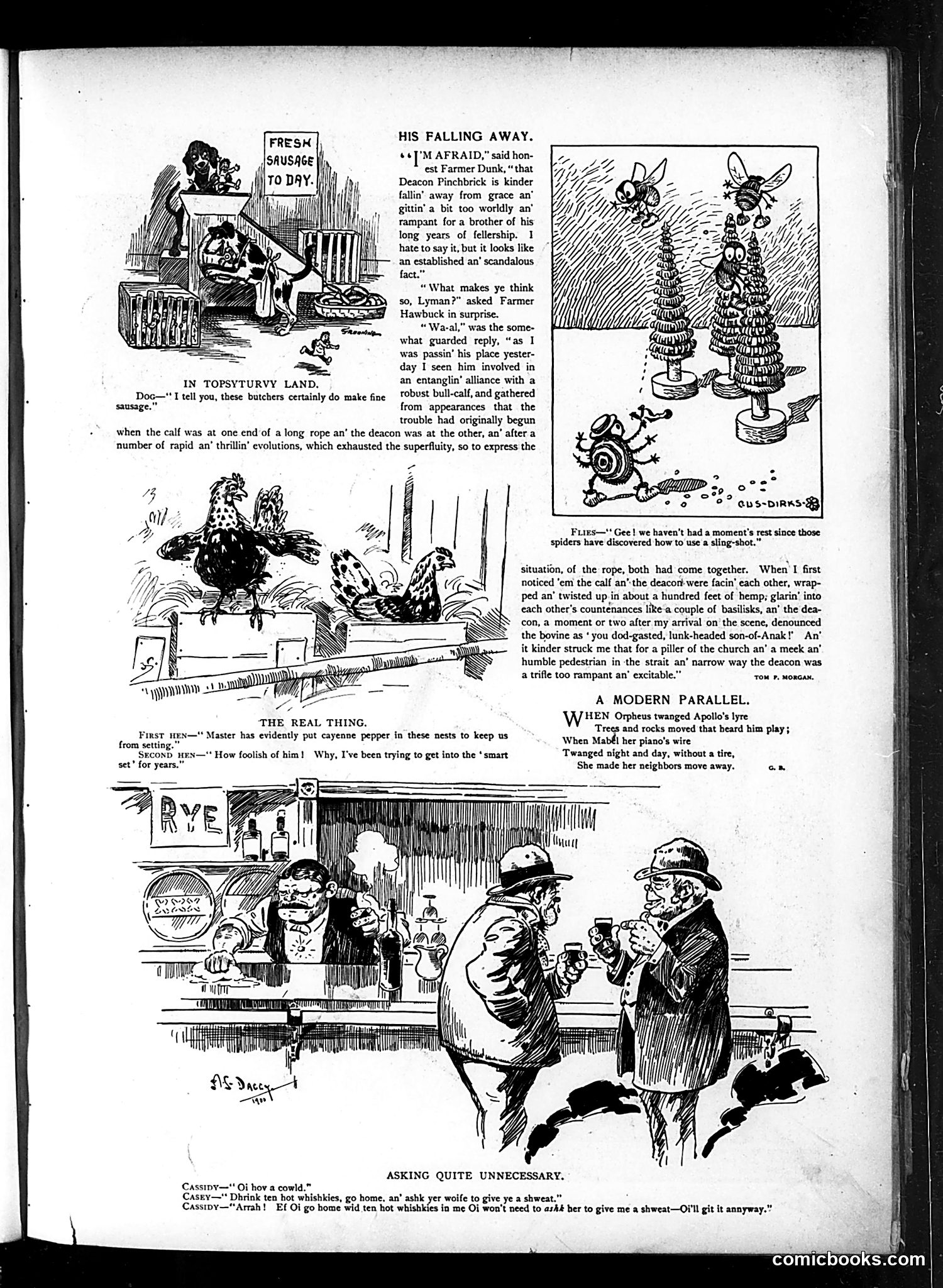
This page contains several unrelated satirical sketches typical of Judge magazine's humor: **"His Falling Away"**: Rural farmers gossip about Deacon Pinchbrick's moral decline. The joke: they've witnessed him tangled in a rope with a bull-calf, and interpret his profane outburst ("dod-gasted, lunk-headed son-of-Anak!") as evidence he's abandoning piety for worldly behavior. The satire mocks small-town hypocrisy and how rural folk judge morality by isolated incidents. **"In Topsyturvy Land"**: Absurdist humor about butchers making sausage and hens trying to enter a "smart set"—pure nonsense without apparent topical reference. **"The Real Thing"** and **"A Modern Parallel"**: Brief comparative jokes about music (Orpheus/Apollo vs. a woman playing piano badly enough to drive neighbors away). **"Asking Quite Unnecessary"**: Dialect humor with an Irish immigrant character joking that ten whiskeys will make him sweat without needing his wife's help. The page reflects Judge's mix of rural satire, absurdist comedy, and ethnic humor typical of early 20th-century American magazines.
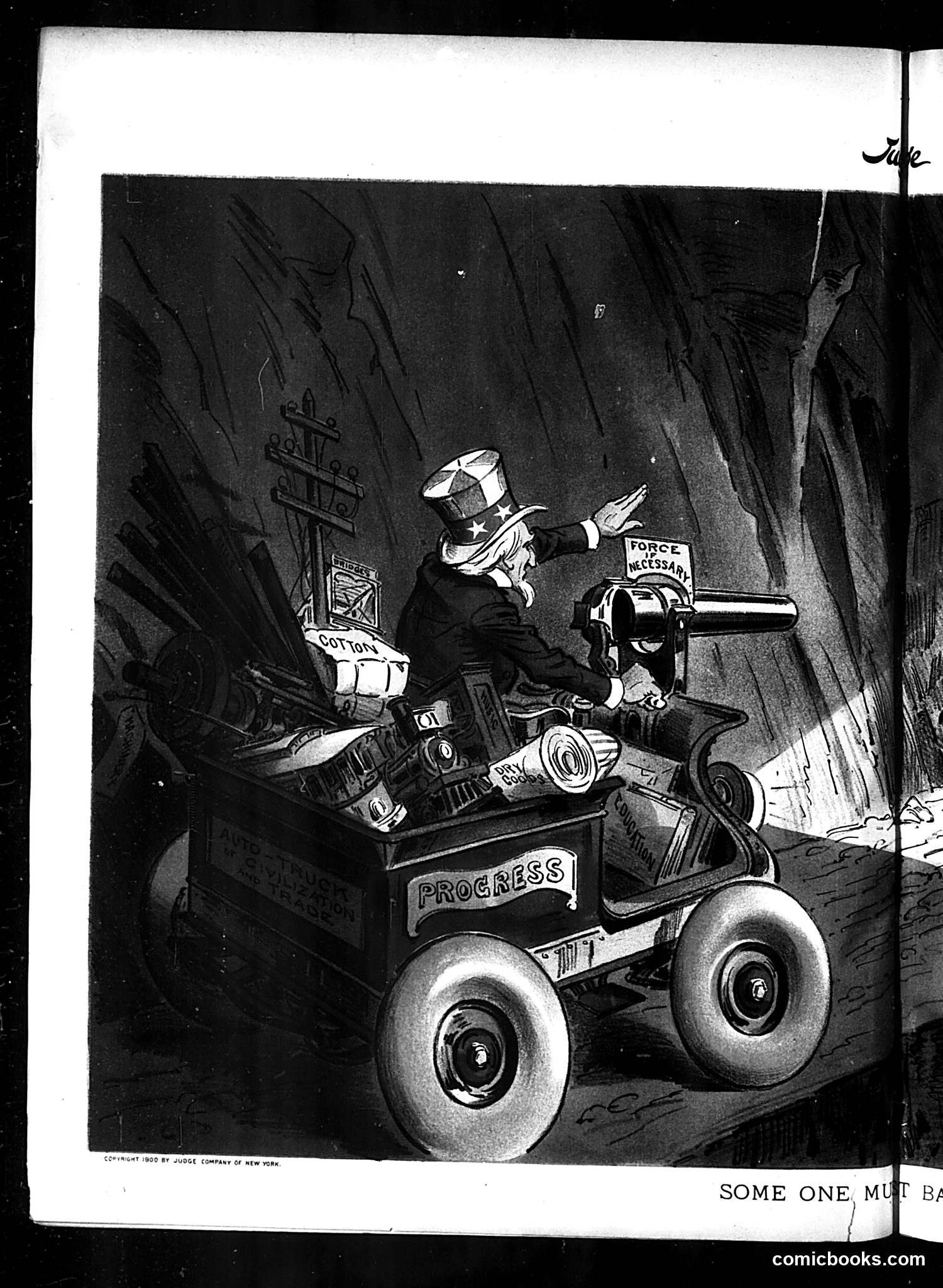
This is a political cartoon from *Judge* magazine depicting "Progress" as a massive industrial machine operated by Uncle Sam (identifiable by his top hat and facial hair). The machine is labeled "PROGRESS" and powered by "COTTON" and "OIL," with a cannon labeled "FORCE IF NECESSARY" mounted on top. The satire criticizes American industrial expansion and imperialism in the early 20th century. Uncle Sam drives this mechanized force through what appears to be difficult terrain, suggesting the nation's aggressive push forward regardless of obstacles. The "Force If Necessary" cannon indicates the cartoon critiques America's willingness to use military power to advance economic and industrial interests—likely referencing contemporary U.S. military interventions or colonial expansion. The cartoon suggests that American "progress" comes at a cost, powered by exploitation and backed by military might.
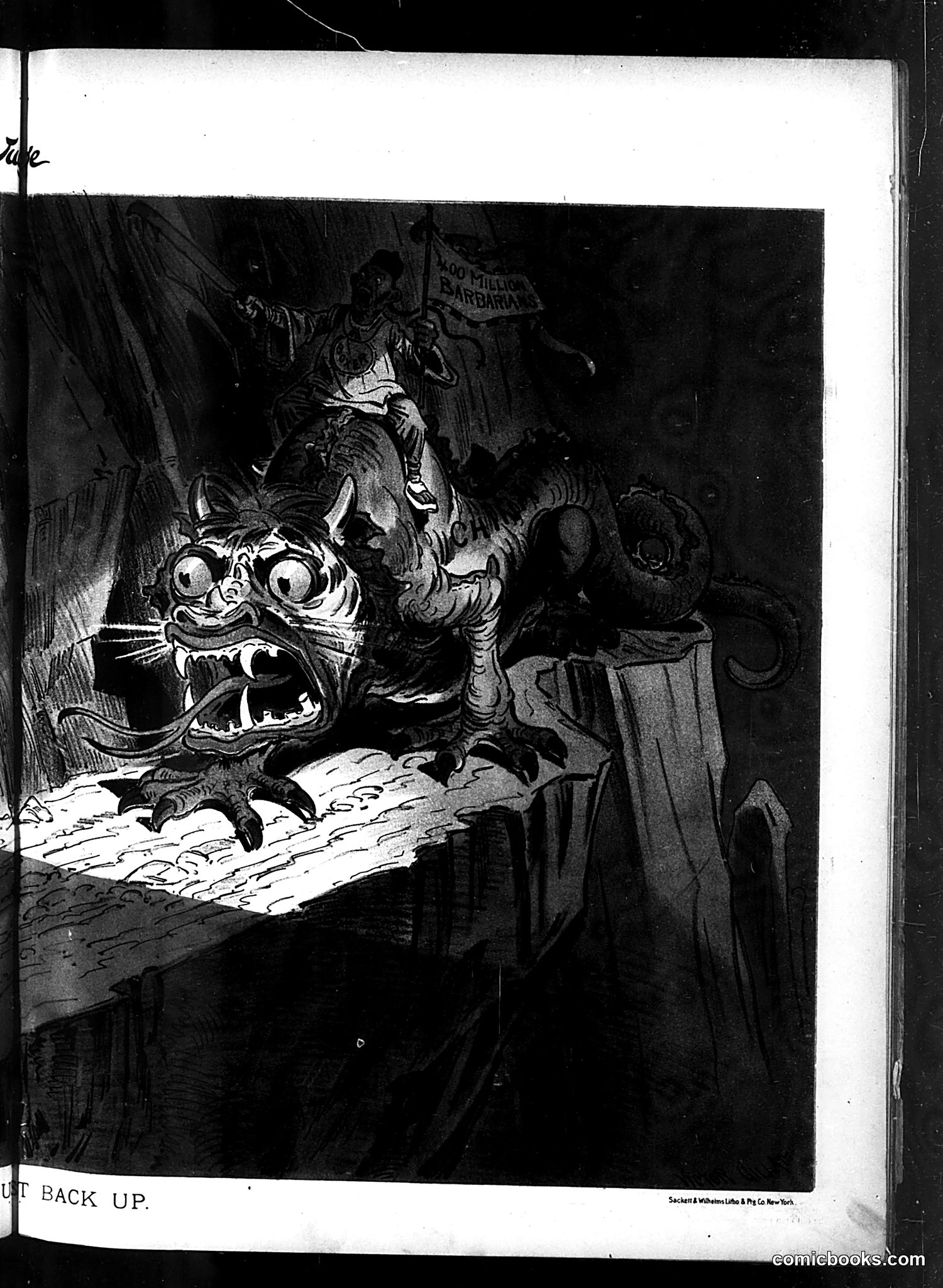
This appears to be a satirical cartoon from *Judge* magazine depicting a demon or devil-like creature at a desk, examining documents. The beast has exaggerated features—bulging eyes, sharp teeth, and menacing expression—typical of late 19th/early 20th-century caricature style. The caption reads "PUT BACK UP," though the full context is unclear from this page alone. The demon examining paperwork likely represents corruption, fraud, or some form of malfeasance being scrutinized. The documents on the desk suggest bureaucratic or financial misconduct. Without additional context or visible publication date, I cannot definitively identify which specific political scandal or social issue is being satirized, though the imagery suggests critique of dishonest governmental or business practices.
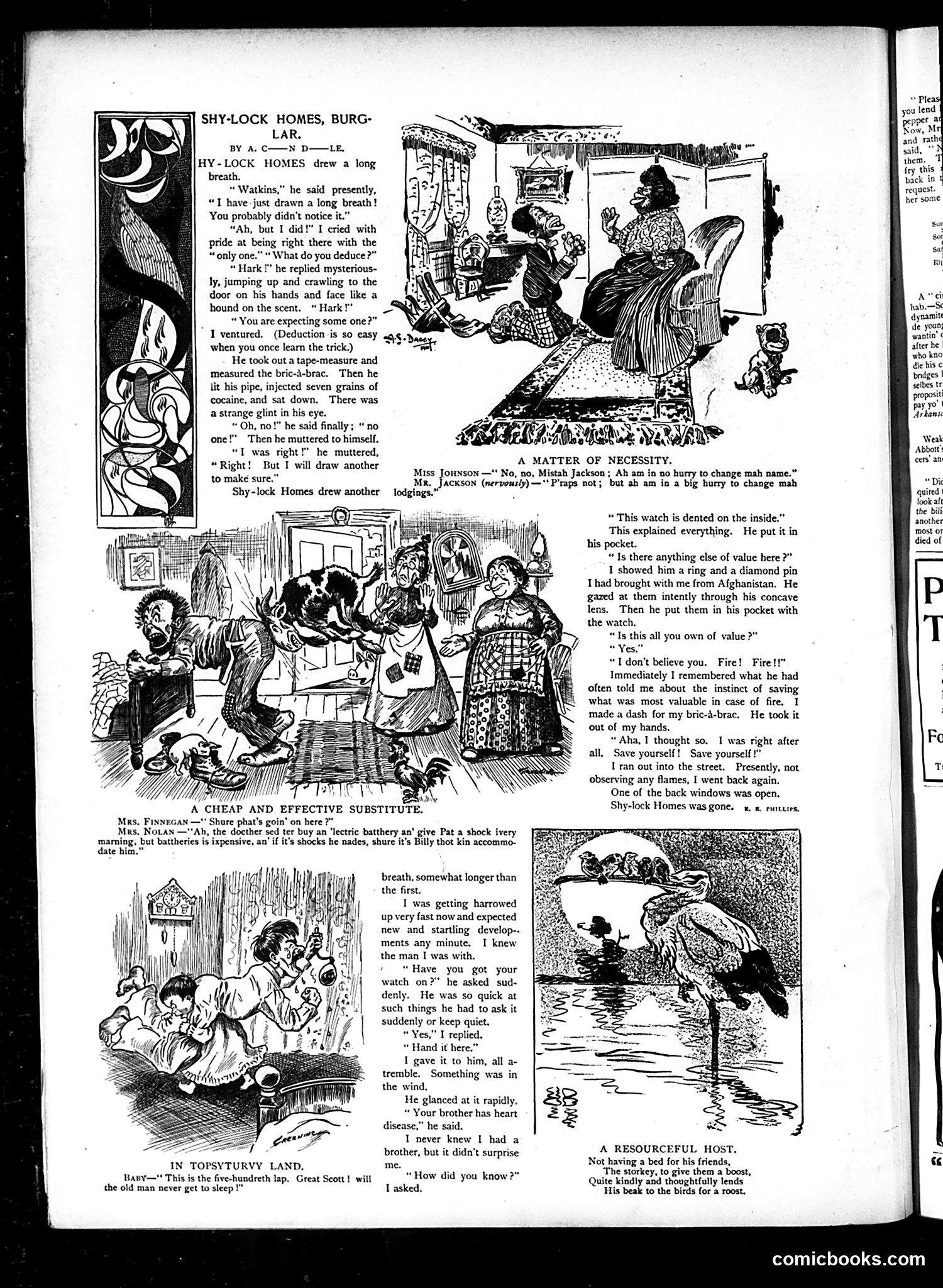
This page contains a parody of Arthur Conan Doyle's **Sherlock Holmes** stories, titled "Shy-Lock Homes, Burglar" (the name pun references Shylock, the Jewish moneylender from *The Merchant of Venice*). The detective's deductive methods are exaggerated for comedic effect—he measures bric-a-brac, injects cocaine, and makes absurd conclusions (diagnosing a dead brother from a watch). The satire mocks Holmes's overly theatrical detective work and his narrator Watson's gullible admiration. When "Shy-Lock Homes" claims a fire emergency, he steals the narrator's valuables—suggesting the detective is actually a con artist exploiting people's trust in his supposed expertise. Secondary cartoons on the page are unrelated vignettes: one depicts an Irish domestic dispute, another shows a resourceful bird offering its beak as lodging. These appear to be standard satirical humor rather than political commentary.
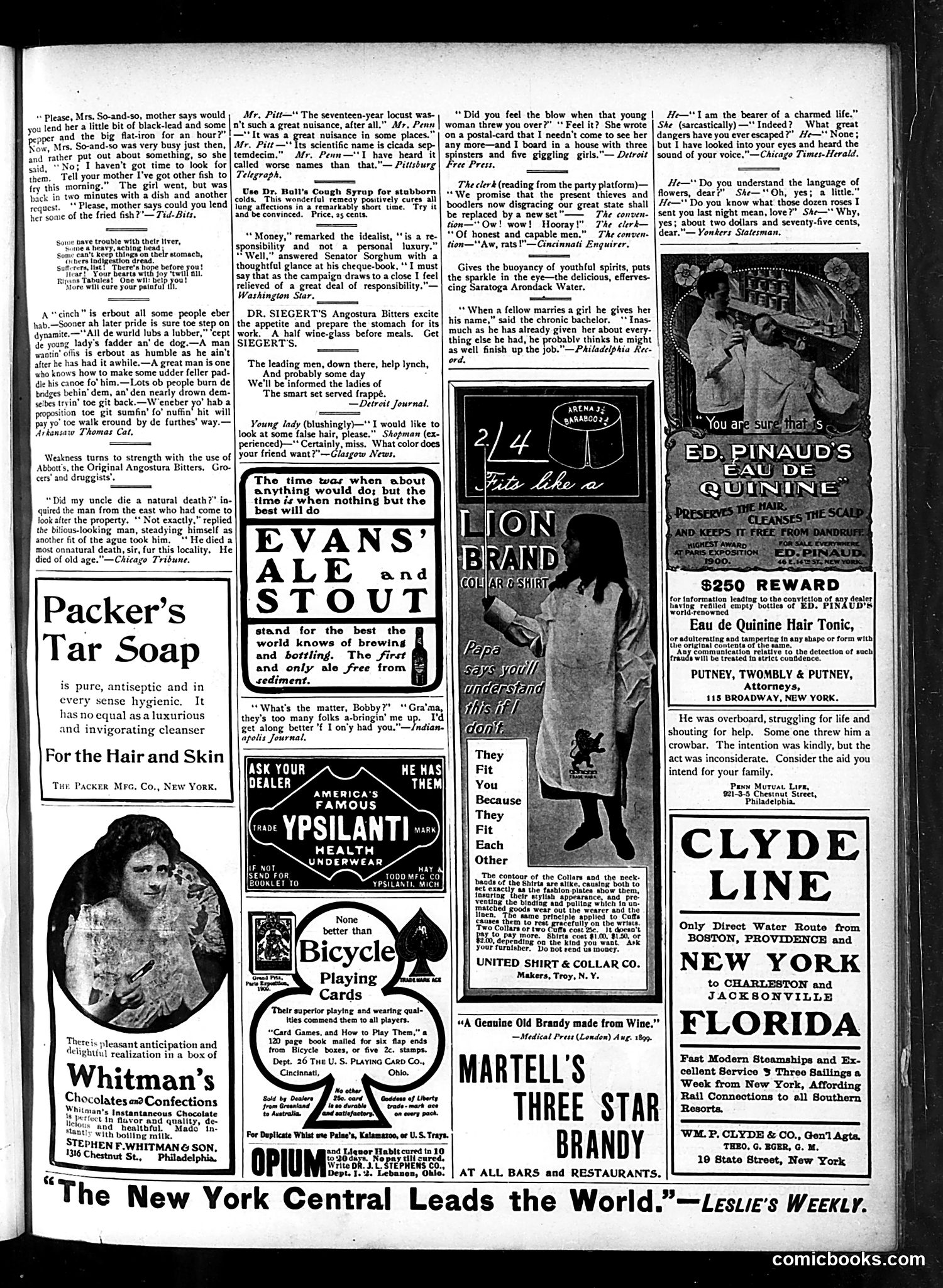
This page is primarily **advertisements and humorous short anecdotes**, not political cartoons. The content is typical of Judge magazine's mixed format. The visible humor pieces include: 1. **A domestic joke** about a neighbor's repeated requests to borrow items, escalating absurdly when she asks to borrow "fried fish"—satirizing social obligation and intrusive borrowing. 2. **Political wit**: A brief exchange between "Mr. Pitt" and "Mr. Penn" about the 17-year locust (cicada), with Penn suggesting it's been called "worse names"—likely referencing tensions between Pennsylvania and Pittsburgh politicians, though specifics are unclear. 3. **Senator Sorghum quip**: A satirical jab at campaign finance, where the senator claims relief from "responsibility" as the campaign ends, implying he felt burdened by campaign money collection. 4. **Folk wisdom** attributed to "Arkansas Thomas Cat" offering rural observations on pride and human nature. The page is otherwise dominated by period advertisements for patent medicines, soap, chocolates, and shipping lines—typical of Judge's revenue model.
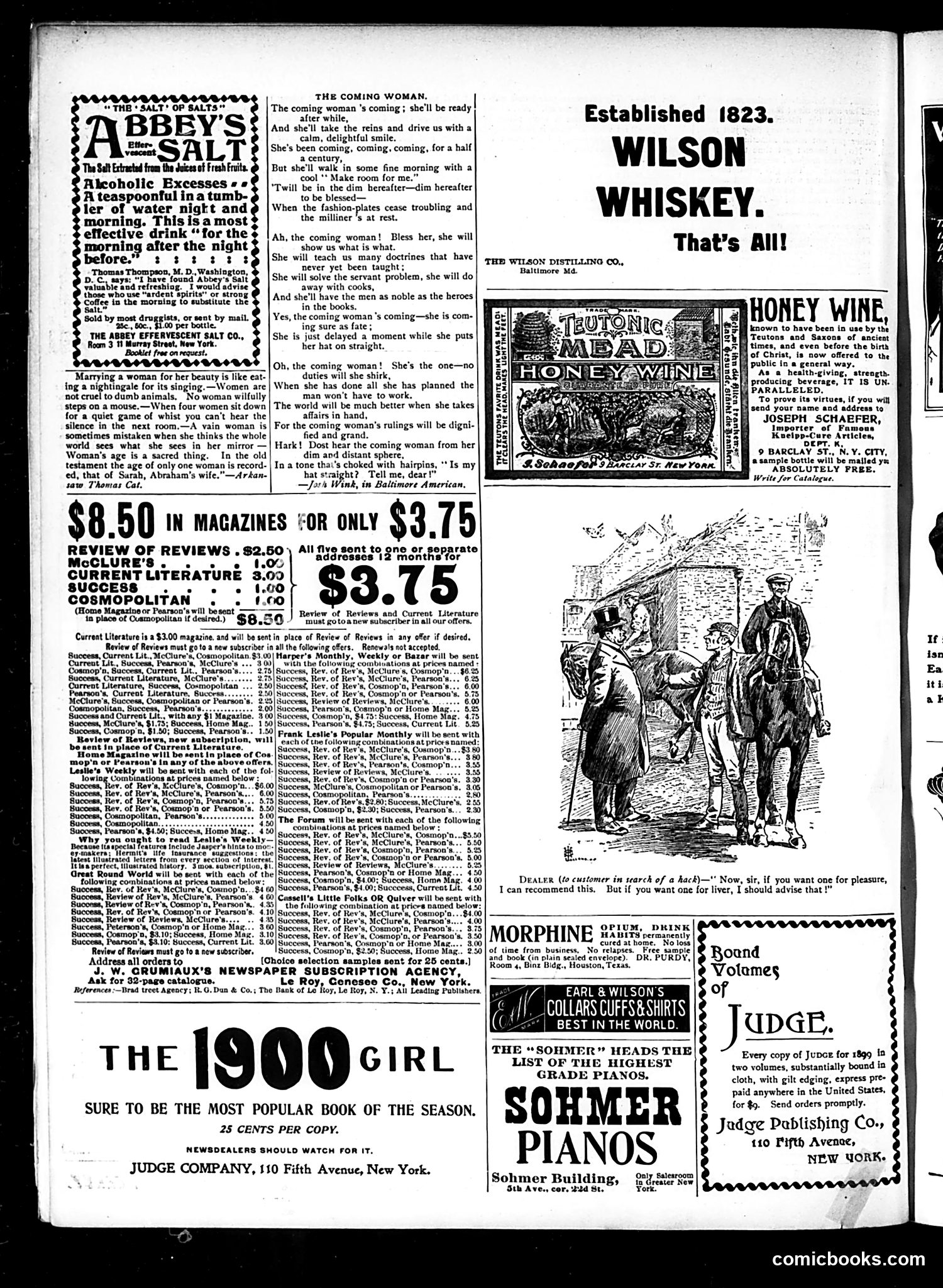
This page features a poem titled "The Coming Woman" that satirizes late-19th-century anxieties about women's liberation and changing gender roles. The poem presents a mock-fearful vision of an empowered woman who will arrive to take control, solve social problems (the "servant problem"), and liberate men from work. The satire's target is clear in the final stanza: the "coming woman" is delayed by—of all things—arranging her hat, undermining the poem's grandiose rhetoric about female capability. This undercuts the serious feminist arguments of the era by suggesting women remain preoccupied with trivial vanities. The poem reflects Judge magazine's skeptical, often dismissive attitude toward women's suffrage and gender equality movements gaining momentum during this period. It uses humor to mock both the promise of women's liberation and, ironically, women themselves.
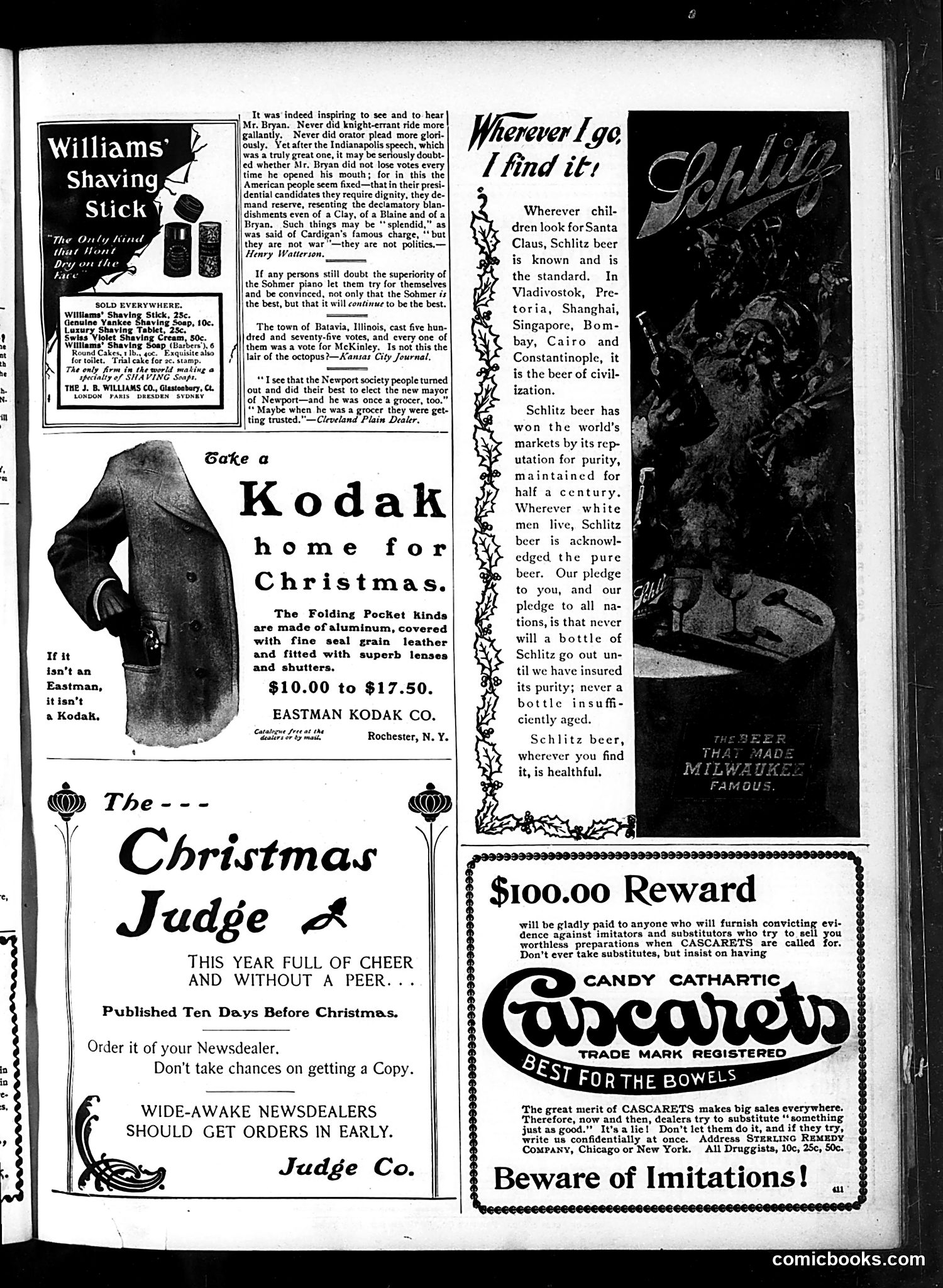
This page is primarily **advertisements** rather than political cartoons, though it contains one political reference worth noting. The most significant content is the **editorial comment about William Jennings Bryan**, the Democratic presidential candidate. The text criticizes Bryan's oratorical style, acknowledging his eloquence but arguing that American voters prefer "dignity" and "reserve" in presidential candidates—they reject the "declamatory" flourishes that Bryan employs. This references Bryan's famous "Cross of Gold" speech at the 1896 Democratic Convention, suggesting that even impressive rhetoric can backfire politically with voters seeking more restrained leadership. The remainder of the page consists of product advertisements: Williams' Shaving products, Kodak cameras, Sohmer pianos, Schlitz beer (emphasizing purity and international reputation), Cascarets laxatives (warning against counterfeits), and The Christmas Judge magazine. The page reflects turn-of-the-century American consumer culture alongside contemporary political debate about campaign style.
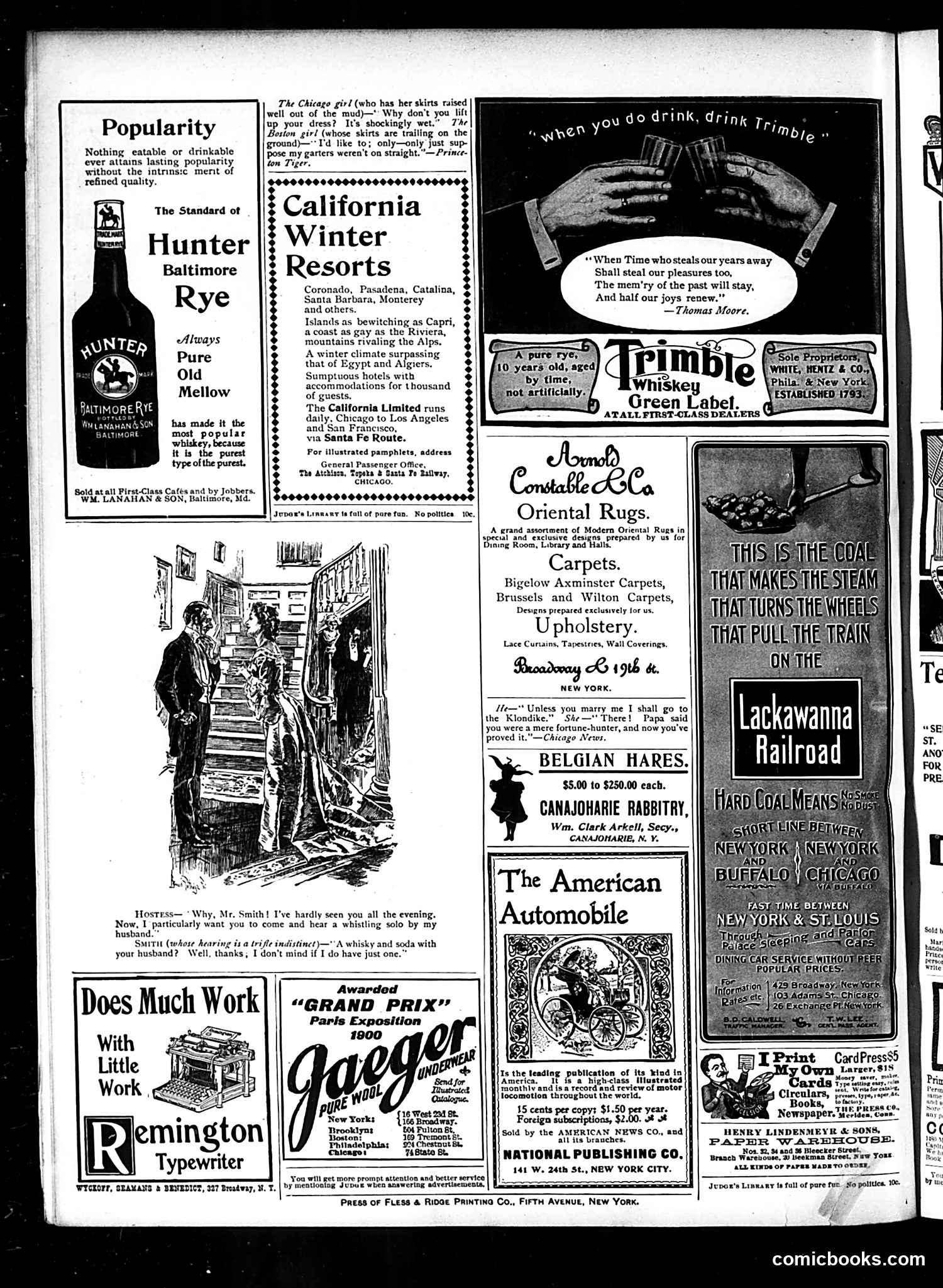
This page is primarily **advertising**, with one small cartoon joke at the bottom left. The main visual humor appears in the "Smith" cartoon: A host invites Mr. Smith to hear his wife's "whistling solo," but Smith—described as hard of hearing—mishears "whistling solo" as "whisky and soda" and eagerly accepts a drink instead. The joke relies on a pun/mishearing common to early 20th-century humor. The page also contains a brief text joke about Chicago and Boston girls' differing attitudes toward muddy streets and proper dress—a regional humor piece typical of Judge's satire. The bulk of the page is filled with period advertisements: Hunter Baltimore Rye whiskey, California winter resorts, Remington typewriters, Trimble whiskey, Oriental rugs, Belgian rabbits, The American Automobile magazine, and railroad advertisements. These ads reflect contemporary consumer interests and business concerns of the era (approximately 1900s).
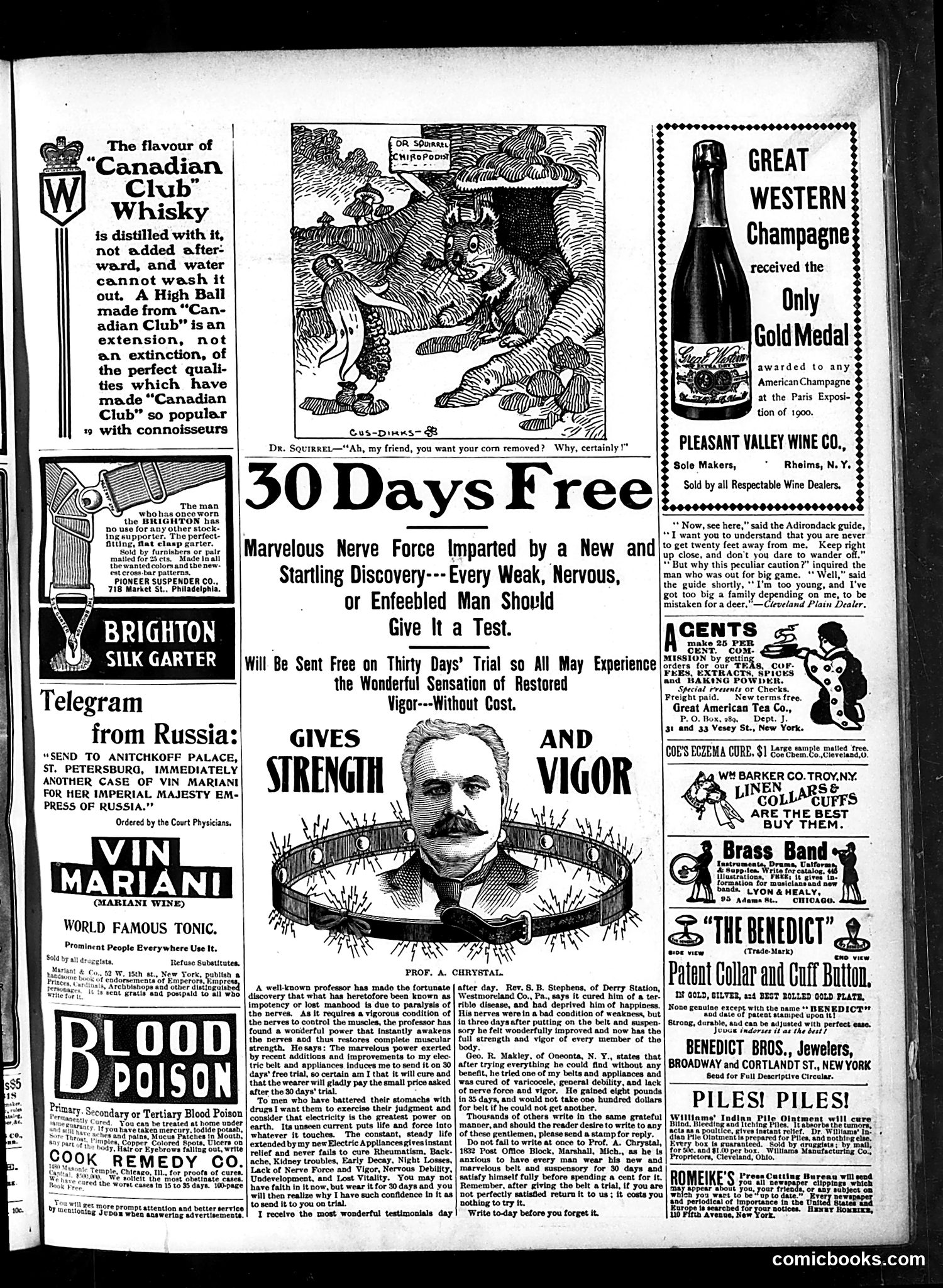
This page is primarily **advertising**, not editorial satire. It contains multiple product advertisements typical of early 1900s magazines. The central cartoon depicts **Dr. Squirrel** (a pun character) offering to remove a corn from a patient—a visual joke playing on the double meaning of "corn" removal. The dominant advertisement promotes an **electric belt** for treating male sexual dysfunction and "lost manhood," marketed by "Prof. A. Chrystal." This reflects the period's widespread pseudoscientific wellness products that exploited male anxieties about virility. The 30-day free trial was a common sales tactic. Other ads include Canadian Club whisky, Vin Mariani (a cocaine-containing tonic), a Russian "telegram" endorsing Vin Mariani to the Empress, and treatments for syphilis ("blood poison")—reflecting both the era's patent medicine culture and widespread venereal disease concerns. The **social context**: these advertisements reveal what early 1900s consumers worried about and what unregulated marketing could claim before FDA oversight.
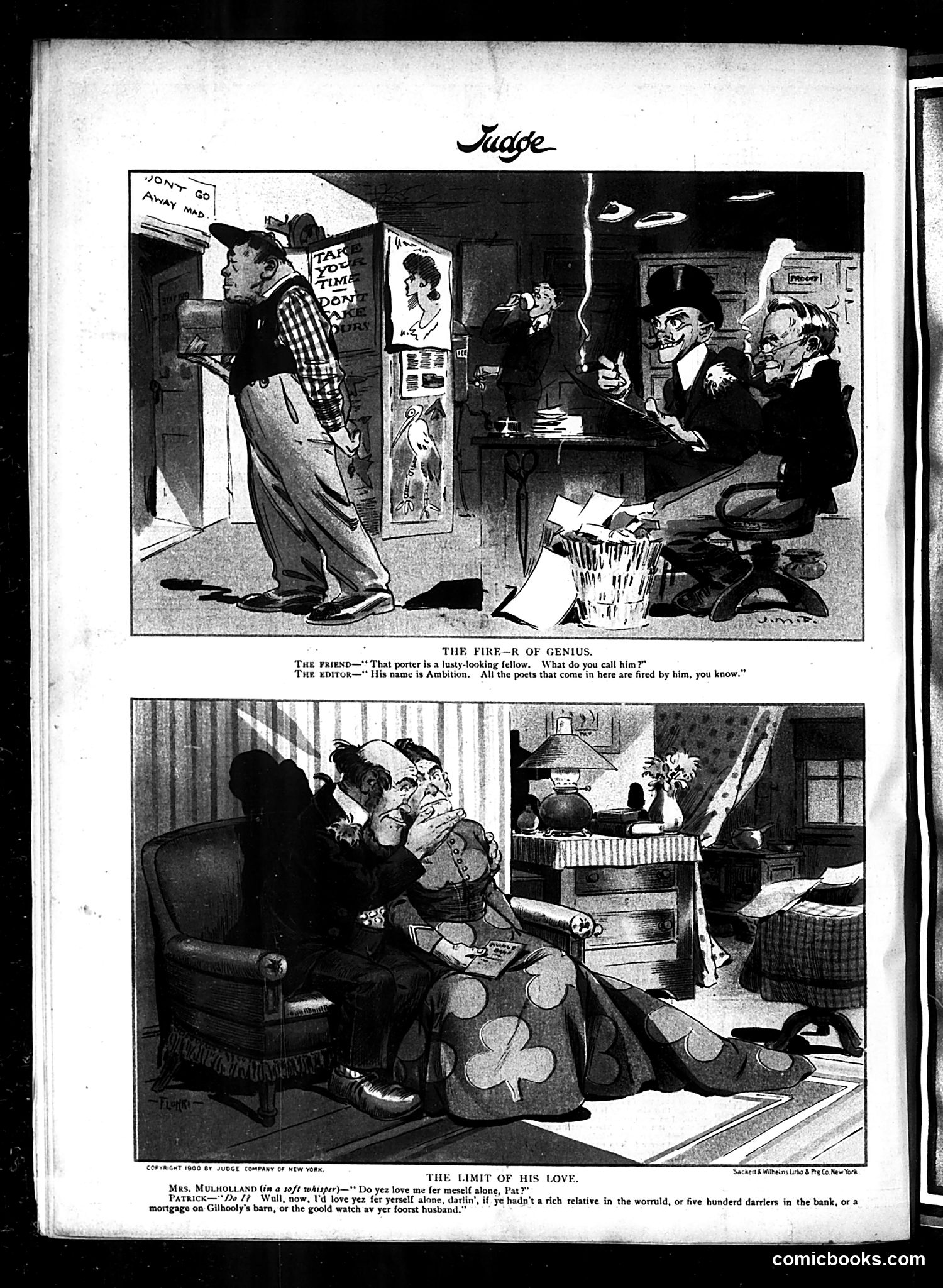
This page contains two satirical cartoons from Judge (copyright 1900). **Top cartoon, "The Fire—r of Genius":** An editor explains to a visitor that the shabby porter named "Ambition" fires all the poets working at the publication. The satire mocks the romantic notion that artistic inspiration drives writers—suggesting instead that desperation and low wages ("firing" them out) are the real motivators. **Bottom cartoon, "The Limit of His Love":** A man (Patrick, written in Irish dialect) responds to his lover's question about loving her "for herself alone" by listing all her material assets: a rich relative, bank deposits, a mortgage on property, and a gold watch from a previous husband. The satire ridicules mercenary attitudes in romance and Irish stereotypes about materialism masked by sentimental language. Both cartoons use exaggerated character types and dialect humor typical of early-1900s American satire.