
A complete issue · 16 pages · 1900
Judge — September 29, 1900
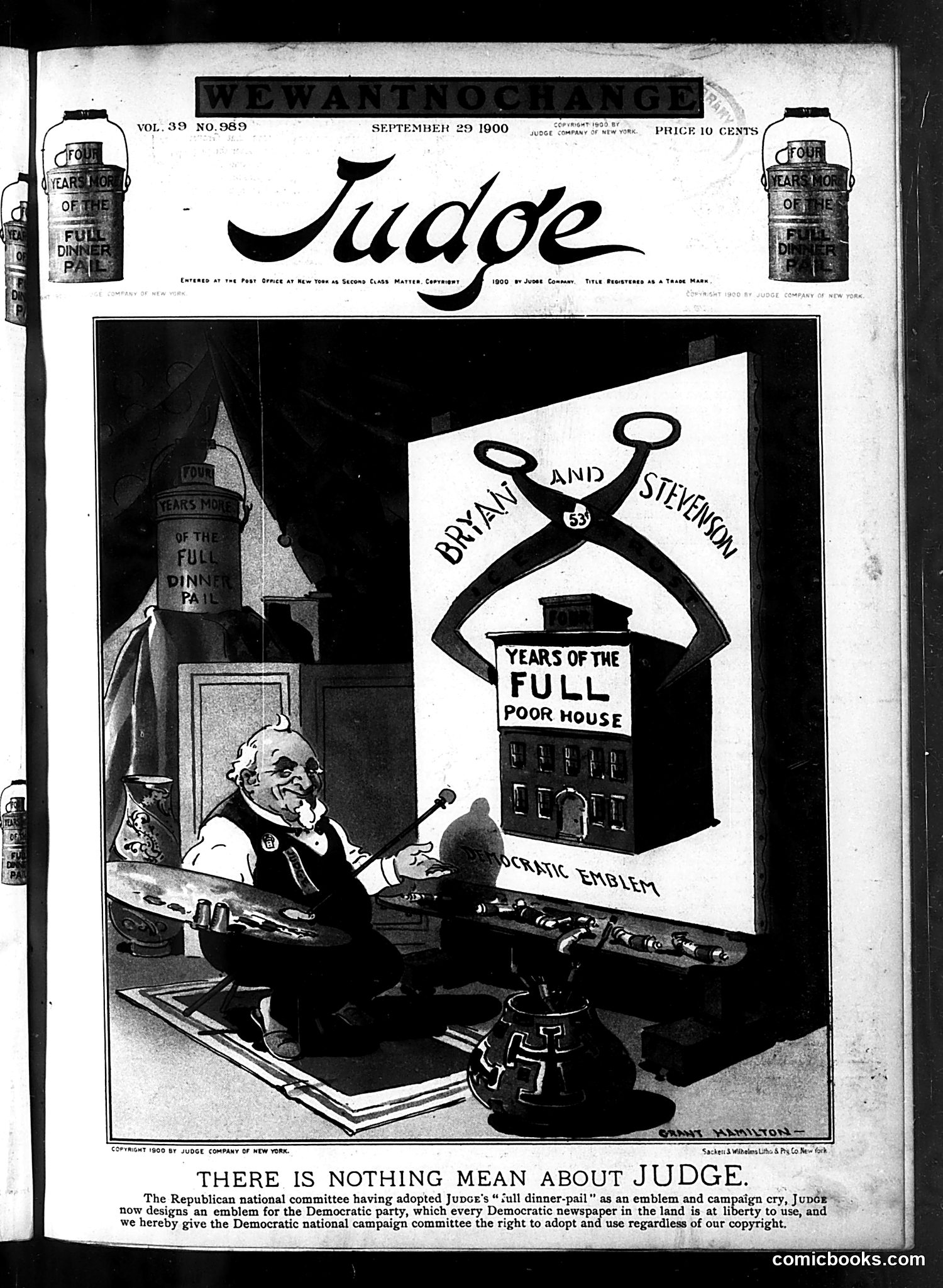
This cartoon satirizes the 1900 U.S. presidential election. A caricatured figure (likely representing Republican strategy or a political operative) displays a Democratic campaign emblem—a poorhouse labeled "Years of the Full Poor House" held by pincers labeled "Bryan and Stevenson." The satire claims Republicans designed this emblem to damage the Democratic ticket of William Jennings Bryan and Adlai Stevenson, arguing their policies would impoverish America. The accompanying text states Republicans adopted the emblem themselves, then claim Democrats created it. The cartoon attacks Republican campaign tactics: accusing them of manufacturing negative imagery while hypocritically distributing it under Democratic names. It's partisan criticism of political dirty tricks during the 1900 election cycle.
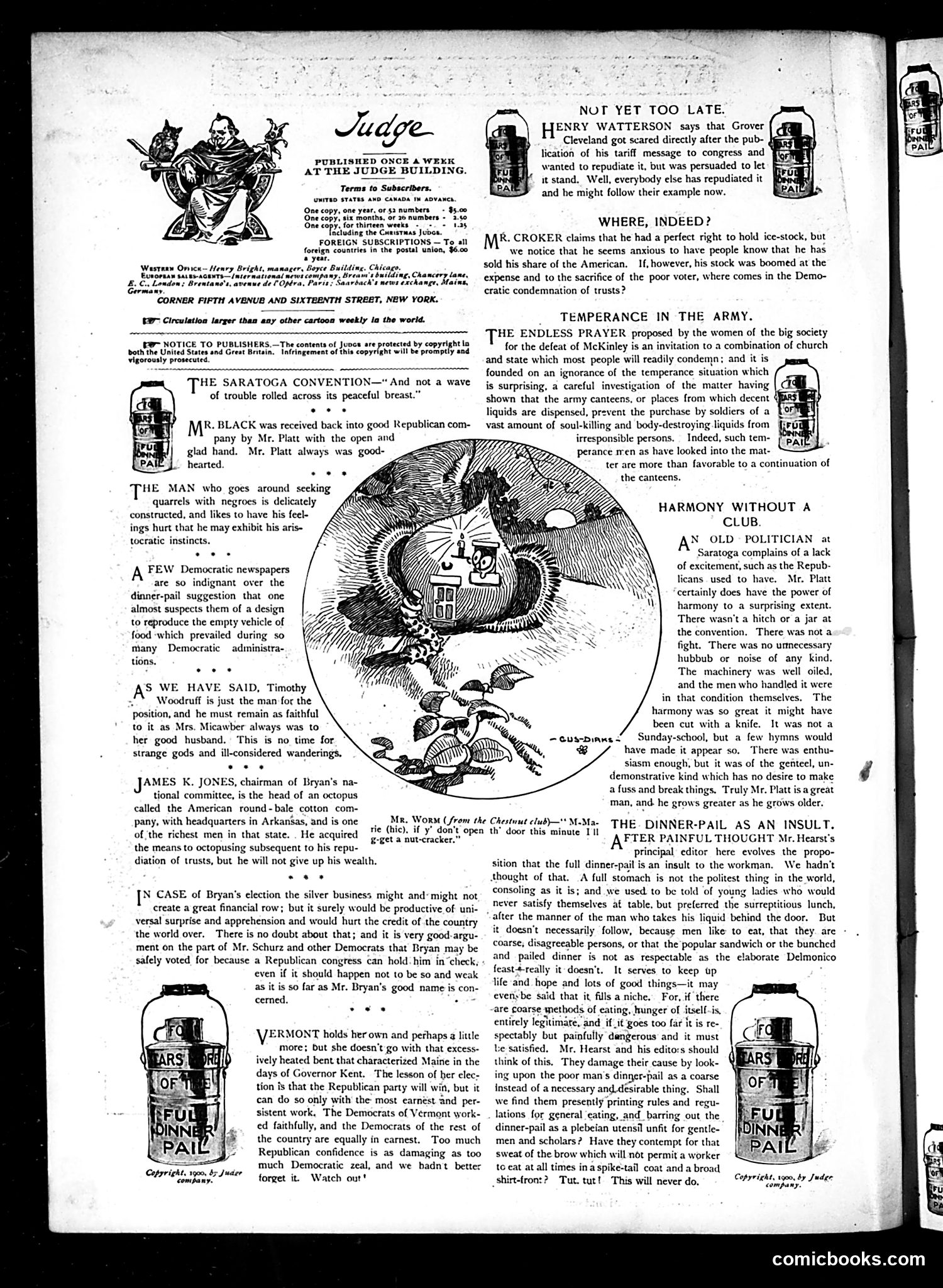
This page contains several political commentary pieces from Judge magazine's satirical section. The main central cartoon depicts what appears to be a large figure or structure labeled with political references, likely commenting on a Democratic convention or political gathering ("The Saratoga Convention"). The articles mock Democratic politicians and policies, including criticism of a "dinner-pail" argument (a political slogan) and commentary on Bryan's election prospects. References to McKinley suggest this is from the 1896-1900 election era. The satire targets Democratic organizational chaos and what the magazine views as hypocritical positions. Specific figures mentioned include Mr. Platt (likely Thomas Collier Platt, a Republican politician) and discussion of Vermont's political situation. Without clearer image resolution of the central cartoon's details, precise identification of all caricatured figures remains uncertain, though the Democratic Party is clearly the primary target.
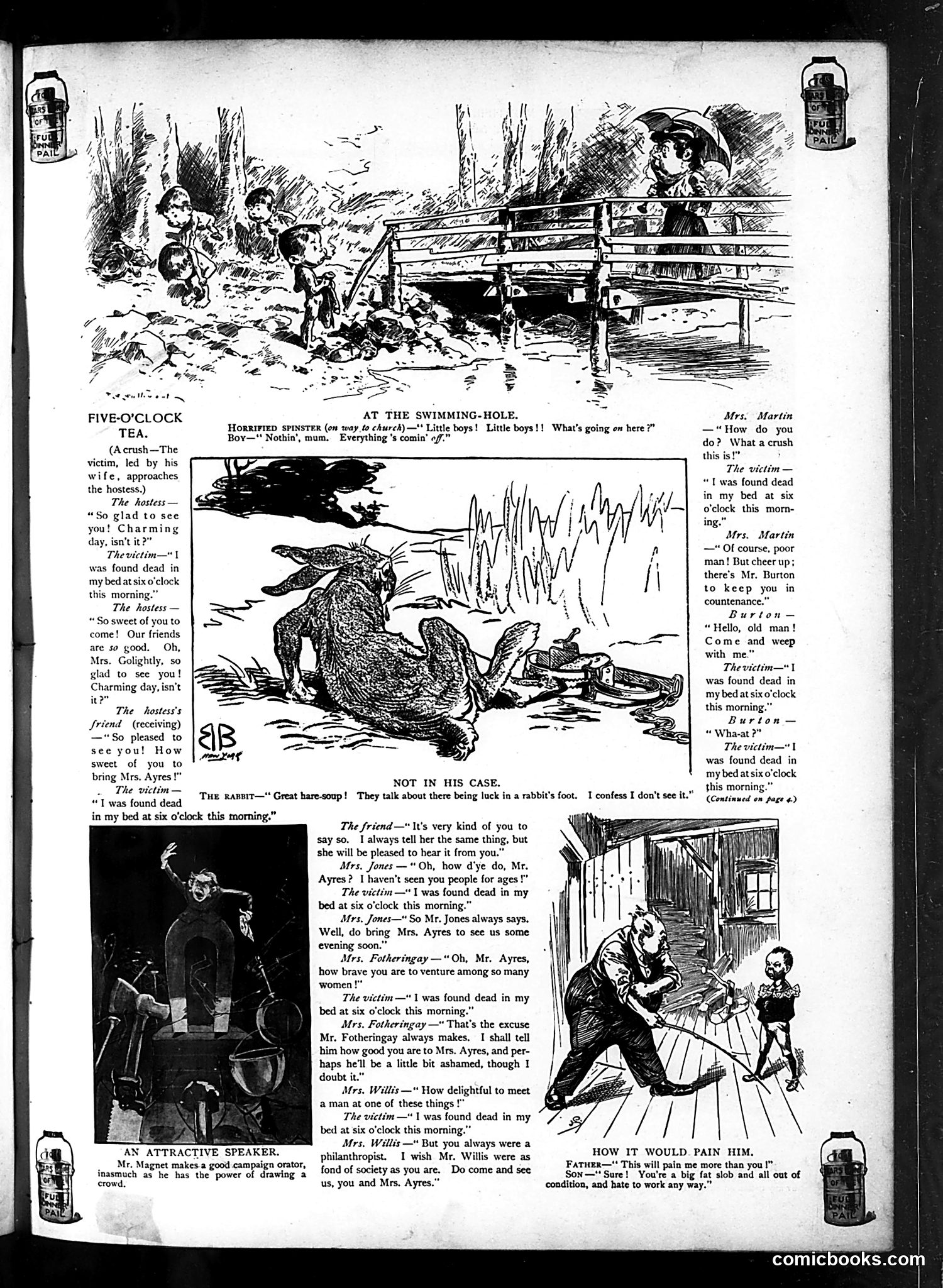
This page satirizes the Victorian social practice of calling hours and the absurdity of rigid social etiquette. The central joke involves a man repeatedly claiming "I was found dead in my bed at six o'clock this morning" as an excuse to leave various social gatherings—yet he keeps appearing at more events. The humor mocks: 1. **Hypocritical excuses**: Characters use transparent lies to escape tedious social obligations 2. **Social climbing**: People like Mrs. Fatheringay desperately want to associate with Mr. Ayres despite his questionable behavior 3. **Rigid formality**: The elaborate courtesy masks people's actual indifference or annoyance The surrounding illustrations (the rabbit, children at the swimming hole, domestic scenes) provide lighter comedic relief contrasting with the artificial tea-time conversation above.
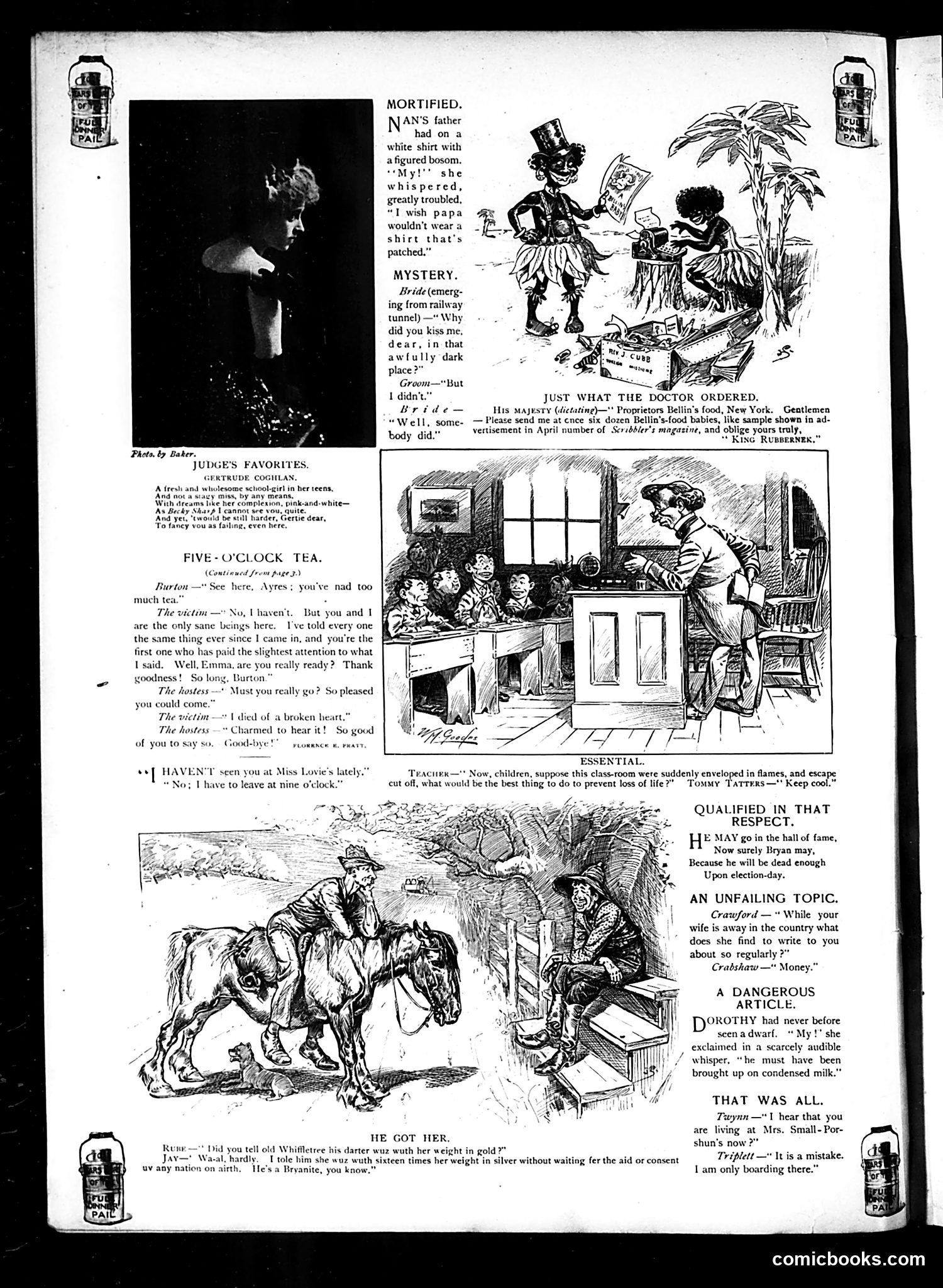
This page contains multiple satirical sketches and humorous anecdotes rather than a unified political cartoon. **Key content includes:** - **"Mortified"** and **"Mystery"**: Domestic humor sketches about embarrassing moments - **"Judge's Favorites"**: A quote credited to Gertrude Coghlan about Irish characteristics - **"Five O'Clock Tea"**: A dialogue about proper social behavior at tea time - **"He Got Her"**: A sketch about a man with a horse and a woman, likely satirizing courtship or marriage - Various other titled sections like **"Essential,"** **"That Was All,"** and **"A Dangerous Article"** containing brief comic dialogues The overall tone is light domestic satire targeting middle-class social conventions, manners, and relationships. Without clearer historical context about specific public figures or events referenced, the page appears primarily devoted to genteel humor rather than sharp political commentary.
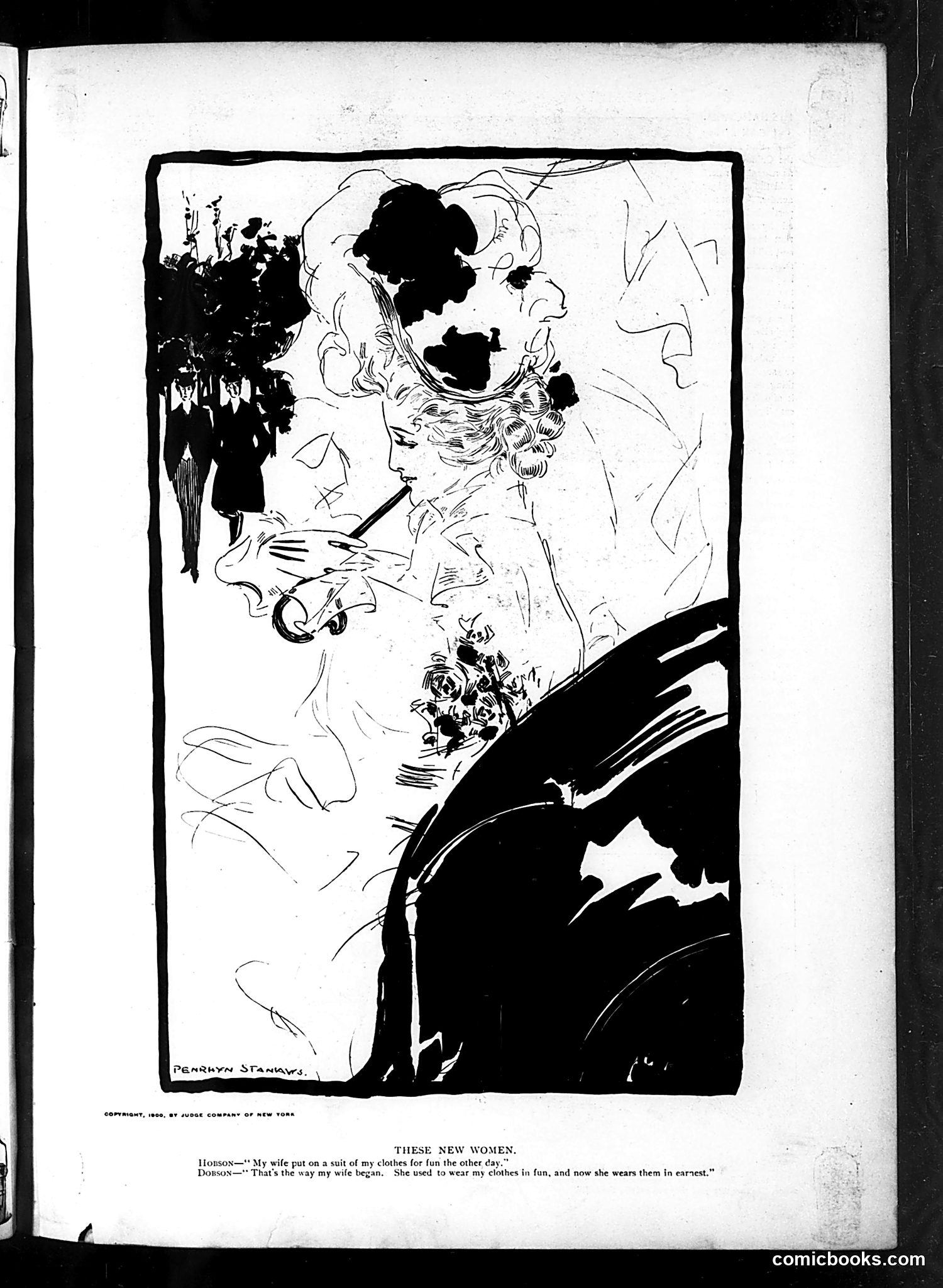
This 1908 Judge cartoon satirizes the "New Woman" movement—the emerging feminist push for women's equality and independence. The artwork depicts two well-dressed men discussing their wives' behavior. The joke concerns women wearing men's clothing: what began as playful cross-dressing has become habitual. The caption implies wives have progressed from doing it "for fun" to doing it "in earnest"—suggesting women are literally adopting masculine dress and, by extension, masculine social roles and independence. The satire mocks anxieties about gender roles destabilizing during this era. Women were increasingly entering the workforce, demanding voting rights, and rejecting Victorian restrictions. The cartoon portrays this as humorously threatening to domestic order—men lose control as women appropriate even their literal clothing and social authority.
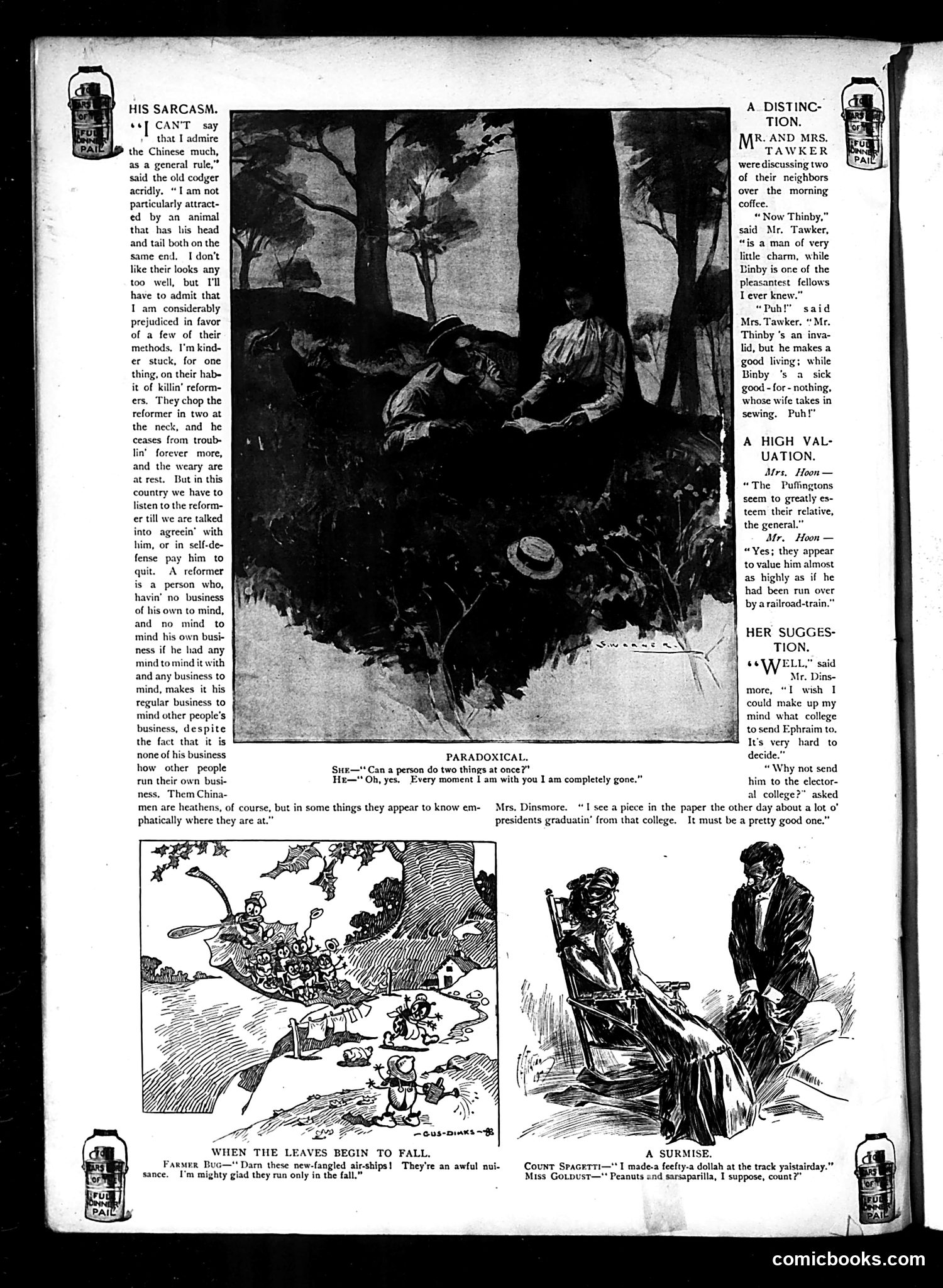
This page contains several satirical pieces typical of early 20th-century American humor: **"His Sarcasm"** presents an old man's backhanded compliment about Chinese people—praising their practice of executing reformers while criticizing their appearance. The joke mocks both anti-Chinese prejudice and the speaker's contradictory logic. **"A Distinction"** satirizes class-based judgments: Mr. and Mrs. Tawker value a sickly but wealthy man (Binby) over a healthy, poor man (Thinby), exposing shallow materialism disguised as social assessment. **"A High Valuation"** similarly ridicules exaggerated respect for a general based solely on having survived a train accident—mocking how status inflates admiration regardless of actual merit. **"Her Suggestion"** jokes about educational prestige, with a parent seeking an "electoral college" recommendation, apparently conflating the political institution with actual schools. The bottom cartoons use ethnic stereotypes (farmers, Italian accents) for rustic humor. Overall, the page satirizes American hypocrisy, materialism, and prejudice through domestic scenarios.
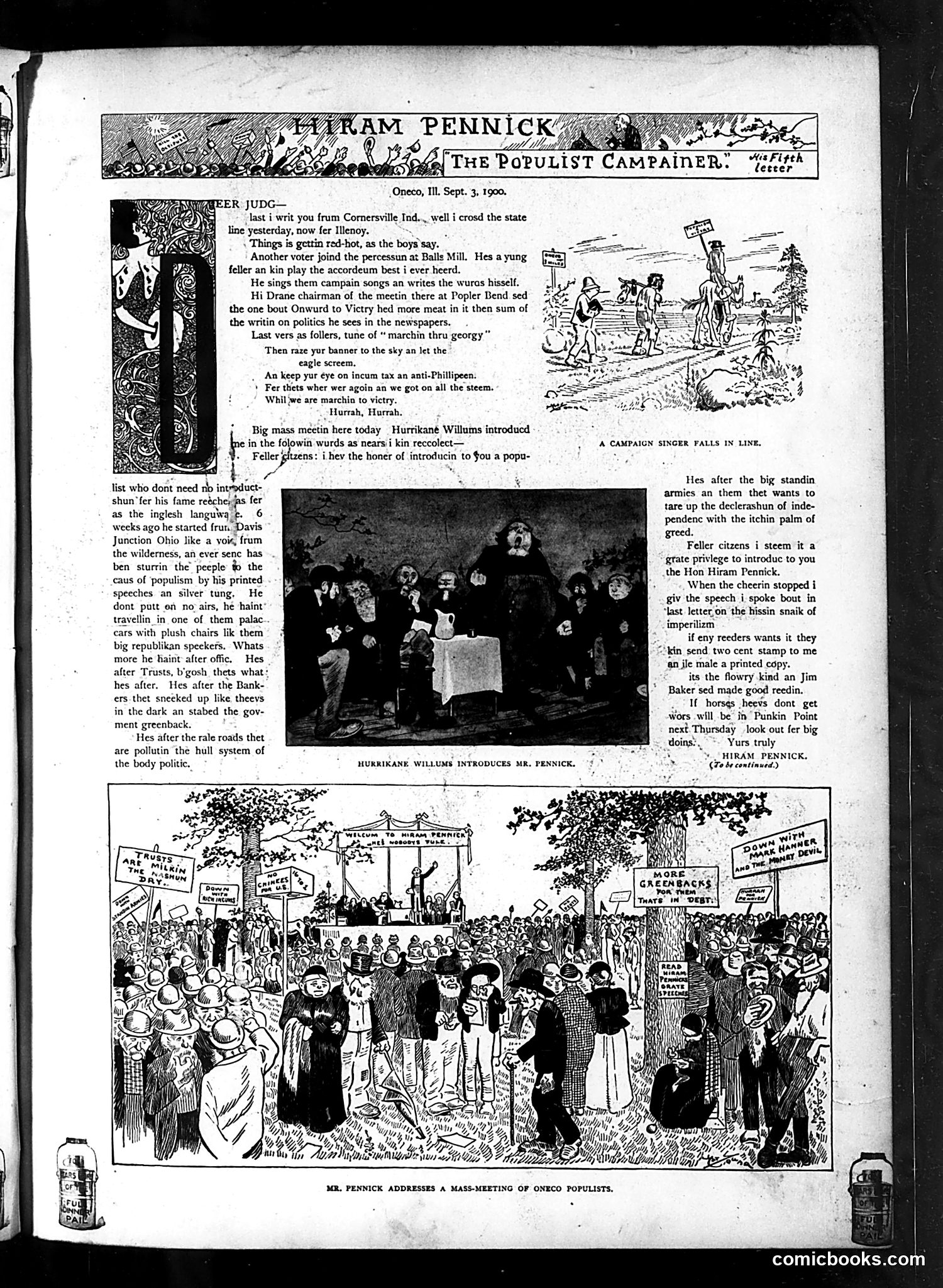
This 1900 Judge magazine page satirizes **Hiram Pennick**, a Populist political candidate. The cartoons mock his campaigning methods and rhetoric. **Key satirical points:** The top cartoon shows a campaign singer "falling in line"—suggesting Populist supporters are mindlessly following slogans rather than thinking independently. The middle photograph depicts "Hurrican Williams introduces Mr. Pennick," capturing him addressing crowds. The large bottom cartoon illustrates Pennick at a mass Populist meeting in Oresco, Indiana, surrounded by numerous supporters holding signs. The proliferation of banners and crowd chaos appears to ridicule Populist organizing as chaotic and sign-heavy rather than substantive. The text mocks Populist rhetoric as inflammatory and demagogic, suggesting the movement relies on emotional appeals and sweeping declarations rather than serious policy discussion. Judge's Republican editors clearly viewed Populism skeptically.
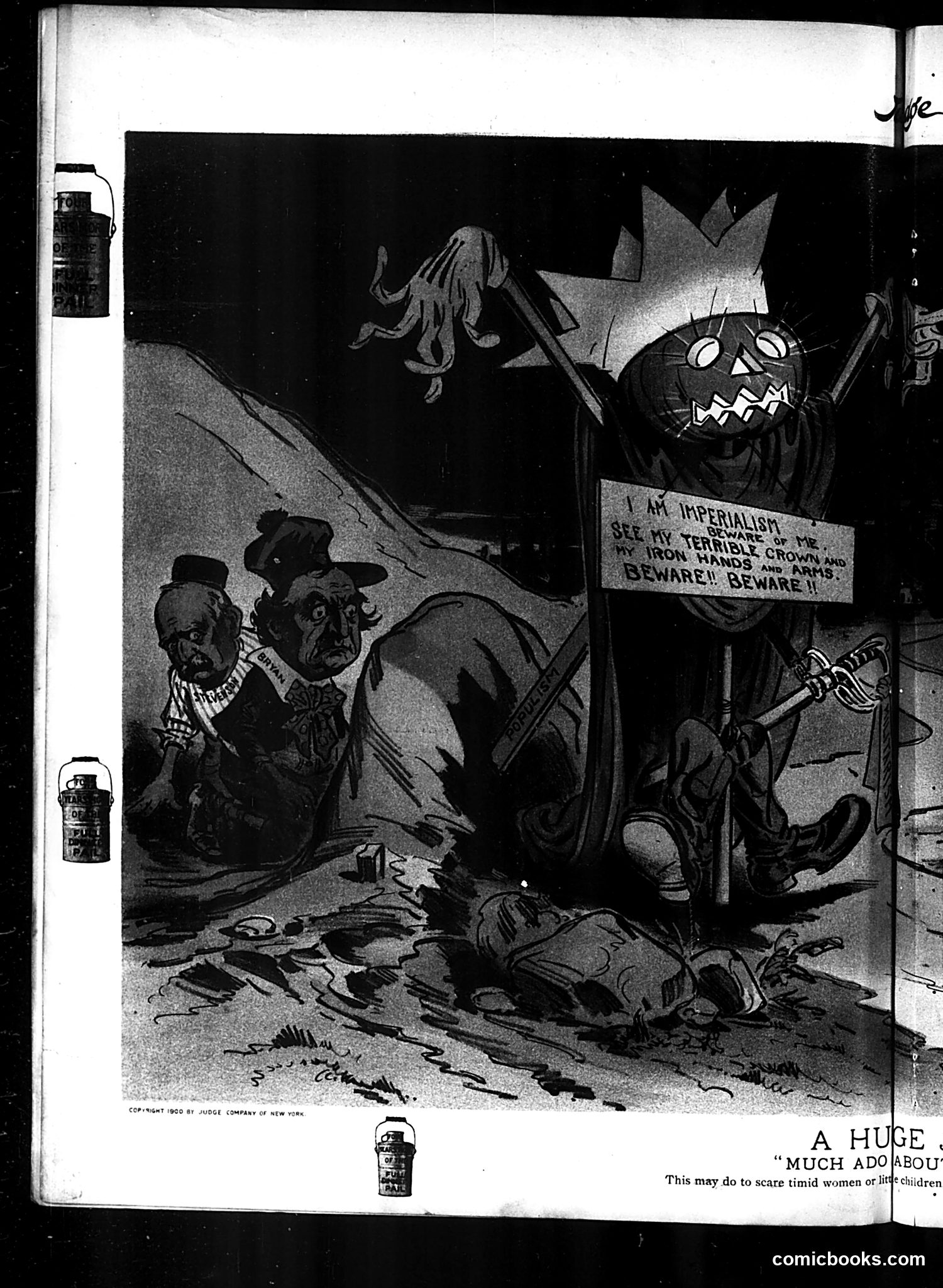
This political cartoon depicts **Imperialism** as a grotesque, menacing figure—a crown-headed monster with exaggerated features—looming over two cowering men below. The figure declares: "I AM IMPERIALISM...SEE MY TERRIBLE CLAWS, MY IRON HANDS AND ARMIES. BEWARE! BEWARE!!" The cartoon satirizes **American imperialism** (likely early 1900s expansion into territories like Cuba, Puerto Rico, and the Philippines following the Spanish-American War). The two men appear to represent either political opponents or the American public, cowering before this embodied threat. The caption's dismissive tone—"This may do to scare timid women or little children"—suggests the cartoonist's cynicism: that imperialism propaganda relies on fear-mongering rather than reasoned argument. The satire mocks both the imperialist threat and those who deploy it.
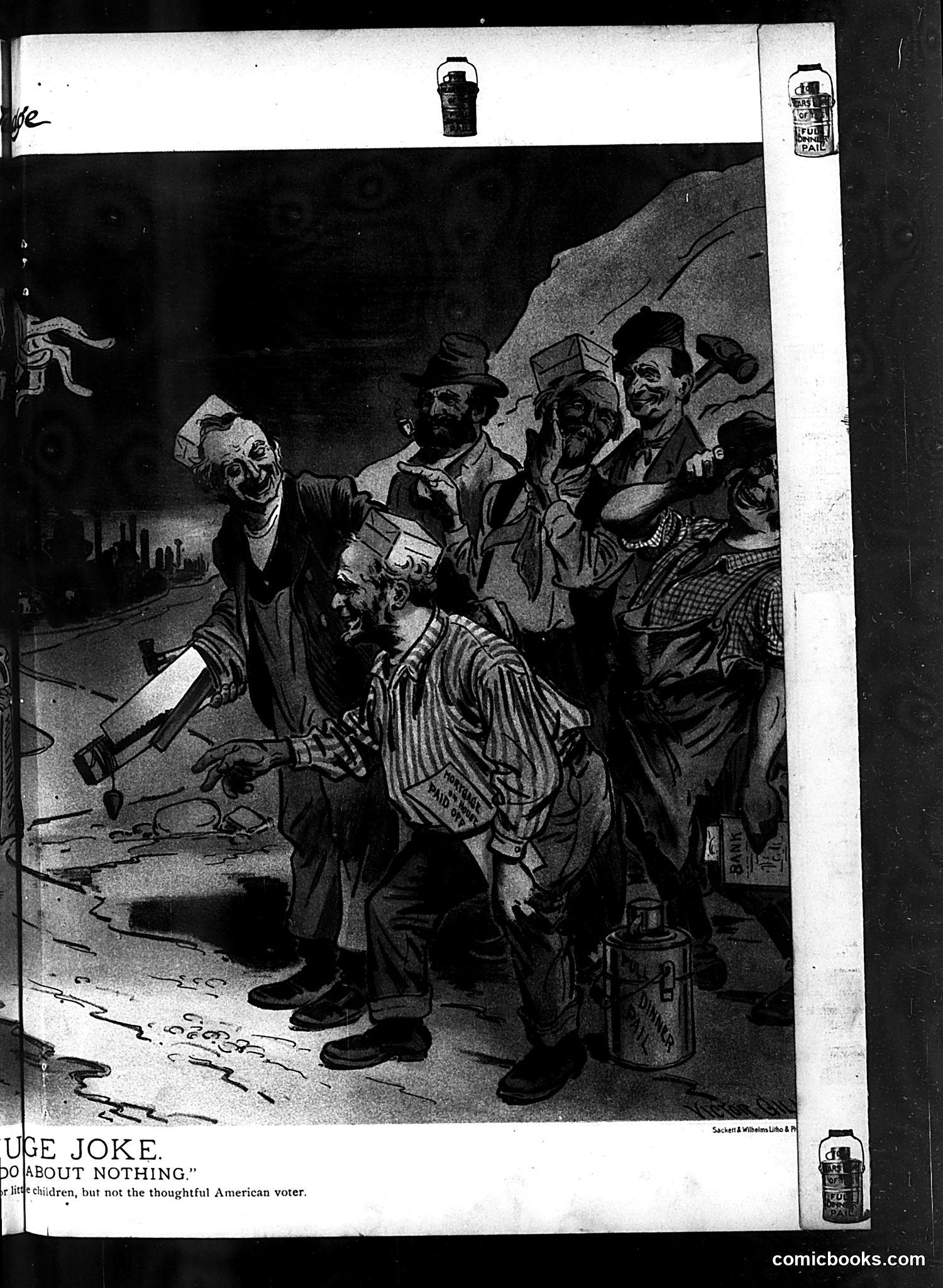
This Judge magazine cartoon satirizes American political discourse as "much ado about nothing." The central figure appears to be a politician or public figure surrounded by what seem to be journalists, advisors, or political opponents—all caricatured with exaggerated features typical of the era's satirical style. The cartoon critiques that political leaders and media focus on trivial matters rather than substantive issues affecting voters. The title suggests empty political rhetoric and posturing. The crowd gesturing animatedly around the central figure emphasizes noise without meaningful content. The caption references "the thoughtful American voter," implying citizens are either ignored or distracted by this meaningless political theater. The satire comments on the disconnect between political debate and genuine public concerns—a timeless critique of democratic discourse.
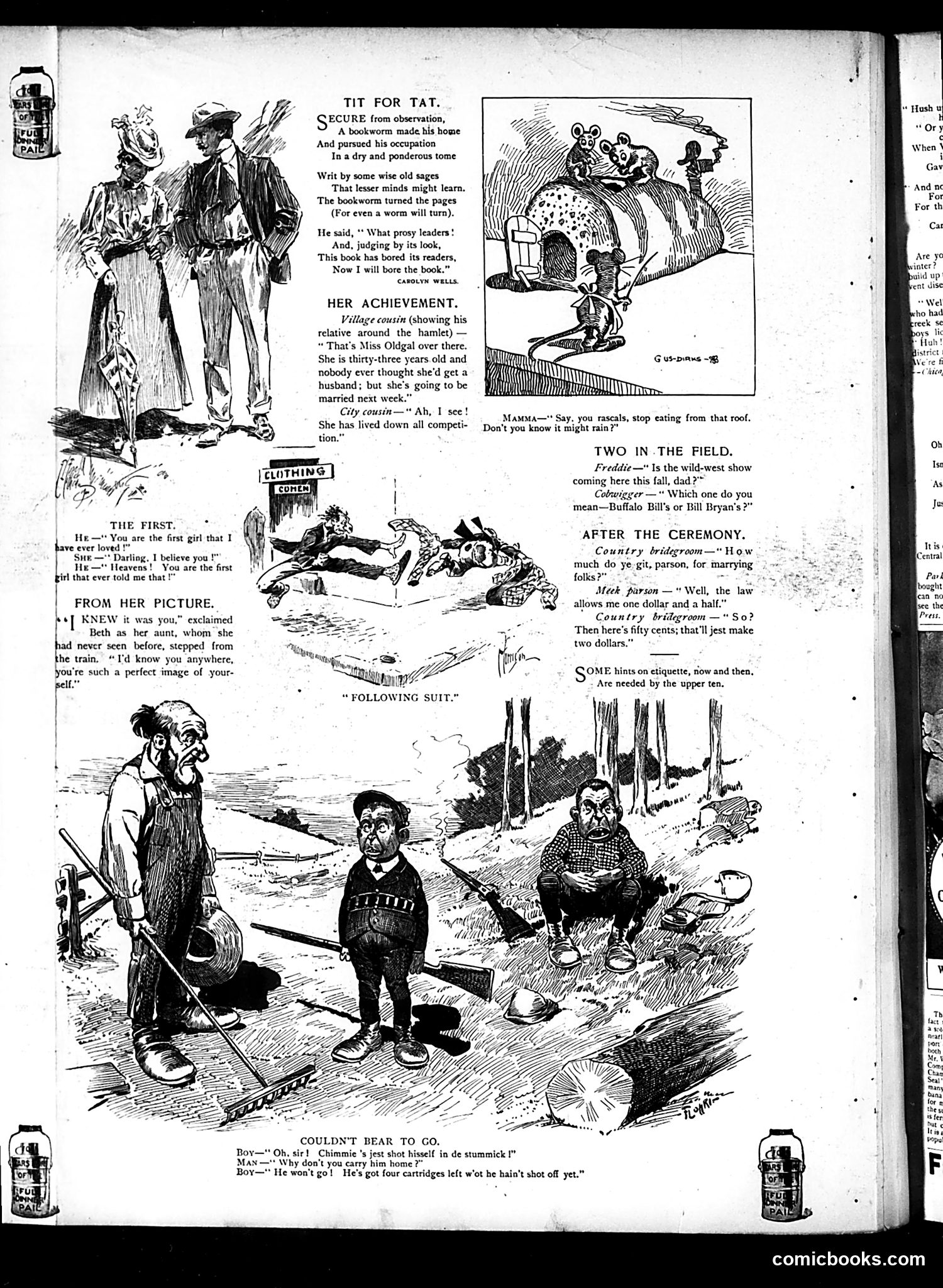
This page collects brief humorous sketches typical of early 20th-century American satire. Key pieces: **"Tit for Tat"** (Carolyn Wells): A bookworm living in a dry academic tome decides to bore the book in revenge for how boring it is—a meta-joke about tedious scholarly writing. **"Her Achievement"**: A rural spinster at 33 finally gets married, with the implication she's succeeded by "living down" (outlasting or overcoming) all competition from other women—mocking both marriage-obsessed society and rural gossip culture. **"Couldn't Bear to Go"**: Dark humor about a shooting accident victim who won't leave because he has ammunition remaining—satirizing rural/working-class recklessness. **"Two in the Field"**: A child conflates "Buffalo Bill's Wild West show" with "Bill Bryan's" (likely William Jennings Bryan, the politician)—contemporary political reference humor. **"After the Ceremony"**: A rural groom haggling with a clergyman over marriage fees, offering less than the legal rate—satirizing rural cheapness and informality. The page satirizes rural simplicity, marriage culture, academic pretension, and class differences—standard Judge themes.
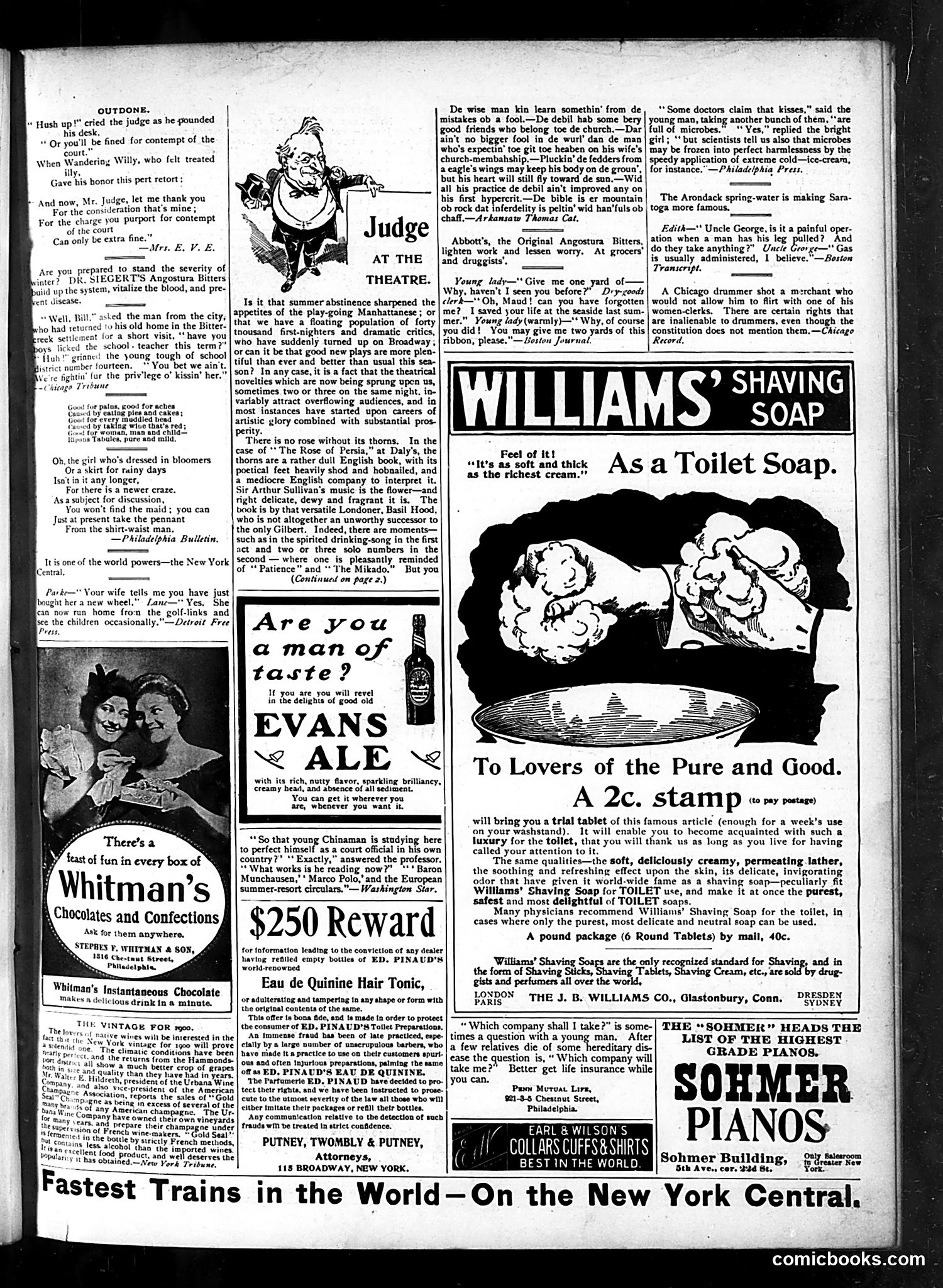
This page from *Judge* magazine contains several satirical pieces typical of early 1900s American humor: **Main Cartoon ("Judge at the Theatre"):** A judge pounds his desk at a defendant ("Wandering Willy") who's being fined for contempt of court. The satire mocks theatrical pretension—the piece discusses Broadway's summer season and its hit plays, suggesting judges and theaters are similarly self-important institutions. **Supporting Jokes:** Scattered throughout are period humor pieces—one about a rural schoolteacher's desirability, another about "bloomers" (women's pants) versus traditional skirts as fashion controversy, and jokes about bicycles and golf. **Advertisements:** The page is heavily populated with product ads (Angostura Bitters, Williams' Shaving Soap, Whitman's chocolate, Evans Ale, pianos), typical of *Judge*'s business model. **Social Context:** The references to bloomers, bicycles, and women's independence reflect early-1900s anxieties about changing gender roles. The humor is gentle mockery rather than pointed political satire.
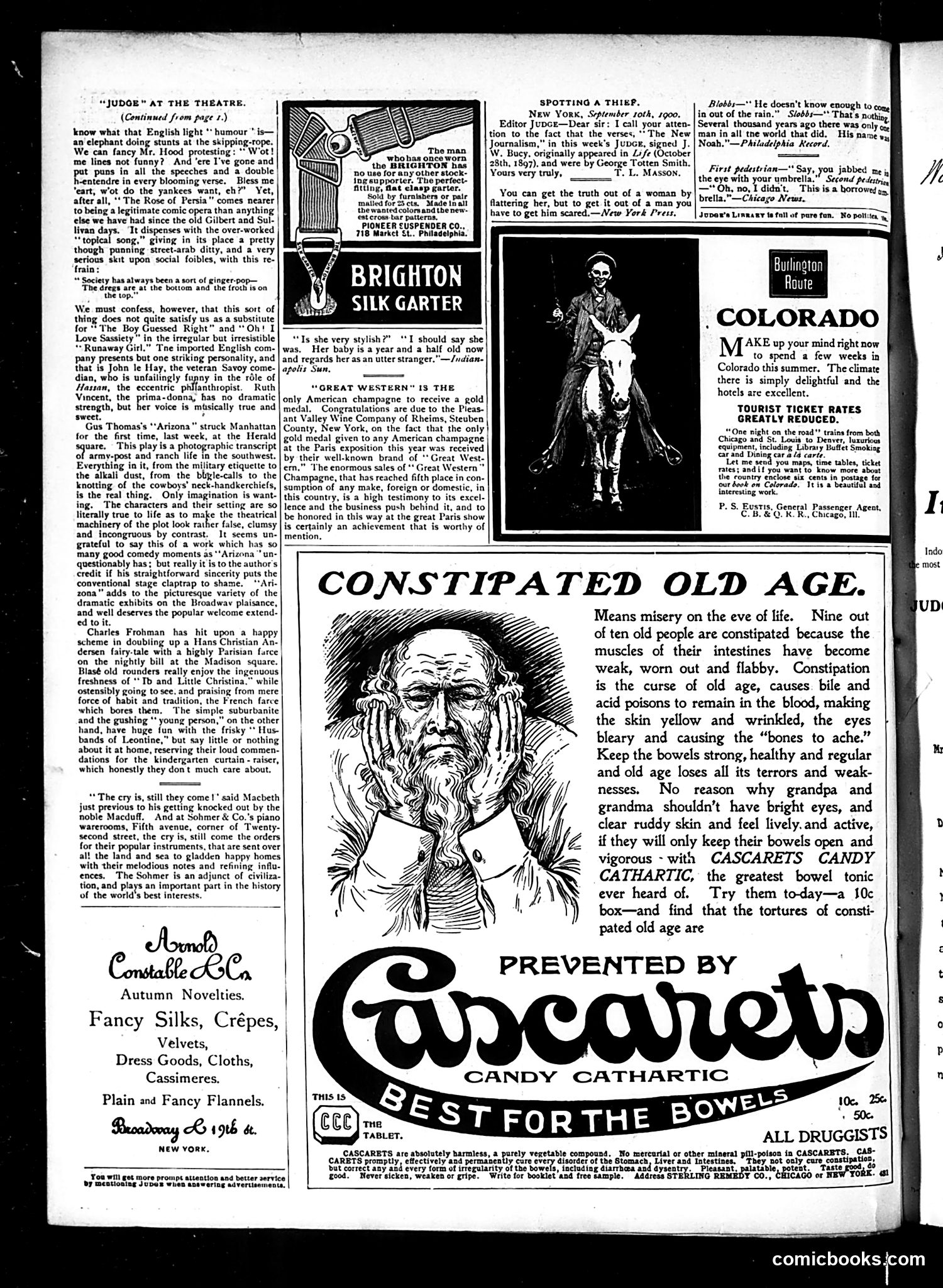
This is primarily a **theater review page** with advertisements, not political satire. The main content critiques recent Broadway productions: **Theater Reviews:** - "The Rose of Persia" (English comic opera): Critic praises it for avoiding tired "topical songs" but finds it inferior to earlier Gilbert & Sullivan works. Notes John le Hay as the standout performer. - "Arizona" (by Gus Thomas): Praised for photographic realism of army-post and ranch life, though the plot feels artificially staged by contrast. - A double-bill at Madison Square featuring a Hans Christian Andersen fairy tale paired with a French farce—the critic observes different audiences enjoy different pieces. **Advertisements:** The page includes ads for Brighton Silk Garters, Colorado tourism, Cascalets candy (a laxative), Arnold Constable fabrics, and Sohmer pianos. The Cascalets ad uses a grotesque elderly face illustration—common medical advertising rhetoric of the era—to warn about constipation affecting the aged.
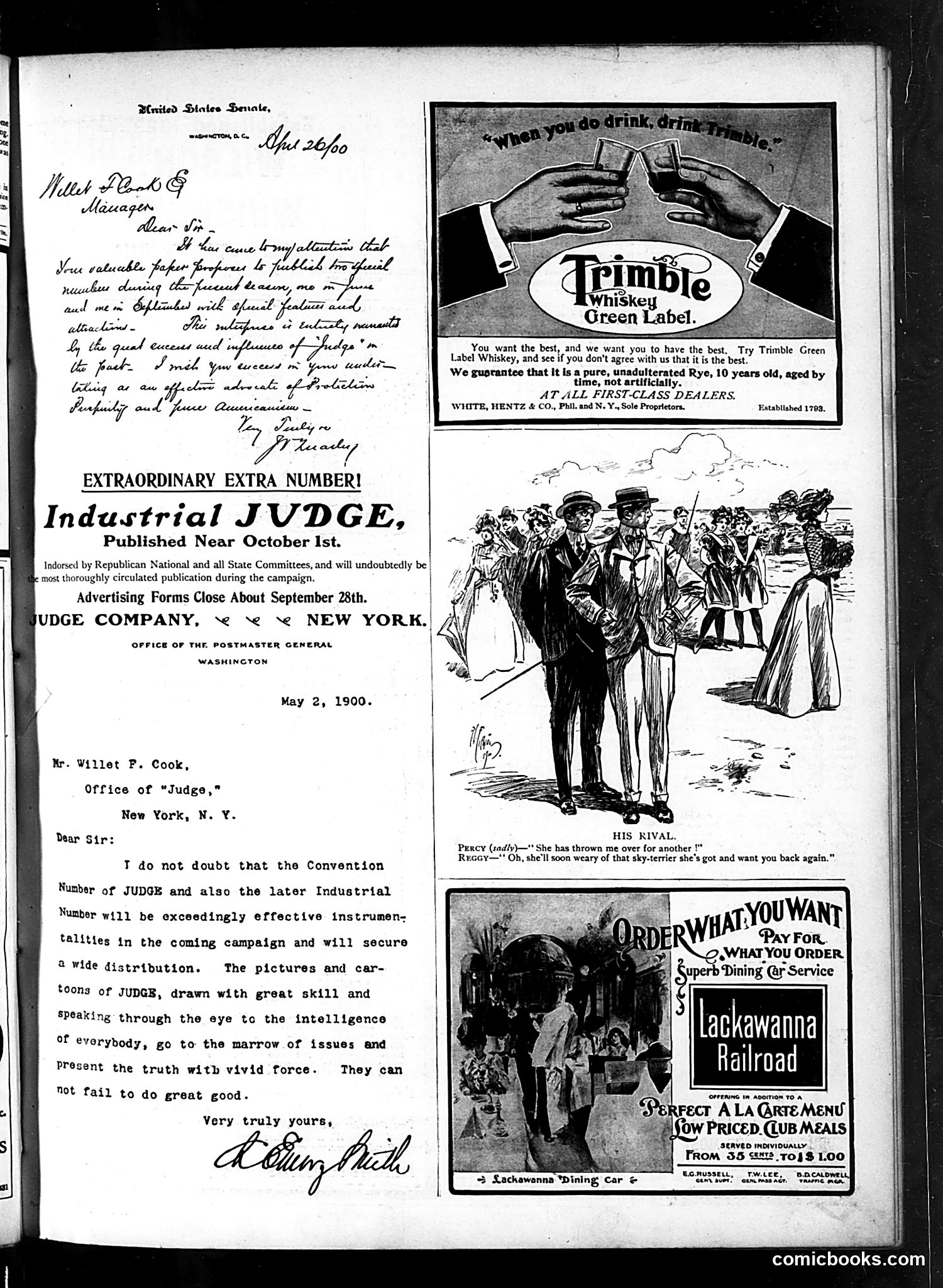
This page contains a letter from the Postmaster General endorsing Judge's "Industrial" campaign edition (published near October 1900), praising its cartoons for their political effectiveness during the coming election campaign. The main cartoon shows two men discussing a woman who has left one for another—a "sky-terrier" (small dog). The humor relies on the rival consoling himself that she'll soon tire of the dog and return to him. It's a light domestic joke unrelated to the political content. The page is primarily **advertising and promotional material** rather than satirical commentary. Advertisements include Trimble Whiskey ("Green Label") and the Lackawanna Railroad's dining car service. The letter itself functions as promotional endorsement, positioning Judge as a powerful tool for the 1900 Republican campaign—likely the McKinley re-election bid. The magazine positioned itself as serious political satire with genuine campaign influence.
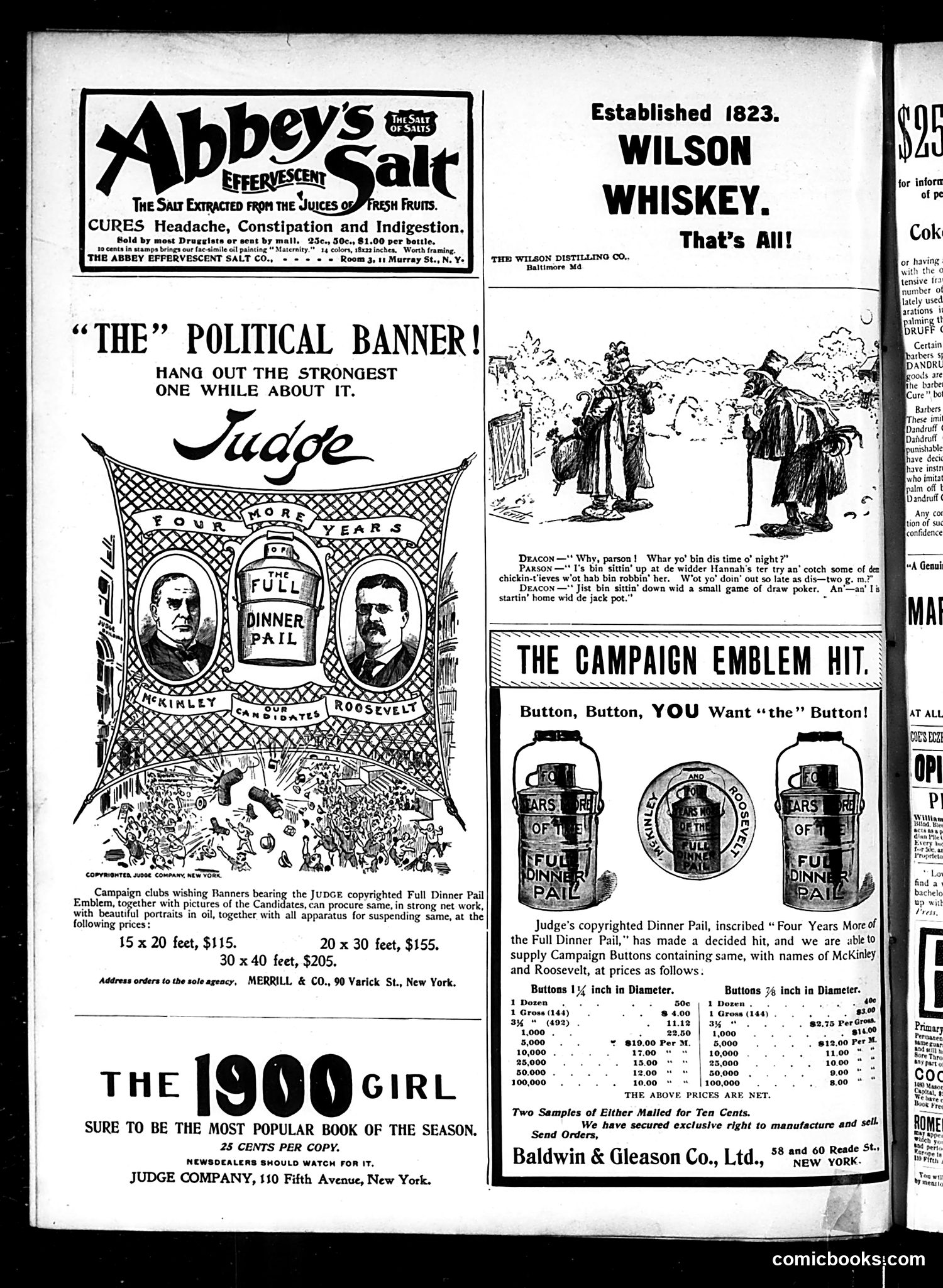
This 1904 **Judge** magazine page features campaign material for the McKinley-Roosevelt Republican ticket. The central cartoon, titled "The Political Banner," depicts the famous **"Full Dinner Pail"** — the GOP's 1900 campaign slogan promising prosperity and worker well-being under Republican leadership. The banner shows portraits of **William McKinley** (left) and **Theodore Roosevelt** (right), with the "Full Dinner Pail" emblem between them. The imagery symbolizes Republican promises of economic security and employment. Below the cartoon, Judge advertises campaign buttons and banners featuring this emblematic pail—merchandise promoting the ticket's core message to voters. The accompanying anecdote about a parson and widower is unrelated humor filler. For modern readers: This reveals how early 20th-century political campaigns used branded imagery and mass-produced merchandise to spread their message, much like today's campaign buttons and signs.
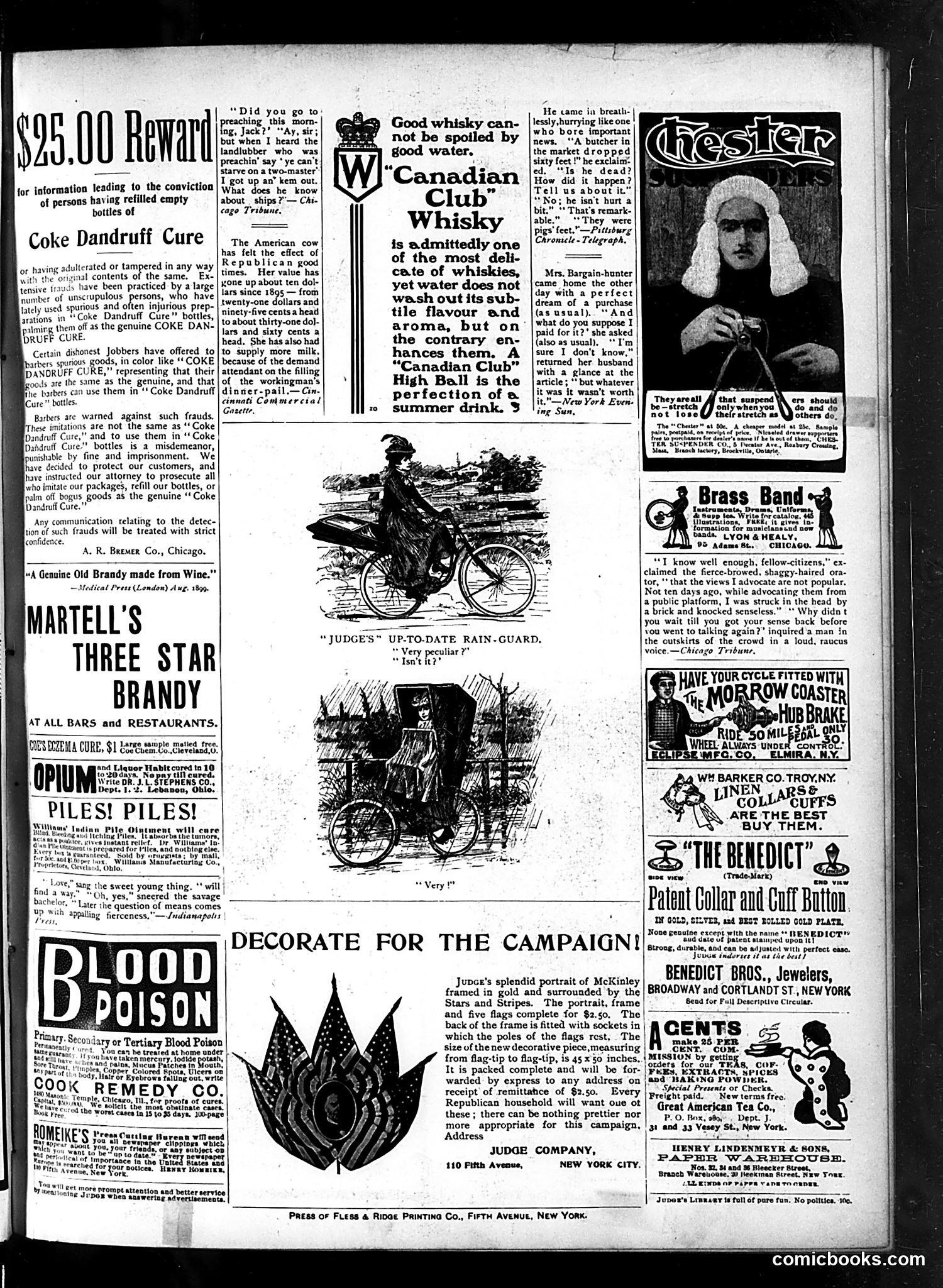
This page is primarily **advertising with interspersed humor pieces**, typical of Judge magazine's format. ## Main Content: **Central Cartoons:** Two bicycle scenes labeled "Judge's Up-to-Date Rain-Guard" and "Very?" appear to be brief visual jokes about cycling practicalities—likely commenting on everyday concerns like weather protection while riding. **Political/Social Humor:** A lengthy anecdote mocks an overeager political orator who brags about being struck in the head while advocating unpopular views, then gets heckled by an audience member sarcastically suggesting he should have waited to recover his "sense" before speaking again. This is standard turn-of-the-century satire targeting hot-headed political agitators. **Advertisements:** The page is dominated by product ads (whisky, brandy, patent medicines, bicycle accessories, collar buttons) typical of the era. **Notable:** A prominent "Blood Poison" patent medicine ad reflects the period's acceptance of dubious health claims now recognized as fraudulent. The page contains no identifiable major political figures or specific dated events—it's generic social commentary and consumer advertising.
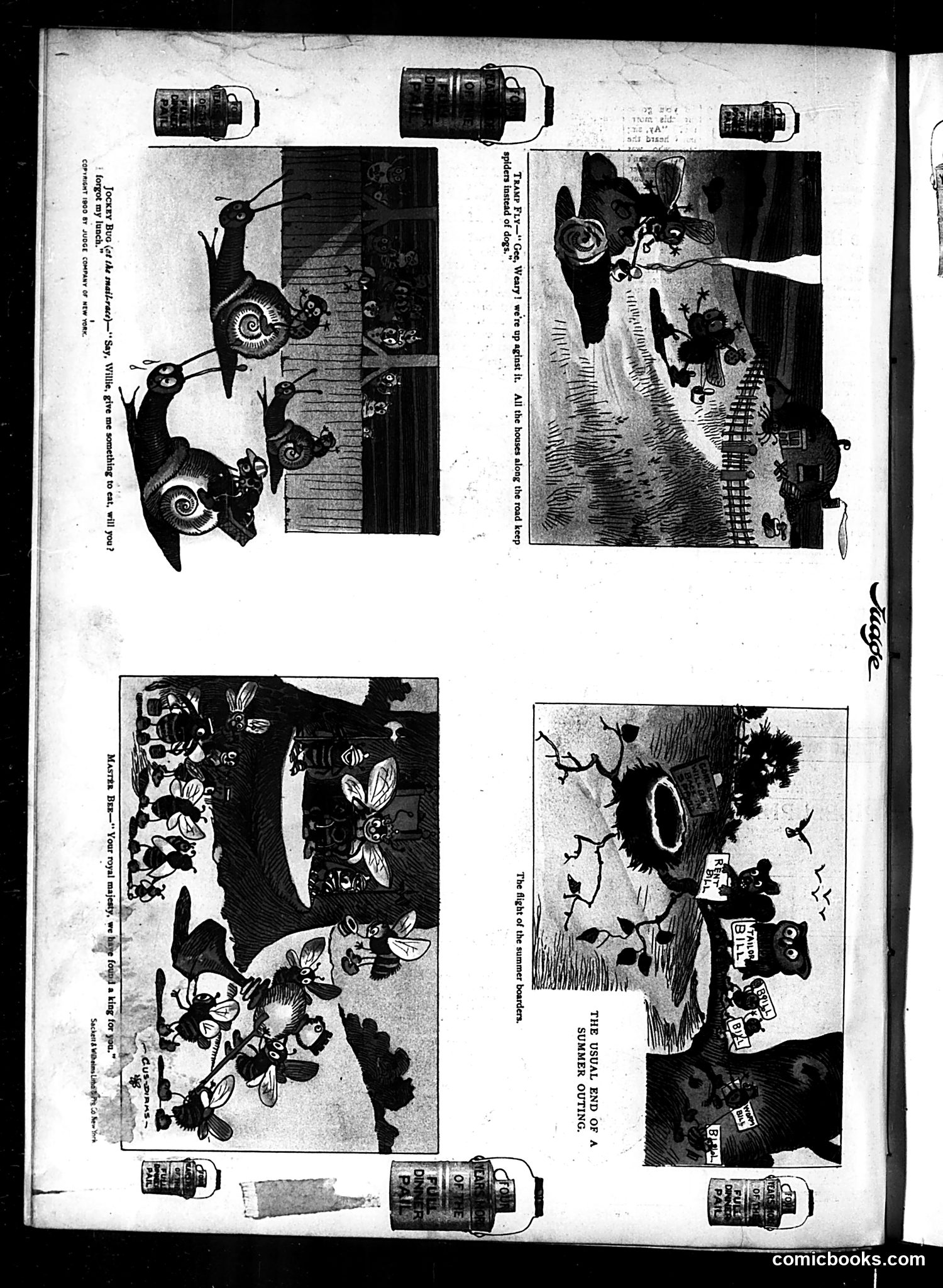
This page contains four separate cartoon vignettes from circa 1900, each depicting humorous scenarios: 1. **Top left**: Anthropomorphized insects (flies) encountering spiders instead of dogs as household "guards"—a visual pun on summer dangers. 2. **Top right**: Appears to show a chaotic summer scene, though details are unclear in this reproduction. 3. **Bottom left**: Titled "THE USUAL END OF A SUMMER OUTING," depicts what appears to be insects or small creatures in vegetation, likely satirizing the messy aftermath of outdoor excursions. 4. **Bottom right**: Shows "JOHNNY BUCK (at the snail-race)" where a character asks another to share food, having forgotten lunch—poking fun at poor planning during leisure activities. The overall theme mocks summer outings' typical mishaps and inconveniences. The humor relies on anthropomorphized animals and insects experiencing very human problems, a common Judge magazine comedic device of the era.