
Judge, 1900-09-29 · page 2 of 16
Judge — September 29, 1900 — page 2: what you’re looking at
What you’re looking at
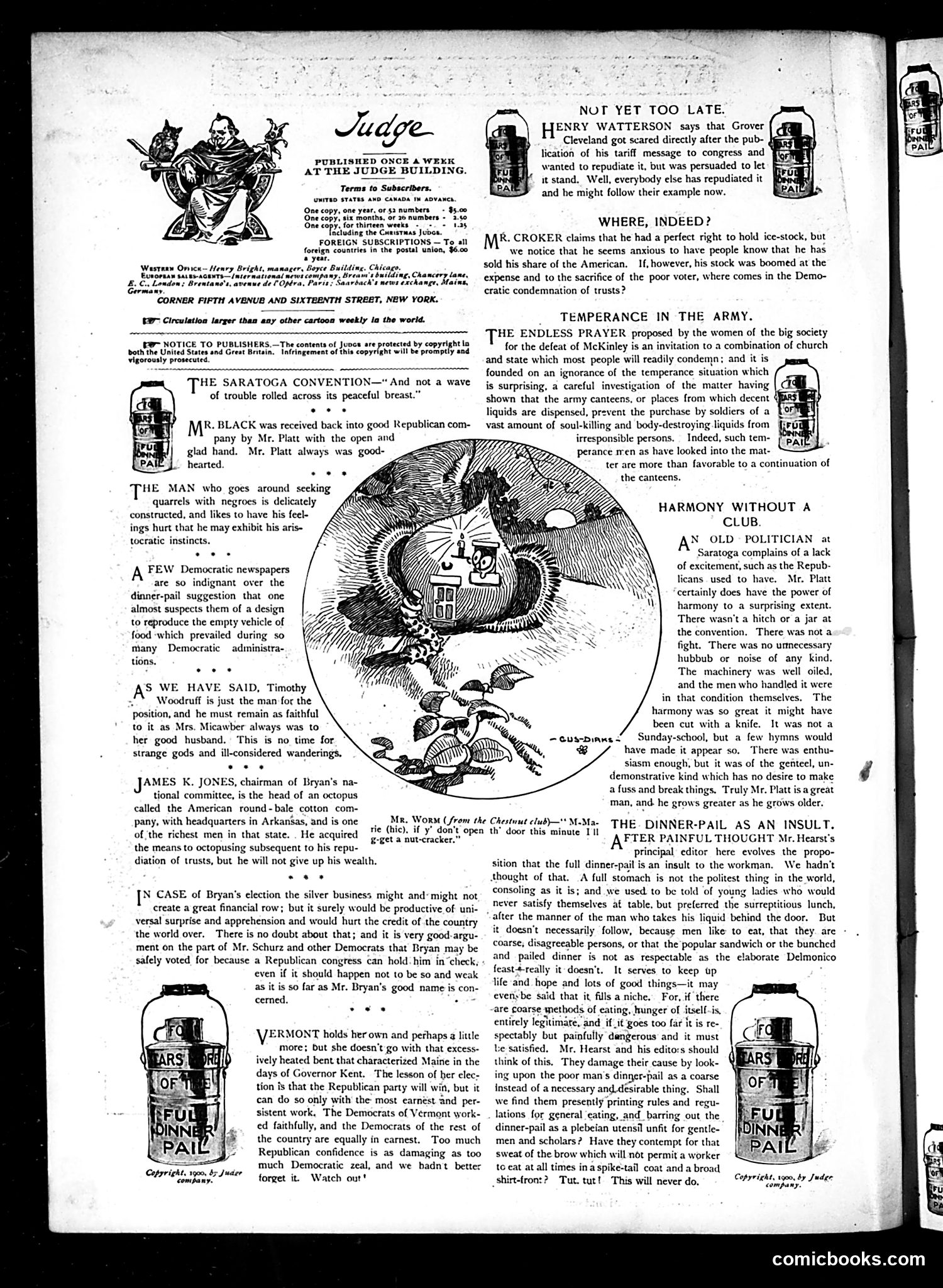
This page contains several political commentary pieces from Judge magazine's satirical section. The main central cartoon depicts what appears to be a large figure or structure labeled with political references, likely commenting on a Democratic convention or political gathering ("The Saratoga Convention"). The articles mock Democratic politicians and policies, including criticism of a "dinner-pail" argument (a political slogan) and commentary on Bryan's election prospects. References to McKinley suggest this is from the 1896-1900 election era. The satire targets Democratic organizational chaos and what the magazine views as hypocritical positions. Specific figures mentioned include Mr. Platt (likely Thomas Collier Platt, a Republican politician) and discussion of Vermont's political situation. Without clearer image resolution of the central cartoon's details, precise identification of all caricatured figures remains uncertain, though the Democratic Party is clearly the primary target.
📄 Transcribed text from this page (OCR, searchable)
Machine-transcribed from the original scan — historical spelling and the odd misread are preserved.
PUBLISHED ONCE A WEKK AT THE JUDGE BUILDING. Terms to Subscribers. One copy, six months, or 30 numbers = Se cary ae mee rn FOREIGN SUBSCRIPTIONS To al (0 eee Se Te Sion bas on «Boye Building, Chicago ree aalidnt Co ctanciry lame Wastaan Omicn— Henry Bright, manage Eusorsan sates-ace ‘Londom: Bren Germany CORNER FIPTH AVENUE AND SIXTEENTH STREET, NEW YORK. 97 Circulation larger than any other cartoon weekly la the world. Fe NOTICE TO PUBLISHERS.—The contents of Juv bboth the United States and Great Britain. tnfringement of thi c vigorously prosecuted. 1d by copyright ia ibe prompthy and THE SARATOGA CONVENTION—“ And not a wave of trouble rolled across its peaceful breast.” MB: BLACK was received back into good Republican com- pany by Mr. Platt with the open and glad hand. Mr. Platt always was good- hearted. THE MAN who goes around seeking quarrels with negroes is delicately constructed, and likes to have his feel- ings hurt that he may exhibit his aris« tocratic instincts. FEW Democratic newspapers are so indignant over the dinner-pail suggestion that one almost suspects them of a design to reproduce the empty vehicle of food which prevailed during so many Democratic administra- tions. tae AS WE HAVE Ss Woodruff is just the man for the position, and he must remain as faithful to it as Mrs. Micawber always was to her good husband. This is no time for strange gods and ill-considered wanderings. eee JAMES K. JONES, chairman of Bryan's na- tional committee, is the head of an octopus called the American round-bale cotton com- pany, with headquarters in Arkansas, and is one of,the richest men in that state. . He acquired the means to octopusing subsequent to his repu- diation of trusts, but he will not give up his wealth. g-get a nut-cracker.” sae [N CASE of Bryan’s election the silver business might and: might not create a great financial row; but it surely would be productive of uni- versal surprise and apprehension and would hurt the credit of the country the world over. There is no doubt about that; and it is very good-argu- ment on the part of Mr. Schurz and other Democrats that Bryan may be safely voted for because a Republican congress can hold-him in “check, even if it should happen not to be so and weak as it is so far as Mr. Bryan's good name is con- cerned. ee sae MONT holds her own and perhaps a little more; but she doesn’t go with that excess- ively heated bent that characterized Maine in the days of Governor Kent. The lesson of her elec- tion is that the Republican party will win, but it can do so only with’ the most earnest and per- sistent work. The Democrats of Vermont work- ed faithfully, and the Democrats of the rest of the country are equally in earnest. Too much Republican confidence is as damaging as too much Democratic zeal, and we badnt better forget it. Watch out! Copyright, 1 compa by Juder my. ‘ORM (from the Chestnut club)—"* M-Ma- if y’ don't open th’ door this minute Ill _shirt-front ? NOT YET TOO LATE. ENRY WATTERSON says that Grover Cleveland got scared directly after the pub- lication of his tariff message to congress and wanted to repudiate it, but was persuaded to let it stand. Well, everybody else has repudiated it and he might follow their example now. WHERE, INDEED? M® CROKER claims that he had a perfect right to hold ice-stock, but ‘we notice that he seems anxious to have people know that he has sold his share of the American. If, however, his stock was boomed at the expense and to the sacrifice of the poor voter, where comes in the Demo- cratic condemnation of trusts? TEMPERANCE IN THE ARMY. HE ENDLESS PRAYER proposed by the women of the big society for the defeat of McKinley is an invitation to a combination of church and state which most people will readily condemn; and it is founded on an ignorance of the temperance situation which is surprising, a careful investigation of the matter having shown that the army canteens, or places from which decent liquids are dispensed, prevent the purchase by soldiers of a vast amount of soul-killing and body-destroying liquids from irresponsible persons. Indeed, such tem- perance men as have looked into the mat- ter are more than favorable to a continuation of the canteens. HARMONY WITHOUT A CLUB. AN OLD POLITICIAN at Saratoga complains of a lack of excitement, such as the Repub- licans used to have. Mr. Platt certainly does have the power of harmony to a surprising extent. There wasn't a hitch or a jar at the convention, There was not a fight. ‘There was no unnecessary hubbub or noise of any kind. The machinery was well oiled, and the men who handled it were in that condition themselves. The harmony was so great it might have been cut with a knife. It was not a Sunday-school, but a few hymns would have made it appear so, ‘There was enthu- siasm enough, but it was of the gefiteel, un- demonstrative kind which has no desire to make a fuss and break things. Truly Mr. Platt isa great man, and he grows greater as he grows older. THE. DINNER-PAIL AS AN INSULT. FTER PAINFUL THOUGHT Mr. Hearst's principal editor here evolves the propo- sition that the full dinner-pail is an insult to the workman, We hadn't thought of that. A full stomach is not the politest thing in the world, consoling as it is; and we used to be told of young ladies who would never satisfy themselves at table, but preferred the surreptitious lunch, after the manner of the man who takes his liquid behind the door. But it doesn’t necessarily follow, because men like to eat, that they. are - coarse, disagreeable persons, or that the popular sandwich or the bunched and pailed dinner is not as respectable as the elaborate Delmonico feast--really it doesn't. It serves to keep up : life and hope and lots of good things—it may evensbe said that it fills a niche. For, if ‘there are coarse methods of eating, hunger of itself-is, entirely legitimate, and if it goes too far it is re- spectably but painfully dangerous and it must Le satisfied. Mr. Hearst and his edito:s should think of this. They damage their cause by look- ing upon the poor man’s dinger-pail as a coarse instead of a necessary and.désirable thing. Shall we find them presently printing rules and regu- lations for general ‘eating, and_barring out the dinner-pail as a plebeian utensil unfit for gentle- men and scholars? Have they contempt for that ‘sweat of the brow which will not permit a worker to eat at all times ina spike-tail coat and a broad Tut. tut! This will never do. - Cus-Dinns = Copyright, 1900, by Juder company. comicbooks.com