
A complete issue · 16 pages · 1900
Judge — September 8, 1900
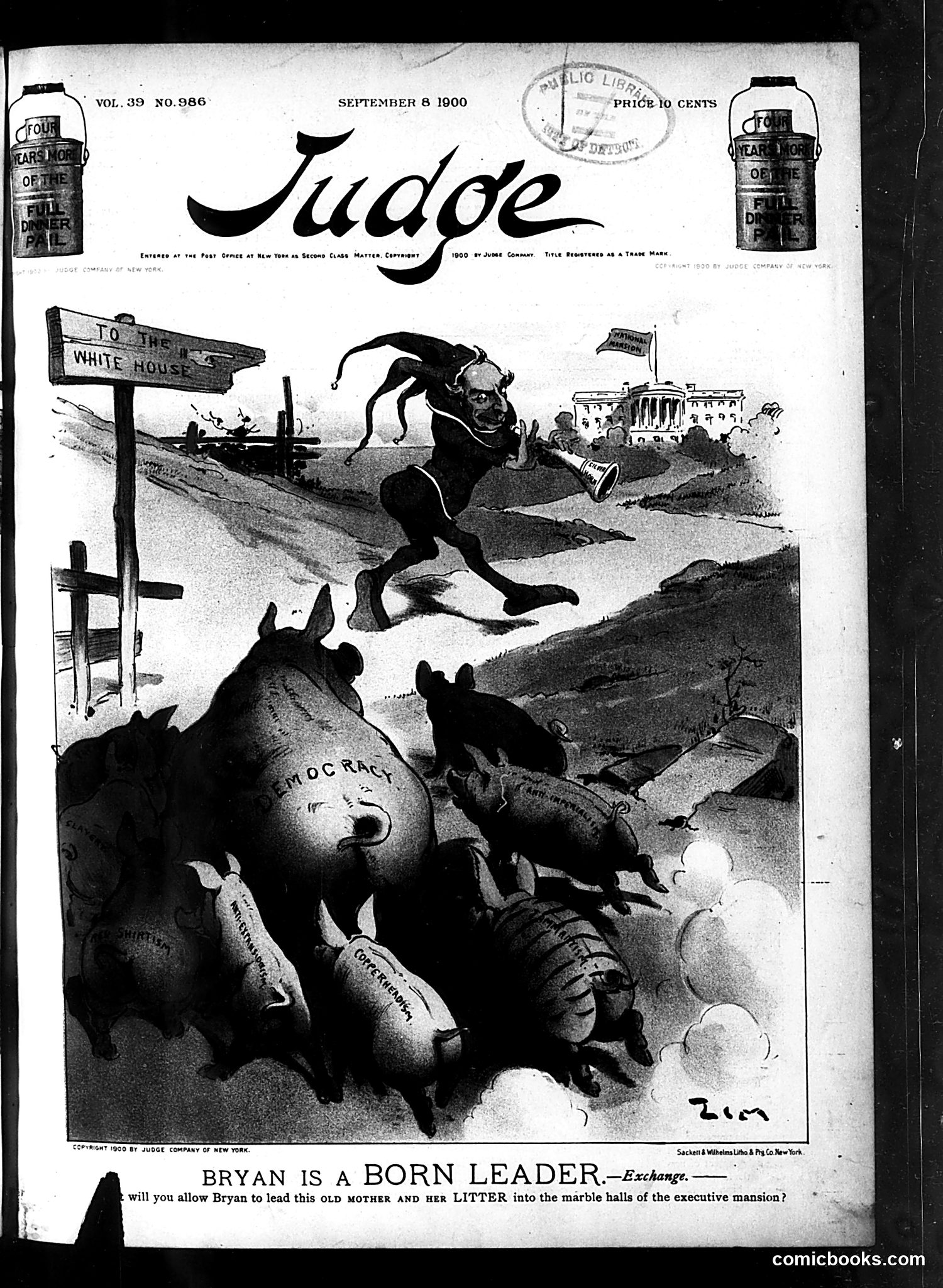
This cartoon satirizes William Jennings Bryan's 1900 presidential campaign. The caption reads "Bryan is a Born Leader" sarcastically, showing Bryan (the demonic figure with horns) attempting to lead "Old Mother" Democracy and "her litter" toward the White House—depicted as marble halls in the background. The animals labeled "Democracy," "Expansion," and "Imperialism" represent political forces Bryan supposedly championed or opposed. The crosses and graves reference casualties, suggesting Bryan's policies would lead to destruction. The devil-like depiction reflects Republican opposition to Bryan's populist, anti-imperialist platform. This is partisan attack propaganda supporting Bryan's opponent, likely President McKinley's re-election campaign.
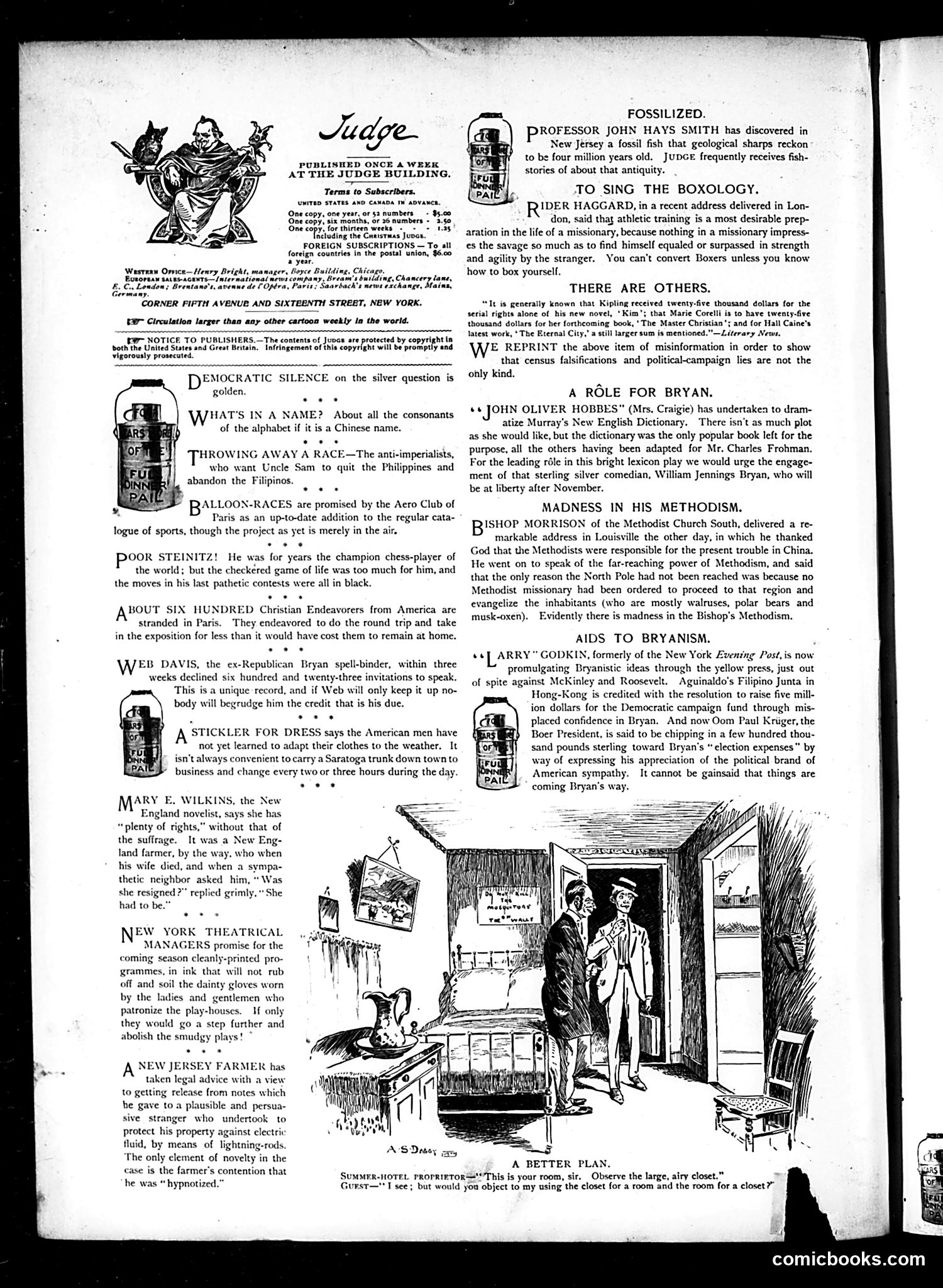
The main cartoon titled "A Better Plan" depicts a hotel proprietor offering a guest unusual room arrangements—suggesting the guest use a closet for sleeping while the proprietor uses the room itself. This is satirical commentary on post-WWI housing shortages and landlord exploitation. The text section "Aids to Bryanism" references William Jennings Bryan and criticizes Democratic political figures like "Larry" Godkin of the *Evening Post* for supporting Bryan's presidential ambitions while allegedly accepting donations from wealthy interests (Aguinaldo's Filipino junta, President Boer, etc.). The satire suggests these supporters are hypocritical—funding Bryan's "common man" campaign through morally questionable sources, thereby undermining his populist credibility.
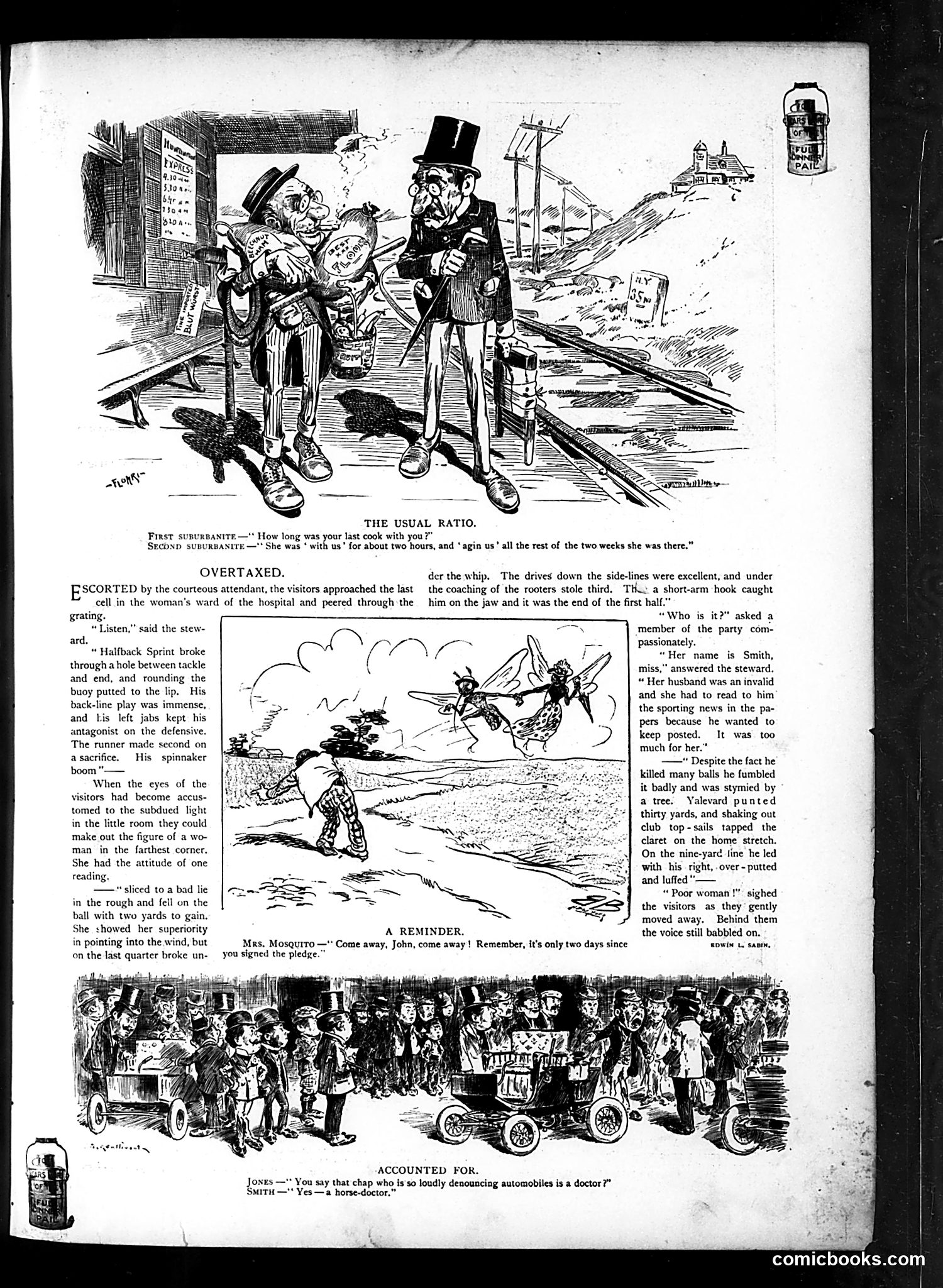
This page contains three satirical cartoons mocking various subjects: **"The Usual Ratio"** (top) depicts two men in formal dress discussing a cook's employment duration, suggesting commentary on domestic worker turnover. **"Overtaxed"** (middle) appears to reference baseball, showing an injured player and discussing sporting injuries and newspaper coverage. The illustration satirizes both the sport's violence and society's obsession with following athletes' misfortunes in the press. **"A Reminder"** shows a character labeled "Mrs. Mosquito," using the insect as social satire—likely mocking someone's persistence or annoyance. **"Accounted For"** (bottom) jokes about automobiles, with characters discussing someone denouncing cars while being a "horse-doctor," satirizing hypocrisy about new technology. The cartoons target domestic service, sports culture, and automobile skepticism—typical early 20th-century American concerns.
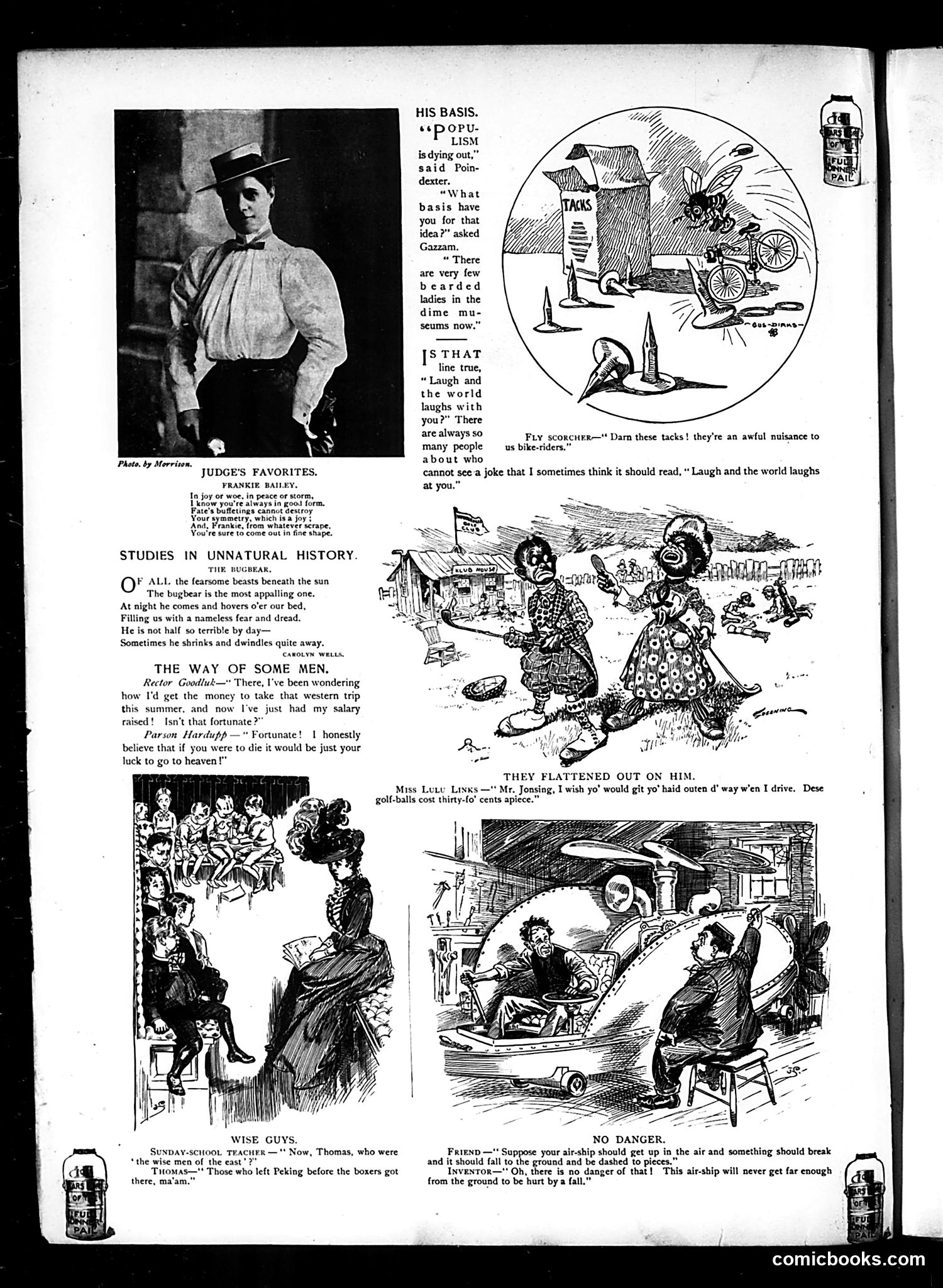
This page contains humor pieces and illustrations rather than political cartoons. The top section features "Judges Favorites" with Frankie Bailey (a famous actress/dancer of the era) photographed in theatrical costume. The middle content includes light social humor: "Studies in Unnatural History" mocking the bugear (unclear reference); "The Joy of Some Men" featuring characters discussing summer plans and salary; and "Wise Guys," a Sunday-school joke. The illustrated cartoons satirize everyday life: "Fly Scorcher" mocks bicycle riders as nuisances; "They Flattened Out on Him" shows women dismissing a suitor; and "No Danger" depicts airship safety concerns—likely referencing early aviation anxieties circa early 1900s. The humor is domestic and social rather than explicitly political.
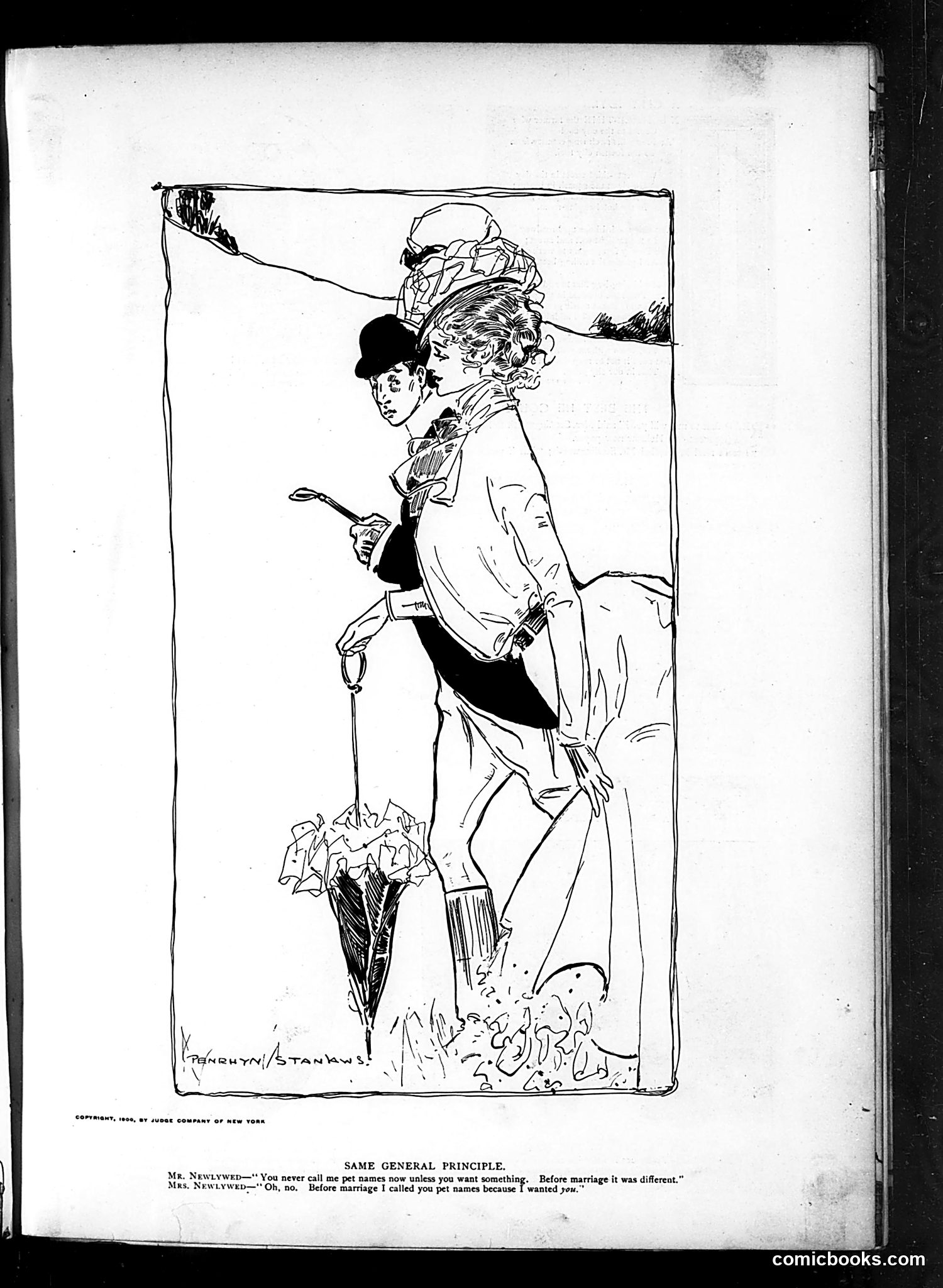
This cartoon satirizes changing marital dynamics, specifically how wives' use of affectionate pet names shifts after marriage. The caption presents a married woman explaining to her husband that she now only uses endearments when she wants something from him—whereas before marriage, she used them genuinely out of affection. The joke targets the common complaint that wives become manipulative after marriage, using charm strategically rather than sincerely. The fashionably dressed woman with her elaborate hat and parasol represents the stereotypical society wife of the early 20th century. The satire cuts both ways: it mocks both the wife's calculated behavior and, implicitly, the husband's gullibility in falling for it. This reflects period anxieties about changing gender relations and women's strategic use of feminine appeal.
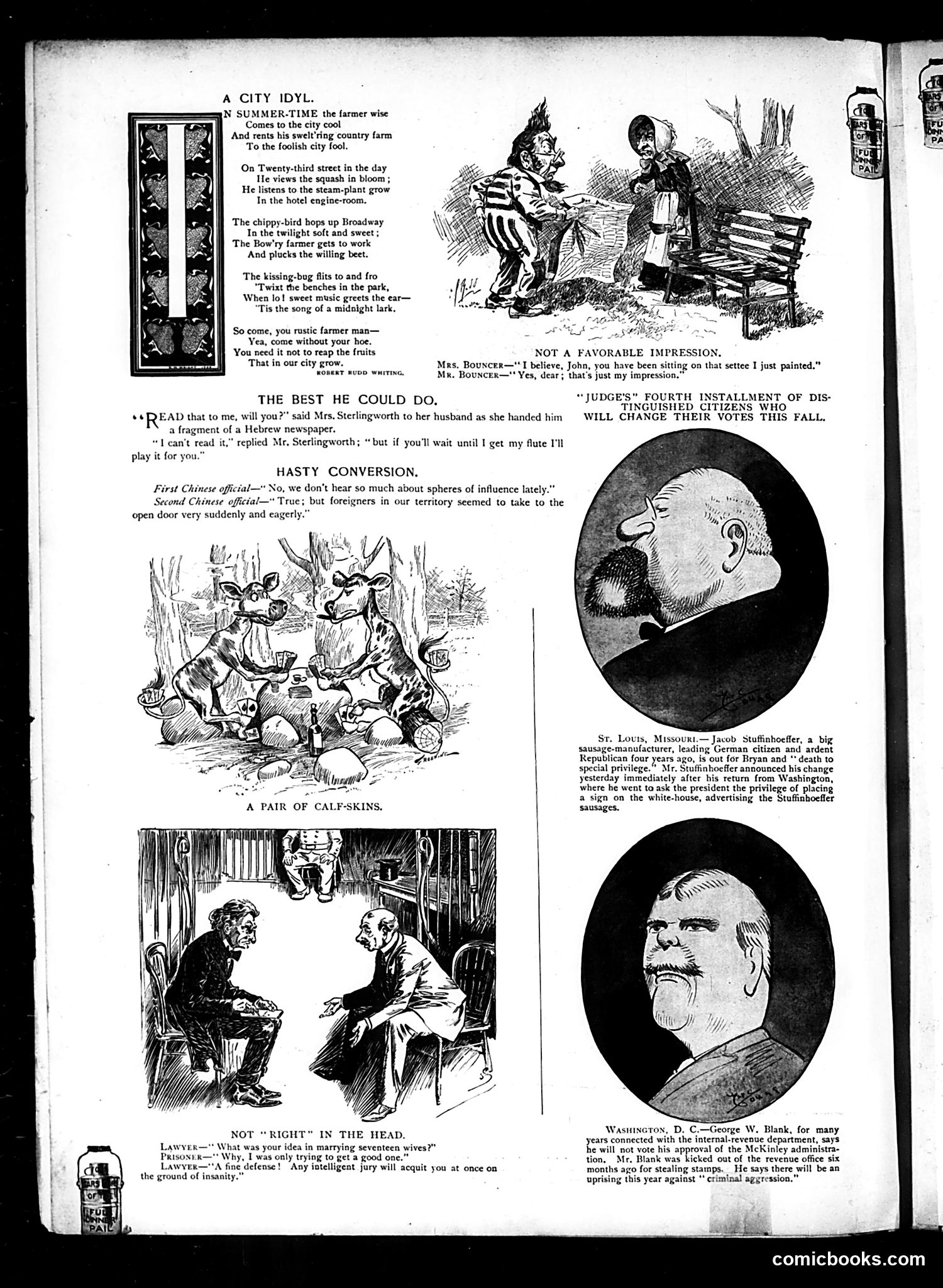
This page contains several satirical pieces mocking political figures and social hypocrisy circa early 1900s: **"A City Idyl"** satirizes urban tourists who romanticize farm life while city farmers exploit them for rent. **"The Best He Could Do"** mocks someone unable to read Hebrew, suggesting reliance on non-intellectual alternatives. **"Hasty Conversion"** depicts two Chinese officials discussing how foreigners suddenly embraced the "open door" policy—satirizing opportunistic shifts in foreign policy regarding China. **"Judge's Fourth Installment"** profiles Jacob Stuffinhoeffer, a German-American sausage manufacturer who switched from Republican to Bryan/anti-monopoly after being denied a White House advertising privilege. This lampoons political conversions motivated by personal grievance rather than principle. **"Not 'Right' in the Head"** shows a man defending polygamy as trial-and-error spouse selection. The overall theme: exposing political inconsistency, opportunism, and the gap between public principles and private self-interest.
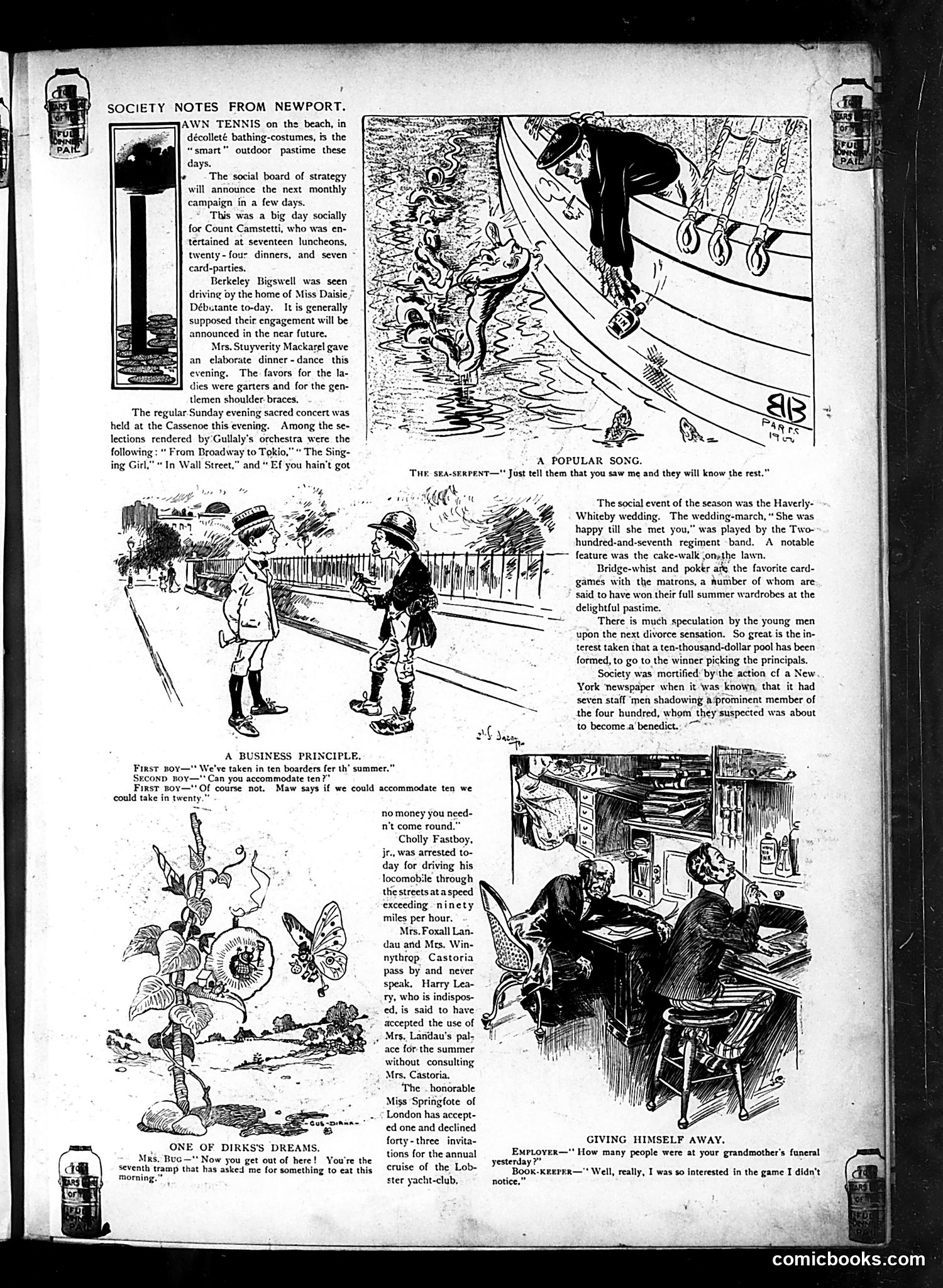
This page satirizes the wealthy Newport, Rhode Island social elite through mock society columns and cartoons. The humor targets their: **Frivolous pursuits**: lawn tennis in revealing bathing costumes, elaborate dinners, card games (bridge-whist, poker), and wedding celebrations like "cake-walks" — presented as shallow pastimes. **Moral bankruptcy**: A "ten-thousand-dollar pool" betting on who will divorce next; newspapers shadowing a society member suspected of becoming engaged ("benedict"); young matrons gambling away their summer wardrobes. **Pretension and excess**: Count Camstetti attending seventeen luncheons and thirty-one dinners in one day; absurd party favors (garters and shoulder braces). **Class indifference**: A separate cartoon shows a wealthy motorist (Cholly Fastboy) recklessly speeding; another depicts homeless men begging for food while the wealthy ignore them. The satire suggests the Four Hundred (elite society) are disconnected from ordinary morality and suffering, indulging in vice and excess while dismissing the poor.
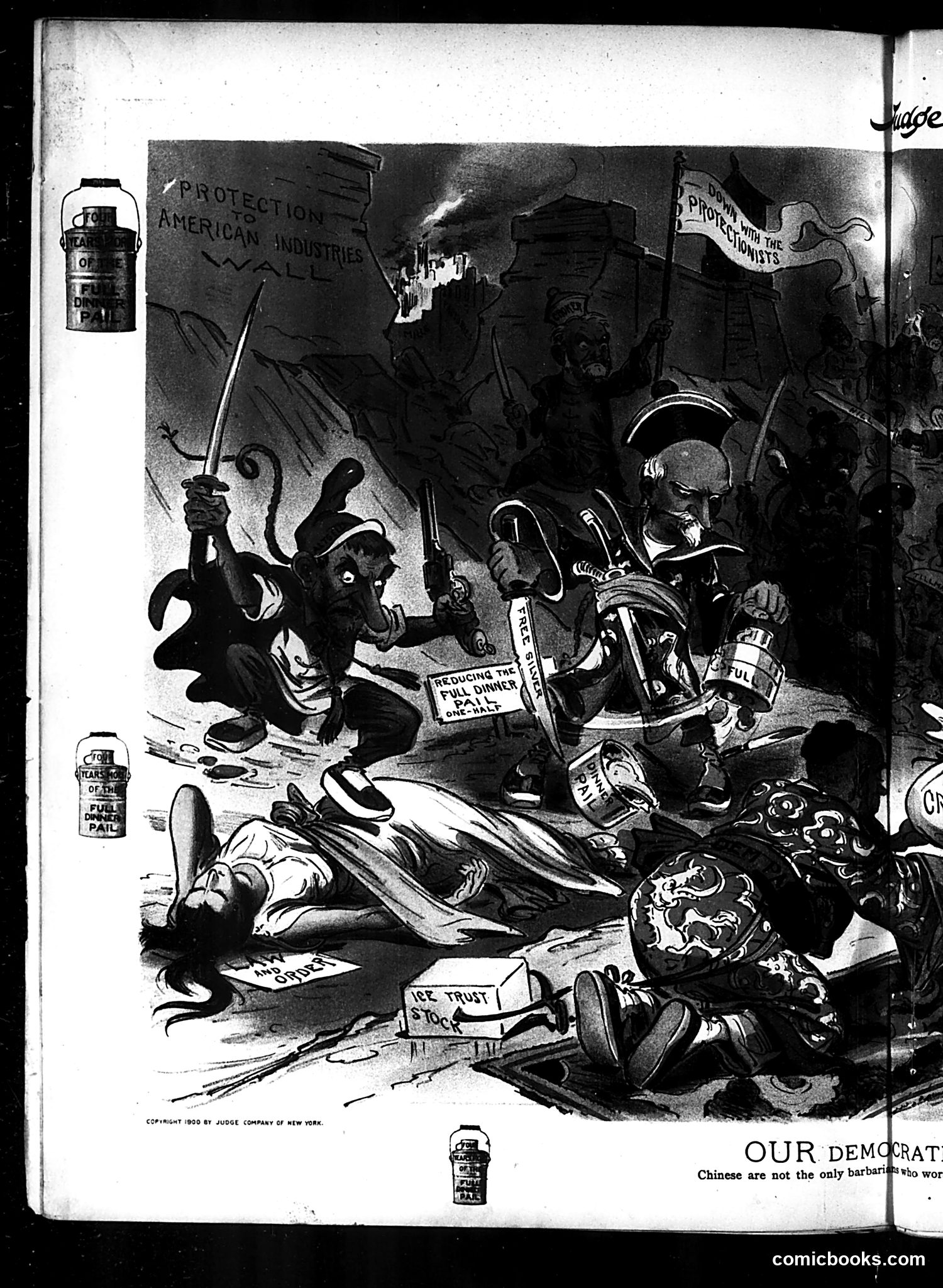
This is a satirical political cartoon from Judge magazine (copyright 1903, per visible text). The cartoon depicts violent chaos involving caricatured figures wielding weapons and tools, with labels referencing "Protection of American Industries," "Reducing the Tariff," and "Ice Trust Stock." The scene appears to satirize industrial/economic conflict, likely critiquing either protectionist tariff policies or monopolistic business practices (the "Ice Trust" suggests references to actual 1900s trusts). The chaotic violence suggests the cartoon mocks the destructive consequences of these policies or corporate practices on American society. The caricatured figures appear exaggerated in a style typical of early-1900s editorial cartoons, though specific identities are unclear without additional context. The overall message critiques specific economic policies or corporate entities affecting the public.
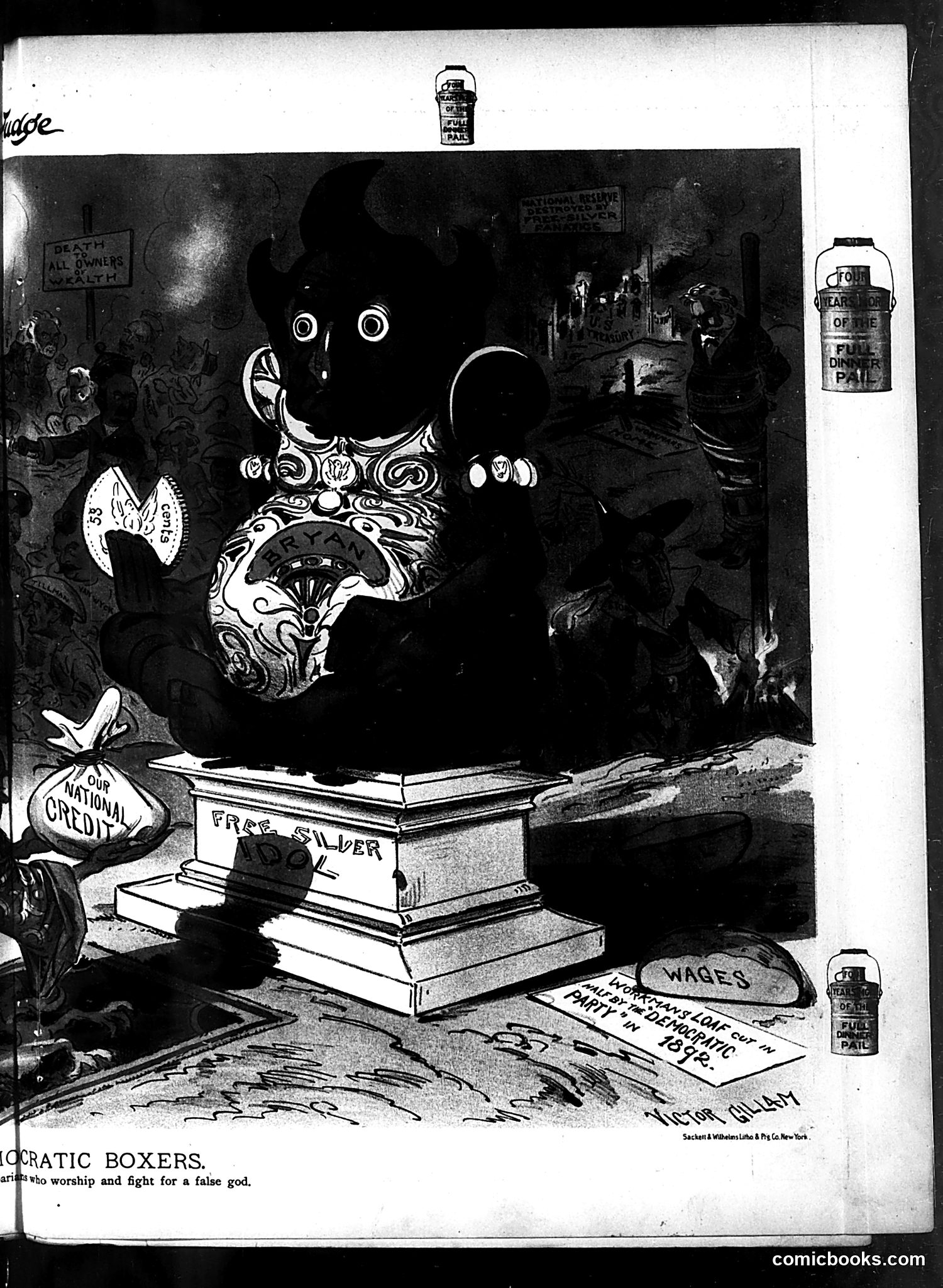
This is a political cartoon satirizing Democratic politicians as worshippers of a false idol. The central figure is a grotesque demon or dark deity, emerging from stacked books labeled "Free Silver" and "National Credit," surrounded by various financial/economic symbols (wages, debt). The caption identifies them as "Democratic Boxers who worship and fight for a false god," suggesting Democrats are blindly devoted to economically destructive policies—likely referencing the Free Silver debate of the 1890s, when Democrats championed unlimited silver coinage despite warnings it would harm national finances. The cartoon's tone is deeply mocking: Democratic leaders are depicted as superstitious worshippers of ruinous economic ideology rather than rational policymakers. The demon imagery emphasizes the cartoonist's view that Free Silver was inherently evil and seductive to Democratic voters.
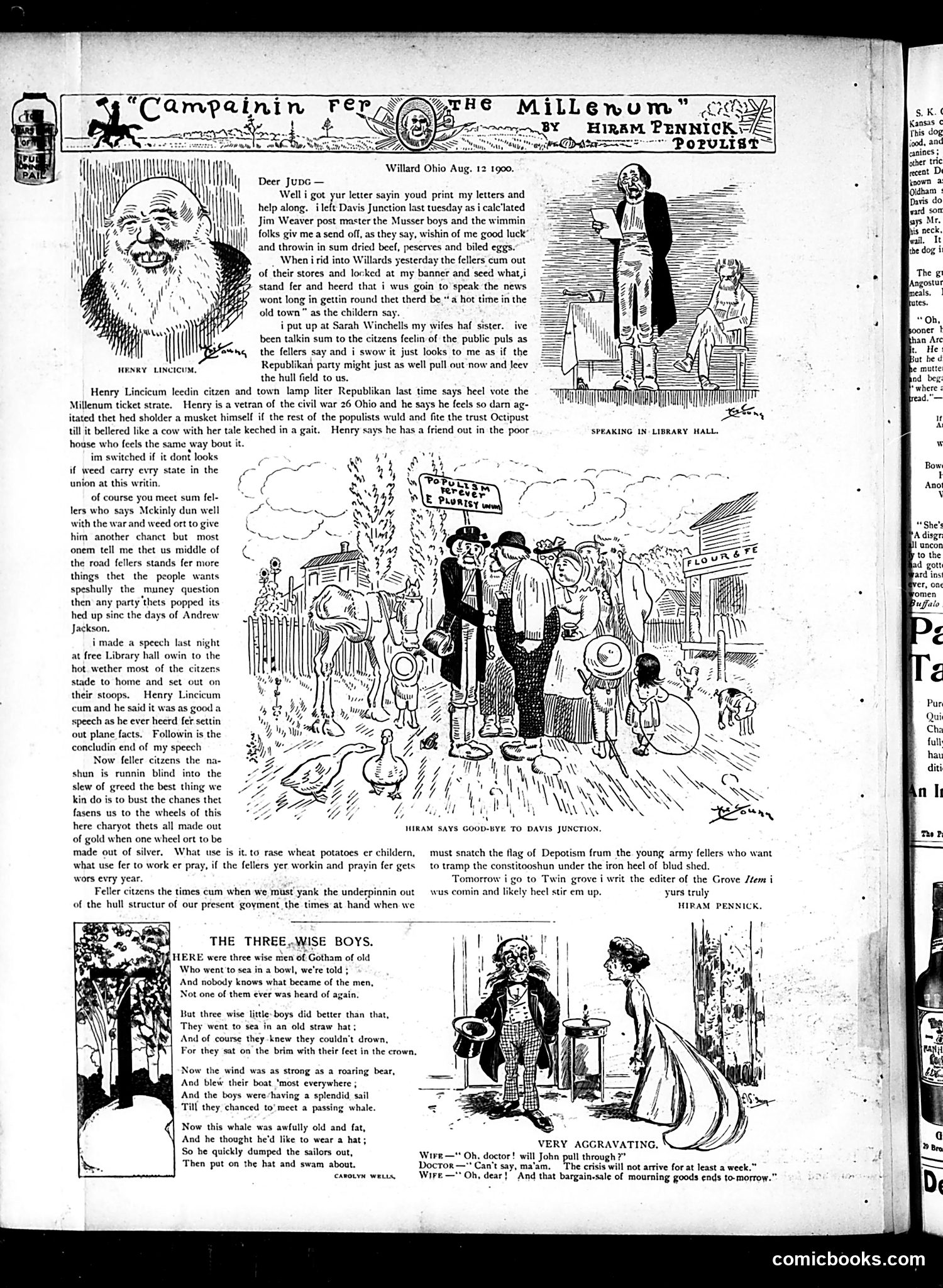
## Main Content: "Campainin fer the Millennium" This is a **Populist Party campaign narrative** by "Hiram Pennick," a fictional rural organizer traveling to promote the Populist ticket in the 1900 election. The satire mocks Populist rhetoric and supporters through exaggerated dialect and grievances. **Key targets:** - The Populist Party's agrarian complaints about monopolies ("the trust Octipust"), currency reform, and anti-establishment messaging - Rural working-class anger at Republican McKinley and industrial capitalism - The "middle of the road" Populist slogan **The joke:** Judge (a Republican-leaning publication) portrays Populists as unsophisticated rural folk with poor grammar, yet their arguments—despite the mockery—resonate with real economic anxieties about corporate power and inequality. The accompanying illustration "Speaking in Library Hall" shows the disconnect between Populist ambitions and actual audience engagement (townspeople stayed home in the heat). ## Secondary Content: "The Three Wise Boys" A whimsical children's poem about boys in a straw hat—unrelated to the political content above.
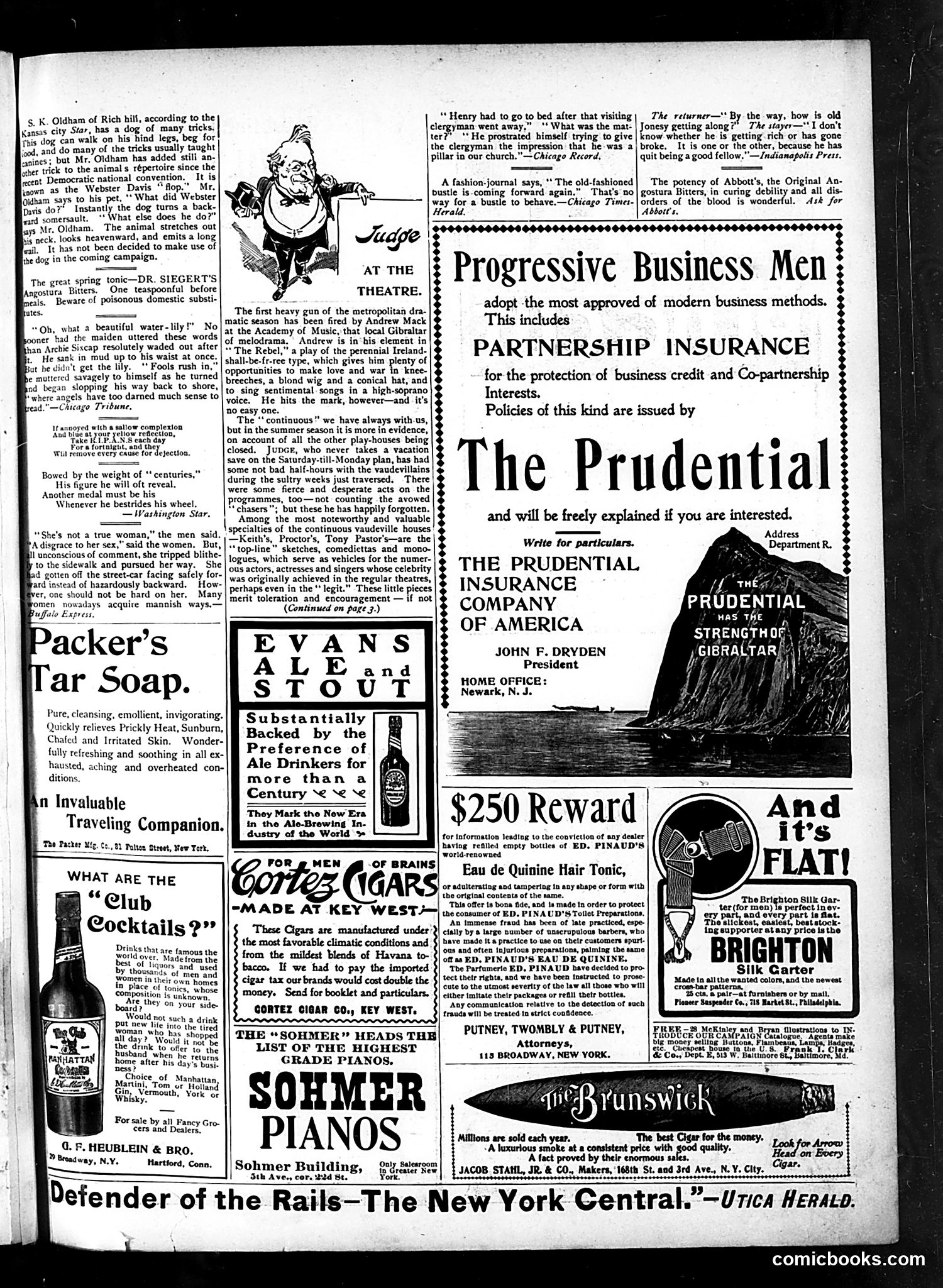
This page from *Judge* magazine is primarily **advertising**, with some satirical commentary mixed in. The main cartoon appears at the top: it depicts **Webster Davis** (a political figure of the era) performing a "flop"—a somersault or reversal. The accompanying text jokes that a dog owner has trained his pet to do the "Webster Davis flop" by turning its back when asked what Davis did, satirizing Davis as someone who reversed his political position or betrayed expectations. The page also contains several short humorous anecdotes mocking human behavior: a man wading into mud pursuing a water lily, a boy pretending to be a church pillar to impress a visiting clergyman, and commentary on fashion and social pretense. The bulk of the page consists of period advertisements for **Packer's Tar Soap, Evans Ale, Cortez Cigars, Sohmer Pianos, and The Prudential Insurance Company**—typical of early 1900s magazine advertising. Without clearer context on Webster Davis's specific political actions, the exact target of that satire remains somewhat unclear, though it clearly mocks a prominent politician's inconsistency.
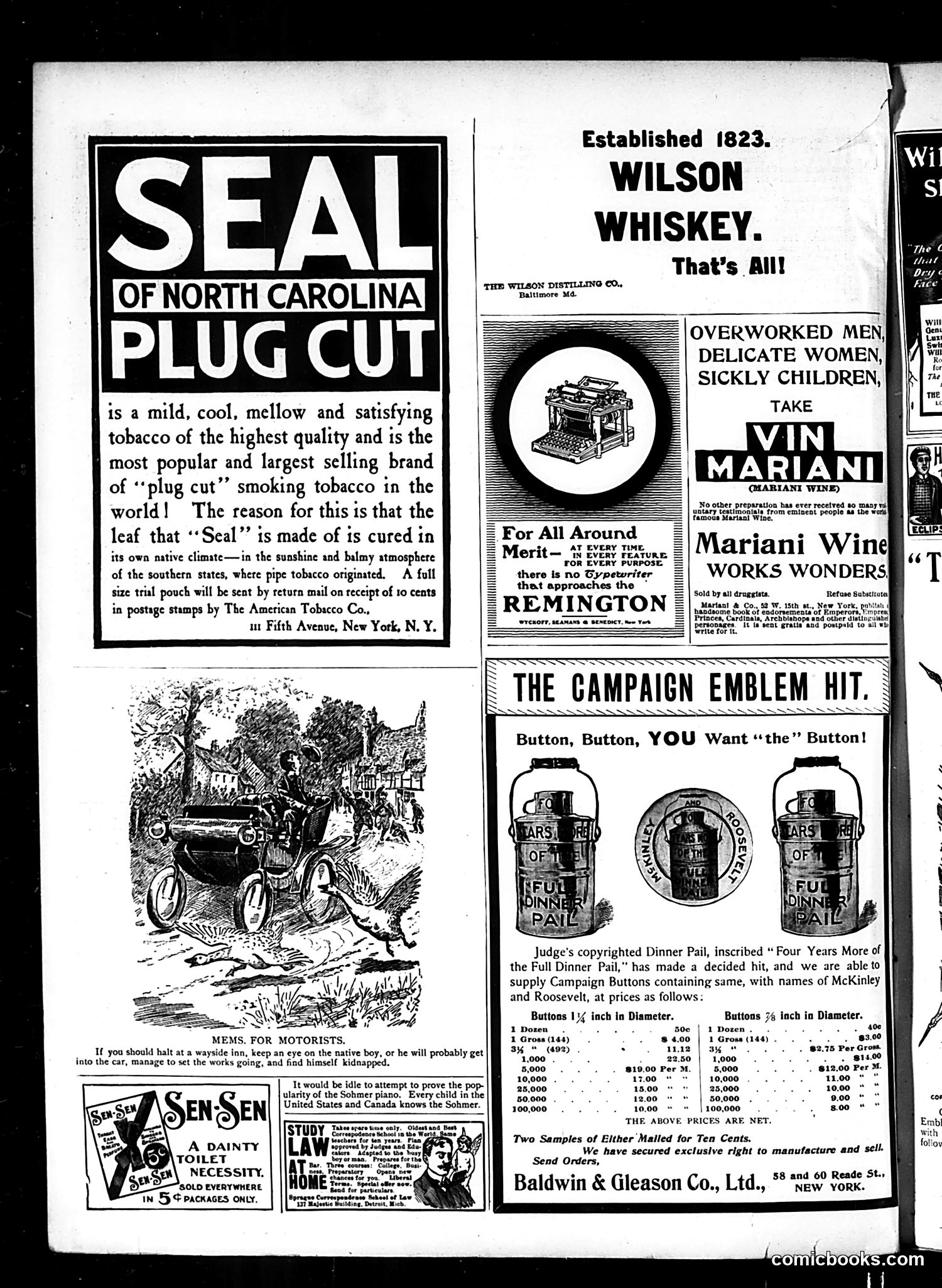
This page is primarily **advertising**, not political satire. It dates to the McKinley-Roosevelt era (likely 1904), evident from the "Campaign Emblem Hit" section promoting dinner-pail buttons featuring McKinley and Roosevelt. The centerpiece advertisement uses the "Full Dinner Pail"—a Republican campaign slogan promising prosperity—as a successful political merchandising gimmick. Baldwin & Gleason offers campaign buttons for purchase at bulk rates. The remaining content consists of product advertisements: Seal tobacco, Wilson whiskey, Mariani Wine (marketed with dubious medical claims to the sickly), Remington typewriters, Sen-Sen breath mints, and correspondence law school. The one cartoon shows a motorist whose car is kidnapped by a mischievous boy—mild humor about automobile novelty rather than political commentary.
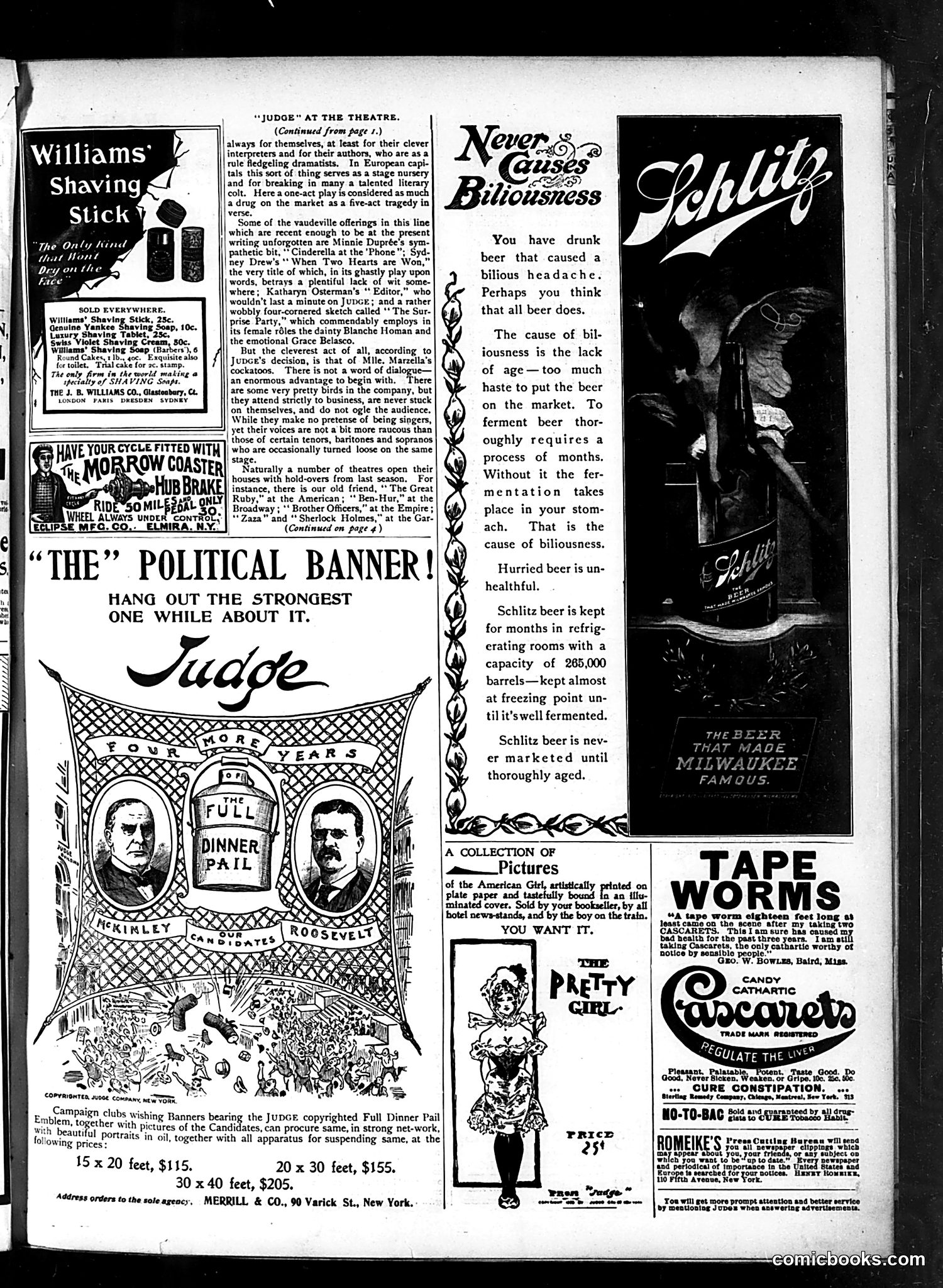
This page primarily showcases a **1912 presidential campaign banner** featuring the "Full Dinner Pail"—a Republican symbol of prosperity under McKinley and Roosevelt. The banner depicts two men (likely Taft and Sherman, the Republican ticket) flanking a dinner pail, invoking the promise of economic abundance. Judge, a Republican-leaning satirical magazine, offered these banners to campaign clubs. The page also contains theater criticism discussing vaudeville acts and one-act plays, plus various product advertisements (Williams' Shaving Stick, Schlitz beer emphasizing proper aging, Cascarets laxatives, and illustrated "Pictures of the American Girl"). The "Full Dinner Pail" referenced the 1900 campaign slogan contrasting Republican prosperity with Democratic recession fears—a message Judge was actively promoting through merchandise sales to supporters.
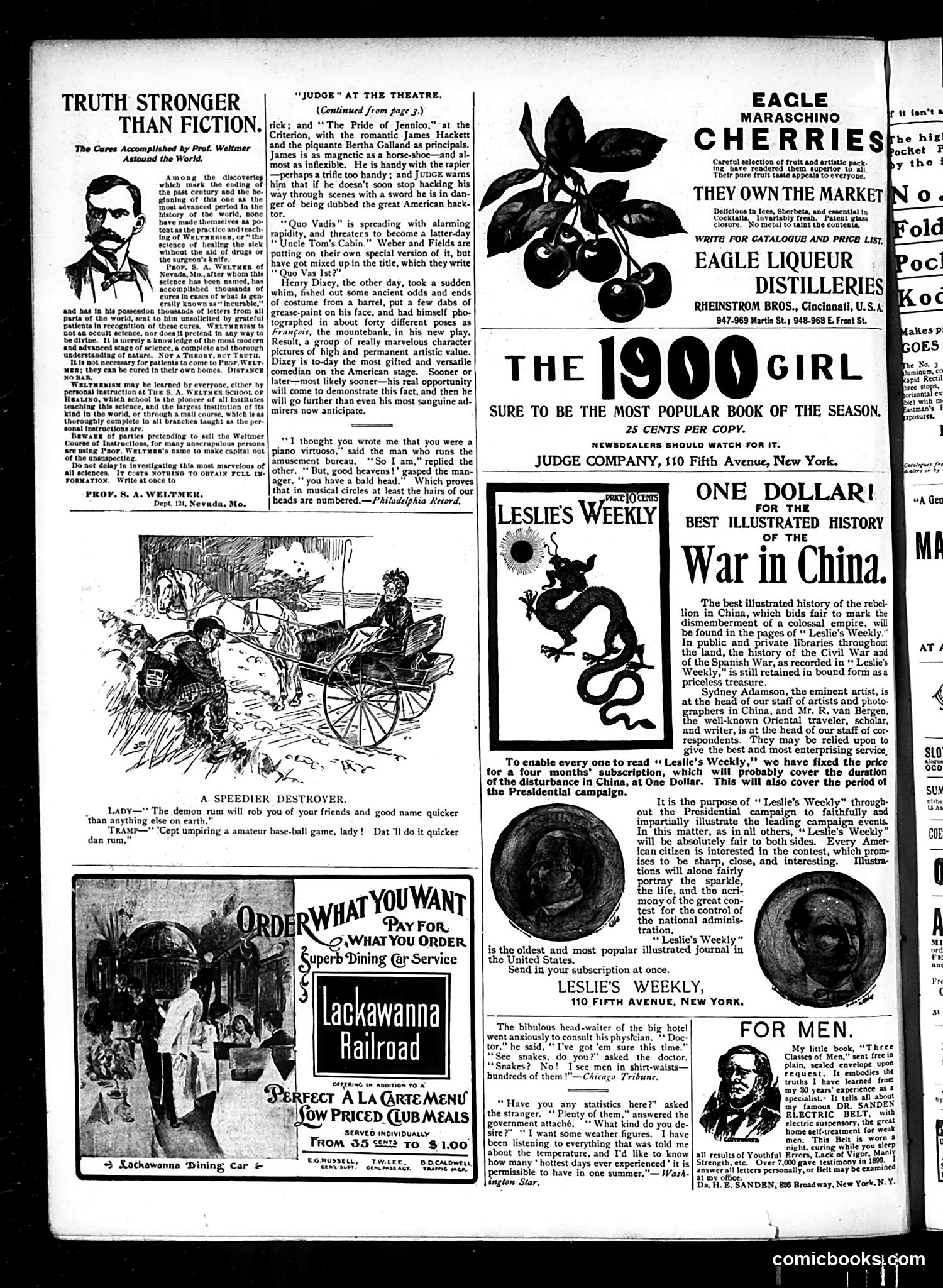
This page from *Judge* magazine (an American satirical weekly) contains mostly **advertisements and theater reviews**, rather than political cartoons. The main content includes: **Theater Criticism**: A review of current Broadway productions, including *"The Pride of Jennico"* and *"Quo Vadis."* The critic jokes about Weber and Fields' version, misspelling it as *"Quo Vas Ist?"* — a pun on the Latin phrase. **Notable reference**: Henry Dixey, a contemporary comedian, is praised as "the most gifted and versatile comedian on the American stage," though the critic suggests he hasn't yet received his proper opportunity. **The anecdote about the "bald-headed pianist"** is a joke playing on vanity and artistic pretension. The page is primarily filled with **product advertisements** (Eagle Maraschino Cherries, Lackawanna Railroad dining cars, a book on the Boxer Rebellion in China, and dubious "Weltmer healing" courses). This was typical *Judge* content—mixing satire with commercial advertising to fund the publication.
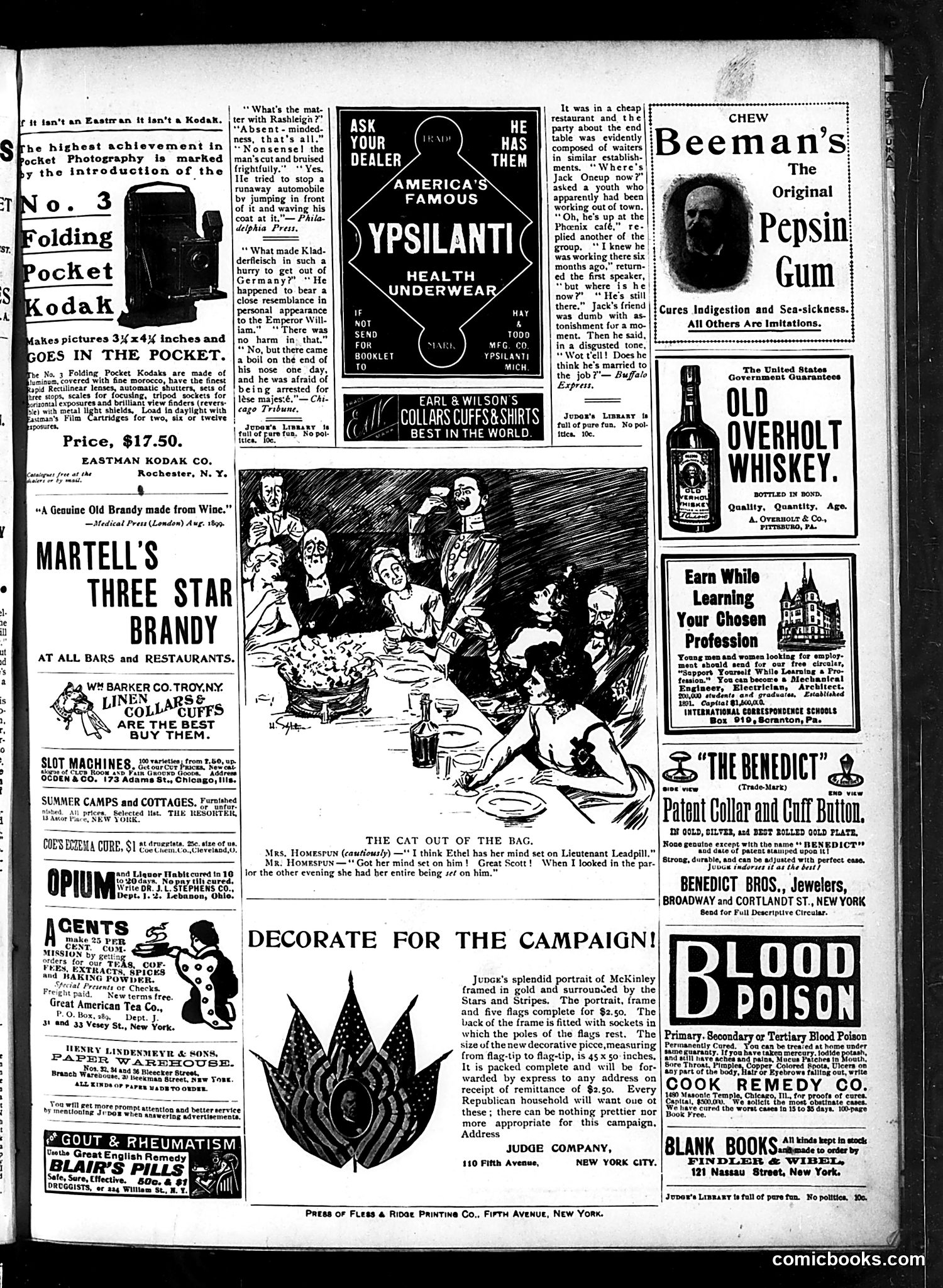
This page is primarily **advertising** with one small cartoon. The main cartoon, titled "The Cat Out of the Bag," depicts a domestic scene where Mrs. Homespun has apparently caught her daughter Ethel's romantic interest in "Lieutenant Leadpill." The humor rests on a double entendre: when Mr. Homespun says the girl "had her entire being set on him," Mrs. Homespun interprets this as evidence of serious romantic intent—suggesting the young man may be a fortune-hunter or unsuitable match. The page reflects early 20th-century social anxieties about courtship and class: the comic tension assumes readers will understand that a mother's vigilance against unsuitable suitors (particularly military officers of questionable means) was a recognized domestic concern. The remainder of the page consists of period advertisements for patent medicines, cordials, correspondence schools, and consumer goods typical of Judge's revenue model.
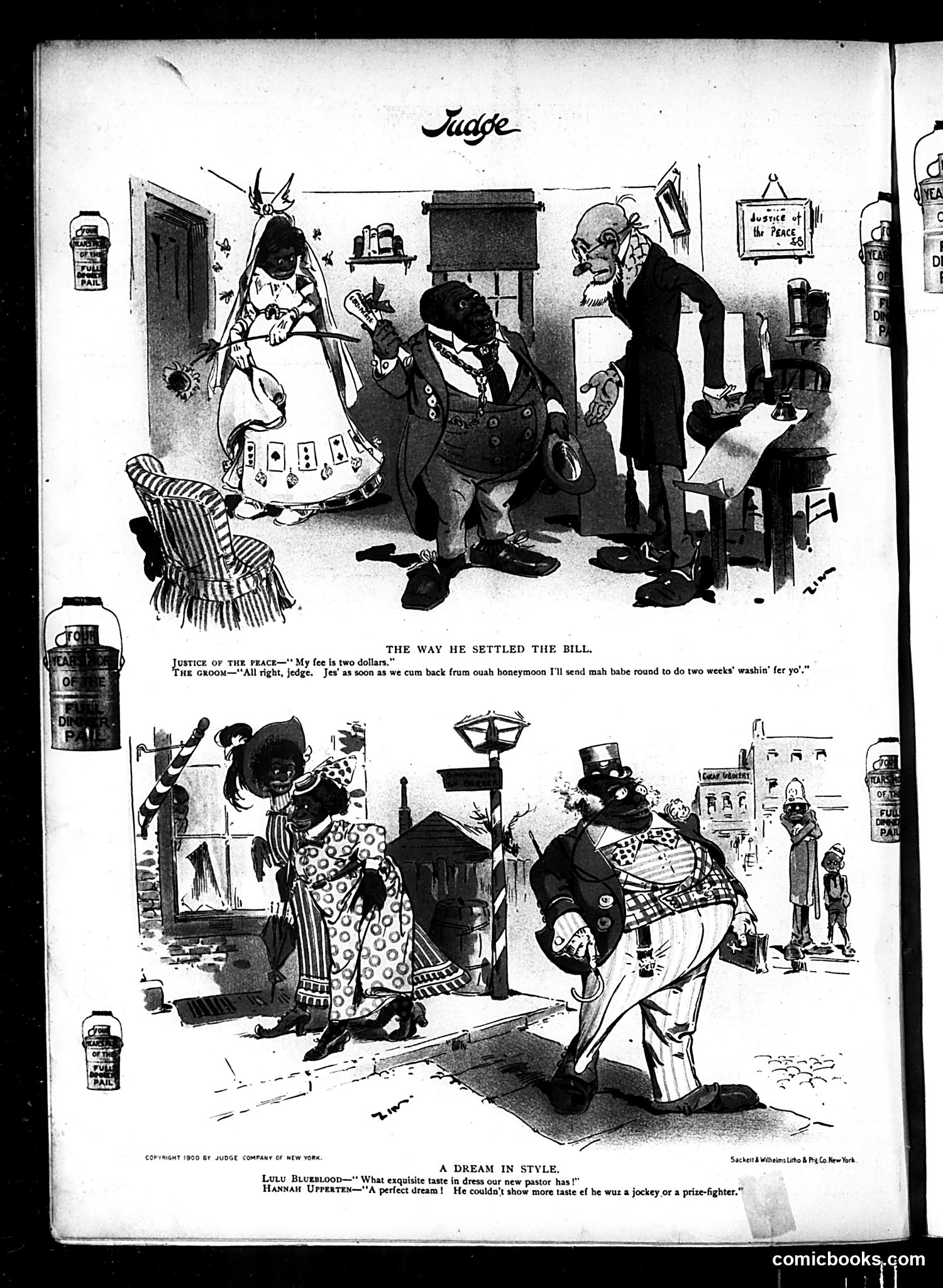
This page contains two satirical cartoons using racial caricatures typical of early 1900s American humor: **"The Way He Settled the Bill"** depicts a Justice of the Peace and a groom with exaggerated features. The groom proposes paying his two-dollar marriage fee through domestic labor—sending his wife to do two weeks of washing for the judge. The joke satirizes both the groom's poverty and the casual assumption that women's unpaid household work could substitute for cash payment. **"A Dream in Style"** mocks a new pastor's fashion sense through dialogue between two women. The satire suggests the pastor dresses with such refined taste that he resembles a jockey or prize-fighter—occupations considered crude or low-class. The joke plays on the incongruity between clerical dignity and these unlikely comparisons. Both cartoons employ dehumanizing racial imagery standard to the era's "Judge" magazine, reflecting deeply problematic artistic conventions of the period.