
A complete issue · 16 pages · 1900
Judge — August 25, 1900
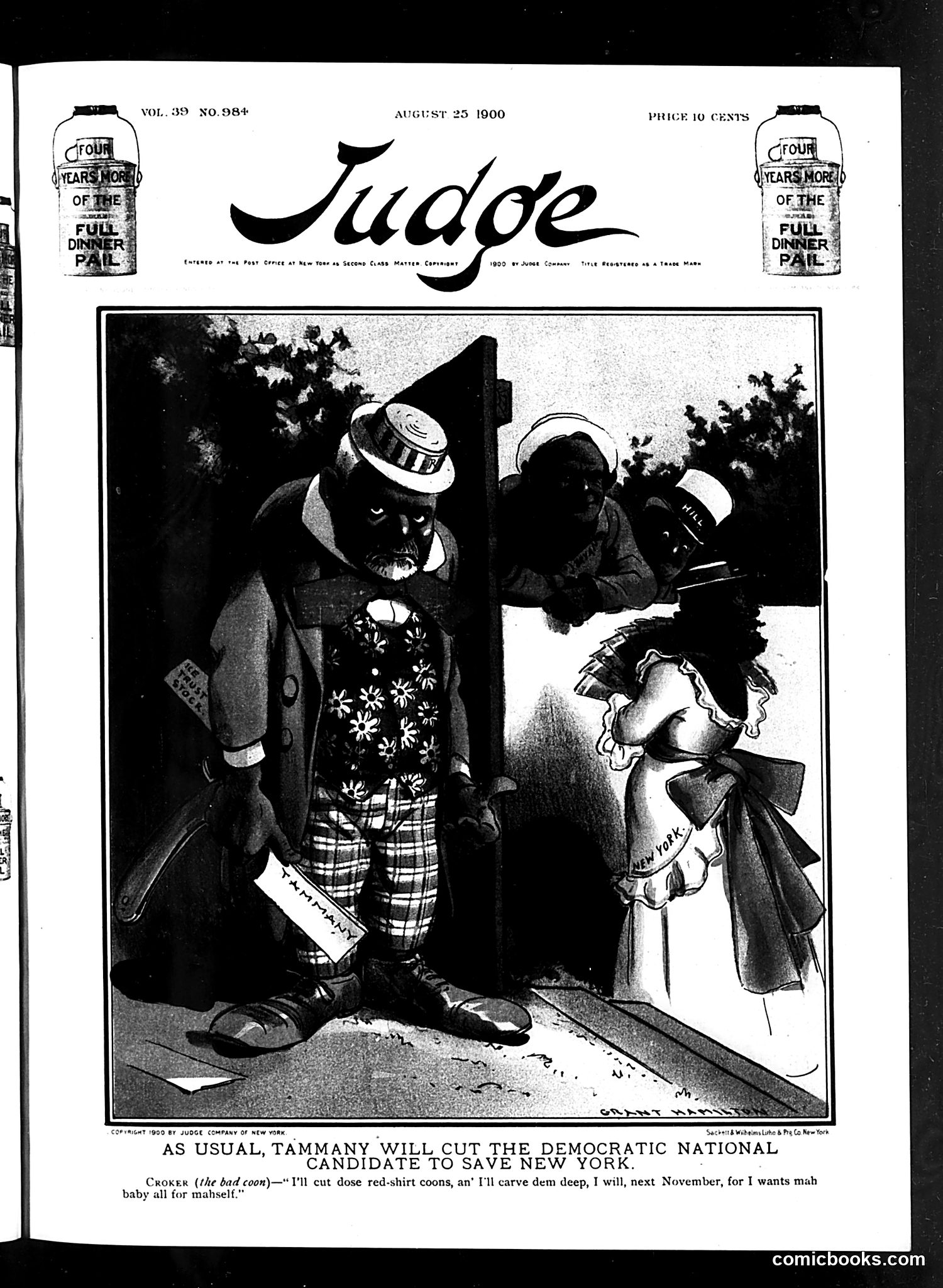
This cartoon satirizes **Tammany Hall's** expected interference in the 1900 Democratic National Convention. The title "As Usual, Tammany Will Cut the Democratic National Candidate to Save New York" indicates the political machine's self-interested maneuvering. The main figure appears to be a **Tammany Hall boss** (depicted with exaggerated caricature features) wielding a knife toward the Democratic nominee, represented as the patriotic figure on the right. The caption quotes a "Croker" (likely **Richard Croker**, Tammany's leader), threatening to "carve dem deep" to benefit his organization. The satire suggests Tammany would sabotage the national Democratic ticket if it conflicted with New York's local interests—a critique of machine politics prioritizing regional power over party success.
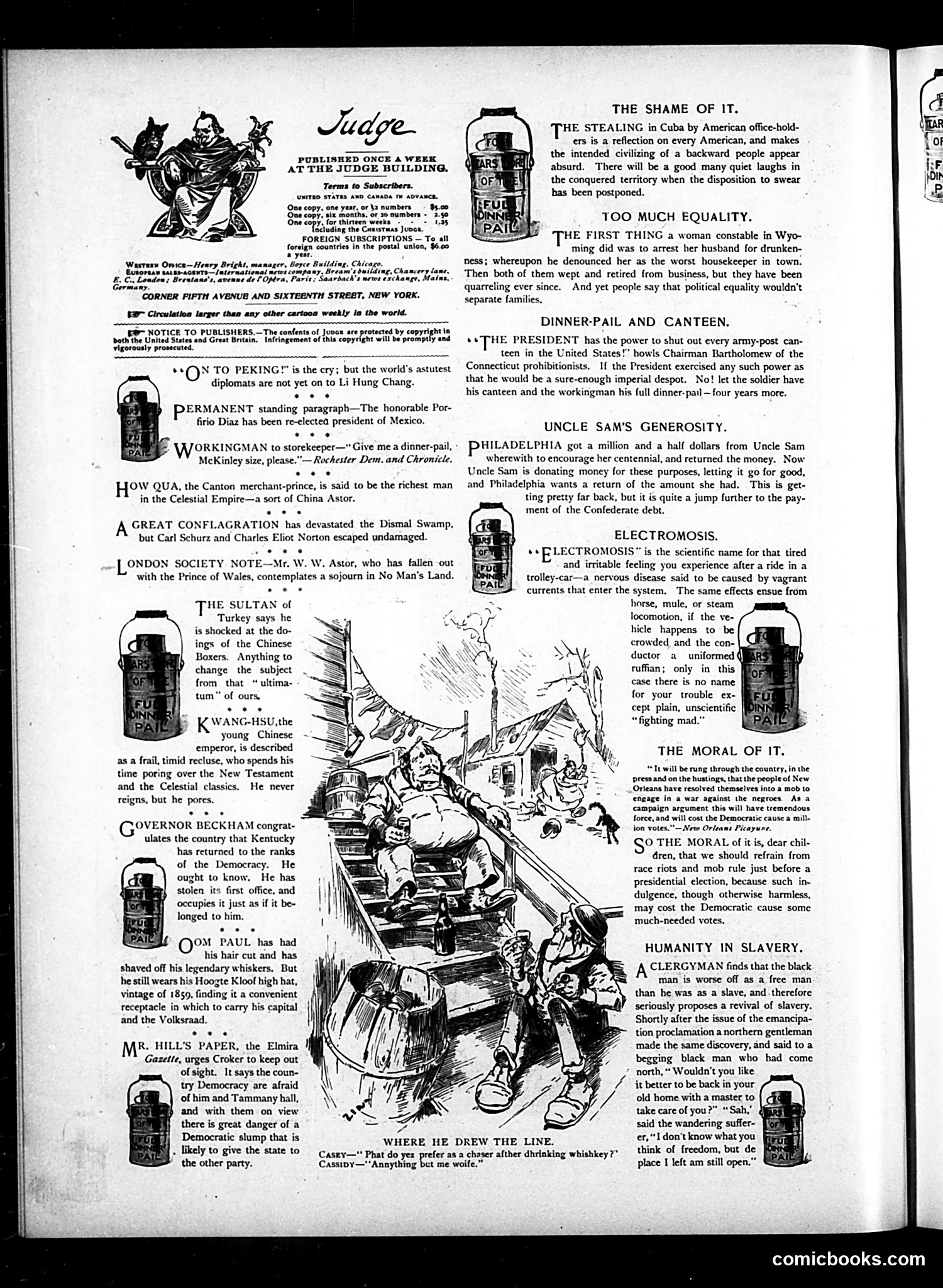
This page contains brief satirical commentary rather than major cartoons. Key items include: **"The Shame of It"**: Critiques stealing in Cuba, arguing it reflects poorly on American civilization and that looters should face consequences. **"Too Much Equality"**: Mocks a Wyoming constable who denounced his wife as the town's worst housekeeper, then wept when she left. The satire suggests political equality doesn't resolve domestic conflicts. **"Where He Drew the Line"** (central cartoon): Shows a man declining to act as a "chuser" (chooser) after drinking whiskey, preferring his wife instead. It satirizes selective principles about alcohol and decision-making. Other brief items comment on Mexican politics, Chinese history, and Democratic Party concerns. The page reflects early 20th-century American attitudes toward gender, politics, and social behavior through humor.
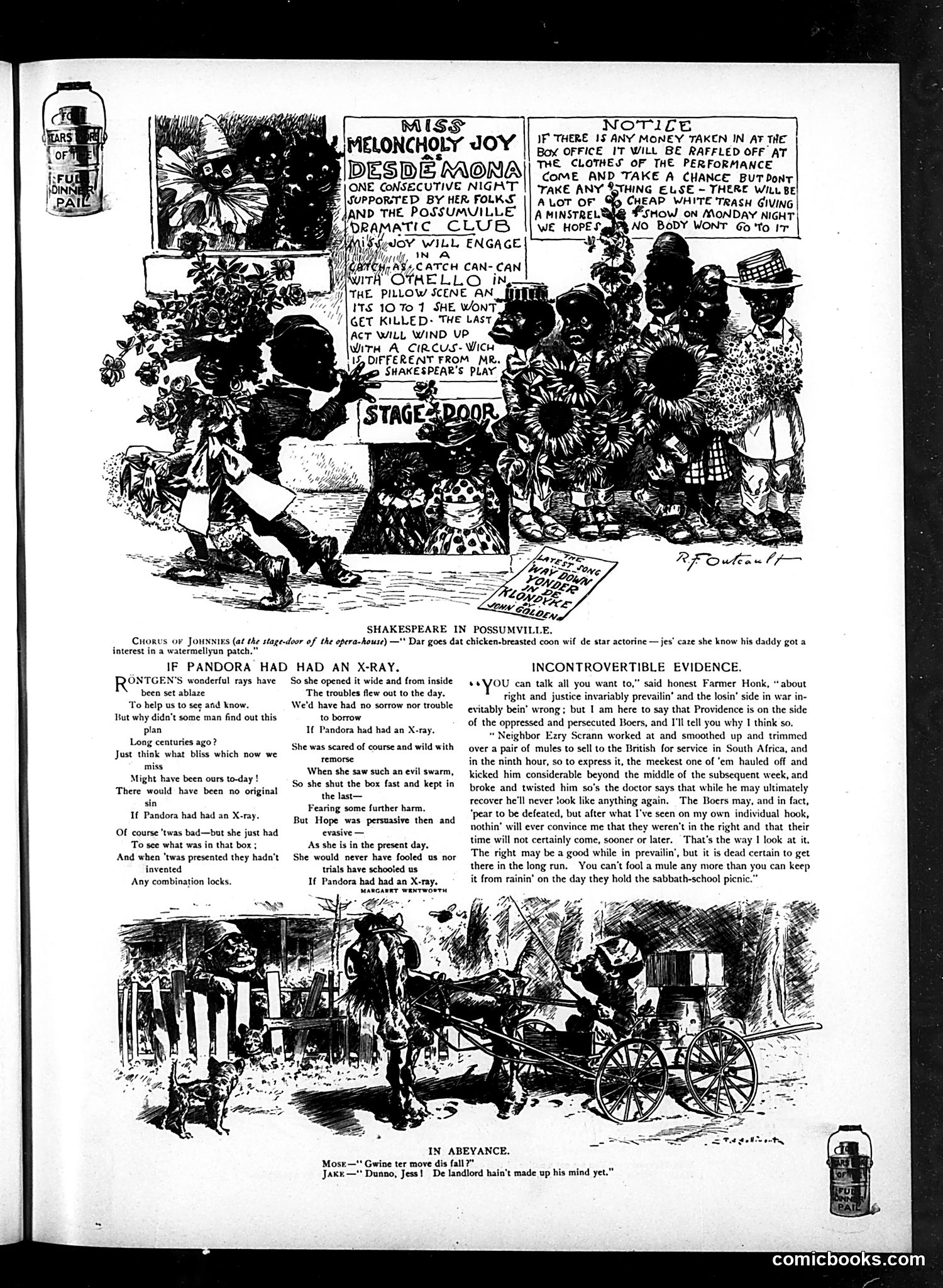
This page satirizes early 20th-century theater and African American performance. The top cartoon mocks "Miss Meloncholy Joy Desdemona," a production by the Posumville Dramatic Club performing Shakespeare's *Othello*. The caricatured figures with exaggerated features represent a minstrel-style theatrical performance—a common racist entertainment form of that era. The satire targets both the amateur theatrical ambitions of African American performers and white audiences' expectations of stereotypical entertainment. The "stage door" scene depicts performers in elaborate costume. The accompanying text pieces ("If Pandora Had Had an X-ray" and "Incontrovertible Evidence") appear to be humorous stories unrelated to the theatrical satire. The bottom illustration ("In Abeyance") shows a separate domestic comedy scene with no clear political content visible.
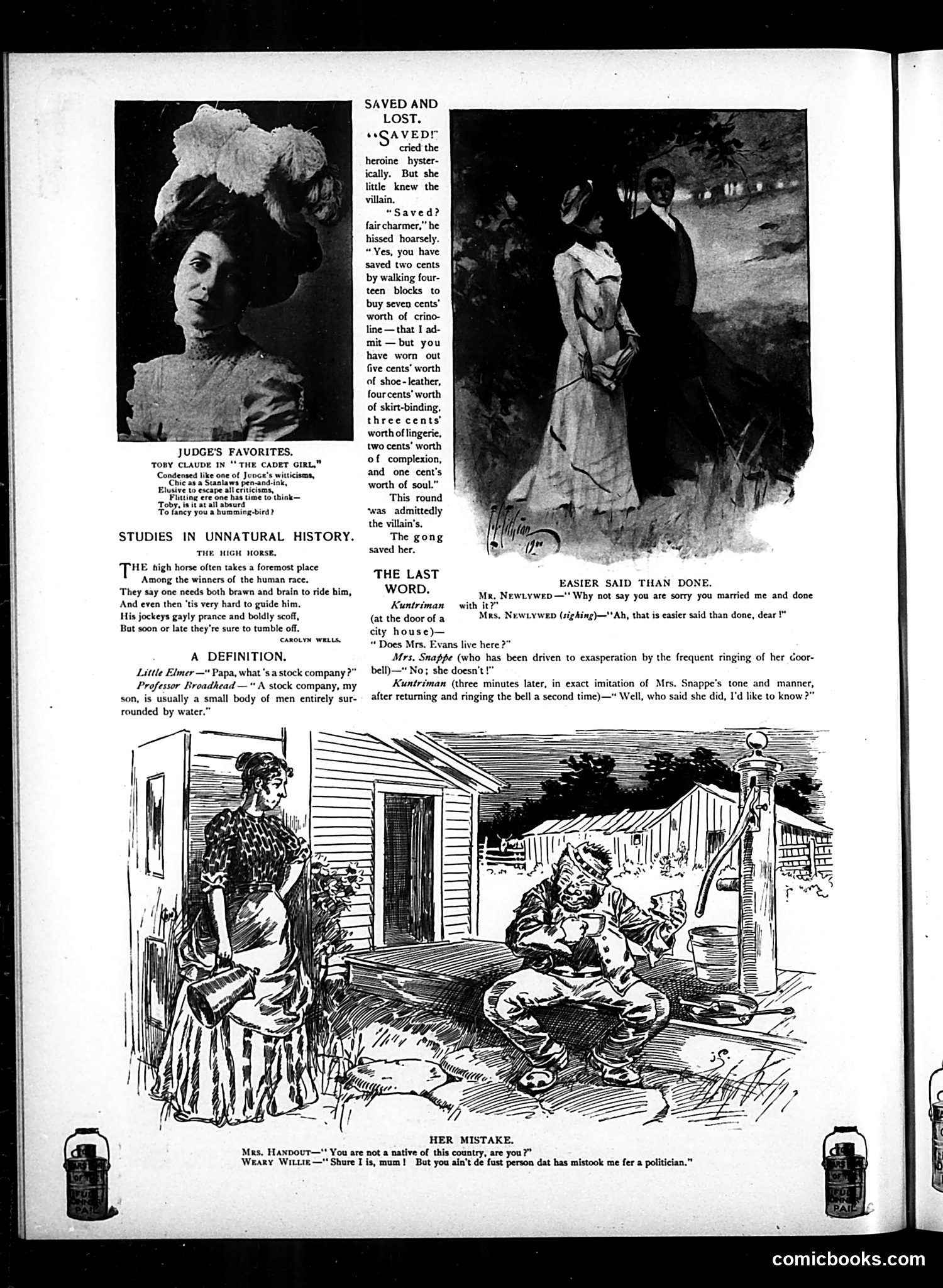
This page contains several distinct pieces of humor and commentary: **"Saved and Lost"**: A narrative about a villain who calculates the heroine's "worth" in material terms (crinoline, shoe-leather, etc.) rather than moral value—satirizing how some men commodify women. **"Studies in Unnatural History"**: A joke about high horses, likely mocking someone's pretentious attitude. **"Her Mistake"**: The cartoon depicts Mrs. Handout mistaking Weary Willie (a vagrant character) for a politician. The joke plays on the era's perception that politicians and vagrants were similarly dishonest or untrustworthy—a commentary on political corruption and hypocrisy common in Gilded Age satire. The other brief sections are humorous definitions and wordplay typical of Judge's satirical format.
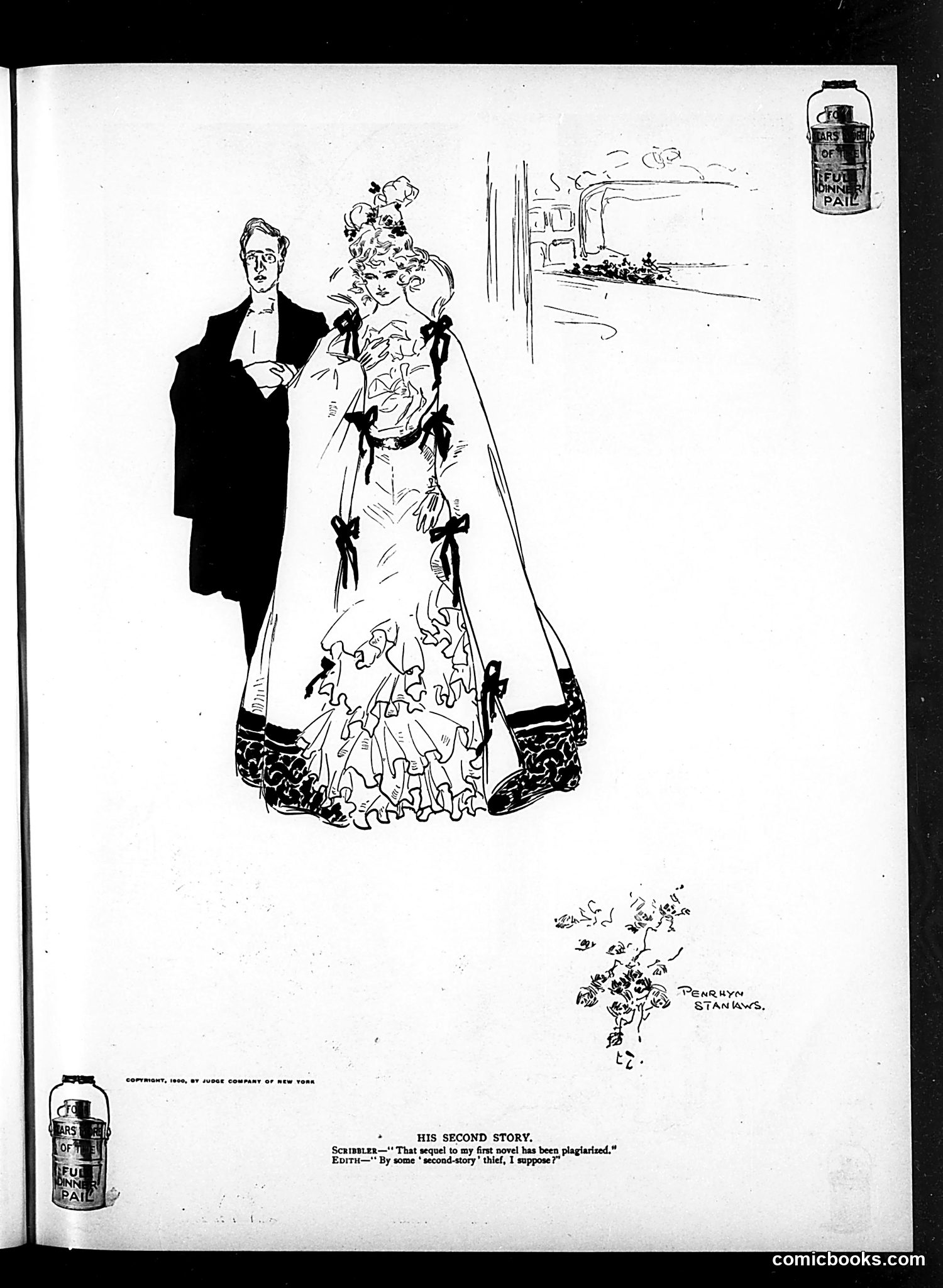
This is a visual pun playing on the term "second-story thief" (a burglar who enters buildings through upper floors). A well-dressed man tells an editor that his novel's sequel has been plagiarized. The editor quips back that it must have been stolen by a "second-story thief"—making a joke about both literary theft and actual burglary. The cartoon's humor relies on the double meaning: the writer's "second story" (his sequel novel) has literally been stolen, making the plagiarist a "second-story thief" in both the literary and criminal sense. The elegant illustration by Penrhyn Stanlaws emphasizes the sophisticated setting, contrasting the refined world of literature with the crude reality of theft.
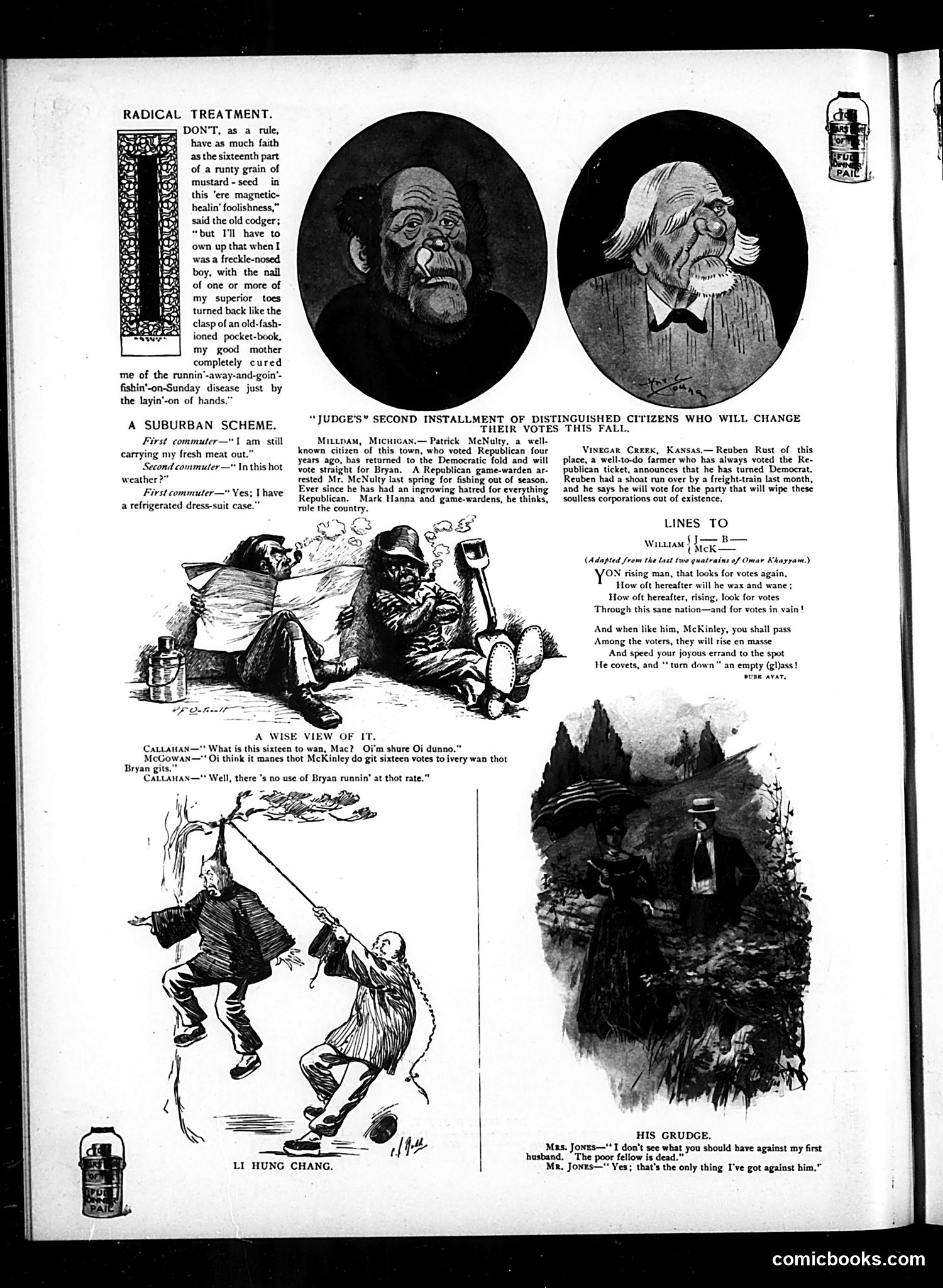
This page satirizes the 1896 U.S. presidential election between Republican William McKinley and Democrat William Jennings Bryan. The central feature, "Judge's Second Installment of Distinguished Citizens," mocks voter switches to Bryan by presenting ridiculous reasons: a Michigan man voting Democratic because a Republican game-warden caught him fishing illegally; a Kansas farmer switching parties because a railroad killed his pig. The satire suggests Bryan's support comes from petty grievances and irrational complaints rather than serious policy differences. The poem "Lines to William" (adapted from Omar Khayyam) predicts McKinley's electoral success despite Bryan's repeated campaigns. Other cartoons on the page are unrelated vignettes—a commuter's refrigerated suit case, ethnic stereotypes in dialogue, and domestic humor. The overall message attacks Bryan's electoral viability and Democratic voters' shallow motivations.
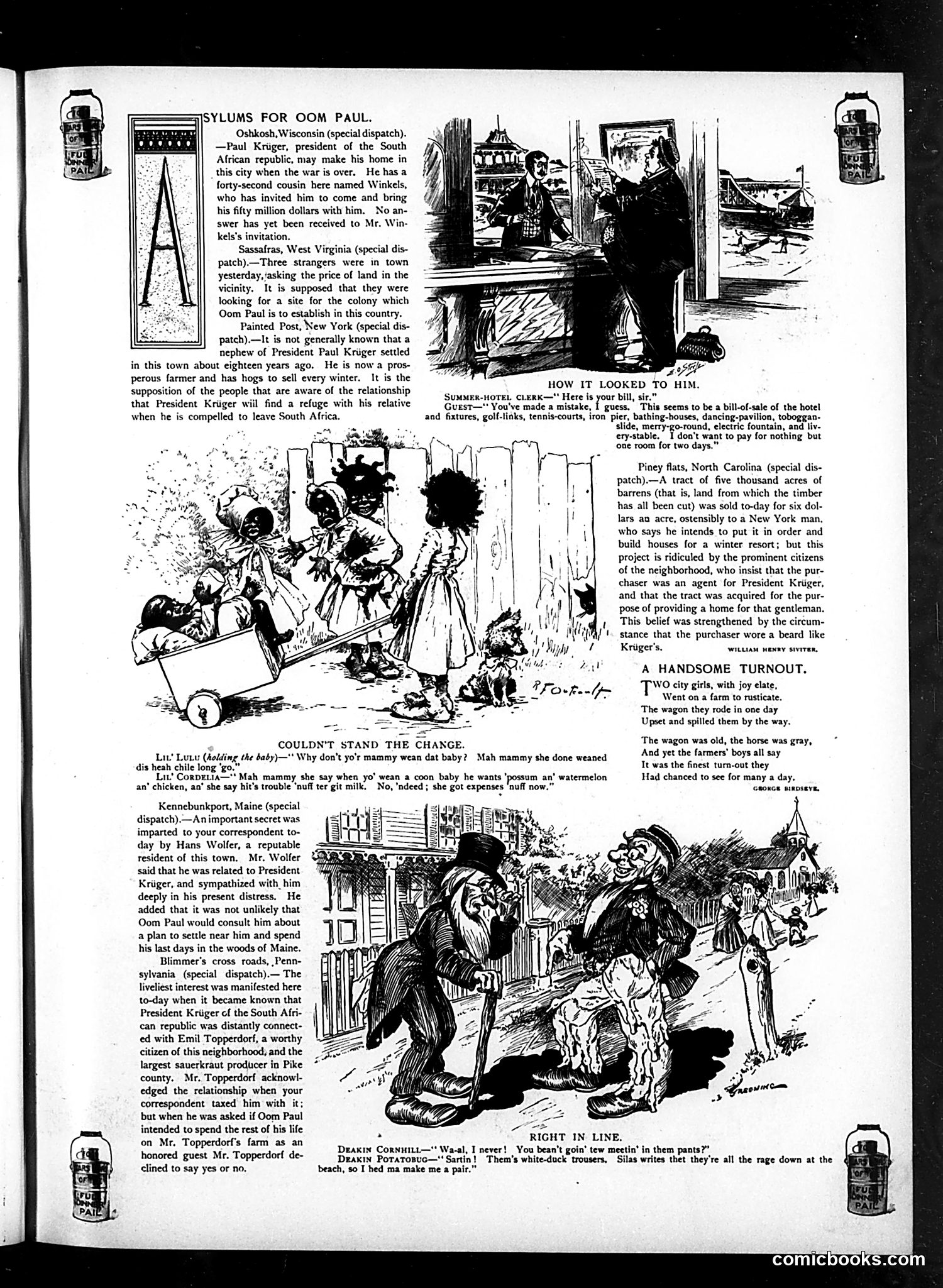
This satirical piece mocks American opportunism during the Second Boer War (1899-1902). "Oom Paul" Kruger, president of the South African Republic, faced military defeat, and the satire imagines various Americans—from Wisconsin to Maine—claiming distant relations to him and offering him refuge, clearly hoping to access his "fifty million dollars." The humor lies in depicting small-town Americans fabricating tenuous connections (a "forty-second cousin," a beard resembling Kruger's, vague family ties) as transparent schemes to secure wealth. Each dispatch from different locales presents increasingly absurd claims of kinship or land sales allegedly intended for Kruger's post-war settlement. The cartoons reinforce this theme: one shows a hotel clerk presenting inflated charges; another depicts rural folk observing a wagon accident. The satire critiques American greed and self-interest—the assumption that a desperate foreign dignitary equals a financial opportunity.
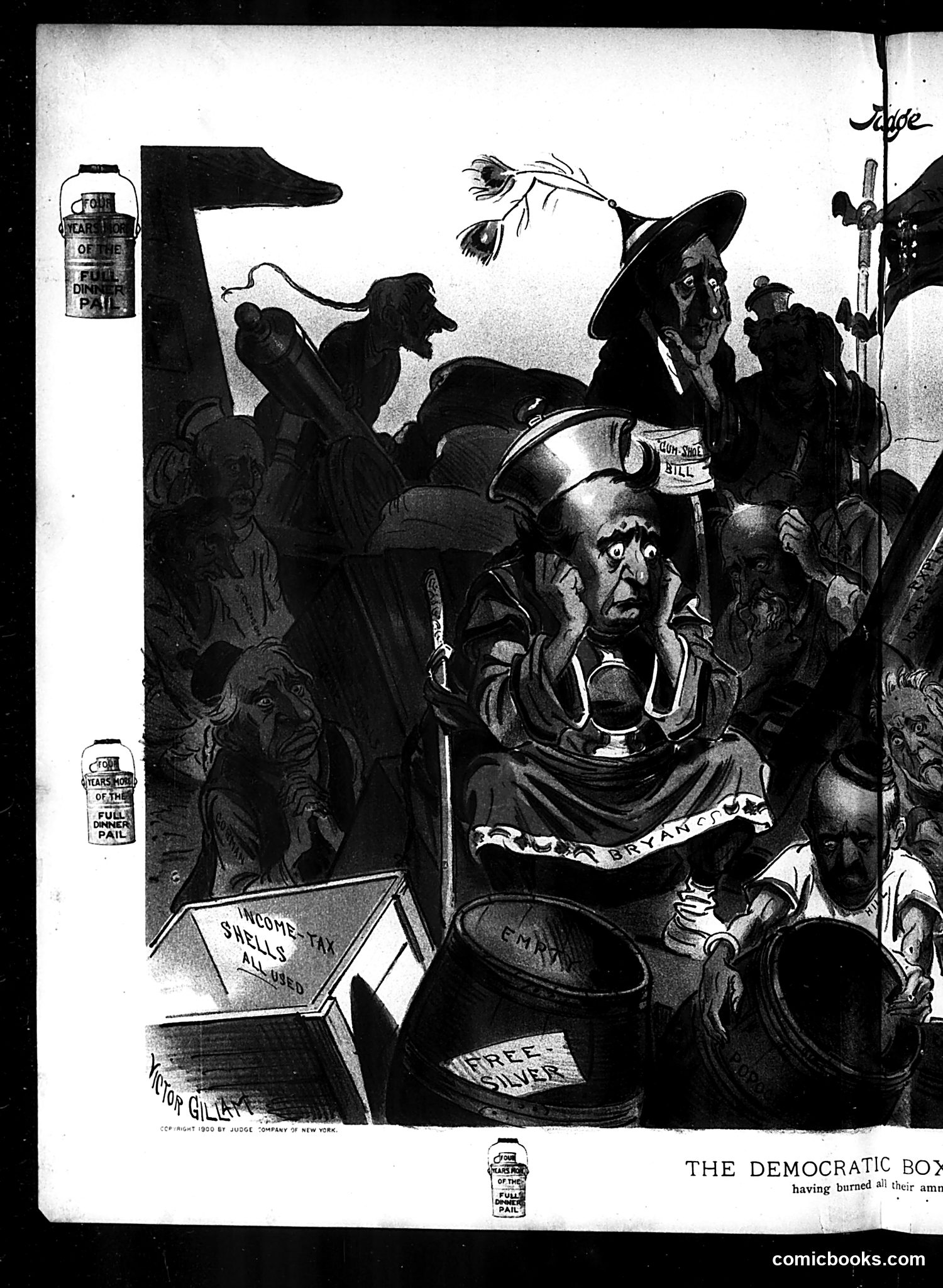
This political cartoon satirizes the Democratic Party as depleted and desperate. The image depicts a crowded, chaotic scene of figures emerging from or surrounding a large box labeled "THE DEMOCRATIC BOX." The OCR text indicates the Democrats have "burned all their ammunition," suggesting they've exhausted their political resources or arguments. The composition—with caricatured faces expressing distress or confusion, various implements scattered about, and a sense of disorder—mocks Democratic disorganization or weakness. Visible text references include "BRYAN" (likely William Jennings Bryan), indicating this cartoon addresses Democratic leadership struggles, possibly from the early 1900s. The satirical point: the Democratic Party is shown as chaotic, spent, and lacking viable direction or candidates.
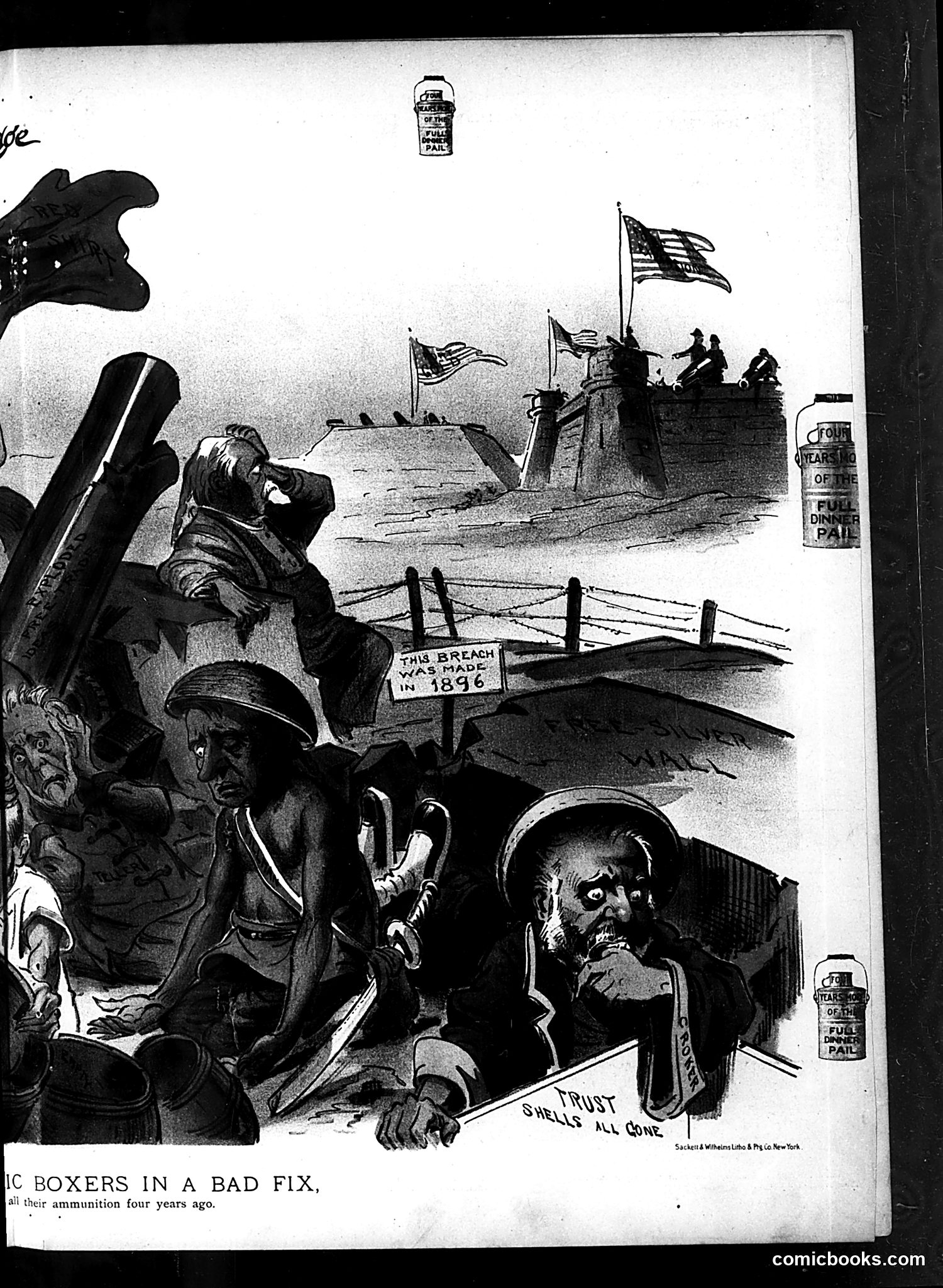
This Judge magazine cartoon satirizes American boxers or prizefighters in a "bad fix," suggesting they've depleted resources ("ammunition") from four years prior. The fortified position with American flags likely represents America's military or defensive posture. The grotesque figures in the foreground—appearing distressed or trapped—represent the boxers facing consequences or hardship. The 1896 date marked on the breach suggests reference to a specific historical moment, possibly relating to the Spanish-American War period or domestic boxing scandals. The cartoon's message appears critical: American boxers have squandered their advantages and now face difficult circumstances. The "Trust Smells All Gone" caption suggests lost commercial opportunity or public support. Without more context, the exact target remains unclear, but the satire condemns poor decision-making or resource mismanagement by the boxing community.
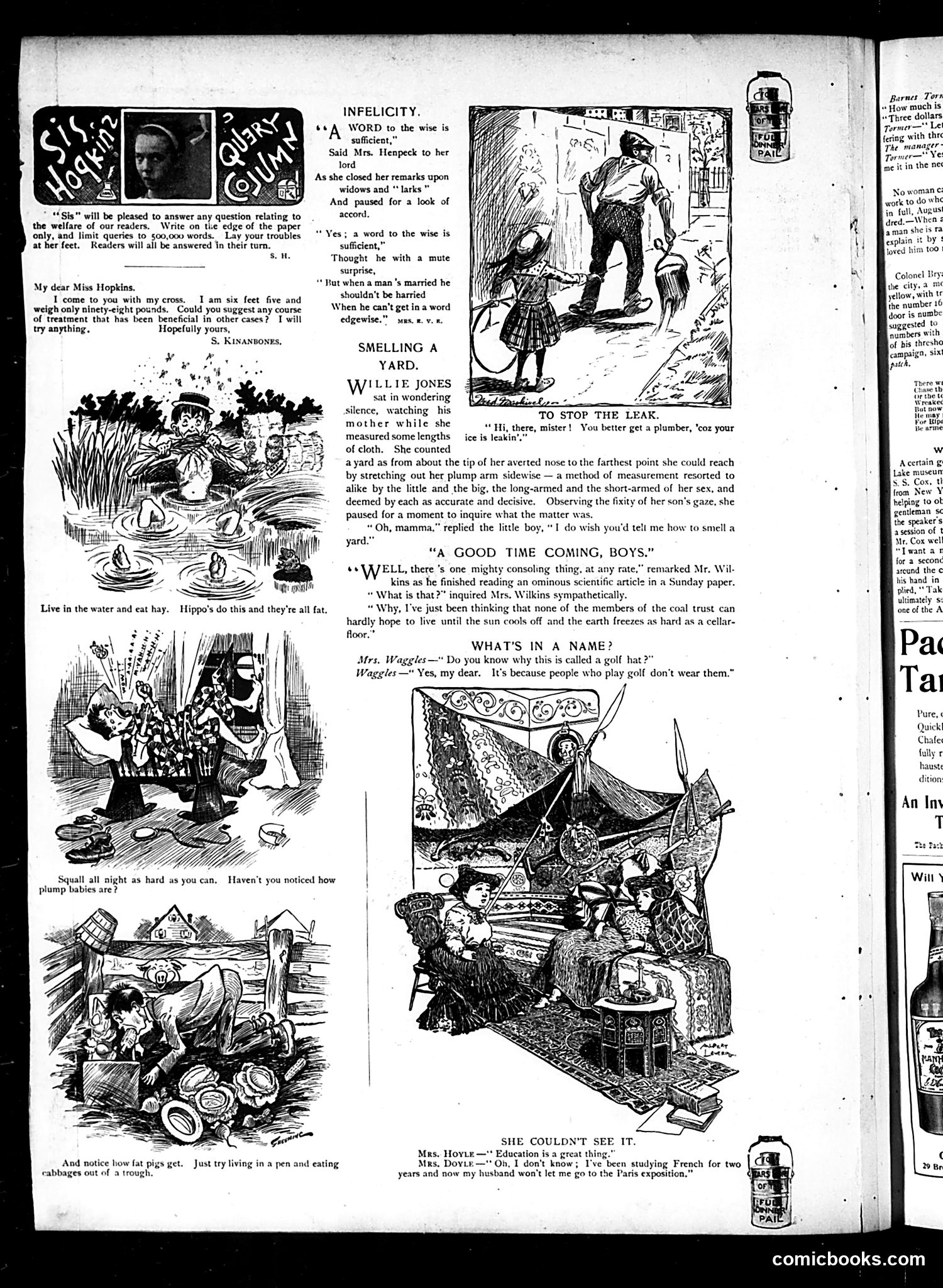
This page contains several brief satirical pieces typical of Judge magazine's humor: **"Infelicity"** mocks nagging wives through a traditional saying—"a word to the wise is sufficient"—implying Mrs. Henpeck's husband should take the hint to stop complaining, though he won't. **"Smelling a Yard"** jokes about imprecise female measurement: a mother measures cloth by stretching from her nose to her outstretched arm, a comically inaccurate method. Her puzzled son asks how to "smell a yard," misunderstanding her process—gentle mockery of both female practicality and childhood confusion. **"A Good Time Coming, Boys"** satirizes public anxiety about industrial monopolies (the "coal trust"), suggesting their members will die before facing consequences since the earth will freeze before the sun cools—dark humor about economic injustice. **"What's in a Name?"** puns on golf hats: golfers don't wear them, so the hat's name is ironic. **"She Couldn't See It"** presents Mrs. Doyle studying French for two years, only for her husband to forbid her attending the Paris Exposition—satirizing wasted female education and male control of married women.
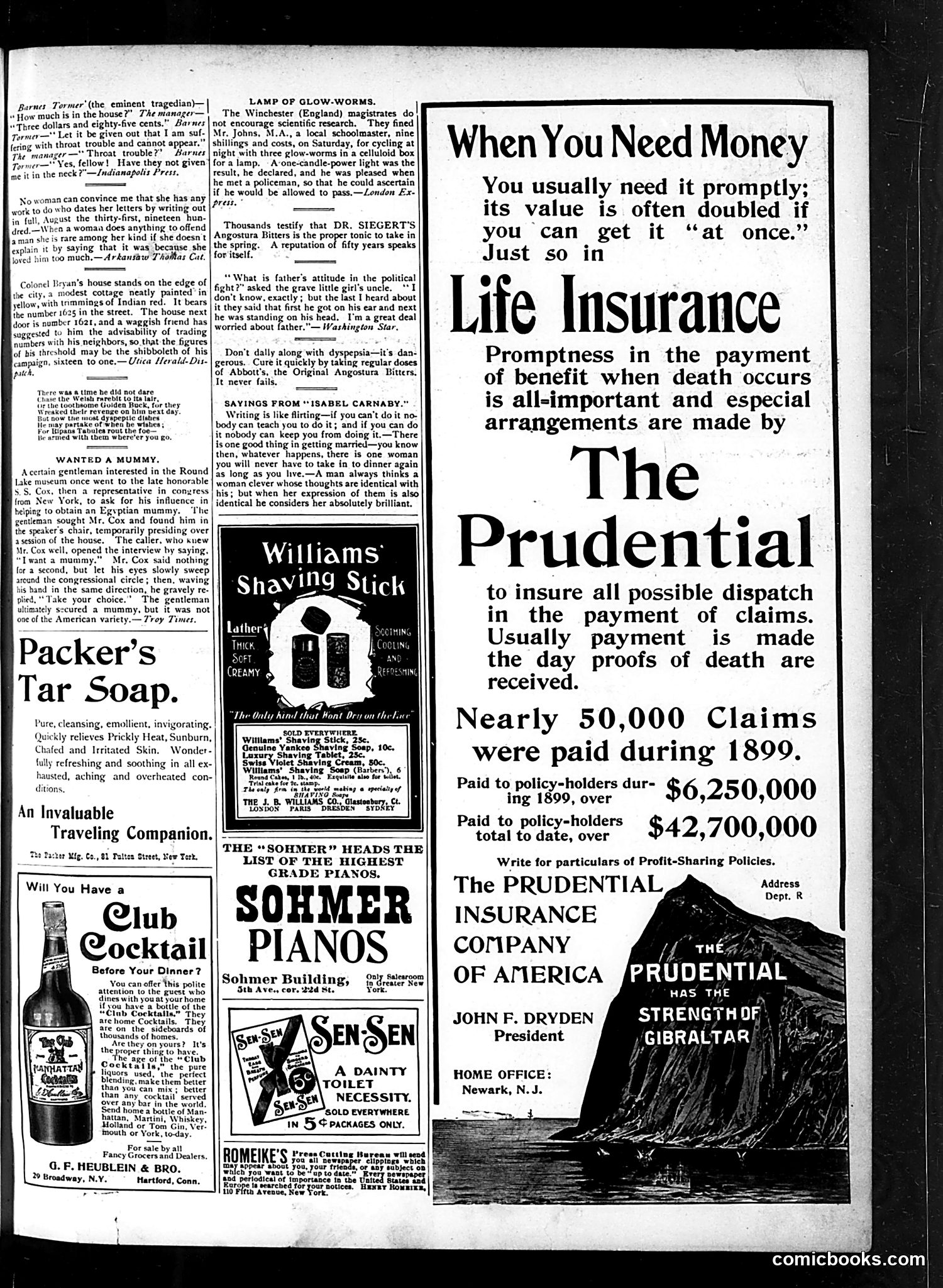
This page is primarily **advertising**, not political satire. It features multiple commercial ads (life insurance, pianos, soap, cocktails, bitters) interspersed with brief humorous anecdotes in the left column. The jokes are gentle social commentary rather than sharp satire: - A theater manager's joke about an actor faking illness to avoid poor attendance - Observations about women's writing habits and emotional reasoning - A reference to William Jennings Bryan's house number (1625) and the populist slogan "16 to 1" (the silver-to-gold ratio Bryan championed)—a topical political reference - A pun where Congressman S.S. Cox is asked for help obtaining an Egyptian mummy and responds by gesturing to his fellow congressmen, calling them "mummies"—insulting Congress as lifeless or ineffectual The largest content is the Prudential Insurance Company advertisement emphasizing prompt claim payment, with statistics from 1899. The page reflects Judge magazine's mix of light humor and commercial content typical of late-19th-century American publications.
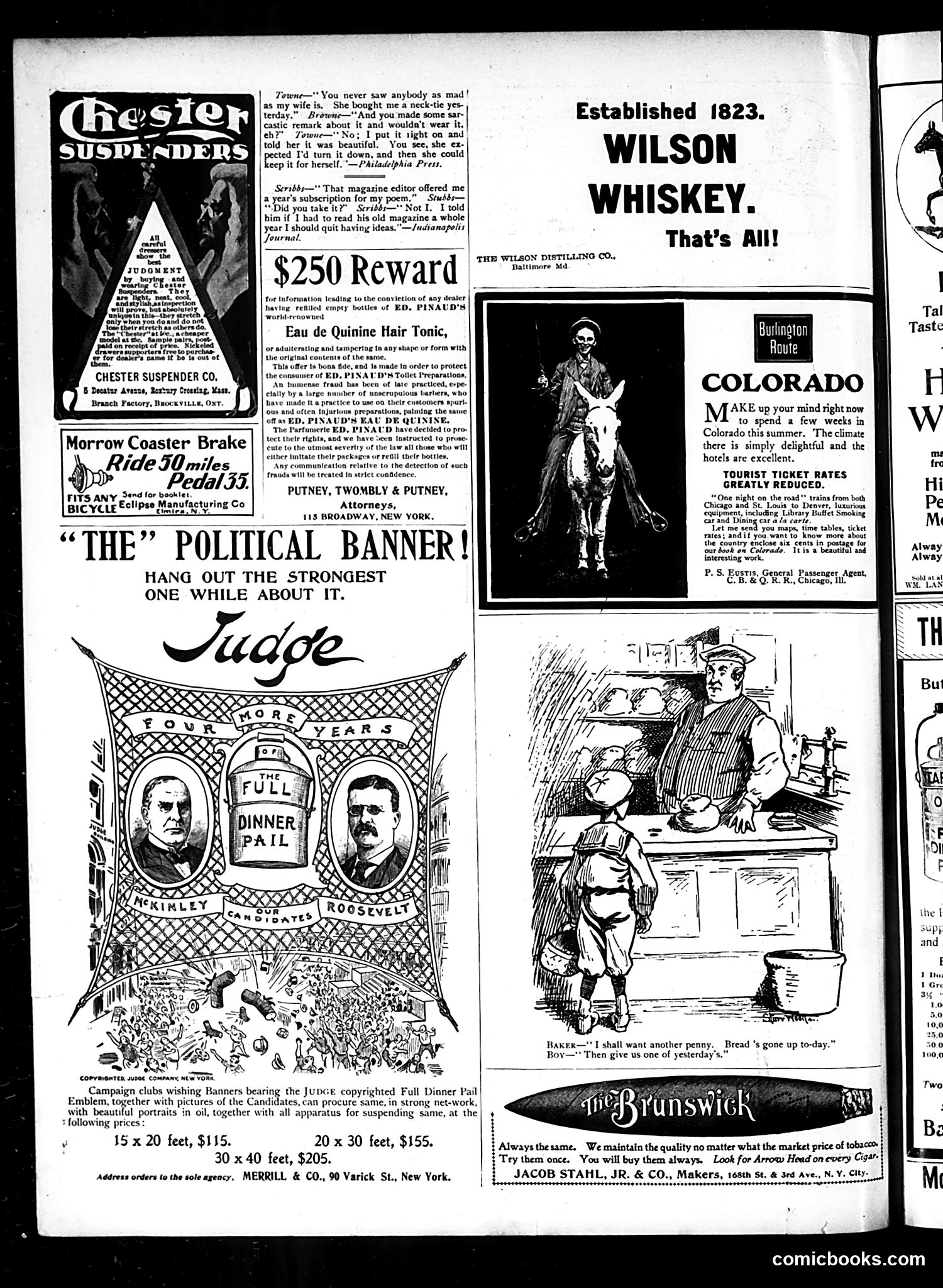
This page features **"The Political Banner"** — a campaign advertisement disguised as satire. The central image displays the "Full Dinner Pail," a Republican campaign symbol from the McKinley-Roosevelt era (early 1900s), flanked by portraits of McKinley and Roosevelt. The satire mocks political banners generally, suggesting campaigns "hang out the strongest one while about it" — implying politicians promote whatever message works, regardless of consistency. The dinner pail symbolized Republican promises of prosperity and worker plenty, contrasting with Democratic claims of economic hardship. The page also contains unrelated humor (marriage jokes, editor anecdotes) and advertisements (whiskey, bicycles, Colorado tourism). This mixed format was typical of Judge magazine. **The political point**: A tongue-in-cheek endorsement of Republican messaging for an upcoming election, wrapped in cynical commentary about campaign rhetoric.
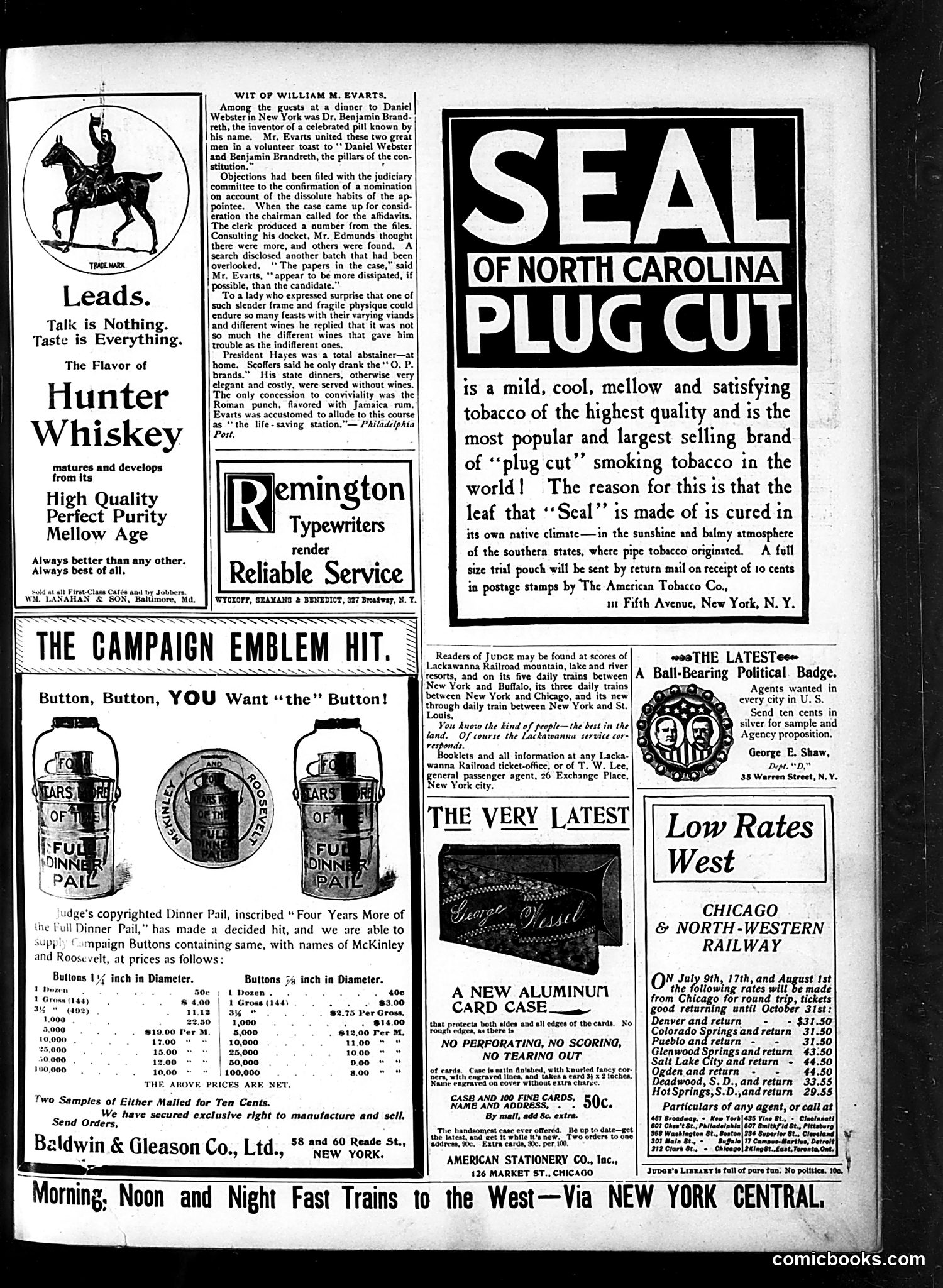
**Main Content - Political Satire:** This page contains two distinct historical references: 1. **"Wit of William M. Evarts"** - Anecdotes about 19th-century politician/lawyer William M. Evarts, including a clever pun on Daniel Webster and Benjamin Brandreth (a pill inventor), joking they are "pillars of the constitution." Another anecdote mocks a nominee's moral character by suggesting court papers documenting his vices are "more dissipated" than he is. 2. **"The Campaign Emblem Hit"** - Political buttons featuring McKinley and Roosevelt with "Full Dinner Pail" imagery, referencing the 1900 campaign promise of economic prosperity. The "Dinner Pail" was Republican campaign rhetoric suggesting workers would prosper under their policies. **Surrounding Material:** Mostly advertisements (Hunter Whiskey, Remington Typewriters, Seal tobacco, railroad services), typical of Judge's revenue model. The page satirizes political rhetoric and character through wordplay and campaign imagery rather than visual cartooning.
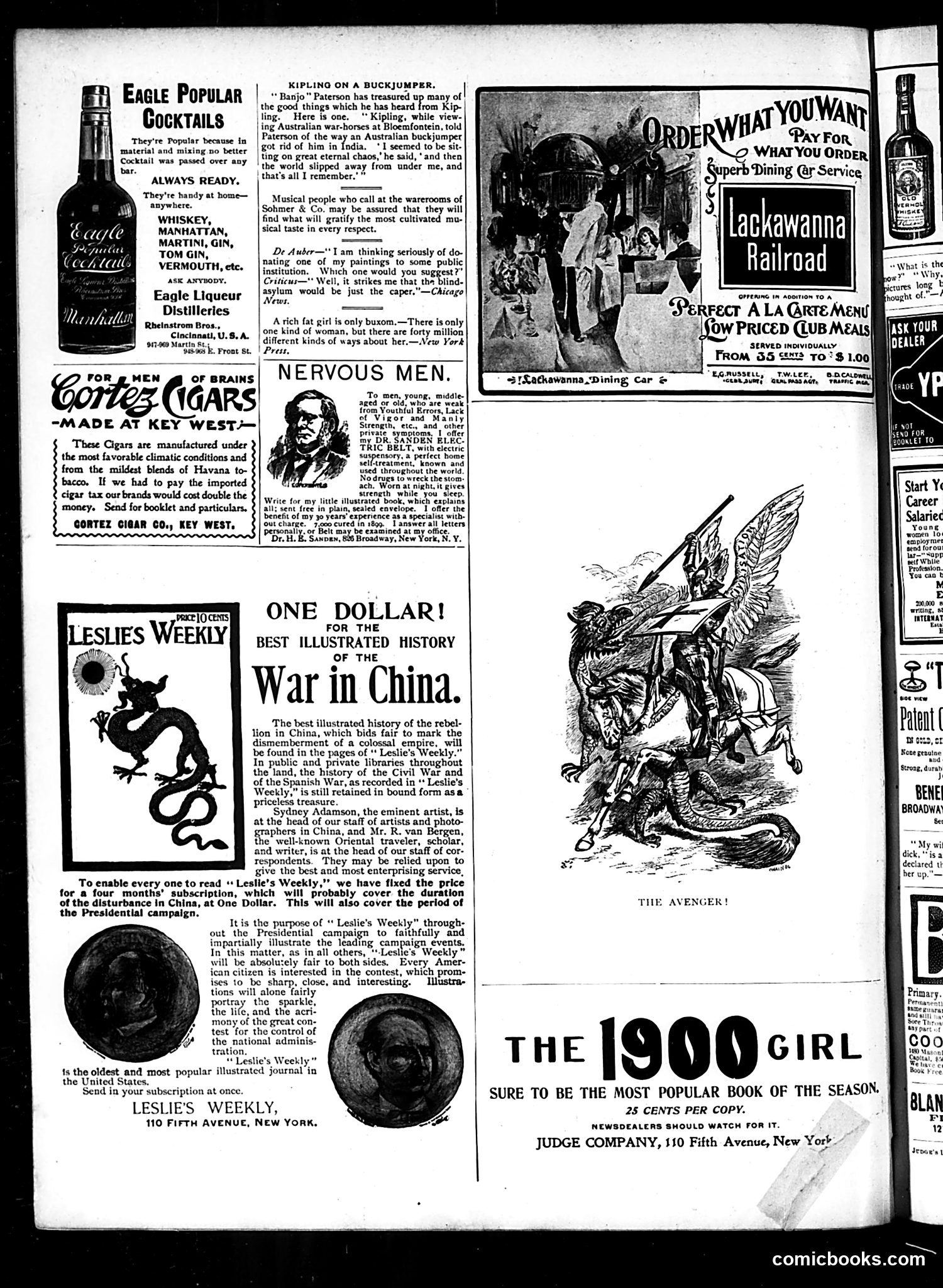
This page is primarily **advertising and promotional content** rather than political satire. The main elements include: **"Kipling on a Buckjumper"**: A brief anecdote (likely apocryphal) about author Rudyard Kipling being thrown from an Australian horse, with his quoted description of the experience as "great eternal chaos." This appears designed as entertaining copy rather than satire—playing on Kipling's celebrity status and the exotic appeal of colonial subjects. **Other content**: The page is dominated by product advertisements (Eagle cocktails, Cortez cigars, Sanden electric belts for "nervous men"), Leslie's Weekly promotion covering the Boxer Rebellion in China, and "The 1900 Girl" book advertisement. The illustration labeled "The Avenger" depicts a winged figure on horseback—unclear what specific event or figure this references without additional context. **Overall**: This is a typical turn-of-century magazine page mixing light humor, celebrity gossip, and commercial advertising rather than sharp political commentary.
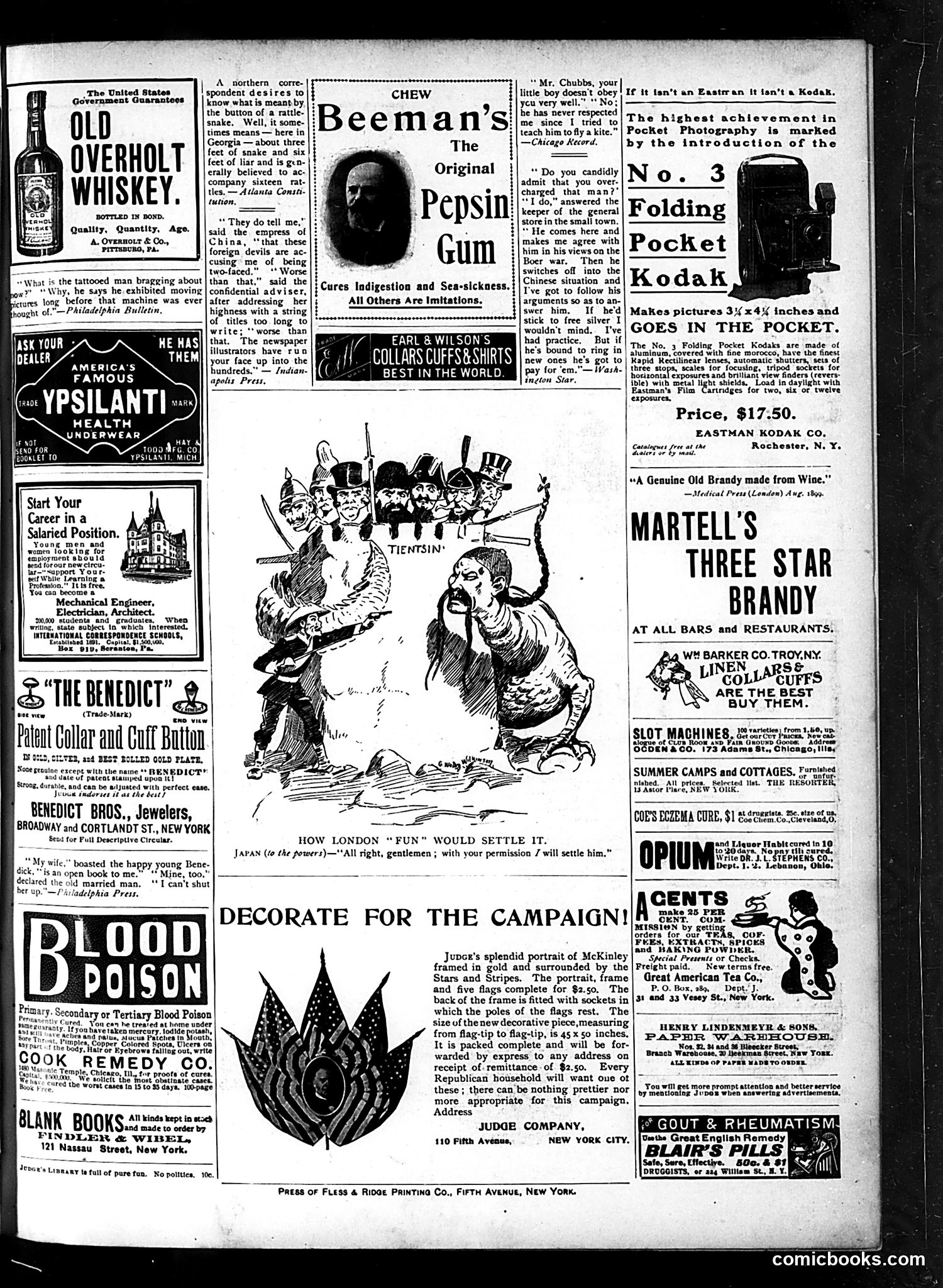
This is primarily an **advertising page** from Judge magazine with one significant political cartoon. ## The Political Cartoon The main cartoon depicts **Japan as a sumo wrestler** preparing to fight, with the caption "How London 'Fun' Would Settle It." Japan declares to assembled gentlemen: "All right, gentlemen; with your permission I will settle him." **Context**: This references the **Boxer Rebellion** (1900) in China. The cartoon satirizes British confidence that Japan could militarily resolve the Chinese situation. Japan is caricatured as a powerful fighter, while the gentlemen represent Western powers observing the conflict. The joke critiques the notion that Japan should be tasked with solving China's problems. ## Advertisements The page is filled with period product ads: whiskey, health underwear, cough syrup, cameras (Kodak), collars/cuffs, and McKinley campaign merchandise (portrait framed with flags for $2.50). The advertisements and cartoons together reflect early 1900s American interests: imperialism, consumer goods, and electoral politics.
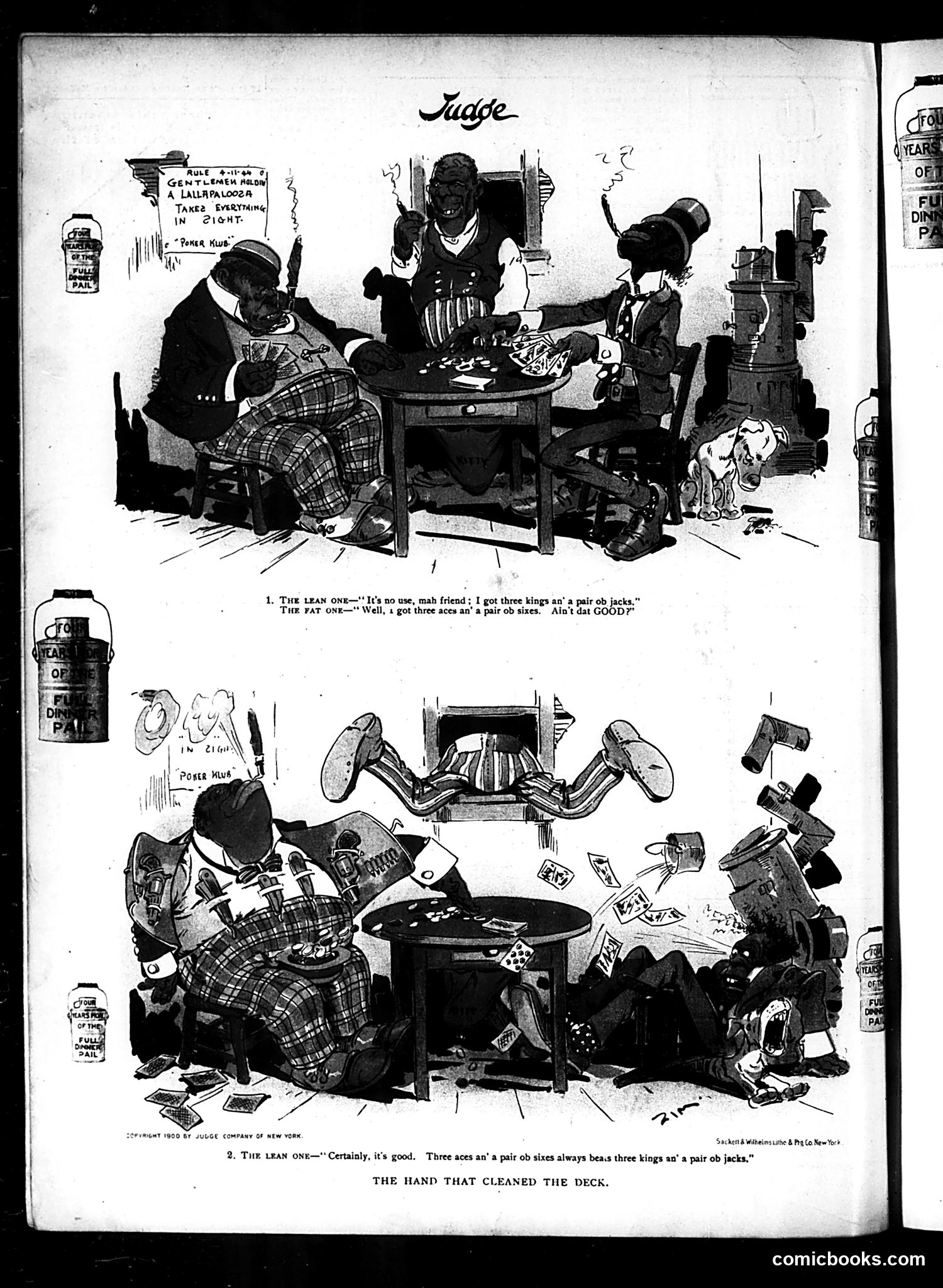
This two-panel cartoon satirizes a poker game between two men using racial caricature and dialect (typical of early 20th-century American humor). **The Setup**: Panel 1 shows a "lean one" and "fat one" playing cards. The lean player claims three kings and a pair of jacks; the fat player has three aces and sixes—ostensibly a winning hand. **The Punchline**: Panel 2 reveals the fat player has lost anyway, because "three aces an' a pair ob sixes always beas three kings an' a pair ob jacks"—a nonsensical poker rule that contradicts actual card rankings. **The Satire**: The title "The Hand That Cleaned the Deck" suggests cheating or manipulation. The joke appears to mock either gullibility or suggest that despite apparent advantages, someone with power manipulates outcomes. The exact political or social reference remains unclear without additional context about Judge's 1920s concerns.