
Judge, 1900-08-25 · page 2 of 16
Judge — August 25, 1900 — page 2: what you’re looking at
What you’re looking at
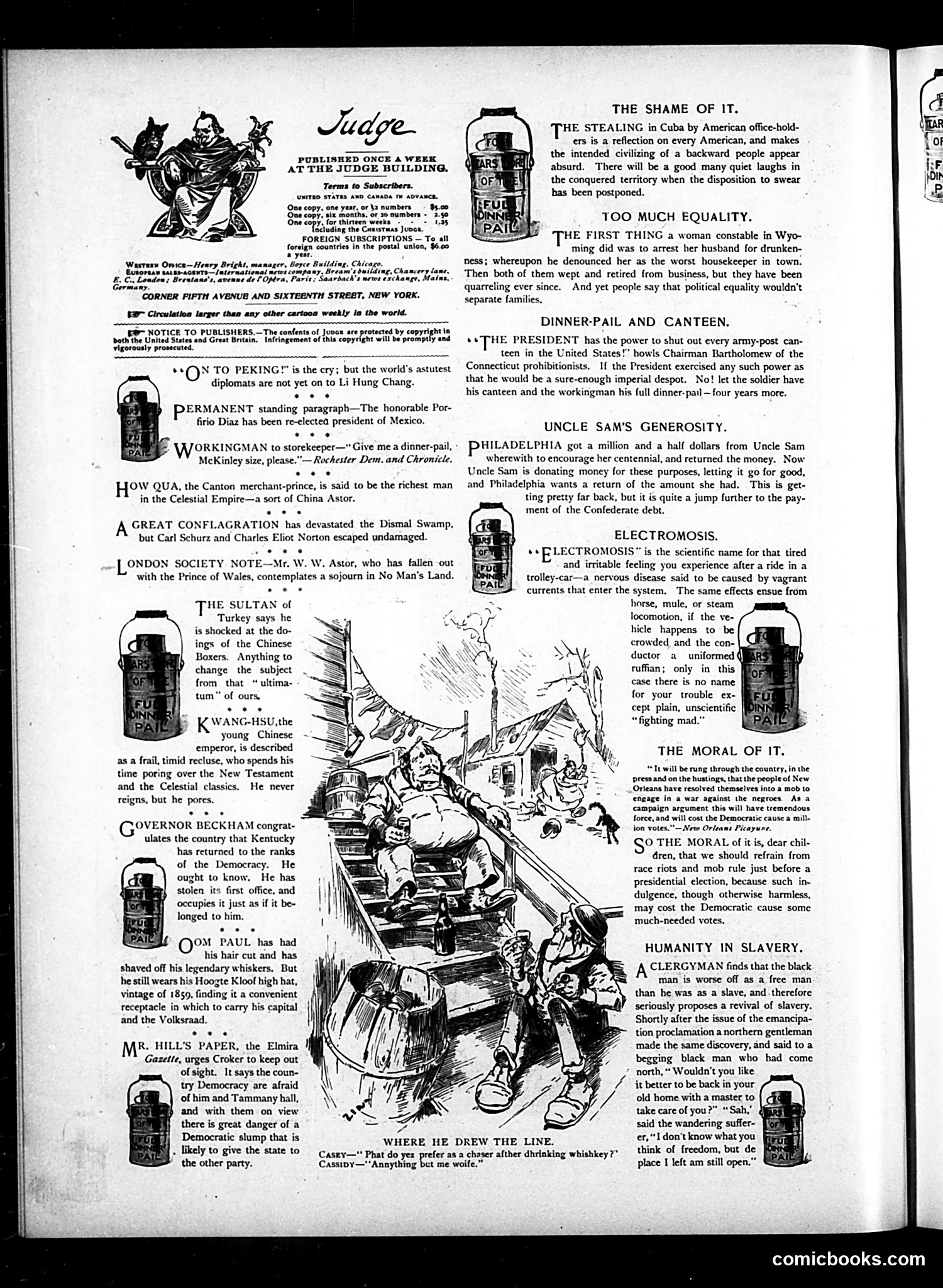
This page contains brief satirical commentary rather than major cartoons. Key items include: **"The Shame of It"**: Critiques stealing in Cuba, arguing it reflects poorly on American civilization and that looters should face consequences. **"Too Much Equality"**: Mocks a Wyoming constable who denounced his wife as the town's worst housekeeper, then wept when she left. The satire suggests political equality doesn't resolve domestic conflicts. **"Where He Drew the Line"** (central cartoon): Shows a man declining to act as a "chuser" (chooser) after drinking whiskey, preferring his wife instead. It satirizes selective principles about alcohol and decision-making. Other brief items comment on Mexican politics, Chinese history, and Democratic Party concerns. The page reflects early 20th-century American attitudes toward gender, politics, and social behavior through humor.
📄 Transcribed text from this page (OCR, searchable)
Machine-transcribed from the original scan — historical spelling and the odd misread are preserved.
PUBLISHED ONCE 4 WEEK AT THE JUDGE BUILDING, Terms to Subscribers. UnrTaD STATIS Amo CANADA TH ADVANCE, ‘One copy, one year, or $2 numbers $5.00 ‘One copy, six months, or 20 oumbers = 3-40 One copy, for thirteen weeks. 1s. faciuding the Cxrstaas Jvoce FOREIGN SUBSCRIPTIONS — To all foreign countries in the postal union, $6.00 eyar. Wasraaw Omice—Henry Bright, manager, Boyce 8: i Saias-acEnts—/alermationad mews Com E, Cu London; Bretane's, avenue del Optra, Pat Germany CORNER FIFTH AVENUE AND SIXTEENTH STREET, NEW YORK. Chicago. fan's building, Chancery lane, arback's mews exchange, Mains, $27 Circulation larger than any other cartooa weekly Ia the world. E9- NOTICE TO PUBLISHERS.—The contents of Juoce are protected by copyright in both the United States and Grest Britain, Iatringement of this copyright will be promptly and vigorously prosecuted. *8Q)N TO PEKING!" is the cry; but the world’s astutest diplomats are not yet on to Li Hung Chang. eee PERMANENT standing paragraph—The honorable Por- firio Diaz has been re-elected president of Mexico. Z ORKINGMAN to storekeeper—“ Give me a dinner-pail, McKinley size, please.""— Rochester Dem. and Chronicle. cee How QUA, the Canton merchant-prince, is said to be the richest man in the Celestial Empire—a sort of China Astor. GREAT CONFLAGRATION has devastated the Dismal Swamp, but Carl Schurz and Charles Eliot Norton escaped undamaged. ONDON SOCIETY NOTE—Mr. W. W. Astor, who has fallen out with the Prince of Wales, contemplates a sojourn in No Man's Land. THE SULTAN of Turkey says he is shocked at the do- ings of the Chinese Boxers. Anything to change the subject from that “ ultima- tum” of ours, see KWANG-HSU, the young Chinese emperor, is described as a frail, timid recluse, who spends his time poring over the New Testament and the Celestial classics. He never reigns, but he pores. GOVERNOR BECKHAM congrat- ulates the country that Kentucky has returned to the ranks of the Democracy. He ought to know. He has stolen its first office, and occupies it just as if it be- longed to him. eee oo PAUL has had his hair cut and has shaved off his legendary whiskers. But he still wears his Hoogte Kloof high hat, vintage of 1859, finding it a convenient receptacle in which to carry his capital and the Volksraad. ove Me: HILL’S PAPER, the Elmira Gazette, urges Croker to keep out of sight. It says the coun- try Democracy are afraid of him and Tammany hall, and with them on view there is great danger of a Democratic slump that is THE SHAME OF IT. ‘THE STEALING in Cuba by American office-hold- ers is a reflection on every American, and makes the intended civilizing of a backward people appear absurd. There will be a good many quiet laughs in the conquered territory when the disposition to swear has been postponed. TOO MUCH EQUALITY. ‘THE FIRST THING a woman constable in Wyo- ming did was to arrest her husband for drunken- ness; whereupon he denounced her as the worst housekeeper in town. Then both of them wept and retired from business, but they have been quarreling ever since. And yet people say that political equality wouldn't separate families, DINNER-PAIL AND CANTEEN. + «THE PRESIDENT has the power to shut out every army-post can- teen in the United States!" howls Chairman Bartholomew of the Connecticut prohibitionists. If the President exercised any such power as that he would be a sure-enough imperial despot. No! let the soldier have his canteen and the workingman his full dinner-pail —four years more. UNCLE SAM’S GENEROSITY. PHILADELPHIA got a million and a half dollars from Uncle Sam wherewith to encourage her centennial, and returned the money. Now Uncle Sam is donating money for these purposes, letting it go for good, and Philadelphia wants a return of the amount she had. This is get- ting pretty far back, but it is quite a jump further to the pay- ment of the Confederate debt. ELECTROMOSIS. LECTROMOSIS" is the scientific name for that tired and irritable feeling you experience after a ride in a trolley-car—a nervous disease said to be caused by vagrant currents that enter the system. ‘The same effects ensue from horse, mule, or steam locomotion, if the ve- hicle happens to be crowded and the con- ductor a ruffian; only in this Ea case there is no name for your trouble ex- cept plain, unscientific | “fighting mad.” THE MORAL OF IT, “Tt will be rung through the country, in the pressand on the hustings, that the people of New Orleans have resolved themselves into a mob to engage in a war against the negroes. As a campaign argument this will have tremendous force, and will cost the Democratic cause a mill- fon votes." —New Orleans Picayune. G0 THE MORAL of itis, dear chil- Gren, that we should refrain from race riots and mob rule just before a presidential election, because such in- dulgence, though otherwise harmless, may cost the Democratic cause some much-needed votes. HUMANITY IN SLAVERY, A CLERGYMAN finds that the black man is worse off as a free man than he was as a slave, and. therefore seriously proposes a revival of slavery. Shortly after the issue of the emancipa- tion proclamation a northern gentleman made the same discovery, and said to a begging black man who had come ’ north, “* Wouldn't you like it better to be back in your old home with a master to take care of you?” “Sah,” said the wandering suffer- er, ‘I don't know what you think of freedom, but de place I left am still open.” WHERE HE DREW THE LINE. Casey—“ Phat do yez prefer as a chaser afther dhrinking whishkey?” Cassipy—"‘Annything bet me woife.”” likely to give the state to the other party. comicbooks.com