
A complete issue · 16 pages · 1900
Judge — August 4, 1900
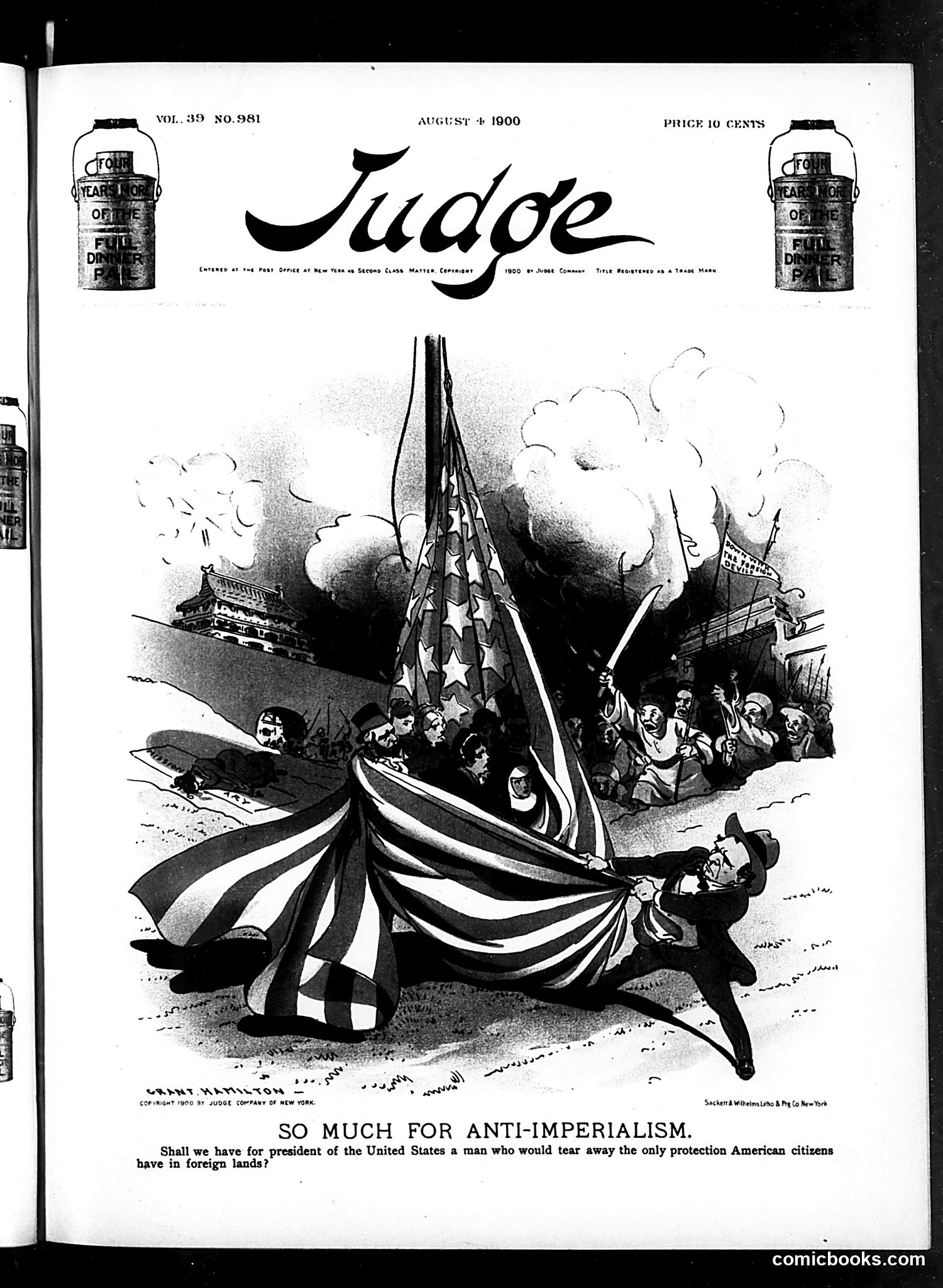
This political cartoon critiques anti-imperialist opposition to American overseas expansion. The central image shows a figure (likely representing an anti-imperialist politician) tearing down the American flag while ships burn in the background—suggesting such views would weaken U.S. military and commercial interests abroad. The caption "SO MUCH FOR ANTI-IMPERIALISM" sarcastically argues that opposing imperialism would leave "American citizens" in foreign lands without protection. This reflects the 1900 presidential campaign debate between imperialists (supporting American territorial expansion in the Philippines, Hawaii, etc.) and anti-imperialists who opposed such policies as contrary to American principles. Judge magazine clearly sided with the imperialist position, portraying anti-imperialism as dangerously naive.
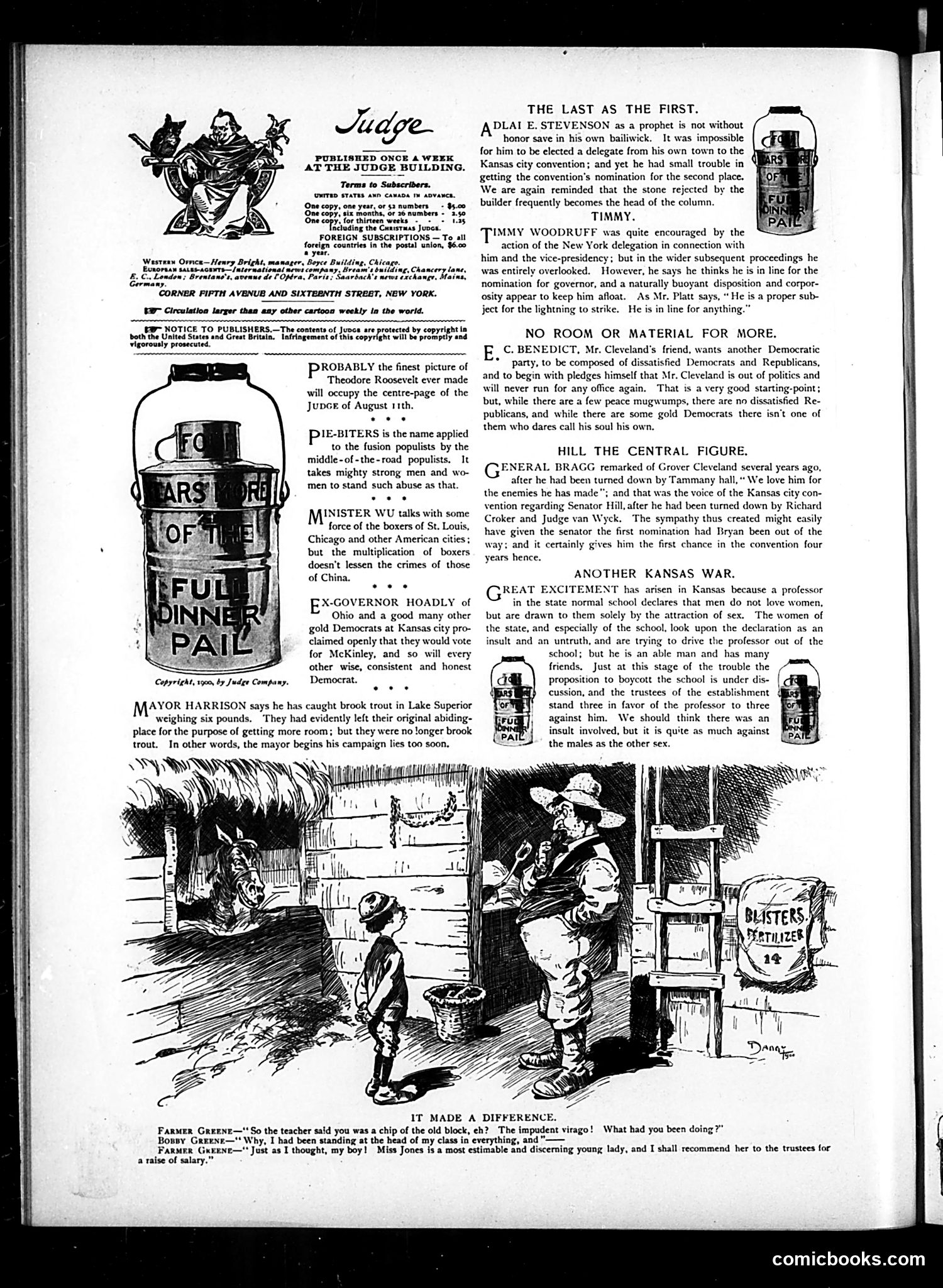
This page contains several political commentary pieces from Judge magazine. The main sections attack Democratic figures and positions: **"The Last as the First"** criticizes Adlai Stevenson's political ambitions, suggesting he lacks genuine support despite seeking delegate positions. **"Timmy"** mocks Timmy Woodruff's overlook in New York political proceedings, implying he's irrelevant to power struggles. **"No Room or Material for More"** attacks Cleveland's Democratic friend for claiming the party has exhausted its roster of viable candidates, sarcastically suggesting even gold Democrats won't improve matters. **"Hill the Central Figure"** discusses General Bragg and Senator Hill's involvement in Kansas political disputes. The page also includes a bottom cartoon about a farmer/teacher interaction, appearing to satirize rural education or class relations. The overall theme ridicules Democratic Party leadership and internal conflicts.
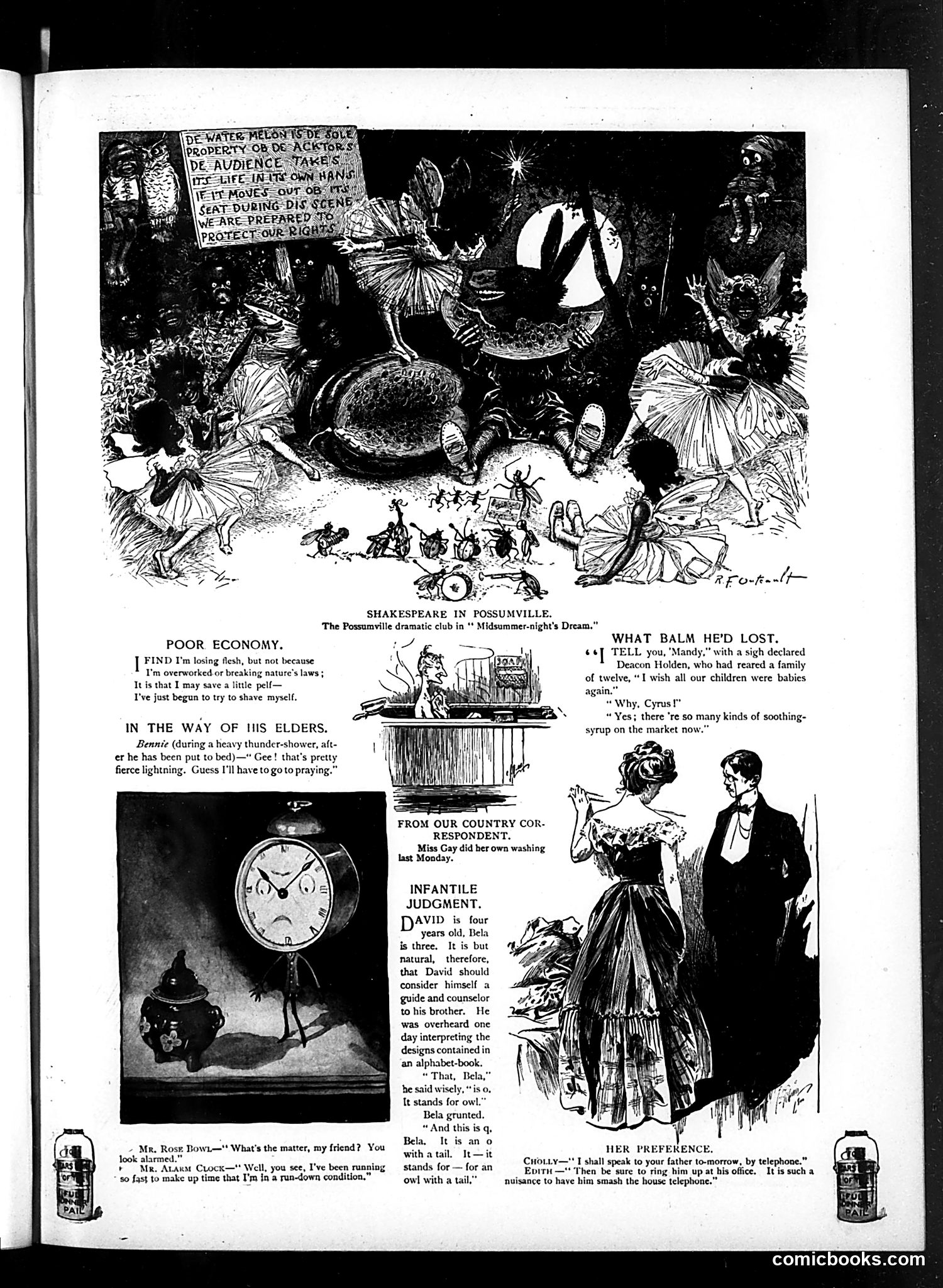
The top illustration satirizes Shakespeare's "A Midsummer Night's Dream" staged by a Possum dramatic club, depicting anthropomorphic animals performing the play. This appears to be light theatrical satire. Below are several brief humorous pieces: "Poor Economy" jokes about breaking nature's laws; "In the Way of His Elders" satirizes a lightning-quick shower; and "Infantile Judgment" shows a child's alphabet-book logic (confusing letters with animal sounds). "What Balm He'd Lost" depicts a woman lamenting large families while another discusses soothing syrup remedies—satirizing parenting struggles and patent medicine culture. "From Our Country Correspondent" and "Her Preference" are brief domestic humor pieces about household matters. The page is primarily light social satire targeting everyday life rather than political commentary.
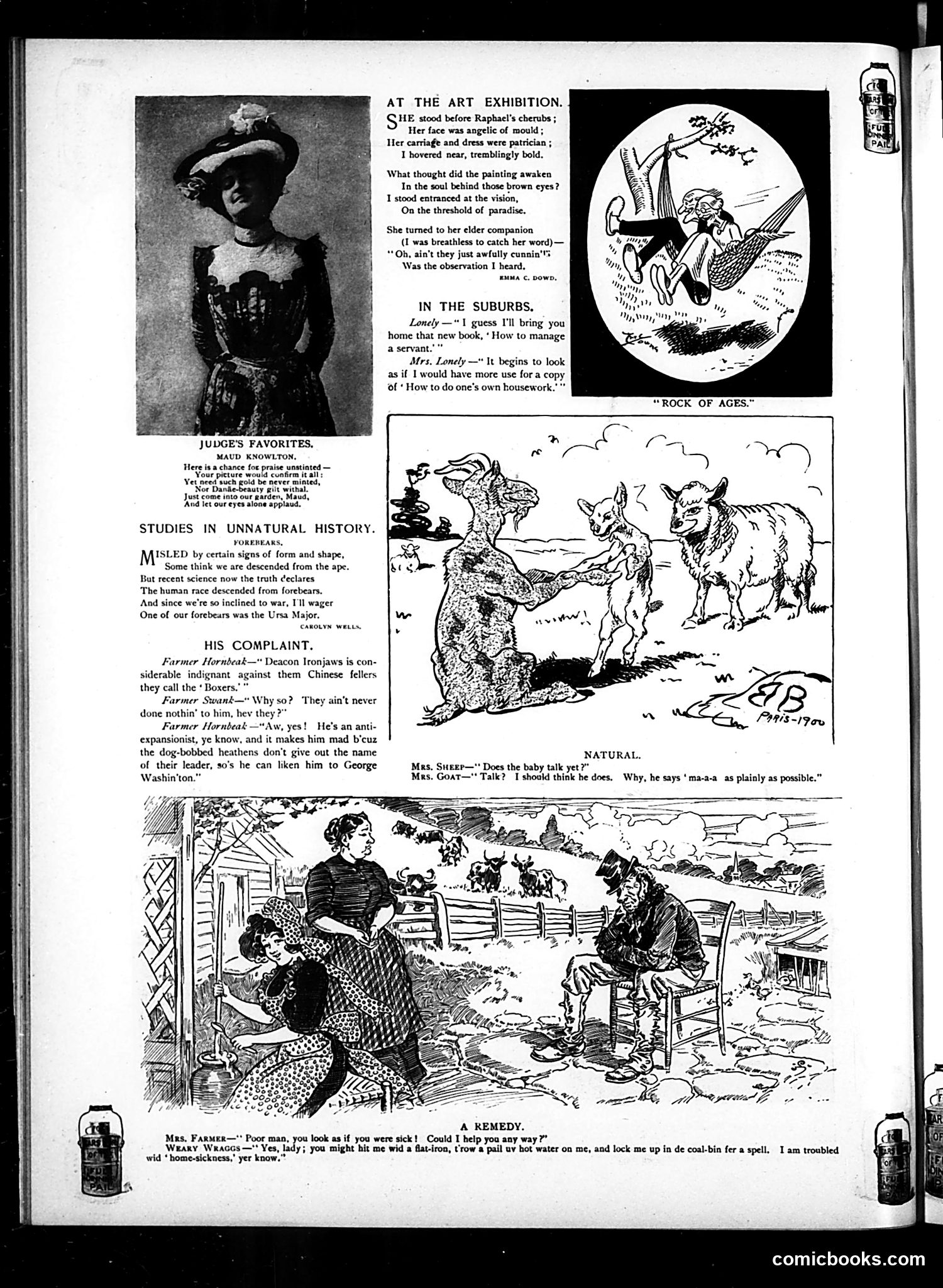
This page contains four separate satirical pieces typical of early-20th-century Judge magazine humor: 1. **"At the Art Exhibition"** mocks pretentious art appreciation, with a woman making banal observations about a painting while positioning herself as cultured. 2. **"In the Suburbs"** satirizes middle-class domestic life and servants' management through dialogue between Lindy and her elder companion about household help books. 3. **"Studies in Natural History"** uses evolutionary humor, suggesting human descent from apes—a common satirical theme following Darwin's theories. 4. **"A Remedy"** depicts rural domestic life, with dialogue suggesting folk remedies for illness (iron tonics, coal-bin confinement). The illustrations employ period cartooning styles with exaggerated features. Overall, the page targets pretension, class anxieties, and outdated rural customs through genteel humor typical of Judge's audience.
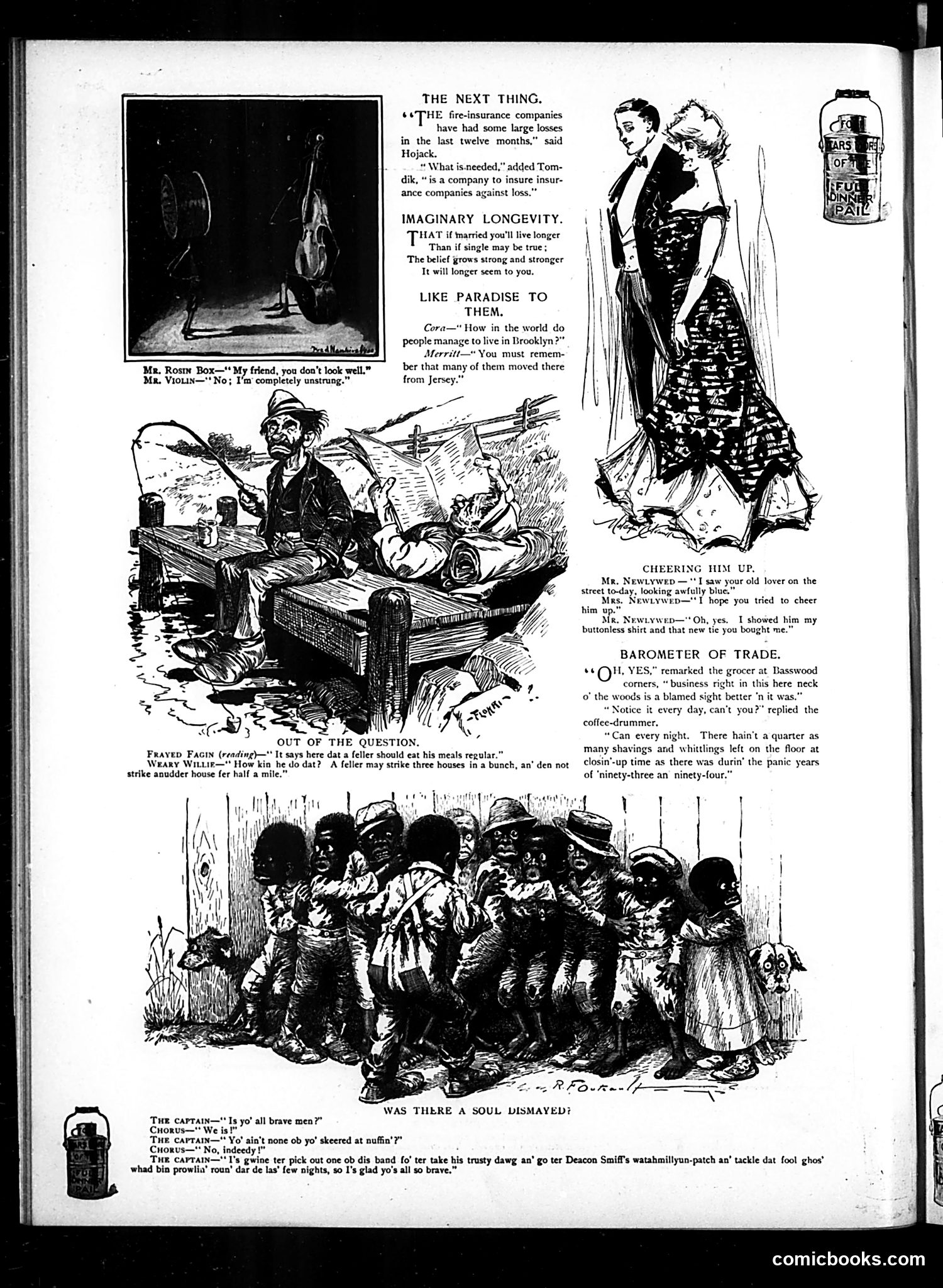
This page contains six separate humorous vignettes satirizing American life, likely from the 1890s-1900s (references to the "panic years of 'ninety-three an' ninety-four'" suggest post-1894). **Key satirical points:** 1. **"The Next Thing"** mocks excessive insurance speculation—the joke that insurers need insurance against losses. 2. **"Imaginary Longevity"** jokes that married men *feel* they live longer due to boredom, not actual longevity. 3. **"Like Paradise to Them"** uses Brooklyn/Jersey migration as a punchline about quality of life. 4. **"Out of the Question"** satirizes vagrants' inability to maintain regular habits. 5. **"Barometer of Trade"** shows economic recovery through a grocer's observations about customer behavior post-panic. 6. **"Was There a Soul Dismayed?"** features a minstrel-show scene (indicated by dialect) mocking Black characters' false bravery before a ghost-hunting task. The page reflects Gilded Age American humor: financial anxiety, class mobility, and period-typical racial caricature.
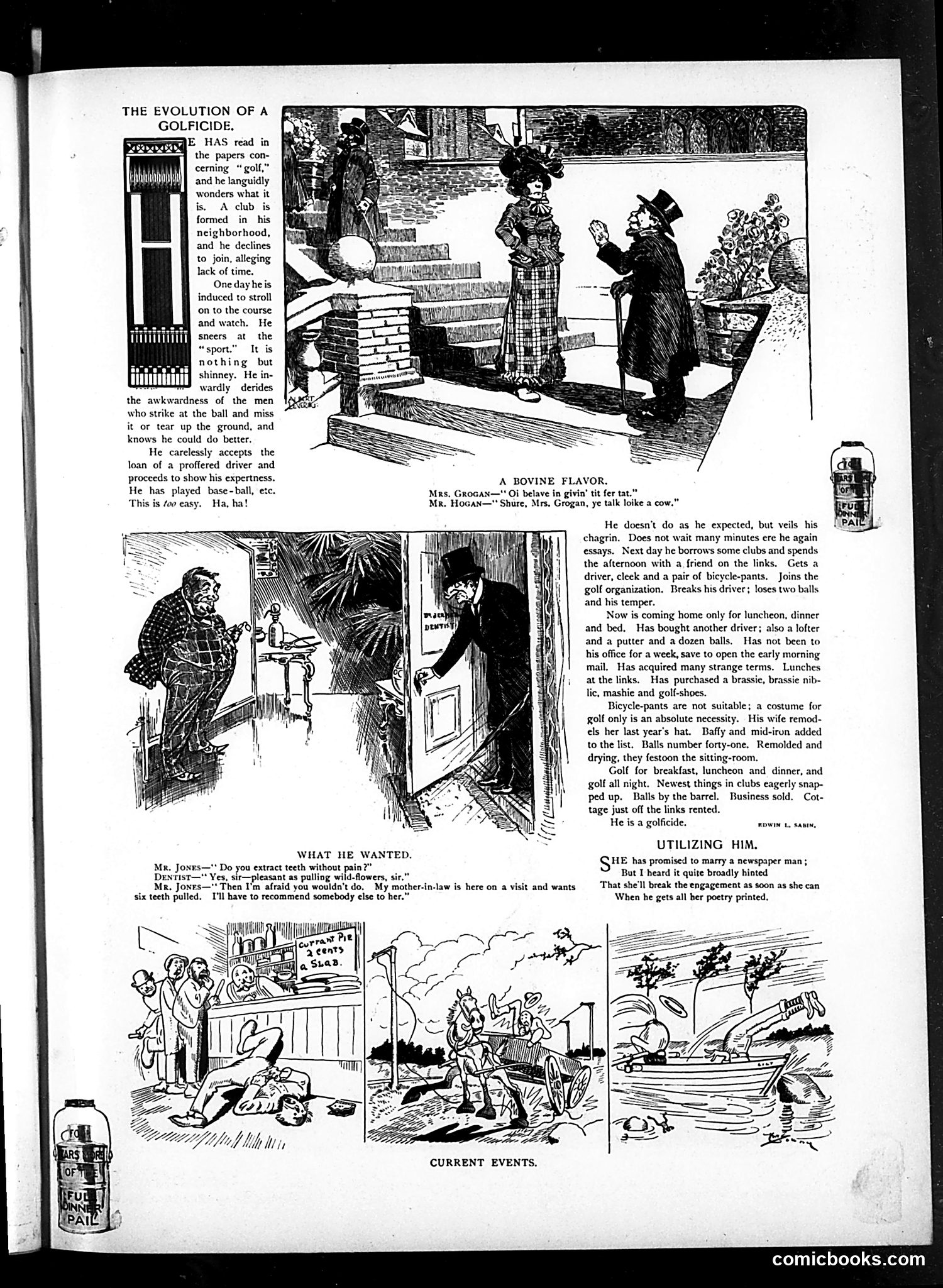
This page satirizes the obsessive craze for golf that swept America in the early 1900s. The main feature traces how a skeptical man becomes completely consumed by the sport: he initially dismisses golf as silly "shinney," borrows clubs to prove he could do better, then gradually transforms into an obsessive golfer who neglects his business, spends lavishly on equipment, abandons his office, and reorganizes his entire life around the links. The term "golficide" suggests golf kills his former self and responsibilities. The supporting cartoons mock related social absurdities: a dentist misunderstanding pain extraction, a woman speaking "like a cow," and a newspaper man whose fiancée threatens to break their engagement if he publishes her poetry. The satire reflects genuine anxiety about golf's emergence as a time-consuming upper-class leisure activity that disrupted traditional work and family life.
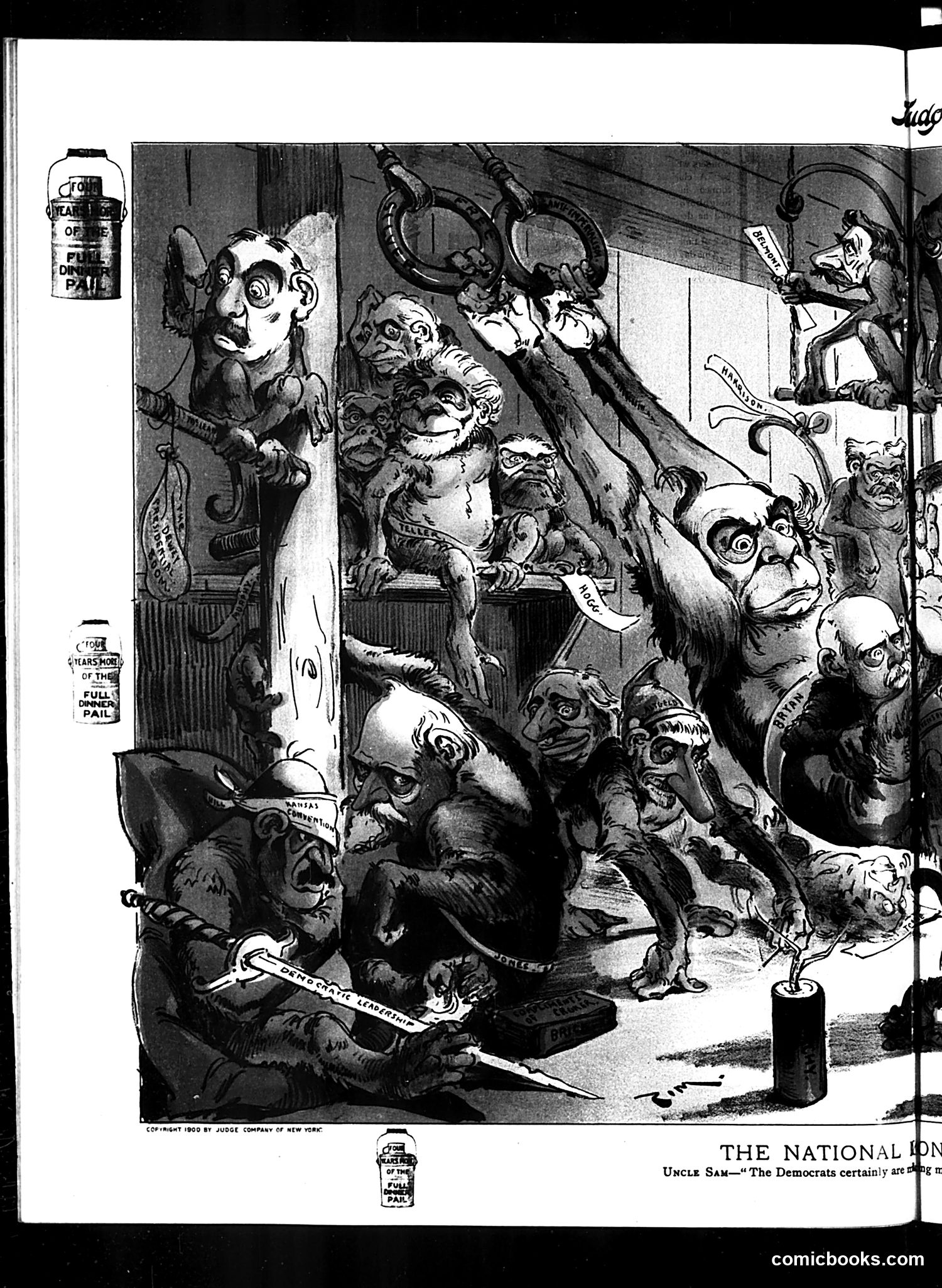
This is a satirical cartoon from *Judge* magazine titled "The National..." (text cut off). It depicts Uncle Sam observing a chaotic scene of monkeys wearing labels and engaged in various destructive activities—pulling ropes, swinging from rings, wielding tools, and creating mayhem. The caption reads: "The Democrats certainly are..." (incomplete in this image). **The satire:** The cartoon uses monkeys as a derogatory caricature to represent Democratic politicians or voters, portraying them as chaotic, uncontrolled, and destructive. This reflects 19th-century Republican editorial attacks on Democrats as incompetent or mob-like. The specific Democratic policies or events being mocked are unclear without the complete caption, but the imagery suggests criticism of Democratic governance as disorderly and dangerous to the nation.
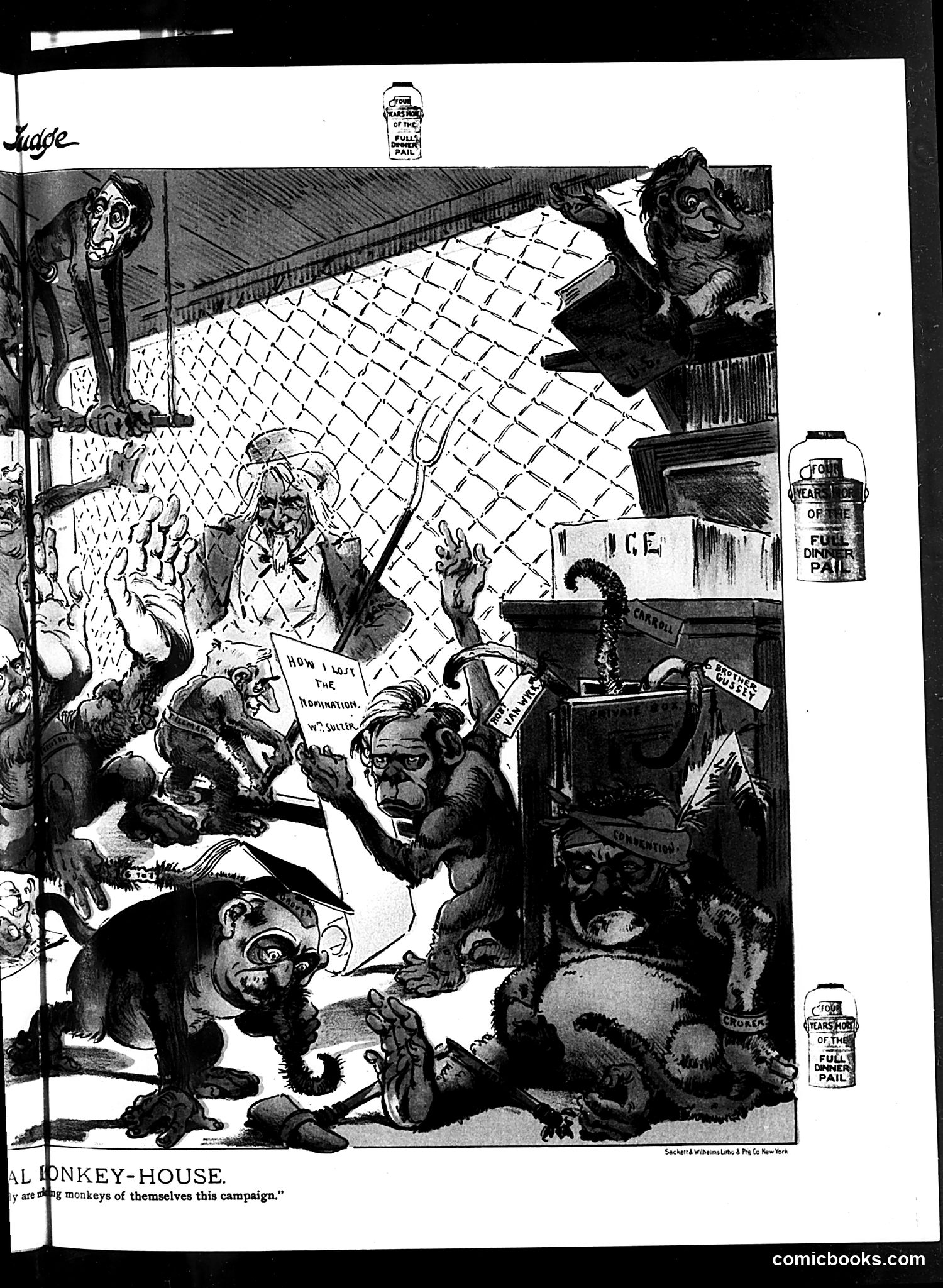
This is a satirical cartoon titled "A Donkey-House" (the donkey being the symbol of the Democratic Party). It depicts monkeys in a chaotic domestic scene, with the caption suggesting Democrats are "making monkeys of themselves this campaign." The cartoon uses animals to mock Democratic political conduct during an election campaign—the specific period unclear from this image alone. The monkeys' disorderly behavior in a house suggests internal chaos, lack of discipline, or foolish conduct within the party. A "Full Dinner Pail" label appears, likely referencing Republican campaign messaging about prosperity. The satire assumes Judge's readers—presumably Republican-leaning—would find the comparison between Democratic politicians and undisciplined monkeys amusing and damaging to the opposition party's reputation.
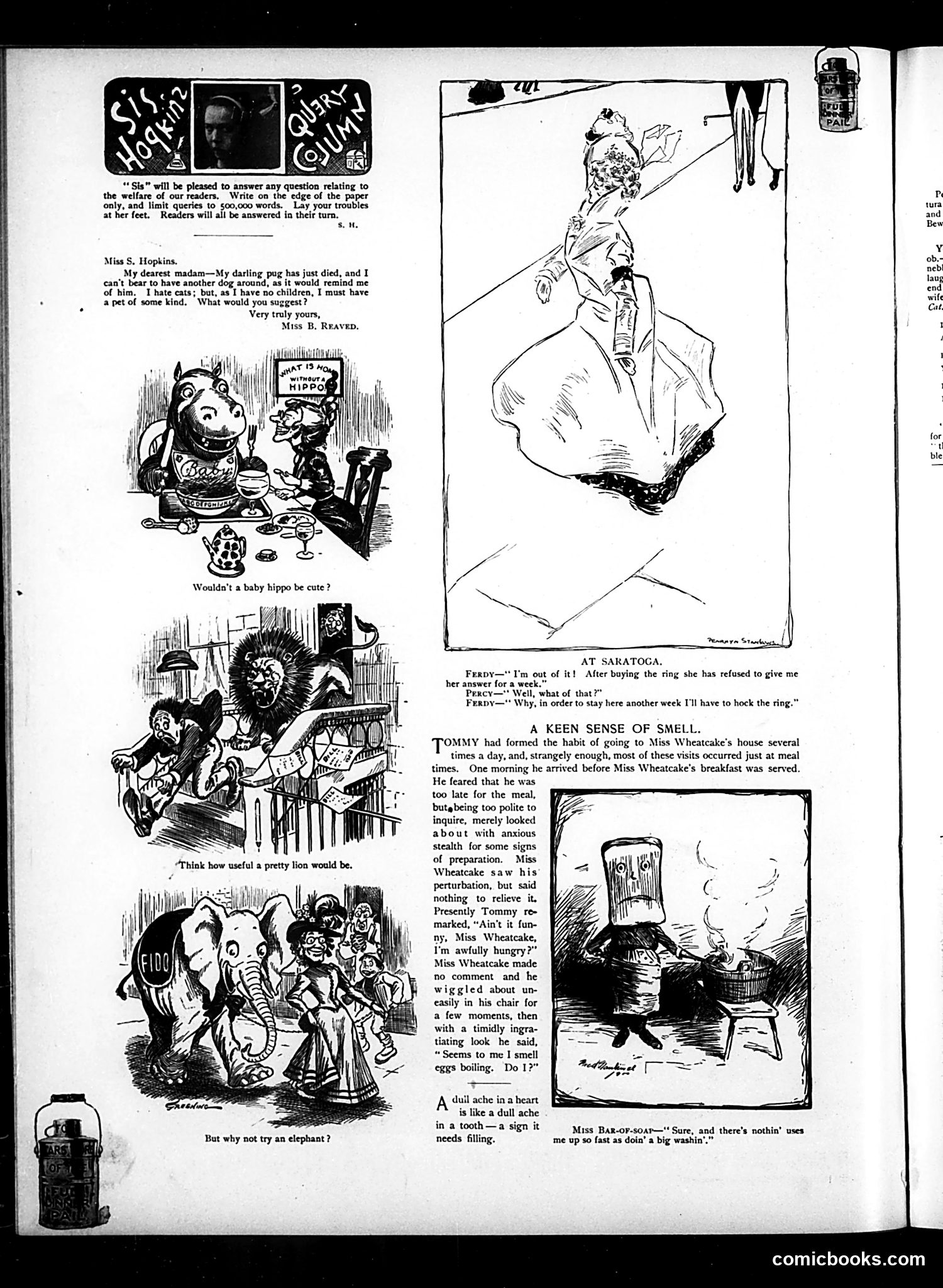
This page from *Judge* magazine contains several distinct items: **"Sis Hopkins" Advice Column**: A satirical mock advice column where readers submit absurd questions. Miss B. Reaven asks what pet to get after her pug dies—the joke is her excessive emotional attachment to replacing the animal. **Three Cartoon Jokes**: 1. A hippo as a pet suggestion (visual gag on the advice column) 2. "At Saratoga": A man at the racetrack complains he must pawn an engagement ring to afford staying another week—social satire on gambling addiction and financial desperation 3. "A Keen Sense of Smell": A boy named Tommy repeatedly visits Miss Wheatcake's house around mealtimes, hoping for food. When caught, he pretends to smell eggs cooking to hint he's hungry—satire of social parasitism and transparent manipulation **Irish Servant Stereotype**: The final caption features "Miss Bar-of-Soap," an Irish servant character using dialect ("nothin' uses me up"), reflecting period humor based on ethnic caricature. The page's common theme: exposing human selfishness, greed, and social manipulation through gentle mockery.
This brief comic story mocks railroad magnates' extreme miserliness. The protagonist is a railroad president so obsessed with penny-pinching that he refuses to let employees ride free—even the conductor and engineer. The joke's punchline: when his train hits a farmer's cow, the animal survives but gets carried twelve miles on the cow-catcher. Though the farmer has no grounds to sue (the cow is unharmed), the president bills him for the cow's railroad fare. The satire targets Gilded Age railroad barons known for ruthless cost-cutting and their indifference to ordinary citizens' welfare. The absurd scenario—charging a farmer for his injured cow's accidental "passage"—exaggerates this mentality to ridiculous extremes, highlighting how corporate greed prioritizes profit over basic human decency.
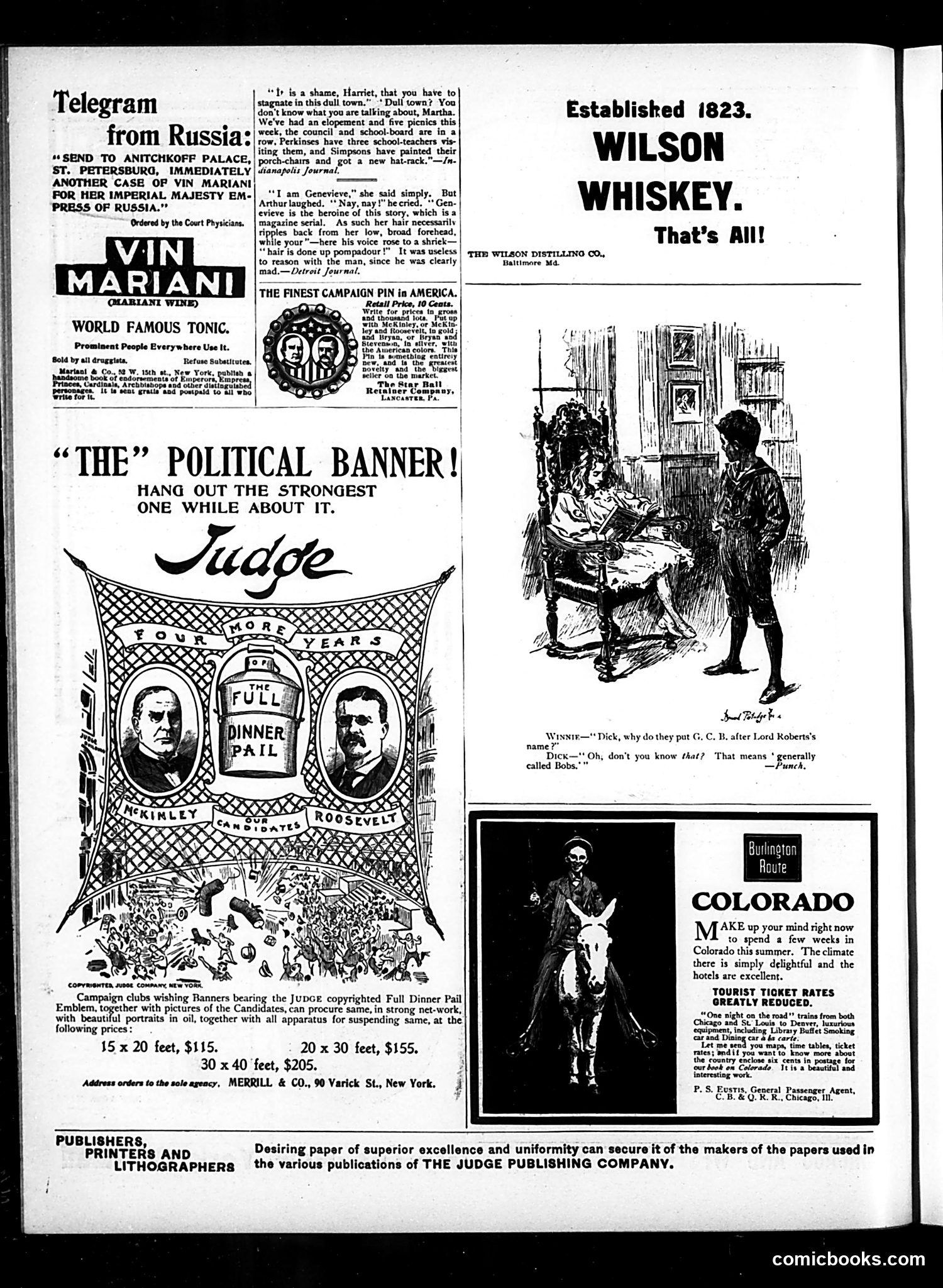
This page primarily features **advertisements and product promotions** rather than political cartoons, though one notable image appears: **"THE" POLITICAL BANNER** advertising campaign materials featuring the "Full Dinner Pail" emblem with portraits of what appear to be political candidates (likely McKinley and Roosevelt, based on visible names). The "Full Dinner Pail" was a **Republican campaign slogan** promoting prosperity and employment. The banner ad satirizes the commercialization of politics—selling campaign materials to clubs at inflated prices ($115-$205), mocking how political messaging had become a marketable product. The page otherwise showcases **typical Judge content**: humorous domestic vignettes about small-town life and satirical product advertisements (Vin Mariani tonic, Wilson Whiskey). The Colorado tourism ad uses standard period marketing language. Overall, this represents Judge's blend of political and social satire alongside commercial advertising.
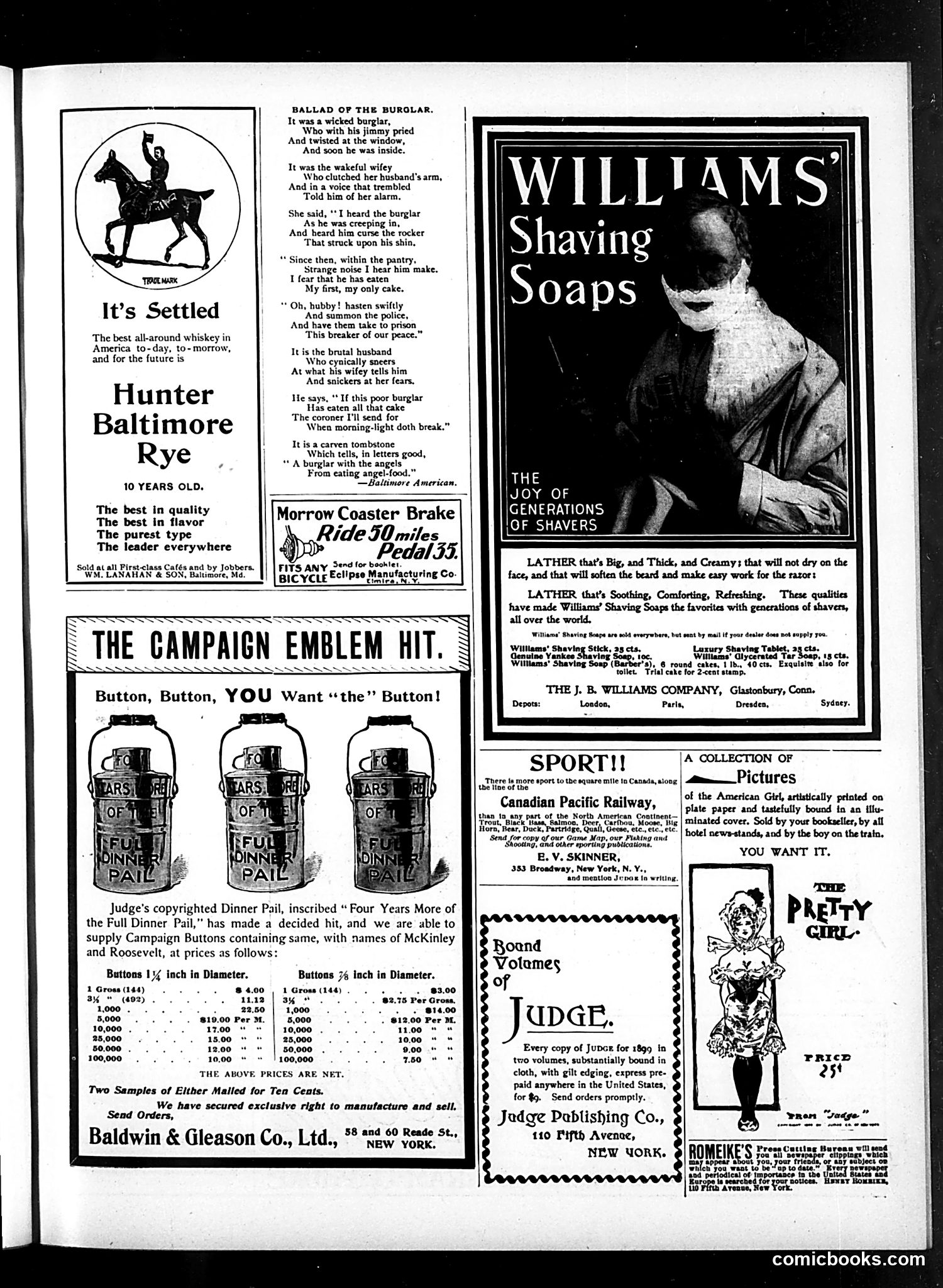
This page is primarily **advertisements and filler content** from Judge magazine, circa 1900. The main cartoon is **"Ballad of the Burglar,"** a humorous narrative poem with ironic twist: a wife discovers a burglar in their home and fears for their safety—but her husband jokes that if the burglar has eaten her homemade cake, he'll be dead by morning from the poor quality of her baking. The satire targets husbands' dismissive attitudes toward their wives' domestic skills and concerns. The page also advertises **Hunter Baltimore Rye whiskey, campaign buttons** (likely for McKinley/Roosevelt), **Williams' Shaving Soaps**, a **picture collection of "the American Girl,"** and Canadian Pacific Railway travel. The "Campaign Emblem Hit" section references the **"Full Dinner Pail"**—a Republican campaign slogan promising prosperity. This is typical Judge content: light domestic humor mixed with commercial advertising, reflecting early 1900s consumer culture and gender relations.
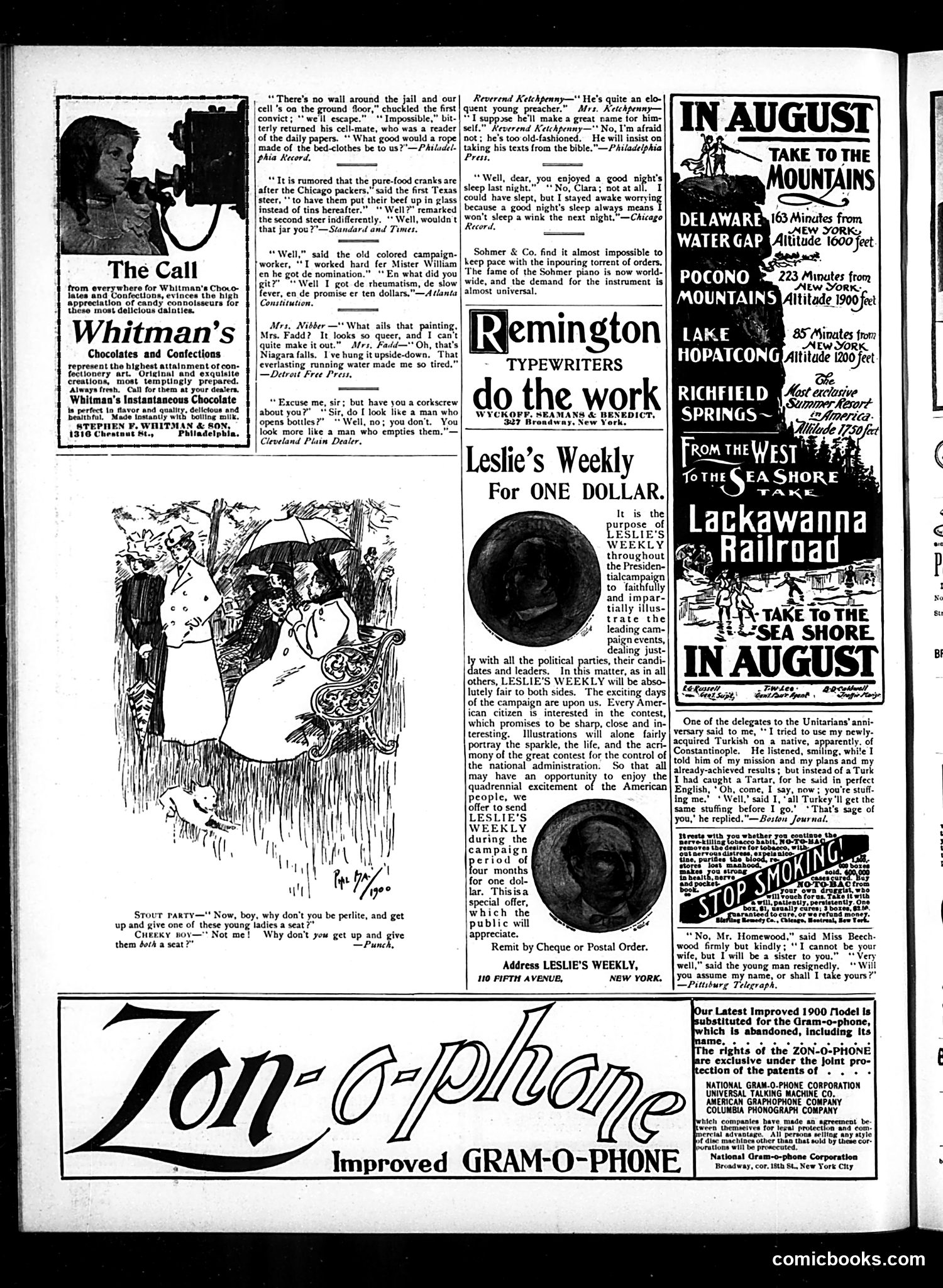
This page is primarily **advertisements and filler jokes** rather than political satire. The small cartoons scattered throughout are brief, unrelated humor pieces typical of the era. The notable exception is **Leslie's Weekly's campaign advertisement**, which references an upcoming presidential election (likely 1908 or 1912, based on the style). Leslie's promises fair, illustrated coverage of the "Presidentialcampaign," emphasizing its commitment to impartially cover "all the political parties, their candidates and leaders." The other content includes: - **Whitman's Chocolate ads** - **Multiple short jokes** with no clear political target (about jail escapes, food safety, a preacher, marital anxiety, and social etiquette) - **Product advertisements** (Remington typewriters, Zon-O-Phone gramophones, Lackawanna Railroad) The page reflects the magazine's mixed function: satirical commentary alongside commercial advertising. The jokes are generic social humor rather than specific political commentary, suggesting this particular issue focuses more on general readership appeal than election-year satire.
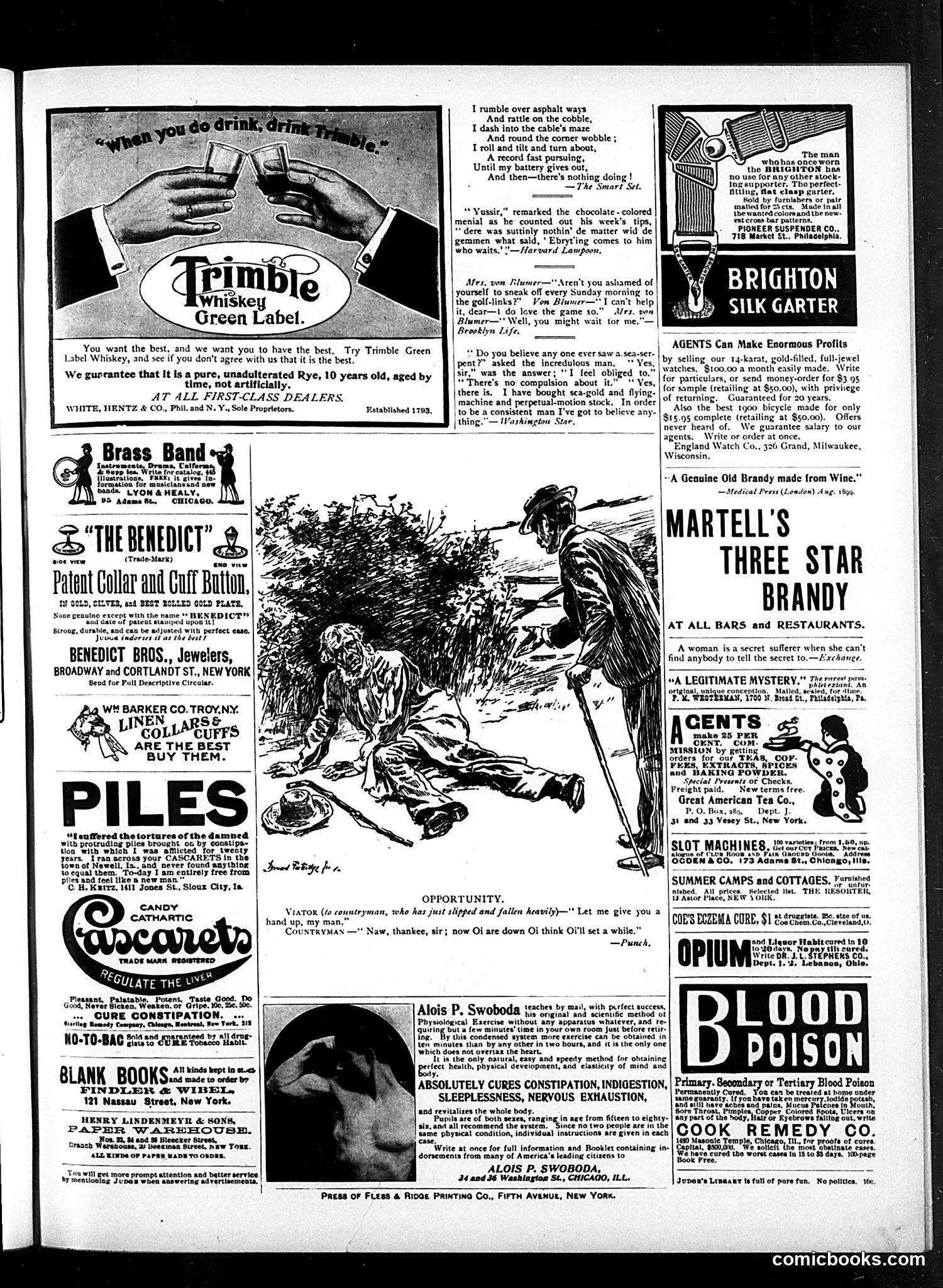
This is primarily an **advertising page** from Judge magazine, with one central illustration. The main cartoon depicts a scene labeled "OPPORTUNITY," showing what appears to be a wealthy man encountering a poor farmer or laborer. The dialogue references a handshake transaction, suggesting a business or employment proposition—likely satirizing false promises made to working-class people by those claiming to offer easy wealth or opportunity. The page is dominated by period advertisements for products and services now associated with harmful, fraudulent, or obsolete practices: patent medicines (blood tonics, constipation "cures"), slot machines, dubious investment schemes (watches and bicycles sold at implausibly low prices), and liquor. The ads targeting salesmen promising "enormous profits" reflect late 19th-century get-rich-quick schemes common to the era. The small poems and anecdotes scattered throughout (from Harvard Lampoon and Brooklyn Life) are lighthearted social commentary on courtship and leisure activities. Overall, the page reflects Judge's satirical mission: exposing consumer fraud and social absurdities through both editorial cartoons and ironic juxtaposition with deceptive advertising.
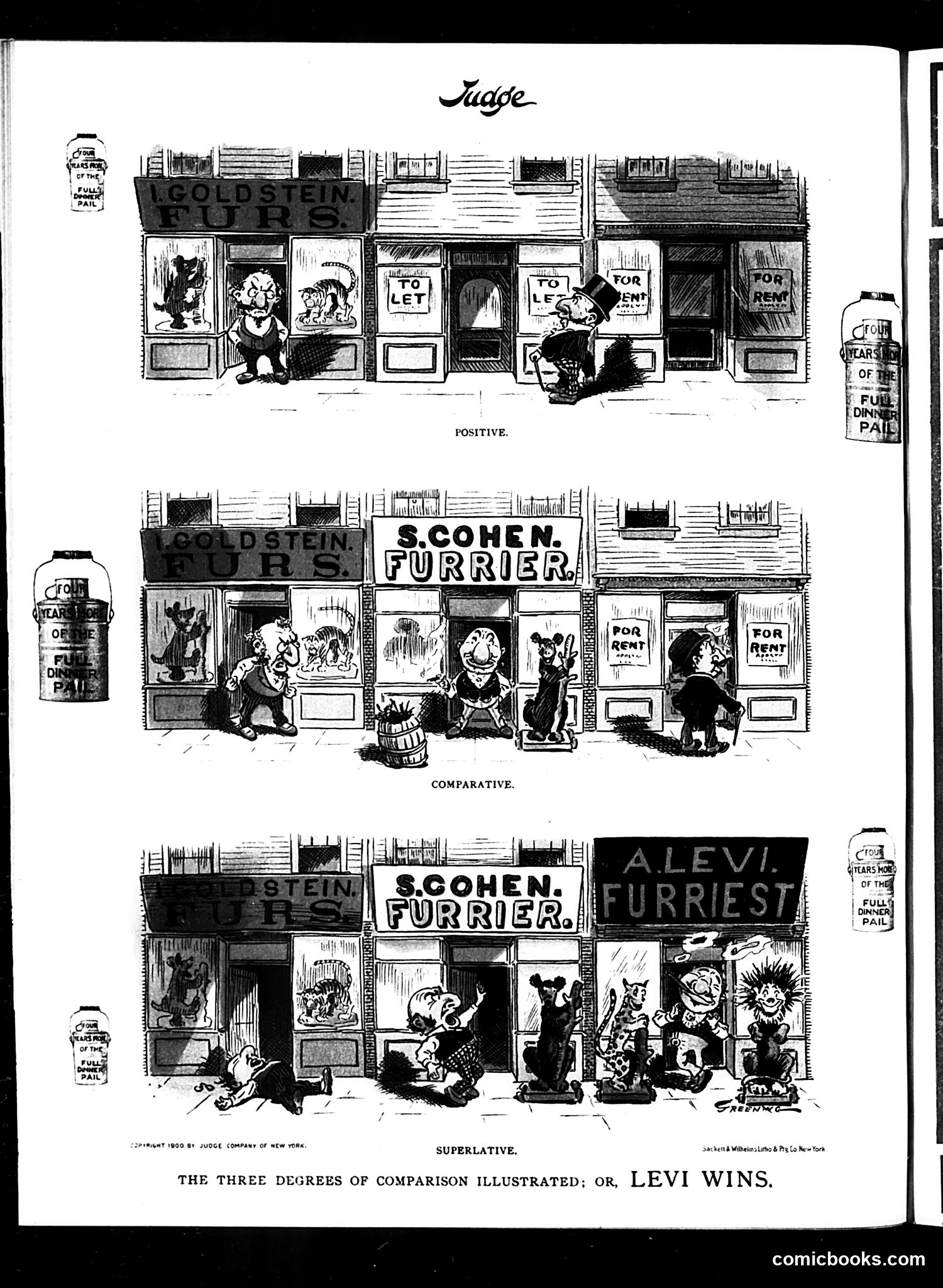
This Judge satire uses a grammar lesson format to mock competition between Jewish merchants. The three panels show storefronts for "Goldstein & Co." and "S. Cohen, Furrier" in increasingly chaotic states—positive, comparative, and superlative. The joke plays on antisemitic stereotypes: each panel depicts more aggressive, underhanded business tactics (window displays become messier, figures more disheveled), suggesting Jewish merchants engaged in cutthroat competition. The title "Levi Wins" suggests Jewish success, framed negatively. The accompanying bottles labeled "Years for the Full Dinner Pail" reference McKinley-era Republican campaign rhetoric. This appears to be satirizing Jewish immigrant merchants' commercial rivalry during the Gilded Age, reflecting period prejudices.