
A complete issue · 18 pages · 1900
Judge — July 21, 1900
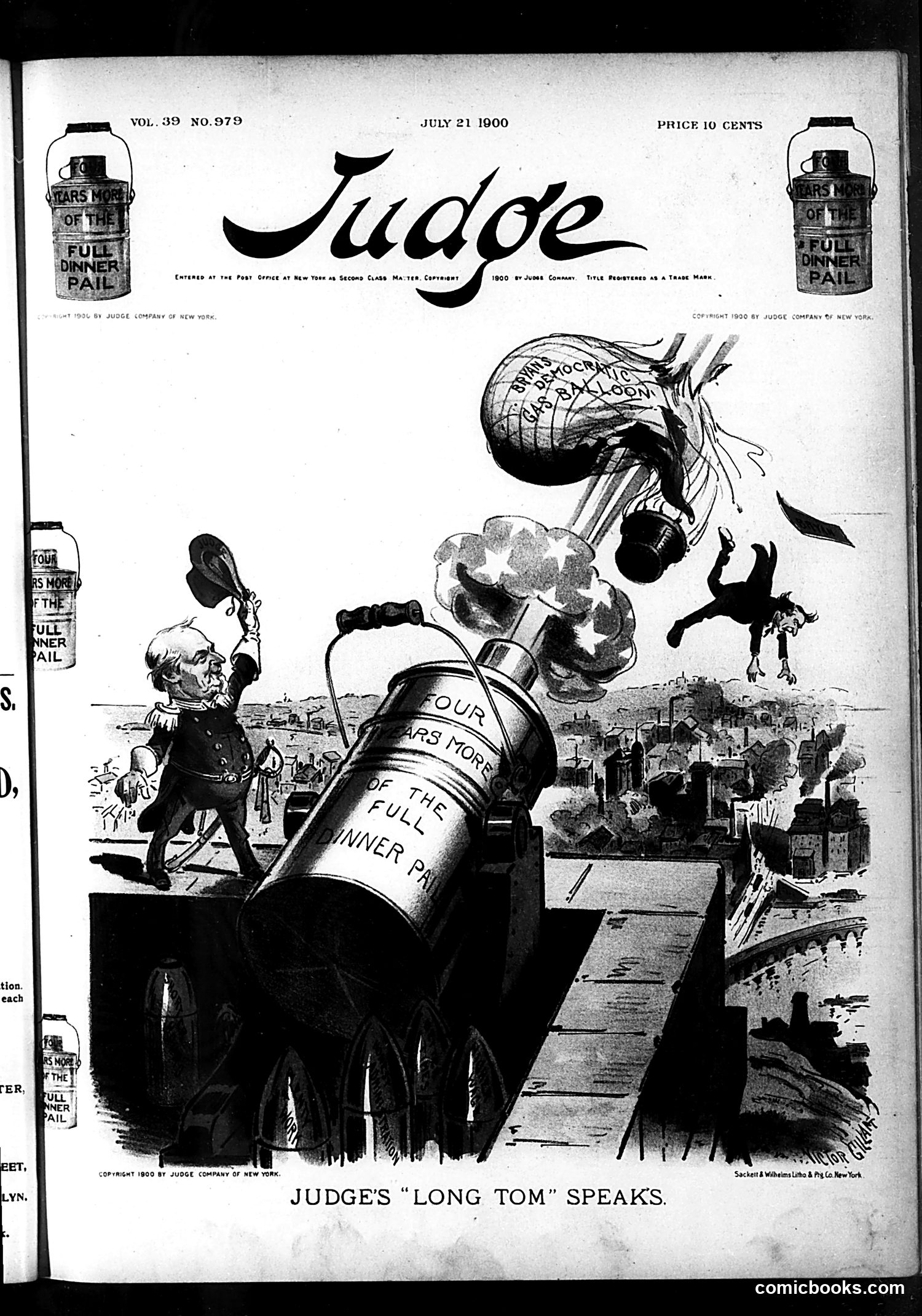
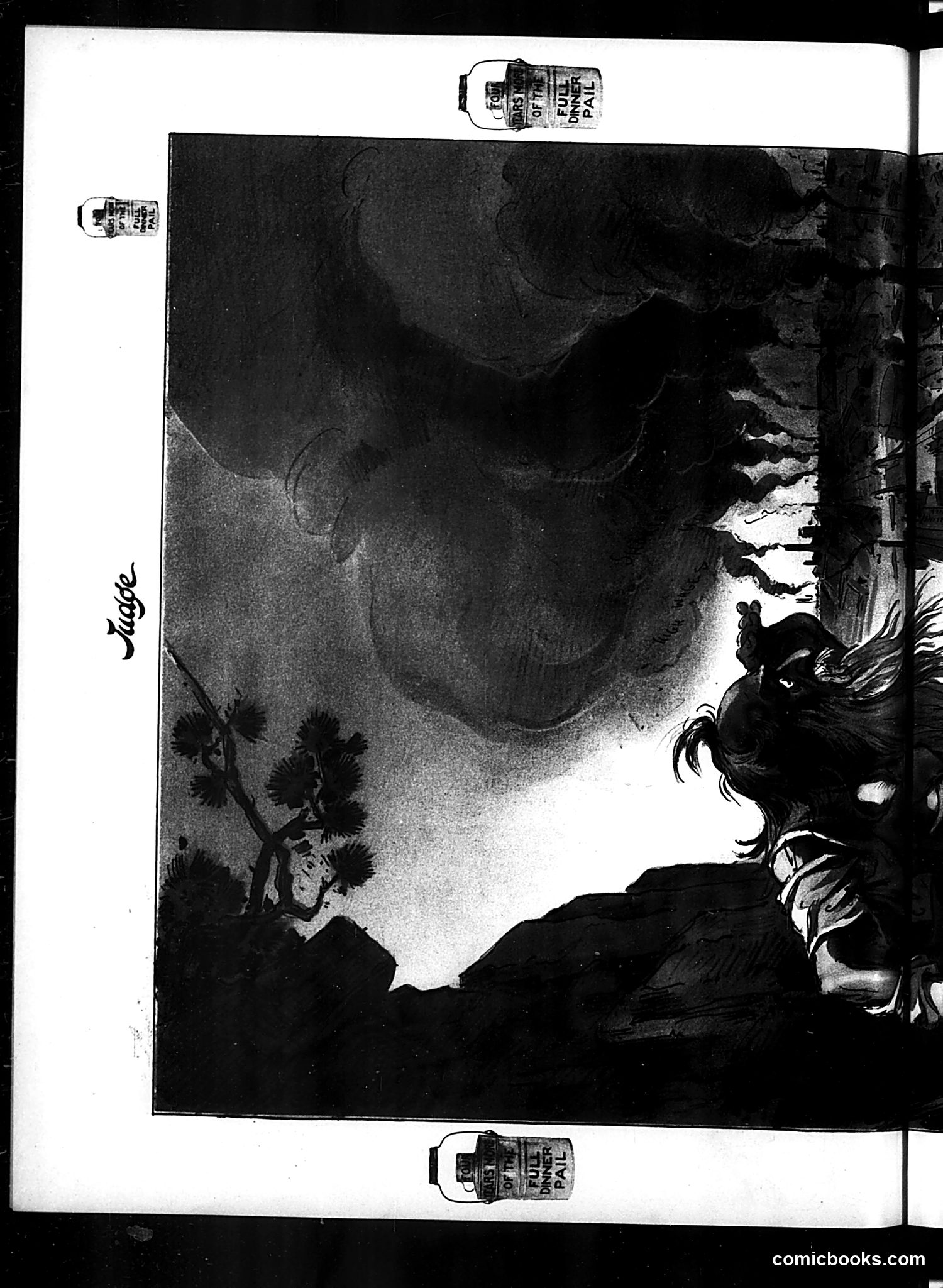
This political cartoon titled "Judge's 'Long Tom' Speaks" depicts a massive cannon labeled "Four Years More of the Full Dinner Pail" firing explosively over a cityscape. The cannon appears to be a reference to McKinley's 1900 presidential campaign slogan promising continued prosperity (the "Full Dinner Pail"). A small figure on the left, likely representing a political opponent or critic, recoils from the blast. The satire suggests the Republican administration's aggressive use of economic prosperity messaging as a political weapon during the 1900 election cycle. The "Long Tom" reference likely alludes to a famous military cannon, implying the administration's powerful political artillery. The overall message critiques expansive campaign rhetoric about economic well-being.
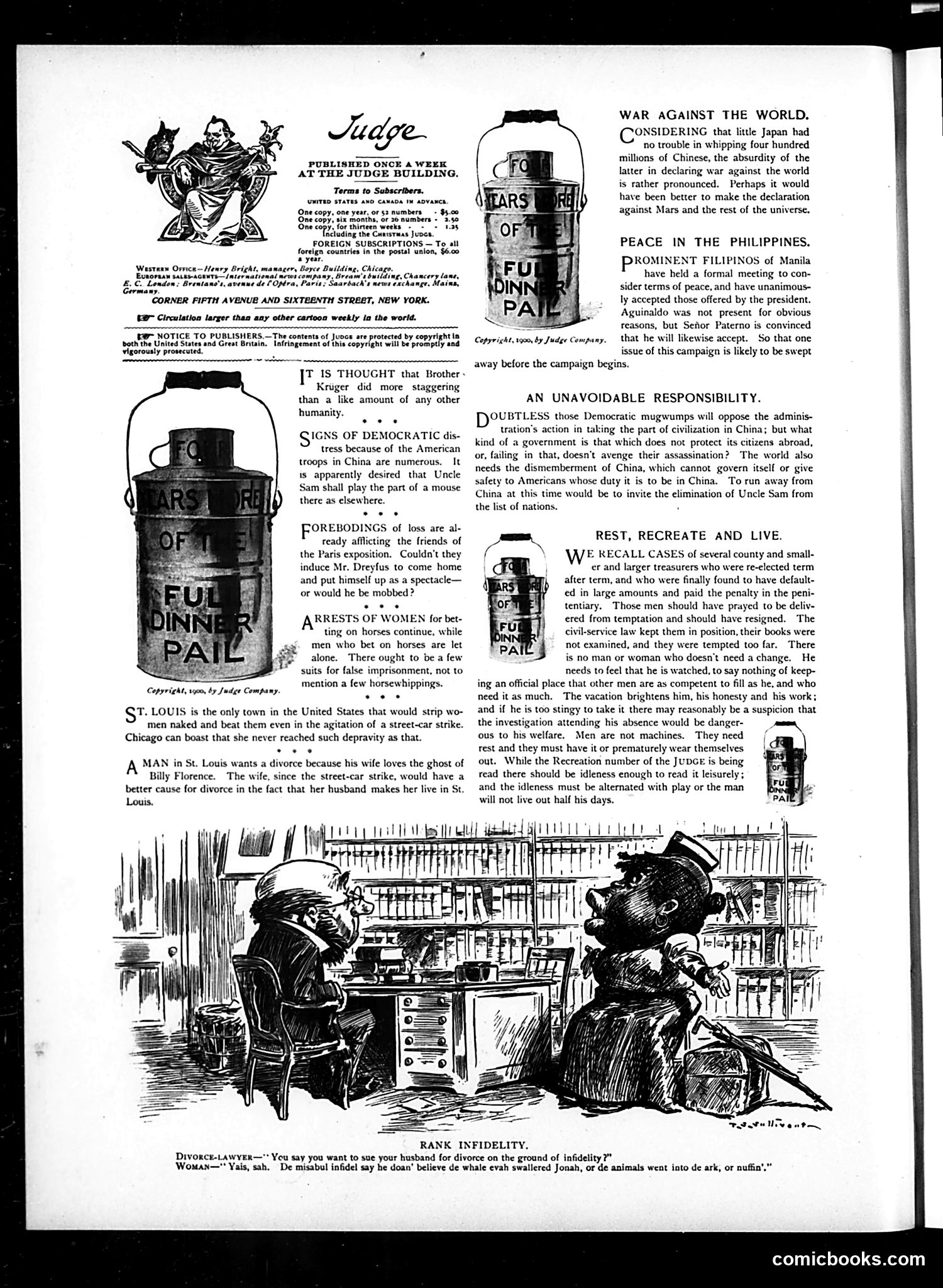
This page contains political commentary and humorous editorial content from Judge magazine. The main articles address: **"War Against the World"** - Satirizes Japan's declaration of war, questioning the absurdity of tiny Japan declaring war on the entire world rather than specifically on China. **"Peace in the Philippines"** - Comments on Filipino leaders accepting peace terms, noting Aguinaldo's absence from negotiations. **"An Unavoidable Responsibility"** - Critiques Democratic opposition to U.S. involvement in China, arguing that protecting American citizens there is an inescapable duty. **"Rest, Recreate and Live"** - Advocates for government officials' vacation time and proper rest, arguing that overworked officials become vulnerable to corruption and poor judgment. The bottom cartoon, "Rank Infidelity," depicts a divorce lawyer scenario using nautical metaphor as wordplay about spousal faithlessness.
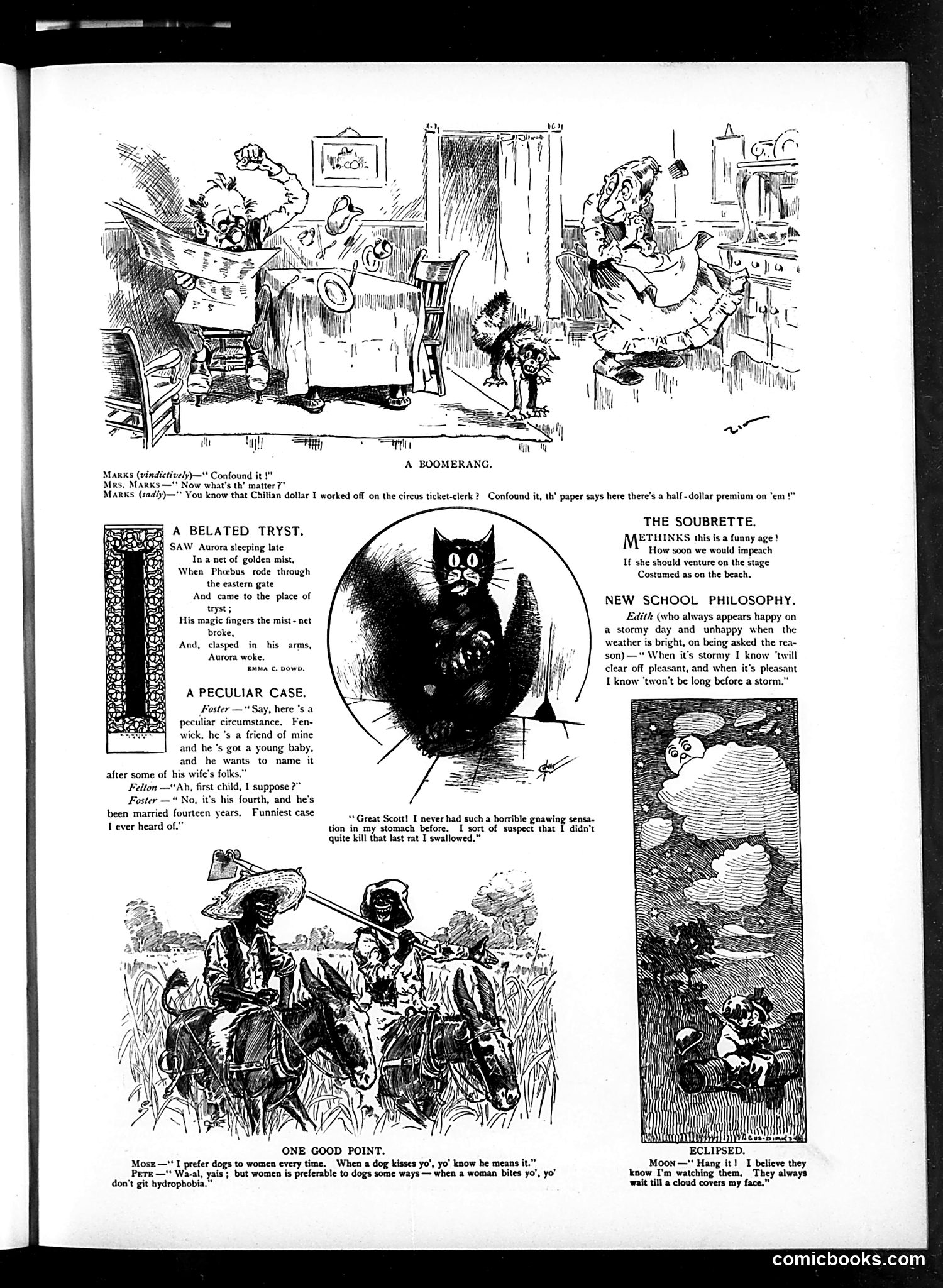
This page contains several unrelated humor pieces typical of Judge magazine's format: **"A Boomerang"** depicts a domestic scene where a man and woman argue about circus work—apparently the woman worked as a circus ticket clerk and the man questions a premium payment. **"A Belated Tryst"** is a romantic poem about a man meeting a woman in mist. **"A Peculiar Case"** is a dialogue joke about naming a baby—the punchline involves confusion about which child in a large family is being discussed. **"One Good Point"** jokes about dogs versus women, playing on the phrase "bites you." **"The Soubrette"** contains verses about an actress and philosophical observations about weather prediction. The remaining items are brief humorous observations. No clear political satire or topical references are evident—these appear to be general-audience humor pieces.
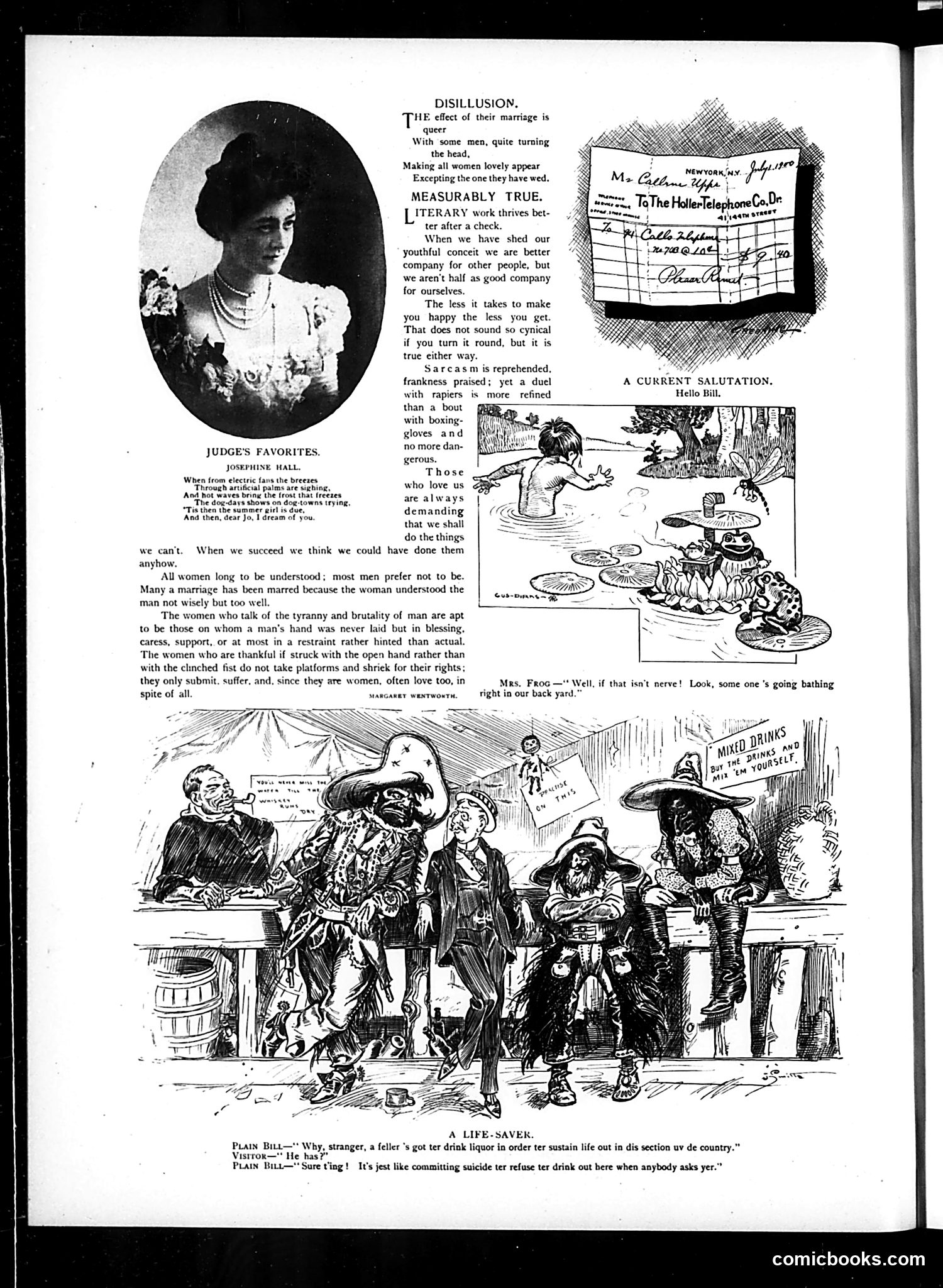
This page contains several satirical pieces targeting early 20th-century social attitudes. **"Judge's Favorites" (top left):** A portrait accompanying poetry mocking women's education and independence, suggesting educated women are problematic and that men prefer compliant wives. **"Disillusion":** Commentary on marriage's sobering effects, with sardonic observations about how courtship differs from married life. **"A Current Salutation":** A humorous illustration showing Mrs. Frog observing someone bathing in her pond, with animal characters making jokes about intrusions. **"A Life-Saver" (bottom):** A cartoon depicting working-class men at a bar. The dialogue satirizes using alcohol as a survival strategy, mocking the desperation of laborers who drink to cope with poverty and hardship. The page overall reflects period attitudes about class, gender, and social problems through biting satire.
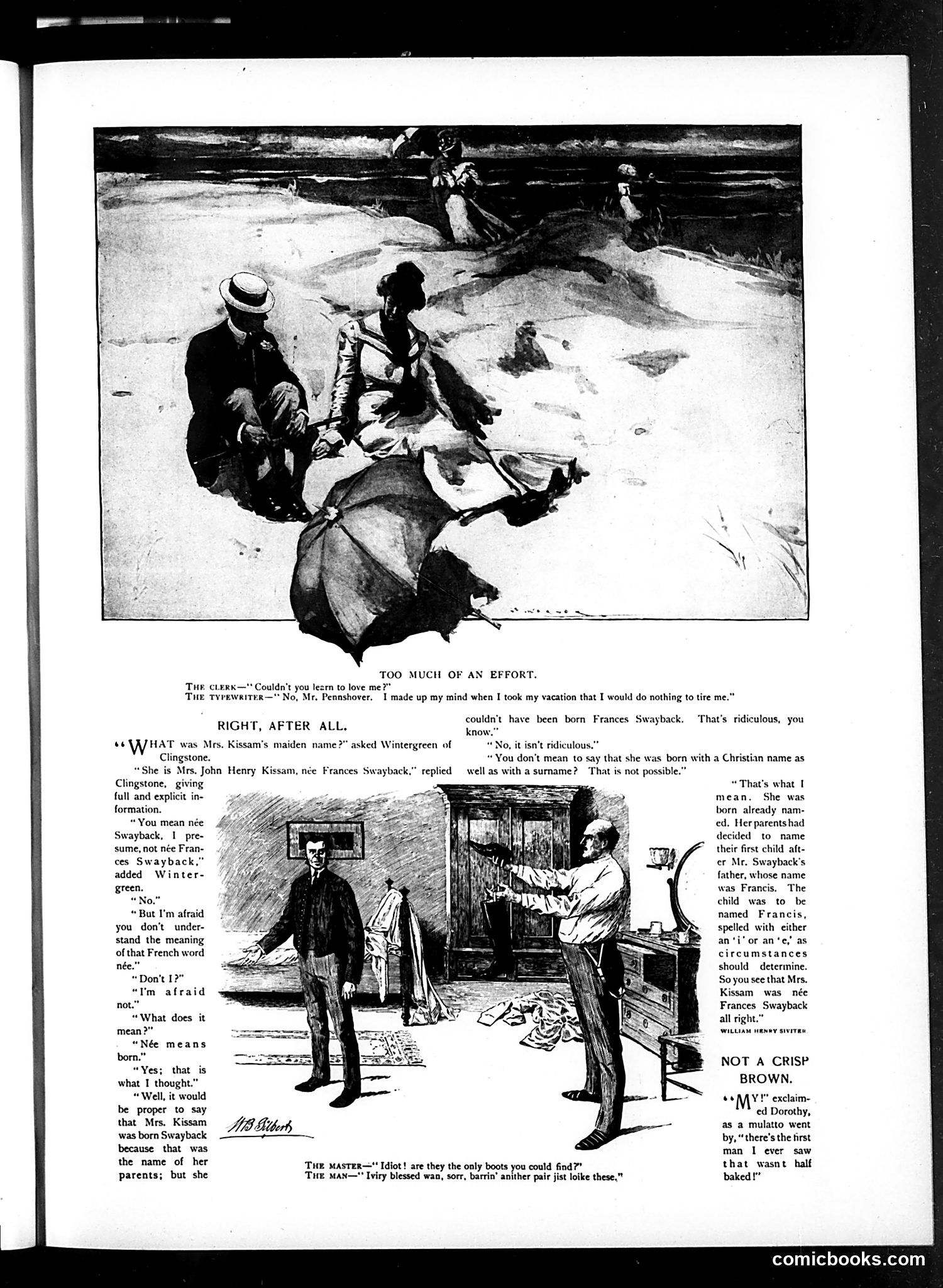
This page contains three separate satirical sketches typical of early 20th-century American humor: 1. **"Too Much of an Effort"**: A clerk proposes to a typewriter operator who refuses, claiming her vacation made her resolve to avoid tiring activities—a joke about modern women's independence and the changing workplace. 2. **"Right, After All"**: A lengthy dialogue explaining the French term "née" (born as). The humor lies in a pedantic discussion of whether a woman named Frances Swayback could have been "born" with that name, culminating in clarification that "née" indicates a maiden name. It satirizes overwrought linguistic debate. 3. **"Not a Crisp Brown"**: An Irish servant's exclamation about an undercooked mulatto (a baked good), with the master questioning why he couldn't find better boots. The humor derives from the servant's malapropism or confusion. All three sketches employ wordplay and situational comedy typical of Judge's satirical style, with particular emphasis on gender relations and linguistic confusion as humor sources.
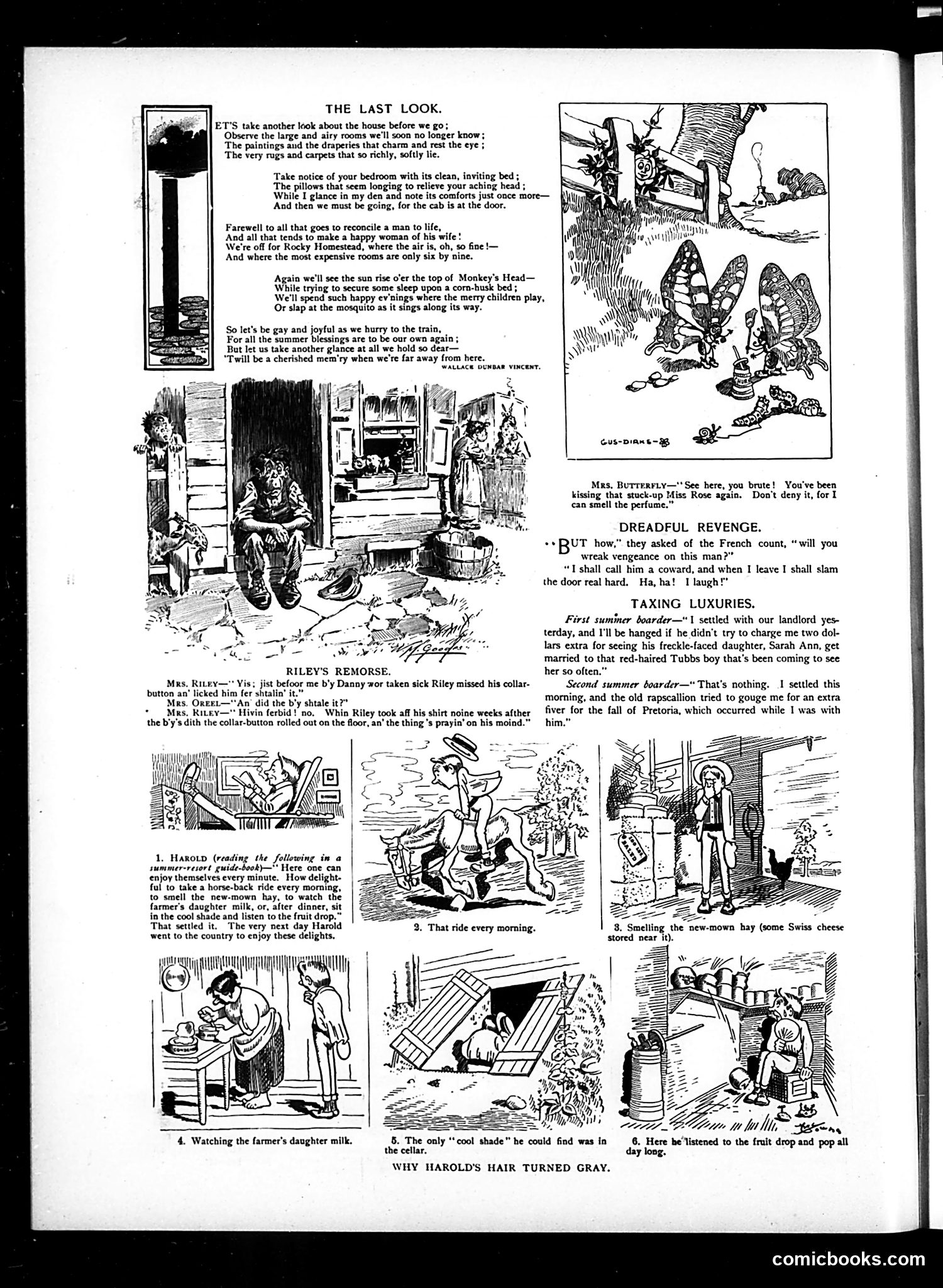
This page satirizes the American summer-boarding phenomenon. The lead poem mockingly contrasts city dwellers' comfortable homes with their anticipated rustic vacation accommodations—luxurious bedrooms versus "six by nine" rooms, quality furnishings versus corn-husk beds, and peaceful evenings versus mosquito-infested nights. The satire targets the romantic myth of pastoral summer retreats. The "Why Harold's Hair Turned Gray" comic sequence illustrates this gap between expectation and reality. Harold reads enticing descriptions of country pleasures (horseback rides, hay-scented air, watching farmers' daughters milk cows), then experiences the actual miserable conditions: extreme heat, uncomfortable sleeping, and disappointing "attractions." The other brief jokes ("Taxing Luxuries," "Riley's Remorse") employ similar logic—mundane situations treated with exaggerated importance, typical of Judge's light satirical humor. The page targets middle-class aspirations and the era's popular vacation trend, suggesting that idealized country retreats rarely matched promotional promises.
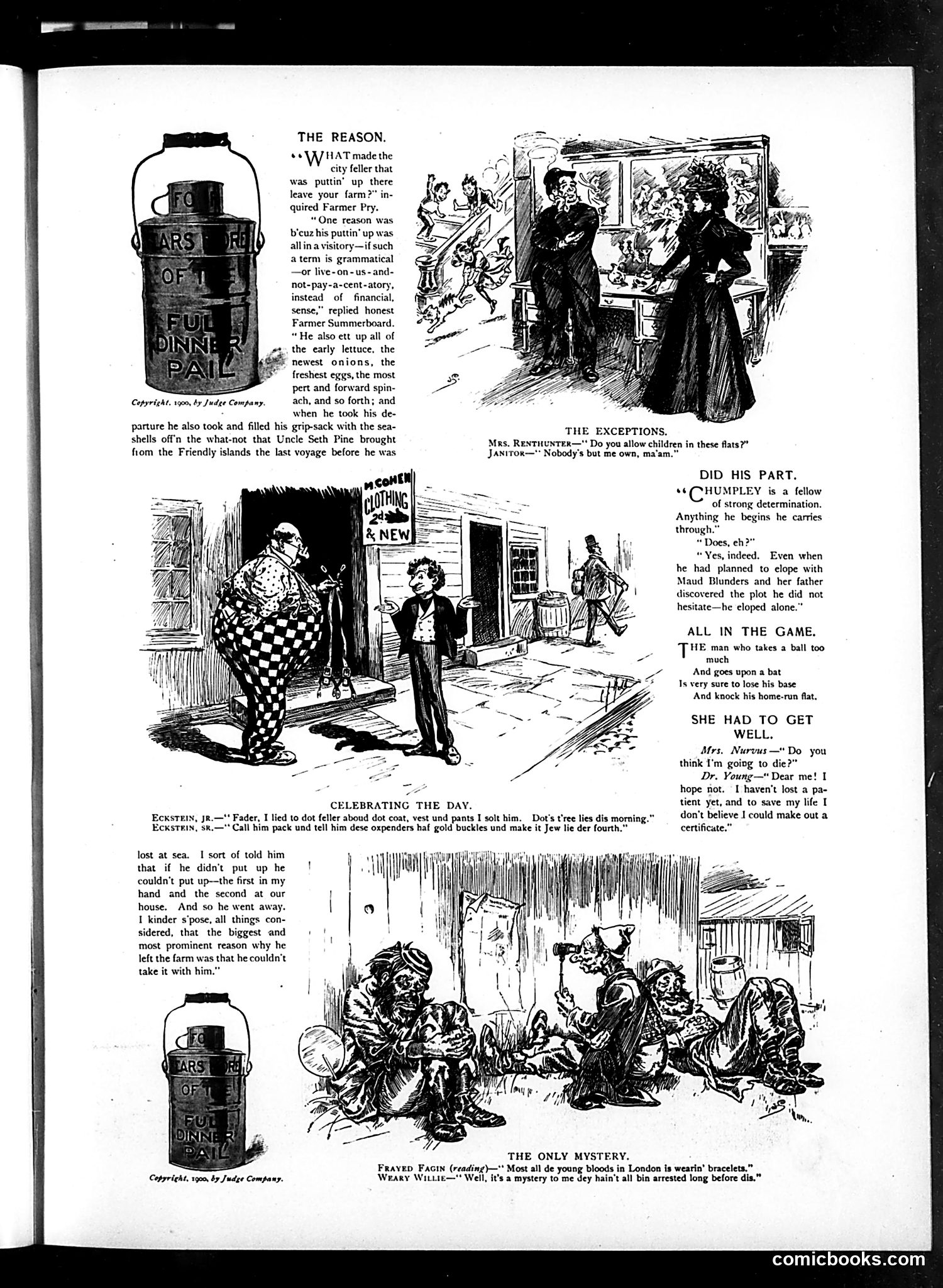
This 1900 page contains multiple unrelated satirical pieces typical of Judge magazine's format: **"The Reason"** mocks urban visitors who overstay at farms—eating provisions, stealing souvenirs (seashells), and leaving without paying. Farmer Summerboard's dialect humor targets both the entitled city guest and rural resentment of such freeloaders. **Other brief jokes** include: apartment-hunting etiquette, a man's determination (he elopes alone after his girlfriend's father catches him), baseball metaphors for romantic failure, and a doctor's boast about never losing patients. **"Celebrating the Day"** uses Yiddish-inflected dialect to satirize Jewish shopkeepers' casual dishonesty—lying about merchandise quality, compounded by the father's encouragement. **"The Only Mystery"** references London youth wearing bracelets (appears to reference a contemporary fashion trend) while implying criminality—the joke being these young men should be arrested for this suspicious behavior. The page reflects 1900s casual ethnic stereotyping common to Judge's humor.
This appears to be a dramatic silhouette illustration rather than a political cartoon. The image shows a nighttime desert or tropical landscape with palm trees silhouetted against a bright moon or light source. In the foreground right, a figure with flowing hair is depicted in profile, gazing toward the luminous scene. The style is characteristic of early 20th-century Judge magazine's artistic content—moody and atmospheric rather than overtly satirical. Without additional context or legible text on the page itself, I cannot identify specific political or social commentary, named figures, or the intended satirical message. The image's purpose and meaning remain unclear from what's visible here.
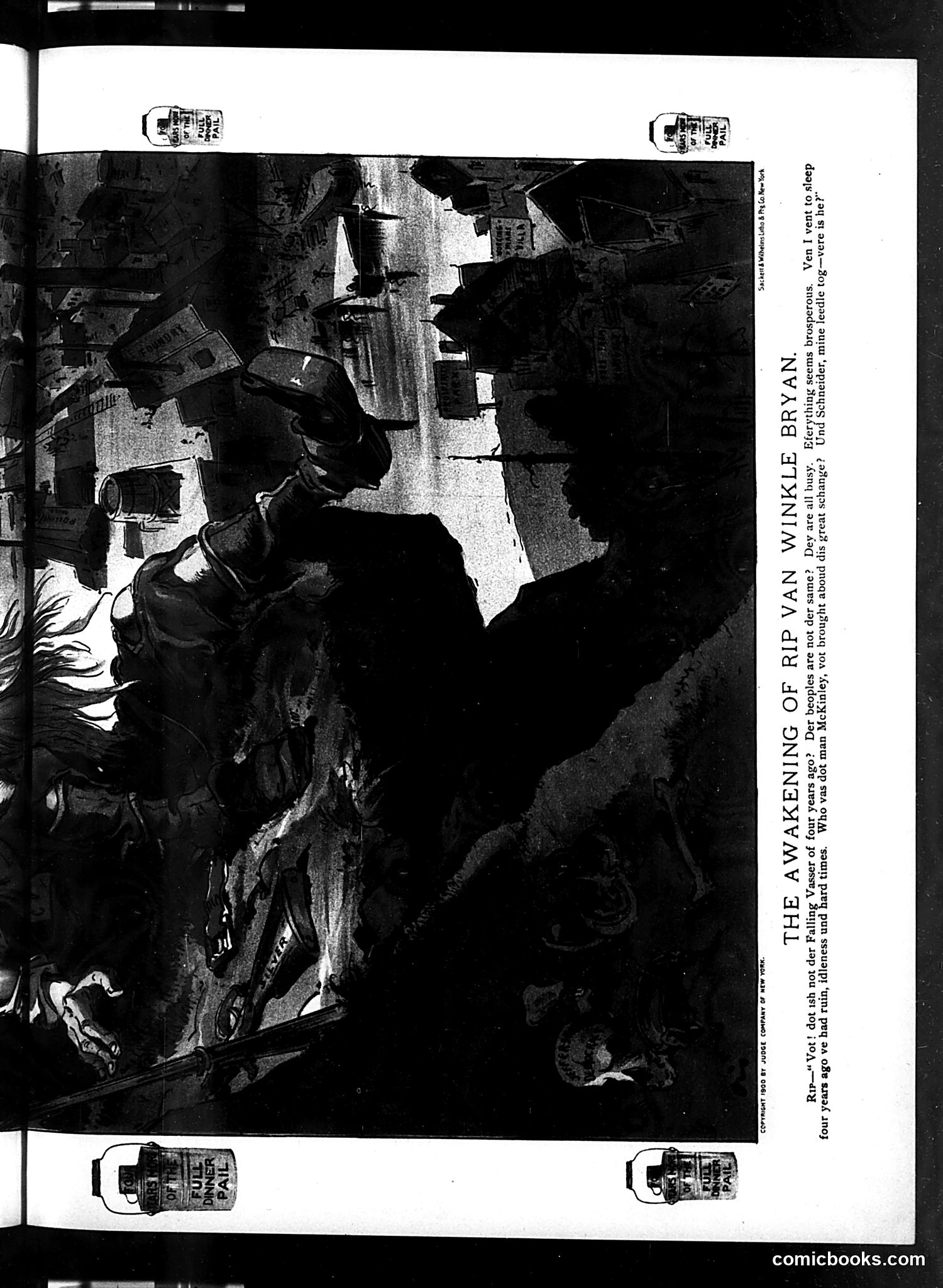
This Judge magazine page satirizes **William Jennings Bryan**, the three-time presidential candidate and prominent politician. The caption indicates he is "awakening" after a long period of dormancy—comparing him to Washington Irving's literary character Rip Van Winkle, who famously slept for decades and awoke to find the world transformed. The satire suggests Bryan has been politically irrelevant or sidelined ("four years ago we said all this"), and the magazine is mocking his attempted or actual political reemergence. The silhouetted figure appears to be waking amid urban chaos or destruction, implying the world has changed dramatically during his absence from influence. The cartoon's point: Bryan's return to politics is outdated and ridiculous given how far American society and politics have progressed without him.
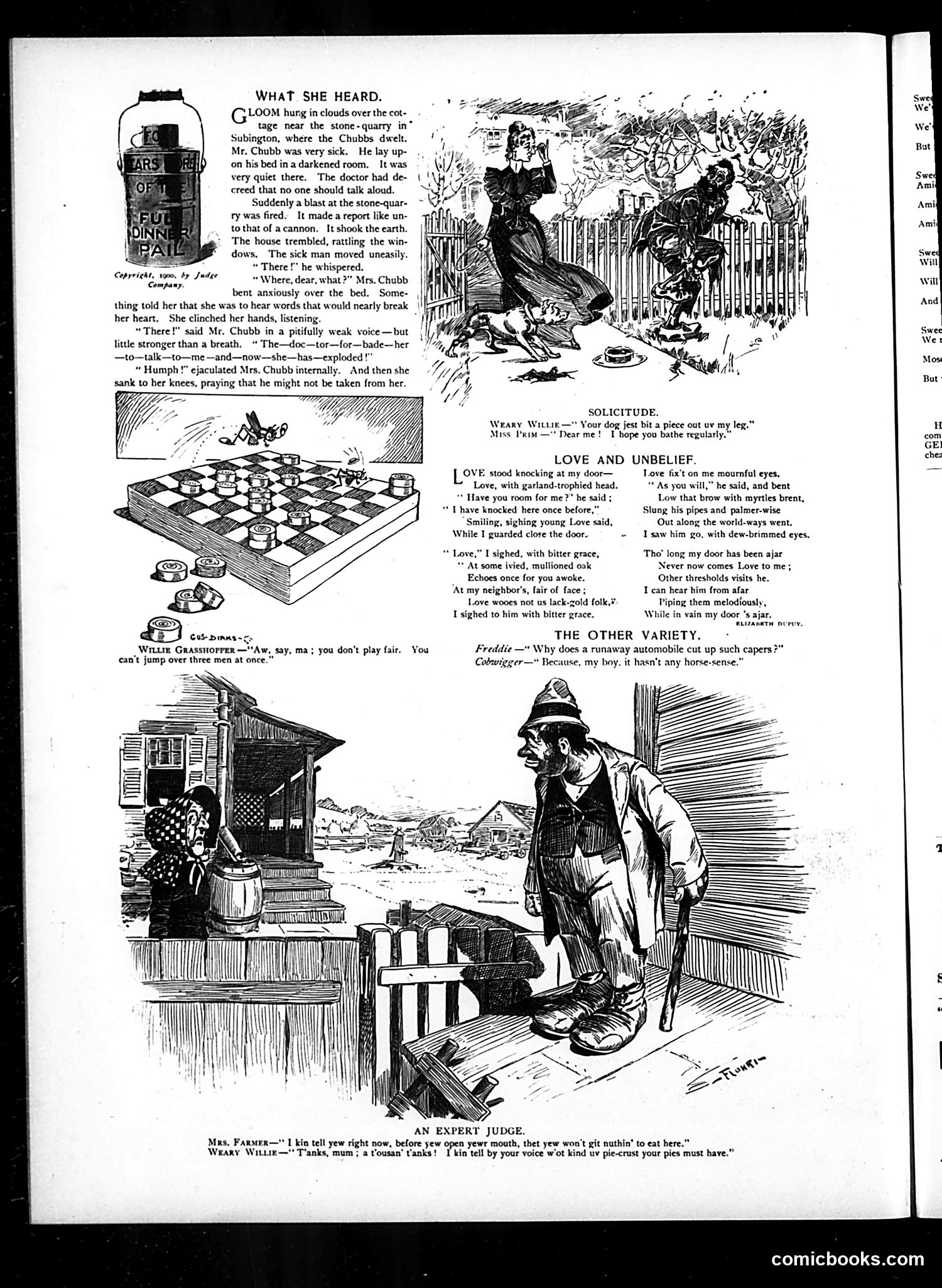
This page from *Judge* contains multiple satirical pieces typical of the magazine's humor: **"What She Heard"** is a domestic comedy about a sick Mr. Chubb who, confined to bed under doctor's orders of silence, misinterprets a stone-quarry explosion as his wife talking—then catastrophizes that she has literally "exploded" from the strain of silence. The joke plays on marital anxiety and misheard sounds. **"Love and Unbelief"** is a sentimental poem about rejecting Love's advances due to poverty ("lack-gold folk"), only to regret it after Love departs to visit wealthier neighbors. It satirizes both romantic self-pity and class consciousness. **"The Other Variety"** offers a brief pun: a runaway automobile lacks "horse-sense." **"An Expert Judge"** depicts a poor farmer's wife dismissing a vagrant (Weary Willie) before he speaks, claiming she can tell by his voice what inferior pie-crust he must make. It satirizes snap judgments and class prejudice. The cartoons employ working-class dialect and stereotypes common to era humor.
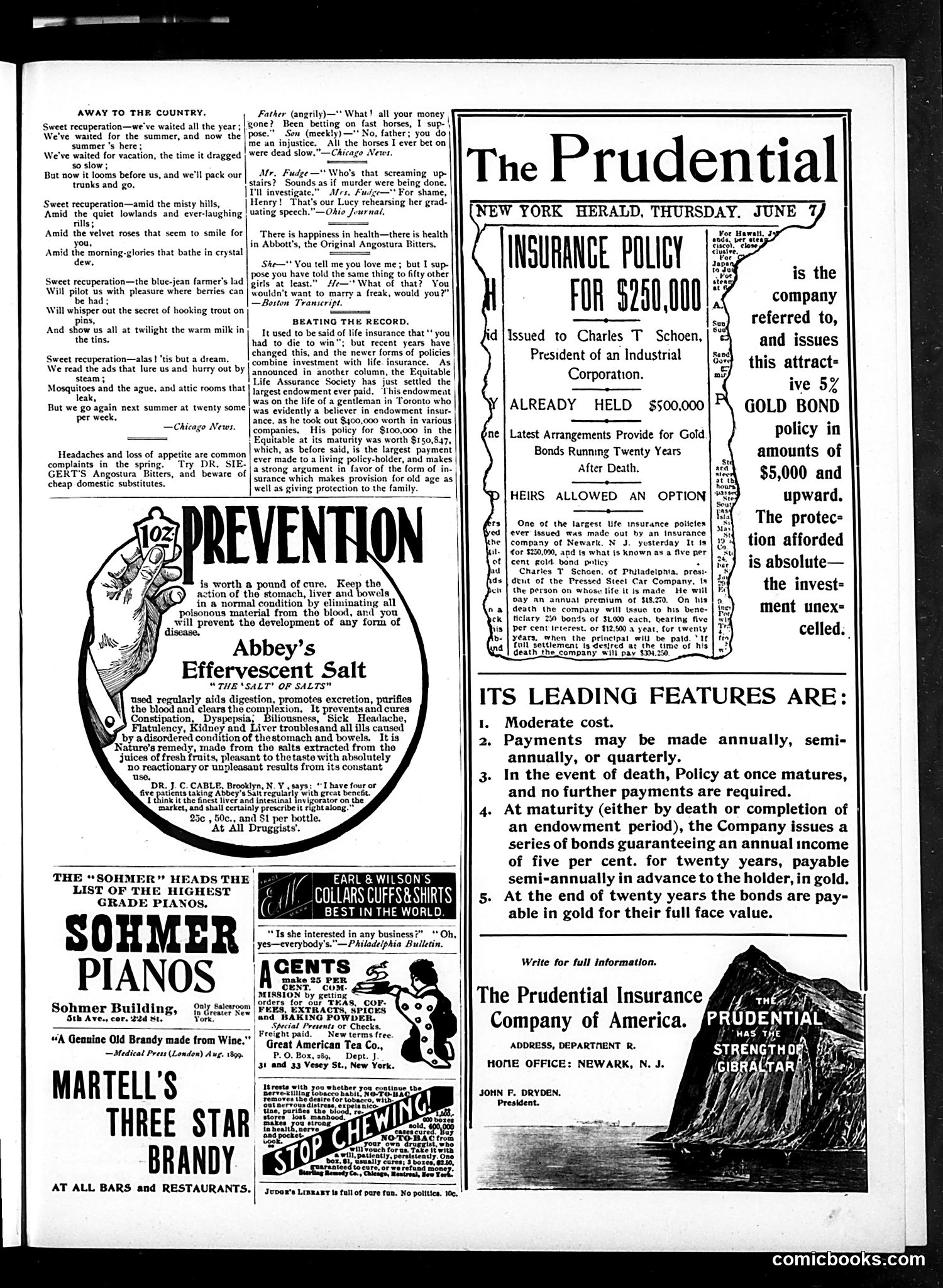
This is primarily an **advertising and light humor page** from June 1913, not a political cartoon. The main content includes: **Legitimate Articles:** - "Away to the Country" — a poem about summer vacation's disappointing reality versus romantic expectations - Health-related advice about digestive issues and insurance innovations **Comic Anecdotes:** The page features brief, mild joke exchanges: a father accusing his son of betting on horses (Son defensively claims he only bet on "dead slow" ones); a young man deflecting criticism about telling multiple girls he loves them as merely being honest rather than unique. **Advertisements:** Most of the page promotes commercial products — Abbey's Effervescent Salt (digestive remedy), Sohmer Pianos, Martell's Brandy, and most prominently, **The Prudential Insurance Company's gold bond policy** (the largest advertisement, detailing investment features). The satire is gentle and domestic rather than political. The overall page reflects early 20th-century consumer culture and conventional middle-class concerns.
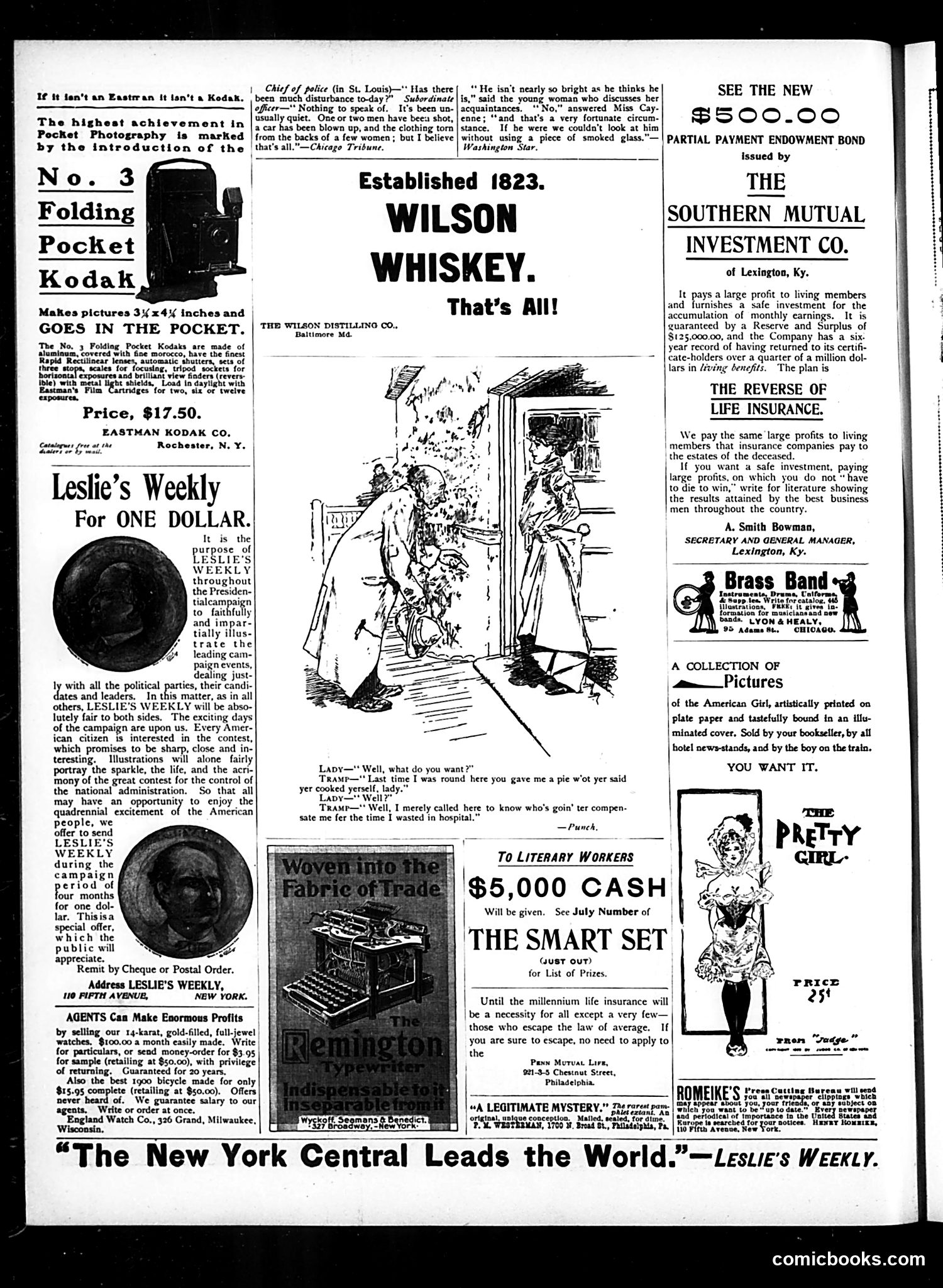
This page is primarily advertising, with minimal editorial cartooning. The visible satirical content includes: **Two brief text-based jokes** (likely reprinted from other publications like the *Chicago Tribune* and *Punch*): 1. A St. Louis police chief casually dismisses violence—shooting, car bombings, women stripped—as "nothing to speak of," mocking urban lawlessness and police indifference. 2. A "smart" young woman disparages an acquaintance's intelligence, with a sardonic reply about his fortunate ignorance. 3. A tramp returns to a woman seeking compensation for hospitalization caused by her pie, a working-class humor piece. The page is dominated by **product advertisements**: Kodak cameras, Leslie's Weekly (promoting presidential campaign coverage), watches, bicycles, Wilson Whiskey, insurance bonds, and literary journals. This reflects Judge's revenue model—advertisements subsidized satirical content. The small cartoons/jokes scattered among ads served as filler between commercial pitches.
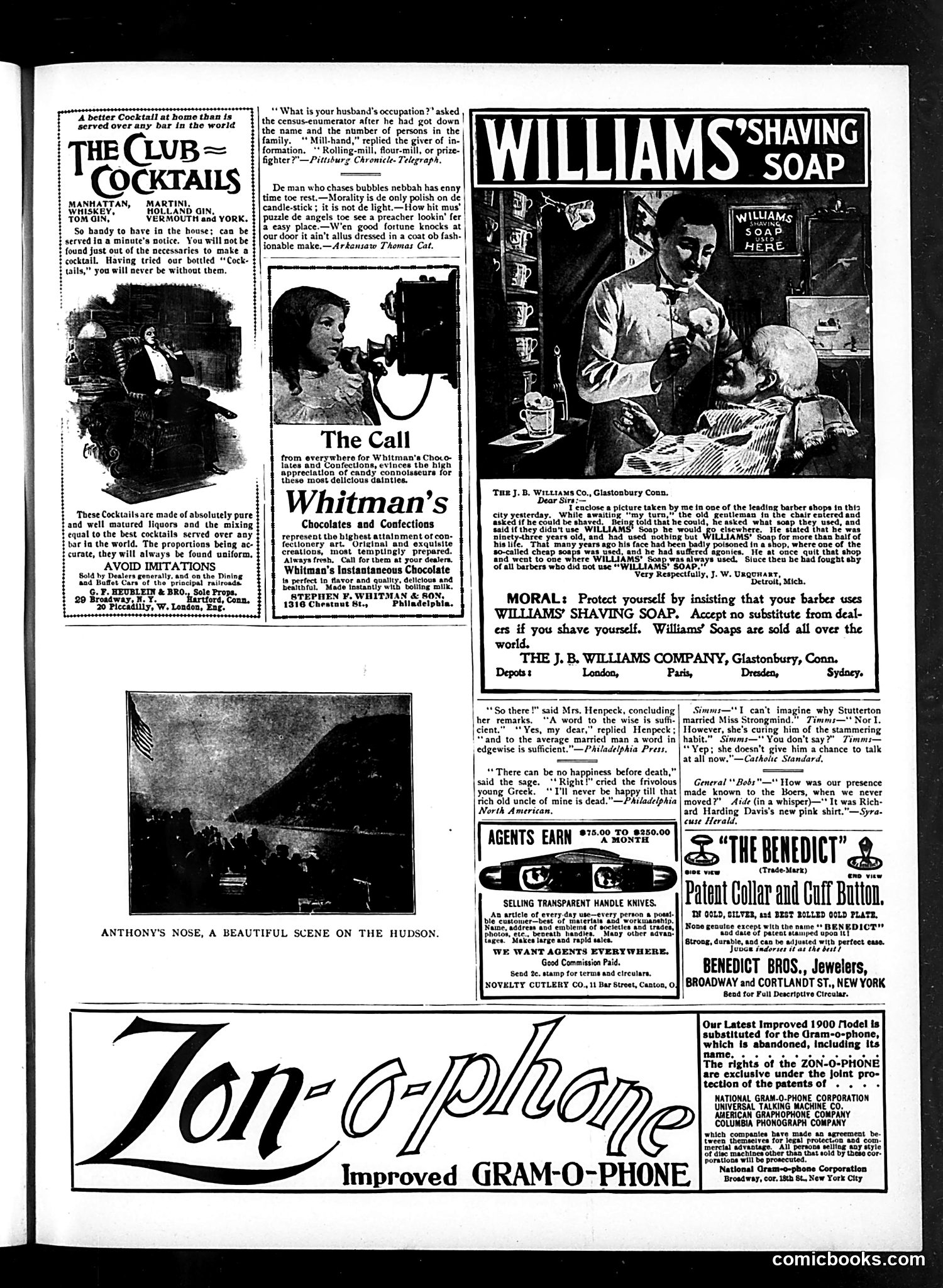
This page from *Judge* magazine is primarily **advertising and filler content** rather than political satire. The main elements are: **Advertisements:** The page consists mostly of product ads—cocktail recipes, chocolates, shaving soap, phonographs, and cutlery—typical of early 1900s magazine padding. **Light Humor Pieces:** Several brief jokes appear, including puns about census-taking, philosophy attributed to "Arkansaw Thomas Cat" (dialect humor common to the era), and marital bickering ("A word to the wise is sufficient"/"A word edgewise is sufficient"). **Williams' Shaving Soap Feature:** A lengthy testimonial about a 93-year-old barber customer praising the product, framed as a moral lesson about product loyalty. **"Anthony's Nose" Image:** A scenic Hudson River photograph, unrelated to surrounding content. The page demonstrates how *Judge* balanced satirical content with commercial advertising revenue. There is **no significant political commentary or caricature** on this particular page—it reflects the magazine's role as both humor publication and advertising vehicle for consumer goods.
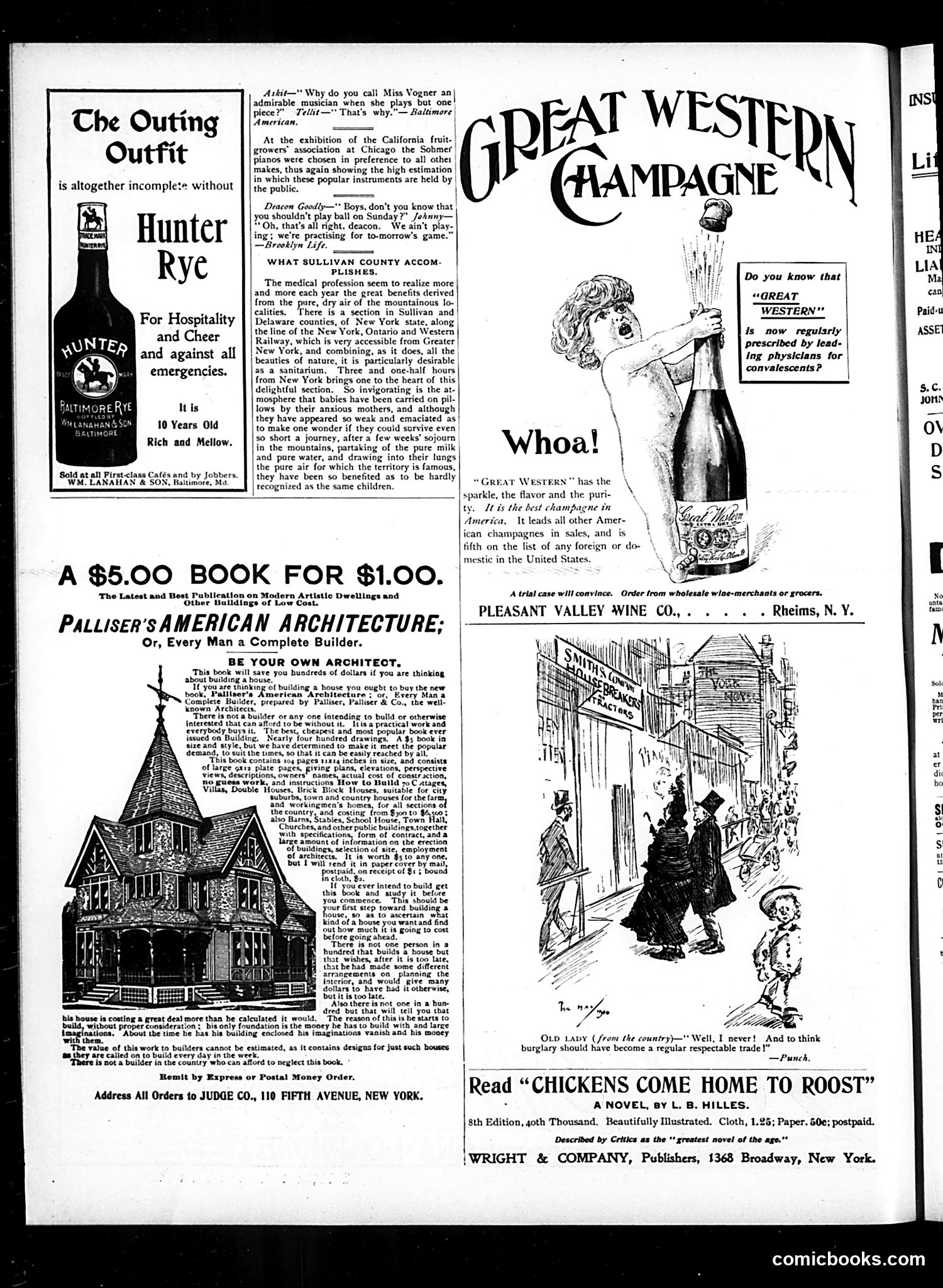
This page from *Judge* magazine contains mostly advertisements and brief humor pieces rather than political cartoons. **The visible jokes** are simple one-liners: a pianist who plays only one piece is "admirable" because that's her limitation; boys practice baseball on Sunday by calling it "practice" rather than "play"; and a deacon accepts this semantic distinction. **The main advertisements** promote Hunter Rye whiskey (emphasizing its medicinal properties), Palliser's architecture book (practical design guides for homebuilders), and Great Western Champagne (claiming superiority among American champagnes). **The illustrated cartoon** at bottom shows an "Old Lady" confronting what appears to be burglars, with the caption suggesting she's become a "regular repeating" target—likely dark humor about home invasion. The page reflects turn-of-the-century advertising culture where beverages were marketed with health claims, and reflects period attitudes toward humor and domesticity.
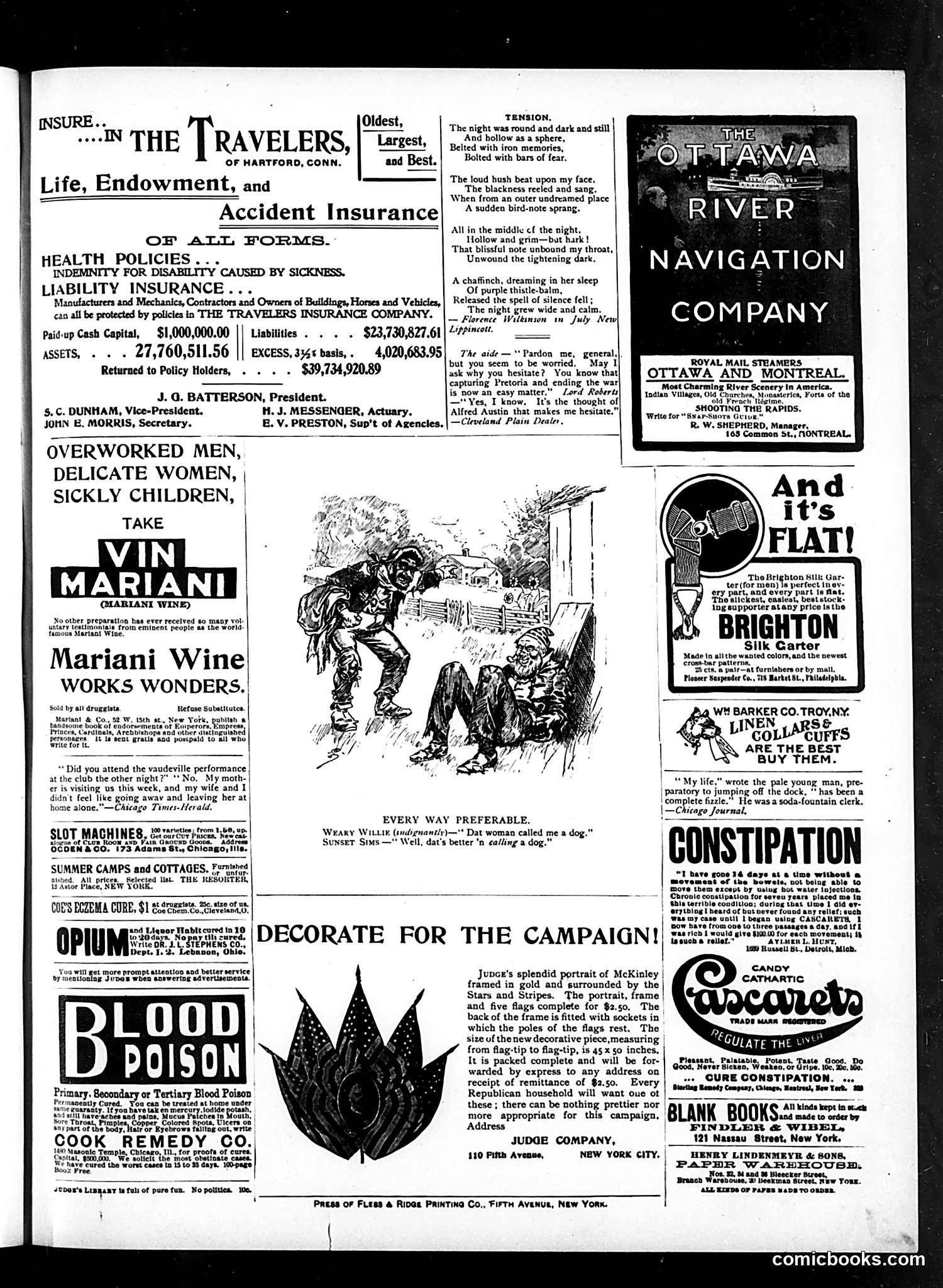
This page is primarily **advertising and filler content**, not political satire. The main editorial cartoon appears to be untitled and shows a figure (possibly a hobo or vagrant) gesturing at what appears to be a domestic scene, illustrating the caption "Every way preferable" — a mild joke about class differences. The only political reference is a small cartoon dialogue about **Lord Roberts and Alfred Austin**. Roberts, a British general, hesitates about capturing Pretoria (during the Boer War), not from military concern but because he fears criticism from **Alfred Austin, the British Poet Laureate**. This satirizes Austin as ineffectual or overly sensitive—a common jab at literary figures deemed irrelevant to serious matters. The rest of the page consists of period advertisements for insurance, wine tonics, steamship travel, and patent medicines—standard Judge magazine filler typical of early 1900s publications.
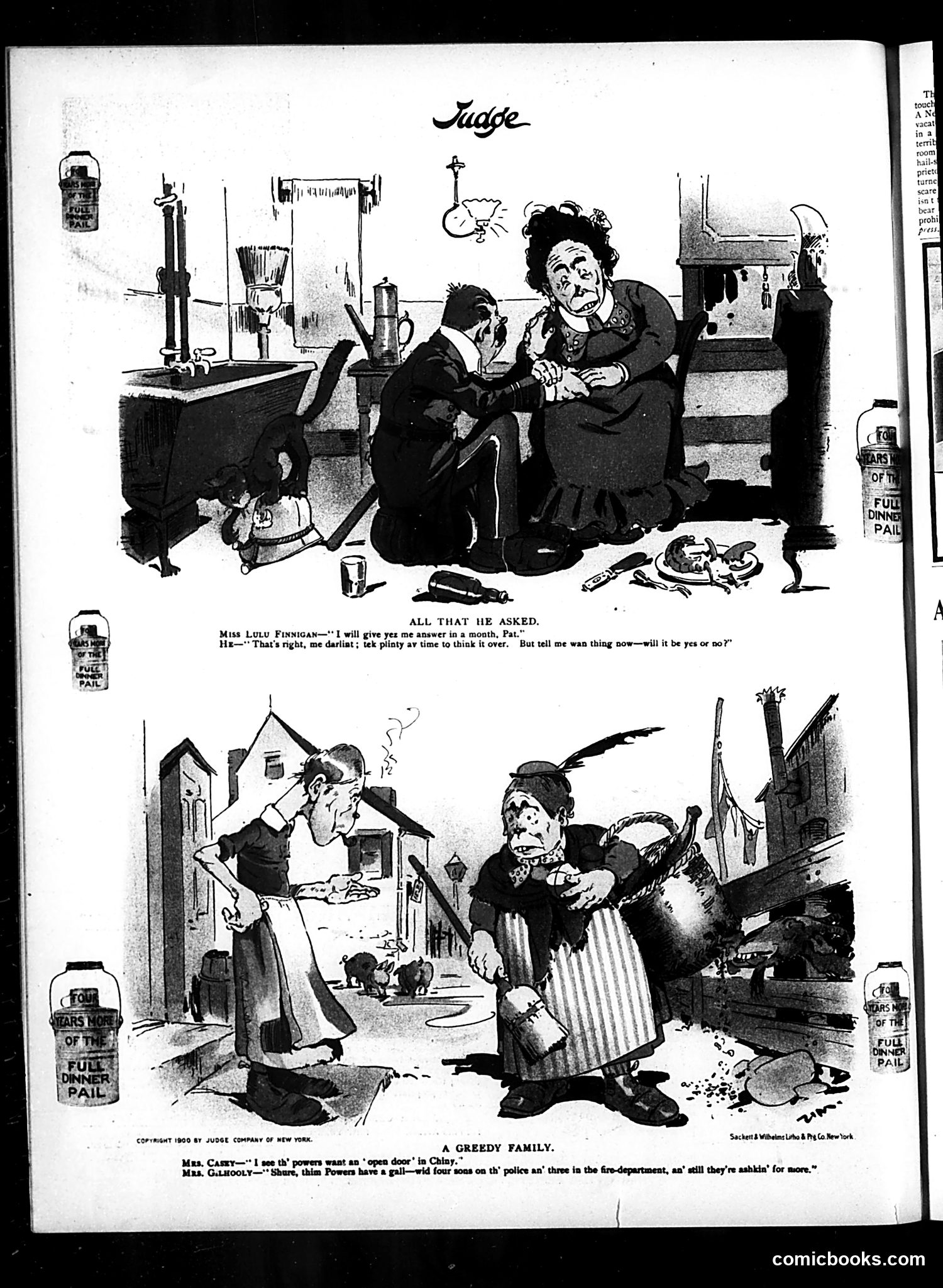
**Top cartoon ("All That He Asked"):** A sentimental Irish-American romance joke. Pat proposes to Miss Lulu Finnegan, who asks for a month to decide. His punchline reveals impatience—he wants to know the answer *now*, undercutting his patient facade. The humor relies on Irish dialect stereotyping common in the era. **Bottom cartoon ("A Greedy Family"):** Social satire about nepotism and political corruption. Mrs. Casey and Mrs. Gilmooly gossip about the "Powers" family, who apparently have four sons on the police force and three in the fire department—public jobs typically obtained through patronage networks—yet still demand more positions. The joke critiques how politically connected families monopolized civil service jobs while ordinary citizens were excluded. "Open door" policy in China (likely referencing recent Boxer Rebellion negotiations) provides ironic contrast to closed-door favoritism at home. Both cartoons use working-class Irish-American characters and vernacular speech typical of Judge's satirical approach to immigrant communities and urban politics.
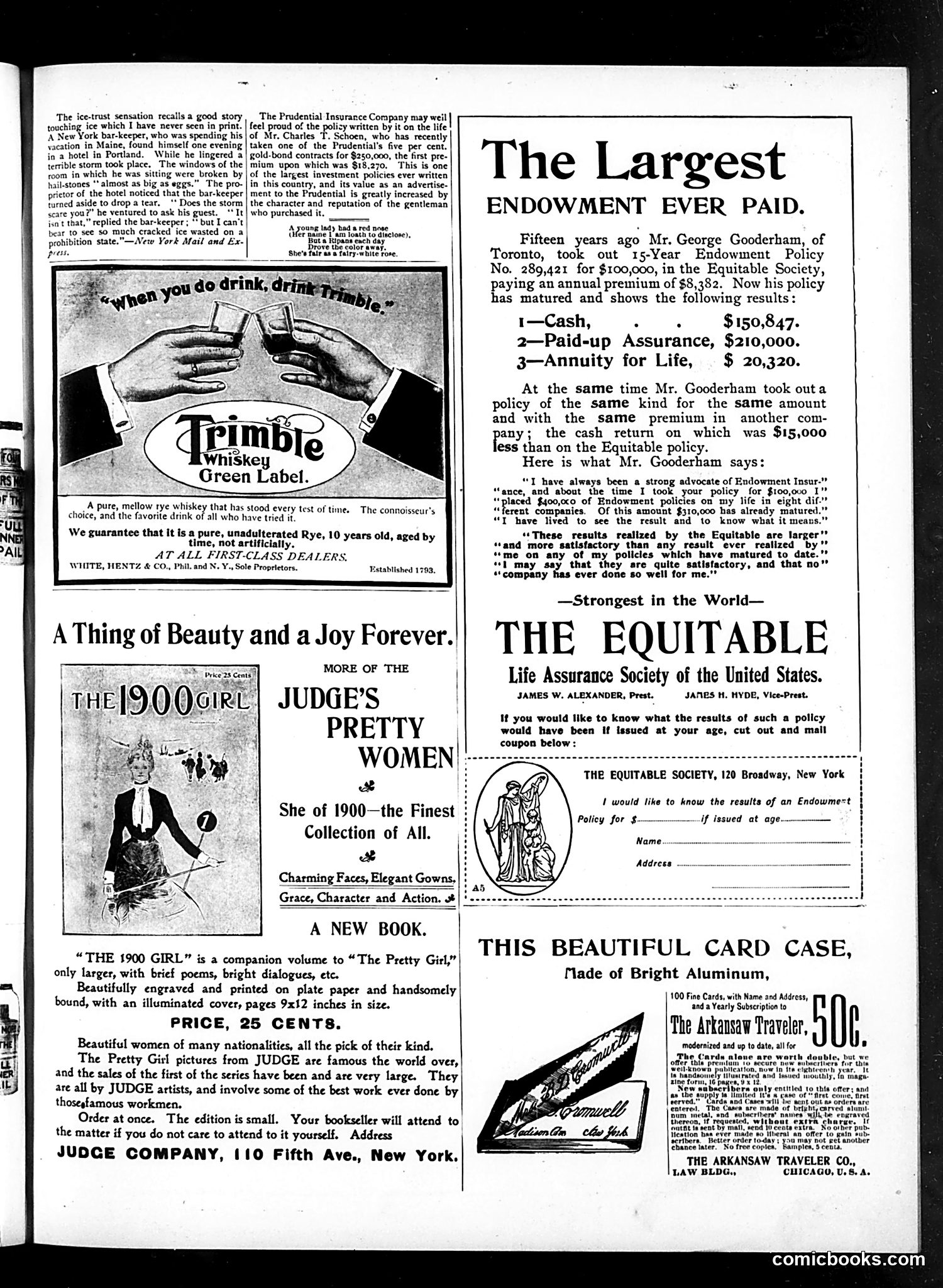
This page is primarily **advertising**, not political satire. The main content consists of commercial advertisements for insurance, whiskey, and books—typical of early 1900s magazines. The dominant feature is a large **Equitable Life Assurance advertisement** highlighting a Canadian policyholder (George Gooderham) whose 15-year endowment policy matured with impressive returns ($150,847 cash plus additional benefits). The ad uses his testimonial to claim superiority over competitors, noting his policy from another company returned $15,000 less. Secondary advertisements include: - **Trimble Whiskey** (with hands toasting) - **Judge Company's "The 1900 Girl"** book (25 cents) - **Arkansas Traveler card case** (50 cents) A brief humor piece at top-left describes a bar-keeper's concern about wasted ice during a Maine storm—a mild joke about economic waste, not political commentary. The page reflects turn-of-century consumer culture and insurance industry competition rather than satirical critique.
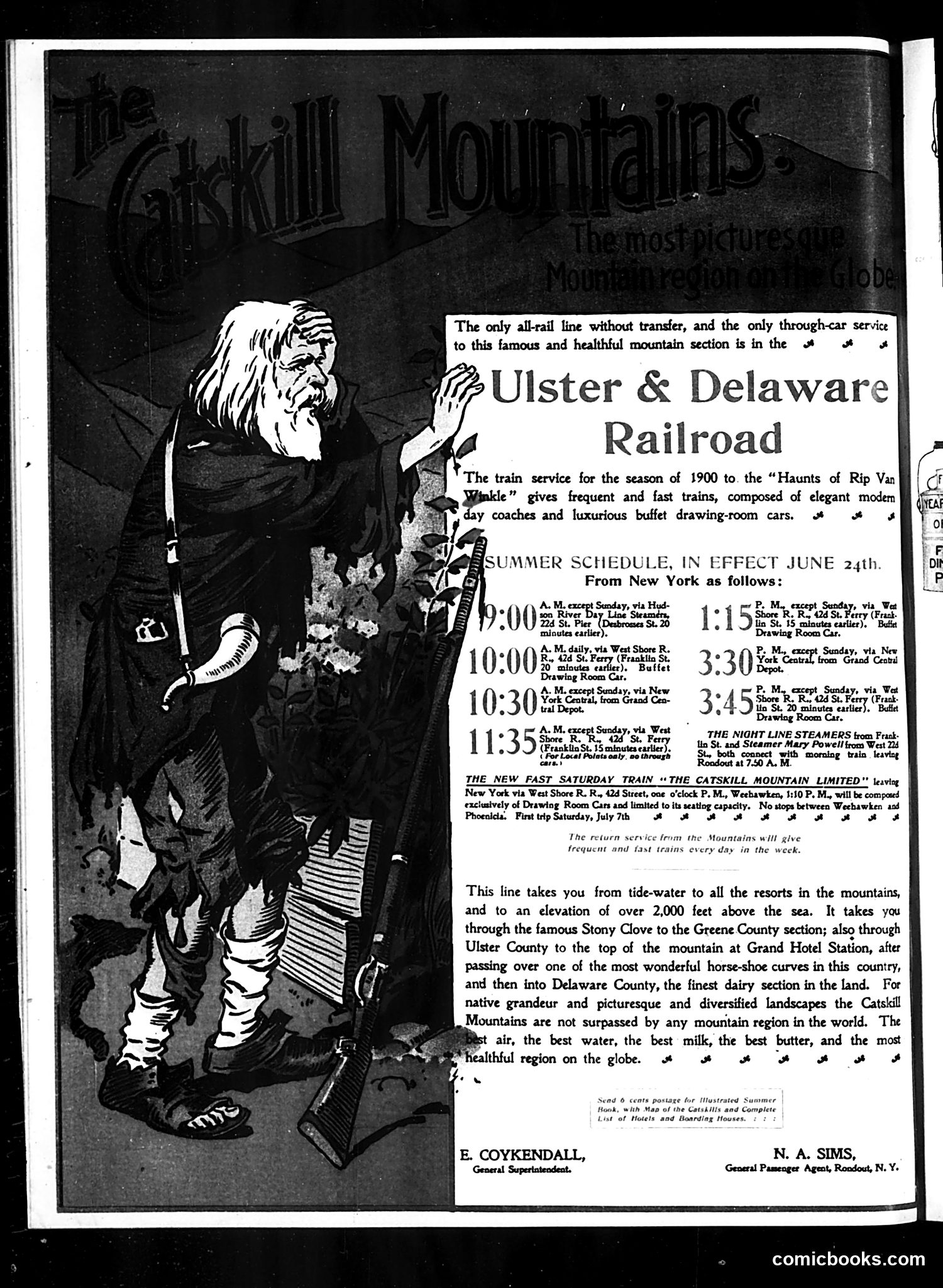
This page is primarily **railroad advertising**, not political satire. It promotes the Ulster & Delaware Railroad's summer 1900 service to the Catskill Mountains. The illustration depicts an old man with a long white beard—likely representing **Rip Van Winkle**, the Washington Irving character who slept in the Catskills. This is a marketing reference: the ad's headline mentions "Haunts of Rip Van Winkle," using the famous literary association to brand the region as a tourist destination. The text emphasizes the railroad's advantages: it's "the only all-rail line without transfer" offering direct service to mountain resorts at 2,000+ feet elevation. It highlights luxury amenities (drawing-room cars, buffet service) and frequent daily schedules from New York. For modern readers: this represents **late-19th-century leisure travel marketing**—when rail companies promoted mountain vacations as healthful escapes for urban professionals. The Rip Van Winkle imagery suggests relaxation and timelessness, appealing to wealthy New Yorkers seeking respite. The page is straightforward commercial promotion, not editorial commentary.