
A complete issue · 16 pages · 1900
Judge — July 7, 1900
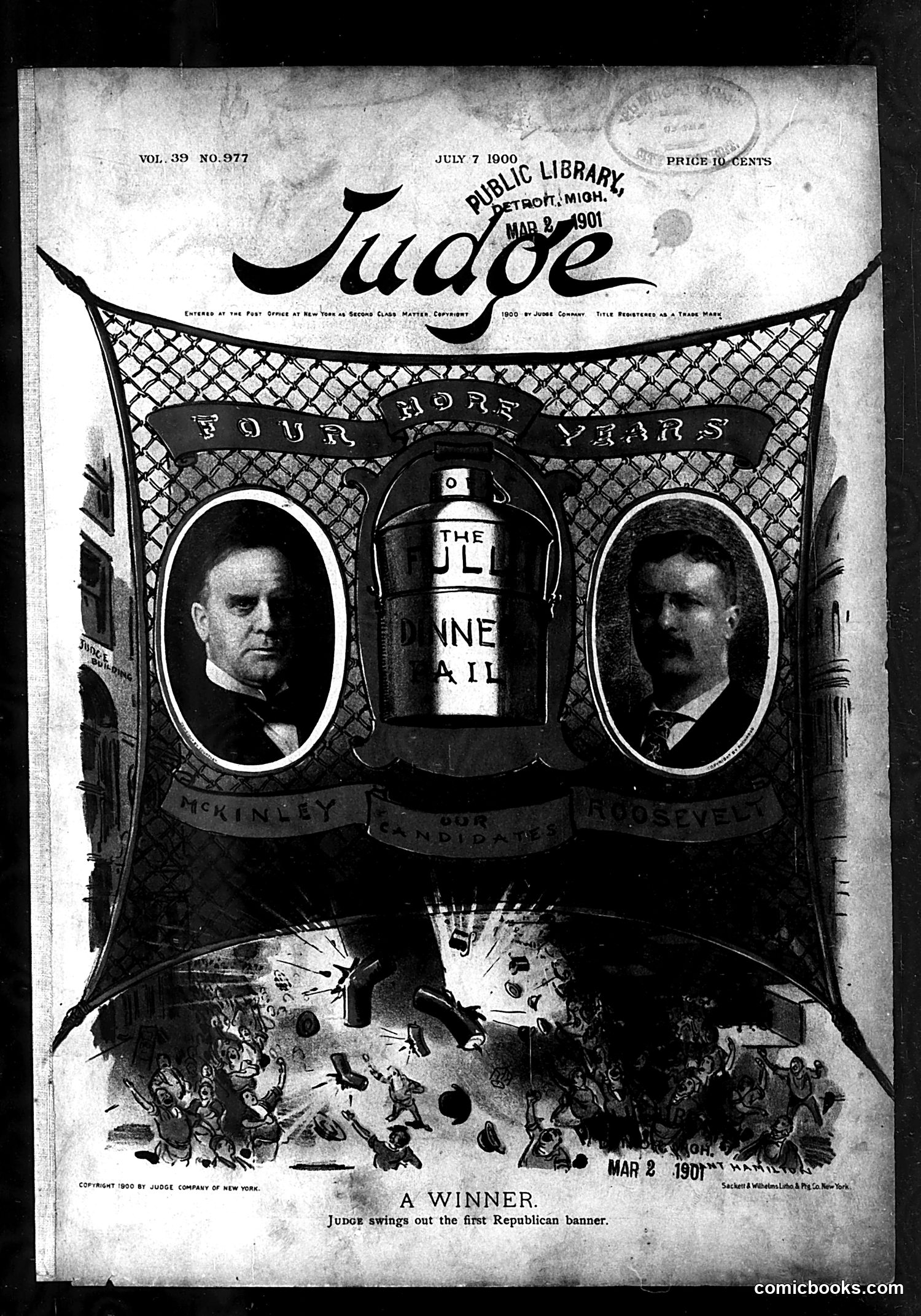
This Judge magazine cover depicts the 1900 U.S. presidential election. The banner reads "Four More Years," and two portrait ovals flank a central bottle labeled "The [Republican] Candidate" (appears to be William McKinley's re-election campaign imagery). Below, chaotic scenes show crowds in celebration or conflict. The caption states "Judge swings out the first Republican banner," indicating this is Judge magazine's endorsement of the Republican presidential ticket. The bottle imagery appears to reference political campaign machinery or messaging. The elaborate net/mesh background and celebratory imagery suggest triumphalism about Republican electoral prospects. The cartoon serves as political propaganda rather than satire—promoting Republican victory rather than mocking it.
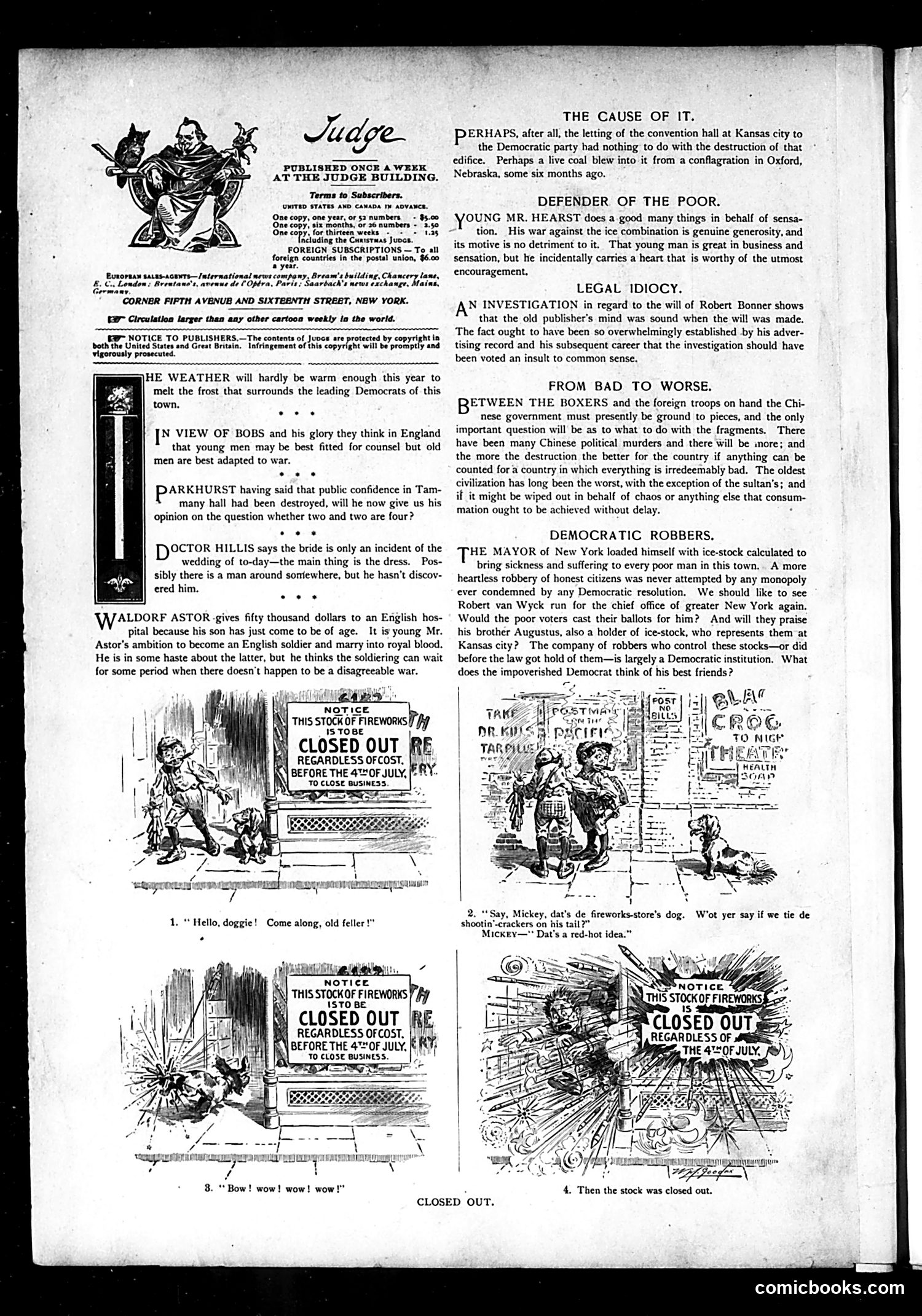
This appears to be a political attack on Democratic leadership regarding Kansas City and Democratic Party corruption. The editorial section contains critiques of Democratic figures (references to "Robert Bonner," the Mayor of New York, and "van Wyck") accused of financial mismanagement and robbing poor citizens. The visual humor centers on a four-panel comic strip showing a fireworks store owner's predicament. Notices state the store must close before July 4th. The owner tries unsuccessfully to unload inventory, attempting to convince a customer (a dog) to buy firecrackers. The final panel depicts an explosion—"the stock was closed out"—making a pun on business failure and literal destruction of remaining merchandise. The satire critiques Democratic incompetence through both political editorial and sight-gag humor.
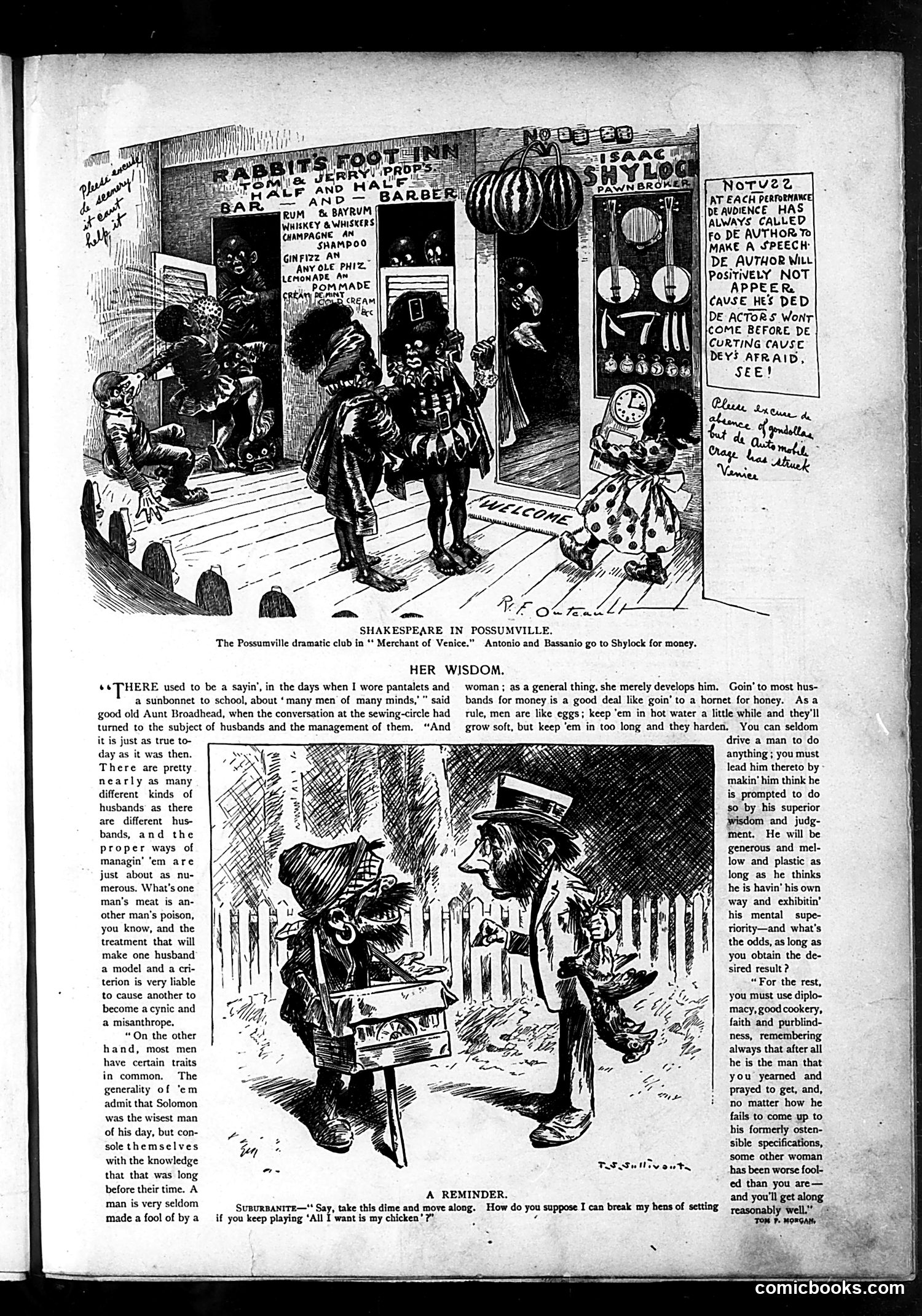
**Top Cartoon: "Shakespeare in Possumville"** This satirizes a dramatic club's production of "Merchant of Venice," with Antonio and Bassanio visiting a character named Shylock for money. The setting is a seedy establishment (Rabbit Inn, bar, barber shop) rather than Venice. The humor derives from transposing Shakespeare into a low-class American setting, mocking both amateur theatrical productions and the pretensions of small-town drama clubs attempting classical plays. **Bottom Cartoon: "A Reminder"** A domestic scene where a man playing violin tells his wife to "say, take this dime and move along." The wife responds sarcastically: "How do you suppose I can break my hens of setting if you keep playing 'All I want is my chicken'?" The joke plays on the song title's double meaning—treating the wife's complaint about his violin playing as literally about chickens, creating absurdist humor typical of Judge's style.
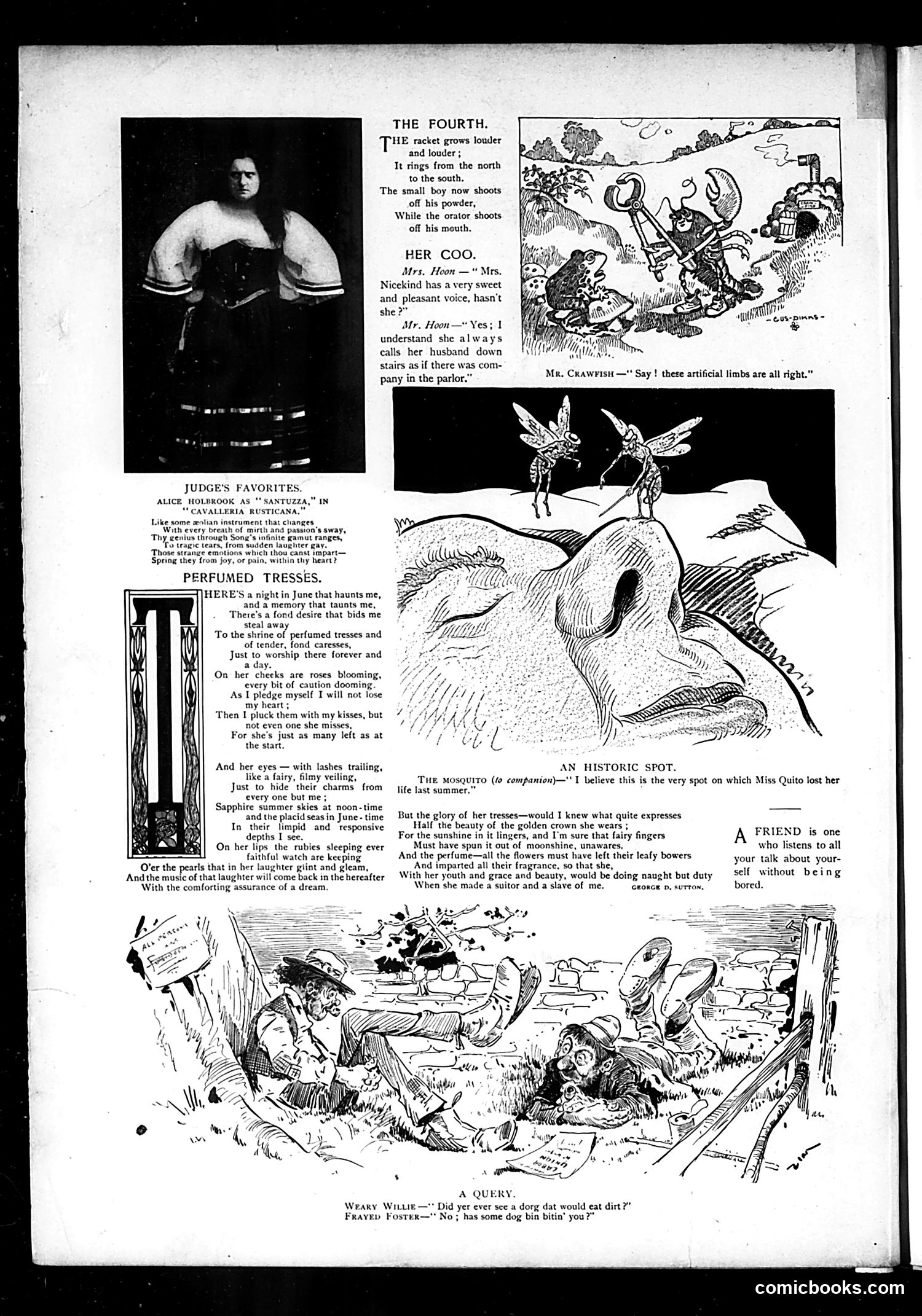
This page contains several unrelated satirical pieces and poems rather than a unified political cartoon. **"Judge's Favorites"** features a photograph of an opera singer performing in "Cavalleria Rusticana," accompanied by admiring verse about her vocal talents. **"Her Coo"** is a brief comedic dialogue about Mrs. Nickkind's sweet voice, with the joke being she calls her husband downstairs constantly. **"The Fourth"** appears to reference Independence Day celebrations with illustrations of children playing with fireworks and toys. **"Perfumed Tresses"** is a romantic poem about a woman's hair and beauty. **"A Query"** is a humorous exchange between "Weary Willie" and "Prayer Foster" about dogs eating dirt. The page reflects typical Judge magazine content: light social satire, poetry, and domestic humor rather than serious political commentary.
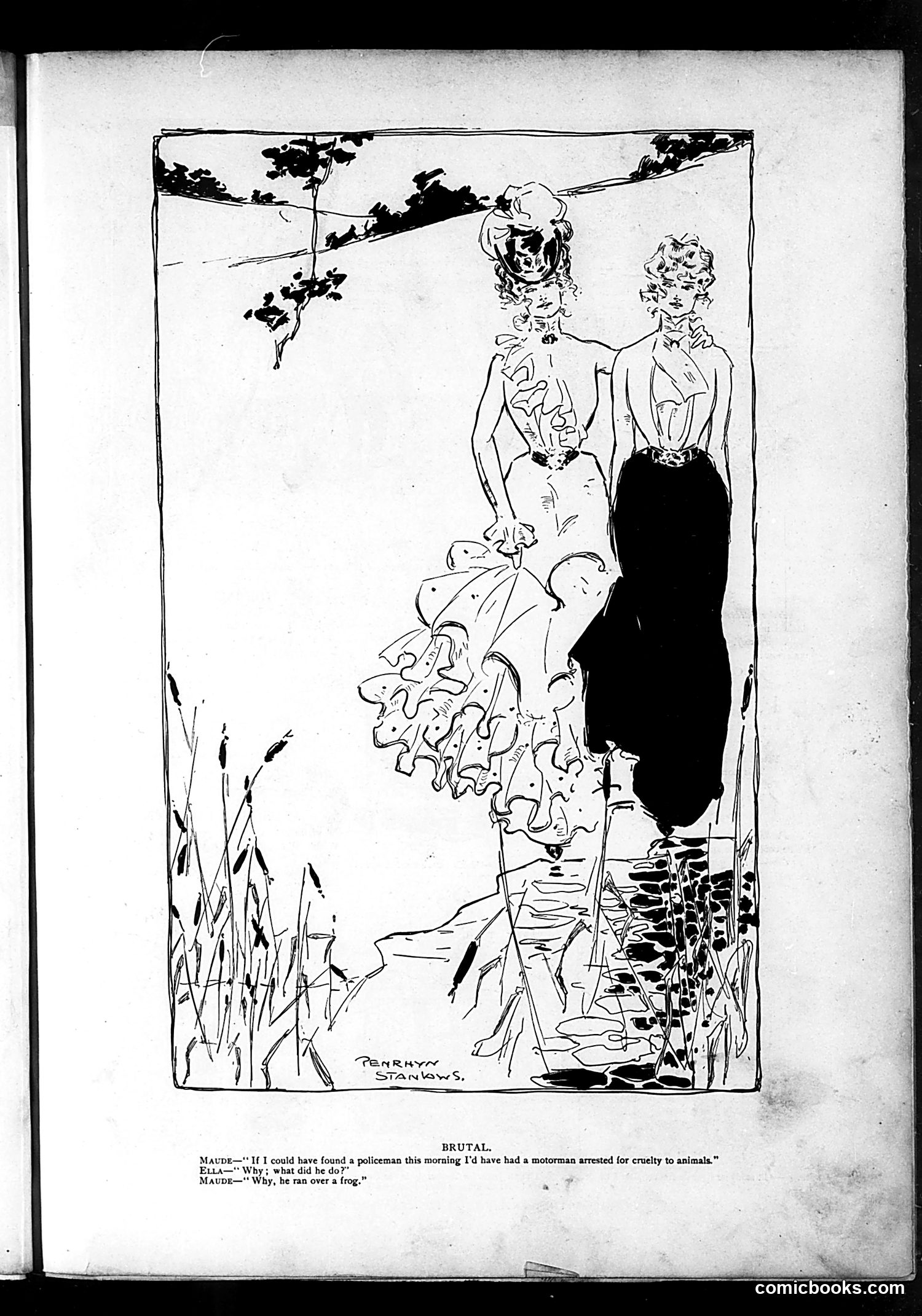
This is a satirical cartoon titled "Brutal" that mocks overzealous animal protection advocates through a dialogue between two women (Maude and Ella). The joke relies on exaggeration: Maude claims she wanted to arrest a streetcar motorman for animal cruelty because he ran over a frog. This absurdly trivial incident—an unavoidable accident involving a common amphibian—is treated with the same seriousness one might reserve for intentional animal abuse. The satire targets early 20th-century animal welfare activists, portraying them as ridiculous and humorless for taking minor incidents to legal extremes. The cartoon suggests such reformers lack proportional judgment and perspective. The illustration's elegant Art Nouveau style contrasts with the pedestrian scenario, emphasizing the pretentiousness of the complaint.
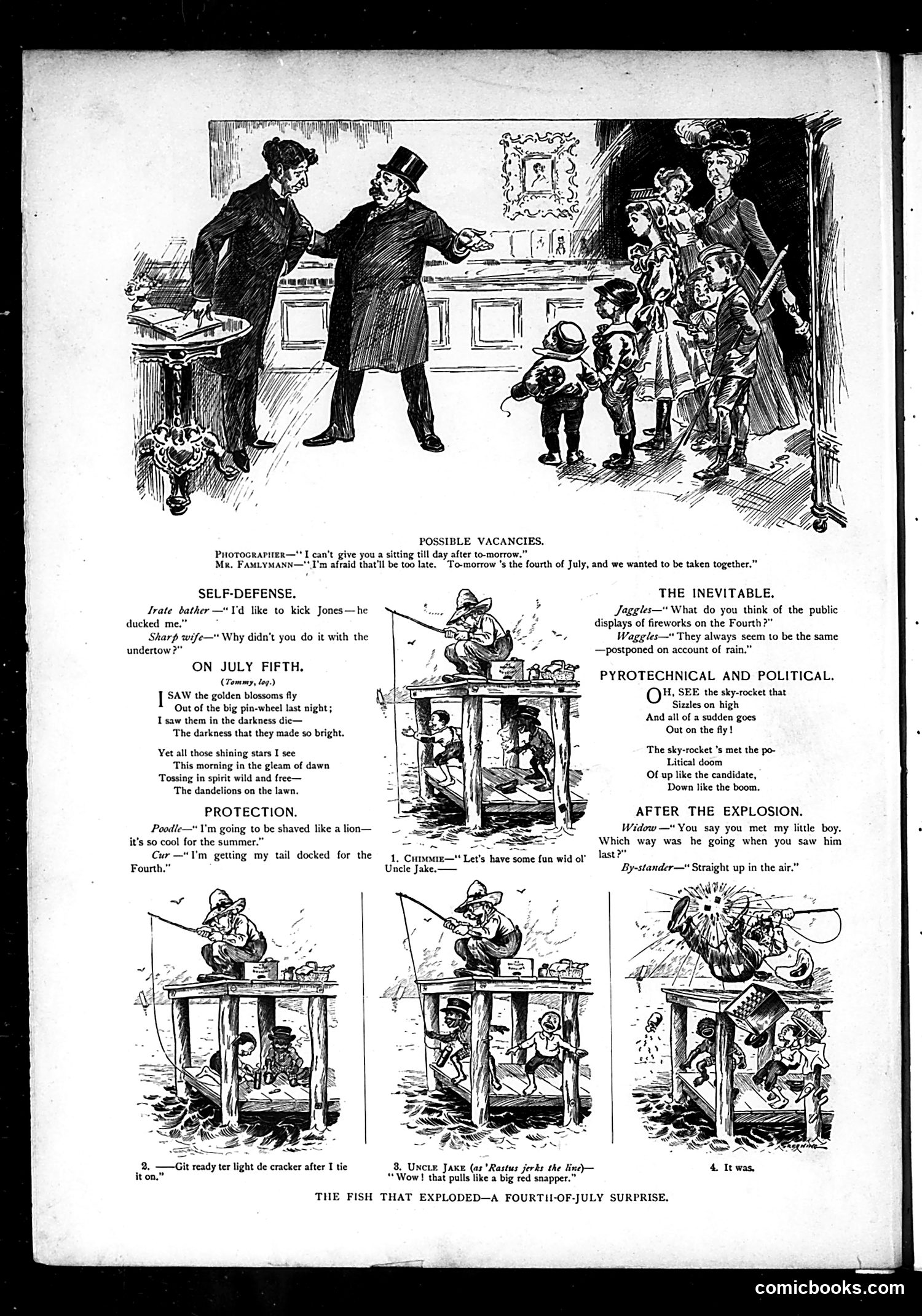
This page collects Fourth of July-themed humor from Judge magazine. The cartoons mock holiday traditions and contemporary follies: **"Possible Vacancies"** jokes about photographers being too busy before July Fourth to take family portraits. **"On July Fifth"** is sentimental verse comparing fireworks' brief beauty to dandelions. **"Protection"** features dogs discussing grooming fashions—a poodle getting a "lion cut" and another dog getting its tail docked. **"Pyrotechnical and Political"** draws a metaphor between sky-rockets and political candidates: both shoot up dramatically then crash down. **"The Fish That Exploded"** appears to be a comic sequence where Uncle Jake and "Rastus" (a racist caricature common to period humor) fish, discovering their catch contains an explosive—a dark joke about Fourth of July accidents. The overall theme satirizes American holiday excess and the predictable dangers of fireworks celebrations.
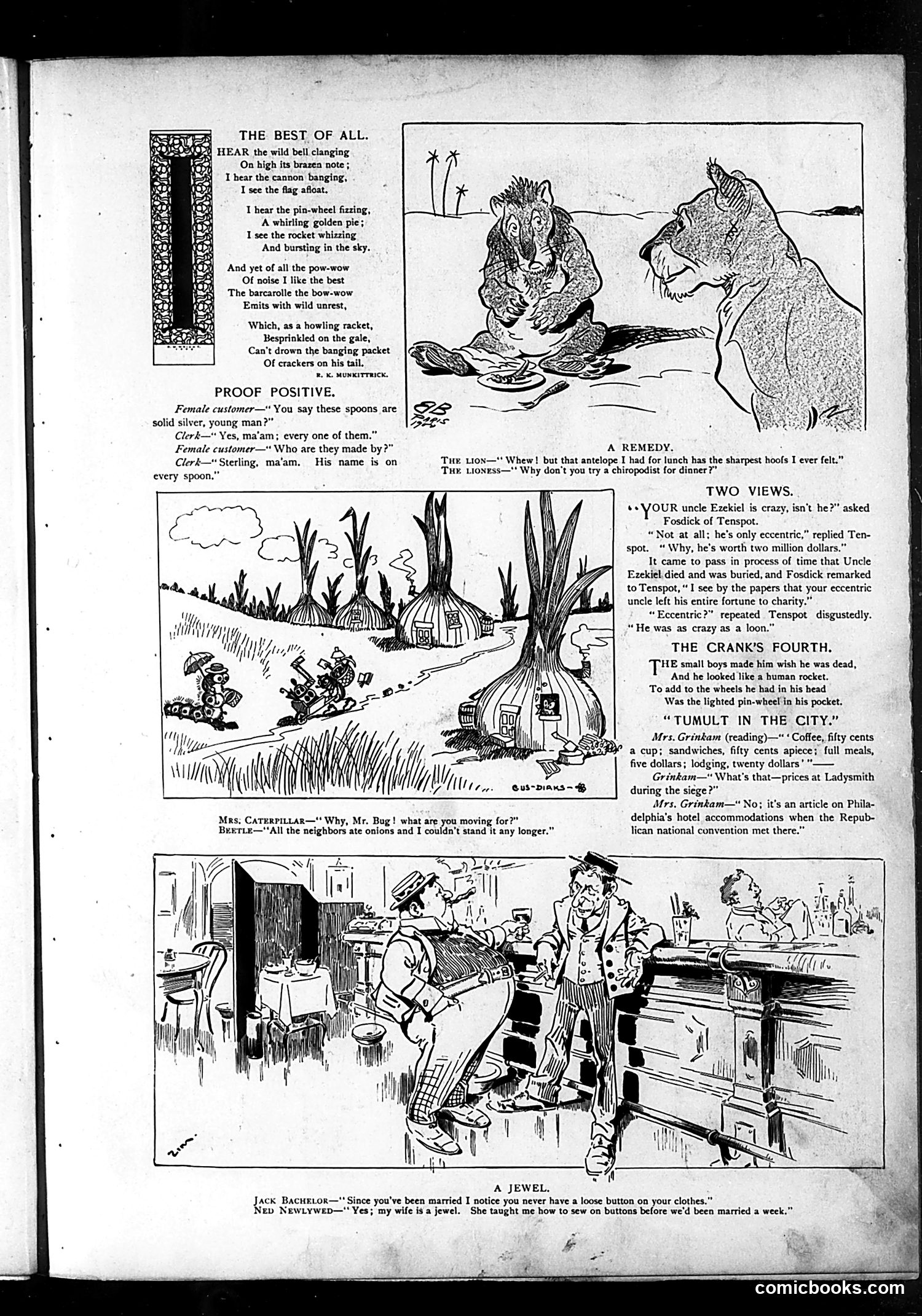
This page contains several satirical humor pieces typical of Judge magazine's content: **"The Best of All"** is a poem mocking patriotic Fourth of July celebrations, ultimately suggesting the best sound is a dog's howling with firecrackers tied to its tail—darkly comic animal cruelty played for laughs. **"Proof Positive"** is a short joke about a silversmith named Sterling selling "sterling silver" spoons, playing on the double meaning of the name. **"Two Views"** satirizes wealth and social perception: Uncle Ezekiel is called "eccentric" when rich but "crazy" after he donates his fortune to charity—mocking how money determines respectability. **"The Crank's Fourth"** depicts a boy injured by fireworks (appearing like "a human rocket"), criticizing the dangerous Fourth of July tradition. **"Tumult in the City"** references the Boer War's Ladysmith siege through hotel pricing jokes. The remaining pieces are brief domestic humor and puns about spoons, buttons, and neighbors.
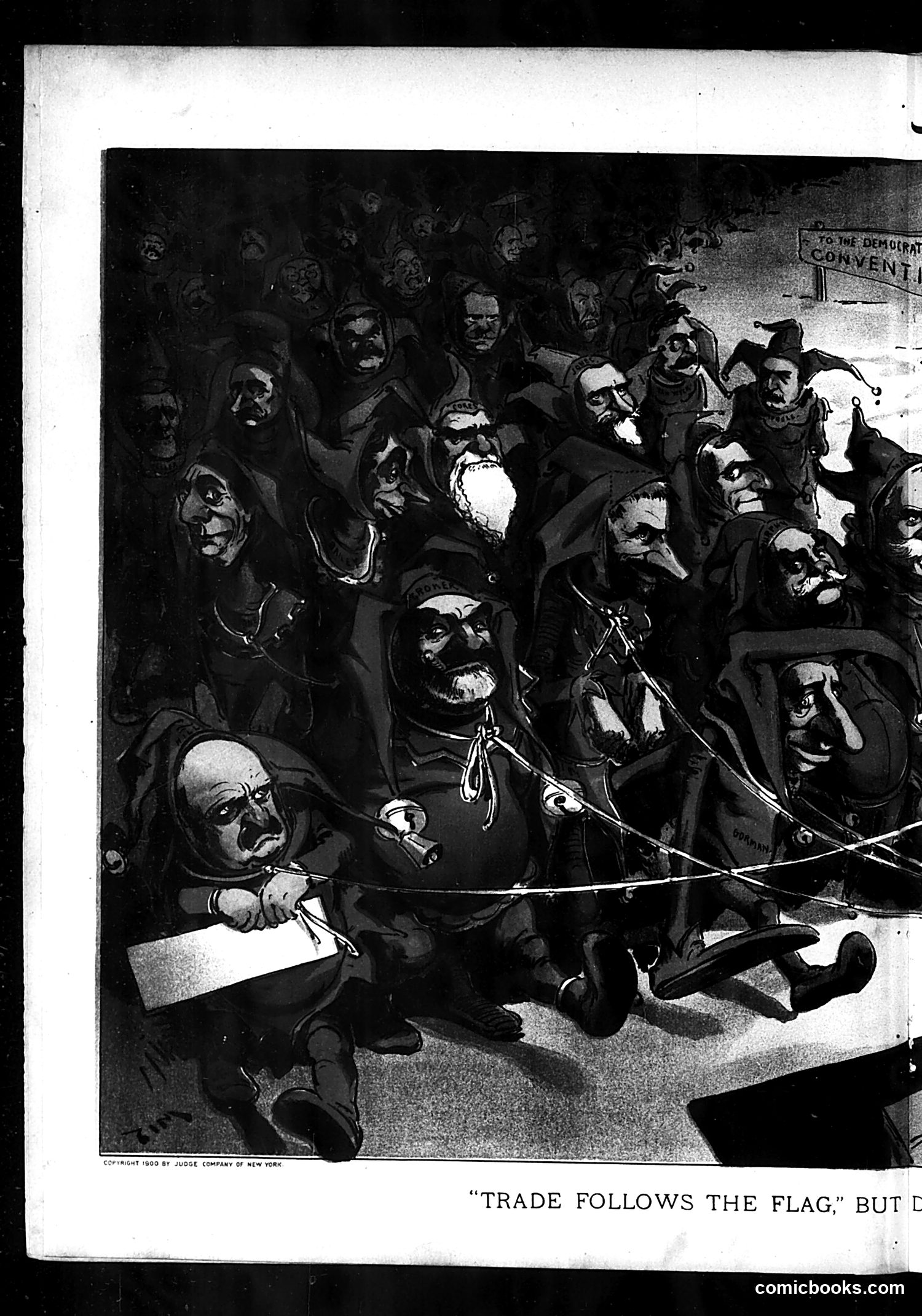
This Judge magazine cartoon illustrates the imperialist saying "Trade Follows the Flag." The image depicts a large crowd of caricatured figures—appearing to represent foreign peoples or colonized populations—gathered densely together. The exaggerated facial features reflect period racial stereotyping common in late 19th/early 20th-century American satire. The incomplete caption suggests the cartoonist is offering a critique or contradiction to the adage. The satire likely questions whether American commercial expansion actually benefits conquered territories or merely exploits them. The masses depicted as faceless, dehumanized crowds reinforce the critique of imperial ventures treating populations as interchangeable economic resources rather than people. The "To the Democratic Convention" sign visible suggests this commentary relates to contemporary political debate over American expansionism.
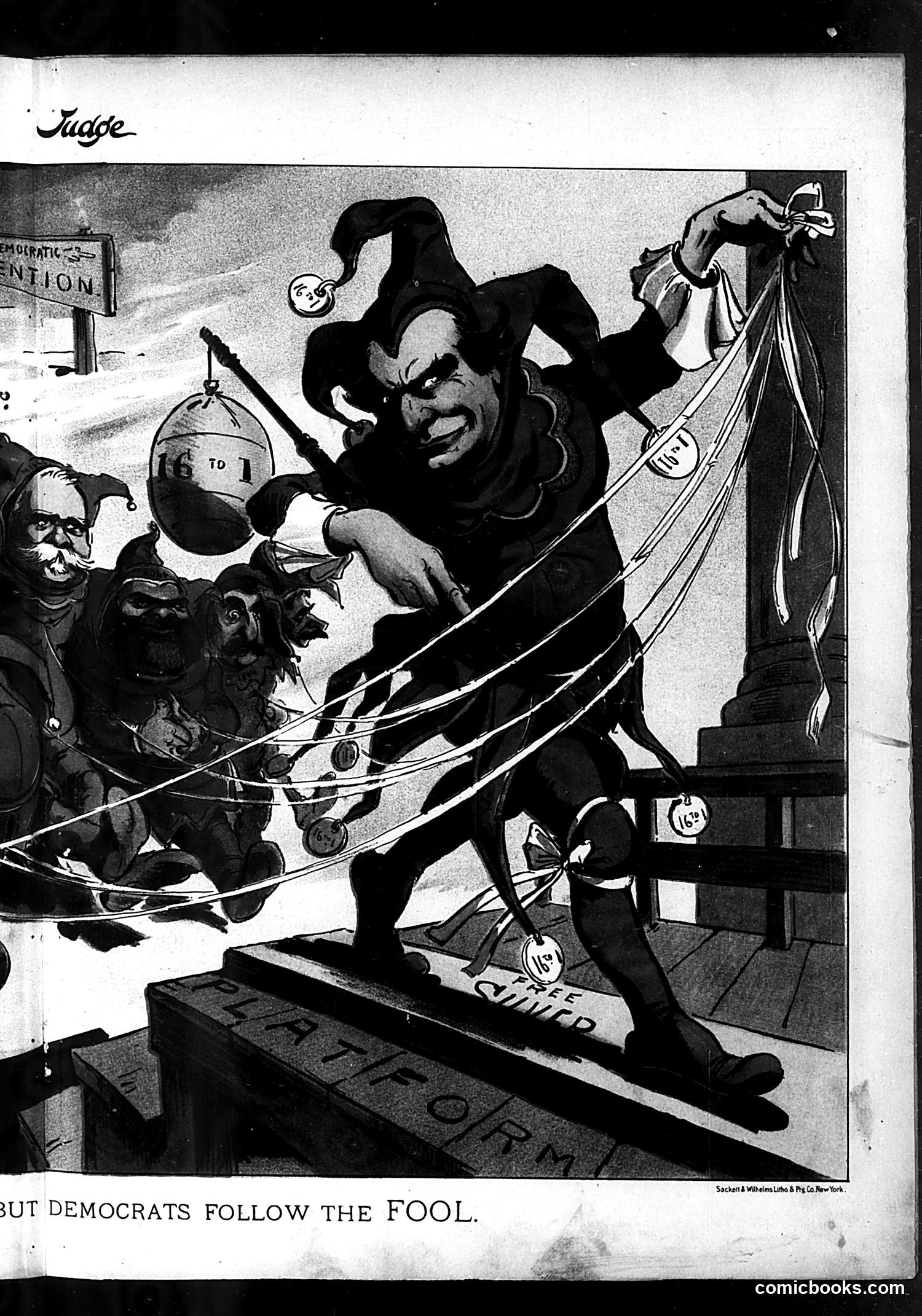
This Judge magazine cartoon depicts a jester or fool figure leading Democrats off a cliff. The caption reads "BUT DEMOCRATS FOLLOW THE FOOL," suggesting Republicans viewed Democratic leadership as foolish and their followers as blindly obedient. The caricatured figures on the left appear to be Democratic politicians being led toward disaster (the cliff edge). The jester's theatrical costume and exaggerated features are typical of Judge's satirical style. Various vessels or containers labeled with what appear to be political positions or policies are being carried along. The cartoon's message is straightforward partisan attack: Democrats lack independent judgment and unwisely follow their leaders. This reflects the era's sharp partisan divisions expressed through Judge's conservative Republican perspective. Without a visible date, the specific political moment remains unclear, though the style suggests early-to-mid 20th century.
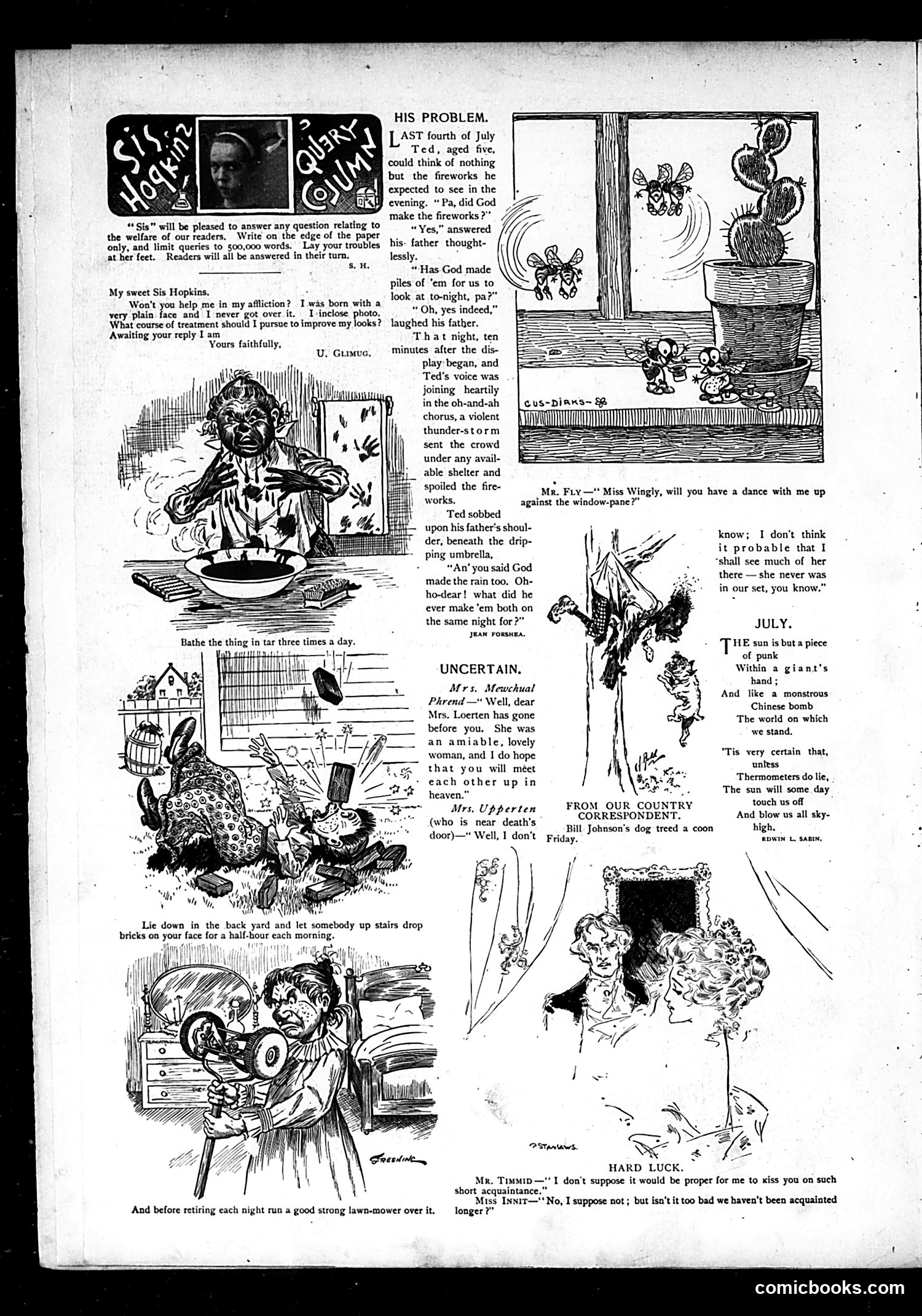
This page contains several humorous pieces typical of early-20th-century satirical magazines: **"His Problem"** depicts a child's theological crisis: after fireworks are ruined by a thunderstorm, five-year-old Ted asks his father why God made both fireworks and rain on the same night—exposing the logical inconsistency a child perceives in divine creation. The humor lies in the father's inability to answer. **"Sis Hopkins' Advice Column"** offers absurd solutions to readers' problems (e.g., "bathe the thing in tar three times a day" for ugliness), satirizing the earnest advice-column format popular in magazines. **"Uncertain"** and **"Hard Luck"** are brief romantic/social comedy vignettes poking fun at courtship etiquette and romantic miscalculation. The **"July" poem** and **"From Our Correspondent"** section provide light seasonal and rural humor. Throughout, the cartoons use exaggerated caricature and slapstick situations to satirize everyday American life—family dynamics, romance, and social pretension—rather than targeting specific political figures or events.
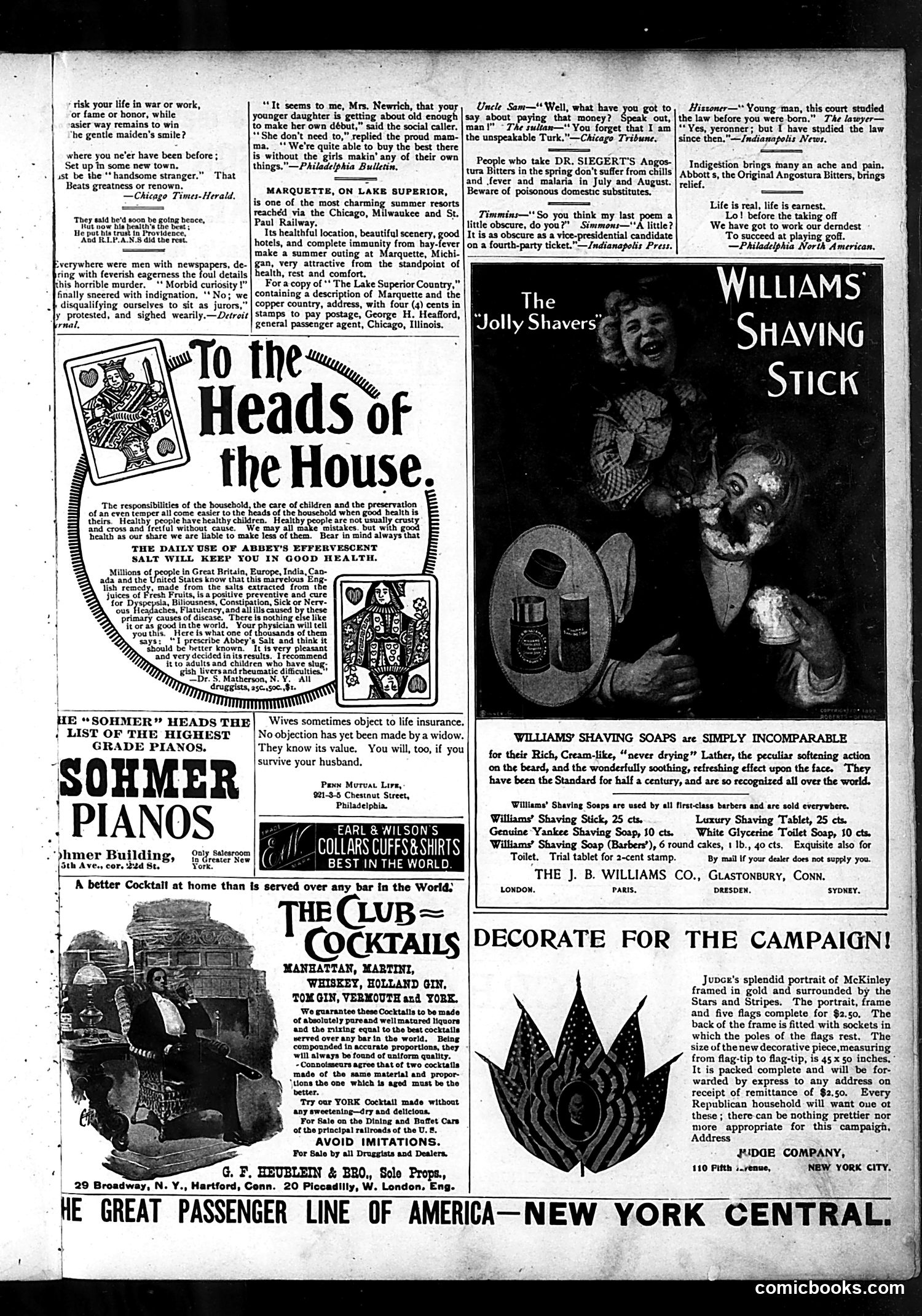
This page is primarily **advertising**, not political satire. The central cartoon ("To the Heads of the House") uses a playing card motif to promote Abbey's Effervescent Salt—a patent medicine marketed to householders as a health tonic that maintains good health and prevents disease. The accompanying text satirizes domestic life through brief anecdotes: one mocks a nouveau riche woman ("Mrs. Newrich") who brags she can *buy* social status for her daughter rather than earning it through proper debut; another gently ridicules people's morbid curiosity about murder details. The page is otherwise filled with period advertisements: Sohmer Pianos, Williams' Shaving Stick, Sohmers Pianos, The Club Cocktails, life insurance, and railroad travel. The "Decorate for the Campaign!" notice at bottom appears to reference patriotic flag bunting, likely for an election campaign.
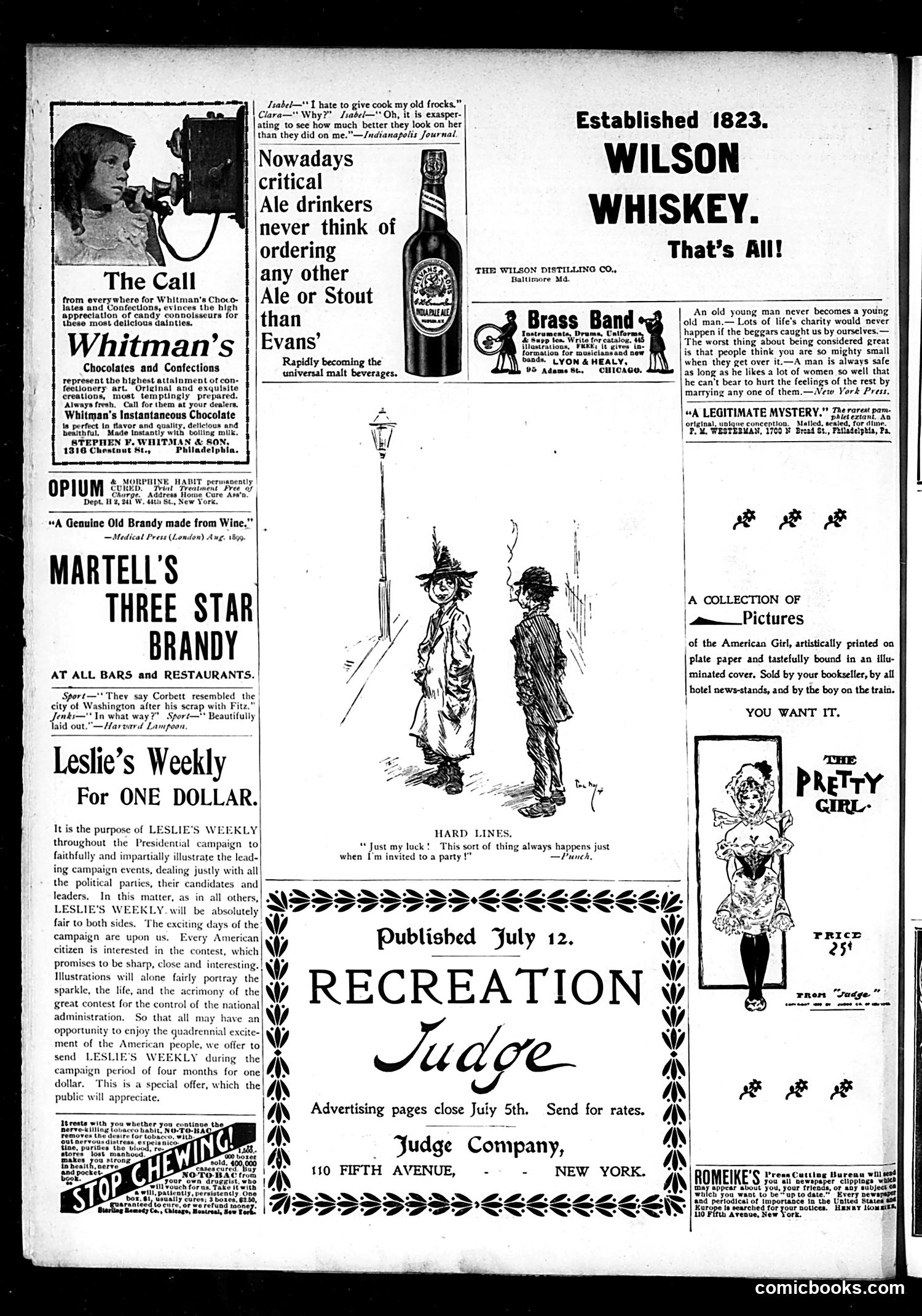
This page is primarily **advertising and promotional material** rather than political satire. The central content includes: **Main Advertisement**: "Recreation Judge" magazine promotes Leslie's Weekly's coverage of an upcoming Presidential campaign (likely 1900s era), promising impartial coverage of "leading campaign events" and candidates from all parties. **Advertisements featured**: - Whitman's Chocolates - Wilson Whiskey (established 1823) - Martell's Three Star Brandy - Evans' Ale - Various other products and services **Cartoon**: A single small cartoon titled "Hard Lines" shows two figures at a lamppost discussing party invitations—this is a generic joke about social embarrassment, not political satire. **Supporting Content**: Several aphorisms and joke excerpts (sourced from other publications like *Punch* and *Indianapolis Journal*) fill space between advertisements. The page reflects Judge's dual nature as both a satirical publication and a commercial advertising vehicle. There is no significant political commentary or caricature evident here—this appears to be a standard advertising section masquerading as editorial content.
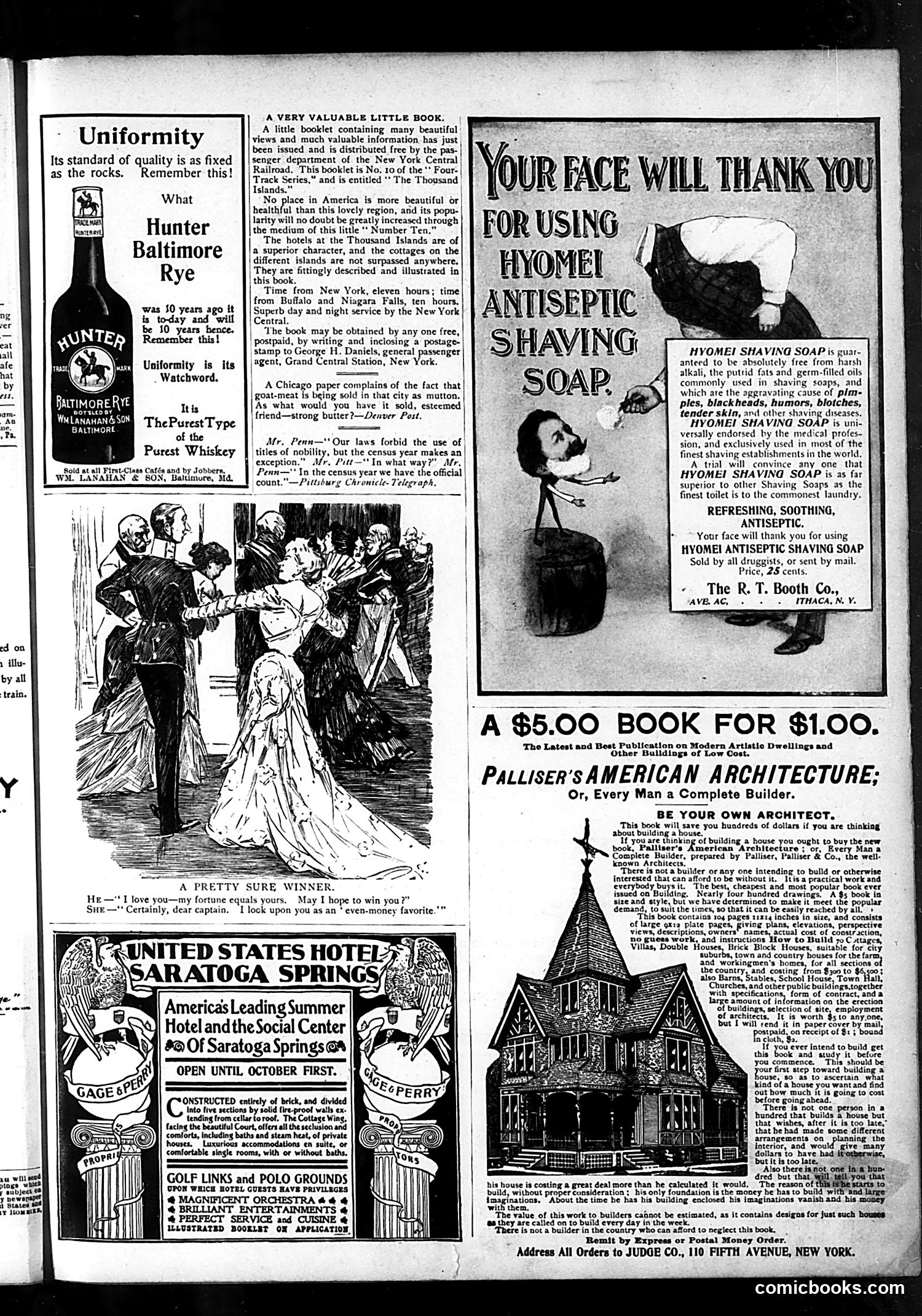
This page is primarily advertising from Judge magazine. The content includes: **Main elements:** 1. **Hunter Baltimore Rye whiskey ad** emphasizes uniformity and consistency as selling points—the drink's "standard of quality is as fixed as the rocks." 2. **A cartoon titled "A Pretty Sure Winner"** depicts what appears to be a courtship scene where a male figure asks a woman to marry him, saying "my fortune equals yours." She replies by calling him an "even-money favorite"—a horse-racing metaphor suggesting she views the proposal as a gamble with predictable odds. 3. **Hyomei Antiseptic Shaving Soap advertisement** claims superiority to competitors and medical endorsement. 4. **United States Hotel at Saratoga Springs ad** promoting luxury resort amenities. 5. **Palliser's American Architecture book promotion** ("A $5.00 book for $1.00"). The cartoon is a light joke about marriage negotiations viewed through gambling language—treating romantic commitment as sporting wager.
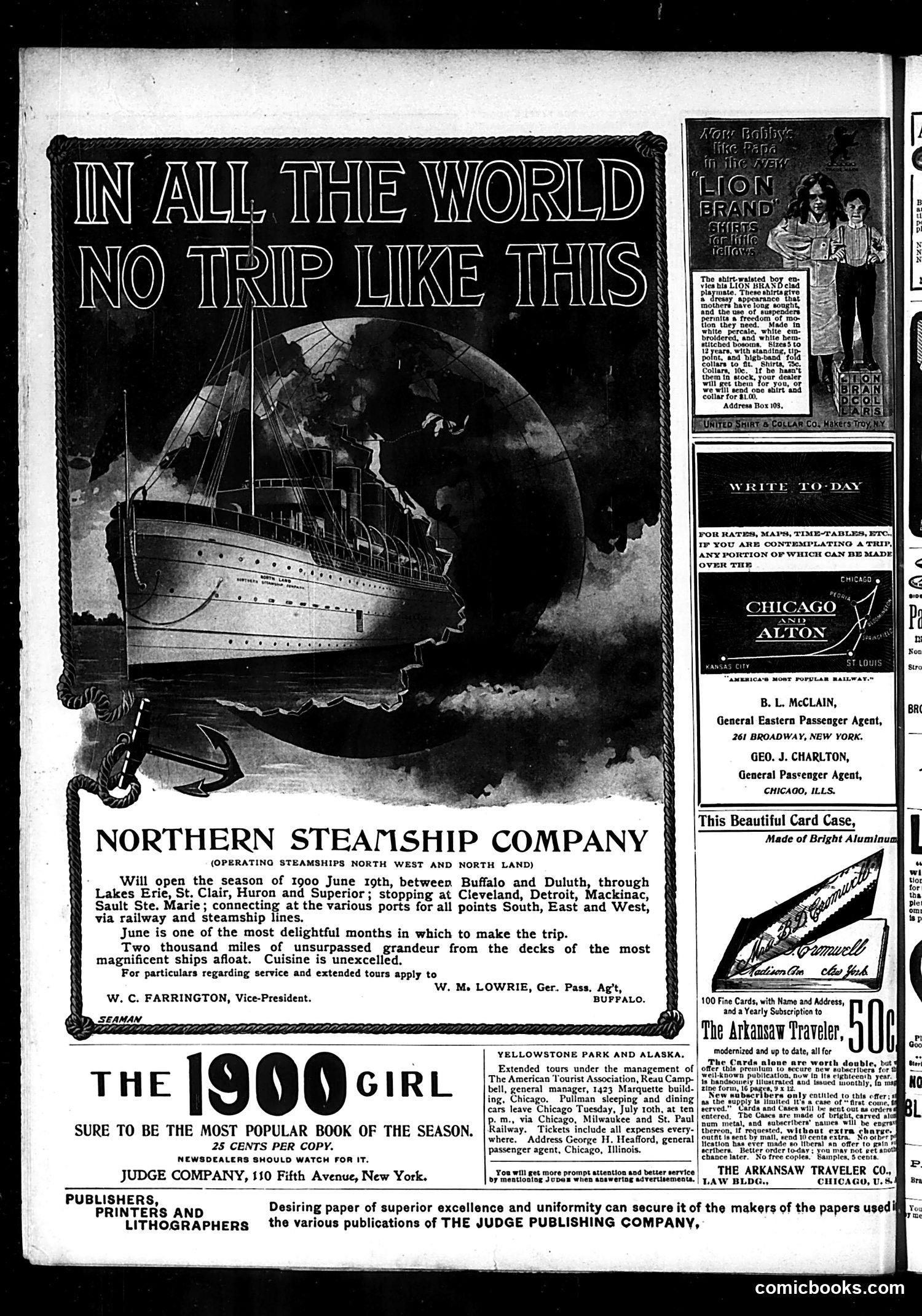
This page is primarily **advertising content**, not political satire. It features travel and tourism promotions typical of the 1900 era. The dominant image advertises the **Northern Steamship Company**, promoting Great Lakes cruises between Buffalo and Duluth. The dramatic illustration of a ship overlaid on a globe with the slogan "In All the World No Trip Like This" exemplifies turn-of-the-century travel marketing—emphasizing luxury, natural grandeur, and accessibility to the American heartland. Supporting advertisements include: - **Chicago and Alton Railway** promoting transcontinental travel - **Yellowstone Park and Alaska tours** through the American Tourist Association - A book promotion for "The 1900 Girl" - Various subscription offers and card cases **No clear political satire is visible.** The page reflects the commercial priorities of Judge magazine, which relied heavily on advertising revenue. The content speaks to emerging leisure travel culture and tourism infrastructure development in turn-of-the-century America—a period of expanding railroad and steamship networks.
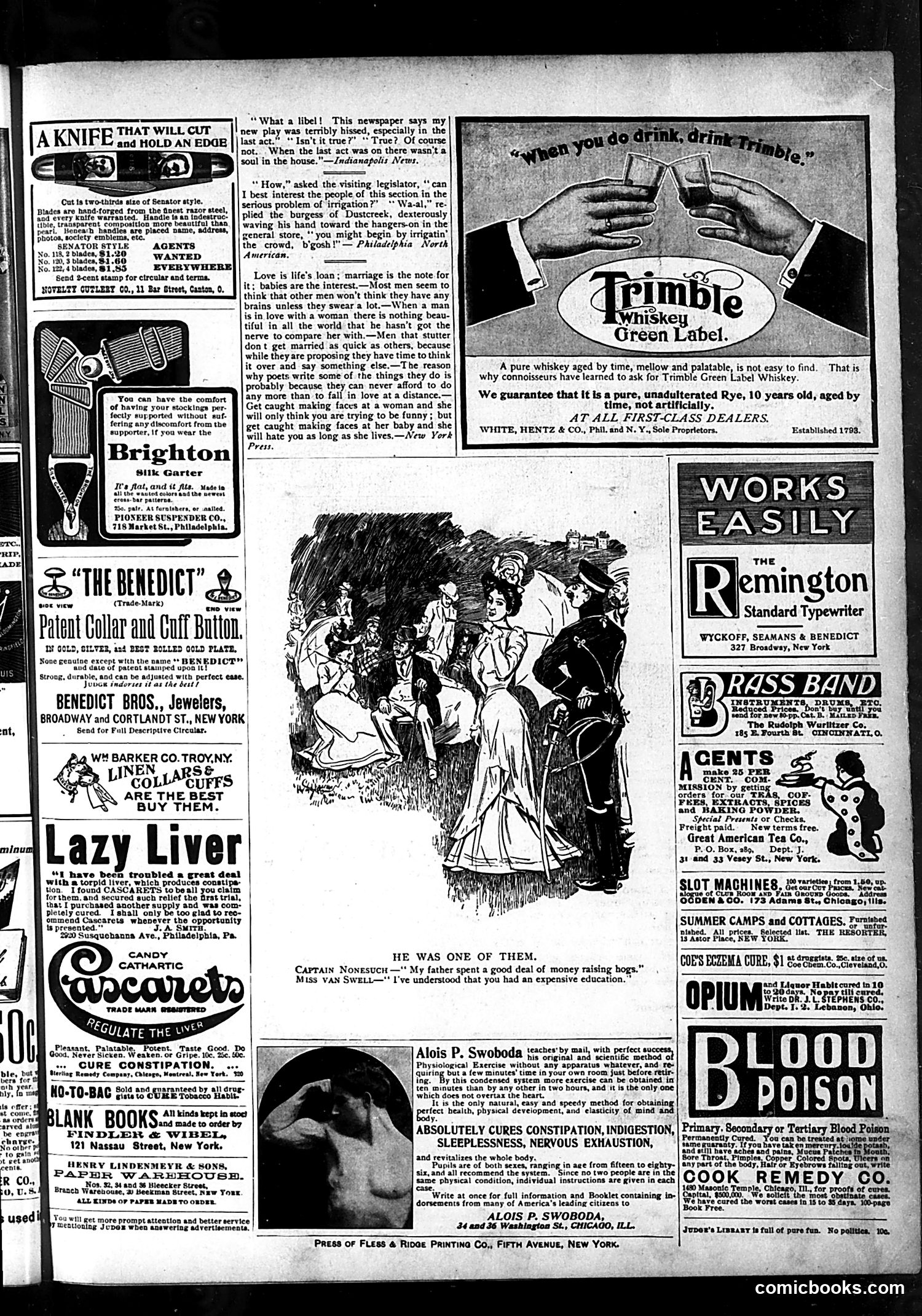
This page from *Judge* magazine contains three distinct satirical pieces: 1. **"What a Libel!"** — A theater producer claims his play wasn't "hissed" (booed), but admits nobody attended the final act. The joke mocks theatrical vanity and the gap between claims and reality. 2. **"How...can I best interest the people?"** — A legislator asks about irrigation policy; a local politician deflects by suggesting he irrigate "the crowd" (the loafers in the general store). This satirizes rural corruption and politicians prioritizing patronage over actual governance. 3. **"Love is life's loan"** — A series of observations about courtship, marriage, and gender dynamics, mocking romantic pretense and male behavior. The stammering joke suggests even nervous men can escape marriage through their own hesitation. The page is primarily **advertising** for various products (cutlery, whiskey, typewriters, patent medicines). The satirical content fills limited space between commercial listings.
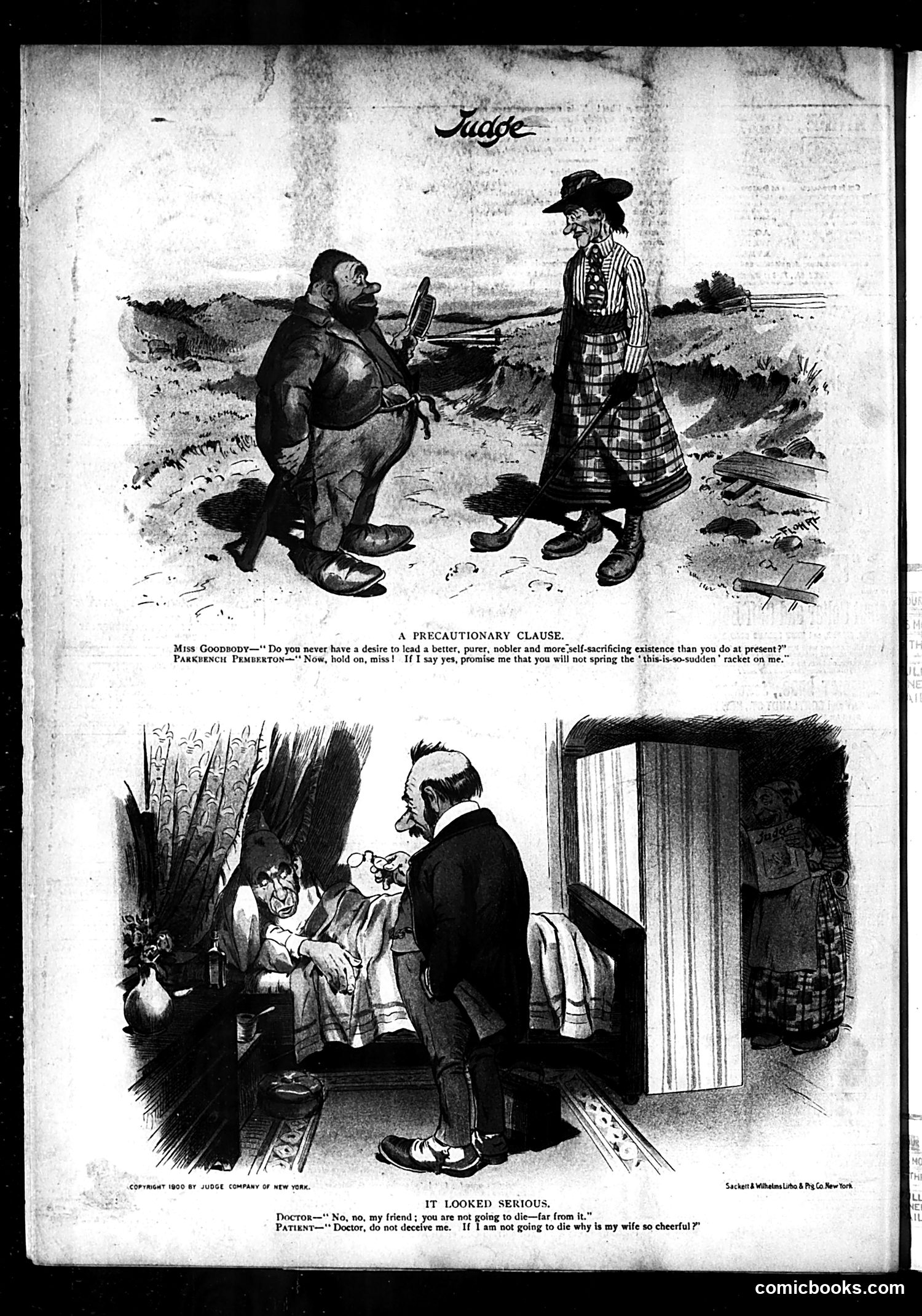
**Top cartoon**: A man (Parkbench Pemberton) deflects a woman's (Miss Goodbody) moral appeal with humor. She asks if he wants to live virtuously; he jokes that if he agrees, she'll use the "this-is-so-sudden" proposal line—a common melodramatic marriage proposal trope. The satire mocks both preachy moral reformers and men's fear of being trapped into marriage through emotional manipulation. **Bottom cartoon**: A doctor reassures a patient he won't die, but the patient grows *more* alarmed—reasoning that if he'll survive, his wife must be unusually cheerful, suggesting she *wants* him dead. The joke cynically assumes marriages are unhappy, with wives hoping for widowhood. Both cartoons reflect early-1900s American anxieties about marriage as a trap, whether for men resisting reform or patients reading spousal behavior.