
A complete issue · 16 pages · 1900
Judge — June 16, 1900
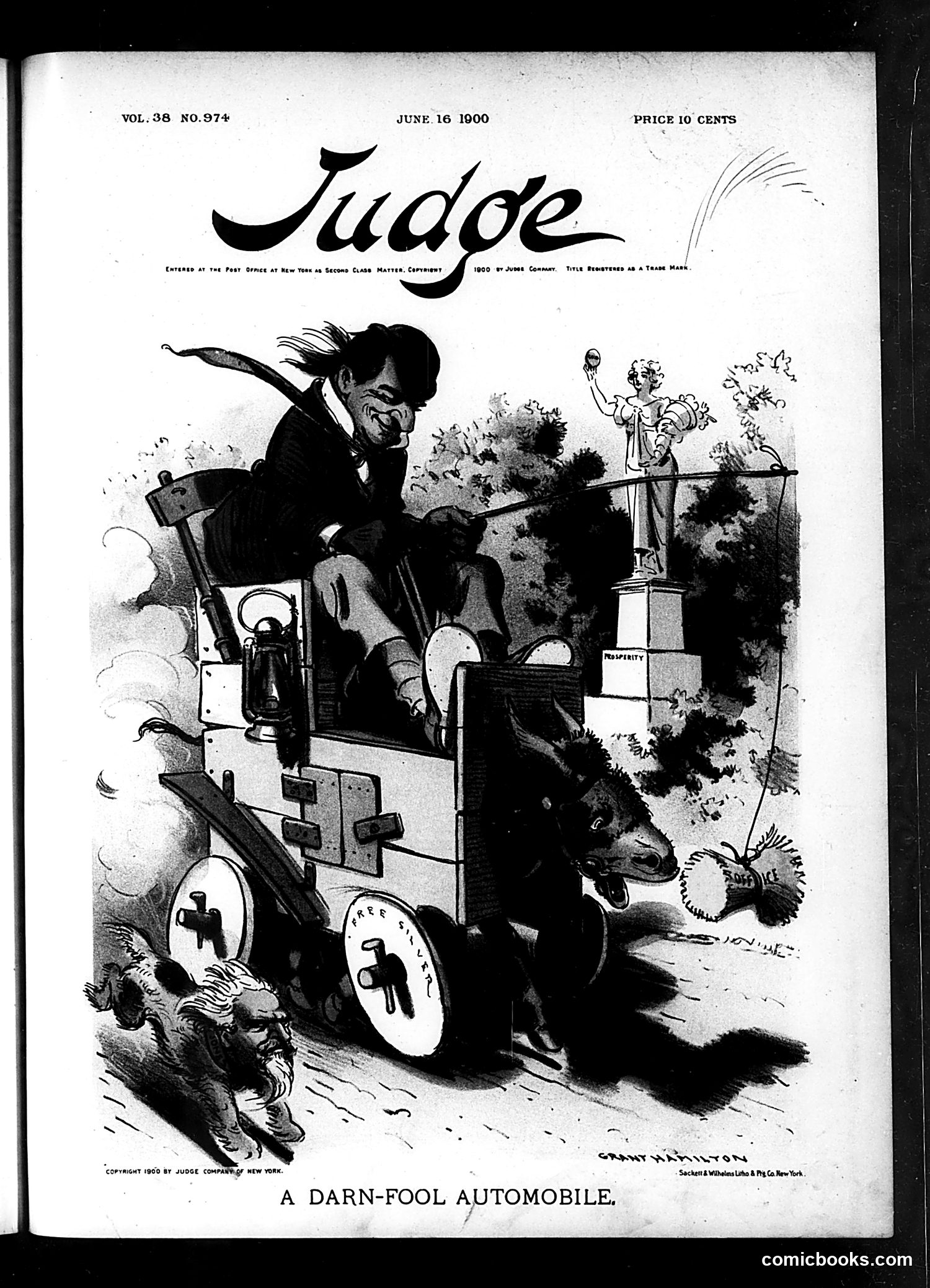
This June 1900 Judge cover satirizes early automobile dangers. The cartoon depicts a caricatured driver operating a primitive motorcar with visible crosses on its wheels—suggesting the vehicle is literally a "death trap." The car appears to be a coffin-like contraption belching smoke and fire. A woman on a pedestal labeled "Prosperity" holds aloft what appears to be a torch or crown, seemingly mocking the era's technological optimism. The wild animals and chaotic surroundings reinforce the message: automobiles represent reckless, uncontrolled danger. The satire critiques both the new automobile industry's safety record and the blind faith Americans placed in mechanical progress during the industrial boom. Early cars were genuinely hazardous, making this cartoon's skepticism topical commentary on the era's technological revolution.
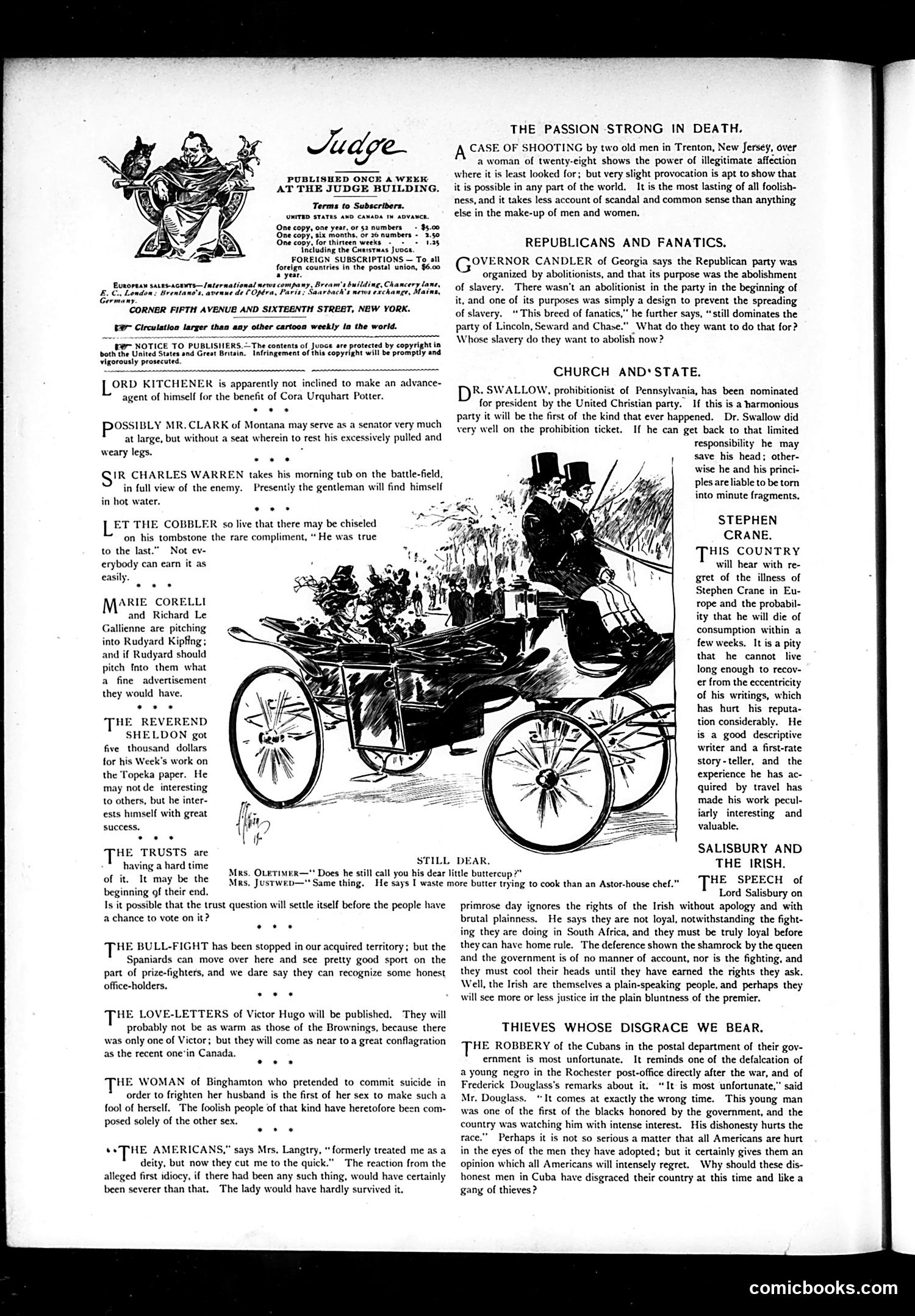
The main cartoon, titled "STILL DEAF," depicts two figures in a carriage—likely representing Mrs. Oluttimer and Mrs. Pottle in domestic conversation. The joke plays on marital communication: one woman asks if her husband still calls her "dear little buttercup," and the other responds he wastes more butter trying to cook than an "Astor-house chef," suggesting indifference to romantic pet names. Below, several brief satirical items mock Republicans as "fanatics," criticize Governor Candler of Georgia regarding abolition debates, and comment on Irish immigration and Cuban postal service theft. The page primarily contains social/political commentary typical of late 19th-century American satire, with domestic humor alongside sharper political criticism.
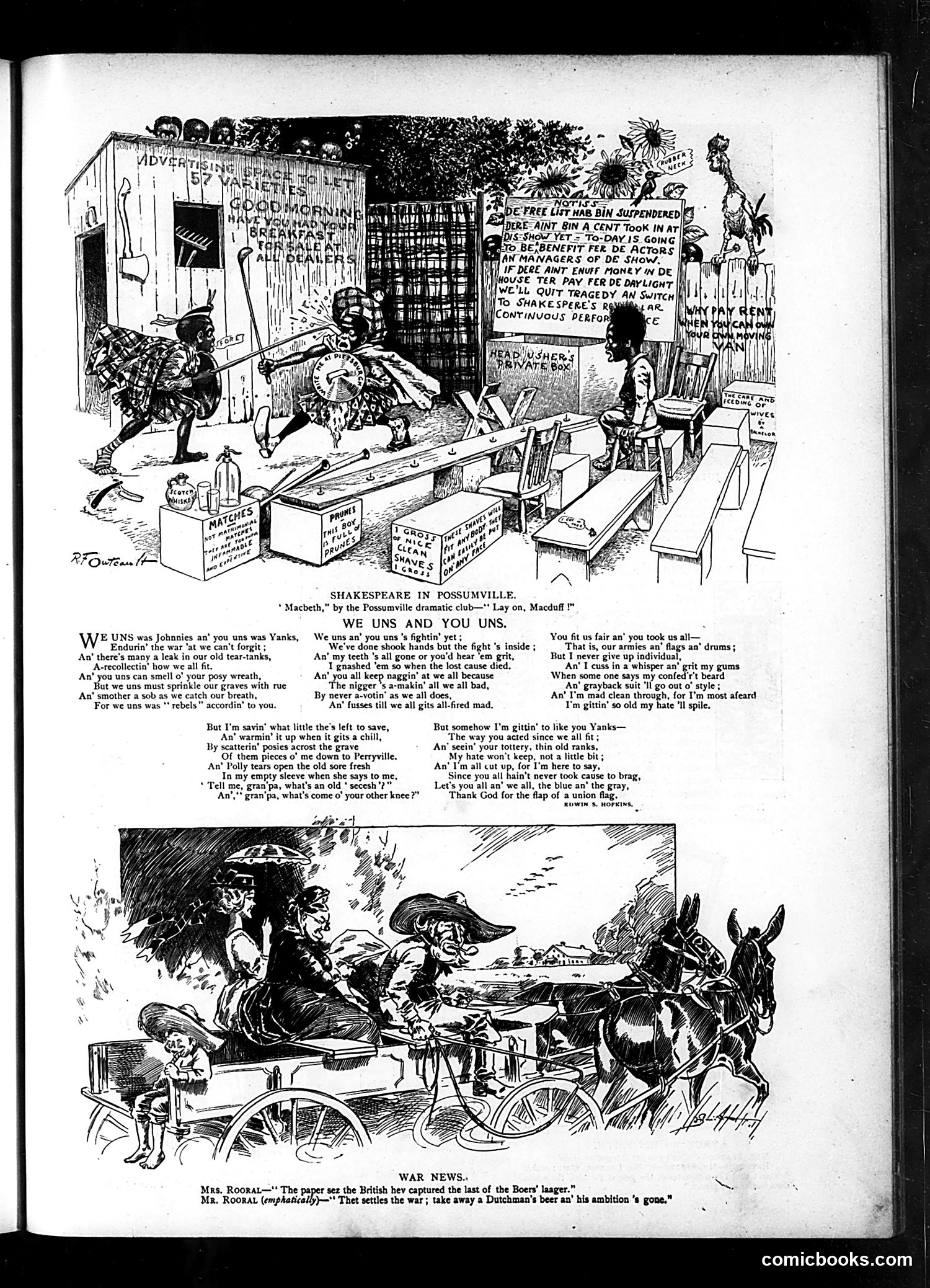
The top cartoon, titled "Shakespeare in Posumville," satirizes a theatrical production by the "Posumville dramatic club." It depicts actors in a squalid setting, with signs advertising various goods and services. The dialogue parodies Shakespeare ("We Uns and You Uns"), mocking what appears to be a poorly-produced or amateur dramatic performance, likely staged by working-class or rural performers. The bottom cartoon shows a woman in a cart pulled by mules, captioned "Mrs. Rooks" and "War News." The brief dialogue suggests she's bringing news about "the Boers' lager" during the Boer War, with a joke about ambition involving "a Dutchman's beer." Both cartoons use dialect and crude stereotypes typical of early 1900s American satirical humor, mocking theatrical pretension and wartime developments.
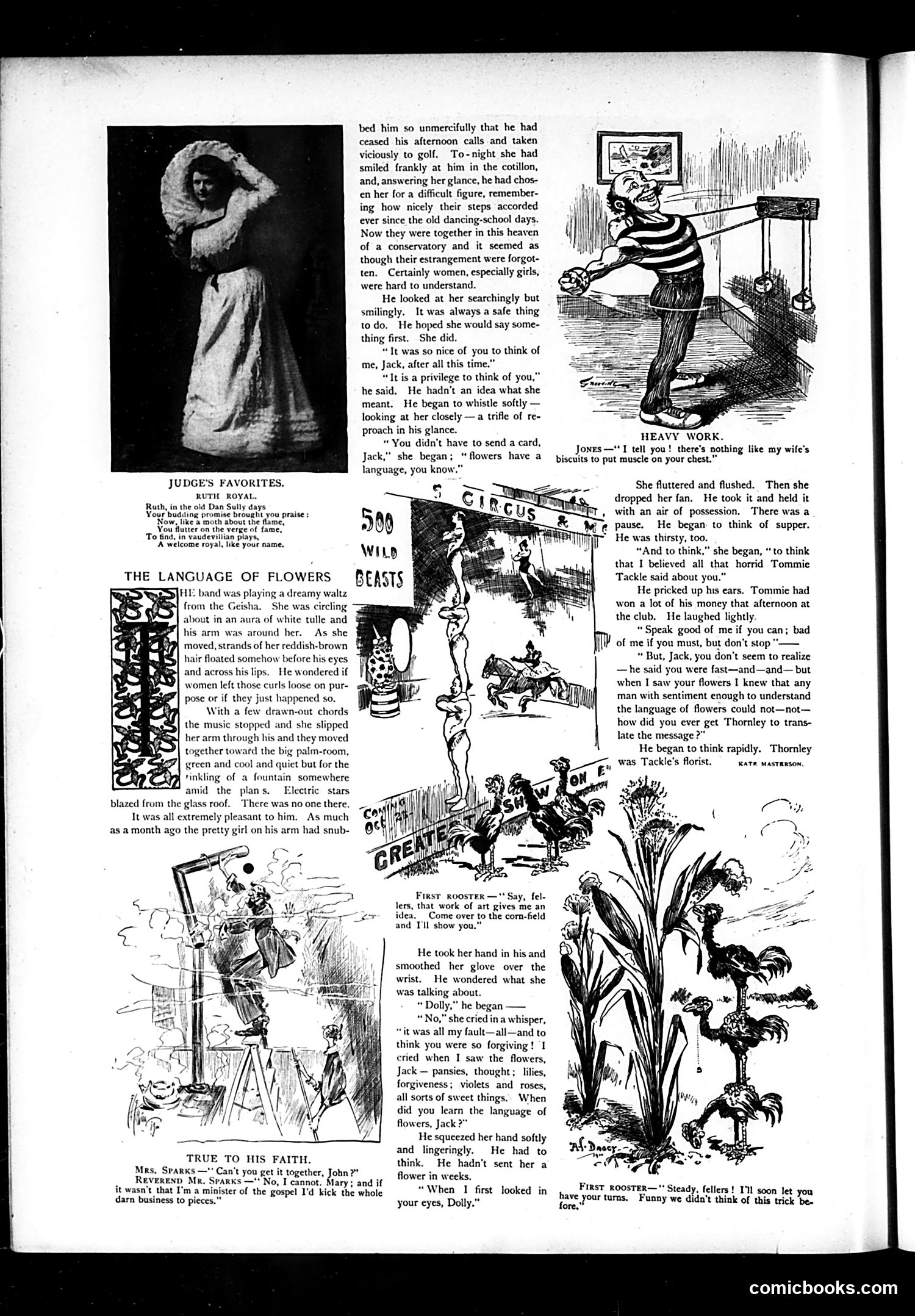
This page is primarily **literary fiction rather than political satire**. The main content is "The Language of Flowers," a romantic story about a man named Jack who sends flowers to reconcile with a woman named Dolly after their estrangement. The cartoons appear to be **humorous illustrations supporting the narrative** rather than political commentary. One shows a man at what appears to be a circus or entertainment venue; another depicts domestic/romantic situations. The smaller items—"Judge's Favorites," "Heavy Work," "True to His Faith," and "First Rooster"—appear to be **brief joke captions** unrelated to broader political issues. This is **not political satire** but rather general humor content typical of Judge magazine's lighter fare.
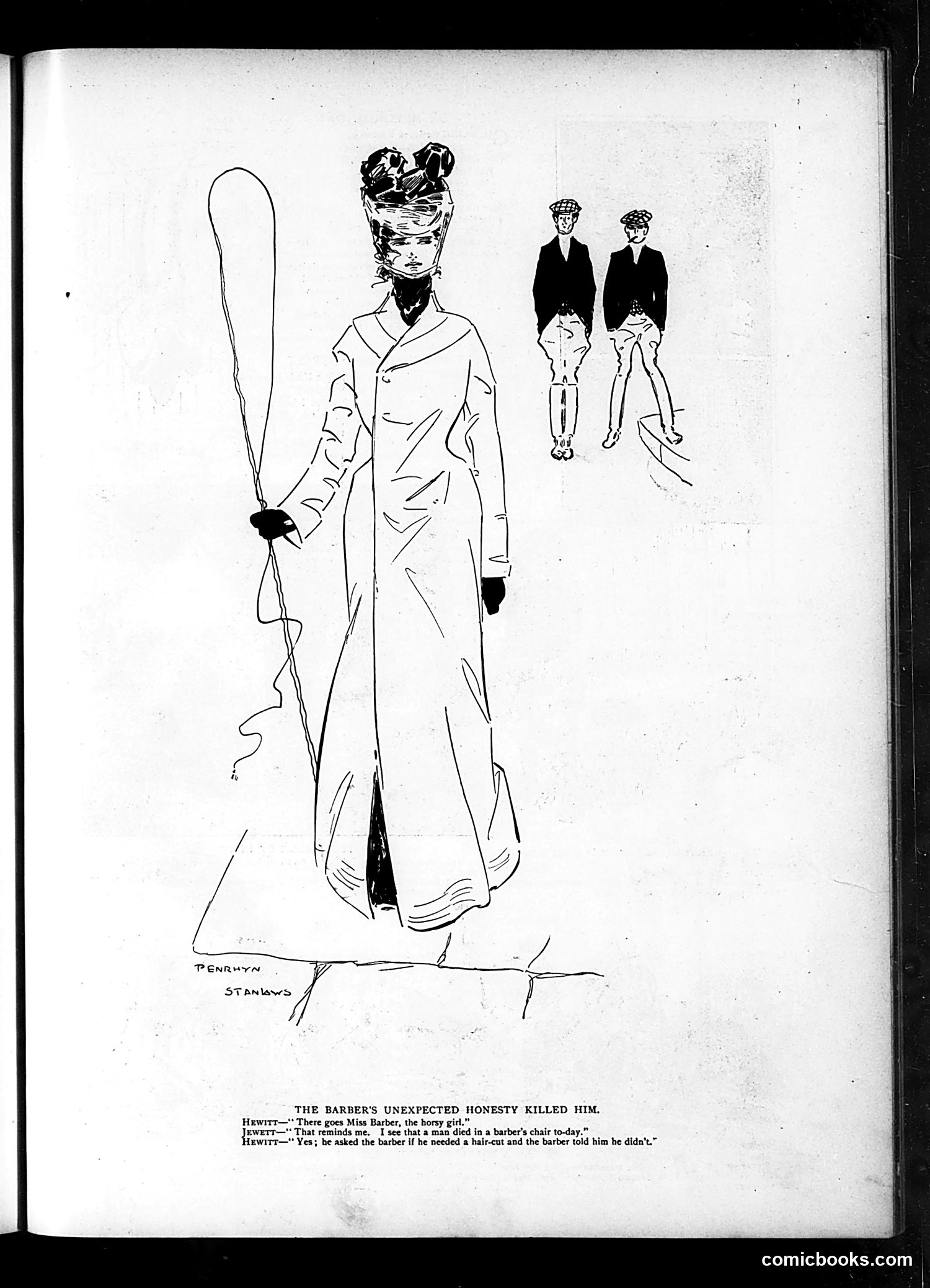
This is a humorous comic strip from *Judge* magazine depicting a joke about barber shop etiquette and honesty. Two men (Hewitt and Jewett) discuss a man who died in a barber's chair. The punchline: the barber told the customer he didn't need a haircut—an unexpectedly honest assessment that apparently shocked the man to death. The satire targets barbers' notorious tendency to oversell unnecessary services to customers. By having the barber break this convention and tell the truth, the joke implies such honesty is so shocking and contrary to normal business practices that it's literally fatal. The accompanying fashion illustration (signed by Penrhyn Stanlaws) shows a woman in a wrap dress with elaborate hat, likely depicting "Miss Barber, the horsy girl" mentioned in the dialogue—though the connection between the joke and illustration remains unclear.
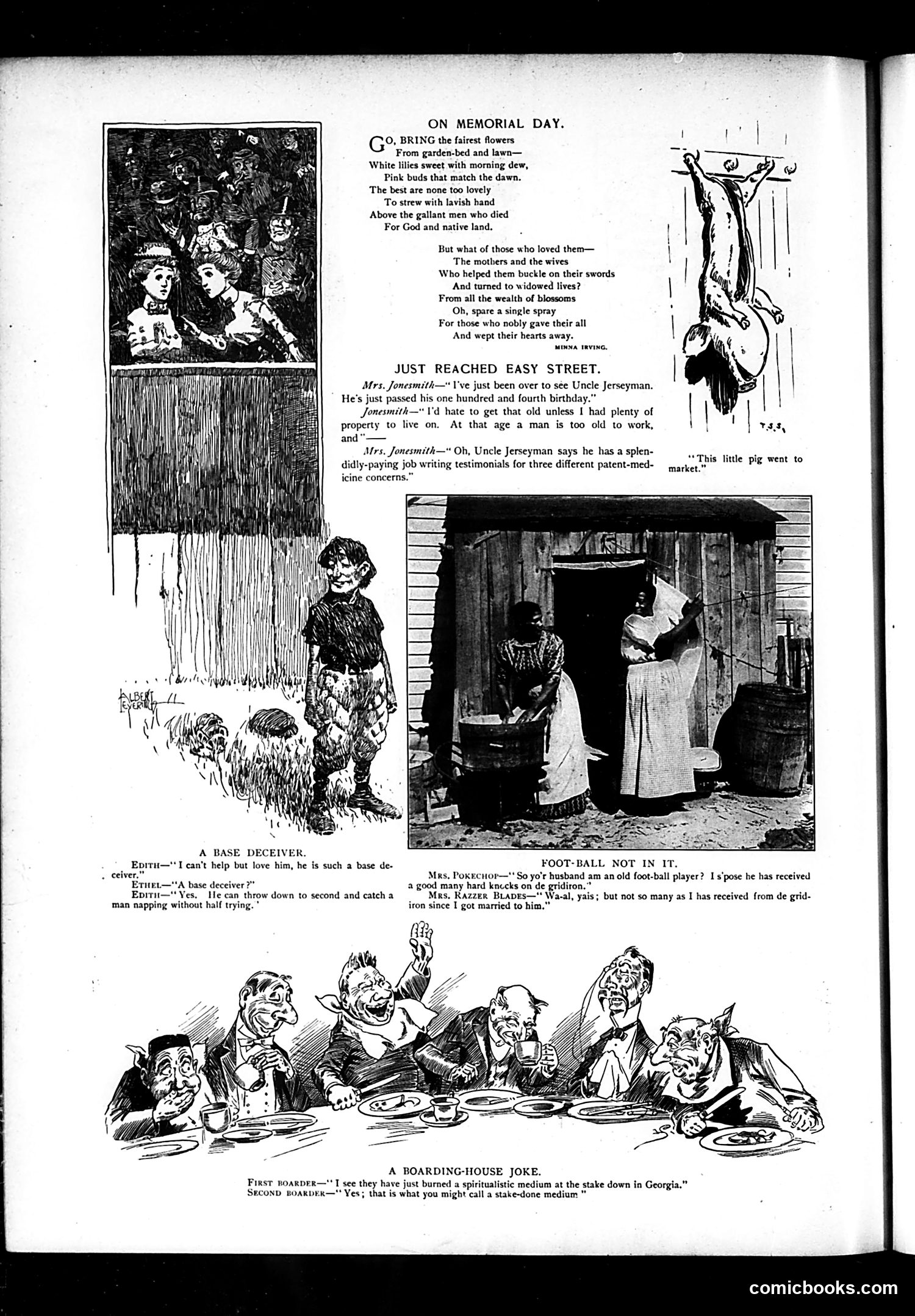
This Judge magazine page contains several satirical humor pieces reflecting early 20th-century American life: **"On Memorial Day"** — A sentimental poem by Ella Wheeler Wilcox honoring fallen soldiers while pointedly asking society not to forget the **widows and mothers** left behind—a critique of how memorial observances focused on the dead rather than the living survivors who suffered. **"Just Reached Easy Street"** — Mocks the elderly and patent-medicine industry. Uncle Jerseyman, 104, survives by writing testimonials for bogus medicinal products—satirizing how unregulated "patent medicines" (often fraudulent tonics) preyed on gullible consumers. **"A Base Deceiver" and "Foot-Ball Not in It"** — Brief joke exchanges using puns and double meanings, typical of the magazine's filler humor. **"A Boarding-House Joke"** — A dark humor punchline about executing a spiritualistic medium ("spiritualist" practitioners were popular but widely considered frauds), with a grim pun on "stake-done" versus "well-done." These pieces collectively satirize medical fraud, social exploitation, and period superstitions.
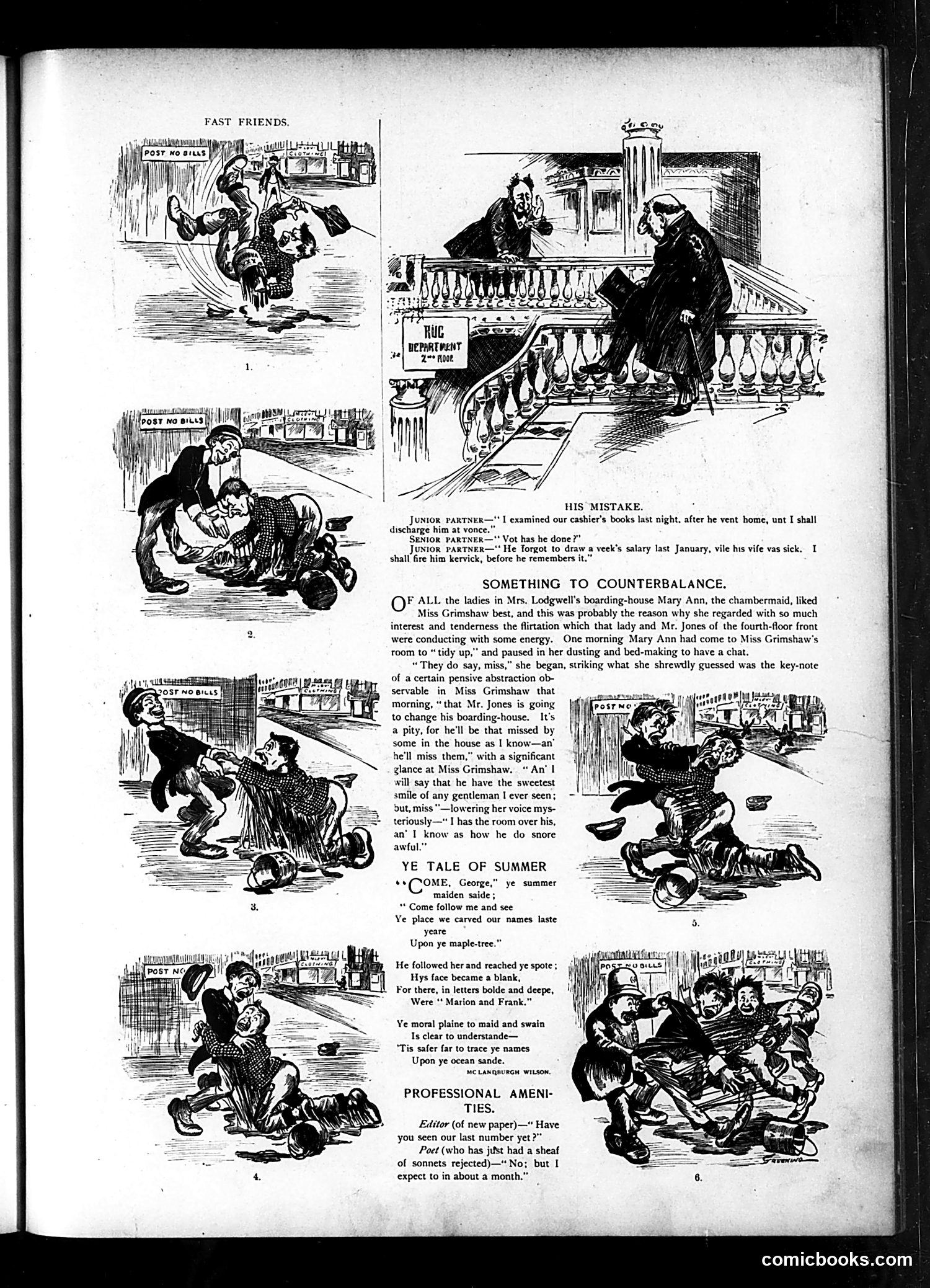
This page from *Judge* contains several unrelated Victorian-era comic sketches satirizing social awkwardness and romantic entanglements. **"Fast Friends"** (top) depicts a senior partner firing a junior partner, callously timing it before the man remembers he's owed back salary from when his wife was ill—illustrating ruthless business ethics disguised as friendship. **"Something to Counterbalance"** shows a chambermaid warning her employer, Miss Grimshaw, that Mr. Jones (a fourth-floor tenant) snores terribly, despite his charming smile and romantic interest in her—the joke being that physical reality spoils romantic fantasy. **"Ye Tale of Summer"** presents a betrayal: a couple returns to a tree where they carved their names years ago, only to discover "Marion and Frank" carved there instead—suggesting infidelity or that the original relationship wasn't exclusive. **"Professional Amenities"** features an editor asking a rejected poet if he's seen the new publication, with the poet sarcastically implying he'll see it in trash bins "in about a month"—mocking professional courtesy masking contempt. The page emphasizes hypocrisy and disappointment in human relationships.
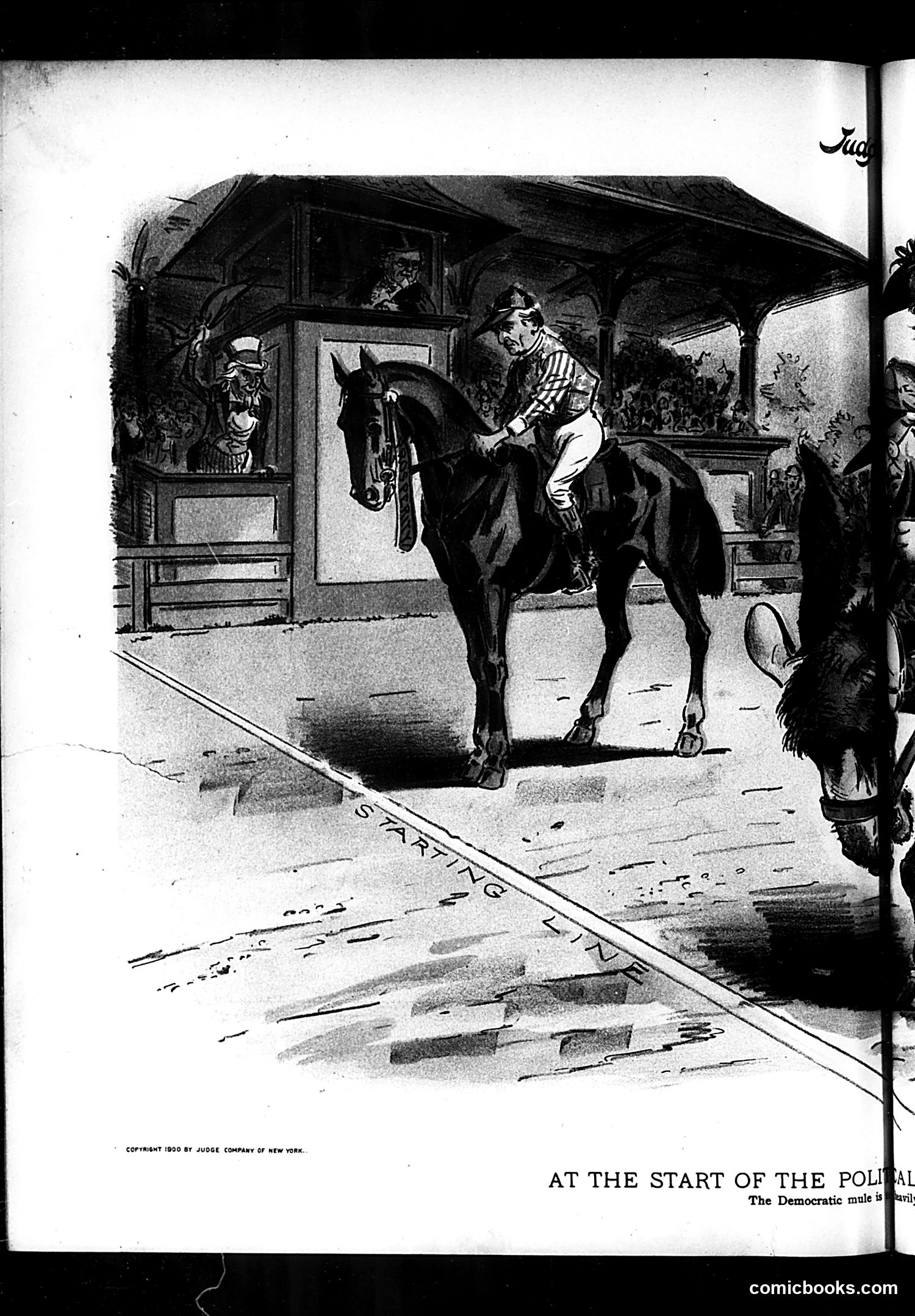
This 1900 *Judge* cartoon depicts a horse race scene, with a rider on a dark horse at the starting line of what appears to be a formal racing event. The visible caption references "The Democratic mule," suggesting the horse represents the Democratic Party. The incomplete OCR text ("The Democratic mule is H[heavily]...") likely completes a political observation about the party's condition or prospects. The cartoon uses the common 19th-century metaphor of political parties as animals in a race—here satirizing the Democratic Party's position or readiness as the 1900 election approached. The formal racing venue and starting line imagery emphasize competition. Without the complete caption, the specific critique remains unclear, but the satire likely commented on Democratic Party weakness or unfavorable odds in that election cycle.
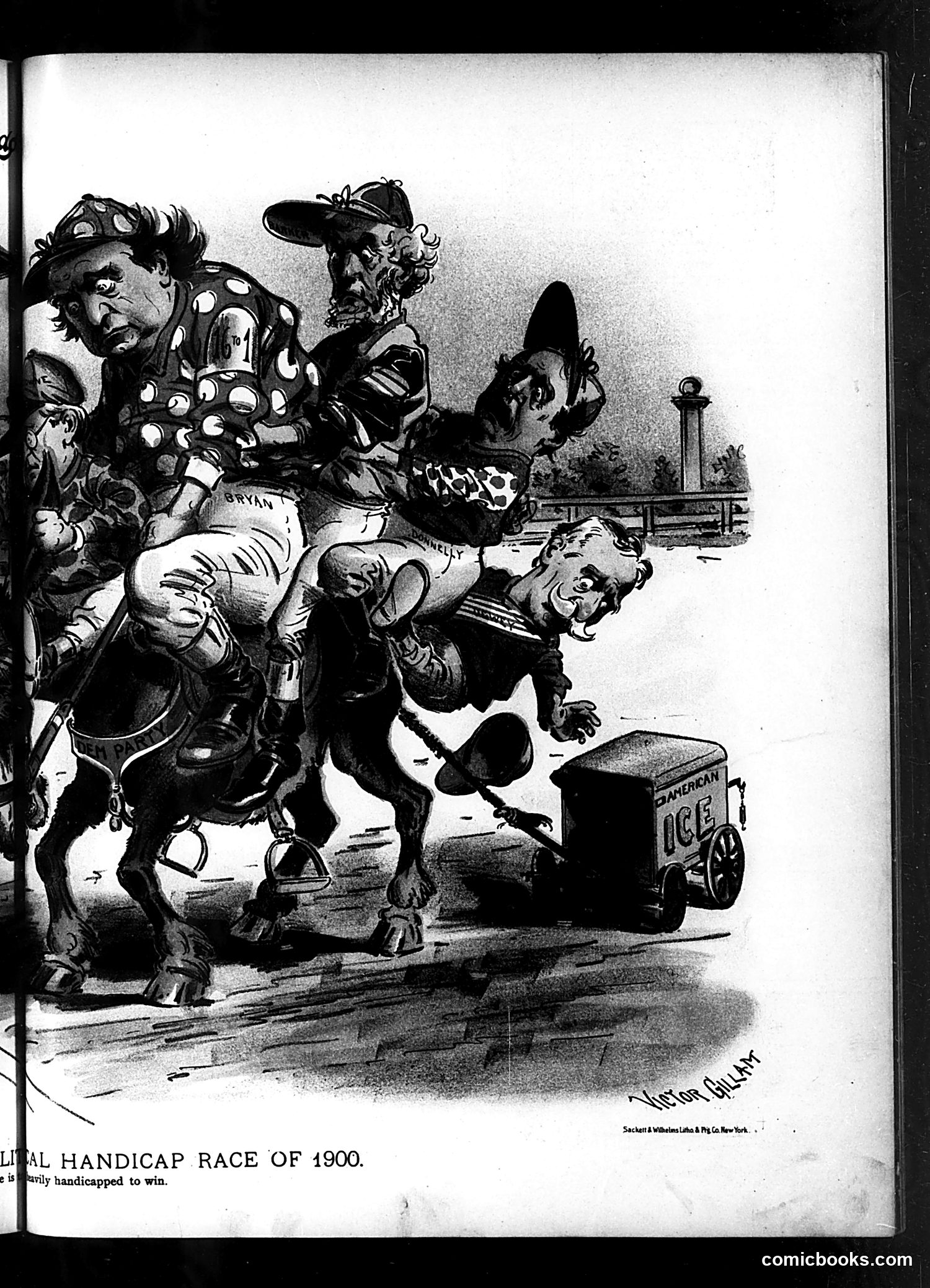
This Judge magazine cartoon depicts the 1900 U.S. presidential election as a race between caricatured political figures. The text indicates candidates are "artificially handicapped to win," suggesting the satire critiques how certain candidates received unfair advantages or disadvantages. The grotesque exaggerated figures appear to represent different political candidates or parties competing in that election year. One figure wears polka dots (labeled "Bryan," likely William Jennings Bryan, the Democratic nominee), while others sport distinctive hats and clothing typical of political caricature. The ice cart labeled "American Ice" likely references the "Ice Trust," a monopoly scandal of that era that became a political issue. The cartoonist criticizes how the electoral system handicapped certain candidates unfairly—a commentary on campaign dynamics, corruption, or unfair electoral practices in the 1900 race between McKinley and Bryan.
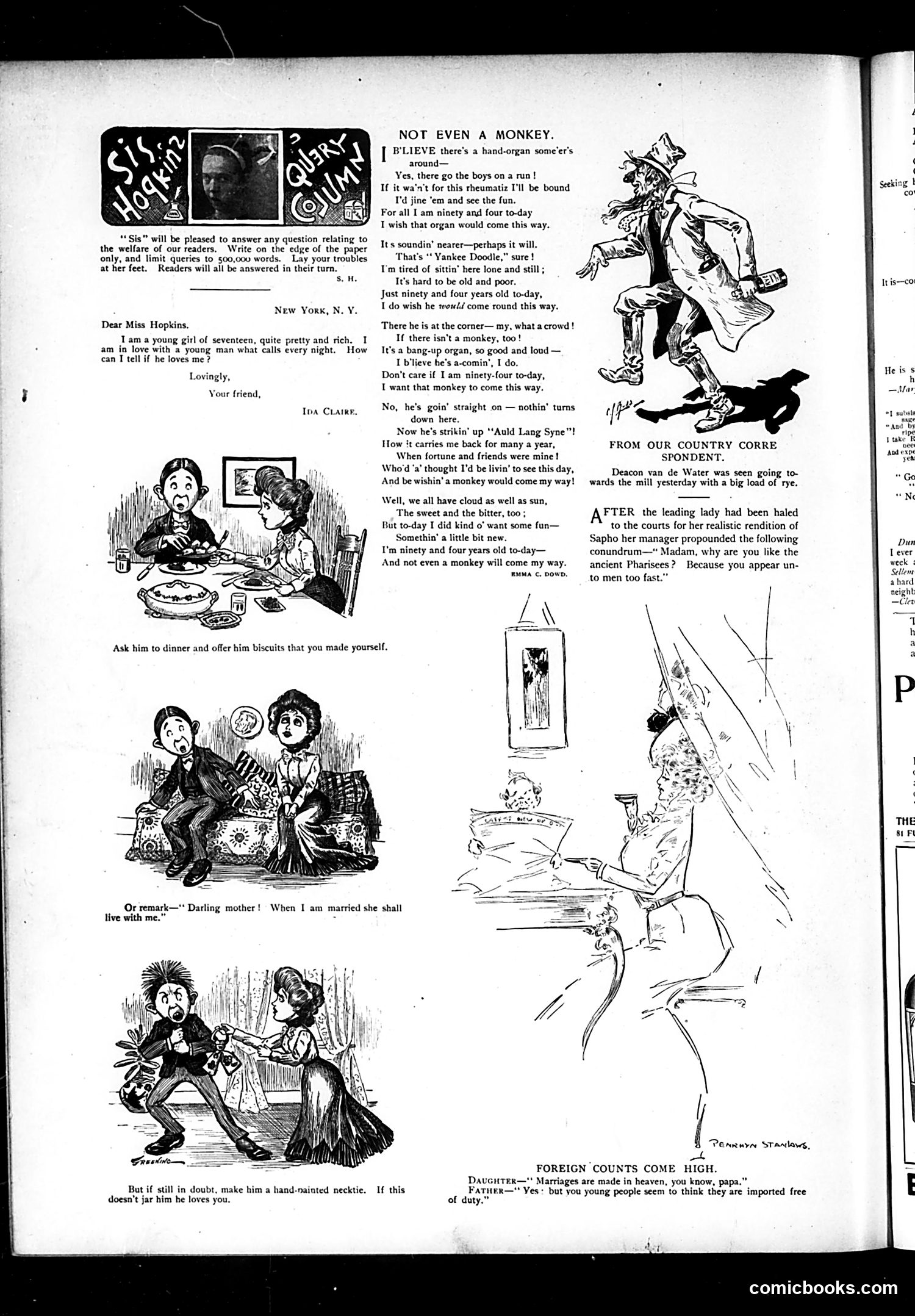
This page contains sentimental comic verse about an elderly poor woman (ninety-four years old) whose highlight is hearing a street organ-grinder and his monkey. The poem's pathos comes from the contrast between her youth ("when fortune and friends were mine") and her current loneliness and poverty. The satire targets genteel poverty and social indifference: despite her anticipation, the organ-grinder passes by without stopping—she doesn't even get the small joy of seeing the monkey. The title's bitterness emphasizes how little life offers her now. The page includes other brief satirical pieces: advice columnist "Sis Hopkins" answers a young woman's love question with practical suggestions (hand-painted necktie); a "country correspondent" reports trivial local news; and a final gag mocks wealthy fathers complaining that imported foreign counts seeking American heiresses expect duty-free status. The overall tone is typically Judge: sympathetic mockery of social pretension and human disappointment.
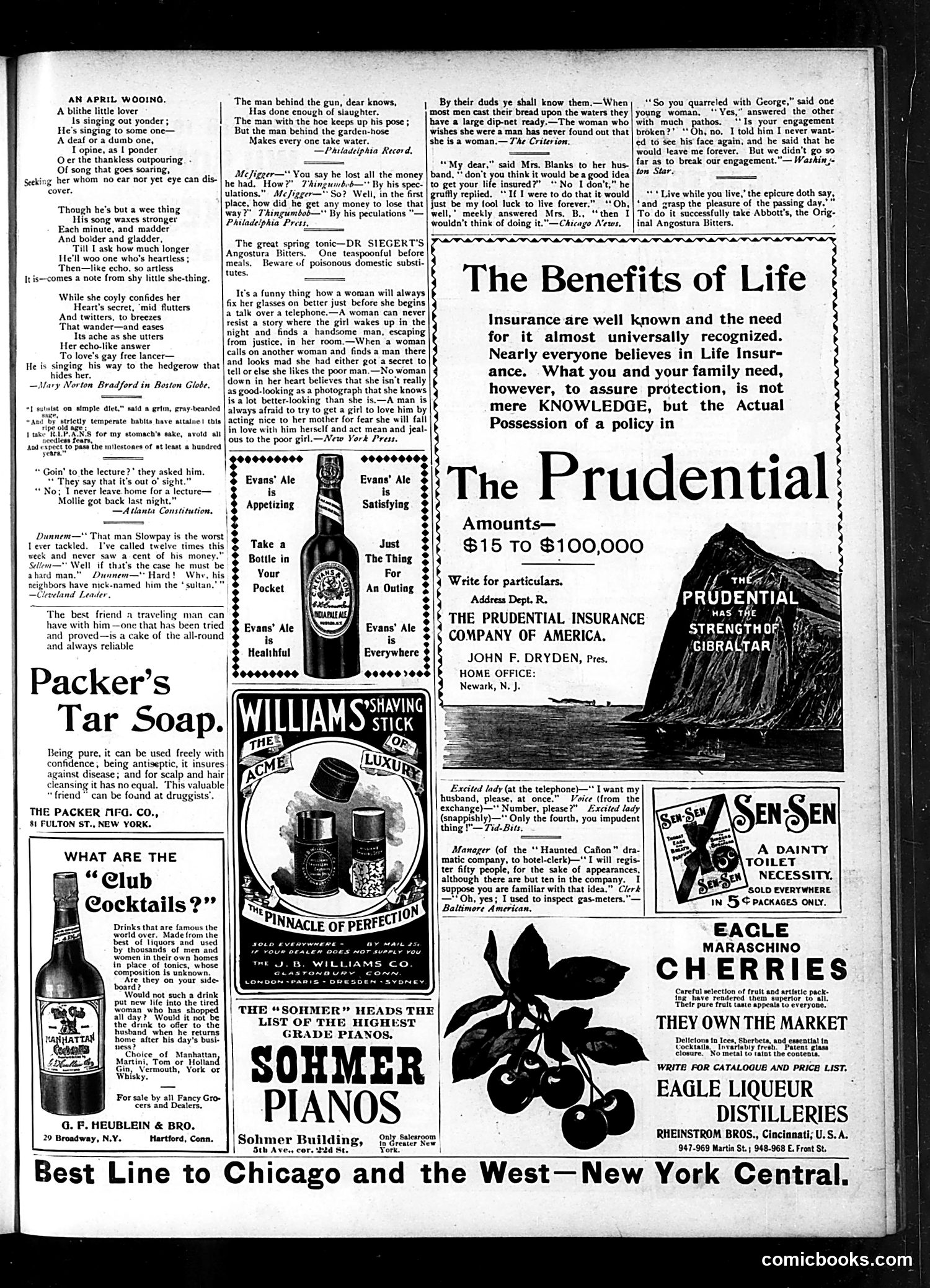
This page is primarily **advertising**, with some miscellaneous commentary and poetry mixed in. The "cartoon" element is minimal—the main satirical pieces are brief, quotation-style jokes scattered throughout: - A **poem about April courtship**, depicting a male bird singing to attract a female - Short quips mocking people's behavior (like women adjusting their glasses before phone calls, or a man nicknamed "the Sultan" for never paying debts) - Joke exchanges about money lost to speculation and drinking habits The advertisements dominate: Packer's Tar Soap, Evans' Ale, Williams' Shaving Stick, Prudential Insurance, Sohmer Pianos, and various liquor products. The "Club Cocktails" section advertises Heublein & Bro.'s cocktail mixers. There's no clear political satire here—rather, this appears to be a typical **Judge magazine page mixing light humor with period advertising**. The humor relies on gentle observation of everyday life (gender relations, business dealings) rather than pointed social critique.
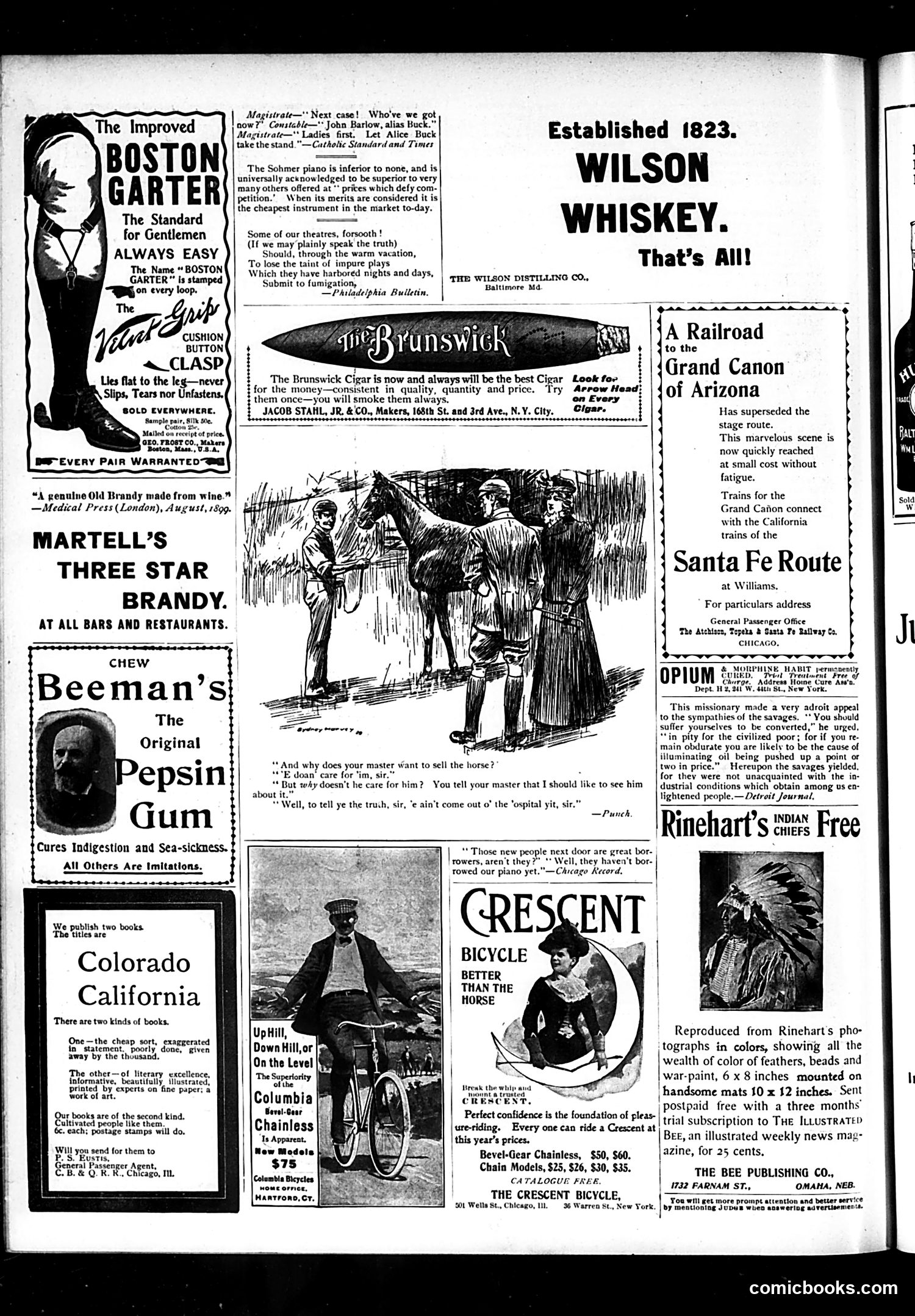
This is primarily an **advertising page** from Judge magazine, circa 1899-1900, featuring various product advertisements (garters, whiskey, bicycles, brandy, chewing gum) interspersed with brief comic jokes. The page contains **three short satirical cartoons/jokes**: 1. **"Next case!"** — A magistrate's wordplay joke about "Alice Buck" and "John Barlow, alias Buck," playing on the surname for comic effect. 2. **The horse-selling dialogue** — A Punch reprint about a master wanting to sell his horse because it "ain't come out o' the 'ospital yit"—humor based on the horse's poor condition and the servant's dialect. 3. **The new neighbors** — A brief joke about neighbors who borrow everything except the piano. Additionally, there's a **satirical "missionary" piece** mocking colonial-era conversion efforts, suggesting missionaries manipulated indigenous peoples by appealing to economic self-interest regarding oil prices—social commentary on imperialism and hypocrisy. The remaining content is straightforward advertising for consumer goods typical of the Gilded Age.
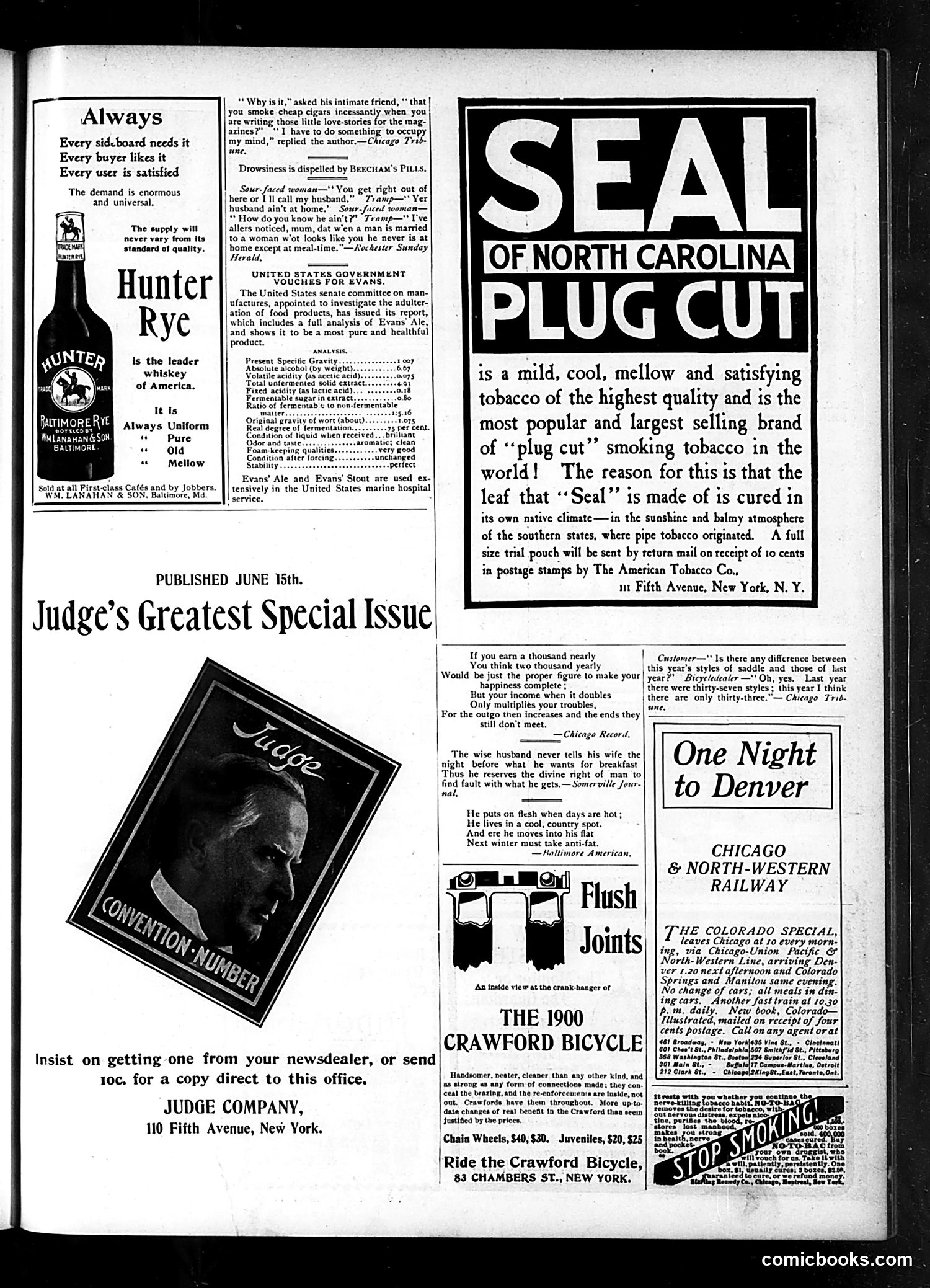
This is primarily an **advertising page** from Judge's "Greatest Special Issue," with minimal cartoon content. The page features several brief jokes and extensive product advertisements typical of early 1900s magazines. The few jokes present are mild observations: a writer smokes cheap cigars to occupy his mind while composing love stories; a tramp knows a husband won't be home because married men to unattractive women avoid their houses; a wife reserves the right to complain about breakfast regardless of what her husband requests. The advertisements promote **Hunter Rye whiskey**, **Evans Ale** (with a government purity endorsement), and notably **"Seal of North Carolina" plug cut tobacco**—claiming it's the world's largest-selling brand. Other ads tout the Crawford Bicycle and Chicago & North-Western Railway's Colorado Special train service. The page reflects **early 1900s consumer culture** and gender stereotypes rather than political satire. Modern readers would note the casual marital tension in jokes and the prevalence of alcohol and tobacco advertising to general audiences—both now heavily restricted.
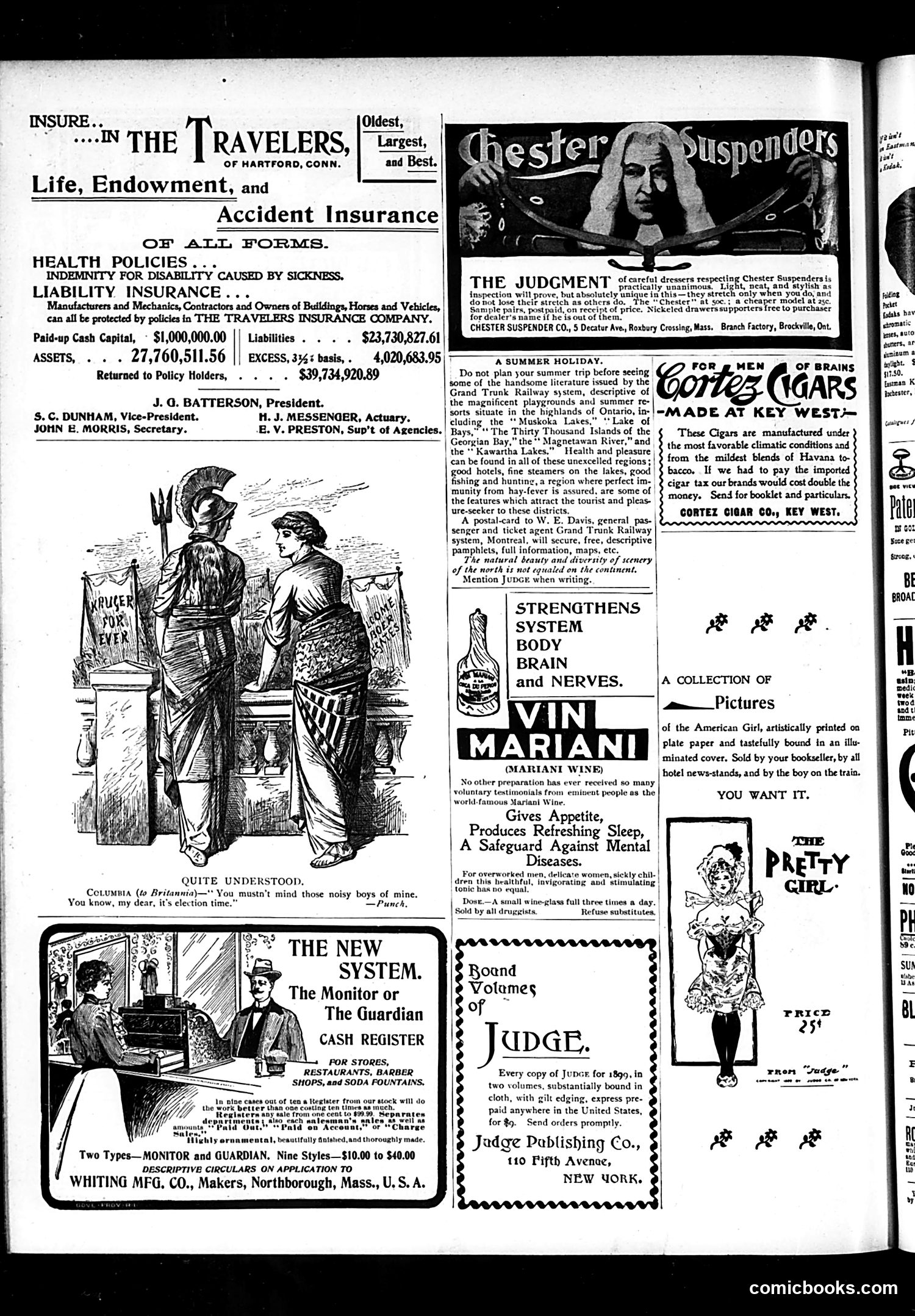
This page is primarily **advertising**, though it includes one political cartoon at the bottom left. ## The Cartoon: "Quite Understood" The single cartoon depicts **Britannia** (personification of Britain, identifiable by her classical warrior attire) speaking with **Columbia** (personification of America). Britannia says she doesn't mind Columbia's "noisy boys" because "it's election time." **The satire:** This references American electoral politics—likely the 1898-1900 period when Judge was publishing. The joke suggests that American boys (citizens/voters) become loud and rowdy during election campaigns. Britannia, representing established British governance, humorously tolerates American democratic chaos as merely temporary election-season noise. It's gentle mockery of American democratic enthusiasm compared to British reserve. The rest of the page contains period advertisements for insurance, cigars, wine tonics, cash registers, and books—typical of Judge's revenue model. These ads reveal common turn-of-century products and health claims (Vin Mariani wine as a "safeguard against mental diseases").
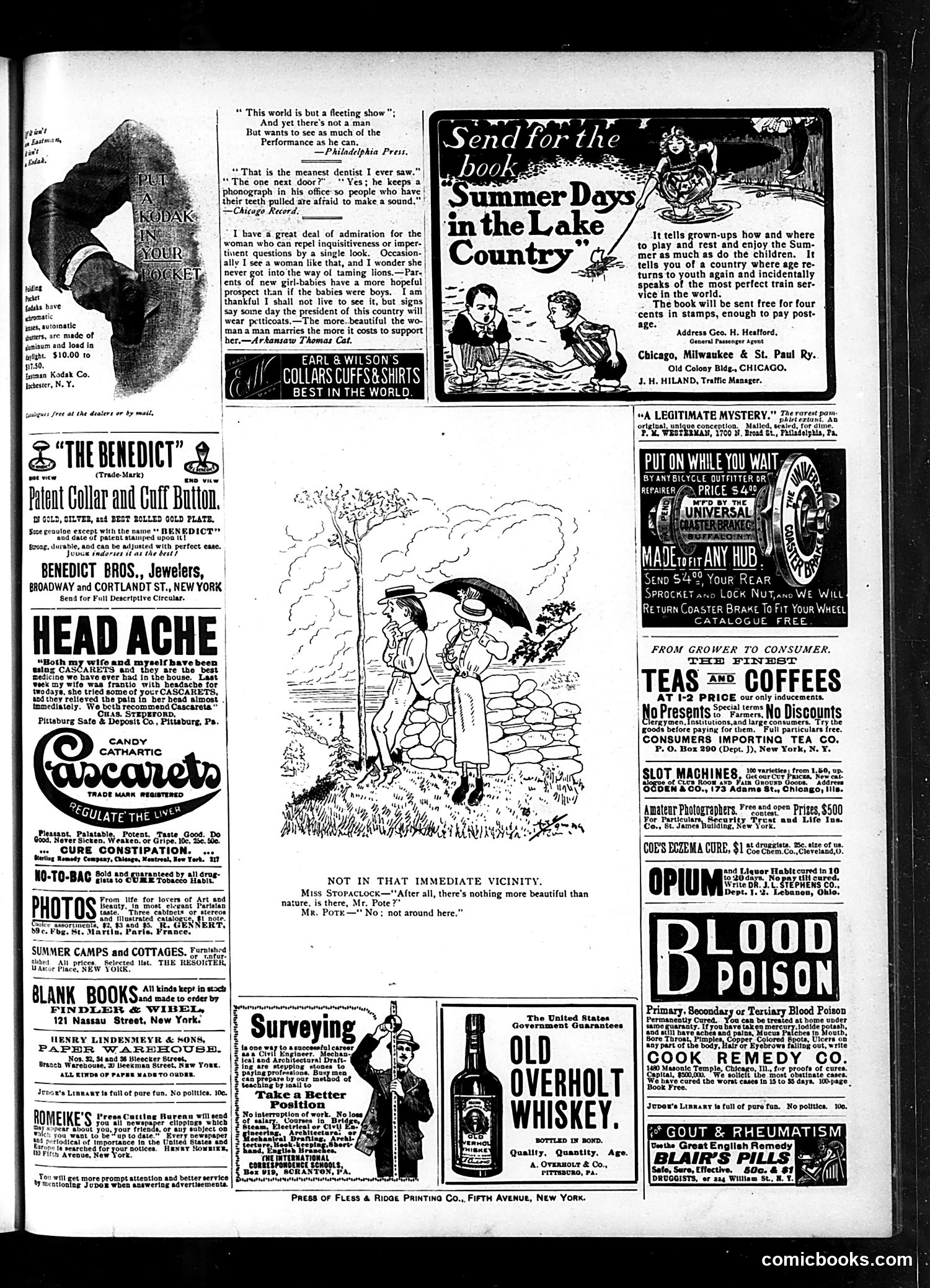
This page is primarily **advertisements and brief joke columns** typical of early 1900s satirical magazines, rather than political cartoons requiring historical context. The main illustration—"Not in That Immediate Vicinity"—shows a couple admiring nature, with the man's deadpan response that there's nothing beautiful "around here." This is gentle social satire about urbanism versus rural aesthetics, not requiring specialized historical knowledge. The scattered one-liners mock mundane experiences: a dentist with a phonograph to silence patients during tooth extraction; a woman's inquisitiveness tamed like lions; predictions that future presidents might wear petticoats (mildly satirizing women's changing social roles). The bulk of the page comprises period product advertisements (Cascarets for headaches, No-To-Bac for tobacco habits, Earl & Wilson collars, Old Overholt whiskey). These reflect contemporary consumer culture rather than political commentary. No specific political figures or events are referenced visibly on this particular page.
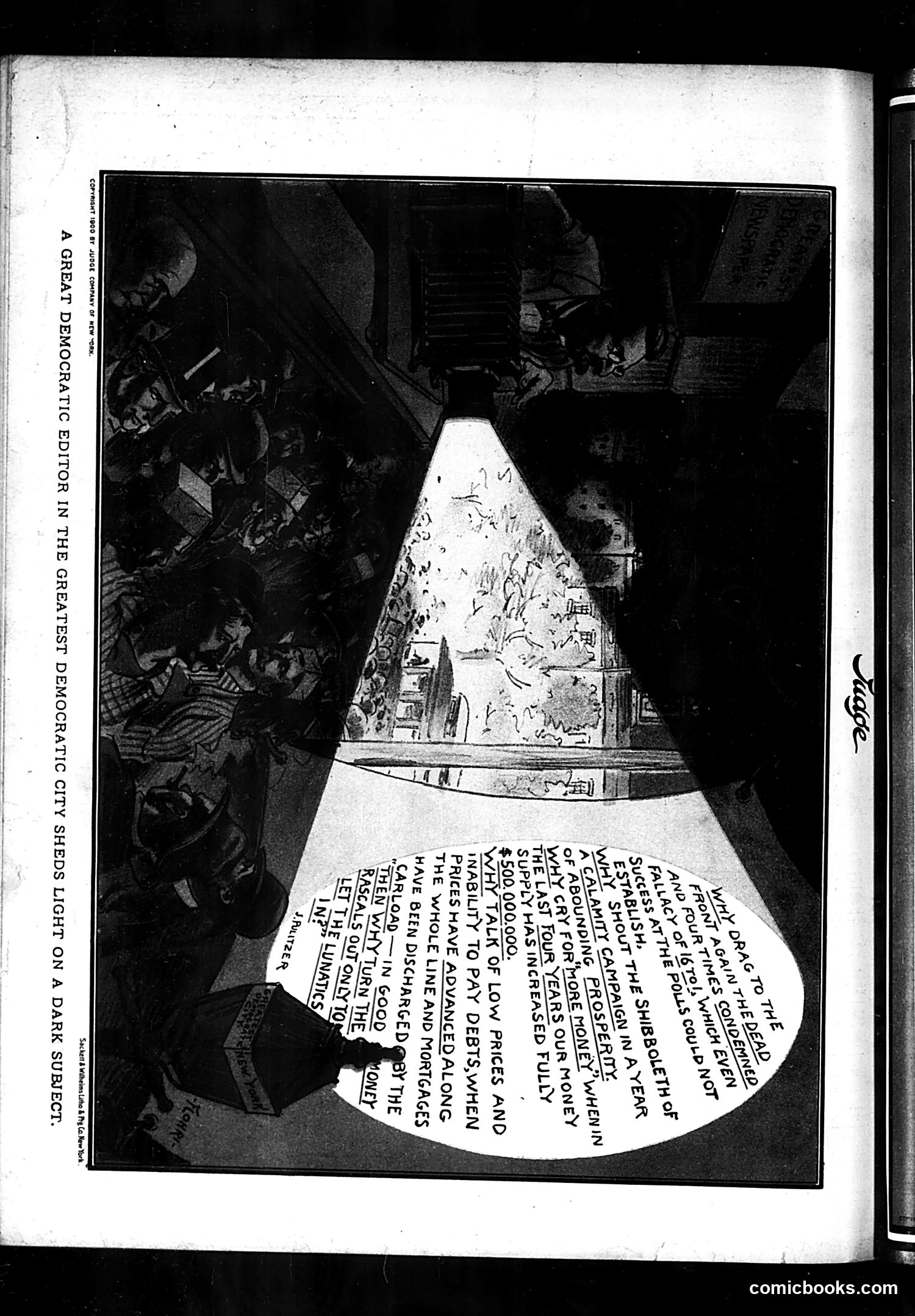
This political cartoon satirizes a Democratic newspaper editor in a major American city (likely New York) who is promoting an optimistic economic narrative. The image shows a figure using a lantern to illuminate text discussing economic conditions. The satire targets Democratic claims about prosperity and debt reduction. The OCR'd text references "low prices," "inability to pay debts," and assertions that "prices have advanced" and "mortgages have been discharged." The cartoon appears to mock Democratic messaging that contradicts observable economic reality—claiming improvement while prices rise and debtors struggle. The "light on a dark subject" caption sarcastically suggests the editor is clarifying murky economic conditions, when actually he's obscuring them with propaganda. This reflects partisan debate circa 1900 over which party better managed the economy, with Judge (a Republican-leaning publication) attacking Democratic spin on economic conditions.