
Judge, 1900-06-16 · page 2 of 16
Judge — June 16, 1900 — page 2: what you’re looking at
What you’re looking at
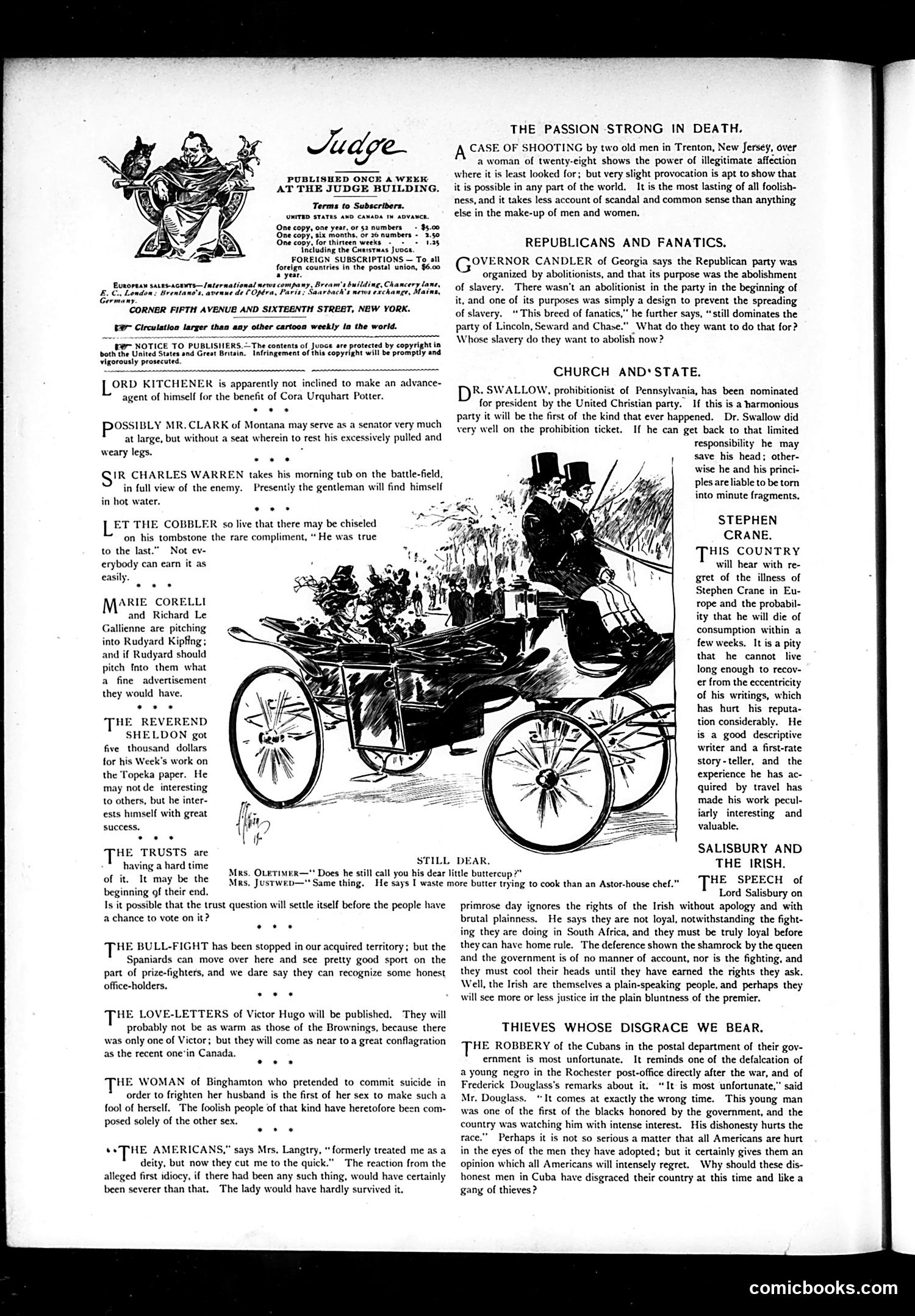
The main cartoon, titled "STILL DEAF," depicts two figures in a carriage—likely representing Mrs. Oluttimer and Mrs. Pottle in domestic conversation. The joke plays on marital communication: one woman asks if her husband still calls her "dear little buttercup," and the other responds he wastes more butter trying to cook than an "Astor-house chef," suggesting indifference to romantic pet names. Below, several brief satirical items mock Republicans as "fanatics," criticize Governor Candler of Georgia regarding abolition debates, and comment on Irish immigration and Cuban postal service theft. The page primarily contains social/political commentary typical of late 19th-century American satire, with domestic humor alongside sharper political criticism.
📄 Transcribed text from this page (OCR, searchable)
Machine-transcribed from the original scan — historical spelling and the odd misread are preserved.
Sudge- PUBLISHED ONCE A WEEK AT THE JUDGE BUILDING. Terms to Subscribers. UNITED STATES AMO CANADA. De ADVANCE. ‘One copy, one year, or $2 numbers One copy, six months, or 26 numbers One copy, for thirteen week: Including the Cunis FOREIGN SUBSCRIPTIONS — To all foreign countries in the postal union, $6.00 a year. Eunorean sates-acewrs—/ntermational mews compa: E.C., London: Brentano's, avenue de (Opéra, Paris, Germany CORNER FIFTH AVENUE AND SIXTEENTH STREET, NEW YORK. £27 Circulation larger than any other cartoon weekly In the world. 1e- NOTICE TO PUBLISHIERS.~The contents of Juoce are protected by copyright in both the United States and Great Britain. Infringement of this copyright will be promptly and vigorously prosecuted. "4 building, Chancery roach's mews exchange, Me ORD KITCHENER is apparently not inclined to make an advance- agent of himself for the benefit of Cora Urquhart Potter. OSSIBLY MR. CLARK of Montana may serve as a senator very much at large, but without a seat wherein to rest his excessively pulled and weary legs. : IR CHARLES WARRE! in full view of the enemy. in hot water. takes his morning tub on the battle-field, Presently the gentleman will find himself LET THE COBBLER so live that there may be chiseled on his tombstone the rare compliment, “He was true to the last.” Not ev- erybody can earn it as easily. Marie CORELLI and Richard Le Gallienne are pitching into Rudyard Kipfing: and if Rudyard should pitch Into them what a fine advertisement they would have. THE REVEREND SHELDON got ind dollars. for his Week's work on the Topeka paper. He may not de. interesting to others, but he inter- ests himself with great success. THE TRUSTS are having a hard time of it. It may be the beginning of their end. Is it possible that the trust question will settle itself before the people have a chance to vote on it? STILL Mrs. Overiaet Mrs, Jusrwep—" Same thing. HE BULL-FIGHT has been stopped in our acquired territory; but the Spaniards can move over here and see pretty good sport on the part of prize-fighters, and we dare say they can recognize some honest office-holders. THE LOVE-LETTERS of Victor Hugo will be published. They will probably not be as warm as those of the Brownings, because there was only one of Victor; but they will come as near toa great conflagration as the recent one’in Canada. HE WOMAN of Binghamton who pretended to commit suicide in order to frighten her husband is the first of her sex to make such a fool of herself. The foolish people of that kind have heretofore been com- posed solely of the other sex. se THE AMERICANS,” says Mrs, Langtry, “formerly treated me as a deity, but now they cut me to the quick.” The reaction from the alleged first idiocy, if there had been any such thing, would have certainly been severer than that, The lady would have hardly survived it. * Does he still call you his dear little buttercup?” He says I waste more butter trying to cook than an Astor-house chef.” THE PASSION STRONG IN DEATH. CASE OF SHOOTING by two old men in Trenton, New Jersey, over a woman of twenty-eight shows the power of illegitimate affection where it is least looked for; but very slight provocation is apt to show that it is possible in any part of the world. It is the most lasting of all foolish- ness, and it takes less account of scandal and common sense than anything else in the make-up of men and women. REPUBLICANS AND FANATICS. GOVERNOR CANDLER of Georgia says the Republican party was organized by abolitionists, and that its purpose was the abolishment of slavery. There wasn’t an abolitionist in the party in the beginning of it, and one of its purposes was simply a design to prevent the spreading of slavery.“ This breed of fanatics,” he further says, “still dominates the party of Lincoln, Seward and Chase.” What do they want to do that for? Whose slavery do they want to abolish now? CHURCH AND‘ STATE. R. SWALLOW, prohibitionist of Pennsylvania, has been nominated for president by the United Christian party. If this is a harmonious party it will be the first of the kind that ever happened. Dr. Swallow did very well on the prohibition ticket. If he can get back to that limited responsibility he may save his head; other- wise he and his princi- ples are liable to be torn into minute fragments, STEPHEN CRANE. THis COUNTRY will hear with re- gret of the illness of Stephen Crane in Eu- rope and the probabil- ity that he will die of consumption within a few weeks. It is a pity that he cannot live long enough to recov- er from the eccentricity of his writings, which has hurt his reputa- tion considerably. He is a good descriptive writer and a first-rate story-teller, and the experience he has ac- quired by travel has made his work pecul- iarly interesting and valuable. SALISBURY AND THE IRISH. THE SPEECH of Lord Salisbury on primrose day ignores the rights of the Irish without apology and with brutal plainness. He says they are not loyal, notwithstanding the fight- ing they are doing in South Africa, and they must be truly loyal before they can have home rule, ‘The deference shown the shamrock by the queen and the government is of no manner of account, nor is the fighting, and they must cool their heads until they have earned the rights they ask. Well, the Irish are themselves a plain-speaking people, and perhaps they will see more or less justice int the plain bluntness of the premier. EAR. THIEVES WHOSE DISGRACE WE BEAR. THE ROBBERY of the Cubans in the postal department of their gov- ernment is most unfortunate, It reminds one of the defalcation of a young negro in the Rochester post-office directly after the war, and of Frederick Douglass's remarks about it, “It is most unfortunate,” said Mr. Douglass. “It comes at exactly the wrong time. This young man was one of the first of the blacks honored by the government, and the country was watching him with intense interest. His dishonesty hurts the race.” Perhaps it is not so serious a matter that all Americans are hurt in the eyes of the men they have adopted; but it certainly gives them an opinion which all Americans will intensely regret. Why should these dis- honest men in Cuba have disgraced their country at this time and like a gang of thieves? comicbooks.com