
Judge, 1900-06-16 · page 7 of 16
Judge — June 16, 1900 — page 7: what you’re looking at
What you’re looking at
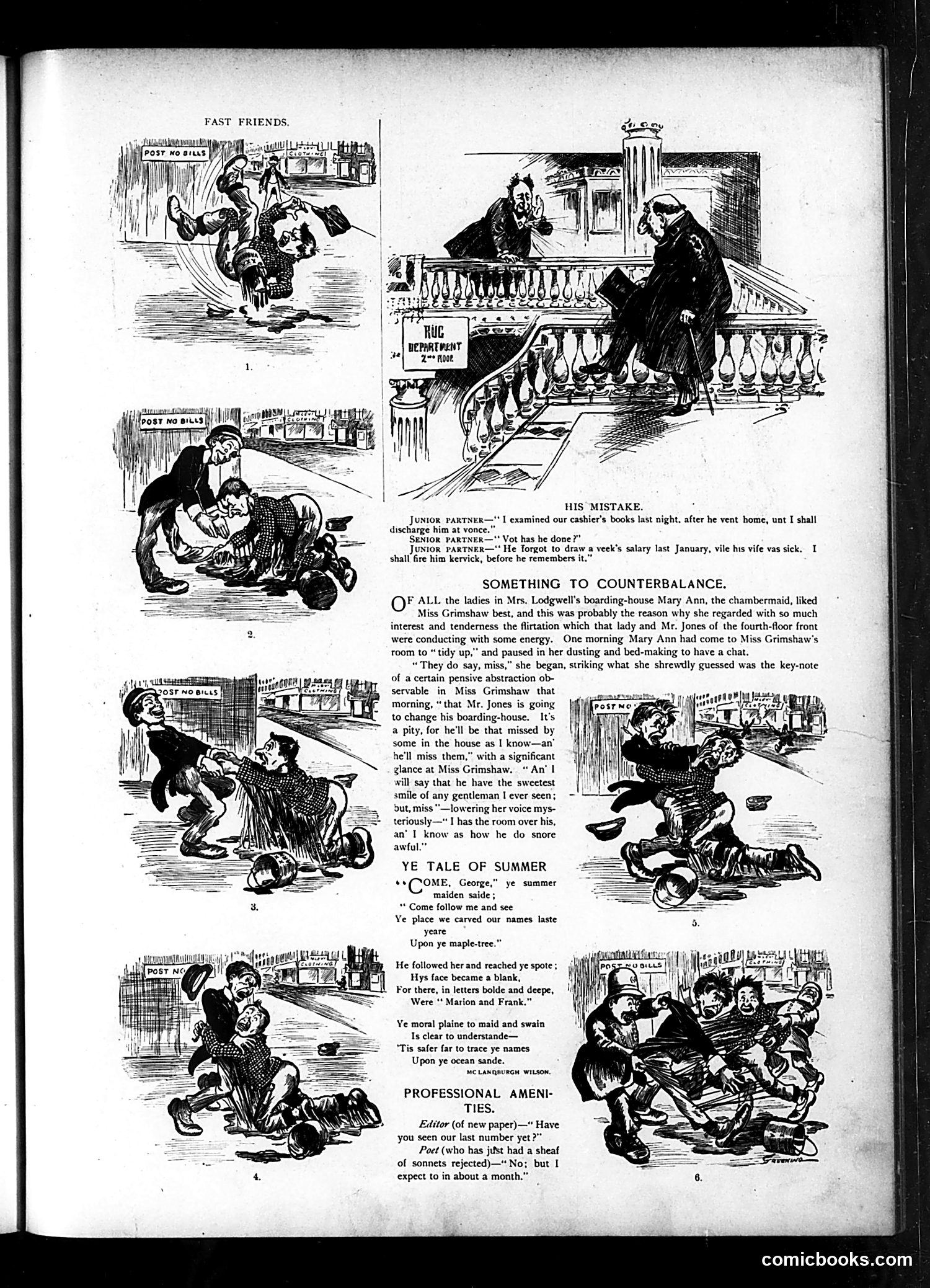
This page from *Judge* contains several unrelated Victorian-era comic sketches satirizing social awkwardness and romantic entanglements. **"Fast Friends"** (top) depicts a senior partner firing a junior partner, callously timing it before the man remembers he's owed back salary from when his wife was ill—illustrating ruthless business ethics disguised as friendship. **"Something to Counterbalance"** shows a chambermaid warning her employer, Miss Grimshaw, that Mr. Jones (a fourth-floor tenant) snores terribly, despite his charming smile and romantic interest in her—the joke being that physical reality spoils romantic fantasy. **"Ye Tale of Summer"** presents a betrayal: a couple returns to a tree where they carved their names years ago, only to discover "Marion and Frank" carved there instead—suggesting infidelity or that the original relationship wasn't exclusive. **"Professional Amenities"** features an editor asking a rejected poet if he's seen the new publication, with the poet sarcastically implying he'll see it in trash bins "in about a month"—mocking professional courtesy masking contempt. The page emphasizes hypocrisy and disappointment in human relationships.
📄 Transcribed text from this page (OCR, searchable)
Machine-transcribed from the original scan — historical spelling and the odd misread are preserved.
FAST FRIENDS. ER—'' He forgot to draw a veek’s salary last January, vile his vife vas sick. I shall fire him kervick, before he remembers it.” SOMETHING TO COUNTERBALANCE, OF ALL the ladies in Mrs. Lodgwell's boarding-house Mary Ann, the chambermaid, liked Miss Grimshaw best, and this was probably the reason why she regarded with so much interest and tenderness the flirtation which that lady and Mr. Jones of the fourth-floor front were conducting with some energy. One morning Mary Ann had come to Miss Grimshaw’s room to “ tidy up,” and paused in her dusting and bed-making to have a chat. “They do say, miss,” she began, striking what she shrewdly guessed was the key-note of a certain pensive abstraction ob- servable in Miss Grimshaw that morning, “that Mr. Jones is going to change his boarding-house. It’s a pity, for he'll be that missed by some in the house as I know—an’ he'll miss them,” with a significant glance at Miss Grimshaw.“ An’ | will say that he have the sweetest smile of any gentleman I ever seen; but, miss "—lowering her voice mys- teriously—“ I has the room over his, an’ I know as how he do snore awful.” YE TALE OF SUMMER Ss(COME, George,” ye summer maiden saide ; ** Come follow me and see Ye place we carved our names laste yeare Upon ye maple-tree.” He followed her and reached ye spote ; Hys face became a blank, For there, in letters bolde and deepe, Were ‘ Marion and Frank.” Ye moral plaine to maid and swain Is clear to understande— “Tis safer far to trace ye names Upon ye ocean sande. MC LANQBURGH WILSON. PROFESSIONAL AMENI- TIES, Editor (of new paper)—" Have you seen our last number yet ?” Poet (who has just had a sheaf of sonnets rejected)—"* No; but I expect to in about a month.” comicbooks.com