
A complete issue · 16 pages · 1900
Judge — May 19, 1900
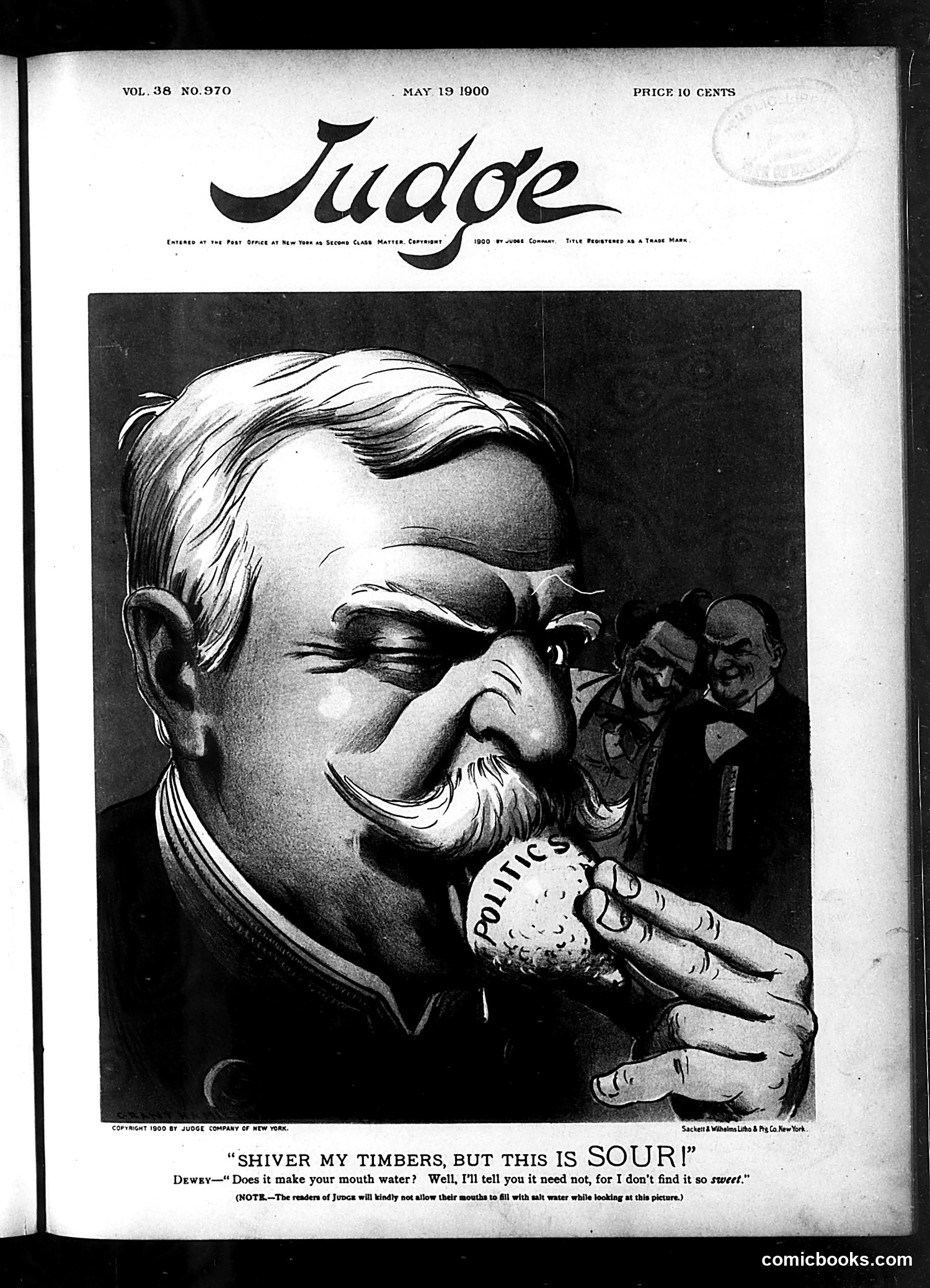
This cartoon satirizes **Admiral George Dewey**, the celebrated American naval commander who defeated the Spanish fleet at Manila Bay during the Spanish-American War (1898). The exaggerated caricature shows Dewey with a prominent mustache, holding what appears to be a bottle labeled "Politics." The joke's caption—"Shiver my timbers, but this is SOUR!"—plays on his nautical background while mocking his venture into political life. The smaller figures in the background likely represent political observers or rivals. The satire suggests that Dewey, flush with military fame, attempted to enter politics but found the political arena distasteful or challenging—a "sour" experience compared to his naval victories. This references Dewey's brief 1900 presidential campaign, which failed to gain traction.
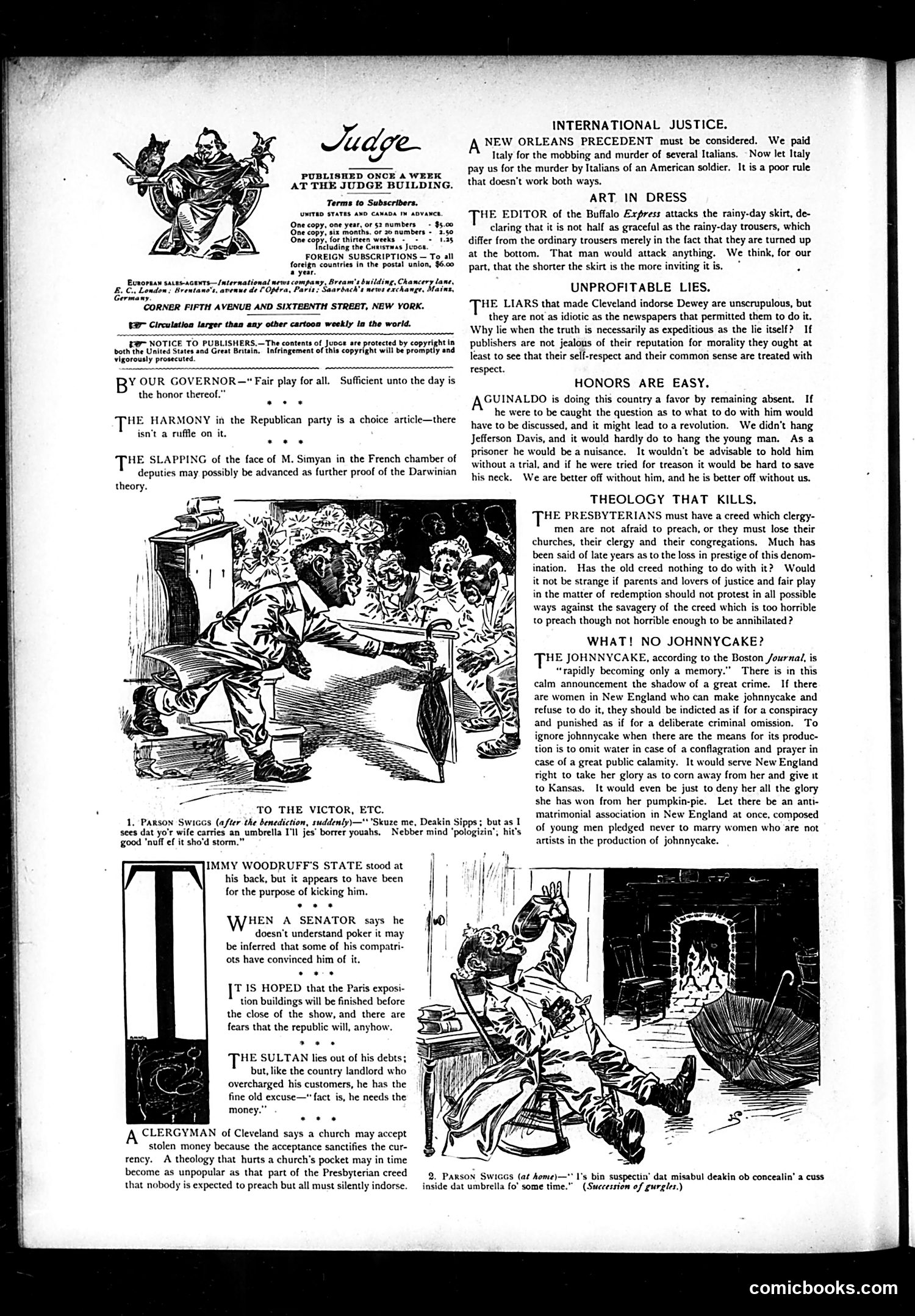
The page contains several political commentary pieces. The main cartoon depicts "Parson Swinds" (a clergyman character) in an umbrella during a storm, with a caption playing on his name ("'Skuse me, Deakin Slipps"). The text sections critique contemporary issues: - **"International Justice"**: Comments on Italy paying for murdered Italian soldiers - **"Art in Dress"**: Satirizes fashion criticism - **"Unprofitable Lies"**: Attacks newspapers for endorsing Dewey - **"Honors Are Easy"**: Discusses Aguinaldo's absence (Philippine context) - **"Theology That Kills"**: Criticizes Presbyterian clergy positions - **"What! No Johnnycake?"**: Satirizes Boston Journal's commentary on American regional pride The humor relies on wordplay, social commentary, and caricature typical of 1890s-1900s American satirical journalism. Without clearer date markers, specific historical context remains partially unclear.
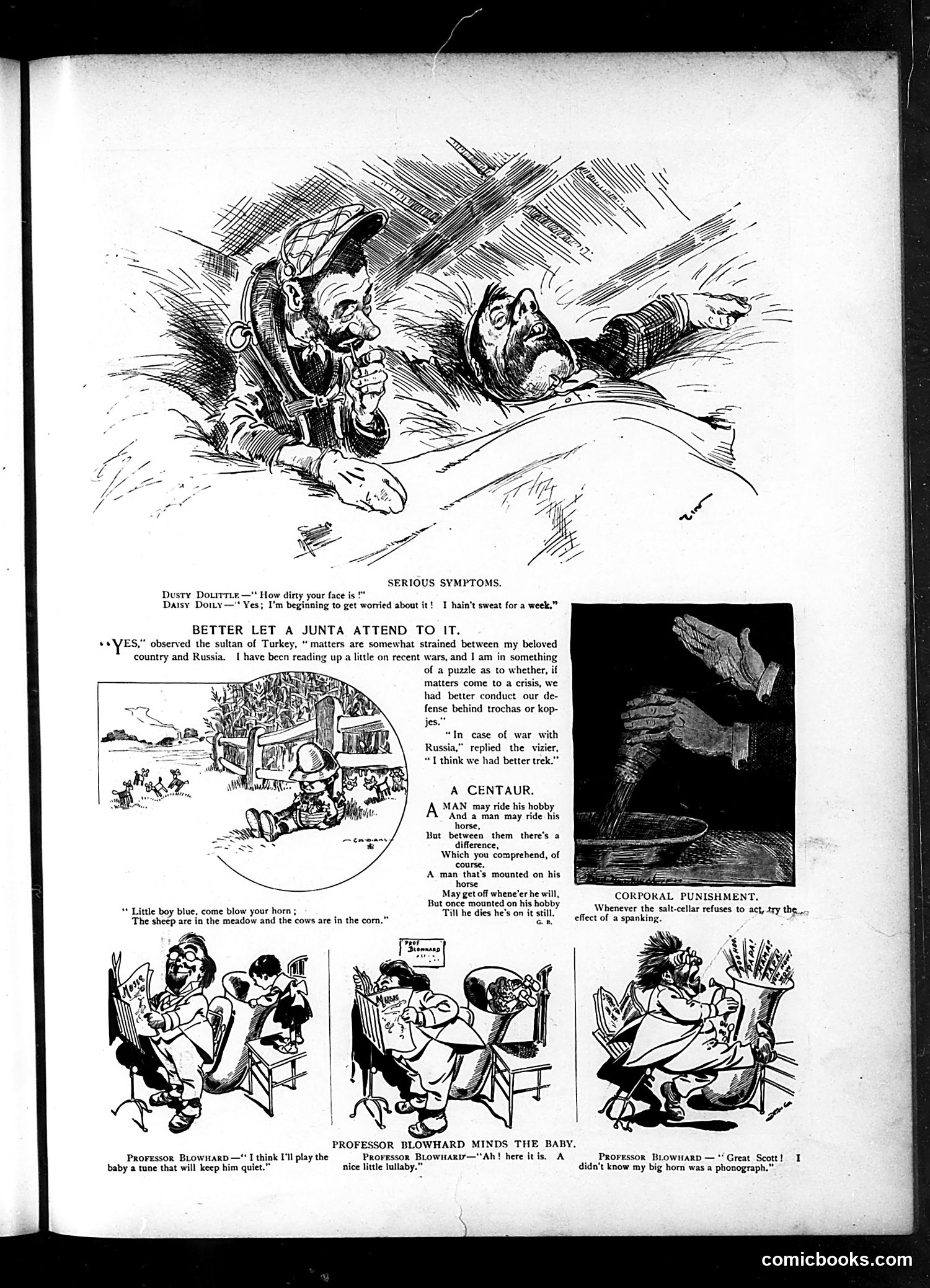
This page contains multiple satirical cartoons and humorous pieces from an early 20th-century American magazine. **Top cartoon ("Serious Symptoms")**: Features "Dusty Doolittle" and "Daisy Doily" discussing domestic concerns—likely commentary on working-class anxieties. **"Better Let a Junta Attend to It"**: Shows the Sultan of Turkey discussing strained relations with Russia, referencing Ottoman-Russian tensions. The joke suggests military intervention ("trochas or kopjes"—military fortifications) is needed. **"A Centaur"**: Contrasts hobbies and horses—a man on a hobby-horse versus one on an actual horse. **"Professor Blowhard Minds the Baby"**: Three-panel domestic humor showing a professor incompetently babysitting, concluding with him not recognizing his own horn as a photograph. The page mixes political satire with domestic comedy typical of Judge's era.
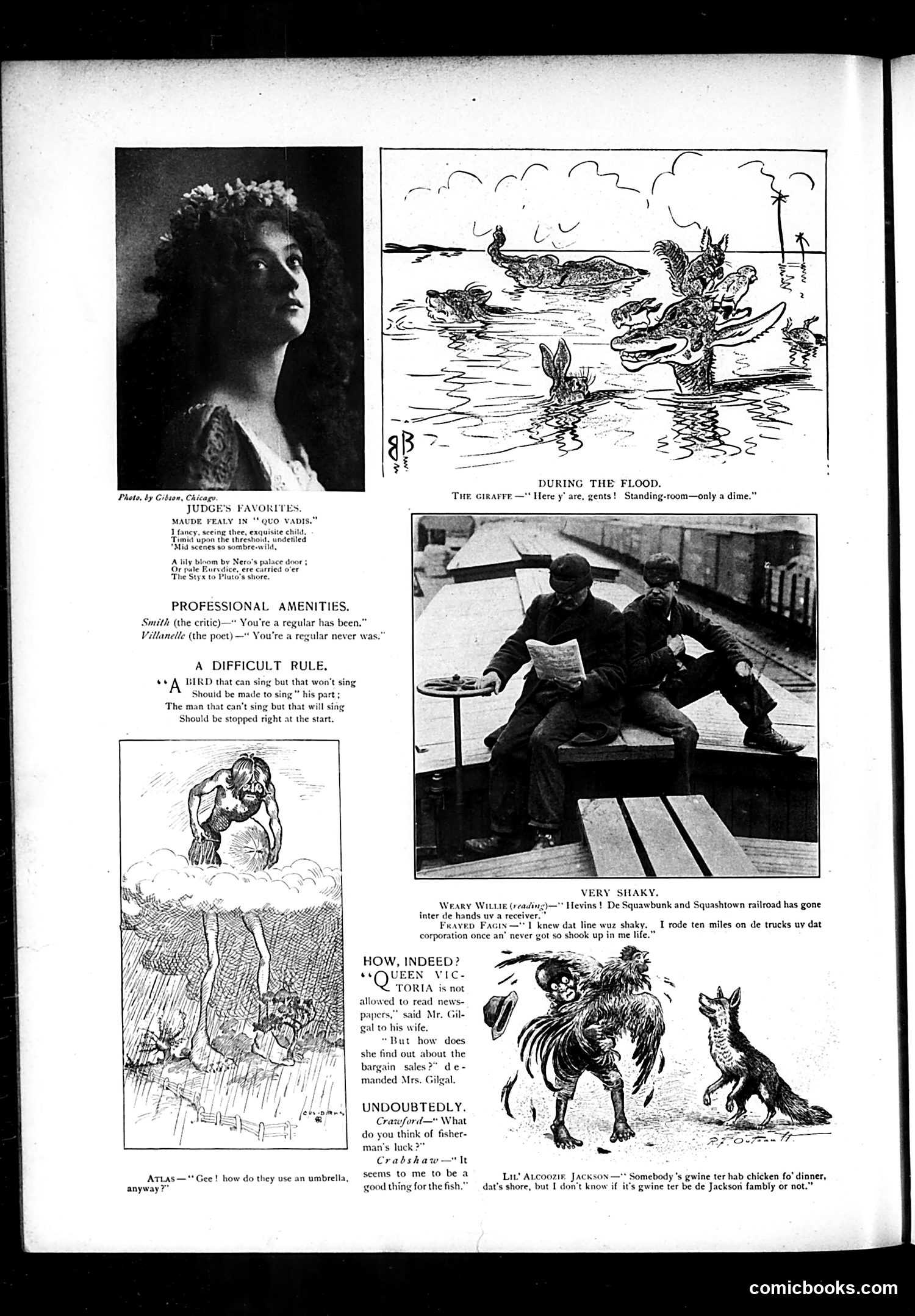
This Judge magazine page contains several unrelated satirical pieces and illustrations: **"Judge's Favorites"** features Madge Realty in "Quo Vadis," a theatrical reference. **"A Difficult Rule"** is a poem about singers—likely commentary on vaudeville or theatrical performers of the era. **"Professional Amenities"** offers a brief exchange between critics and poets about being "regular." **"During the Flood"** cartoon depicts animals in water during a flood, with giraffes remarking on limited standing room—social commentary via animal satire. **"Very Shaky"** references the Heistin & De Squashbunk railroad, apparently a failed venture, mocking financial disaster through fictional railroad names. **"How, Indeed?"** and **"Undoubtedly"** are brief satirical exchanges about Queen Victoria and fishermen's luck. **"Lil' Algonquin Jackson"** jokes about chicken theft, using period dialect humor. The overall page is typical Judge fare: topical humor, theatrical references, and genteel satire for educated readers.
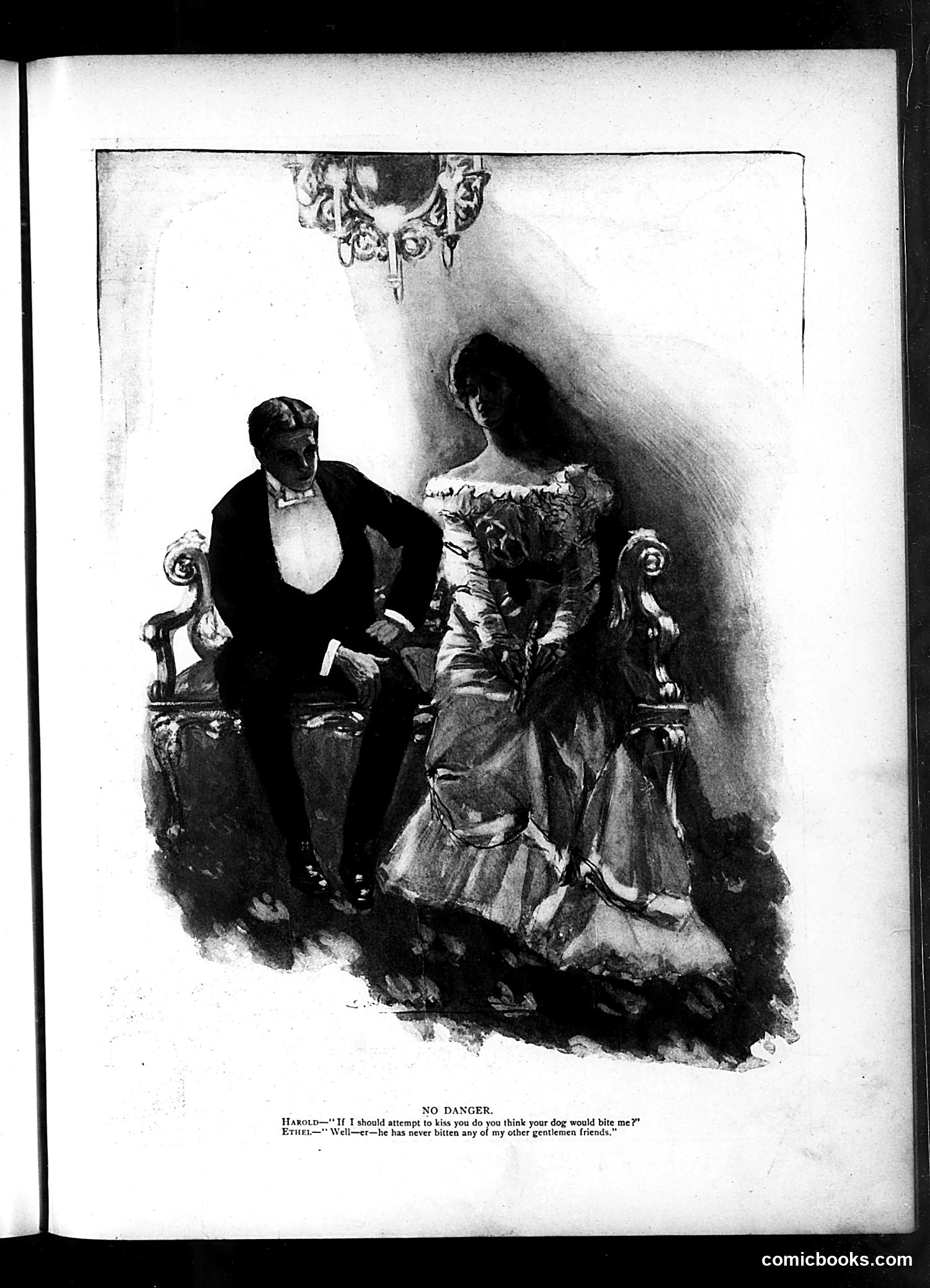
This is a social satire cartoon depicting a romantic encounter between a man named Harold and a woman named Ethel. Harold nervously asks if her dog would bite him if he attempted to kiss her. Ethel's response—that the dog "has never bitten any of my other gentlemen friends"—is the joke's punch line. The humor relies on the implication that Ethel receives many male visitors, suggesting loose morality or promiscuity by early 20th-century standards. Harold's concern about the dog is rendered humorous and secondary to this social commentary. The cartoon satirizes both the woman's apparent romantic availability and the man's somewhat awkward courtship approach, typical of Judge magazine's focus on urban social conventions and romantic etiquette of the era.
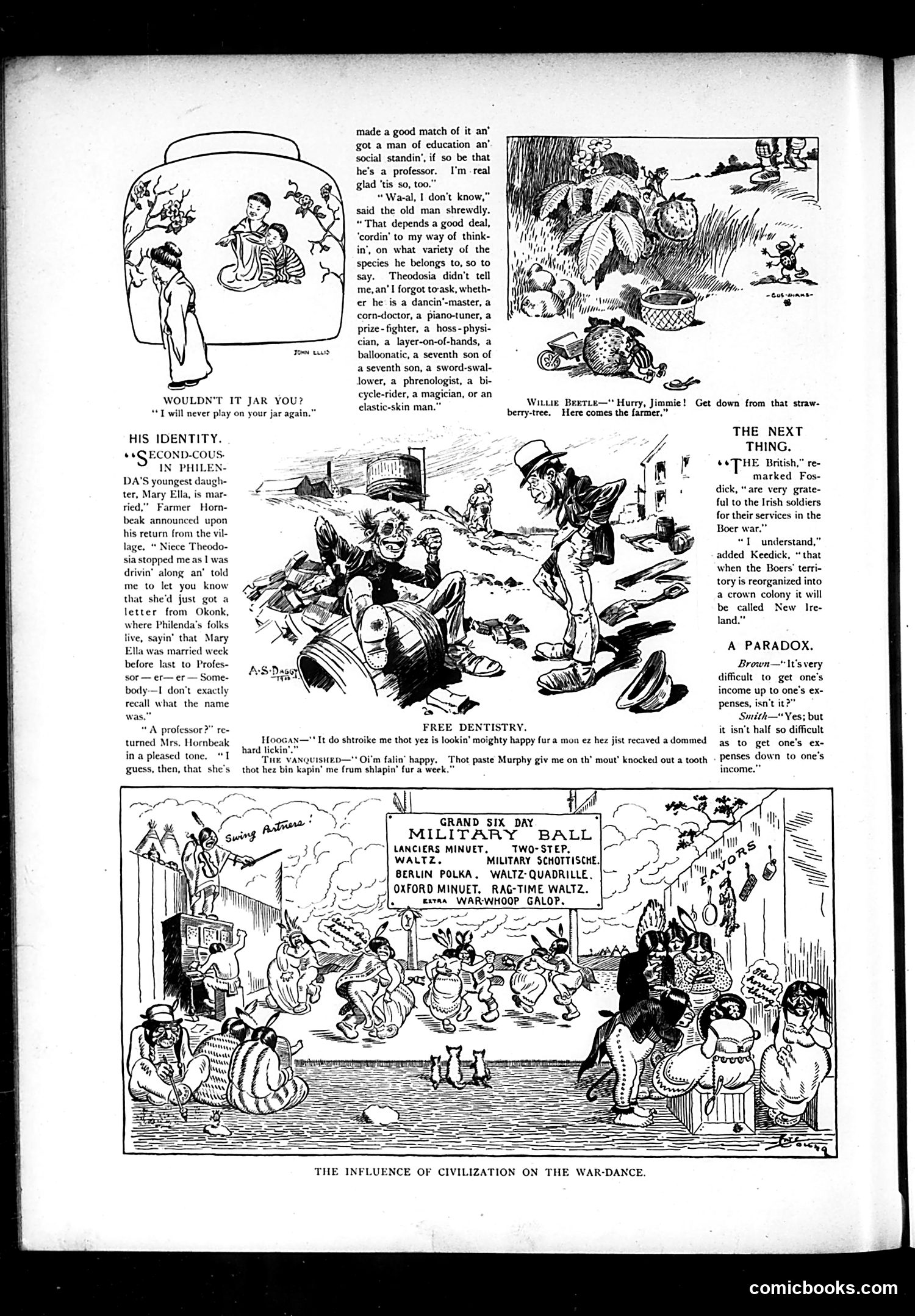
This page contains three distinct satirical pieces typical of early 1900s American humor: **"His Identity"** mocks the vagueness of introducing a new professor husband. The elderly farmer's confusion about what "kind" of professor the son-in-law is—listing absurd specialties like "corn-doctor," "balloonatic," and "sword-swallower"—satirizes how the title "professor" was loosely applied to various dubious practitioners and charlatans of the era. **"The Next Thing"** references the Boer War and British recruitment of Irish soldiers. The joke plays on the irony that after the war, the Boers' territory becoming "New Ireland" would be a strange reward for Irish service to Britain. **The bottom cartoon**, "The Influence of Civilization on the War-Dance," depicts a "Military Ball" with refined dances (waltzes, polkas) replacing a "War-Whoop Galop"—satirizing how European "civilization" was supposedly improving or replacing indigenous practices, reflecting contemporary imperialist attitudes. The humor throughout relies on wordplay, social pretension, and period-specific references to late Victorian/Edwardian society and colonial politics.
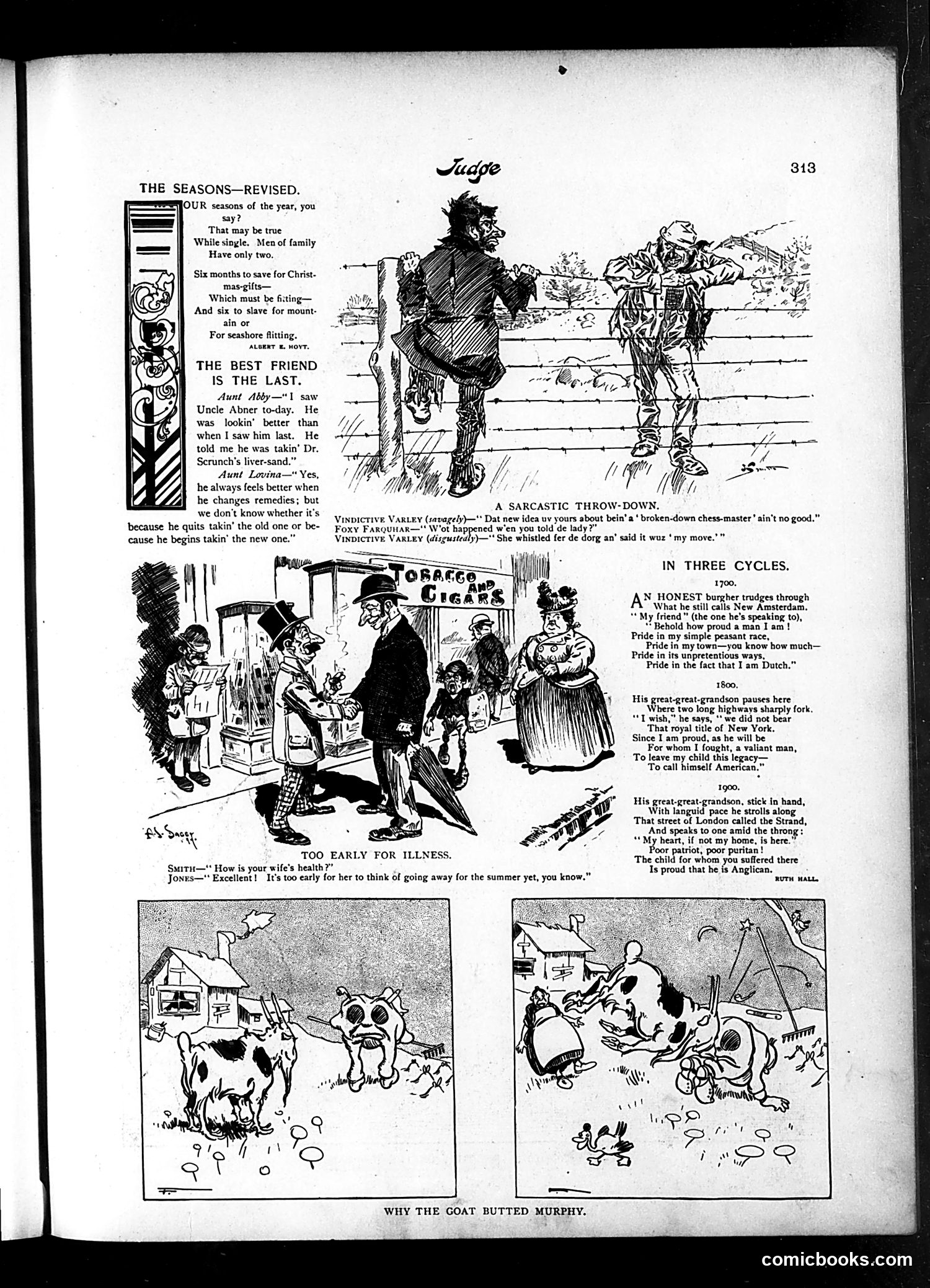
This page contains several satirical pieces targeting early 1900s American life: **"The Seasons—Revised"** jokes that married men with families only experience two seasons: Christmas shopping and vacation planning—a commentary on middle-class domestic obligations. **"The Best Friend is the Last"** satirizes patent medicine culture, where elderly men feel better switching between ineffective "liver tonics," unable to discern whether improvement comes from stopping the old medicine or starting the new. **"A Sarcastic Throw-Down"** shows a chess player's failed romantic overture—the woman's dismissive "my move" insult suggests she's unmoved by his company. **"In Three Cycles"** traces American pride across generations: 1700 celebrates Dutch heritage in New Amsterdam; 1800 shifts to American identity; 1900 reveals the great-great-grandson has become an Anglophile living in London. The satire critiques immigrant descendants who reject their heritage for perceived sophistication. The bottom section includes unrelated domestic humor cartoons. The overall page reflects Judge's typical mocking of American materialism, quackery, and social pretension.
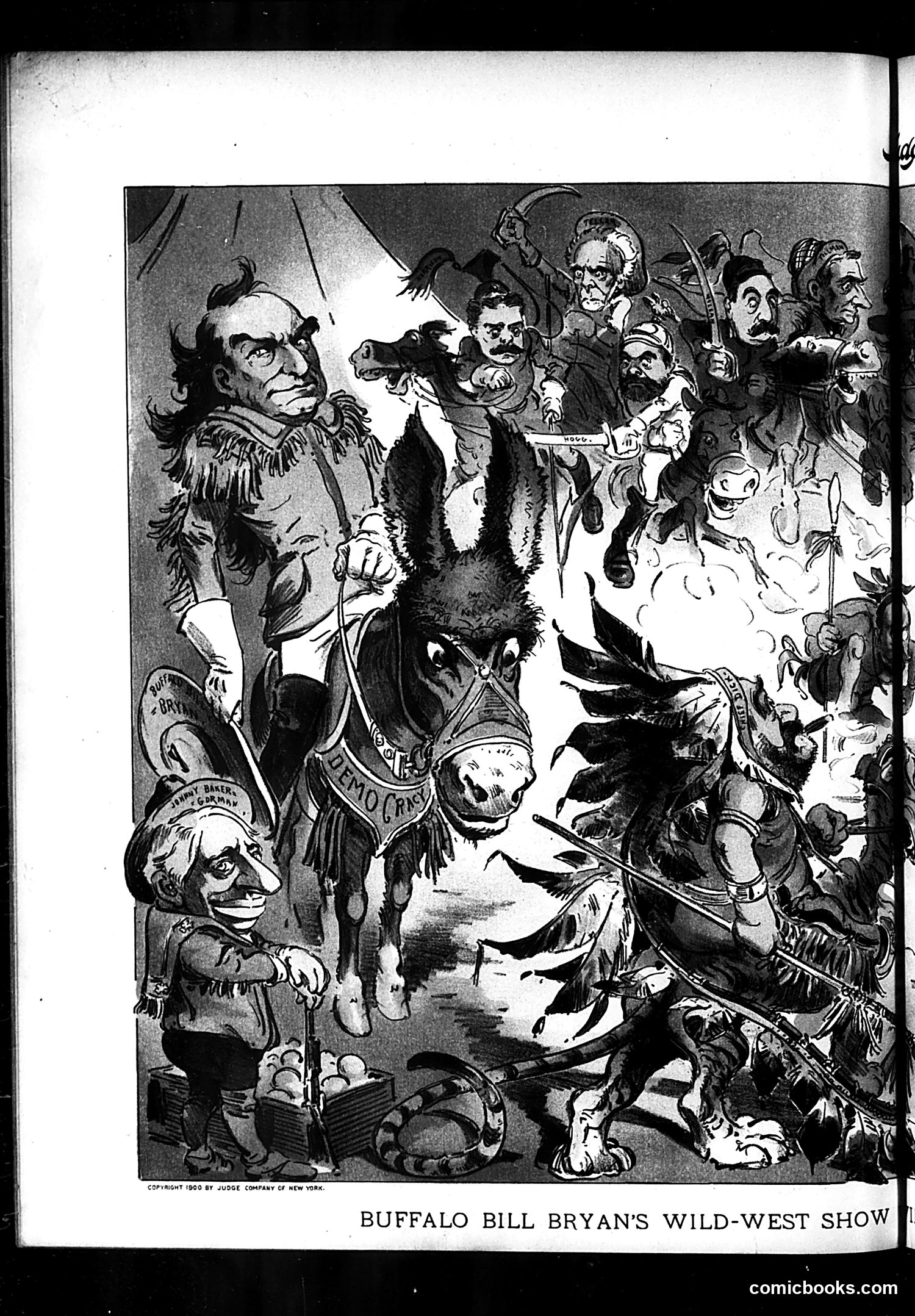
This satirical cartoon from *Judge* magazine (copyright 1903) depicts Buffalo Bill's Wild West Show as a circus of political figures. The central horse carries a caricatured rider surrounded by exaggerated politicians and performers—some depicted as animals or buffoonish characters. The satire appears to mock the spectacle and theatricality of contemporary politics, suggesting political leaders are as much entertainers and oddities as Wild West performers. The various grotesque caricatures likely represent specific political figures or types of the era, though the OCR text is too corrupted to identify them precisely. The cartoon critiques how politics resembles carnival entertainment rather than serious governance—a common *Judge* theme during the Theodore Roosevelt era.
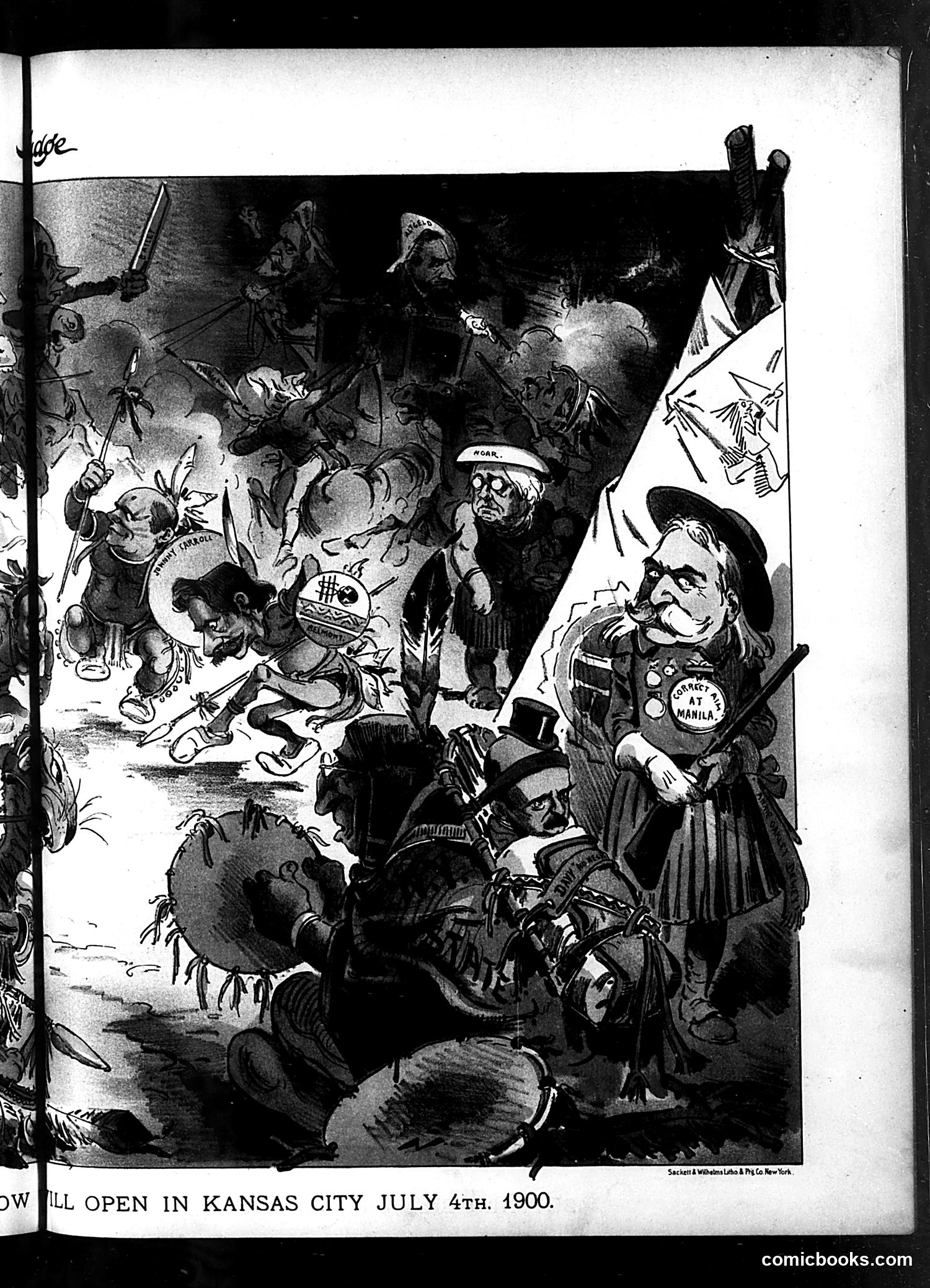
This Judge magazine cartoon satirizes the 1900 Pan-American Exposition planned for Kansas City. The caricatured figures appear to represent political and business leaders involved in organizing the event. The grotesque, exaggerated depictions—common in turn-of-the-century political satire—mock what the cartoonist likely viewed as corruption, incompetence, or wasteful spending associated with the exposition's planning or management. The crowded, chaotic scene with various figures in period dress suggests infighting or competing interests among organizers. Without clearer identification of specific individuals, the precise targets remain unclear, but the overall message critiques those responsible for the exposition's development as buffoonish or self-serving.
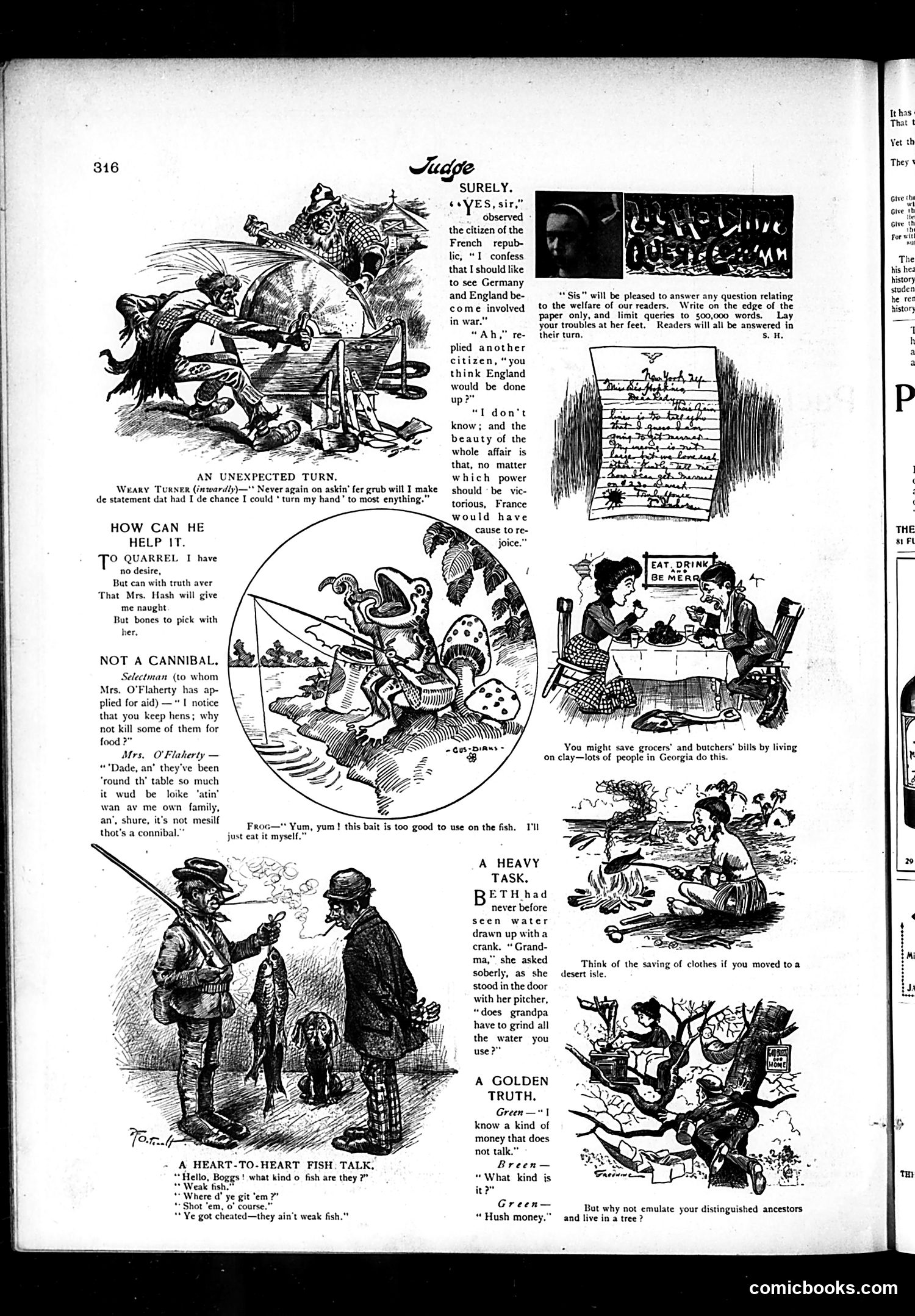
This page contains multiple short humorous sketches typical of Judge's satirical format: **"An Unexpected Turn"**: A starving man (Weary Turner) resolves never again to ask for food, having learned that accepting charity from Mrs. Hash only results in receiving bones—a dark joke about poverty and exploitation of the poor. **"Not a Cannibal"**: An Irish immigrant woman (Mrs. O'Flaherty) refuses a selectman's suggestion to kill her hens for food, joking that eating them would be like eating family members. The sketch mocks both Irish stereotypes and class-based economic advice. **"How Can He Help It"**: A man cannot avoid quarreling with Mrs. Hash because she provides only bones—implying domestic strife stems from poverty and poor provisions. **Other sketches** address topics like water-pumping labor, money/class differences, and weak character ("weak fish"). The recurring poverty theme and immigrant caricatures reflect turn-of-century American anxieties about urban poor and immigration.
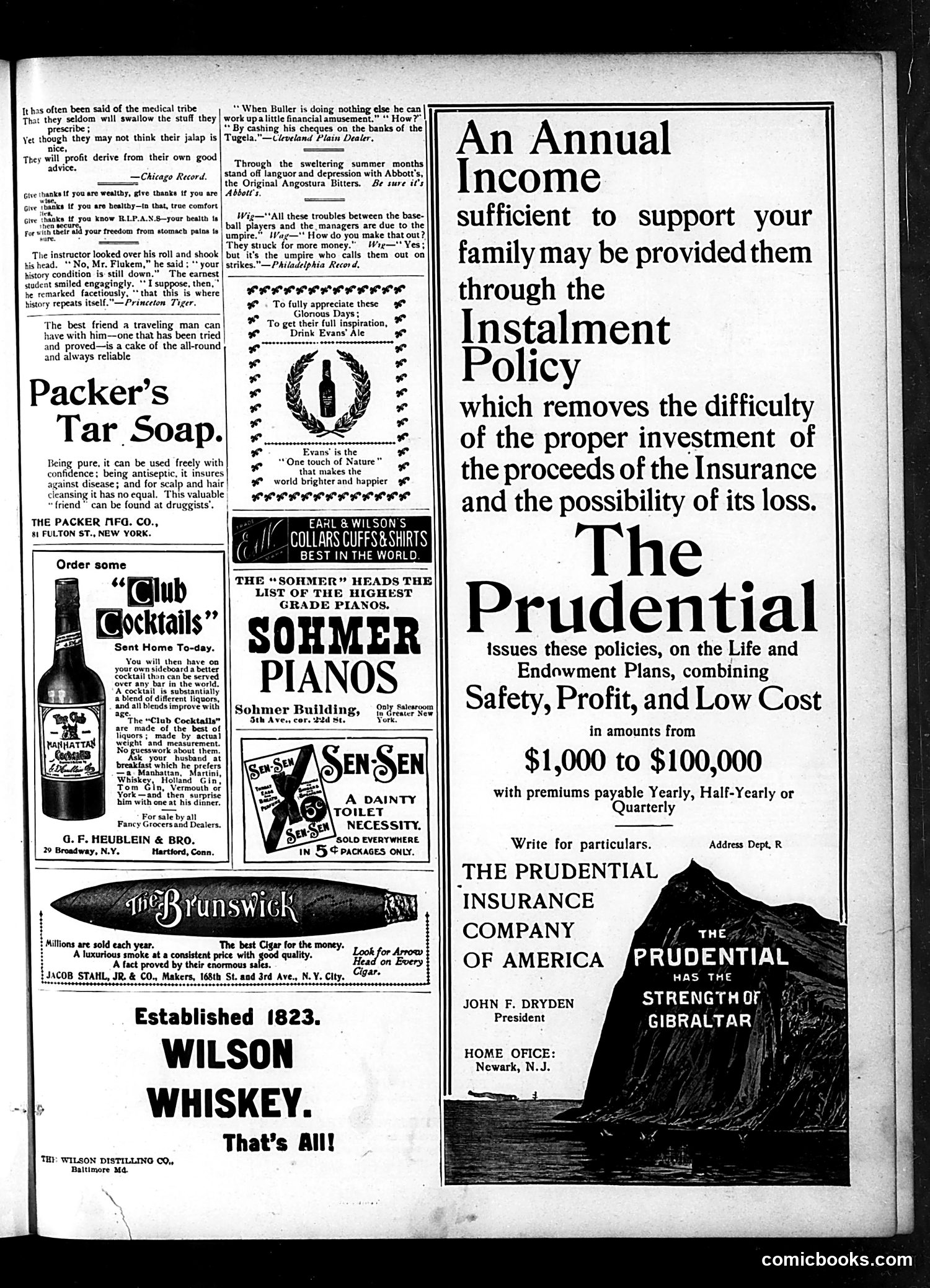
This appears to be primarily an **advertising page** from Judge magazine, with minimal satirical content. The page consists almost entirely of commercial advertisements for products like Packer's Tar Soap, Wilson Whiskey, Sohmer Pianos, and The Prudential Insurance Company. The small humor items scattered throughout are brief jokes rather than cartoons: - A joke about a student claiming "history repeats itself" after failing - A quip about baseball umpires calling strikes, suggesting labor disputes between players/managers stem from umpire authority - A medical profession joke about doctors profiting from their own remedies The **Prudential Insurance ad** is notably large, emphasizing "Instalment Policy" options for families—reflecting early-20th-century marketing of life insurance as financial security for working people. The page lacks the satirical cartoons typical of Judge's political commentary; it's instead a revenue-generating advertisement section with filler humor.
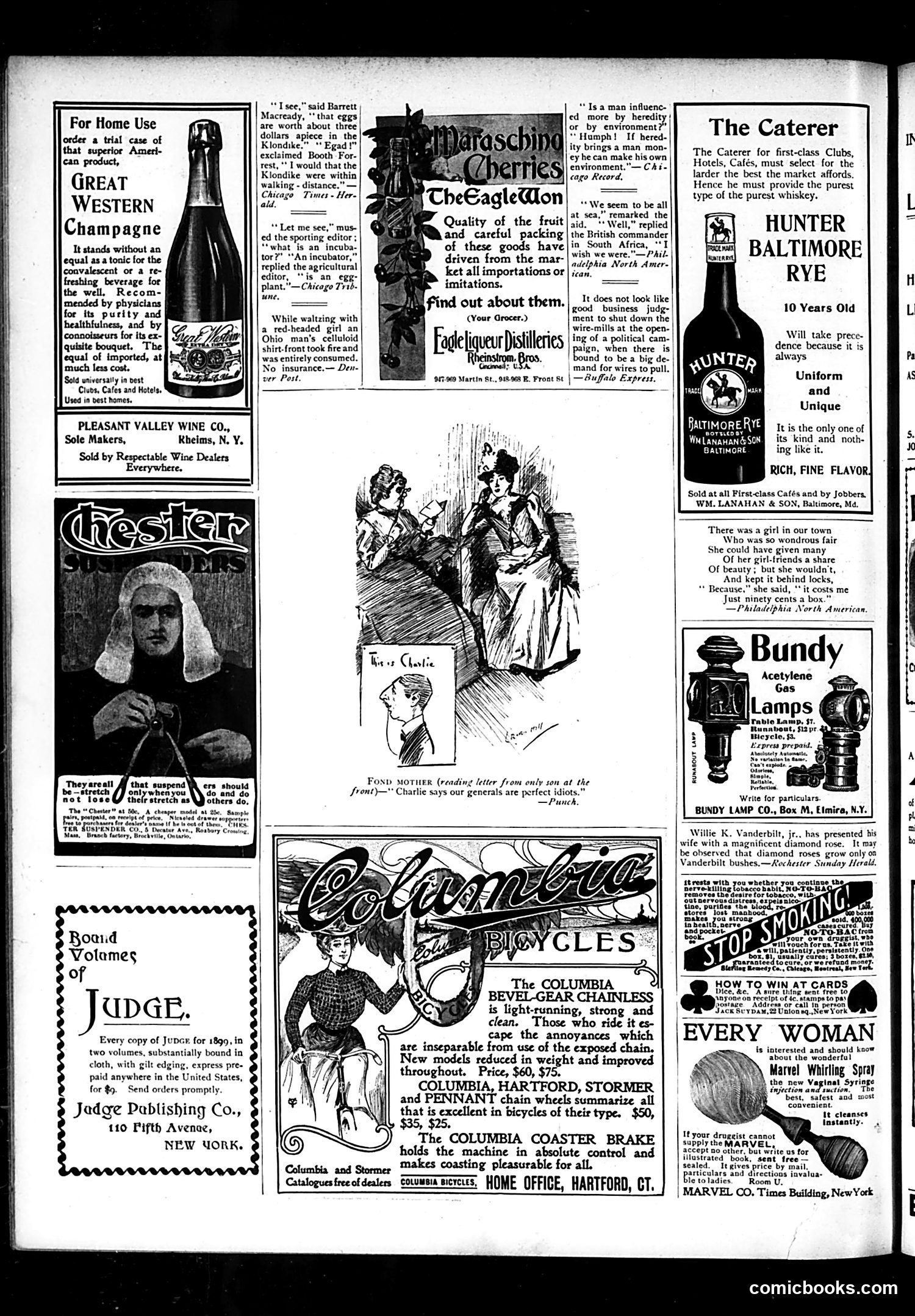
This is primarily an **advertising page** from Judge magazine (circa 1899), with several small satirical jokes interspersed. The main content consists of product advertisements for champagne, bicycles, lamps, and whiskey—typical of period magazines. The few cartoons/jokes present are brief, topical quips: - References to the **Klondike Gold Rush** (eggs costing $3 there) - A joke about an **Ohio man's celluloid shirt catching fire** while dancing - A mother reading her son's letter from the **Boer War** (South Africa), where he criticizes generals as "perfect idiots"—satirizing both military incompetence and a soldier's candid correspondence - A final joke about **Willie K. Vanderbilt Jr.** gifting his wife a diamond rose, mocking wealthy excess (only the ultra-rich can afford such frivolous luxury) The satire is gentle, focused on contemporary events (the wars, wealth disparities) and absurdist humor rather than sharp political commentary.
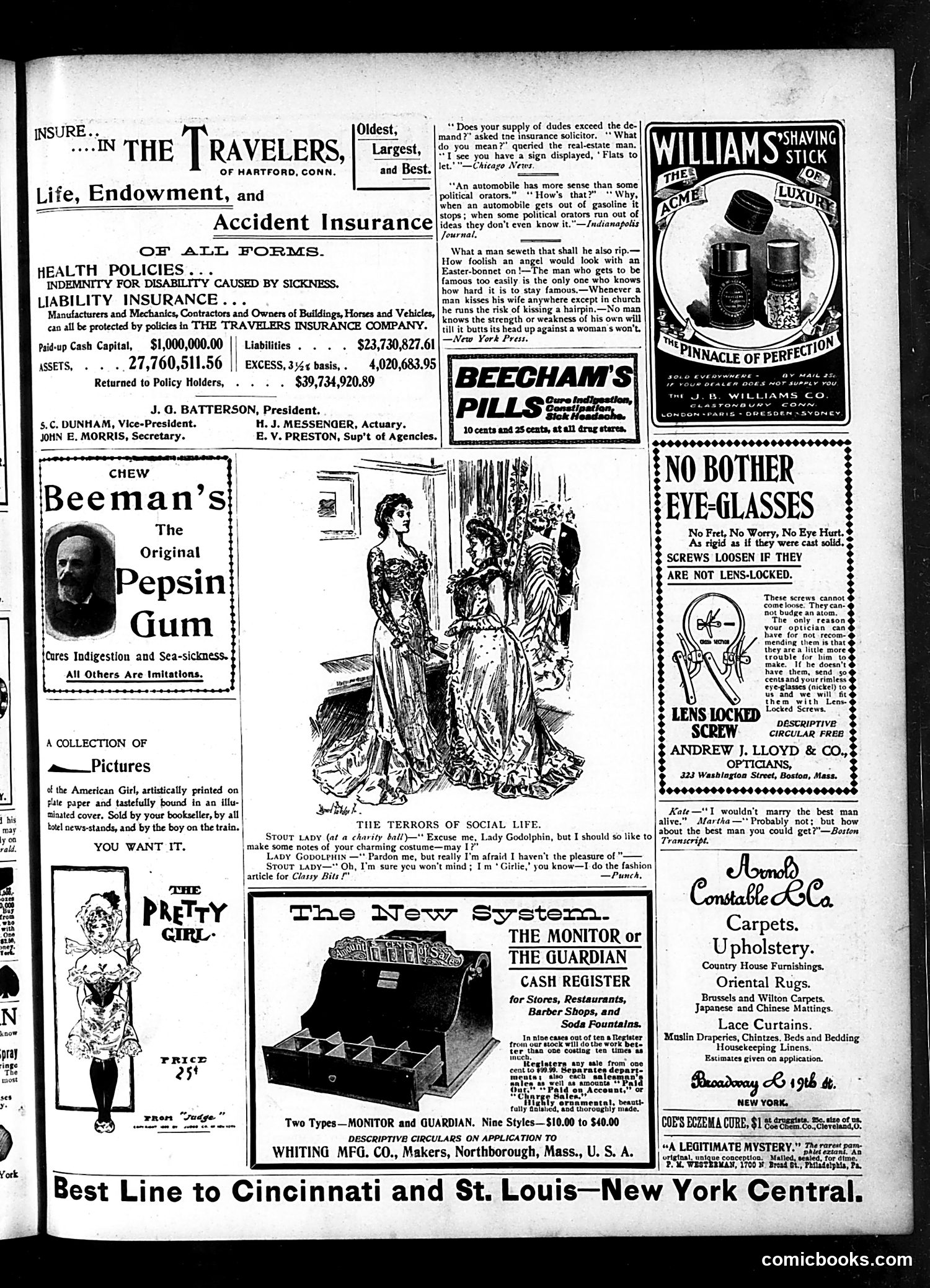
This is primarily an **advertising page** from *Judge* magazine, not a satirical cartoon page. The layout consists almost entirely of commercial advertisements for insurance, patent medicines, and consumer goods typical of the early 1900s. The only genuine satirical content appears as **brief humor fragments** scattered among ads—short jokes about automobiles lacking sense, angel fashion mishaps, and a "Terrors of Social Life" sketch about a society woman attempting to interview another lady's costume for a fashion magazine. These are mild social observations rather than sharp political satire. The page's main interest lies in its advertisements: Travelers Insurance, Beeman's Pepsin Gum, Williams Shaving products, Beecham's Pills, eyeglasses, cash registers, and home furnishings. These reveal period consumer culture and marketing strategies. The "Godolphin" sketch (by *Punch*) is the closest to satirical intent—gently mocking pretentious society women and fashion journalism's invasiveness—but it's minor content on an otherwise commercially-driven page.
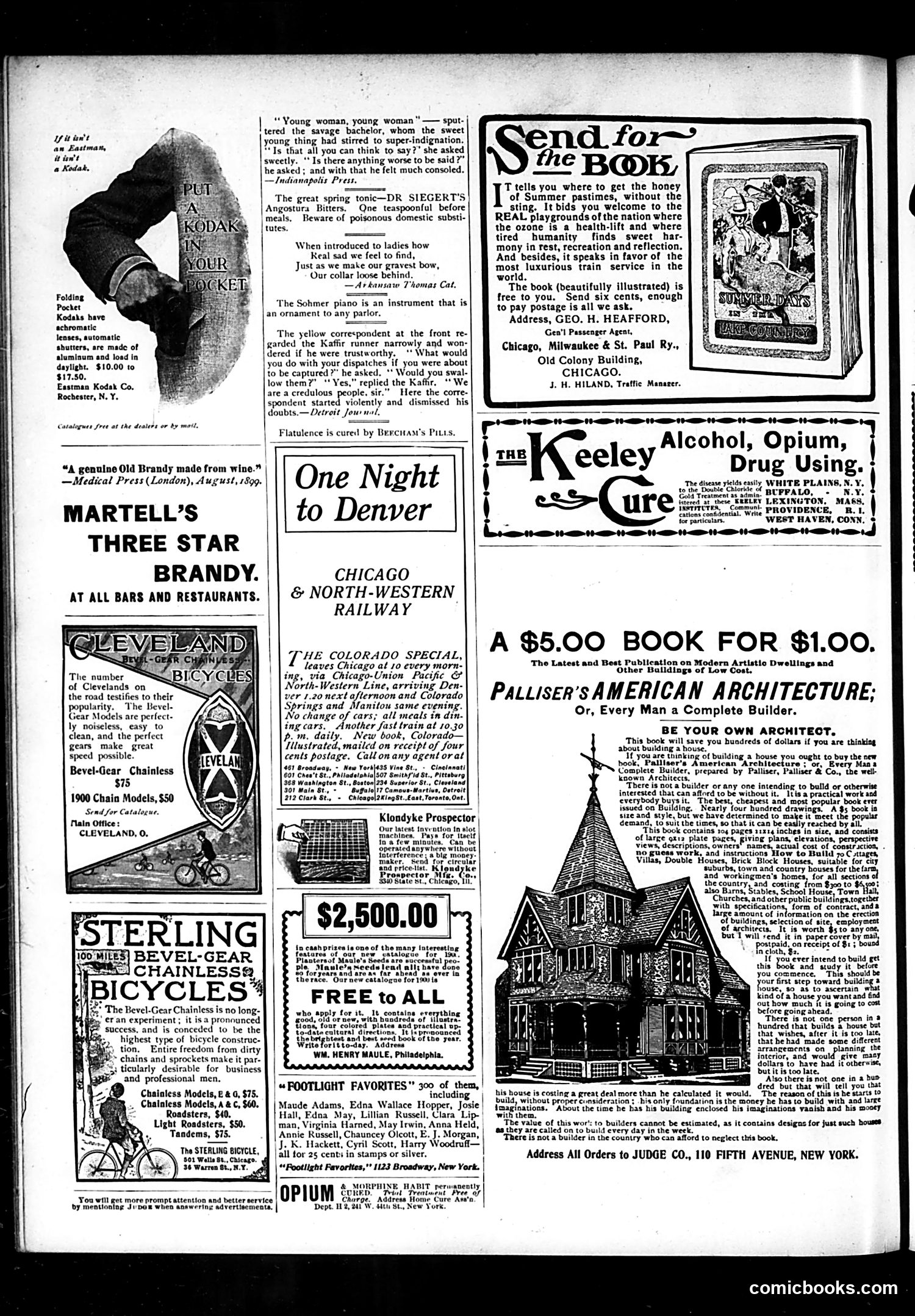
This is primarily an **advertising page**, not a satirical cartoon page. The advertisements and brief text snippets reflect late-1890s/early-1900s American consumer culture and attitudes. **Key content includes:** - **Photography equipment** (Kodak): Marketed to amateur photographers - **Bicycles** (Cleveland, Sterling): Popular transportation/leisure items of the era - **Patent medicines** (Angostura Bitters, Siegert's, Keeley Cure): Addressing various ailments with unregulated products - **Railroad service** (Chicago & North-Western Railway): "One Night to Denver" offering modern rapid travel - **Architecture book**: "Palliser's American Architecture"—enabling ordinary people to build homes with professional designs **The brief joke text** mocks relationships (the "savage bachelor") and includes a colonial-era anecdote about a Kaffir (a period term for Black Africans) courier—reflecting contemporary racial attitudes without being a formal cartoon. **Overall message:** The page showcases consumer goods and services available to American middle-class readers, reflecting optimism about technology, commerce, and modernization in this era.
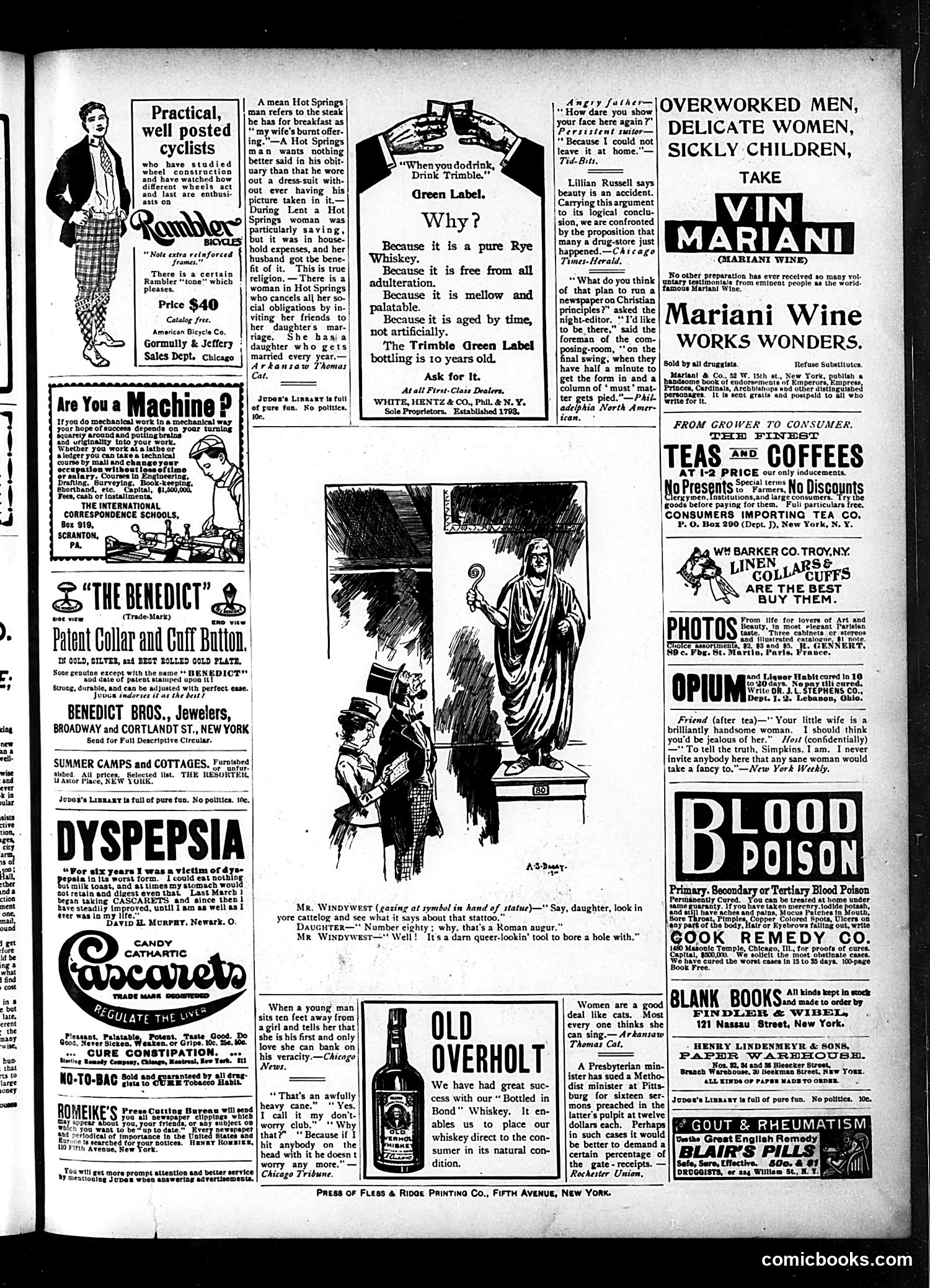
This page is primarily **advertisements and light humor** rather than political satire. The content reflects early 1900s consumer culture and social attitudes. **Key advertisements include:** - **Rambler bicycles** and cycling equipment (popular transportation/leisure) - **Mariani Wine**—marketed as a medicinal tonic for "overworked men, delicate women, sickly children" (patent medicines were common cure-alls, often containing cocaine or alcohol) - **Trimble whiskey** (spirits advertised openly) - **Correspondence schools** promoting self-improvement - **Remedies for dyspepsia** and other ailments **The humor section** features brief anecdotes from Hot Springs, Arkansas, including jokes about marriage, burnt offerings, and social obligations—mild domestic comedy typical of the era. **The central cartoon** (signature "A.S. Davy") depicts a woman with a cane confronting a man, captioned with dialogue about "Roman augur" and "queer-looking tool"—likely a visual pun, though the specific reference is unclear. The page exemplifies how early-20th-century magazines mixed editorial content with patent medicine and consumer product advertising.
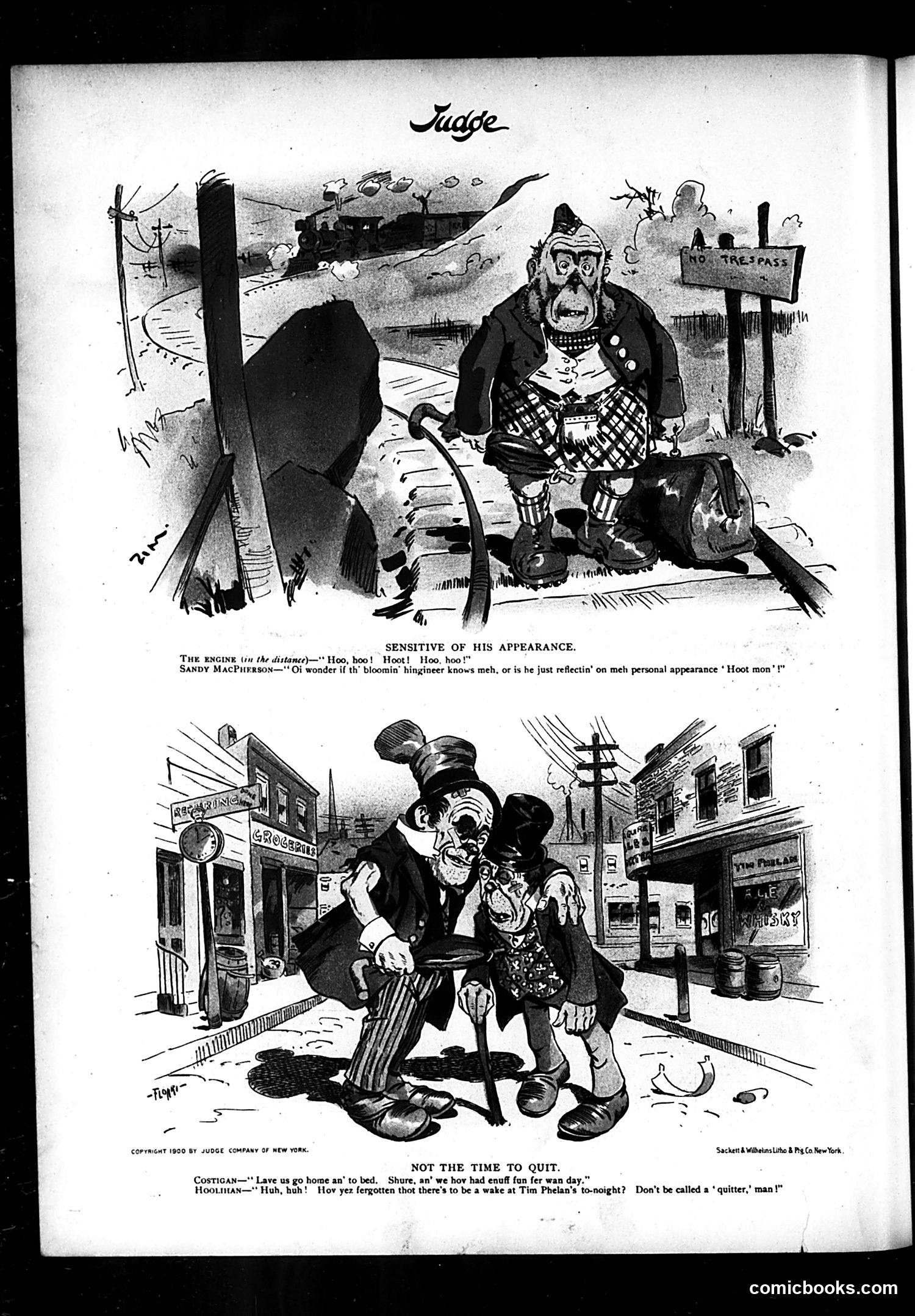
This page contains two ethnic stereotype cartoons typical of early 1900s American satire: **Top cartoon**: A Scottish character (Sandy MacPherson, identifiable by dialect and kilts) mistakes a train engine's whistle for personal mockery about his appearance. The humor relies on Scottish stereotypes and a play on the word "reflecting." **Bottom cartoon**: Two Irish characters (Costigan and Hoolihan, marked by brogue dialect and urban setting) debate going home versus attending a wake—a social obligation. The joke hinges on the shame of being called a "quitter" among Irish working-class culture, where social duty outweighs fatigue. Both cartoons use exaggerated ethnic dialects, caricatured facial features, and cultural stereotypes as comedy. They reflect Judge's reliance on immigrant and ethnic humor, common in American satirical magazines of this era, which often mocked working-class immigrant groups for entertainment.