
Judge, 1900-05-19 · page 7 of 16
Judge — May 19, 1900 — page 7: what you’re looking at
What you’re looking at
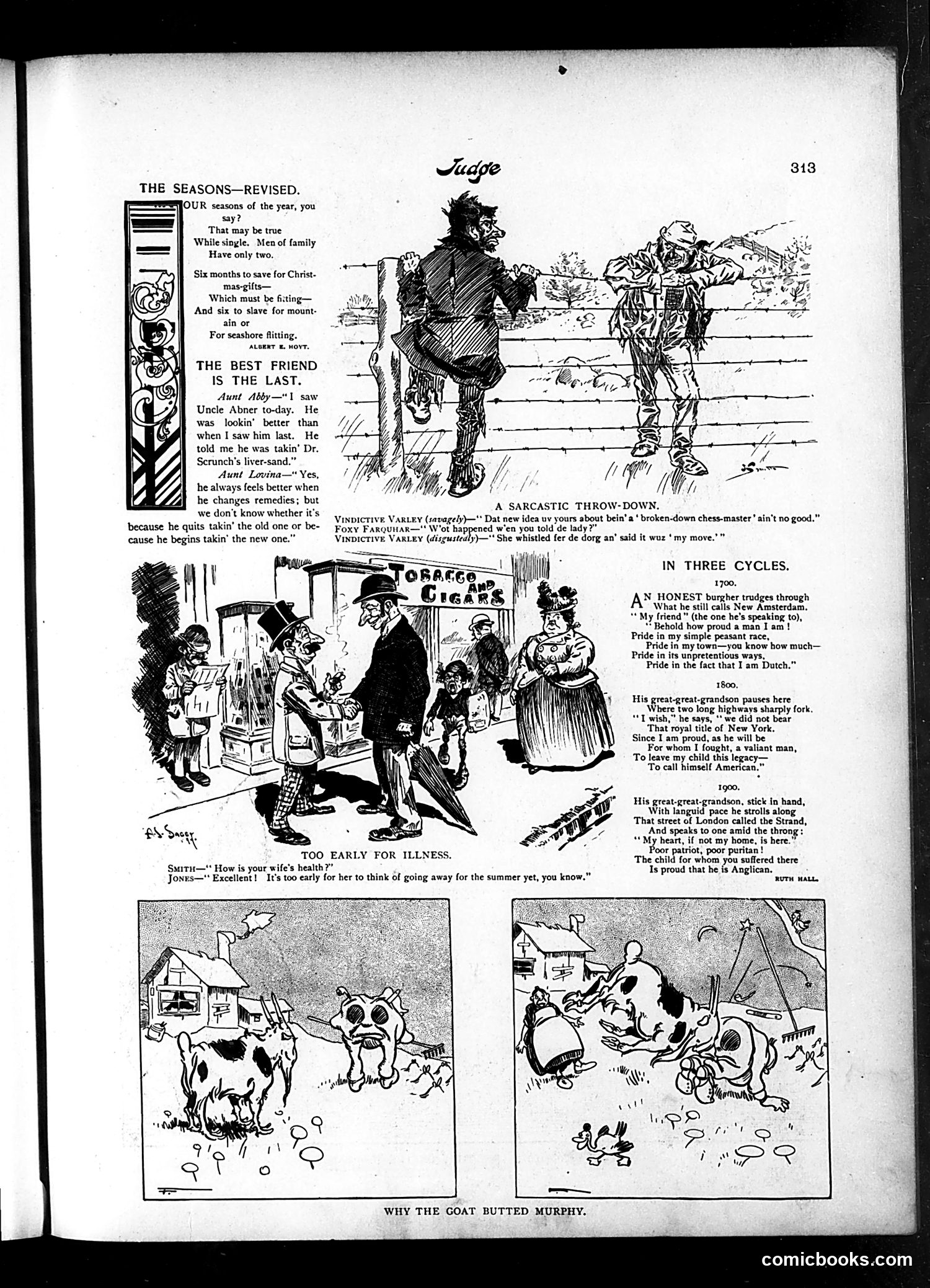
This page contains several satirical pieces targeting early 1900s American life: **"The Seasons—Revised"** jokes that married men with families only experience two seasons: Christmas shopping and vacation planning—a commentary on middle-class domestic obligations. **"The Best Friend is the Last"** satirizes patent medicine culture, where elderly men feel better switching between ineffective "liver tonics," unable to discern whether improvement comes from stopping the old medicine or starting the new. **"A Sarcastic Throw-Down"** shows a chess player's failed romantic overture—the woman's dismissive "my move" insult suggests she's unmoved by his company. **"In Three Cycles"** traces American pride across generations: 1700 celebrates Dutch heritage in New Amsterdam; 1800 shifts to American identity; 1900 reveals the great-great-grandson has become an Anglophile living in London. The satire critiques immigrant descendants who reject their heritage for perceived sophistication. The bottom section includes unrelated domestic humor cartoons. The overall page reflects Judge's typical mocking of American materialism, quackery, and social pretension.
📄 Transcribed text from this page (OCR, searchable)
Machine-transcribed from the original scan — historical spelling and the odd misread are preserved.
THE SEASONS—REVISED. OUR seasons of the year, you say? ‘That may be true While single. Men of family Have only two. Six months to save for Christ- mas-gilts— Which must be fisting— And six to slave for mount- ain or For seashore flitting. ALERT HOYT. THE BEST FRIEND IS THE LAST. Aunt Abby—"1 saw Uncle Abner to-day. He was lookin’ better than when I saw him last. He told me he was takin’ Dr. Scrunch’s liver-sand.” Aunt Lovina—" Yes, he always feels better when be care ren but A SARCASTIC THROW-DOWN. We don't know whether it's icrive VaRLEY (savagely)—"* Dat new idea uv yours about bein’ a ‘ broken-down chess-master’ ain't no good.” because he quits takin’ the old one or be- Foxy Farquitar—'* W'ot happened w'en you told de lady?” cause he begins takin’ the new one.” VINDICTIVE VARLEY (disgustedly)—" She whistled fer de dorg an’ said it wuz ‘ my move.’ IN THREE CYCLES. 1700. AN HONEST burgher tradges through What he still calis New Amsterdam, “My friend" (the one he’s speaking to), ** Behold how proud a man I am ! Pride in my simple peasant race, Pride in my town—you know how much— Pride in its unpretentious ways, Pride in the fact that I am Dutch.” 1800, His great-great-grandson pauses here Where two long highways sharply fork. “TL wish,” he says, ‘* we did not bear That royal title of New York. Since I am proud, as he will be For whom I fought, a valiant man, To leave my child this legacy— To call himself American.” 1900. His great-great-grandson, stick in hand, With languid pace he strolls along That street of London called the Strand, ‘And speaks to one amid the throng’: ; 4 “My heart, if not my home, is here.” . ‘oor patriot, poor puritan ! +) « TOO; EARLY'FOR “ILLNESS. The child for whom you suffered there How is your wife's health?” . 4 : Is proud that he is Anglican. Jonrs—" Excellent! It’s too early for her to think of going away for the summer yet, you know, RUTH WALL. WHY THE GOAT BUTTED MURPHY. comicbooks.com