
A complete issue · 16 pages · 1900
Judge — April 14, 1900
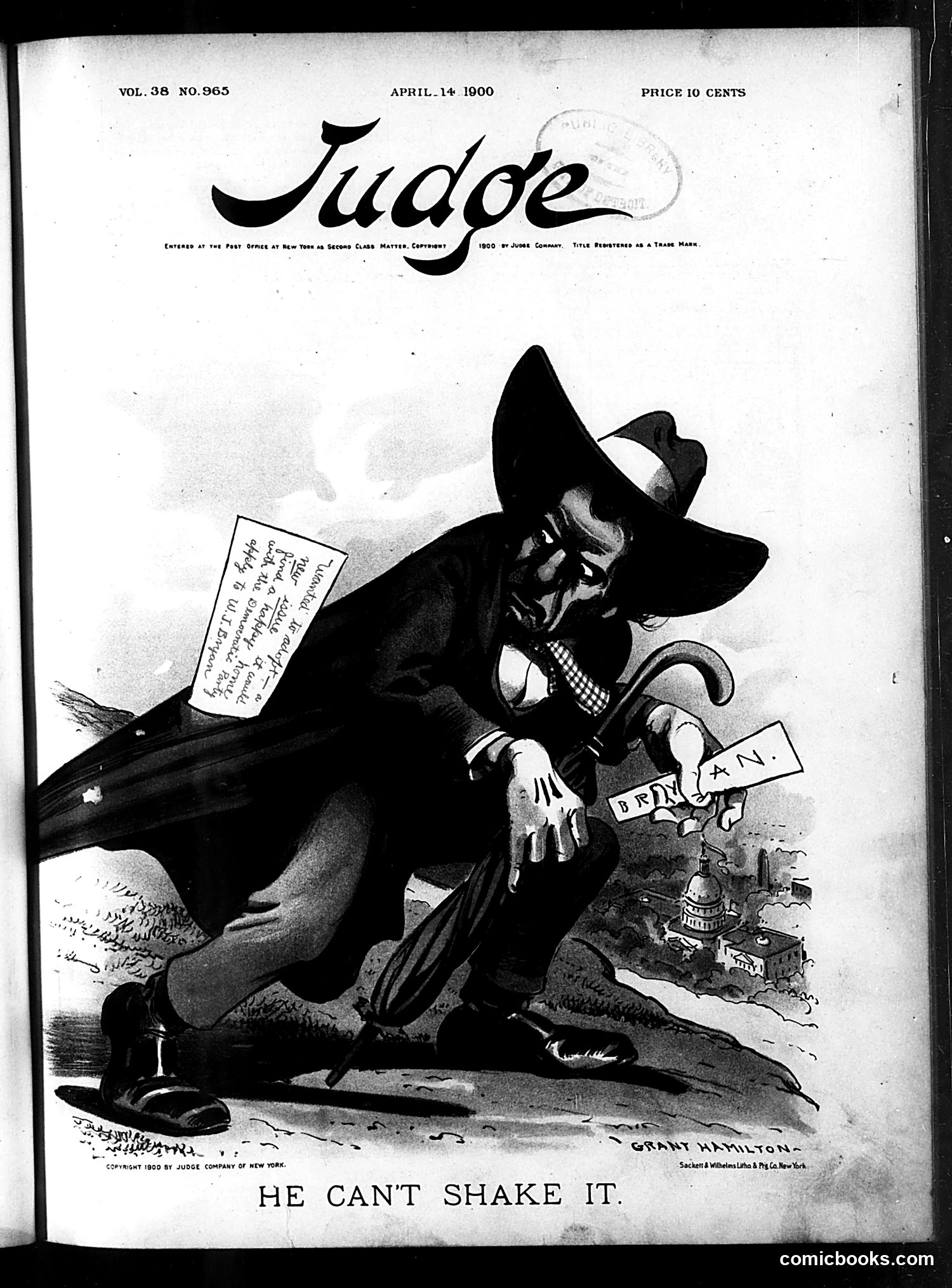
This is the cover of *Judge* magazine from April 14, 1900. The cartoon, credited to Grant Hamilton, depicts a caricatured figure in formal dress with a large nose, depicted as a devil or demon-like character. He holds papers labeled with what appears to be financial or political documents, and clings to Washington D.C. (identifiable by the Capitol building). The title "He Can't Shake It" suggests the figure cannot escape or be removed from political influence. Without clearer label visibility, the specific target is unclear—likely a political figure or financial interest the magazine viewed as parasitically attached to government. The demonic characterization and tenacious grip indicate strong editorial disapproval of whoever or whatever this represents.
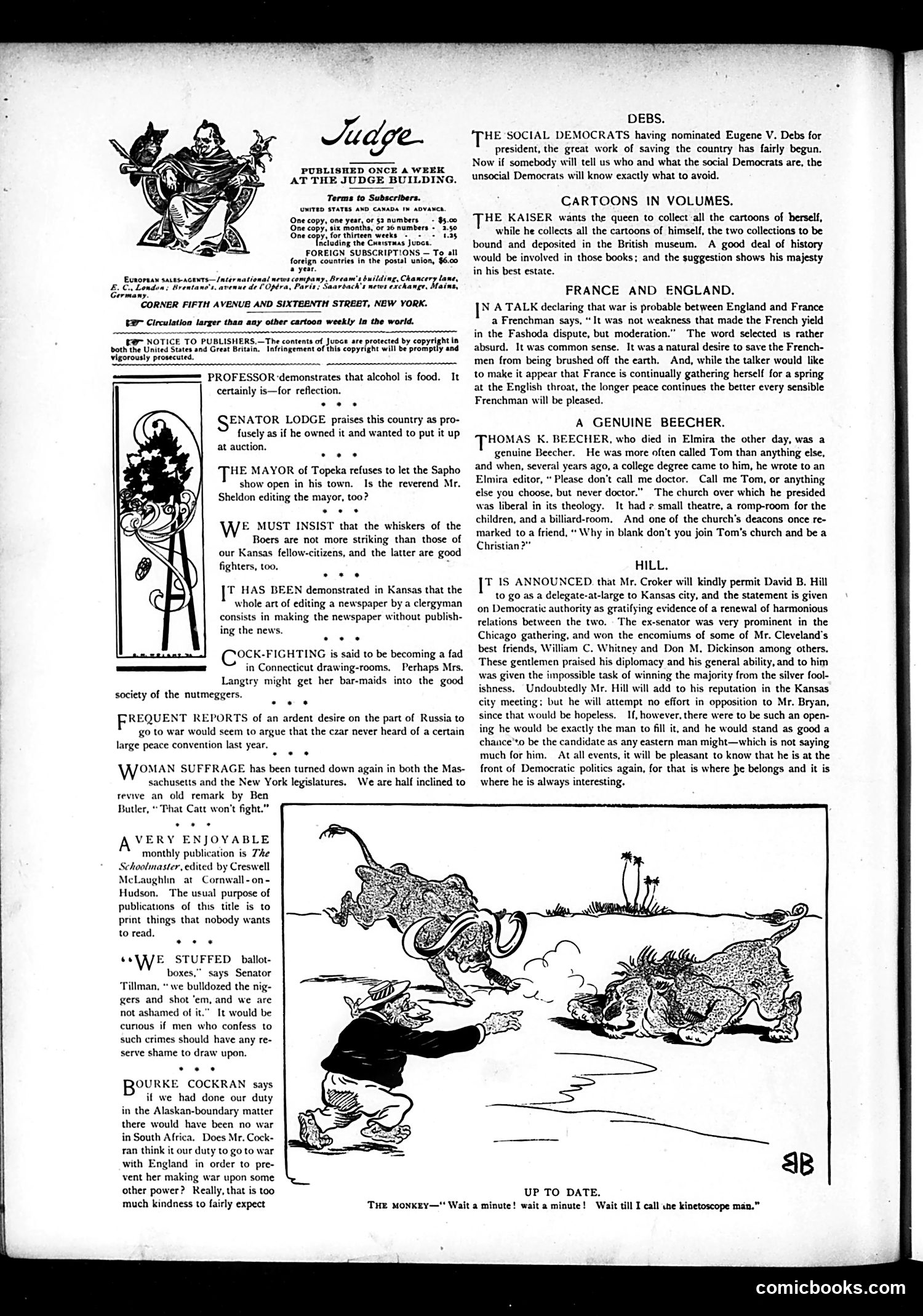
The main cartoon depicts a monkey observing two fighting animals (likely representing nations or political entities) in a desert landscape. The monkey says: "Wait a minute! wait a minute! Wait till I call up the kinetoscope man." This satirizes how modern technology—specifically the kinetoscope (an early motion picture device)—has transformed conflict into entertainment spectacle. The monkey, representing perhaps a sensationalist media figure or the general public, treats warfare or political fighting as amusing content worthy of filming rather than serious concern. The surrounding editorial content critiques Democratic politics, discusses Anglo-French relations, and comments on war preparedness, suggesting this appeared during a period of international tension and domestic political debate, likely early 1900s.
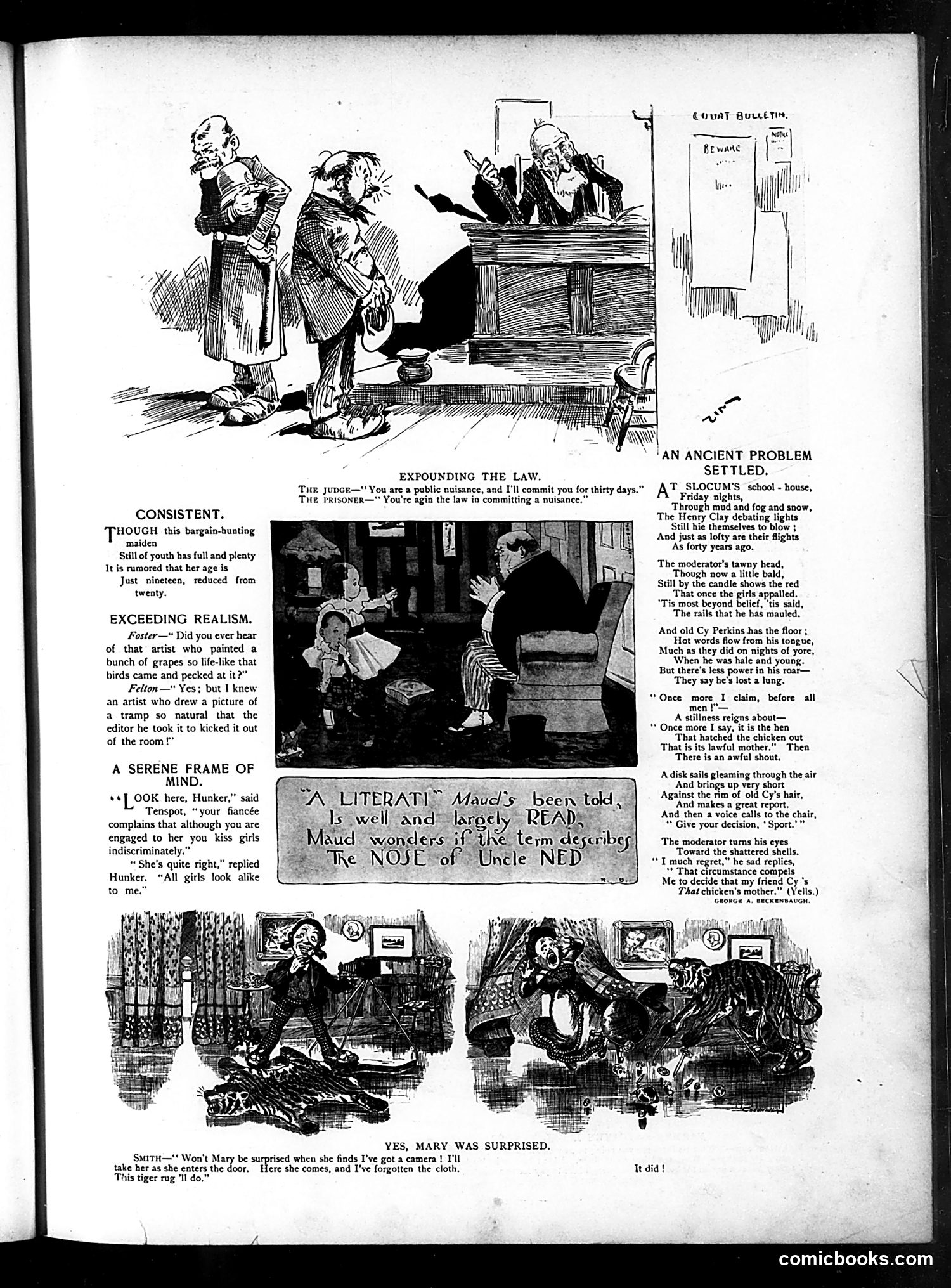
This Judge magazine page contains multiple humorous sketches and brief comedic pieces rather than a single political cartoon. The top cartoon, "Expounding the Law," shows a judge sentencing someone to thirty days for being "a public nuisance," with the prisoner sarcastically thanking him for "consulting a nuisance." It satirizes judicial pronouncements that state the obvious. Below are several short joke exchanges ("Consistent," "Exceeding Realism," "A Serene Frame of Mind") poking fun at artists, pretension, and romantic miscommunication—typical genteel humor of the era. The bottom cartoons about "Mary Was Surprised" appear to be domestic comedy sketches, likely involving a surprise (camera) and household mishap with a tiger. The overall page represents general satirical humor rather than specific political commentary, targeting Victorian-era social conventions and domestic situations familiar to Judge's educated readership.
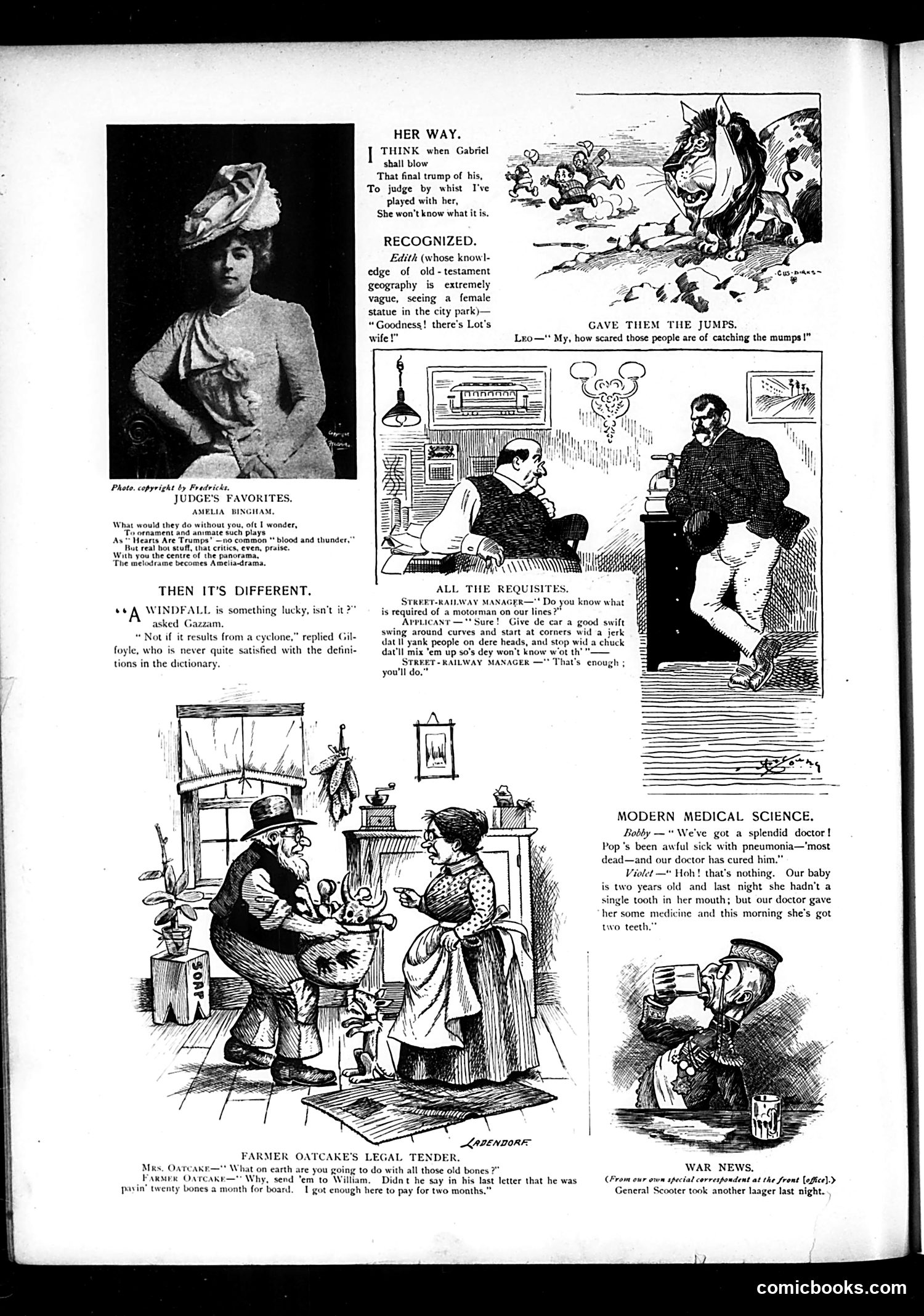
This page contains several disconnected satirical pieces typical of Judge's format: **"Her Way"** and **"Then It's Different"** appear to be literary/theatrical commentary, possibly satirizing women's writing or performance standards of the era. **"Farmer Oatcake's Legal Tender"** (bottom left) depicts a rural man discussing payment methods with a woman, likely satirizing rural/urban class differences or confusion over modern currency and banking practices. **"Modern Medical Science"** mocks contemporary medicine through dialogue about a doctor treating pneumonia and a baby's tooth growth—suggesting skepticism toward period medical claims. **"War News"** references General Scooter in some military context, unclear without additional historical documentation. The page emphasizes class humor, rural stereotypes, and skepticism toward modern institutions—typical Judge satire from the early 20th century.
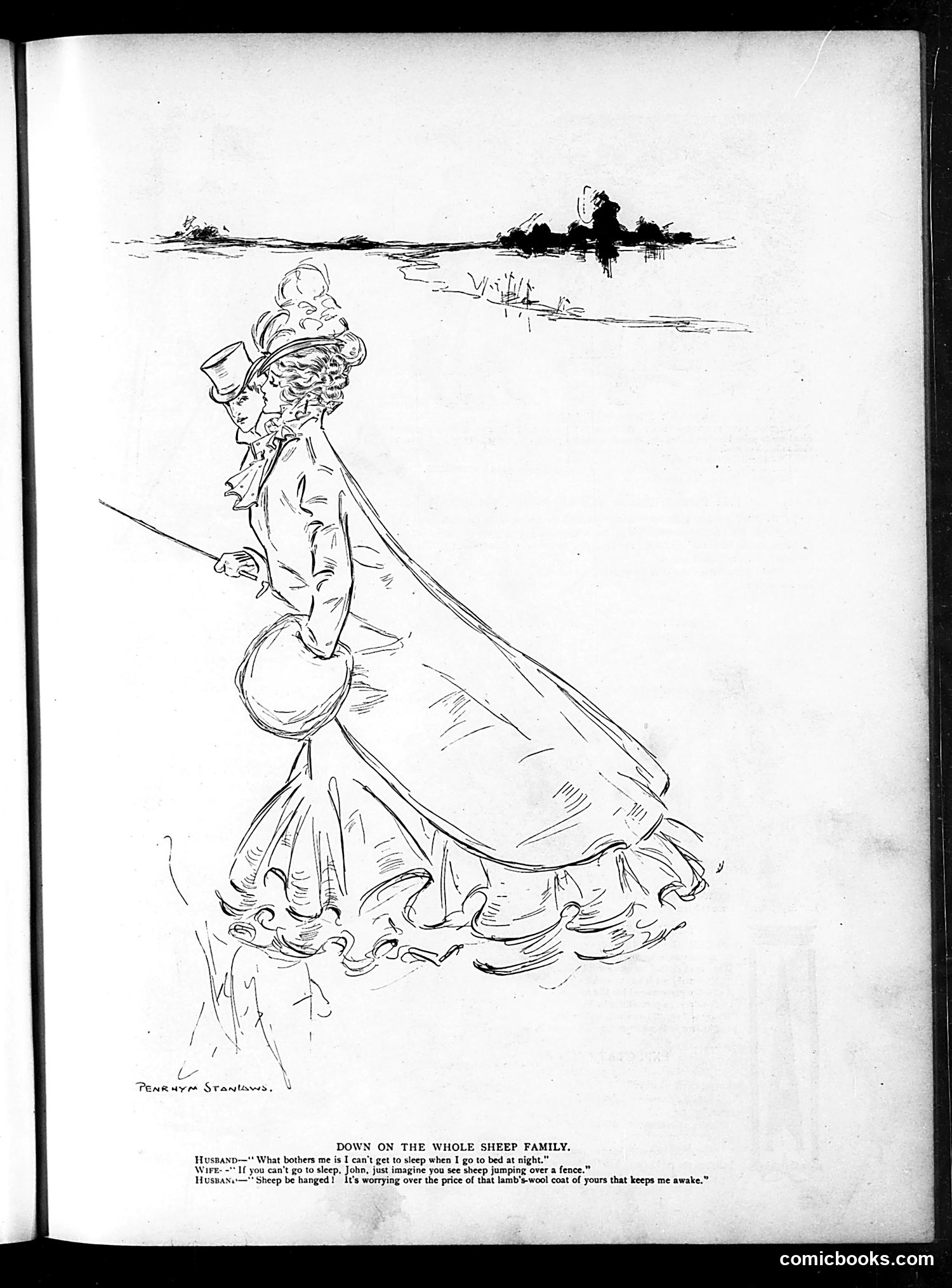
This cartoon satirizes domestic anxiety over household expenses, specifically women's fashion costs. A husband complains he can't sleep; his wife offers the traditional remedy of counting sheep. He responds that he's actually kept awake worrying about the price of *her* lamb's-wool coat. The satire targets the tension between husbands concerned about finances and wives' spending on luxury goods—a common theme in early 20th-century humor. The irony is that the cure for insomnia (sheep) directly relates to his worry (sheep's wool products). The cartoon critiques both frivolous female consumption and the economic pressures on working-class or middle-class families during what appears to be a period of inflation or economic concern (the exact date is unclear from the page). The sketch style is typical of Judge magazine's satirical illustrations.
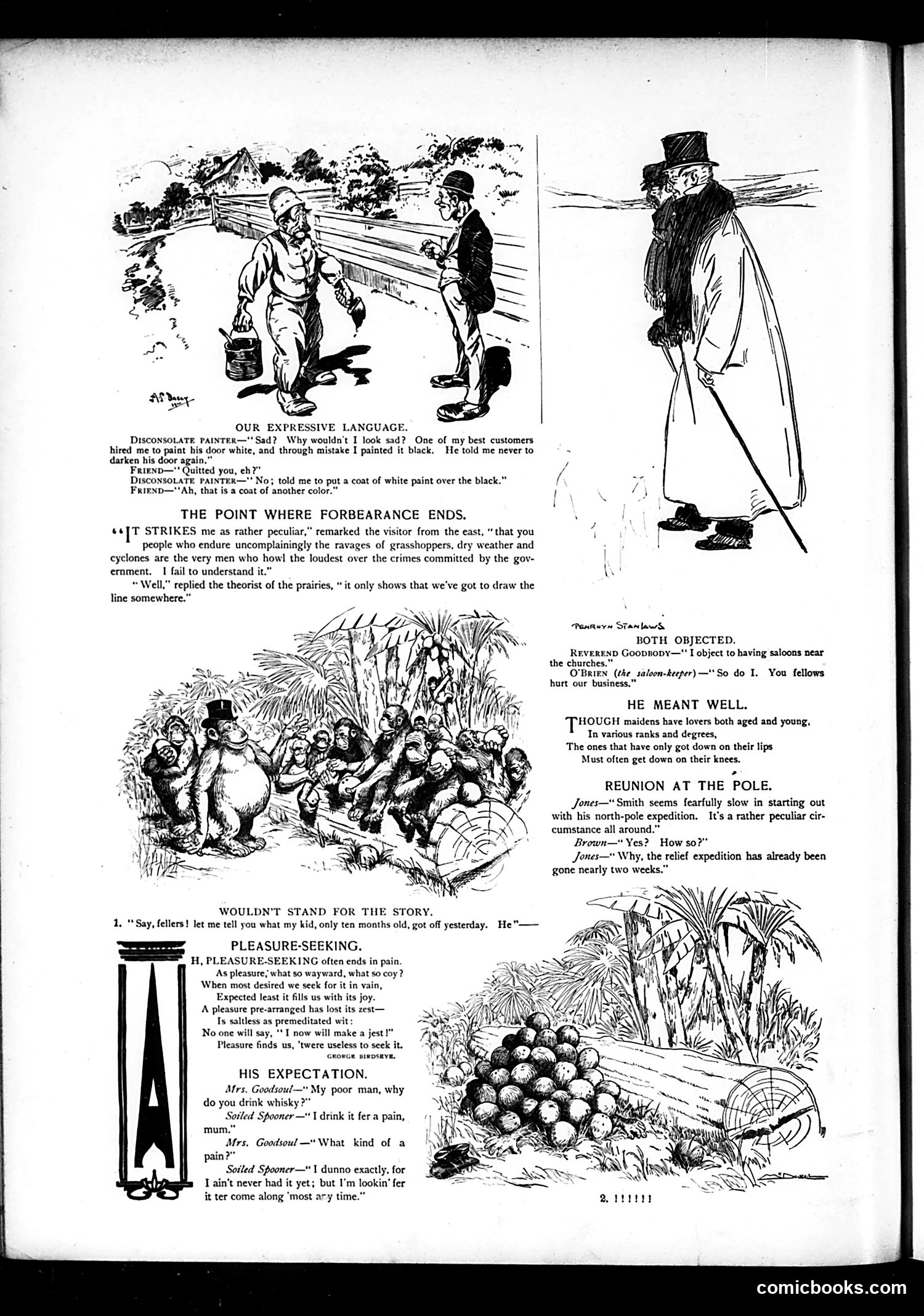
This page contains several satirical humor pieces typical of Judge magazine's social commentary: **"Our Expressive Language"** plays on the idiom "darken one's door" (meaning to visit unwelcome). A painter who mistakes a door color receives orders never to "darken his door again"—then is told to paint it white, prompting the pun "that is a coat of another color" (meaning a different matter entirely). **"The Point Where Forbearance Ends"** satirizes frontier settlers' selective outrage: they endure natural disasters (grasshoppers, drought, cyclones) without complaint but rage against government corruption. The joke critiques their inconsistent standards of what's tolerable. **"Both Objected"** presents ironic agreement between a reverend opposing saloons near churches and a saloon keeper opposing them—both for selfish reasons (morality vs. business). The remaining pieces are light humor about courtship, Arctic expeditions, exaggerated baby stories, and a drunk's reasoning about drinking "whisky" preemptively for anticipated pain. The page demonstrates Judge's mix of political/social satire with genteel Victorian-era humor.
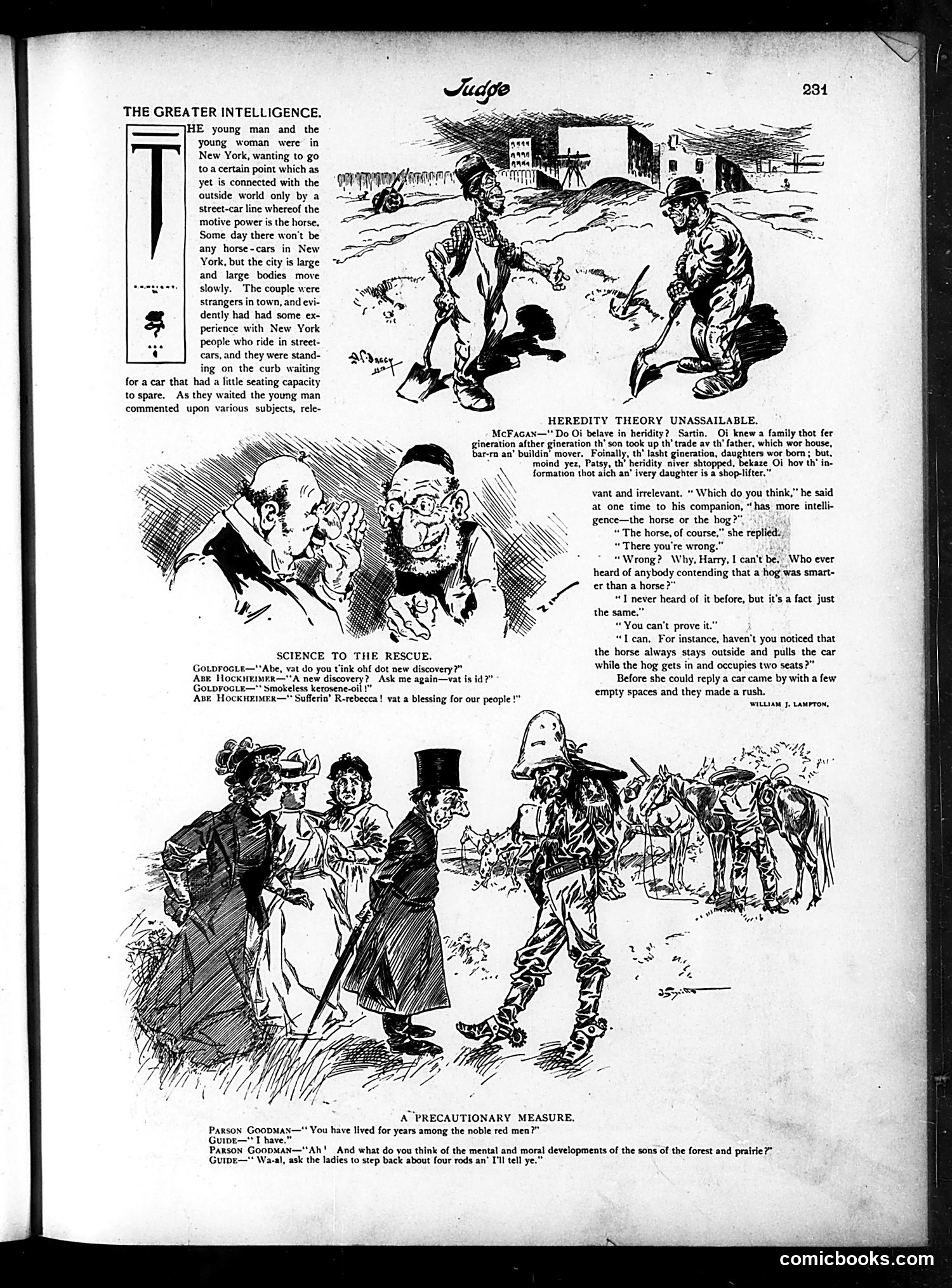
This page contains three satirical sketches typical of early-20th-century Judge magazine: **"The Greater Intelligence"** mocks a young couple's debate about whether horses or hogs are smarter. The joke's punchline—that hogs are cleverer because they occupy two seats on crowded streetcars while horses stay outside—is absurdist humor playing on urban transit frustrations. **"Heredity Theory Unassailable"** features Irish-immigrant character McFagan (identified by dialect spelling) making a crude joke: he argues heredity is real because criminal behavior runs in families, claiming the latest generation of daughters are all shoplifters. It's ethnic humor relying on offensive Irish stereotypes. **"Science to the Rescue"** and **"A Precautionary Measure"** use Yiddish-dialect characters (Goldfogle, Hochheimer) and a guide character to deliver punchlines about foolish "discoveries" and Native Americans respectively. These sketches reflect Judge's reliance on ethnic caricature and dialect humor—now considered offensive—as primary comedic vehicles for early-1900s audiences.
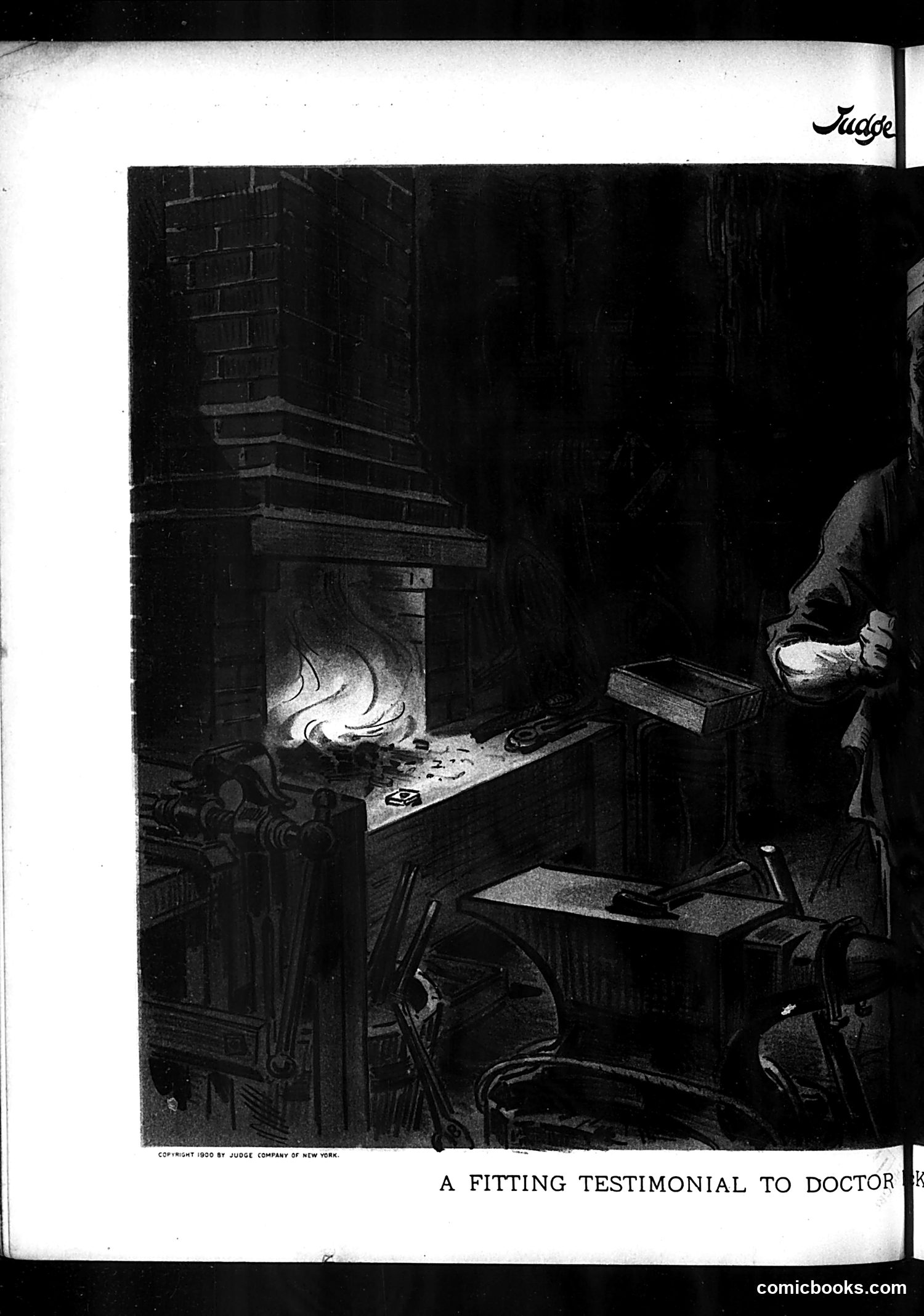
This appears to be a Judge magazine illustration (copyright 1920) depicting a doctor's office scene. A figure on the right holds what looks like a book or document, standing near a desk with papers. A fireplace glows warmly in the background, suggesting a comfortable professional setting. The caption "A Fitting Testimonial to Doctor" suggests this satirizes the practice of doctors receiving testimonials or endorsements from grateful patients. The exact identity of the doctor being referenced is unclear from the visible text, but the illustration appears to be commenting ironically on medical credibility or the value of patient testimonials as proof of a doctor's competence—a practice Judge's satirical tradition would likely mock. The specific historical medical or social context remains unclear without additional information.
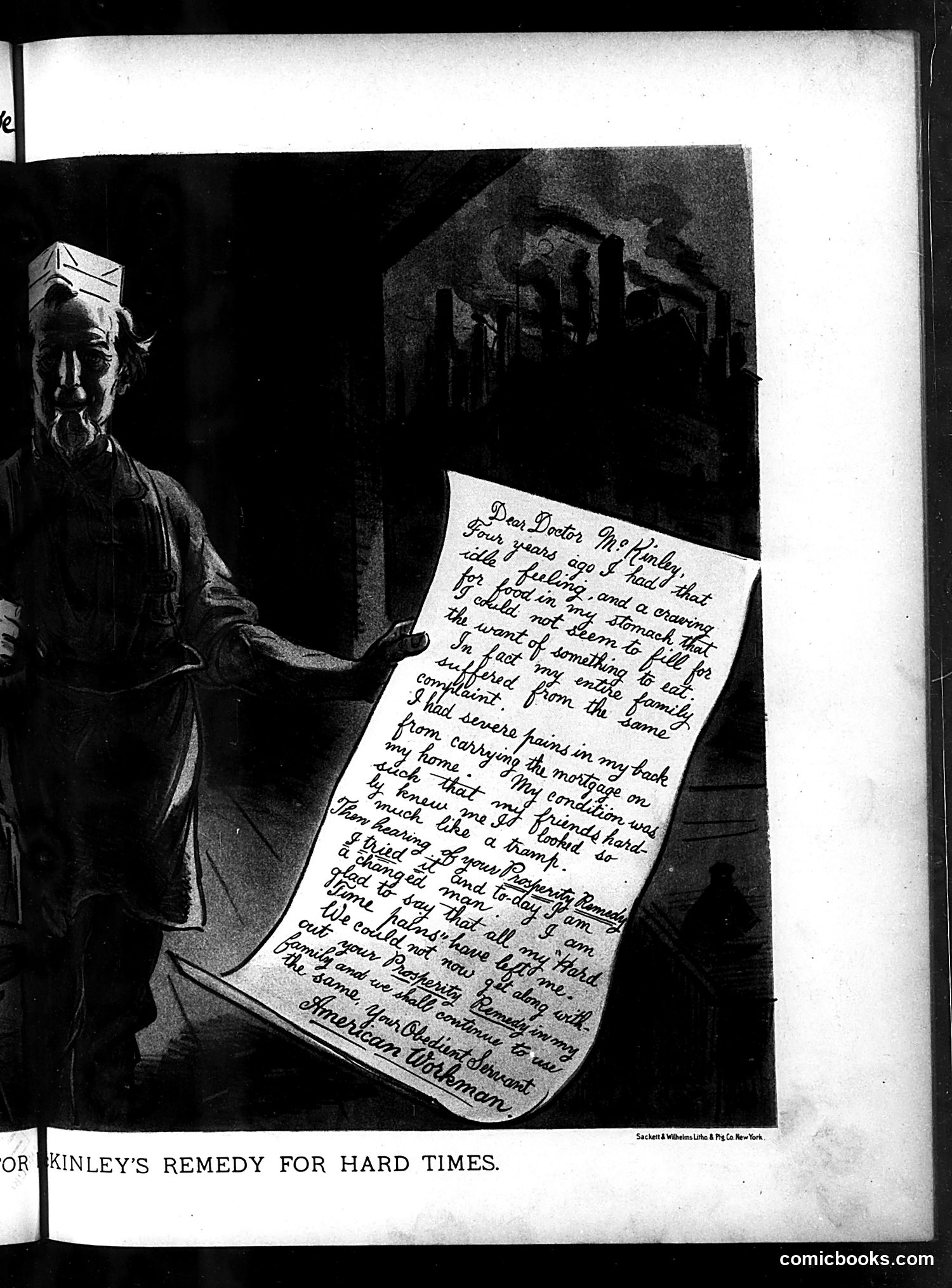
This is a political cartoon satirizing President William McKinley's response to economic hardship. The figure on the left, wearing a doctor's cap, represents McKinley as a physician offering a "remedy" for hard times. He displays a lengthy handwritten prescription or letter—likely representing his proposed economic policies or legislation. The satire suggests McKinley's solutions were merely words on paper rather than effective action. The dramatic, somewhat grotesque rendering of the figure and the emphasized document imply skepticism about whether his policies would actually help ordinary Americans suffering economically. This likely references economic conditions during McKinley's presidency (1897-1901) and critiques the gap between political promises and real relief for working people facing financial distress.
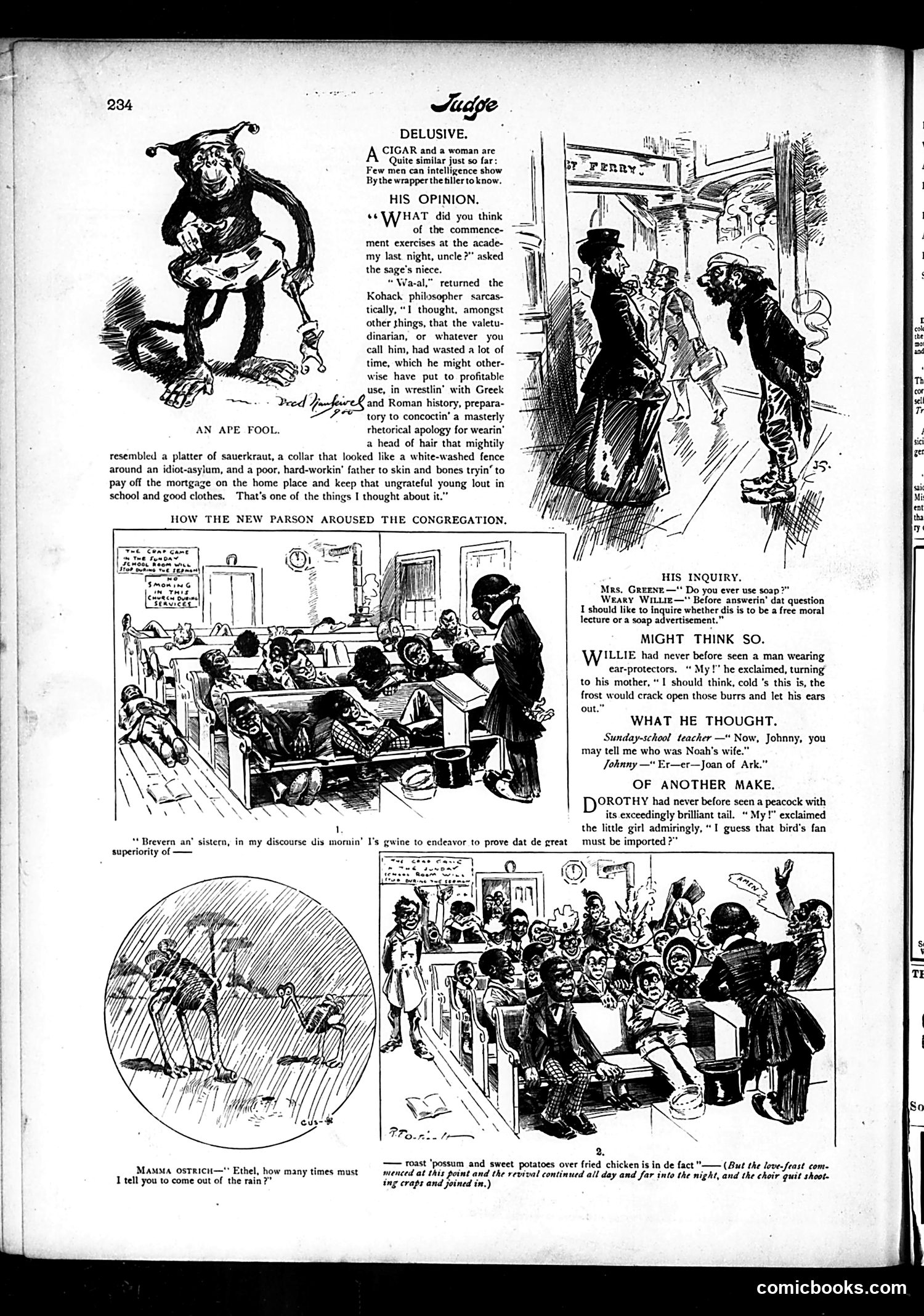
This page presents multiple satirical vignettes typical of Judge's humor: **"Delusive"** opens with a cynical comparison: cigars and women are alike because men judge both by appearance rather than substance—the "wrapper" deceives. **"His Opinion"** features a curmudgeonly character (likely an immigrant, suggested by dialect) sarcastically criticizing a graduation speech. He mocks the valedictorian's flowery rhetoric about Greek and Roman history while overlooking the real sacrifice—a poor father working himself to death paying for his ungrateful son's education. The satire targets pretentious academic speeches that ignore economic reality. **Other brief jokes** mock children's innocent misunderstandings ("Joan of Ark" for Noah's wife) and naive wonderment at unfamiliar things (ear-protectors, peacock feathers). **"How the New Parson Aroused the Congregation"** satirizes a minister whose sermon about "possum versus fried chicken" accidentally triggers a revival that descends into gambling and chaos—mocking both rural religious fervor and the hypocrisy beneath it. The overall tone is cynical, class-conscious commentary on American life, education, religion, and human nature.
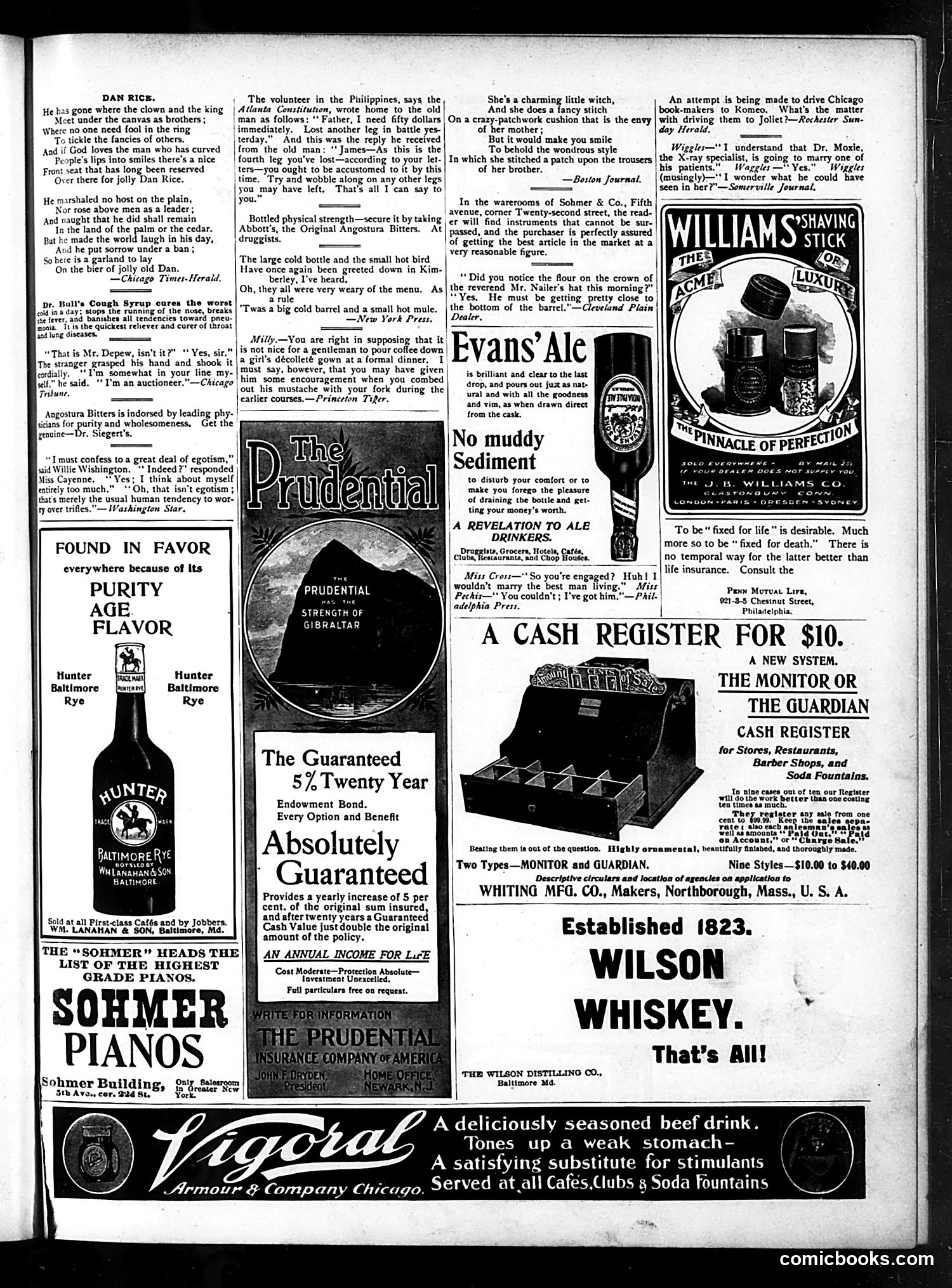
This page is primarily **advertising**, with minimal satirical content. The main feature is a tribute poem to **Dan Rice**, a famous 19th-century circus clown who has recently died. The poem, from the *Chicago Times-Herald*, celebrates Rice as an entertainer who brought joy to ordinary people—contrasting his humble legacy with those of military leaders and monuments. The page contains numerous period advertisements (Hunter Baltimore Rye whiskey, Sohmer Pianos, Prudential Insurance, Evans' Ale, Wilson Whiskey) and brief humorous snippets typical of *Judge*'s format, including jokes about courtship, military mishaps in the Philippines, and social etiquette. These snippets lack specific satirical targets and serve mainly as filler between ads. The **political reference** appears oblique: the Philippines mention reflects the ongoing American colonial campaign (early 1900s), presented here humorously rather than critically.
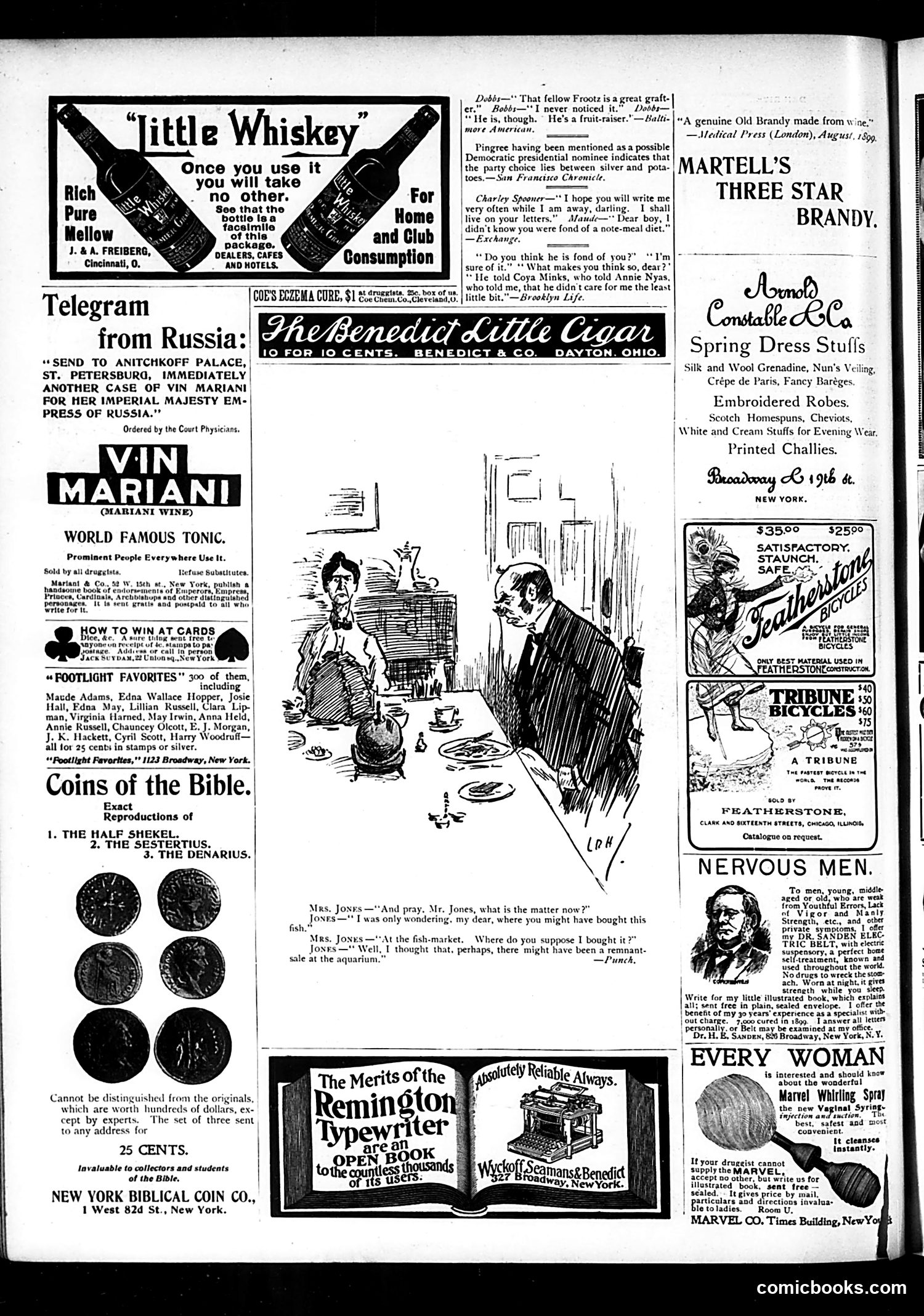
This page is primarily **advertising**, with minimal editorial cartoon content. The notable cartoon shows **Mrs. Jones and Mr. Jones** at a fish market, where Jones makes a sarcastic joke suggesting his wife bought their fish at a "remnant-sale at the aquarium"—implying the fish is stale or defective. The humor is domestic/marital, not political. The page's real significance lies in its **advertisements**, which reveal late 19th-century attitudes and claims: - **Vin Mariani** (cocaine wine) is advertised as endorsed by the Russian Empress and "prominent people"—legal then, shocking now - **Nervous Men** ads hawking electric belts for sexual dysfunction ("Youthful Errors") - **Coe's Eczema Cure** and various patent medicines with dubious efficacy claims - **Martell's Brandy** marketed as medicinal These ads reflect an era before FDA regulation, when substances like cocaine were openly sold as tonics, and pseudoscientific "cures" flourished without scrutiny.
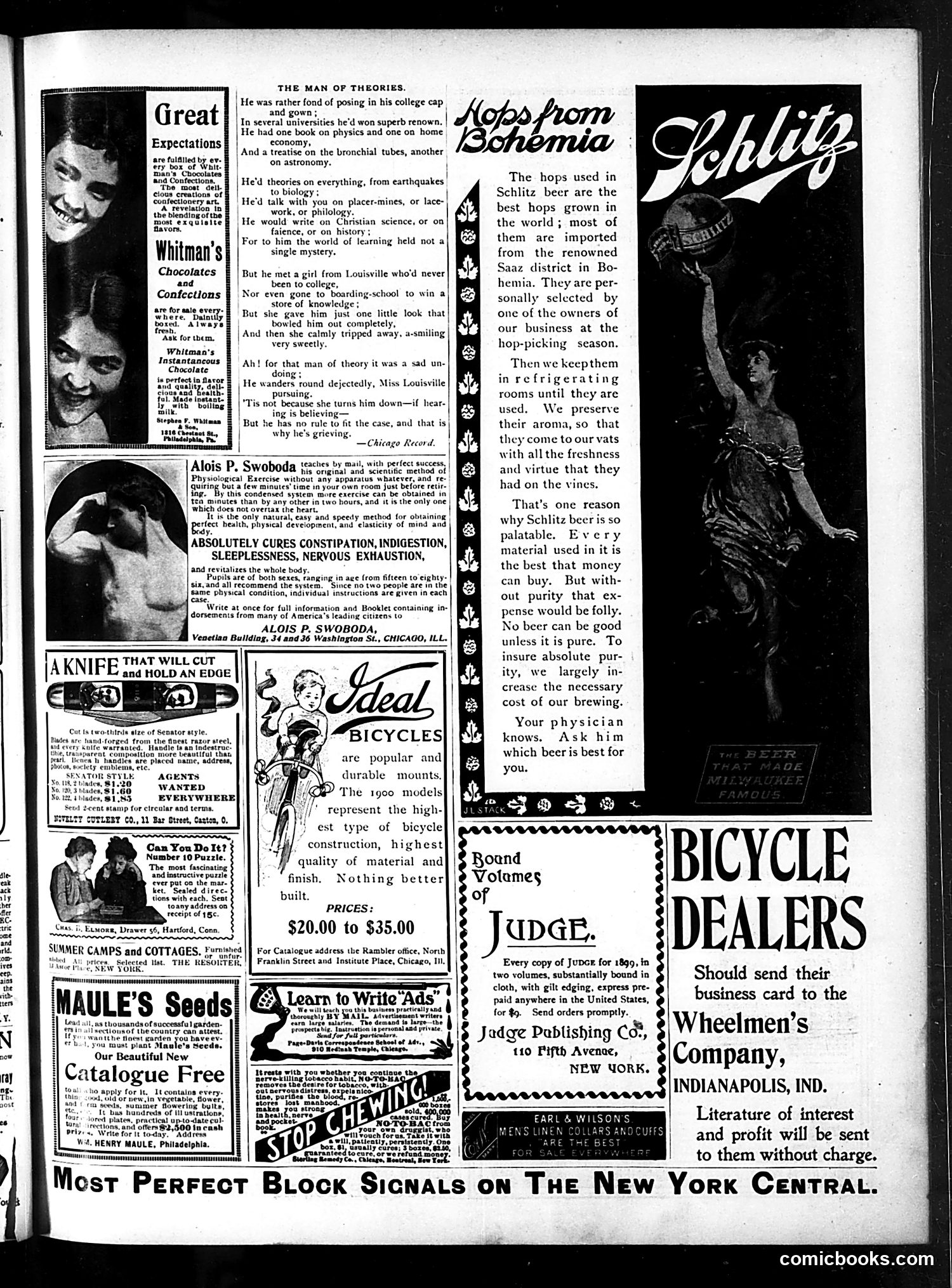
This satirical poem mocks an overeducated pedant—a college professor type who has authored treatises on physics, astronomy, bronchial tubes, and numerous other subjects. He considers himself an authority on everything from earthquakes to Christian Science. The joke: This man of elaborate theories and academic credentials is completely undone by a simple, uneducated girl from Louisville. She needs no boarding school, possesses no "store of knowledge," yet captivates him entirely with a single look. The satire targets late-19th-century academic pomposity and the pretense of universal expertise. The irony is that his elaborate theoretical framework fails him completely in real life—he "has no rule to fit the case" of love and human connection. His grief stems not from rejection but from lacking a theory to explain his predicament. The message: Common sense and genuine human feeling trump academic pretension. The illustration likely shows this befuddled theorist, though details are unclear in the reproduction.
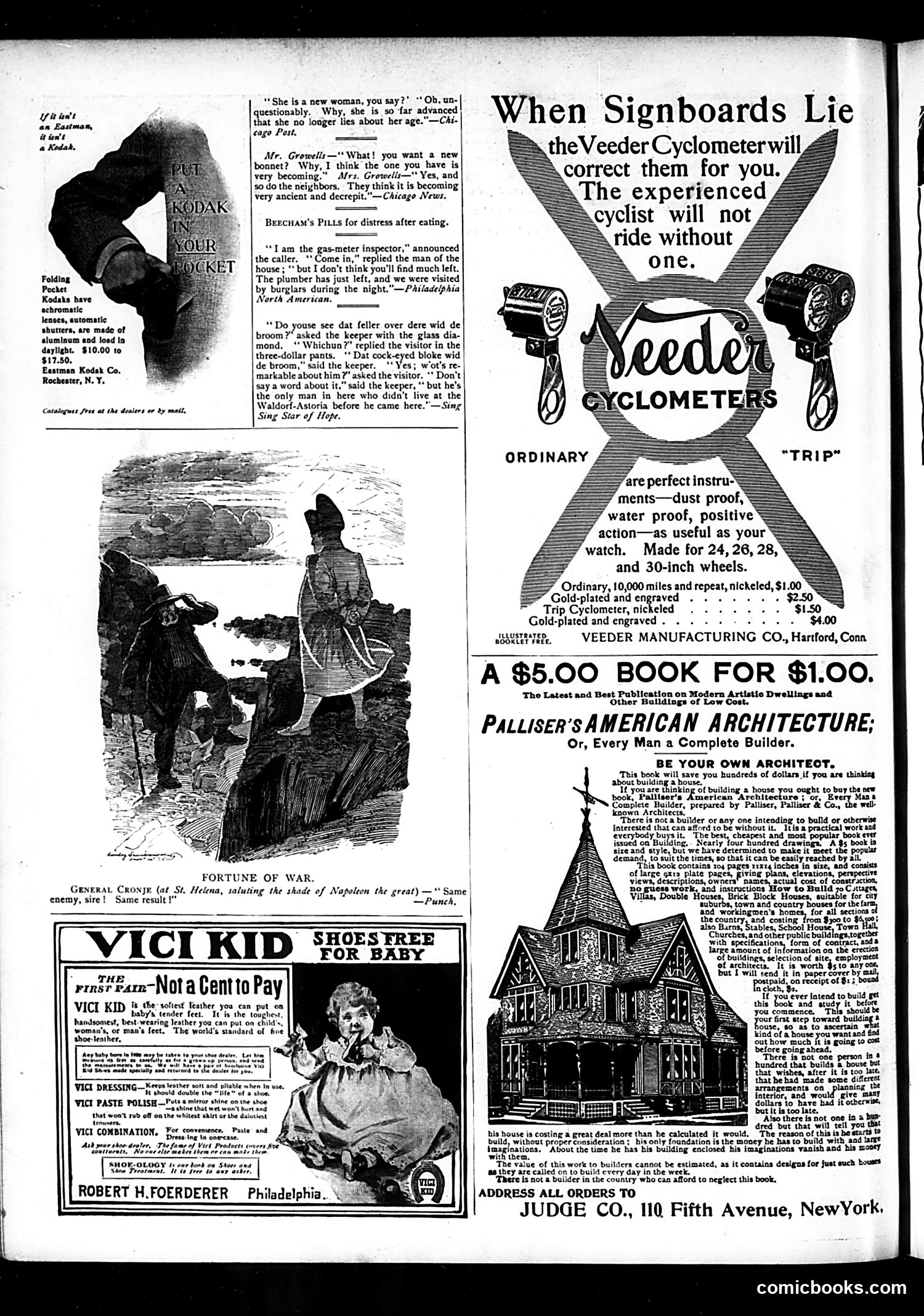
This page mixes satirical content with period advertisements, typical of Judge magazine's format. ## Cartoons/Satire: **"Fortune of War"** (bottom left): A political cartoon depicting General Cronje (Boer War figure) saluting Napoleon's ghost, sardonically suggesting identical military defeats—commentary on the ongoing Second Boer War and inevitable colonial conflicts. **Humor pieces** (top): Short jokes about "new women" (emerging feminism), including one mocking a woman's infidelity and another about a tenement dweller visited sequentially by a gas inspector, plumber, and burglars—social satire about urban poverty and overlapping indignities. ## Advertisements: The page is dominated by product ads: Kodak cameras, Veeder cyclometers (bicycle odometers), Vici Kid shoes, Beecham's Pills, and a mail-order architecture book. These reflect early 1900s consumer culture targeting middle-class readers. **Context**: The page captures Judge's blend of sharp social commentary with commercialism, aimed at educated urban audiences during the Progressive Era.
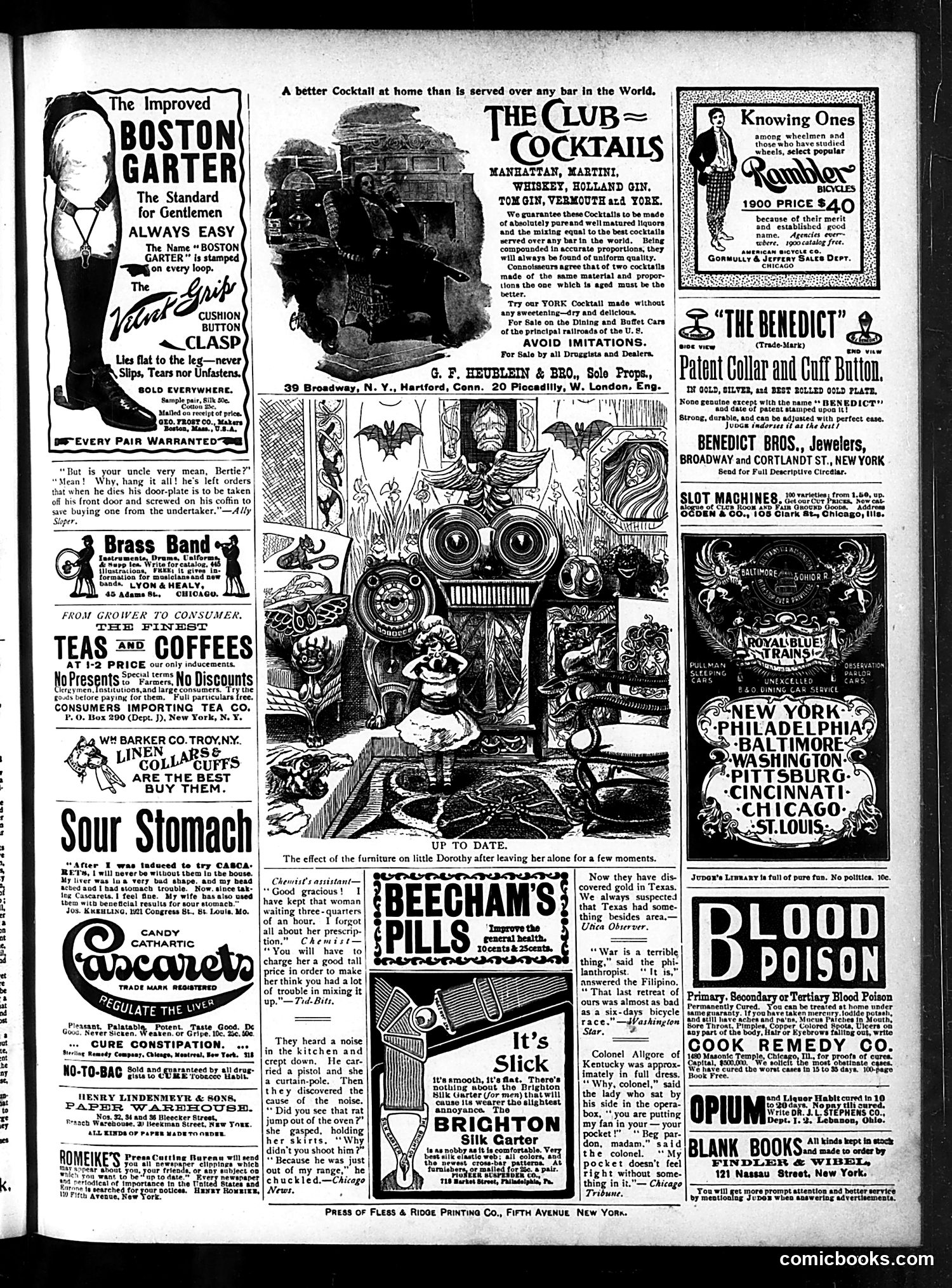
This page from *Judge* magazine (circa 1900, based on bicycle and transportation references) is primarily **advertising with minimal editorial cartoon content**. The central illustration labeled "UP TO DATE" appears to be a humorous domestic scene showing a child among overturned furniture—likely a visual joke about parenting or household chaos, though the joke's specifics aren't entirely clear without fuller context. The advertisements reveal period concerns: **medical remedies for syphilis** ("Blood Poison"), digestive aids ("Sour Stomach"), and patent medicines claiming to treat venereal disease. The cocktail ads and garter advertisements reflect gentlemen's consumer goods. The only clearly satirical element is the brief "Bertie" joke mocking miserly uncles—cheap humor about inheritance and funeral costs. The page largely documents **early 1900s consumer culture and medical anxiety** rather than political satire. The "Texas gold" brief joke appears to mock Texas's actual economic struggles.
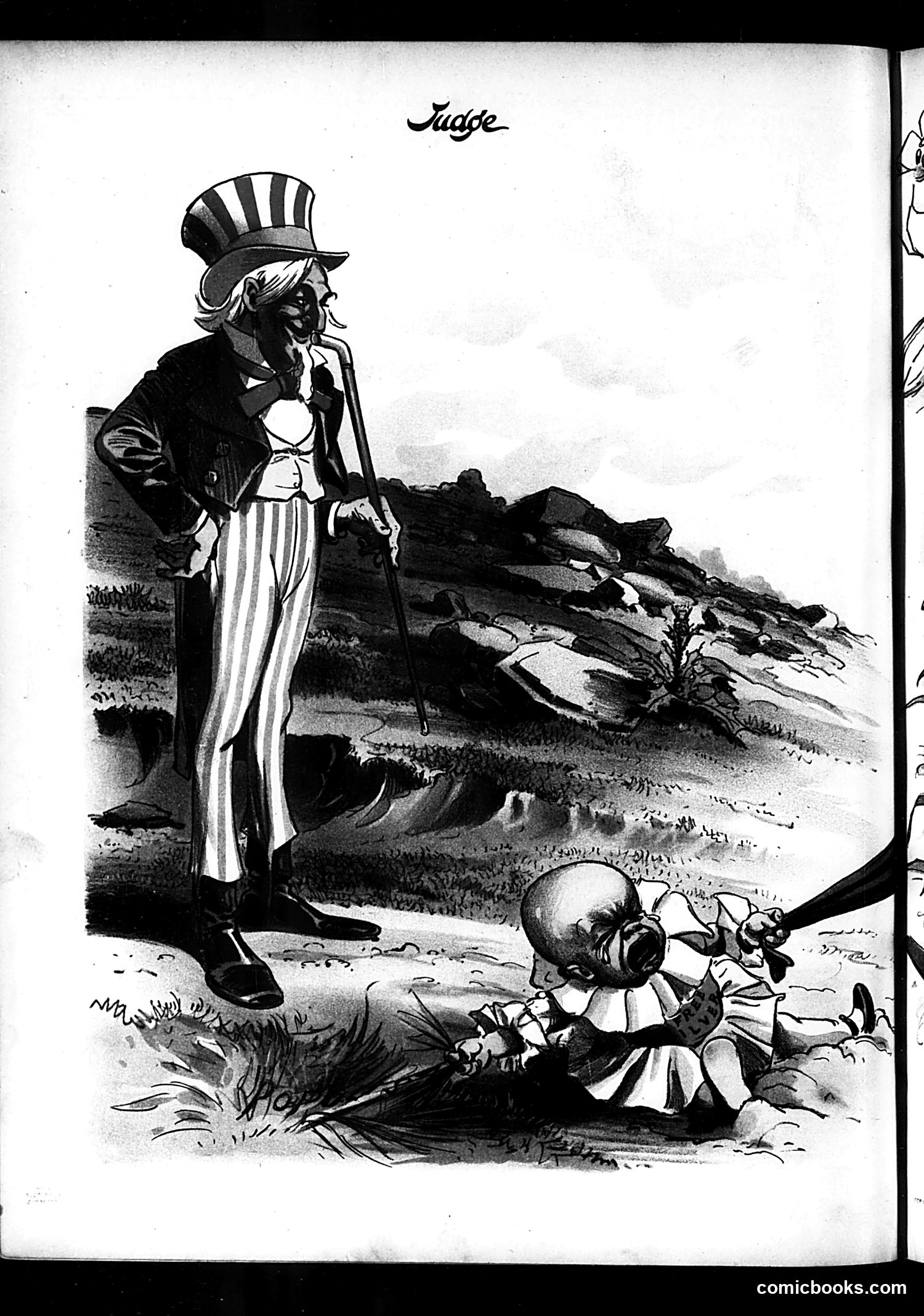
This political cartoon titled "Judge" depicts Uncle Sam (identifiable by his distinctive striped pants, top hat, and goatee) standing over a prostrate figure in classical dress. The fallen figure appears to represent a nation or political entity, possibly in the context of American imperialism or foreign policy. The cartoon satirizes America's international power and influence, likely from the late 19th or early 20th century when Judge magazine frequently critiqued American expansionism. Uncle Sam's dominant posture suggests military or political conquest, while the classical dress of the defeated figure may reference European powers or established world order being challenged by American might. Without the specific publication date visible, precise historical context remains unclear.