
Judge, 1900-04-14 · page 6 of 16
Judge — April 14, 1900 — page 6: what you’re looking at
What you’re looking at
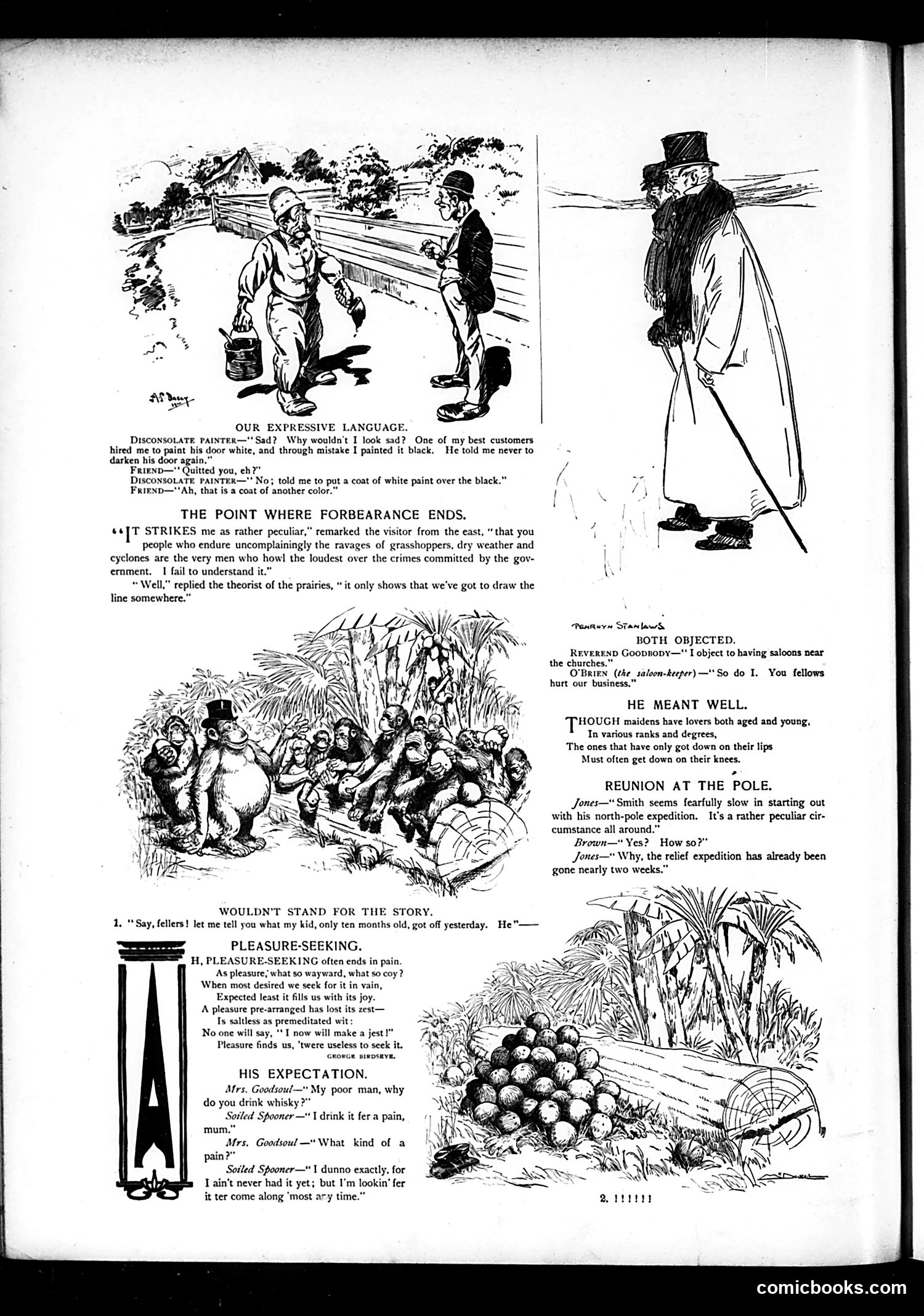
This page contains several satirical humor pieces typical of Judge magazine's social commentary: **"Our Expressive Language"** plays on the idiom "darken one's door" (meaning to visit unwelcome). A painter who mistakes a door color receives orders never to "darken his door again"—then is told to paint it white, prompting the pun "that is a coat of another color" (meaning a different matter entirely). **"The Point Where Forbearance Ends"** satirizes frontier settlers' selective outrage: they endure natural disasters (grasshoppers, drought, cyclones) without complaint but rage against government corruption. The joke critiques their inconsistent standards of what's tolerable. **"Both Objected"** presents ironic agreement between a reverend opposing saloons near churches and a saloon keeper opposing them—both for selfish reasons (morality vs. business). The remaining pieces are light humor about courtship, Arctic expeditions, exaggerated baby stories, and a drunk's reasoning about drinking "whisky" preemptively for anticipated pain. The page demonstrates Judge's mix of political/social satire with genteel Victorian-era humor.
📄 Transcribed text from this page (OCR, searchable)
Machine-transcribed from the original scan — historical spelling and the odd misread are preserved.
OUR EXPRESSIVE LANGUAGE. DISCONSOLATE PAINTER—‘‘Sad? Why wouldn't I look sad? One of my best customers hired me to paint his door white, and through mistake I painted it black. He told me never to . darken his door again.” j FrignpD—"‘ Quitted you, eb?" / DiscoNsOLATE PAINTER—"' No; told me to put a coat of white paint over the black.” { Frienp—''Ah, that is a coat of another color.” THE POINT WHERE FORBEARANCE ENDS. ‘ s4]T STRIKES me as rather peculiar,” remarked the visitor from the east, “that you people who endure uncomplainingly the ravages of grasshoppers, dry weather and cyclones are the very men who howl the loudest over the crimes committed by the gov- ernment. I fail to understand it.” “Well,” replied the theorist of the prairies, “ it only shows that we've got to draw the line somewhere.” Pennurn STan laws BOTH OBJECTED. REVEREND Goopropy—"' I object to having saloons near the churches.” O'BRIEN (the saloon-keeper)—" So do 1. You fellows hurt our business,” HE MEANT WELL. THOUGH maidens have lovers both aged and young, In various ranks and degrees, ‘The ones that have only got down on their lips Must often get down on their knees. REUNION AT THE POLE. Jones— Smith seems fearfully slow in starting out with his north-pole expedition. It’s a rather peculiar cir- cumstance all around.” Brown—" Yes? How so?” JSones—" Why, the relief expedition has already been gone nearly two weeks.” WOULDN'T STAND FOR THE STORY. 1, “Say, fellers! let me tell you what my kid, only ten months old, got off yesterday. He"— PLEASURE-SEEKING. H, PLEASURE: == SEEKING often ends in pain. As pleasure, what so wayward, what so coy? When most desired we seek for it in vain, Expected least it fills us with its joy. A pleasure pre-arranged has lost its zest— >! Is saltless as premeditated wit: SON No one will say, ‘* I now will make a jest!” ‘ af Pleasure finds us, ‘twere useless to seek it, “-¥3 HIS EXPECTATION. ‘a Mfrs. Goodsoul— My poor man, why ae do you drink whisky ?”” >. Sotled Spooner —" | drink it fer a pain, ! mum.” Mrs. Goodsoul —What kind of a pain?” Soiled Spooner—"\ dunno exactly, for Tain’t never had it yet; but I'm lookin’ fer it ter come along ‘most ary time.” ~ PIE NN —— ‘ ) Qrrseyy comicbooks.com