
Judge, 1900-04-14 · page 7 of 16
Judge — April 14, 1900 — page 7: what you’re looking at
What you’re looking at
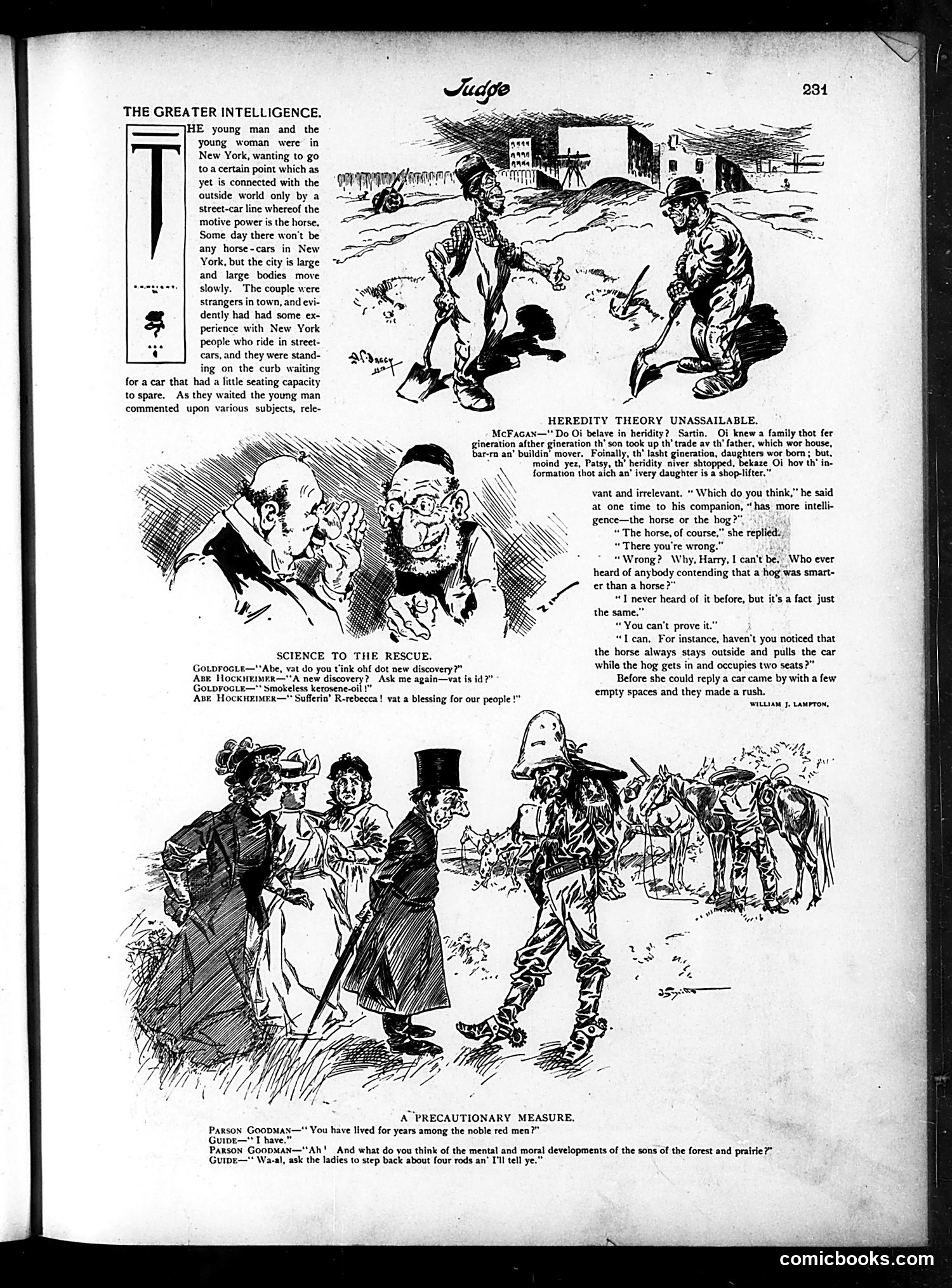
This page contains three satirical sketches typical of early-20th-century Judge magazine: **"The Greater Intelligence"** mocks a young couple's debate about whether horses or hogs are smarter. The joke's punchline—that hogs are cleverer because they occupy two seats on crowded streetcars while horses stay outside—is absurdist humor playing on urban transit frustrations. **"Heredity Theory Unassailable"** features Irish-immigrant character McFagan (identified by dialect spelling) making a crude joke: he argues heredity is real because criminal behavior runs in families, claiming the latest generation of daughters are all shoplifters. It's ethnic humor relying on offensive Irish stereotypes. **"Science to the Rescue"** and **"A Precautionary Measure"** use Yiddish-dialect characters (Goldfogle, Hochheimer) and a guide character to deliver punchlines about foolish "discoveries" and Native Americans respectively. These sketches reflect Judge's reliance on ethnic caricature and dialect humor—now considered offensive—as primary comedic vehicles for early-1900s audiences.
📄 Transcribed text from this page (OCR, searchable)
Machine-transcribed from the original scan — historical spelling and the odd misread are preserved.
THE GREATER INTELLIGENCE, HE young man and the young woman were in New York, wanting to go to acertain point which as yet is connected with the outside world only by a street-car line whereof the motive power is the horse. Some day there won't be any horse-cars in New York, but the city is large and large bodies move slowly. The couple were strangers in town, and evi- dently had had some ex- perience with New York people who ride in street- cars, and they were stand- ing on the curb waiting for a car that had a little seating capacity to spare. As they waited the young man commented upon various subjects, rele- HEREDITY THEORY UNASSAILABLE. McFAcax—'Do Oi belave in heridity? Sartin. Oi knew a family thot fer gineration afther gineration th’ son took up th’ trade av th’ father, which wor house, bar-rn an’ buildin’ mover. Foinally, th" lasht gineration, daughters wor born ; - moind yez, Patsy, th’ heridity niver shtopped, bekaze Oi hov th’ formation thot aich an’ ivery daughter is a shop-lifter.” vant and irrelevant. “ Which do you think,” he said at one time to his companion, “has more intelli- gence—the horse or the hog?" “The horse, of course,” she repliéd:, “There you're wrong.” Sead “Wrong? Why, Harry, I can't be. Who ever heard of anybody contending that a hog was smart- er than a horse?” “I never heard of it before, but it’s a fact just the same.” “You can't prove it.” “Tcan, For instance, haven't you noticed that SCIENCE IOCTHETRESCUE! the horse always stays outside and pulls the car GotprocLe—"‘Abe, vat do you t'ink ohf dot new discovery?” while the hog gets in and occupies two seats?” Abe HOcKHEIMER—"A new discovery? Ask me again—vat is id?” Before she could reply a car came by with a few GOLDFOGLE- mokeless kerosene-oil !" empty spaces and they made a rush. Suflerin’ R-rebecca! vat a blessing for our people!" Lilie re “ ae i hatron A PRECAUTIONARY MEASURE. Parson Goopmax—"* You have lived for years among the noble red men?” Guipe—"* I have.” Parson GoopMan—"‘Ah' And what do you think of the mental and moral developments of the sons of the forest and prairie?” Gutpe—"* Wa-al, ask the ladies to step back about four rods an’ I'll tell ye.” comicbooks.com