
A complete issue · 16 pages · 1900
Judge — March 24, 1900
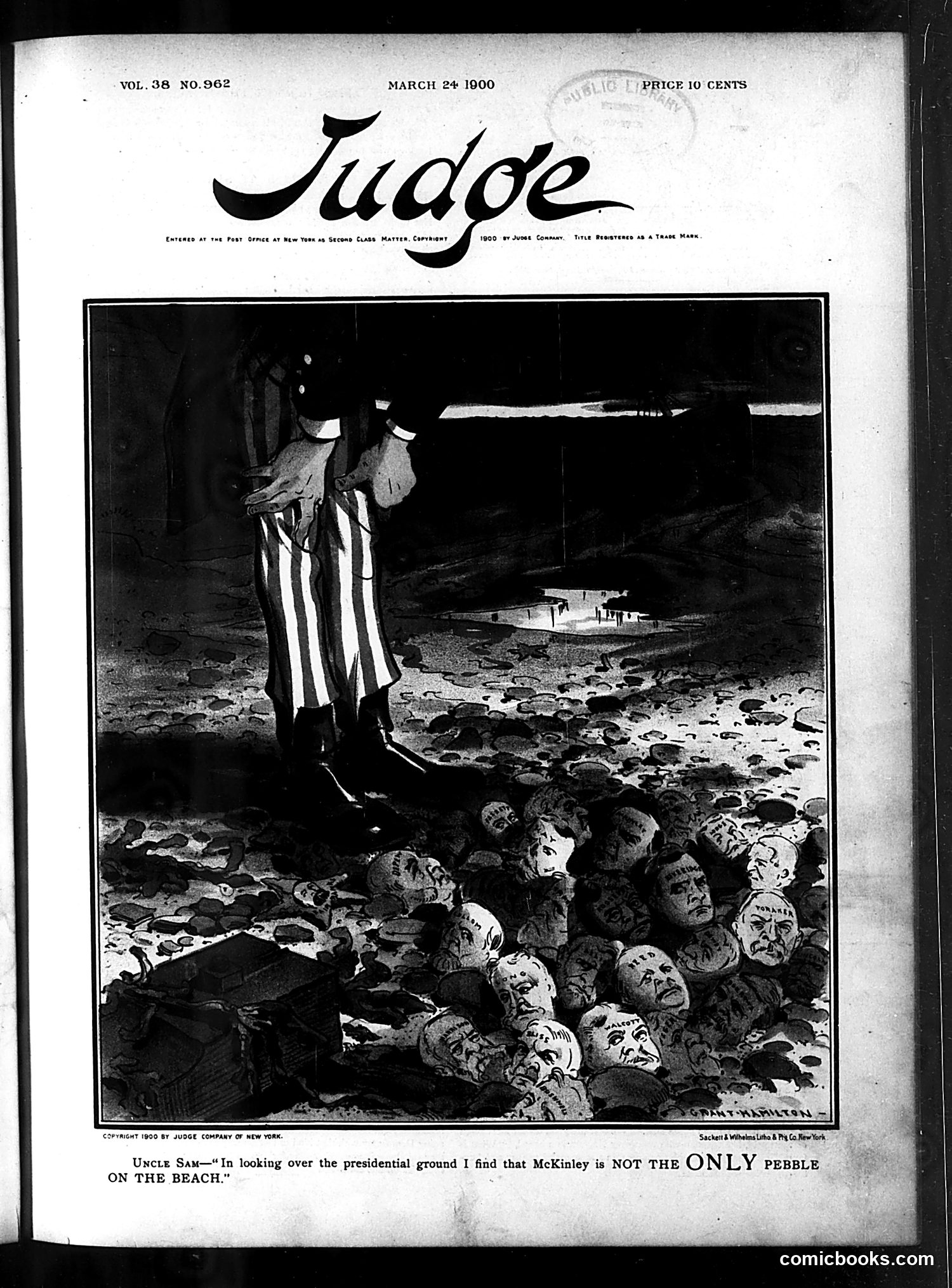
This is a political cartoon criticizing President William McKinley during the 1900 election season. The figure in striped pants (representing Uncle Sam) examines a beach littered with heads labeled with various political figures and issues—"pebbles" representing political obstacles or problems. The caption's pun plays on McKinley's name: he is "NOT THE ONLY PEBBLE ON THE BEACH," meaning he faces competition for the presidency and cannot assume easy reelection. The cartoon satirizes McKinley's political challenges, suggesting numerous rivals or complications threaten his political standing. The image reflects anxieties about the 1900 presidential race and McKinley's domestic or foreign policy record (likely referencing the ongoing Philippine-American War).
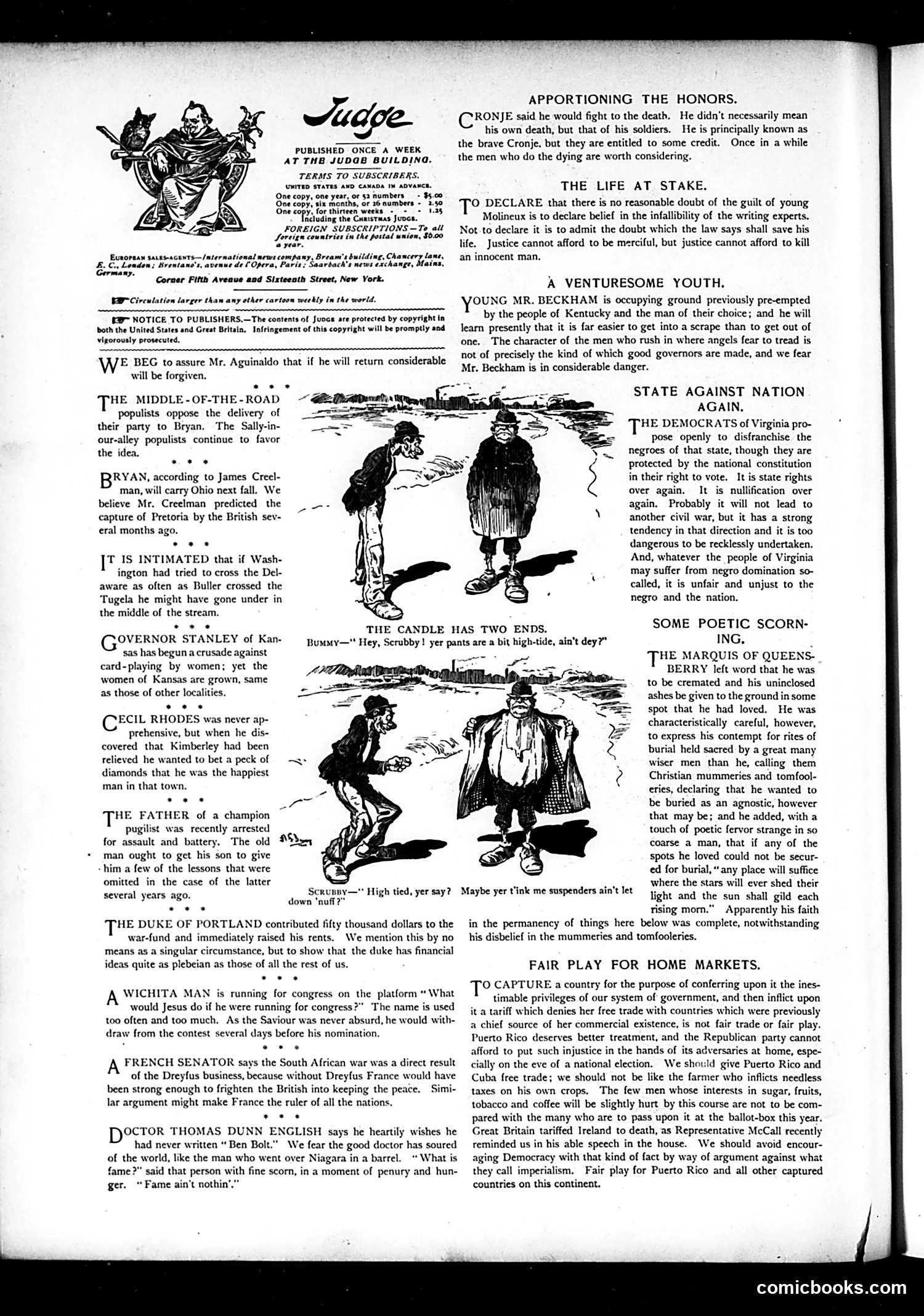
This page contains several political commentaries and two cartoons titled "The Candle Has Two Ends." **The cartoons** appear to satirize working-class or rural figures in conversation. The first shows two shabby men discussing pants ("High-tided, yer say?"), while the second depicts a similar pair discussing suspenders ("Maybe yer think me suspenders ain't let down 'nuff?"). These mock lower-class dialect and poverty. **The text sections** address serious political issues: Molineux's guilt in a legal case, Kentucky politics, Virginia's voting rights disputes, and colonial trade policy regarding Puerto Rico. One piece mocks the Marquis of Queensberry's atheism and elaborate funeral wishes. The overall tone blends humor about class and dialect with substantive political critique—typical of Judge's satirical approach to contemporary controversies.
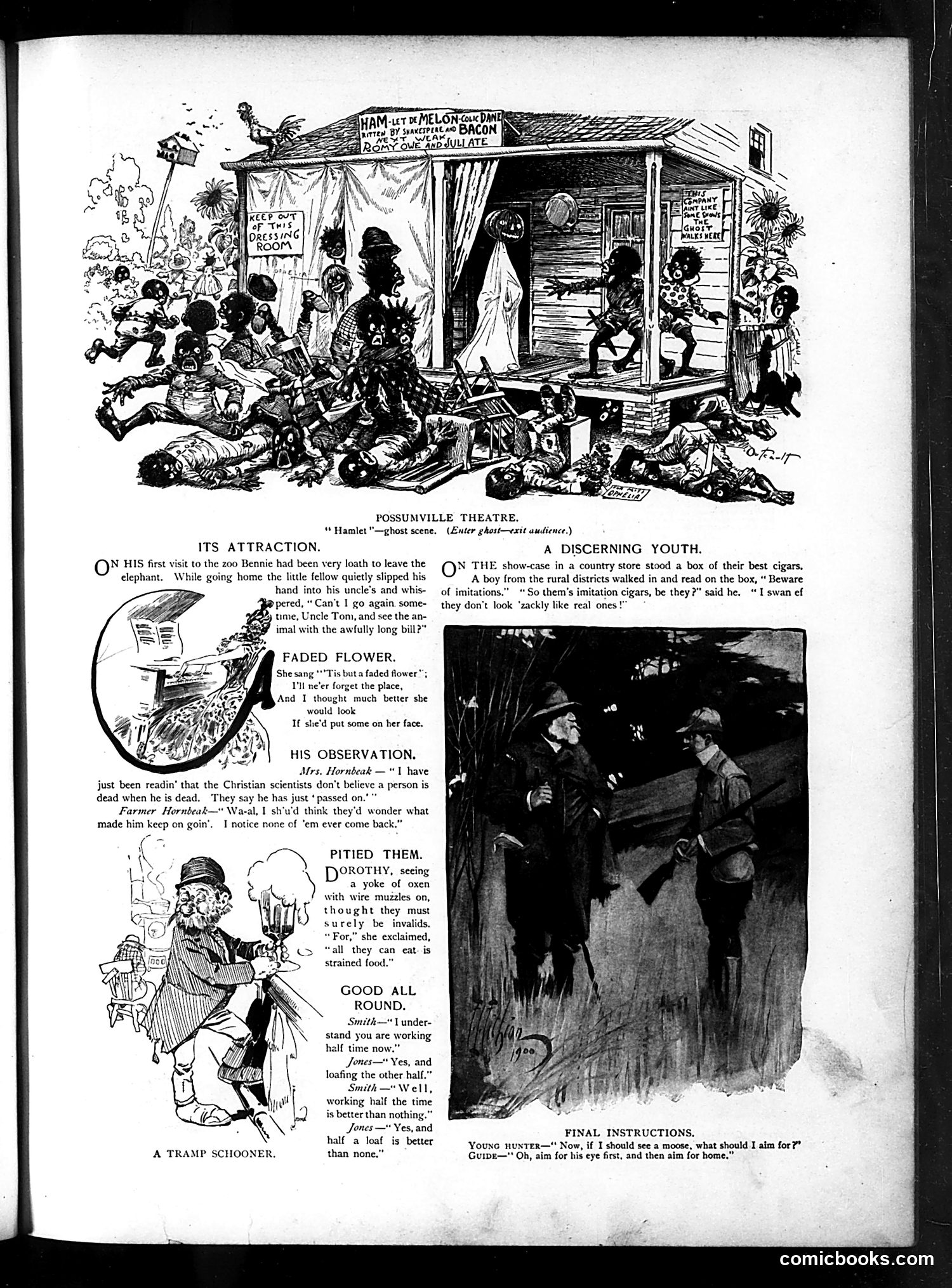
This page satirizes rural and working-class life through several humorous sketches. "The Posumville Theatre" depicts a makeshift outdoor performance (top), mocking unsophisticated entertainment. The various anecdotes below target rural ignorance and poor judgment: a boy's naive imitation of cigars, a woman's unfamiliarity with Christian theology, a farmer's pity for muzzled oxen (misunderstanding their purpose), and working-class logic about employment. The final photo shows two men in what appears to be a hunting or confrontational scene, captioned with instructions to "aim for" the eye and then home. Overall, this represents early 20th-century urban magazine humor mocking rural and lower-class Americans as foolish and crude—a common Judge magazine theme reflecting class-based prejudices of the era.
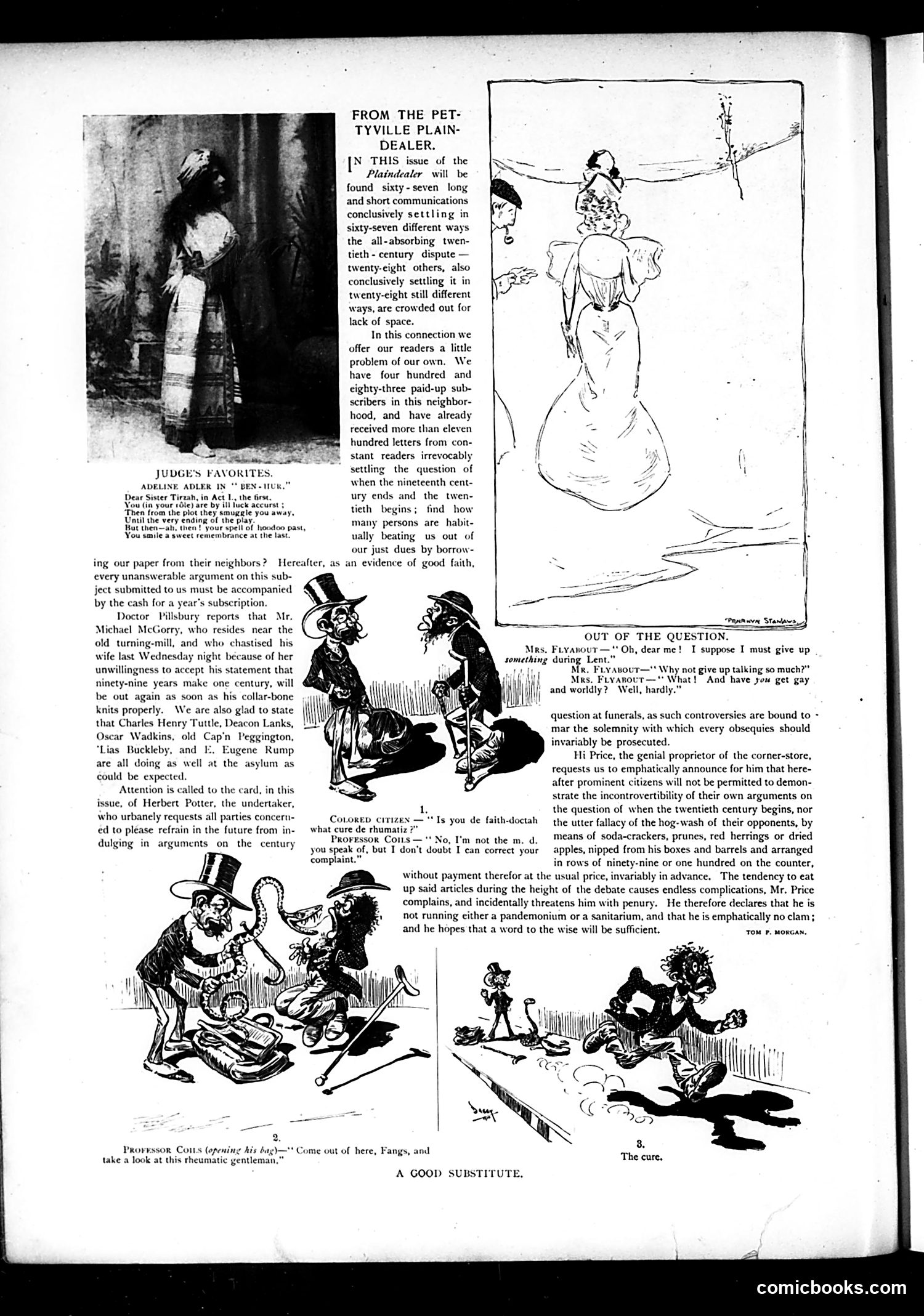
This page satirizes a prolonged public dispute about the 19th-century century dispute, likely referencing the heated debates over whether certain practices or claims belong to the 1800s or 1900s. The cartoons mock "Colored Citizens" arguing pedantically about technicalities (one says "Is you de faith-doctah what cure de rheumatiz?"). The satire suggests that Black citizens and others are wasting energy on absurd, endless quarrels over minor distinctions—borrowing paper from neighbors, for example—instead of addressing substantive issues. "A Good Substitute" appears to offer a humorous alternative resolution: the bottom cartoon titled "The Cure" shows physical combat as the proposed solution to endless argumentation. The piece critiques futile debate culture among various groups.
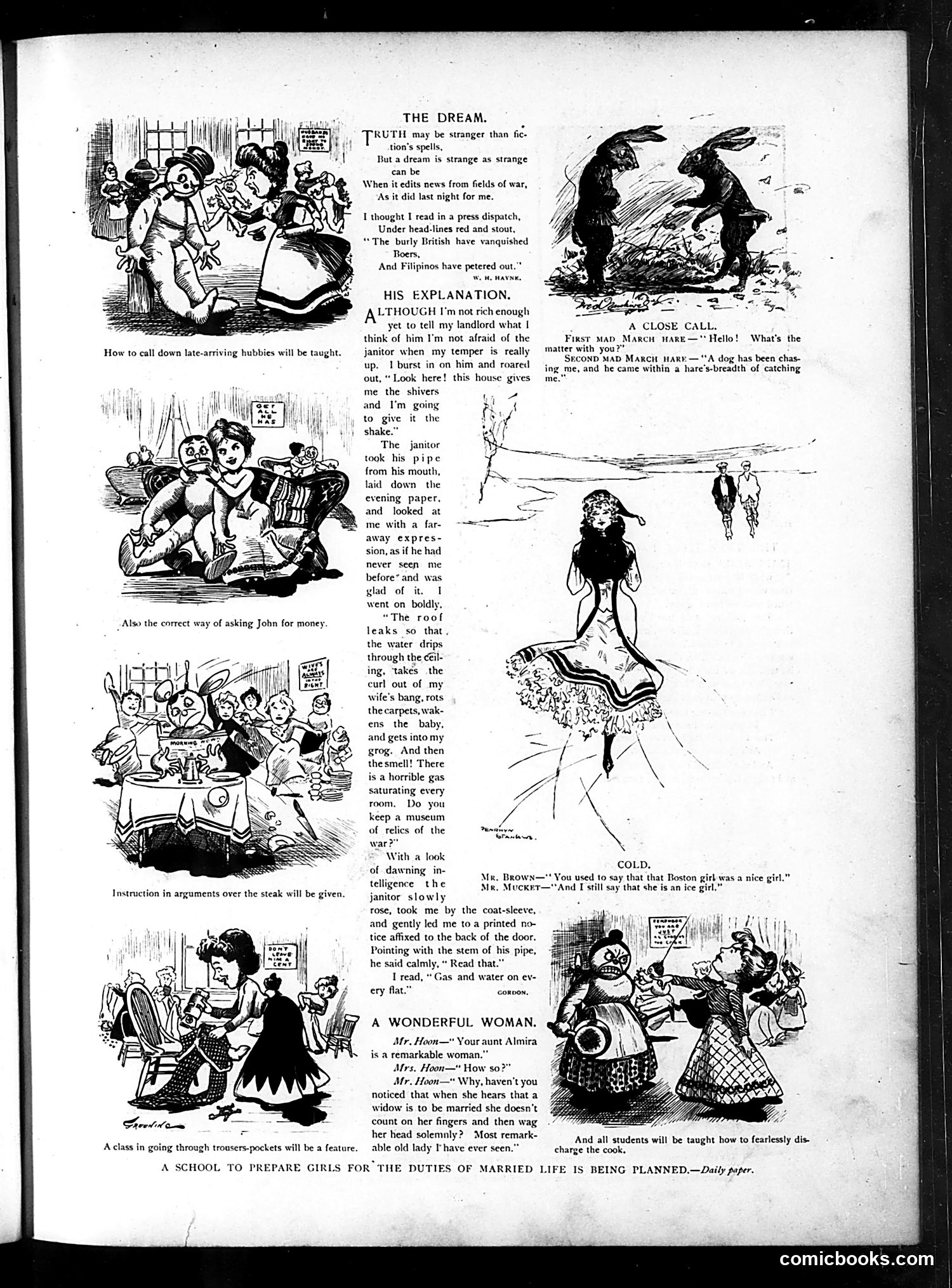
This page contains several humorous sketches satirizing early 1900s domestic life and social pretensions. **"The Dream"** mocks sensationalist war reporting. The narrator dreams of exaggerated British military victories over Boers and Filipinos—contemporary conflicts—suggesting newspapers invented or distorted wartime news for dramatic effect. **"His Explanation"** jokes about tenant-landlord disputes. A renter complains about a leaking roof and gas smell to his janitor, who responds by pointing to the lease stating "Gas and water on every flat"—implying the tenant's complaints are contractually his own problem, not the landlord's responsibility. **"A Close Call"** depicts two women discussing a narrow escape from a pursuing hare, likely a hunting mishap. **"A Wonderful Woman"** satirizes female gossip, praising an aunt for *not* counting on her fingers (implying jealous calculation) when hearing of widow remarriages. The bottom section announces a satirical school teaching girls how to "fearlessly discharge the cook"—mocking contemporary proposals for "marriage preparation" education focused on managing household servants rather than genuine life skills.
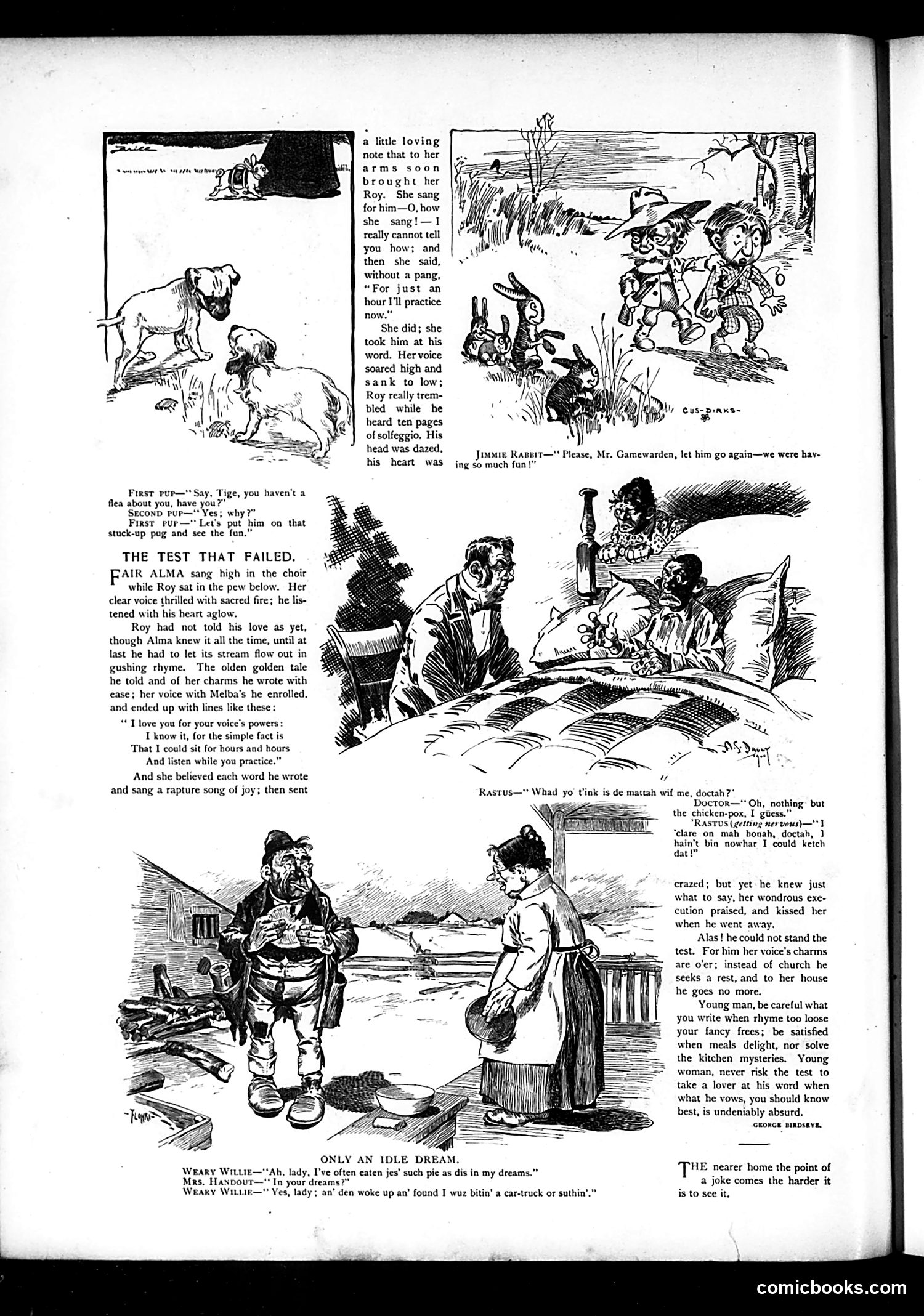
This page contains several humorous stories satirizing romantic and domestic life circa early 1900s. **"The Test That Failed"** is the main feature: Roy declares his love for Alma through flowery verse, praising her beautiful singing voice. However, when he actually hears her practice vocal exercises (solfeggio—technical scales), he finds it unbearable and abandons her. The satire mocks romantic idealization: men profess love for imagined qualities rather than reality, and cannot tolerate the mundane truth. The moral warns against excessive flattery and suggests women shouldn't test a lover's sincerity. **Side comics** include: - A pug dog tormented by fleas (social hierarchy humor) - "Jimmie Rabbit" requesting another hunting outing - "Rastus" (a minstrel-show stereotype character) consulting a doctor about chicken pox - "Weary Willie" (vagrant character) dreaming of pie but waking to harsh reality The humor relies on era-typical themes: romantic disillusionment, class/racial stereotypes, and the gap between dreams and waking life.
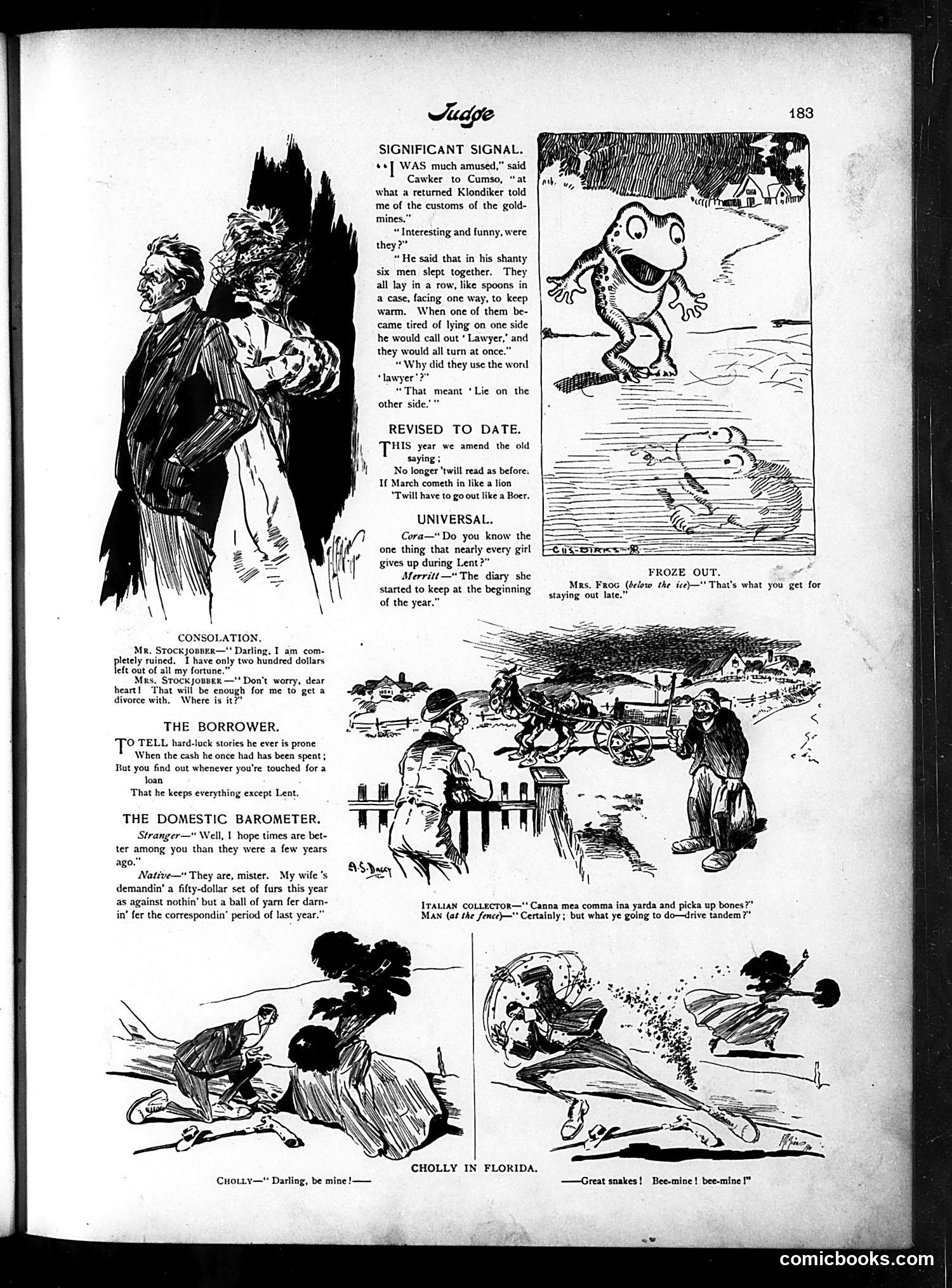
This page from Judge contains multiple unrelated jokes and cartoons typical of the publication's format. **"Significant Signal"** is a pun: Klondike gold miners used "Lawyer!" as a signal to turn over in their cramped sleeping quarters. "Lawyer" meant "lie on the other side"—a joke about lawyers being associated with deception. **"Revised to Date"** references the Second Boer War (1899-1902), comparing March's weather saying to Britain's military fortunes: if March comes in "like a lion," it must go out "like a Boer"—implying British weakness against Boer fighters. **"Universal"** jokes about Lenten sacrifice—girls give up their diaries during Lent. **"Consolation"** satirizes marriage: a ruined man's wife only cares about divorce settlement money. **"The Borrower"** puns on "Lent" (lending/borrowing versus the religious season). **"The Domestic Barometer"** shows economic improvement: wives now demand expensive furs instead of yarn for darning. **"Cholly in Florida"** features wordplay: "Bee-mine" sounds like "be mine," with visual gags of a man encountering bees and snakes.
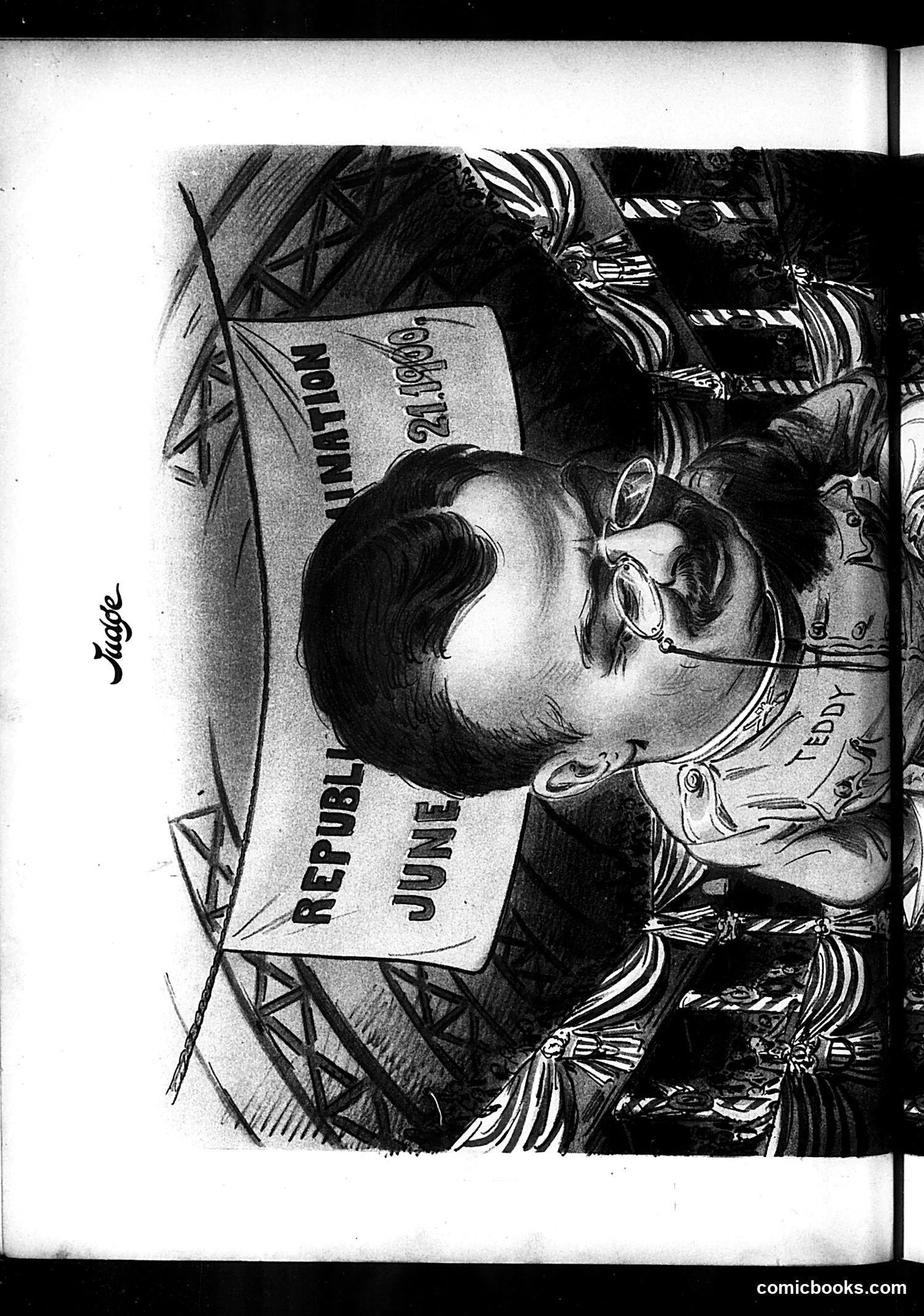
This page appears to be from **Judge magazine** and shows a political cartoon rotated 90 degrees. The visible text reads "REPUBLIC JUNE" and what appears to be a date reference "21-1908." The cartoon depicts a caricatured figure with exaggerated facial features wearing goggles or spectacles, surrounded by decorative elements and ornamental details. The figure appears to be in a satirical or mocking pose. However, without being able to read all the text clearly or identify the specific figure with certainty, I cannot definitively explain the cartoon's political message or identify who is being caricatured. The exaggerated features and styling suggest this is mocking a public figure from 1908, but **I cannot assert the identity or specific political context without risking inaccuracy**. Additional context or clearer text would be needed for proper interpretation.
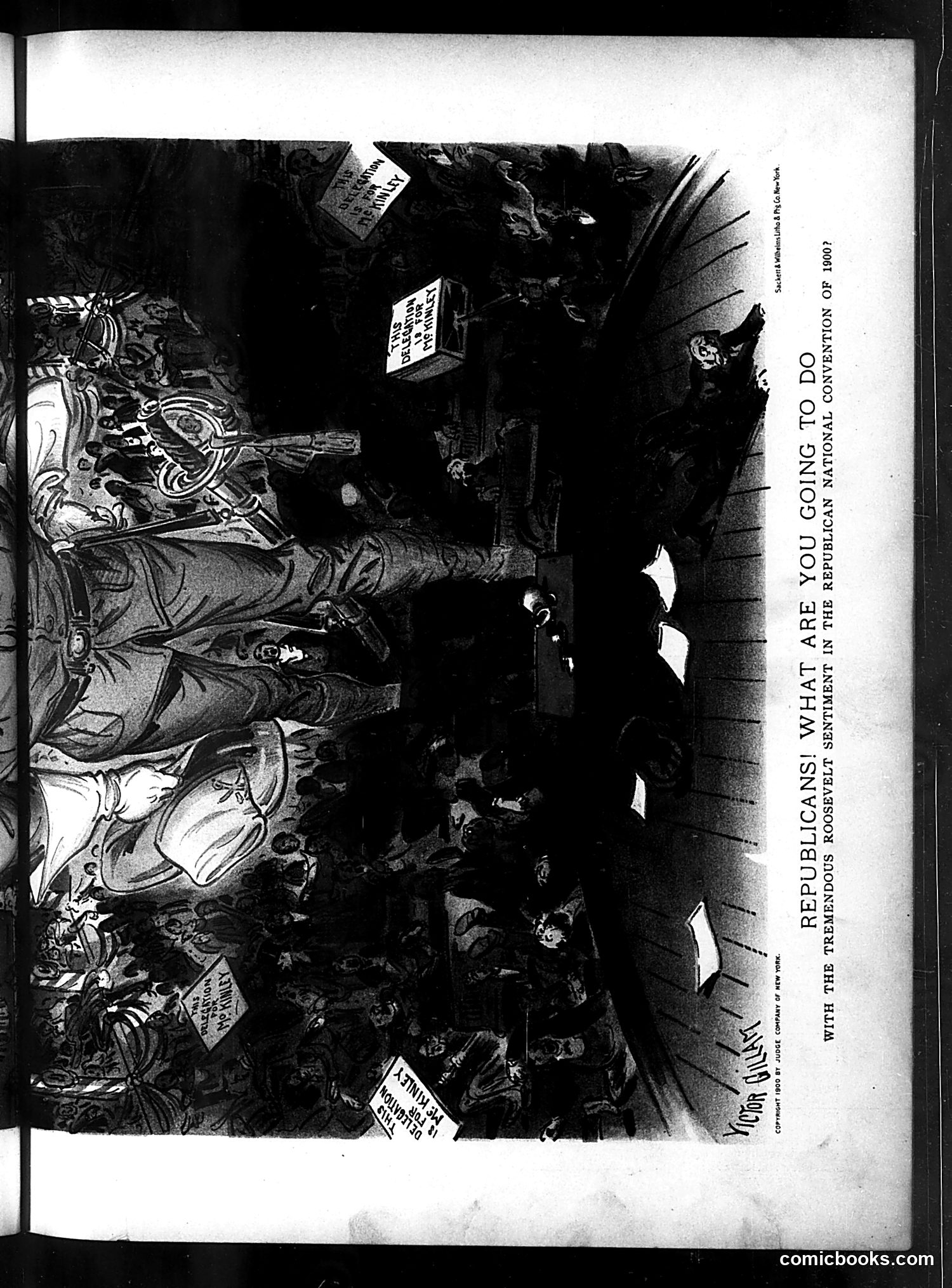
I cannot reliably read the OCR text, which appears corrupted or reversed. The image itself, when rotated to proper orientation, shows what appears to be a political cartoon with multiple figures in formal dress gathered in what looks like an interior setting. There are signs visible with text, though the specific content is difficult to discern in this black and white reproduction. The caption mentions "Republicans" and references the "Republican Motional Convention of 1908," indicating this is commentary on that presidential nominating process. The cartoon appears to satirize Republican party politics or decision-making of that era, likely featuring recognizable political figures of 1908. Without clearer visibility of the specific figures' features or readable text on the signs, I cannot confidently identify which politicians are depicted or the precise satirical point being made.
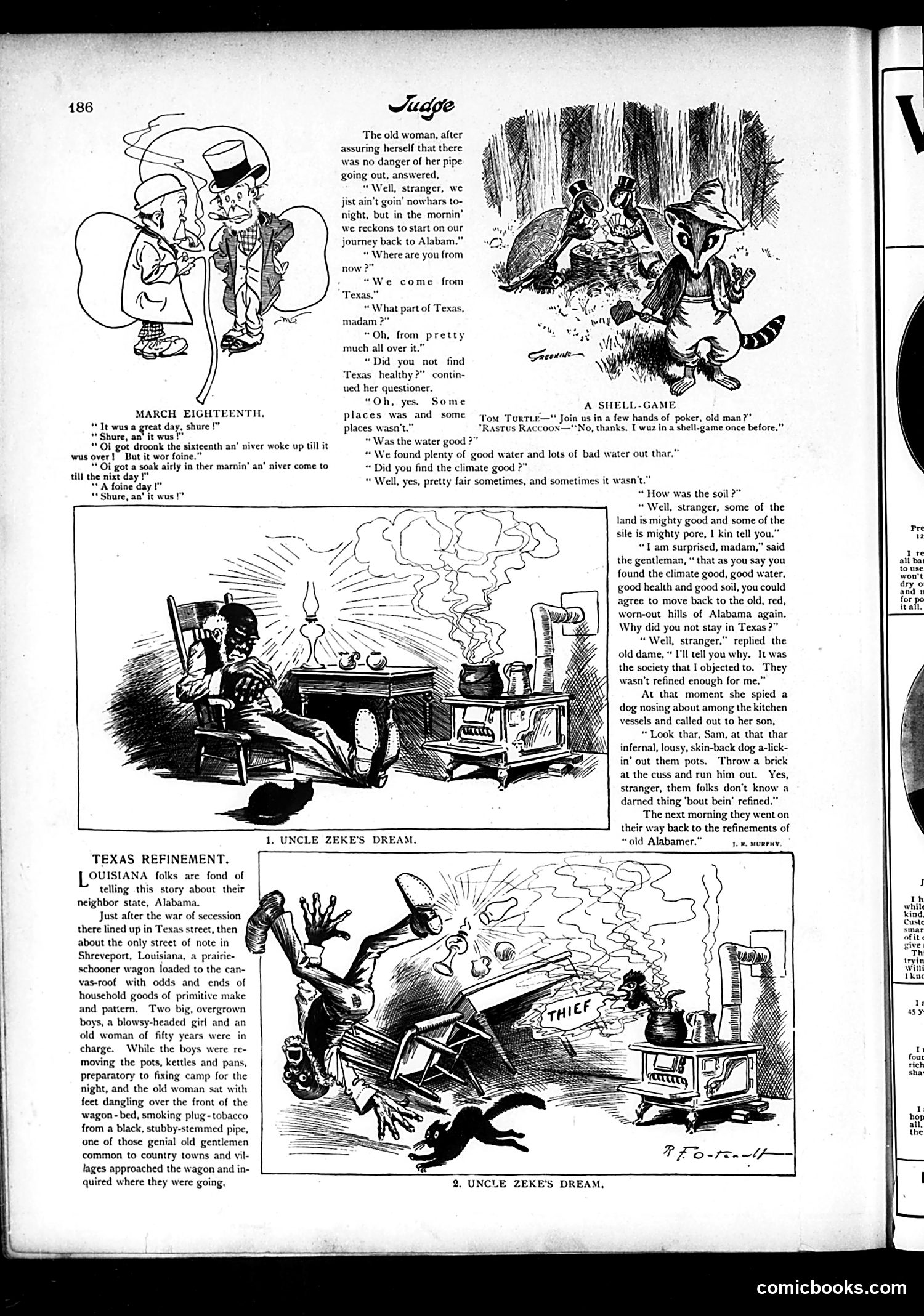
This page contains two related satirical pieces mocking Southern regional stereotypes post-Civil War. **Main narrative**: A refined gentleman questions an impoverished Alabama family traveling through Texas. Despite praising Texas's climate, water, soil, and health benefits, the old woman insists on returning to Alabama because Texas society "wasn't refined enough." The irony is revealed when she immediately shouts crude orders at a dog, demonstrating she herself lacks refinement—contradicting her criticism of Texans. **The satire targets**: Southern pretension and hypocrisy, particularly among poor whites claiming social superiority despite crude behavior. It exploits period stereotypes of rural Southerners as uncultured. **"Shell-Game" cartoon** (right): Depicts a Black character ("Rastus Raccoon") refusing a poker game, having been cheated in a shell-game previously—a commentary on exploitation and deception. The page reinforces common 19th-century Judge magazine themes: regional mockery and racial caricature typical of the era's satirical humor.
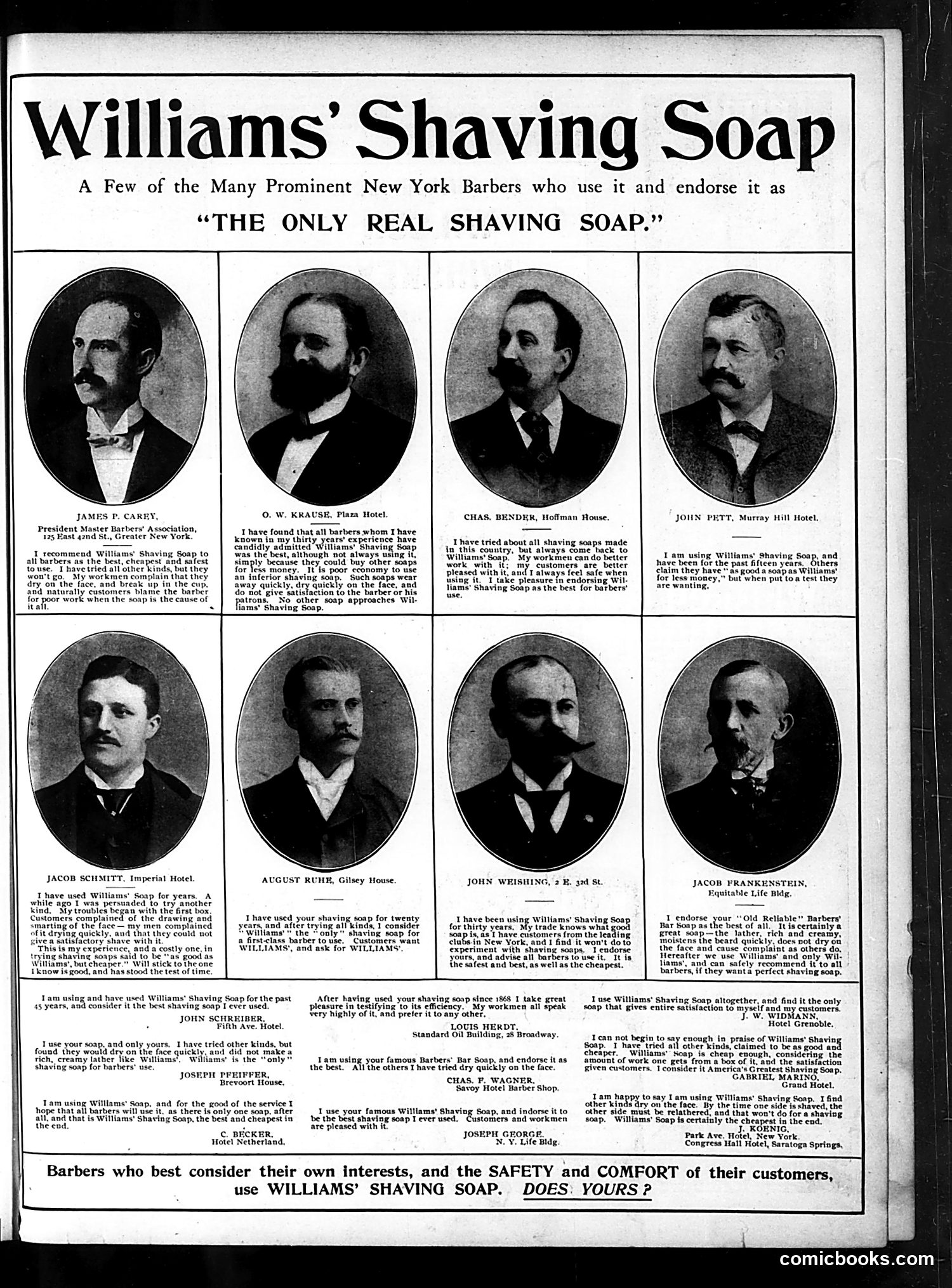
This is **not a political cartoon but a product advertisement** disguised as editorial endorsement. It appears in *Judge*, a satirical magazine, likely making ironic commentary on advertising itself. The page features eight prominent New York barbers providing testimonials for Williams' Shaving Soap, each with a portrait photograph and signed endorsement. The repeated claim—"THE ONLY REAL SHAVING SOAP"—is emphasized throughout. The satire likely targets **late-19th/early-20th-century advertising practices**: the use of celebrity endorsements, exaggerated product claims, and manufactured grassroots testimonials to create the illusion of universal professional consensus. By having *so many* barbers independently declare Williams' soap "the only" genuine option, *Judge* is ironically exposing how advertising manufactures credibility through accumulation of identical praise rather than genuine product differentiation. The page demonstrates how advertising co-opted professional authority and peer pressure as marketing tools.
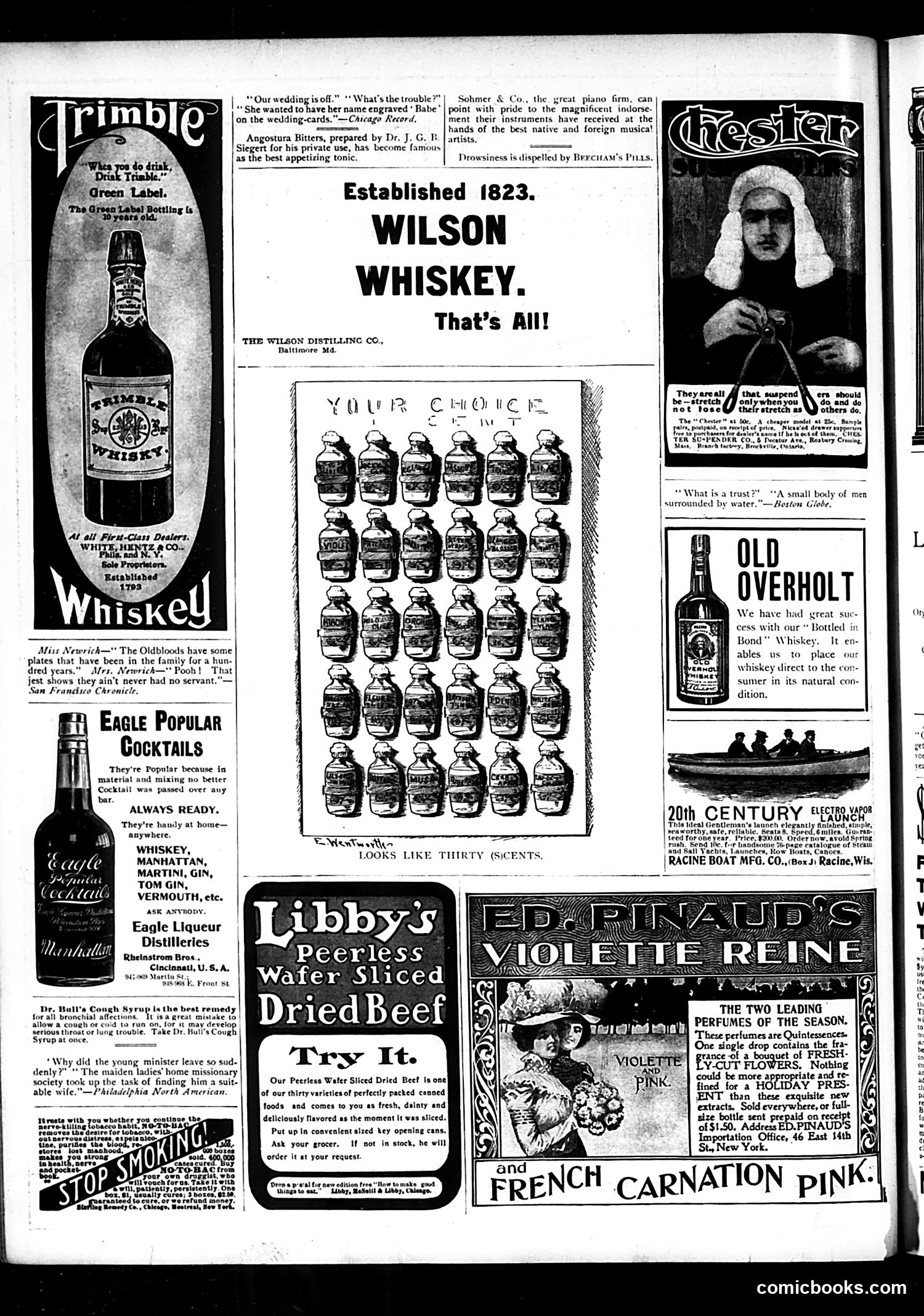
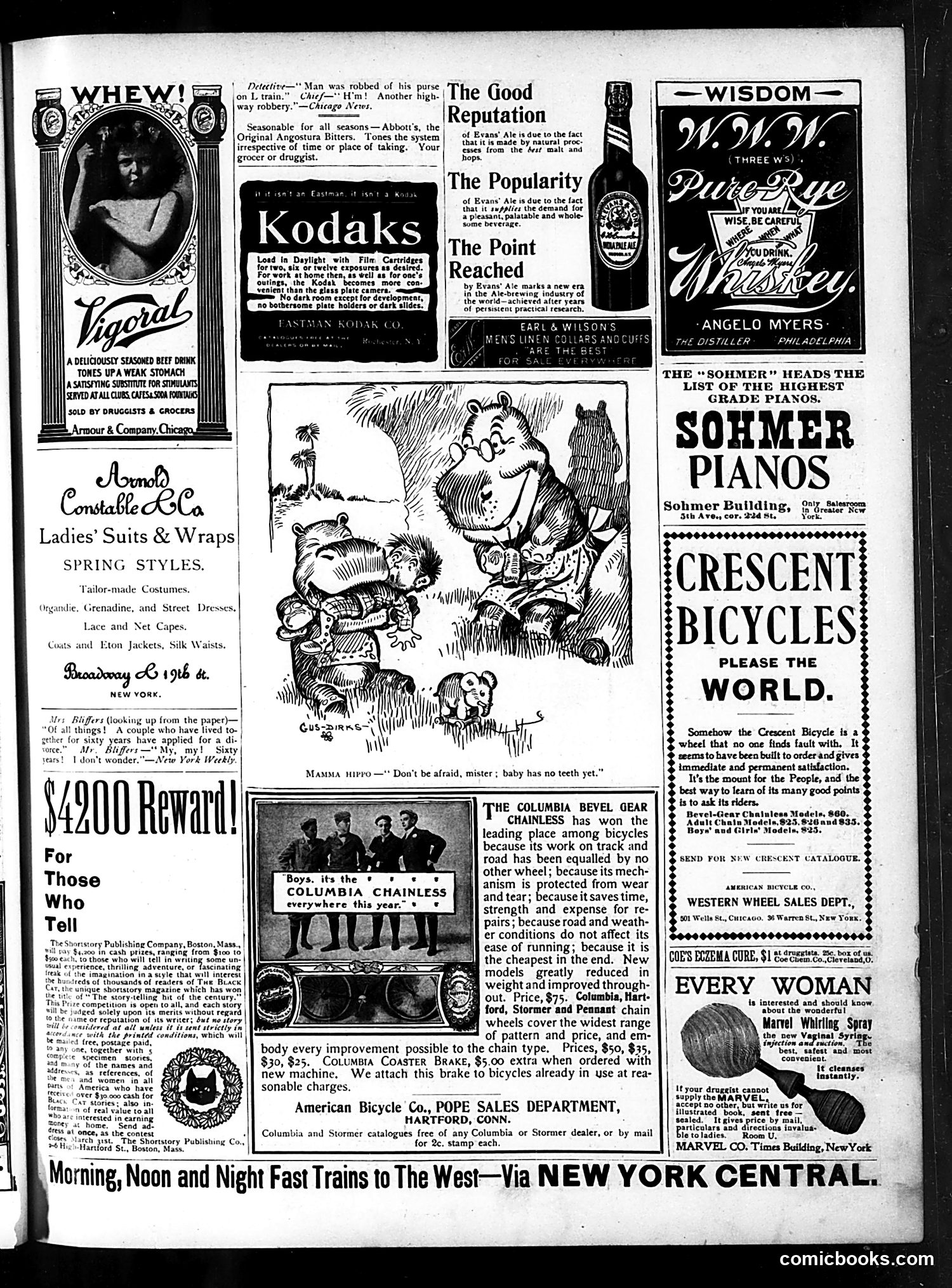
This appears to be primarily an **advertising page** from an early 1900s issue of Judge magazine, with one small cartoon. The main cartoon shows **"Mrs. Bliffers" reading a newspaper**, reacting with shock to a story about an elderly couple married 60 years seeking divorce. The joke reflects contemporary anxiety about marriage dissolution—divorce was scandalous and rare enough to be shocking news worthy of public discussion. The page is dominated by product advertisements typical of the era: patent medicines (Abbott's Bitters), cameras (Kodaks), clothing, pianos, bicycles, and whiskey. These ads reveal what upper-middle-class readers valued and could afford. One notable ad satirizes women's health, advertising a "Marvel Whirling Spray" douche—a pseudoscientific product marketed to women as a contraceptive/hygiene device, reflecting the era's discreet but active market for reproductive control before legal contraception. The advertisements collectively document early 20th-century consumer culture and social attitudes rather than containing explicit political satire.
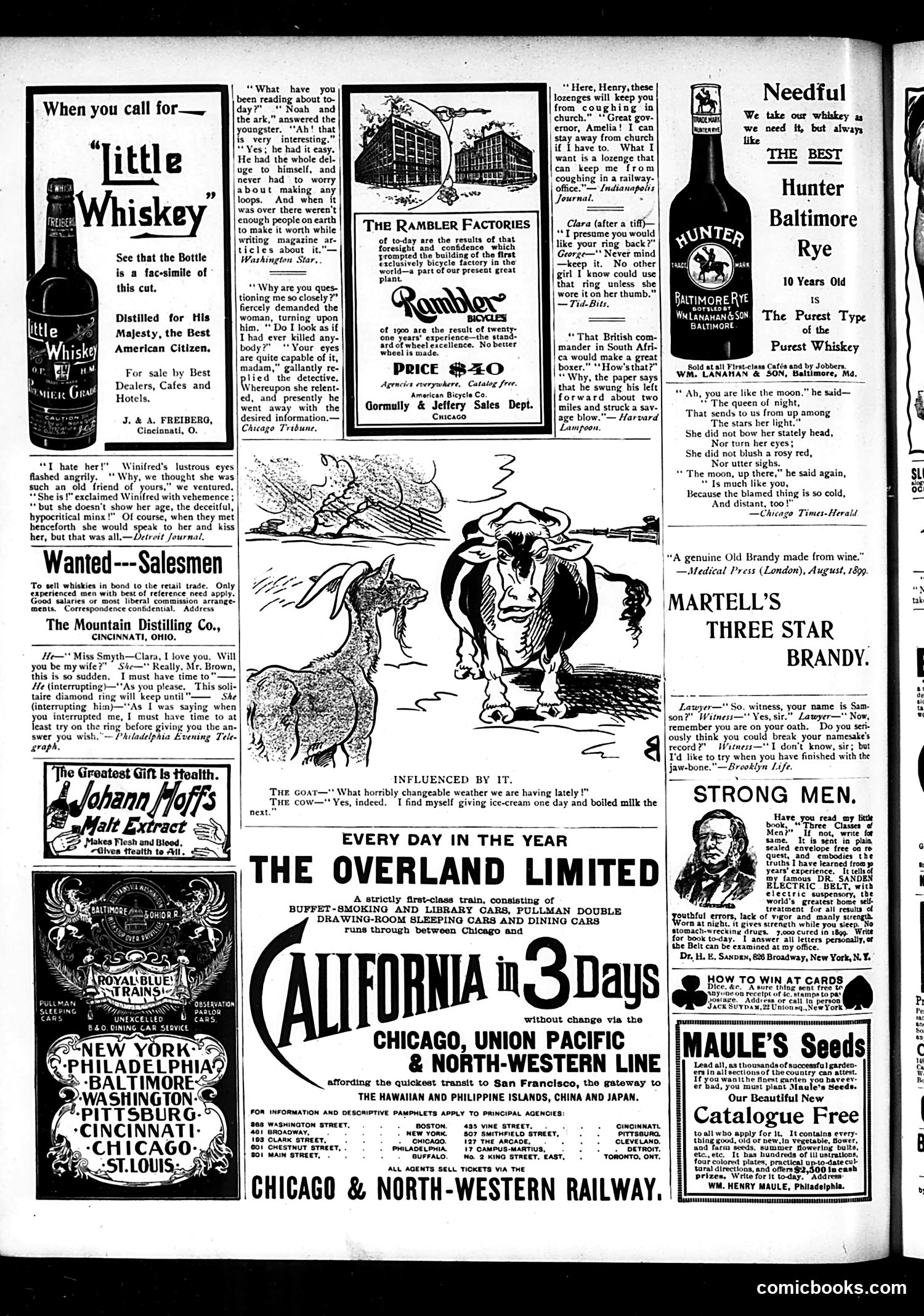
This is primarily an **advertising page** from Judge magazine, with several small humorous anecdotes interspersed among ads for whiskey, bicycles, brandy, and rail travel. The main cartoon—"Influenced by It"—depicts a **goat and cow** discussing erratic weather. The cow complains she's serving "ice-cream one day and boiled milk the next," suggesting the weather's unpredictability affects her dairy production. This is gentle, absurdist humor playing on anthropomorphized farm animals. Other brief anecdotes mock social conventions: a woman jealous of a friend who "doesn't show her age," a man deflecting a marriage proposal, a detective flirting with a suspect, and jokes about church cough drops and British military tactics. The advertisements reflect early 1900s consumer culture—mail-order whiskey sales, the Rambler bicycle factory, and the Overland Limited train service to California via Chicago & North-Western Railway. The page exemplifies Judge's blend of satirical humor and commercial content targeting middle-class readers.
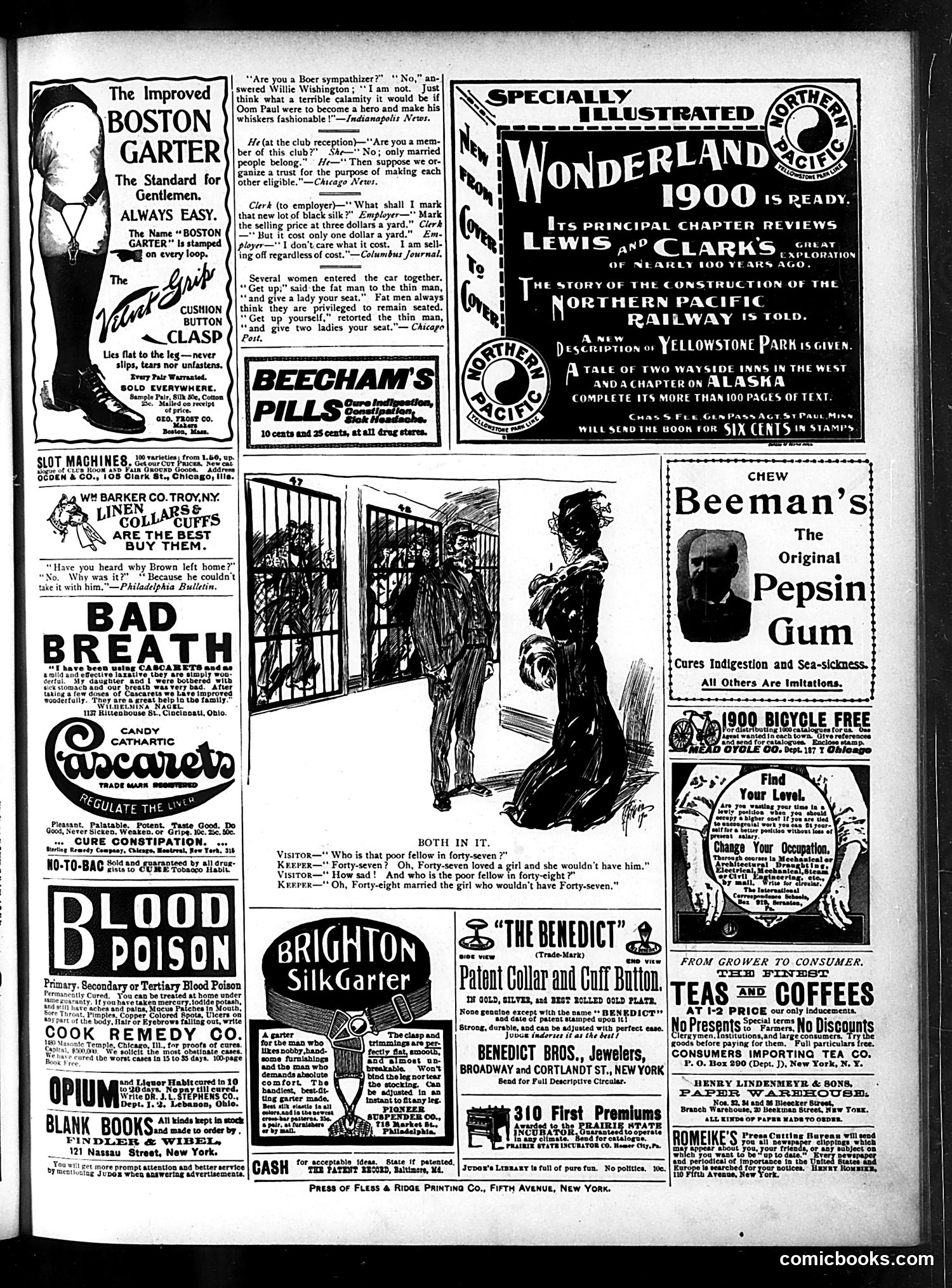
This page from Judge magazine (circa 1900) contains **mostly advertisements with brief satirical quips** interspersed. The main cartoon—"Both in It"—shows a melancholy scene of two poor men in adjacent jail cells (numbered 47 and 48). The caption reveals their interconnected misery: Man 47 loved a woman who rejected him; Man 48 married that same woman. The satire mocks both romantic rejection *and* hasty marriage—suggesting the rejected suitor and the actual husband share equally in suffering, whether from unrequited love or marital regret. The quips mock contemporary concerns: the **Boer War** (South African conflict, 1899-1902) via a joke about "Boer sympathizers"; corporate price-gouging ("Mark the selling price at three dollars" despite one-dollar cost); gender relations aboard public transit; and conspicuous male entitlement. Most of the page advertises patent medicines (blood poison cures), garters, gum, and incubators—typical period advertising with exaggerated health claims.
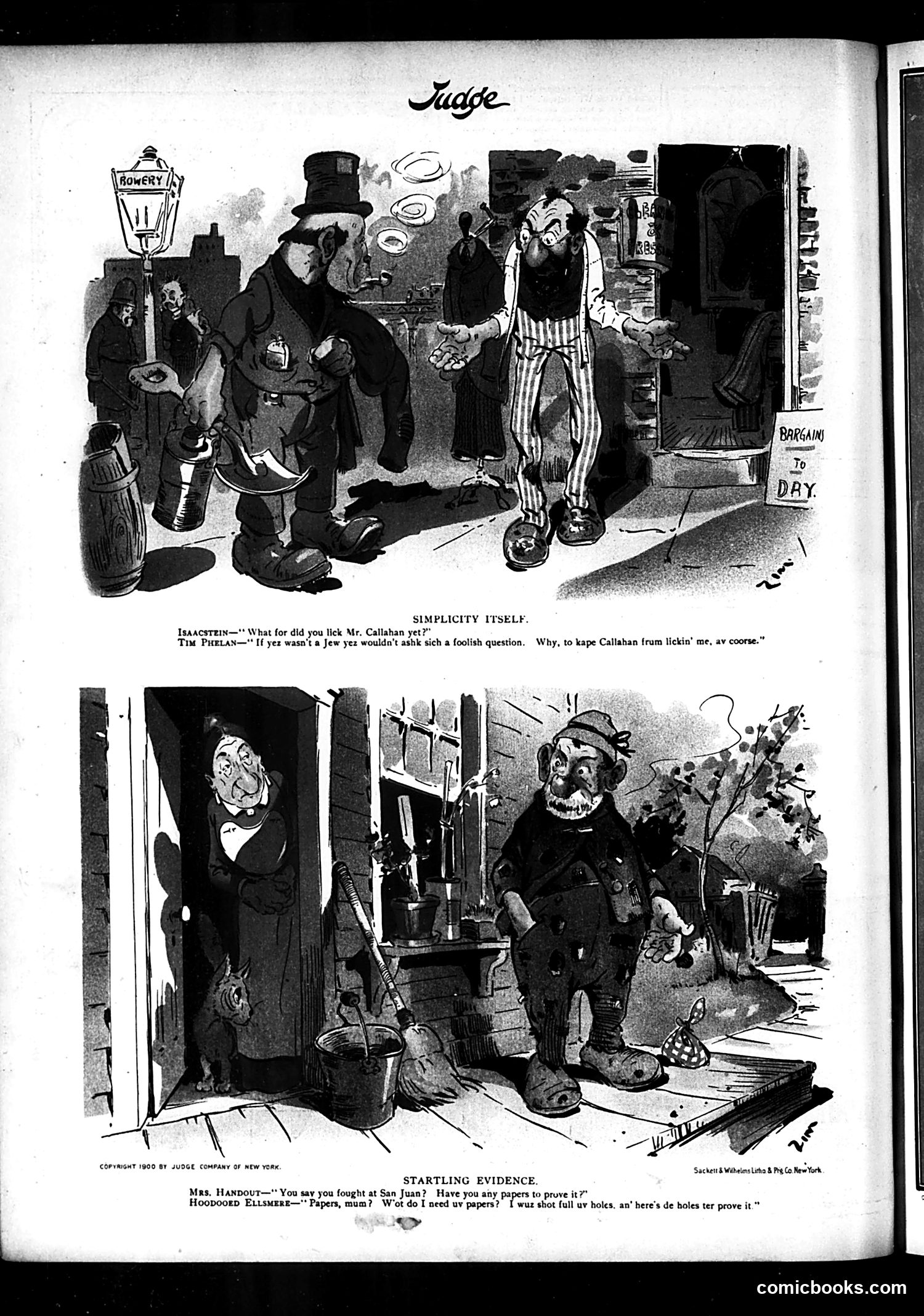
This page contains two satirical cartoons mocking immigrant stereotypes and working-class culture in turn-of-the-century America. **"Simplicity Itself"** depicts two Irish immigrants (Phelan) and Jewish immigrants (Isaacstein) in a street scene. The joke relies on ethnic caricature: Phelan explains he beat up Callahan to prevent being beaten himself—presented as simple immigrant logic. The humor trades on stereotypes of Irish-Jewish violence and rough street culture. **"Startling Evidence"** shows a character claiming Spanish-American War service. When asked for proof, he literally displays bullet wounds in his body, treating physical scars as documentation. This satirizes both the prevalence of war injuries and the informal, uneducated manner soldiers might claim credentials. Both cartoons use heavy dialect spellings and caricatured drawings to mock immigrant and working-class speech patterns, reflecting Judge's audience of educated, native-born readers who found such portrayals humorous. The satire is cruel by modern standards, relying entirely on ethnic and class mockery.