
Judge, 1900-03-24 · page 6 of 16
Judge — March 24, 1900 — page 6: what you’re looking at
What you’re looking at
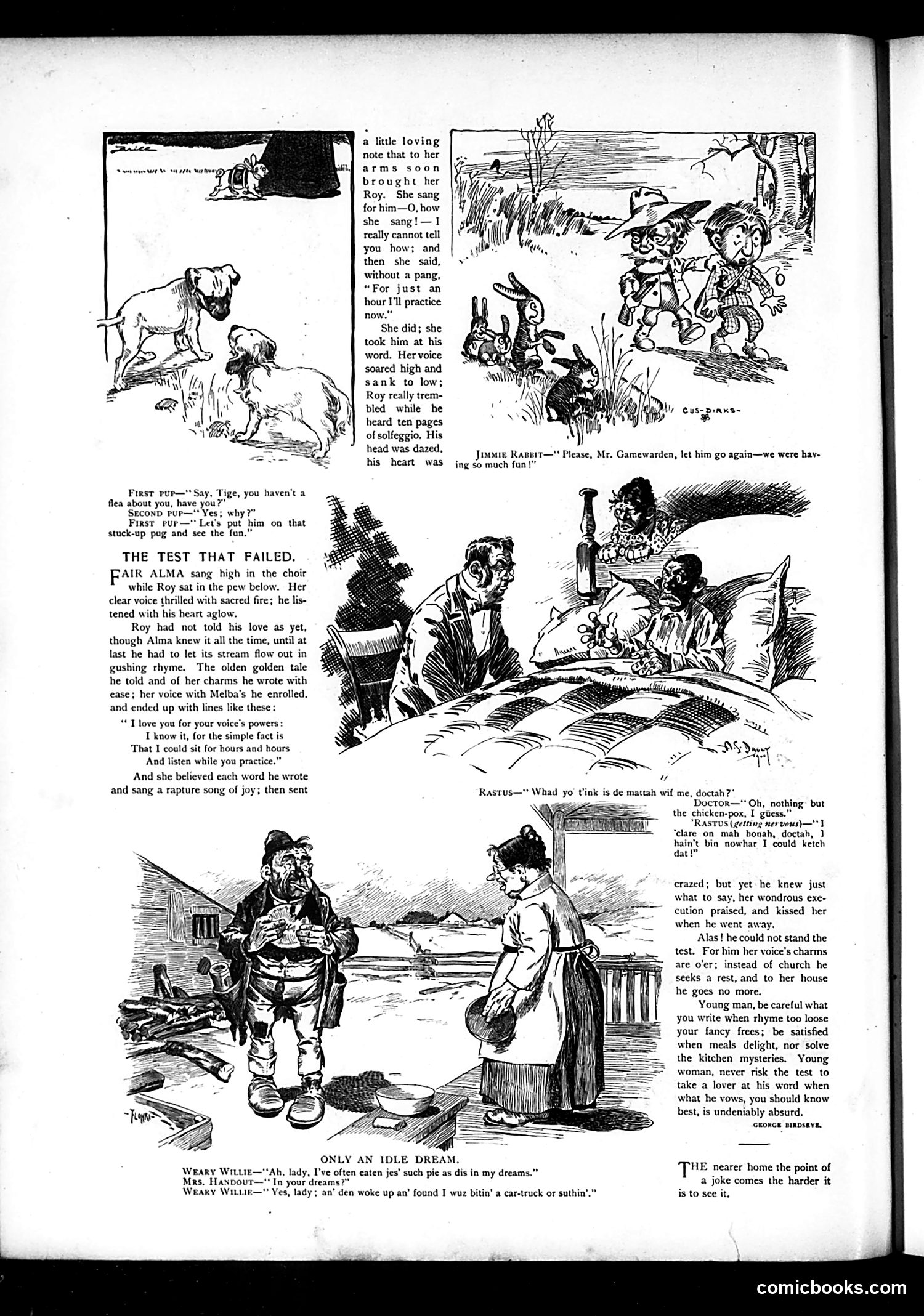
This page contains several humorous stories satirizing romantic and domestic life circa early 1900s. **"The Test That Failed"** is the main feature: Roy declares his love for Alma through flowery verse, praising her beautiful singing voice. However, when he actually hears her practice vocal exercises (solfeggio—technical scales), he finds it unbearable and abandons her. The satire mocks romantic idealization: men profess love for imagined qualities rather than reality, and cannot tolerate the mundane truth. The moral warns against excessive flattery and suggests women shouldn't test a lover's sincerity. **Side comics** include: - A pug dog tormented by fleas (social hierarchy humor) - "Jimmie Rabbit" requesting another hunting outing - "Rastus" (a minstrel-show stereotype character) consulting a doctor about chicken pox - "Weary Willie" (vagrant character) dreaming of pie but waking to harsh reality The humor relies on era-typical themes: romantic disillusionment, class/racial stereotypes, and the gap between dreams and waking life.
📄 Transcribed text from this page (OCR, searchable)
Machine-transcribed from the original scan — historical spelling and the odd misread are preserved.
= BY a little loving ceo note that to her arms soon brought her Roy. She sang for him—O, how she sang!—1 really cannot tell you how; and then she said, without a pang, “For just an hour I'll practice now.” She did; she took him at his word. Her voice soared high and sank to low; Roy really trem- bled while he heard ten pages of solfeggio. His head was dazed, his heart was Jnoue Ranit—" Please, Mr. Gamewarden, let him go again—we were hav. ing so much fun !” First pup—'* Say, Tige, you haven't a flea about you, have you?” Second Pup—"* Yes; why?” First pur—" Let's put him on that stuck-up pug and see the fun.” THE TEST THAT FAILED. FAIR ALMA sang high in the choir while Roy sat in the pew below, Her clear voice thrilled with sacred fire; he lis- tened with his heart aglow. Roy had not told his love as yet, though Alma knew it all the time, until at last he had to let its stream flow out in gushing rhyme. The olden golden tale he told and of her charms he wrote with ease; her voice with Melba’s he enrolled. and ended up with lines like these: “ T love you for your voice’s powers: I know it, for the simple fact is That I could sit for hours and hours And listen while you practice.” And she believed each word he wrote and sang a rapture song of joy; then sent Rastus—"* Whad yo’ t'ink is de mattah wif me, doctah?’ — Doctor—"Oh, nothing: but the chicken-pox, I gies.” ‘ "RASTUS (gelting nervous)—"*1 “clare on mah honah, doctah, } hain'g bia nowhar T could Ketch ar crazed; but yet he knew just what to say, her wondrous exe- cution praised, and kissed her when he went away. Alas! he could not stand the test. For him her voice’s charms are o'er; instead of church he seeks a rest, and to her house he goes no more. Young man, be careful what you write when rhyme too loose your fancy frees; be satisfied when meals delight, nor solve the kitchen mysteries. Young woman, never risk the test to take a lover at his word when what he vows, you should know best, is undeniably absurd. WY Grorce pinpseve, Zn . ONLY AN IDLE DREAM. Weary Wittir—"Ah, lady, I've often eaten jes’ such pie as dis in my dreams." Mrs. Haxpour—'" In your dreams?” Weary WiLtir—“* Yes, lady; an’ den woke up an’ found I wuz bitin’ a car-truck or suthin’.” THE nearer home the point of a joke comes the harder it is to see it, comicbooks.com