
A complete issue · 16 pages · 1900
Judge — March 3, 1900
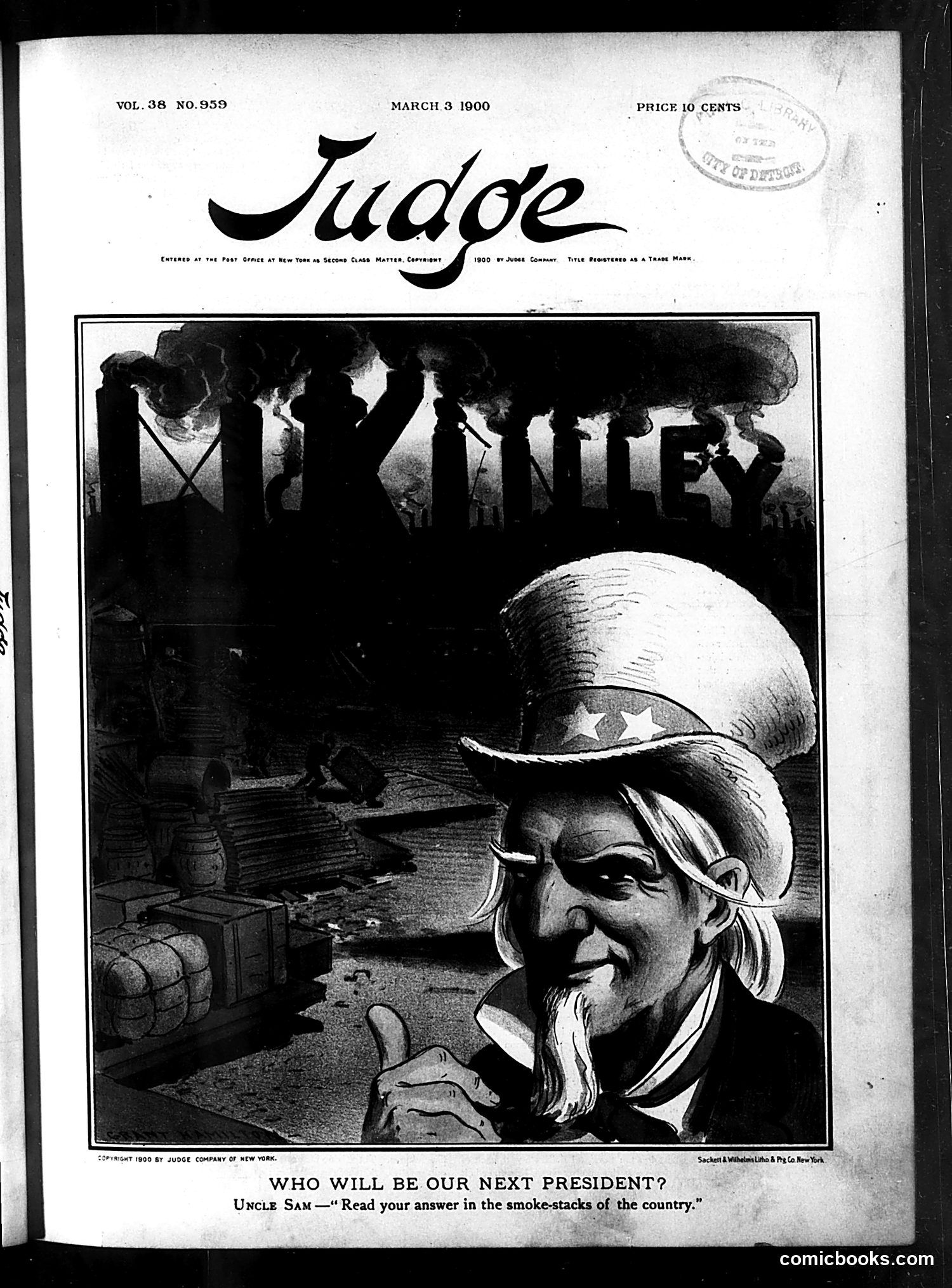
This political cartoon addresses the 1900 U.S. presidential election. Uncle Sam, depicted in the foreground with his characteristic starred top hat, gazes into factory smokestacks while smoke spells "McKINLEY." The caption reads: "WHO WILL BE OUR NEXT PRESIDENT? Uncle Sam—'Read your answer in the smoke-stacks of the country.'" The satire suggests that President William McKinley's reelection is being determined by industrial interests and economic power rather than democratic choice. The smokestacks—symbols of industrial America—appear to literally "vote" for McKinley, implying that big business controlled political outcomes. This reflects Progressive Era criticism of corporate influence on American politics and elections.
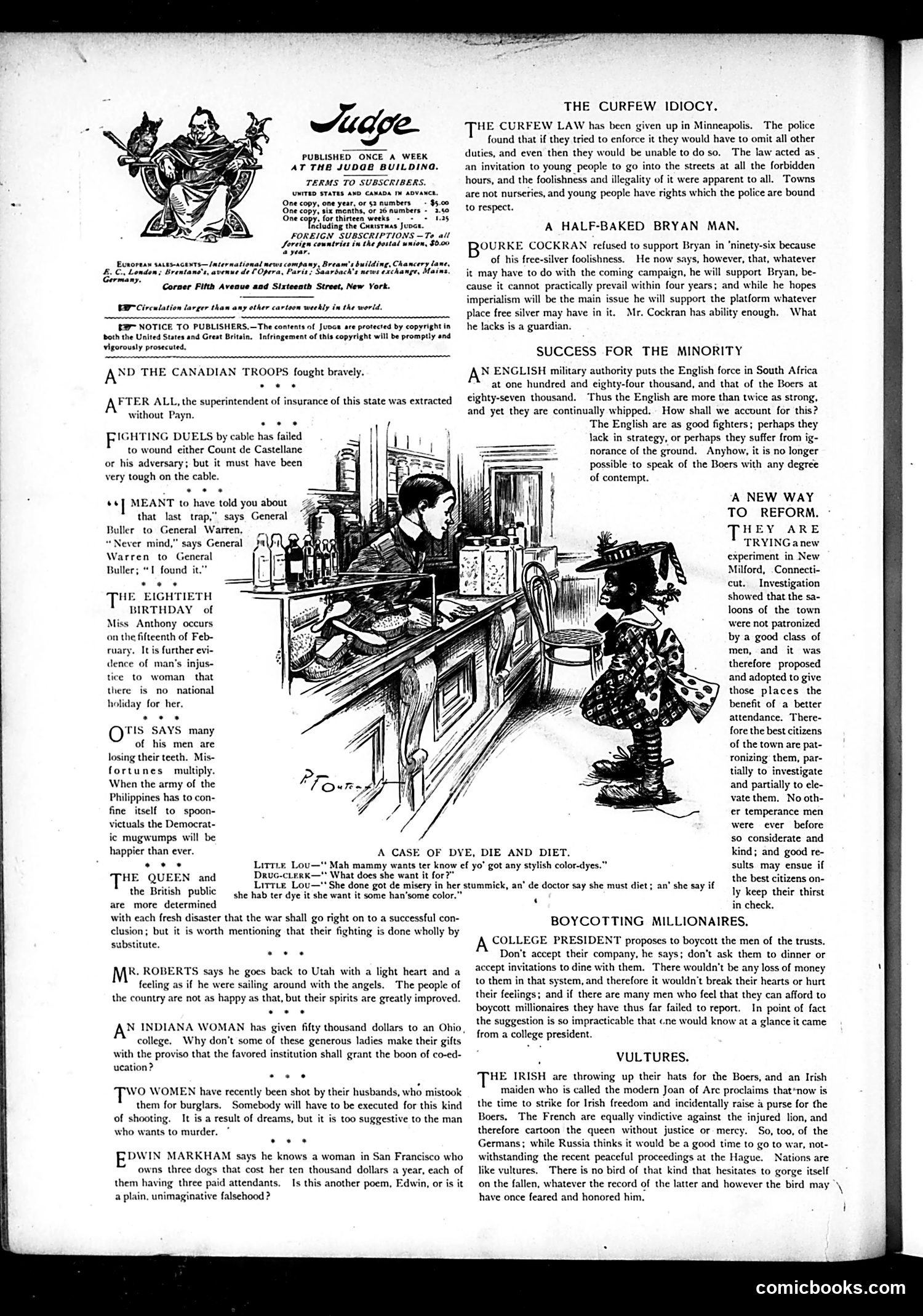
The main cartoon, titled "A Case of Dye, Die and Diet," depicts a pharmacy counter scene. A well-dressed customer asks a druggist about "stylish coloredyes," while the druggist responds with a medical pun about the customer's dietary needs affecting digestion and complexion. The joke plays on double meanings: "dye" (for coloring), "die" (to cease living), and "diet" (food intake). It's a lighthearted pharmaceutical humor piece typical of Judge's satirical style. The surrounding text includes brief political commentary on various contemporary issues including the Boer War, Philippine colonial administration, and labor disputes—standard fare for this era's satirical magazine. The cartoon itself appears designed primarily for wordplay entertainment rather than sharp political critique.
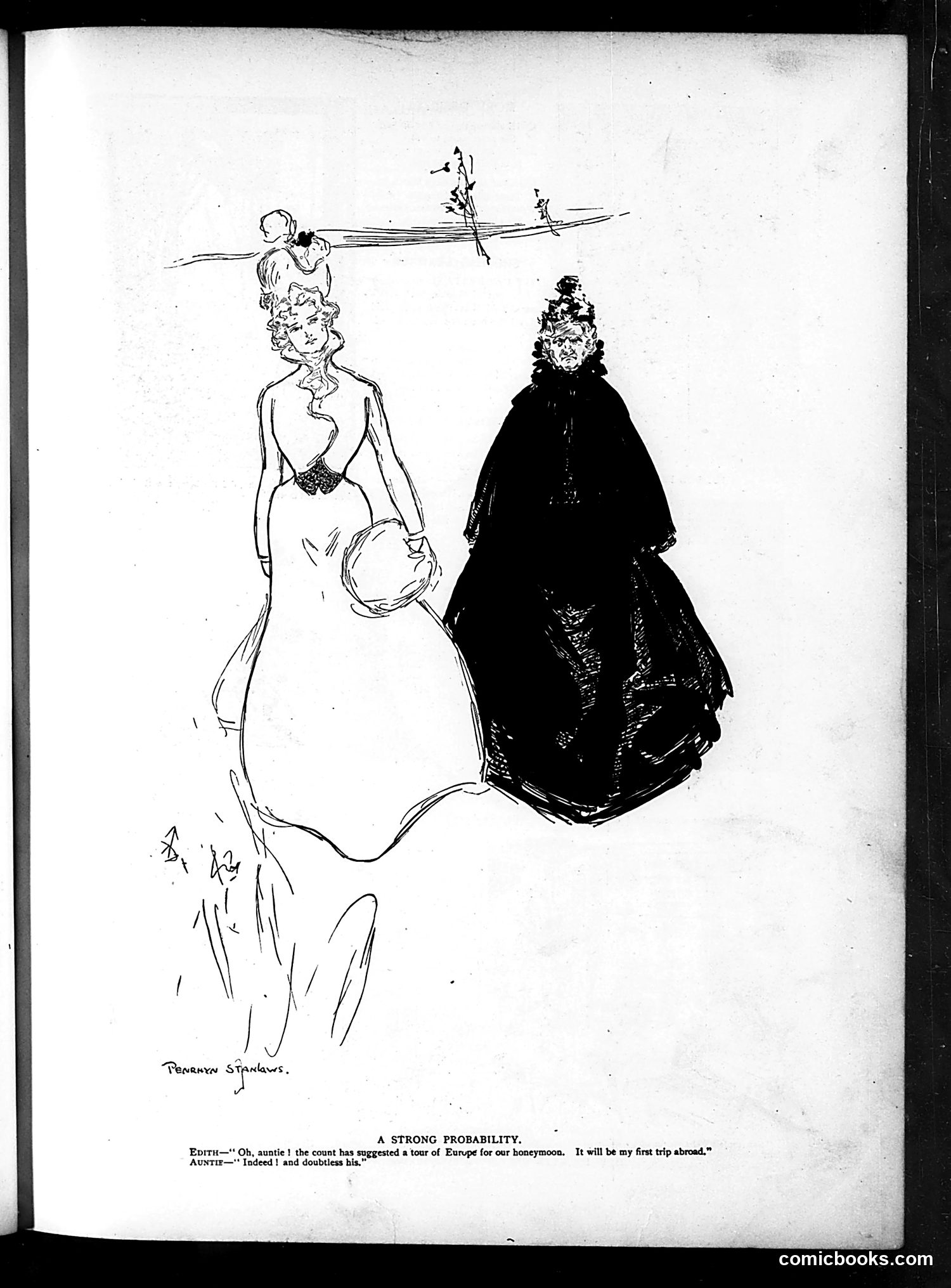
This Judge magazine cartoon satirizes a society wedding. The dialogue shows: **Edith** (the bride, in white): "Oh, auntie! the count has suggested a tour of Europe for our honeymoon. It will be my first trip abroad." **Auntie** (in black): "Indeed! and doubtless his." The joke targets the common practice of wealthy American heiresses marrying European nobility, often impoverished aristocrats seeking American money. "Auntie's" dry response implies the "count" is a fortune hunter—his European tour will be funded by the bride's wealth, and he'll use her money to return home for the first time in years. The satire mocks both the gullibility of wealthy Americans and the mercenary tactics of European suitors.
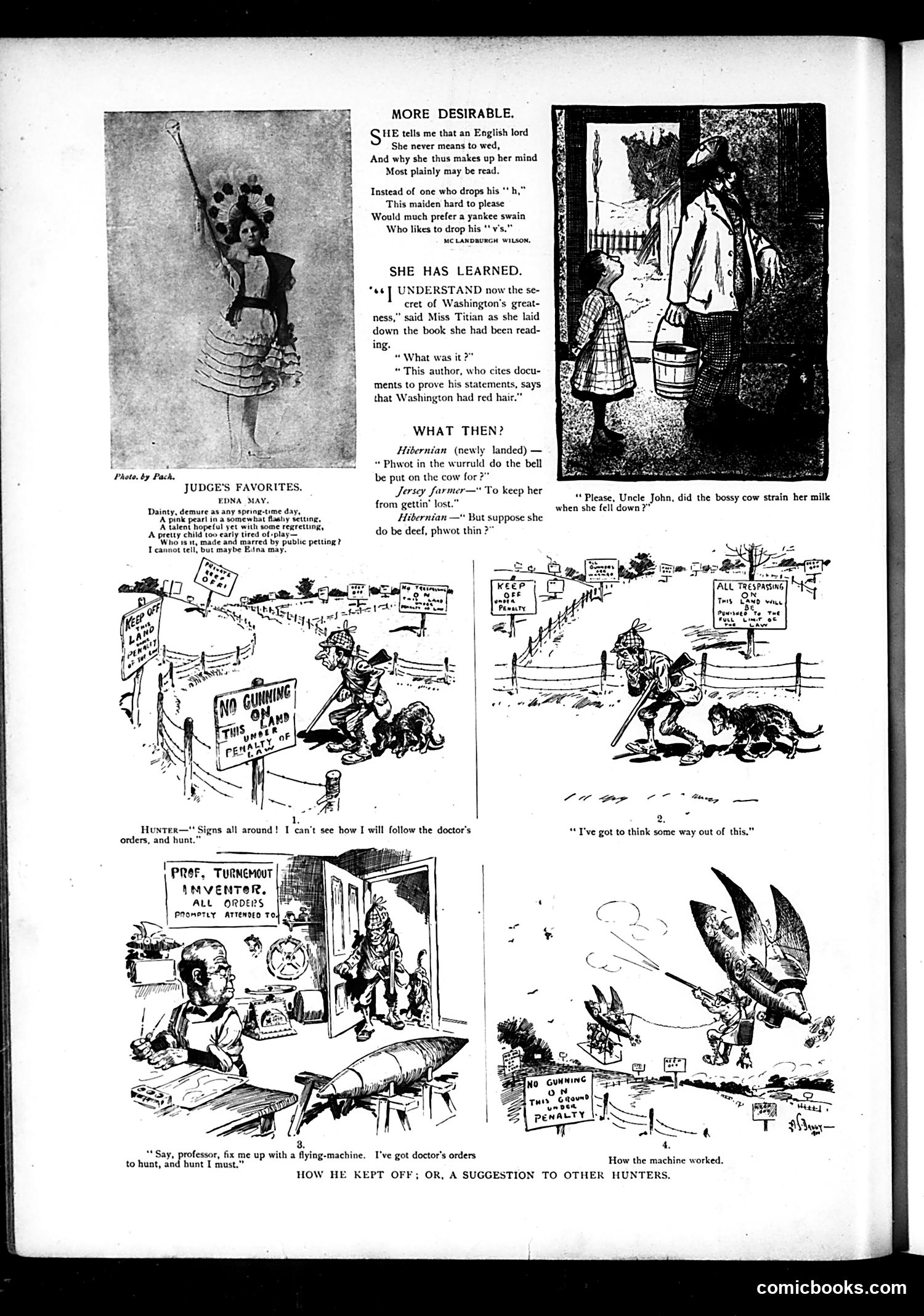
This page contains several humorous sketches satirizing early 20th-century American life and social conventions: **"More Desirable"** mocks English pronunciation pretensions, with a poem suggesting Americans prefer dropping "r's" to affected English accents. **"She Has Learned"** jokes about a woman claiming to understand "Washington's greatness" by citing that George Washington had red hair—satirizing superficial education. **"Judge's Favorites"** and subsequent farm scenes humorously depict rural life mishaps, including a hunter defying doctor's orders to use a flying machine for hunting. **"How He Kept Off"** shows a professor using the flying machine to escape hunting obligations, with the final panel titled "How the machine worked," likely depicting an absurd failure—satirizing both early aviation enthusiasm and the impracticality of emerging technology.
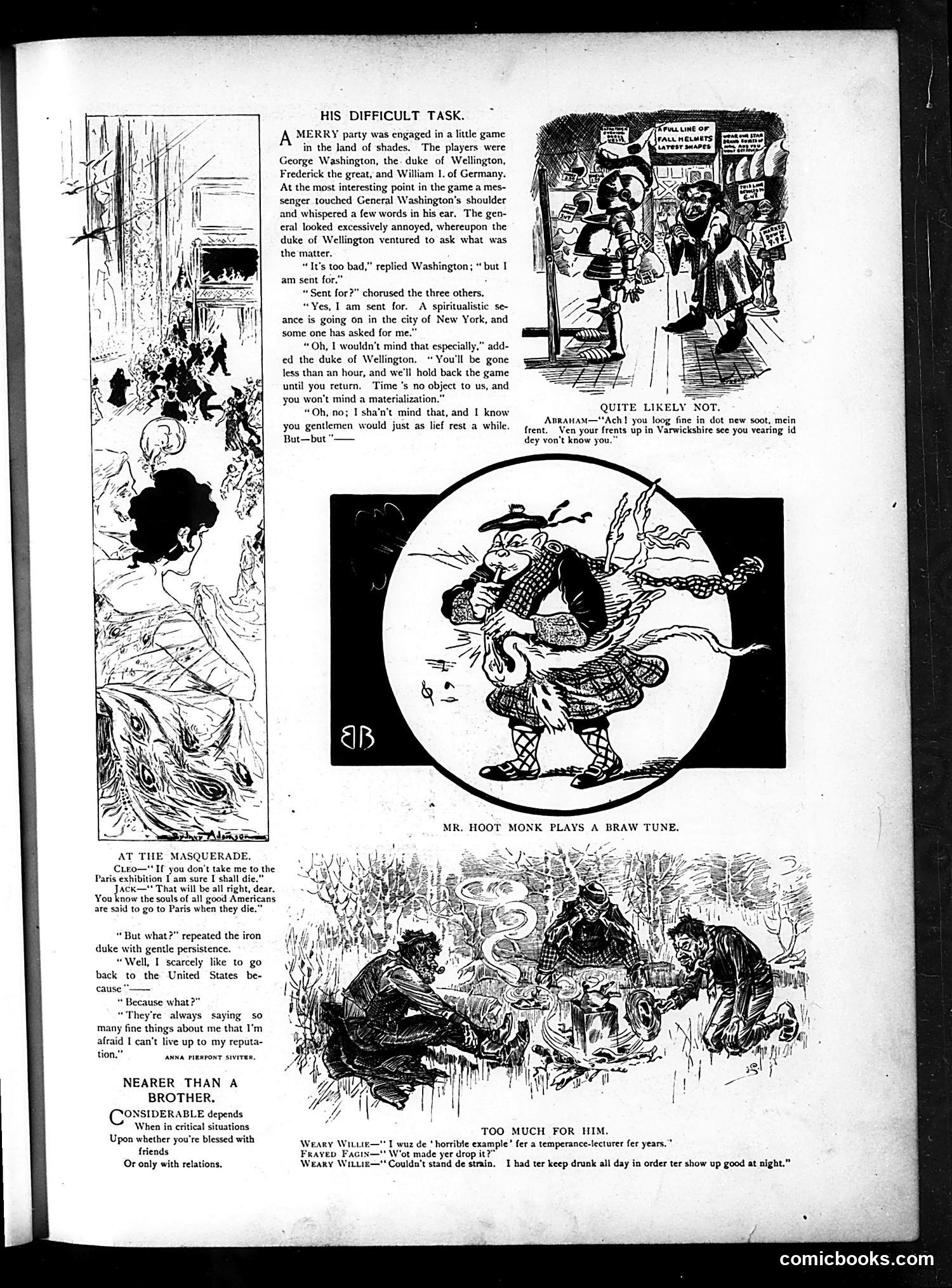
This page contains multiple satirical pieces mocking spiritualism and social pretension: **"His Difficult Task"** depicts famous historical military figures (Washington, Wellington, Frederick the Great, William I of Germany) in the afterlife, interrupted by a spiritualist séance demanding Washington's appearance in New York. The joke targets the era's obsession with spiritualism—treating it as absurdly intrusive even to the dead. Washington's reluctance to return because he "can't live up to [his] reputation" satirizes American glorification of historical figures. **"At the Masquerade"** ridicules wealthy Americans' obsession with Paris exhibitions and culture. **"Too Much for Him"** and **"Nearer Than a Brother"** are dialect humor pieces (in exaggerated immigrant/working-class accents) about temperance lectures and social relations—common Judge fare of the era. The cartoons reflect late 19th-century American anxieties about spiritualism, class pretension, and immigrant assimilation.
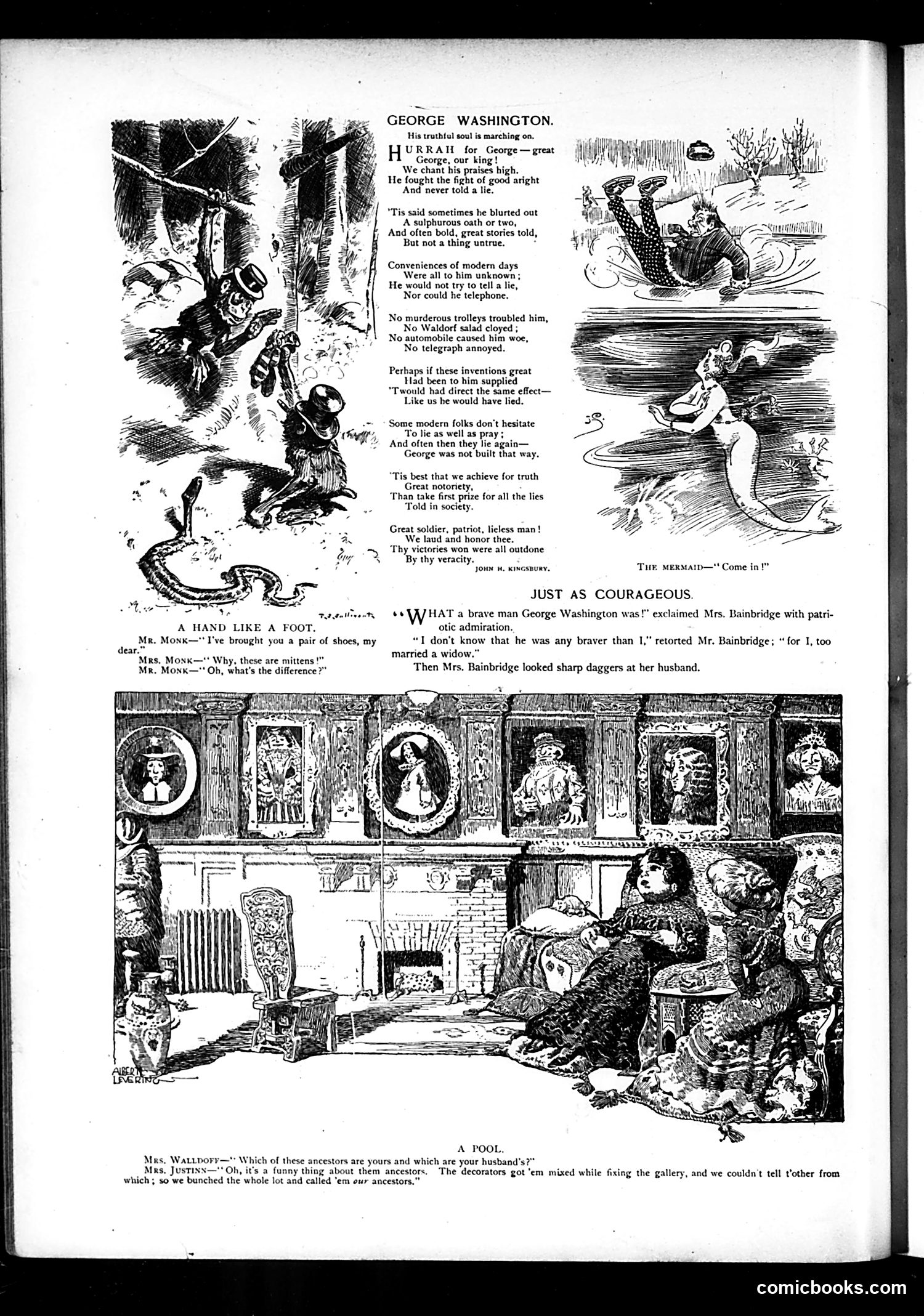
This page celebrates George Washington's legendary honesty, particularly the apocryphal cherry-tree story ("never told a lie"), contrasting his virtue with modern society's casual dishonesty. The poem mocks contemporary conveniences (telephones, automobiles, trolleys) as enabling lies, suggesting that Washington's era of simplicity fostered moral integrity while modernity breeds corruption. The satirical sketches beneath mock petty domestic dishonesty: one couple exchanges a mittens/shoes mix-up with feigned confusion; another has a woman jealously respond to her husband's boast of matching Washington's bravery; a third shows socialites admitting they've bunched together unknown ancestors after decorators mixed up family portraits—all comic examples of everyday deception. The satire's point: American society contradicts Washington's example by normalizing lies in trivial matters, suggesting national moral decline since the founding era.
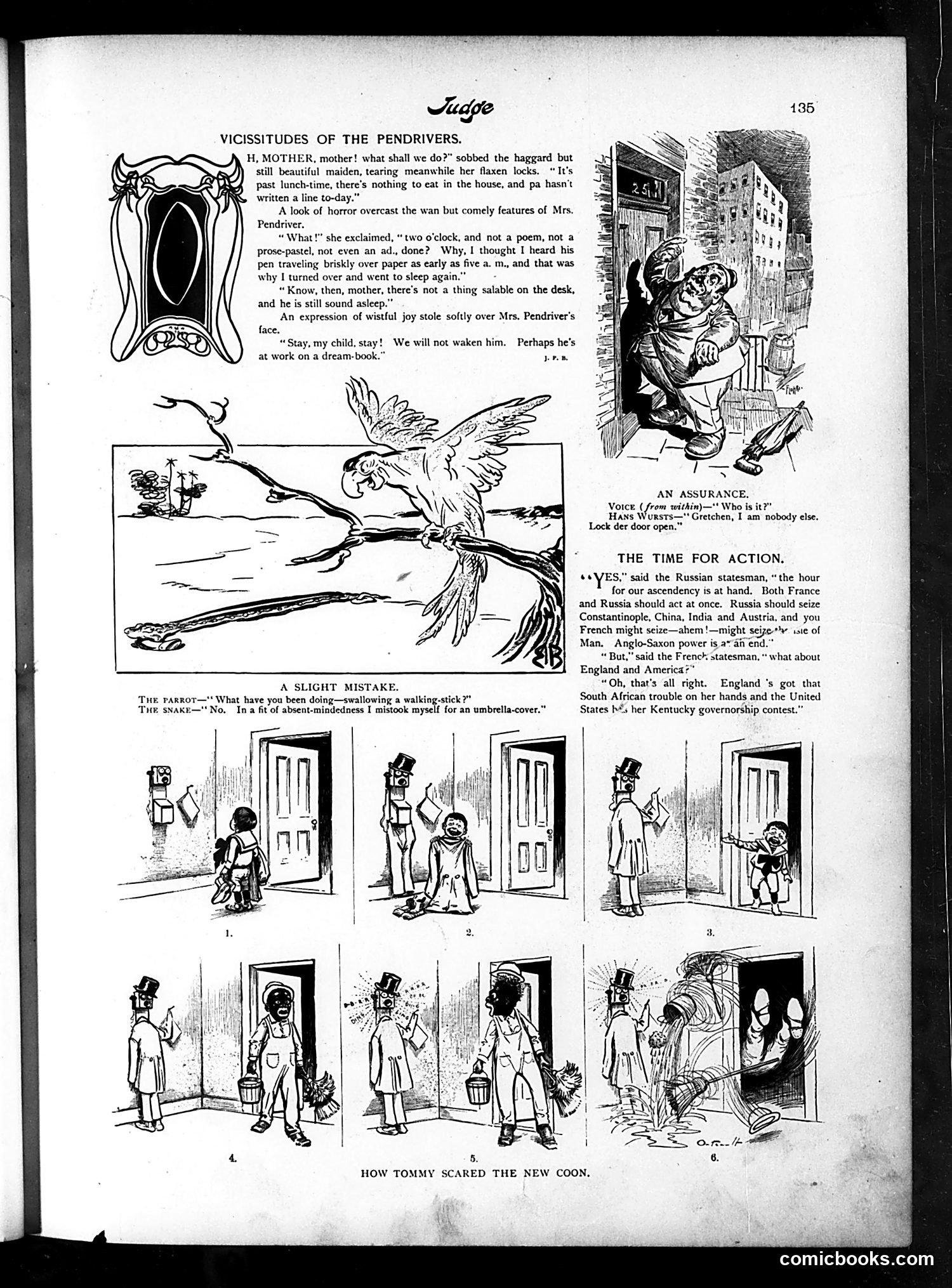
This page contains several satirical pieces typical of late 19th-century humor: **"Vicissitudes of the Pendrivers"** mocks struggling writers ("pen drivers") whose livelihood depends on constant output. The joke: a writer's family celebrates his unproductiveness, hoping he's working on something valuable rather than producing saleable work. **"The Time for Action"** satirizes Russian imperialist ambitions. A Russian statesman proposes aggressive expansion into Constantinople, China, India, and Austria while offering France the "Isle of Man"—a trivial consolation prize. The French statesman's concern about England and America is dismissed. This appears to reference late 19th-century European power politics and colonial rivalries. **"A Slight Mistake"** presents a simple visual joke about a parrot and snake. **"How Tommy Scared the New Coon"** (bottom)—a six-panel sequence depicting a child's interaction with what the title suggests is a raccoon (or uses period-appropriate but now offensive terminology). The narrative arc shows the child's escalating actions. The page reflects typical Judge content: literary satire, international politics commentary, and domestic humor.
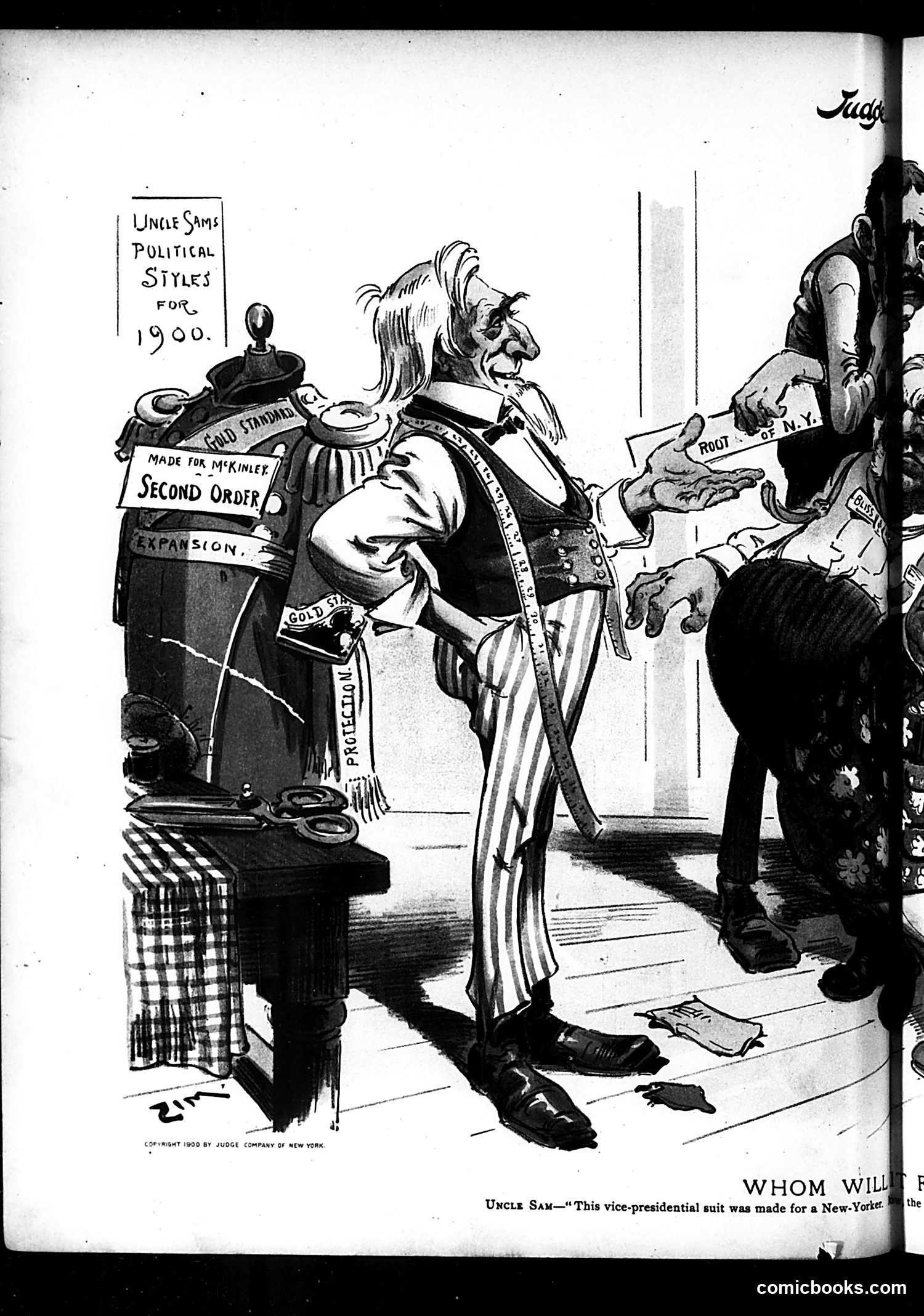
This 1900 *Judge* cartoon satirizes the upcoming U.S. vice-presidential selection. Uncle Sam, personified as a tailor, displays a formal suit labeled "Made for McKinley" and "Second Order," with various political elements attached—including references to "Gold Standard," "Expansion," and what appears to be "Root of N.Y." The cartoon mocks the process of choosing William McKinley's running mate by presenting it as custom tailoring—implying the vice presidency was being fabricated to suit particular interests or candidates. "Root of N.Y." likely references Elihu Root, a New York political figure. The suit's ornate decorations represent competing political factions trying to influence the selection. The satire suggests the vice-presidency was a constructed political garment designed for McKinley's reelection campaign rather than a genuine position chosen on merit.
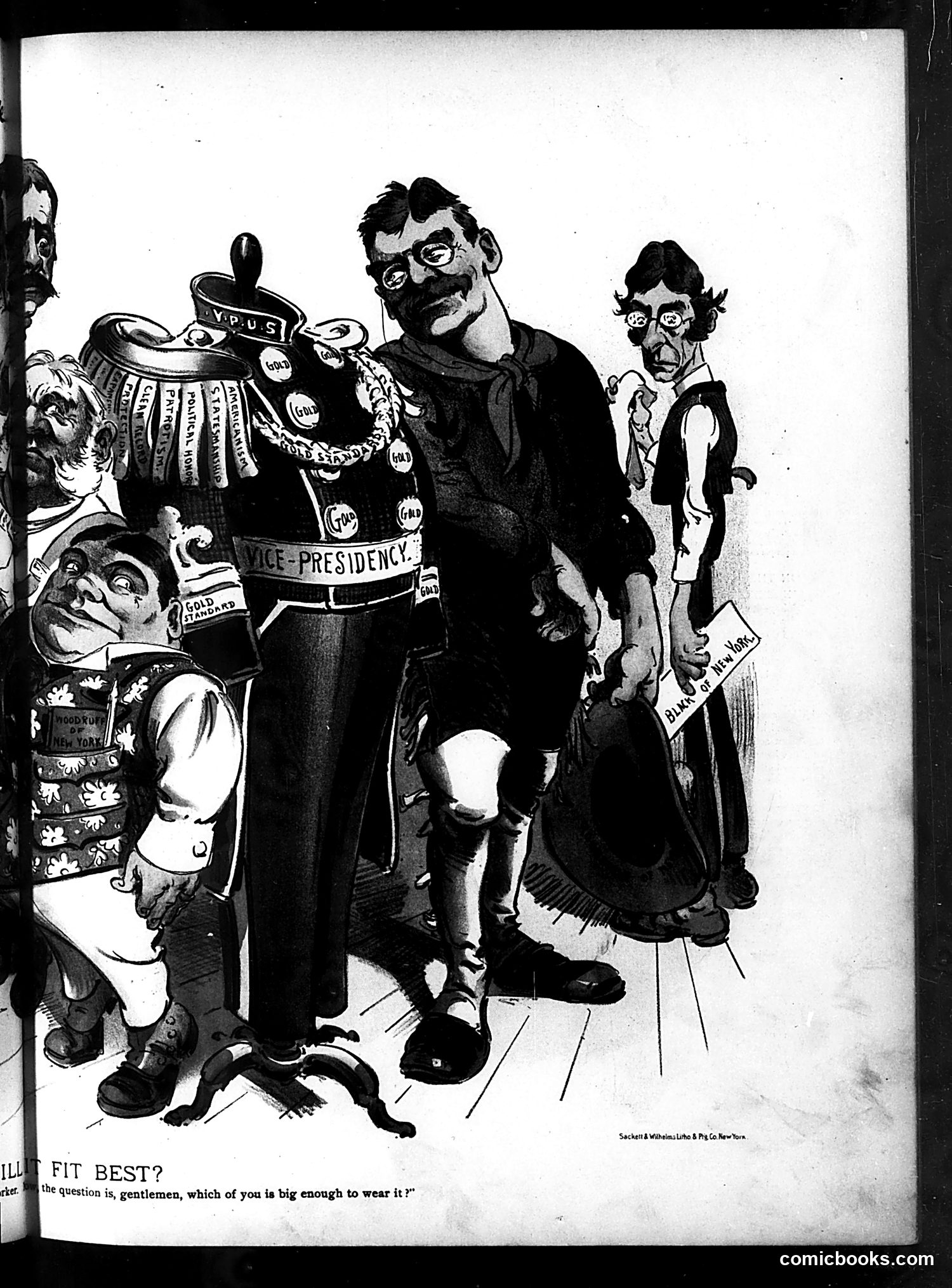
This appears to be a Judge magazine cartoon satirizing American political leadership, likely from the early 20th century. The central figure wears a "Vice-Presidency" costume decorated with various emblems and insignia, suggesting it represents an actual or aspirational political office. The surrounding caricatured figures—depicted with exaggerated features in the period's satirical style—appear to be competing politicians or party figures being mockingly asked "which of you is big enough to wear it?" The joke suggests these political candidates are all too small or inadequate for high office. The elaborate costume itself may be satirizing the inflated pretensions of political ambition. Without clearer identification of specific individuals or a visible date, the precise political context remains unclear, though the satire targets perceived insufficiency among contemporary political figures.
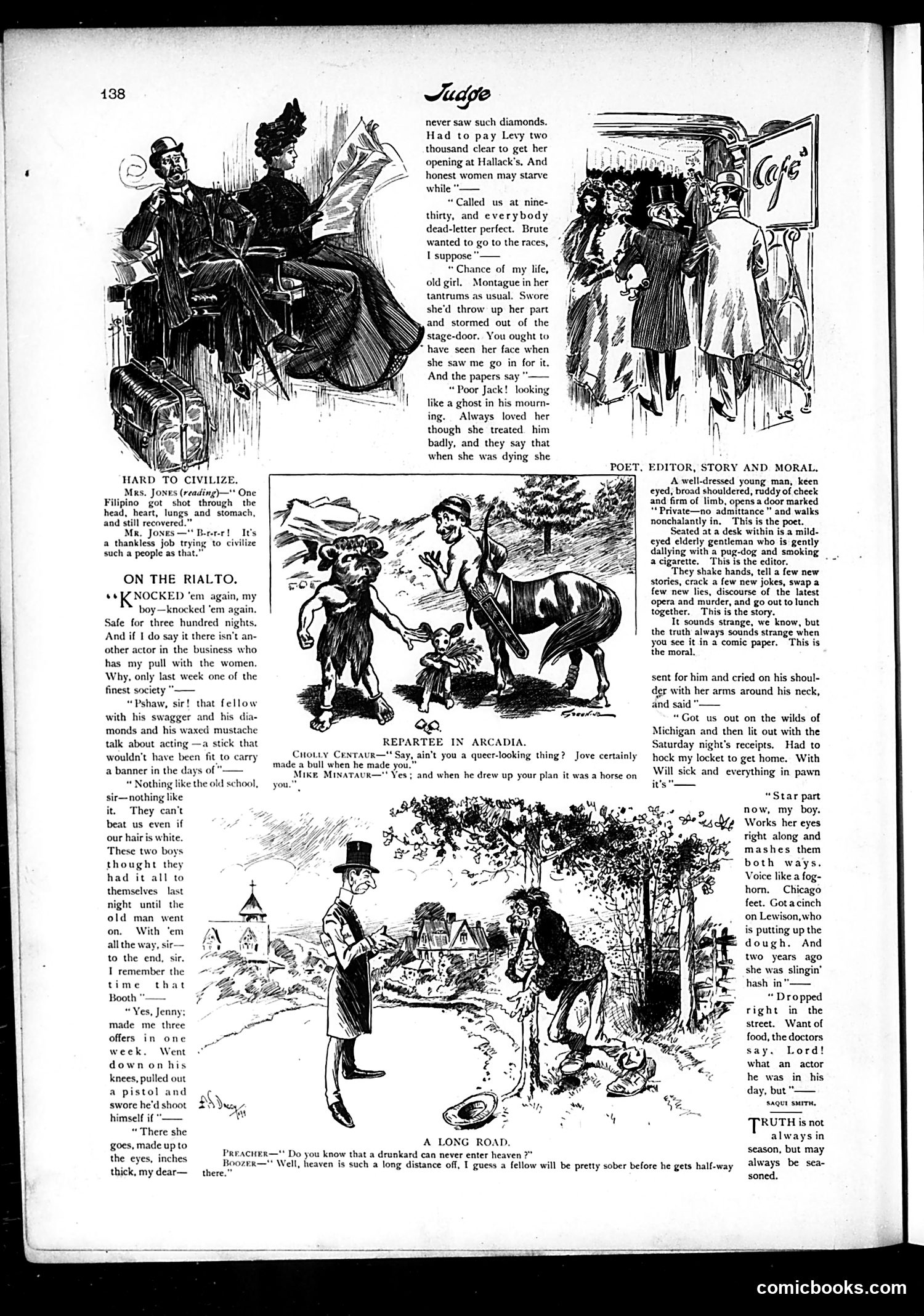
This *Judge* page satirizes several topics: **"Hard to Civilize"** mocks American imperial policy in the Philippines (early 1900s), where Filipino resistance fighters were being killed. The joke darkly suggests Filipinos are so tough that even multiple fatal wounds won't stop them—making them impossible to "civilize" (a euphemism for colonial conquest). **"On the Rialto"** depicts two aging theater actors boasting about their past conquests and theatrical successes. It satirizes vanity in the theatrical world—these men live entirely in nostalgia, name-dropping famous actors like Booth and exaggerating their relevance. **"Repartee in Arcadia"** offers a simple insult joke between a centaur and minotaur, each calling the other a poorly-made creature. **"A Long Road"** jokes that a drunkard might reform through the sheer time it takes to travel to heaven. **"Poet, Editor, Story and Moral"** cynically describes a poet pitching a story to an editor—they swap lies, gossip, and go to lunch. The "moral" is that truth in comic papers sounds absurd.

This is primarily **advertising, not satire or political commentary**. The Prudential Insurance Company placed this full-page ad in *Judge* magazine to promote their dominance in the life insurance market. The ad claims The Prudential "leads the world" with $222 million in new insurance written in 1899—more than any competitor. It emphasizes their strength through: - The **laurel wreath border** (classical symbol of victory/supremacy) - The **Rock of Gibraltar image** with the slogan "The Prudential has the strength of Gibraltar" (their actual company motto, suggesting unshakeable stability) - References to profit-sharing policies available from $15 to $100,000 The company's president, John F. Dryden, is credited. This represents early corporate advertising in *Judge*, capitalizing on the magazine's affluent readership to promote financial products during the Gilded Age.
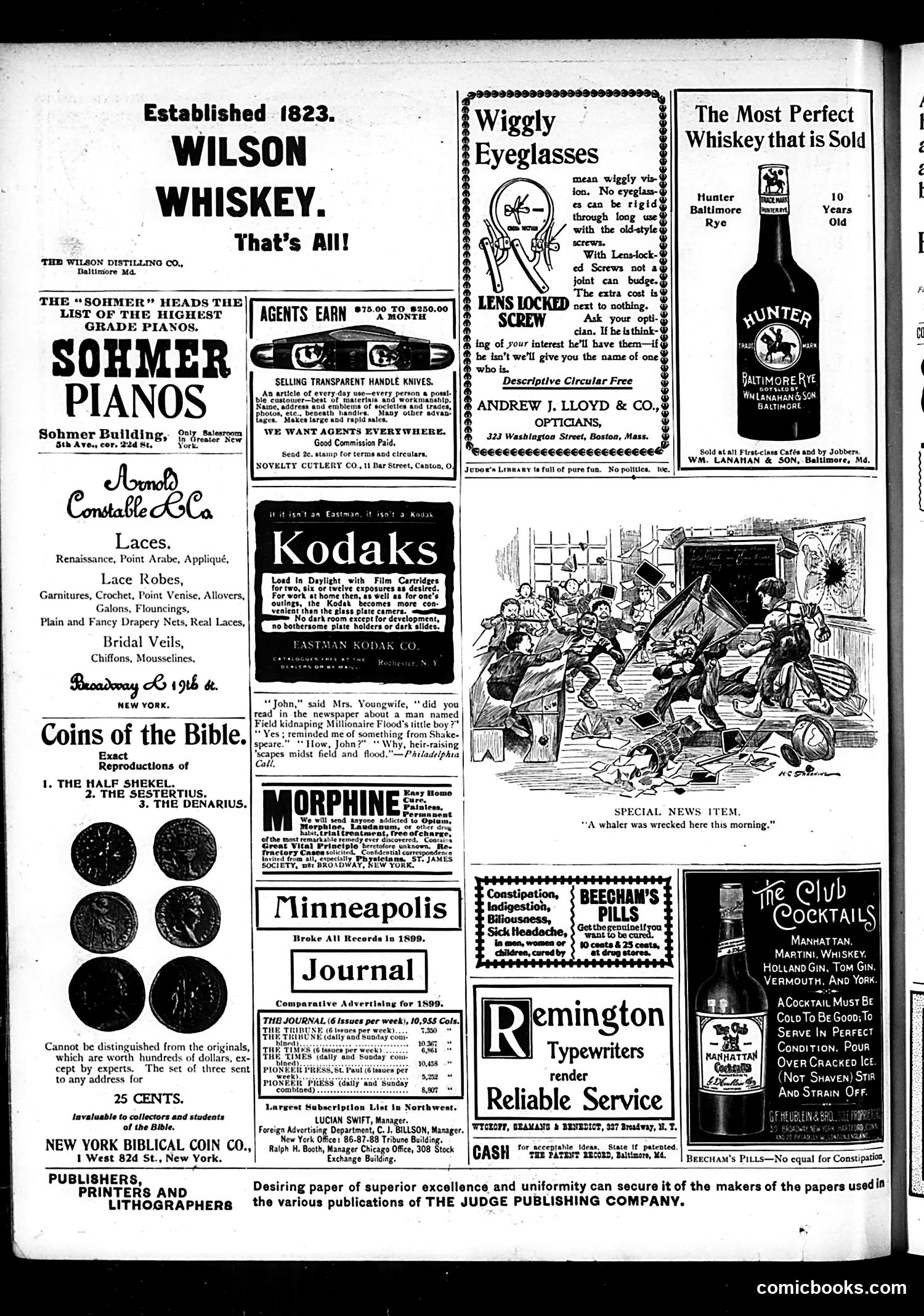
This page is primarily **advertising**, not editorial content or political cartoons. Judge magazine filled pages with commercial advertisements for products ranging from whiskey to typewriters. The one notable editorial element is a small cartoon captioned "SPECIAL NEWS ITEM: A whaler was wrecked here this morning," depicting what appears to be a chaotic maritime accident scene. This is a visual gag—likely mocking sensationalist newspaper reporting or making an ironic comment about everyday disasters treated as "news." The advertisements reflect 1899 consumer culture: Wilson Whiskey, Sohmer Pianos, Kodak cameras (emphasizing their modern convenience), Morphine remedies (legal at this time), and Remington Typewriters. There's also a brief textual joke referencing a kidnapping case involving "Field" and "Flood"—likely alluding to a real contemporary crime story, with a Shakespeare pun. The page primarily documents **commercial products of the era** rather than satirical political commentary.
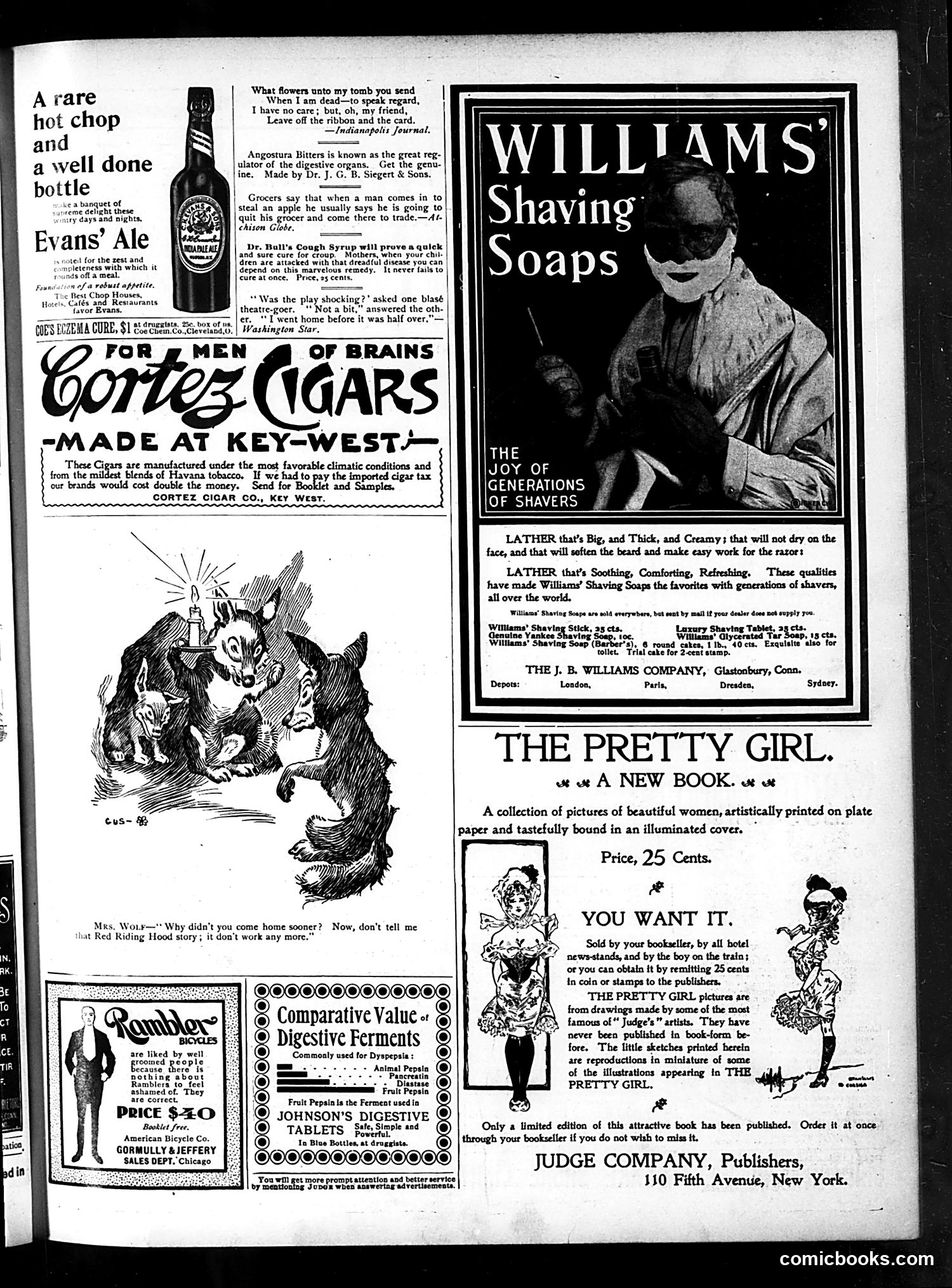
This page is primarily **advertising** with minimal editorial content. The main items include: **Advertisements:** Evans' Ale, Cortez Cigars, Williams' Shaving Soaps, Ramblers Bicycles, Johnson's Digestive Tablets, and "The Pretty Girl" book (a collection of illustrations of attractive women). **Minimal Cartoon/Editorial Content:** There is one small comic illustration labeled "Mrs. Wolf" showing a domestic scene where a wife confronts her husband about coming home late, dismissing his excuse about "Red Riding Hood" as no longer believable. The caption suggests marital discord and a wife's skepticism of her husband's excuses—a common theme in period humor. **Social Context:** The "Pretty Girl" book advertisement reflects early-1900s popular culture fascination with illustrated images of beautiful women, sold through bookstores and train vendors. The page primarily serves as a vehicle for product advertising rather than satirical commentary or political messaging.
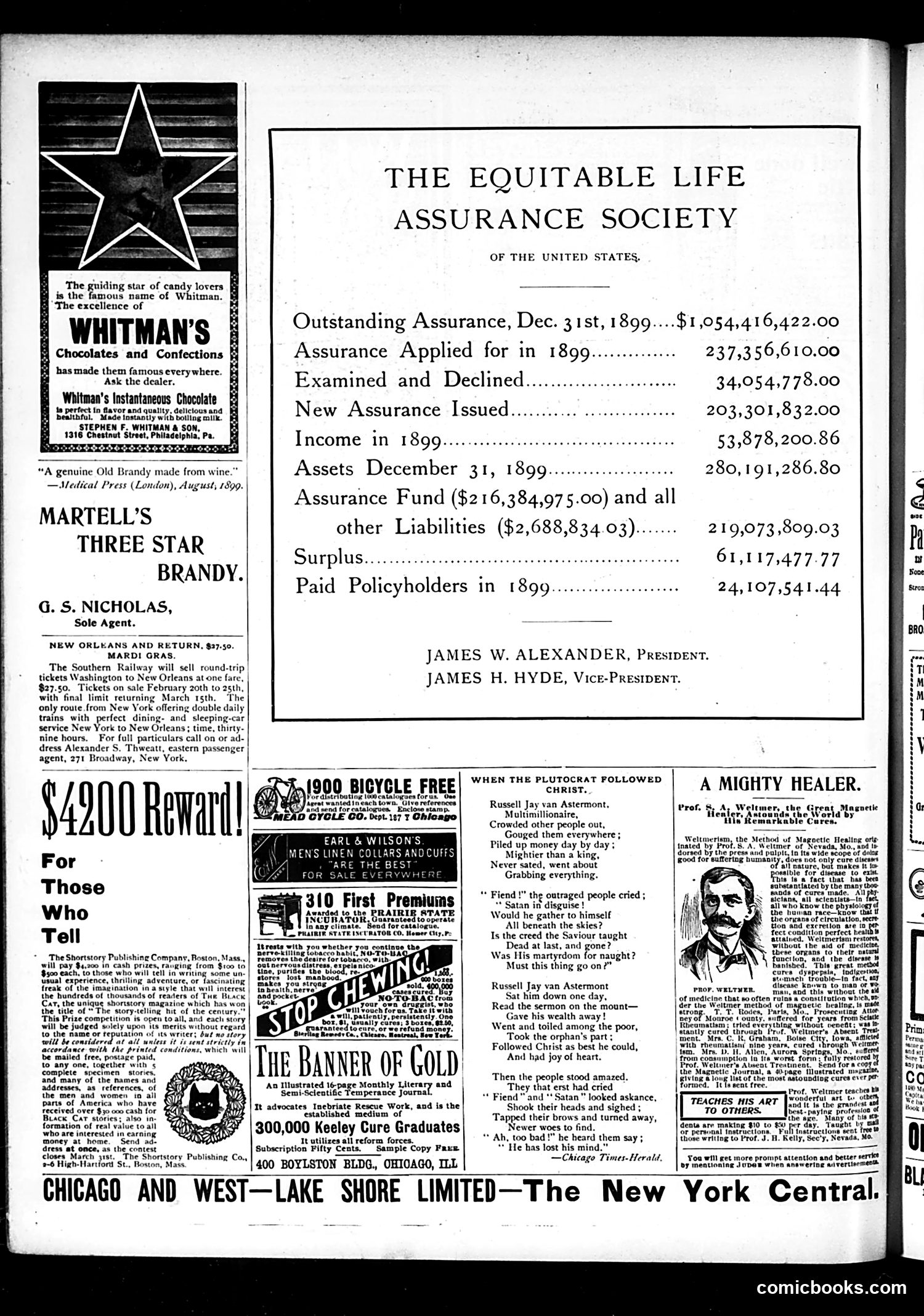
This page is primarily **advertising and financial announcements**, not satirical content. The main feature is a statement from The Equitable Life Assurance Society displaying substantial financial figures ($1 billion+ in outstanding assurance). The only narrative content is a poem titled "When the Plutocrat Followed Christ," featuring a wealthy industrialist named Russell Jay van Astermont. The satire is straightforward: it depicts a stereotypical Gilded Age robber baron—someone who ruthlessly accumulates wealth through exploitation—experiencing a moral conversion after reading Christ's Sermon on the Mount. He then renounces his fortune and helps the poor. The satire targets wealthy industrialists of the era, suggesting their greed contradicts Christian values, and implying such conversions are rare or remarkable. The poem reflects Progressive-era social criticism of unchecked capitalism and wealth concentration, common themes in Judge during this period. The surrounding ads (chocolates, brandy, railway tickets, story contests) represent typical advertising of the era.
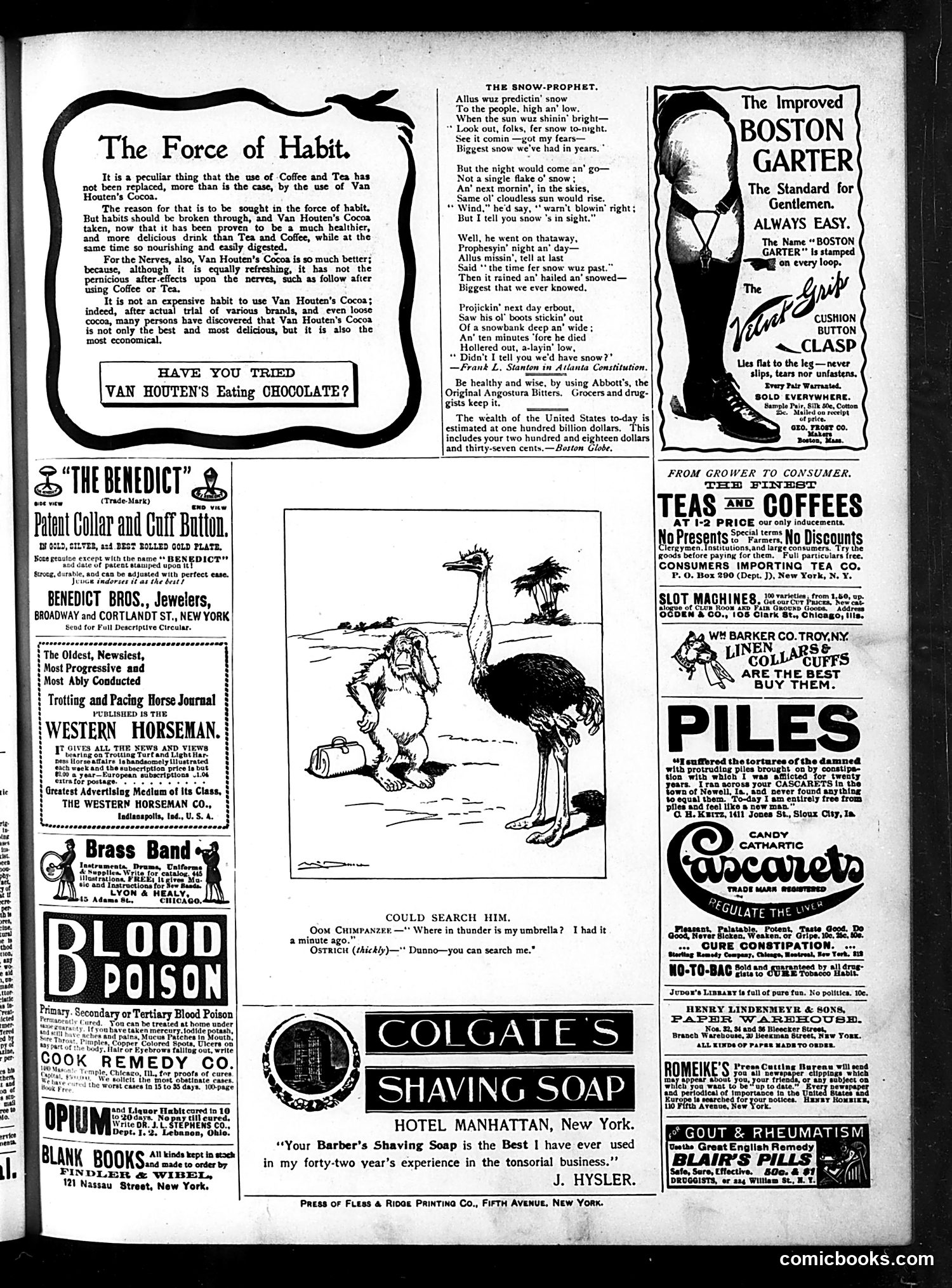
This page is primarily **advertising**, typical of Judge magazine's revenue model. However, it contains one notable satirical cartoon: ## "Could Search Him" Cartoon The central cartoon depicts an ostrich with its head buried in sand, alongside a chimpanzee. The caption jokes that when the chimp asks the ostrich where its umbrella is, the ostrich responds "Dunno—you can search me." **The satire:** This plays on the popular (false) belief that ostriches bury their heads in sand when frightened. The humor lies in the ostrich's literal response to "search me"—it cannot be searched because its head is inaccessible. It's a simple visual pun exploiting the outdated animal misconception. ## Other Content The page features numerous patent medicine and product advertisements typical of the era (cocoa, bitters, garters, pills for piles), plus editorial verse called "The Snow-Prophet" about a failed weather predictor. None of these contain political satire—they're straightforward commercial content and light humor. The cartoon's appeal relies entirely on audience familiarity with the ostrich-head myth, now scientifically discredited.
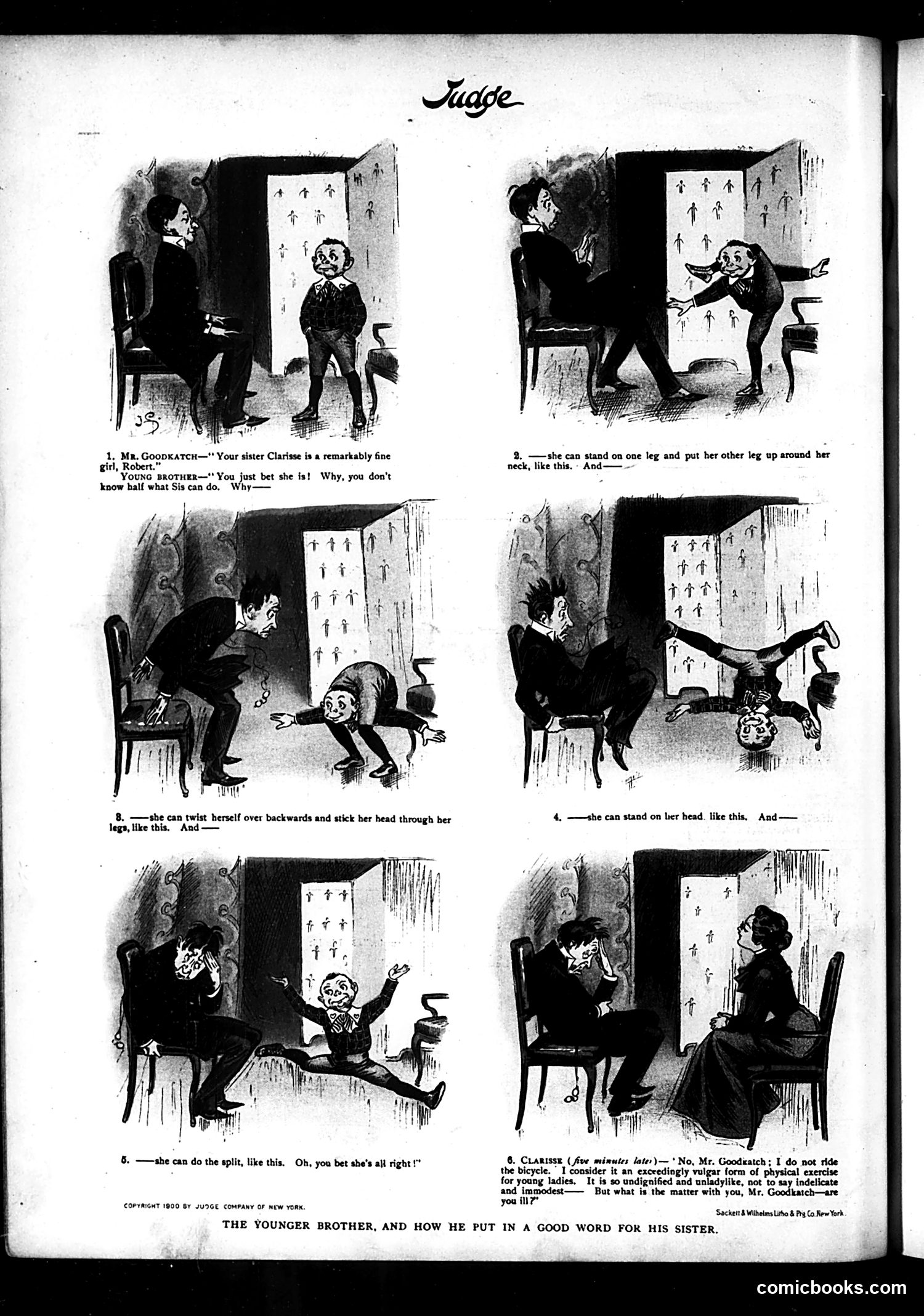
This 1900 Judge cartoon satirizes Victorian-era gender hypocrisy regarding physical activity for women. **The Setup:** A young brother enthusiastically boasts to Mr. Goodkatch about his sister Clarisse's impressive physical abilities—she can perform acrobatic feats like contortions, splits, and backbends. **The Joke:** In panel 6, when Goodkatch later proposes to Clarisse, she primly refuses, declaring that riding a bicycle is "exceedingly vulgar" and "indelicate" for young ladies—too undignified and immodest. **The Satire:** The cartoon mocks the contradictory standards imposed on women. Clarisse's family celebrates her ability to perform elaborate physical contortions (which would require exposing her legs and body), yet she claims a bicycle—a practical activity—is too improper. The brother's well-intentioned boasting actually undermines her pretense of delicate propriety, exposing the absurdity of these arbitrary social rules. The cartoon critiques how Victorian society simultaneously demanded women be athletic enough to perform for entertainment while claiming they were too fragile for independent activities like cycling.