
Judge, 1900-03-03 · page 5 of 16
Judge — March 3, 1900 — page 5: what you’re looking at
What you’re looking at
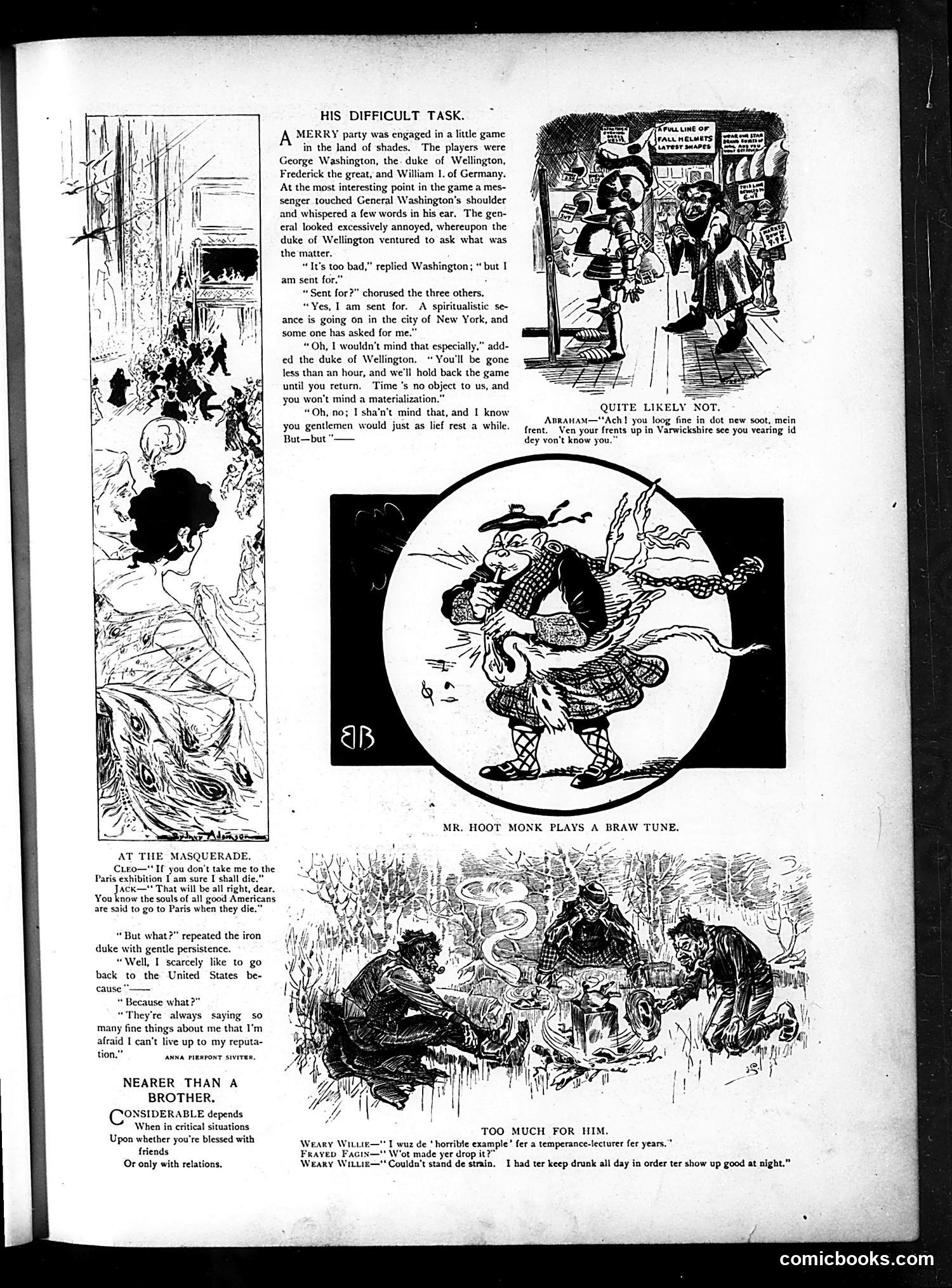
This page contains multiple satirical pieces mocking spiritualism and social pretension: **"His Difficult Task"** depicts famous historical military figures (Washington, Wellington, Frederick the Great, William I of Germany) in the afterlife, interrupted by a spiritualist séance demanding Washington's appearance in New York. The joke targets the era's obsession with spiritualism—treating it as absurdly intrusive even to the dead. Washington's reluctance to return because he "can't live up to [his] reputation" satirizes American glorification of historical figures. **"At the Masquerade"** ridicules wealthy Americans' obsession with Paris exhibitions and culture. **"Too Much for Him"** and **"Nearer Than a Brother"** are dialect humor pieces (in exaggerated immigrant/working-class accents) about temperance lectures and social relations—common Judge fare of the era. The cartoons reflect late 19th-century American anxieties about spiritualism, class pretension, and immigrant assimilation.
📄 Transcribed text from this page (OCR, searchable)
Machine-transcribed from the original scan — historical spelling and the odd misread are preserved.
HIS DIFFICULT TASK. A MERRY party was engaged in a little game in the land of shades. The players were George Washington, the. duke of Wellington, Frederick the great, and William I. of Germany. At the most interesting point in the game a mes- senger touched General Washington's shoulder and whispered a few words in his ear. The gen- eral looked excessively annoyed, whereupon the duke of Wellington ventured to ask what was the matter. “It’s too bad,” replied Washington; “ but I am sent for.” “Sent for?” chorused the three others. “Yes, I am sent for. A spiritualistic se ance is going on in the city of New York, and some one has asked for me.” “Oh, I wouldn't mind that especially,” add- ed the duke of Wellington. “You'll be gone less than an hour, and we'll hold back the game until you return. Time ’s no object to us, and you won't mind a materialization.” Pees “Oh, no; I sha'n't mind that, and I know QUITE LIKELY "aid face fae. i ‘ Apranam—Ach ! you loog fine in dot new soot, mein you gentlemen would just as lief rest a while. rent Ven your frents up in Varwickshire see you vearing id But—but "— dey von't know you.” MASQUERADE, CLeo—"' If you don't take me to the Paris exhibition I'am sure I shall die.” ACK—"* That will be all right, dear. You know the souls of all good Americans are said to go to Paris when they die.” “But what?" repeated the iron duke with gentle persistence. “Well, I scarcely like to go back to the United States be- cause Because what?” “They're always saying so many fine things about me that I'm afraid I can't live up to my reputa- tion.’ ANNA PLERPONT SIVITRR, NEARER THAN A BROTHER. CONSIDERABLE depends When in critical situations TOO MUCH FOR HIM. Upon whether you're blessed with I wuz de ‘horrible example’ fer a temperance-lecturer fer years.” friends FRAvED Fa “* Wot made yer drop it?” Or only with relations. Weary Wit Couldn't stand de strain. I had ter keep drunk all day in order ter show up good at night.” comicbooks.com