
A complete issue · 16 pages · 1900
Judge — February 17, 1900
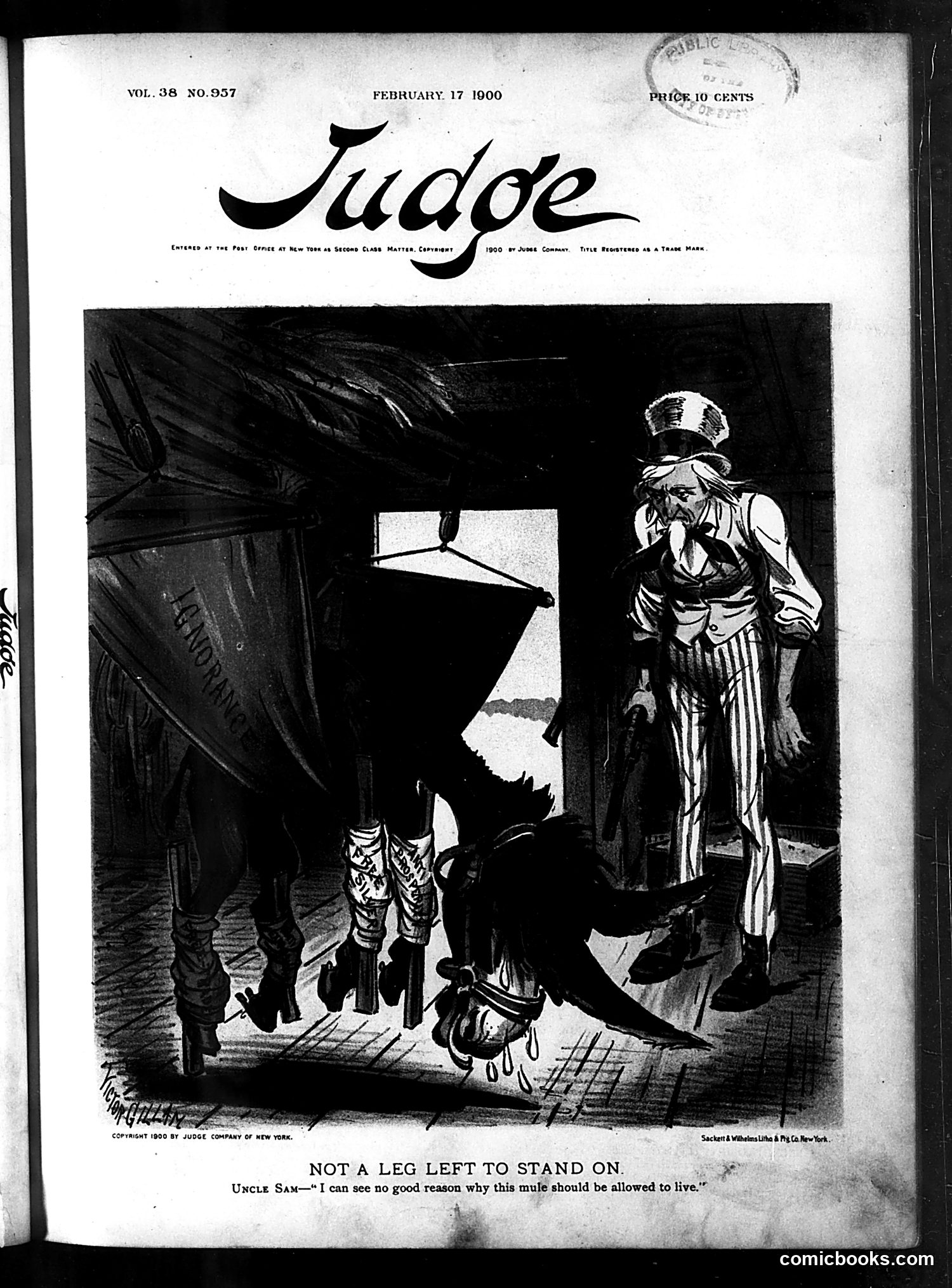
This February 1900 *Judge* cartoon satirizes American foreign policy regarding the Philippine-American War. Uncle Sam (the tall figure in striped pants and star-spangled hat) observes a severely injured mule, saying he sees "no good reason why this mule should be allowed to live." The mule represents the Philippines, depicted as crippled and maimed—"not a leg left to stand on." The cartoon critiques the brutal consequences of the U.S. military campaign in the Philippines, which began in 1899. By portraying the nation as a destroyed animal beyond usefulness, the cartoonist suggests American intervention has devastated the islands, leaving them unable to function independently. The satire questions the justification for continuing the conflict.
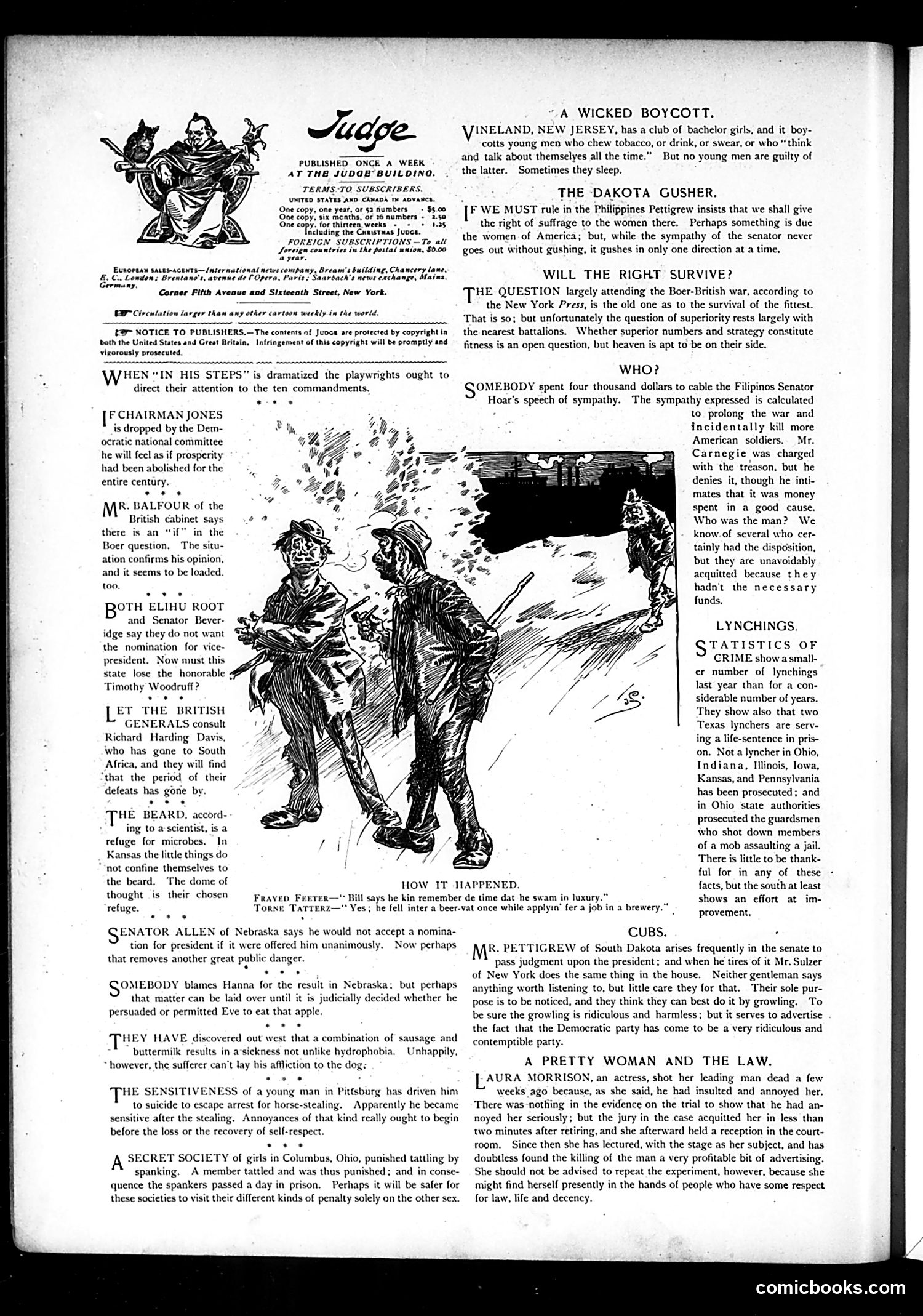
The central cartoon, titled "How It Happened," depicts two men in a physical altercation, illustrating the caption about "Frayed Fetters" and someone swimming in luxury before a brewery incident. The specific historical event is unclear from the image alone. The page contains multiple brief political commentary sections critiquing various figures: Chairman Jones (Democratic), Mr. Balfour (British cabinet member on the Boer War), Senator Allen (Nebraska), and others. These appear to be satirical jabs at political positions rather than elaborate cartoon satire. A substantial article discusses lynching statistics, presenting it as a crime problem requiring state-level prosecution solutions—reflecting late 19th/early 20th-century Progressive Era discourse on law and order. The "Pretty Woman and the Law" section comments on an actress's legal troubles, suggesting public disapproval of her conduct.
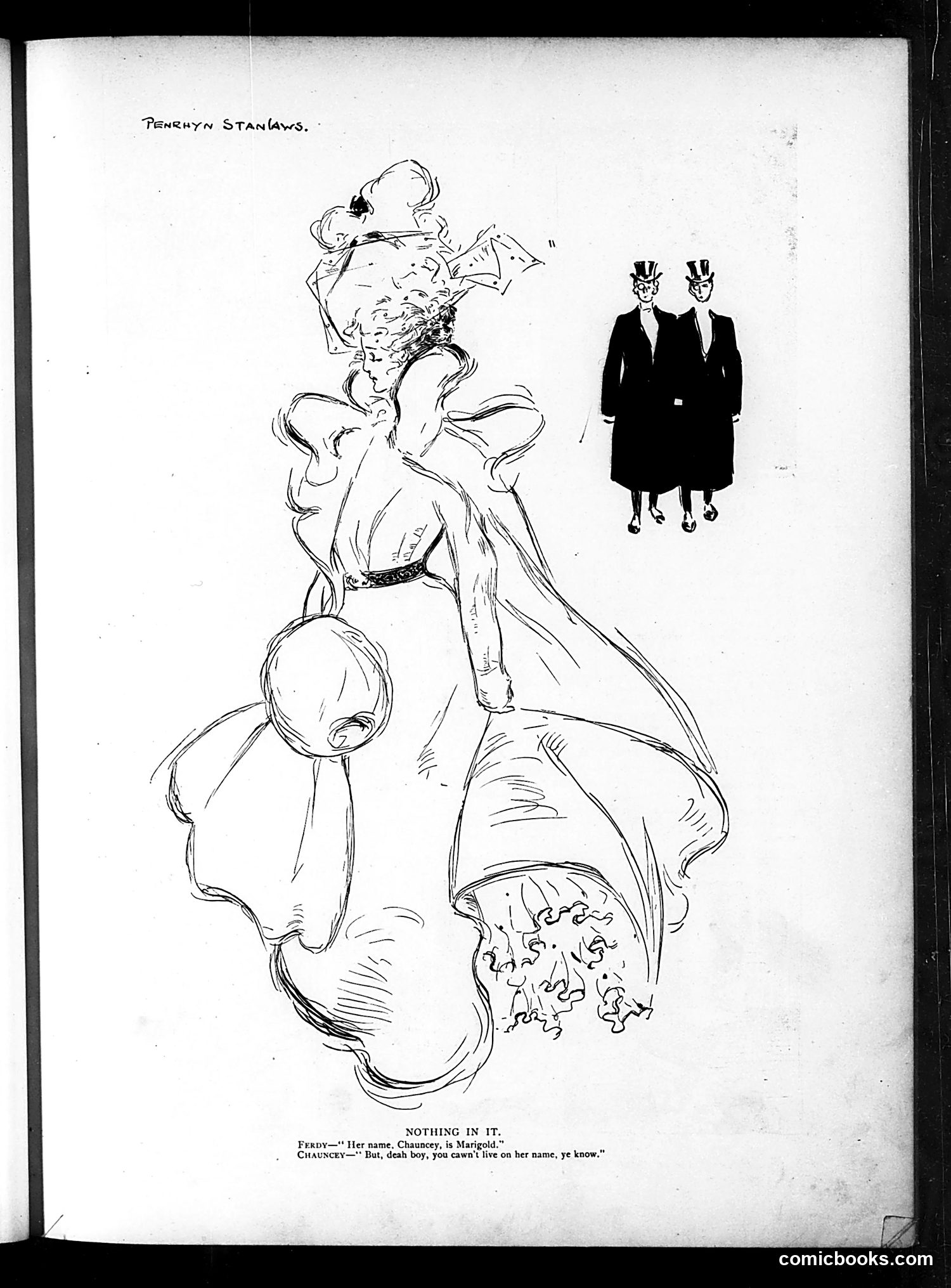
This page features a satirical cartoon by artist Penrhyn Stanlaws from *Judge* magazine. The central image depicts a grotesquely exaggerated female figure emerging from what appears to be a large clam or shell, with small figures tumbling from the base. The caption references a dialogue between "Freddy" and "Chauncey" about someone named Chauncey being "married" to a woman, with Chauncey responding that despite her name, "you can't live on her name, you know." The satirical point appears to target wealthy or aristocratic marriages of convenience, mocking the notion that social status or a prestigious name alone provides financial security. The grotesque imagery emphasizes the emptiness of such unions. The two formally-dressed observers on the right reinforce the social commentary.
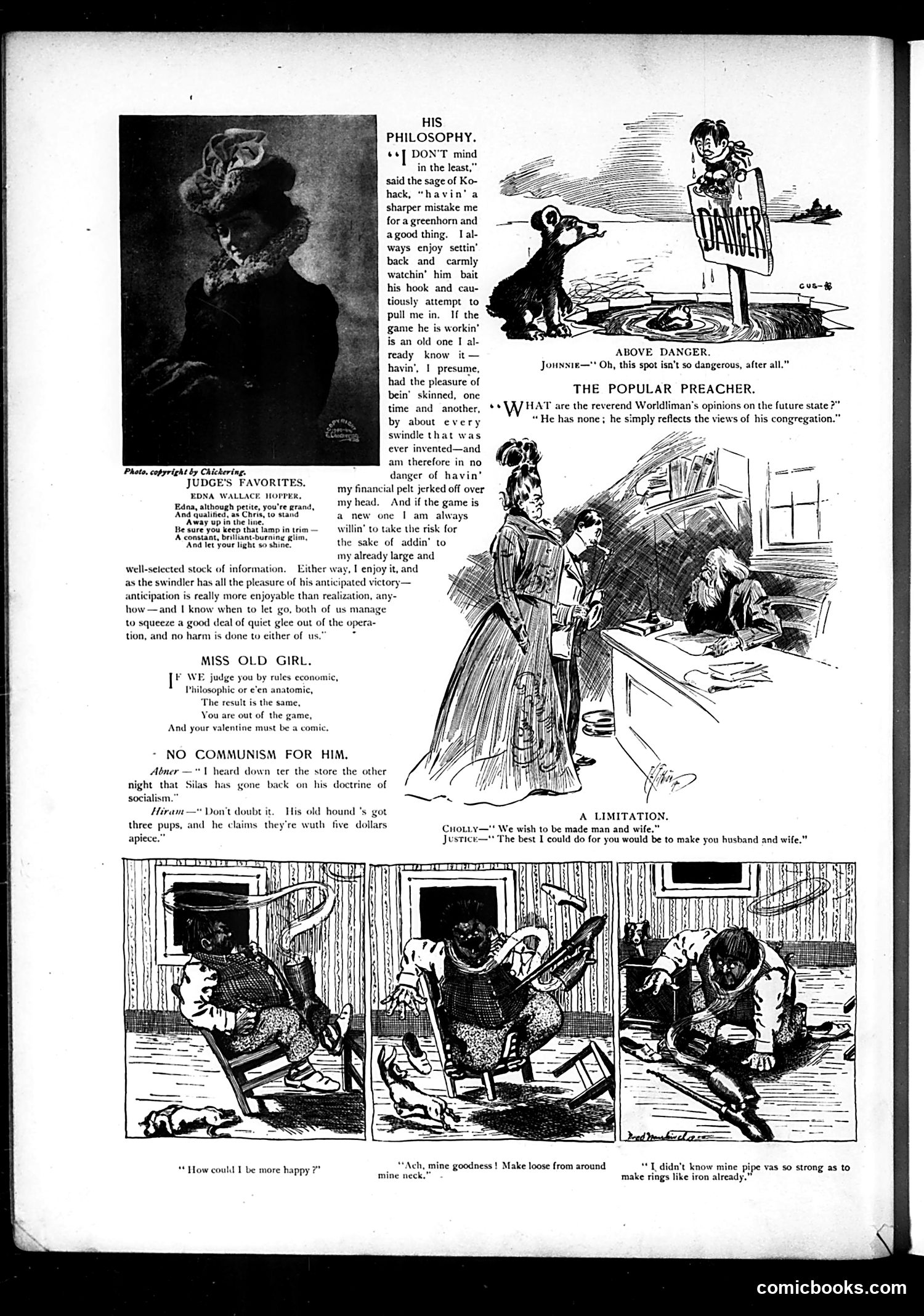
This page contains satirical commentary and humorous illustrations typical of early 20th-century American humor magazines. **"Judge's Favorites"** features a portrait of an elegant woman with witty verse celebrating her refined taste and discernment. **"The Popular Preacher"** mocks a reverend who simply echoes his congregation's existing views rather than offering independent moral leadership—satire on religious conformity. **"Miss Old Girl"** and **"No Communism for Him"** are brief humorous exchanges poking fun at economic philosophy and socialist doctrine, reflecting contemporary anxieties about radical ideology. The bottom strip appears to be a domestic comedy sequence about a pipe-smoking character, likely satirizing Victorian-era husband behavior or marital dynamics. Overall, the page reflects Judge's characteristic blend of social observation and gentle mockery of contemporary American society, religion, and politics.
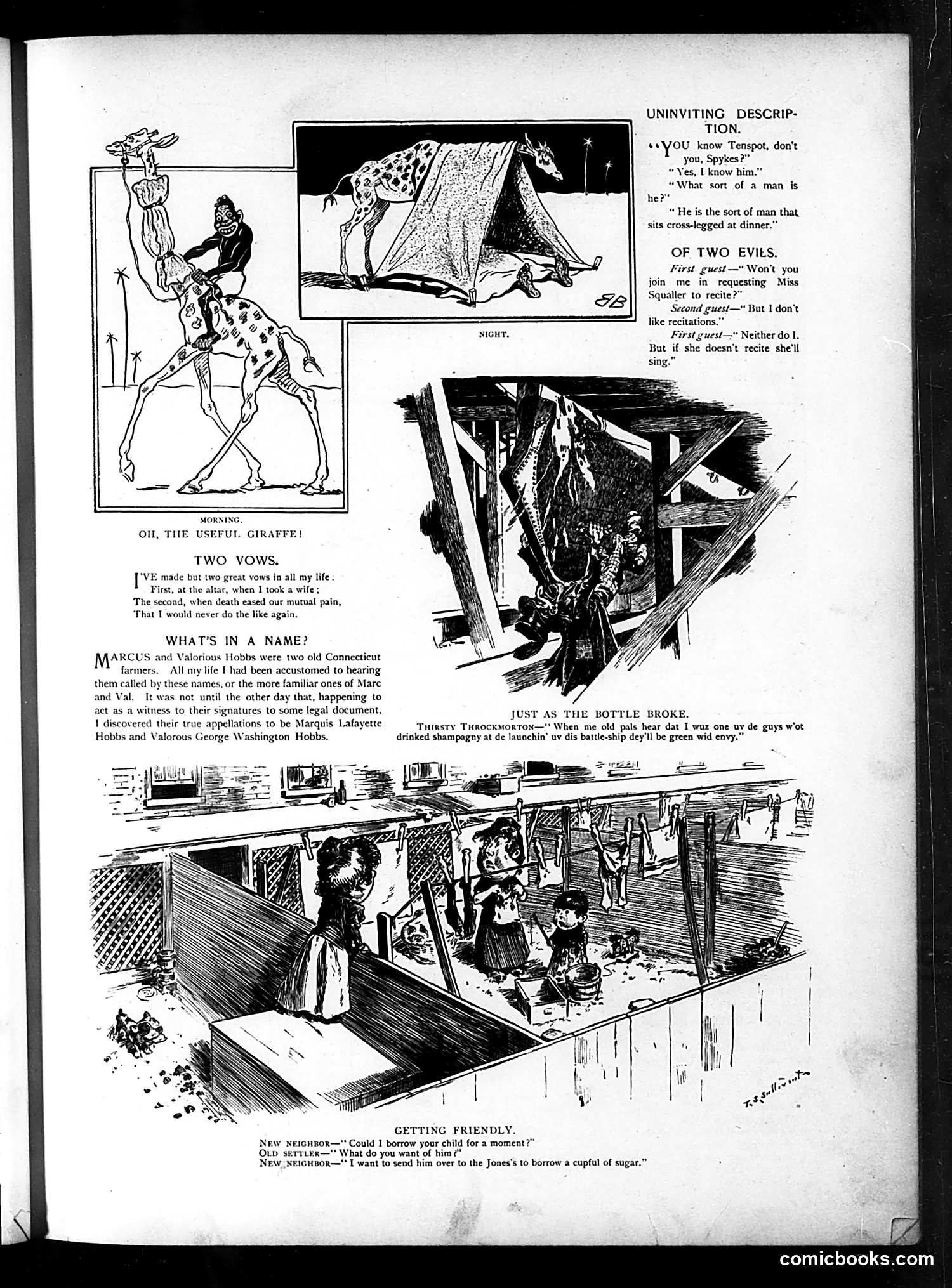
This page contains multiple unrelated satirical vignettes typical of Judge magazine's humor: **"Uninviting Description"** and **"Of Two Evils"** are brief social jokes mocking Victorian etiquette and tedious social obligations (awkward dinner guests, unwanted recitations). **"Two Vows"** is a cynical marriage joke: a man swears never to remarry after his wife's death brings him relief. **"What's in a Name?"** satirizes rural Connecticut farmers bearing grandiose patriotic names (Marquis Lafayette, Valorous George Washington) despite their humble station—a commentary on American democratic pretension or immigrant naming aspirations. **"The Useful Giraffe"** (top-left illustration) appears to be satirical commentary on colonial or exotic animals, though context is unclear. **"Just as the Bottle Broke"** mocks working-class Irish pretension: a character boasts about attending a ship launch where champagne was served, seeking envy from peers. **"Getting Friendly"** depicts new neighbors and class dynamics—borrowing sugar represents either friendly neighborliness or calculated social positioning. The page satirizes social climbing, marital discord, and class pretension.
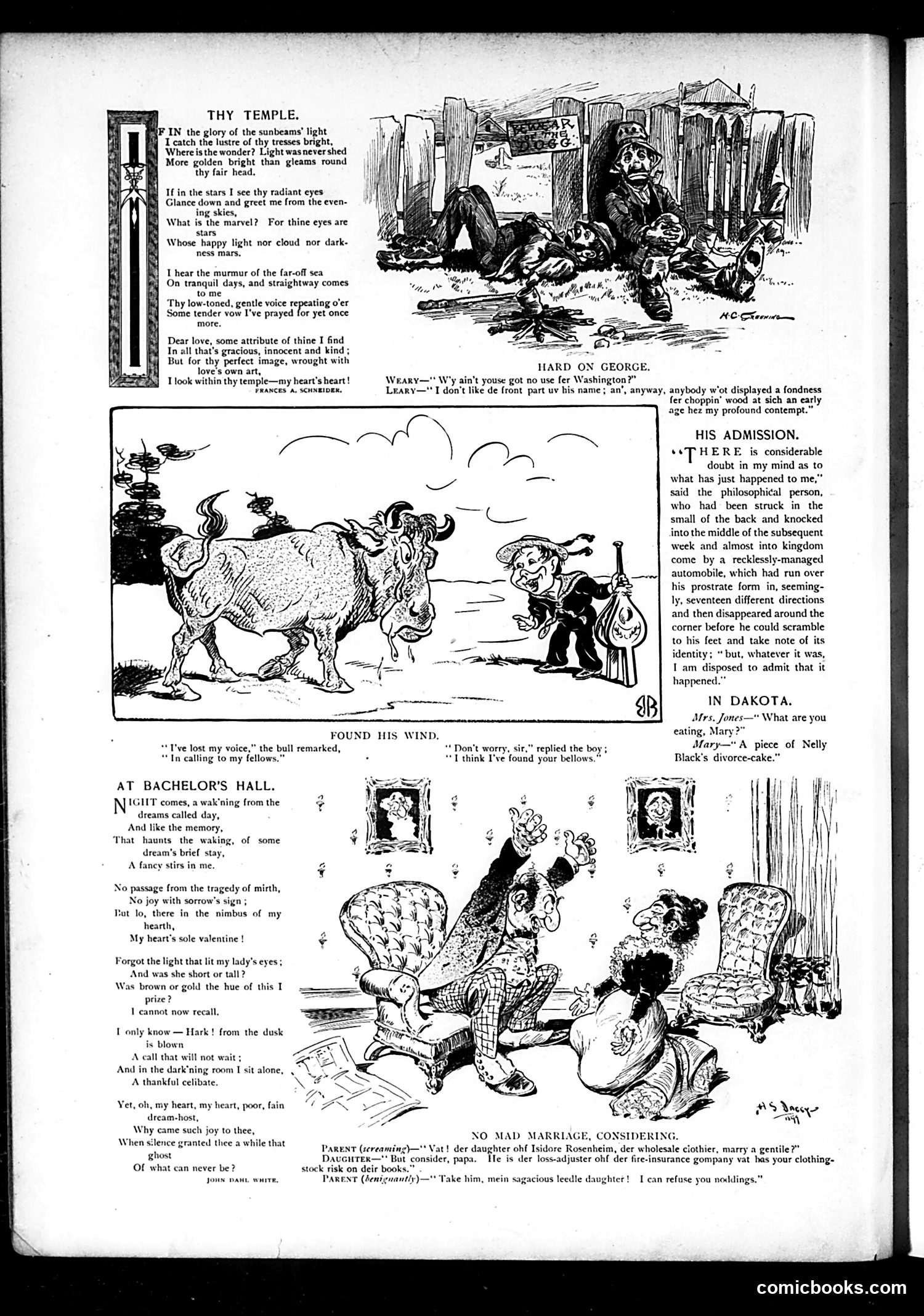
This page contains several satirical pieces reflecting late 19th/early 20th-century American attitudes: **"Hard on George"** mocks George Washington, with a working-class character dismissing him for his famous youth (chopping down the cherry tree legend), showing anti-establishment sentiment. **"His Admission"** satirizes the prevalence of reckless automobiles—a new technology causing accidents—through dark humor about a hit-and-run victim philosophically accepting being run over multiple times. **"In Dakota"** jokes about divorce being so common that "Nelly Black's divorce-cake" exists as a commodity, reflecting anxieties about rising divorce rates in the era. **"No Mad Marriage, Considered"** depicts a Jewish parent (stereotypically characterized) initially objecting to his daughter marrying a gentile, then accepting when learning the man works in insurance—satirizing both immigrant religious concerns and mercenary materialism. The romantic poetry sections are period-typical sentimental verse. Overall, the page reflects Judge's satirical focus on contemporary social anxieties: technology dangers, family instability, and ethnic tensions in American society.
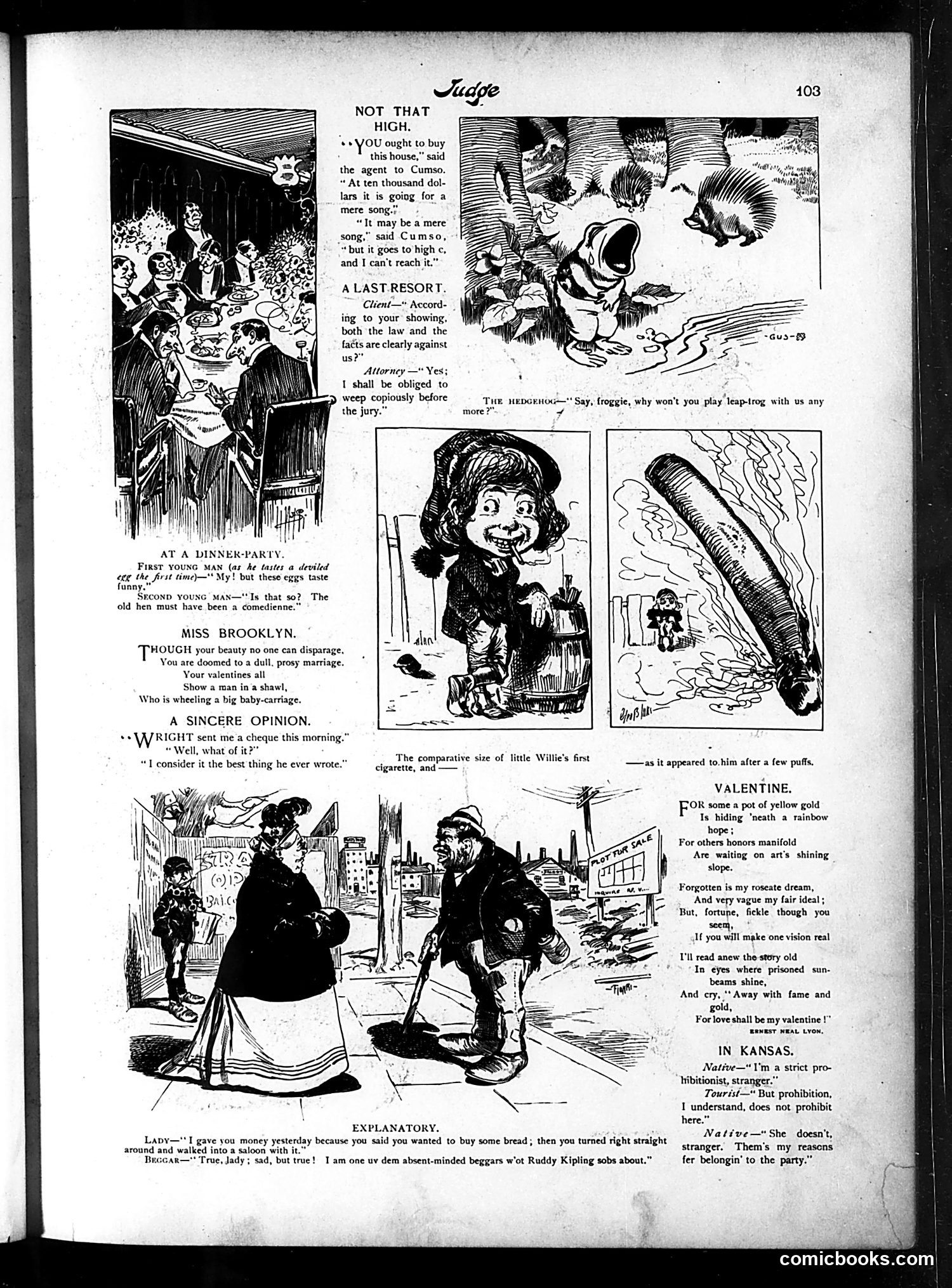
This page contains multiple short jokes and cartoon sketches typical of Judge's satirical style: **"Not That High"** mocks real estate agents' inflated sales pitches—a man refuses to buy a house because the asking price is impossibly high, using the musical metaphor "high C." **"A Last Resort"** satirizes incompetent lawyers who resort to emotional manipulation (weeping before juries) when lacking legitimate legal arguments. **"Miss Brooklyn"** ridicules the stereotype of Brooklyn women facing loveless marriages to domesticated men reduced to pushing baby carriages. **"A Sincere Opinion"** jokes that a wealthy man's check is his finest written work—suggesting wealthy people are otherwise inarticulate. **"In Kansas"** presents ironic dialogue about prohibition laws: a Kansas native claims strict prohibition while implicitly admitting saloons operate openly, mocking the law's ineffectiveness. **"The Beggar"** references Ruddy Kipling's famous poem about "absent-minded beggars," using it to excuse a beggar's dishonest spending of alms money on alcohol instead of bread. The Valentine and other verses are sentimental poetry padding. Overall, the page satirizes lawyers, real estate fraud, changing gender roles, and prohibition's failures.
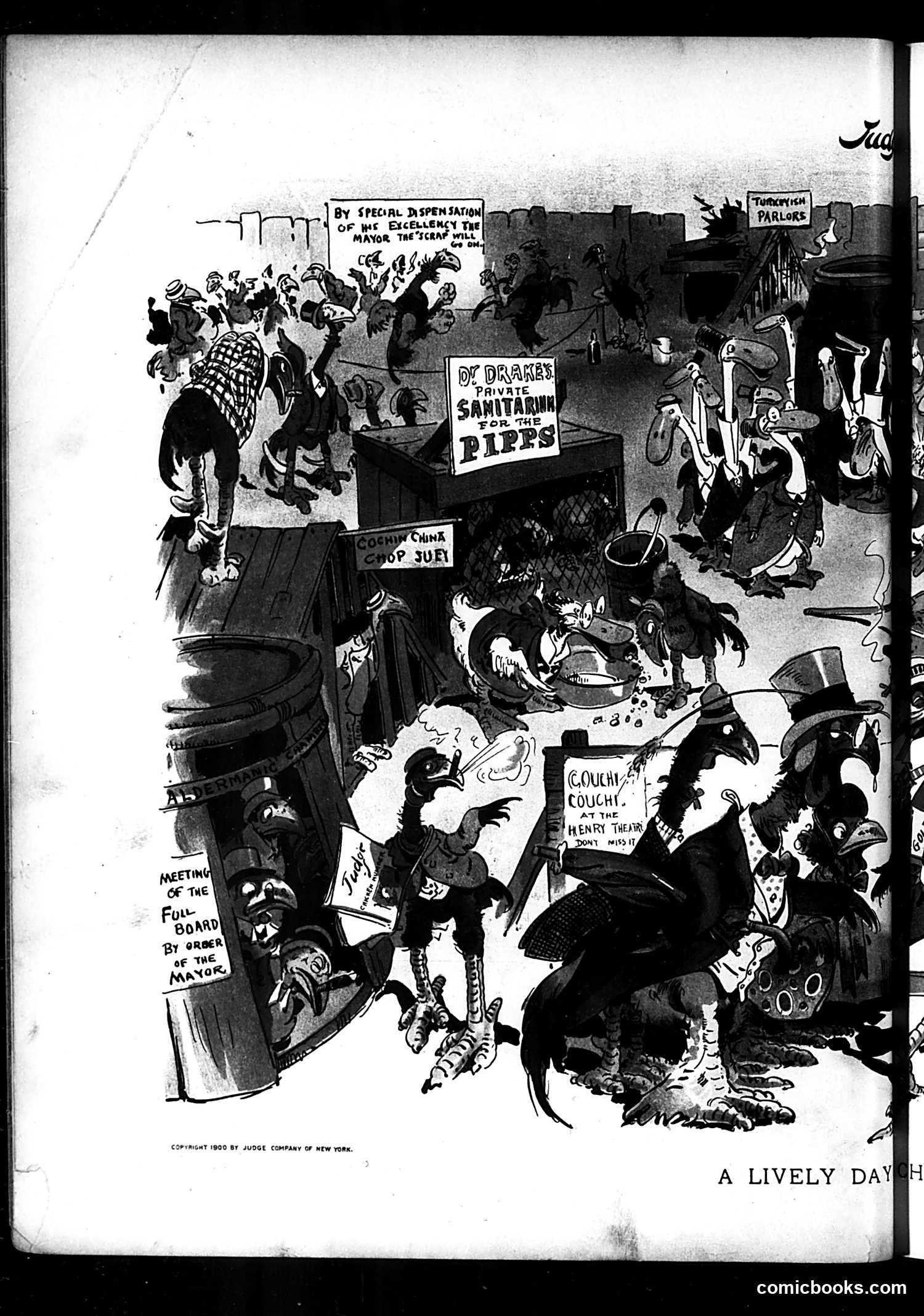
This 1900 satirical cartoon depicts a chaotic street scene with caricatured figures of various nationalities and types. Visible signs reference "Turkish Tailors," "Cochin China Soup Suet," and "Dr. Drake's Private Sanitarium for the Pipes," suggesting commentary on immigrant communities and their businesses in turn-of-the-century America. The central figure appears to be labeled as the Mayor (referenced in the OCR text as "Mayor Trescrap"), presiding over disorder "by special dispensation of his excellency." The cartoon satirizes urban chaos, immigrant populations, and municipal governance during this period. The style and composition—with exaggerated caricatures and crowded composition—typify Judge's approach to mocking both political figures and ethnic stereotypes common to that era's American satire.
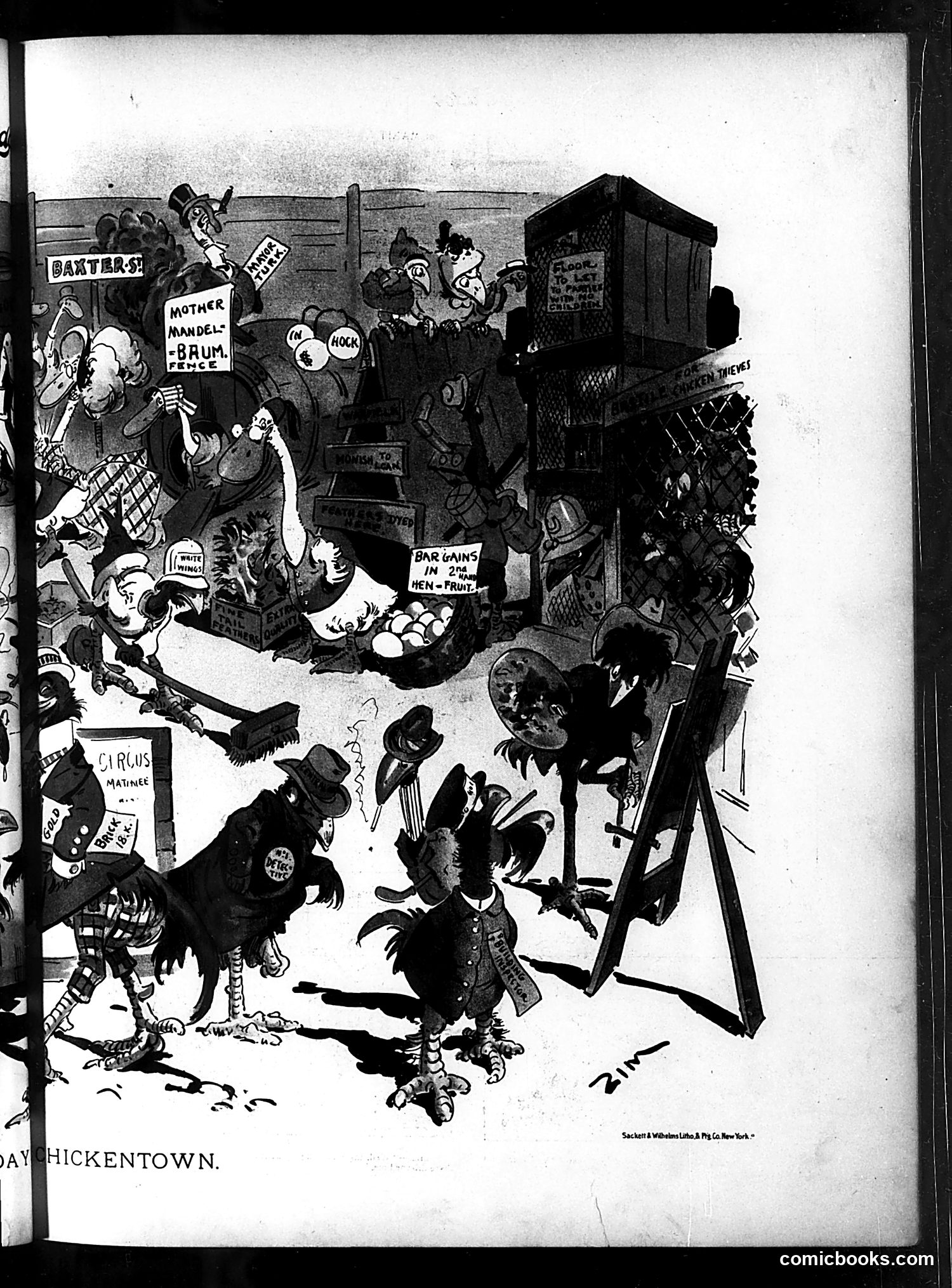
This satirical cartoon depicts a chaotic scene labeled "Hickentown," showing anthropomorphic animals (chickens and similar creatures) engaged in various disreputable activities. Visible signs reference "Mother Mandel-Brum," "Barracks," and "Bargains in 2nd Hand Fruit," suggesting commentary on corrupt local governance, possibly graft or exploitation. The scene appears to mock urban vice and political corruption through animal caricature—a common Judge magazine technique. The crowded, lawless atmosphere with makeshift structures suggests criticism of either municipal mismanagement or immigrant communities stereotyped as disorderly. Without the publication date visible, the specific political figures or local scandals referenced remain unclear, though the style suggests early 20th-century American satire.
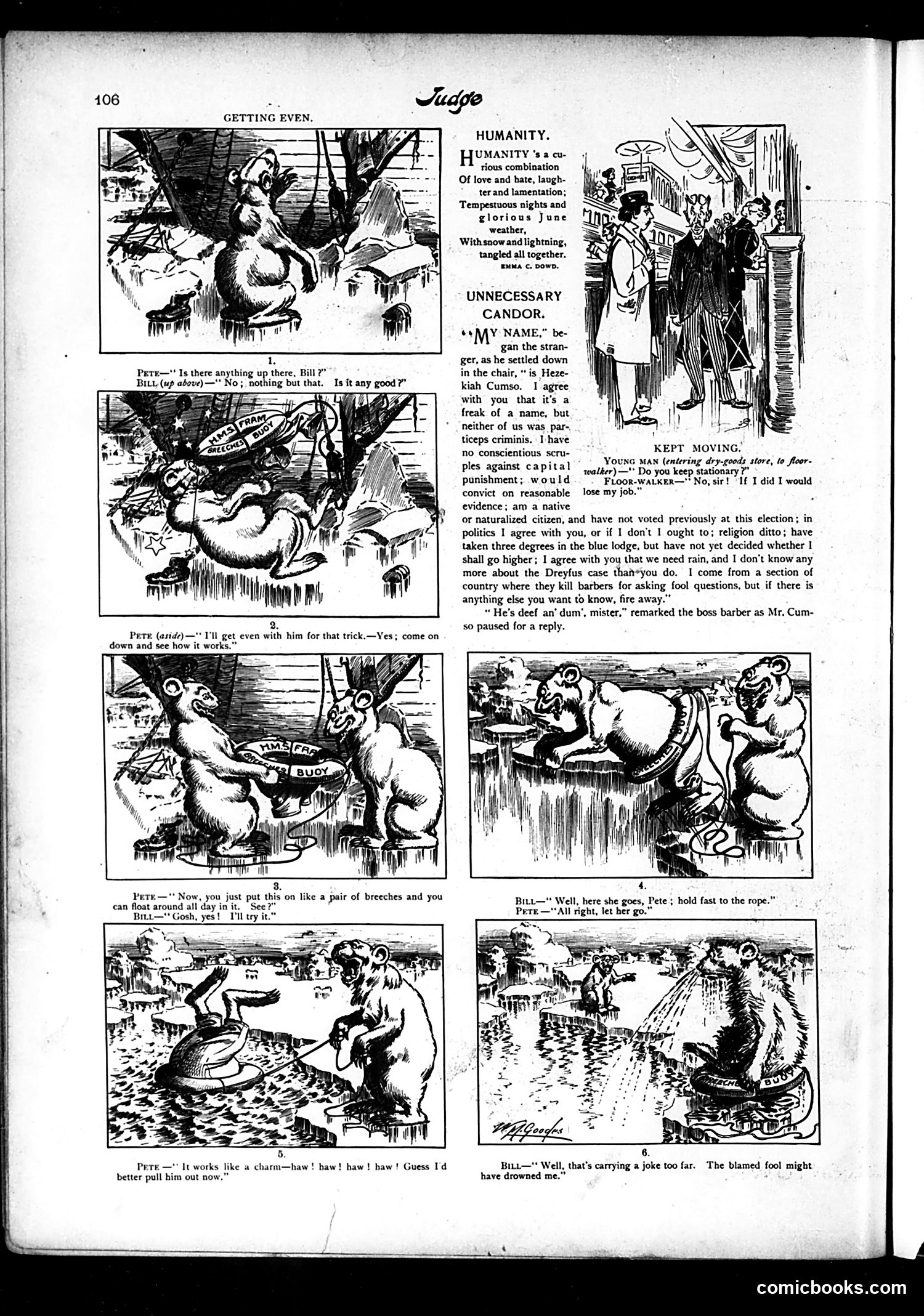
This page contains two separate satirical pieces: **"Getting Even"** (main comic strip): Two characters, Pete and Bill, play a prank involving a buoy in water. Pete tricks Bill into a dangerous situation, then attempts a "rescue" that goes wrong—nearly drowning Bill. The joke critiques escalating revenge pranks that backfire. **"Unnecessary Candor"** (right panel): A job applicant or stranger delivers an absurdly honest monologue to a barber, admitting he's uninformed on politics, religion, and current events (likely referencing the Dreyfus affair). His honesty is so tactless that the barber describes him as "deaf and dumb"—satirizing how brutal truthfulness can be socially unacceptable, and mocking the oversharing of private opinions. Both pieces use exaggerated character behavior to mock American social norms: the dangers of petty retaliation in "Getting Even" and the social awkwardness of excessive candor in the second piece. The cartoons are illustrated with typical period woodcut-style drawings.
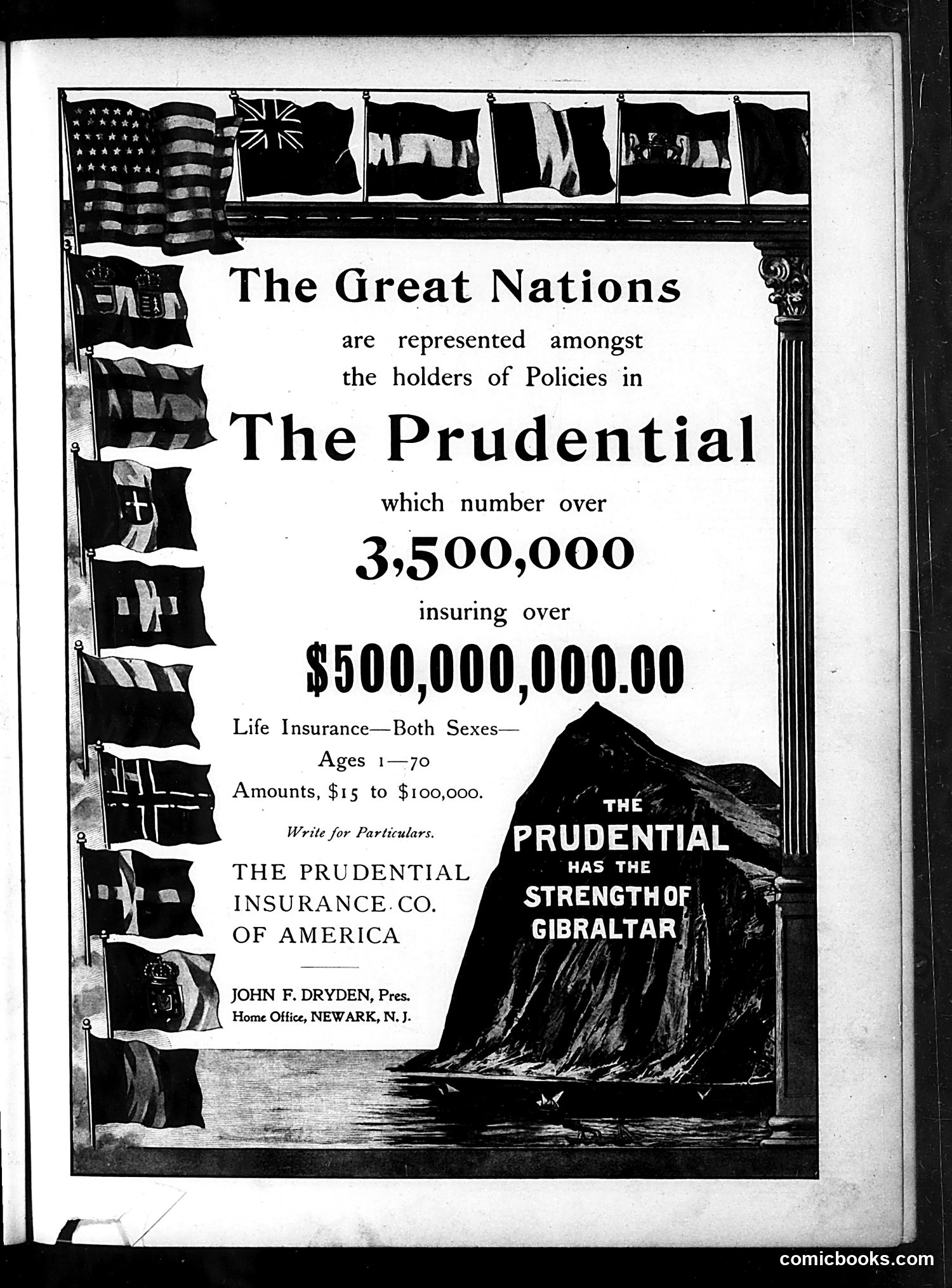
This is primarily a **full-page advertisement**, not satirical content. The Prudential Insurance Company of America is marketing life insurance policies to an international audience. The page features flags of major world powers along the left margin (American, British, and others), visually communicating that the company serves "Great Nations" globally. The company boasts 3.5 million policyholders insuring over $500 million—figures meant to demonstrate financial strength and stability. The right side includes an image of Gibraltar's rock formation with the slogan "THE PRUDENTIAL HAS THE STRENGTH OF GIBRALTAR"—a metaphor equating the company's reliability with this famous natural fortress. The advertisement emphasizes accessibility: life insurance available to both sexes, ages 1-70, in amounts from $15 to $100,000. The company president is identified as John F. Dryden, with headquarters in Newark, New Jersey. This represents early-20th-century corporate advertising using nationalist imagery and patriotic symbolism to build consumer confidence.
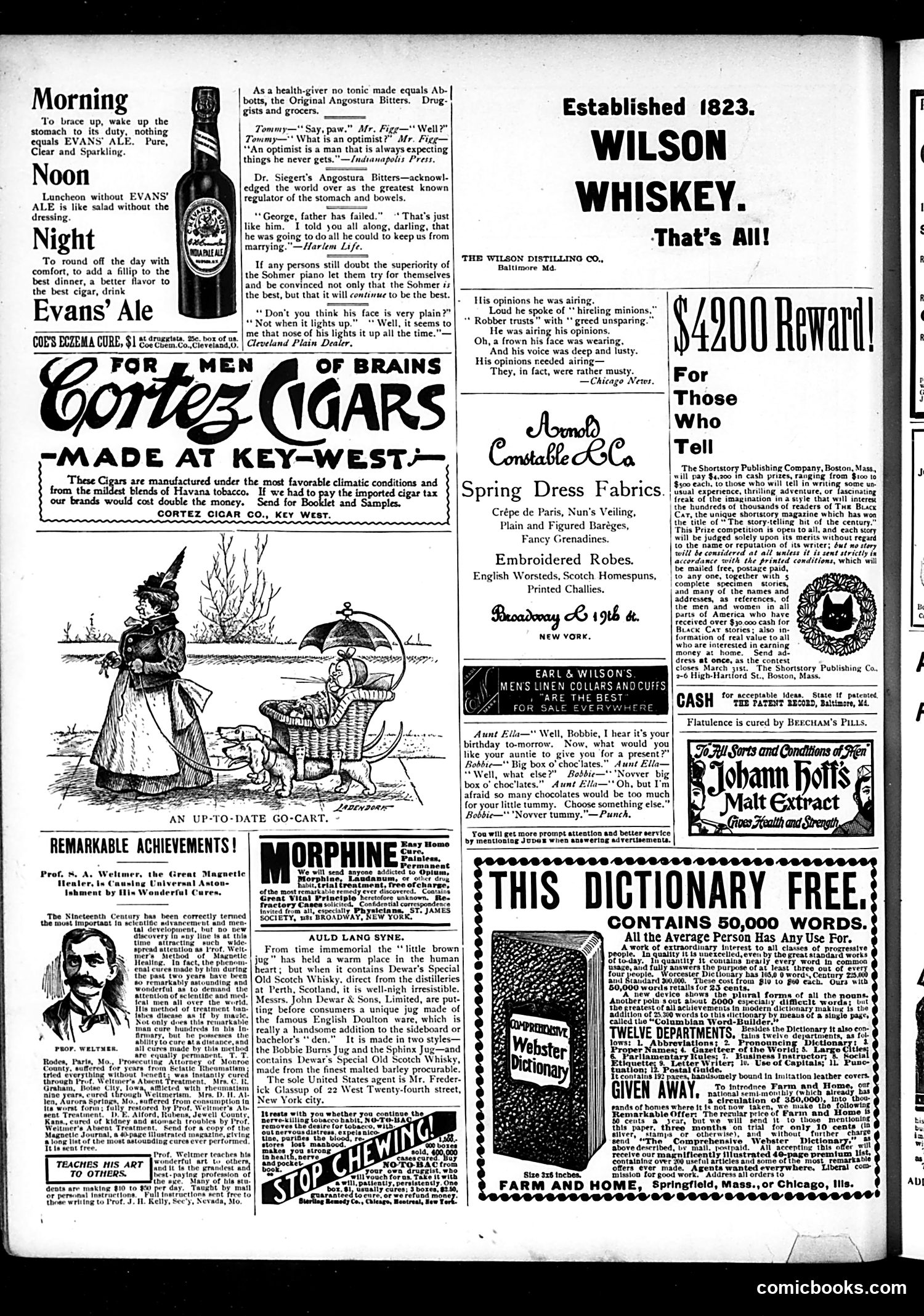
This page is primarily **advertising and light humor**, typical of early-20th-century American magazines. The main cartoon ("An Up-to-Date Go-Cart") depicts a woman and man with a baby carriage—likely satirizing modern conveniences or parenting trends of the era, though the specific satire is unclear from the image alone. The page includes numerous **patent medicine and consumer product ads**: Evans' Ale, Angostura Bitters, Cortez Cigars, and notably Prof. Weltmer's "Magnetic Healing" services—a common medical fraud of the period claiming to cure addiction through magnetic therapy. **Political/social content** is minimal. One brief joke mocks an optimist's false expectations—mild social commentary on human nature rather than political satire. The **Wilson Whiskey ad** and "Stop Chewing" tobacco ads reflect period concerns about substance habits. Overall, this is a **commercial page** showcasing the magazine's revenue model through advertising to male readers, with filler humor rather than substantive political or social commentary.
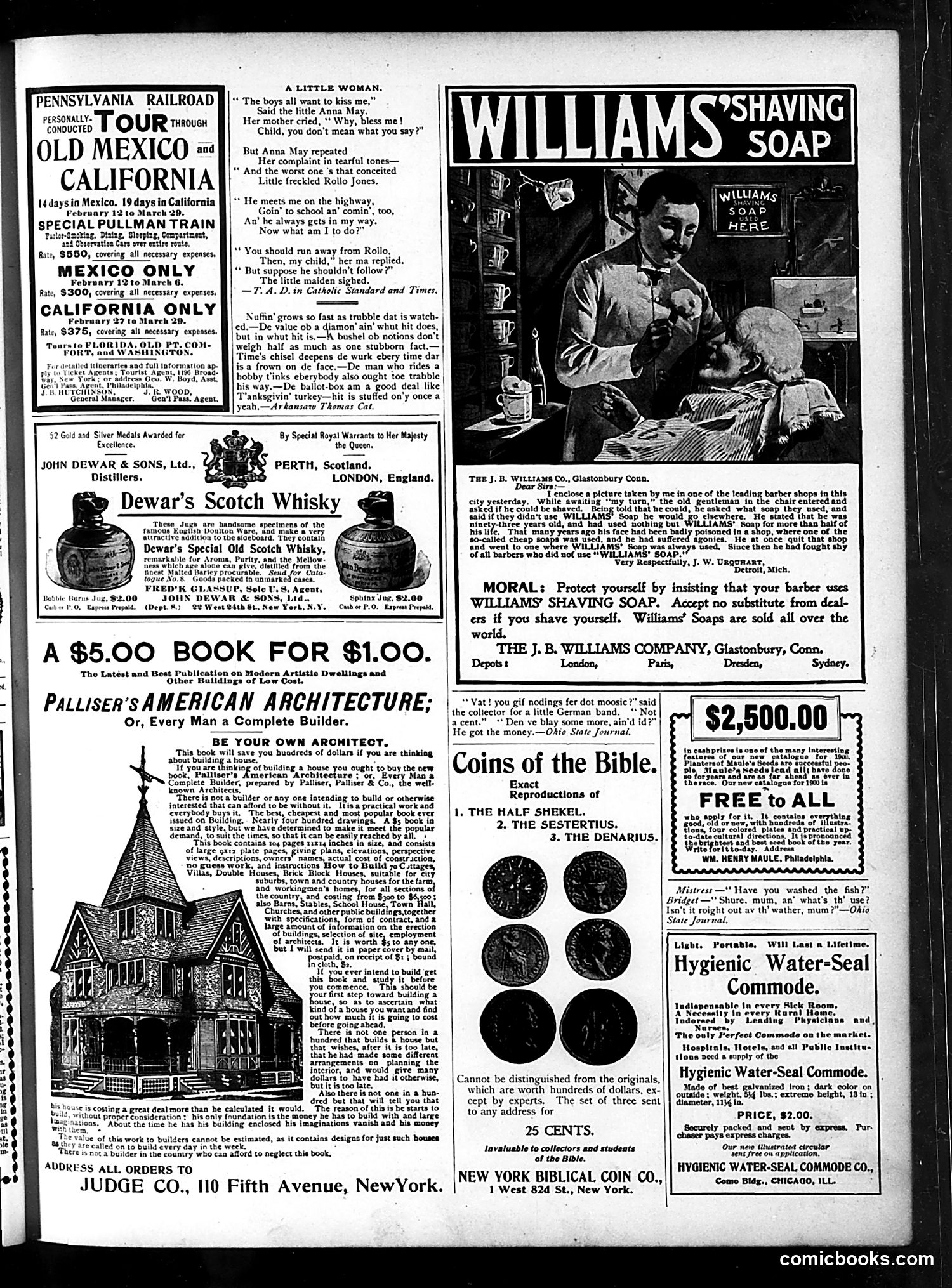
This page is primarily **advertisements and light verse**, not political satire requiring historical context. The main content includes: **"A Little Woman" poem**: A sentimental dialogue between a mother and daughter (Anna May) about boys wanting to kiss her and a persistent classmate named Rollo Jones blocking her path to school. The humor is gentle domestic comedy—the child's problem and mother's naive advice ("run away") create the joke. **Travel and product advertisements** dominate the page: Pennsylvania Railroad tours to Mexico and California, Dewar's Scotch Whisky (with royal warrants), a $5 architecture book offer, and various other commercial products (coins, soap, water seals). **"Coins of the Bible"** advertisement offers exact reproductions of biblical-era coins—apparently targeting collectors and students. The page reflects turn-of-the-century American consumer culture and family-oriented humor rather than sharp political commentary. No specific political figures or events are caricatured here.
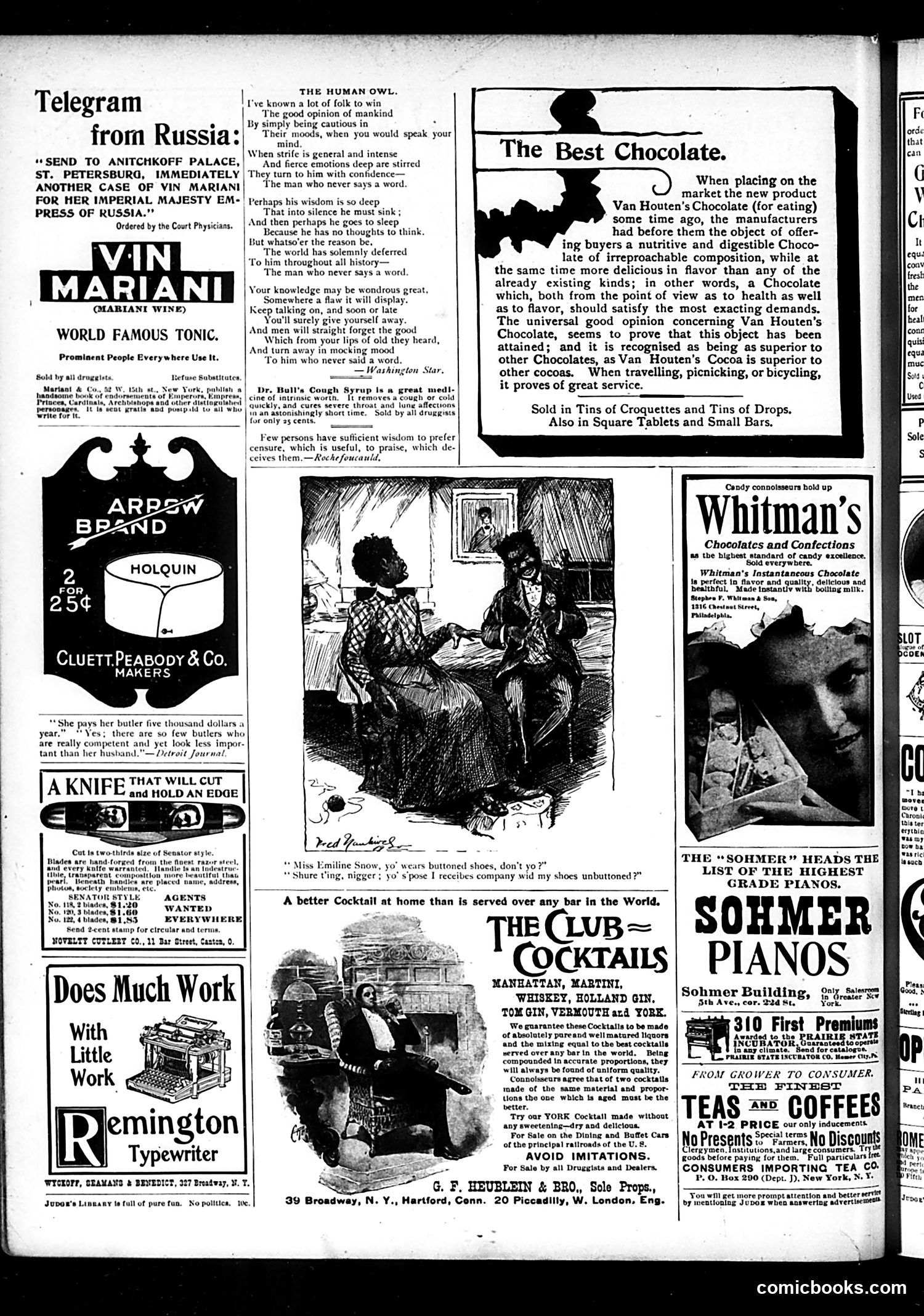
This page is primarily **advertisements and filler content** rather than political satire. The main elements are: **The "Telegram from Russia" advertisement** at top mocks Russian imperial extravagance by claiming the Empress orders Vin Mariani (a wine tonic) through court physicians—implying frivolous luxury spending. **The "Human Owl" poem** satirizes silent people who gain undeserved respect simply by never speaking, suggesting wisdom through silence is often mere emptiness. **A racial caricature cartoon** (center-left) depicts a Black servant in degrading dialect, perpetuating period stereotypes common to Judge's editorial approach. The remaining content consists of product advertisements: typewriters, knives, chocolates, cocktail mixers, pianos, and tea—typical Judge revenue sources. **For modern readers:** This reflects Gilded Age consumerism, casual racism in mainstream publications, and satirical jabs at European royalty and American pretension, all normalized in early 1900s magazines.
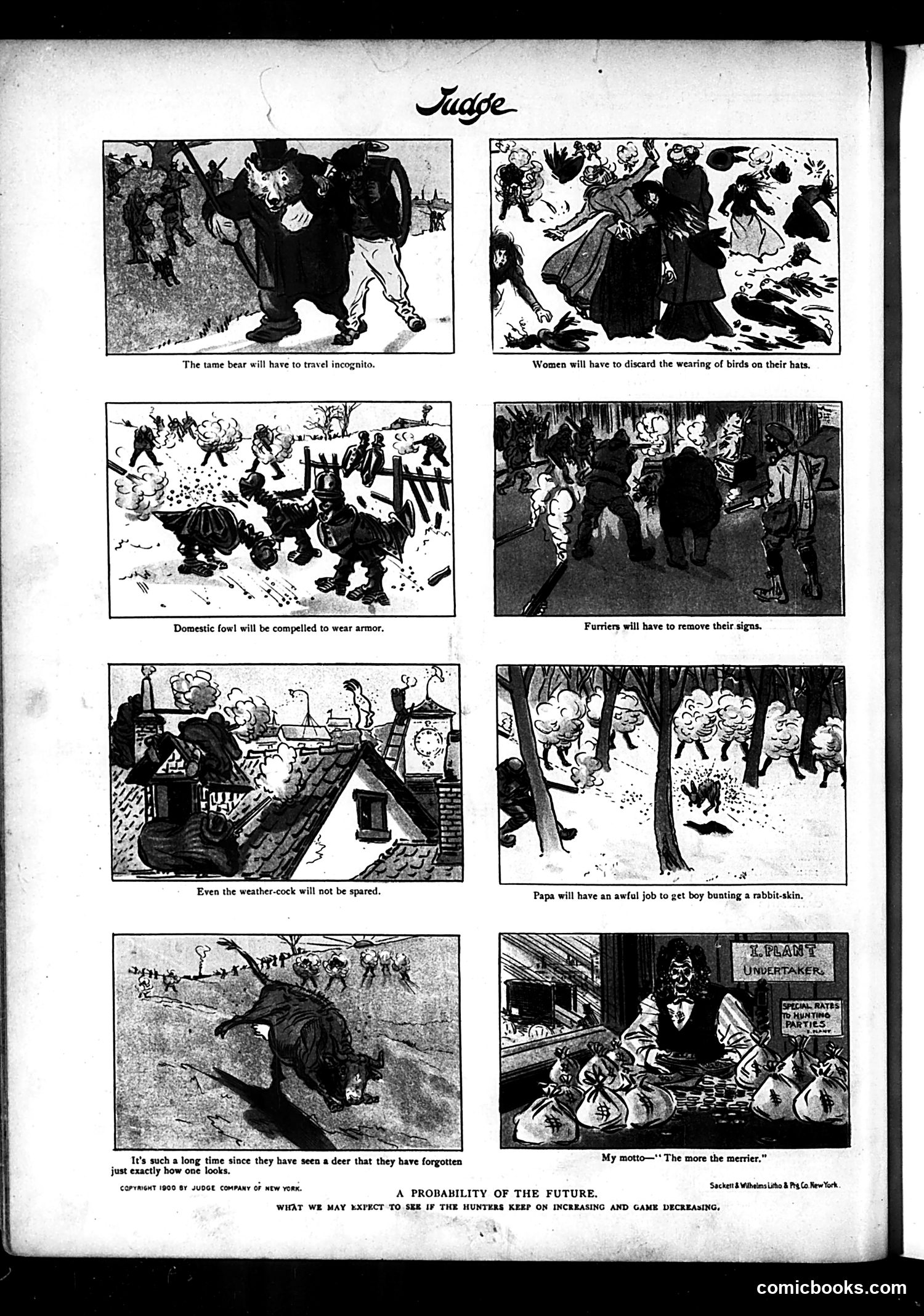
This satirical page warns about consequences of overhunting. The eight panels depict absurd future scenarios if game depletion continues: - A tame bear must travel "incognito" (disguised) - Women remove bird feathers from hats (fashion affected by scarcity) - Domestic fowl wear armor for protection - Furriers remove shop signs (no business without pelts) - Weather vanes get hunted instead of game - Fathers resort to hunting rabbit-skins - Deer become so rare, hunters forget what they look like - A taxidermist's "motto" becomes "the more the merrier"—he profits from extinct species The final panel shows a stuffed-animal undertaker profiting from extinction, making the satire's point clear: uncontrolled hunting threatens wildlife and dependent industries. This reflects genuine Progressive-era conservation concerns about depleted American game populations, predating modern environmental awareness. The cartoonist argues hunters' self-interest—economic and sporting—demands restraint.