
A complete issue · 16 pages · 1900
Judge — January 13, 1900
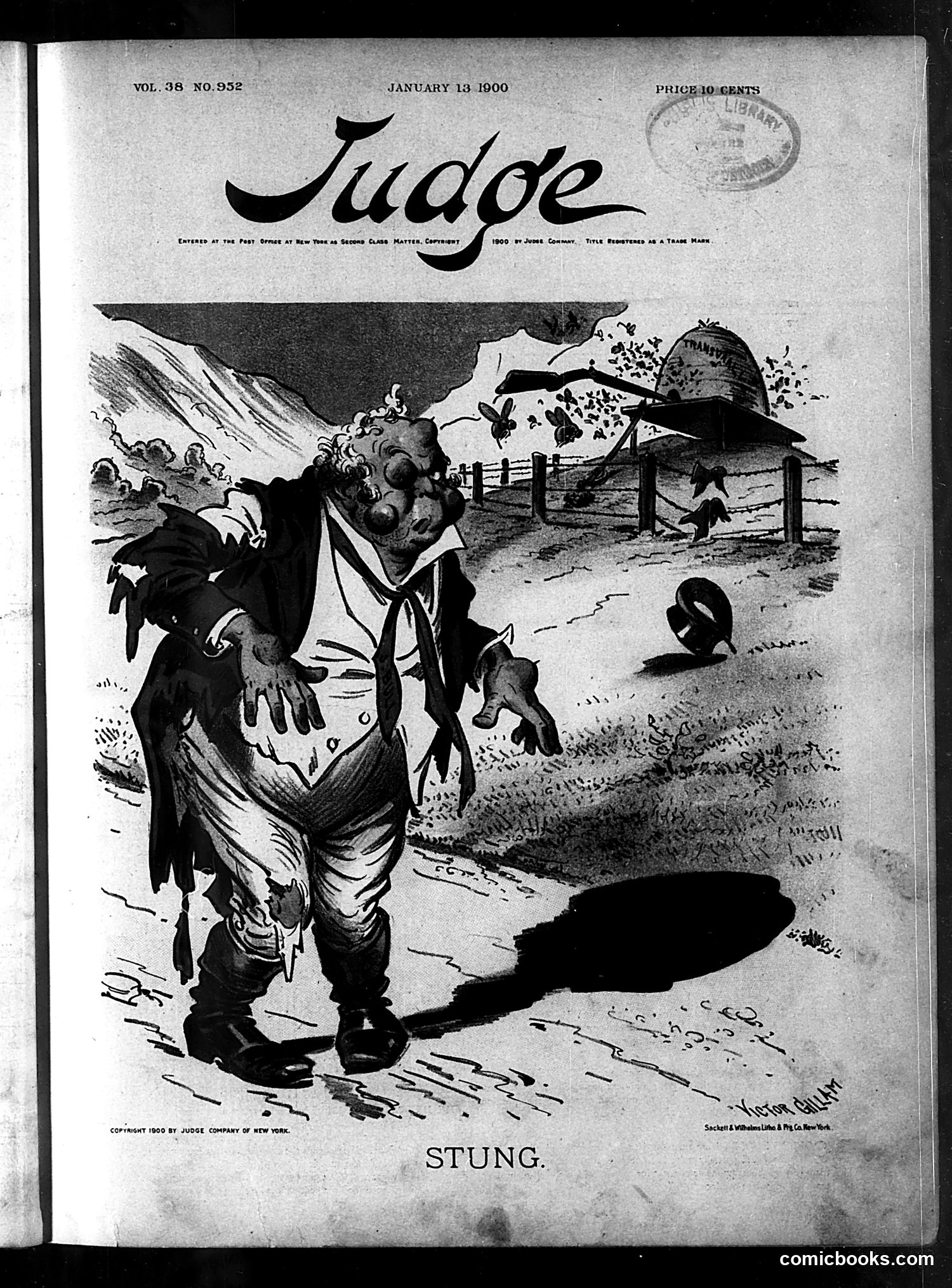
This political cartoon depicts a disheveled man in formal attire being chased by bees emerging from an overturned beehive. The title "Stung" is a clear pun—the figure has been literally stung by bees, but "stung" also means being tricked or deceived in financial or political contexts. Without additional context identifying the specific figure, the cartoon likely satirizes a political or business leader who has been caught in a scheme or suffered an unexpected defeat around January 1900. The rural farm setting with fence and scattered hay suggests themes of agricultural policy or rural concerns common to 1900s American politics. The cartoon's humor relies on the visual metaphor of being "stung"—both literally by insects and figuratively by circumstance.
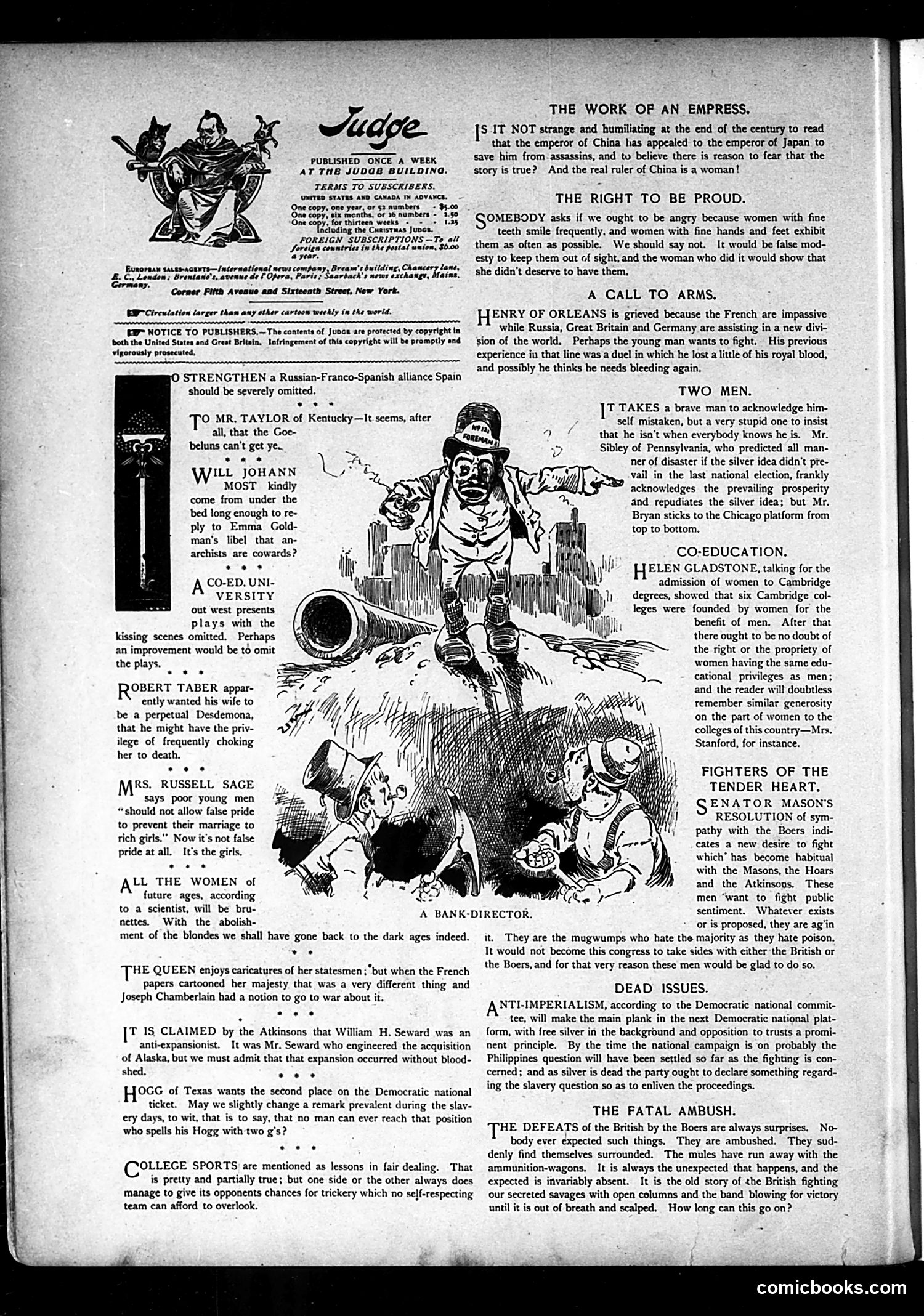
The central cartoon titled "A Bank-Director" depicts a portly, intoxicated banker surrounded by bottles and money bags, collapsed or reclining in disarray. This satirizes corruption and financial misconduct among banking officials—likely referencing late 19th or early 20th-century banking scandals. The surrounding editorial columns address contemporary political issues: imperial ambitions in China and Japan, French military preparedness, silver currency debates in American politics, and women's education rights. One piece criticizes "mugwumps" (independent Republicans) opposing party loyalty. The overall tone suggests Judge was attacking both financial corruption and what it viewed as dangerous political independence, while advancing Republican positions on currency and imperialism—typical of the magazine's conservative satirical stance during this era.
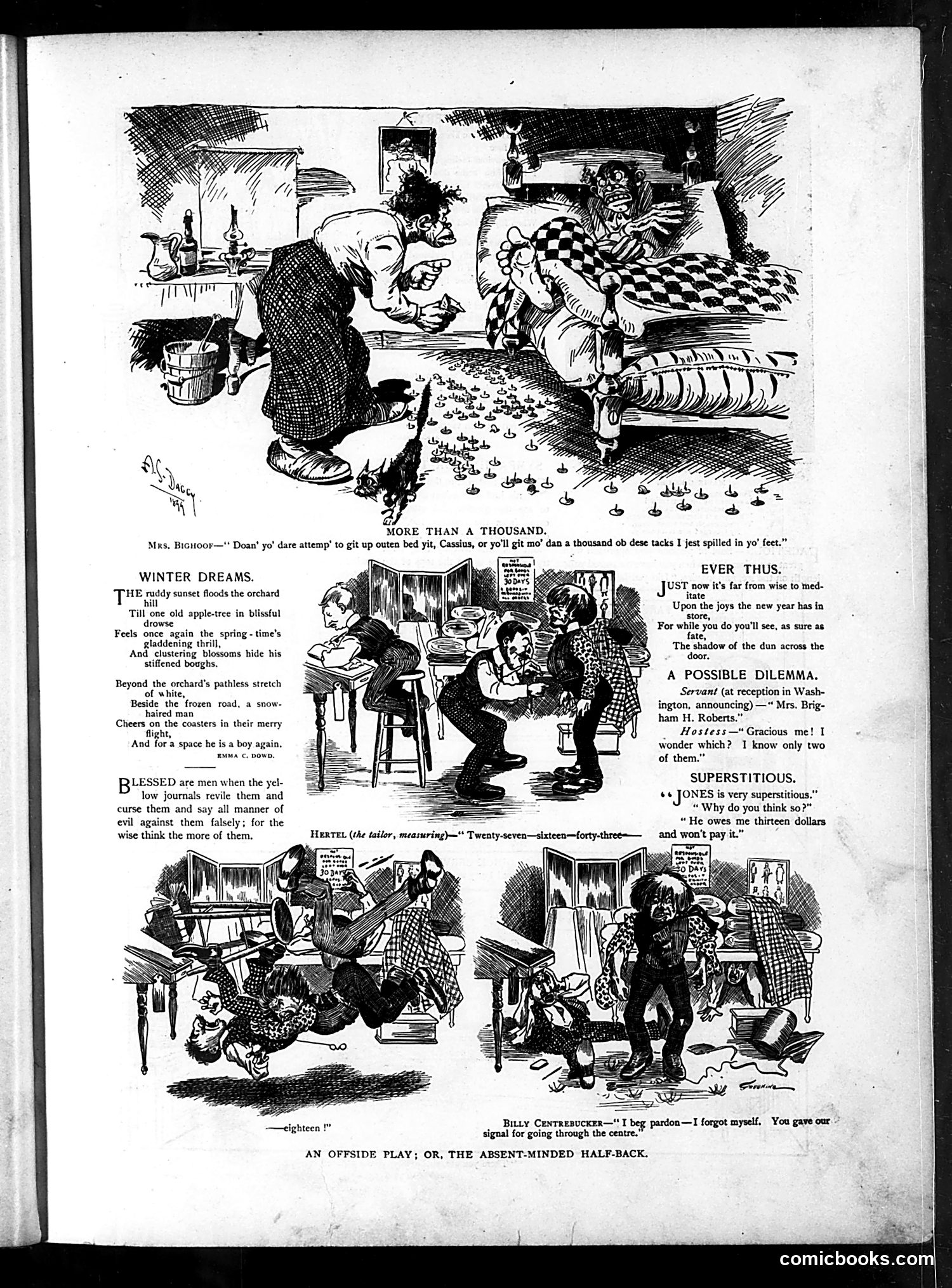
This page contains several satirical sketches and short pieces typical of Judge's humor circa late 19th/early 20th century. The top cartoon "MORE THAN A THOUSAND" depicts a domestic scene where a woman (Mrs. Bigbody) threatens a man about bed tactics, using crude wordplay about "tacks" spilled on feet—simple marital humor. Below are three separate sketches: "WINTER DREAMS" (a poem), "A POSSIBLE DILEMMA" (brief dialogue about Mrs. Brigham H. Roberts), and "SUPERSTITIOUS" (a joke about someone owing thirteen dollars). The lower panels labeled "AN OFFSIDE PLAY; OR, THE ABSENT-MINDED HALF-BACK" show comic domestic scenes with a tailor and someone named Billy Centerbucker. These are light social satire and domestic humor—no apparent political content. The page emphasizes everyday situations for comedic effect rather than topical commentary.
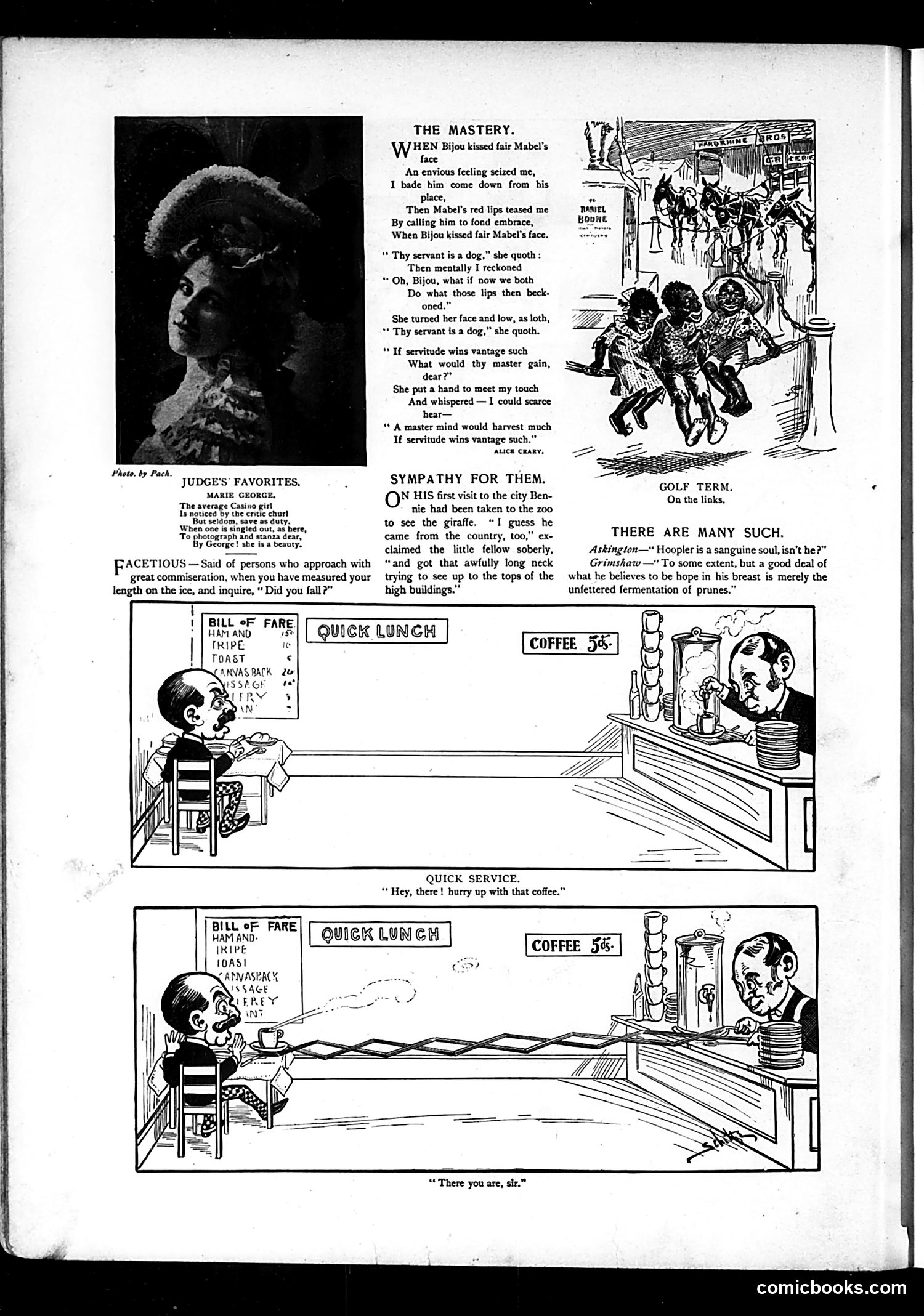
This page from *Judge* magazine contains several unrelated satirical pieces and advertisements. **"The Mastery"** depicts a romantic scene with poetry about a man (Bijou) kissing a woman (Mabel). The satire appears to mock Victorian courtship rituals and the servant-master dynamic referenced in the quoted exchanges. **"Judge's Favorites"** is a brief character definition of "facetious" behavior—mocking people who ask annoying questions ("Did you fall?"). **"Sympathy for Them"** humorously describes a countryman's reaction to seeing a giraffe at the zoo, suggesting rural naiveté about exotic animals. **"Quick Service"** is a two-panel comic satirizing slow restaurant service—the customer grows increasingly frustrated as the waiter fails to deliver coffee promptly, finally receiving it as an impossibly long stream. The page primarily uses humor to mock social pretension, rural ignorance, and service-industry incompetence.
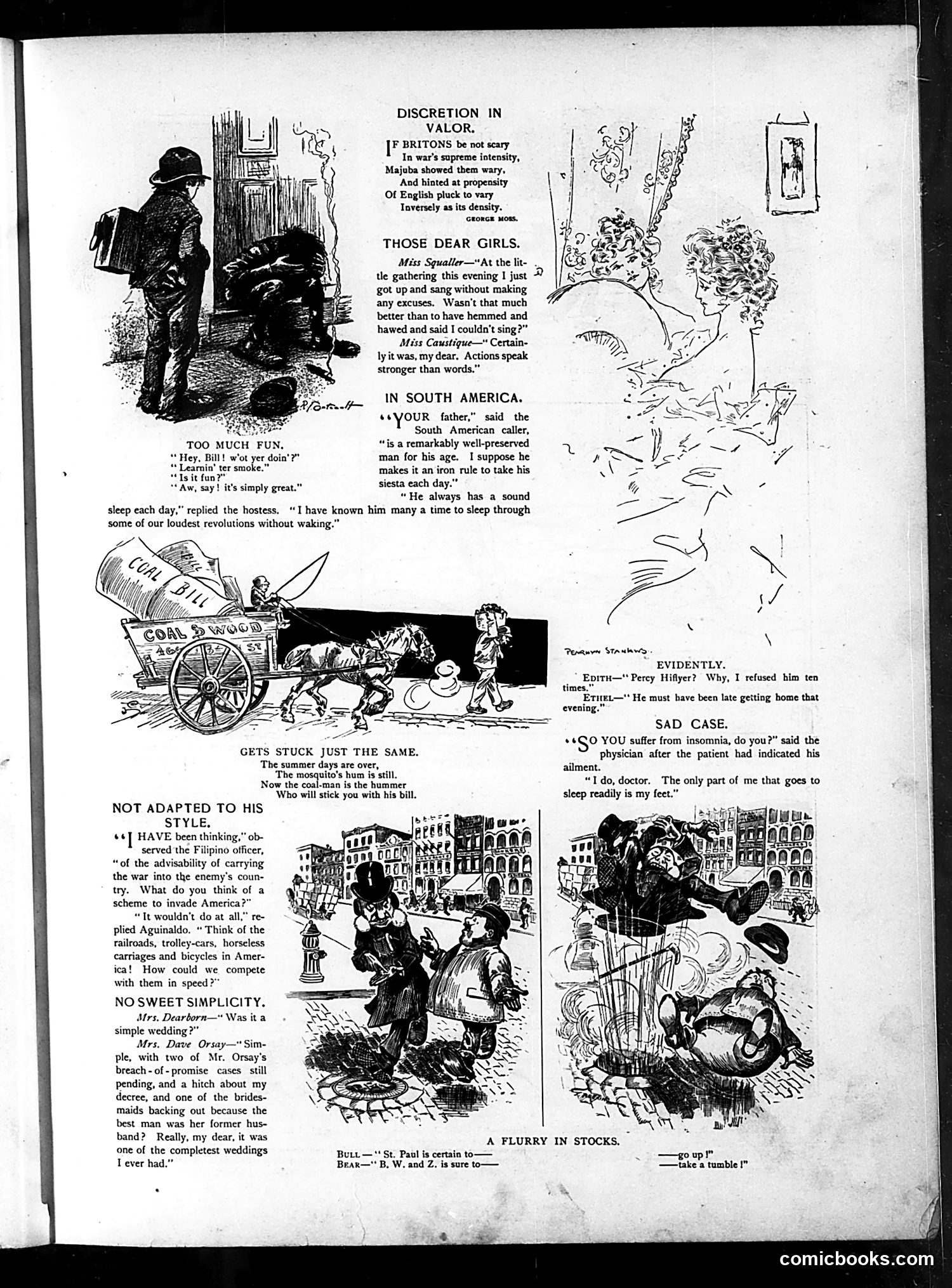
This page contains multiple unrelated satirical sketches typical of Judge magazine's format. **"Discretion in Valor"** mocks British military confidence by referencing the Battle of Majuba Hill (1881), where British forces suffered an embarrassing defeat by Boer forces in South Africa—undermining claims of English martial superiority. **"Those Dear Girls"** satirizes women's social pretension, where a woman brags about singing without apology, and her companion sarcastically agrees that thoughtless action is superior to politeness. **"In South America"** jokes about political instability in South American nations, depicting a region so accustomed to revolutions that a man sleeps through them undisturbed—suggesting constant governmental upheaval. **"Not Adapted to His Style"** references Filipino insurgent leader Aguinaldo, who considers invading America but abandons the idea because American infrastructure (railroads, trolleys, bicycles) would be militarily superior—satirizing both colonial ambitions and American technological advancement. The remaining sketches target insomnia, coal delivery bills, and stock market speculation with light humor.
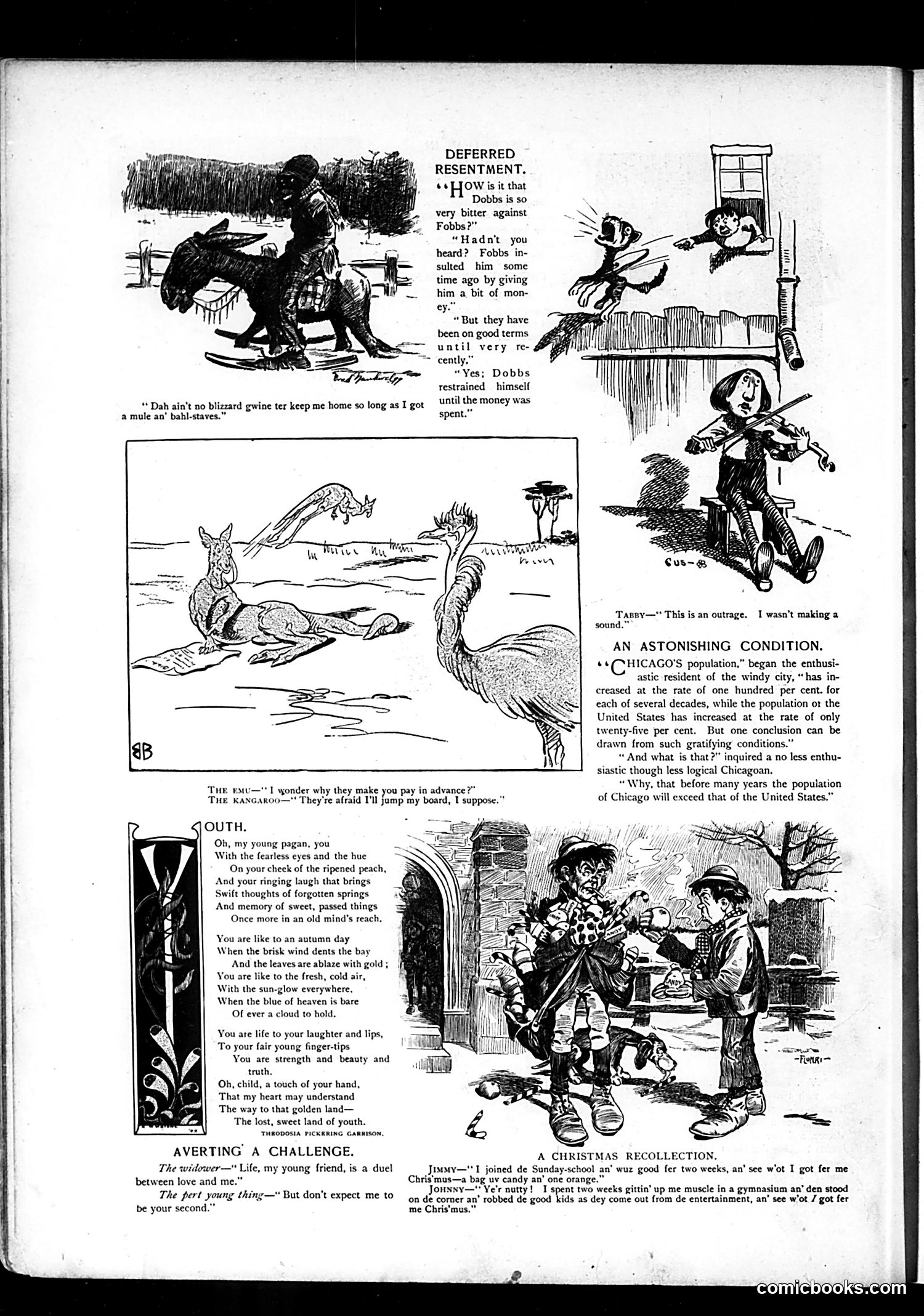
This page contains several satirical pieces: **"Deferred Resentment"** mocks human nature—a man harbors bitter resentment toward someone who insulted him, but only *after* the money given to him is spent. The joke critiques how financial self-interest suppresses honest emotion. **"An Astonishing Condition"** satirizes flawed logic through a Chicago booster's absurd conclusion: because Chicago's population growth rate exceeds the national average, Chicago's population will eventually exceed that of the entire United States—mathematically impossible. **"South"** is a sentimental poem addressed to youth, nostalgic and romantic rather than satirical. **"Averting a Challenge"** jokes about courtship: a widower compares life to a duel between love and himself; when he asks the young woman to be his "second" (dueling term), she refuses, avoiding romantic commitment. **"A Christmas Recollection"** presents street children comparing Christmas rewards: one received candy for good behavior; the other spent weeks building muscles to rob those good children—cynical commentary on urban poverty and morality.
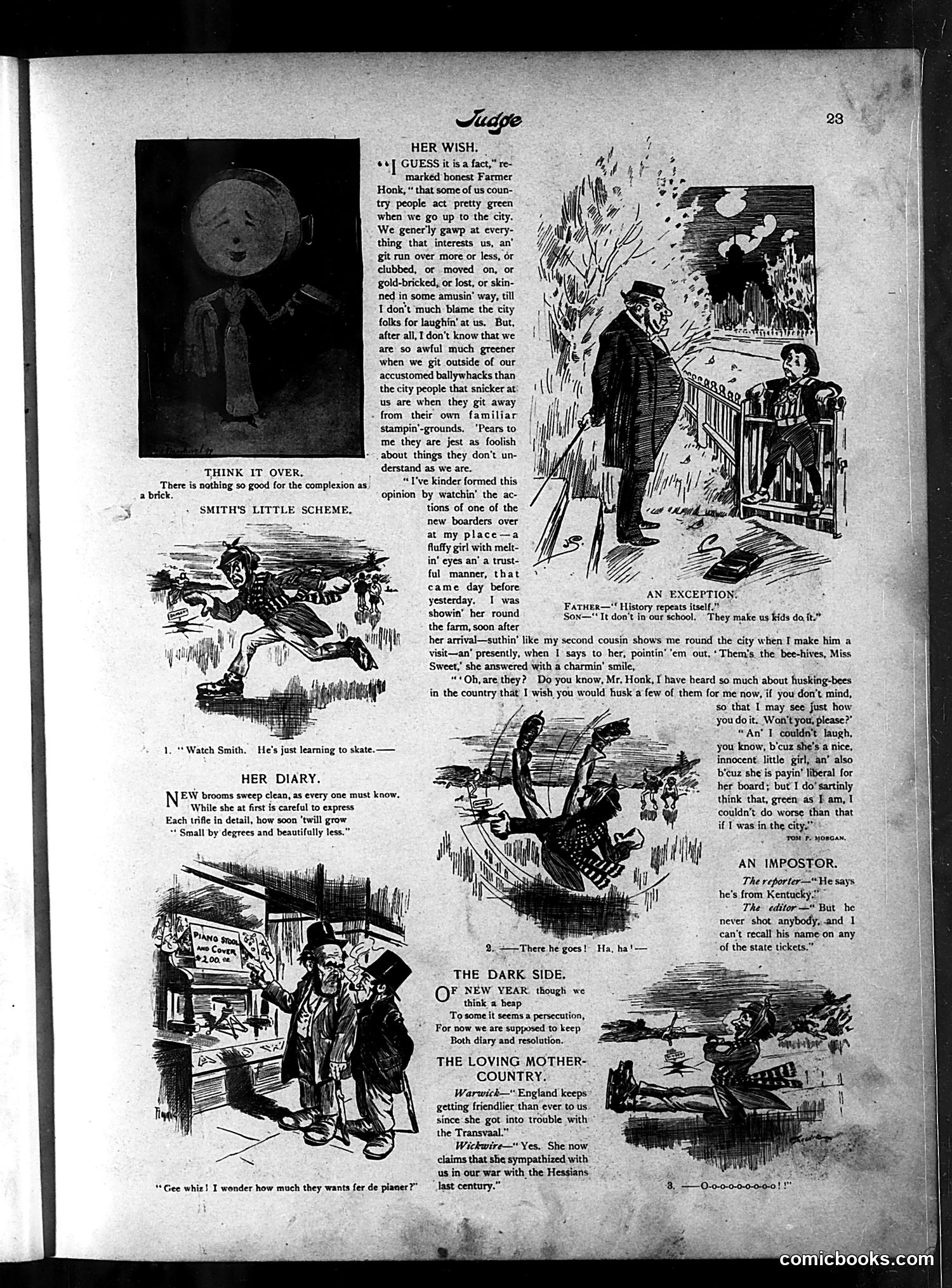
This page contains several satirical pieces mocking rural naïveté and urban sophistication. The main feature, "Her Wish," presents Farmer Honk's commentary on city versus country people. Honk argues that rural visitors to cities are mocked as "green" (unsophisticated), yet city people visiting the countryside are equally foolish. He illustrates this through a boarder who doesn't understand what a "bee-hive" is—she asks him to "husk" them, confusing the structure with husking bees (community work events). The cartoon "Smith's Little Scheme" appears to show a man learning to skate, suggesting comedic incompetence. "An Impostor" sarcastically notes that a man claiming to be from Kentucky lacks the violent credentials (shooting) or political prominence supposedly characteristic of the state. "The Loving Mother-Country" satirizes Britain's sudden friendliness toward America, suggesting it's merely self-interested—Britain now claims retrospective sympathy for America's Revolutionary War against "the Hessians."
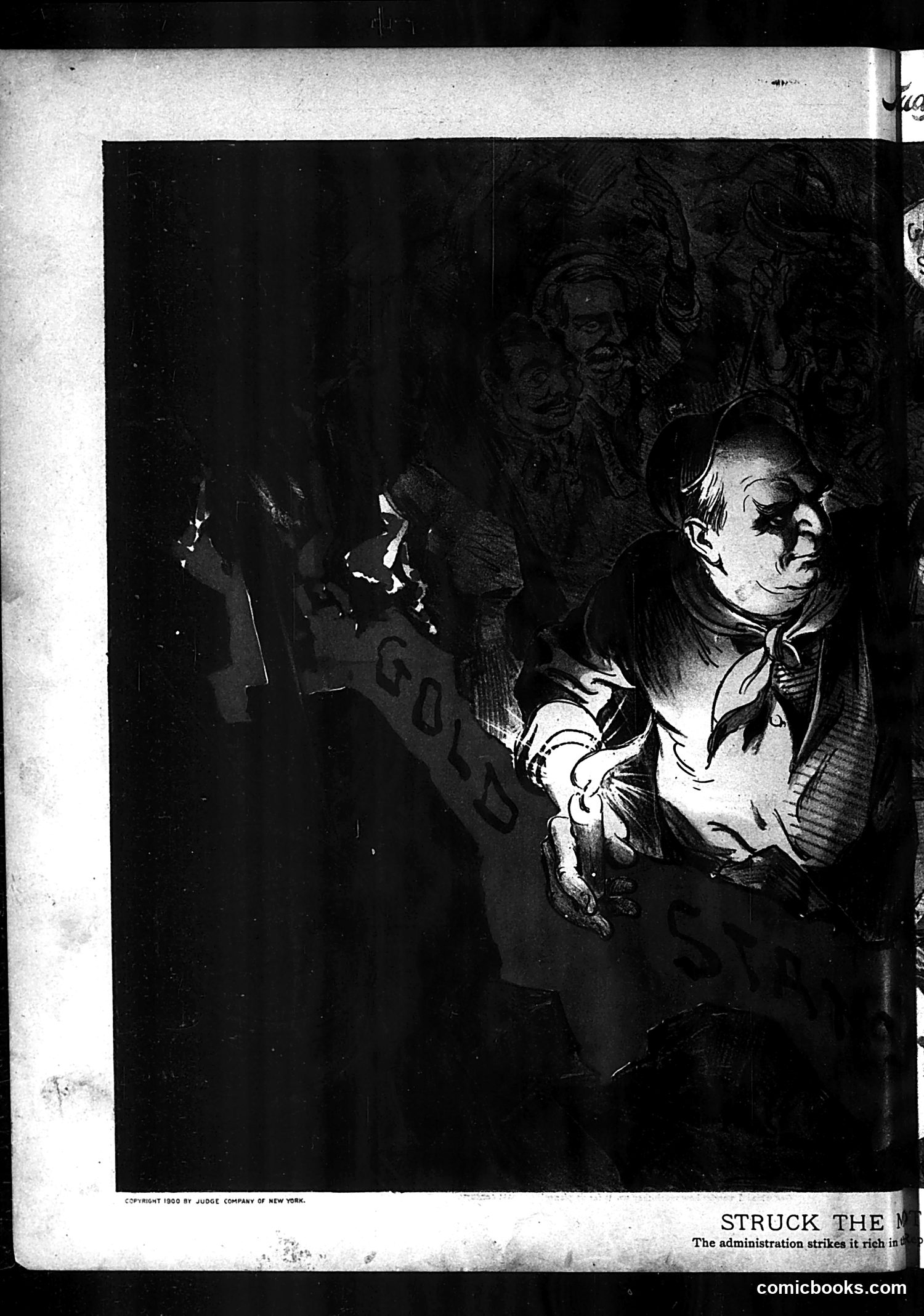
This appears to be a satirical Judge magazine cartoon from 1900 depicting an "administration" striking it rich. The image shows a well-dressed man in profile (likely representing a government official or administrator) who appears gleeful or satisfied, with other figures visible in the darker background. The caption "STRUCK THE N[...]" and phrase "The administration strikes it rich in?" suggest the cartoon satirizes government officials or the current administration obtaining wealth—possibly through corruption, patronage, or questionable dealings. The incomplete OCR text prevents identifying the specific scandal or event referenced. The dramatic chiaroscuro lighting and caricatured style emphasize the satirical nature, typical of Judge's political commentary during the McKinley administration era. Without complete text, the precise target remains unclear, but it critiques perceived dishonest enrichment by government officials.
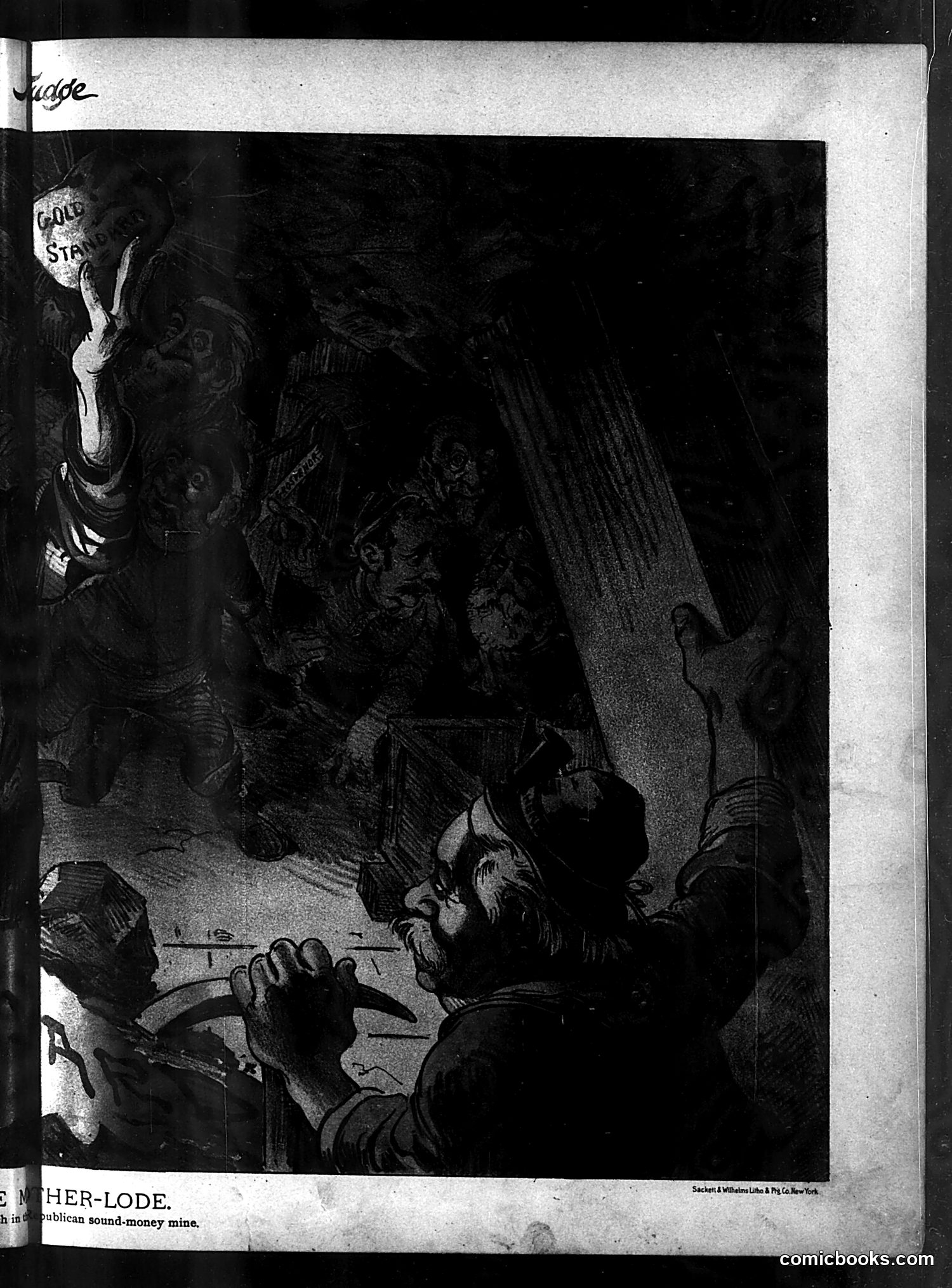
This appears to be a satirical cartoon from *Judge* magazine depicting a mining scene titled "Republican Sound-Money Mine." The cartoon shows workers (depicted with exaggerated features typical of period caricature) laboring in what seems to be a mine shaft, with ornate decorative elements and classical imagery above them. The "sound-money mine" reference points to late 19th-century American political debate over monetary policy—specifically the Republican Party's advocacy for the gold standard versus Democrats' support for free silver coinage. The cartoon likely satirizes Republican economic policies, suggesting they extracted wealth from ordinary workers while promoting sound-money doctrine benefiting wealthy interests. The classical/ornamental imagery may contrast pretentious claims with harsh working conditions below.
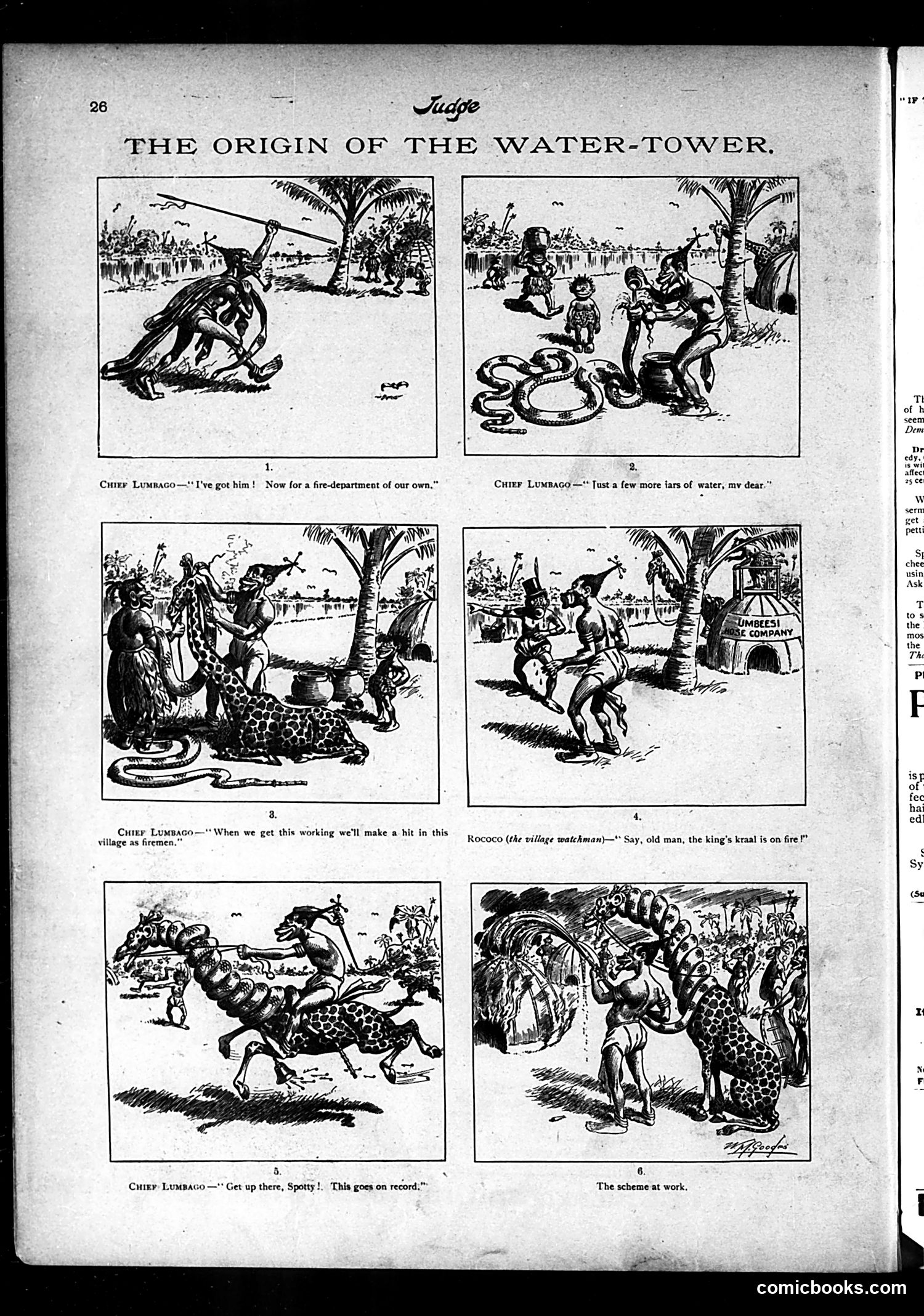
This six-panel comic satirizes colonial African administration, specifically mocking the improvisation and absurdity of European "civilization" projects. "Chief Lumbago" (a stereotyped African chief character) attempts to build a water tower using a giraffe as the structural element. The panels show escalating chaos: catching the giraffe, using it as infrastructure, and the animal being paraded around as an accomplishment. The satire targets European colonizers' claims of bringing modern utilities and "progress" to Africa through ridiculous, impractical schemes. The giraffe—a living African animal—literally replacing proper engineering represents how colonial ventures substituted genuine infrastructure with exploitative spectacle. The title's mock-earnestness emphasizes the absurdity of presenting such incompetent plans as innovation or service to local communities.
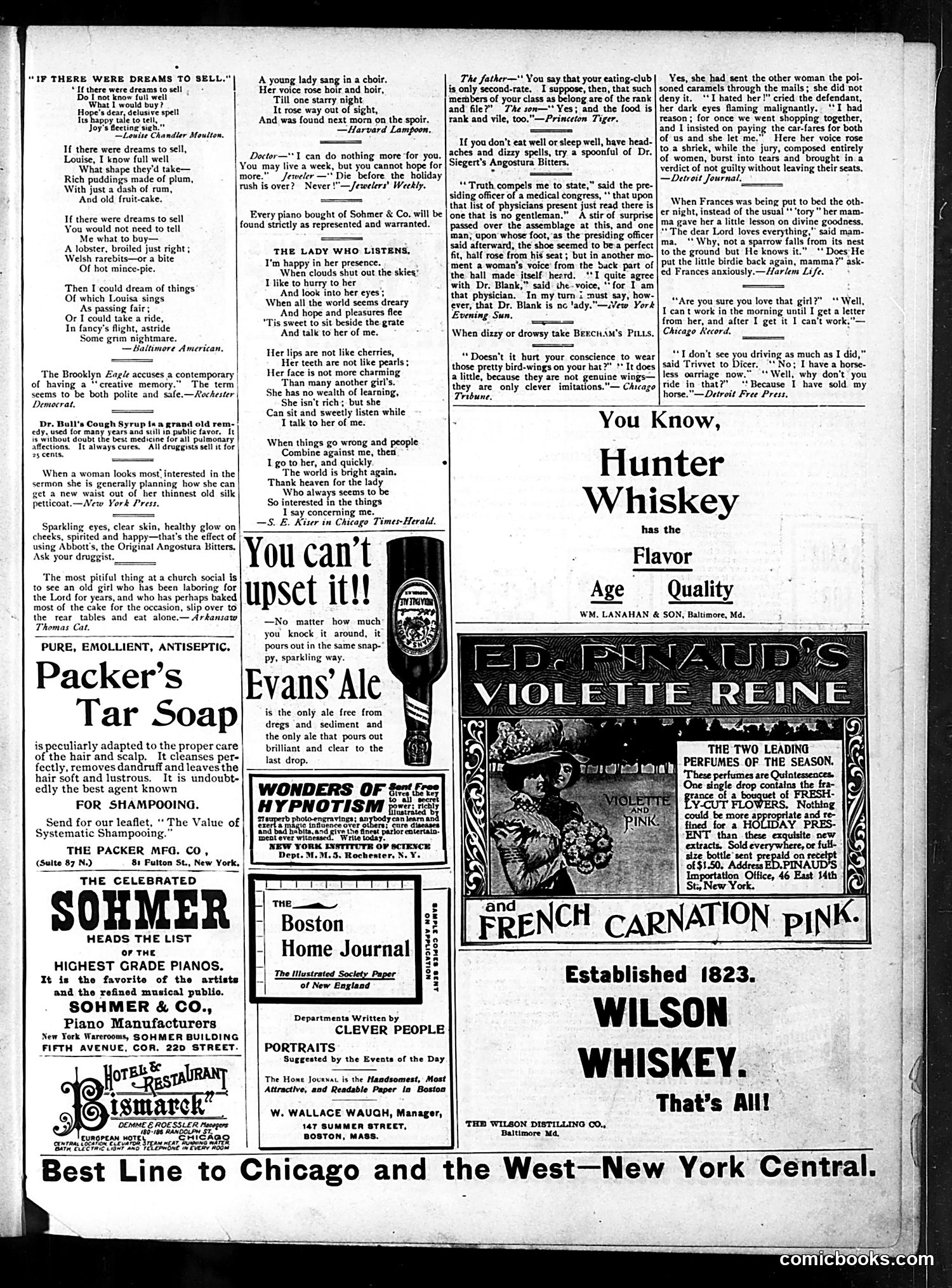
This page is primarily **advertising with light humorous verse** rather than political satire. The content includes: **Humorous Poetry & Jokes**: Several short, whimsical pieces satirizing everyday life—a woman's singing voice that literally "rises out of sight," jokes about college eating clubs serving "rank and vile" food, and a courtroom scene where an all-female jury acquits a woman who poisoned a rival over shared cab fare (satirizing female pettiness). **Social Commentary**: The verses gently mock romantic sentimentality (men praising women who simply listen to them talk) and absurd social situations (a physician admitting he's "no gentleman" at a medical conference). **Advertisements**: The page is dominated by product ads—Packer's Tar Soap, Evans' Ale, Hunter Whiskey, Wilson Whiskey, Sohmer pianos, and travel services. These occupy more space than editorial content. The page reflects **early 20th-century Judge magazine's formula**: light, genteel humor mixed with commercial messaging, targeting middle-class readers with gentle ridicule of their own pretensions rather than sharp political critique.
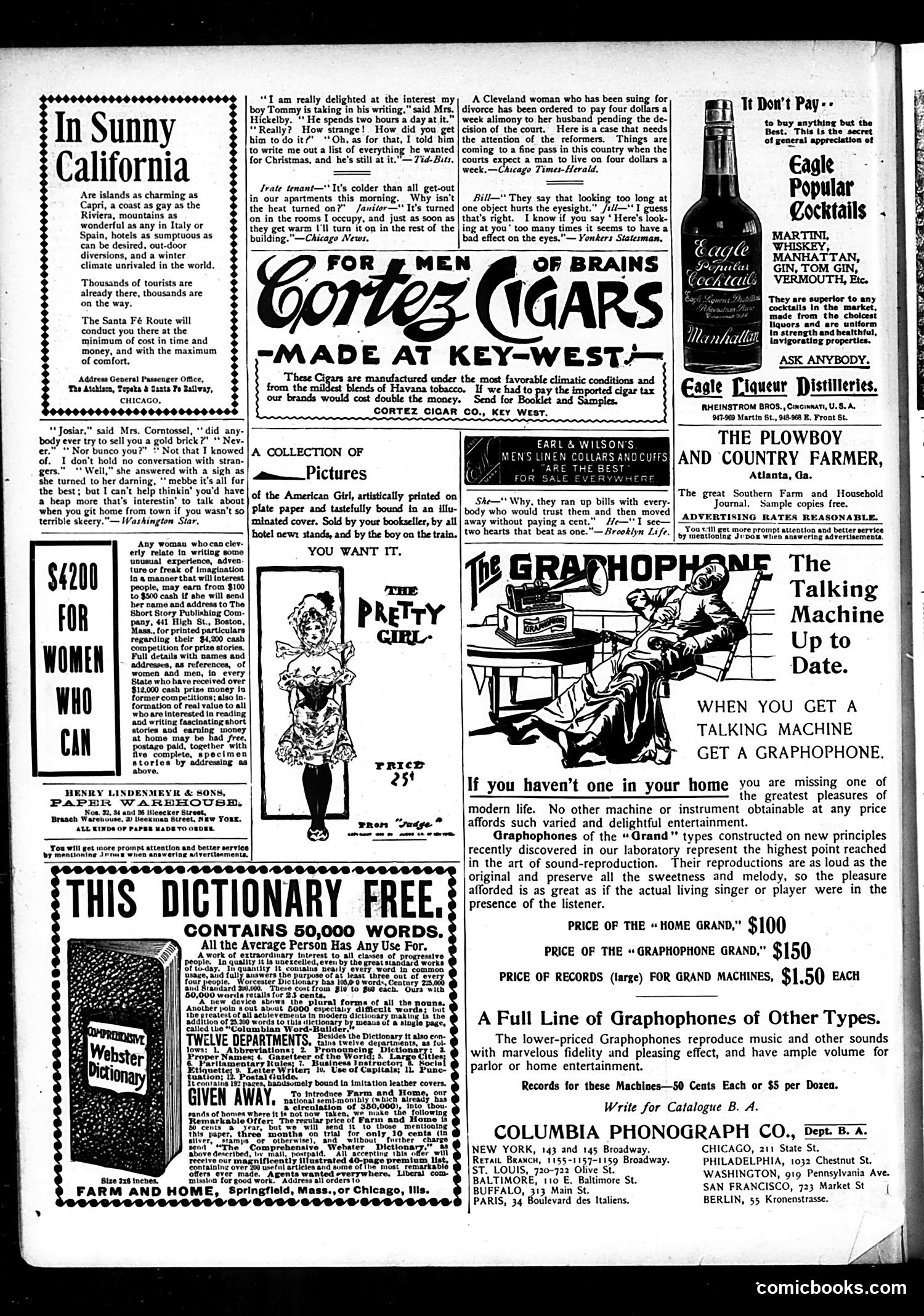
This is primarily an **advertising page** from Judge magazine, with minimal satirical content. The main cartoons are brief comic asides: **"Josiar" dialogue**: A rural woman scolds her husband for being too fearful and cautious, missing life's interesting experiences—gentle Americana humor about timidity. **Tenant vs. Janitor**: Dark comedy about class indifference. A janitor refuses to heat tenants' apartments while keeping his own warm, claiming he'll share warmth once his rooms are toasty—satirizing worker laziness or landlord negligence during winter. **Alimony joke**: A sarcastic editorial note mocking a Cleveland court ordering a woman to pay her husband $4/week alimony, calling it reform-worthy absurdity—reflecting period tensions over women's economic independence and divorce law. The page is otherwise dominated by ads for cigars, phonographs, dictionaries, and railways—typical early 20th-century advertising content with little satirical intent beyond the brief comic snippets.
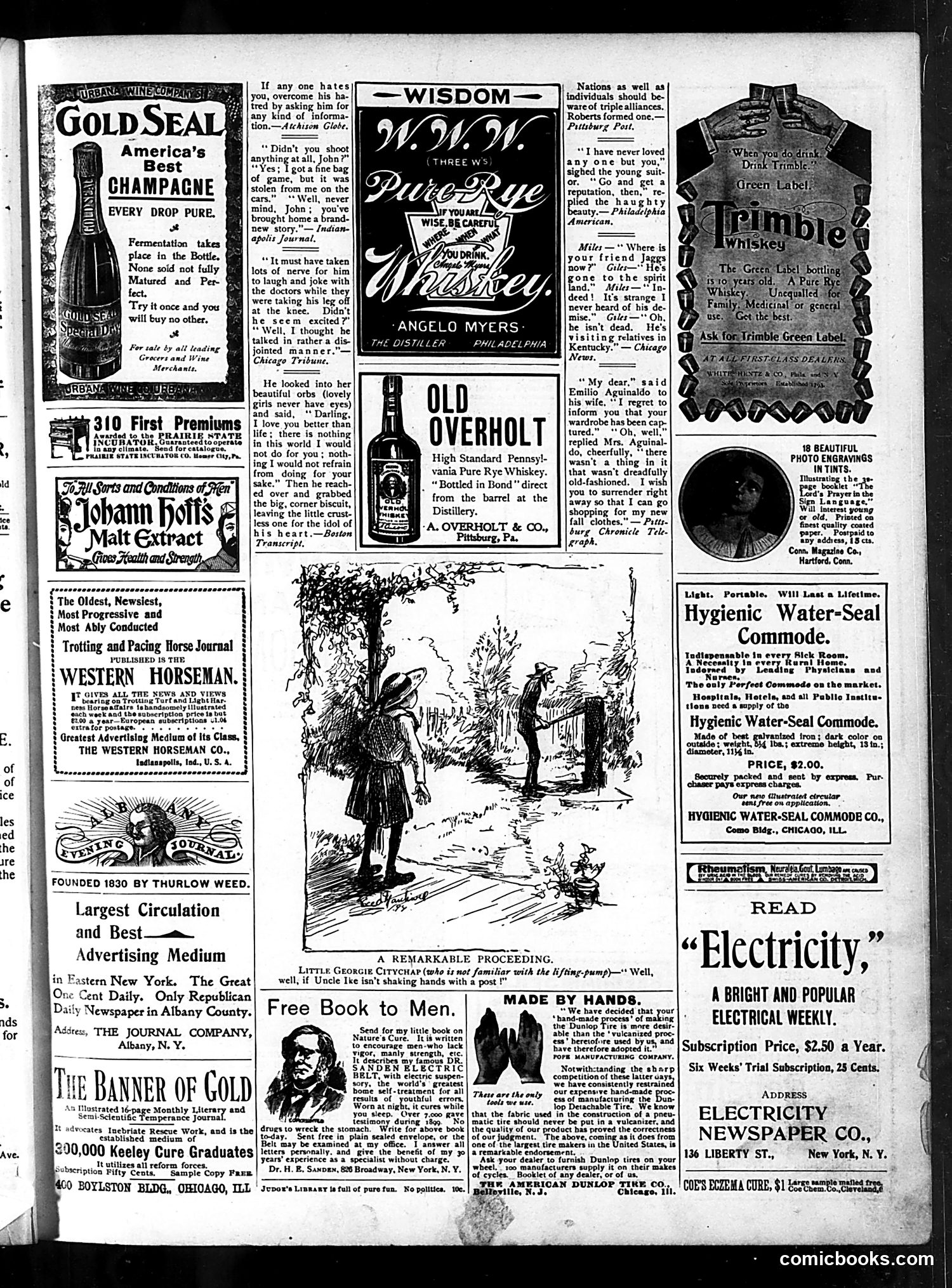
This page is primarily **advertising**, typical of early 1900s magazines. The central cartoon—"A Remarkable Proceeding"—depicts "Little Georgie" (likely a child character) observing Uncle Ike shaking hands with a fence post, with the caption joking that "Uncle Ike isn't shaking hands with a post!" The humor appears to play on mistaken identity or unclear vision, though the specific reference is obscure today. The page also contains scattered humor snippets mocking men—particularly in courtship situations. One joke satirizes a suitor's professed devotion before grabbing "the big, corner biscuit," leaving his beloved with leftovers. Another item references "Emilio Aguinaldo" (Filipino revolutionary leader), joking that his wife welcomes the capture of her wardrobe as an excuse for new shopping—satirizing both American military involvement in the Philippines and domestic gender dynamics. The advertisements promote alcohol, horse journals, and patent medicines typical of the era.
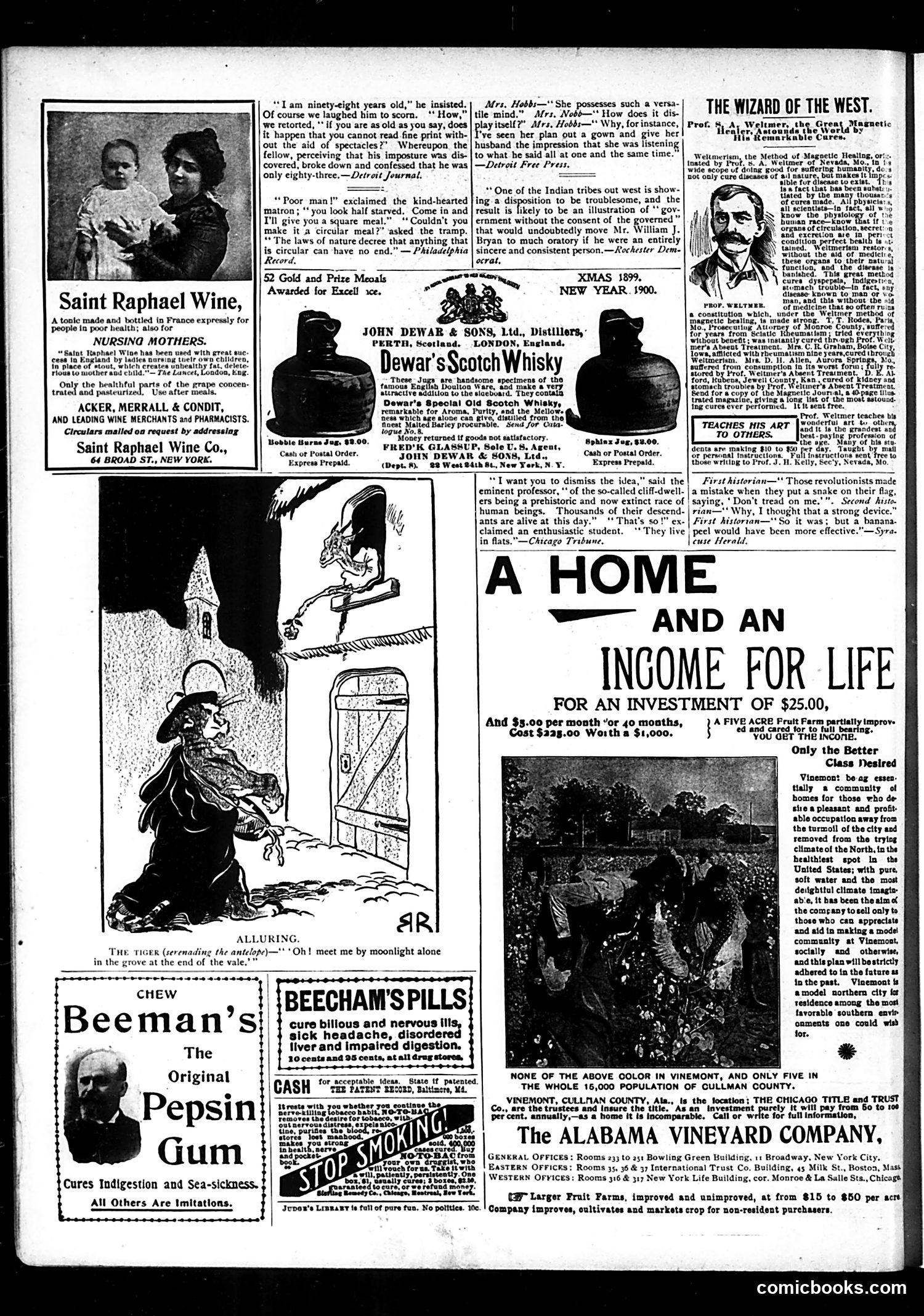
This is primarily an **advertising page** from Judge magazine (circa 1899-1900), not primarily satirical content. **The main cartoon** ("Alluring," by artist AR) shows a skeletal figure (Death personified) luring a starving man with food—a dark visual joke about poverty and mortality. **The text snippets** are brief humorous anecdotes: - A man claims to be 98 but is caught in the lie (he's only 83) - A tramp asks for a "circular meal" because "what is circular can have no end"—wordplay satirizing the tramp's hunger - A woman is praised for her "versatile mind," illustrated by her ability to plan a dress *and* deceive her husband simultaneously—mocking female deviousness The **advertisements** promote: - Saint Raphael Wine (health tonic for nursing mothers) - Dewar's Scotch Whisky (luxury items) - Beeman's Pepsin Gum and Beecham's Pills (patent medicines) - Prof. Wellmer's "magnetic healing" (fraudulent medical claims) - Alabama Vineyard Company (investment opportunity) The humor is period-typical: mildly misogynistic, irreverent toward authority, and promoting dubious "medicines."
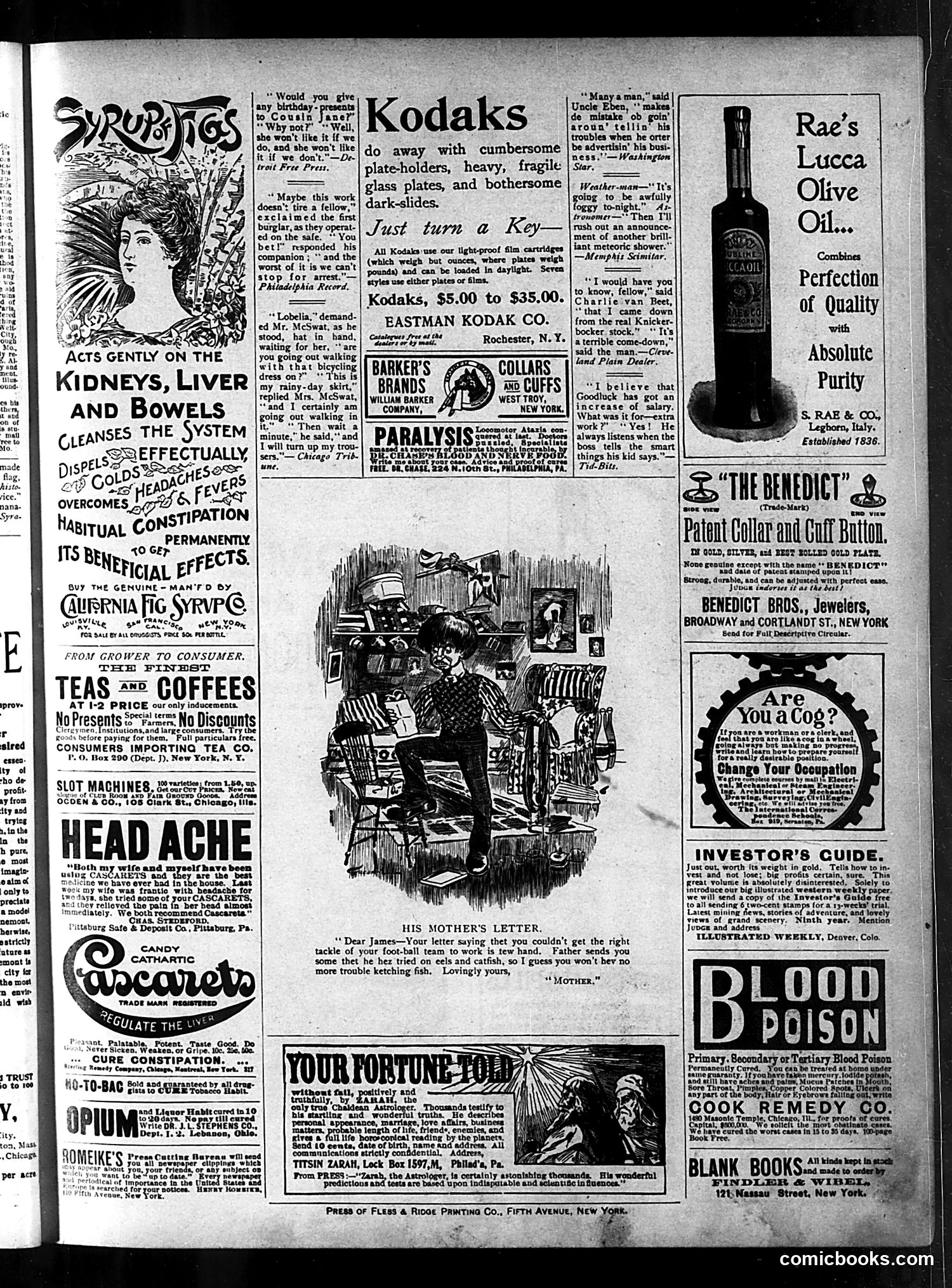
This is primarily an **advertising page** from Judge magazine, interspersed with brief humorous snippets typical of the publication's satirical style. The central cartoon shows a burglar scene with the caption "His Mother's Letter"—a joke about a mother confusing her son's football equipment needs with fishing tackle. The humor lies in the absurd maternal misunderstanding. Surrounding this are numerous small comic anecdotes on contemporary topics: a woman defending her "rainy-day" bicycle dress, a weather forecaster and astronomer's exchange about fog and meteors, a man bragging about Knickerbocker ancestry. These represent Judge's signature form of social satire—gentle mockery of middle-class life, pretension, and domestic situations. The **advertisements dominate**, hawking Kodak cameras, California Fig Syrup (a laxative), patent collars, olive oil, and various remedies—typical patent medicine and consumer goods of the era. The page reflects Judge's dual nature: satirical commentary for educated readers, funded by advertising to the aspirational middle class.
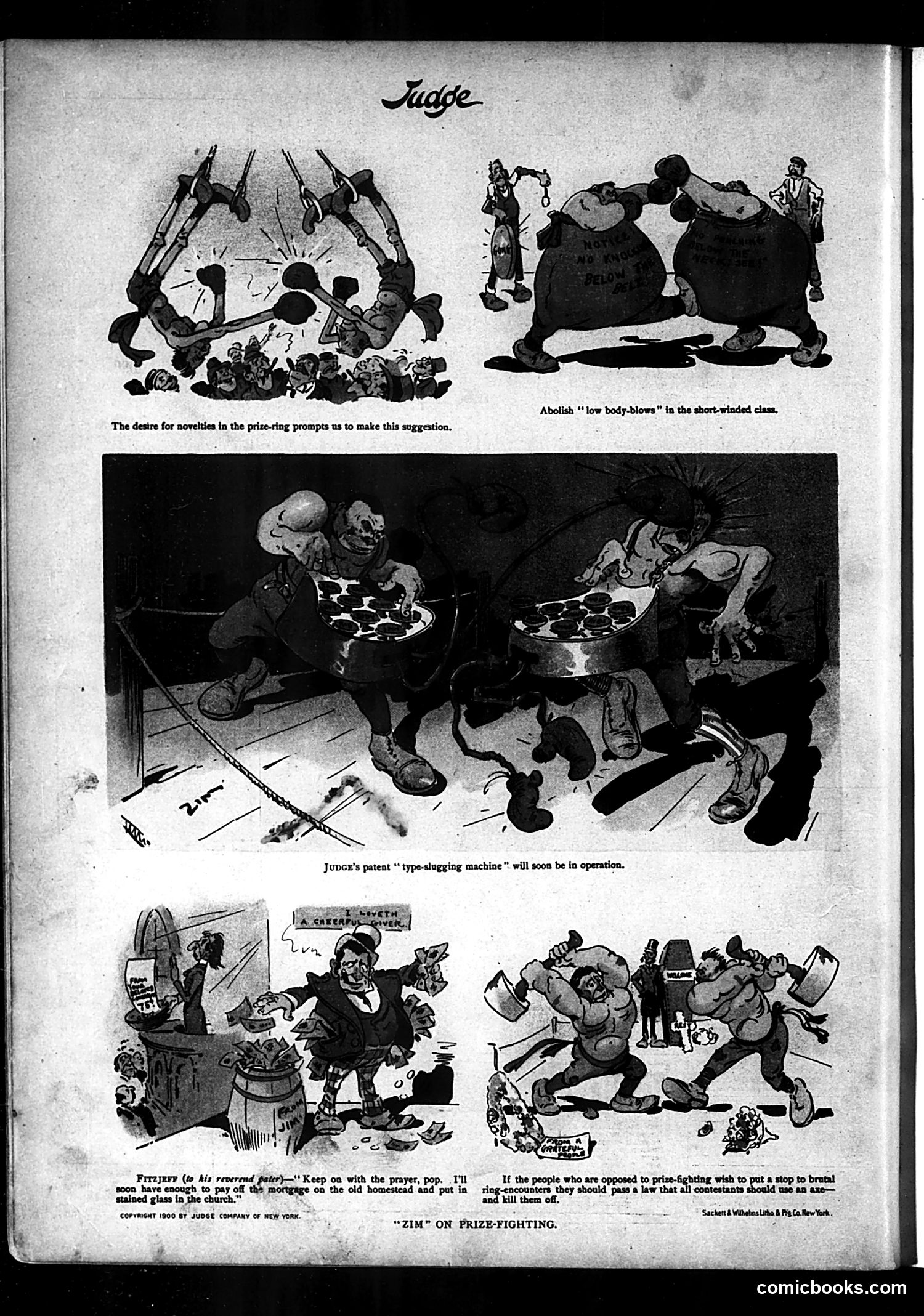
This page from *Judge* satirizes boxing regulation and brutality. The top cartoons mock the desire for novelty in prize-fighting, showing exaggerated boxing scenarios with spectators. The central illustration depicts what appears to be a match with grotesque figures and a "type-slogging machine," suggesting boxing has become absurdly mechanical or dehumanized. The bottom comic presents a domestic scene where "Fitzjerr" tells his reverend father to "keep on with the prayer, pop"—implying the family needs prayer to save their mortgaged homestead. The joke appears to be that prize-fighting promoters exploit poor families desperate for income, turning brutal boxing into economic necessity rather than sport. The final caption "If the people who are opposed to prize-fighting wish to put a stop to brutal encounters they should pass a law that all contestants should use an anesthetic" suggests satirical criticism of both boxing brutality and ineffective reform efforts.