
A complete issue · 16 pages · 1899
Judge — November 18, 1899
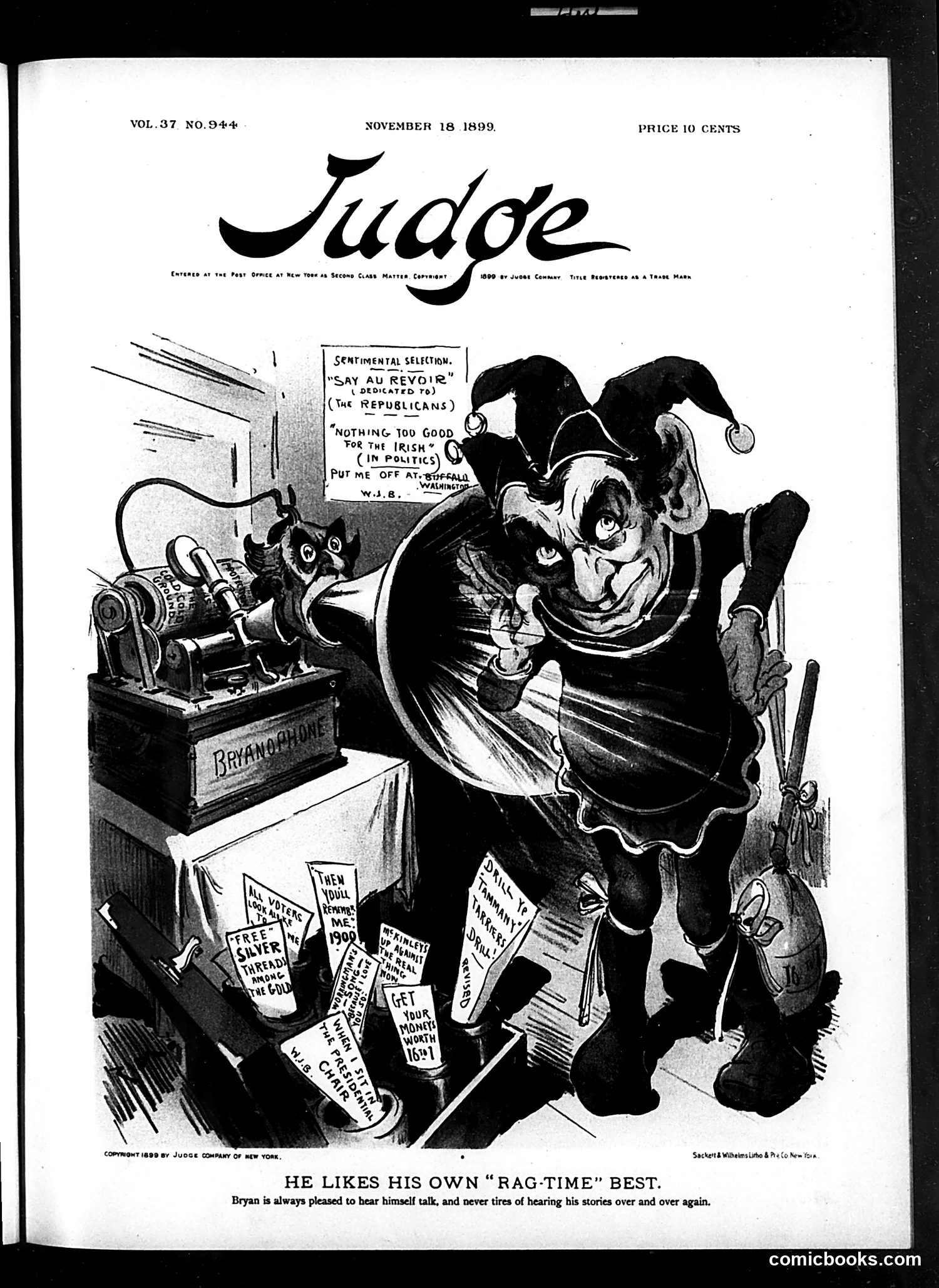
This political cartoon satirizes **William Jennings Bryan**, the Democratic presidential candidate, depicted as a grotesque figure operating a phonograph labeled "Bryanophone." The cartoon mocks Bryan's campaign strategy and rhetorical style. The "Sentimental Selection" box references Bryan's political positions on Irish independence and Republican policy criticism. The scattered papers at the bottom—labeled with Bryan campaign slogans like "FREE SILVER," "GET YOUR MONEY'S WORTH," and other talking points—suggest his message is mechanically repetitive rather than thoughtful. The title, "He Likes His Own 'Rag-Time' Best," implies Bryan endlessly repeats himself and enjoys hearing his own voice. The cartoon criticizes both his oratorical approach and the substance (or lack thereof) of his political messaging during the 1899-1900 campaign period.
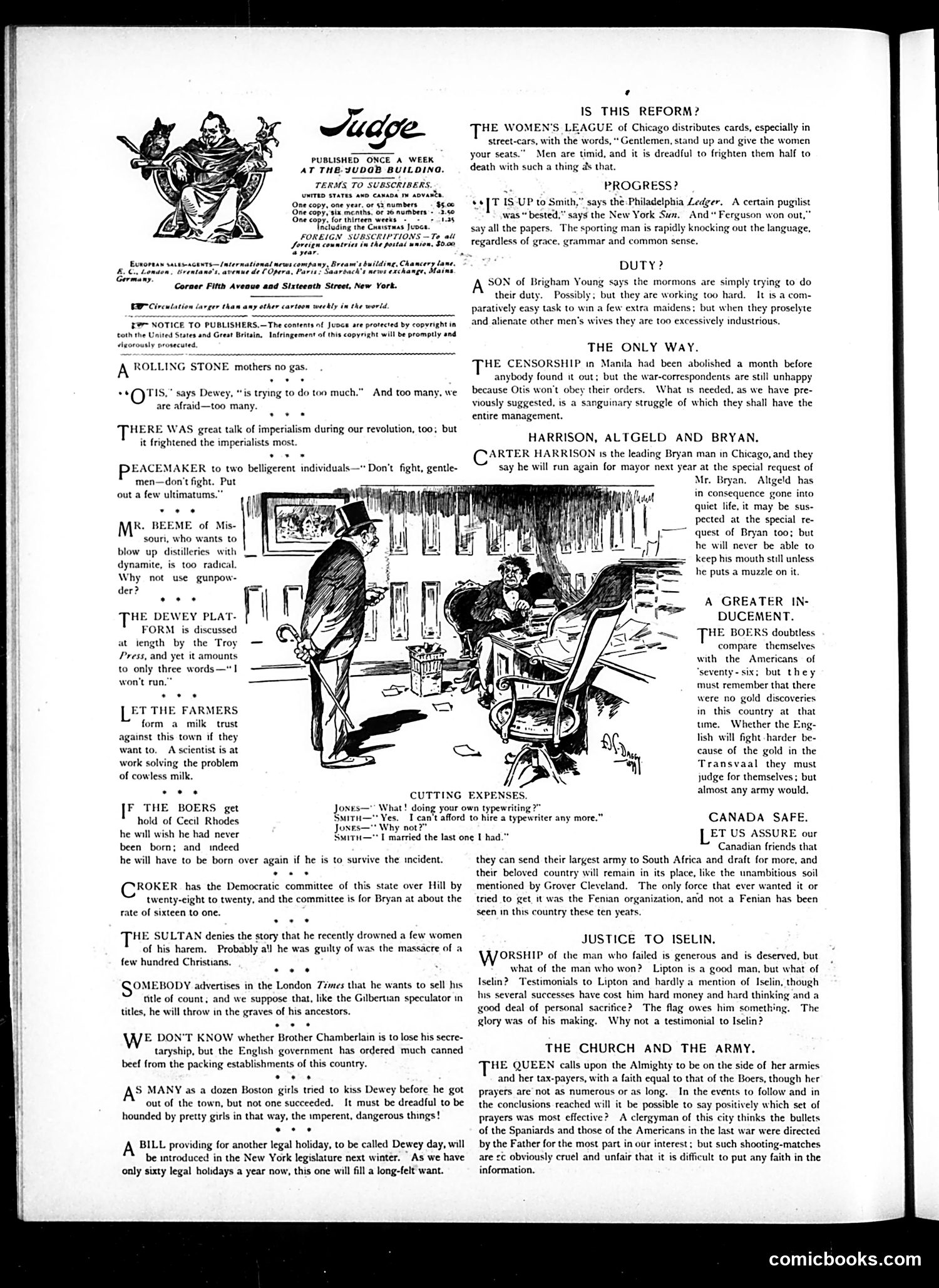
The central cartoon titled "CUTTING EXPENSES" depicts two businessmen discussing cost-cutting measures. One says "Jones—What! doing your own type-writing?" The other responds "Yes. I can't afford to hire a type-writer any more." The first replies "I worried the last one I had." This satirizes the economic hardships of the period (likely post-WWI era based on magazine context), showing how even middle-class professionals were forced to economize by doing clerical work themselves. The dark humor lies in the ambiguous final line—suggesting the previous typist either quit or died from overwork—implying that even this "savings" came at human cost. The surrounding editorial content discusses political figures (Bryan, Harrison, Croker) and social issues of the era.
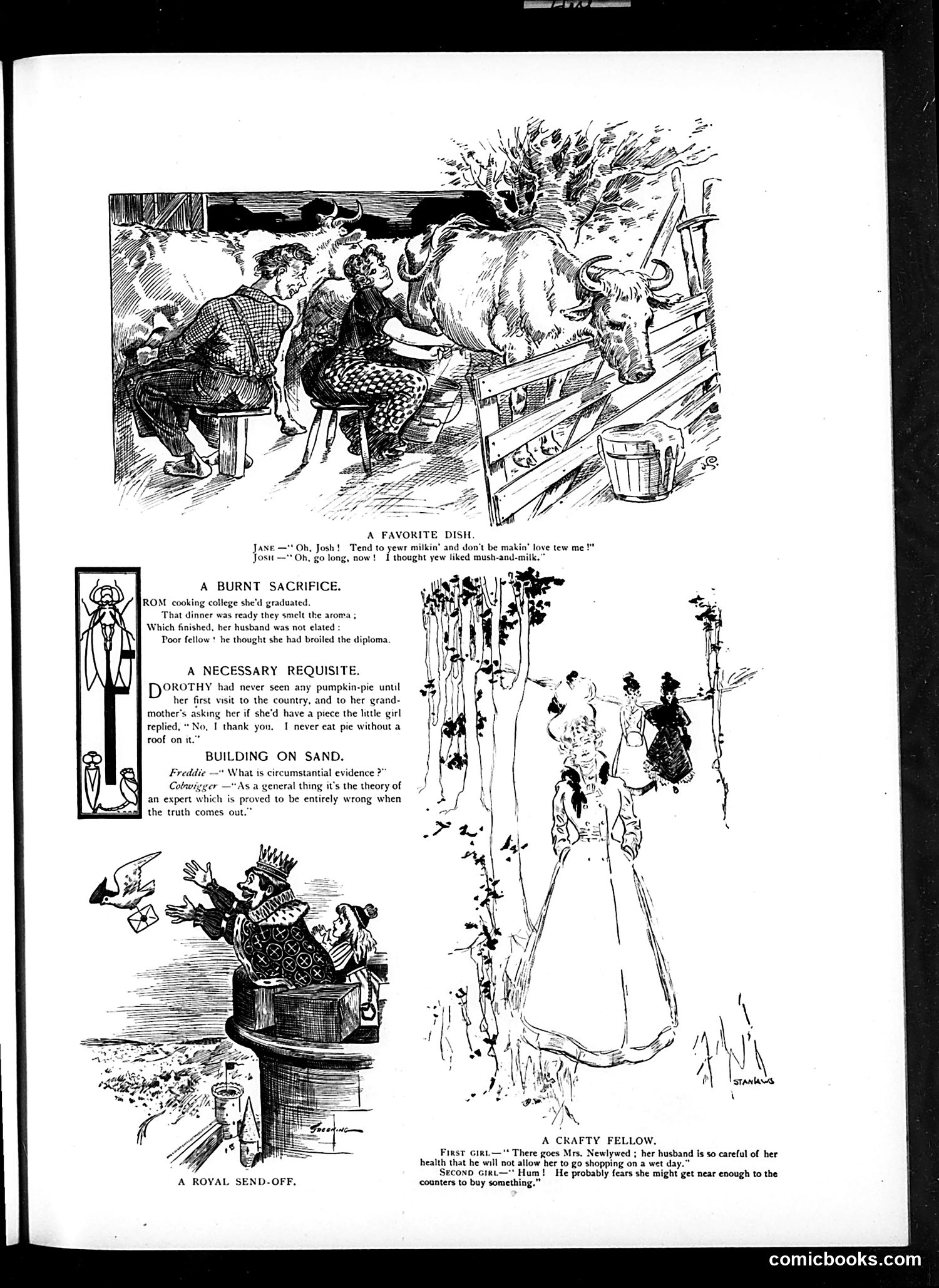
This page contains several humorous vignettes satirizing domestic life and social conventions of the era: **"A Favorite Dish"**: Rural couple banter about milking and love-making, playing on double meanings. **"A Burnt Sacrifice"**: Wife's cooking disaster—she burned the pumpkin pie, ruining dinner. **"A Necessary Requisite"**: Joke about pumpkin pie being essential; a mother won't visit without guarantee of it. **"Building on Sand"**: Dialogue between Freddy and Cottager about an expert being "proved to be entirely wrong when the truth comes out"—likely mocking overconfident professionals. **"A Royal Send-off"**: Illustration of a figure in a trash bin, possibly political, though unclear without fuller context. **"A Crafty Fellow"**: Wife carefully restricts her husband's shopping to prevent wasteful spending. The humor targets domestic squabbles, female domesticity, and marital economics typical of early 20th-century American satire.
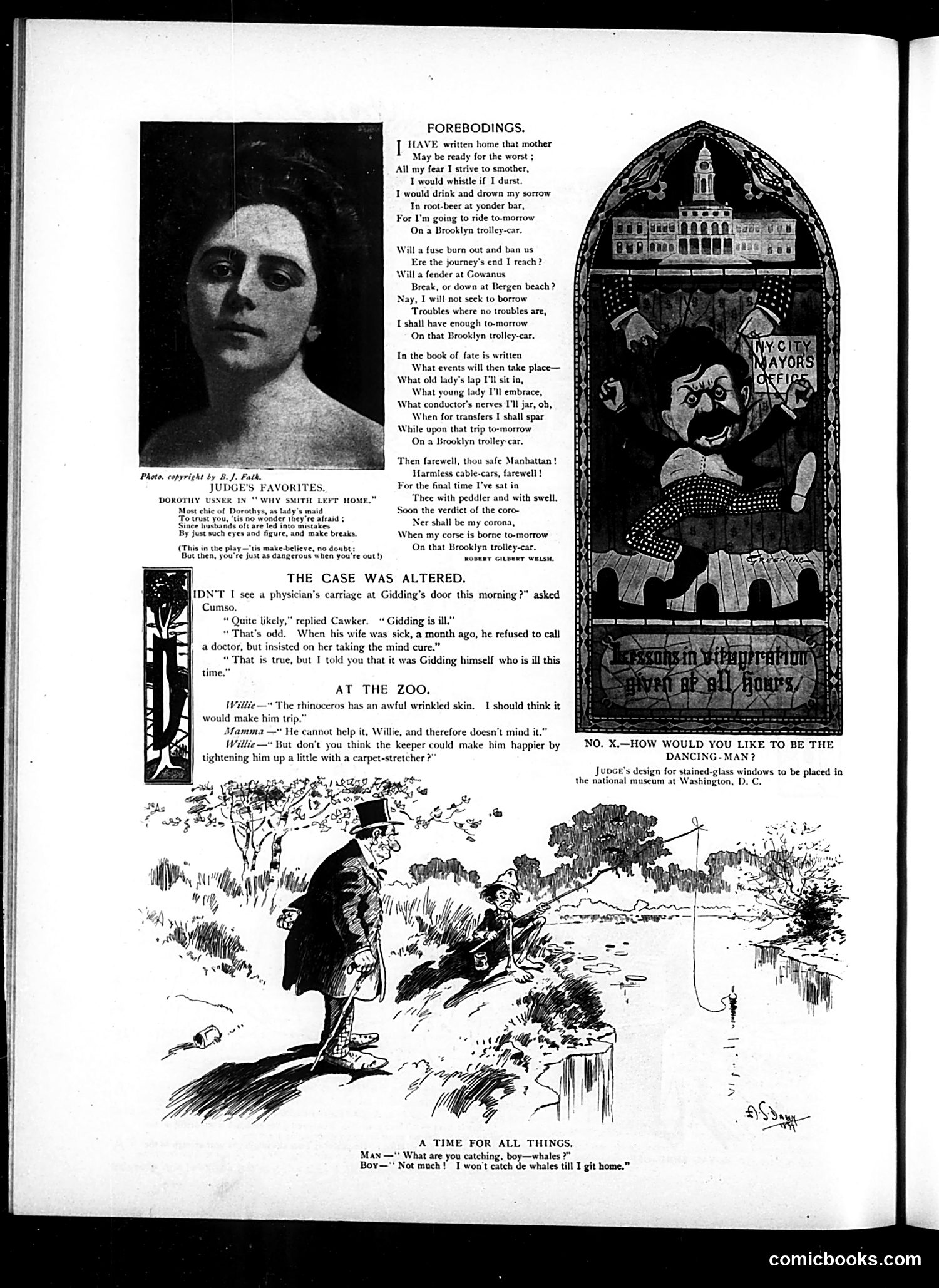
This page contains literary and humorous content rather than political satire. "Forebodings" is a poem by Dorothy Smith about anxieties regarding travel on a Brooklyn trolley car—a mundane but contemporary concern for early 20th-century readers. "Urge's Favorites" praises actress Dorothy Smith. "The Case Was Altered" and "At the Zoo" are brief humorous dialogues about everyday situations—a man refusing to see a doctor and children observing a rhinoceros at the zoo. The stained-glass window design on the right appears to be a design submission for a national museum, showing a "dancing man" figure. "A Time for All Things" is a fishing joke about catching whales. The page emphasizes comedic domestic and social observations rather than political commentary, typical of Judge's general-interest humor content.
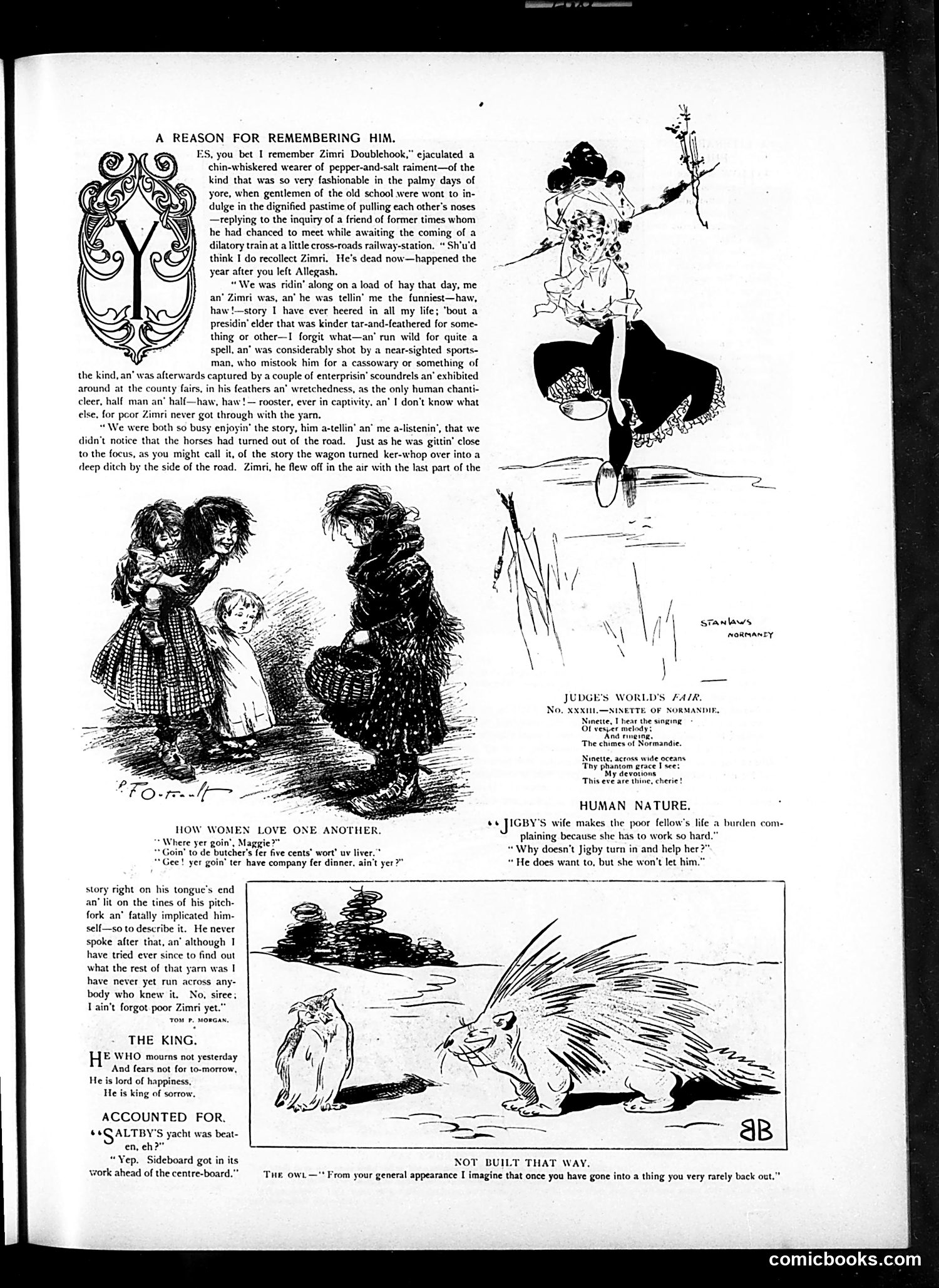
This page contains several unrelated satirical pieces typical of late 19th/early 20th-century Judge magazine. **"A Reason for Remembering Him"** is a tall tale where a narrator recalls his friend Zimri Doublehook, who died after falling from a hay wagon while telling an absurdly elaborate story about a tar-and-feathered minister. The joke satirizes rural storytelling culture—Zimri's death mid-yarn ensures the story remains forever unfinished, a humorous commentary on compulsive storytellers. **"How Women Love One Another"** mocks female pettiness: a woman going to buy cheap liver for dinner insists she's having company for dinner anyway—a jab at women's social pretension. **"Human Nature"** jokes about marital dynamics: a wife complains her poor husband won't help with housework, yet deliberately prevents him from doing so. **"Not Built That Way"** features an owl and frog; the owl's comment about "backing out" appears to be a visual pun or innuendo. The page also includes poetry and unrelated content, typical of Judge's miscellaneous format.
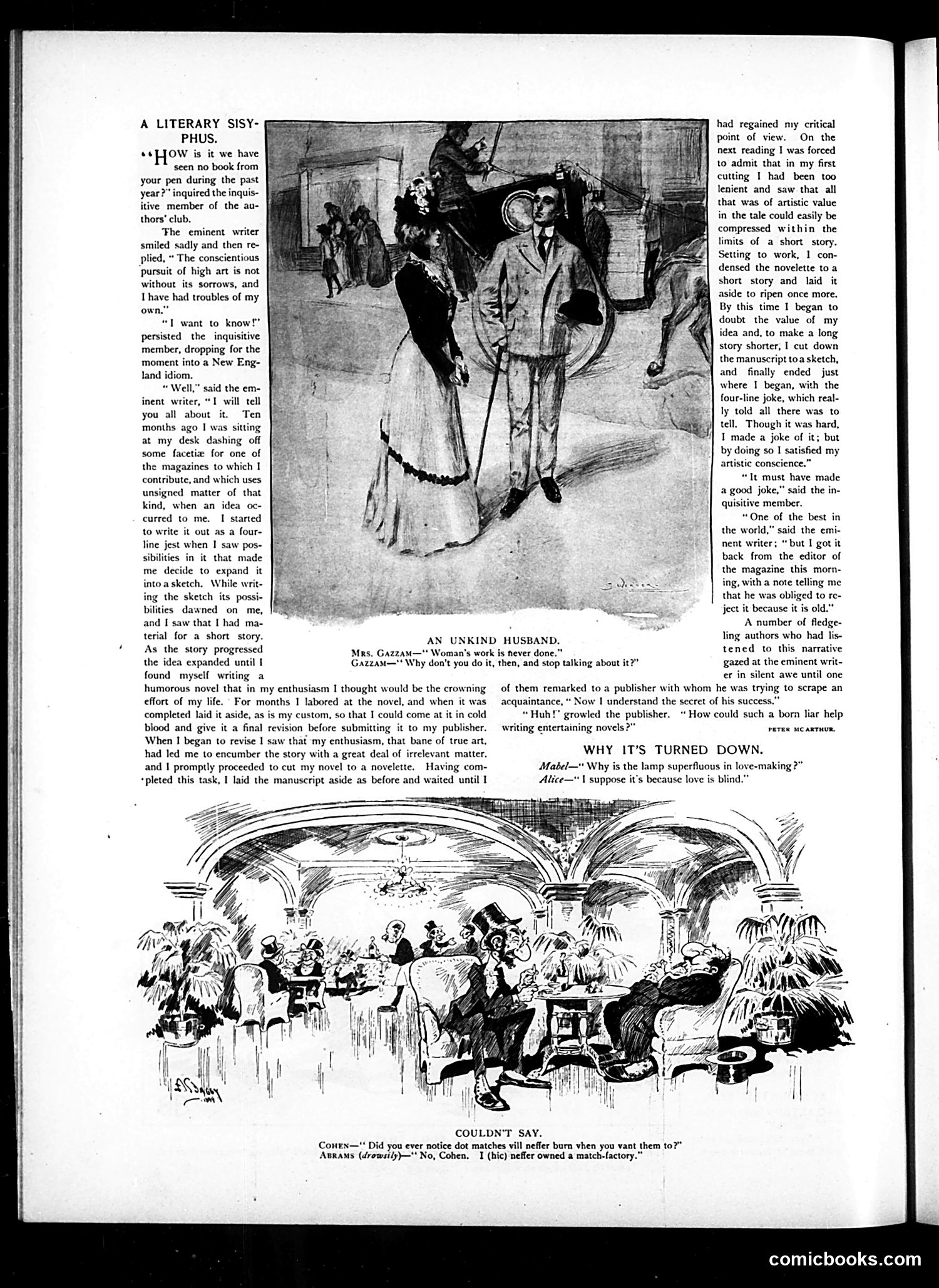
This page satirizes the creative struggles of ambitious writers. The main story depicts an author who starts with a four-line joke, expands it into a sketch, then a short story, then a novelette, finally a novel—only to have an editor reject it as "old," forcing him to cut it back down to the original four-line joke. The satire mocks both writerly overambition and the futility of endless revision. The top illustration labeled "An Unkind Husband" shows a domestic scene where a wife complains about her endless work, while her husband dismisses her concerns—typical period humor about marriage and gender roles. The bottom cartoon "Why It's Turned Down" features what appear to be Jewish characters (indicated by the Yiddish dialect spelling), making a joke about matches that won't light—a common vaudeville-style ethnic humor of the era. The page overall reflects early 20th-century magazine satire targeting literary pretension and featuring casual ethnic stereotyping typical of the period.
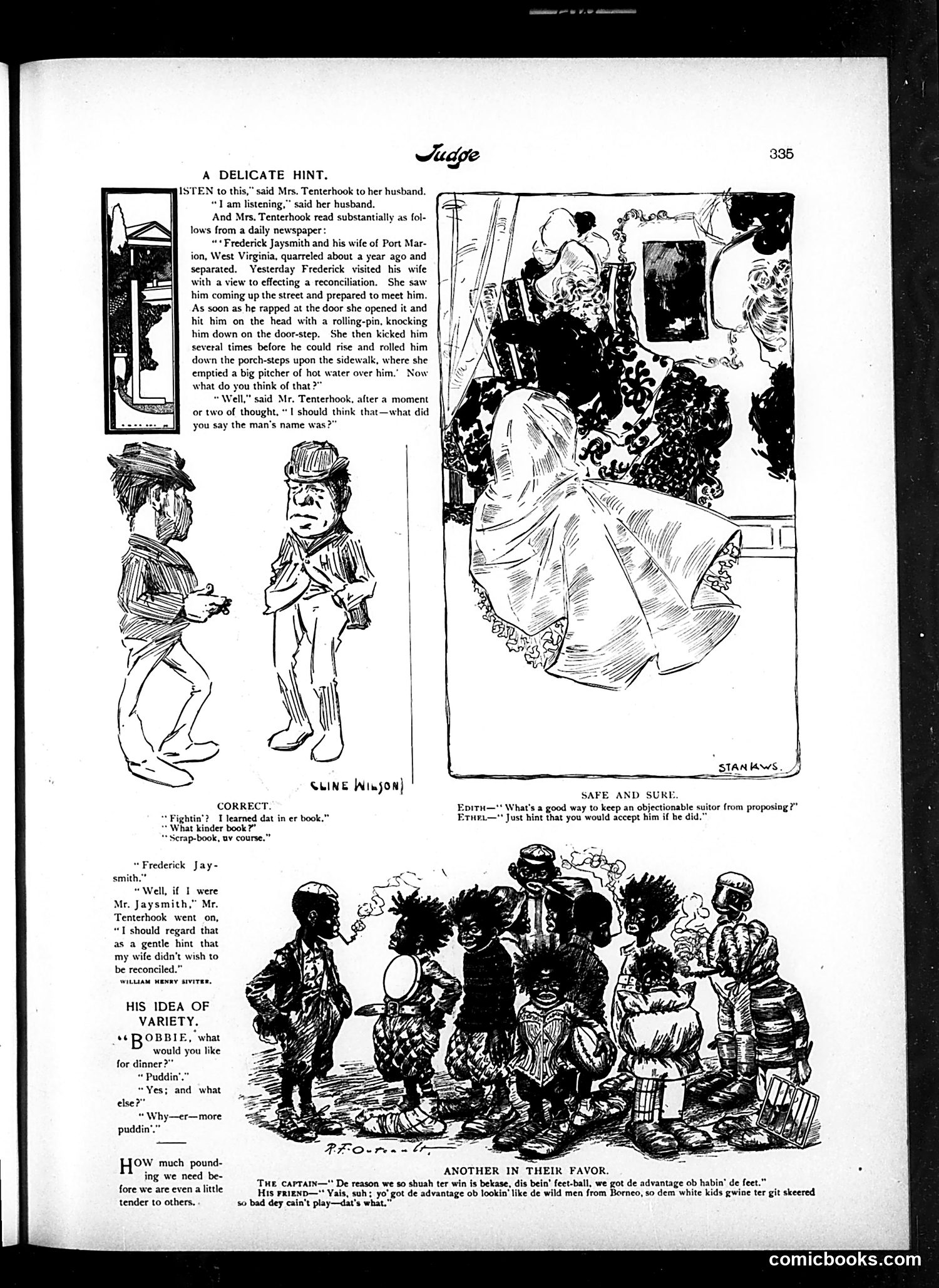
This page contains several satirical cartoons mocking domestic life and social conventions of the era. **"A Delicate Hint"** satirizes marital discord. Mrs. Tenterhook reads her husband a newspaper story about Frederick Jaysmith, whose wife violently attacked him (rolling pin, kicks, hot water) when he attempted reconciliation. Mr. Tenterhook's deadpan response—suggesting this constitutes a "gentle hint" that reconciliation is unwelcome—is the joke: the satire lies in understating extreme violence as merely subtle marital communication. **"Safe and Sure"** jokes about courtship: the advice column suggests hinting you'd accept an unwanted suitor *if* he proposes, thereby discouraging him. **"His Idea of Variety"** mocks a child's limited palate, wanting only "puddin'" for dinner, with no variation. **"Another in Their Favor"** (bottom) uses racist dialect and caricature, depicting African American football players claiming their advantage is "havin' de feet." The satire appears to mock the players themselves rather than racism. The page reflects Judge's typical early 20th-century humor: domestic absurdism, courtship follies, and unfortunately, period-typical racial stereotyping.
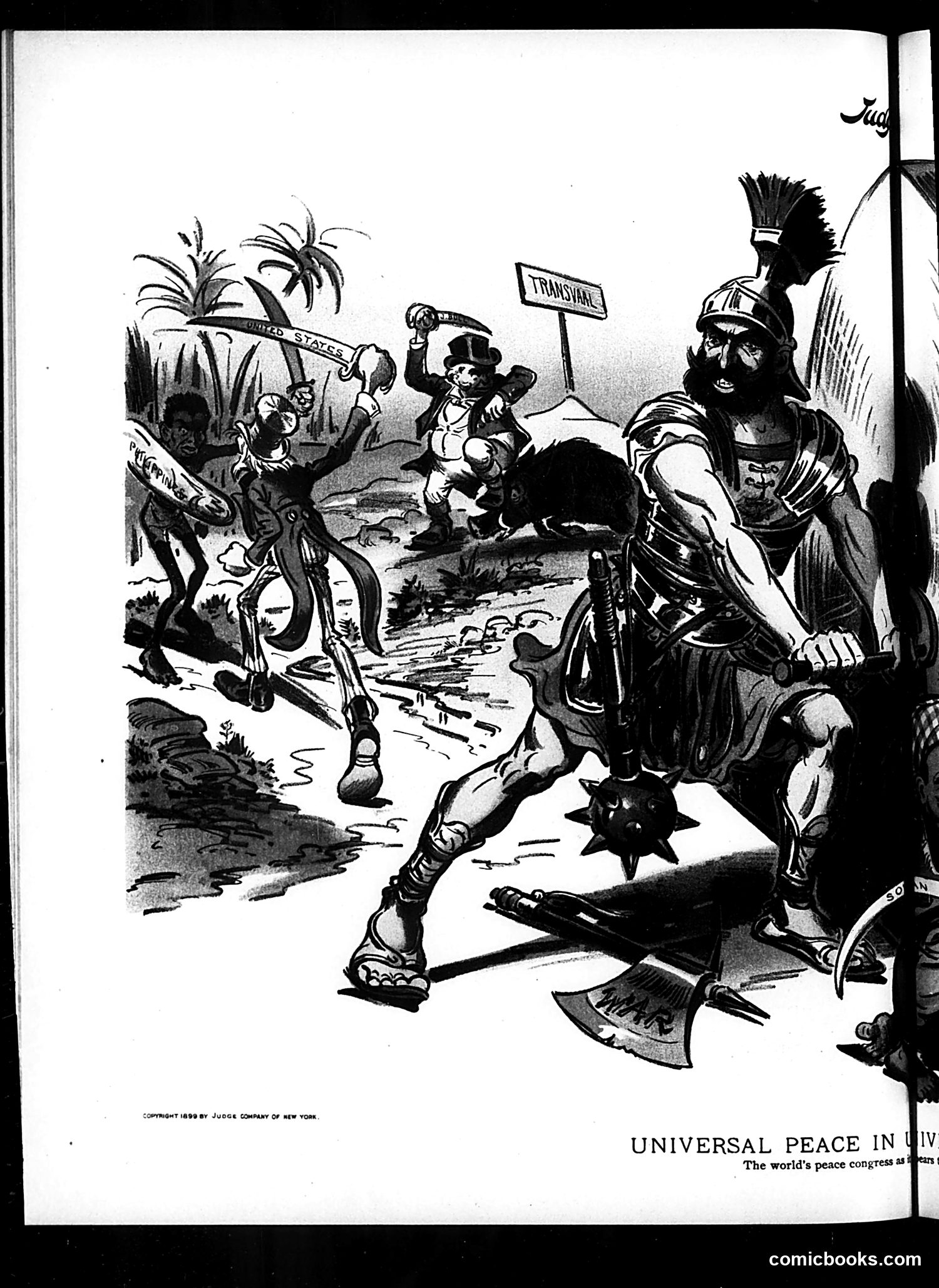
This satirical cartoon depicts a "world's peace congress" as chaotic rather than peaceful. On the right, militaristic figures in armor and helmets (representing various nations) appear menacing. On the left, what appears to be Native American or indigenous figures are shown alongside palm trees, suggesting colonial territories or exotic locales. The central figure holds weapons (axes visible in foreground), undermining the "peace" premise. A sign reading "TRANSVAAL" references the South African region, likely invoking contemporary colonial conflicts. The satire suggests that international peace conferences are merely theater—nations arrive armed and hostile despite peaceful rhetoric. The inclusion of colonial imagery implies that "universal peace" excludes or exploits non-Western peoples. The cartoon critiques the gap between stated peaceful intentions and actual militaristic realities of international relations.
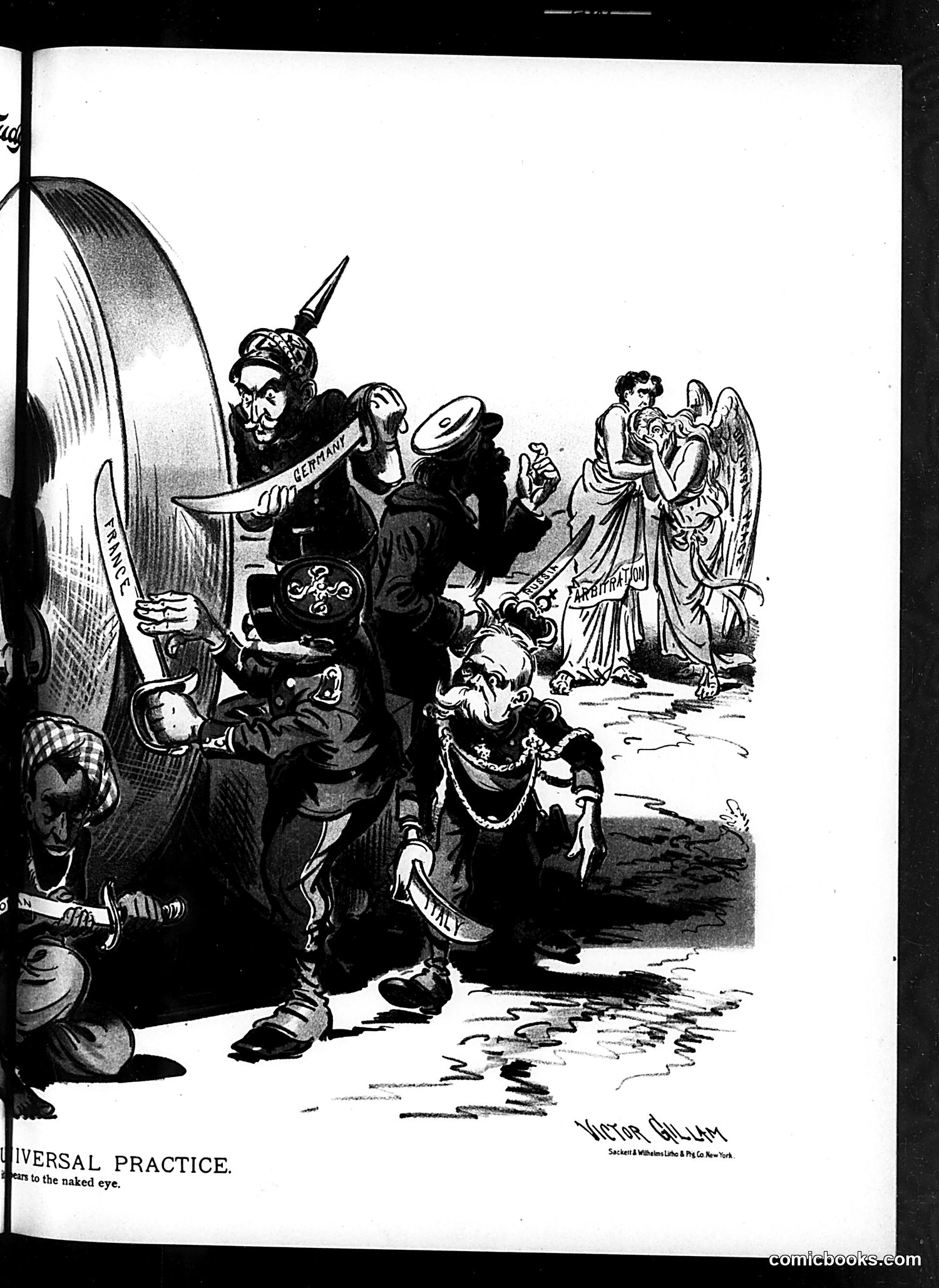
This satirical cartoon depicts military and political figures engaged in what appears to be imperialist or colonial expansion activities. On the left, a Prussian officer (identifiable by the spiked helmet) and other military leaders examine a map or territory. On the right, angelic figures labeled "Arbitration" observe the proceedings, seemingly mockingly, as the powerful nations divide up territory. The title "Universal Practice" suggests that imperial conquest and territorial seizure are standard conduct among nations despite their claims to peaceful arbitration. The contrast between the aggressive military figures and the symbolic angels of peace/arbitration critiques the hypocrisy of nations that publicly espouse diplomatic solutions while privately pursuing territorial acquisition through military force. This likely reflects early 20th-century concerns about European imperialism and great-power competition.
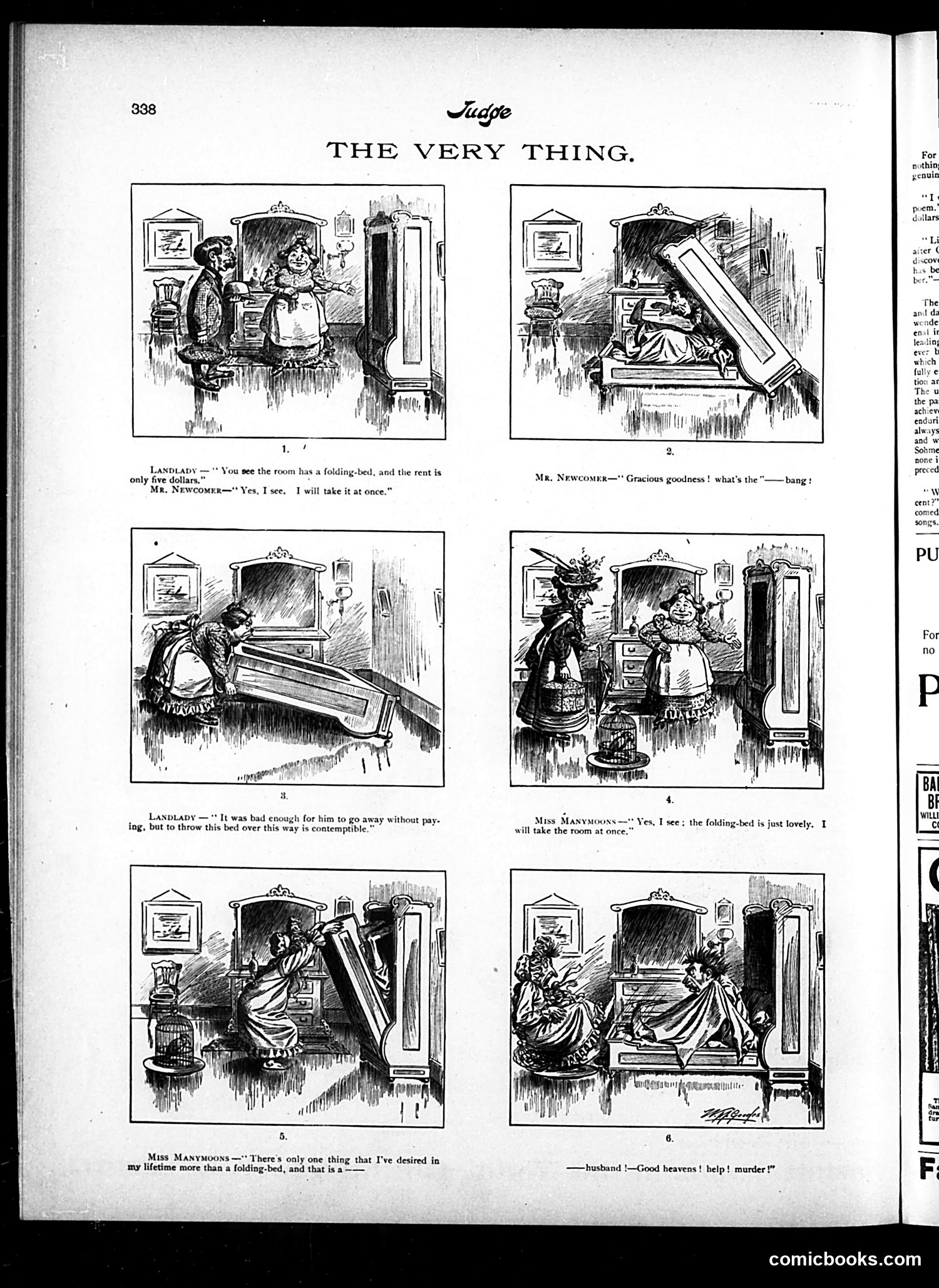
This six-panel comic satirizes the appeal of space-saving furniture to renters of modest means. The central joke involves a **folding bed** — a practical but temperamental device popular in cramped urban housing of the era. The narrative follows two separate renters (Mr. Newcomer and Miss Manymoons) who each enthusiastically rent a room specifically because it features this bed, only to have it violently collapse or malfunction on them. The humor escalates from mild annoyance to chaos: panel 2 shows the bed unexpectedly closing, panel 5 shows Miss Manymoons being struck by it. The final panel's punchline — "husband! Good heavens! help! murder!" — suggests Miss Manymoons was struck *while in bed with someone*, implying scandalous cohabitation. This adds a moral dimension to the satire: the folding bed becomes not just a practical inconvenience but evidence of impropriety. The cartoon satirizes both the unreliable technology marketed to poor renters and contemporary anxieties about urban morality and cramped living conditions.
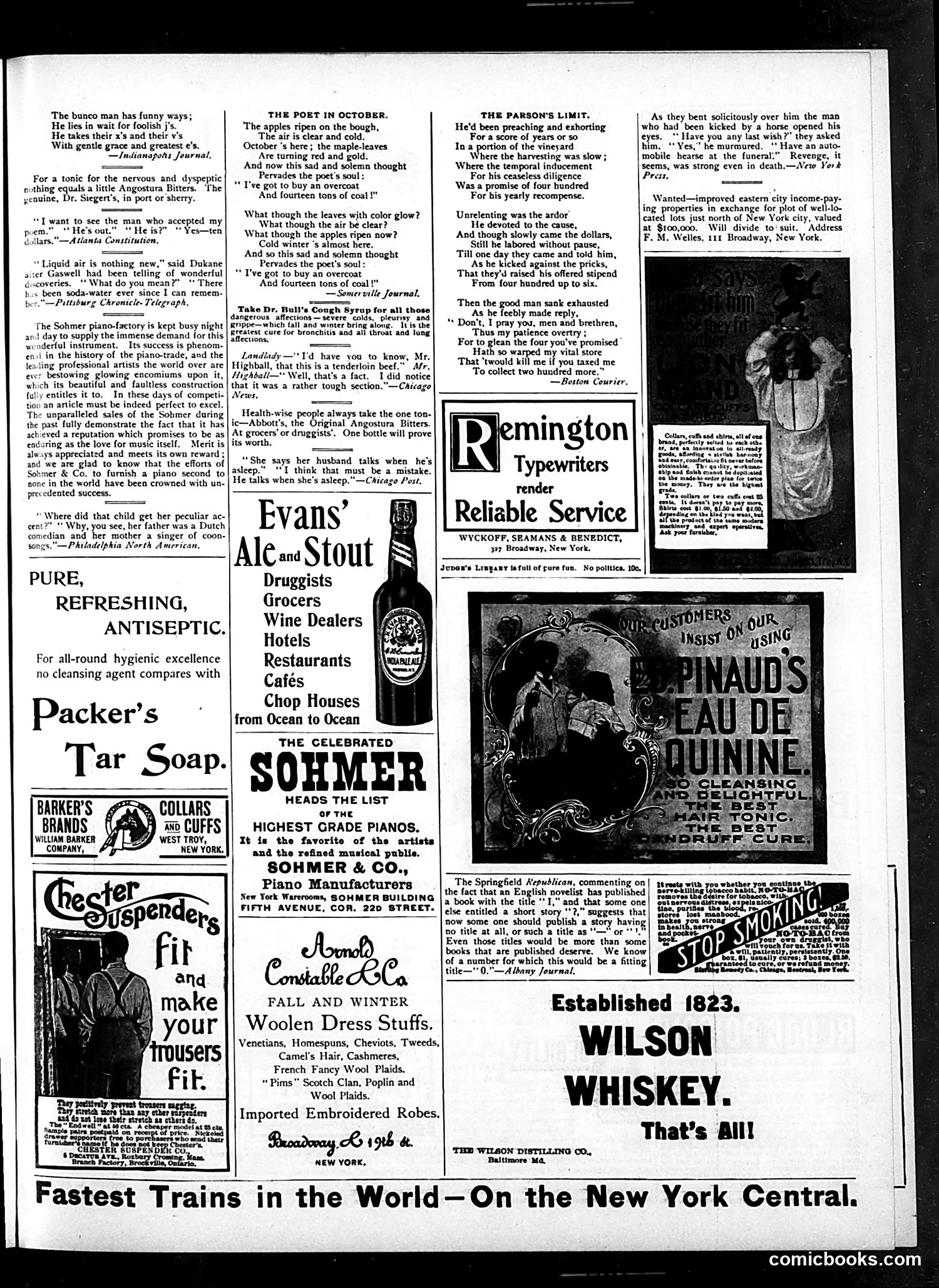
This page is primarily **advertising**, with some light satirical poetry and anecdotes scattered throughout. The notable content includes: **Poetry/Humor sections:** Three brief satirical poems mock middle-class anxieties—a poet obsessing over winter expenses despite autumn's beauty; a parson disappointed that his 20 years of labor earned only modest salary increases; and a dying man's last wish for an automobile hearse (suggesting spite toward those around him). **Advertisements:** The page is dominated by product ads typical of early 20th-century America: Packer's Tar Soap, Evans' Ale and Stout, Remington Typewriters, Pinaud's Eau de Quinine (a hair product), Wilson Whiskey, Chester Suspenders, and piano manufacturers. **Social context:** The humor reflects period concerns—financial precarity, clergy underpayment, and class consciousness. The advertisements assume a middle-class readership concerned with respectability, hygiene, and consumption. The satire is mild and domestic rather than political, typical of Judge's general-interest humor magazine format during this era.
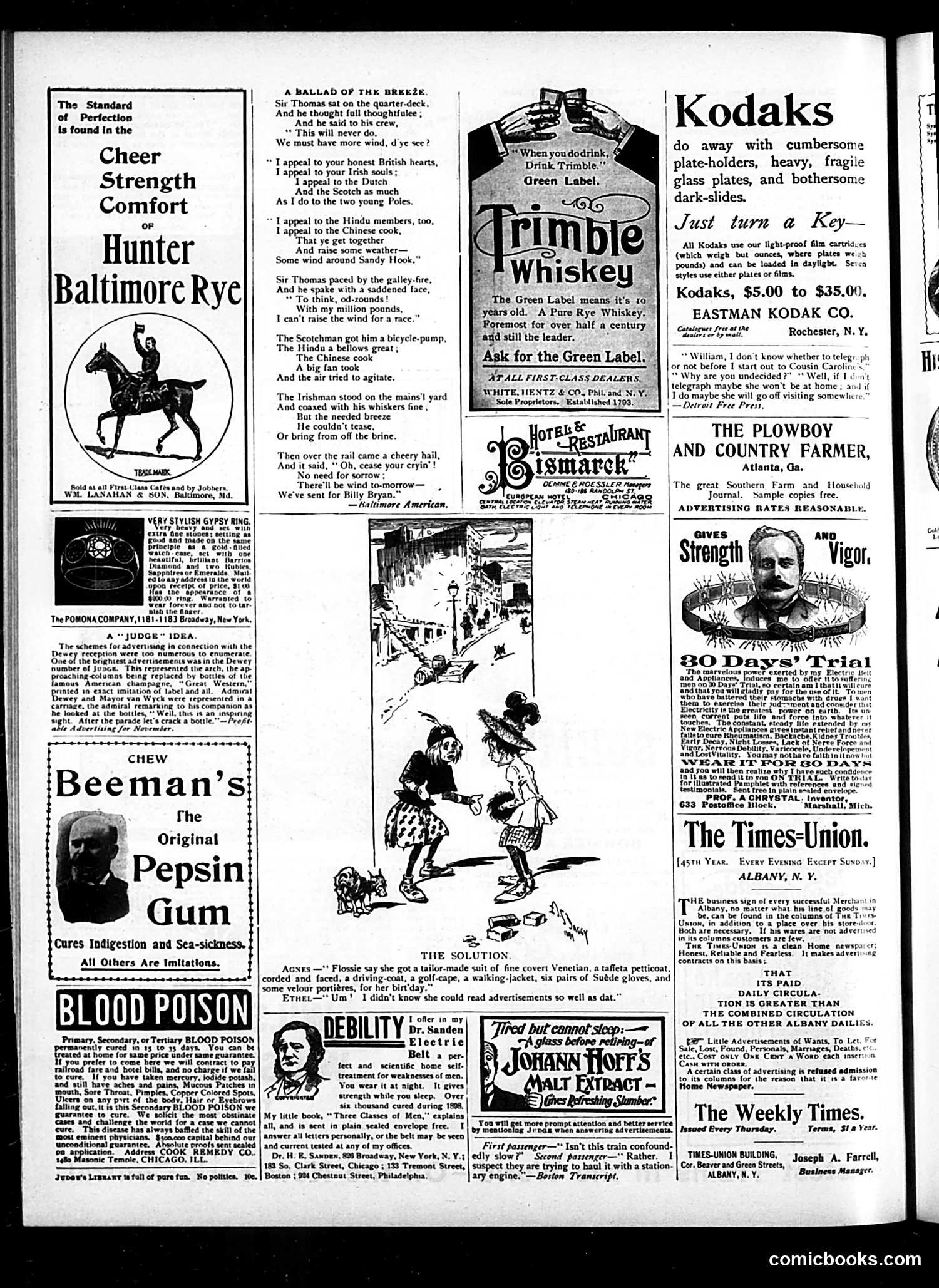
This page is primarily **advertisements** with one satirical cartoon titled "A Ballad of the Breeze" (top center). The cartoon mocks the frustration of a ship captain unable to catch wind, appealing in desperation to sailors of various nationalities—Irish, Dutch, Chinese, Scottish, Hindu—to somehow produce a breeze. The final punchline references **Billy Bryan**, the Democratic presidential candidate. The satire likely critiques political leadership or campaign desperation circa Bryan's presidential runs (1896 or 1900). The captain represents a leader appealing to diverse groups for help with an impossible task—perhaps mocking Bryan's populist coalition-building or the general absurdity of political promises. The remainder of the page consists of period advertisements for Kodak cameras, Trimble Whiskey, Beeman's Gum, and various other products and publications typical of *Judge* magazine's commercial content.
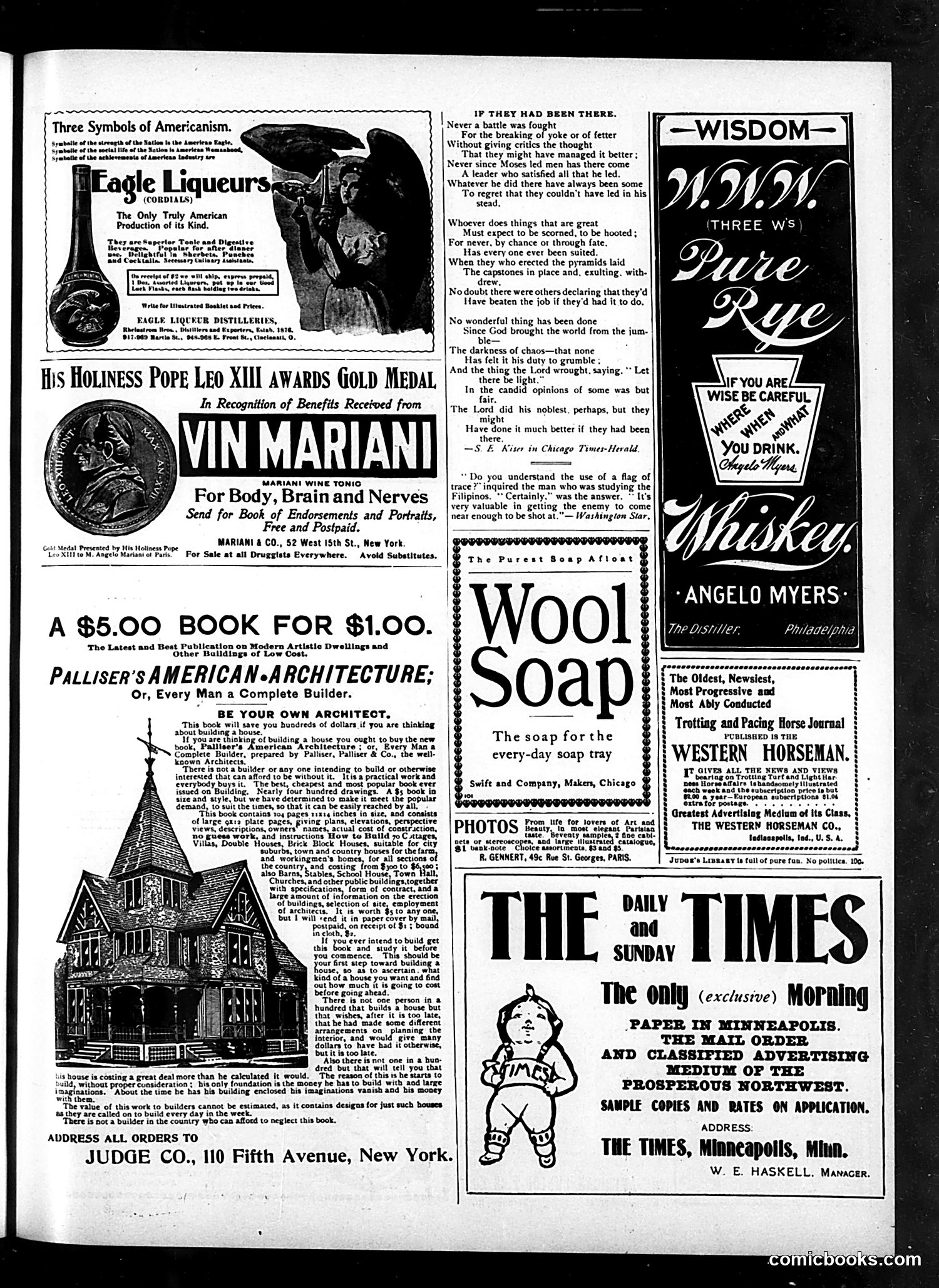
This is primarily an **advertising page** rather than a satirical cartoon page. It contains commercial advertisements for various products marketed to American consumers of the era. The notable elements include: **Eagle Liqueurs** advertised as "The Only Truly American Production of its Kind" — appealing to nationalist sentiment popular at the time. **Mariani Wine Tonic** prominently features a papal endorsement from Pope Leo XIII, claiming medicinal benefits "For Body, Brain and Nerves." This exploits religious authority to market an alcoholic product as therapeutic. **Palliser's American Architecture** book offers affordable home-building guidance, targeting working-class aspirations for homeownership. The upper right contains a **"Wisdom" advertisement** for "Pure Rye Whiskey" by Angelo Myers, with cautionary language about careful drinking. The **poem excerpt** ("If They Had Been There") appears unrelated to the ads—typical filler content for Judge. This page reflects early 20th-century advertising practices: exploiting patriotism, religious authority, and aspirational messaging to sell alcohol, real estate guides, and consumer goods to a growing American middle class.
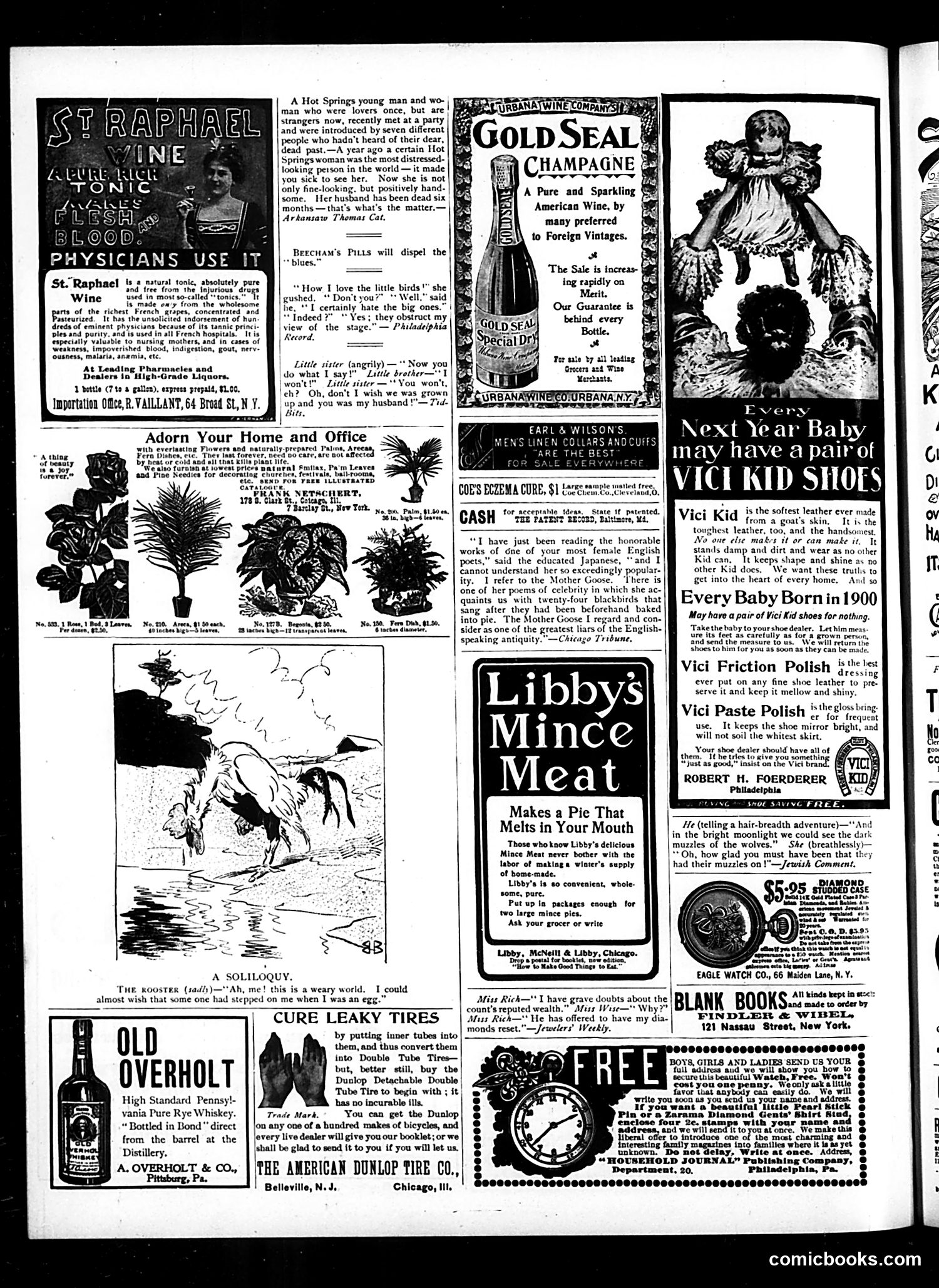
This page is primarily **advertising** for consumer goods from the early 1900s, with brief comic anecdotes scattered throughout. The small cartoons and jokes include: 1. **"A Soliloquy"** — A dialogue between a rooster and another character, with a brief existential complaint about "a weary world," followed by a practical discussion about buying bicycle tires. 2. **Comic vignettes** about relationships and courtship (a couple introduced at a party after being past lovers; a sister threatening her brother about future marriage). 3. **A joke about Mother Goose** — An educated Japanese character expresses bewilderment at the nursery rhyme about blackbirds baked in a pie, treating it as literal and absurd rather than whimsical. The bulk of the page showcases ads for St. Raphael Wine (marketed to physicians), Vici Kid Shoes, Libby's Mince Meat, tire repair products, and other merchandise. This was typical for Judge—a satirical magazine that supplemented editorial content with advertising revenue.
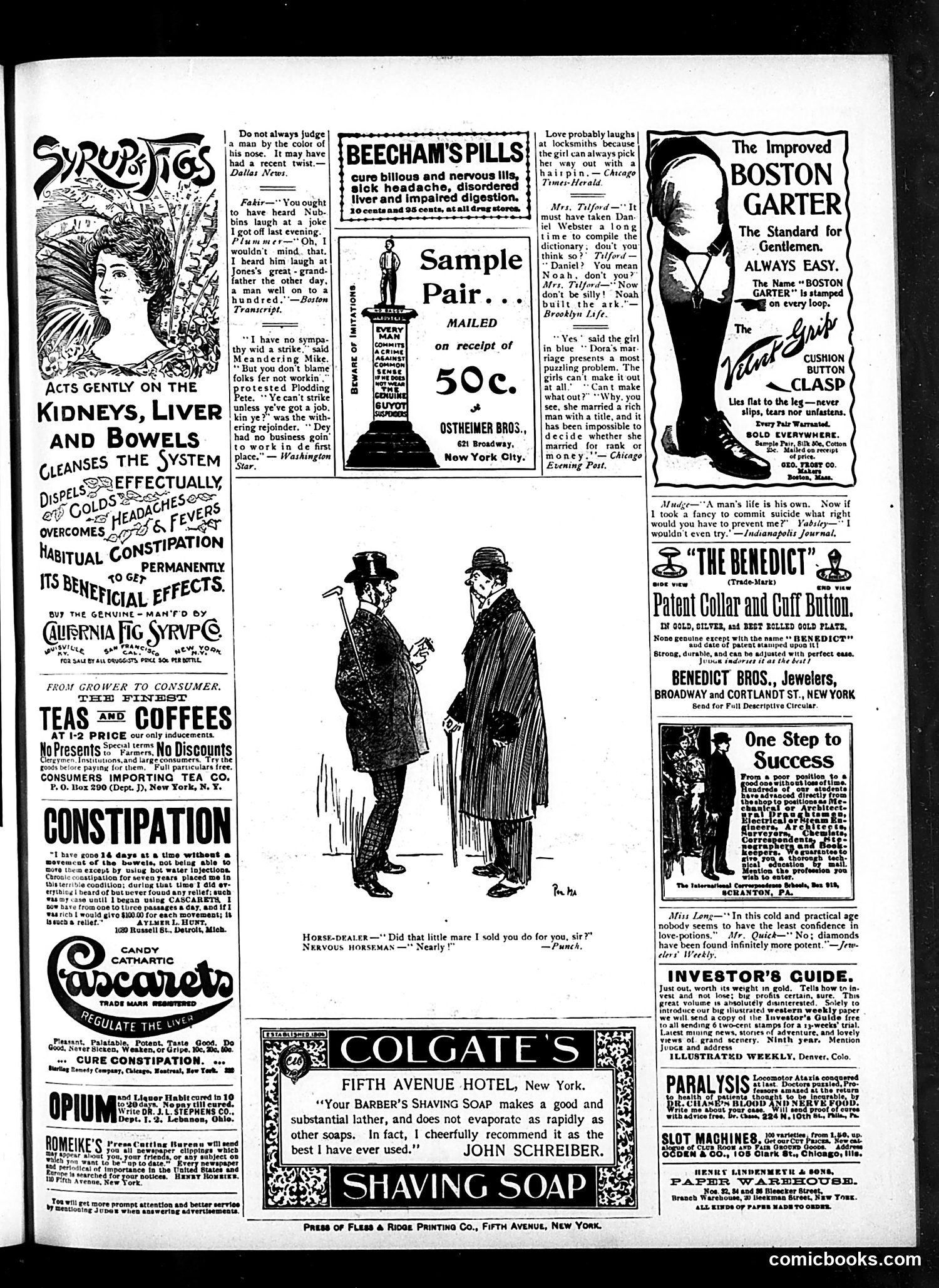
This is primarily an **advertising page** from Judge magazine, with minimal editorial cartoon content. The main satirical element is a small illustration labeled "Horse-dealer" and "Nervous Horseman" depicting a transaction joke about a mare's performance—typical 19th-century humor about livestock deals. The page is dominated by patent medicine advertisements (Beecham's Pills, California Fig Syrup, Cascarets) and consumer goods (Boston Garter, shaving soap, jewelry)—common in period magazines. A notable feature is the "Syrup of Figs" ad, which despite modern skepticism, was a genuine popular remedy. The scattered "Subroutines" jokes in the margins concern mundane domestic topics: marriage, strikes, constipation (a recurring theme), and romance. These reflect typical Judge humor: marital wit and social observation rather than political satire. Without identifying specific dated events, the page represents Judge's dual business model: satirical commentary mixed with revenue-generating advertisements, reflecting late-19th or early-20th-century American popular culture and consumer markets.
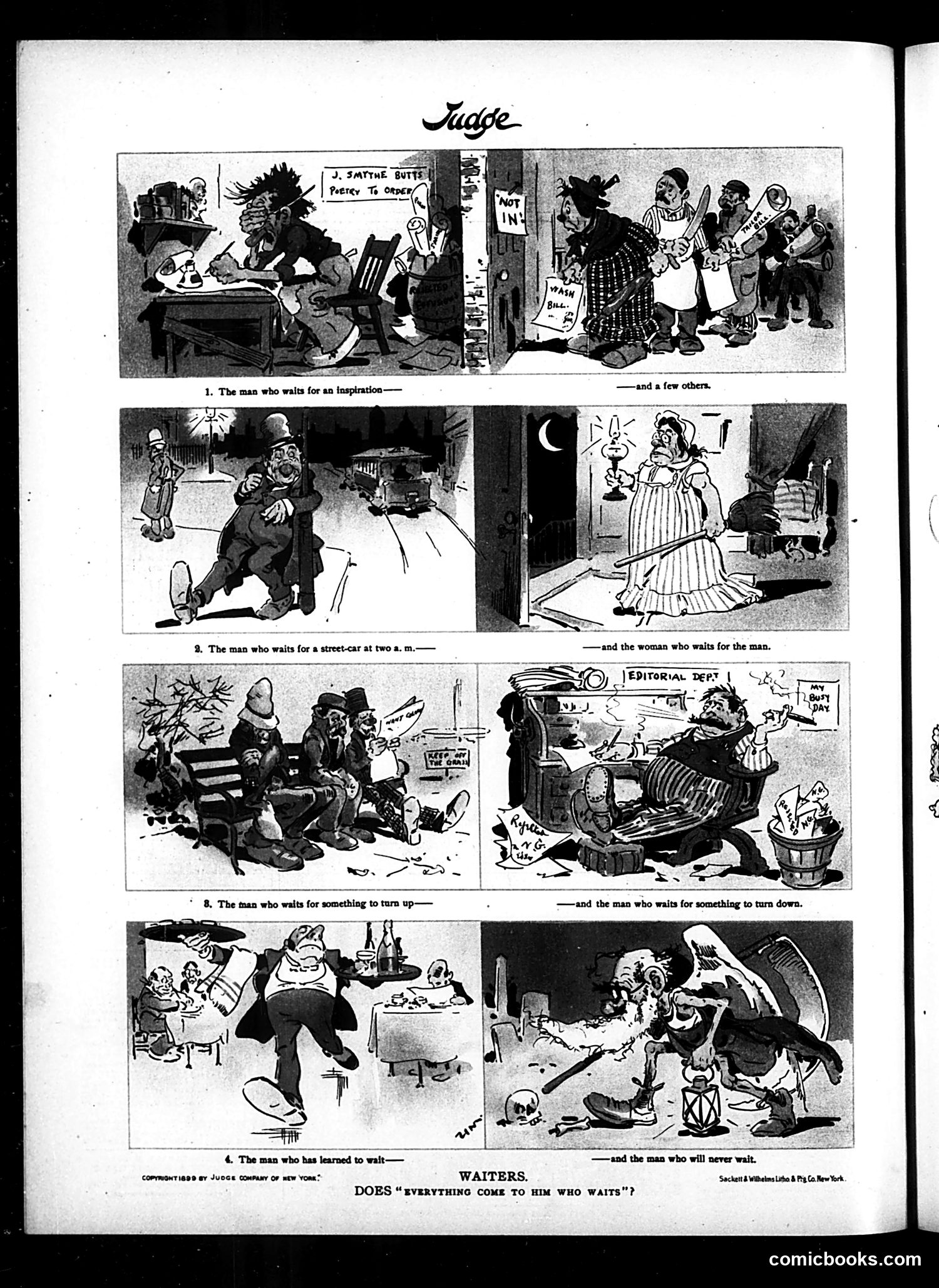
This cartoon satirizes the common proverb "everything comes to him who waits" by depicting various types of people waiting—with contrasting outcomes. The panels show: a man waiting for a streetcar at 2 a.m. (likely never arriving); a woman waiting for a man (who doesn't show); men waiting for fortune or opportunity to "turn up" (sitting idle); an editor waiting for something to improve (surrounded by chaos); a man who has "learned to wait" (apparently successful or resigned); and finally, a man who "will never wait" (depicted as a devil, suggesting impatience brings damnation). The satire mocks both excessive patience and impatience, suggesting that waiting alone doesn't guarantee results—a cynical commentary on the optimistic proverb's reliability in modern life. The Judge magazine's satirical tone undercuts conventional wisdom about patience and hard work.