
Judge, 1899-11-18 · page 6 of 16
Judge — November 18, 1899 — page 6: what you’re looking at
What you’re looking at
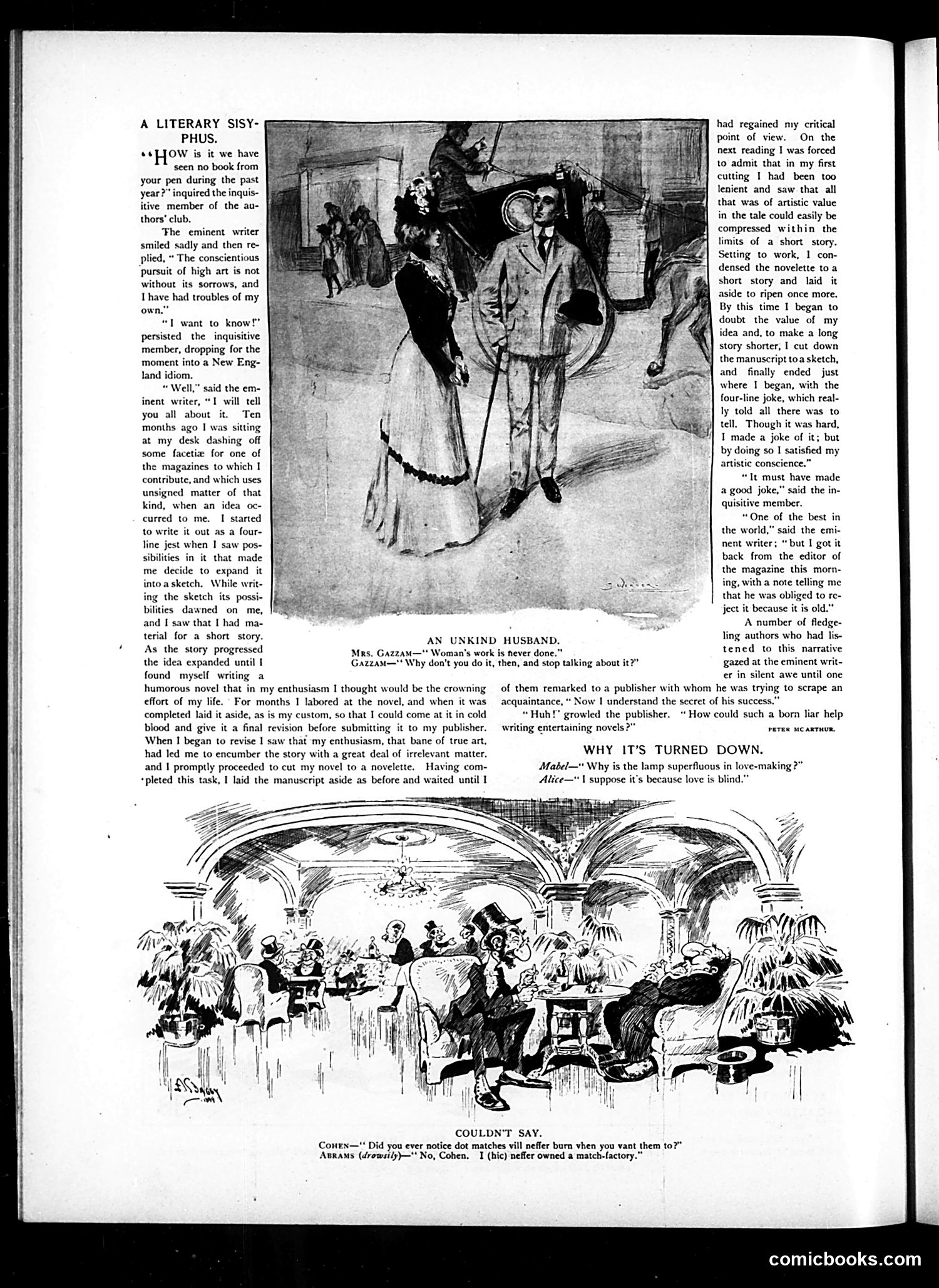
This page satirizes the creative struggles of ambitious writers. The main story depicts an author who starts with a four-line joke, expands it into a sketch, then a short story, then a novelette, finally a novel—only to have an editor reject it as "old," forcing him to cut it back down to the original four-line joke. The satire mocks both writerly overambition and the futility of endless revision. The top illustration labeled "An Unkind Husband" shows a domestic scene where a wife complains about her endless work, while her husband dismisses her concerns—typical period humor about marriage and gender roles. The bottom cartoon "Why It's Turned Down" features what appear to be Jewish characters (indicated by the Yiddish dialect spelling), making a joke about matches that won't light—a common vaudeville-style ethnic humor of the era. The page overall reflects early 20th-century magazine satire targeting literary pretension and featuring casual ethnic stereotyping typical of the period.
📄 Transcribed text from this page (OCR, searchable)
Machine-transcribed from the original scan — historical spelling and the odd misread are preserved.
A LITERARY SISY- = Ss Sey] bad regained my critical PHUS. ¢ i r P< soar i point of vy. On the «6 LIOW is it we have ff eee 4 next reading I was forced seen no book from — : : to admit that in my first your pen during the past , eae ty cutting I had been too year?” inquired the inquis- i} : ? —s lenient and saw that all itive member of the au- ae Cae % - 2 ~ that was of artistic value thors’ club. » ; f hi in the tale could easily be Fhe eminent writer fi | : q compressed within the smiled sadly and then re- ge » limits of a short story. plied, “The conscientious |i i a ey > \ E2| Setting to work, 1 con- pursuit of high art is not F f : ; densed the novelette toa without its sorrows, and |e 1 4 short story and laid it Thave had troubles of my 2 ie : . 3 : SVM aside to ripen once more, own,” : | WAFA By this time 1 began to “1 want to know!” [ie 4 - ie. ‘¢ doubt the value of my persisted the inquisitive E . me? ] idea and, to make a long member, dropping for the } "3 . 4 ‘ : story shorter; I cut down moment into a New Eng- - 2 ’ y 5 the manuscript toa sketch, land idiom. i . 4 “ and finally ended just “ Well,” said the em- 2s 2 P t where I began, with the inent writer, “I will tell | t j : four-line joke, which real- you all about it. Ten [7 { ‘ 1S 4 | ly told all there was to months ago I was sitting ; 4 REN ee 4 tell. Though it was hard, at my desk dashing off j : I made a joke of it; but some facetia for one of Rie Aras ‘ a | by doing so I satisfied my the magazines to which 1 | ~ : ‘ J oe artistic conscience.” contribute, and which uses $ ; ‘ “It must have made unsigned matter of that \ : a good joke,” said the in- kind, when an idea oc- quisitive member. curred to me. I started to write it out as a four- line jest when I saw pos- sibilities in it that made me decide to expand it into1a sketch. While writ- ing the sketch its possi- bilities dawned on me, and I saw that I had ma- terial for a short story. As the story progressed the idea expanded until | found myself writing a “One of the best in the world,” said the emi- nent writer; “but I got it back from the editor of the magazine this morn- ing, with a note telling me that he was obliged to re- ject it because it is old.” eS A number of fledge- aw umeauen es ling authors who had lis- Mrs, Gazzam—" Woman's work is never done.” tened to this narrative Gazzam—"* Why don't you do it, then, and stop talking about it?” gazed at the eminent writ- er in silent awe until one humorous novel that in my enthusiasm I thought would be the crowning of them remarked to a publisher with whom he was trying to scrape an effort of my life. For months I labored at the novel, and when it was acquaintance, “* Now I understand the secret of his success.” completed laid it aside, as is my custom, so that I could come at it in cold "Huh!" growled the publisher. “How could such a born liar help biood and give it a final revision before submitting it to my publisher. writing entertaining novels?” When I began to revise I saw that my enthusiasm, that bane of true art, had led me to encumber the story with a great deal of irrelevant matter. WHY IT’S TURNED DOWN. and I promptly proceeded to cut my novel to a novelette. Having com- pleted this task, I laid the manuscript aside as before and waited until I COULDN'T SAY. ConeN— Did you ever notice dot matches vill neffer burn vhen you vant them to?” Awrass (drewsily)—"* No, Cohen. I (hic) neffer owned a match-factory.” comicbooks.com