
A complete issue · 20 pages · 1899
Judge — September 30, 1899
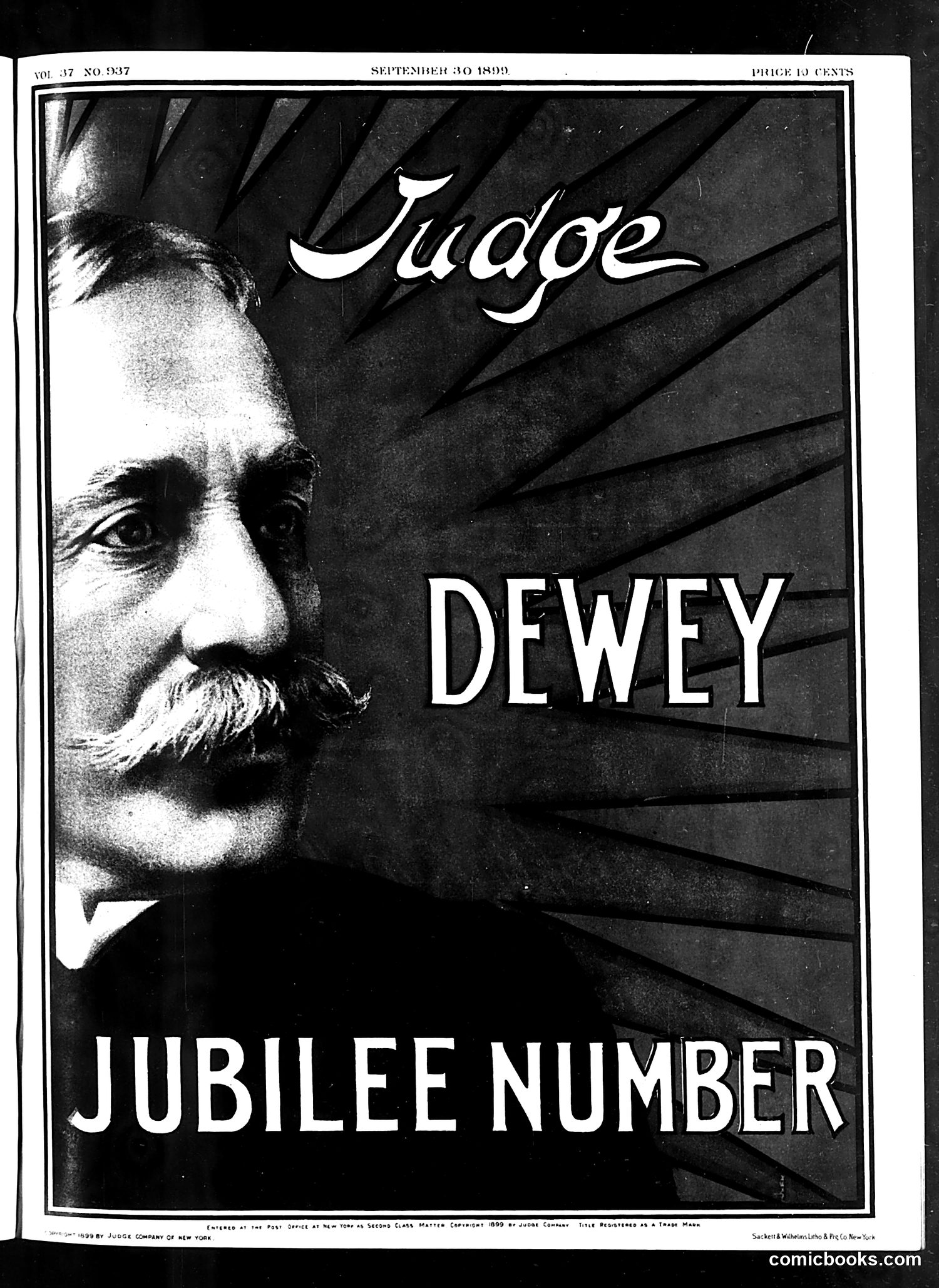
This is a **jubilee cover celebrating John Dewey**, the prominent American philosopher and educator. The radiating sunburst design behind his portrait suggests celebration and importance. In 1909, Dewey was a major intellectual figure, known for his progressive educational theories emphasizing practical experience over rote learning. The "Jubilee Number" likely commemorates a significant milestone—possibly his 50th birthday (born 1859) or an academic anniversary. Judge magazine, a satirical publication, treats Dewey with genuine respect here rather than mockery, indicating he was viewed favorably by the magazine's editors and educated readership. His distinctive mustache and formal attire reflect the dignity afforded to major public intellectuals of the Progressive Era.
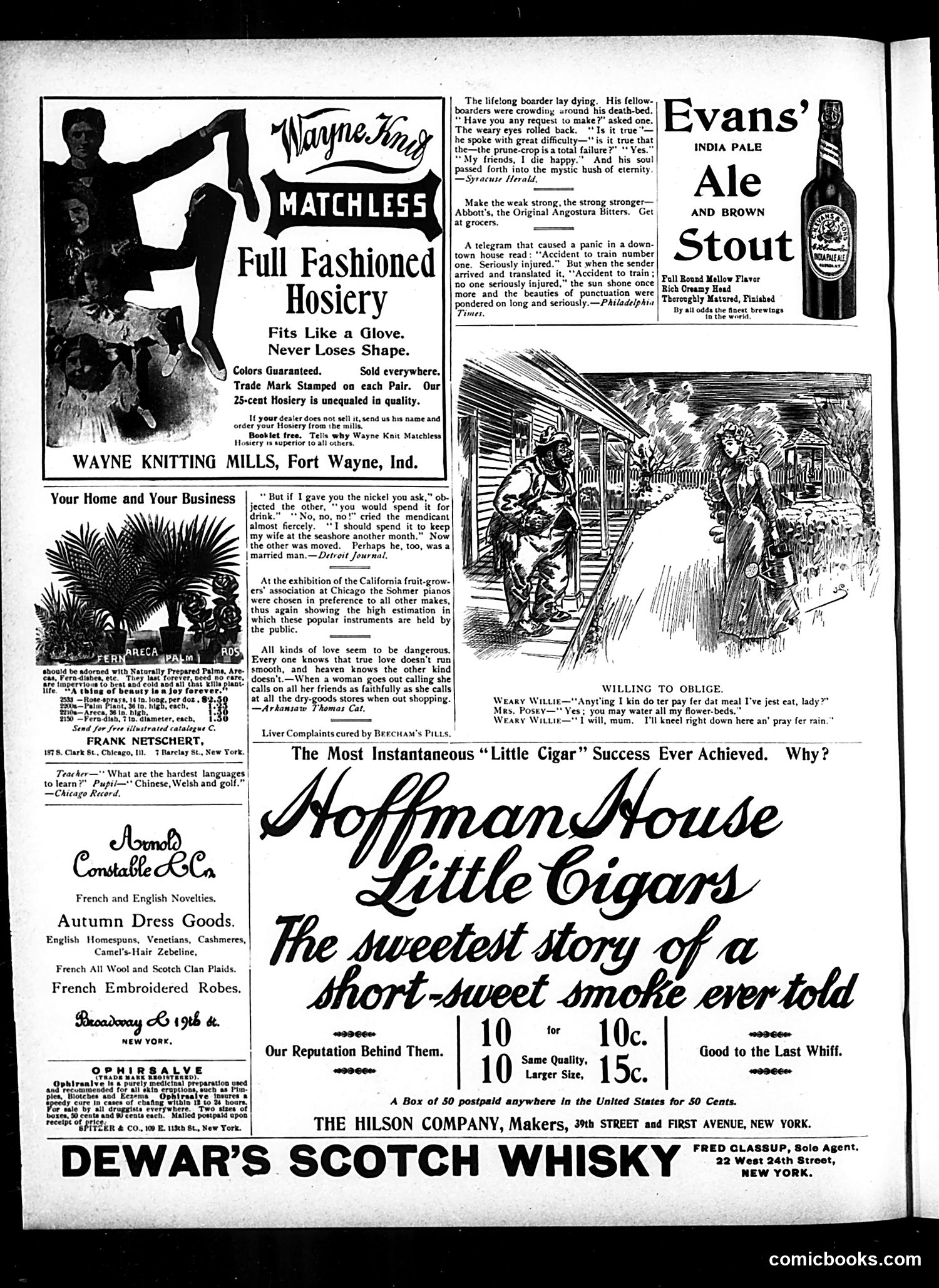
This page is primarily **advertising content** rather than satirical cartoons. The major features are: 1. **Wayne Knitting Mills hosiery ad** - featuring an illustration of a woman in classical pose promoting "matchless" full-fashioned hosiery 2. **Hoffmann House Little Cigars ad** - the dominant lower section advertising cigars at 10 for 10 cents or 10 for 15 cents, claiming "the sweetest story of a short-sweet smoke ever told" 3. **Supporting ads** for Evans' India Pale Ale and Brown Stout, Dewar's Scotch Whisky, Arnold Constable & Co. clothing, and Beecham's Pills The page reflects early 20th-century consumer advertising conventions. There is no apparent political satire or commentary visible—this represents Judge magazine's commercial advertising revenue model rather than editorial content.
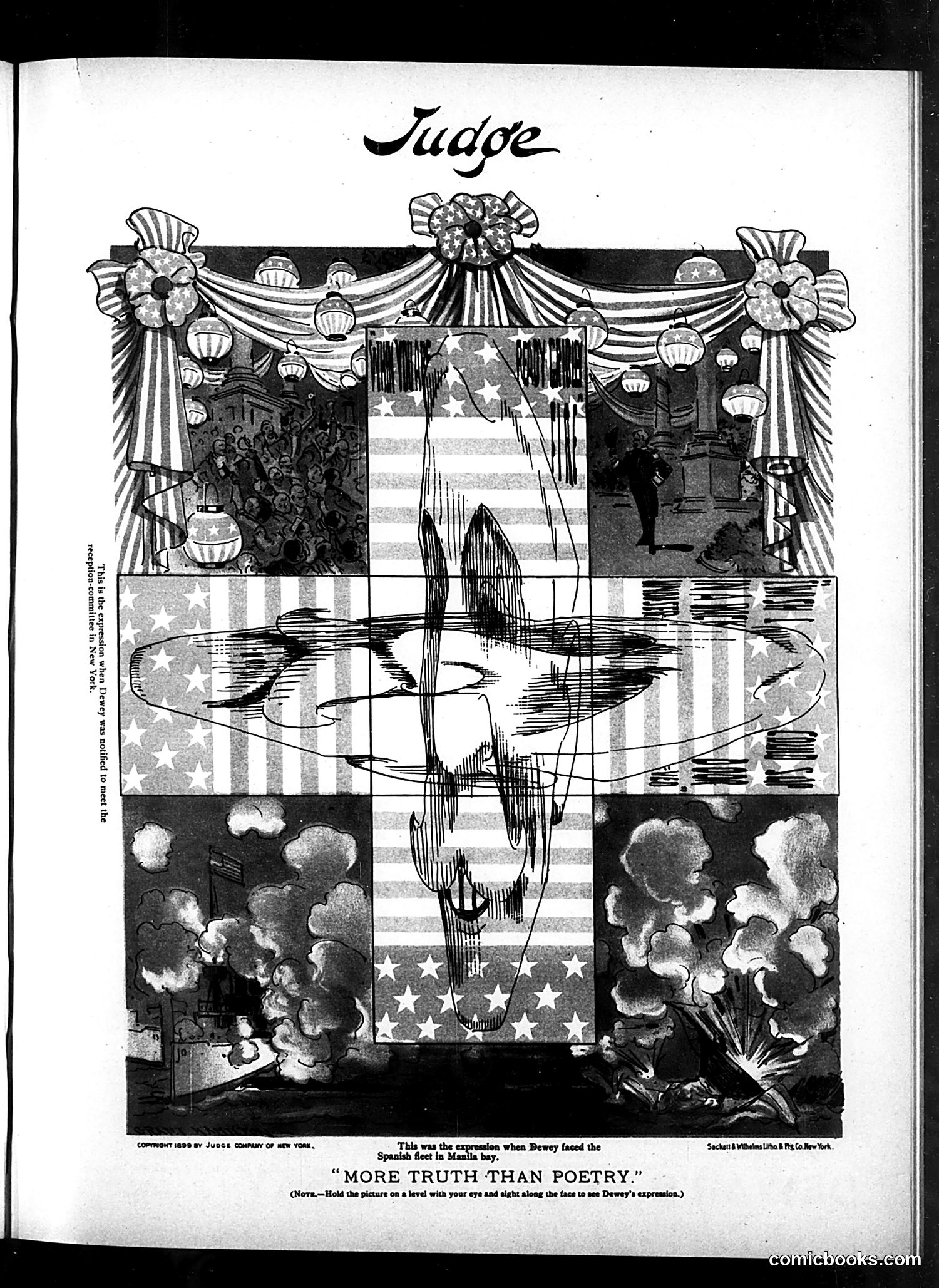
This political cartoon satirizes Admiral George Dewey's reaction upon encountering Spanish forces in Manila Bay (the 1898 Spanish-American War naval battle). The central image shows Dewey's face distorted in shock or disgust overlaid on an American flag. Surrounding vignettes depict: - Upper scenes: crowds witnessing the battle and military proceedings - Lower scenes: explosions and naval combat chaos The caption instructs viewers to "hold the picture on a level with your eye and sight along the face to see Dewey's expression," creating an optical illusion effect. The satire mocks both the sensationalized media coverage of the battle and Dewey's emotional response to encountering enemy forces, presenting the gritty reality ("truth") beneath celebratory war narratives ("poetry").
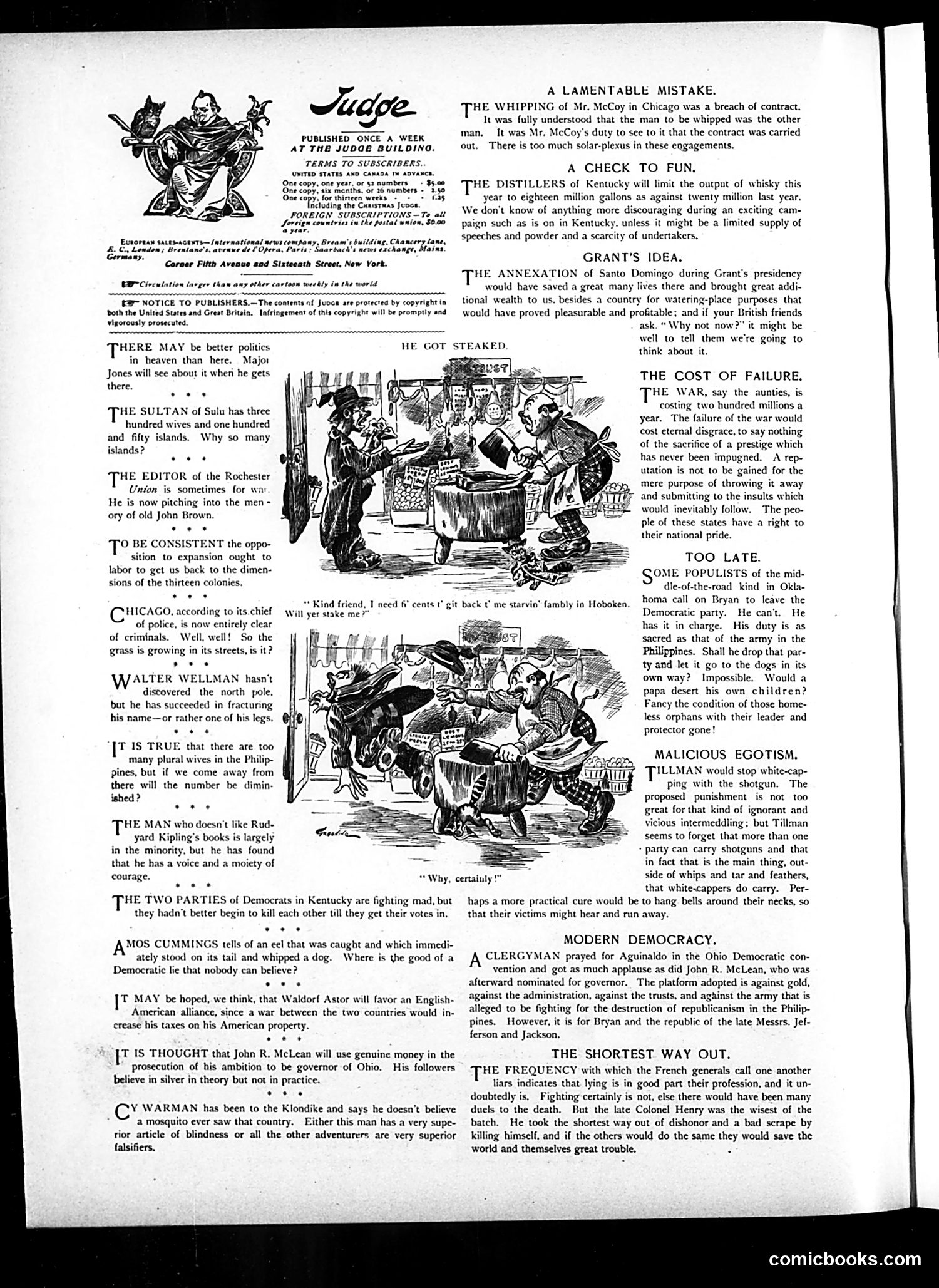
This page contains multiple short political commentary pieces rather than a single cartoon. The visible illustrations accompany brief satirical columns about contemporary issues. **"He Got Steaked"** depicts what appears to be a dining scene with the caption about someone needing five cents and returning to Hoboken, suggesting commentary on working-class struggles or financial desperation. **"Why, certainly!"** (lower cartoon) shows figures in conversation, likely satirizing political hypocrisy or empty promises. The text columns address topics including: Kentucky whiskey production limits, Theodore Roosevelt's presidency and Santo Domingo annexation, war costs, Philippine politics, and Democratic party infighting—all early 1900s concerns. The page functions as a satirical news digest, using humor to mock politicians, military decisions, and social conditions of the era rather than developing single extended political cartoons.
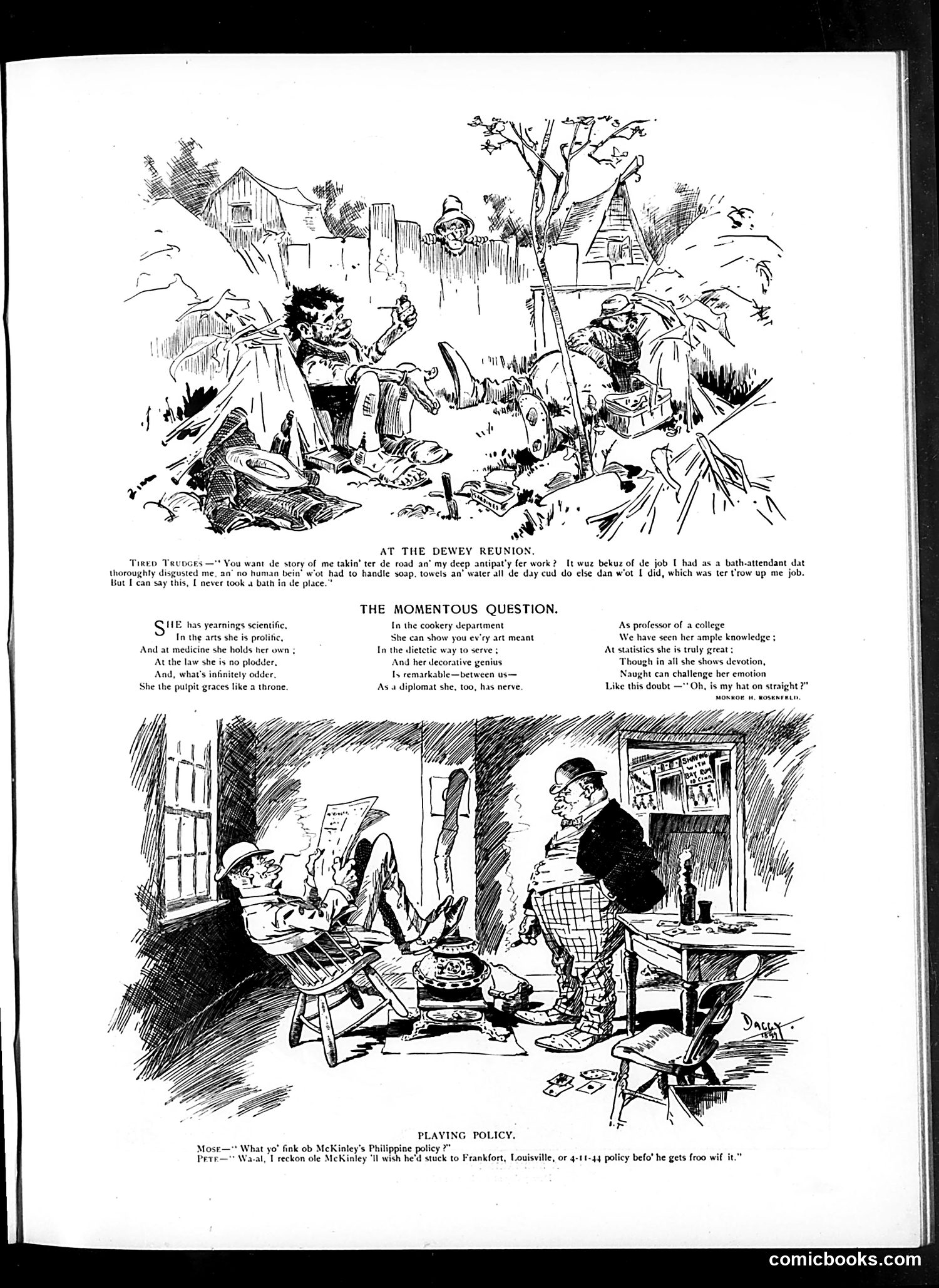
**Top cartoon ("At the Dewey Reunion"):** Depicts worn-out laborers discussing their work histories. The "Tired Truckee" complains about a bath-attendant job involving soap and water—work so unpleasant he quit rather than endure it. This appears to satirize working-class aversion to menial labor, likely from the early 1900s. **Middle section ("The Momentous Question"):** A poem mocking the "New Woman"—the educated, professionally-ambitious woman of the era. She excels at science, medicine, law, cooking, diplomacy, and other fields, yet worries absurdly about whether her hat sits straight. The satire critiques women's liberation as ridiculous: despite genuine accomplishments, women remain trivially concerned with appearance. **Bottom cartoon ("Playing Policy"):** Two men debate President McKinley's Philippine policy (America's colonial expansion after the Spanish-American War). One sarcastically wishes McKinley had stuck to "policy" numbers from Kentucky cities—a reference to illegal gambling/numbers games ("policy" games). The joke equates McKinley's foreign policy decisions with reckless gambling.
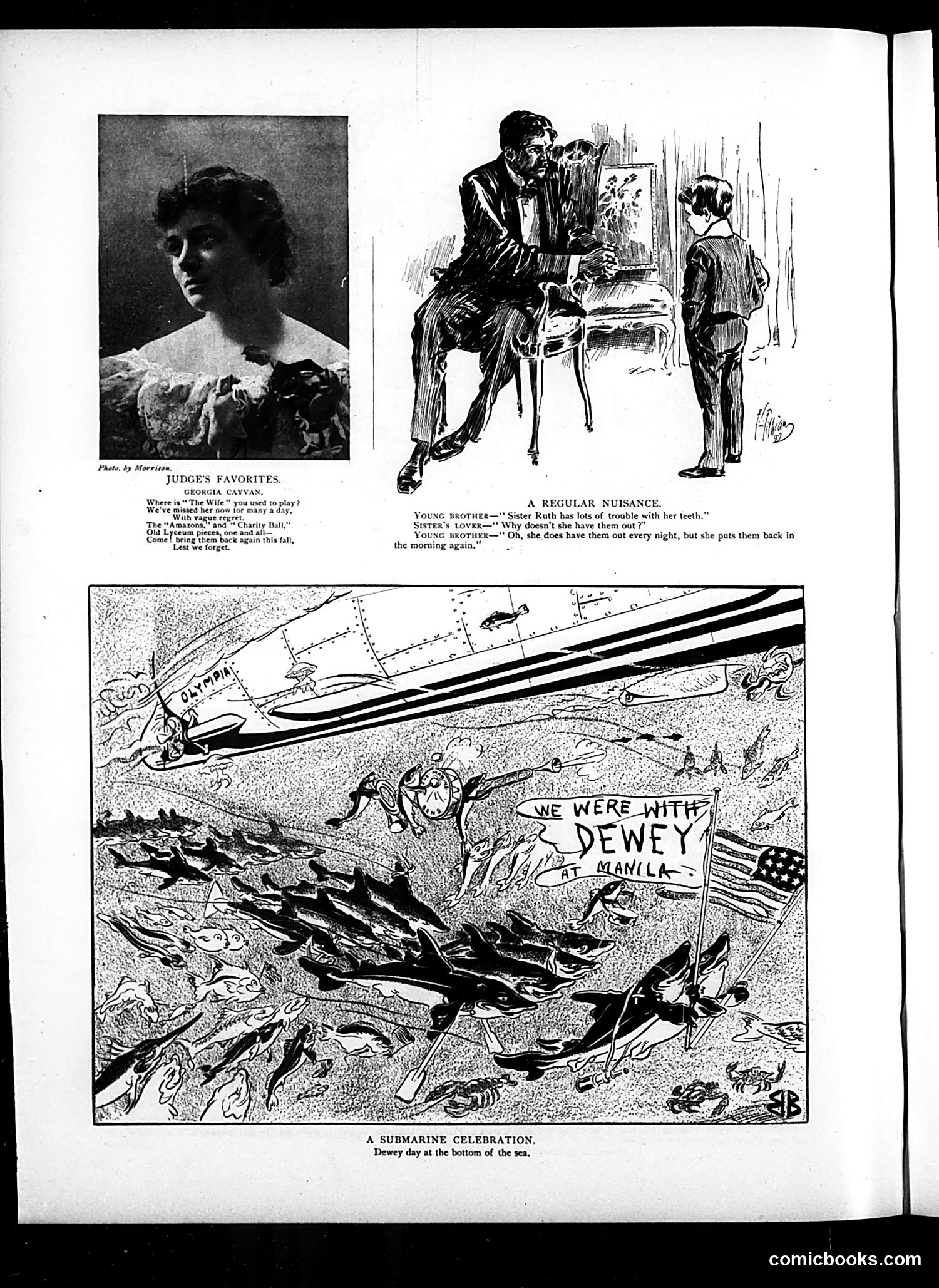
**Top Section:** Features Georgia Cayvan, an actress, with a nostalgic joke about her former role in "The Wife." **Middle Cartoon:** A domestic humor strip depicting siblings discussing their sister Ruth's dental problems—she removes her false teeth at night but reinserts them each morning. This mocks the vanity of maintaining appearances. **Bottom Cartoon:** "A Submarine Celebration" depicts an underwater scene with naval vessels and a banner reading "WE WERE WITH DEWEY AT MANILA," referencing Admiral George Dewey's 1898 victory in the Spanish-American War. The caption "Dewey day at the bottom of the sea" appears to be dark humor—likely satirizing either excessive patriotic commemoration or, possibly, celebrating enemy ships sunk during that battle lying on the ocean floor. The American flag and celebratory imagery suggest this mocks jingoistic nationalism or military excess following the war.
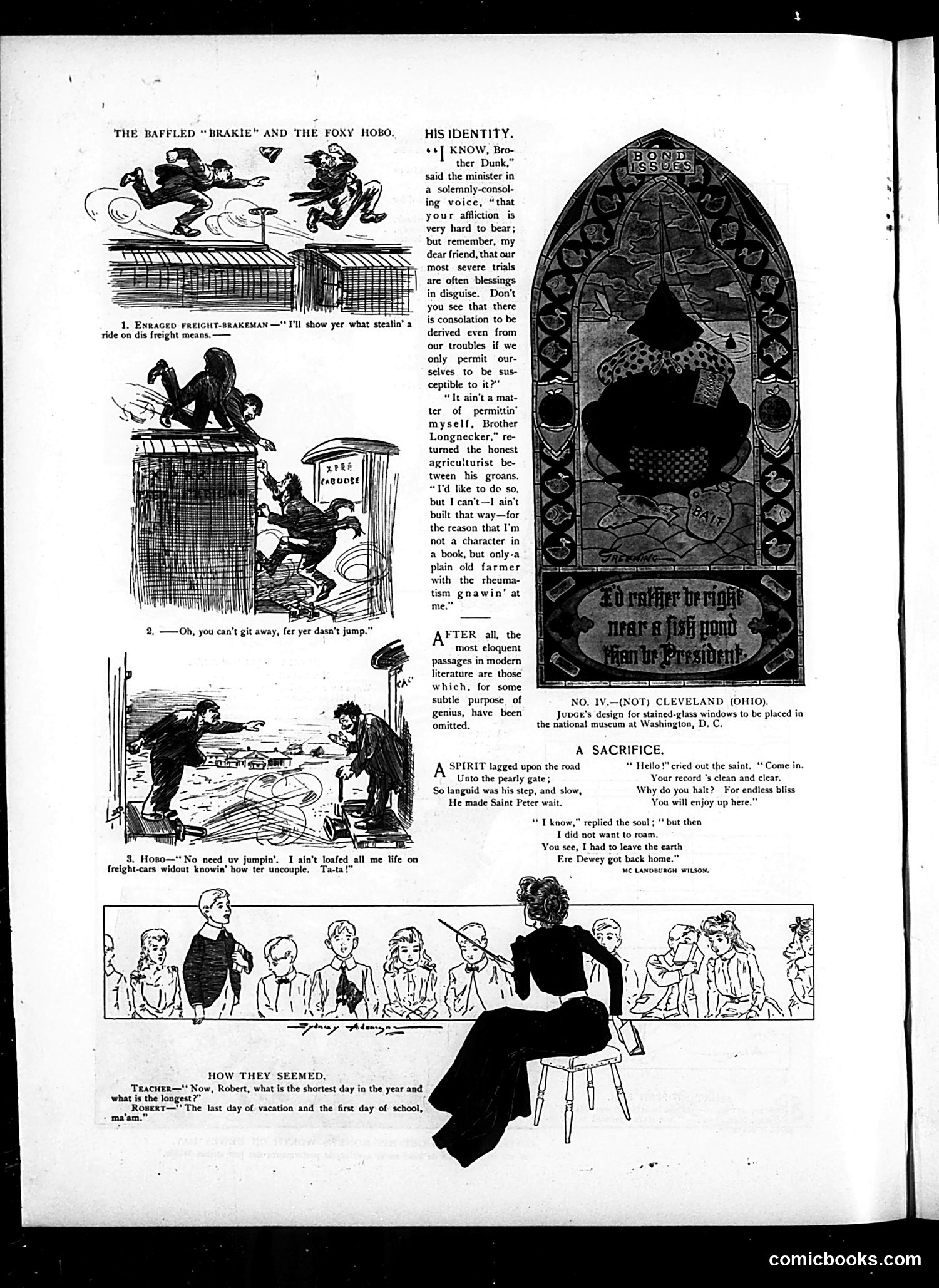
This page contains working-class humor and social commentary typical of Judge magazine. The top cartoons depict a railroad "brakeman" (brakie) being outwitted by a clever hobo who knows how to uncouple freight cars—the joke being the hobo's superior cunning despite his lowly status. The lower section includes a schoolroom joke about time perception, a minister's attempt to console a farmer about suffering (the farmer insists he's not a fictional character who can find comfort in suffering), and a stained-glass window design satirizing Cleveland, Ohio. The final poem "A Sacrifice" references Admiral Dewey (likely from the Spanish-American War era), with a soul reluctant to enter heaven because Dewey hadn't yet returned home—contemporary political humor about a celebrated military figure. The overall tone reflects turn-of-the-century American attitudes toward labor, religion, and patriotism.
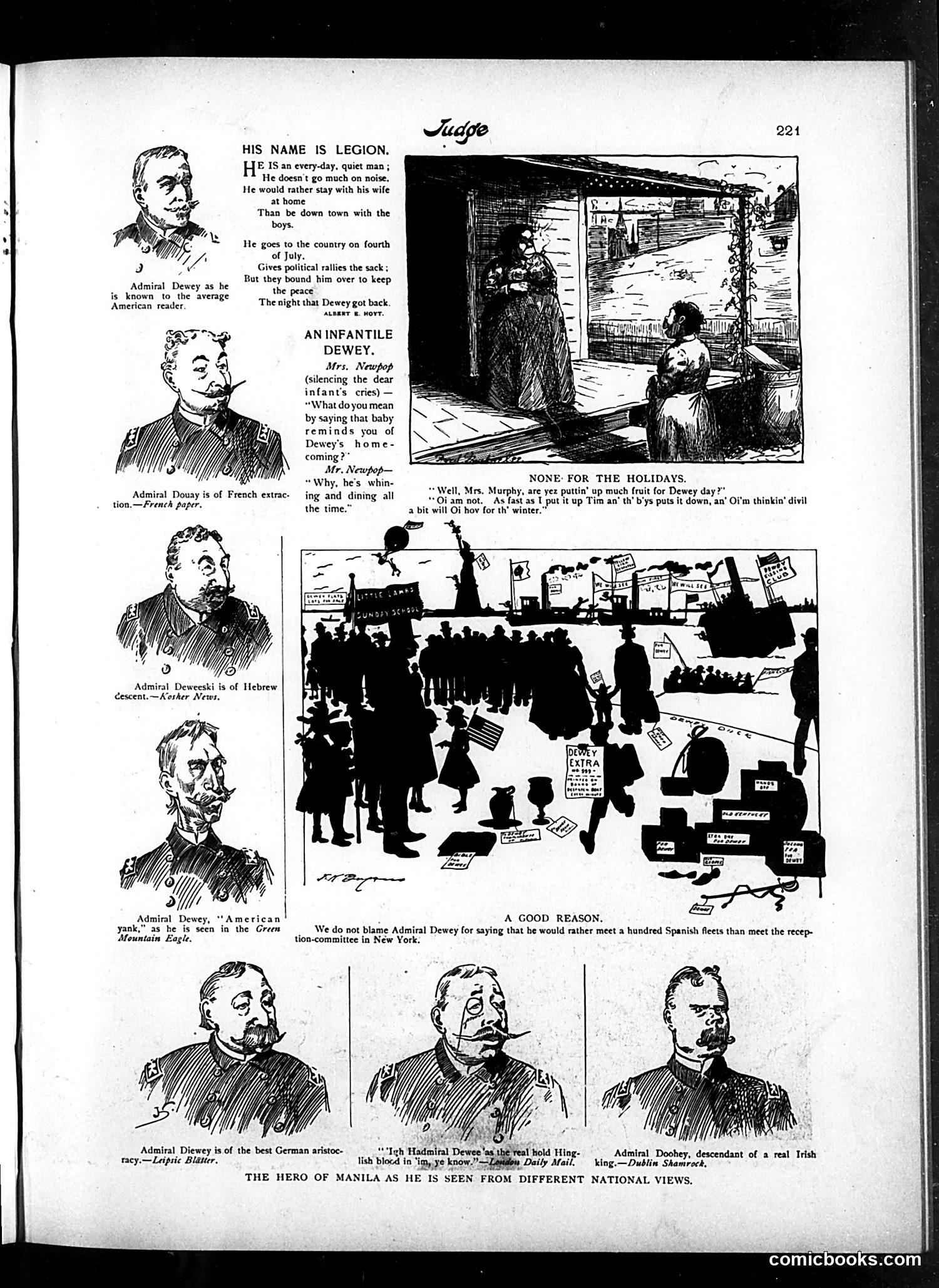
This Judge magazine page satirizes Admiral George Dewey following his famous naval victory at Manila Bay (Spanish-American War, 1898). The humor centers on the contrast between Dewey's modest, private personality and the massive public reception planned for his return to America. **The satire:** Multiple cartoons mock the absurdity of celebrating a quiet man who reportedly preferred staying home. "His Name is Legion" jokes that he's just an ordinary fellow forced into the spotlight. "An Infantile Dewey" compares him to a crying baby. The bottom panel shows how different nations characterized Dewey according to their own biases—German, Jewish, Irish—suggesting national stereotyping. **The key joke:** "A Good Reason" explicitly states that Dewey would rather face Spanish fleets than the New York reception committee, mocking the overwhelming public celebration planned for the war hero's homecoming. The page satirizes American hero-worship and civic excess.
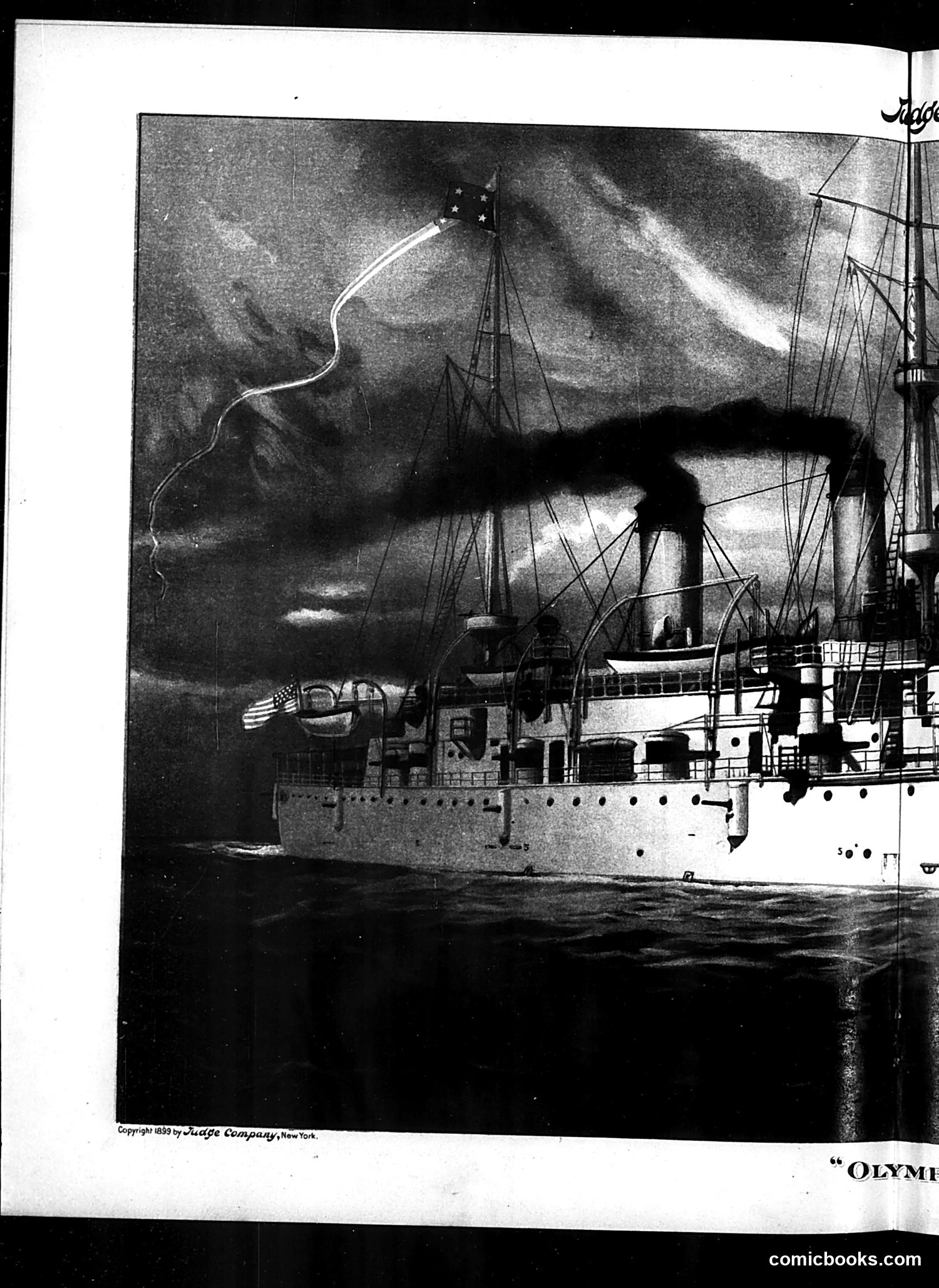
This 1889 Judge magazine illustration depicts a steamship (labeled "OLYMP[IC]" at bottom right) navigating stormy seas with dark, dramatic skies and lightning. An American flag is visible on the vessel. The image appears to be commentary on maritime travel or shipping during the late 19th century—a period of significant ocean-going commerce and technological advancement. The dramatic, threatening weather conditions likely serve as metaphorical commentary on contemporary economic, political, or social "storms" affecting American shipping or commerce. Without additional text visible on this page, the specific satirical target remains unclear. The image's style and period suggest it comments on either maritime safety concerns, economic uncertainty, or America's naval/commercial position during this era.
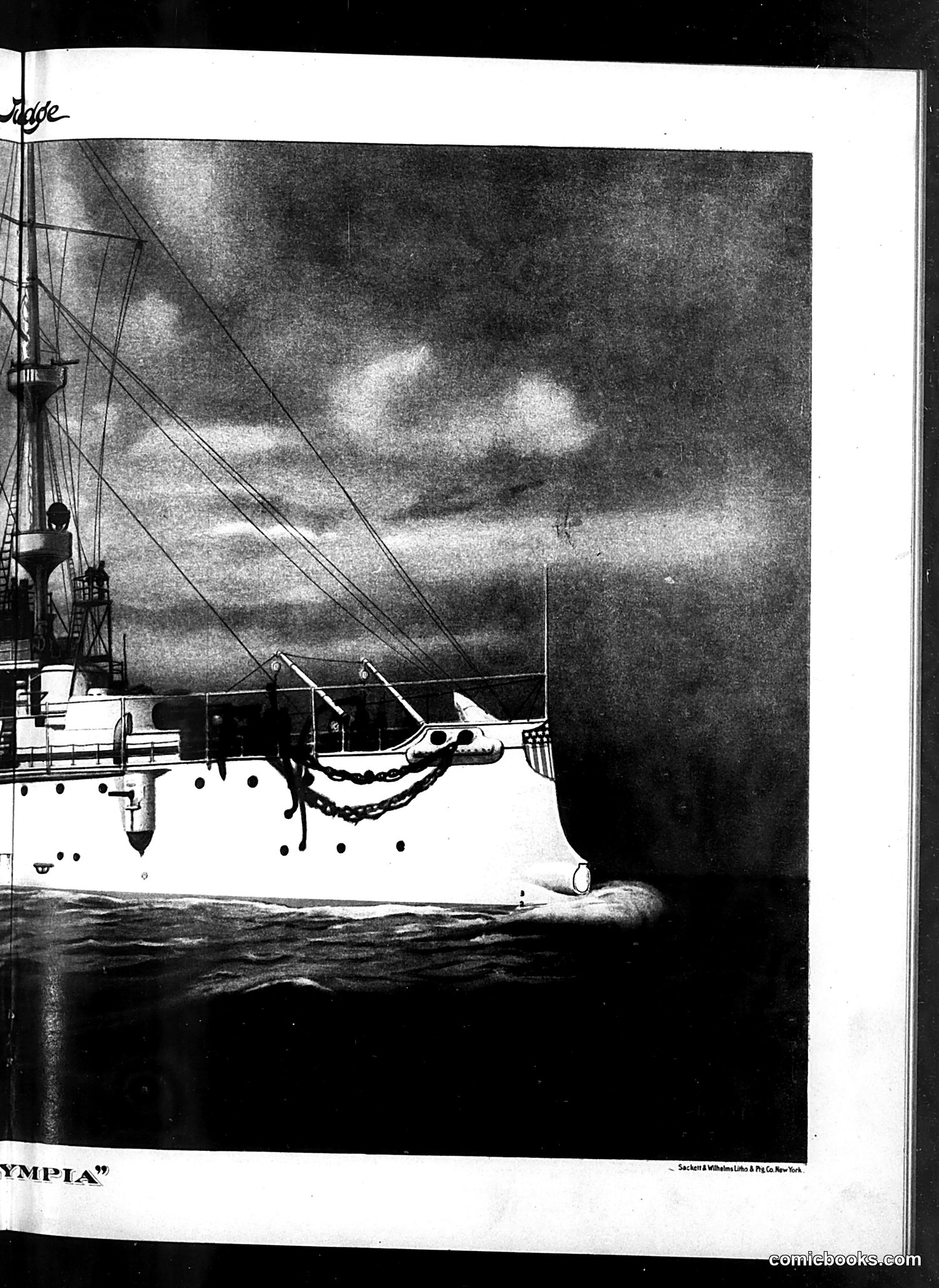
This page shows a dramatic illustration of a large naval vessel (labeled "YMPLA" - possibly incomplete) positioned against a massive dark iceberg or ice formation. The ship appears small and vulnerable in comparison to the towering ice. Given this is from *Judge* magazine, this likely satirizes a contemporary maritime disaster or naval incident. The composition emphasizes human vulnerability against nature's overwhelming force. Without the complete title or date visible, the specific event remains unclear, but the stark black-and-white contrast and dramatic scale suggest commentary on a real shipping tragedy or maritime concern of the era when *Judge* published satirical content. The image's power lies in its visual argument about scale and human insignificance.
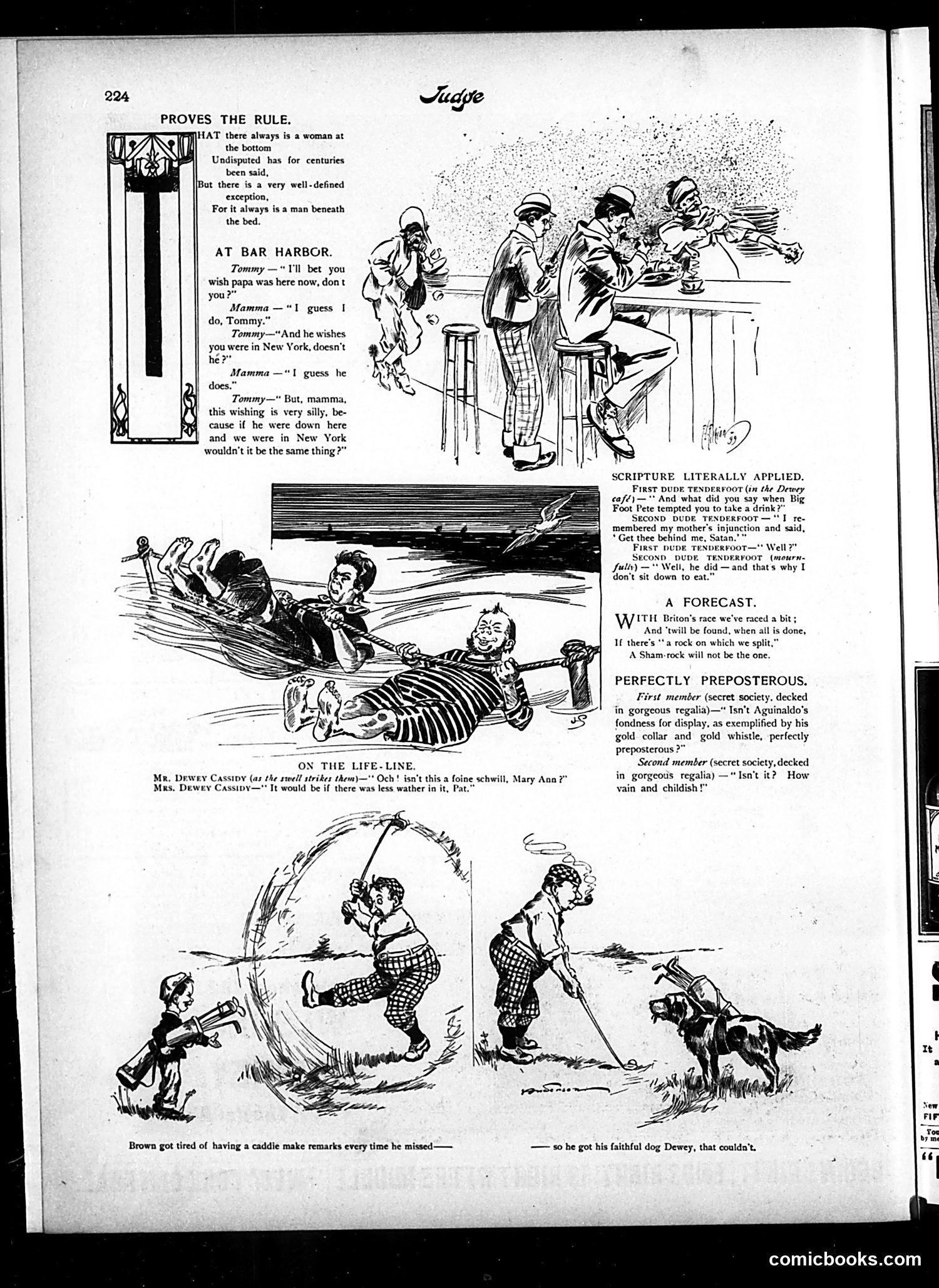
This page from *Judge* contains multiple humor pieces targeting early 1900s American society and politics. **"Proves the Rule"** opens with a verse about domestic dynamics—a married couple at Bar Harbor where the wife wishes her husband were present, and the husband wishes she were in New York. Their son Tommy exposes the logical absurdity: if both parties got their wishes, nothing would change. **"On the Life-Line"** mocks working-class Irish characters (Cassidy and Pat) complaining about drinks containing too much water—a dig at Irish drinking culture and working-class pretension. **"Scripture Literally Applied"** jokes about Western dudes misapplying religious doctrine. One "tenderfoot" tells a man tempting him to drink, "Get thee behind me, Satan"—which apparently backfired physically. **"A Forecast"** appears to reference Anglo-American relations and Irish independence (the "Sham-rock" pun), suggesting Britain won't split with America over Irish issues. **"Perfectly Preposterous"** mocks secret society hypocrisy: elaborately dressed members criticize another's (Aguinaldo's—likely Philippine general) ostentatious display. The golf cartoon jokes about caddies' commentary frustrating golfers.
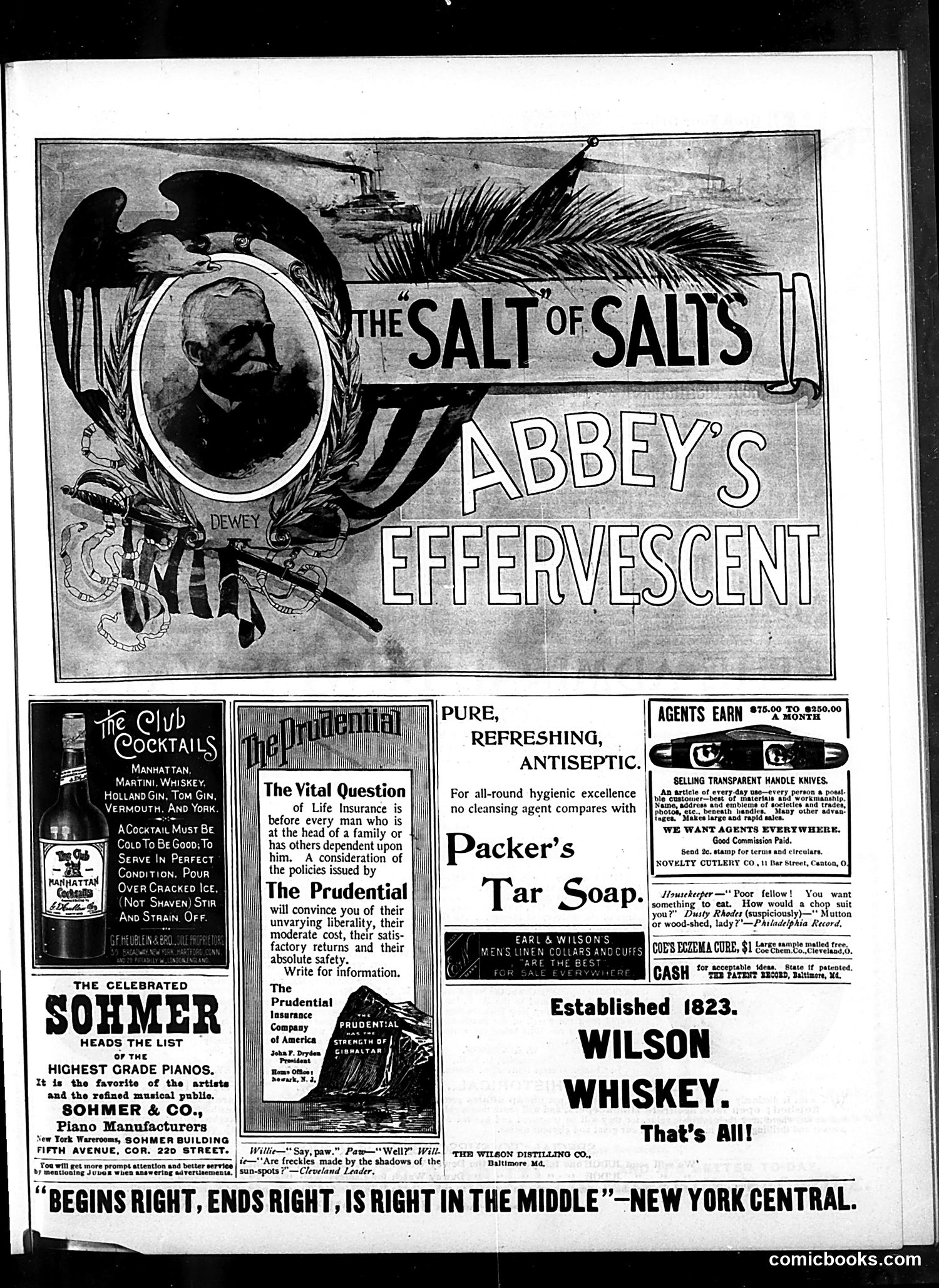
This is primarily an **advertising page** rather than editorial content. The dominant image—"The Salt of Salts: Abbey's Effervescent"—is a product advertisement featuring a portrait (labeled "Dewey") surrounded by patriotic imagery (eagle, palm fronds, naval ship). The smaller cartoons are brief jokes unrelated to the ads: - A child asks their father about freckles being "shadows of sun-spots" - A hungry vagrant suspiciously asks if offered food is mutton or "wood-shed" (a euphemism for beating) The page showcases typical early-1900s advertisements for **luxury goods and services**: cocktails, pianos, life insurance, tar soap, cutlery, and whiskey. The "Dewey" reference in the Abbey's ad likely invokes Admiral Dewey's Spanish-American War fame to suggest vigor and vitality. The satirical content is minimal; this page demonstrates Judge's primary revenue source—paid advertising integrated with light humor.
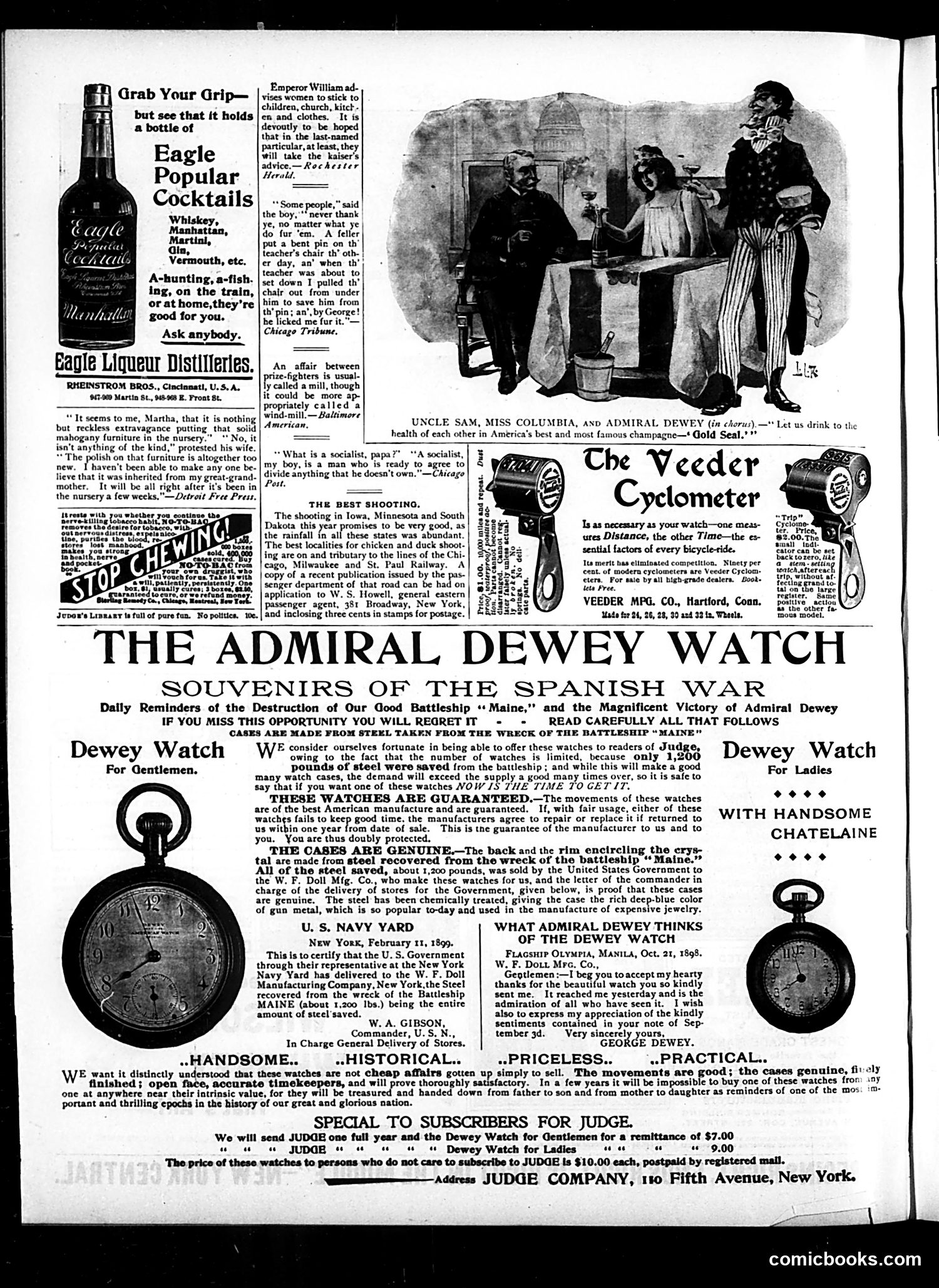
This page is primarily **advertising and promotional content** rather than political satire, though it includes several period humor items. The main focus is the **"Admiral Dewey Watch"** — a patriotic souvenir supposedly made from steel salvaged from the USS *Maine*, the battleship that sank in 1898, triggering the Spanish-American War. Admiral George Dewey was the war's celebrated naval hero. The watches are marketed as patriotic mementos to readers. The scattered **text jokes** mock contemporary targets: Kaiser Wilhelm's outdated views on women; a boy's misguided attempt to protect his teacher; and socialists (typical conservative magazine humor). The **cartoon** shows Uncle Sam, Miss Columbia (America personified), and Admiral Dewey toasting together—celebrating American victory and national pride during the post-Spanish-American War period when such patriotic merchandise was commercially popular. This reflects **1898-1899 America**: nationalism was high, war heroes were commercialized, and magazines like *Judge* blended advertising with satirical commentary.
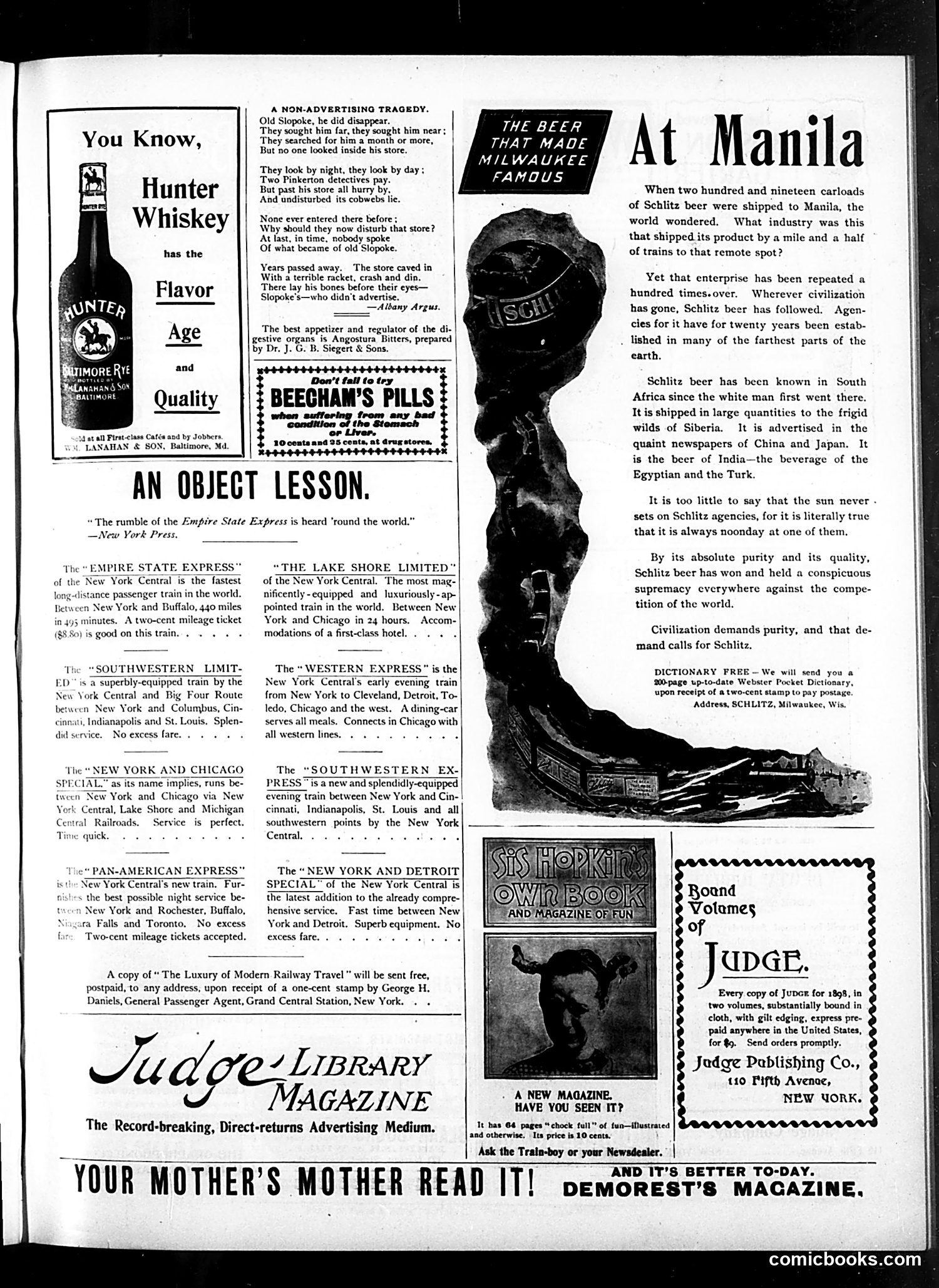
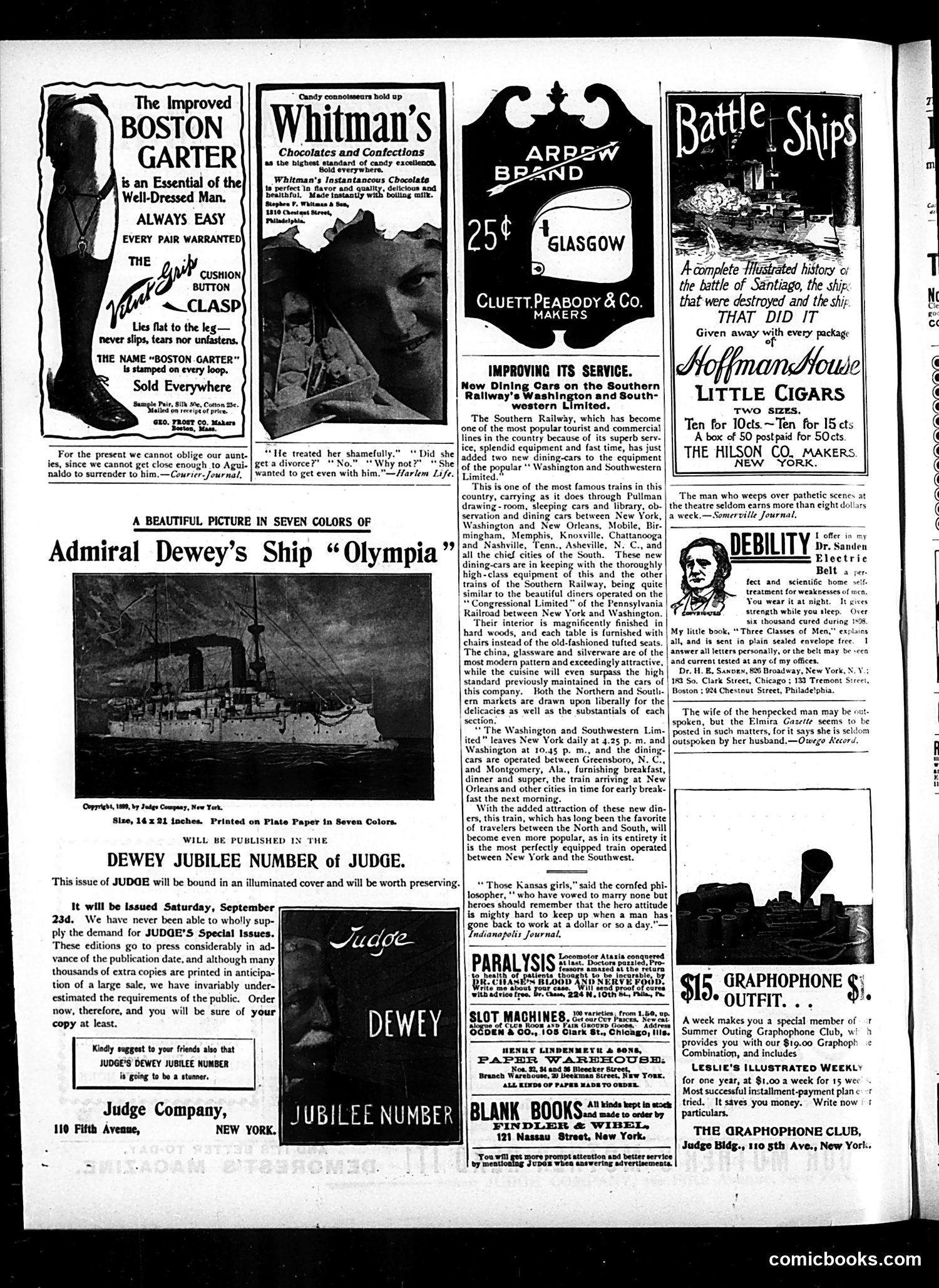
This page is primarily **advertising** rather than editorial content, featuring products popular in the 1898-1900 era: Boston Garters (men's socks), Whitman's chocolates, Arrow Brand collars, and a Graphophone (early phonograph). The only satirical element visible is a brief joke at top-left referencing **Aguinaldo**, the Filipino independence leader during the Spanish-American War. The joke plays on contemporary frustration that America couldn't locate Aguinaldo to force his surrender—a reference to the ongoing Philippine-American conflict (1899-1902). The page's centerpiece advertises a **Dewey Jubilee issue** of Judge magazine, celebrating Admiral George Dewey, whose naval victory at Manila Bay (1898) made him a national hero. The accompanying illustration shows Dewey's ship *Olympia*. Most of the remaining space covers railroad and product advertisements, reflecting the magazine's commercial nature alongside its satirical content.
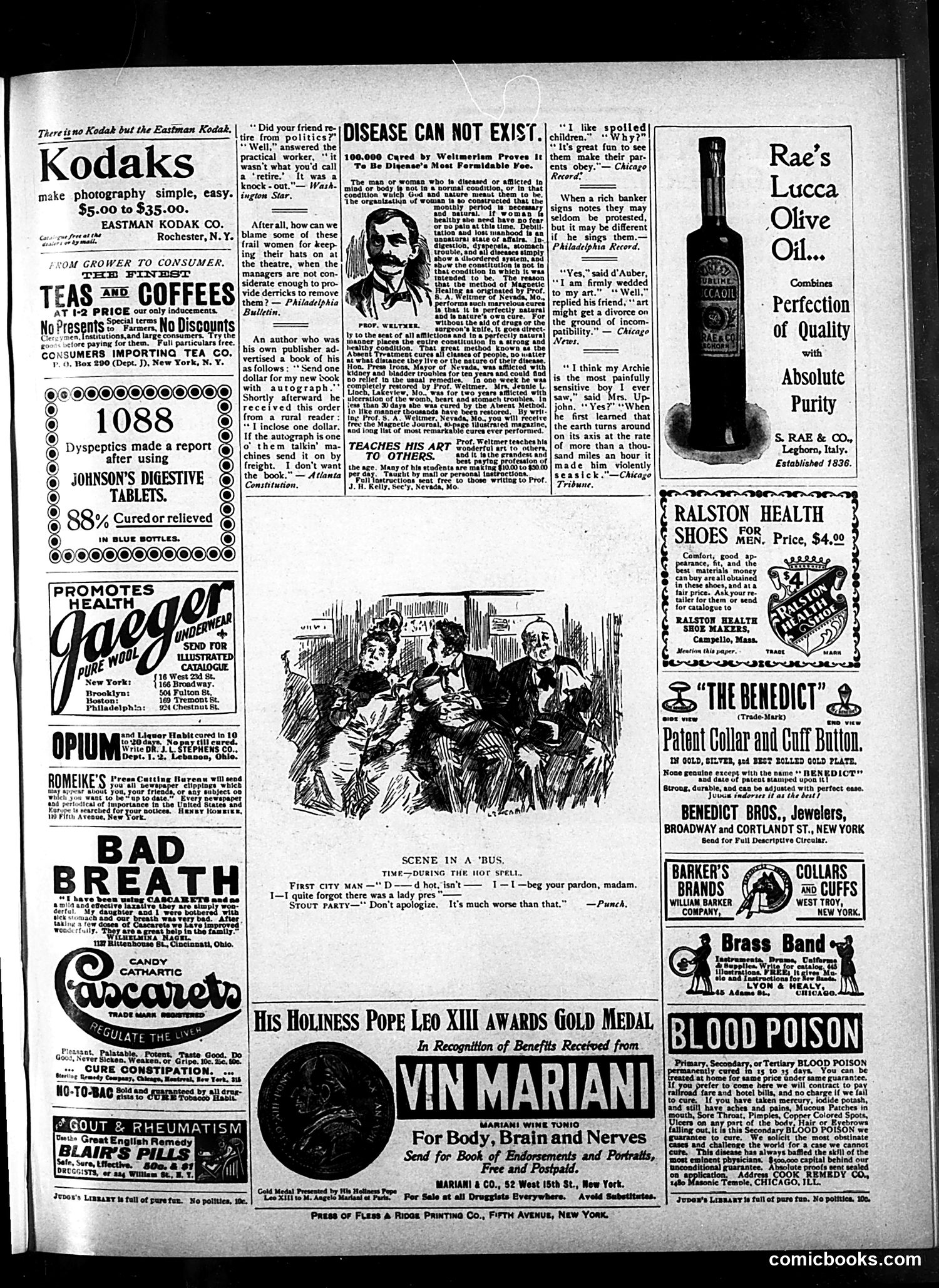
This page from *Judge* magazine contains primarily **advertisements and comic vignettes** rather than a unified political cartoon. The main satirical content consists of brief, standalone jokes about social behavior: 1. **"Disease Cannot Exist"** — A dialogue mocking people who deny illness exists, featuring a skeptical "practical worker" responding to someone's claim that disease is merely a mental construct. 2. **"Scene in a Bus"** — A humorous exchange about poor manners during hot weather, with a man apologizing for body odor while a stout passenger retorts defensively. 3. **Various one-liners** about wealthy bankers, sensitive children, and marital discord — typical early-20th-century domestic humor. The page is dominated by **patent medicine and consumer product advertisements** (Kodaks, digestive tablets, shoe brands, wine tonics), reflecting the magazine's commercial nature. The *Judge* format mixed satirical commentary on everyday life with aggressive advertising, targeting middle-class readers with both humor and health/consumer product pitches. The overall tone is lighthearted social observation rather than pointed political critique.
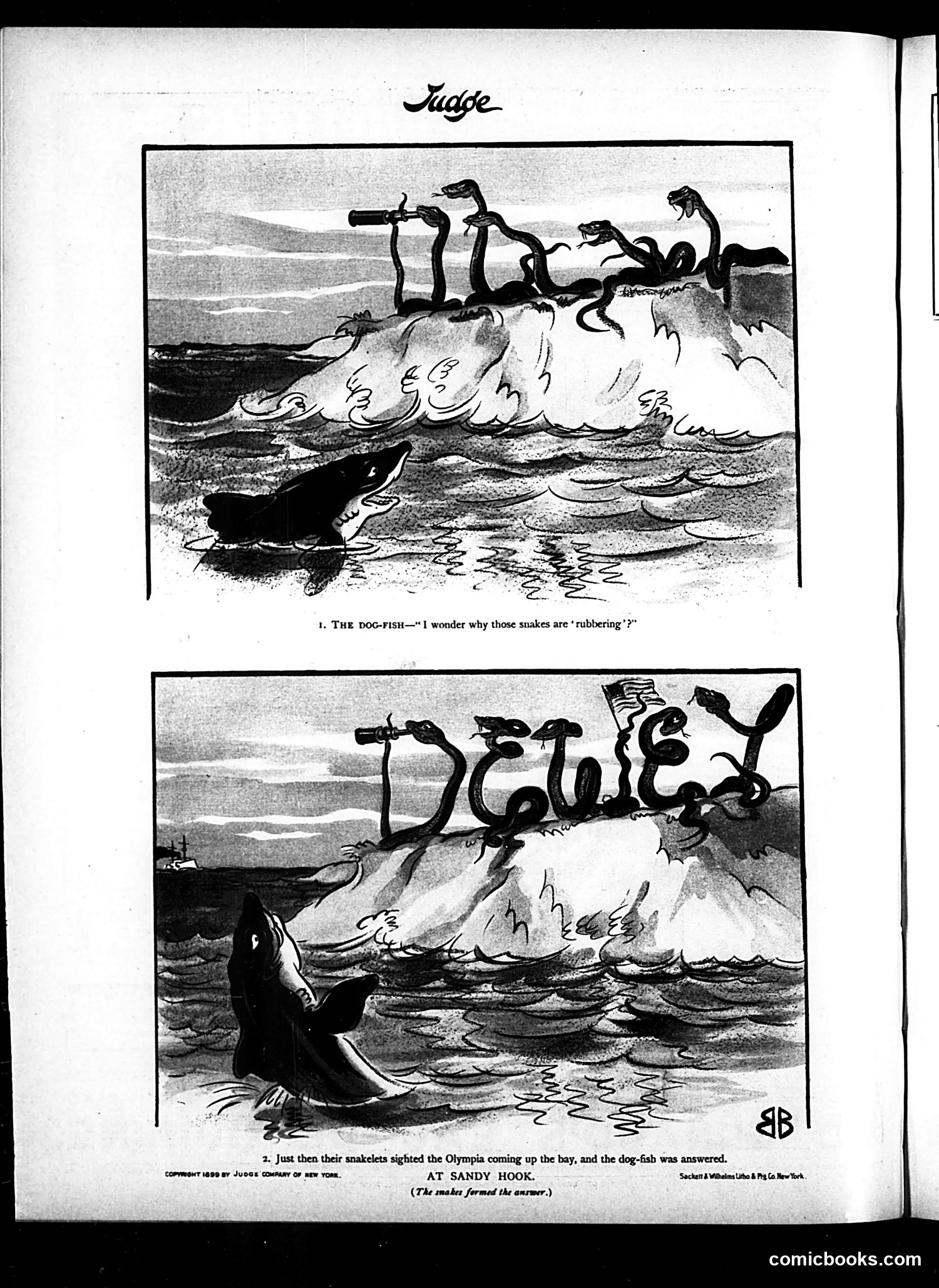
This is a two-panel satirical cartoon from Judge magazine (1899). The humor relies on visual wordplay: sea snakes form letters spelling "DETECT" and "DECOY" when viewed from above. The cartoon references the USS Olympia, Commodore Dewey's flagship from the Spanish-American War (1898), returning to New York. A "dog-fish" (a type of shark) observes the snakes, which the caption suggests are somehow "answering" the ship's arrival. The satire appears to mock naval detection methods or perhaps comment on the Olympia's famous voyage. The phrase "The snakes formed the answer" suggests the joke: instead of sophisticated naval technology, mere snakes provide the response to the ship's approach. The reference to Sandy Hook (New York harbor entrance) confirms this depicts the Olympia's celebrated return to American waters, a major news event in 1899.
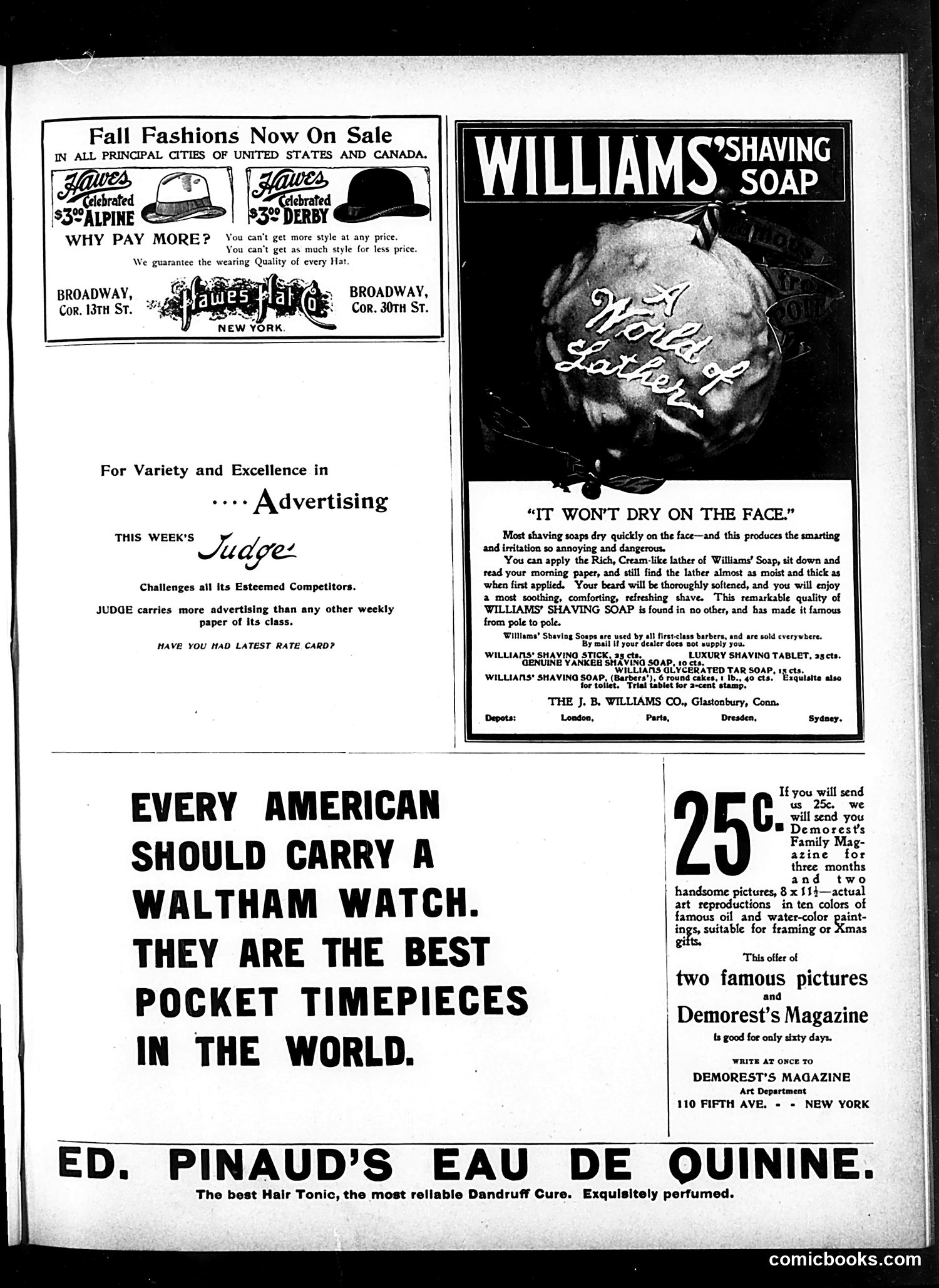
This page is primarily **advertising**, not satire or political commentary. It contains: **Fashion ads** (top): Hawes hats promoting Alpine and Derby styles, sold at Broadway locations in New York, emphasizing quality and value. **Product advertisements**: Williams' Shaving Soap (with image of lathered face), Waltham pocket watches, Demorest's Magazine subscription offer, and Ed. Pinaud's hair tonic. **One editorial note** (middle-left): "Judge" self-promotes, claiming it carries more advertising than competitors, challenging readers with "HAVE YOU HAD LATEST RATE CARD?"—essentially soliciting more advertisers. **Historical context**: This reflects early 20th-century Judge magazine's business model—generating revenue through high-volume advertising while maintaining editorial prestige. The ads themselves are straightforward product pitches without visible satirical intent, typical of periodicals from this era mixing editorial and commercial content liberally.
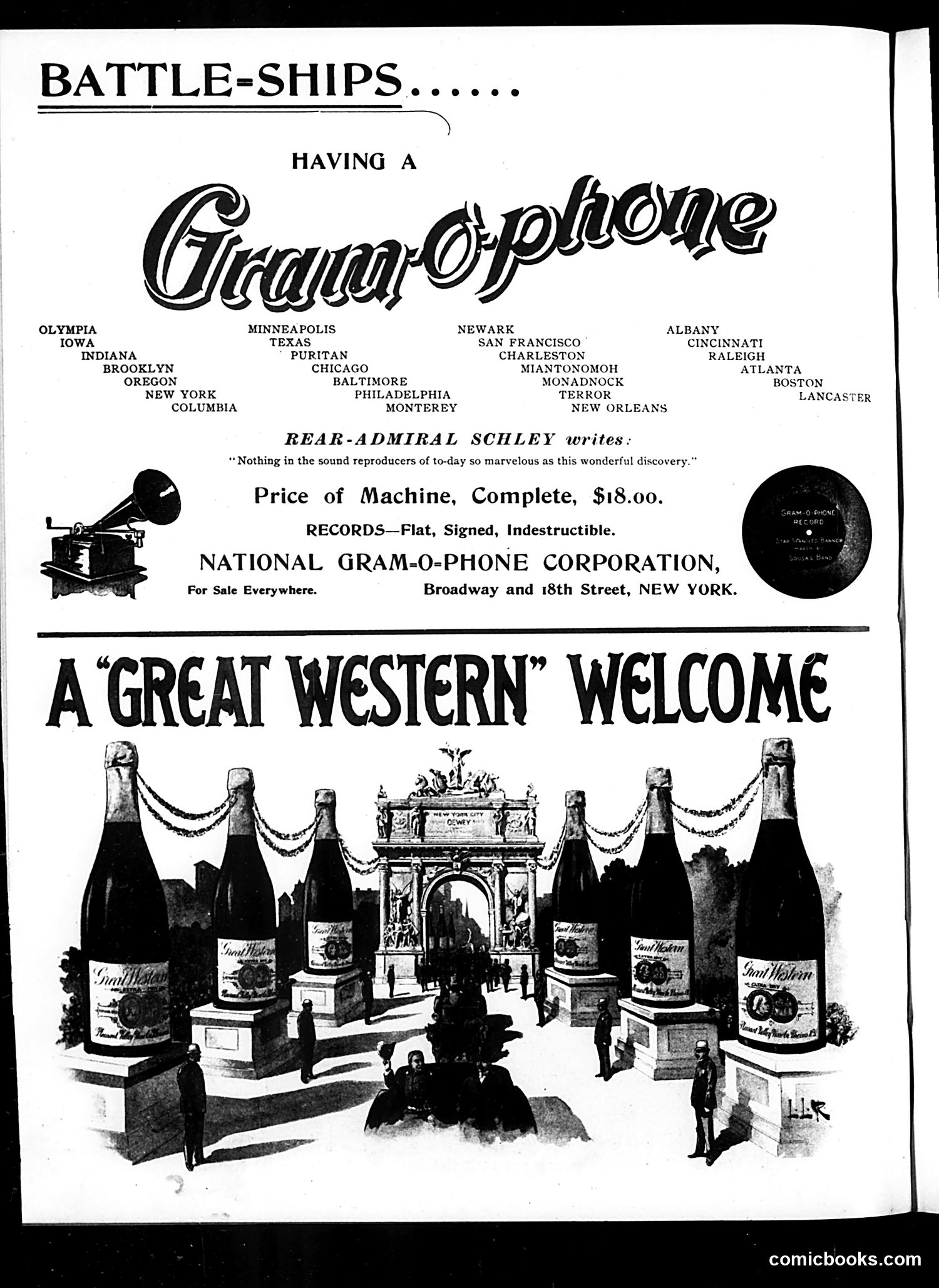
This page contains two distinct advertisements rather than political satire. The top section advertises the Gram-O-Phone, a new sound recording device priced at $18.00. It uses an endorsement from Rear-Admiral Schley (a Spanish-American War naval hero) to promote the machine's superiority. The "battle-ships" list appears to reference actual U.S. Navy vessels, likely meant to evoke national pride and technological progress during the early 1900s. The lower advertisement promotes "Great Western" brand whiskey, depicted with celebratory imagery of large bottles flanking an ornate arch structure, suggesting a triumphant reception or welcome for the product. Both ads reflect early 20th-century advertising strategies: using authority figures/testimonials and patriotic themes to sell consumer goods to Judge magazine's middle-to-upper-class readers.