
A complete issue · 17 pages · 1899
Judge — June 24, 1899
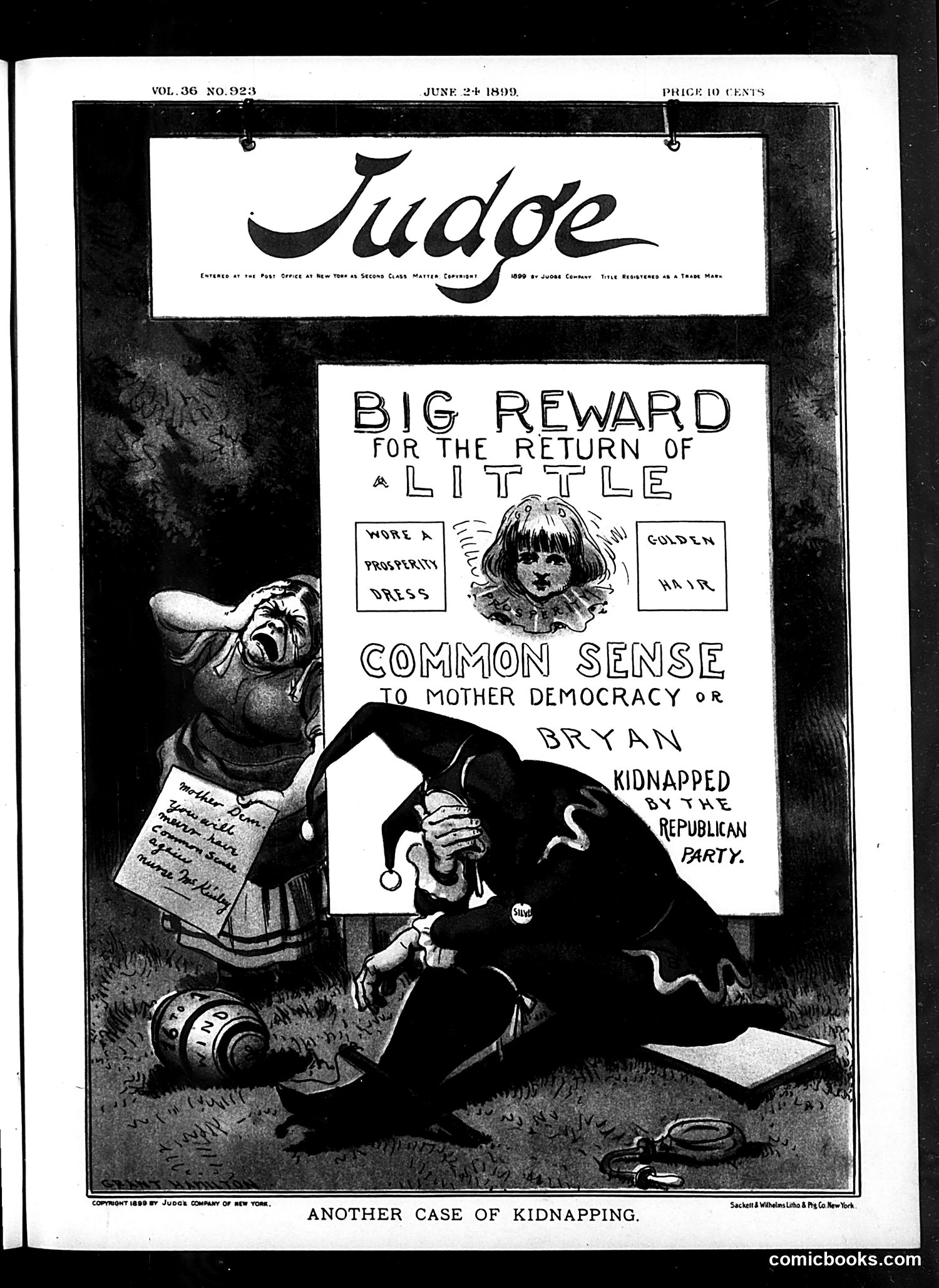
This 1899 *Judge* cartoon satirizes the 1896 presidential election aftermath. The image depicts a child labeled with "golden hair" and "proper dress"—representing "Common Sense"—being kidnapped "by the Republican Party." The figure on the left appears to be **Mother Democracy**, distraught over losing her child. The cartoon suggests Republicans kidnapped rational political discourse during the election, particularly regarding William Jennings Bryan's Democratic candidacy. The "big reward" poster emphasizes Democrats' desperation to recover sound judgment from Republican control. This reflects deep partisan divisions of the era, with *Judge* (a Democratic-leaning publication) claiming Republicans had corrupted the democratic process and public reason itself through their campaign tactics and political dominance.
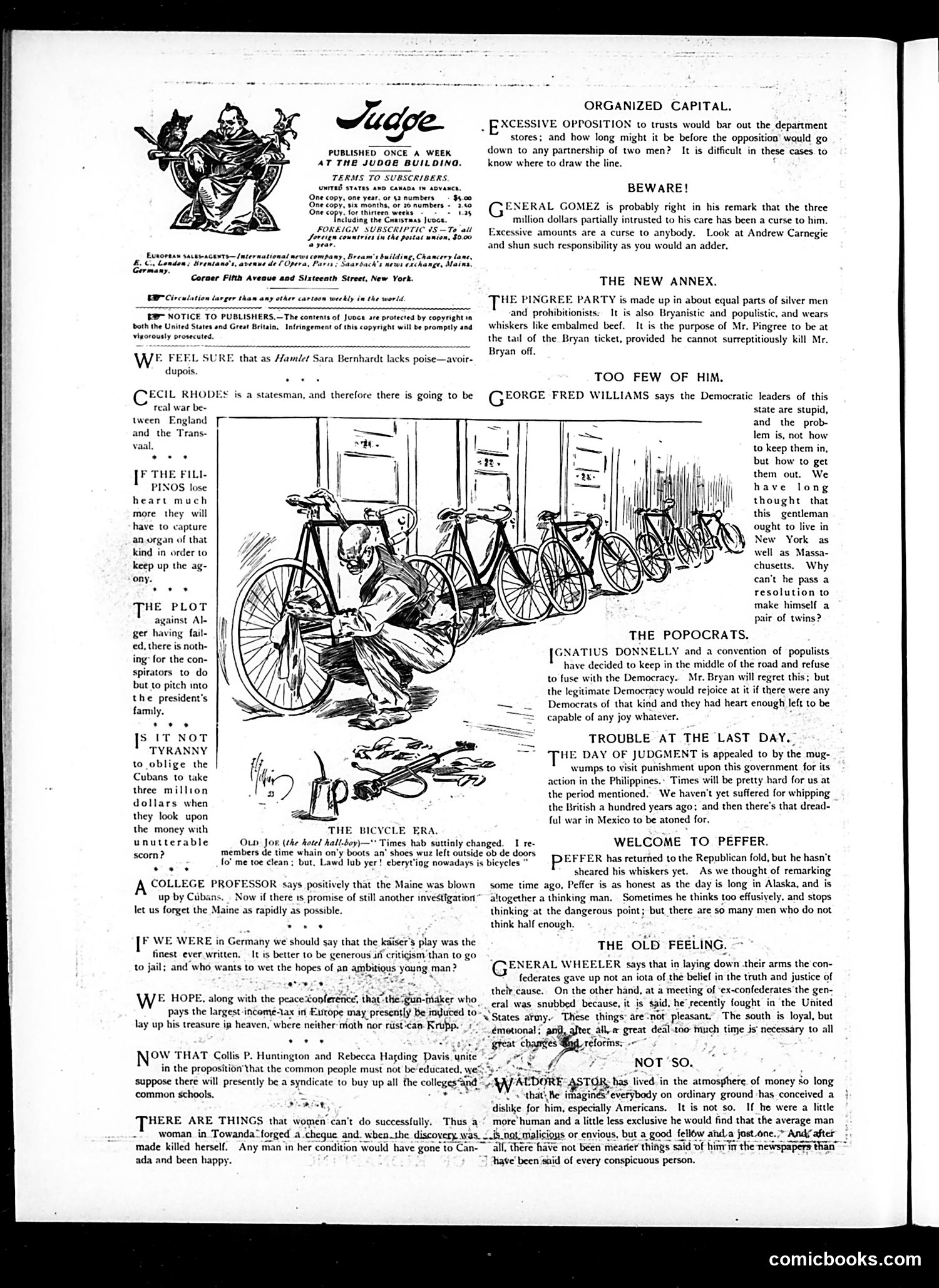
The main cartoon depicts "THE BICYCLE ERA" — a line of bicycles with riders, satirizing the late 19th-century bicycle craze. The accompanying text criticizes this fad as frivolous distraction. The page contains multiple political editorials mocking Democratic and Populist leaders. "THE POPOCRATS" ridicules Ignatius Donnelly and populists for considering fusion with the Democratic Party. "ORGANIZED CAPITAL" warns against trusts. Other sections target General Gomez (unclear which historical figure), critique Democratic incompetence, and mock reformers like General Wheeler. The overall tone is conservative, attacking populism, trust-busting concerns, and Democratic leadership as ineffectual. References suggest this is from the 1890s political era, though specific dates aren't provided in the text.
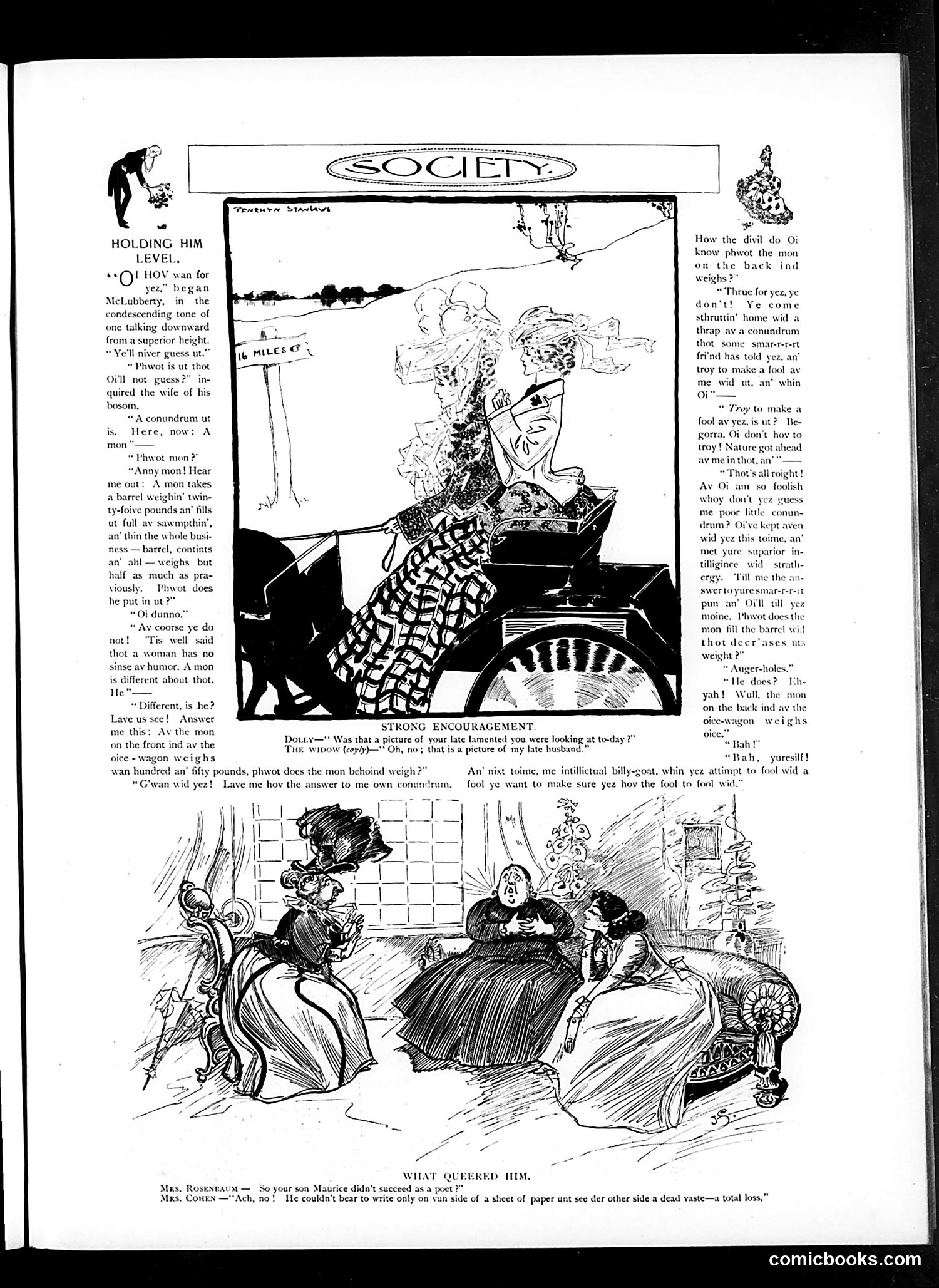
This page contains two satirical sketches about marital dynamics and domestic life, typical of Judge's early 20th-century humor. The upper cartoon "A Pound Enchantment" depicts a husband and wife arguing about weight—he condescendingly asks if she wants to lose pounds, she defensively responds about the burden of housework. The satire mocks the husband's presumption and insensitivity regarding her domestic labor. The lower sketch "What Queered Him" shows Mrs. Rosenbaum and Mrs. Cohen discussing why Maurice failed as a poet. The joke suggests he couldn't succeed because he only had "a sheet of paper" between them—a crude sexual innuendo about marital intimacy undermining artistic ambition. Both pieces satirize gender relations and marriage, reflecting period attitudes toward women, domestic roles, and Jewish immigrant life.
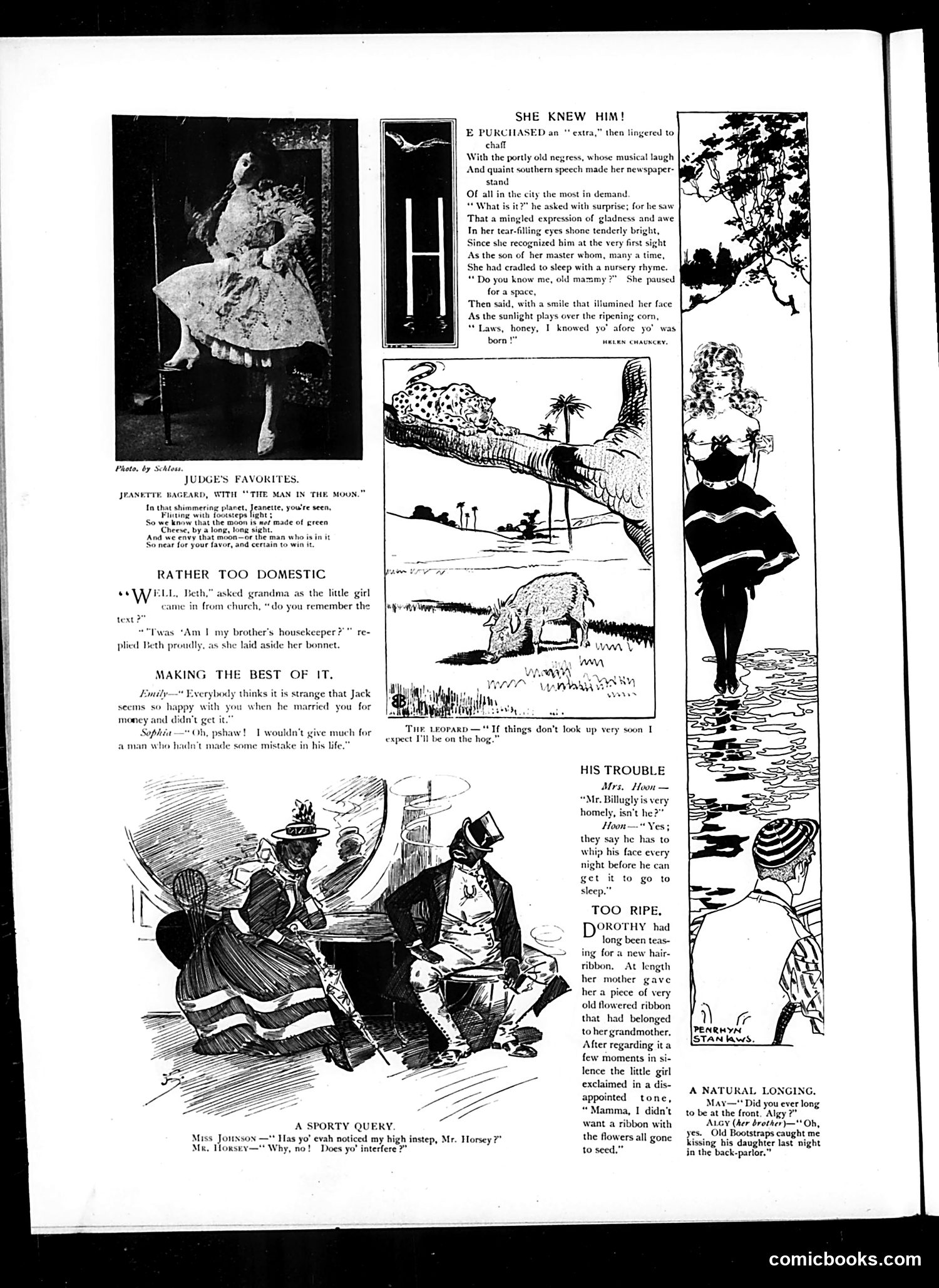
This page consists of humorous domestic vignettes rather than political cartoons. The content includes: **"Judge's Favorites"** - A photo of actress Jeanette MacDonald in "The Man in the Moon" production. **Short comedic sketches** with titles like "Rather Too Domestic," "Making the Best of It," "A Shorty Query," "His Trouble," "Too Ripe," and "A Natural Lounging." These appear to be lighthearted married-couple and family humor typical of early 20th-century Judge magazine—featuring dialogue about household dynamics, children's behavior, and domestic mishaps. **"The Leopard"** - An illustrated fable about a leopard on a tropical island, with the moral: "If things don't look up very soon I expect I'll be on the hop." The humor targets domestic life, marital relations, and parenting—universal themes requiring no historical context beyond understanding period social expectations around family roles.
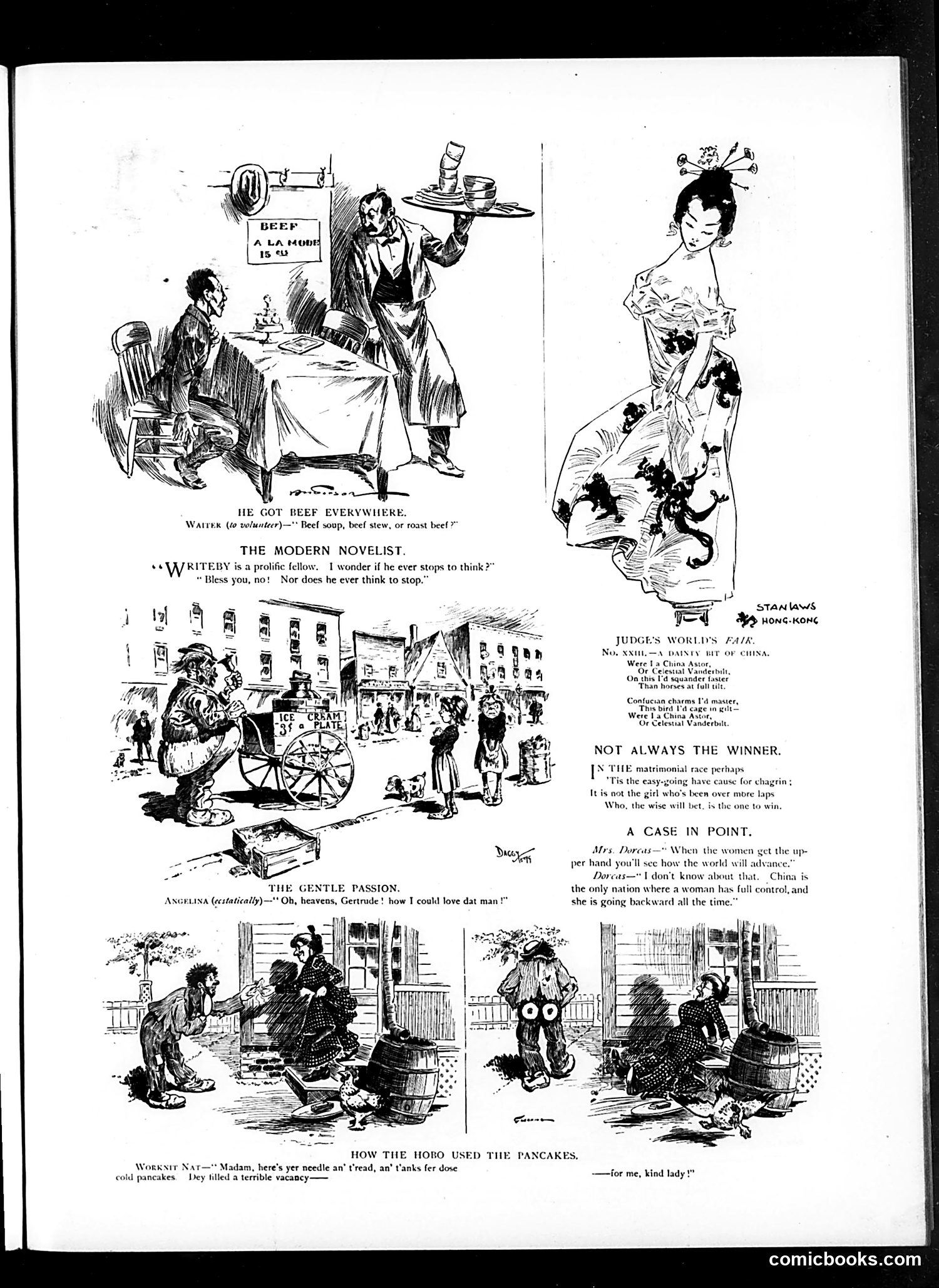
This page contains several satirical cartoons mocking contemporary social types and issues: **"He Got Beef Everywhere"** ridicules a volunteer waiter obsessed with beef offerings—likely satirizing both nouveau riche pretension and food obsessions of the era. **"The Modern Novelist"** jokes that prolific writers don't think while writing, suggesting mass-produced, thoughtless literature was common. **"Stan Laws, Hong-Kong"** appears to be a fashion illustration with social commentary about wealth (referencing the Astor and Vanderbilt families), possibly mocking American fascination with Asian aesthetics or critiquing women's advancement. **"Not Always the Winner"** satirizes matrimonial prospects, suggesting experienced women ("over more laps") paradoxically have worse marriage chances—commentary on Victorian attitudes toward women's virtue and marriage desirability. **"The Gentle Passion"** and **"How the Hobo Used the Pancakes"** depict working-class/vagrant characters in humorous domestic situations, reflecting Judge's typical approach to class-based humor. Overall, the page reflects early 20th-century satirical concerns: literary quality, gender roles, class distinctions, and social pretension.
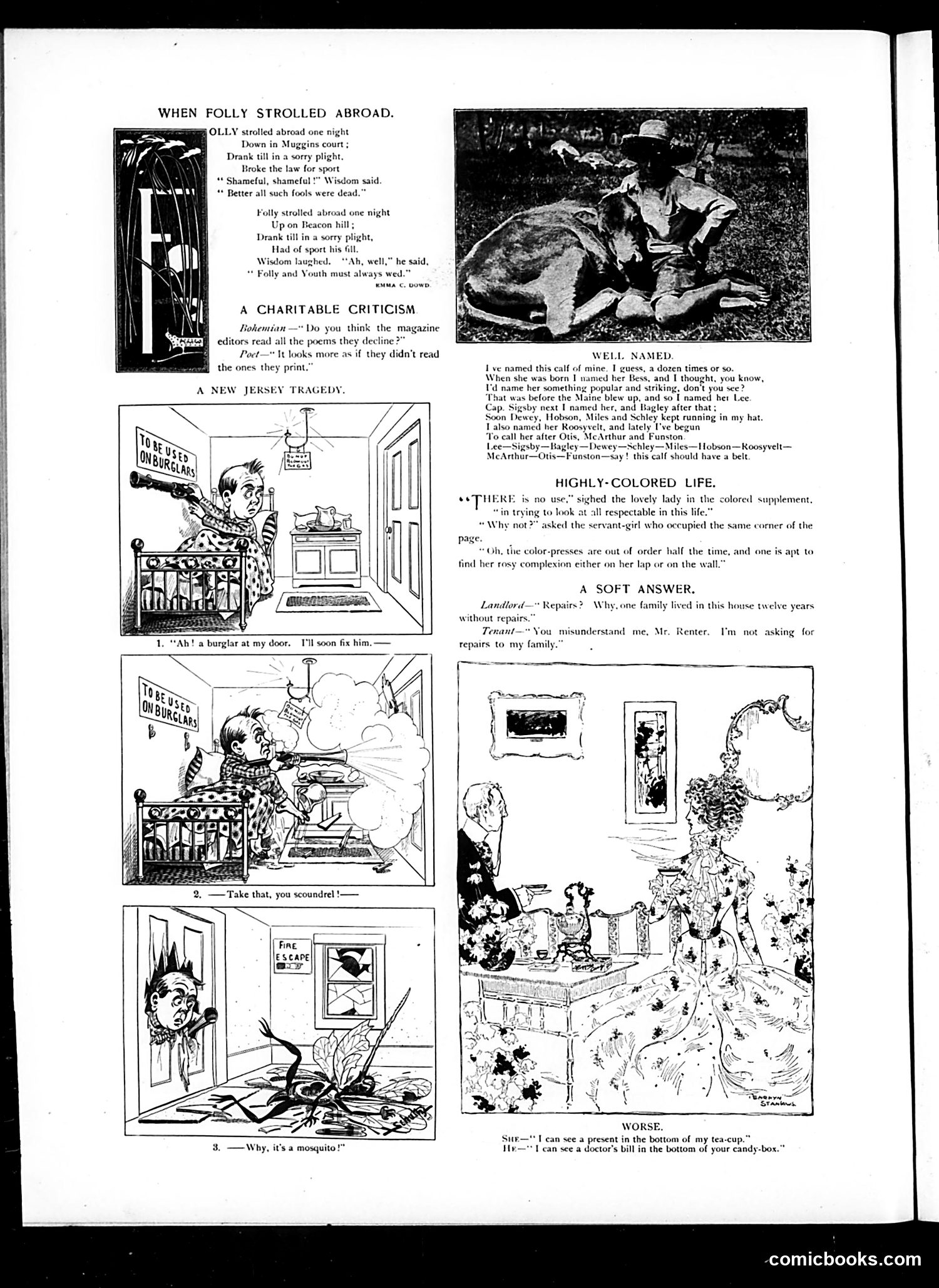
This page contains several unrelated satirical pieces typical of Judge's humor: **"When Folly Strolled Abroad"** contrasts Wisdom's stern judgment of lower-class drunkenness (Folly drinking in "Muggins court") with his indulgent acceptance of upper-class revelry ("Beacon hill"), satirizing class hypocrisy. **"A New Jersey Tragedy"** depicts a child mistaking a mosquito for a burglar—likely referencing New Jersey's reputation for mosquitoes, a common joke of the era. **"Well Named"** humorously catalogs a farmer's repeated renaming of his calf after naval figures from the Spanish-American War (Maine, Lee, Sigsby, Schley, Hobson, Roosevelt), satirizing the public's obsession with war heroes. **Other pieces** mock magazine editors, color-printing technology failures, landlord-tenant disputes, and fortune-telling pretensions—all representing everyday social frustrations of the period.
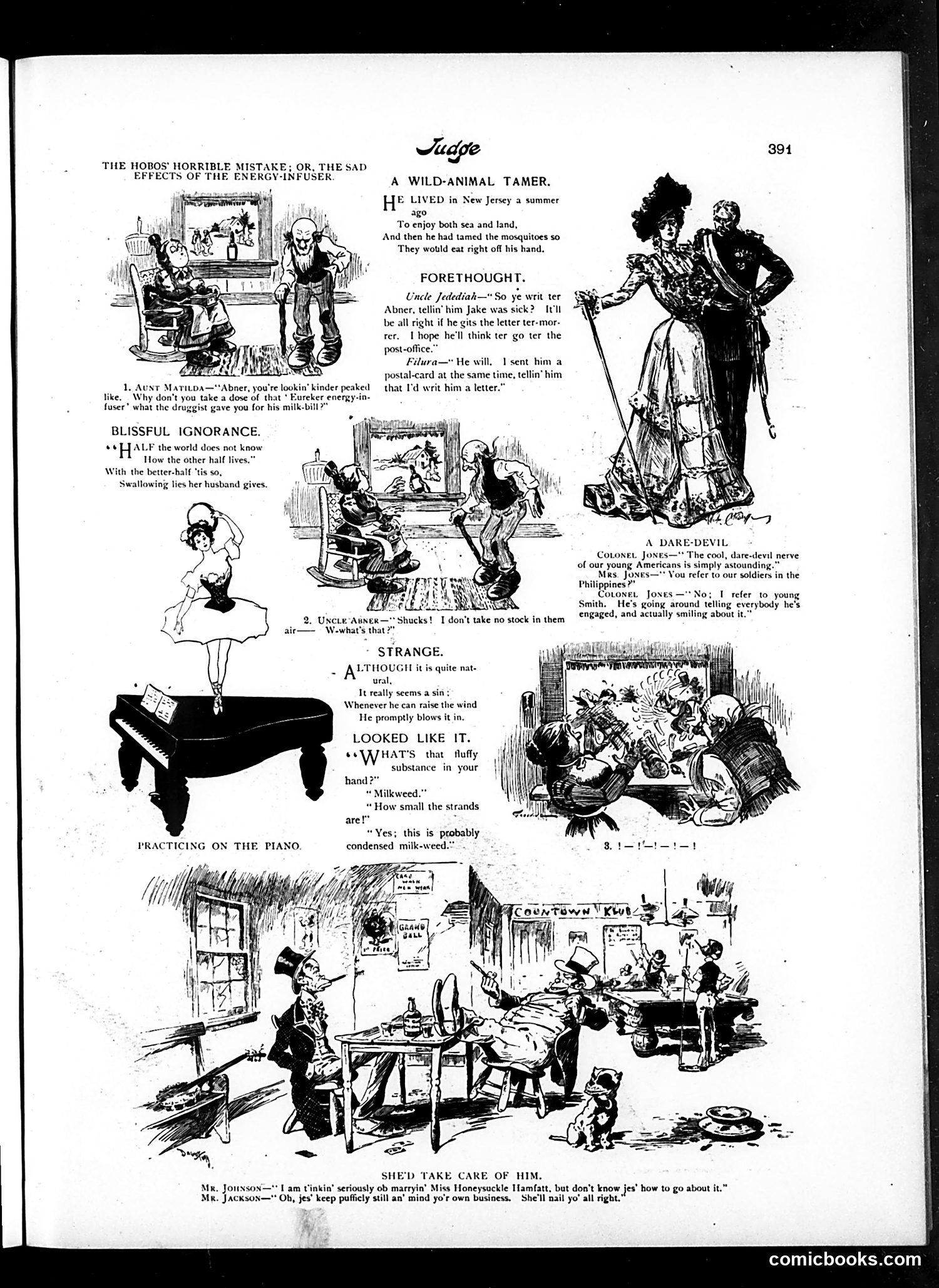
This page contains multiple short humorous sketches typical of early 20th-century American satire: **"The Hobos' Horrible Mistake"** mocks rural/working-class dialect and patent medicine culture, showing characters discussing a fake "Eureka energy-infuser" tonic. **"Blissful Ignorance"** satirizes wives as gullible, believing whatever husbands tell them—reflecting period attitudes about women's credulity. **"A Wild-Animal Tamer"** is a tall tale about someone who tamed mosquitoes in New Jersey, mocking exaggeration. **"A Dare-Devil"** contrasts military courage with the audacity of young men openly announcing engagements and appearing happy—treating romance as recklessly brave. **"She'd Take Care of Him"** uses African American dialect humor (common in this era's satire, though offensive today) about courtship, suggesting women will pursue marriage aggressively without male effort. The page relies on period stereotypes, patent medicine hucksterism, and assumptions about gender, class, and race that reflect 1900s American attitudes rather than endorsing them by modern standards.
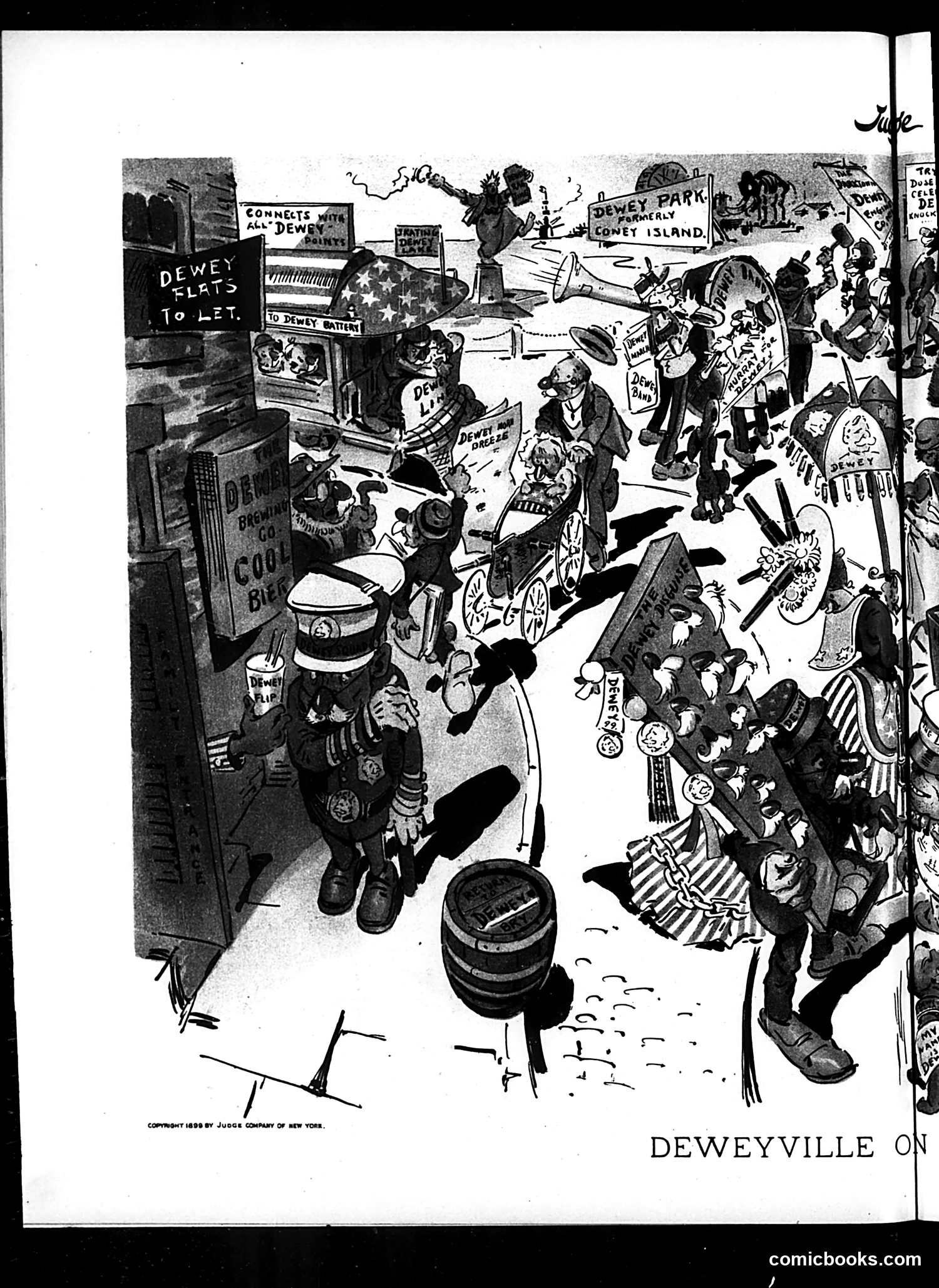
This is a satirical cartoon celebrating Admiral George Dewey following his naval victory in the Spanish-American War (1898). The cartoon depicts an exaggerated, chaotic celebration of "Deweyville"—a fantastical town named after the celebrated admiral. The scene shows commercial exploitation of Dewey's fame: signs advertise "Dewey Flats," "Dewey Park," "Dewey Island," and a "Dewey Battery." Various figures engage in frenzied commerce and revelry, suggesting how American businesses and entrepreneurs rushed to capitalize on Dewey's popularity through naming rights and merchandise. The satire mocks both the excessive hero-worship of Dewey and the commercialization of patriotic sentiment—showing how quickly public admiration transforms into profit-seeking ventures.
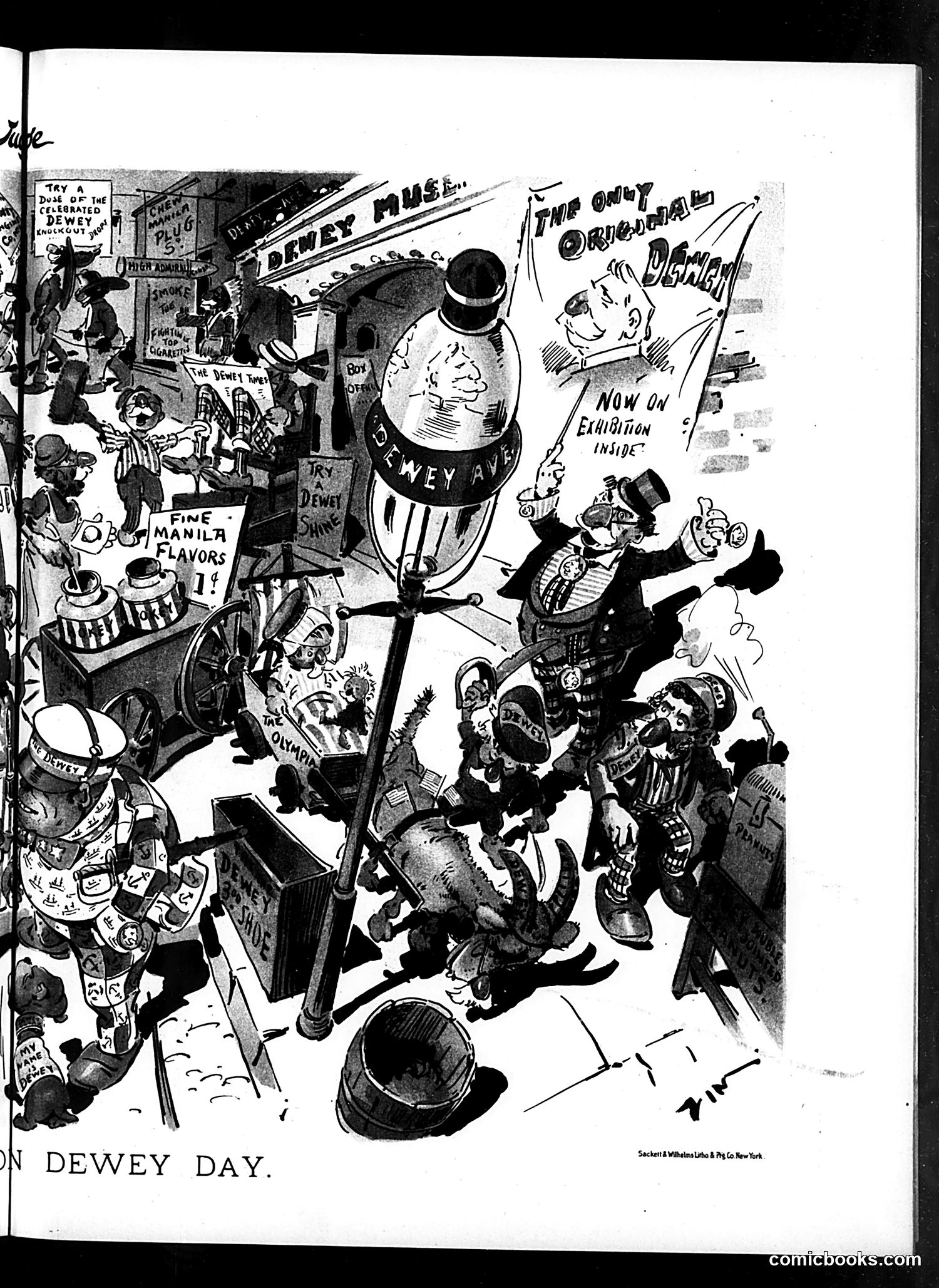
This cartoon satirizes a celebration of Admiral George Dewey following his 1898 naval victory in the Spanish-American War. The central figure is an enormous Dewey character being paraded through streets lined with vendors, politicians, and celebrants. The satire mocks the commercialization and circus-like atmosphere surrounding Dewey's homecoming. Signs advertise "Dewey Plugs," "Fine Manila Flavors," and various merchandise exploiting his fame. Politicians and businessmen crowd around the spectacle, eager to profit from his popularity. The "muse" character and sign reading "The Only Original Dewey" joke about competing commercialization of his name. The cartoon critiques how Americans transformed a military hero into a marketable commodity, with vendors and politicians more interested in profit than genuine civic honor.
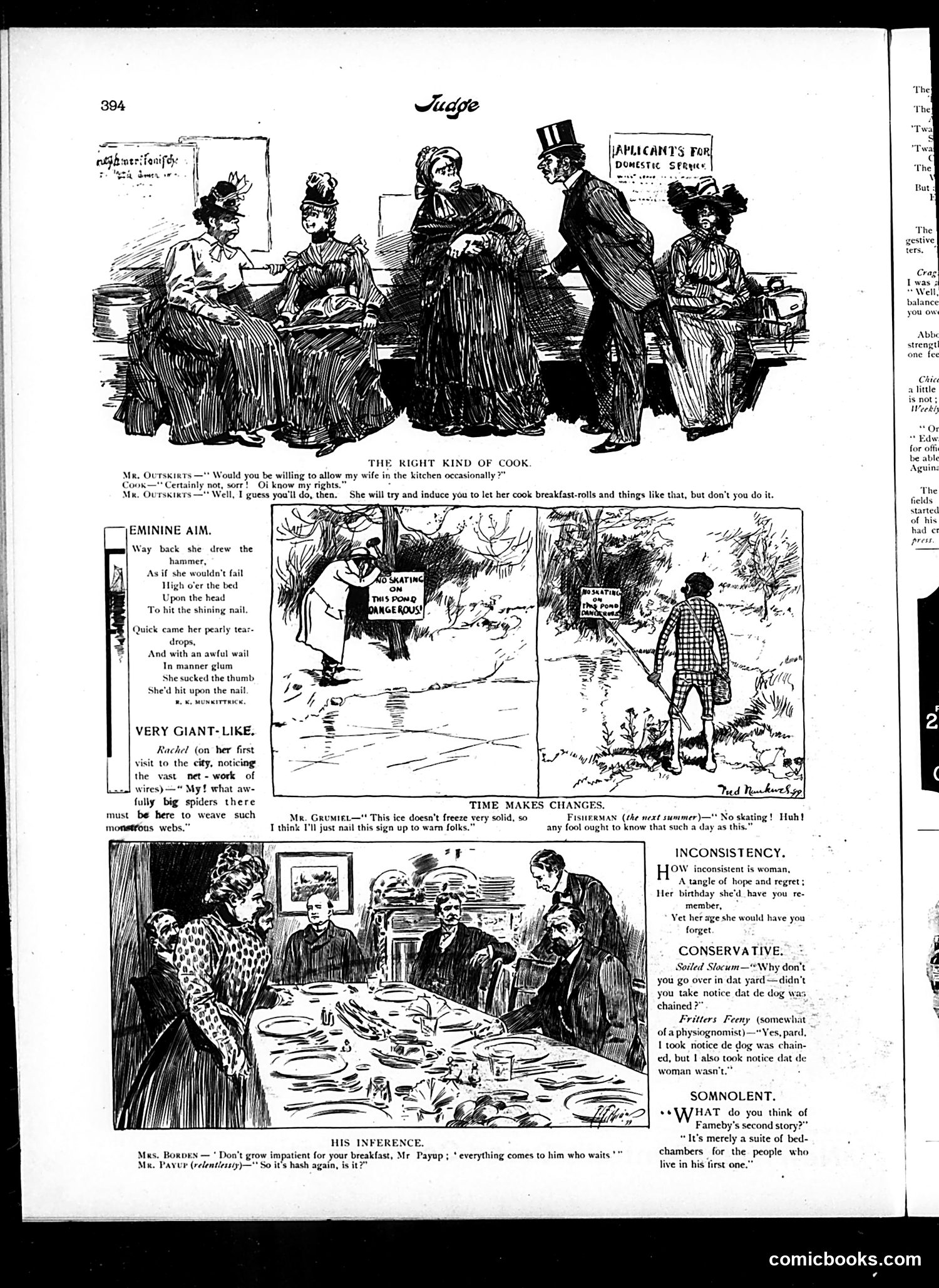
This page contains six separate satirical cartoons and humorous verses targeting domestic life and gender stereotypes of the era. **"The Right Kind of Cook"** depicts an employer interviewing a cook, praising him for resisting the wife's attempts to influence kitchen decisions—satirizing both servants' rigid hierarchies and wives' domestic limitations. **"Feminine Aim"** mocks women's incompetence through a poem about a girl hammering a nail into her thumb, playing on period stereotypes of female clumsiness. **"Very Giant-Like"** shows a rural woman amazed by city electrical wires, satirizing rural ignorance of modern technology. **"Time Makes Changes"** contrasts a fisherman's winter warning sign with summer skating conditions, suggesting human shortsightedness. **"Inconsistency"** and **"Conservative"** are brief verses mocking women's contradictions and a man's failure to notice a woman wasn't chained (like the dog). **"His Inference"** jokes that hash served repeatedly suggests the husband will eventually receive only bedroom accommodations—satirizing marital discord and domestic monotony. The overall tone reflects Victorian-era assumptions about women's intellectual and practical inferiority.
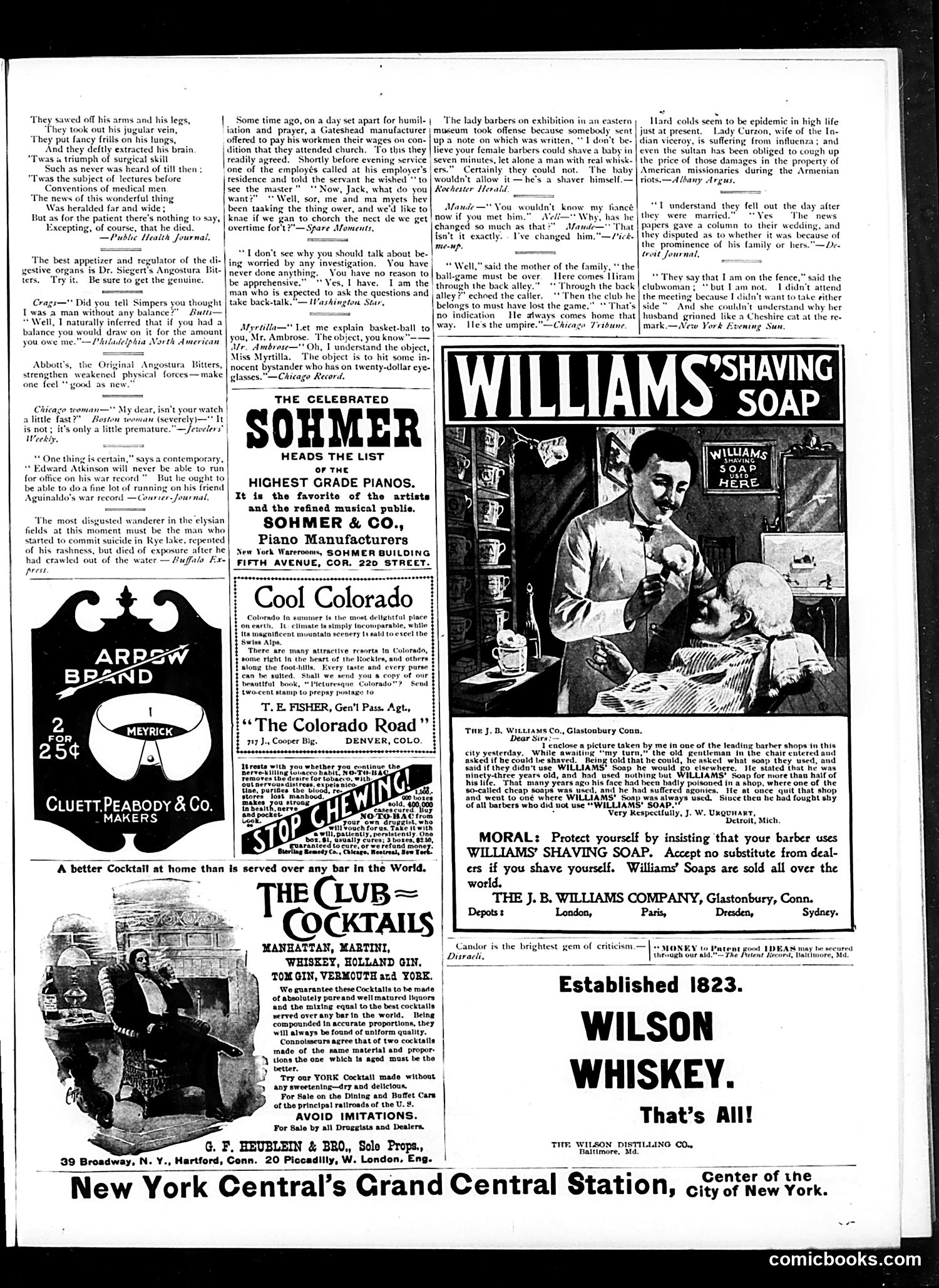
This appears to be primarily **a page of advertisements and miscellaneous humor snippets**, not a political cartoon. The main content consists of: 1. **Medical satire poem** (top left): Dark humor about surgical "advancement" that kills the patient—a critique of medicine prioritizing technical skill over patient welfare. 2. **Various brief jokes and anecdotes**: Including workplace humor (a worker negotiating "overtime" for attending mandatory church), a barber shop story about female barbers being insulted, and marital disputes. 3. **Large advertisements**: For Sohmer pianos, Williams Shaving Soap, Arrow Brand Meyrick collars, The Club cocktails, and Wilson Whiskey. 4. **A small "Cool Colorado" tourism ad** and railroad promotion. The page reflects early 20th-century concerns (female workers in traditionally male jobs, the intersection of labor and religion, medical ethics) through light satirical humor rather than pointed political commentary. The advertisements dominate the layout, suggesting this was primarily a commercial publication despite its satirical pretensions.
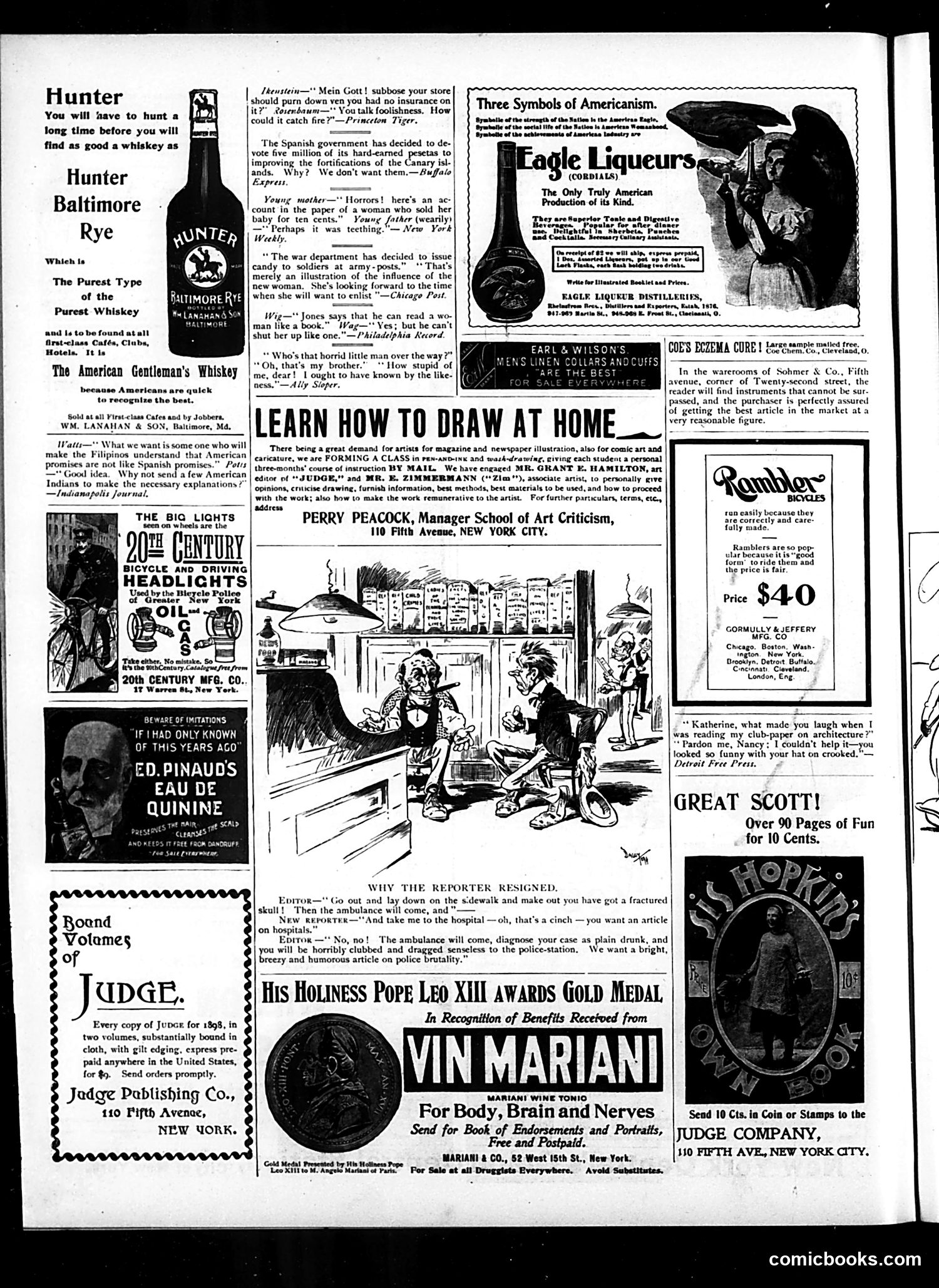
This page contains primarily **advertisements and brief satirical snippets** rather than a major political cartoon. The most substantive satirical content is "Why the Reporter Resigned," a dialogue mocking newspaper sensationalism. An editor instructs a reporter to fake injury to generate an ambulance/hospital story, but the reporter recognizes he'll instead be arrested as a drunk—exposing how newspapers manufacture drama while law enforcement treats poor or disheveled people brutally. Other brief jokes reference: - **Filipino colonial governance** (a reference to U.S. occupation post-1898, sarcastically suggesting American Indians be sent to "explain" promises to Filipinos) - Various puns in small snippets about insurance, babies, and courtship The page is dominated by period advertisements for whiskey, bicycle headlights, art instruction, drawing classes, and patent medicines—typical of Judge's revenue model. The "Three Symbols of Americanism" (the eagle image) is promotional rather than satirical. The satire present is mild social commentary on journalism ethics and colonial attitudes, not sharp political critique.
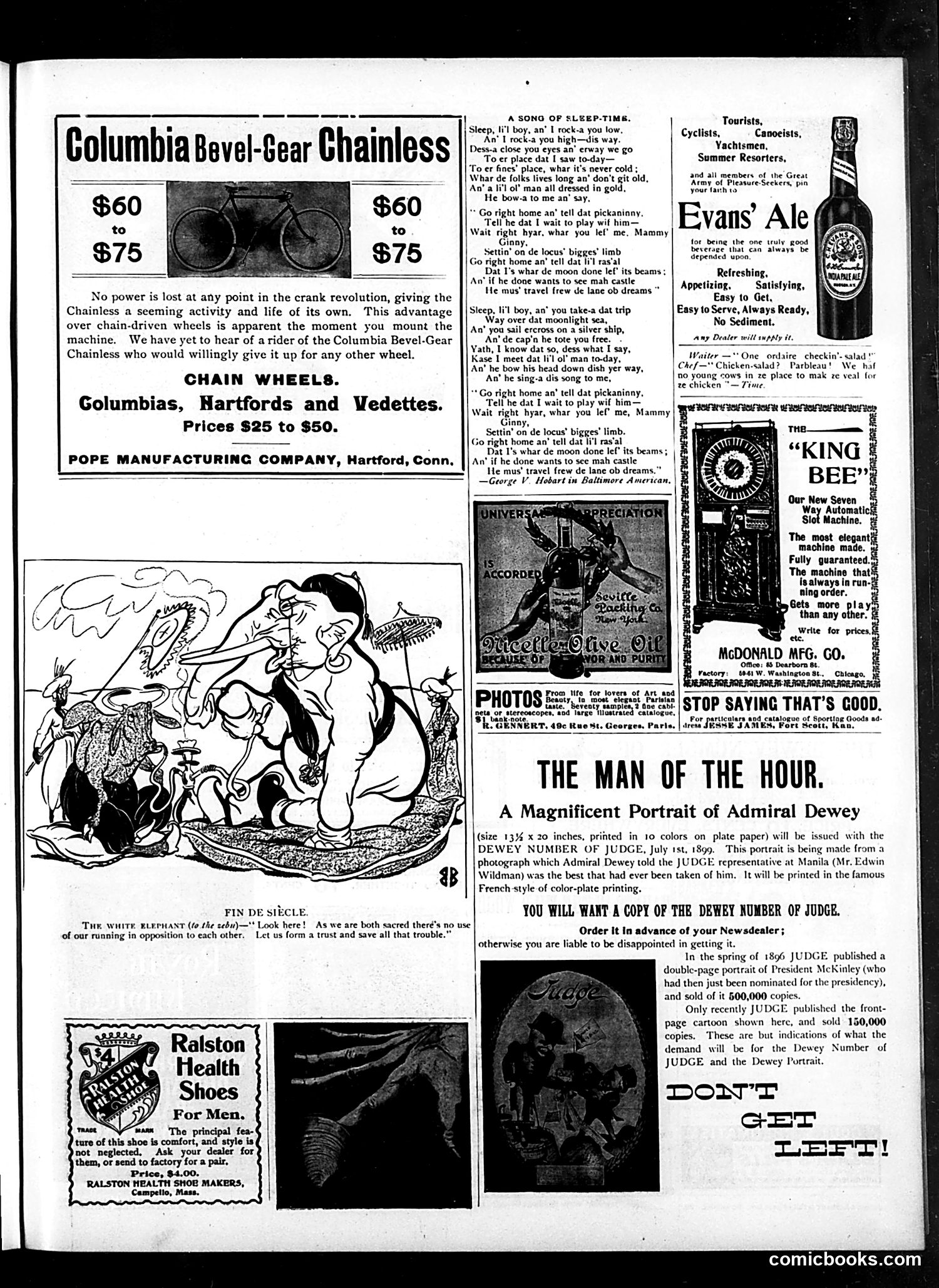
This cartoon depicts **two elephants in formal dress** shaking hands or trunks, with the caption explaining they're forming a "trust" to avoid competition—a direct satire of the **monopoly and trust-building era** of the 1890s. The white elephant represents one business interest, the other elephant another. By anthropomorphizing them as gentlemen agreeing to eliminate competition rather than compete fairly, the cartoonist mocks the period's rampant corporate consolidation. The phrase "Fin de Siècle" (end of century) adds ironic commentary on the era's defining economic practice. This reflects real Progressive-era anxieties about **industrial monopolies** like Standard Oil and Carnegie Steel, which dominated markets by eliminating competitors through trusts and mergers rather than honest competition. The joke: rather than compete, businesses simply agreed to divide markets—rendering competition meaningless and harming consumers. This was a central political issue of the 1890s-1900s, eventually leading to antitrust legislation.
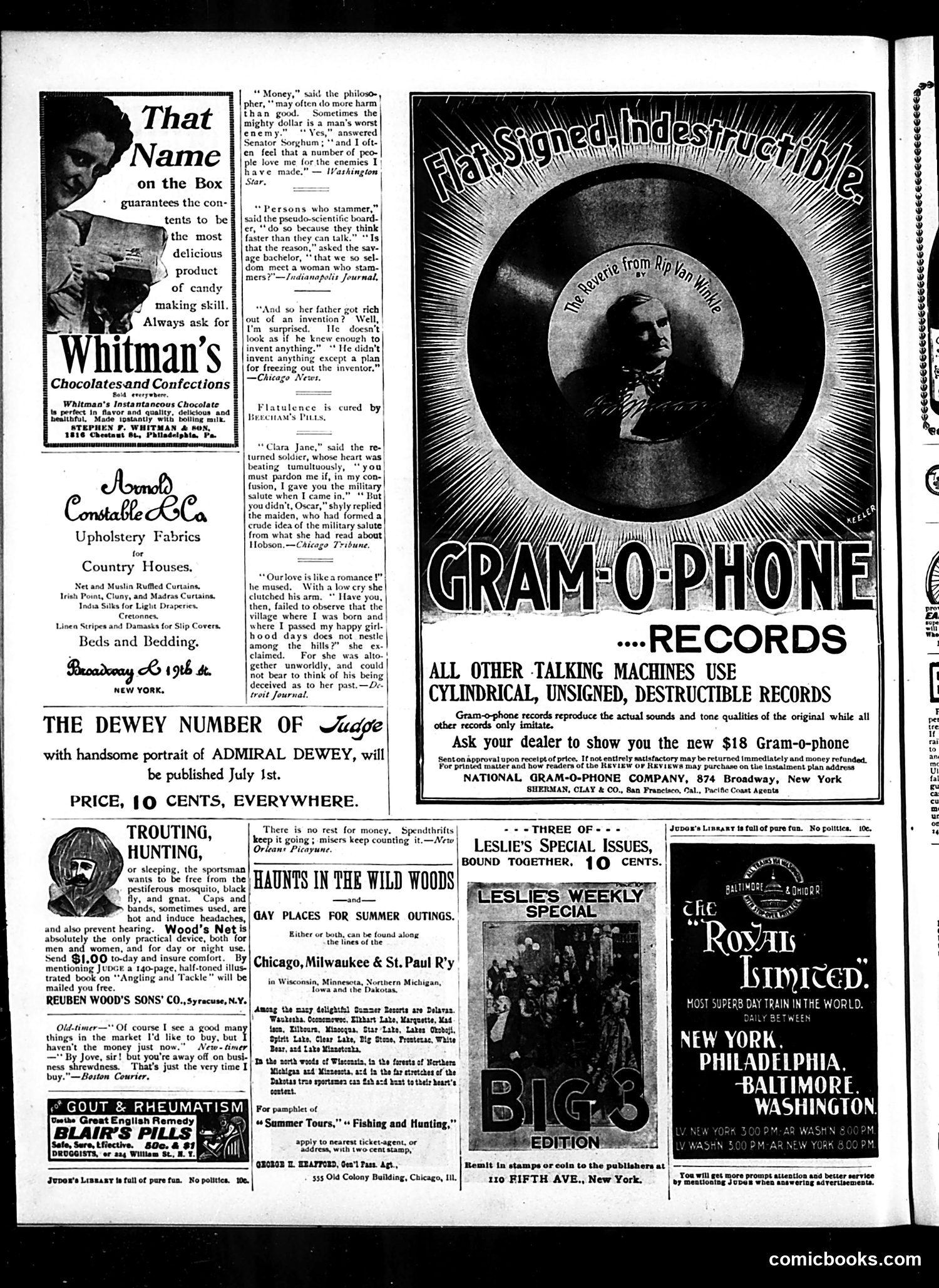
This page is primarily **advertisements** rather than editorial cartoons. The small satirical pieces that do appear are brief, humorous anecdotes—typical of Judge magazine's format—not political commentary. The visible jokes mock human nature: a senator's comment on enemies, stammering differences between men and women, a man who "froze out" an inventor rather than inventing anything himself, and romantic misunderstandings. The main content consists of product ads: Whitman's chocolates, upholstery fabrics, fishing nets, gout remedies, and notably a **Gram-o-phone Records advertisement** emphasizing that their records use superior, signed cylinders versus competitors' "cylindrical, unsigned, destructible records." There's also promotion for Judge's own publication and travel guides. The **Admiral Dewey reference** (a recent Spanish-American War hero, circa 1898) suggests this is from that era, when such nostalgic promotional tie-ins were common marketing tactics.
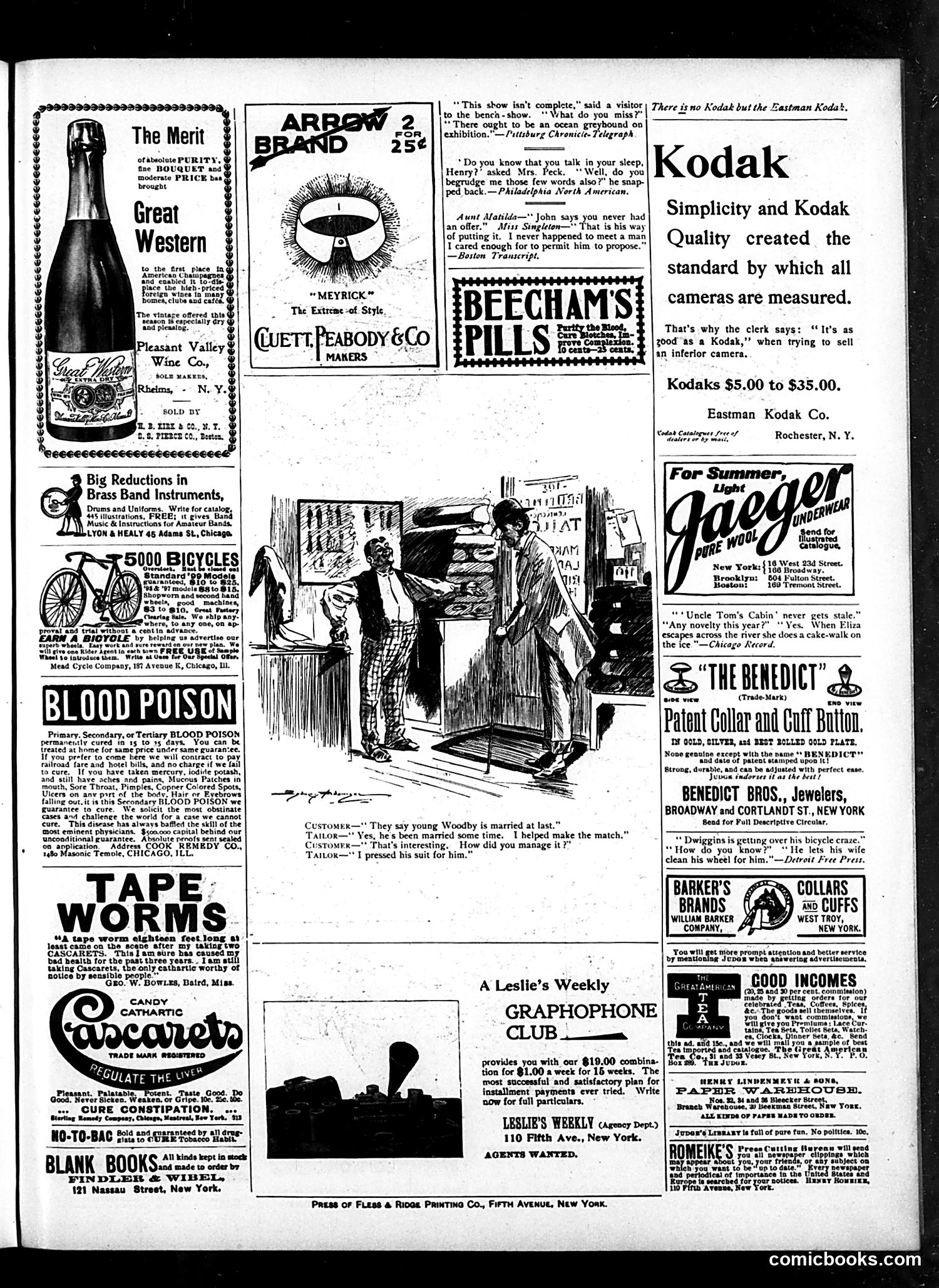
This page is primarily **advertisements with minimal satirical content**. The layout is typical of Judge magazine—commercial ads fill most space, with brief humorous anecdotes scattered throughout. The **main cartoon** (center) depicts a tailor and customer discussing a married man named Woodby. The joke turns on wordplay: when the customer says he "helped make the match," the tailor replies "I pressed his suit for him"—a pun on both courtship and tailoring. The page includes three short **humor snippets** above the cartoon playing on marital miscommunication and courtship conventions typical of early 20th-century comedy—a wife complaining her sleeping husband won't talk, an aunt describing a woman who never received proposals because she never "cared enough" to permit them. The **advertisements** dominate—promoting wine, bicycles, medical treatments (including dubious "cures" for blood poisoning and tapeworms), cameras, and gramophones. These reflect contemporary consumer culture and patent medicine claims now recognized as fraudulent. The Kodak ad notably claims their cameras set the standard for quality.
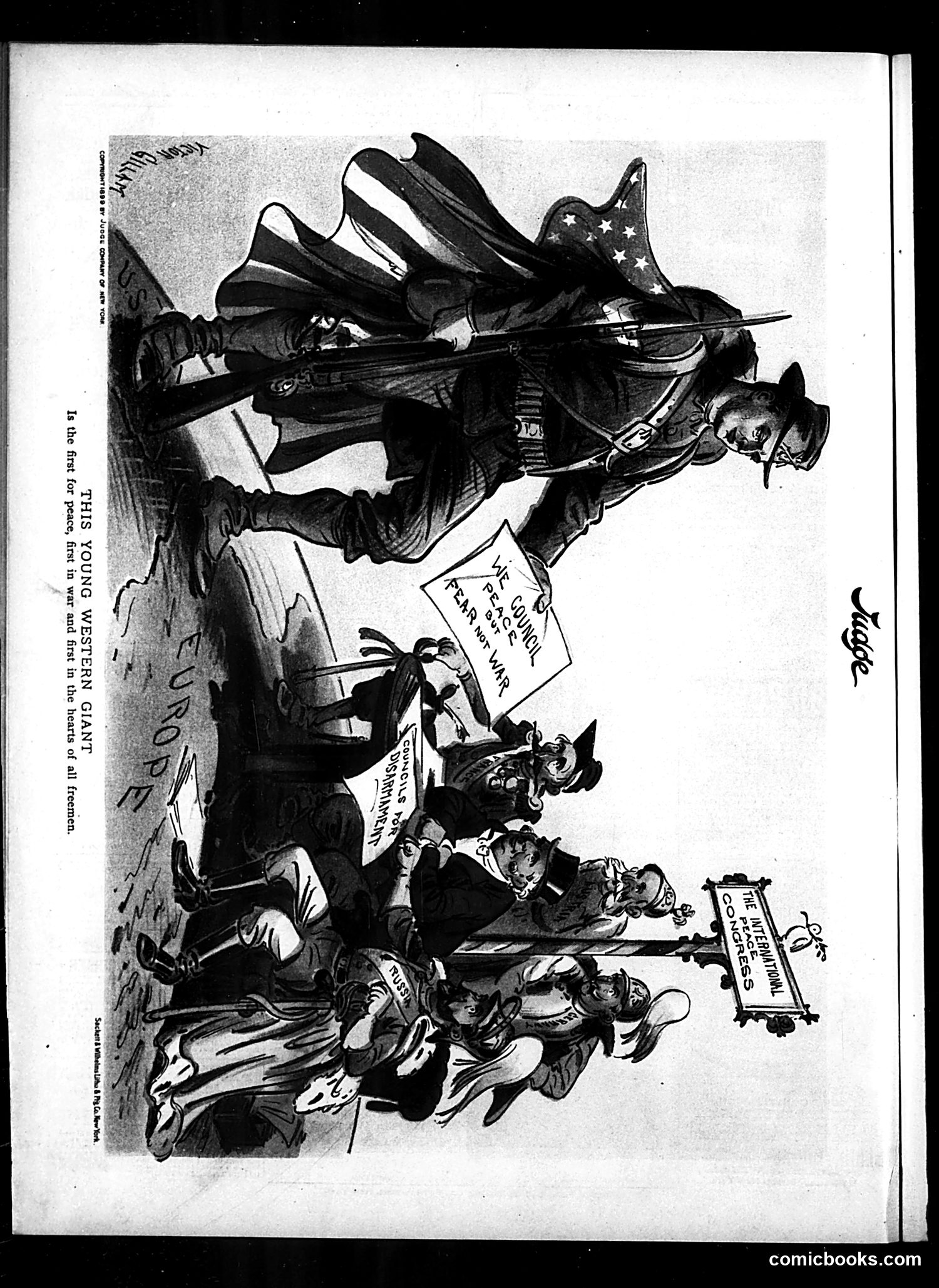
This appears to be a Gilded Age satirical cartoon from *Judge* magazine depicting America as a "Young Western Giant"—a muscular, confident figure holding a rifle and American flag. The composition echoes the famous description of George Washington ("first in peace, first in war, first in the hearts of his countrymen"). The cartoon likely celebrates American expansionism and military prowess during the late 19th century, possibly referencing conflicts like the Spanish-American War or westward expansion. Lower figures appear to represent other nations or conquered territories, arranged hierarchically beneath the dominant American giant. The satire critiques American imperial ambitions and exceptionalism through flattery—ironically comparing the nation's aggressive posture to founding ideals. Without a visible date, the specific conflict referenced remains uncertain, though the "Western Giant" language suggests 1890s-era imperialism.

I can see this is a page from Judge magazine, but the image is almost entirely black with only a white margin visible on the left side. The OCR text contains only a website URL ("comicbooks.com"), which appears to be a watermark rather than actual page content. I cannot discern any cartoon figures, political references, satirical content, or readable text from the image itself. The page appears either to be a blank or heavily degraded scan, or possibly a back cover or endsheet. To properly analyze this Judge magazine page's satire and historical context, I would need a clearer, more legible image showing the actual editorial content or illustrations.