
A complete issue · 16 pages · 1899
Judge — June 17, 1899
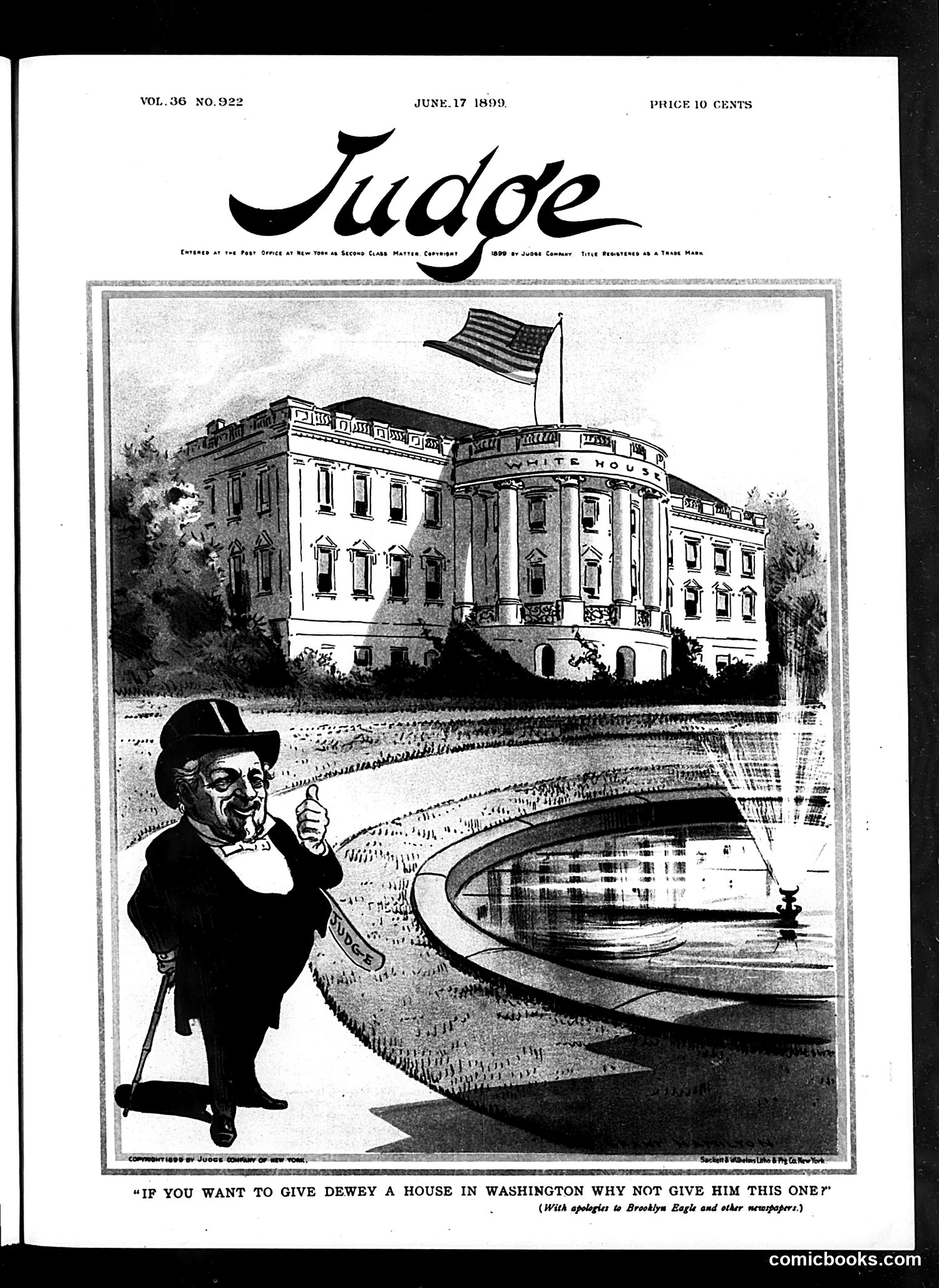
This editorial cartoon satirizes proposals to provide housing for Commodore George Dewey, the American naval hero of the Spanish-American War (1898). The caricatured figure in the foreground—identifiable by the caption as representing Dewey—stands before the White House, holding what appears to be a surveying tool. The satire's point: Brooklyn Eagle and other newspapers were advocating giving Dewey a house in Washington as a reward for his military service. Judge mocks this idea by asking rhetorically why not simply give him the White House itself—suggesting the proposed honor was already absurdly generous. The cartoon critiques both the excessive adulation of military figures and the impractical nature of public gift-giving schemes.
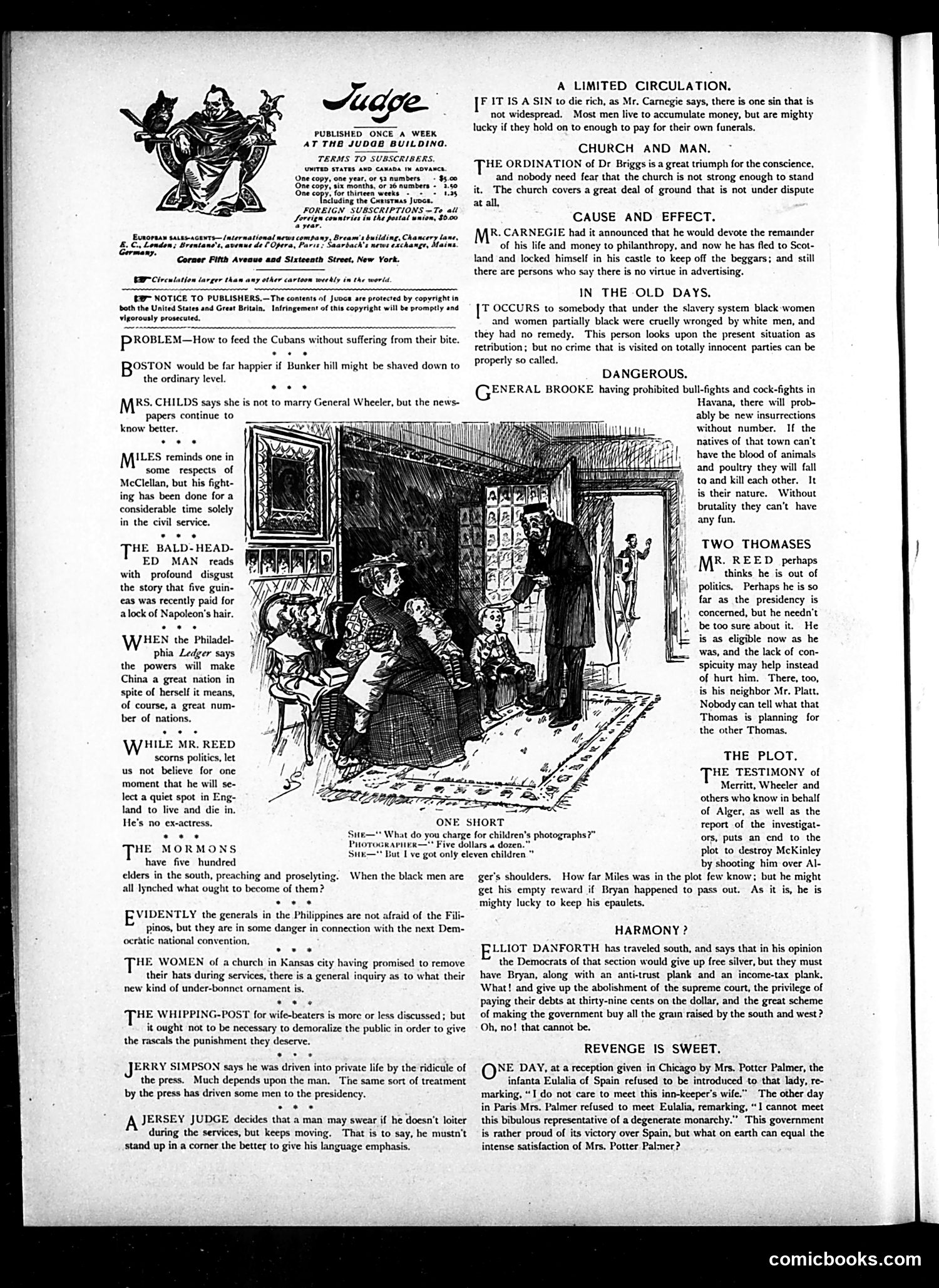
The central cartoon titled "ONE SHORT" depicts a scene where a photographer charges "Five dollars a dozen" for children's photographs, with a client responding "But I've got only eleven children." The satire mocks commercial photography pricing practices of the era—the photographer's absurd bulk-rate pricing scheme creates a humorous dilemma for a large family. The surrounding text snippets are political commentary on various 1890s-1900s issues: General Brooke's building restrictions in Havana (likely post-Spanish-American War), Reed's eligibility for presidency, McKinley assassination plot references, and Democratic silver-currency politics. The humor relies on period-specific commercial absurdity rather than sophisticated political critique.
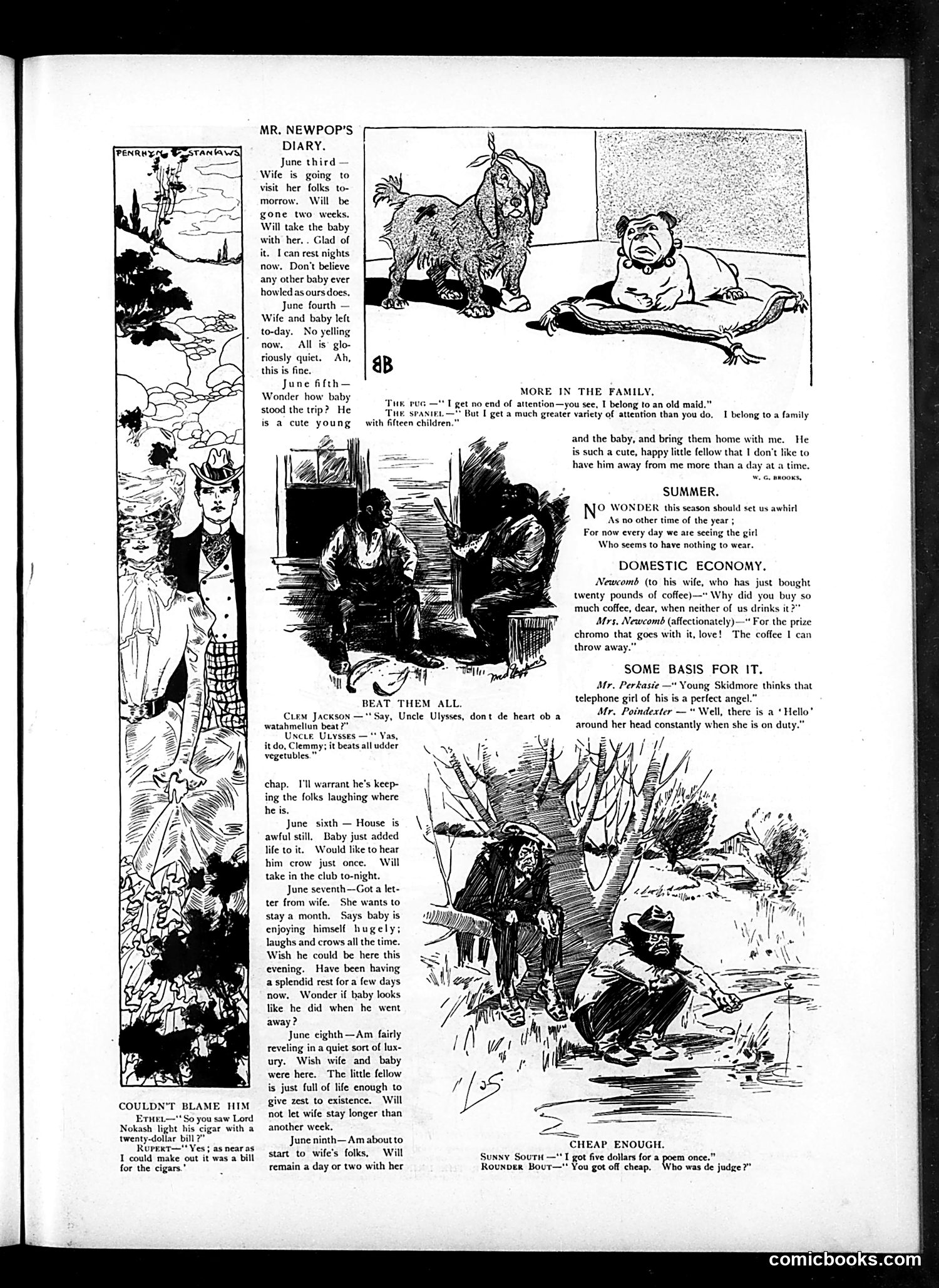
This page contains **Mr. Newpop's Diary**, a domestic humor column spanning June 3-9, chronicling a new father's complaints about his baby and household life. The diary entries mock contemporary parenting anxieties and domestic economy. The accompanying illustrations satirize family situations: one shows a man lounging while a dog holds a baby, captioned about attention-seeking; another depicts two women gossiping, likely about household servants or domestic help. A bottom sketch shows two men fishing, with dialogue about cheap poetry. The satire targets **middle-class domestic frustrations**—particularly new fathers' helplessness with infants, wives' household management, and servants' reliability. These were common grievances in early 20th-century American humor, reflecting class anxieties and gender role expectations of the era. The tone is gently mocking rather than deeply political.
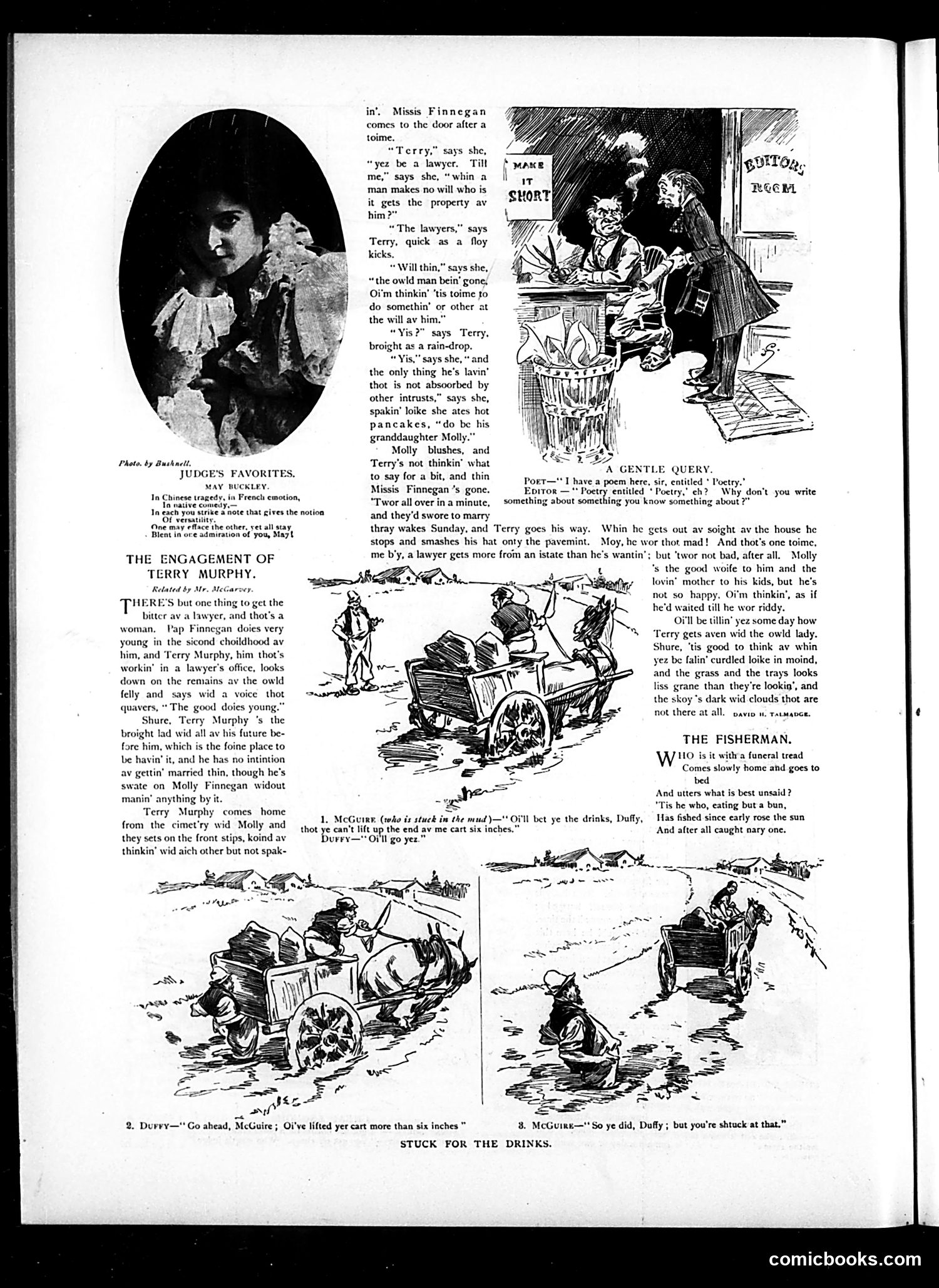
This page contains three distinct pieces: 1. **"Judge's Favorites: May Buckley"** - A photograph and laudatory poem about an actress, standard fan-promotion content. 2. **"The Engagement of Terry Murphy"** - A story about a working-class Irish laborer (Terry) engaged to Molly Finnegan. The narrative satirizes his rough behavior and lack of refinement through dialect humor, depicting him as an uncouth suitor unsuitable for marriage—typical Irish-immigrant stereotype humor common to the era. 3. **"The Fisherman" and "Stuck for the Drinks"** - Comic verses accompanying illustrations of rural/working-class characters in awkward situations, using slapstick and wordplay for humor. The page reflects Judge's typical formula: celebrity coverage mixed with working-class character satire relying on ethnic stereotypes and dialect comedy for humor.
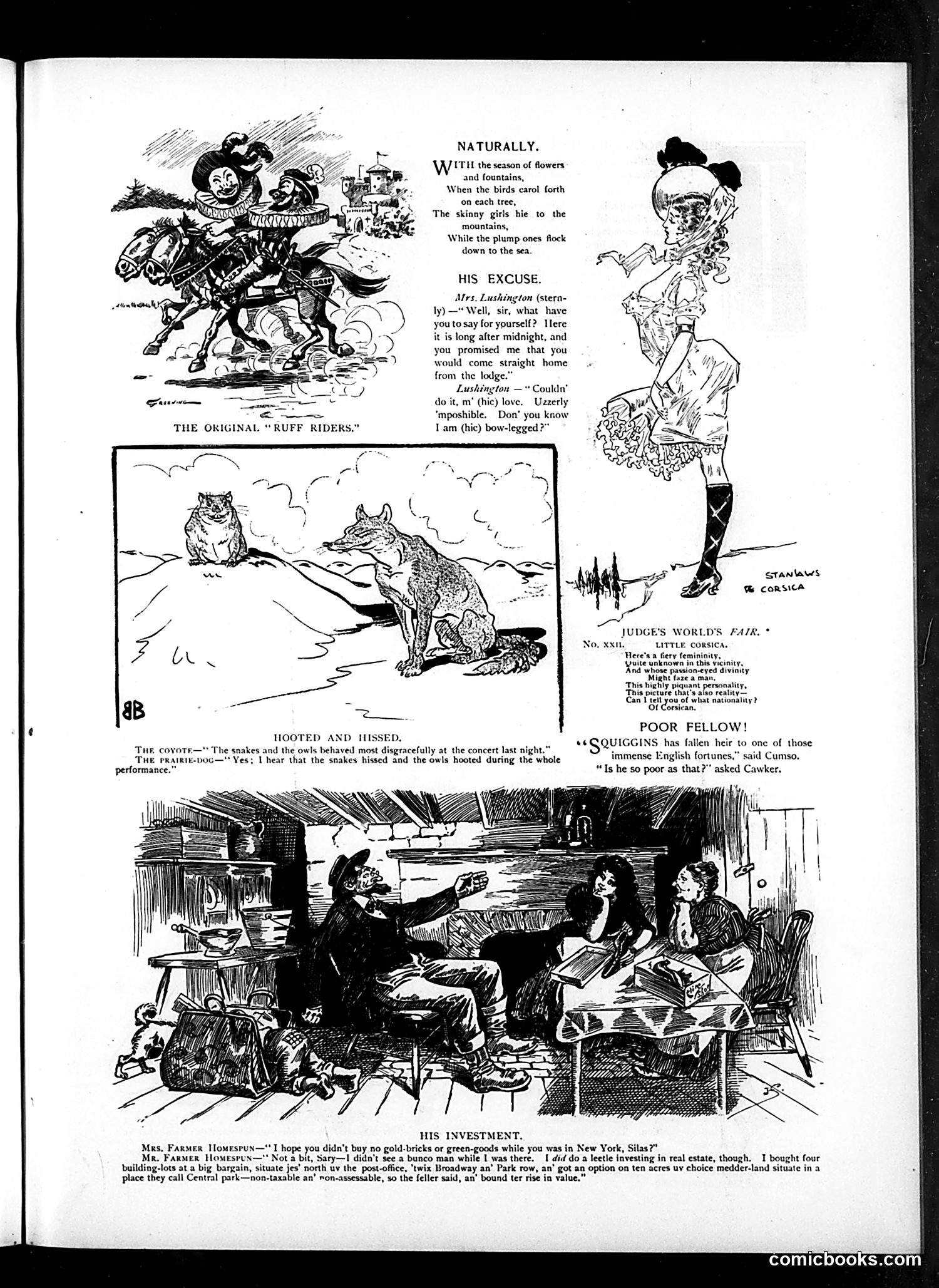
This page contains several satirical sketches mocking social pretensions and gullibility: **"His Excuse"** ridicules a drunk husband's transparent lie—blaming his lateness on being "bow-legged"—to his suspicious wife, Mrs. Lushington. **"His Investment"** satirizes rural naiveté. A farmer boasts of buying Manhattan real estate ("building-lots" near Broadway and Park Row) plus "ten acres" in Central Park, which he's been assured are "non-taxable" and "non-assessable." The joke: he's been swindled. Central Park cannot be privately owned or developed—he's bought worthless claims, a classic con on gullible newcomers to the city. **"Judge's World's Fair"** appears to be a beauty commentary on a Corsican woman. The minor sketches ("Naturally," "Hooted and Hissed," "Poor Fellow") offer light social observations about seasonal behavior and fortune. The overall theme: urban con artists exploiting rural innocence and marital deception.
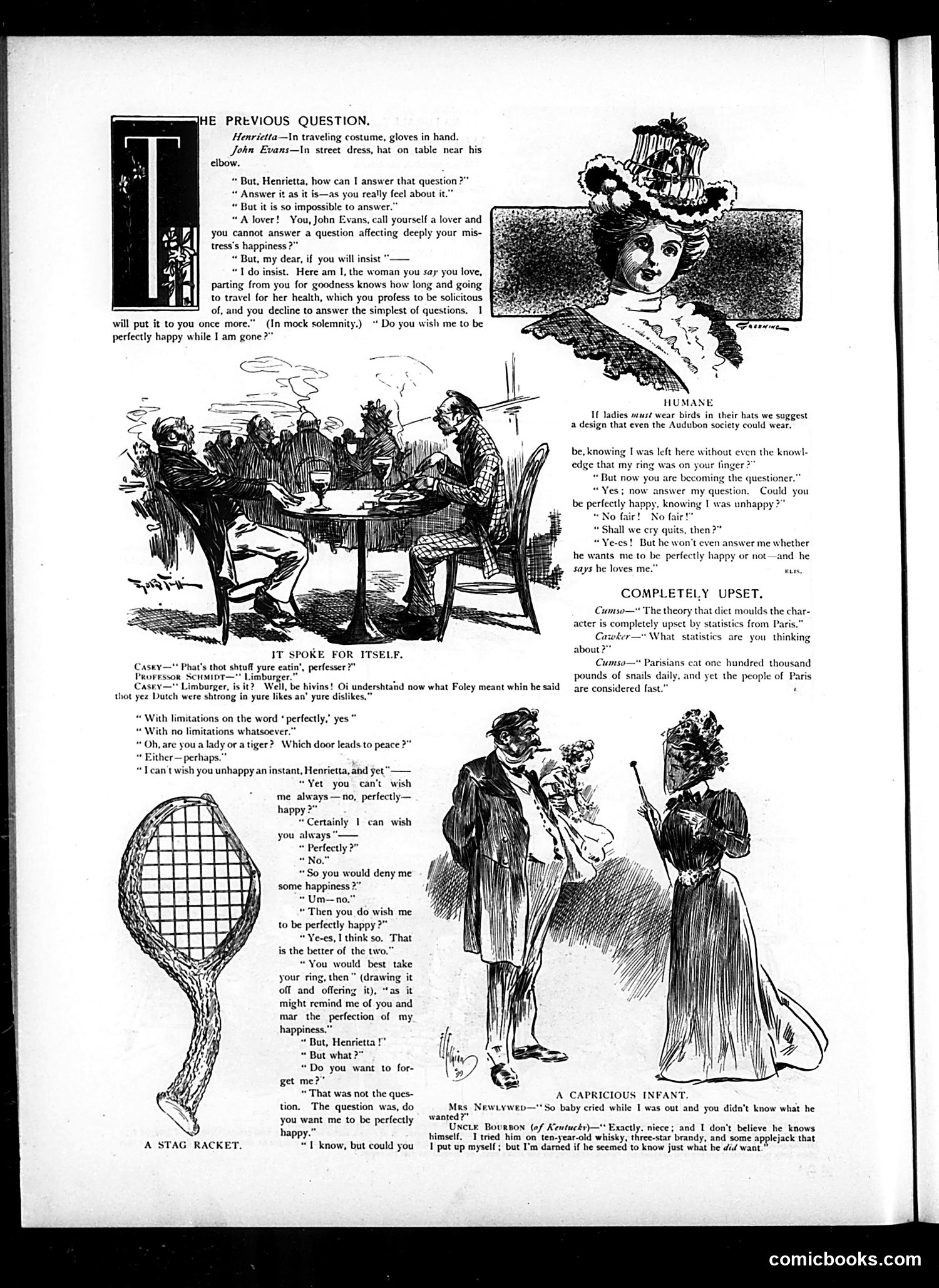
This page contains several unrelated satirical sketches typical of Judge magazine's humor: **"The Previous Question"** (top): A couple's domestic dispute where John Evans cannot simply answer whether he wants his departing fiancée Henrietta to be "perfectly happy." His logical evasions—he can wish her happiness but not "perfectly"—parody how men dodge emotional commitments through semantic arguments. The satire targets masculine emotional avoidance in courtship. **"Humane"** (right): Mocks the contradiction between ladies' fashion (wearing dead birds in hats) and animal-welfare advocates like the Audubon Society, who supposedly oppose bird killing. **"It Spoke for Itself"** & **"Completely Upset"** (bottom left): Irish immigrant humor (Casey character) about Limburger cheese's smell, and a Paris diet-versus-morality joke suggesting Parisians eat poorly yet claim virtue. **"A Capricious Infant"** (bottom right): Uncle Bourbon tries whiskey and brandy to soothe a crying baby—crude humor about Southern stereotypes and reckless child-rearing. The page reflects early 20th-century Judge sensibilities: romantic satire, xenophobic humor, and casualness about harm.
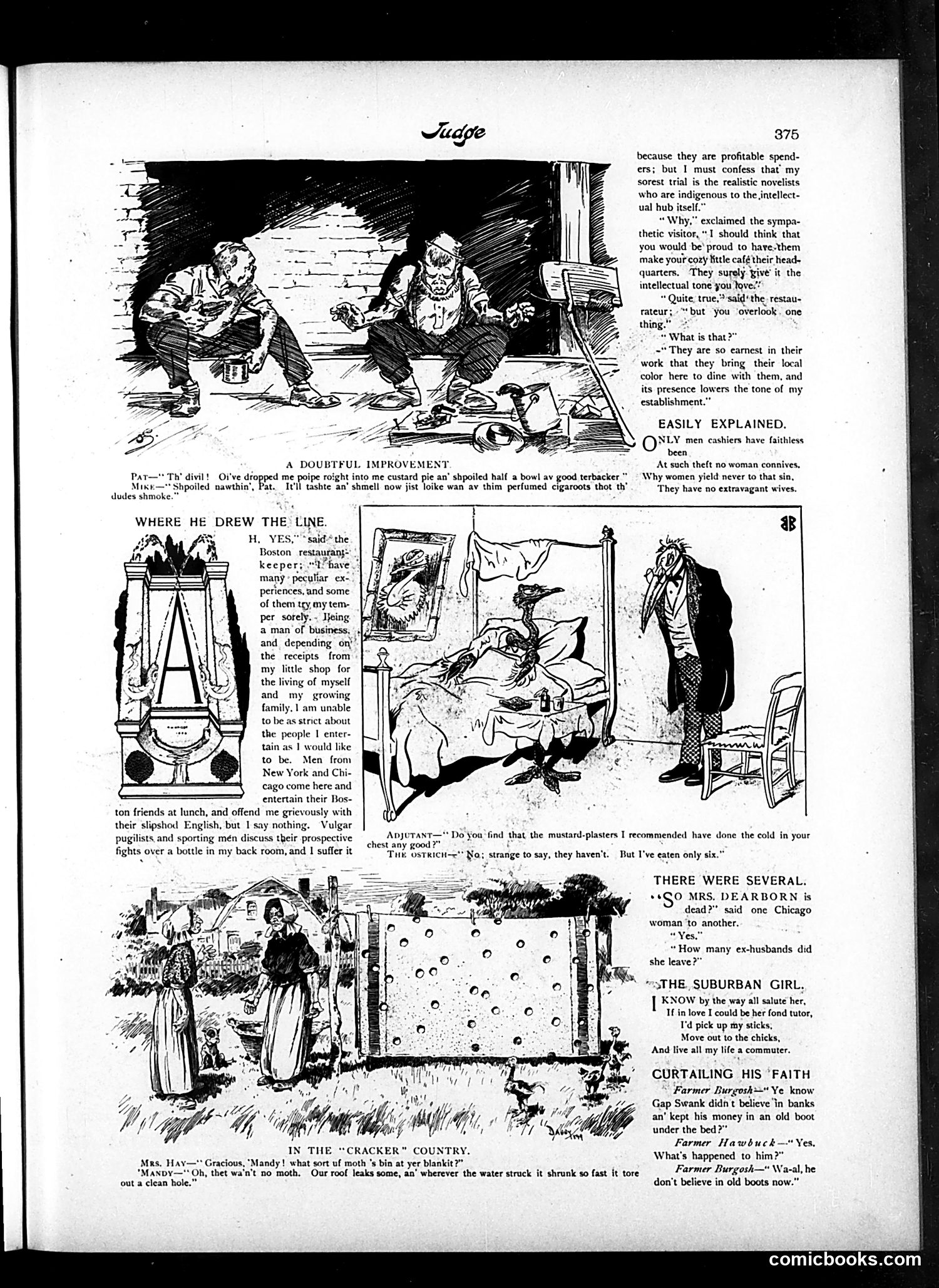
This page contains multiple unrelated satirical comic strips typical of Judge's format. **"A Doubtful Improvement"**: An Irishman (Pat) complains that his pipe fell into his custard pie, but notes the accident makes the dish taste like the perfumed cigars wealthy men smoke—a joke about class pretension and smoking fads. **"Where He Drew the Line"**: A Boston restaurant keeper tolerates rude New York/Chicago businessmen and vulgar prizefighters, but draws the line at something unstated—satirizing class anxiety and selective tolerance among establishments catering to mixed clientele. **"Easily Explained"**: A brief joke asserting male cashiers are unfaithful thieves while women never are—because women have "extravagant wives" (husbands) to steal from anyway. Dark humor about gender and marital finances. **Other strips** cover suburban romance, farming superstitions, and regional dialect humor. The page reflects turn-of-century American social anxieties: class mobility, immigration, gender roles, and rural-urban differences. Most humor relies on ethnic stereotypes and now-dated assumptions about morality.
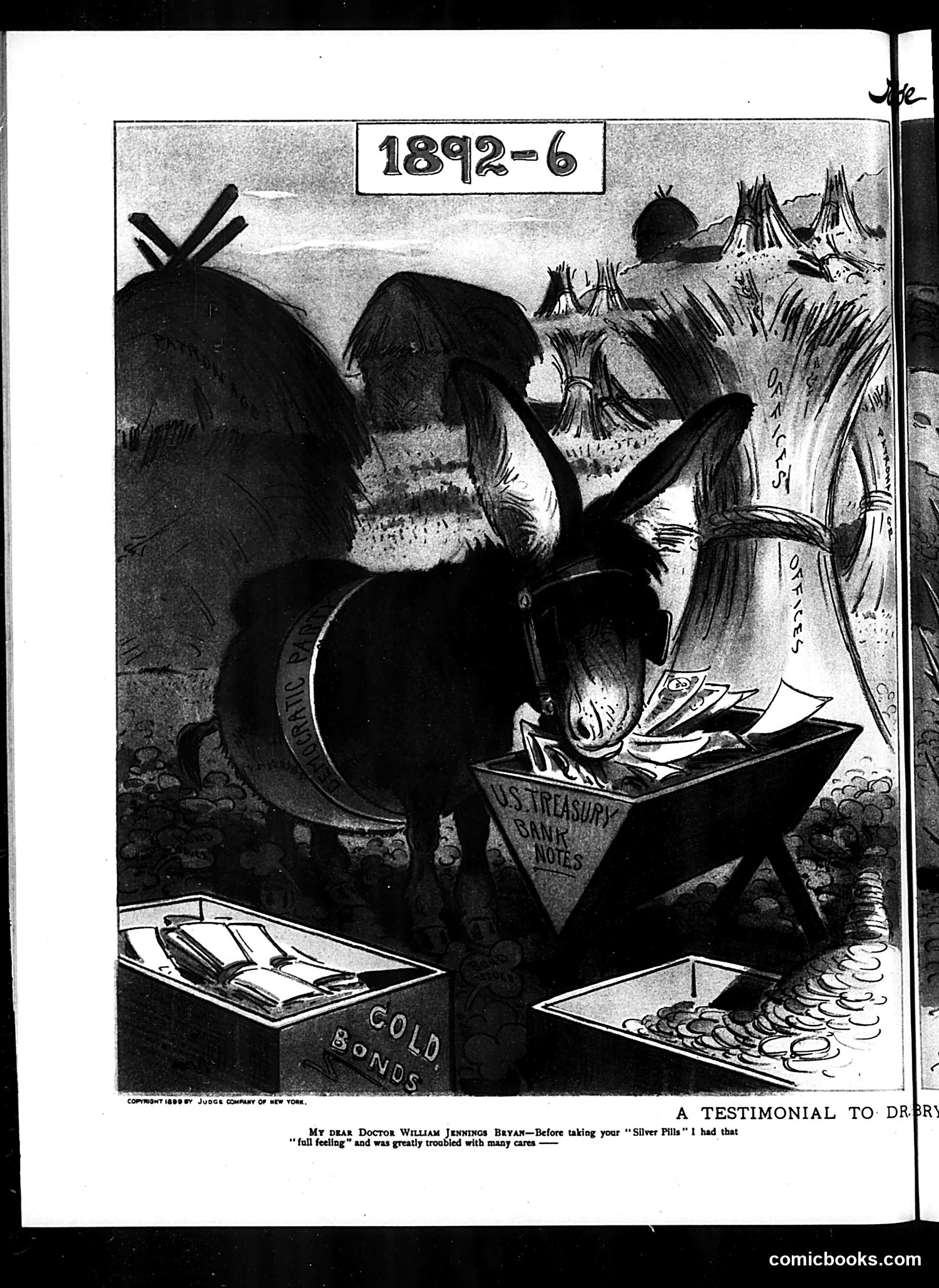
This is a satirical attack on William Jennings Bryan, the Democratic politician famous for championing "free silver" during the 1890s. The cartoon depicts Bryan as a charlatan doctor hawking "Silver Pills" to cure America's economic "fall feeling" and troubles. The imagery shows a donkey (traditional symbol for Democrats) as the gullible patient, while skeletal figures in the background represent the devastating economic consequences Bryan's silver policies would supposedly cause. Treasury bonds and gold bonds are scattered about, emphasizing the financial disaster the cartoonist warns against. The satire mocks Bryan's "free silver" platform as snake-oil medicine—false promises of economic relief that would actually harm the nation's financial stability. Judge magazine, being Republican-leaning, frequently attacked Bryan's monetary proposals.
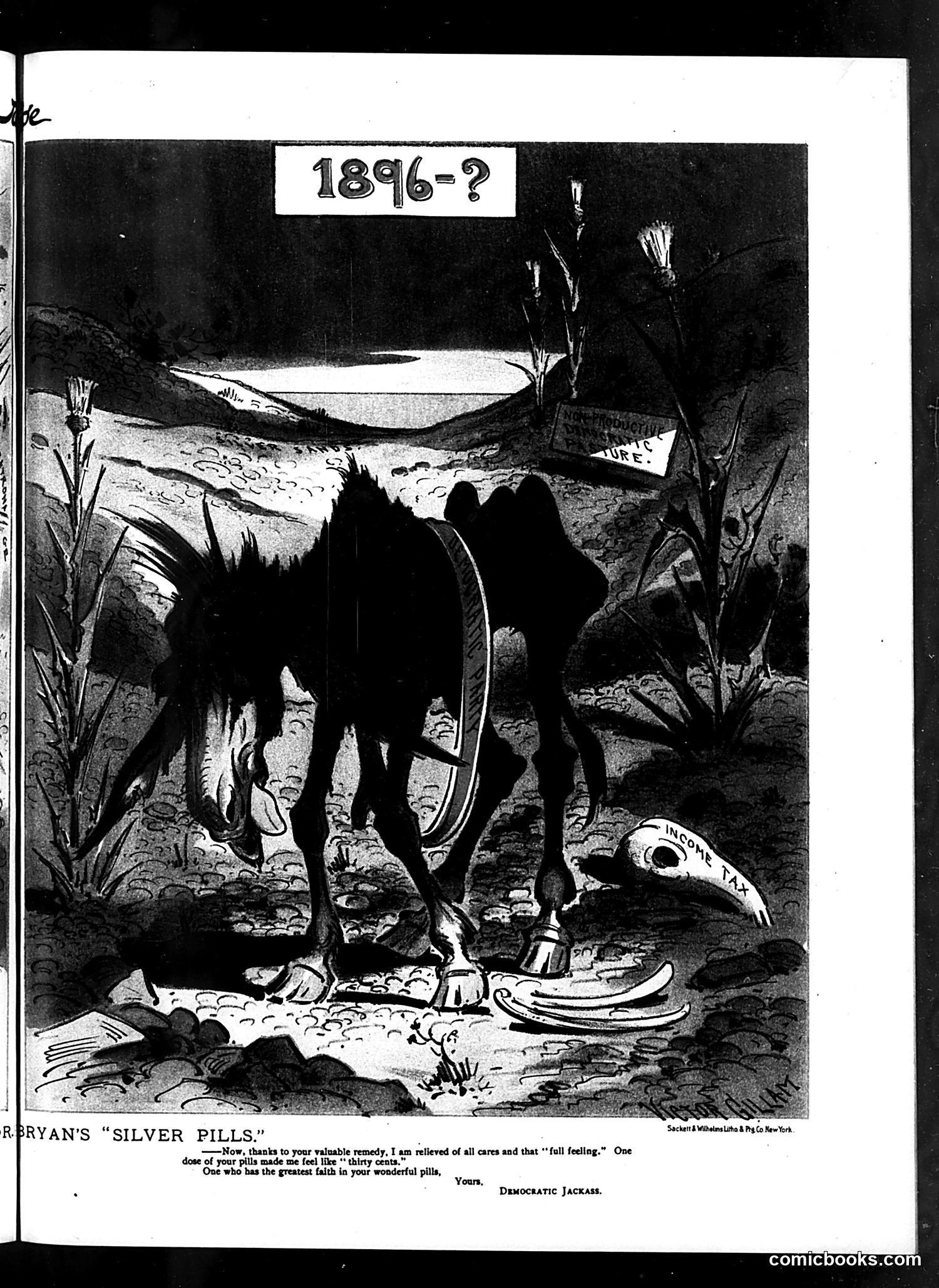
This is a satirical attack on William Jennings Bryan, the 1896 Democratic presidential candidate who championed "free silver"—unlimited coinage of silver as currency. The cartoon depicts a donkey (traditional symbol of the Democratic Party) as a sick patient taking Bryan's "silver pills" as a cure-all remedy. The joke: Bryan's silver platform is presented as worthless medicine. The donkey claims the pills made him feel like "thirty cents"—a pun suggesting the policy devalues currency and the party itself. The signature "Democratic Jackass" reinforces the mockery. The cartoonist ridicules Bryan's supporters as gullible voters buying into false economic promises. The barren landscape suggests economic devastation rather than the prosperity silver advocates promised.
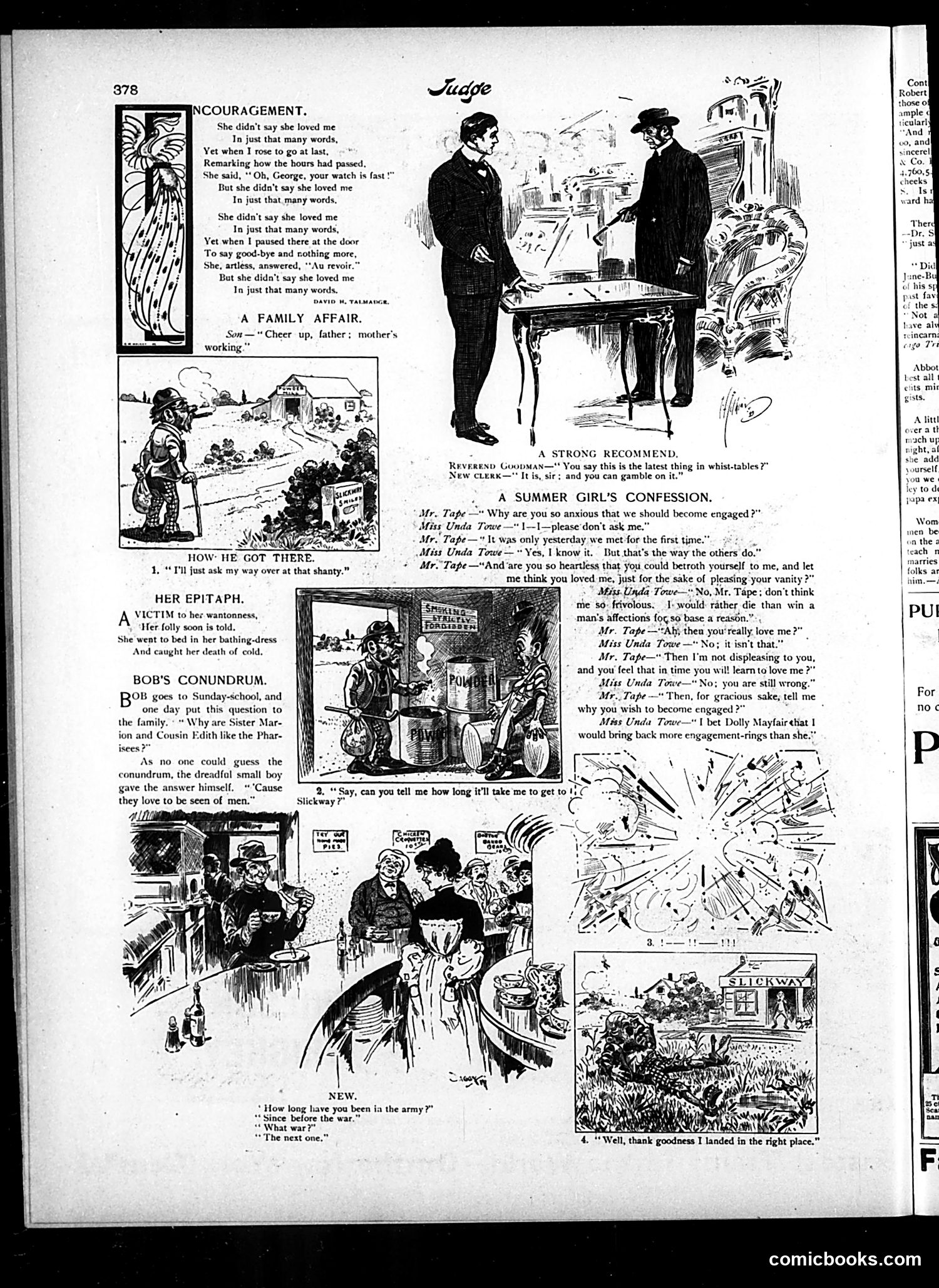
This page contains humorous short pieces typical of early 20th-century American satirical magazines: **"Encouragement"** mocks romantic miscommunication—a man interprets polite gestures (a woman checking his watch, saying "au revoir") as signs of affection when she's merely being courteous. **"A Family Affair"** presents dark humor about economic hardship: a son tells his unemployed father to "cheer up" because "mother's working"—suggesting the mother has taken employment out of necessity, inverting traditional gender roles. **"A Summer Girl's Confession"** satirizes female vanity and social competition. A woman admits she's engaged merely to outdo her rival Dolly Mayfair in collecting engagement rings—a critique of superficial courtship customs. Other pieces include light domestic humor and wordplay typical of Judge's style. The cartoons are gentle social satire targeting courtship customs, gender roles, and vanity among the leisure classes—concerns of Judge's middle-class readership.
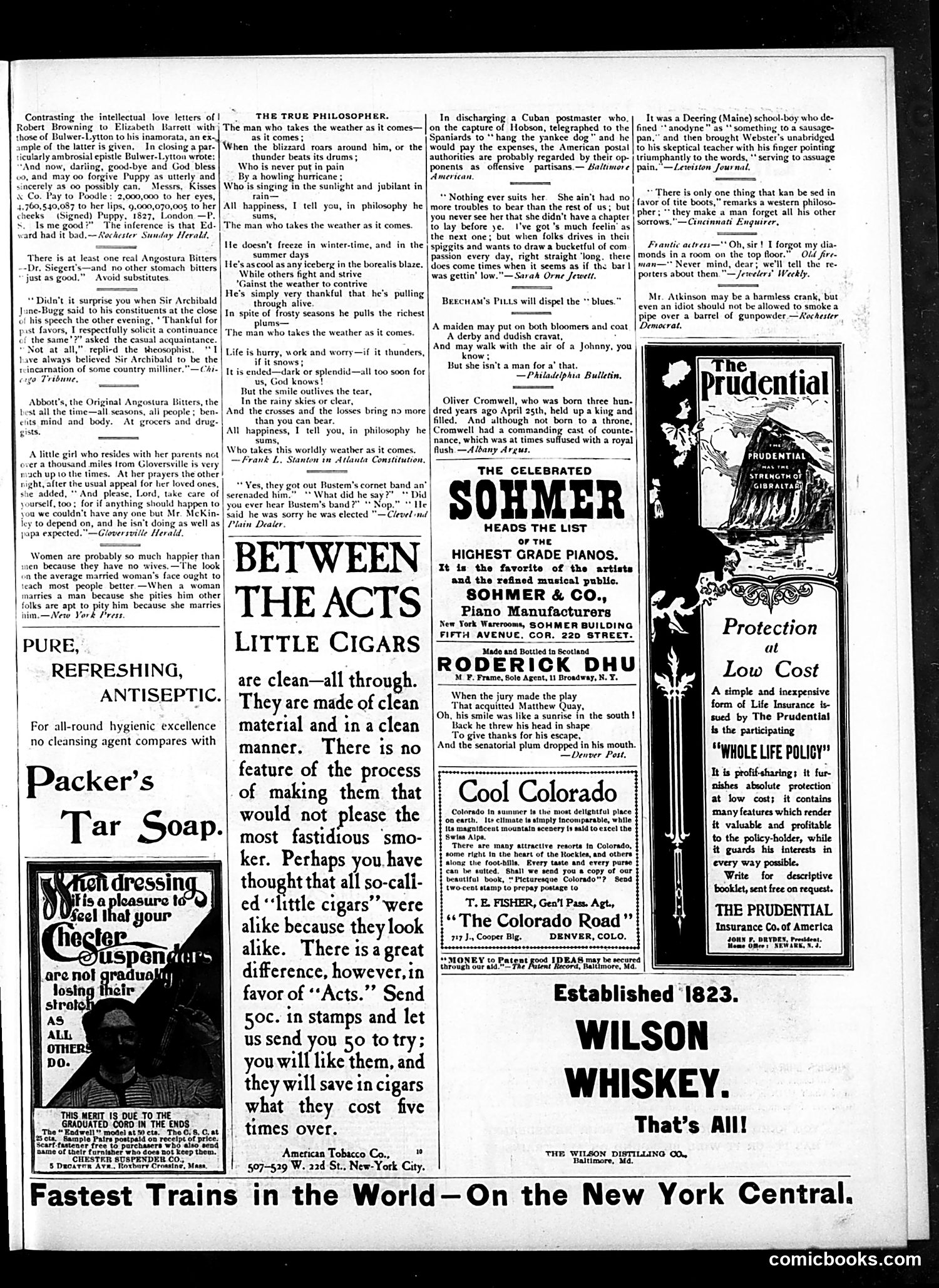
This page is primarily **advertising and light humor** rather than political satire. The content consists of: **Humorous Anecdotes:** - A joke about romantic letters from famous writers (Browning vs. Bulwer-Lytton) - A child's prayer mentioning President McKinley - Observations about married women's happiness - A politician's speech joke about reincarnation **Advertisements:** The page features prominent ads for consumer products: Angostura Bitters, Packer's Tar Soap, Chester Suspenders, Between the Acts Little Cigars, Sohmer Pianos, Prudential Life Insurance, and Wilson Whiskey. **Context:** This appears to be a typical Judge magazine page from the 1890s-1900s era, mixing brief satirical commentary (often mocking politicians, society figures, and daily life) with revenue-generating advertisements. The McKinley reference dates this likely to his presidency (1897-1901). The tone is genteel humor rather than sharp political critique.
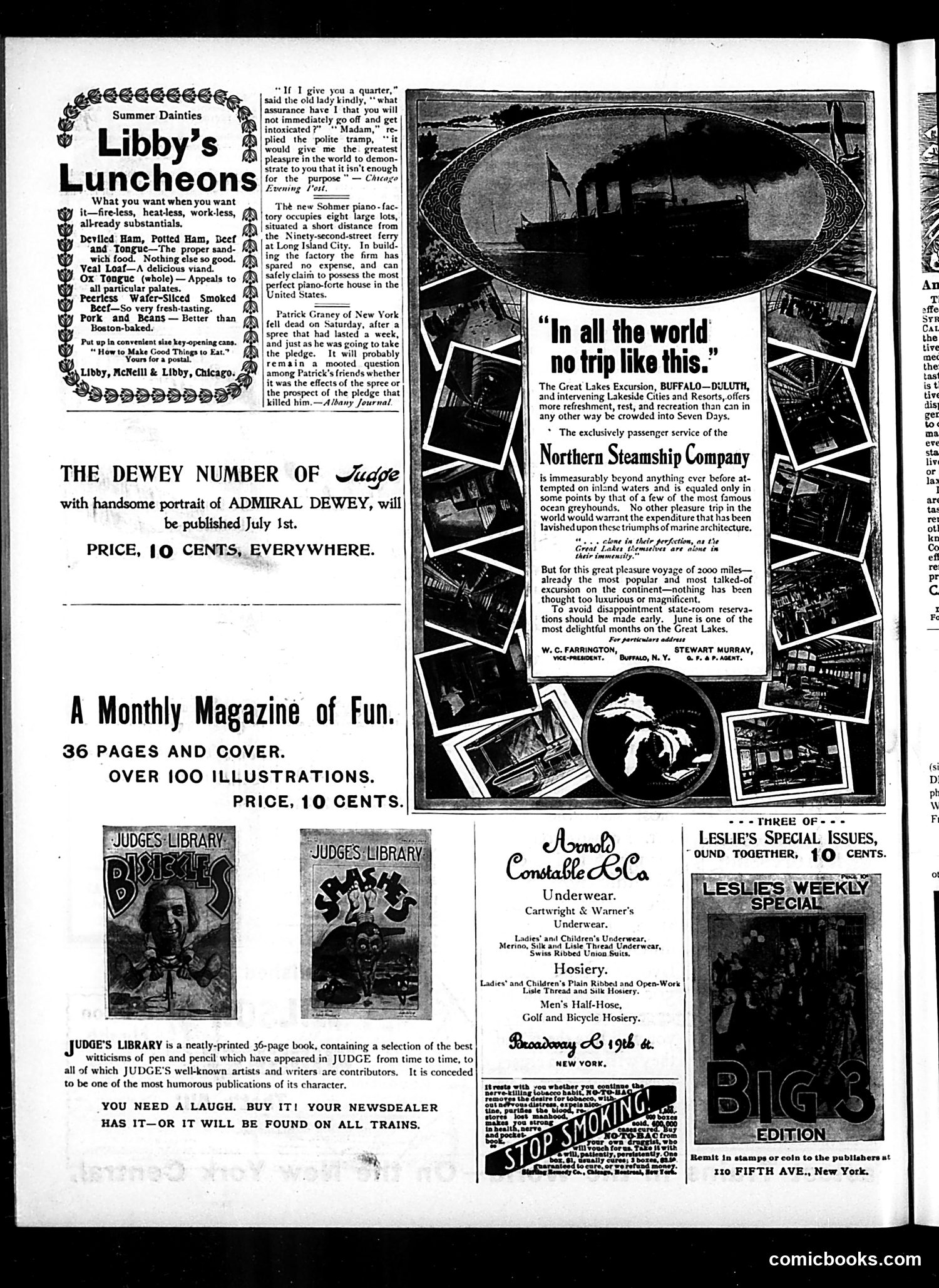
This is primarily an **advertising page** from Judge magazine, circa 1898-1899 (based on the Admiral Dewey reference to the Spanish-American War victory). The page contains two brief satirical anecdotes alongside product advertisements: 1. **The tramp joke**: An old lady offers a quarter to a beggar, asking what guarantee she has he won't spend it on alcohol. The tramp replies he'd be "delighted" to demonstrate the quarter isn't enough for intoxication—a dark joke about poverty and alcoholism. 2. **Patrick Graney anecdote**: A man dies after a week-long drinking spree, just as he planned to take the temperance pledge. The joke mocks the irony of his timing, questioning whether the spree or the prospect of sobriety killed him—satirizing both alcoholism and failed reform efforts. The remaining content is straightforward advertising: Libby's canned foods, Northern Steamship Company lake cruises, Judge Library books, and clothing/hosiery products. Nothing overtly political appears on this page.
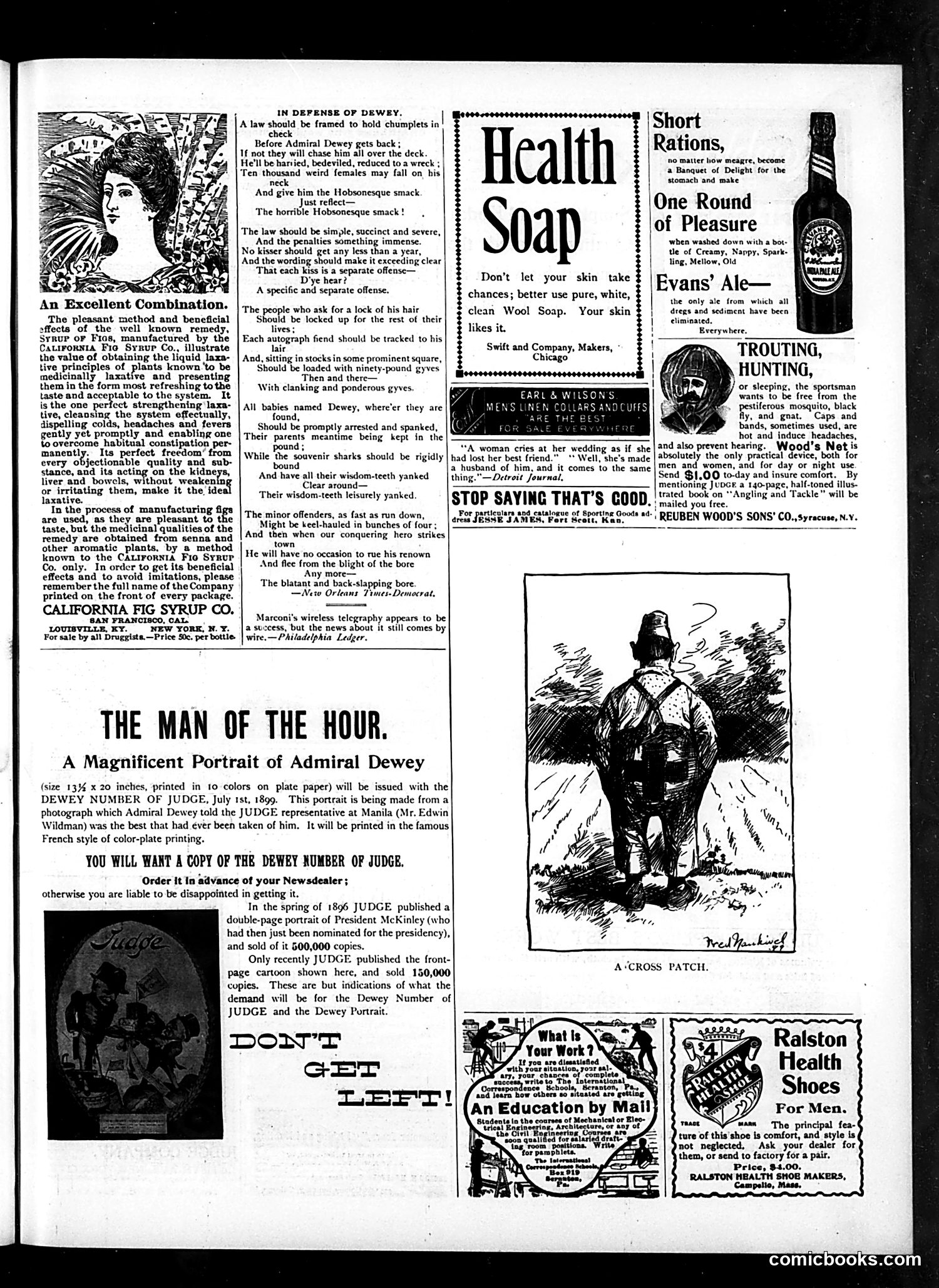
This poem satirizes the excessive public enthusiasm anticipated for Admiral George Dewey's return to America following his naval victory in the Spanish-American War (Manila Bay, 1898). The satire proposes absurdly harsh laws to protect Dewey from well-meaning but annoying admirers: fans wanting locks of hair, autograph seekers, people naming babies after him, and "souvenir sharks." The humor escalates from mere imprisonment to stocks, ninety-pound chains, and keel-hauling for minor offenses. The poem mocks both the public's obsessive hero-worship and Dewey's anticipated discomfort with it. References to "Hobsonesque" behavior allude to Richmond Hobson, another Spanish-American War hero mobbed by admirers. The piece appeared amid genuine concern that Dewey's homecoming would trigger scenes of mass hysteria—which it actually did in 1899.
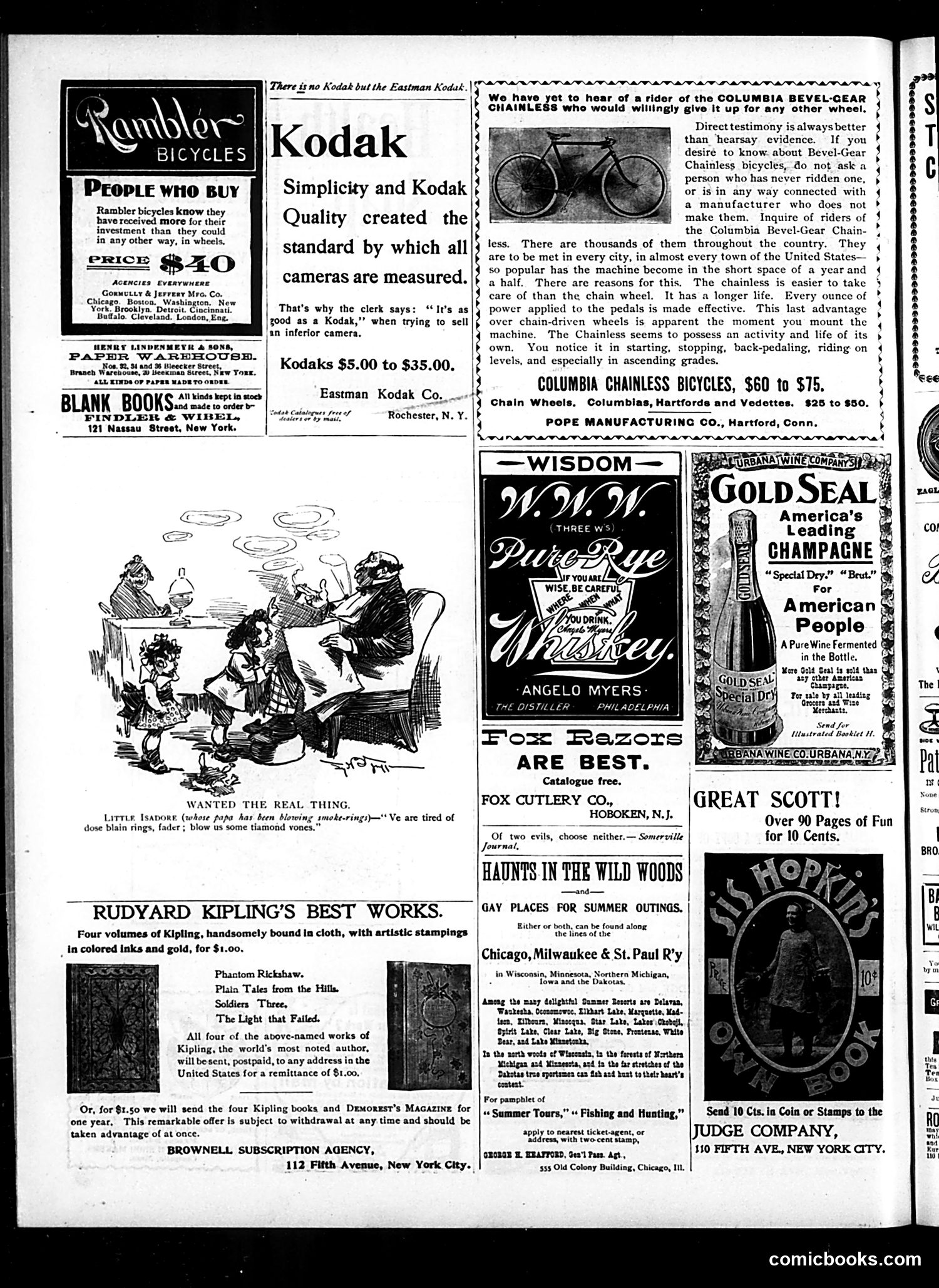
This page is primarily **advertising**, not political satire. It contains multiple product endorsements typical of early 1900s magazines: **Main Content:** - Kodak cameras and Rambler bicycles promote themselves as industry standards - Columbia chainless bicycles are positioned as superior to chain-driven models - Various luxury goods (razors, whiskey, champagne, books) fill remaining space **The One Cartoon:** At bottom left, titled "Wanted the Real Thing," shows a child (Little Isadore) asking his father to stop blowing smoke rings and instead blow "diamond vones" (diamond rings). This is a humorous domestic scene about a child's materialistic desires—a gentle satire on consumer culture and children's wish-lists rather than political commentary. **Historical Context:** The ads reflect Gilded Age consumer culture, with emphasis on product quality and testimonials. The bicycle ads are notable: chainless bicycles were a significant innovation of the 1890s, and manufacturers competed vigorously for market share. No major political figures or events are referenced. This is essentially a commercial publication.
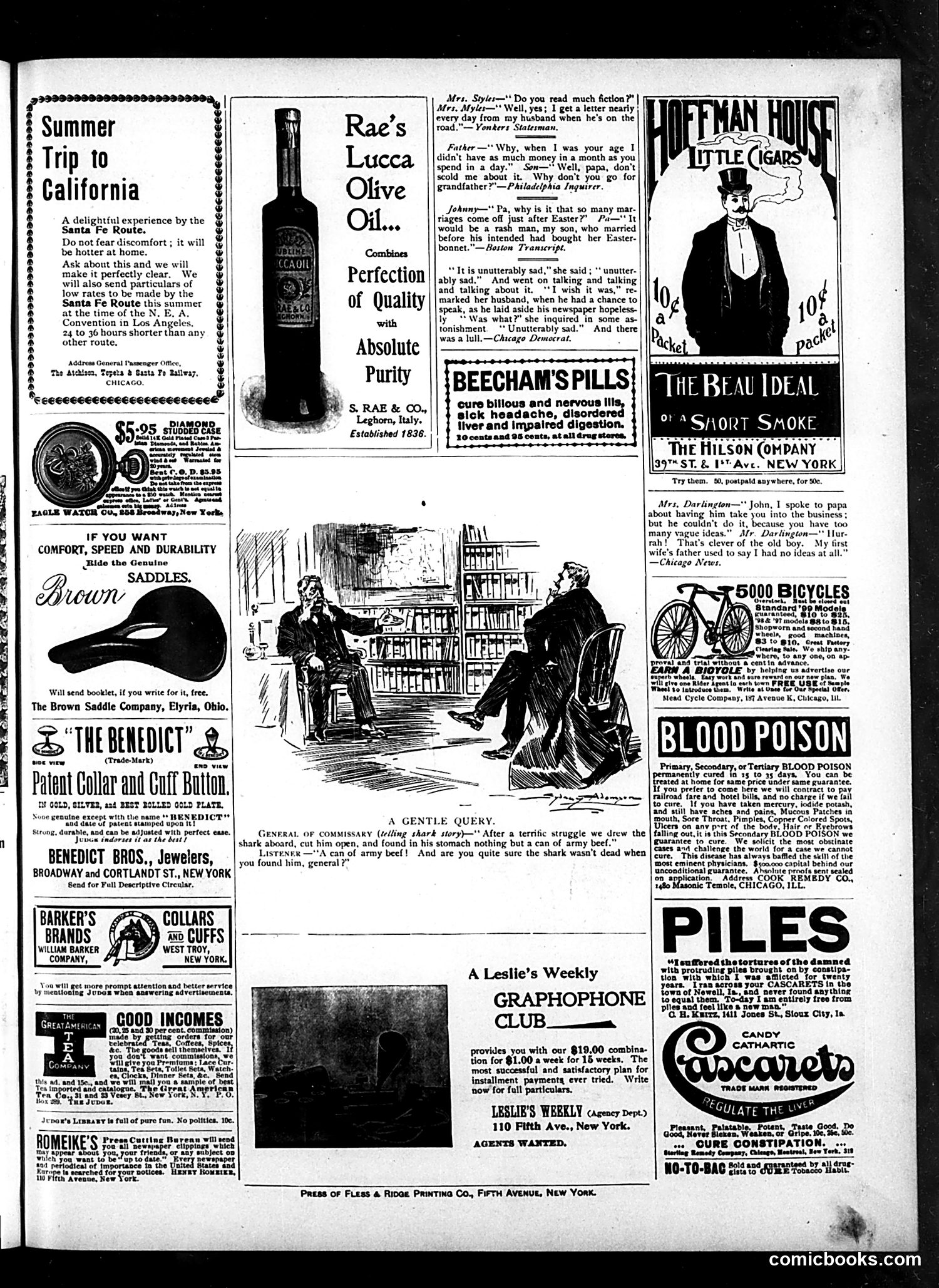
This page consists primarily of **period advertisements** rather than editorial cartoons. The main satirical content is a single cartoon titled "A Gentle Query," depicting two military officers discussing a shark supposedly found with canned army beef in its stomach. The joke appears to mock the dubious quality or credibility of military provisions—the implication being that even a dead shark wouldn't plausibly contain such a thing, casting doubt on the officer's tall tale. The remainder of the page features **filler jokes and ads** typical of early 1900s magazines: quips about marriage timing around Easter, a husband avoiding his wife's reading habits, and various product advertisements (olive oil, saddles, collars, pills, gramophones). These jokes reflect period concerns with matrimony, domestic life, and consumer goods, but lack specific political satire or historical references requiring context.
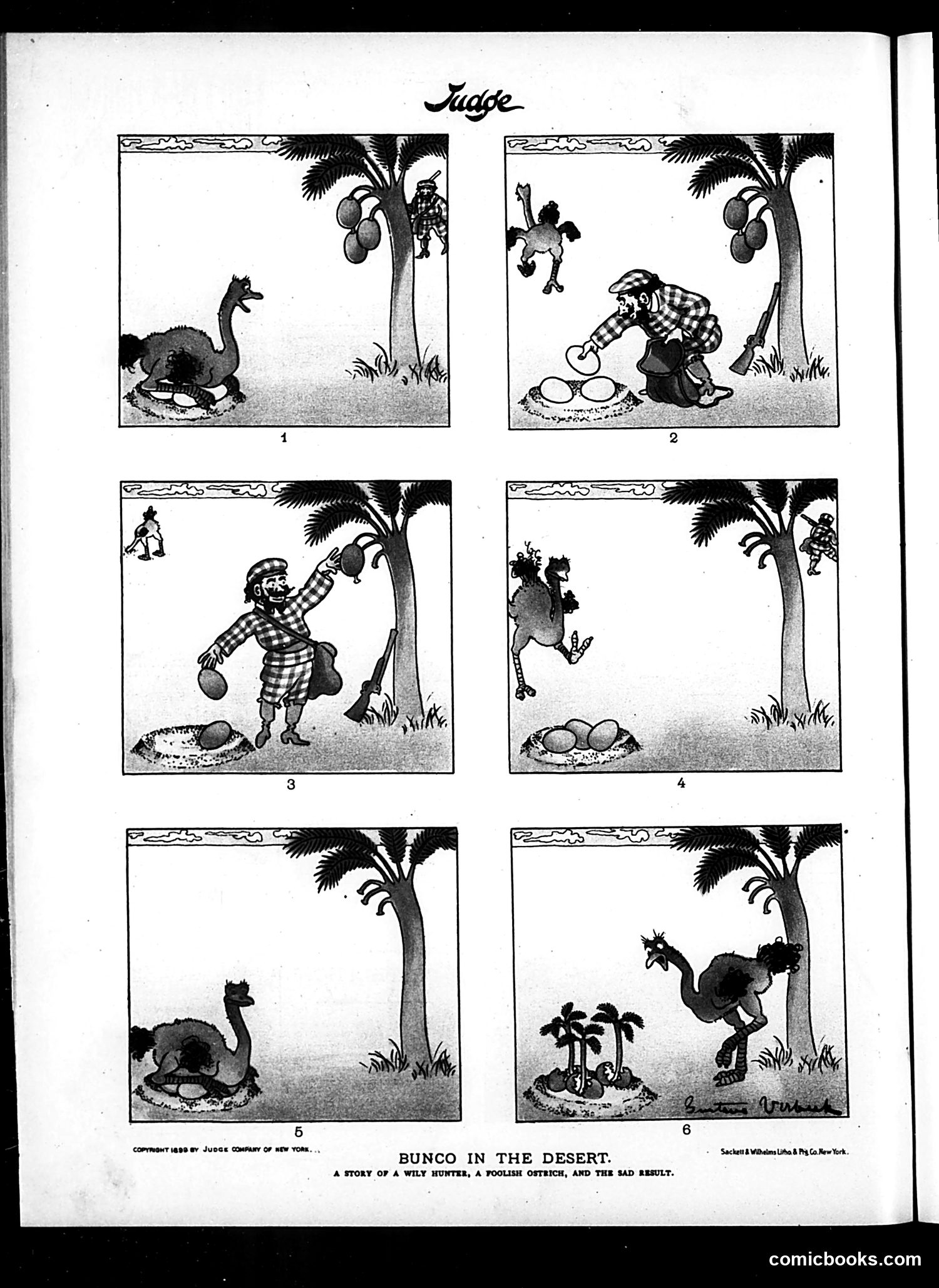
This is a six-panel comic strip titled "Bunco in the Desert" depicting a con artist's scheme involving an ostrich and a hunter. The narrative shows: a hunter encounters an ostrich (panel 1); the hunter sets a trap with eggs (panel 2); he attempts to catch the bird (panel 3); the ostrich escapes with the eggs (panel 4); the hunter pursues but is kicked by the ostrich (panel 5); finally, the ostrich triumphs while the defeated hunter lies wounded (panel 6). The humor relies on slapstick and role-reversal—the "wily hunter" becomes the foolish victim, outwitted by the ostrich. "Bunco" refers to a con game, suggesting the ostrich deliberately deceived the hunter. This appears to be straightforward comedic entertainment rather than political satire, typical of Judge magazine's humor content from 1890.