
Judge, 1899-06-17 · page 10 of 16
Judge — June 17, 1899 — page 10: what you’re looking at
What you’re looking at
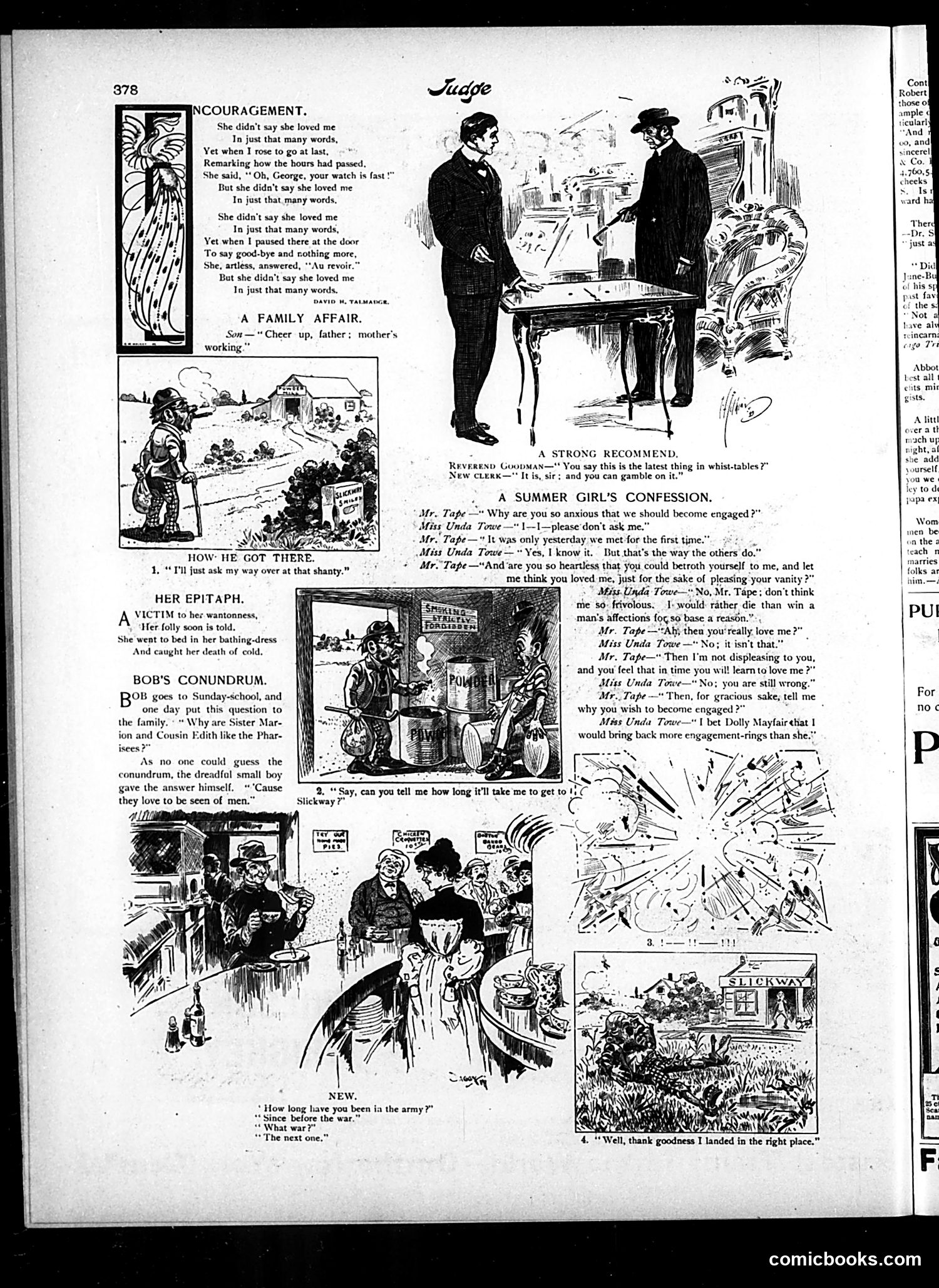
This page contains humorous short pieces typical of early 20th-century American satirical magazines: **"Encouragement"** mocks romantic miscommunication—a man interprets polite gestures (a woman checking his watch, saying "au revoir") as signs of affection when she's merely being courteous. **"A Family Affair"** presents dark humor about economic hardship: a son tells his unemployed father to "cheer up" because "mother's working"—suggesting the mother has taken employment out of necessity, inverting traditional gender roles. **"A Summer Girl's Confession"** satirizes female vanity and social competition. A woman admits she's engaged merely to outdo her rival Dolly Mayfair in collecting engagement rings—a critique of superficial courtship customs. Other pieces include light domestic humor and wordplay typical of Judge's style. The cartoons are gentle social satire targeting courtship customs, gender roles, and vanity among the leisure classes—concerns of Judge's middle-class readership.
📄 Transcribed text from this page (OCR, searchable)
Machine-transcribed from the original scan — historical spelling and the odd misread are preserved.
INCOURAGEMENT. She didn’t say she loved me In just that many words, Yet when I rose to go at last, Remarking how the hours had passed, She said, “Ob, George, your watch is fast !” But she didn’t say she loved me In just that many words, She didn’t say she loved me In just that many words, Yet when I paused there at the door To say good-bye and nothing more, She, artless, answered, “*Au revoir.” But she didn’t say she loved me In just that many words. A FAMILY AFFAIR. ‘ : sam | tans ae cage Tri Son—“ Cheer up, father; mother's working.” Abbot “st all its mit sts. A littl 3 RECOMMED You say this is the latest thing in whist-tables ?" New cierk—" It is, sir; and you can gamble on it.” A SUMMER GIRL’S CONFESSION. Mr. Tape —* Why are you so anxious that we should become engaged ?” g Miss Unda Towe —" \—1—please'don't ask me.” : : mA Mr.’ Tape—"*\t was only yesterday we met-for the first time.” . er pr Haase Miss Unda Towe ~~ Yes, | know it. But that’s the way the others do.” A Re aes So erates Mr. Tape —“And’are you so heartless that you could betroth yourself to me, and let : Y ny: me think you loved:me, just for the sake of pleasing your vanity?” $ = Tae Miss. Unda Towe—" No, Mr. Tape; don’t think . HER EPITAPH. ( = ‘ me 30: frivolous. I would: rather die than win a PUI A VICTIM to her wantonness, man’s affections for, so base a reasbn.” Her folly soon is told. Mr. Tape —*Aby then you' really. love me?” She went to bed in her bathing-dress ‘ Ee 3 Lge ~ Miss Unda Towe —' ; it isn’t that.” - And caught her death of cold. Ip Mr. Tape—*Then I'm not displeasing to you, folks ar him. Mane) ib : : and you feel that in time you wil! learn to love me BOB'S CONUNDRUM. y AN : f Mi OB goes to Sunday-school, and one day put this question to the family. « * Why are Sister Mar- jon and Cousin Edith like the Phar- isees? As no one could guess the conundrum, the dreadfal small boy gave the answer himself. "Cause they love to be seen of men.” * How long have you been ia the army?” “Since before the war.” “* What war?” ** The next one,” Miss Unda Towe— you are still wrong.” ‘Mr. Tape —* Then, for gracious sake, tell me why you wish to become engaged 2” Miss Unda Towe— 1 bet Dolly Mayfair etiat 1 would bring back more engagement-rings than she.”” “Well, thank goodness I landed in the right place.” comicbooks.com