
A complete issue · 16 pages · 1899
Judge — May 27, 1899
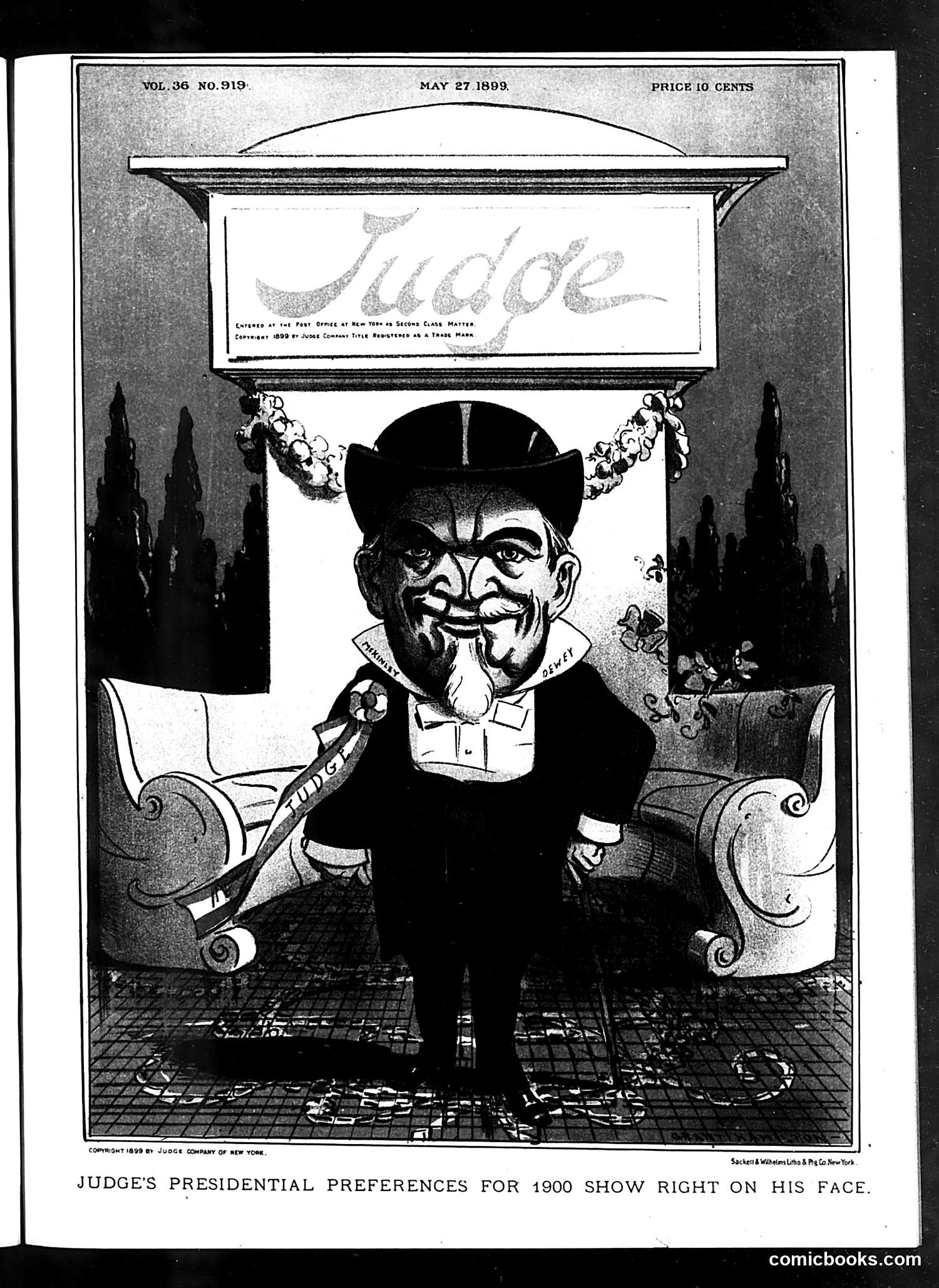
**Date & Publication:** May 27, 1899, Judge Magazine (Vol. 36, No. 919), 10 cents **The Cartoon:** The cover depicts a demonic or devilish figure in formal attire (tuxedo, bow tie) seated in an ornate chair beneath a portrait labeled "Judge." The character has exaggerated facial features including a pointed goatee and menacing expression. Cypress trees flank the scene, and grape vines drape from above. **The Satire:** The caption states "JUDGE'S PRESIDENTIAL PREFERENCES FOR 1900 SHOW RIGHT ON HIS FACE." This is satirizing the 1900 presidential election. The demonic characterization suggests Judge magazine's editors are mocking someone's candidacy or the political situation itself—likely criticizing a particular candidate or party as devilish or corrupt, though the specific target isn't entirely clear without additional context about 1900 election debates.
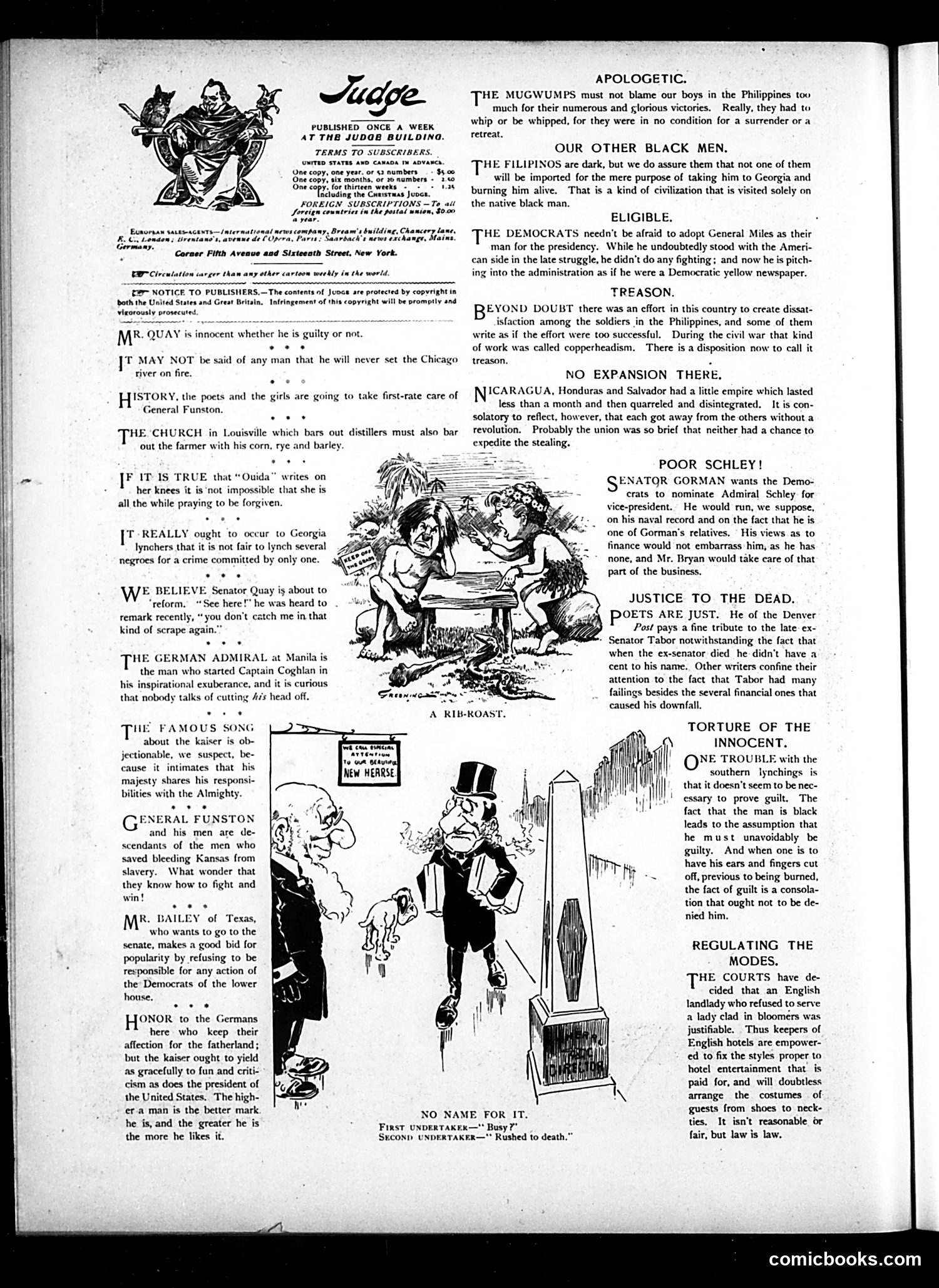
This page contains political commentary and satirical pieces from the post-Spanish-American War period (likely early 1900s), focusing on Philippine colonial issues and American politics. **Main cartoons:** - "A Rubdown" depicts figures in a bathhouse scene, likely satirizing political dealings or negotiations - "No Name for It" shows well-dressed men with a guillotine, referencing French Revolution imagery to comment on violent solutions to political problems **Text sections attack:** - Military conduct in the Philippines ("Mugwumps" and "black men" references) - Democratic politicians, including General Miles and Senator Gorman - Lynching and racial violence ("Torture of the Innocent") - English fashion standards The overall tone is aggressively partisan Republican, defending American imperial expansion while sarcastically criticizing Democratic opposition and racial violence domestically.
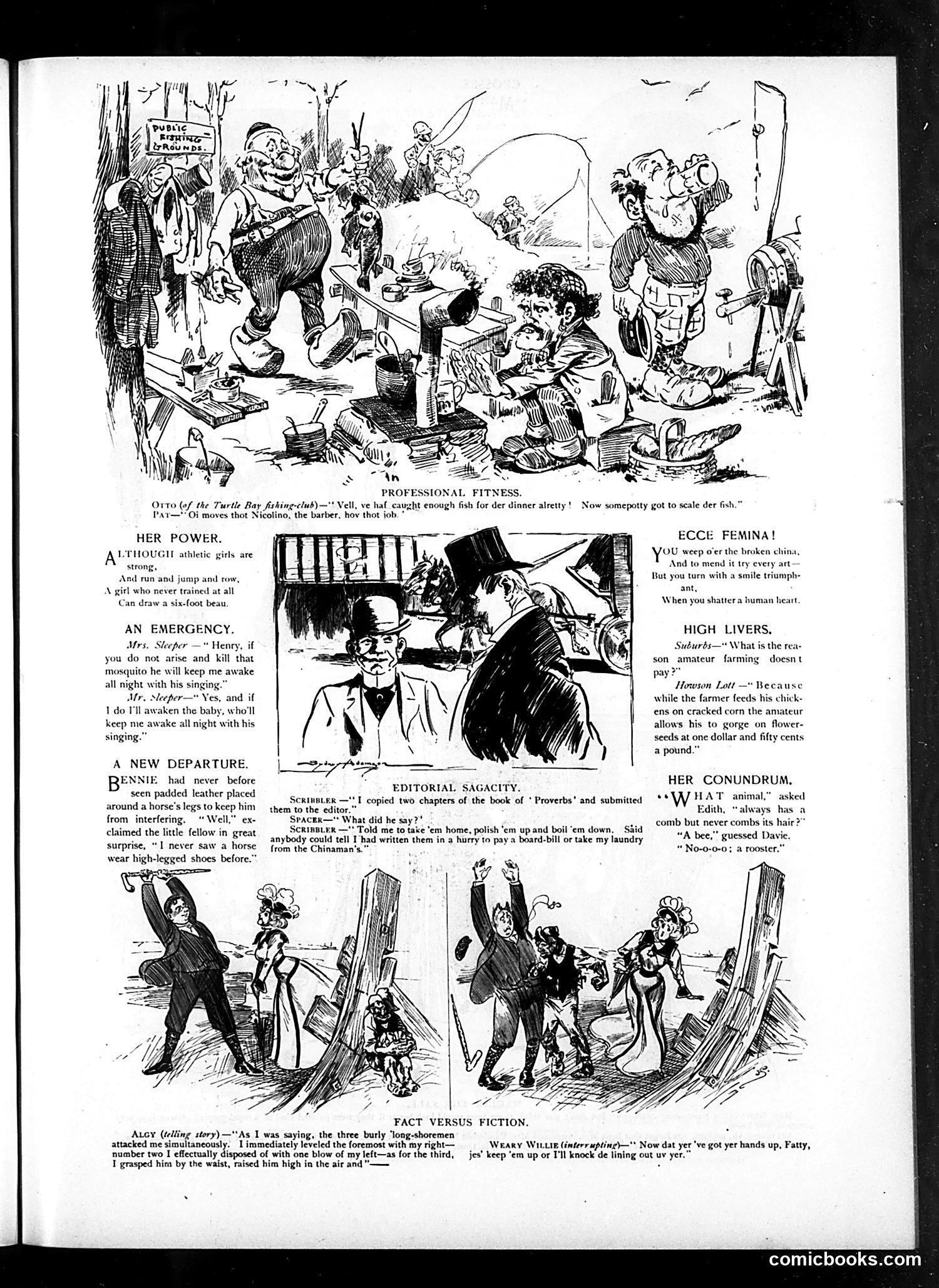
This page contains several satirical pieces typical of Judge's humor: **"Professional Fitness"** (top): A fishing scene satirizing women's suffrage and gender roles—mocking the notion that women lack physical capability, shown through exaggerated caricatures of women fishing incompetently. **"Her Power," "An Emergency," "A New Departure"**: Brief humorous anecdotes about domestic life and gender dynamics, poking fun at women's behavior and relationships. **"Editorial Sagacity"** and **"Fact Versus Fiction"**: Comic exchanges satirizing journalistic practices and the gap between reality and newspaper reporting. **"High Livers," "Her Conundrum,"** etc.: Witty one-liners and joke sections common to Judge's format. The overall tone reflects turn-of-the-century American attitudes—mocking women's capabilities, domestic comedies, and contemporary social pretensions. The artwork employs exaggerated facial features typical of period caricature.
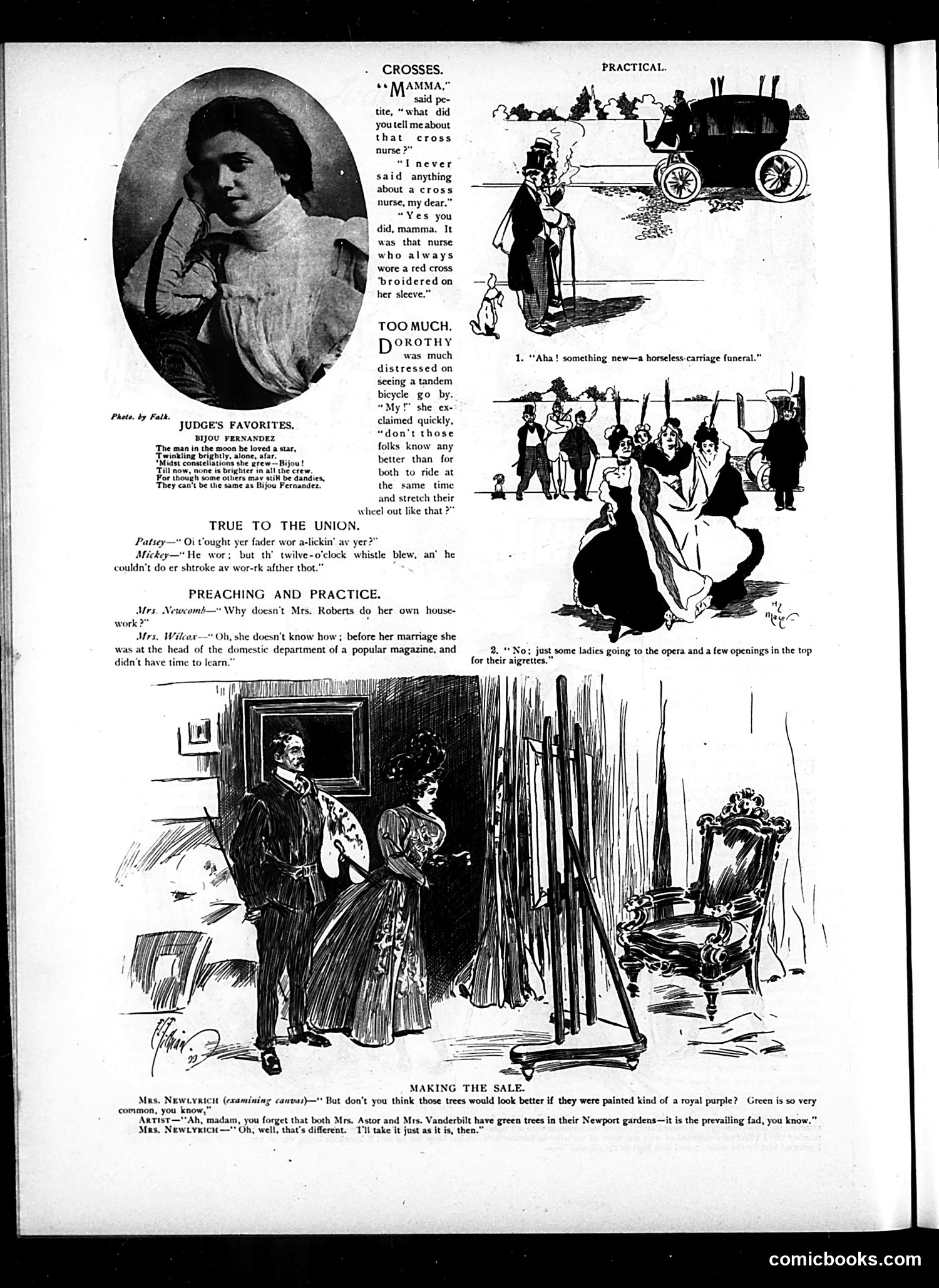
This page contains several disconnected satirical pieces typical of Judge magazine's format: **"Crosses"** mocks a conversation about a nurse wearing a red cross emblem—social commentary on healthcare workers. **"Too Much"** satirizes Dorothy's complaint about tandem bicycles being impractical for city riding, suggesting women's impracticality. **"True to the Union"** is a brief dialect joke about Civil War-era military service. **"Preaching and Practice"** mocks Mrs. Roberts, a magazine editor, for not doing housework despite preaching domesticity—critiquing hypocritical "New Woman" rhetoric. **"Making the Sale"** (bottom) shows Mrs. Newlylrich trying to convince an artist to paint trees "royal purple" instead of green, lampooning wealthy nouveau-riche women's gaudy taste and ignorance of aesthetics. The overall theme: satire of women's changing social roles and pretensions.
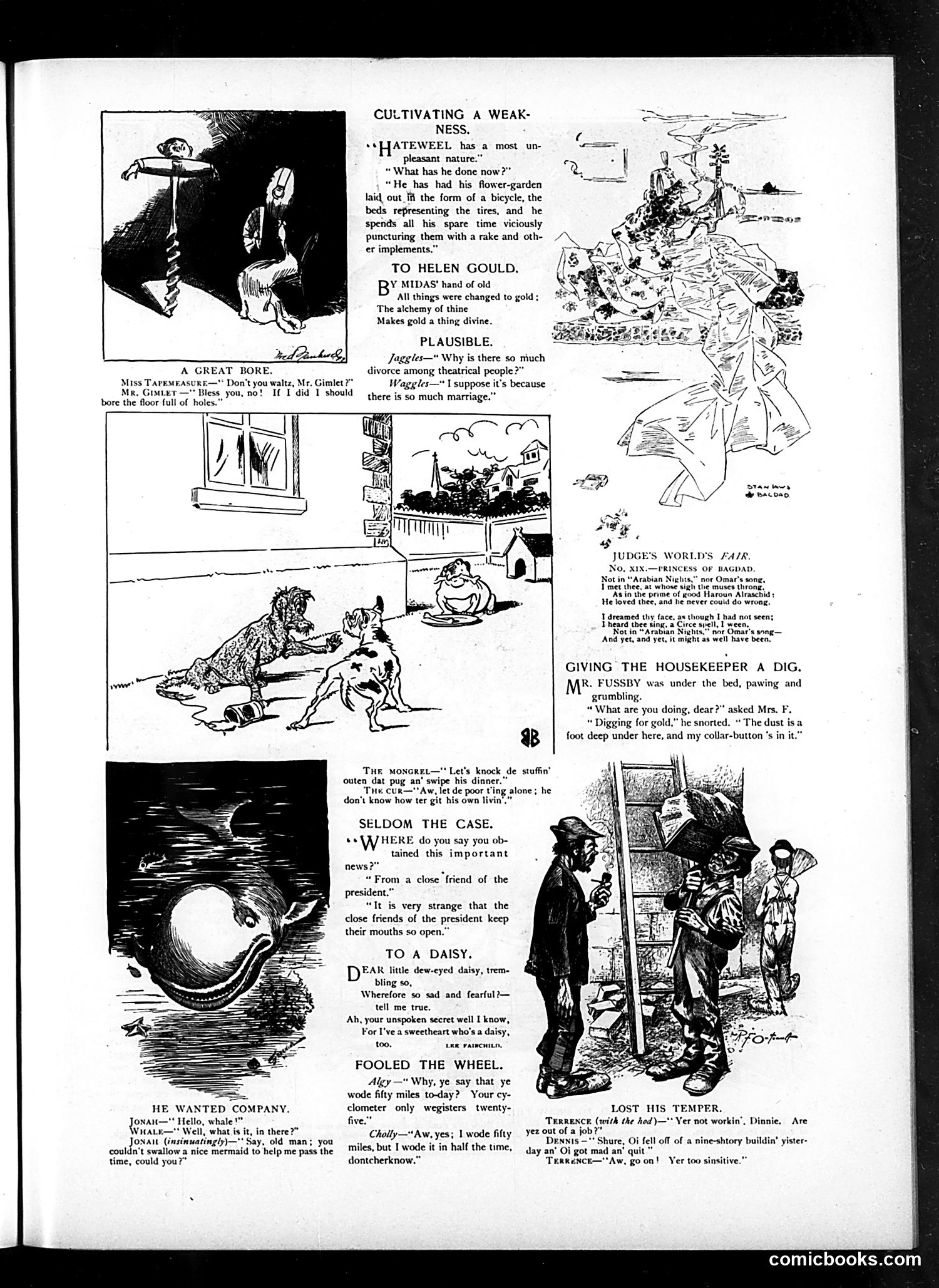
This page collects miscellaneous short jokes and satirical verses typical of Judge magazine's format. Key items: **"A Great Bore"**: Mocks the tediously boring Mr. Gimlet, who claims waltzing would bore holes in the floor—absurdist humor about an insufferable person. **"Cultivating a Weakness"**: Satirizes someone neurotically obsessed with puncturing his bicycle-bed flower garden, suggesting aristocratic ennui and idle fixation. **"Plausible"**: Social commentary on theatrical divorces—the joke being actors marry constantly, thus divorce frequently. Reflects period skepticism toward stage people's morality. **"Giving the Housekeeper a Dig"**: Domestic humor where a husband digs under the bed claiming to search for "gold" and lost collar-buttons, mocking male laziness and marital banter. **"Seldom the Case"**: Political satire suggesting the president's "close friends" gossip indiscreetly—commentary on political loose talk. The remaining items are light verse and brief anecdotes with no clear political meaning. Overall, the page emphasizes character satire and domestic/social observation rather than hard political commentary.
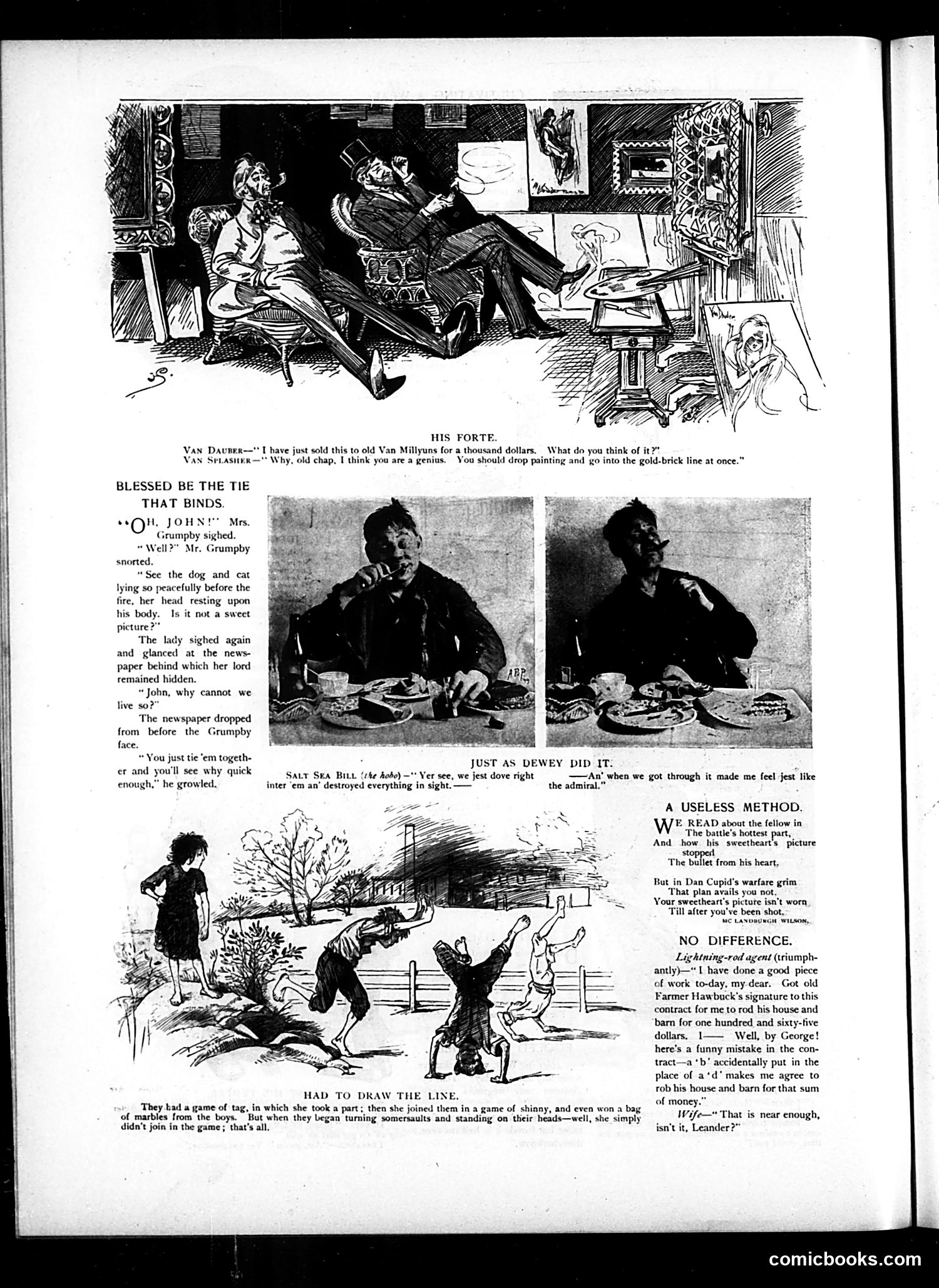
This page contains multiple satirical cartoons typical of early 20th-century American humor: **"His Forte"** mocks art dealers and fraudulent salesmanship. Van Daubner sells a questionable painting to a wealthy collector ("old Van Millyuns"), and his friend suggests he'd make more money in "gold-brick" schemes—con artist slang for selling worthless items as valuables. **"Blessed Be the Tie That Binds"** depicts marital discord. Mrs. Grumphy admires animals lying peacefully together and wishes her husband would behave similarly, but he's dismissive. The punchline suggests tying them together like animals—dark domestic humor. **"Just as Dewey Did It"** and **"A Useless Method"** reference Admiral Dewey (likely Spanish-American War fame), using wartime and romantic imagery for comedic effect. **"No Difference"** shows a lightning-rod salesman tricking a farmer into a contract—a typo changing 'd' to 'b' means the farmer agreed to *rob* instead of *rod* his property. **"Had to Draw the Line"** depicts a girl joining boys' games until they do somersaults and headstands—suggesting impropriety concerns about female modesty.
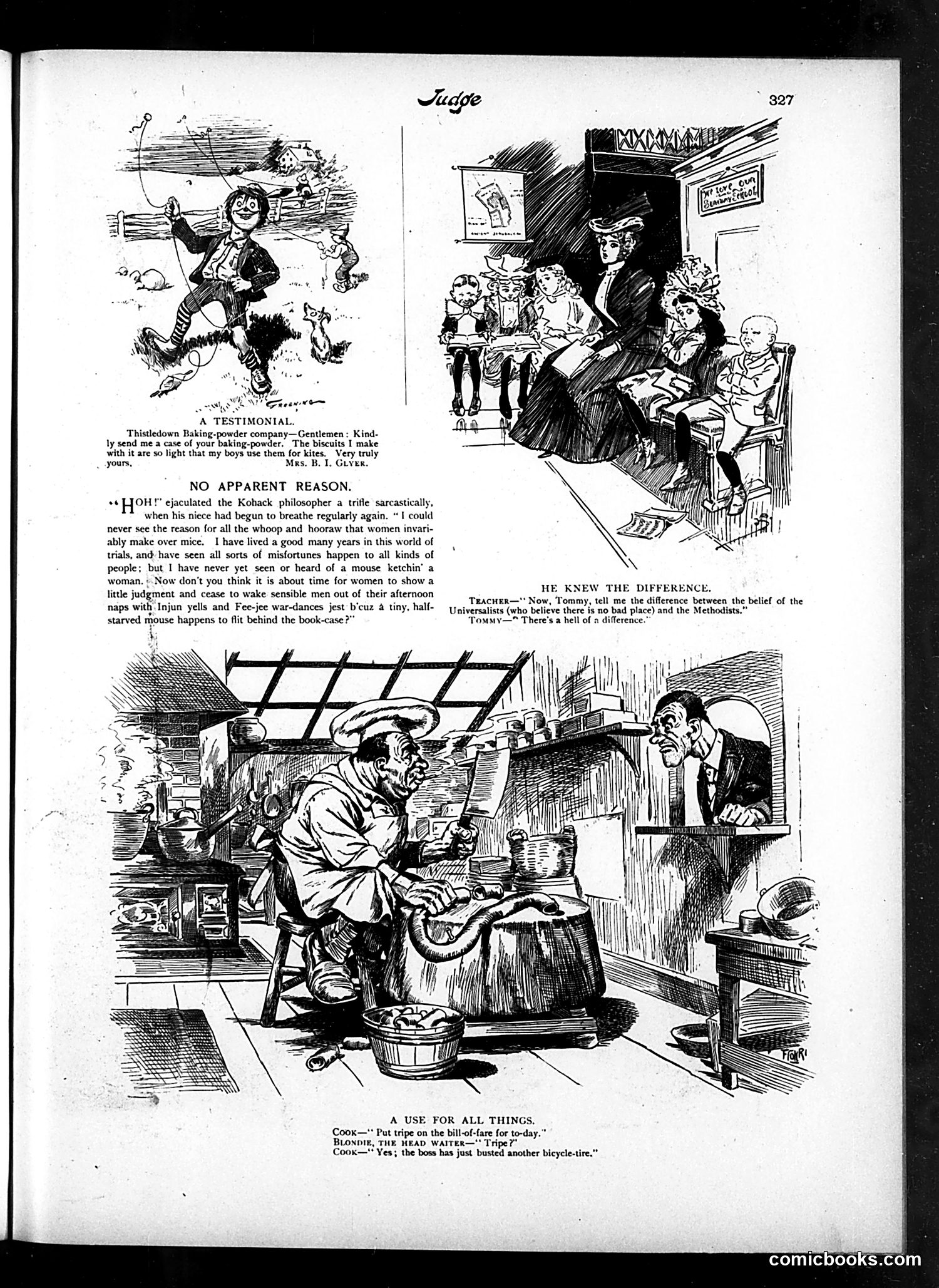
This page contains three separate humor pieces typical of late-19th/early-20th century satirical magazines: **"A Testimonial"** mocks exaggerated advertising claims—a woman credits baking powder for making biscuits so light her boys use them as kites. **"No Apparent Reason"** presents a curmudgeonly character (appears to be a stereotypical "Bohack philosopher") sarcastically questioning why women scream over mice, claiming he's never heard of mice attacking women. The joke satirizes both gender stereotypes and irrational fears. **"He Knew the Difference"** is a joke about theological terminology: a schoolboy explains the difference between Universalist and Methodist beliefs through wordplay about hell—implying Methodists believe in damnation while Universalists don't. **"A Use for All Things"** is a pun: the cook suggests using tripe (organ meat) on the menu because the boss just destroyed a bicycle tire, making "tripe" (also meaning nonsense) the appropriate daily special. These reflect common Judge humor: advertising satire, gender stereotypes, religious mockery, and simple wordplay puns.
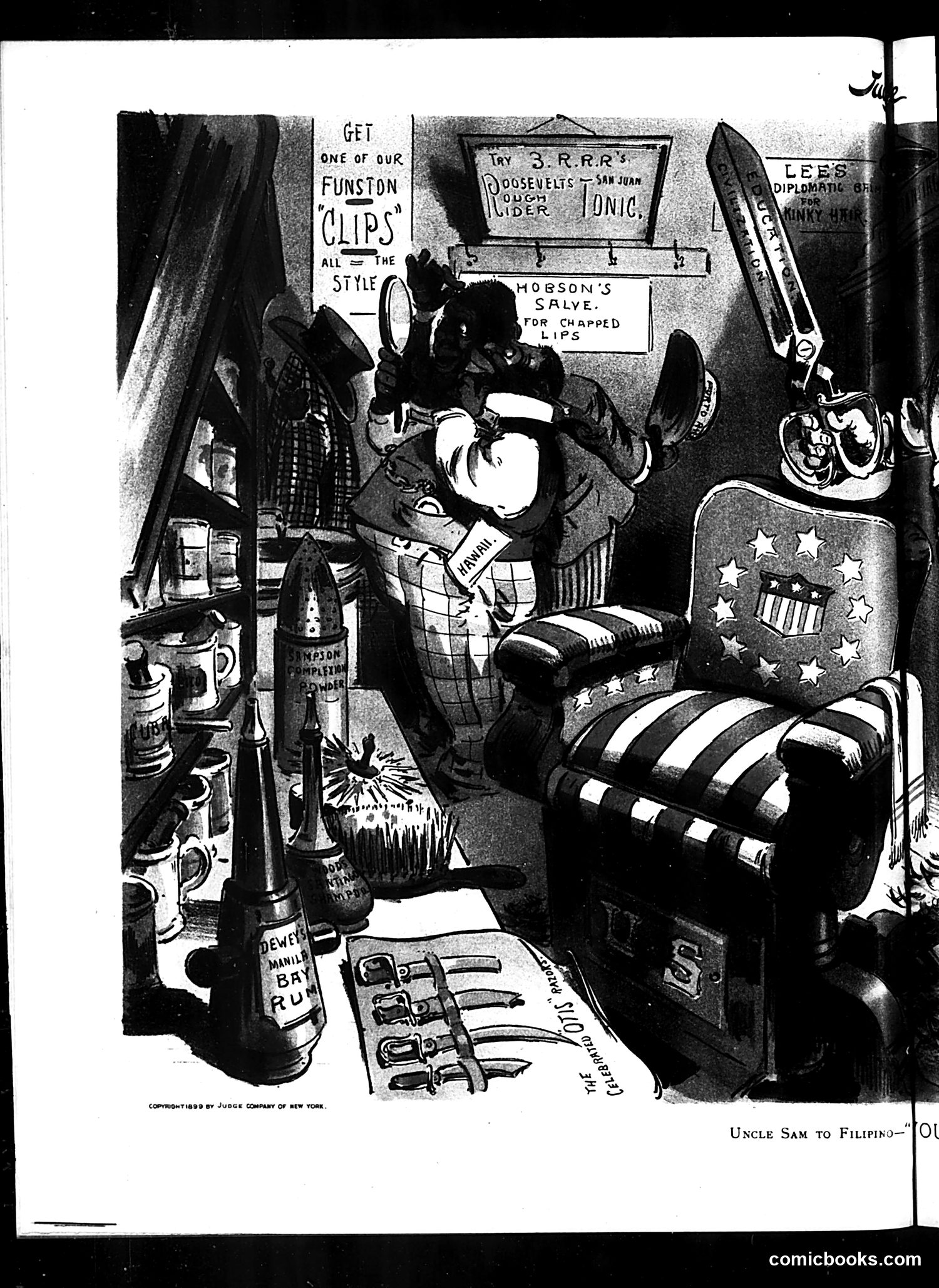
This is a political cartoon satirizing American imperialism following the Spanish-American War (1898). Uncle Sam, personified as America, is depicted as a merchant aggressively selling American consumer products—Funston clips, Roosevelt tonic, Hobson's salve, and other branded goods—to the Philippines, represented as a figure labeled "Filipino." The cartoon criticizes how the U.S. justified colonial occupation by claiming to "civilize" the Philippines through American commerce and culture. The ironic juxtaposition of weaponry (bullets, cannons) alongside cosmetics and patent medicines suggests the violent contradiction underlying American "benevolence"—military conquest packaged as beneficial trade. The satirical point: America uses commercial and cultural products to rationalize territorial conquest and economic exploitation of colonial subjects.
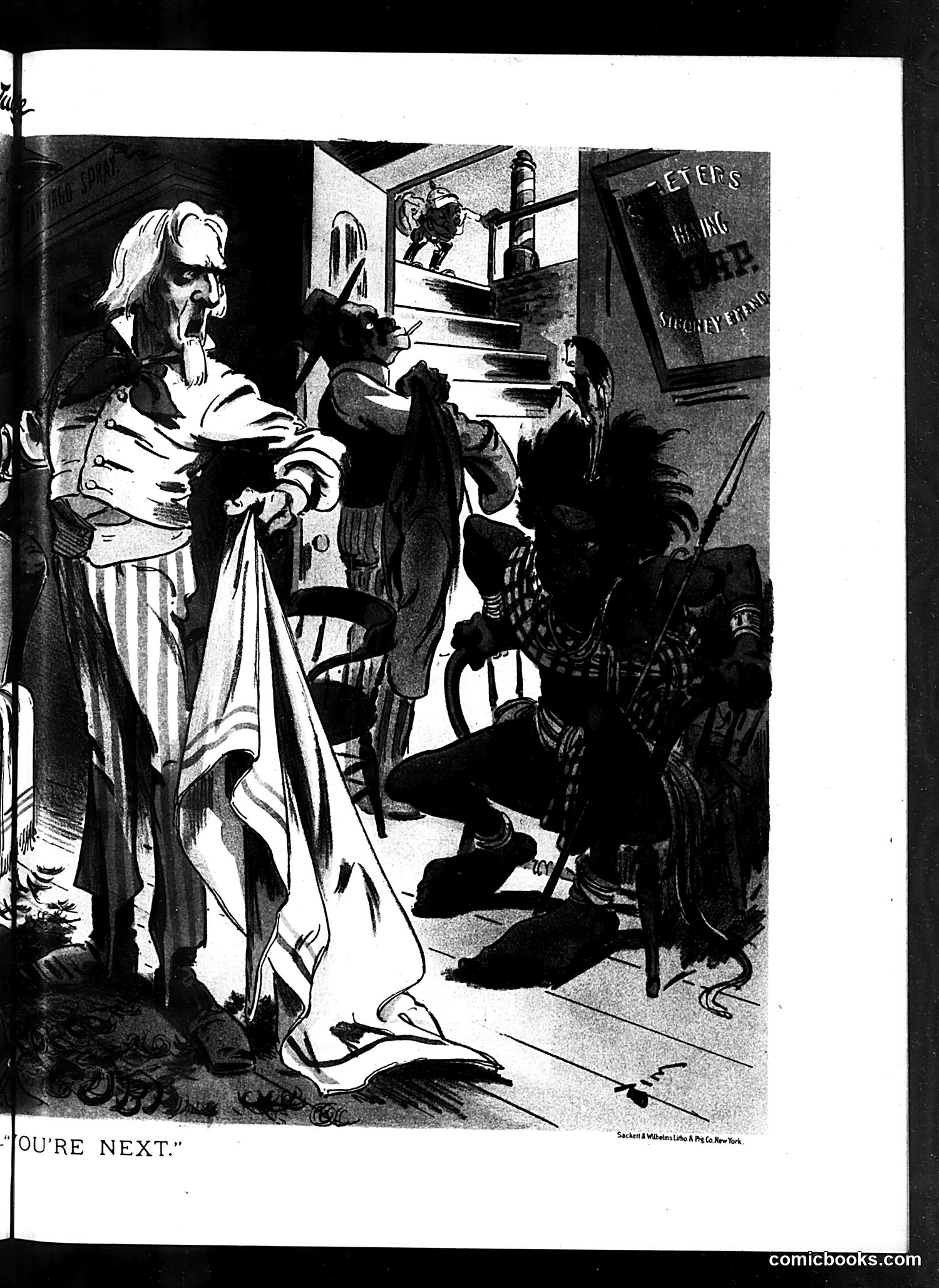
This appears to be a satirical cartoon from *Judge* magazine depicting an execution or guillotine scene. The caption "YOU'RE NEXT" suggests threat or warning to a particular political figure or group. The central figure—a caricatured man with exaggerated features wearing formal dress—appears to be awaiting execution while others look on. The style suggests this references late 19th or early 20th-century political anxieties, possibly relating to anarchist violence, revolution, or extreme political movements of that era. Without a visible date or clearer context, the specific political target remains unclear. The cartoon likely satirizes fears about violent overthrow of the established order, or warns a particular political figure of consequences for their actions.
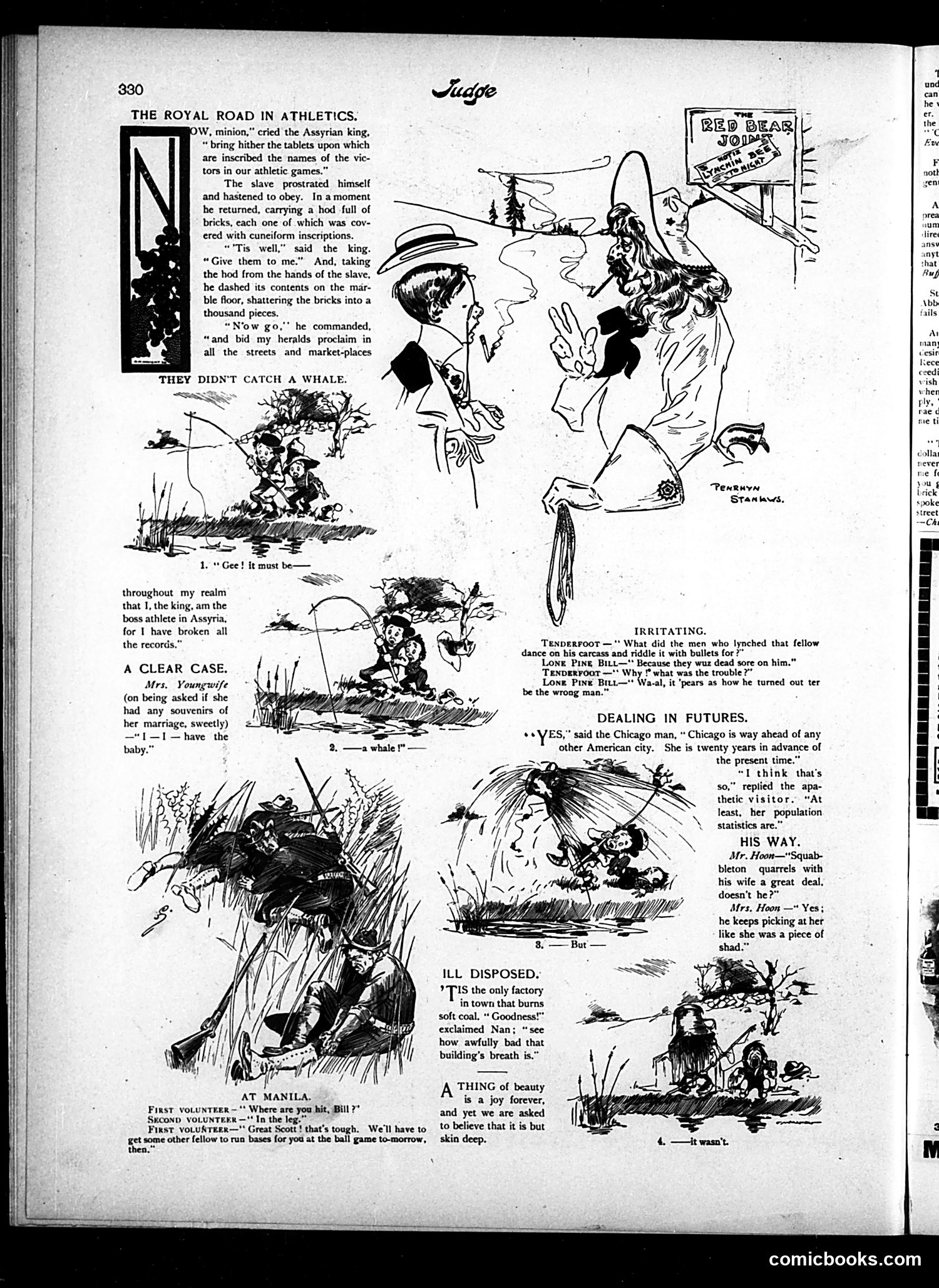
This page contains multiple unrelated satirical cartoons typical of Judge magazine's format. **"The Royal Road in Athletics"** (top left): A mock-historical piece satirizing athletic record-keeping. An Assyrian king destroys tablets listing actual athletic victors, then proclaims himself champion by destroying the evidence. This appears to mock contemporary athletes or institutions that claimed records through dubious means—perhaps referring to specific turn-of-the-century athletic scandals or exaggerated record claims. **Remaining cartoons** include domestic humor ("A Clear Case" about marriage), frontier dialect jokes ("Irritating" and "At Manila" about frontier violence and military life), and social commentary on Chicago's growth ("Dealing in Futures"). The "At Manila" section references the Philippine-American War, common in this era's Judge content. Most humor relies on period-specific slang, gender stereotypes, and casual references to violence now considered offensive. Without specific dates or bylines visible, precise historical context remains unclear.
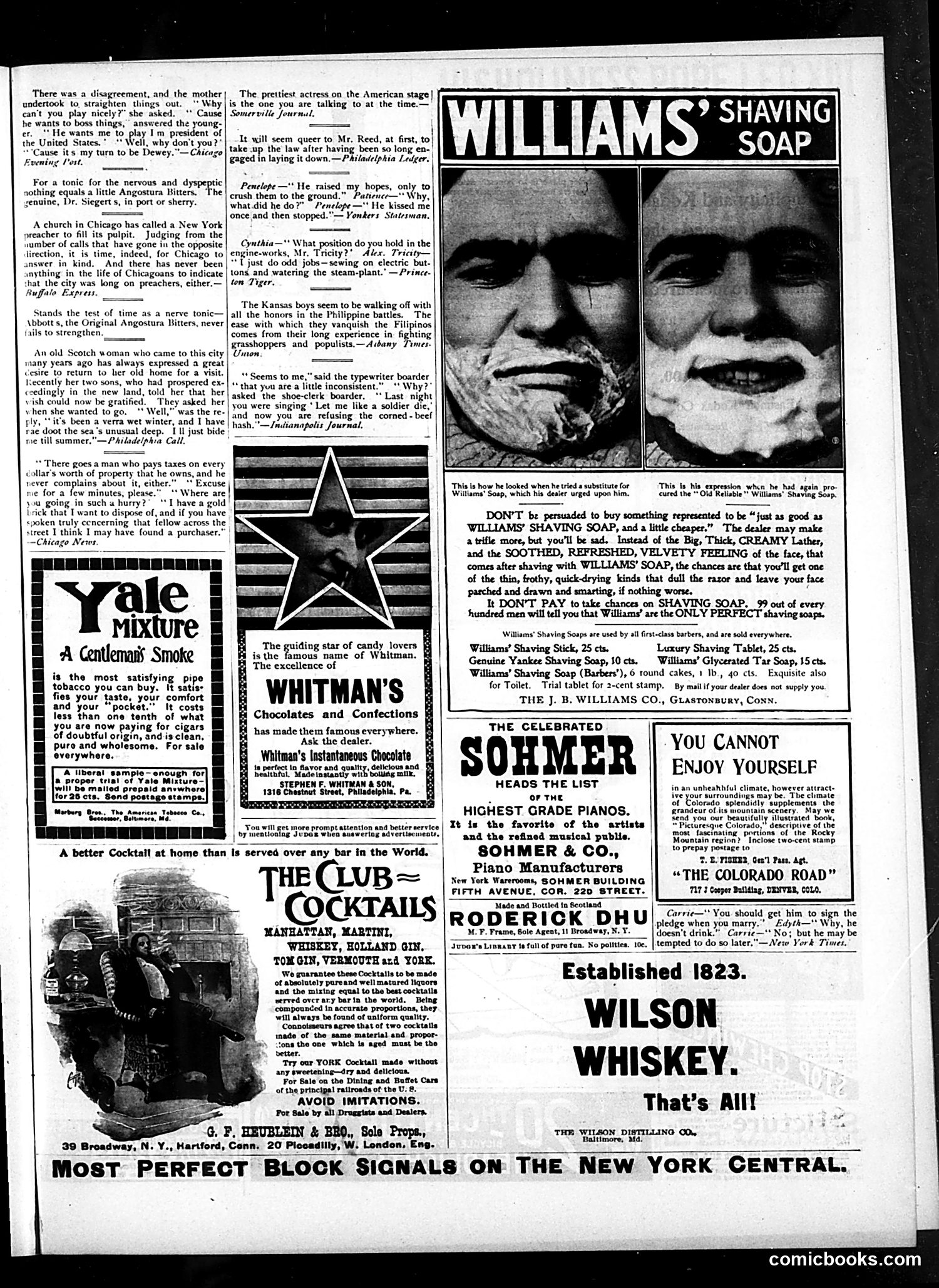
This page is primarily **advertising**, featuring product promotions for Williams' Shaving Soap, Yale Mixture tobacco, Whitman's chocolates, and Wilson Whiskey, among others. The small satirical pieces are brief jokes, not political cartoons: - **"Dewey" reference**: A child prefers playing "Dewey" over "President," likely mocking Thomas Dewey or referencing a current political figure of minor importance compared to the presidency. - **"Mr. Reed"** joke: References someone named Reed recently entering law practice after a career "laying down" law—appears to be a pun on a contemporary public figure, though the specific person is unclear. - **Kansas/Populists joke**: A regional jab at Kansas boys fighting Filipinos in the Philippine-American War, sarcastically crediting their success to experience fighting "grasshoppers and populists"—referencing the Populist Party's strength in Kansas. The page reflects early 1900s concerns: Philippine military campaigns, regional stereotypes, and contemporary political figures. The advertising dominates, with humor secondary.
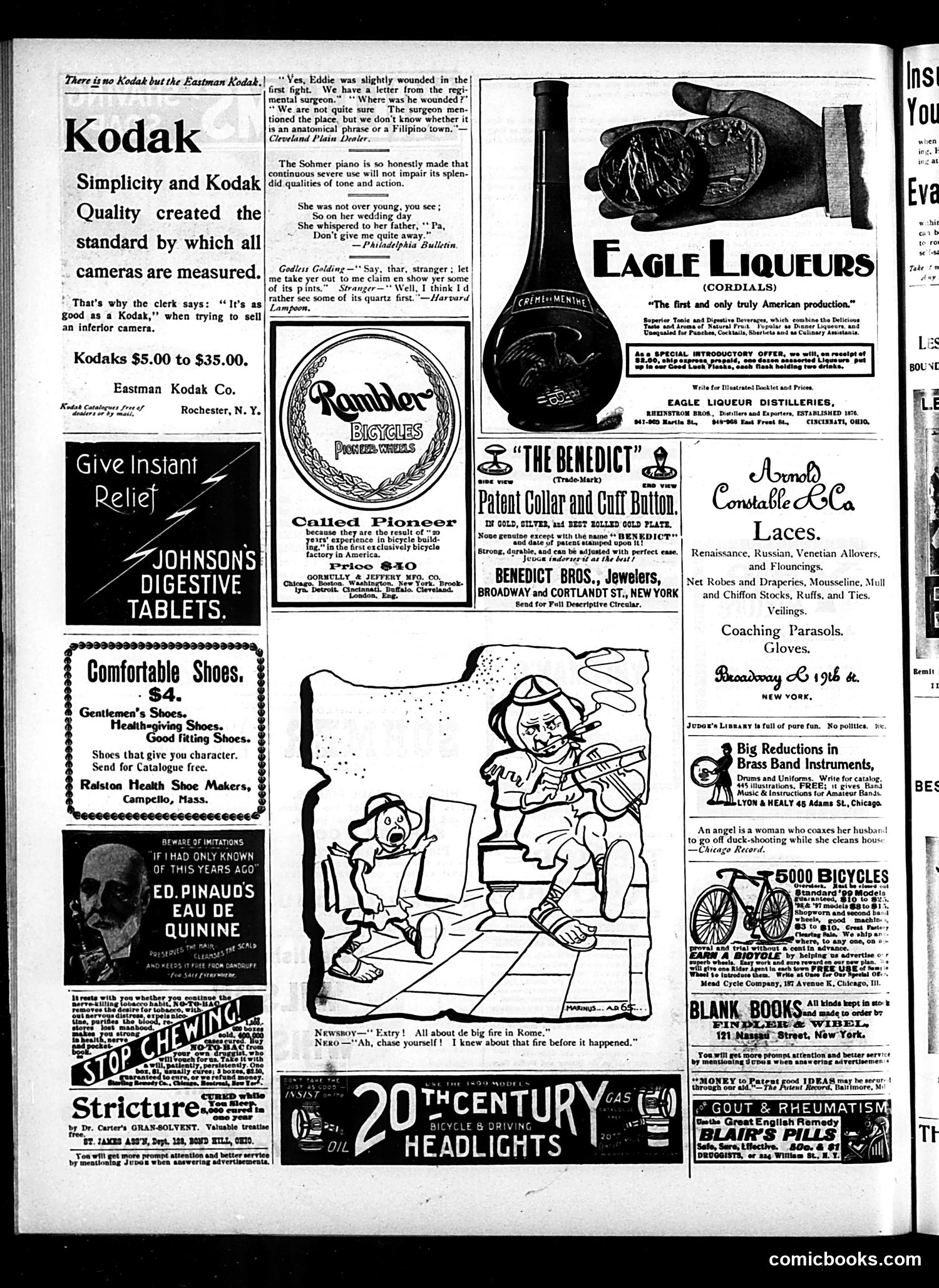
This page is primarily **advertisements** with a small cartoon and joke snippets, typical of early 20th-century magazine layout. ## The Main Cartoon The cartoon at bottom-left shows two cartoon characters discussing a fire in Rome. One (labeled "Nero") tells the other to "chase yourself" because he already knew about it—a crude joke referencing the historical legend that Nero "fiddled while Rome burned." The satire is that Nero supposedly caused or ignored Rome's destruction, so knowing about a fire beforehand would be unsurprising. ## The Jokes Short quips scattered throughout include: - A **wounded soldier joke** about unclear anatomy/geography (possibly referencing the Philippines conflict) - A **wedding joke** about an aging bride - A **mining prospector joke** about quartz vs. "pints" (unclear/possibly bawdy) ## The Advertisements Most of the page features product ads: Kodak cameras, shoes, bicycles, pianos, jewelry, liqueurs, and band instruments—typical consumer goods of the era. The page reflects early 1900s American commercial culture and mild satirical humor, with no significant political commentary.
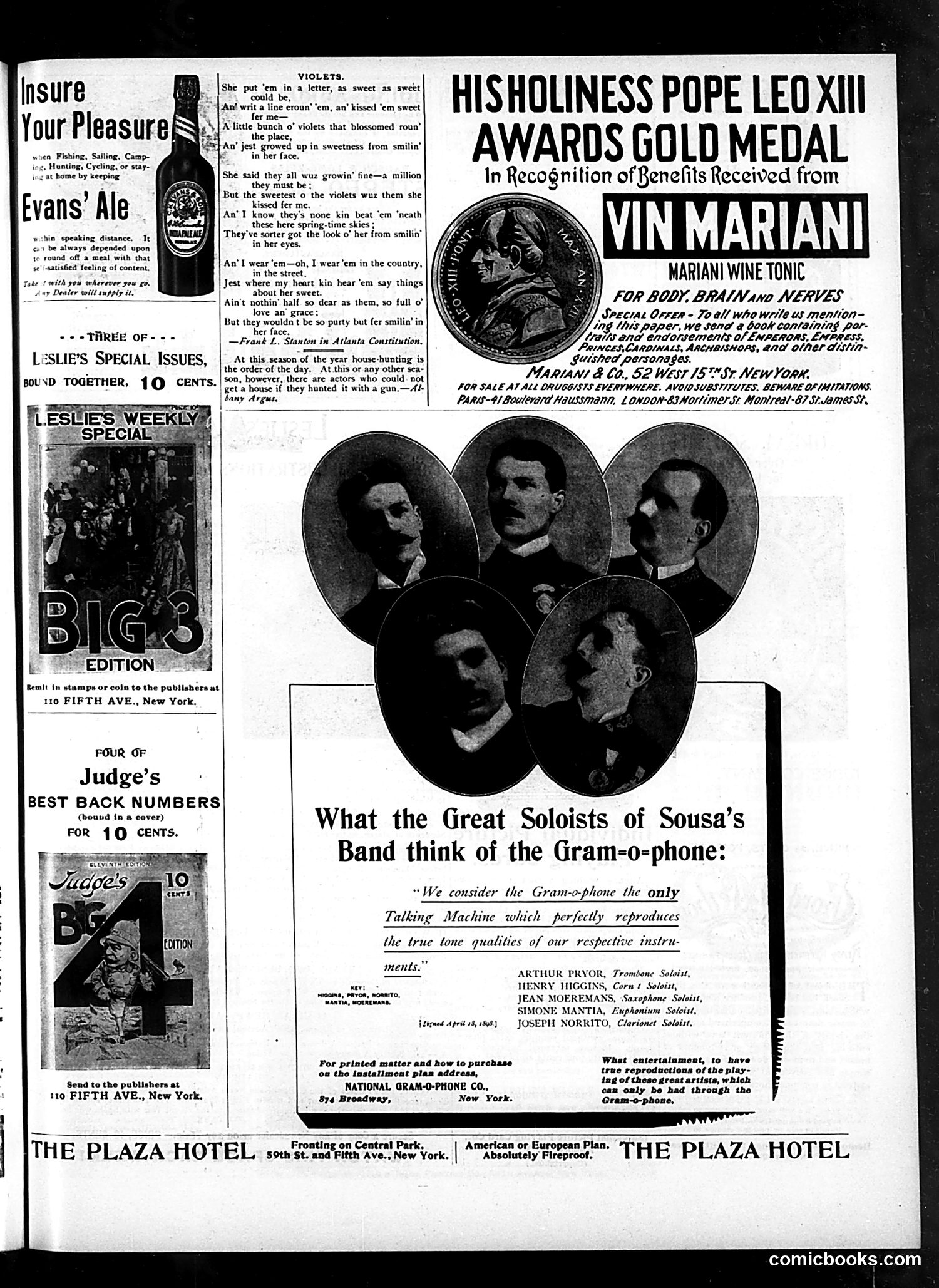
This page is primarily **advertising**, not political satire. It contains: 1. **Evans' Ale advertisement** - a beer brand positioned as accompaniment to leisure activities 2. **Mariani Wine Tonic endorsement** - claiming Pope Leo XIII awarded it a gold medal for health benefits. This is a patent medicine advertisement exploiting papal authority to suggest medical legitimacy (a common practice then) 3. **Gram-o-phone testimonial** - featuring five members of John Philip Sousa's famous military band (identified by instrument: Pryor/trombone, Higgins/cornet, Moeremans/saxophone, Mantia/euphonium, Norrito/clarinet) endorsing the phonograph's sound quality 4. **Minor content** - a poem "Violets" about romance, and ads for Leslie's magazine back issues and The Plaza Hotel The page reflects **turn-of-century marketing**: celebrity endorsements, dubious health claims backed by authority figures, and new technology promotion. No political cartoon is present—this is a commercial publication page typical of 1898.
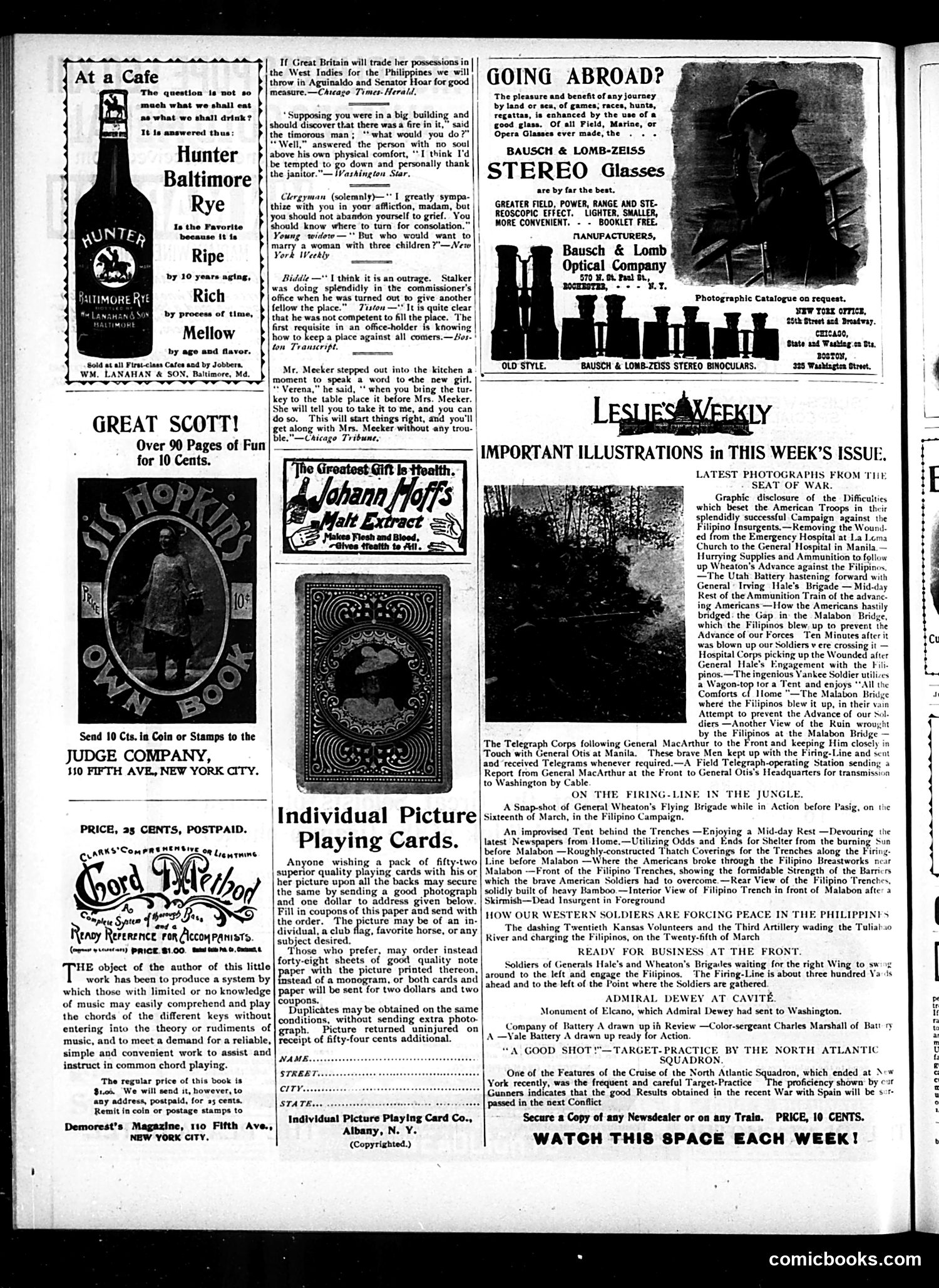
This page is primarily **advertisements and filler content** rather than political satire. The notable exception is a brief editorial quip at the top: The single political reference mocks the **Philippine-American War** context. A Chicago Times-Herald quote sarcastically proposes that Britain trade her West Indies possessions for the Philippines, with America throwing in **Aguinaldo** (the Filipino independence leader) and **Senator Hoar** (an anti-imperialist politician) as bonus items. This joke ridicules American imperialism—suggesting the Philippines are worthless enough that anti-war politicians should be included as incentive to take them off America's hands. The rest of the page consists of liquor advertising (Hunter Baltimore Rye), book/music instruction promotions, playing card advertisements, and comic anecdotes about domestic situations and social etiquette—typical filler for a humor magazine of this era.
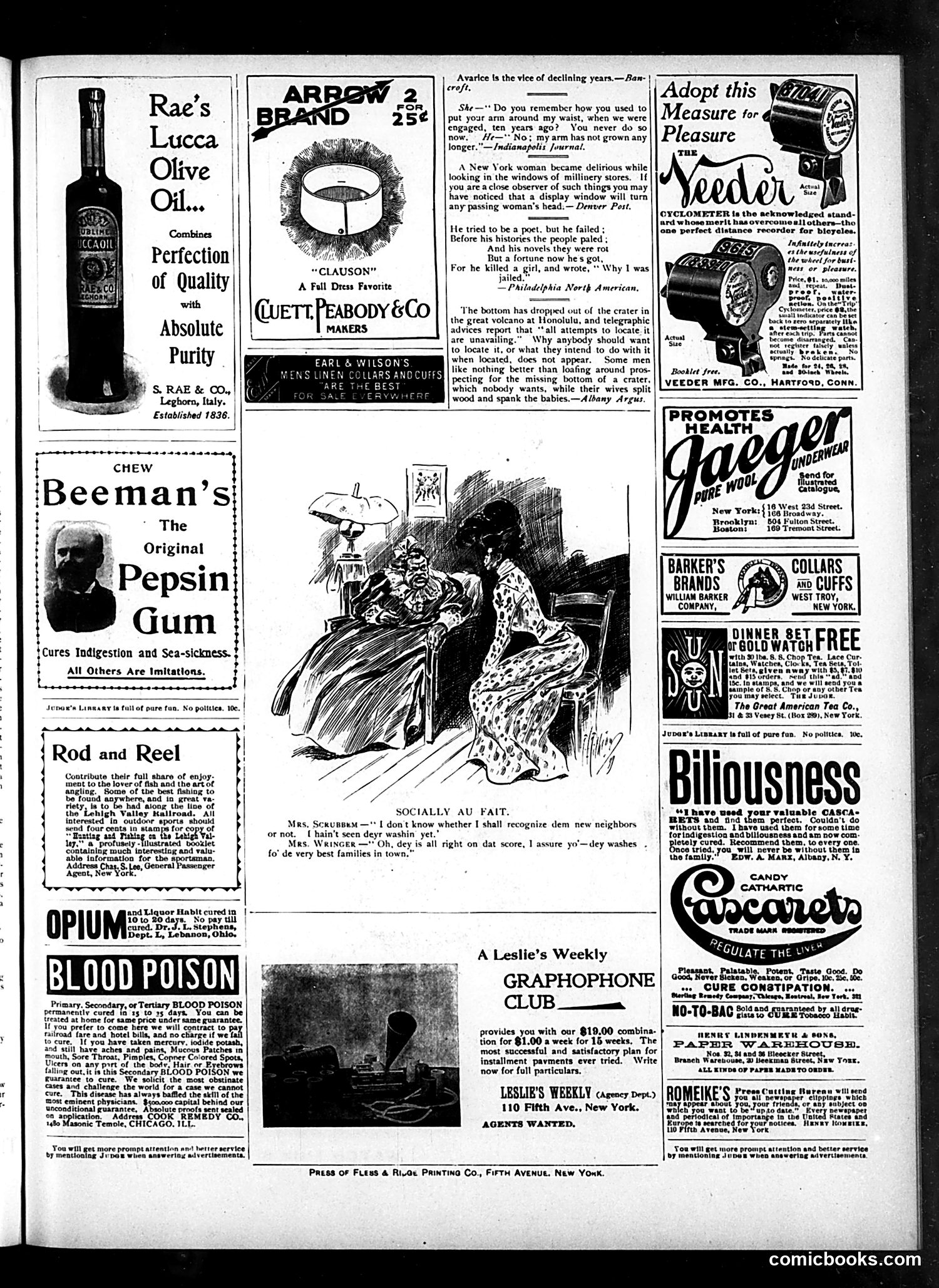
This page is primarily **advertising**—typical of early 20th-century magazines—with one modest cartoon labeled "Socially Au Fait." The cartoon depicts two women gossiping. Mrs. Schurman wonders whether she'll recognize new neighbors; Mrs. Waincer reassures her that "they wash"—implying the joke is about class anxiety. The humor hinges on the snobbish concern that new neighbors might be of lower social standing, with cleanliness serving as a crude marker of respectability. The advertisements reflect period concerns: Beeman's Pensin Gum for "indigestion and sea-sickness," opium treatments, "blood poison" cures (likely syphilis), and graphophone (early record player) club memberships. The page captures early 1900s attitudes about hygiene, class status, and the patent medicines that exploited consumer anxieties before FDA regulation.
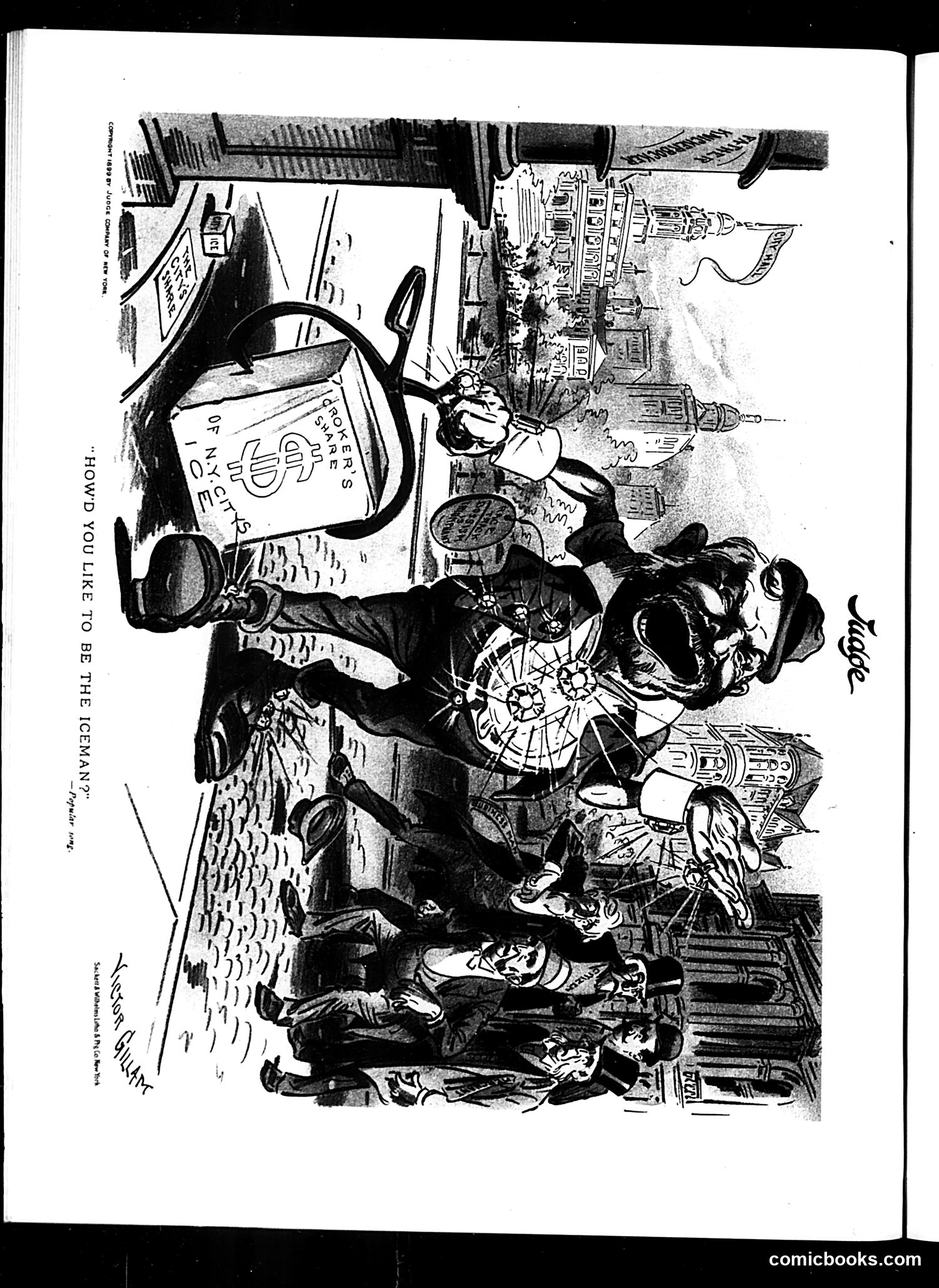
This satirical cartoon appears to reference the popular song "How'd You Like to Be the Iceman?" The image shows what seems to be an iceman (identifiable by the ice block visible in the upper left) surrounded by several figures in an urban street setting. The cartoon likely satirizes the iceman profession—a common occupation before electric refrigeration became widespread. The satire probably mocks either the profession itself, the song's popularity, or social attitudes toward working-class laborers. The crowded composition and the characters' expressions suggest commentary on urban life or labor conditions of the era. Without clearer visibility of specific faces or additional context, the exact satirical target remains unclear, though it appears critical of something about the iceman's role or status in society.