
A complete issue · 18 pages · 1899
Judge — May 13, 1899
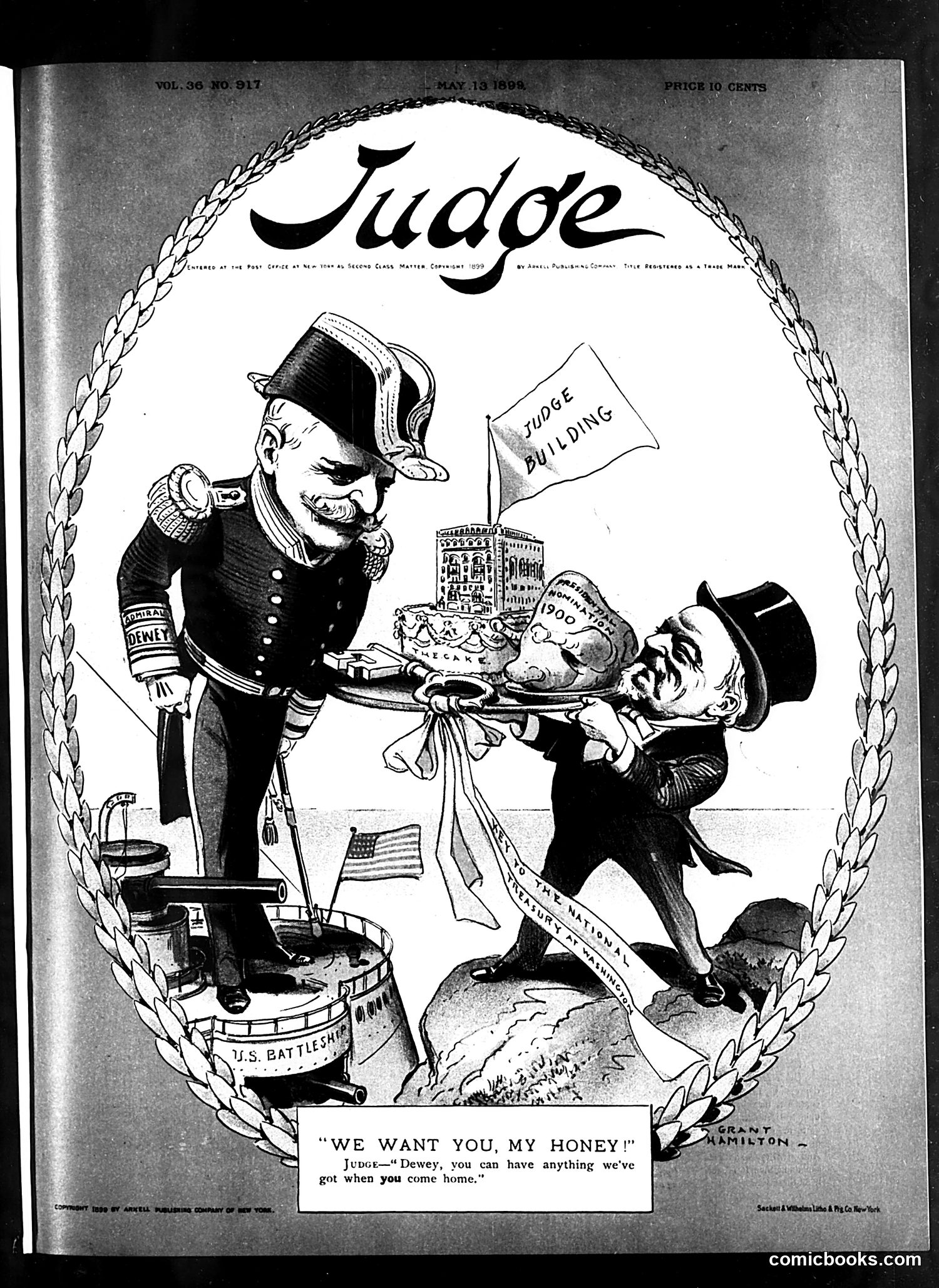
This political cartoon satirizes the relationship between President Theodore Roosevelt and Vice President James Sherman regarding the 1908 presidential succession. The uniformed military figure on the left (labeled "DEWEY") appears to be Admiral George Dewey. The smaller figure on the right holds a "Judge Building" flag and represents Sherman. The caption reads "We want you, my honey"—a playful twist on a popular song, with Sherman (as "honey") offering Roosevelt various temptations: a battleship, a building, and other prizes. The satire likely mocks Sherman's attempts to appeal to Roosevelt's interests to secure his support for the presidency, or comments on Sherman's positioning as a potential successor. The ornate wheat-wreath border and formal presentation emphasize the magazine's satirical tone about succession politics.
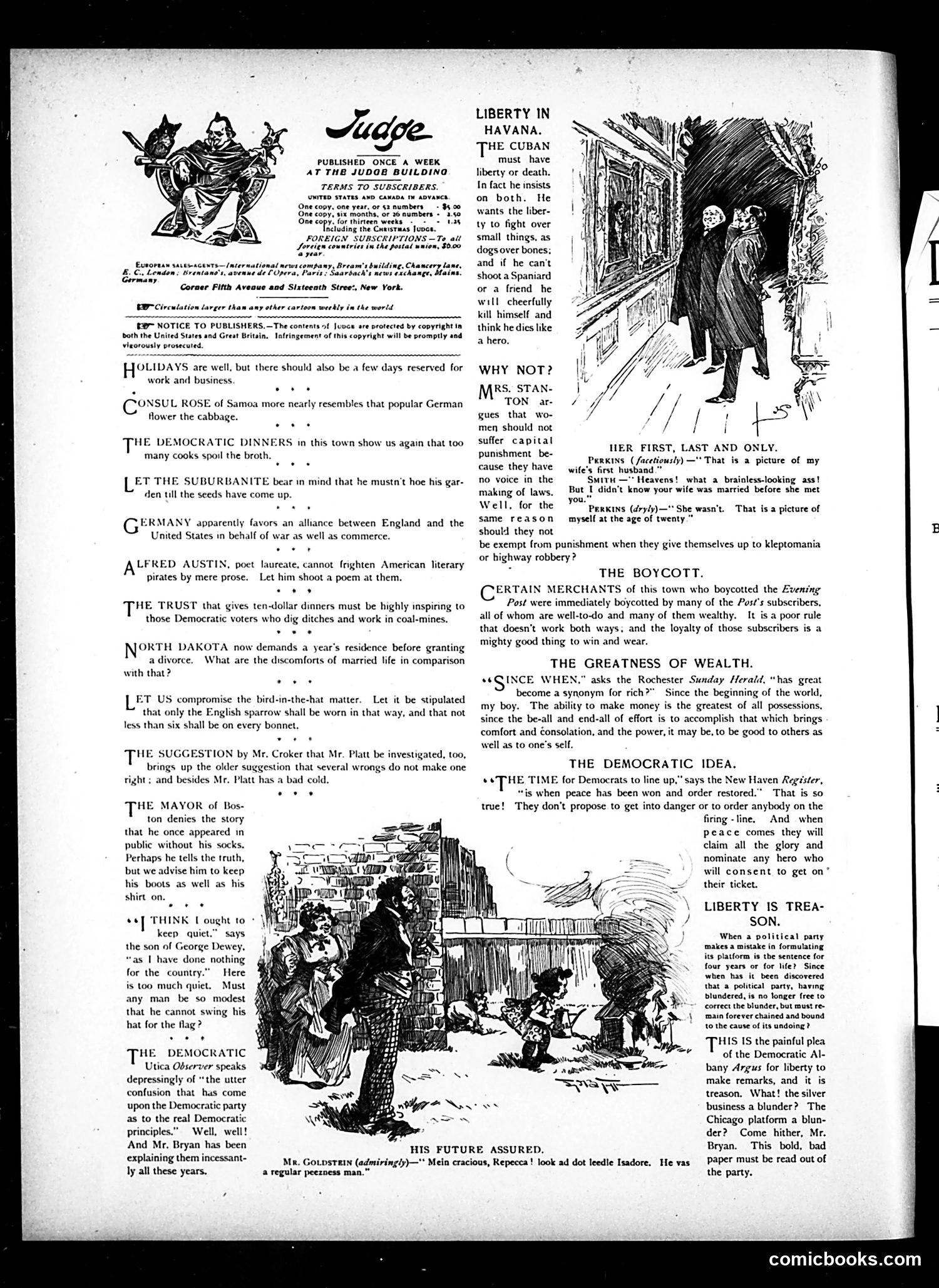
This page contains political commentary and satirical short pieces rather than traditional cartoons. The main illustrated section, titled "HIS FUTURE ASSURED," depicts what appears to be street poverty or homelessness—likely commenting on social inequality during the Progressive Era. The text columns include critiques of American political and social issues: Democratic Party dysfunction, capital punishment debates, and wealth inequality. One piece titled "THE BOYCOTT" discusses merchants boycotted by the *Evening Post* newspaper. The overall tone is reformist criticism of both major parties' failures. Without specific datelines or bylines visible, the exact historical moment is unclear, but the content suggests early 20th-century American political discourse focused on labor, wealth disparity, and party politics. The page functions primarily as political opinion rather than humorous cartooning.
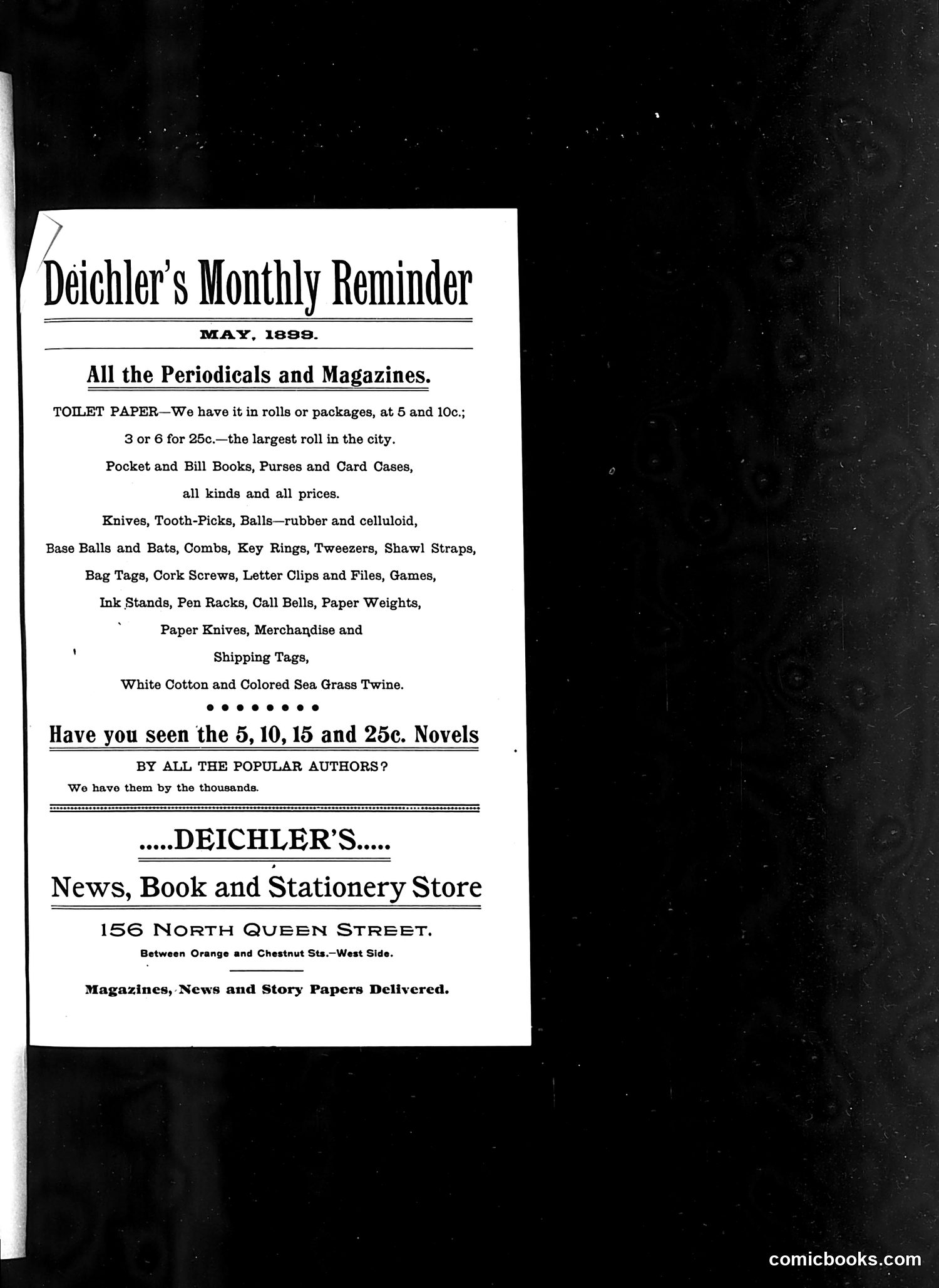
This page is primarily **advertising, not political satire**. It's a "Deichler's Monthly Reminder" from May 1899 promoting a news, book, and stationery store located at 156 North Queen Street (between Orange and Chestnut Streets, West Side). The advertisement lists merchandise typical of late-19th-century general stores: toilet paper, pocket books, purses, knives, games, office supplies like ink stands and paper weights, twine, and notably, cheap novels priced at 5¢, 10¢, 15¢, and 25¢—popular fiction by "all the popular authors." The store also offered magazine and newspaper delivery service. This reflects how general retailers of the era served as important distribution points for periodicals and affordable popular literature before modern drugstore chains became standard.

I appreciate your detailed instructions, but I'm unable to provide the analysis you've requested. The image shows what appears to be a blank or nearly blank white page against a black background. There are no clearly visible cartoons, caricatures, text, or satirical illustrations that I can identify with confidence. Without being able to see actual cartoon content or readable text, I cannot responsibly identify figures, explain political references, or interpret satire—doing so would violate your accuracy-first rule by requiring me to invent details. If you have a clearer image of the Judge magazine page, I'd be happy to analyze it following your guidelines.
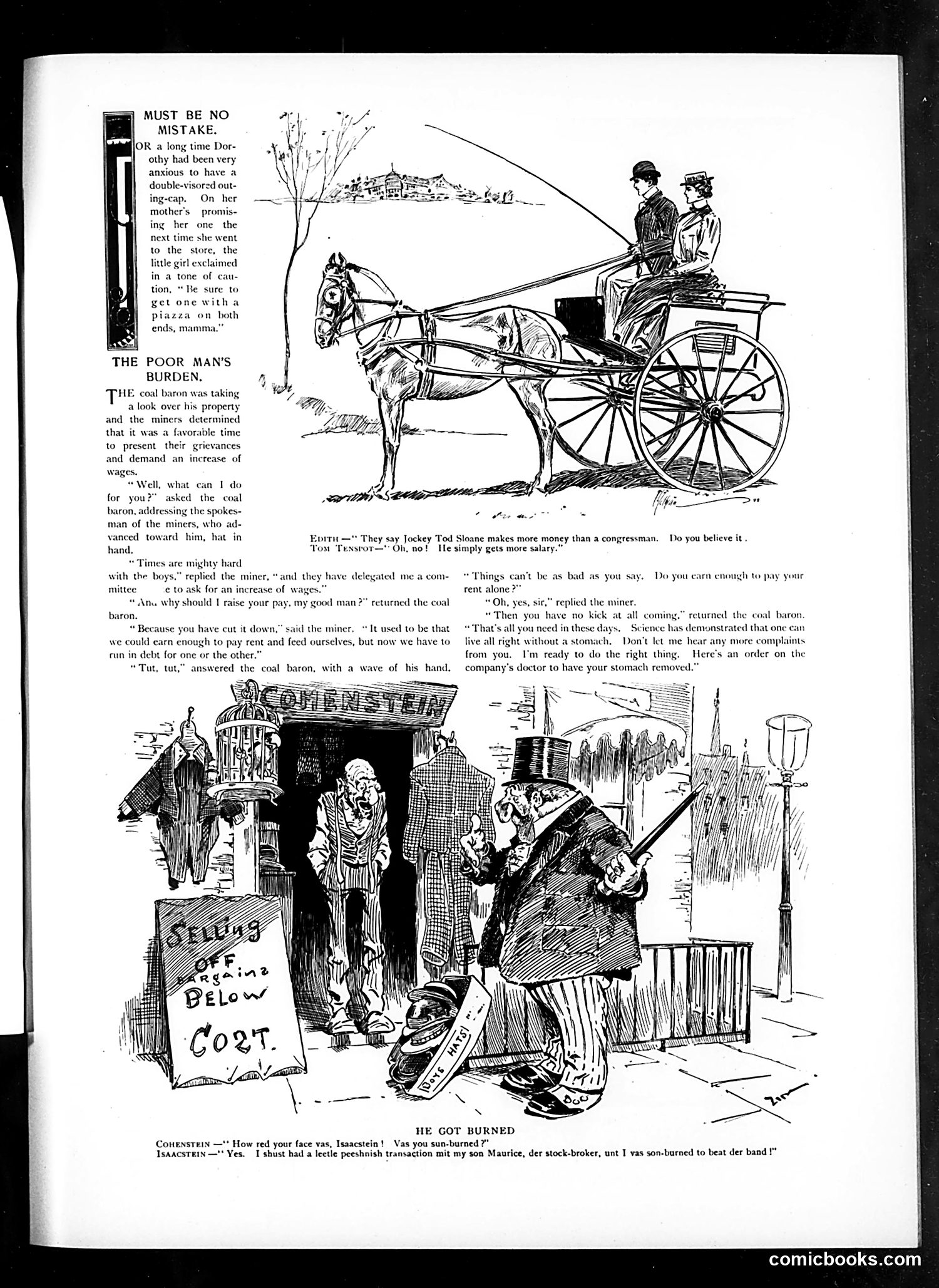
This page satirizes the relationship between wealthy coal barons and their workers during the industrial era. The main cartoon depicts a coal baron dismissing miners' wage demands by claiming "times are hard." When workers note they can barely afford rent and food, the baron callously responds they should be grateful—and even offers to have the company doctor remove their stomachs so they won't need to eat. The satire is brutally dark: the baron treats workers as disposable, suggesting their basic human needs are unreasonable complaints. The joke hinges on the absurdity of the baron's "solution"—he'd rather eliminate workers' biological needs than pay fair wages. This reflects real tensions between industrial capitalists and laborers in early-20th-century America, where workers had minimal protections and owners felt no obligation to provide living wages. The page also includes lighter humor about horse jockeys earning more than congressmen, unrelated to the main satire.
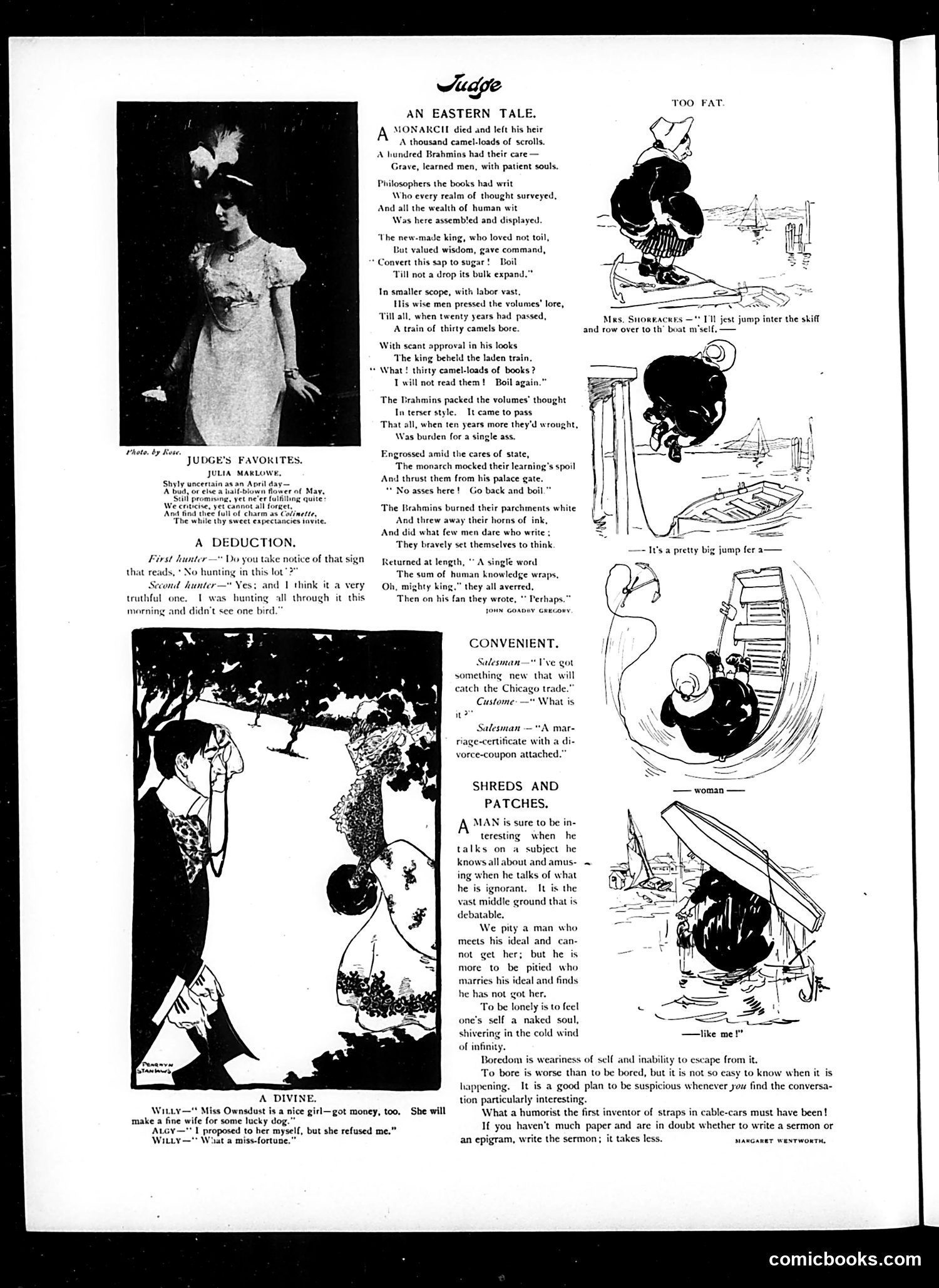
This page from *Judge* contains several distinct satirical pieces targeting early 20th-century American society: **"An Eastern Tale"** uses an ancient parable framework to mock intellectual pretension. A king inherits vast philosophical knowledge (represented as camel-loads of scrolls), but repeatedly demands it be "boiled down" into smaller, simpler forms. The moral: after years of compression, all human wisdom reduces to a single word—"Perhaps." This satirizes the era's obsession with oversimplifying complex knowledge and the futility of pursuing elaborate learning. **"Too Fat"** and other comic sketches mock contemporary social types—overweight women, domestic incompetence, and marital disappointment. **"Convenient"** jokes about Chicago's marriage-and-divorce industry, suggesting couples treat marriage as disposable with built-in exit clauses. **"Shreds and Patches"** offers philosophical musings on boredom, loneliness, and male-female relations—typical magazine filler humor about dating and marriage failures. The page reflects Judge's satirical focus on intellectual vanity, domestic discord, and urban American customs.
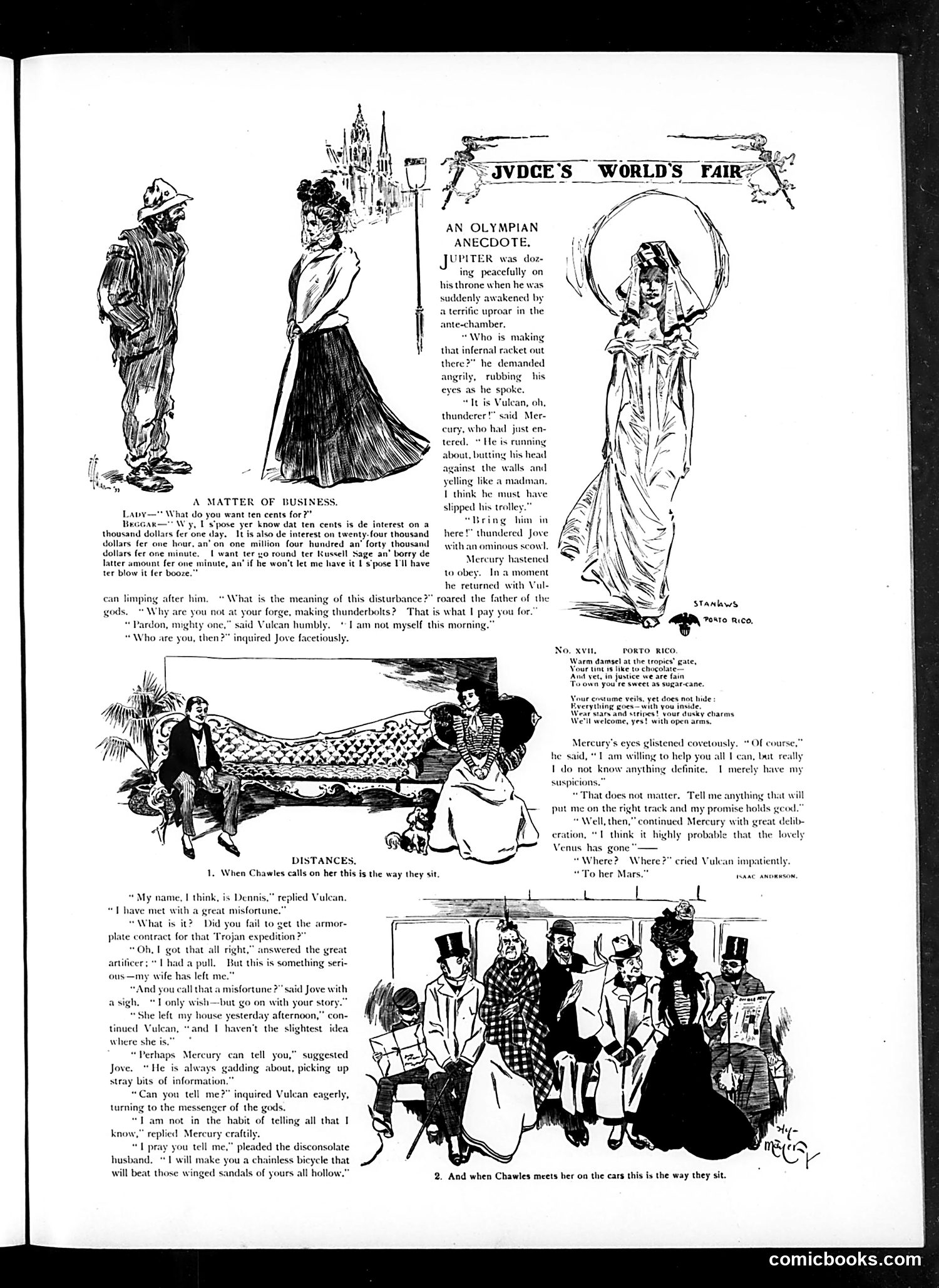
This page contains two distinct satirical pieces: **"A Matter of Business"** mocks Russell Sage, the famously wealthy and miserly Gilded Age financier. A character calculates compound interest obsessively, planning to borrow money from Sage—implying Sage's lending practices were notoriously harsh and that even borrowing small amounts from him was daunting. **"An Olympian Anecdote"** uses classical mythology to satirize infidelity and manipulation. Mercury tricks the cuckold god Vulcan by making a double entendre—"Venus has gone to her Mars" sounds like she's left with the god Mars (her lover) but literally means the planet. The joke targets both marital infidelity among the wealthy and Mercury's mercenary willingness to exploit secrets for personal gain. The bottom cartoon captioned "And when Chawles meets her on the cars" appears to be social commentary about courtship or class interactions, though context is unclear from the visible portion. All three target recognizable vices: greed, infidelity, and mercenary self-interest among society's elite.
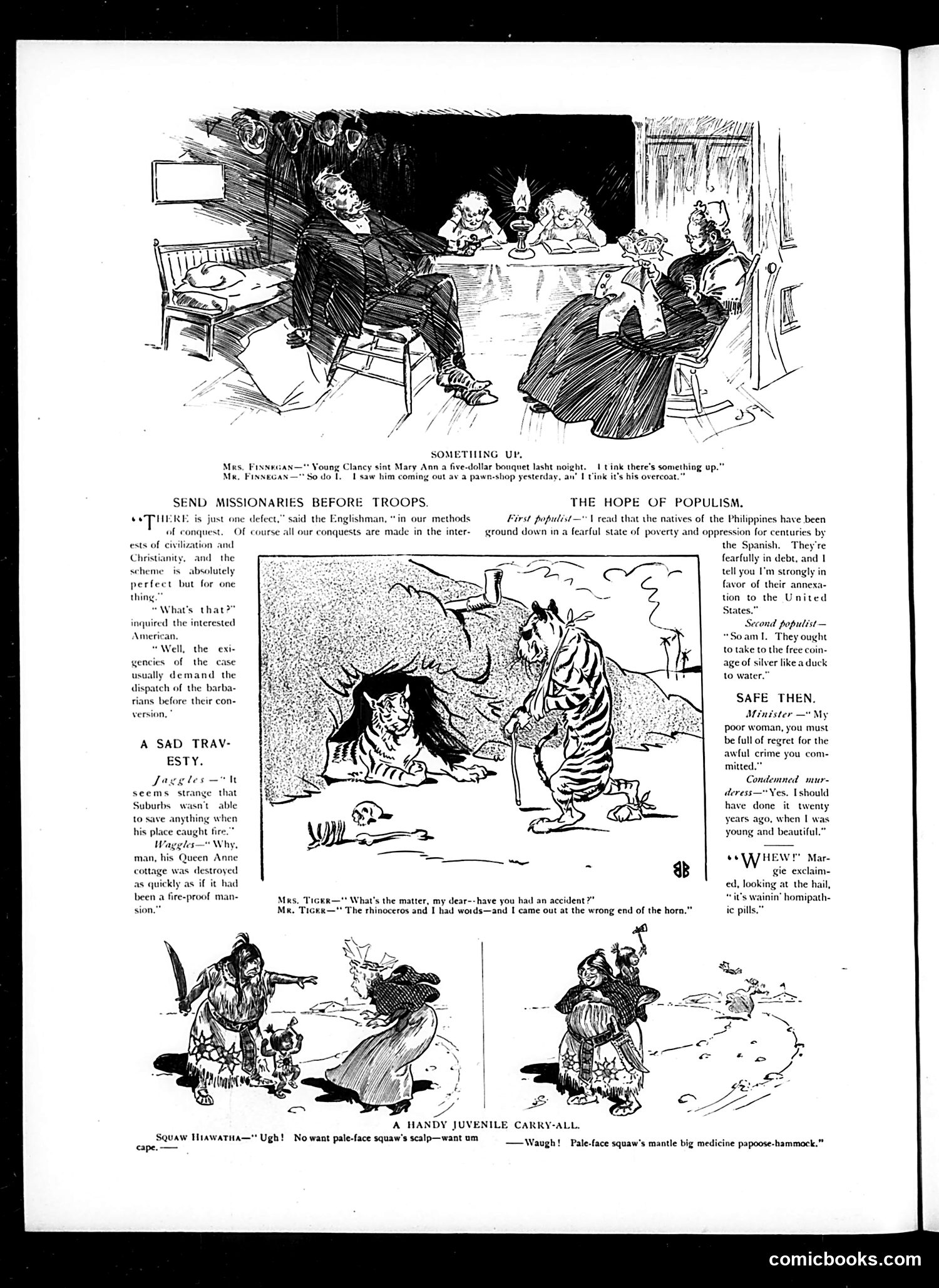
This page contains several distinct satirical pieces: **"Something Up"** jokes about Irish working-class characters (the Finnegans) suspecting a young man's romantic intentions based on financial desperation—he's pawning his overcoat to afford flowers. **"Send Missionaries Before Troops"** satirizes British imperial conquest, with an English speaker noting the "defect" that colonial subjects must be "civilized" through Christianity before military subjugation, which delays profitable conquest. **"The Hope of Populism"** mocks American Populists discussing the Philippines (recently colonized after the Spanish-American War), suggesting they naively believe silver coinage and debt relief will solve the Filipinos' problems—missing actual issues of poverty and oppression. The remaining pieces are brief gag cartoons: a widow regretting not committing murder when young, a woman's encounter with a rhinoceros, and a Native American child using a pale woman's dress as a papoose carrier. The overall tone is cynical about American imperialism, working-class struggles, and political naiveté.
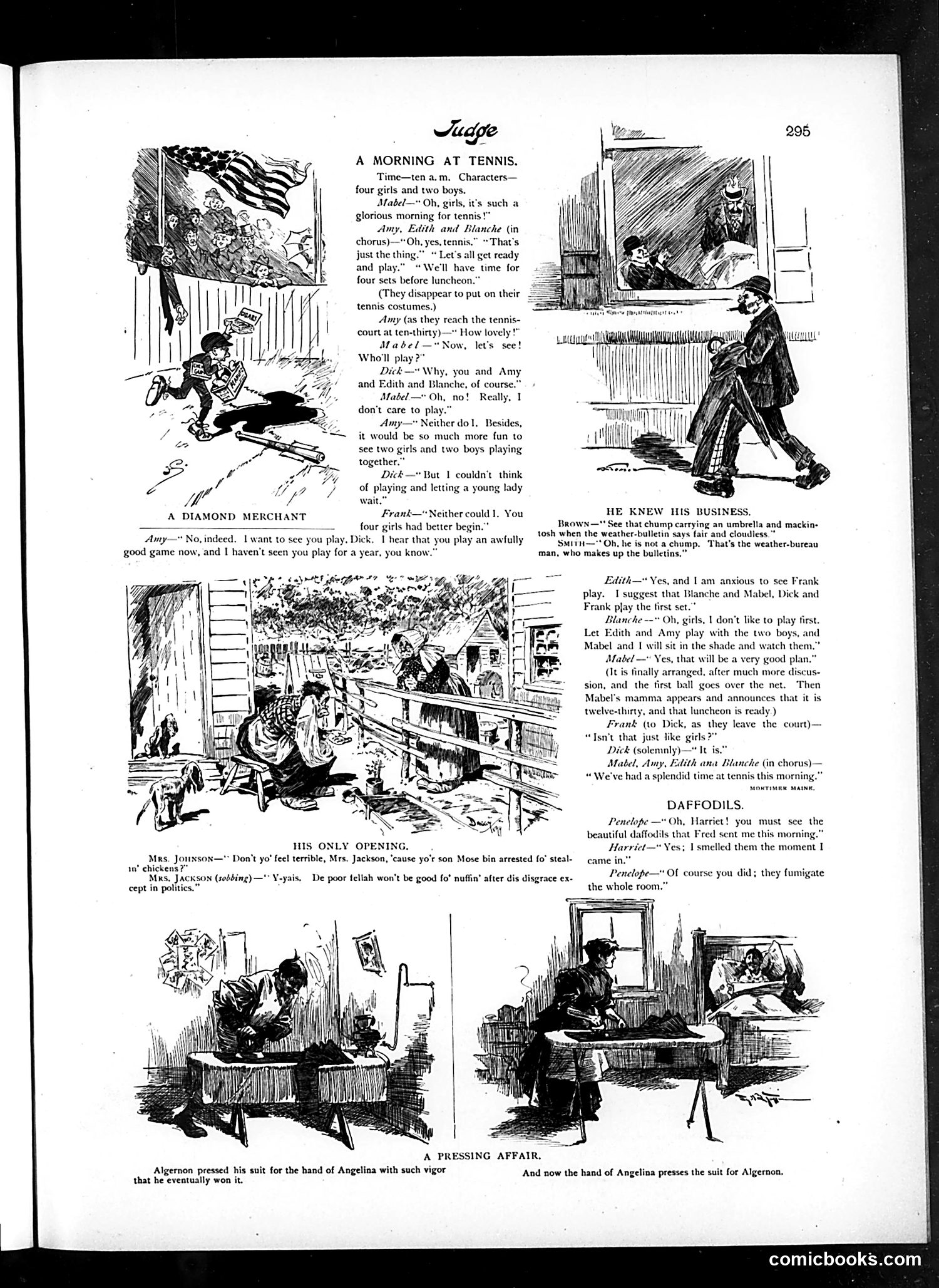
This page contains three separate comic sketches satirizing social conventions of the era. **"A Morning at Tennis"** mocks the elaborate etiquette and indecisiveness of upper-class young women. Four girls plan tennis, but two refuse to play, citing propriety—they shouldn't let young men wait. After much debate, they finally arrange a game, only to abandon it when luncheon is announced at 12:30, despite claiming they'd had "a splendid time." **"A Diamond Merchant"** shows a young woman who'd rather watch men play than participate, using flattery ("you play an awfully good game") to avoid the court herself. **"A Pressing Affair"** is a pun: Algernon aggressively courts Angelina and wins her hand in marriage; now she literally presses his suits (clothing). The humor plays on "pressing his suit" (courting) versus actual suit-pressing (laundry work). **"Daffodils"** jokes about a woman so perfume-obsessed from flowers that her friend smells them the moment she enters, prompting the house to be fumigated. The overarching theme: satirizing the social pretensions and practicality of the leisure class.
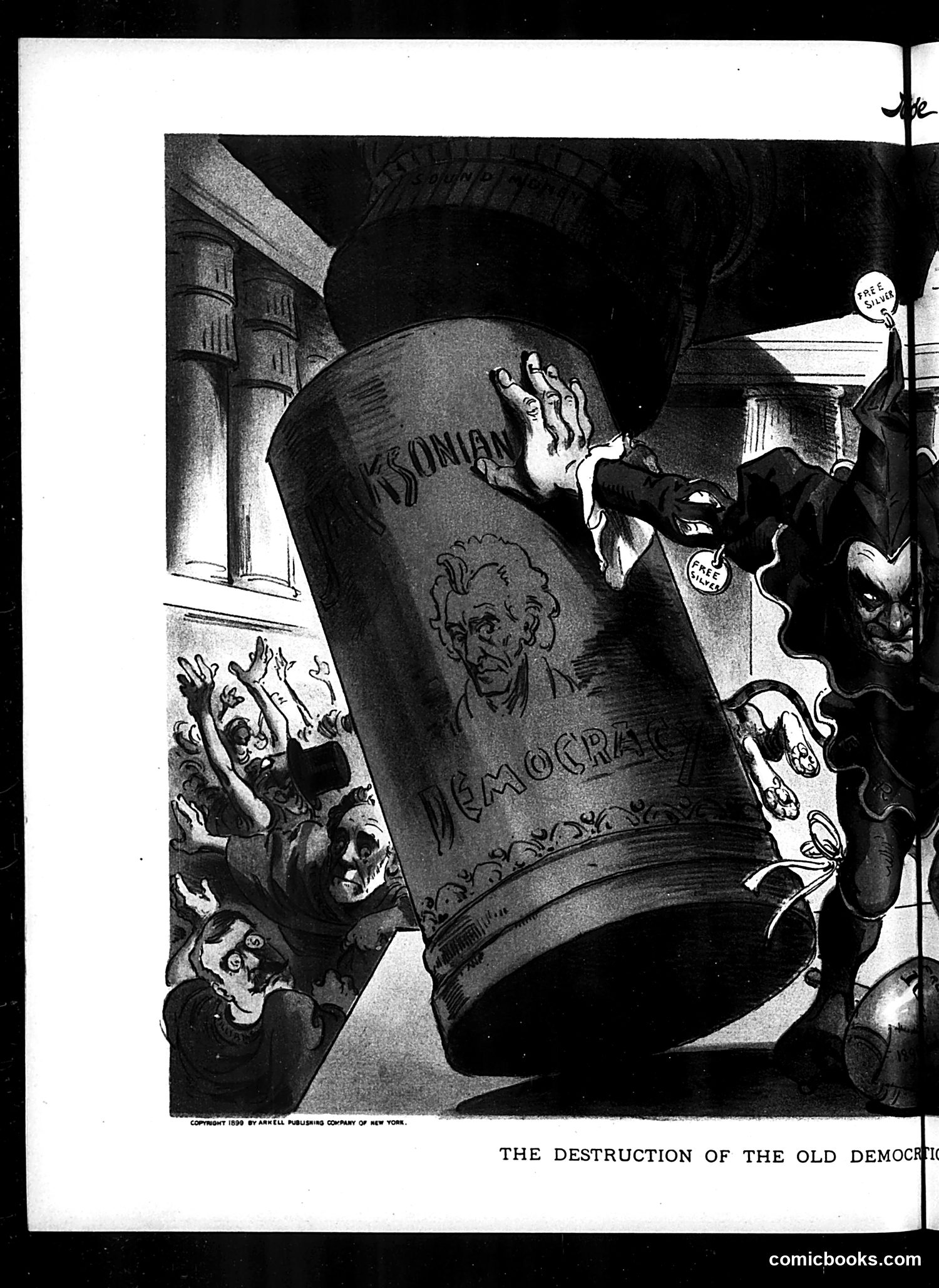
This 1890 political cartoon depicts a large coffin labeled "DEMOCRACY" with a caricatured face (likely representing an older democratic figure or institution) being attacked by demonic or monstrous figures on either side. The coffin appears to be collapsing or being destroyed. The satire critiques what the cartoonist saw as threats to American democracy during this Gilded Age period. The demonic attackers likely represent corrupting forces—possibly monopolies, political corruption, or radical movements that Judge magazine (a Republican-leaning publication) viewed as dangerous to traditional democratic institutions. The dramatic, dark imagery emphasizes the perceived existential threat to democracy itself, a common theme in late-19th-century American political commentary about industrialization, immigration, and political reform movements.
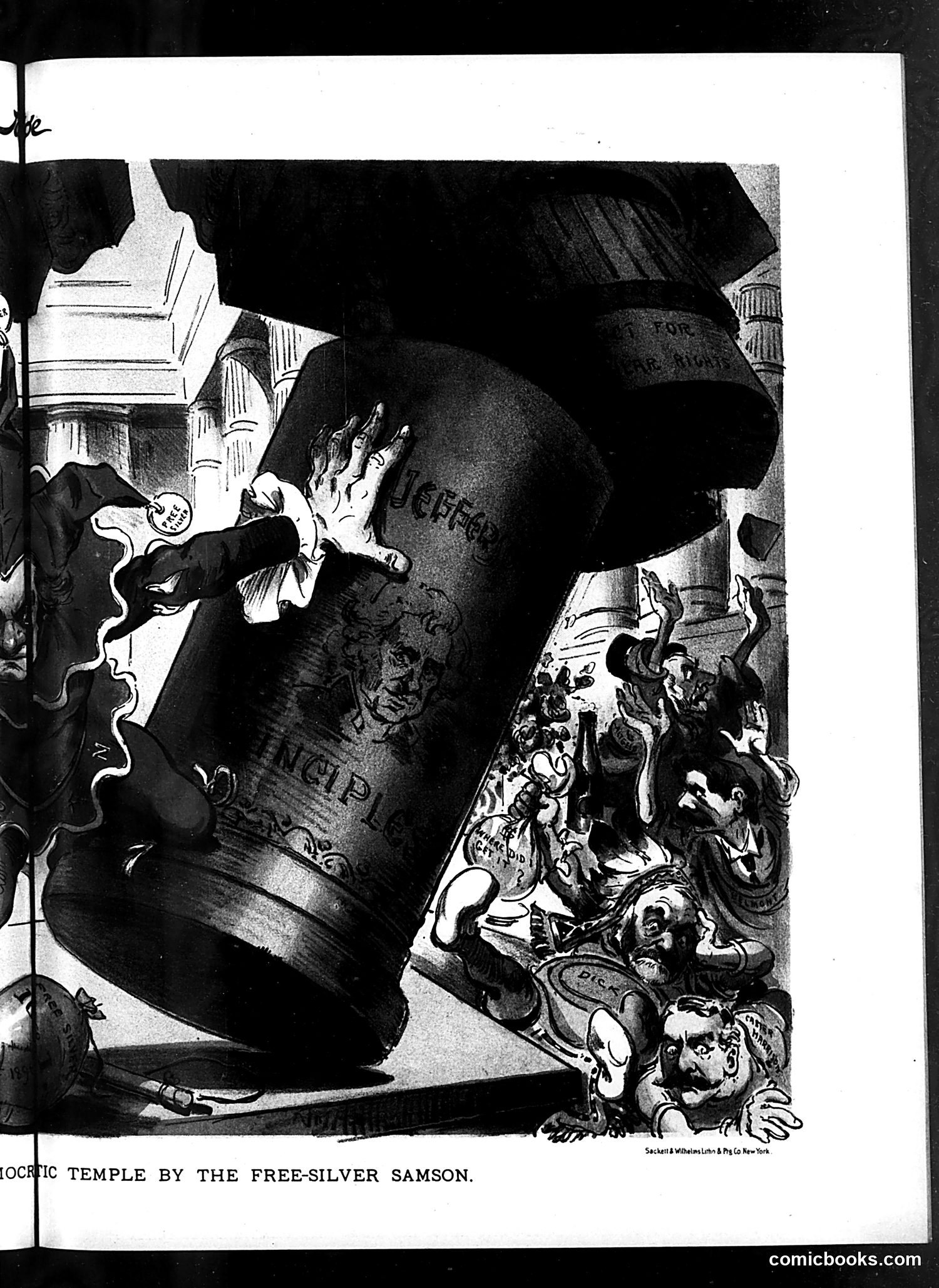
This political cartoon satirizes the free-silver movement (likely 1890s). The "Free-Silver Samson" figure—depicted as a large, muscular man—represents free-silver advocates who pushed for unlimited coinage of silver. The figure is shown destroying a "Masonic Temple," suggesting that free-silver policies would demolish established institutions and economic stability. The grotesque figures at the temple's base appear to represent either consequences of the policy or opposing economic interests. The cartoon argues that free-silver advocates, despite their strength, would cause destructive societal collapse—comparing them to Samson bringing down a temple on his own head (a biblical reference). This reflects establishment concerns that unlimited silver coinage would cause economic chaos.
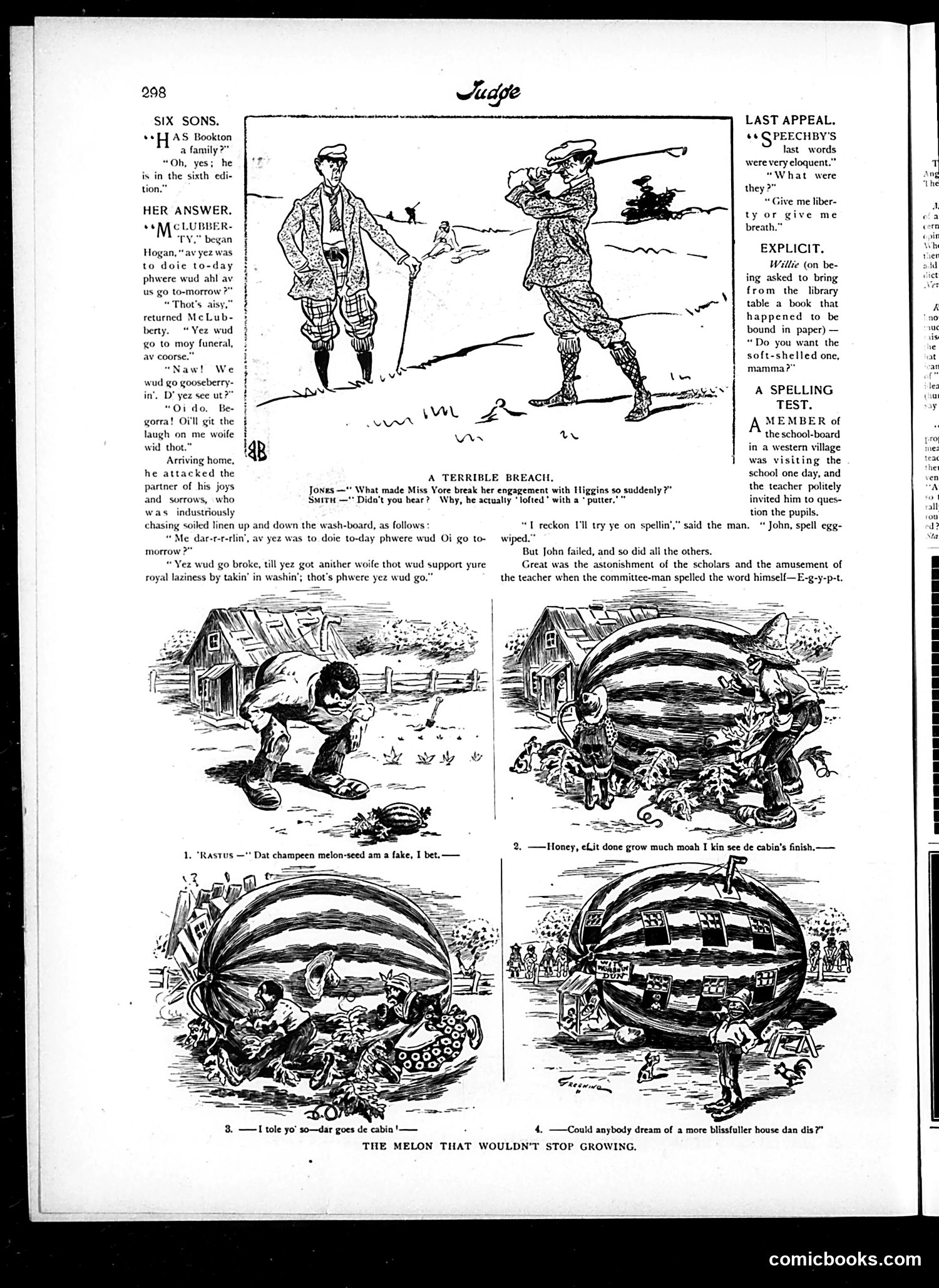
This page contains multiple satirical sketches typical of Judge's humor: **"Six Sons"** and **"Her Answer"**: A domestic comedy sketch in Irish dialect where a husband asks his wife where he'd go if he died tomorrow. She sardonically replies he'd "go broke" without her income from taking in laundry—mocking working-class financial dependence and marital dynamics. **"A Terrible Breach"**: A golf joke about Jones breaking his engagement with Miss Yore because Higgins used a "putter" (a golf club, but the word suggests improper behavior). **"A Spelling Test"**: A schoolboard member tests pupils on spelling "egg" but they all fail. He then spells it "E-g-y-p-t"—the joke being he's incompetent himself, satirizing rural education standards and government oversight. **"The Melon That Wouldn't Stop Growing"**: A series of four panels showing an enormous melon progressively destroying a cabin, satirizing either agricultural absurdity or exaggeration in farming claims. The overall tone mocks working-class life, rural ignorance, and institutional incompetence through visual humor and dialect comedy.
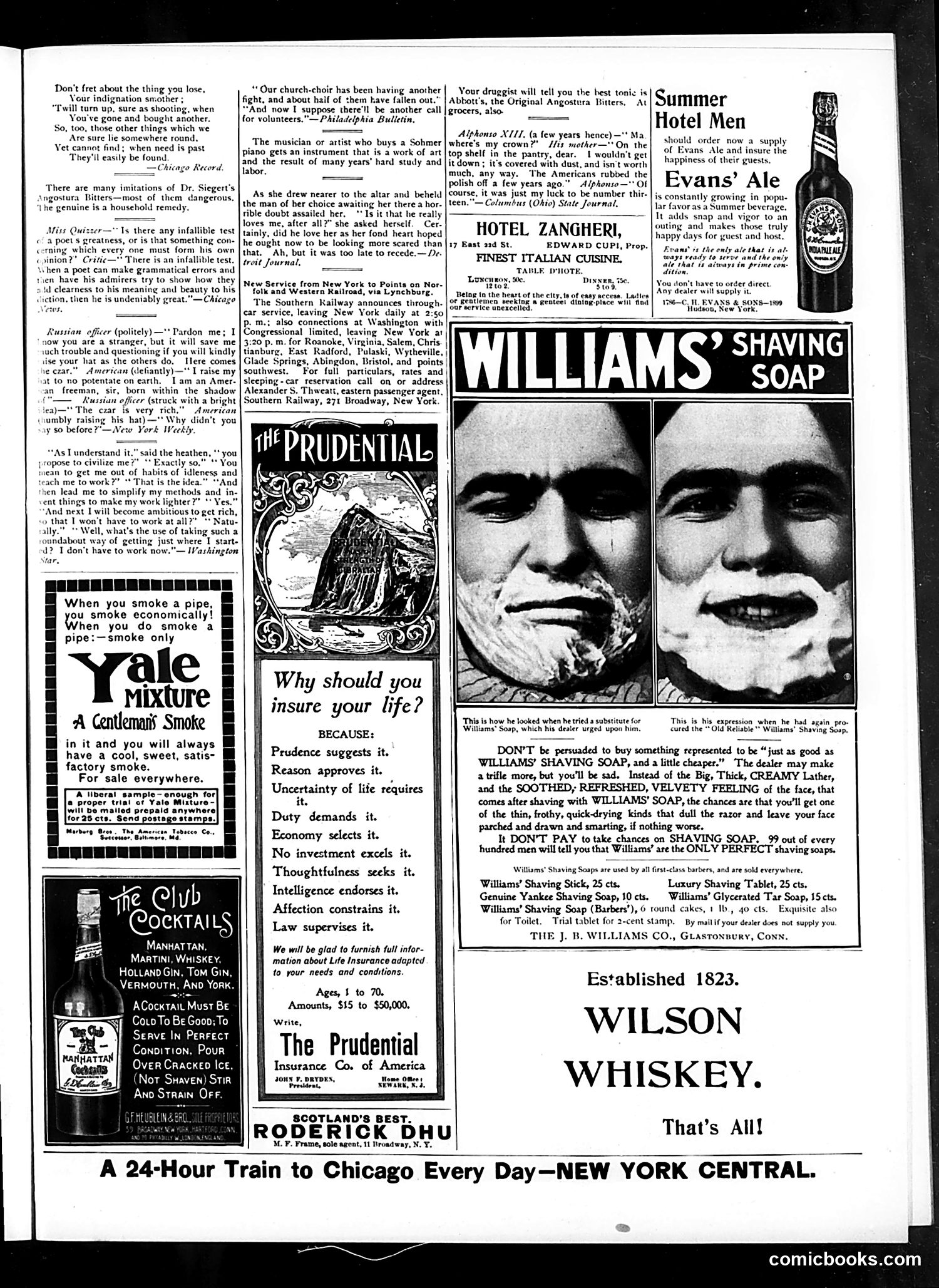
This page is primarily **advertisements and filler content** rather than political satire. The dominant features are ads for Wilson Whiskey, Williams' Shaving Soap, The Prudential Insurance, Yale Mixture tobacco, and cocktail ingredients. The small text items appear to be **humorous anecdotes** typical of Judge's format: - A joke about Russian deference to authority (an American refuses to tip his hat until learning the Czar is wealthy) - A satirical exchange where a "heathen" points out that "civilizing" him into work habits just returns him to his original laziness - Various domestic humor pieces about poets, church choirs, and engagements **No clear political cartoon is visible.** The Williams' Shaving Soap section includes before/after photographs demonstrating the product's effect, which is straightforward advertising rather than satire. The page reflects Judge's typical mixed format of **light social humor, advertisements, and consumer goods promotions**, rather than hard-hitting political commentary.
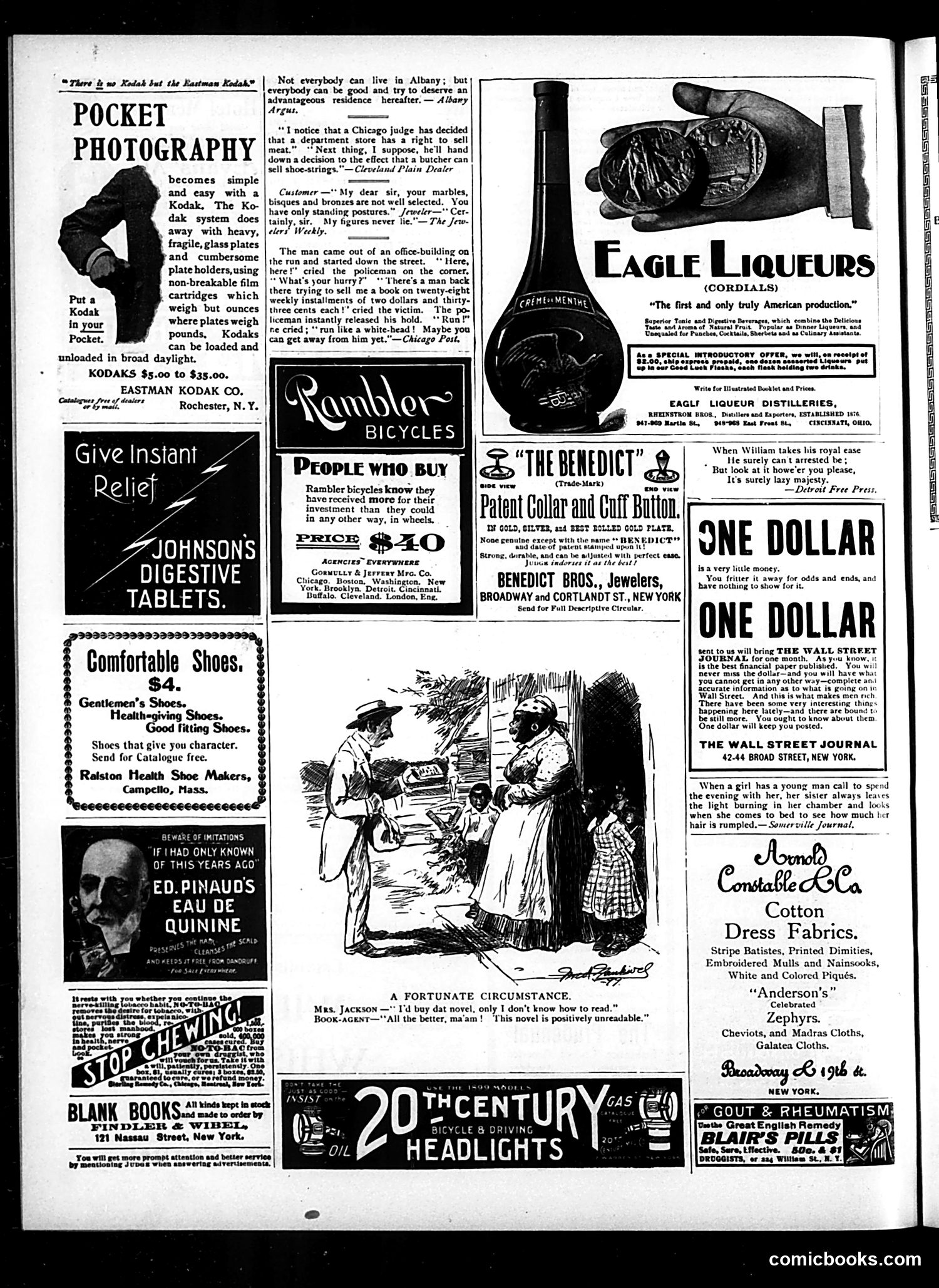
This page from *Judge* is primarily **advertising** rather than editorial satire. However, it includes several brief humorous items: **The cartoons/jokes:** - A sketch titled "A Fortunate Circumstance" depicts a book agent convincing a woman who can't read to buy an unreadable novel—a jab at both poor literature and aggressive sales tactics. - Brief quips mock: a Chicago judge's absurd ruling (department stores selling meat), a jeweler claiming his figurines "never lie," and a police officer sympathizing with someone fleeing a book salesman using predatory installment plans. **The advertisements** include period products: Kodak cameras (emphasizing ease-of-use), Johnson's Digestive Tablets, Rambler bicycles, Eagle Liqueurs, and *The Wall Street Journal* subscription. The page's humor targets **commercialism, dishonest salesmanship, and questionable consumer products**—typical *Judge* satire. The "unreadable novel" joke particularly reflects contemporary anxieties about mass-market publishing quality.
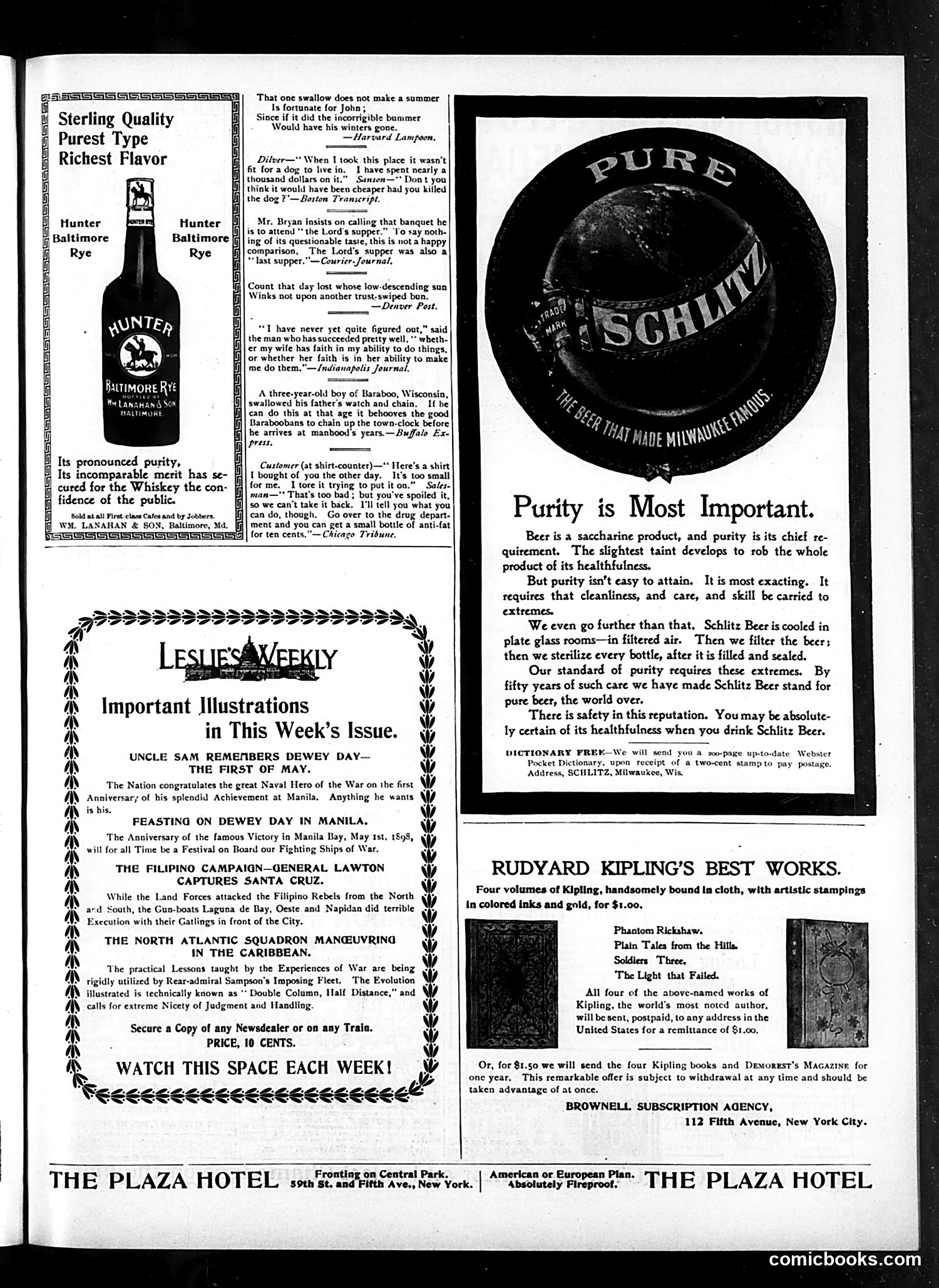
This page is primarily **advertising and announcements**, not political satire. The left column contains humorous quotations (a common Judge feature), while the right features a **Schlitz Beer advertisement** emphasizing purity through multiple filtration and sterilization processes. The middle section announces commemorative content about **Admiral Dewey's naval victory at Manila Bay (May 1, 1898)** during the Spanish-American War—celebrating the first anniversary. References to "the Filipino Campaign" and "General Lawton" reflect contemporary U.S. military operations in the Philippines following that war. The humor snippets mock everyday situations (wives' spending habits, shirt returns, swallowing pocket watches) rather than offering political commentary. The **Rudyard Kipling advertisement** at bottom promotes his collected works. **Context for today:** This represents Judge circa 1899, when American imperial expansion and the Philippine conflict were current events, Dewey was celebrated as a national hero, and beer companies marketed products through purity claims.
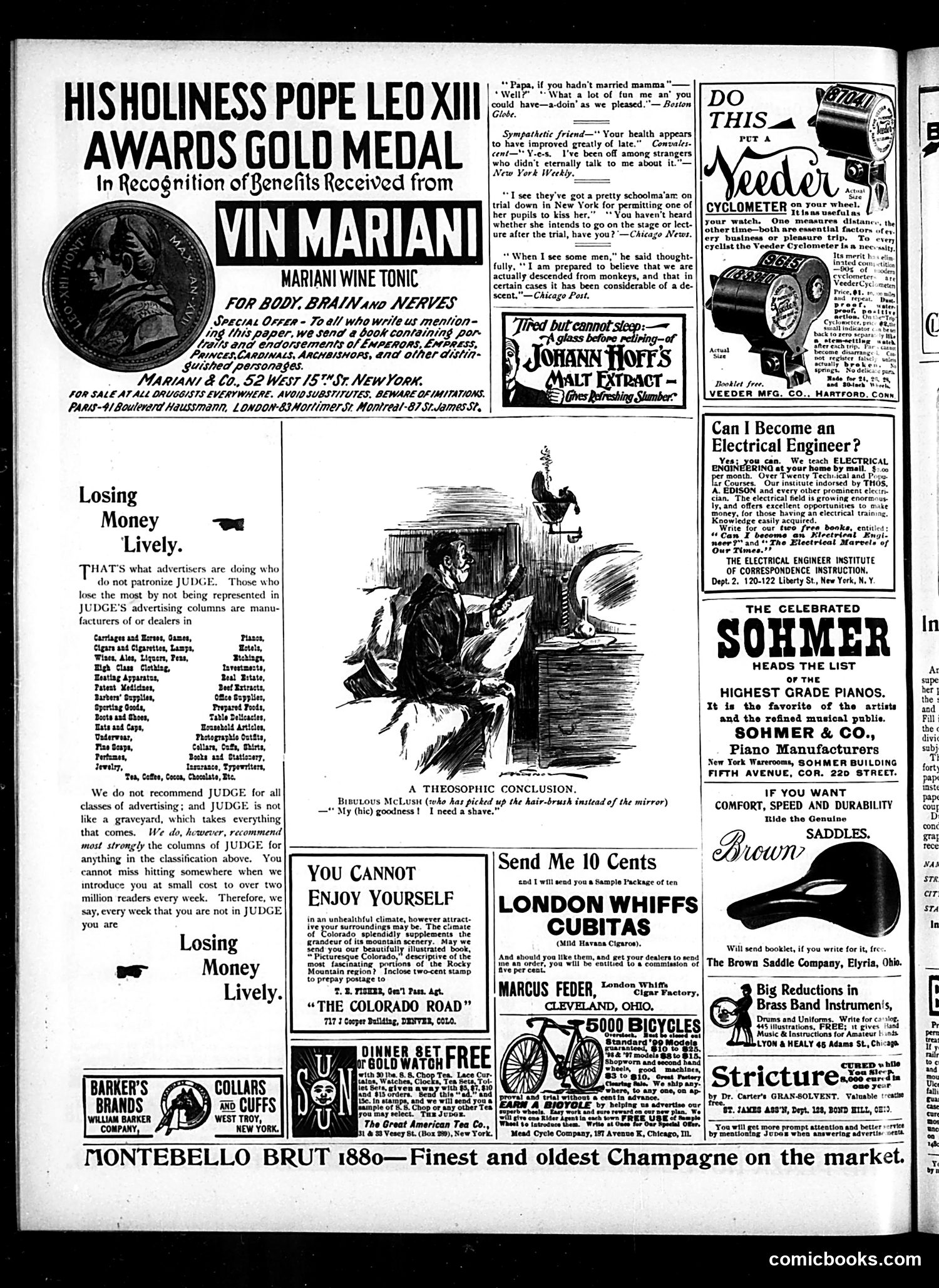
This page is primarily **advertising**, not political satire. The dominant feature is a full-page advertisement for **Mariani Wine Tonic**, claiming Pope Leo XIII awarded it a gold medal for health benefits. This is a patent medicine ad exploiting religious authority for credibility—a common practice in this era. The page includes small **humor fillers** (jokes) on various topics: marriage, health, a schoolteacher trial, and evolution, which were typical filler content for satirical magazines. The cartoon shows a man (labeled "Bibulous McLeish") mistaking a hairbrush for a mirror while intoxicated—a simple visual gag about drunkenness. The remaining space contains **typical period advertisements** for bicycles, saddles, cigars, tea, and correspondence courses. There is **no significant political content** on this page. It represents standard magazine monetization through product advertising and light humor.
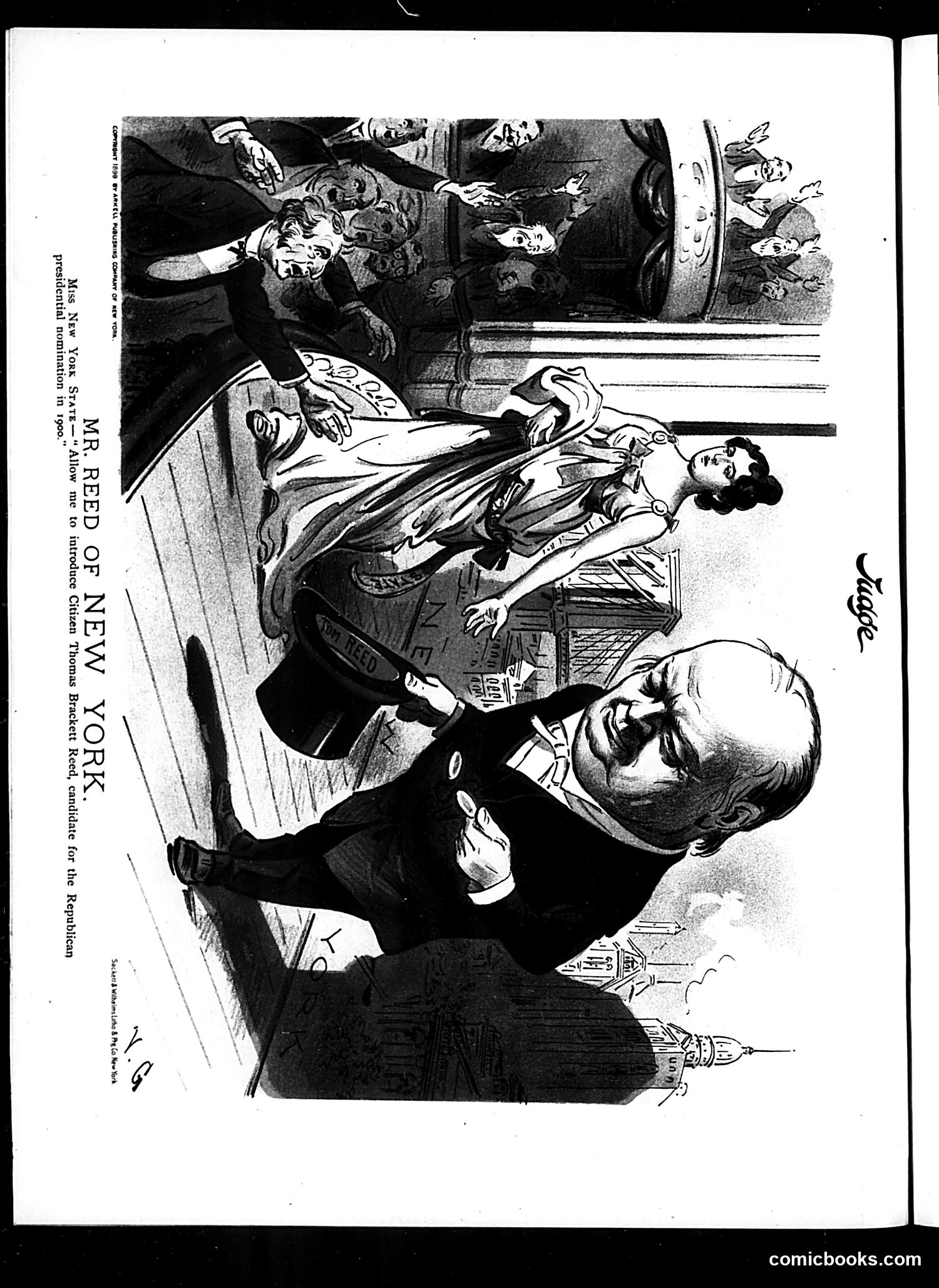
This Judge magazine cartoon satirizes **Thomas Brackett Reed**, a prominent Republican politician from New York who sought the 1900 presidential nomination. The image shows a bald, heavyset man being introduced to "Miss New York State" (personified as an attractive woman), suggesting Reed is courting voter support from his home state. The satire likely mocks Reed's presidential ambitions or his political character—the somewhat grotesque physical caricature combined with the formal "introduction" implies skepticism about his candidacy or fitness for higher office. Reed was known as a formidable Speaker of the House, but this cartoon suggests Judge editors viewed his presidential aspirations with humor or derision, portraying him as an unlikely suitor for the nation's highest office.