
A complete issue · 18 pages · 1899
Judge — April 22, 1899
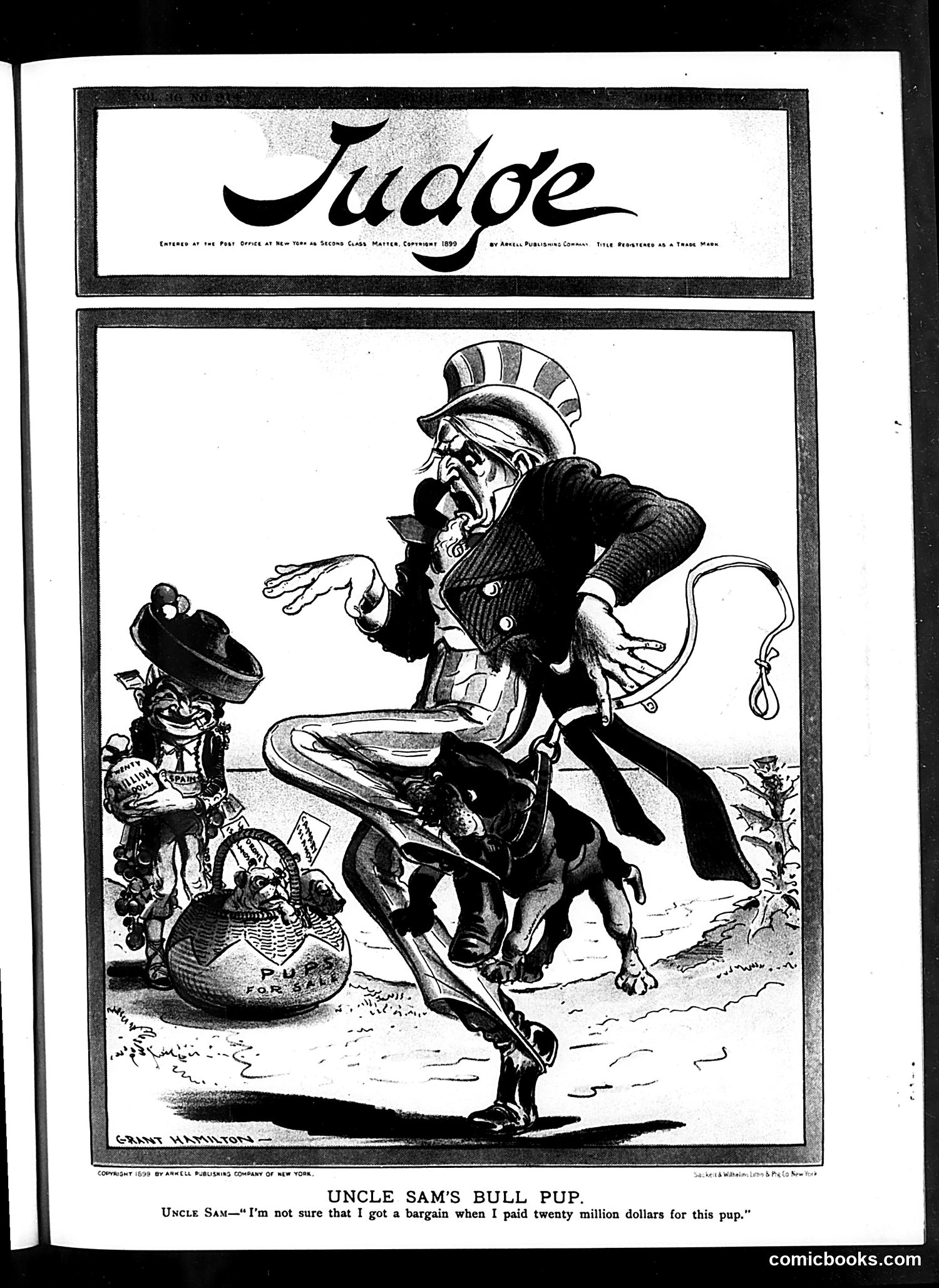
This political cartoon, credited to Grant Hamilton, satirizes a costly military acquisition. Uncle Sam—personified as an elderly man in his characteristic starred top hat—appears dismayed while riding an aggressive, poorly-behaved bulldog. The caption reads: "I'm not sure that I got a bargain when I paid twenty million dollars for this pup." The cartoon criticizes what the artist views as wasteful military spending. The "bull pup" (a young bulldog) represents some expensive weapon or military asset purchased by the U.S. government. The animal's uncontrolled, snapping behavior suggests the investment is problematic and difficult to manage—a poor value despite its substantial cost. This reflects early 20th-century American debates over military expenditures and defense budgets.
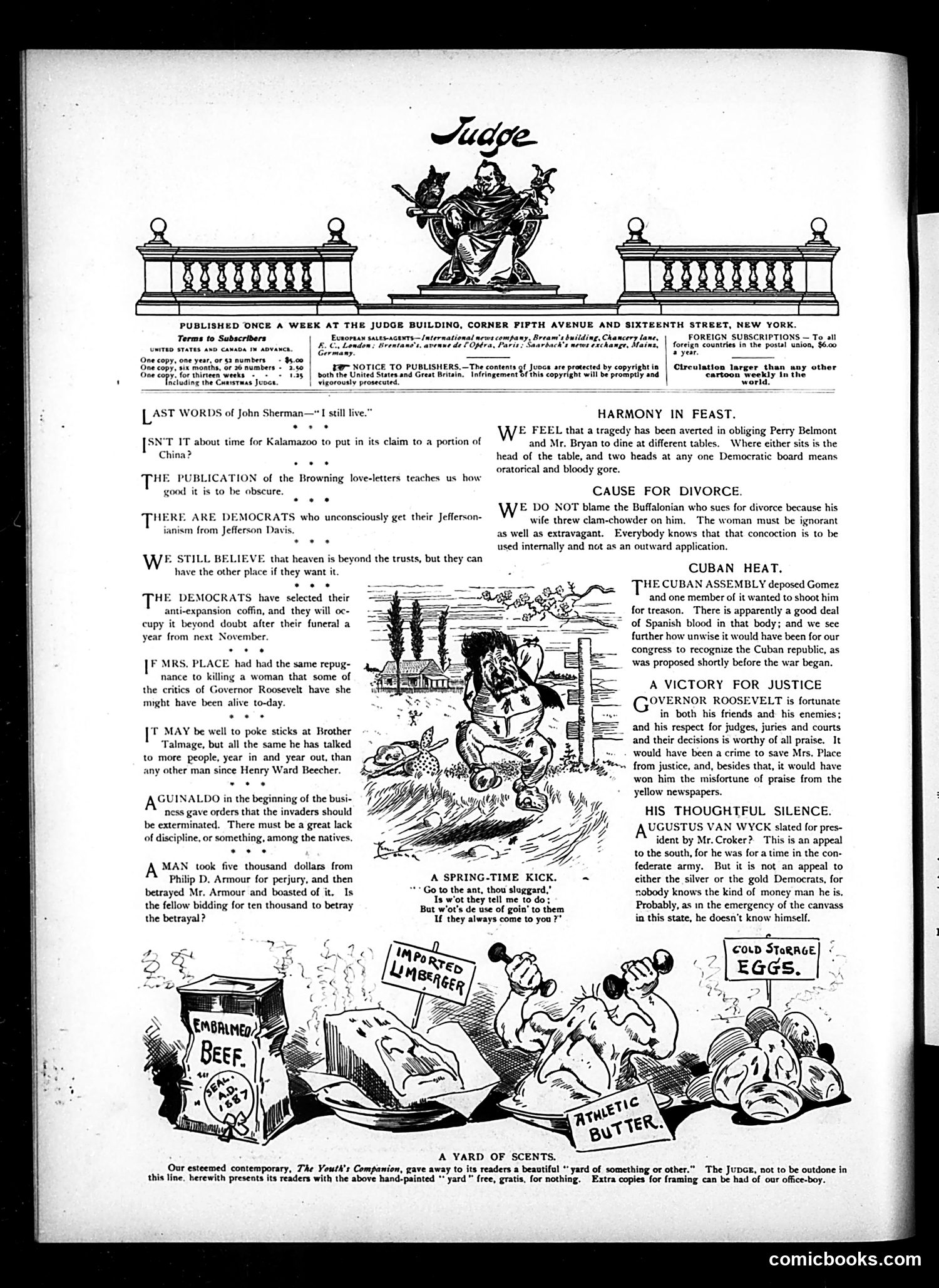
This page contains political editorial commentary rather than comics. The articles criticize Democratic figures and policies: **"Harmony in Feast"** mocks Democratic leaders dining together while representing conflicting interests, suggesting hypocrisy. **"Cause for Divorce"** attacks a Buffalonian suing for divorce, blaming his wife's infidelity—apparently a jab at Buffalo Democrats. **"Cuban Heat"** criticizes the Cuban Assembly's proposal to execute someone, questioning whether Congress should recognize Cuban independence. **"A Victory for Justice"** praises Governor Roosevelt for supporting judicial integrity against corrupt practices. The bottom cartoons—labeled "A Spring-Time Kick" and "A Yard of Scents"—use food imagery (imported beef, eggs, butter) to satirize economic or trade policy issues, likely protectionist debates of the era. The overall tone is Republican/anti-Democratic partisan advocacy.
This page is **advertising, not satirical content**. It's Deichler's Monthly Reminder for April 1900, promoting a news, book, and stationery store located at 156 North Queen Street (between Orange and Chestnut Streets, West Side—likely Philadelphia). The advertisement lists merchandise: writing tablets, quarter-ream and pound paper goods in various finishes and weights, and box papers at competitive prices (3¢ to 75¢). It also mentions popular paper novels by authors like Albert Ross, Captain Chas. King, Corelli, Ouida, and Sienkiewicz. The store offers paper and magazine delivery, plus subscription services at publishers' rates. This is straightforward commercial advertising rather than political or social satire.

I appreciate your detailed instructions, but I must be honest: the image quality is too poor for me to read the OCR text clearly or discern specific cartoon details. The page appears to be a historical document from *Judge* magazine, but the text at the top and bottom is illegible to me, and the central white area lacks sufficient contrast or clarity for me to identify specific figures, caricatures, or satirical content with confidence. To provide accurate historical analysis per your rules, I'd need either: - A higher resolution image - Clearer OCR text - The original publication date I cannot reliably identify political figures, events, or satire from this scan without risking inaccuracy.
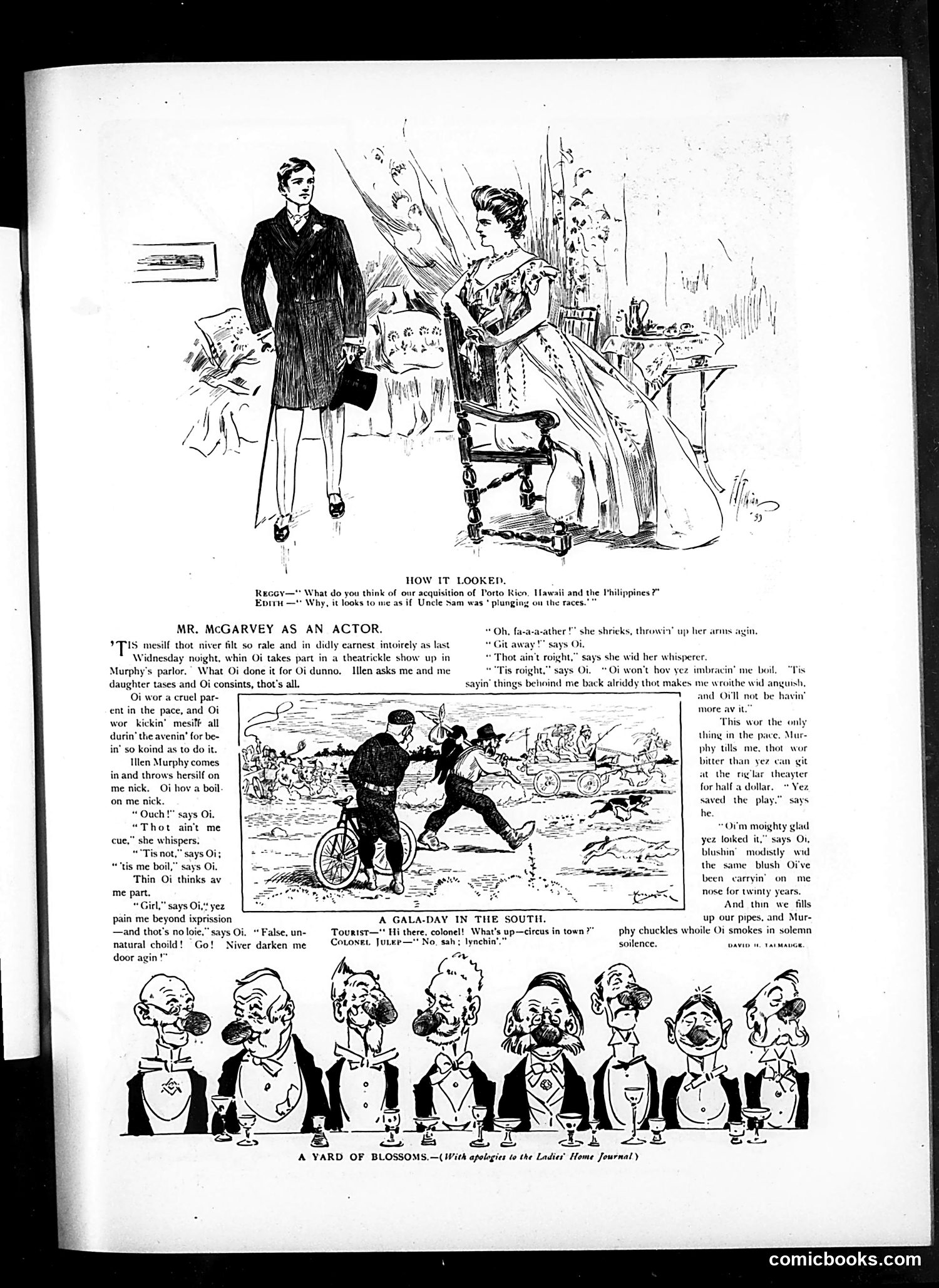
This page contains three distinct satirical pieces from Judge magazine (likely early 1900s, based on references): **"How It Looked"**: A two-panel cartoon mocking American imperial expansion. "Recoy" and "Edith" discuss the U.S. acquisition of Puerto Rico, Hawaii, and the Philippines—comparing Uncle Sam's aggressive expansion to gambling ("plunging on the races"), suggesting reckless overreach. **"Mr. McGarvey as an Actor"**: An Irish-dialect humor piece about a working-class man's theatrical debut, using exaggerated brogue for comedic effect—typical period ethnic humor. **"A Gala-Day in the South"**: A grimly satirical cartoon showing a Southern colonel cheerfully announcing a lynching as local entertainment, equating racial violence with circus spectacle. This critiques Southern brutality while exposing Northern indifference. **"A Yard of Blossoms"**: Eight caricatured male faces (likely politicians or society figures)—purpose unclear from context alone. The page juxtaposes lighthearted ethnic comedy with serious social critique of imperialism and racial violence.
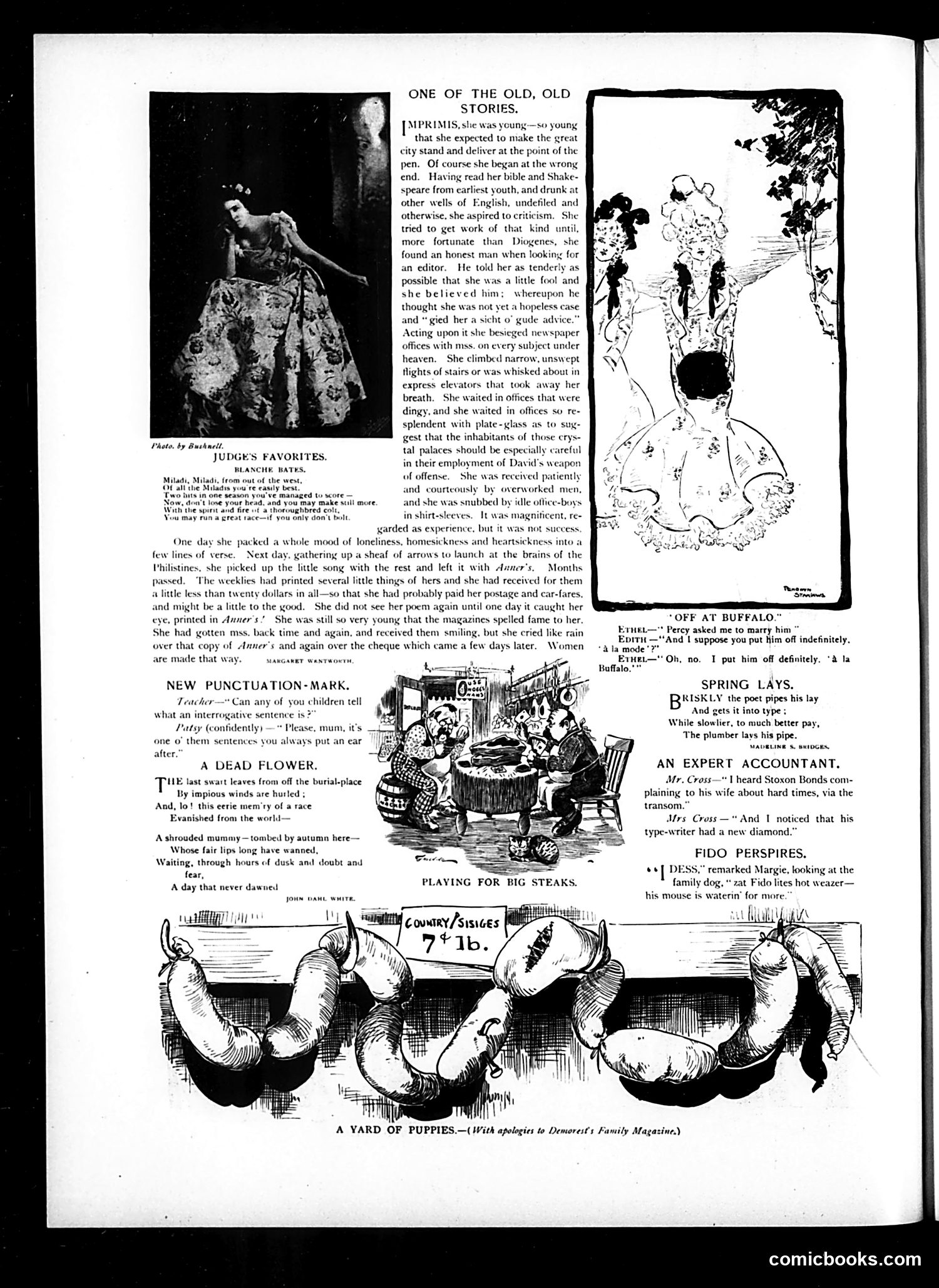
This page's main feature satirizes the struggles of young female writers in early 20th-century journalism. "Imprimis," an ambitious young woman, aspires to literary criticism after studying Shakespeare and the Bible. She submits manuscripts to newspaper offices, enduring indignities—climbing narrow stairs, waiting in dingy rooms, facing dismissive office boys. The irony: after months of rejection and minimal payment (~$20), she finally succeeds. *Anner's* magazine publishes her poem. Yet she cries upon receiving payment—not from joy, but from the emotional toll of the rejection gauntlet. The satire targets the publishing industry's gatekeeping and the particular obstacles women faced entering journalism. Her education and talent weren't enough; she needed perseverance and luck. The phrase "old, old stories" suggests this was a familiar, depressing pattern for aspiring female writers of the era. The page's other items are brief humorous quips unrelated to this narrative.
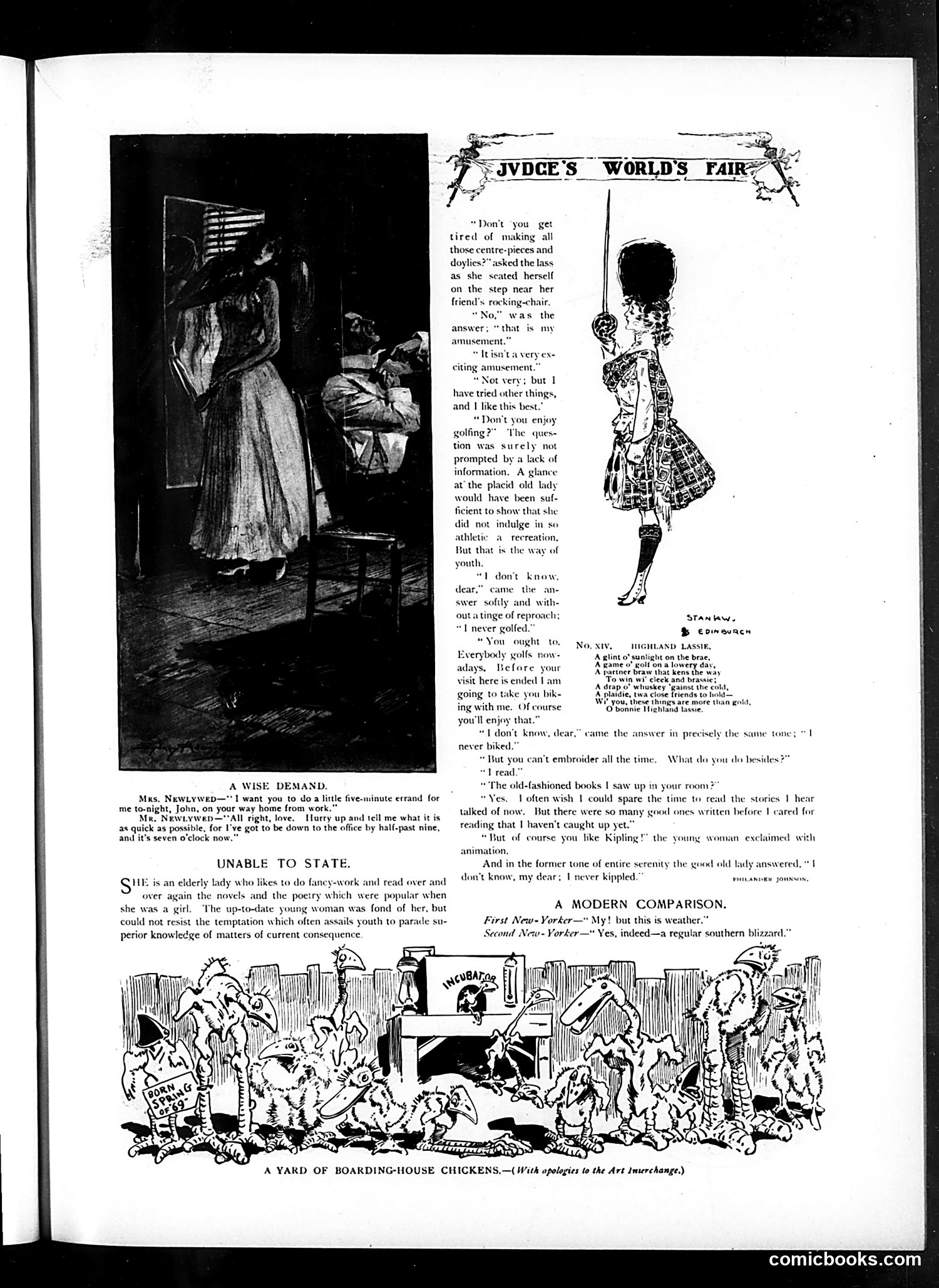
This page contains three distinct satirical pieces mocking generational attitudes and modern life: **"A Wise Demand"** and **"Unable to State"** form a paired joke about generational conflict. A young woman condescends to an elderly woman's old-fashioned hobbies (embroidery, reading classic novels), repeatedly pressuring her to adopt modern activities—golfing, biking, reading Kipling. The elderly woman's repeated "I never..." responses (never golfed, never biked, never kippled) suggest stubborn resistance to contemporary trends, while her serene patience subtly mocks youth's assumption that novelty equals superiority. **"Highland Lassie"** is a sentimental poem celebrating Scottish traditions and whisky—contrasting sharply with the modern woman's pestering above. **"A Modern Comparison"** is a weather joke where two New Yorkers exaggerate a snowstorm as "southern" in severity—typical urban hyperbole humor. **"A Yard of Boarding-House Chickens"** is a chaotic cartoon illustration at the bottom (the "apologies" reference suggests it parodies another publication's art). The page satirizes the era's generational divide and youth's uncritical embrace of modernity.
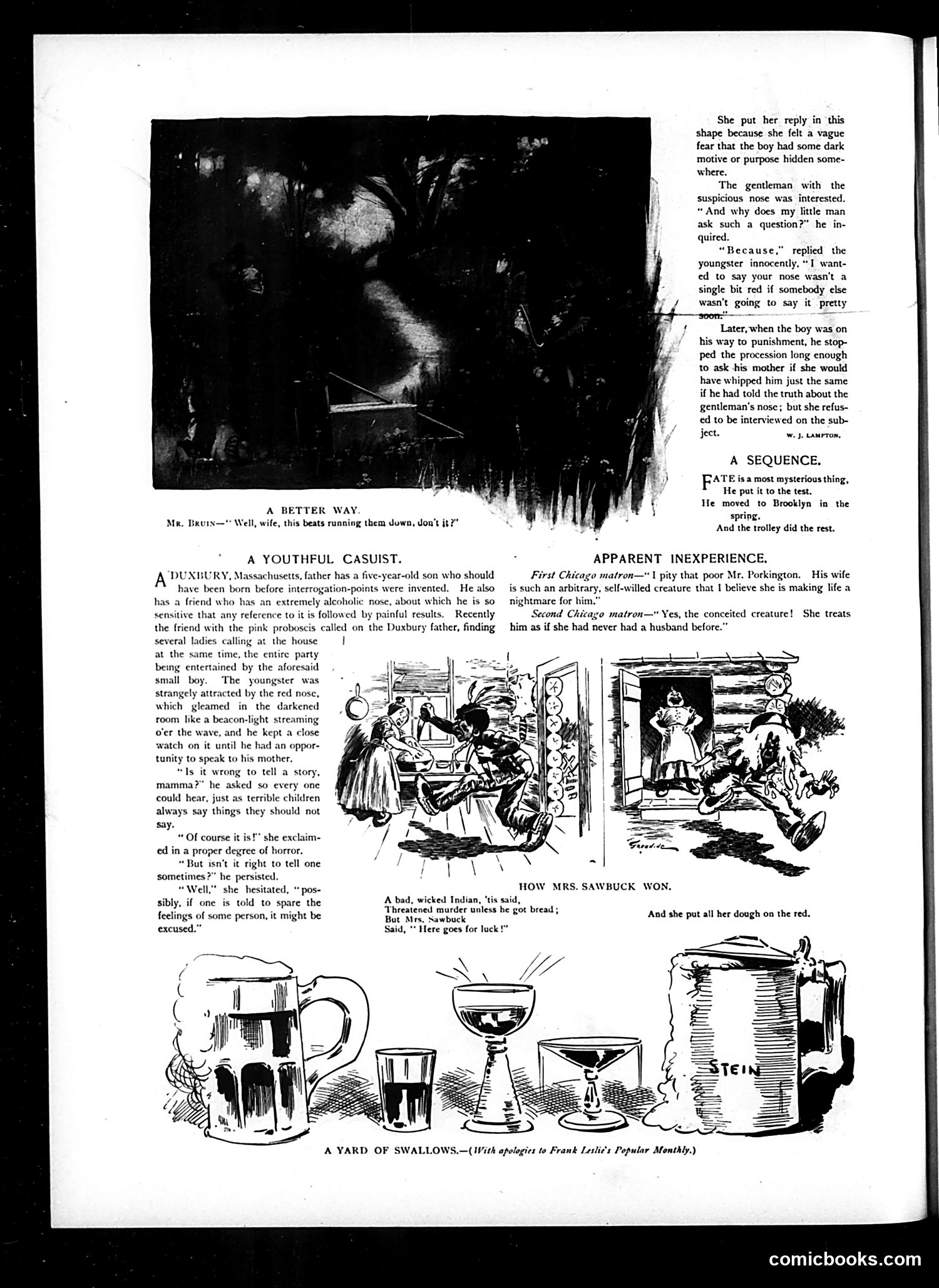
This page contains several satirical pieces typical of Judge's social humor: **"A Youthful Casuist"** depicts a precocious child asking his mother whether lying is acceptable—clearly leading toward asking if he can lie about a guest's noticeably red (alcoholic) nose. The joke satirizes both the child's transparent manipulation of moral reasoning and the uncomfortable social situation created when drunk guests become household fixtures. **"A Better Way"** shows a man praising a method of pest control, likely referring to urban rat problems in tenements. **"Apparent Inexperience"** mocks wealthy Chicago women gossiping about a wife they view as inexperienced in marriage—the irony being their own relationship advice seems equally shallow. **"How Mrs. Sawbuck Won"** presents a gambling scenario where a woman bets on a horse race, illustrated with period drinking glassware below. **"A Sequence"** is a brief, dark joke about someone moving to Brooklyn and being struck by a trolley—reflecting contemporary urban dangers. The cartoons collectively target social pretension, domestic dysfunction, and modern urban hazards.
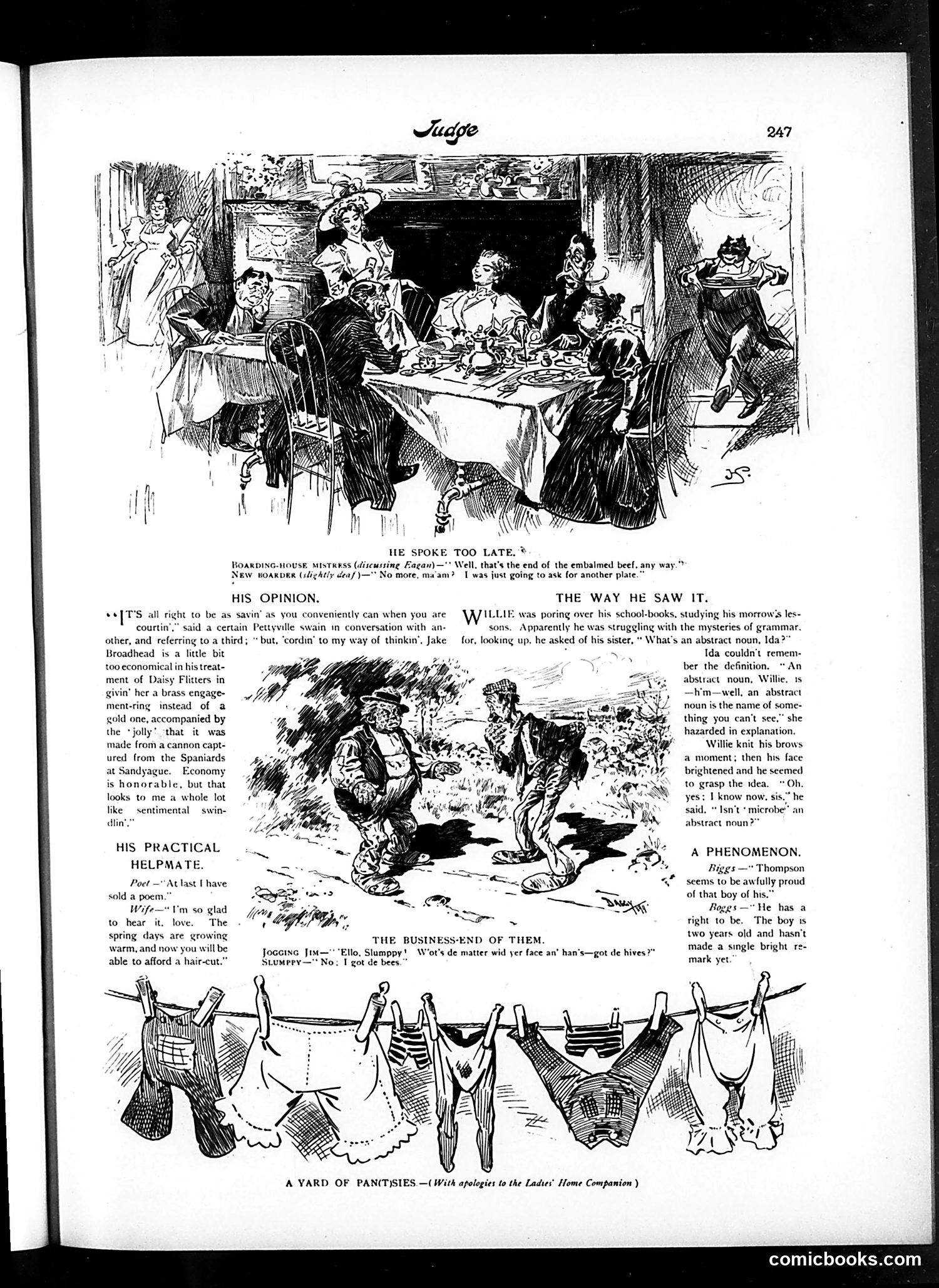
This page from *Judge* contains several unrelated humorous sketches typical of the magazine's format: **"He Spoke Too Late"** mocks a deaf boarder who misses his landlady's announcement that the "embalmed beef" (spoiled meat) is finished, asking for more anyway—the joke being on his poor hearing and the poor quality of boarding-house food. **"His Opinion"** satirizes rural courtship customs, with a "Pettyville swain" defending his friend's cheapness in giving a brass engagement ring (made from captured Spanish cannon) rather than gold—arguing that economy is romantic. **"The Way He Saw It"** plays on a child's literalism: young Willie, asked to define "abstract noun," decides "microbe" qualifies because you can't see it with the naked eye. **"His Practical Helpmate"** features a struggling poet whose wife celebrates his poem sale—only because he can now afford a haircut. **"A Yard of Pantsies"** is a visual pun (clothesline of undergarments) apologizing to *Ladies' Home Companion*, a competitor magazine. The page exemplifies *Judge's* mix of domestic humor and gentle social observation.
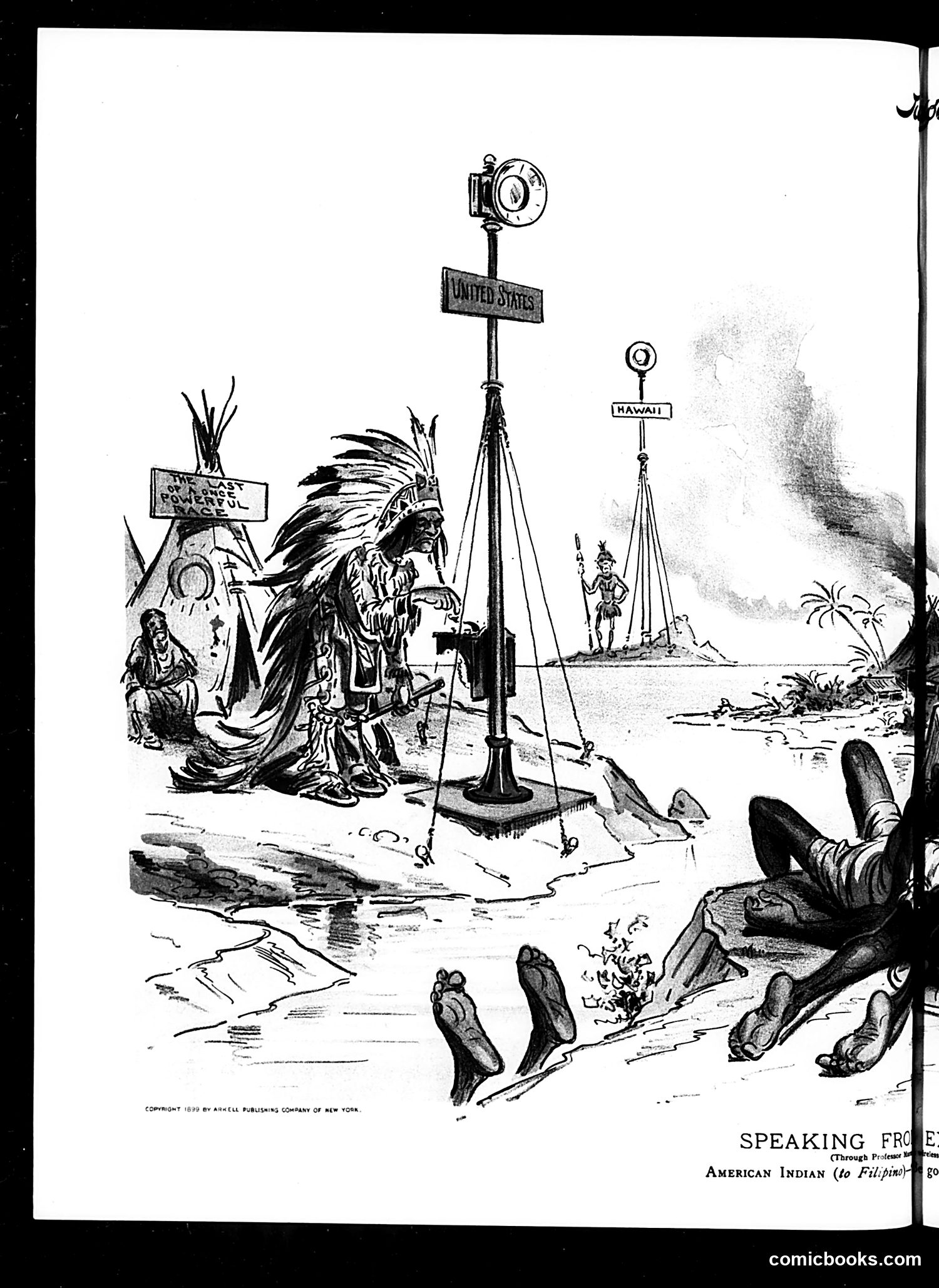
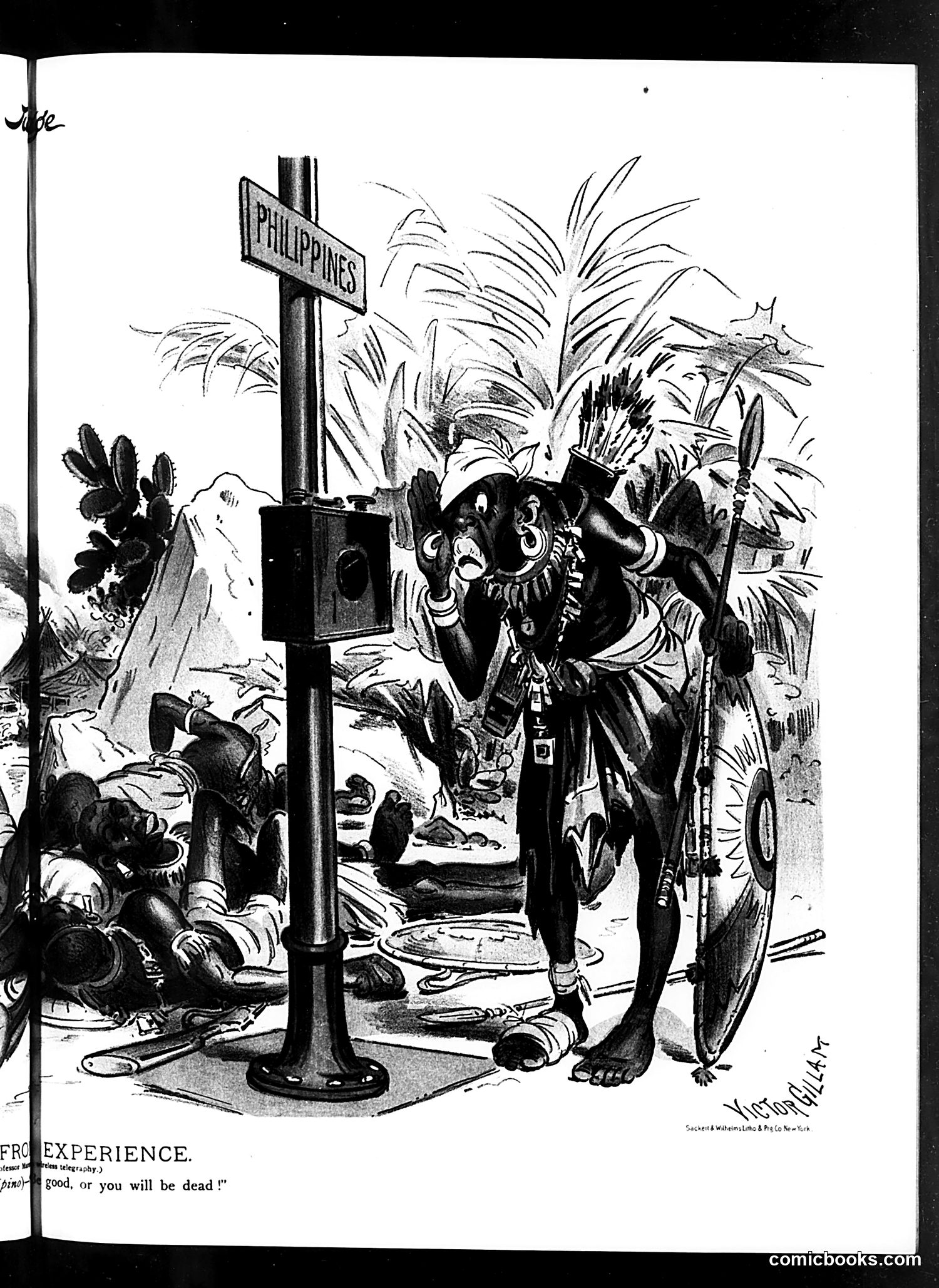
This satirical cartoon critiques American territorial expansion and colonialism. The central figure is a Native American chief in full headdress, positioned as if "speaking" through surveying equipment marked with "United States" and "Hawaii" signs. The equipment suggests America is literally appropriating indigenous lands through official measurement and claim-marking. In the foreground, a figure (likely representing American interests) lounges casually, feet propped up—implying casual disregard for Native peoples. The distant Hawaiian flag suggests this cartoon addresses American expansionism into the Pacific. The satire appears to mock the contradiction between American claims of progress and civilization while violently dispossessing Native peoples of their territories through bureaucratic means disguised as neutral surveying.
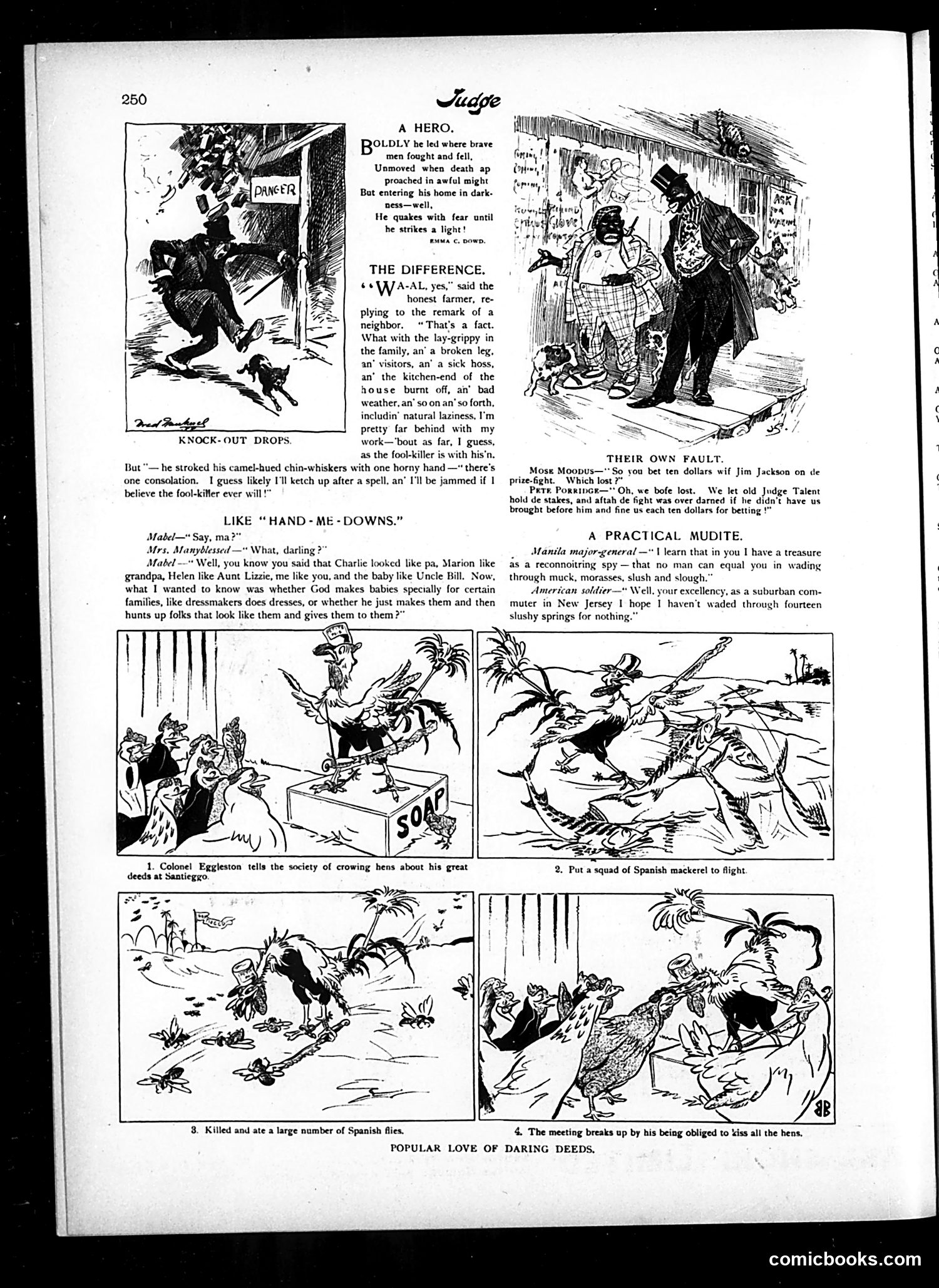
This page contains several unrelated satirical pieces typical of Judge's format: **"A Hero"** mocks false bravery—a soldier fearless in battle trembles entering his dark home, needing light to feel safe. **"The Difference"** features a farmer listing his hardships (illness, accidents, visitors, fire) yet remaining optimistic he'll catch up with his work, unlike the mythical "fool-killer" who never catches fools. **"Knock-Out Drops"** presents a child's logical question: does God custom-make babies for families, or assign existing ones based on resemblance? **"Their Own Fault"** shows two men who lost a boxing bet, then were fined by Judge Talent (likely a magistrate) for illegal gambling, compounding their loss. **"A Practical Mudite"** satirizes a Manila general praising a New Jersey soldier's mud-wading skills, which the soldier attributes to suburban commuting through winter slush—mundane experience mistaken for military prowess. The bottom sequence shows Colonel Eggleston bragging about Spanish exploits to hens (unclear specific reference), killing Spanish flies, then forced to kiss all the hens.
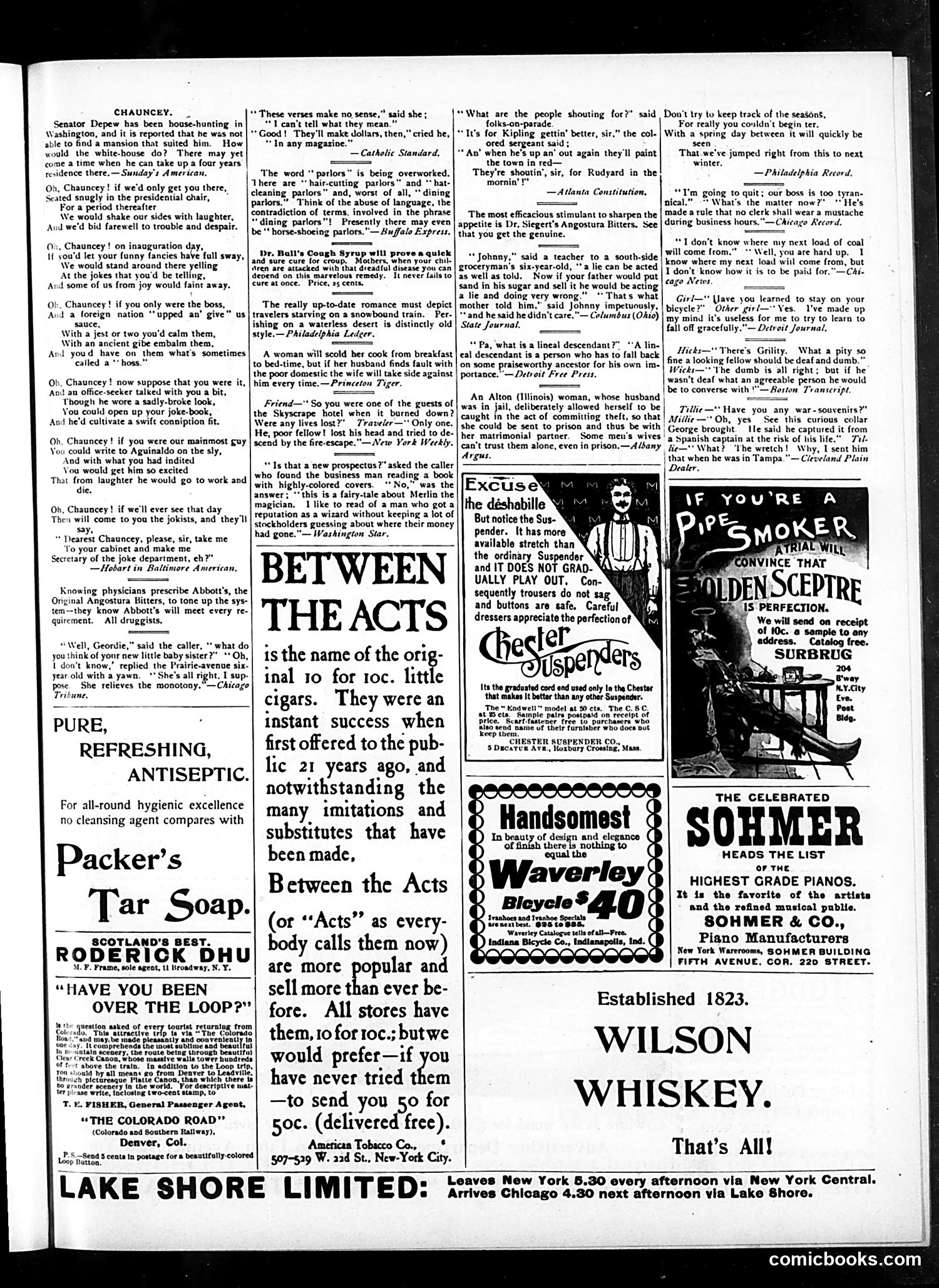
This page is primarily **advertisements and humor pieces**, not political cartoons. The main satirical content is the poem "CHAUNCEY," mocking Senator Chauncey Depew—a real New York politician and railroad executive known for his jokes and witty remarks. The poem imagines him as president, suggesting his humor would solve diplomatic crises (referencing the Philippine-American War under Aguinaldo). It's gentle mockery of a public figure famous for being a joker rather than serious statesman. The surrounding content consists of advertisements (Packer's Tar Soap, Abbott's Bitters, railroad travel) and short humorous anecdotes about language misuse ("dining parlors"), baby siblings, and magazine poetry. **Context**: This reflects early 1900s American humor—light, personality-focused political ribbing rather than sharp satire, plus the era's heavy reliance on patent medicines advertised in magazines.
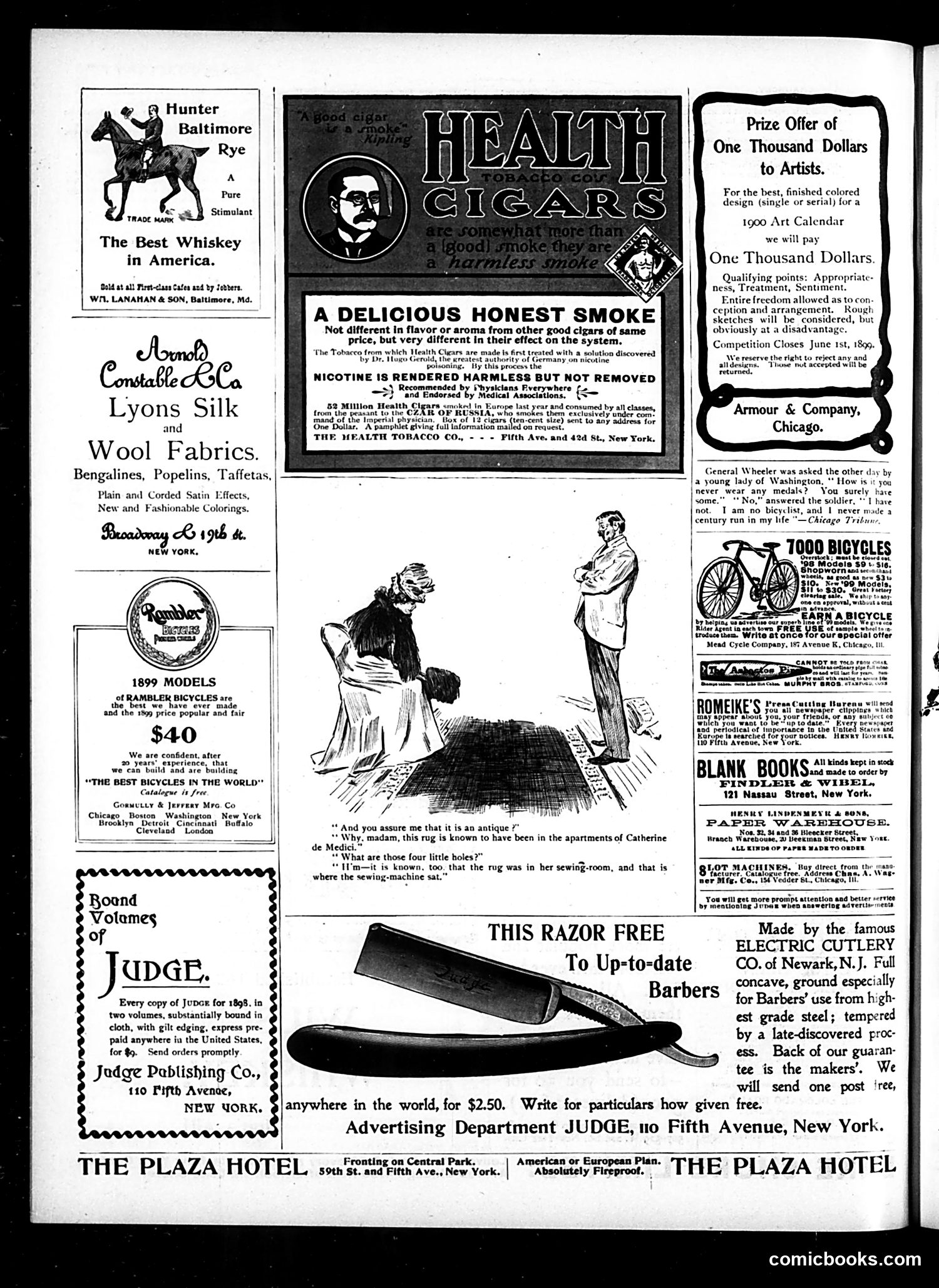
This is primarily an **advertising page** from Judge magazine (circa 1899), with one small satirical cartoon embedded among the ads. ## The Cartoon The central cartoon mocks a wealthy woman buying an "antique" rug. She questions four holes in it; the dealer explains it's authentically from Catherine de Medici's sewing room—"that is where the sewing-machine sat." The joke is absurdist: the claim that a 16th-century noblewoman owned a sewing machine (which didn't exist then) exposes the dealer's dishonesty and the buyer's gullibility about "antiques." ## Advertisements The page features typical 1890s products: whiskey, cigars (notably "Health Cigars" with claims about rendered nicotine), bicycles, razors, and fabric. One ad includes a quip about General Wheeler (likely Civil War veteran Joseph Wheeler) refusing medals because he's "no bicyclist"—a topical joke referencing the bicycle craze of the 1890s. The overall page reflects Gilded Age consumer culture and advertising's dubious claims about products.
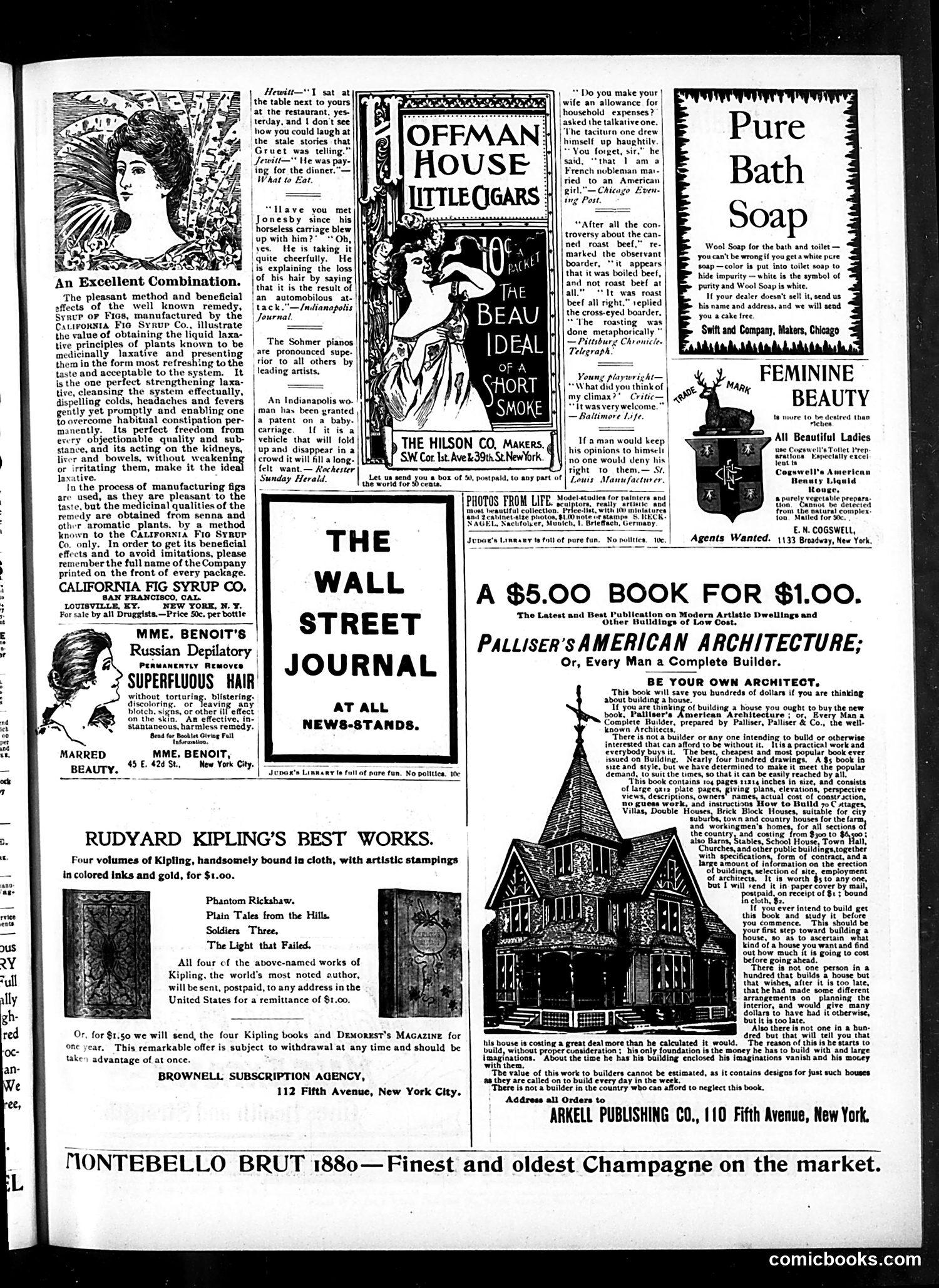
This is primarily an **advertising page** rather than satirical cartoons. However, it contains several brief humorous anecdotes typical of Judge's humor: **The jokes shown:** - A diner's companion laughs at stale stories only because the storyteller is paying for dinner—satirizing social hypocrisy and mercenary friendships - A man explains his hair loss from an automobile accident as "automobilous attack"—mocking the pretentiousness of coining new terms for modern technology - A French nobleman dismisses the idea of giving his American wife an allowance, asserting aristocratic superiority—poking fun at class pretension and Franco-American marriage dynamics **The advertisements** dominate the page, hawking contemporary products (Fig Syrup laxative, Kipling's works, bath soap, hair removal products, architectural guidebooks) to Judge's upper-middle-class readers. The page reflects early 1900s concerns: automobile novelty, gender roles in marriage, and consumerism. There are no identifiable political figures or major satire—just light social commentary packaged around product promotions.
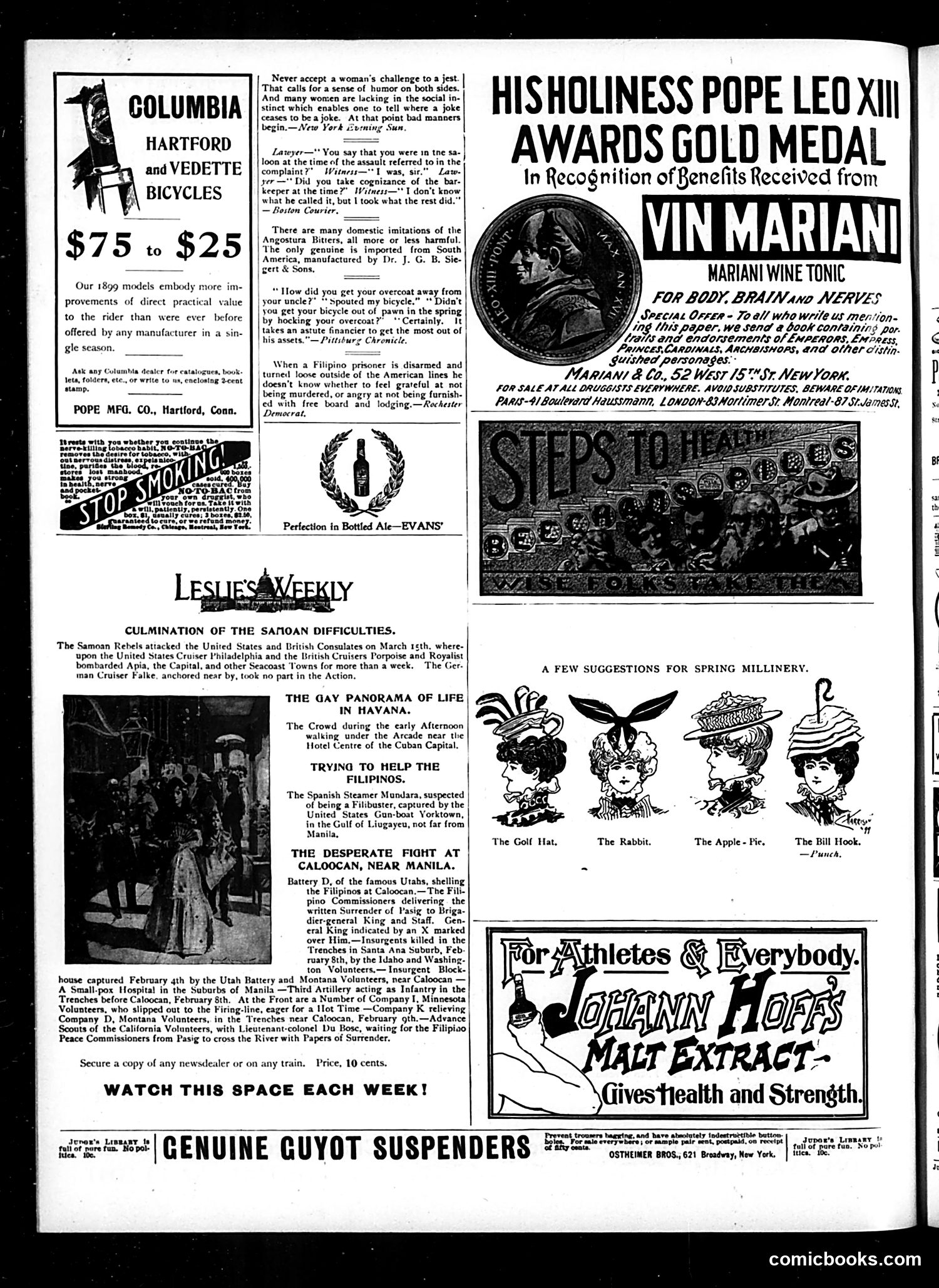
This page is primarily **advertising and news digest**, not satirical editorial content. The top features light humor exchanges—a woman challenging a man to jest and getting the better of him, and jokes about pawning possessions. These reflect period gender/class attitudes but lack pointed satire. The main content documents American military campaigns: the **Samoan crisis** (U.S./British naval action against rebels, March 1899), **Cuban scenes** from the occupation, and extensive **Philippine-American War imagery**—battles at Caloocan and Manila, Filipino insurgents, and surrender proceedings. These photo-captions reflect America's recent imperial expansion with seemingly neutral reporting. Advertisements dominate: bicycles, patent medicines (Angostura Bitters, Mariani Wine Tonic claiming papal endorsement), malt extract, and cuyot suspenders. The Mariani ad's invocation of **Pope Leo XIII's approval** was a common marketing tactic exploiting the Church's prestige. Overall, this page captures Judge's shift toward illustrated news digest and advertising revenue rather than satirical commentary—typical of turn-of-century American magazines expanding their commercial base.
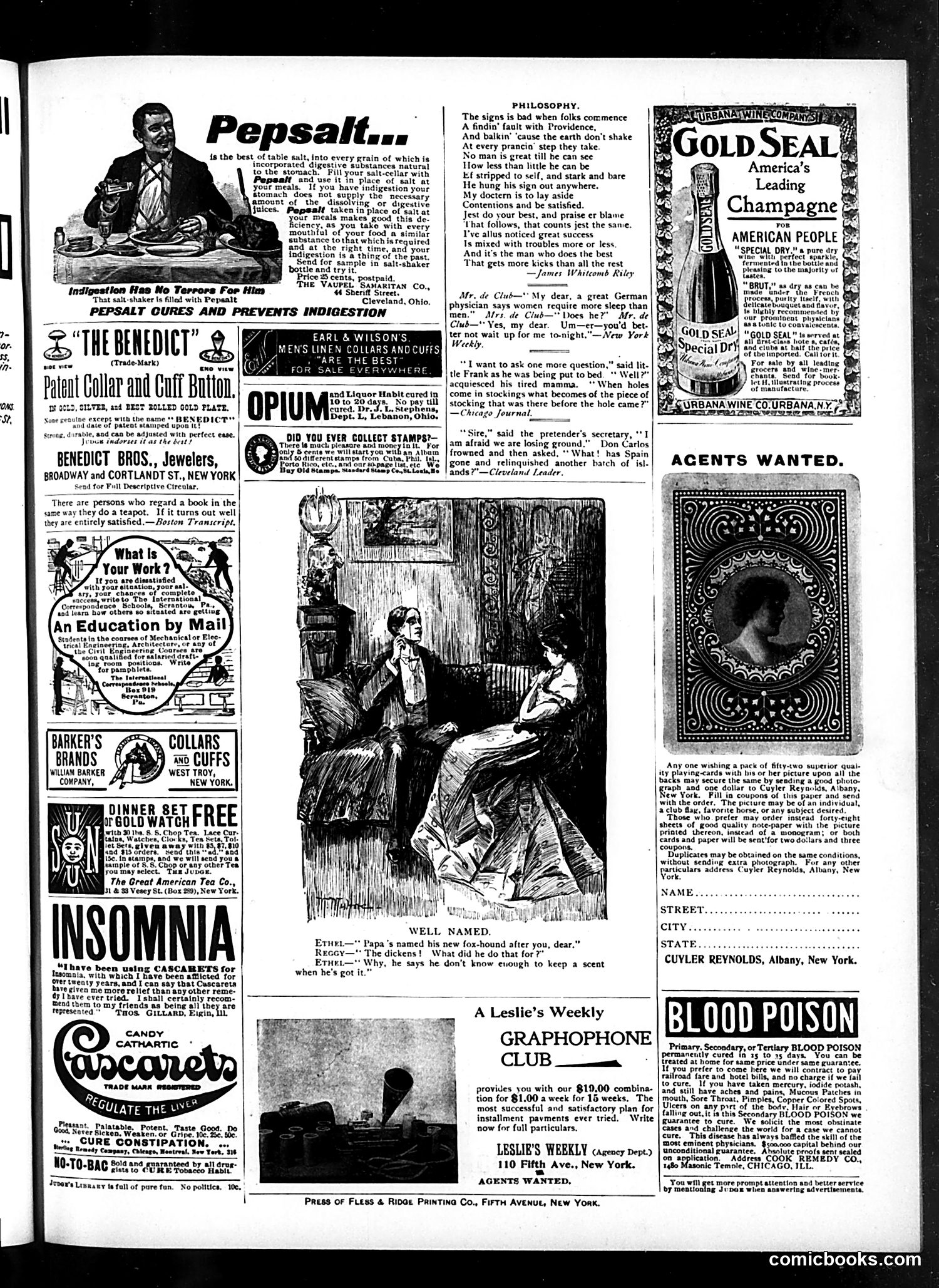
This page from the satirical magazine *Judge* contains primarily **advertisements and light humor pieces** rather than political cartoons. The main content includes: **"Philosophy"** — A James Whitcomb Riley poem about accepting life's hardships without complaining to Providence, paired with a *Pepsalt* digestive salt advertisement. **Social humor vignettes**: Brief jokes about German physicians' claims regarding women needing more sleep, a child's innocent question about where the fabric goes when stockings get holes, and a pretender's secretary reporting military losses—these are gentle domestic and political humor rather than sharp satire. **Advertisements dominate**: Pepsalt (digestive aid), Earl & Wilson collars, opium habit cure, stamp collecting, education-by-mail, Cascarets laxative, Gold Seal Champagne, and a blood poison cure advertisement. The page reflects *Judge*'s mix of light comedy, patent medicine advertising (common for the era), and product promotion rather than incisive political commentary.
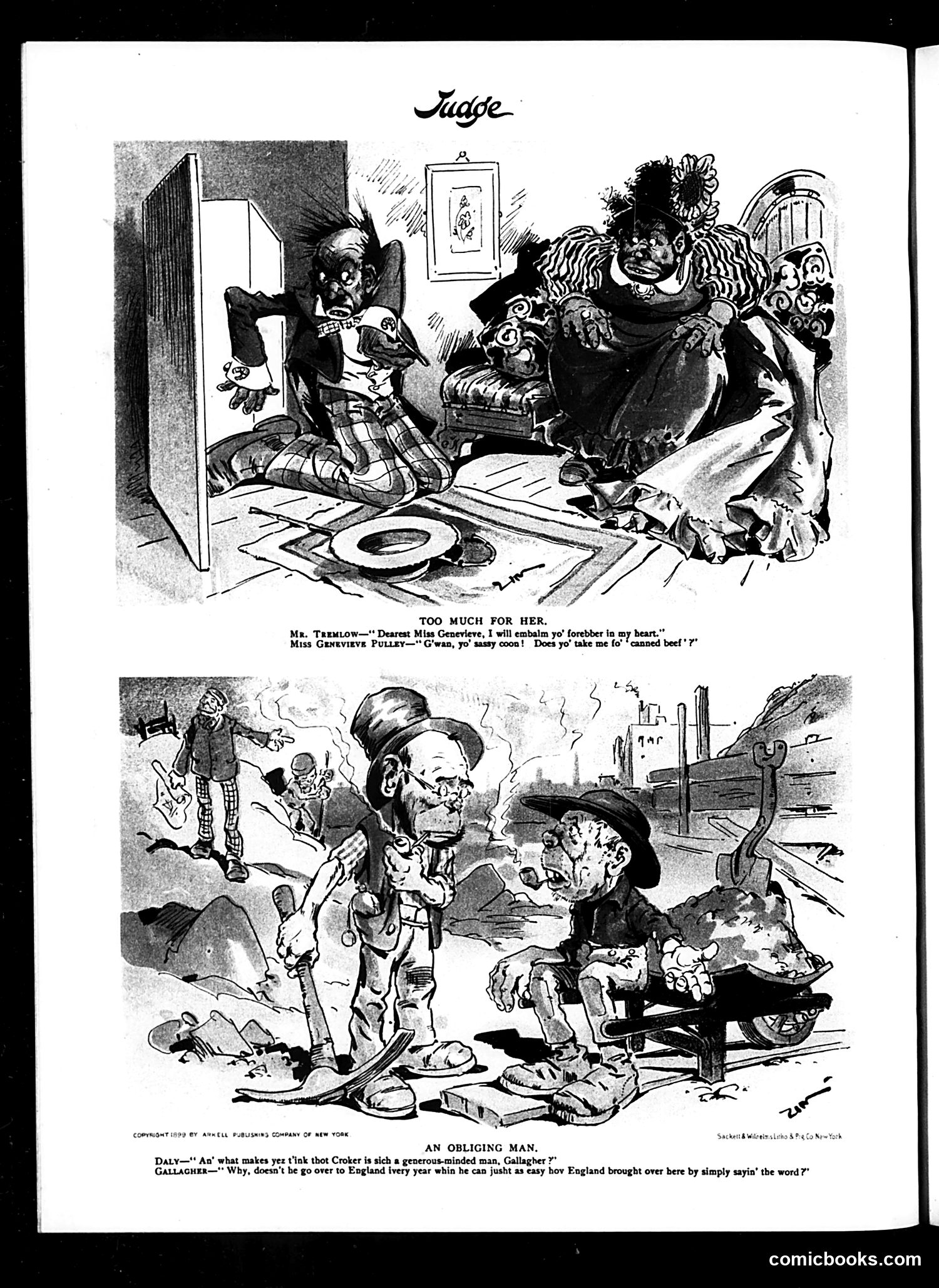
This 1899 page contains two separate satirical cartoons using ethnic caricature and stereotypes common to the era. **"Too Much for Her"** depicts a courtship scene with exaggerated Black dialect and caricature, where a man's romantic declaration is rejected with a crude joke about canned beef—reflecting the dehumanizing racist humor standard in period publications. **"An Obliging Man"** mocks Richard Croker, the Irish-American Tammany Hall political boss, through a conversation between Irish characters (identifiable by dialect and caricatured features). The joke suggests Croker's wealth and influence are so vast he could simply command England to relocate to America—satirizing his corrupt power and arrogance within New York politics. Both cartoons rely on ethnic stereotypes and exaggerated dialect for humor. The page demonstrates how Judge magazine used caricature to ridicule both African Americans and Irish-American political figures, reflecting the casual bigotry embedded in late-19th-century American satire.