
A complete issue · 16 pages · 1899
Judge — April 15, 1899
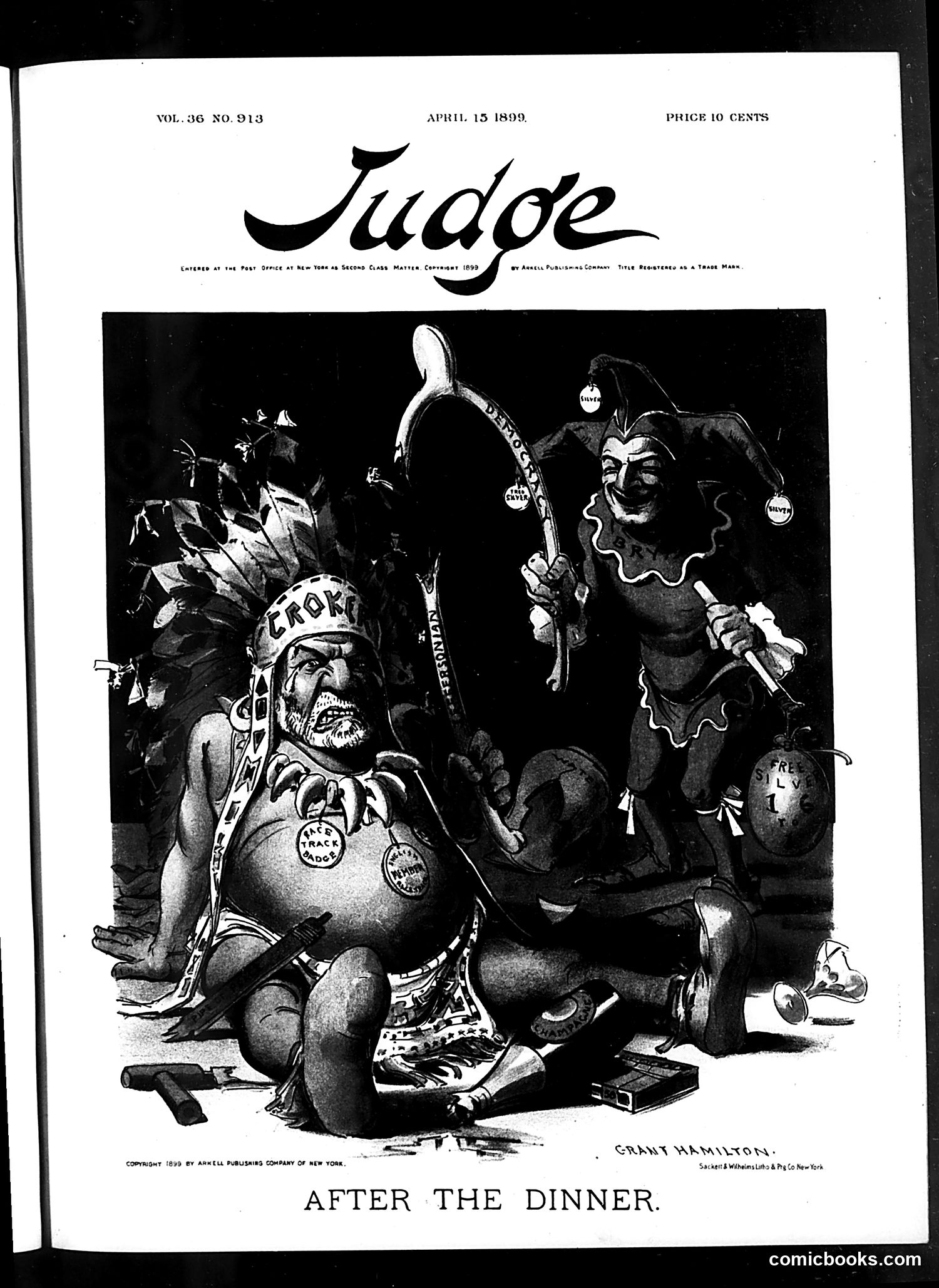
This cartoon by Grant Hamilton depicts a grotesque figure labeled "CROOK" adorned with medals and badges representing various scandals or corrupt practices. The figure is surrounded by what appears to be a devil or demon character and other symbolic elements suggesting vice and malfeasance. The title "After the Dinner" and the festive, ornamental decorations suggest this satirizes someone who has celebrated or benefited from corrupt dealings. The medals worn by the "CROOK" character likely reference specific contemporary scandals or instances of political corruption from 1899. Without clearer identification of the specific individual being caricatured, the broader point appears to be mocking political or corporate corruption and the way wrongdoers adorned themselves with symbols of their misdeeds.
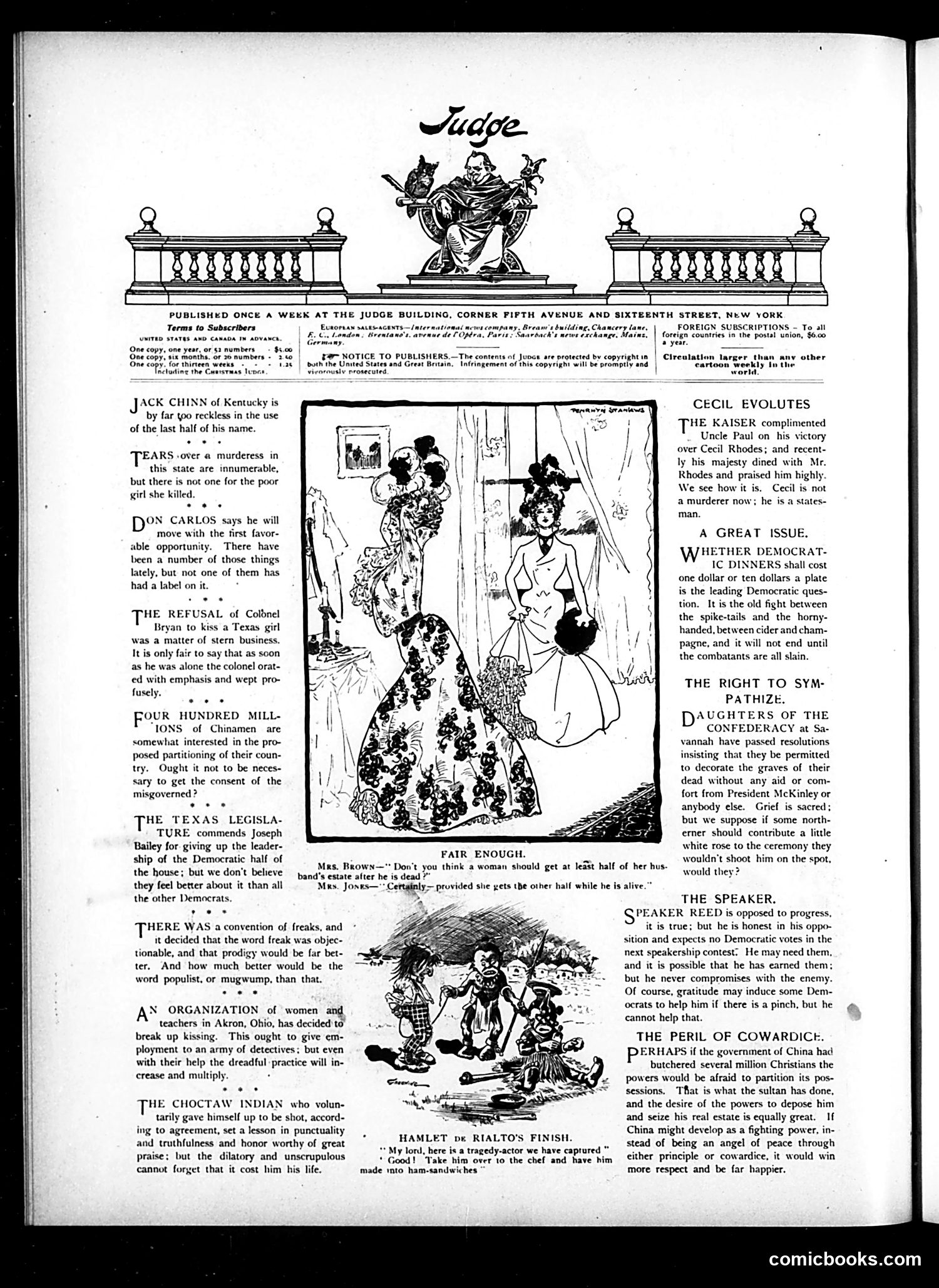
This page contains editorial commentary rather than traditional political cartoons. The visible illustrations appear to be satirical vignettes accompanying brief opinion pieces. The central cartoon labeled "Fair Enough" depicts a marital dispute over property division, with the caption suggesting a woman should receive "at least half of her husband's estate after he is dead." The bottom cartoon, "Hamlet de Rialto's Finish," shows what appears to be a theatrical scene, likely referencing contemporary drama or performance scandals. The surrounding text discusses various political and social issues including Democratic Party divisions, Confederate monument controversy, and Chinese government concerns. However, without clearer image resolution of specific figures, I cannot definitively identify particular individuals or confirm exact historical references. The satire generally critiques political hypocrisy and social inequities of the era.
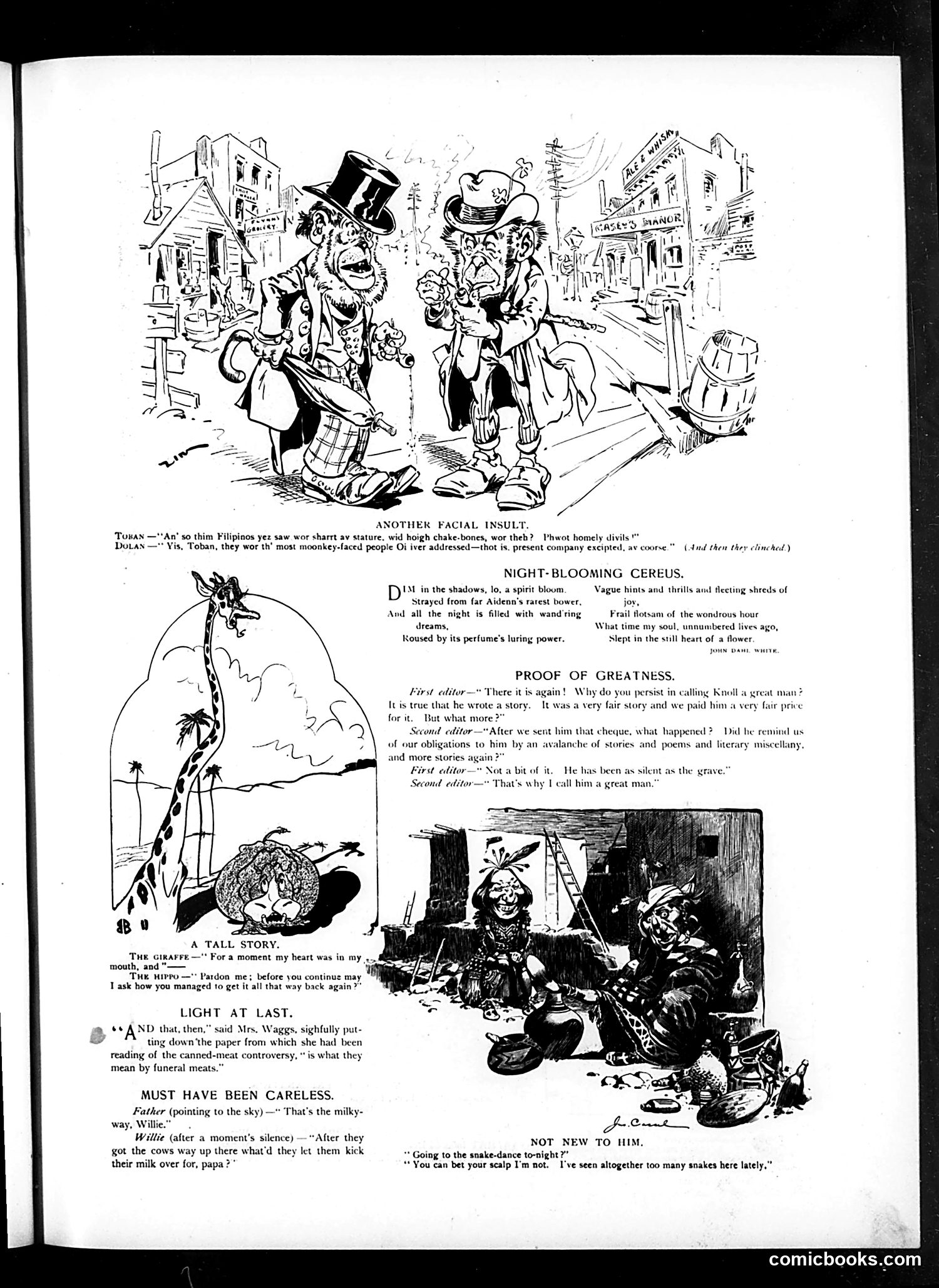
**"Another Facial Insult"** (top cartoon): Two grotesquely caricatured figures in top hats exchange insults on a city street. The exaggerated facial features—particularly prominent teeth and simian characteristics—suggest this employs racist caricature common to the era. The dialogue references "Filipinos" and "monkeys," indicating this satirizes early 20th-century American attitudes toward Filipino people during or after the Philippine-American War (1899-1902). The "facial insult" joke relies on dehumanizing ethnic caricature. The remaining content includes humorous vignettes and poetry ("Night-Blooming Cereus," "A Tall Story") typical of Judge's satirical format, though their specific references are unclear without additional historical context. The page demonstrates how period satirical magazines normalized racist imagery as humor.
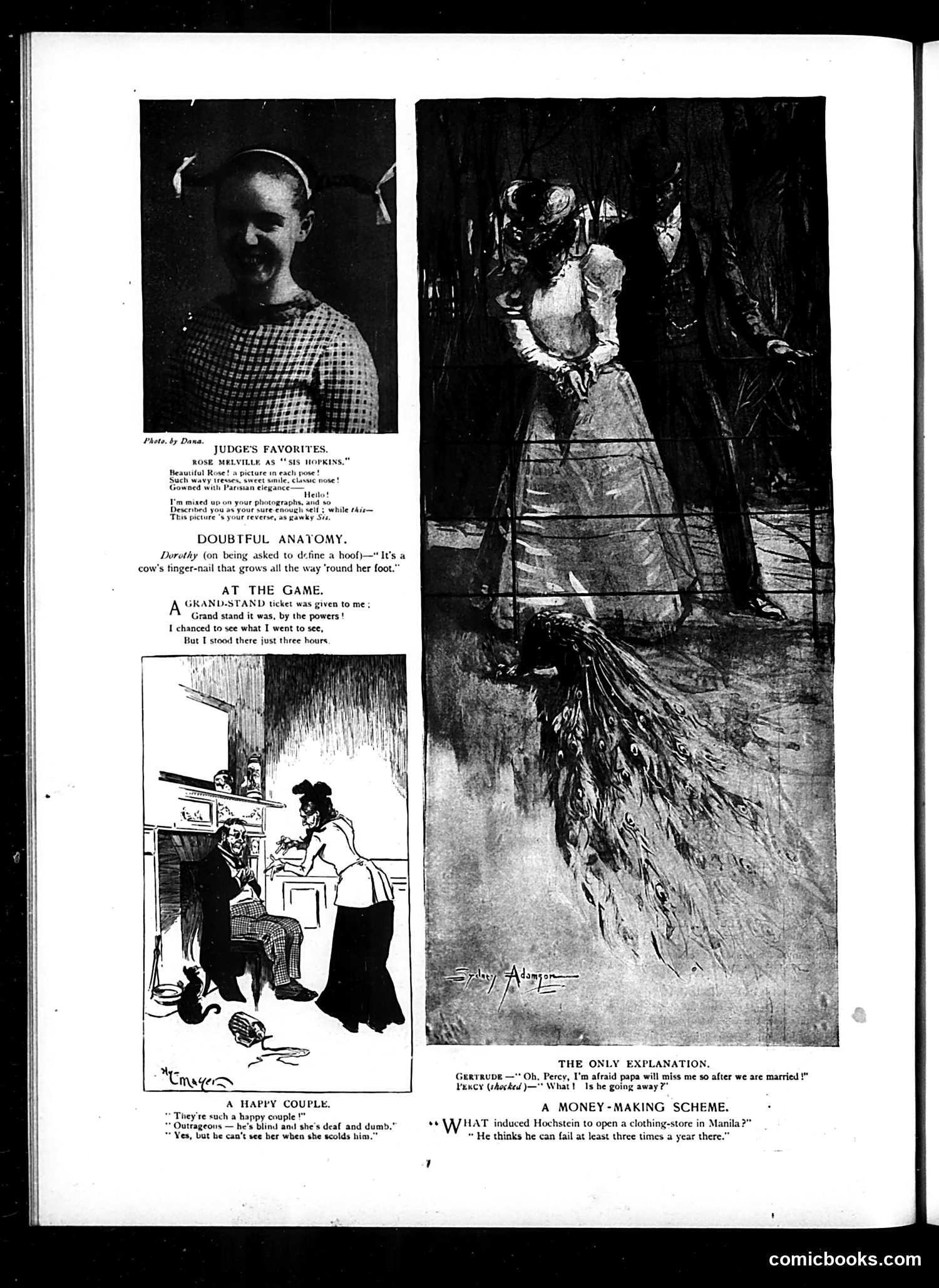
This page contains several unrelated satirical pieces and illustrations typical of early Judge magazine content. **Top Left:** A portrait labeled "Judges' Favorites" references actor John Melville as "Mrs. Hopkins," with a humorous poem beneath. **"Doubtful Anatomy"** and **"At the Game"** are brief joke entries with accompanying illustrations—standard filler humor about anatomical oddities and sporting experiences. **"A Happy Couple"** cartoon depicts a domestic scene with the caption about a couple where "he's blind and she's deaf and dumb"—dark humor common to the era. **"The Only Explanation"** shows what appears to be a romantic scenario. **"A Money-Making Scheme"** references someone named Hochstein opening a clothing store in Manila, suggesting three annual sales. The page represents typical Judge content: celebrity references, domestic humor, and business satire aimed at educated American readers.
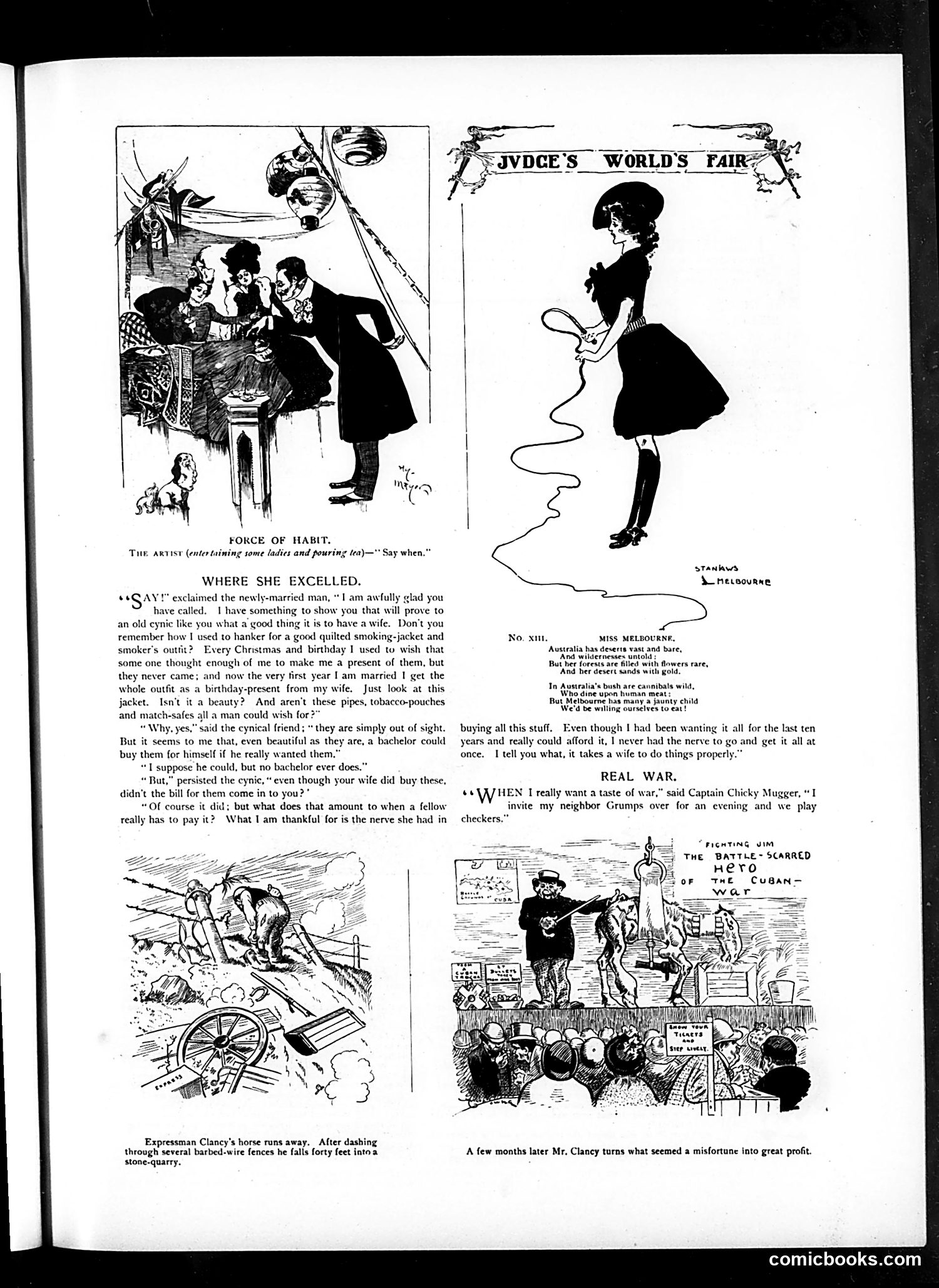
This page contains three distinct satirical pieces: 1. **"Force of Habit"** and **"Where She Excelled"**: These cartoons mock newlywed dynamics. A husband boasts that his wife bought him smoking accessories—not recognizing the cynic's point that he paid for them anyway through their shared finances. The humor targets male naiveté about marriage economics and the "force of habit" of wives managing household purchases. 2. **"Real War"**: A brief joke where Captain Chicky Mugger equates playing checkers with his neighbor to experiencing actual warfare, satirizing either his overly dramatic personality or the genteel, conflict-avoidant nature of upper-class leisure activities. 3. **Expressman Clancy cartoons**: These show slapstick humor—a horse accident that becomes unexpectedly profitable. This appears to be serialized humor unrelated to the other content. The **"Miss Melbourne"** poem celebrates Australia's natural resources and beauty, seemingly promotional rather than satirical. Overall, the page mixes domestic satire, war commentary, and slapstick humor typical of early-20th-century Judge magazine.
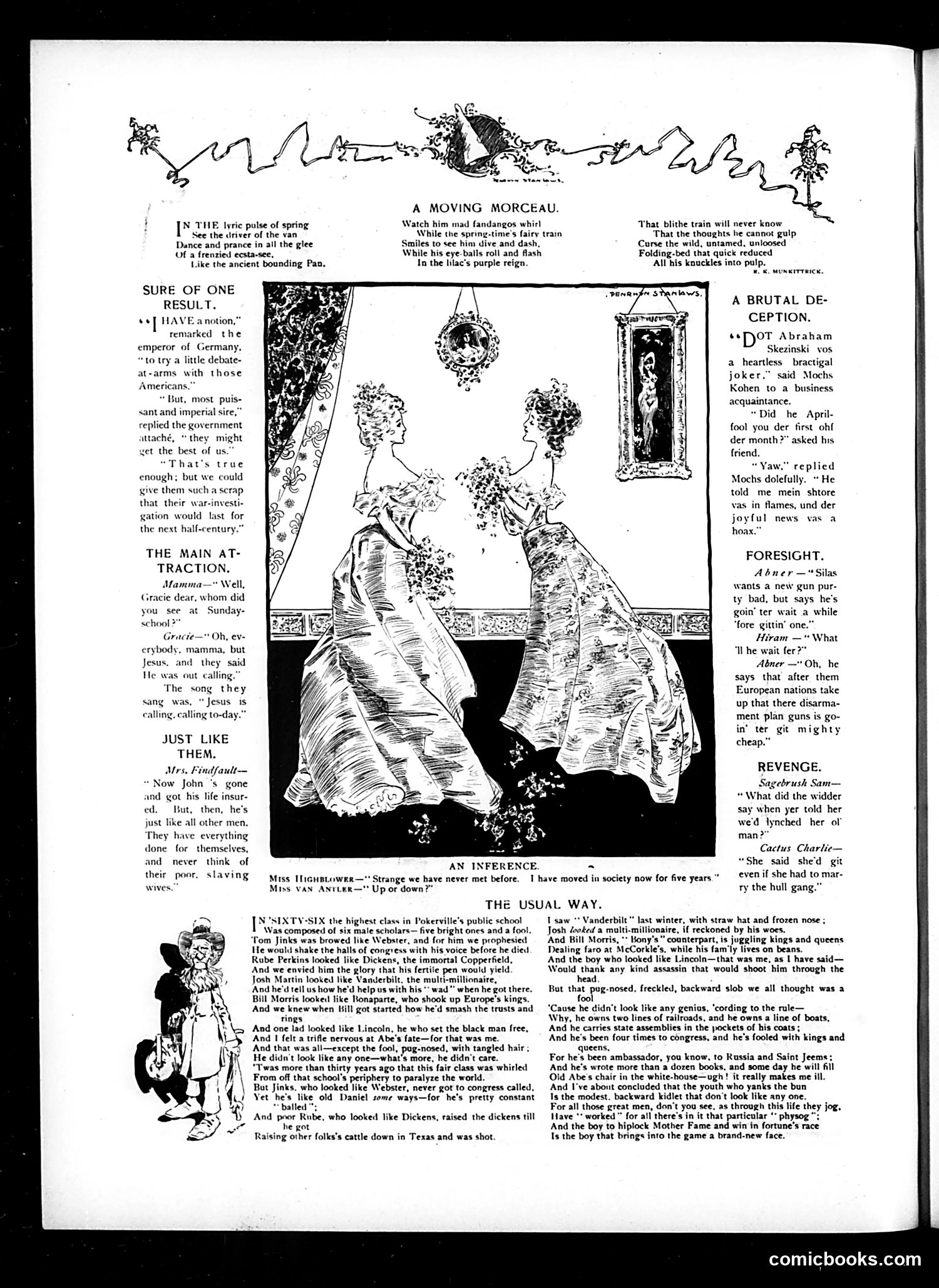
This satirical page contains multiple short comedic pieces typical of early-20th-century American humor magazines. The central cartoon "An Inference" depicts a woman in an elaborate dress, mocking the pretentious social climbing referenced in the caption—a woman boasting she's "moved in society now for five years," while the joke reveals her elegant appearance masks an accident: her elaborate dress conceals bruises from being caught in a folding bed. Other pieces mock contemporary topics: "Sure of One Result" features a German emperor considering military debate with Americans; "A Brutal Deception" presents immigrant characters (Skezinski, Kohen) in dialect humor, a common but dated stereotyping device; "Foresight" shows rural characters anticipating cheaper guns after European disarmament. The longest piece, "The Usual Way," is a sentimental poem about six schoolboys—one resembling each famous figure (Webster, Dickens, Vanderbilt, Bonaparte, Lincoln). It contrasts youthful promise with adult mediocrity, the ironic point being the unremarkable fool ultimately succeeds while the promising ones fail or struggle. The humor relies on period-specific references and now-offensive ethnic caricatures.
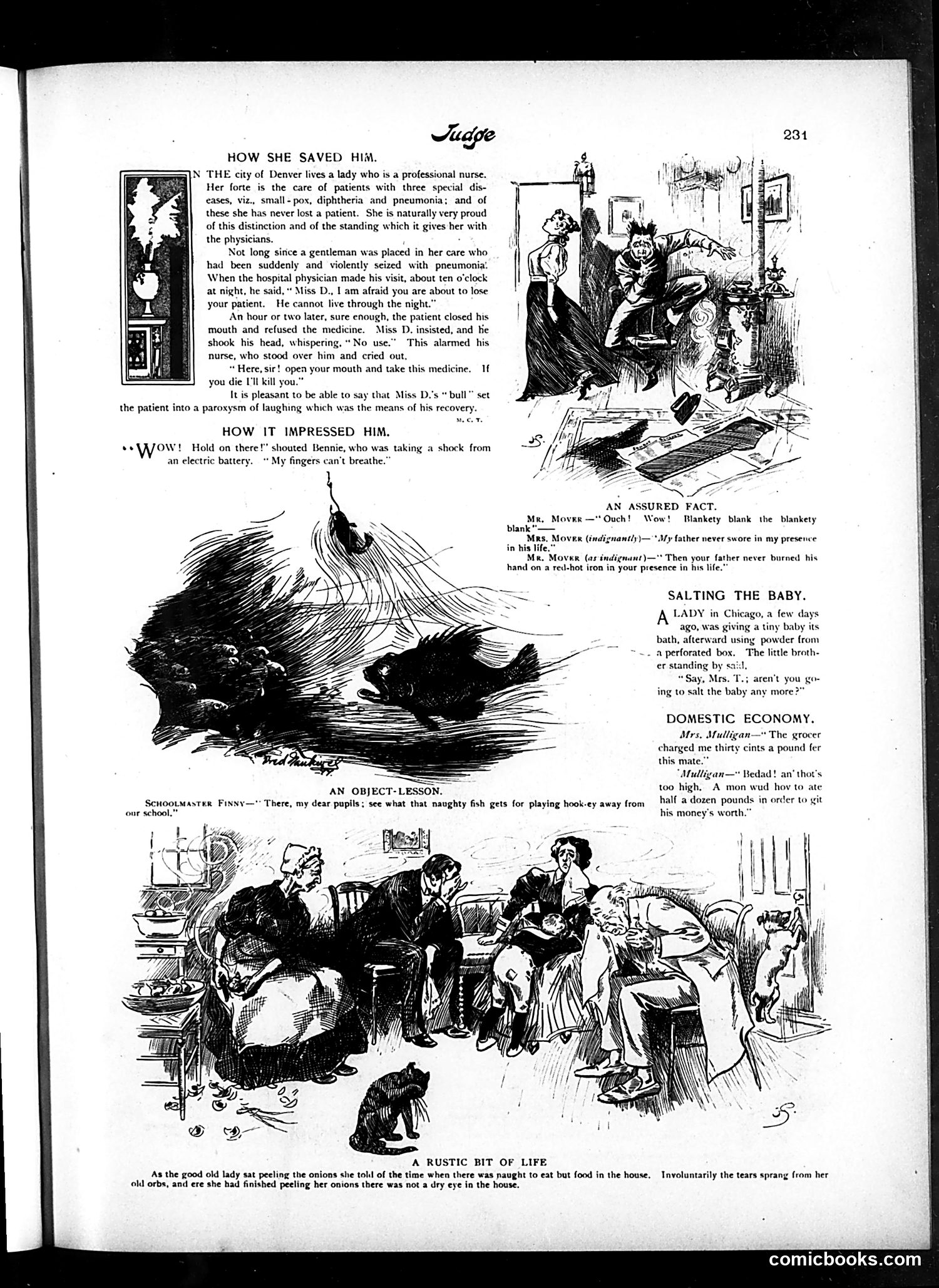
This page contains several unrelated humorous anecdotes typical of Judge's format: **"How She Saved Him"** tells of a Denver nurse's unconventional bedside manner—she threatens to kill a pneumonia patient if he dies, which makes him laugh so hard he recovers. The satire mocks both medical pessimism and the absurdity of using psychological shock as treatment. **"How It Impressed Him"** is a brief children's joke about a boy receiving an electric shock, confusing electrical current with breathing. **"An Assured Fact"** plays on Irish immigrant dialect (the "Mulligan" family), with Mr. Mover defending his use of profanity by noting his father never swore *unless* he burned himself—implying certain circumstances justify coarse language. **"Salting the Baby"** jokes about a child misunderstanding baby powder as salt. **"Domestic Economy"** continues the Irish-dialect humor, mocking working-class attitudes toward food costs. **"A Rustic Bit of Life"** is a sentimental anecdote about an elderly woman's tears while peeling onions, presented as touching rather than comic. The page reflects period humor relying heavily on ethnic stereotypes and simple punchlines.
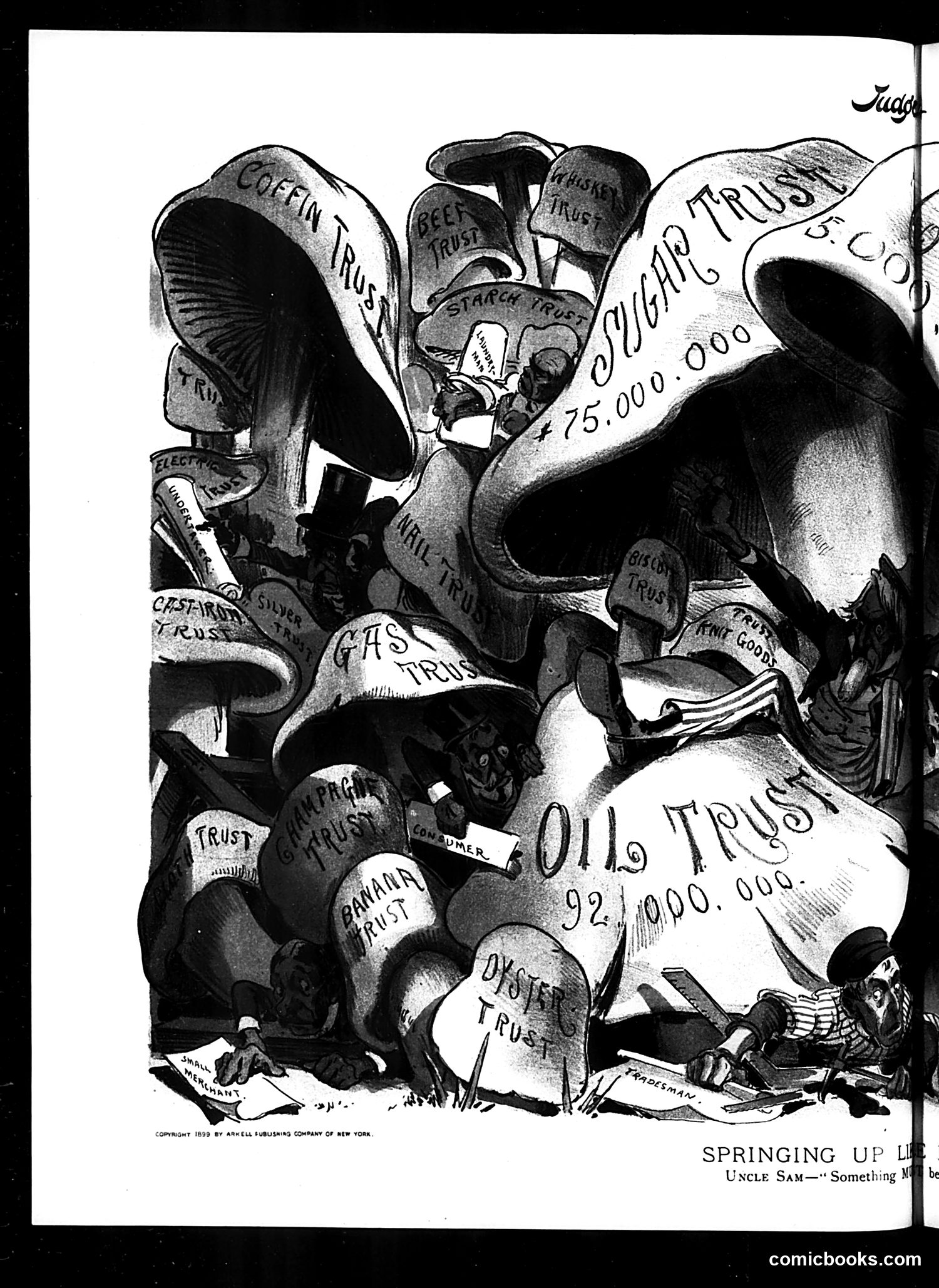
This is a political cartoon satirizing the growth of monopolistic business trusts in early American capitalism. The image depicts a grotesque, bloated octopus-like creature with multiple tentacles, each labeled with different trust names: "Beef Trust," "Steel Trust," "Oil Trust," "Sugar Trust," "Electric Trust," "Cast Iron Trust," "Silver Trust," and others, some showing specific dollar amounts (like "$75,000,000" and "$92,000,000"). Uncle Sam (visible at bottom) appears helpless as these trusts multiply and expand. The cartoon criticizes how large corporations were consolidating market power, creating monopolies that controlled prices and competition. This reflects Progressive Era concerns (likely early 1900s) about unchecked corporate power threatening fair commerce and consumers. The "springing up" title suggests these trusts were rapidly proliferating despite public concern.
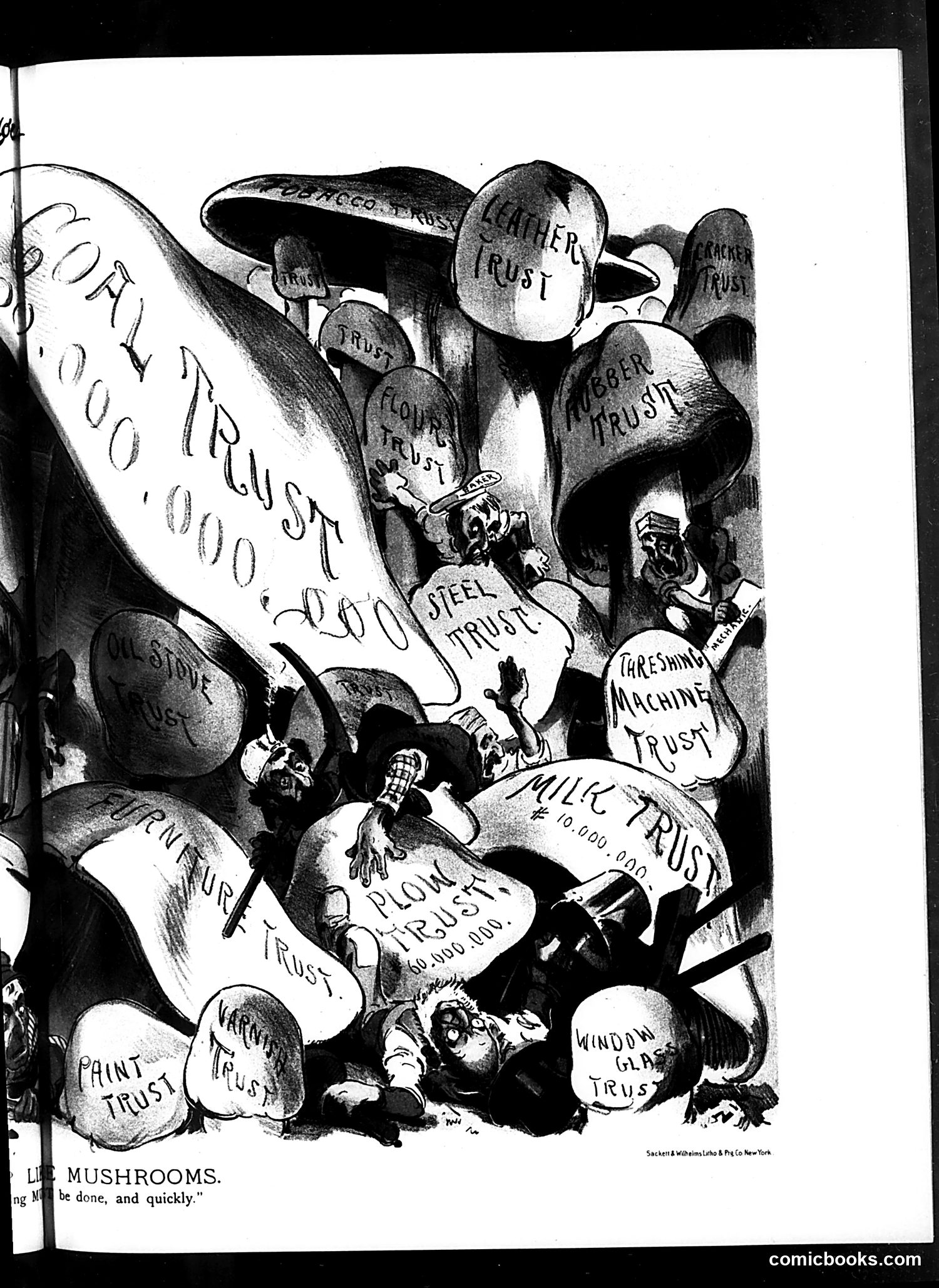
This political cartoon satirizes American industrial monopolies of the early 20th century, depicted as giant mushrooms sprouting rapidly from the ground. Each mushroom is labeled with a different "trust" — the Steel Trust, Oil Trust, Flour Trust, Milk Trust, Paint Trust, Window Glass Trust, and Threshing Machine Trust. Tiny human figures at the base appear overwhelmed and crushed by these massive growths. The mushroom metaphor suggests these trusts sprouted suddenly and uncontrollably, like fungi in dark conditions, representing how monopolies proliferated with minimal oversight. The cartoon criticizes the rapid consolidation of American industry into monopolistic trusts that dominated prices and markets, harming ordinary workers and consumers. The caption's phrase "be done, and quickly" implies urgent action was needed to eliminate these predatory corporate structures.
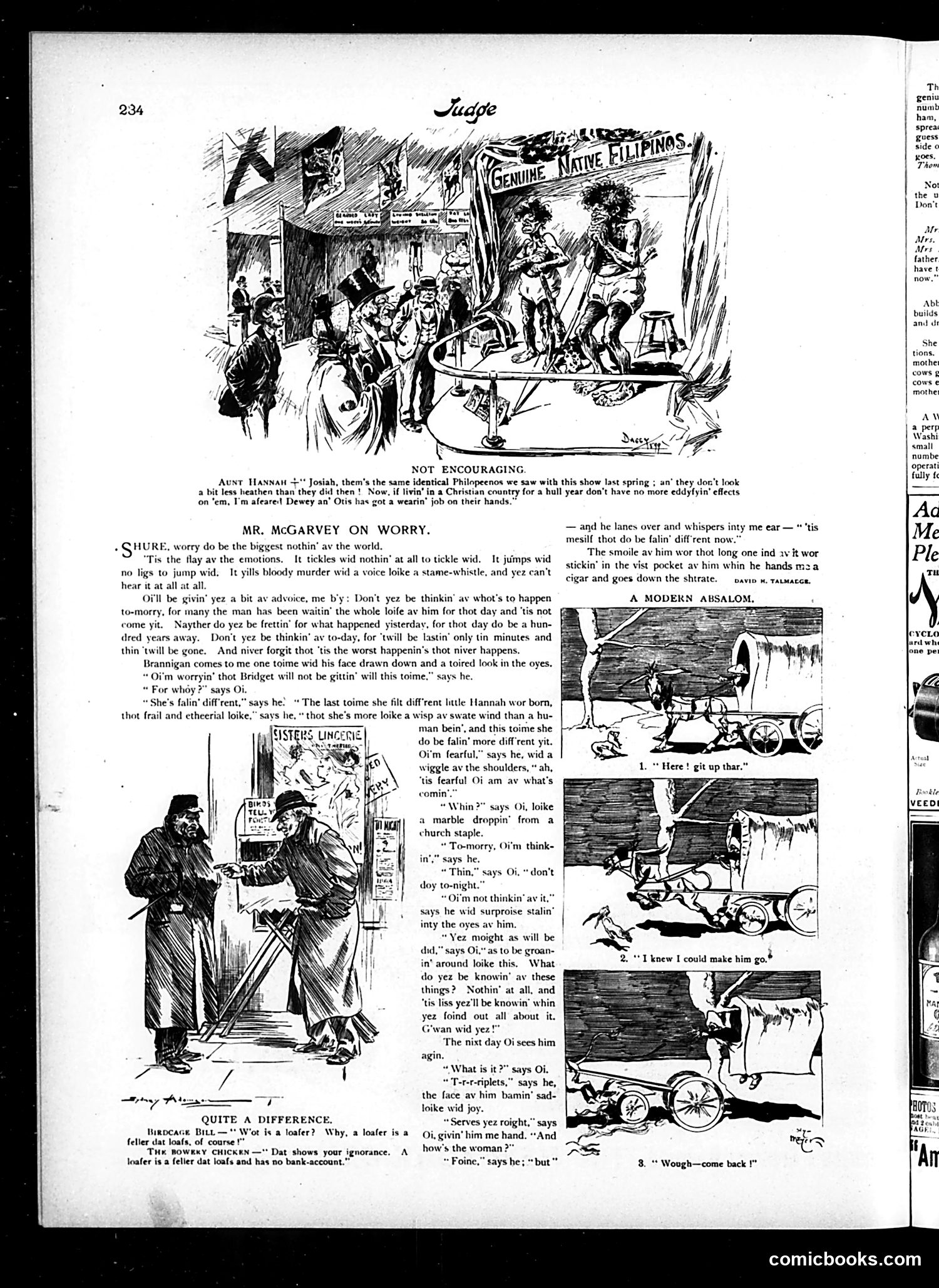
This page contains three separate satirical pieces: 1. **"Not Encouraging"** - A sketch mocking a Filipino show at what appears to be an exhibition. The sign reads "Genuine Native Filipinas," suggesting turn-of-the-century American fascination with colonized peoples displayed as curiosities. The dialogue between Aunt Hannah and Mr. McGarvey satirizes naive American attitudes toward the Philippines. 2. **"Quite a Difference"** - A brief quip comparing a loafer and a chicken, playing on class distinctions and idleness. 3. **"A Modern Absalom"** - A three-panel comic strip showing someone attempting to retrieve a hat from what appears to be a dangerous situation involving a cart or wagon, with humorous consequences. The page reflects early 1900s American attitudes toward colonialism and working-class humor.
This page is primarily composed of advertisements and brief humor pieces rather than political cartoons. The visible humor snippets—about sandwich fillings, a child asking if cows blow horns, and lectures about things people shouldn't know—are lighthearted social observations rather than satire. They mock everyday situations: absurd advice on cooking, children's innocent questions embarrassing adults, and lecturers' pretensions about improving public morality. The advertisements dominate, promoting products like Yale Mixture tobacco, bicycling equipment, cocktail ingredients, and pianos. Only minimal political or satirical content appears here; this appears to be a typical Judge magazine page mixing entertainment with advertising revenue rather than focused political commentary.
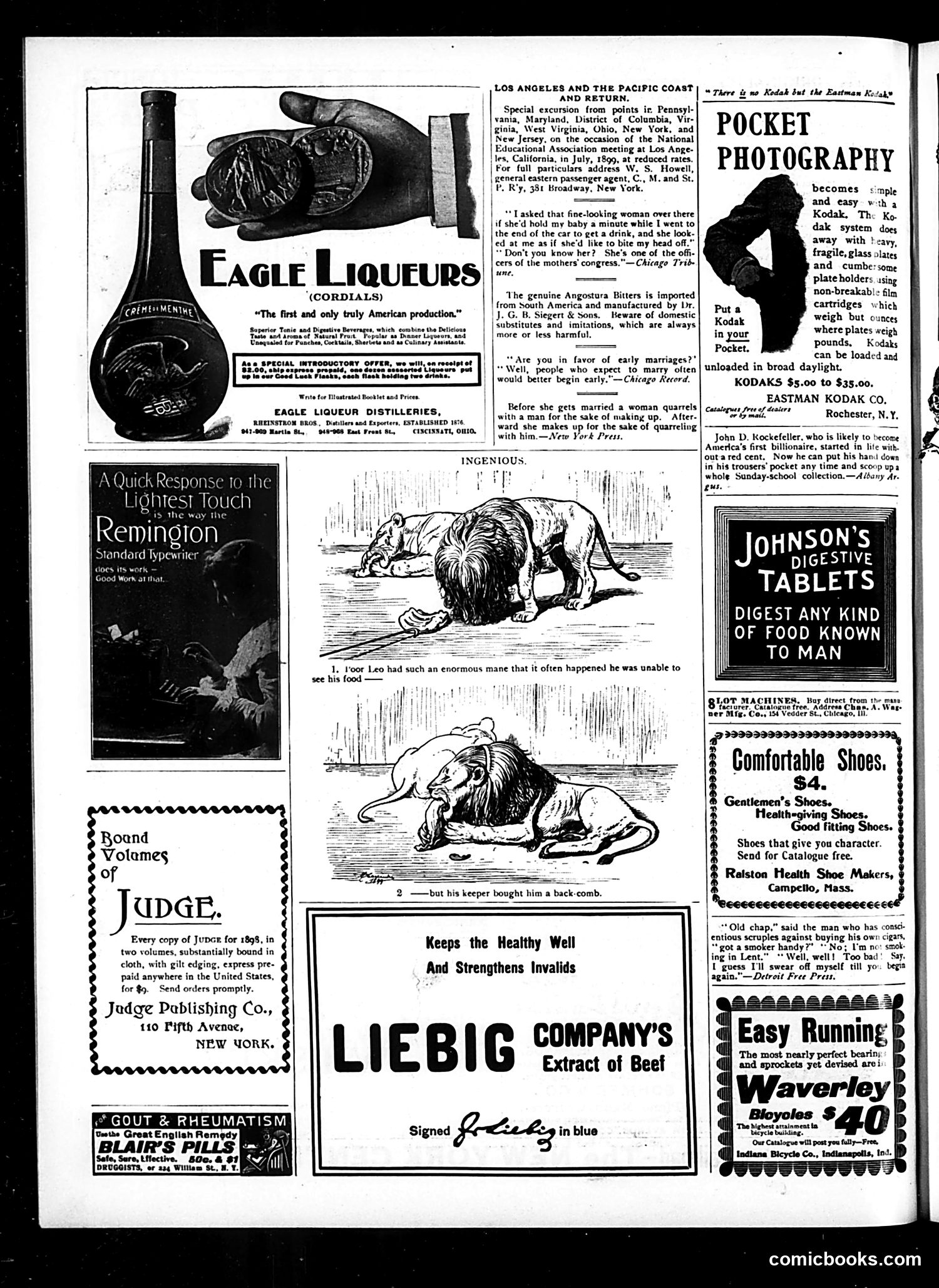
This page is primarily **advertising**, with one cartoon feature. The main satirical content is a two-panel comic titled "INGENIOUS" depicting a lion unable to see its feet due to an enormous mane, solved when "his keeper bought him a back-comb." The joke plays on the literal absurdity—the solution to a grooming problem is humorous understatement. The page otherwise contains period advertisements (Eagle Liqueurs, Kodak cameras, Liebig's Extract of Beef, Remington typewriters, Johnson's Digestive Tablets) and editorial notices typical of *Judge* magazine circa 1899. There's a brief satirical paragraph about John D. Rockefeller's wealth, mocking his rise from nothing to billionaire status. The content reflects late-19th-century American consumer culture and gentle humor rather than pointed political satire. Modern readers would mainly note the quaint products advertised and the innocent nature of the wordplay compared to contemporary comedy.
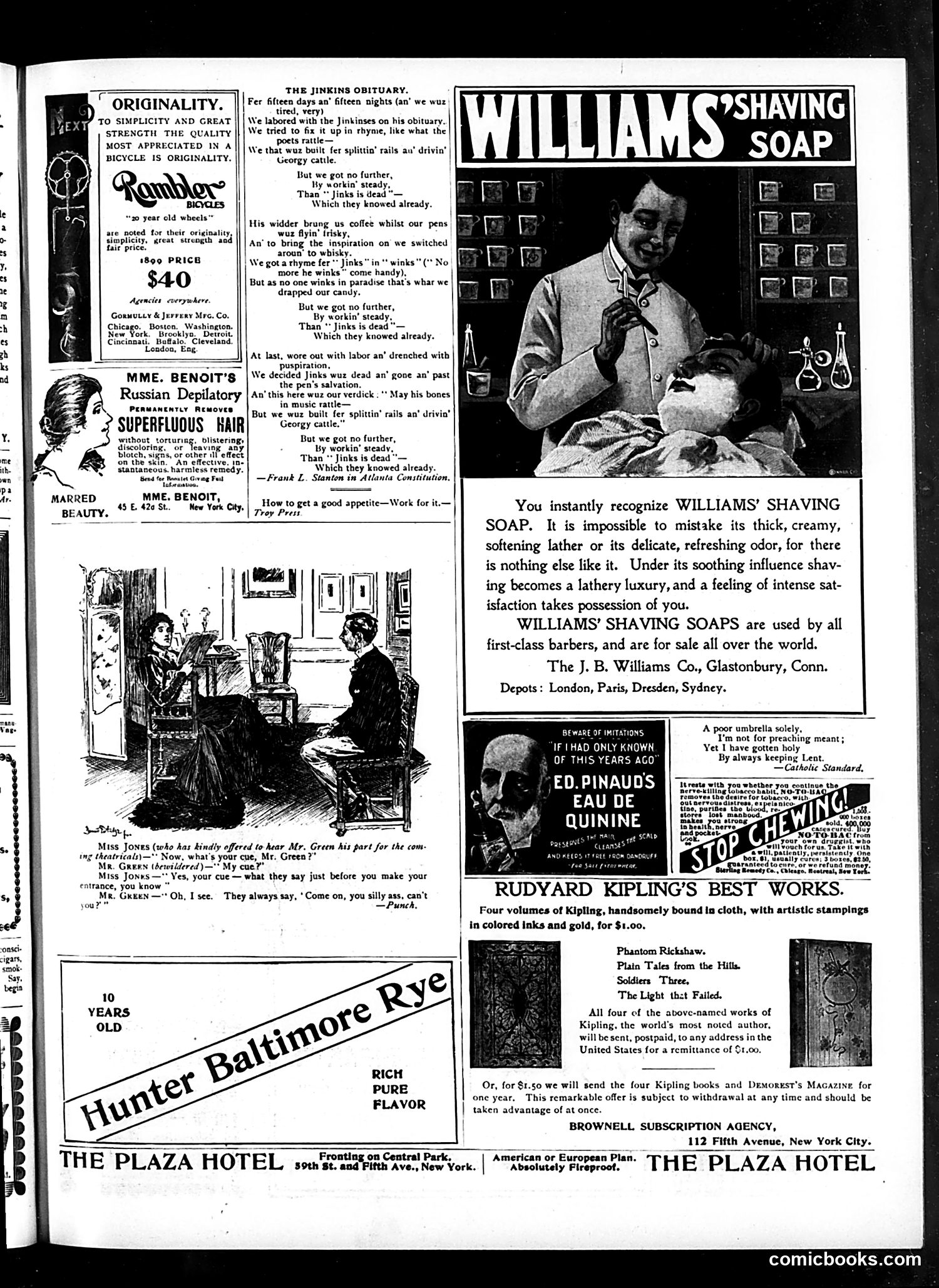
This page is primarily **advertising and light humor**, not political satire. The main content includes: 1. **"The Jinkins Obituary"** — A humorous poem by Frank L. Stanton about rural writers struggling to compose an obituary. The joke: despite fifteen days of effort, whisky, and inspiration, they can only manage "Jinks is dead"—which everyone already knew. It's gentle satire on pretentious writing and rural dialect humor, popular in late 1890s magazines. 2. **Theatrical humor** — A brief exchange where an actor doesn't understand "cue," expecting the director means insults ("silly ass") rather than the signal to enter. 3. **Multiple product advertisements** — Raley bicycles ($40), hair removal, shaving soap, quinine tonic, Kipling books ($1.00), whisky, and hotels. The page reflects turn-of-the-century American popular culture: rural comedies, patent medicines, and aspirational literary offers. There is no identifiable political content or caricature of public figures.
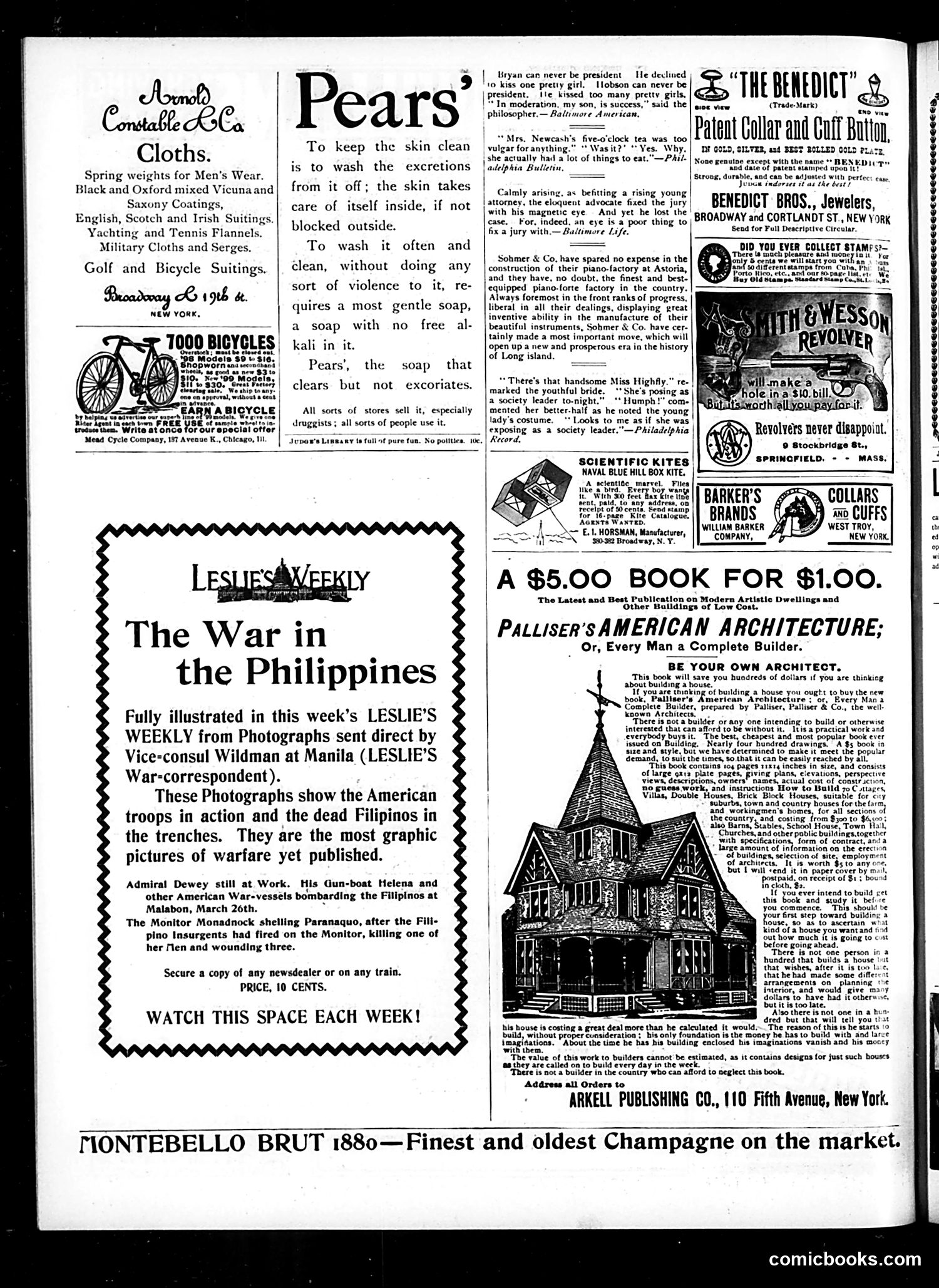
This page is primarily advertising with some political content. The main satirical piece is a brief political joke contrasting William Jennings Bryan and naval officer Hobson regarding presidential eligibility—Bryan "can never be president" because he declined to kiss a pretty girl, while Hobson "can never be president" because he kissed too many. This appears to mock Bryan's perceived excessive caution while satirizing Hobson's well-publicized romantic engagements, making light of their fitness for office through romantic conduct rather than policy. The remainder consists of period advertisements for clothing, bicycles, soap, pianos, jewelry, and other goods typical of Judge magazine. A Leslie's Weekly promotion advertises coverage of the Philippine-American War with photographs from Manila, reflecting contemporary U.S. military interests in the islands.
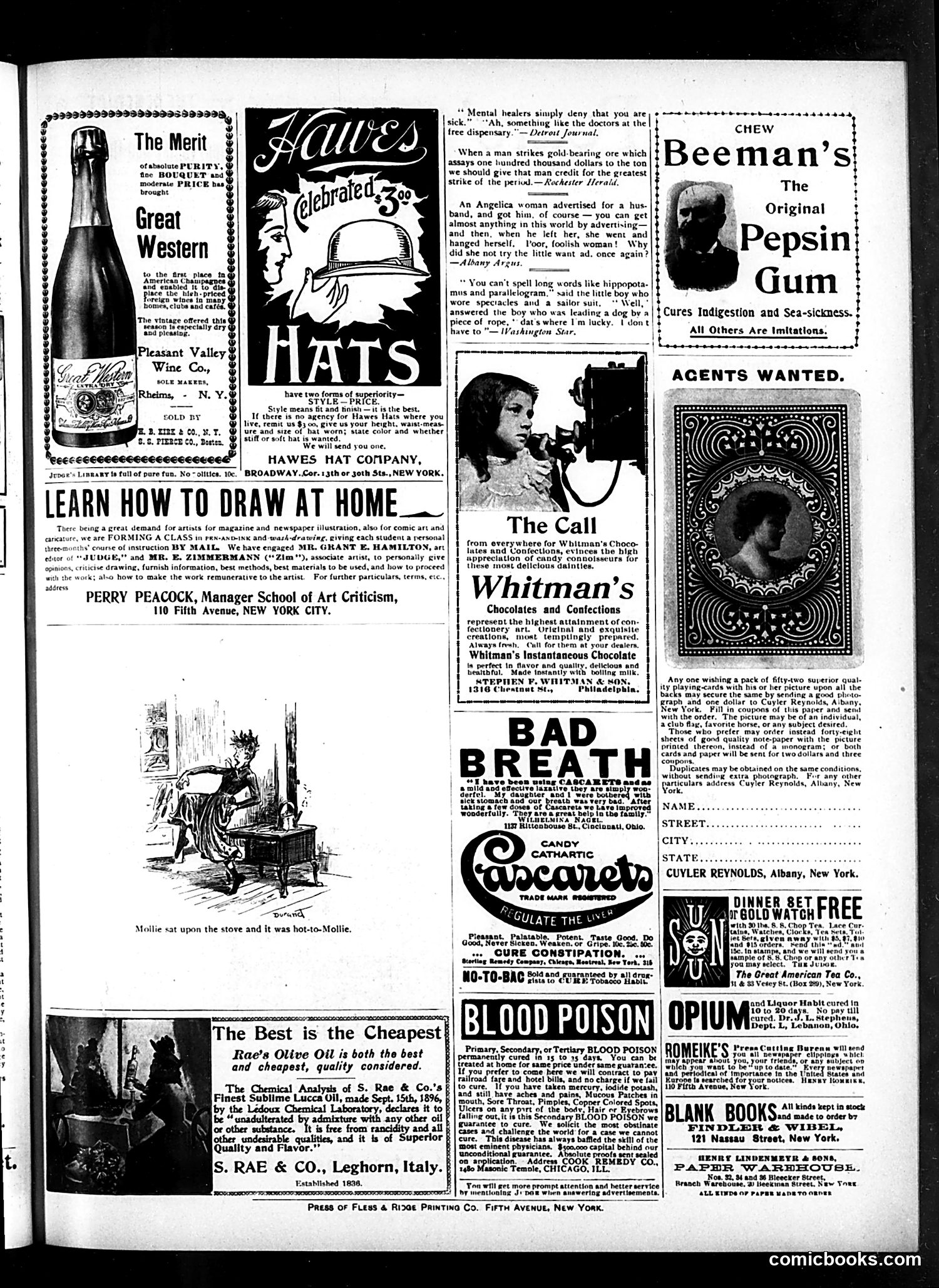
This page is primarily **advertisements and advice columns** rather than political satire. The visible content includes: - Product ads (Hawes Hats, Beeman's Pepsin Gum, Whitman's Chocolates, wine) - A humorous drawing of "Mollie" sitting at a hot stove - Brief funny anecdotes in text boxes (mental healers, spelling difficulties, an unfortunate woman who advertised for a husband) - An art school advertisement featuring instructors from *Judge* magazine The jokes are light domestic humor typical of early 20th-century magazines—wordplay, domestic mishaps, and social observation rather than political commentary. The page demonstrates that *Judge* mixed satirical content with conventional period advertising and entertainment filler.
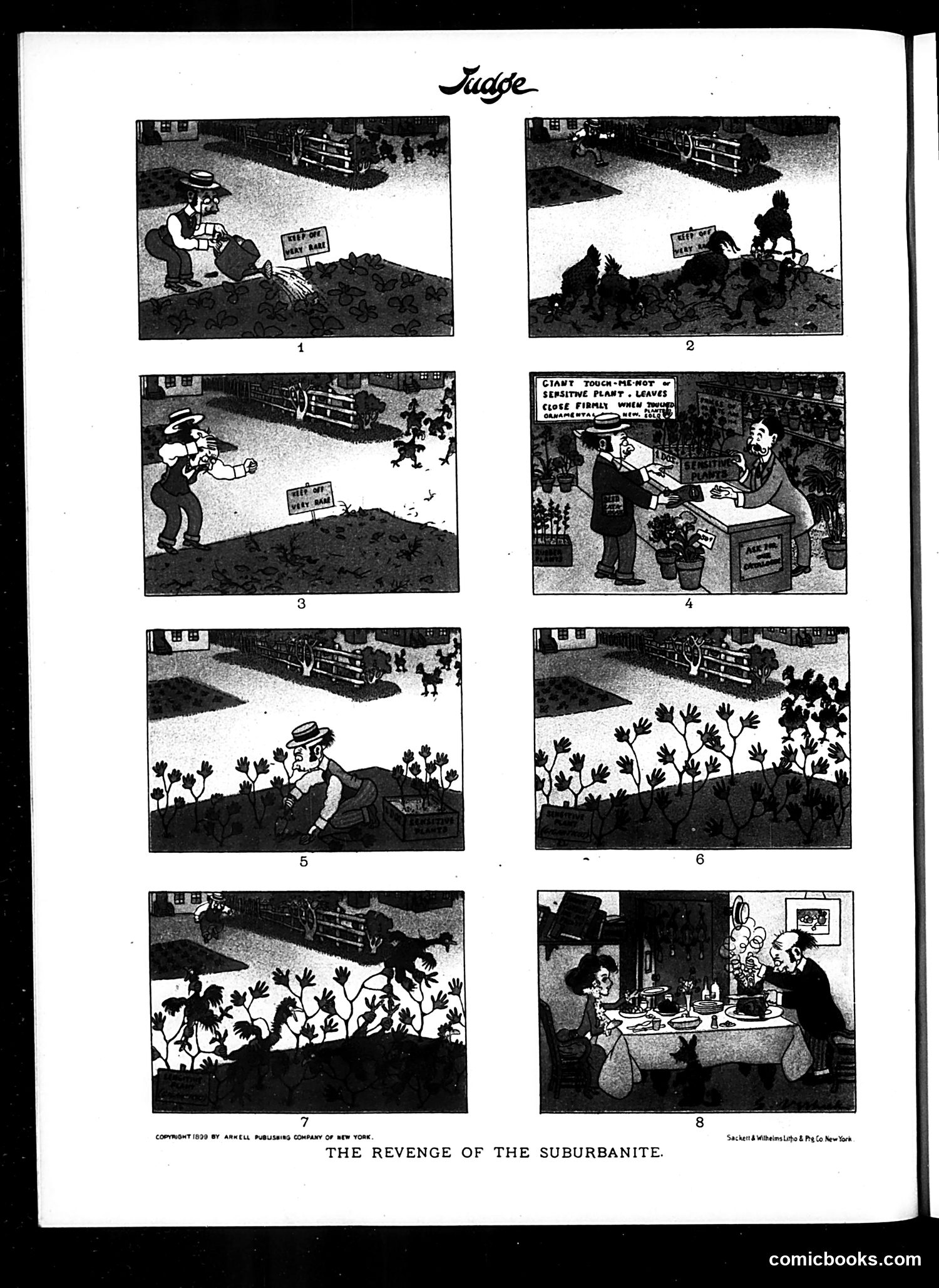
This satirical comic strip depicts a suburbanite's comedic retaliation against city dwellers. The narrative shows a man discovering his vegetable garden being trampled by what appears to be urban visitors or troublemakers (panels 1-3). He consults with someone, likely a nurseryman or garden expert (panel 4), who provides giant touch-me-not plants with sensitive leaves that close when touched (panel 5-6). When city people later trespass in his garden, the plants trap them en masse (panel 7). The final panel shows the suburbanite and his wife dining contentedly at home, suggesting satisfaction at his botanical trap's success. The satire mocks the growing tension between urban and suburban communities in the 1890s, when suburbanization was creating conflict over property rights, trespassing, and differing social values between city and country residents.