
A complete issue · 16 pages · 1899
Judge — March 18, 1899
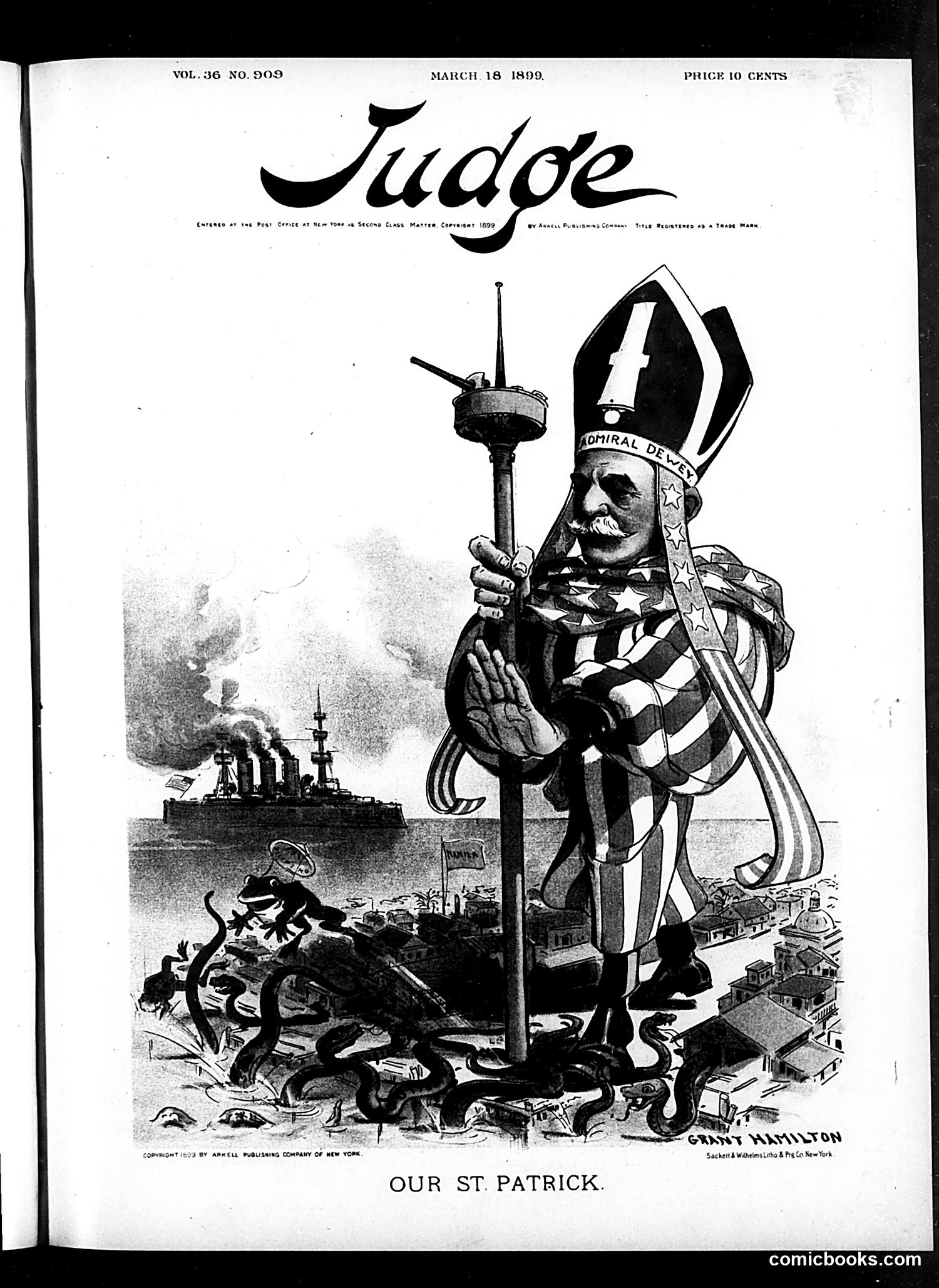
This cartoon depicts Admiral Dewey as a bishop-like figure labeled "Admiral Dewey," holding a torch and cross, standing triumphantly over defeated enemies. The imagery appears to reference Dewey's 1898 naval victory in the Spanish-American War's Battle of Manila Bay. The figure tramples what appear to be serpents or demons beneath his feet, likely representing Spain or Spanish colonial forces. A warship smokes in the background, reinforcing the military context. The "St. Patrick" reference plays on the saint's legendary victory over snakes in Ireland, cleverly comparing Dewey's military triumph to religious heroism. The cartoon celebrates American naval supremacy and frames imperial conquest in Christian/heroic terms typical of 1899 American triumphalism following the Spanish-American War.
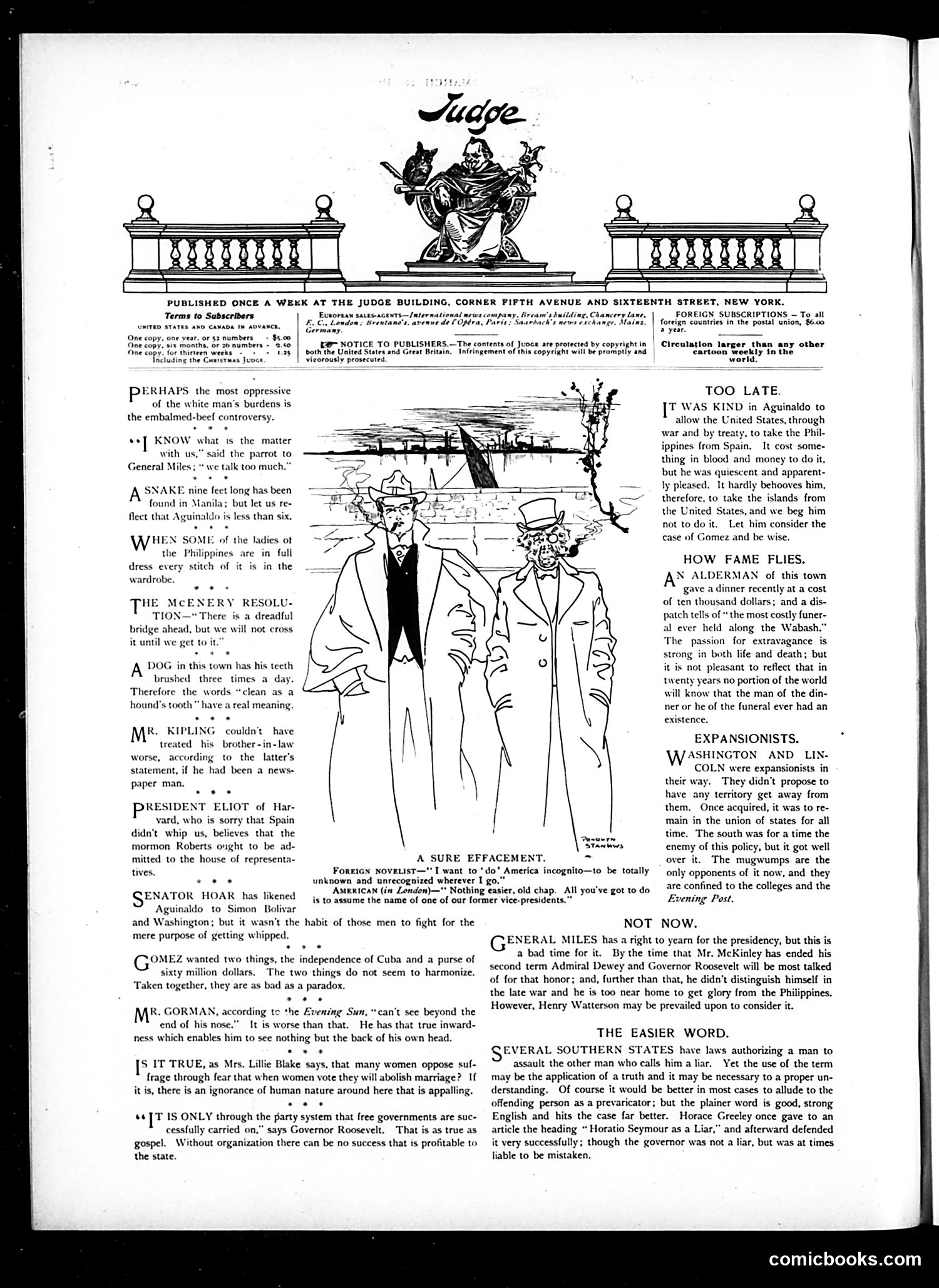
The central cartoon depicts two men walking together, likely representing American political or military figures of the early 20th century. Based on the accompanying text fragments discussing General Miles, presidential ambitions, and expansionist policies, this appears to satirize debates over American imperial expansion and territorial acquisition. The caption "A Sure Effacement" suggests the cartoon mocks someone's fading relevance or disappearing influence in politics. The surrounding editorial comments reference expansionism, the Philippines, Cuba, and presidential succession—indicating this addresses debates over America's growing imperial ambitions and which political figures would lead such efforts. The specific identities of the two figures are unclear from the image alone, but the satire targets competing visions of American foreign policy expansion.
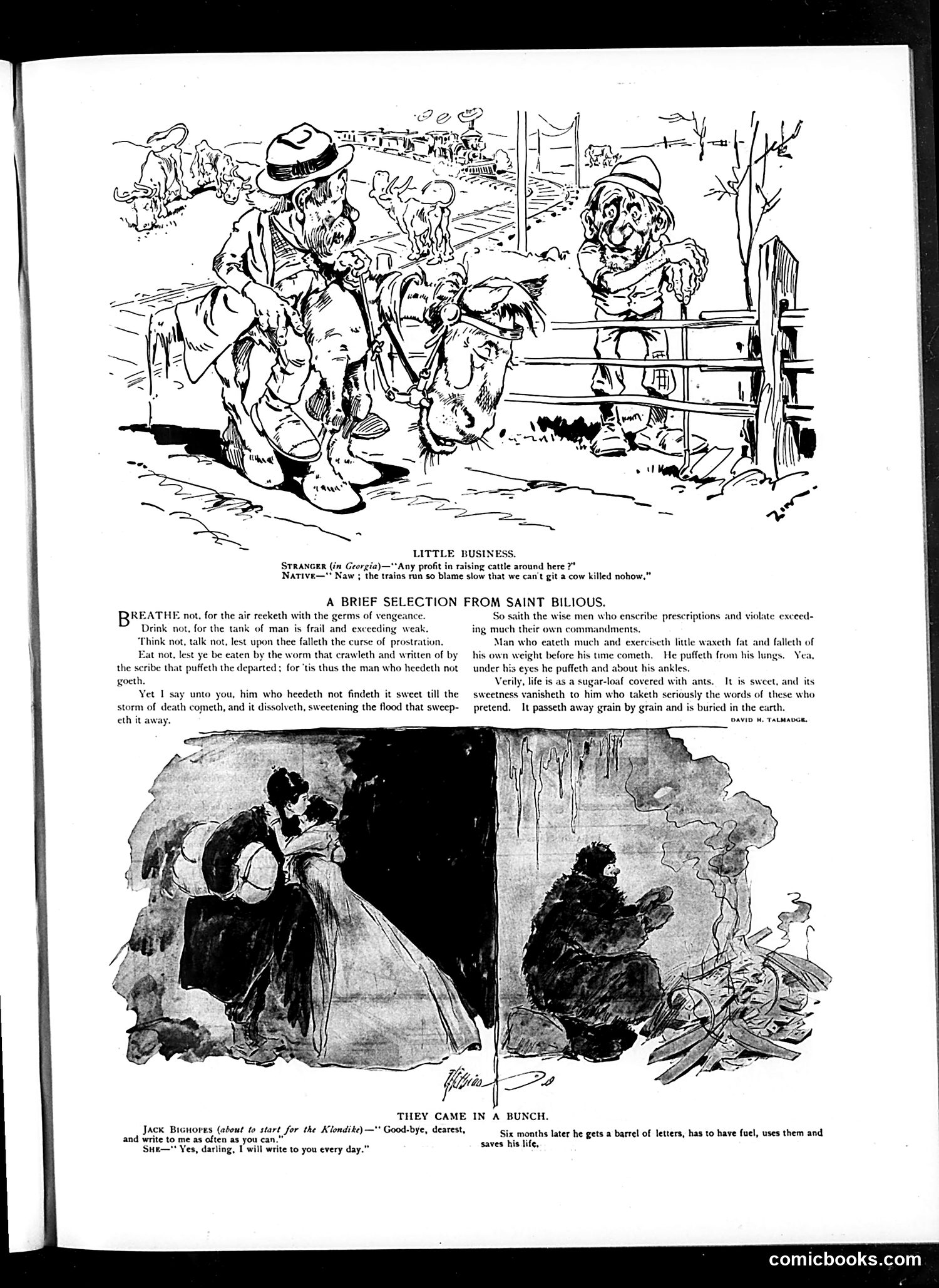
**Top Cartoon ("Little Business"):** A stranger in Georgia asks a Native about cattle-raising profits. The Native replies that slow cattle rates make profits impossible—a joke about regional economic hardship, likely post-Civil War Georgia struggling with agricultural recovery. **Bottom Section ("A Brief Selection from Saint Bilious" and "They Came in a Bunch"):** This appears to be satirical moral/religious commentary rather than political cartooning. The "Saint Bilious" text mocks excessive moralizing and self-righteousness. The accompanying illustration shows Jack Burroughs (labeled as "about to start for the Klondike"), depicting the Klondike Gold Rush era. The narrative follows his departure and later return, suggesting satire about frontier adventurism or get-rich-quick schemes of that period. The page blends humor about regional economics, moral hypocrisy, and the Gold Rush phenomenon.
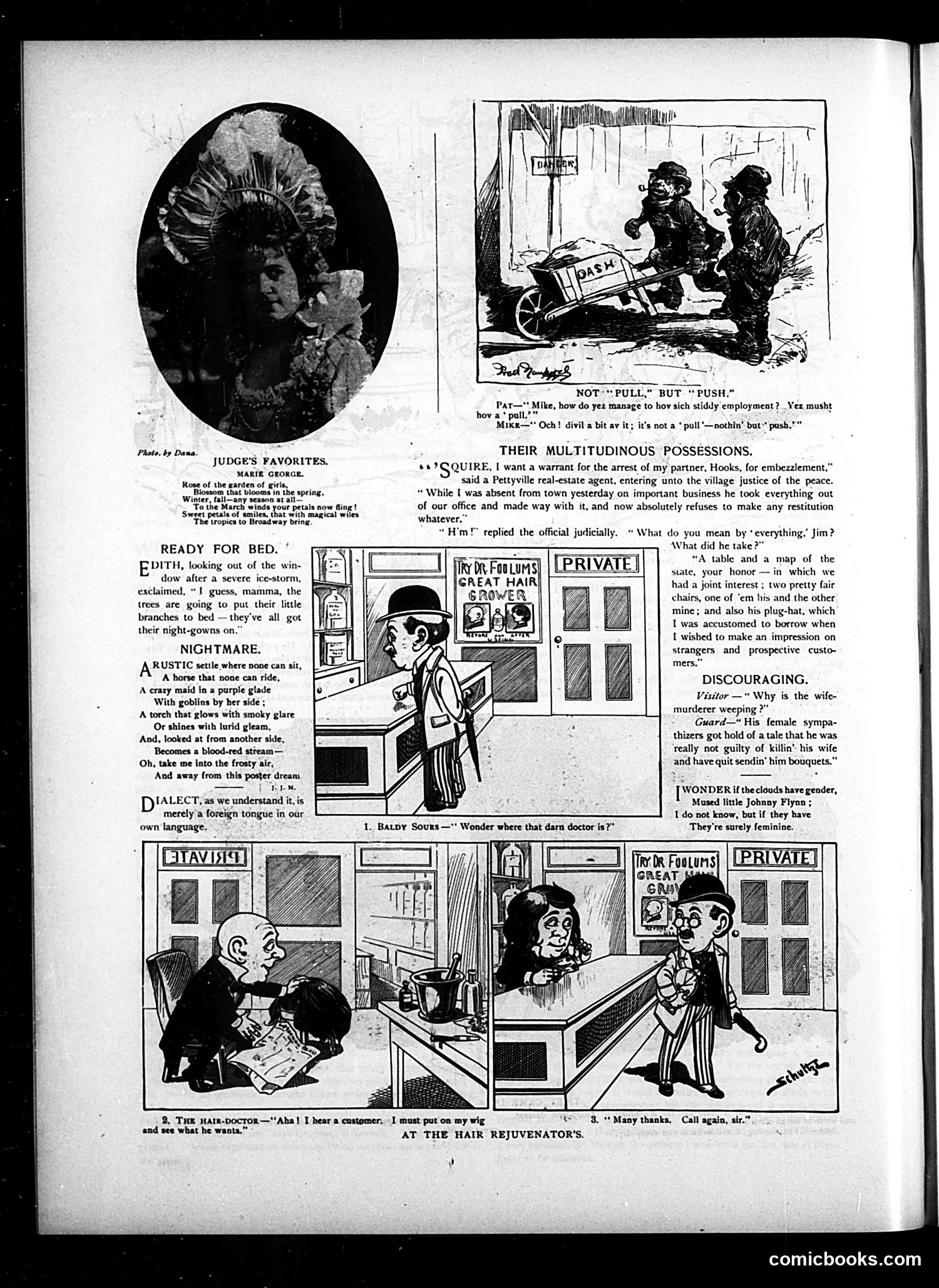
This page combines literary/poetic content with satirical cartoons reflecting early 20th-century American life. **"Judge's Favorites"** features a portrait of a woman in elaborate dress, paired with romantic poetry about spring and love—typical sentimental content for the era. **The cartoons** mock everyday situations: a couple arguing about pushing a baby carriage; a man searching for a doctor; and a hair salon scene where a customer complains about service while the proprietor tries to make a sale. The humor targets **ordinary frustrations**—marital disputes, difficult service encounters, and commercial deception—rather than political figures. The style reflects Judge's focus on middle-class domestic comedy and social observation, satirizing common annoyances of urban life through exaggerated character types and dialogue.
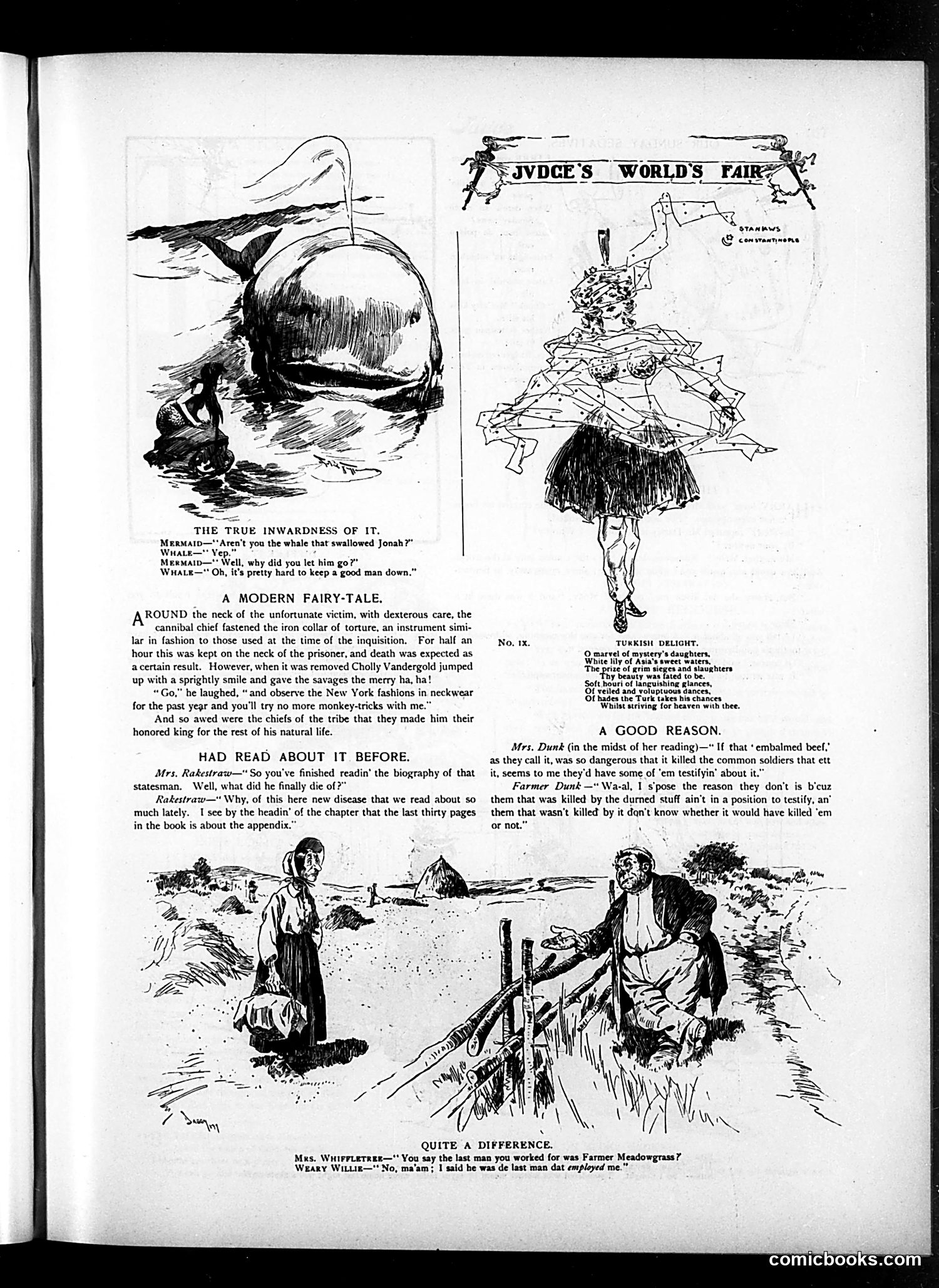
This page contains several satirical vignettes typical of early 20th-century American humor: **"The True Inwardness of It"** is a biblical joke: a mermaid asks a whale why it released the prophet Jonah, and the whale replies "it's pretty hard to keep a good man down"—suggesting even miraculous captivity can't contain exceptional people. **"A Modern Fairy-Tale"** satirizes American materialism and fashion obsession. A wealthy man (Cholly Vandergold) survives torture by claiming New York neckwear fashions are more intimidating, so impressing cannibals with Western style that they crown him king. **"Had Read About It Before"** is a pun: a man mistakes "appendix" (the book section) for the medical condition, implying the statesman died from appendicitis rather than understanding the actual reference. **"A Good Reason"** appears to reference the Spanish-American War and controversies over "embalmed beef" supplied to troops—a farmer logically notes dead soldiers can't testify about whether the spoiled meat killed them. **"Quite a Difference"** plays on semantic wordplay between "worked for" and "employed by," suggesting class distinction in servant-employer language.
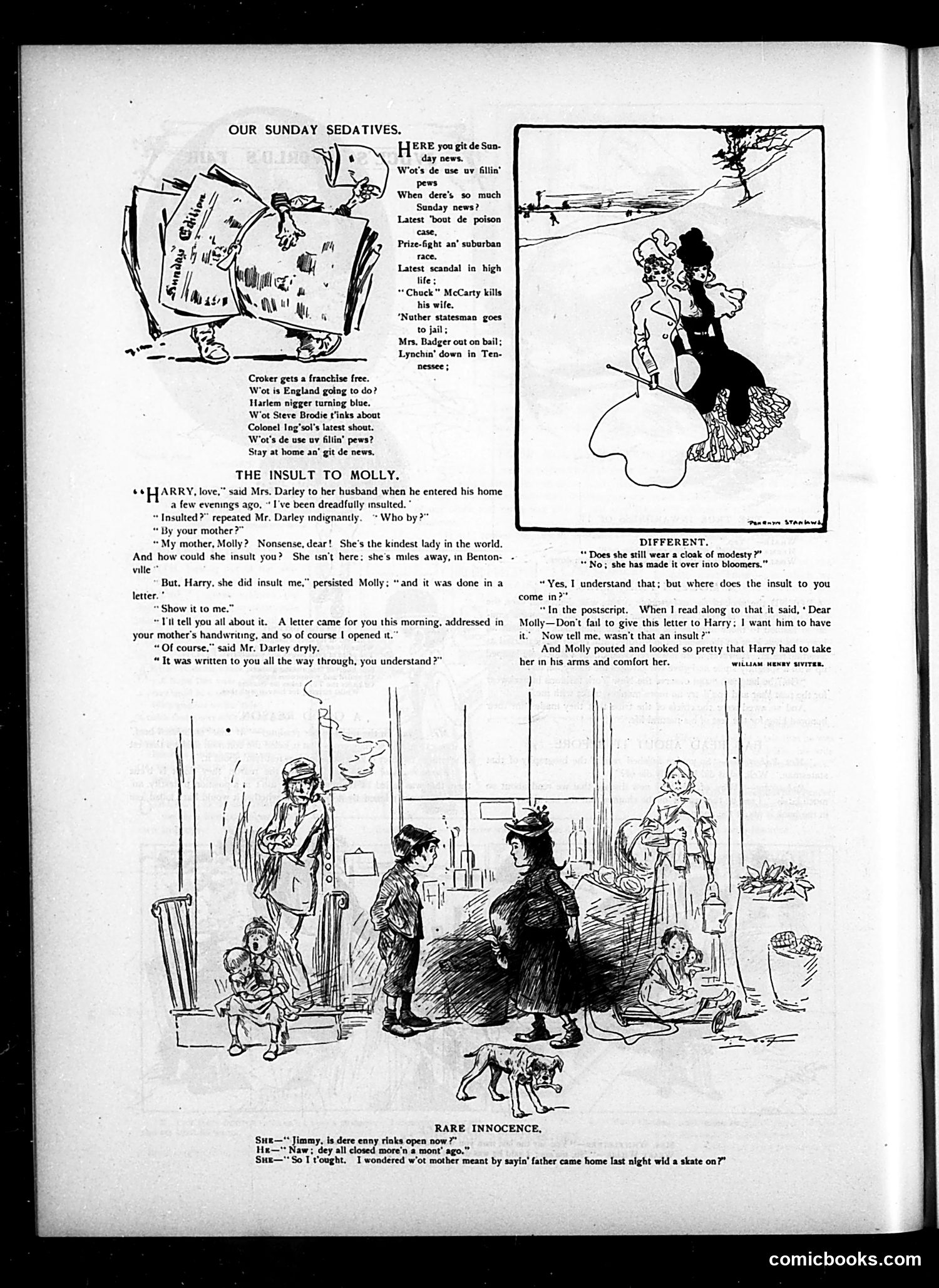
**Top cartoon**: Mocks newspaper readers' appetite for sensational Sunday news. The figure represents a typical reader consuming lurid headlines: poison cases, prize fights, scandals involving figures like "Chuck" McCarty (likely a contemporary reference to a murder case), political corruption (Croker getting franchises), lynchings, and social gossip. The satire suggests people stay home reading papers instead of attending church ("filling pews"), preferring tabloid sensationalism to spiritual life. **"The Insult to Molly"**: Humorous domestic story where a wife opens her husband's mail and takes offense at his mother's postscript requesting he read the letter—interpreting this as doubt about his trustworthiness. The joke mocks female sensitivity and marital dynamics of the era. **"Rare Innocence"**: A child misunderstands an adult idiom—"came home with a skate on" (drunk)—literally thinking father brought home ice skates, wondering why mother mentioned closed rinks.
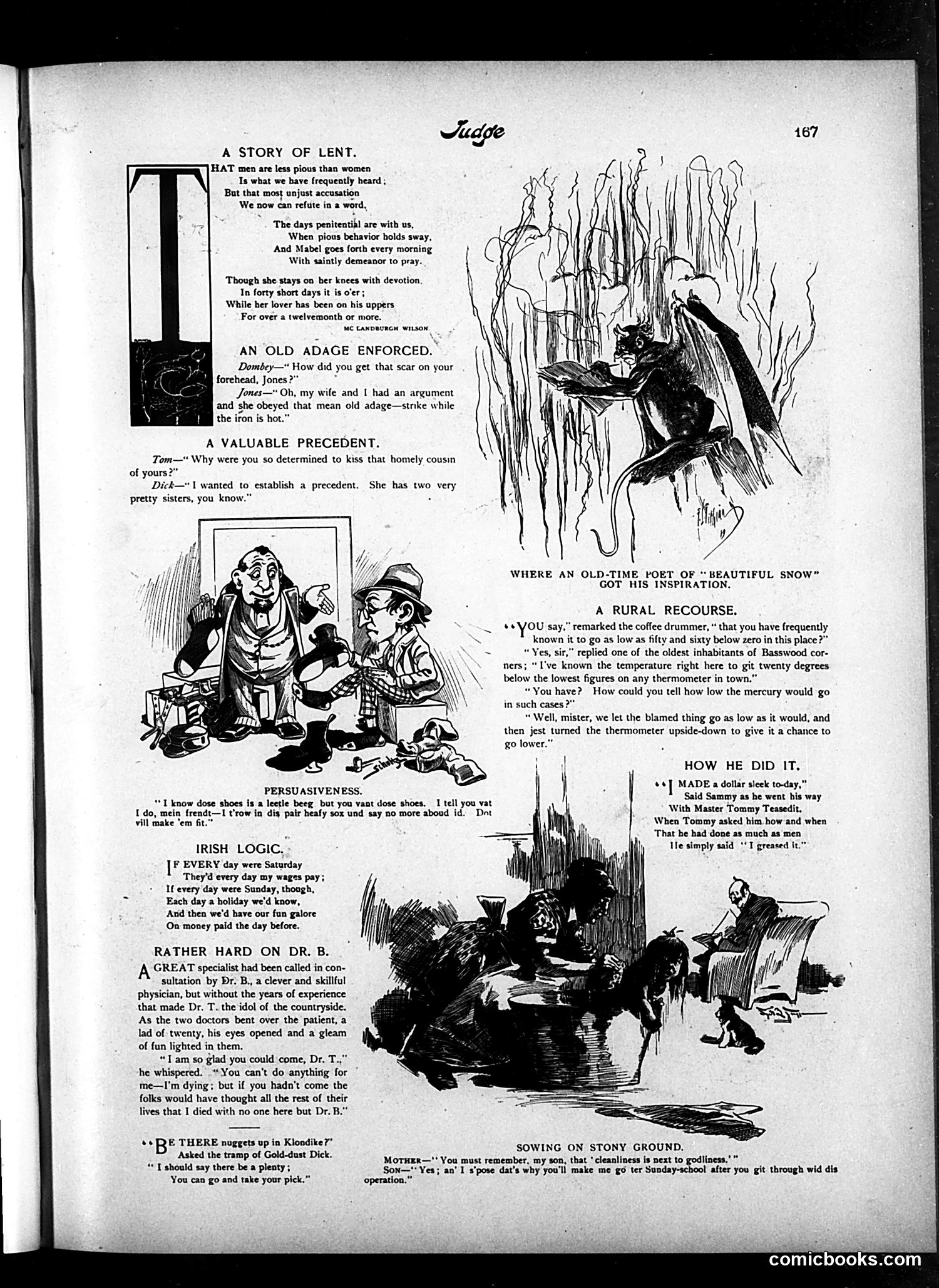
This page contains multiple short humorous vignettes typical of early 20th-century satirical magazines: **"A Story of Lent"** mocks religious hypocrisy—a woman performs ostentatious piety during Lenten season while her male suitor suffers financial hardship ("on his uppers"), suggesting shallow devotion. **"An Old Adage Enforced"** jokes about domestic violence, using the phrase "strike while the iron is hot" to explain a wife's scar-inflicting attack. **"A Valuable Precedent"** presents courtship logic: kissing an ugly cousin to establish precedent for kissing her attractive sisters. **"A Rural Recourse"** satirizes rustic ingenuity—a farmer claims impossible cold temperatures by flipping the thermometer upside-down to show lower readings. **"How He Did It"** depicts greasing as a shortcut success method. Other sections include "Irish Logic," "Persuasiveness" (featuring ethnic caricature), and jokes about mining ("Klondike") and cleanliness. The humor relies on period conventions: ethnic stereotypes, domestic violence, religious mockery, and rural foolishness—reflecting contemporary Judge magazine sensibilities.
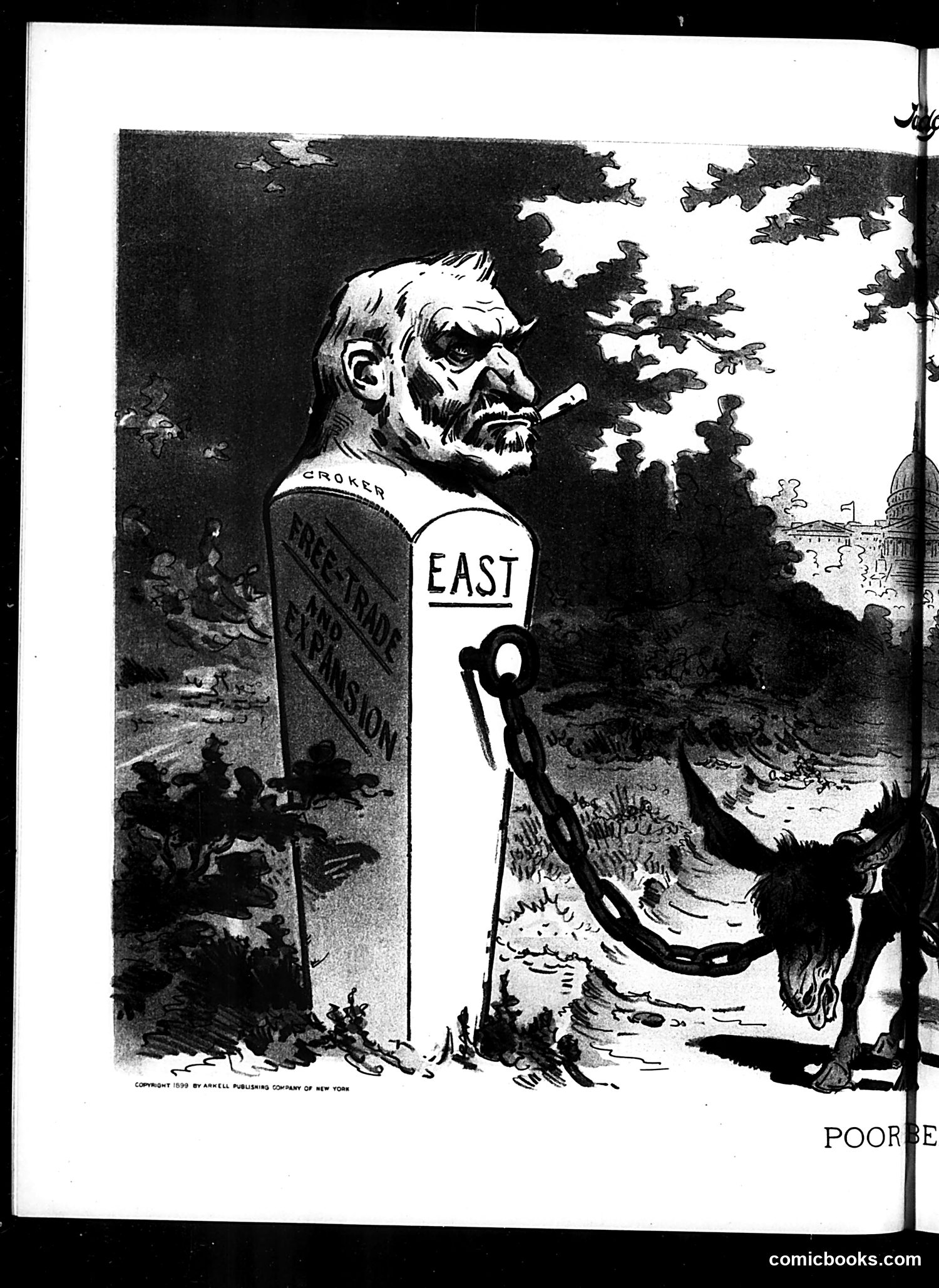
This is a satirical cartoon from Judge magazine (copyright 1599, likely a typographical error for 1899). The image depicts a bearded man labeled "CROKER" smoking a cigar, positioned next to a monument or sign reading "EAST" with what appears to be additional text about an extension. The figure is chained, suggesting political captivity or constraint. Richard Croker was a prominent Tammany Hall boss in New York during the 1890s, so this likely satirizes his political power and corruption. The "East" reference and Capitol building in the background suggest commentary on eastern political machines or New York politics. The chain imagery implies the cartoon critiques Croker's control or bondage to corrupt political interests. The overall tone is darkly satirical of machine politics.
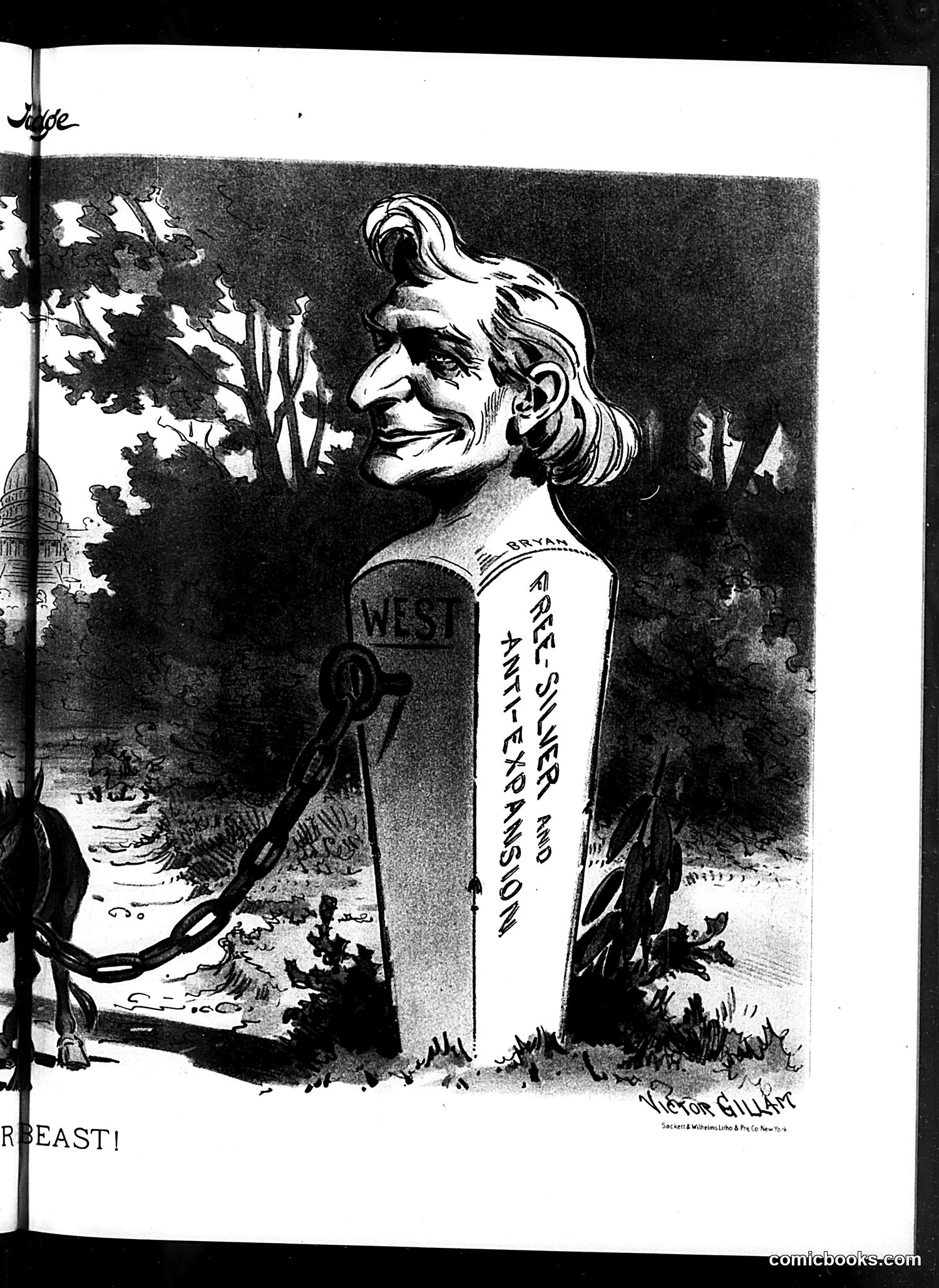
This appears to be a Clifford Berryman cartoon from Judge magazine depicting a bust or monument labeled "West" with text reading "Bryan" and what seems to be "Held Sway" or similar. The caricatured head shows a man with distinctive flowing hair. The cartoon likely satirizes William Jennings Bryan, the three-time presidential candidate and prominent Populist/Democratic figure. The "West" reference suggests commentary on Bryan's political base in America's western states. The monument format suggests the cartoon mocks Bryan's aspirations or legacy. The exact date and specific political context remain unclear without additional page information, but the style and subject matter indicate this targets Bryan's political prominence during the late 19th or early 20th century.
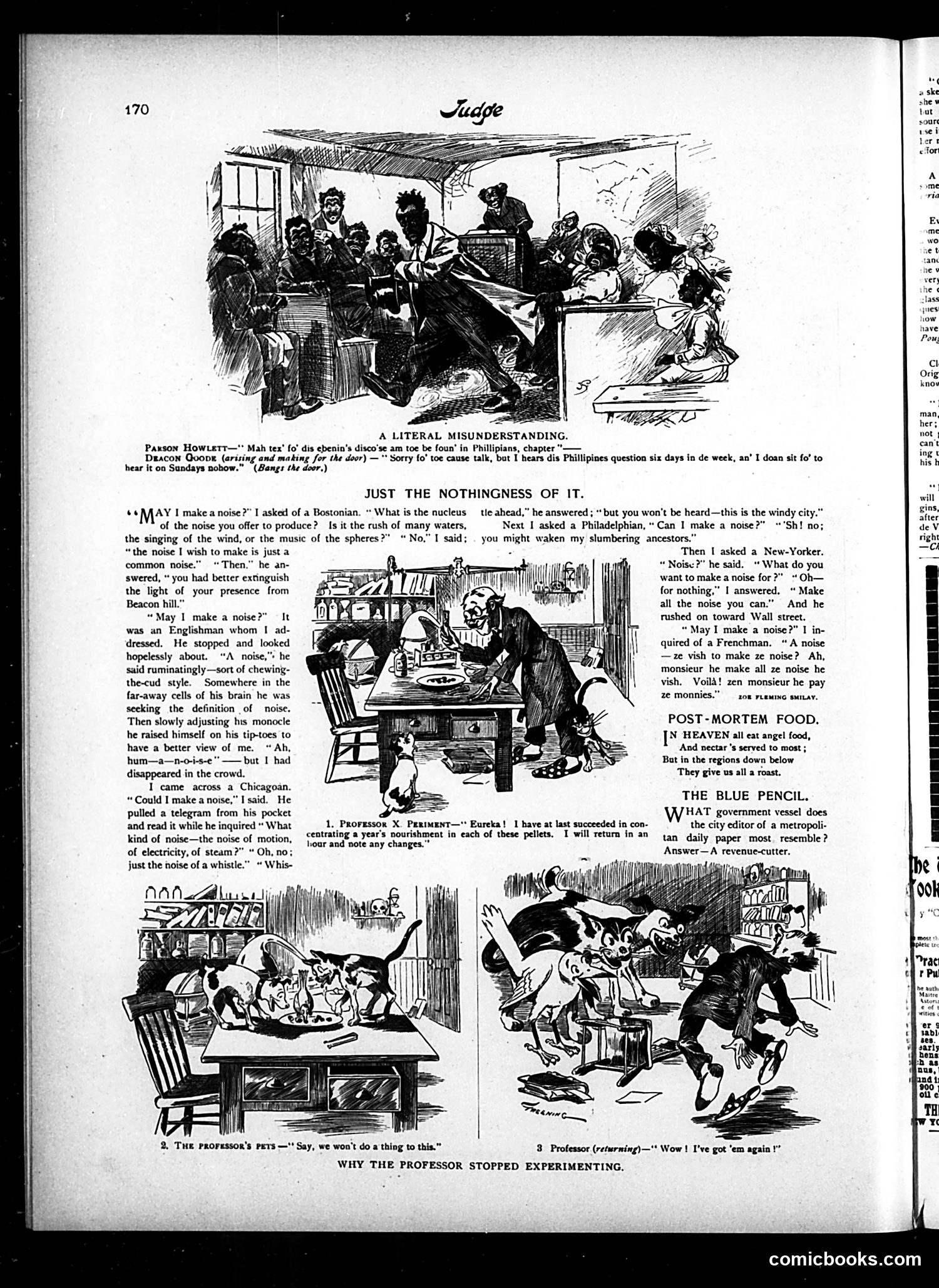
This page contains three unrelated satirical pieces typical of Judge's humor: **"A Literal Misunderstanding"** (top cartoon): A deacon mishears the pastor's reference to Philippians (a biblical book) as "Philippines" (the colonial territory), assuming it's about the Philippines Question—a heated contemporary political debate. He leaves church in frustration, having heard about the Philippines all week already. This mocks both the deacon's literal-mindedness and the era's obsession with Philippine colonial policy. **"Just the Nothingness of It"** (text + middle cartoon): A humorous essay where the author asks various Americans if he can "make a noise," receiving characteristic responses reflecting regional stereotypes: Bostonians are pretentious, Englishmen pedantic, Chicagoans commercial, New Yorkers crude, and Frenchmen mercenary. **"Why the Professor Stopped Experimenting"** (bottom cartoon): A scientist condenses a year's nutrition into pellets for testing. When he returns, the pellets have somehow animated into chaotic creatures—a visual gag suggesting the experiment backfired spectacularly.
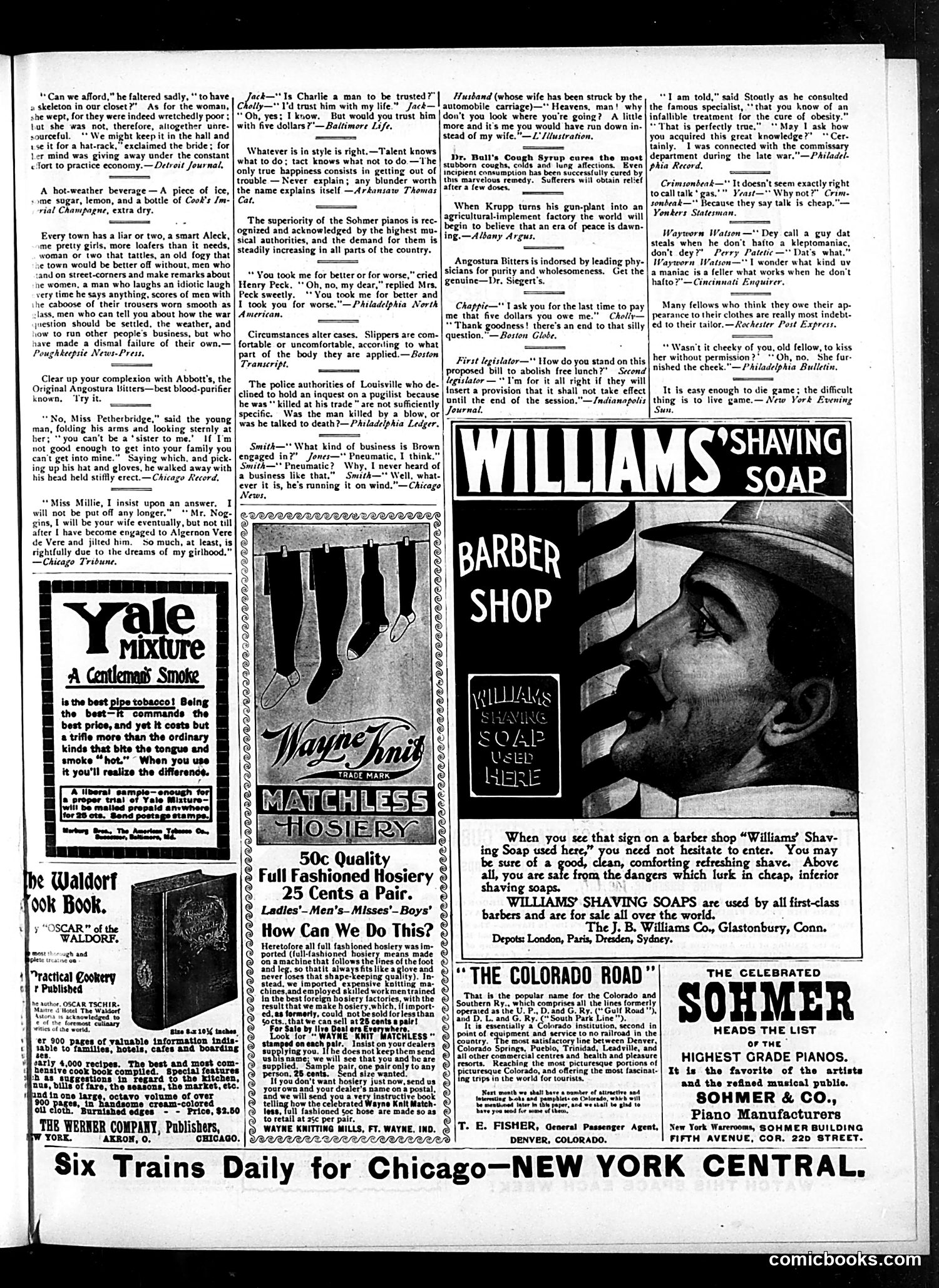
This page is primarily **advertising and humor snippets** rather than political cartoons. The visible content consists of: 1. **Short satirical jokes** about everyday life—poverty, romance, small-town gossip, and social pretension. These reflect Judge's typical humor formula: brief, cynical observations about human nature and Victorian-era social conventions. 2. **Product advertisements** dominating the layout: Yale pipe tobacco, Wayne Knitting Mills hosiery, Williams Shaving Soap, Sohmer pianos, and railroad services. These ads use period marketing appeals (quality, affordability, sophistication). 3. **No identifiable political cartoons or caricatures** of public figures are visible on this page. The overall tone is genteel satire aimed at middle-class readers—poking fun at romantic misadventures, marital complications, and social pretense, while promoting consumer goods. This represents Judge's standard early 20th-century formula of entertainment mixed with commerce.
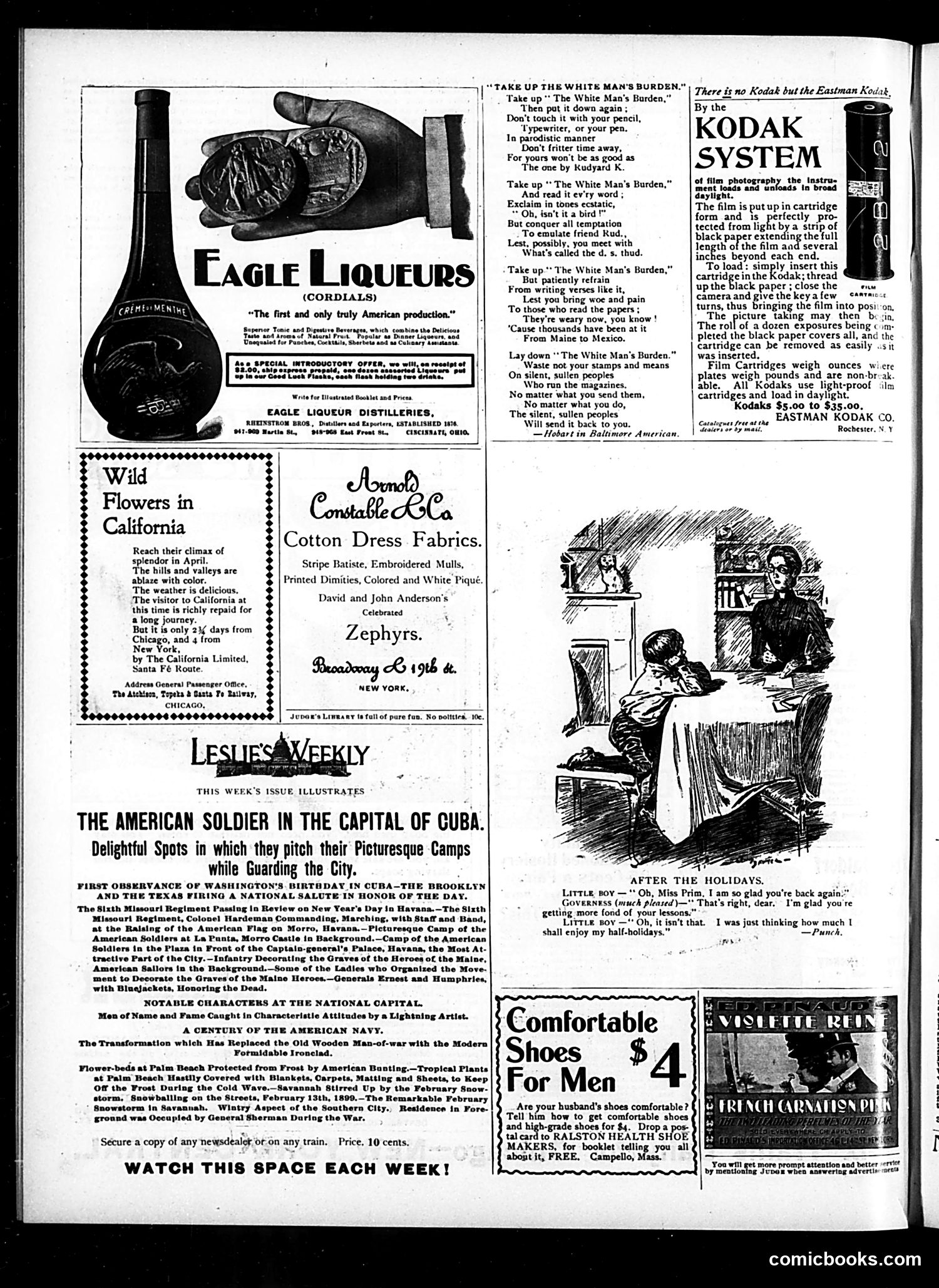
This page mixes advertisements with satirical poetry mocking the popularity of Rudyard Kipling's 1899 imperialist poem "The White Man's Burden." **The Main Satire:** The untitled poem parodies Kipling's famous work, which justified Western imperial expansion. The satirist urges readers to *read* Kipling's poem but *not imitate* it—warning that amateur attempts at writing similar imperial verse will be rejected by magazine editors and cause "woe and pain" to readers exhausted by thousands of imitations "From Maine to Mexico." The joke targets the poem's overwhelming popularity and the flood of mediocre copycat verses it inspired. The phrase "d. s. thud" appears to mean rejection slips hitting desks with dull thuds. **Historical Context:** Published during America's post-Spanish-American War occupation of Cuba (evident from the adjacent article about American soldiers in Havana), the satire gently mocks the imperial fervor Kipling's poem had inspired, while specifically attacking derivative hack writers rather than Kipling himself. The remainder consists of period advertisements for liqueur, fabrics, shoes, and Kodak cameras.
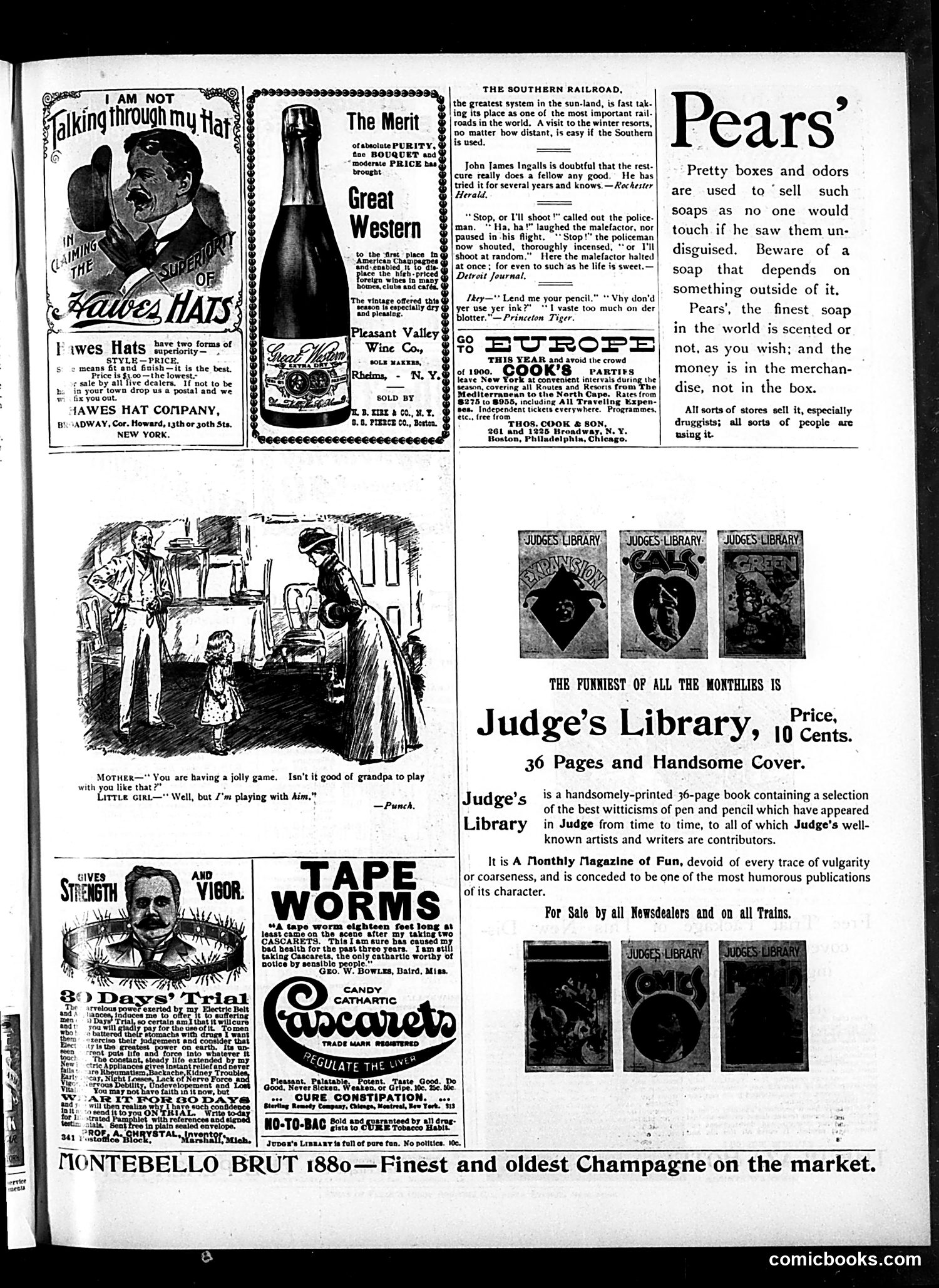
This is primarily an **advertising page** from Judge magazine (date unclear from image). The main content consists of product advertisements rather than political satire. The one cartoon present—a mother and child discussing grandpa—is a simple domestic joke: the little girl says she's "playing with" grandpa, implying he's become a toy-like plaything in his old age. It's gentle humor about aging and changing roles within families. The advertisements reflect late 19th/early 20th-century patent medicine culture: Cascarets (a laxative claiming to expel tapeworms), Dr. Pearson's Tonsorial preparations, and Capcarels candy. These ads exemplify the era's unregulated medical claims. The Pears' soap advertisement uses a different approach—emphasizing quality over packaging, contrasting with competitors that relied on "pretty boxes and odors" to disguise inferior products. Other ads promote hats, wine, champagne, and Judge's own Library publication (a humor anthology). The page is essentially a commercial vehicle rather than satirical commentary.
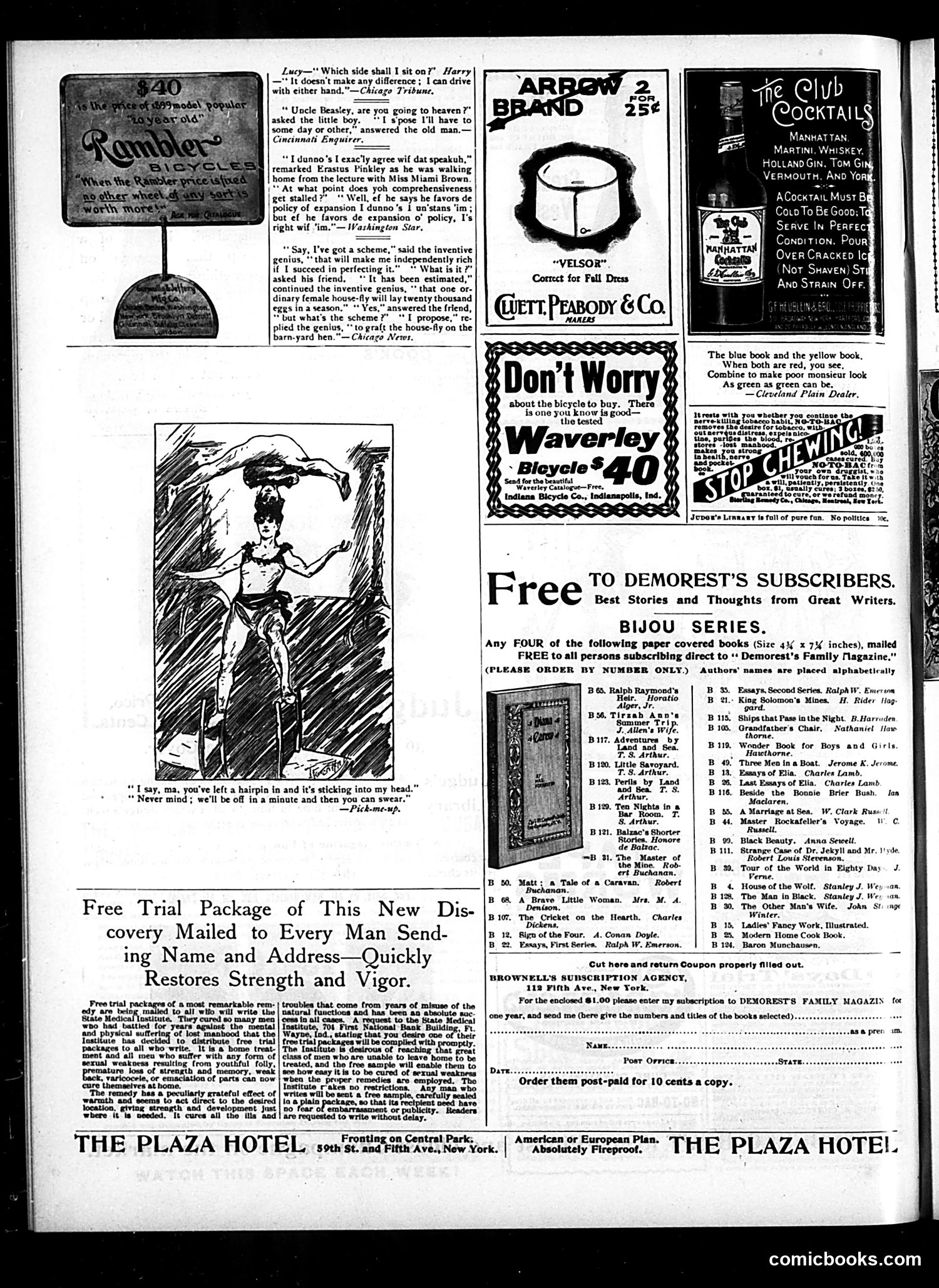
This page is primarily **advertisements and promotional material**, not political satire. It contains several brief humorous anecdotes (jokes from various newspapers) and extensive ads for products like bicycles, cocktail guides, and hotel services. The cartoon visible shows a woman and man in a car, with a joke about the man being able to drive with "either hand"—likely a reference to early automobiles and gender roles, though the precise satirical point is unclear from context. The page's main content is a free trial offer for a "discovery" restoring "strength and vigor" (appears to be a patent medicine advertisement), subscription offers to Demorest's Family Magazine with free books, and hotel/product advertisements. The humor throughout reflects early 1900s sensibilities about technology, courtship, and domestic life, but contains no identifiable political figures or major social commentary.
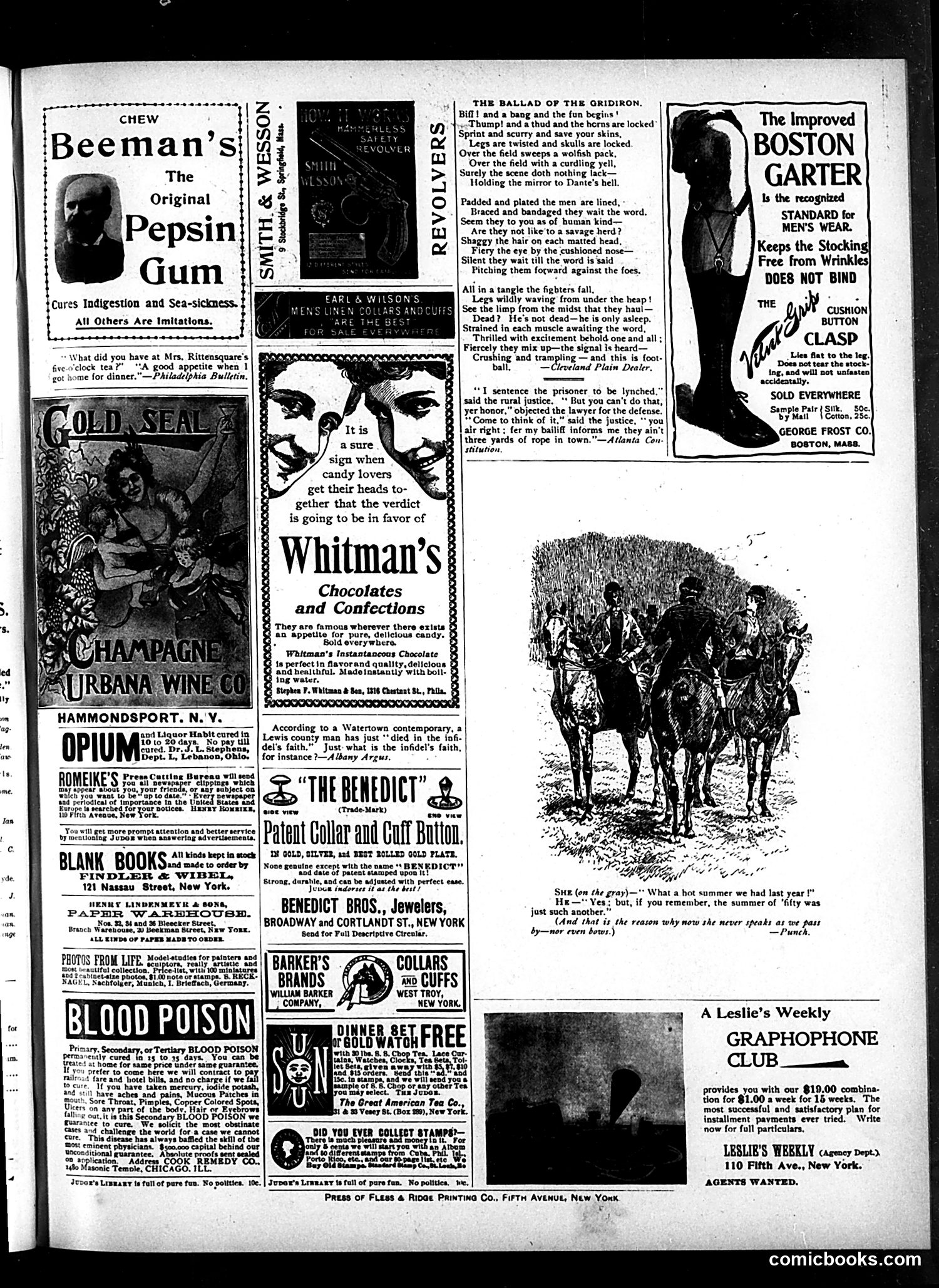
This is primarily a **commercial advertising page** with one notable satirical poem. The page's main content is product advertisements typical of early 1900s periodicals. The significant editorial content is **"The Ballad of the Gridiron,"** a satirical poem criticizing American football as barbaric and violent. The poet compares the sport unfavorably to "Dante's hell," describing padded players as a "savage herd" with "shaggy" hair, using language that suggests the game is brutal and dehumanizing. This reflects early Progressive-era critiques of football's dangerous physicality—a legitimate public concern before modern safety regulations. The advertisements reflect period consumer culture: Beeman's Pepsin Gum, Whitman's Chocolates, Smith & Wesson revolvers, patent medicines (including a "Blood Poison" cure), and various paper products and jewelry. A brief humorous exchange at bottom left mocks rural justice, likely suggesting incompetence or corruption in small-town legal systems—a common satirical target of the era.
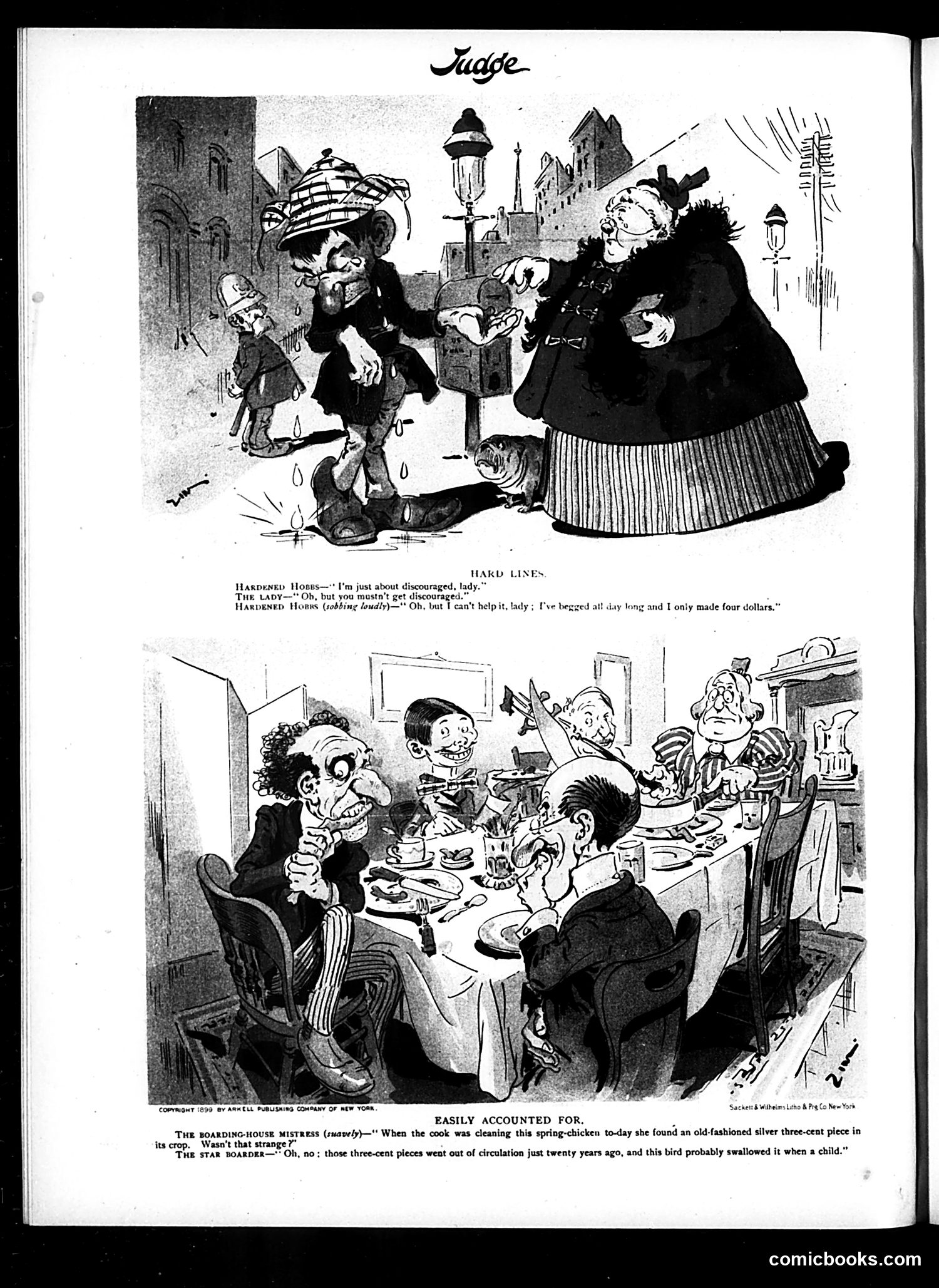
**Top cartoon ("Hard Lines"):** A beggar named "Hardened Honus" complains to a wealthy woman that despite begging all day, he's only earned four dollars. The satire mocks both the beggar's implausible complaint (four dollars was substantial income for the era) and the patronizing sympathy of the well-to-do, suggesting either the beggar is dishonest or the wealthy woman is naive about working-class economics. **Bottom cartoon ("Easily Accounted For"):** A boarding-house mistress and "star boarder" (a regular tenant) discuss finding an old three-cent coin inside a chicken. The joke relies on the coin being obsolete—removed from circulation twenty years prior—allowing the boarder to humorously explain how the bird could have swallowed it as a chick. This is gentle, absurdist humor about coincidence rather than social satire. Both cartoons use exaggerated character types typical of 1890s Judge magazine humor.