
A complete issue · 16 pages · 1899
Judge — March 11, 1899
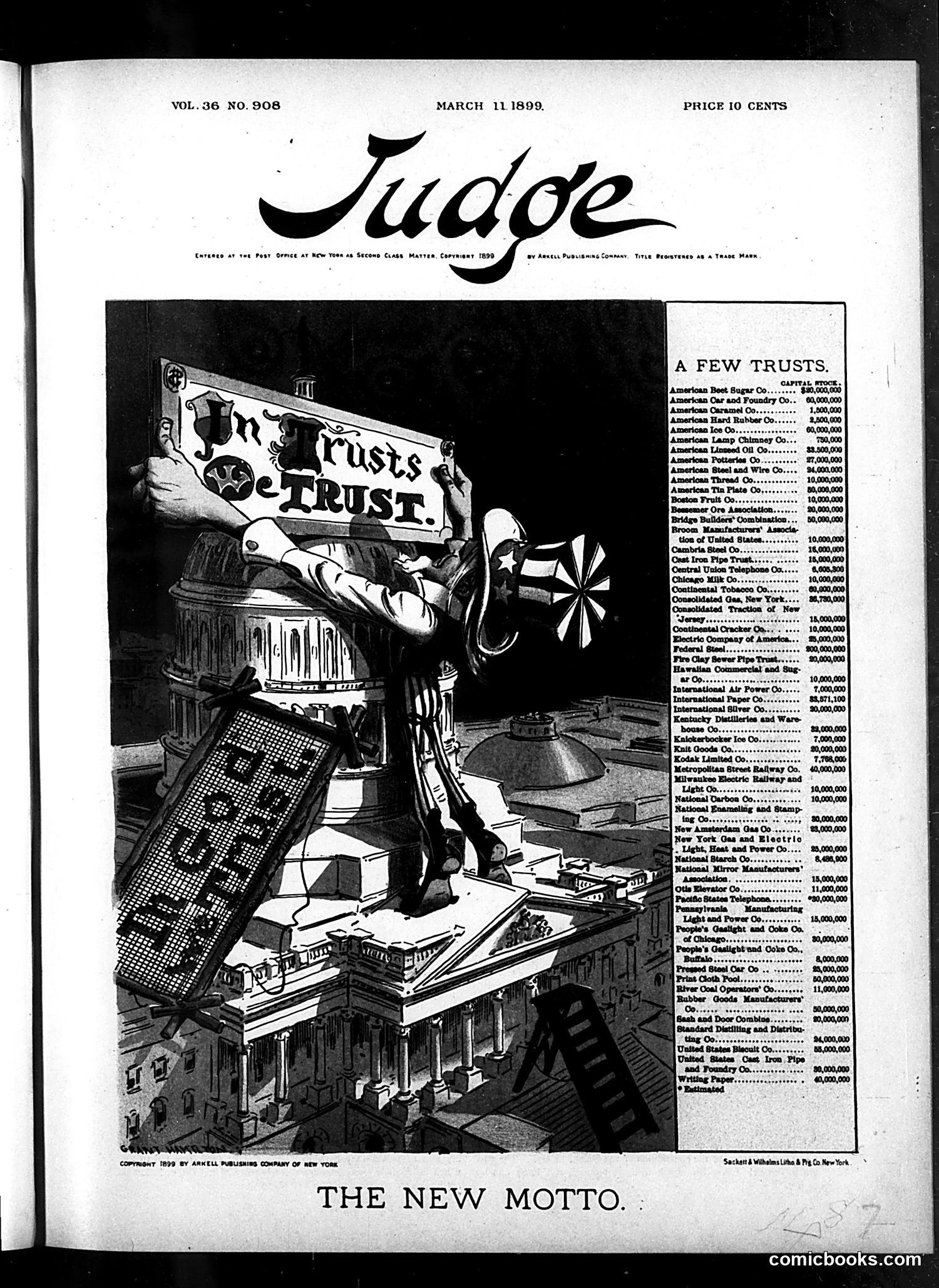
This political cartoon satirizes American **corporate trusts** and monopolies during the Gilded Age. The central figure represents "Trusts" as an octopus-like creature crushing a building labeled the Capitol, symbolizing how monopolistic corporations wielded excessive power over government institutions. The accompanying list of trusts—ranging from oil and steel to railroads and whiskey—documents the era's dominant cartels. The "new motto" appears to be that trusts, not democratic institutions, now control America. This reflects genuine 1890s anxieties about trust concentration. President Theodore Roosevelt would later campaign on trust-busting (starting 1901), making this cartoon representative of widespread public concern about corporate power overwhelming democratic governance.
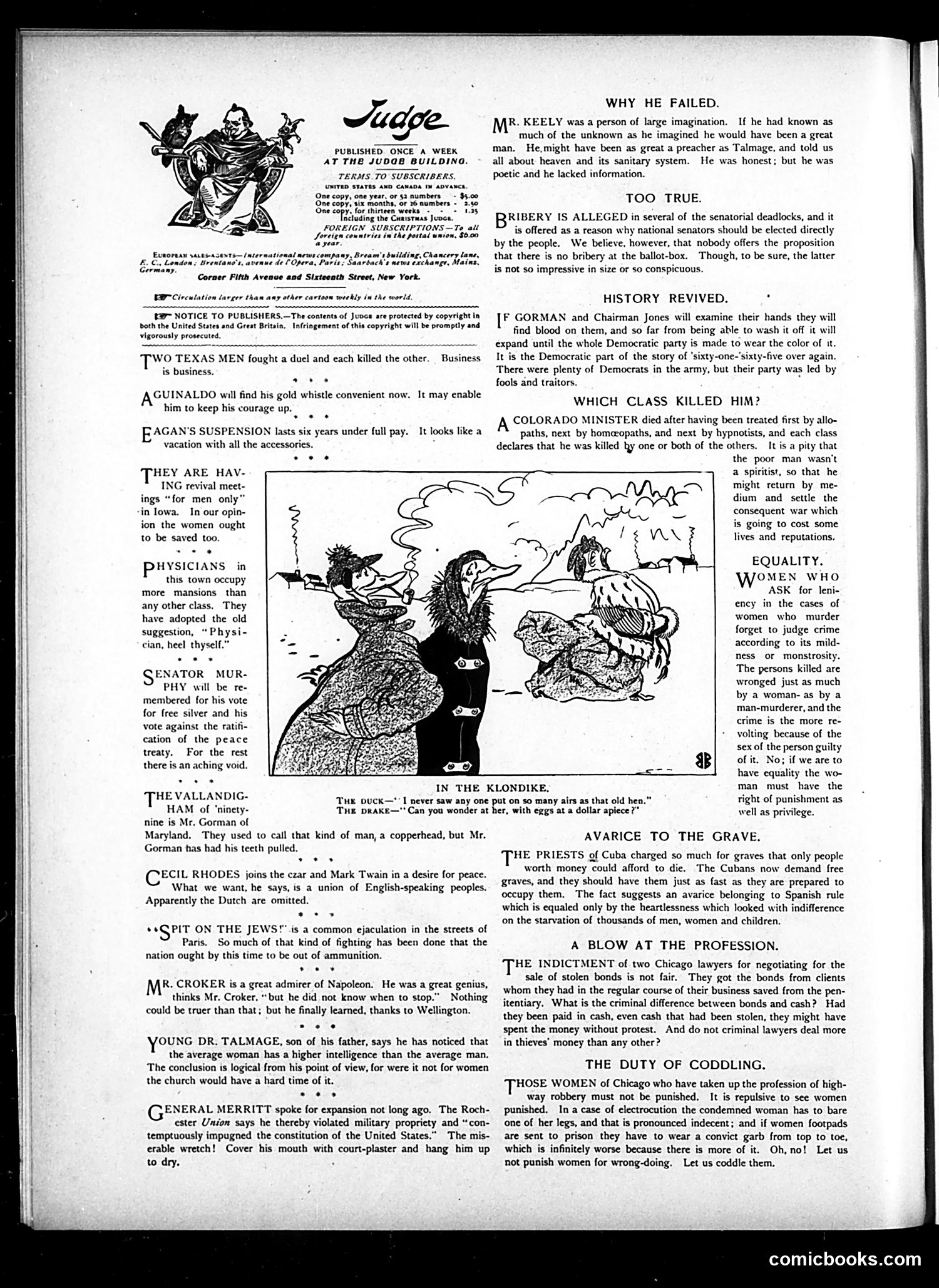
This cartoon depicts two figures arguing over a duck and a shark in what appears to be the Klondike region (referenced in the caption). The male figure claims he "never saw any one put on so many airs as that old hen," while the female responds sarcastically about the duck's supposed sophistication. The satire appears to comment on human vanity and pretension during the Klondike Gold Rush era. The absurdist scenario—debating animal behavior in harsh frontier conditions—mocks people's tendency to maintain social affectations even in extreme circumstances. The cartoon suggests that regardless of environment or hardship, humans cling to class-conscious attitudes and petty arguments, revealing the artificiality of social pretense.
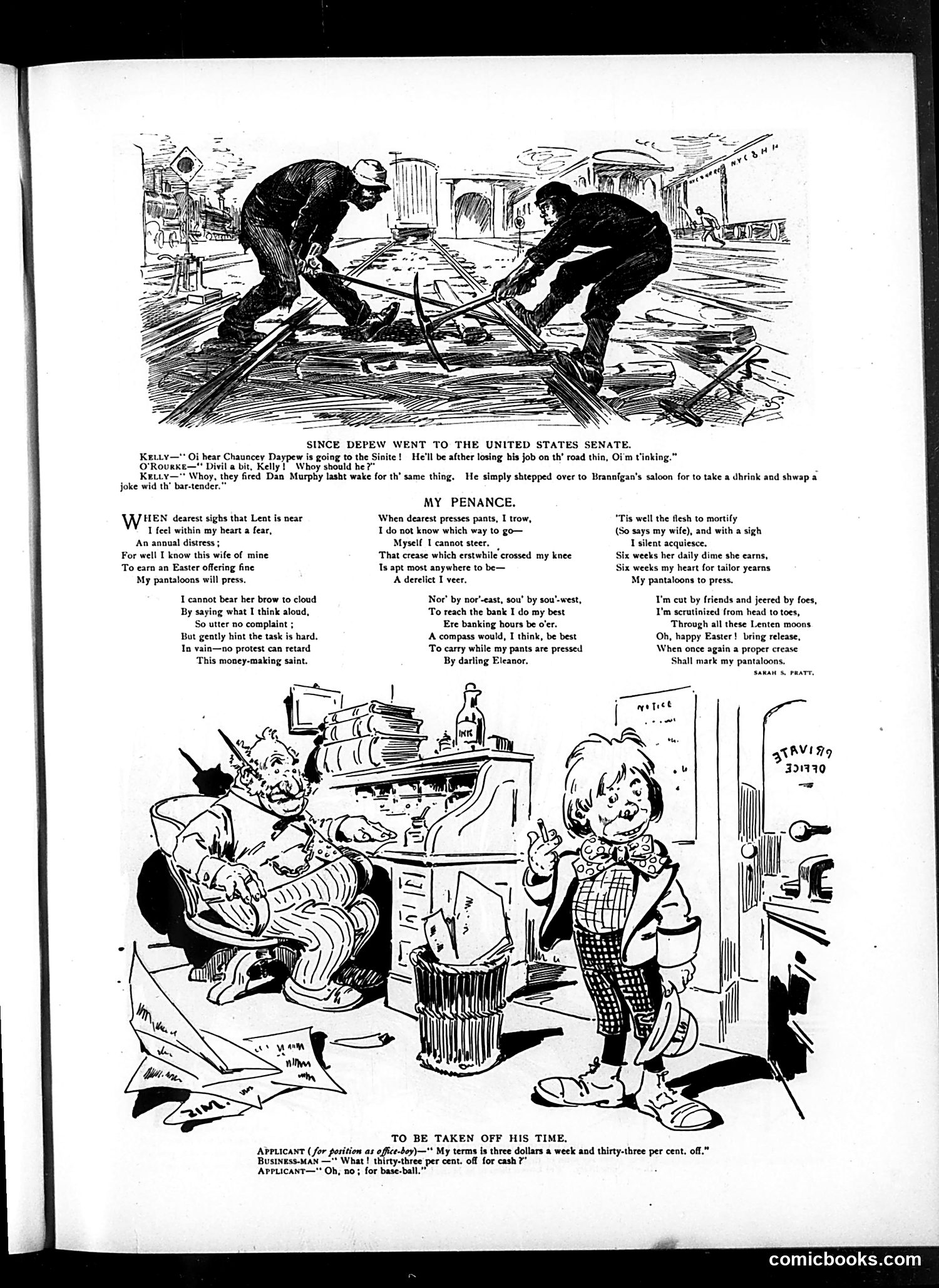
**Top Cartoon:** References Chauncey Depew going to the U.S. Senate. The dialogue suggests railroad workers (Kelly and O'Rourke) expect Depew will lose his railroad job, with dark humor about him only getting a "drink and cheap a joke for his trouble" at Brannigan's saloon instead. **Middle Section:** "My Penance" is a poem by Sarah B. Pratt about romantic heartbreak and longing during Lent—unrelated to politics. **Bottom Cartoon:** "To Be Taken Off His Time" depicts a job applicant negotiating wages ($3/week plus 33¢ per cent off) with a businessman surrounded by cluttered papers and office chaos. The satire mocks both excessive haggling over pittance wages and workplace disorder during the Gilded Age.
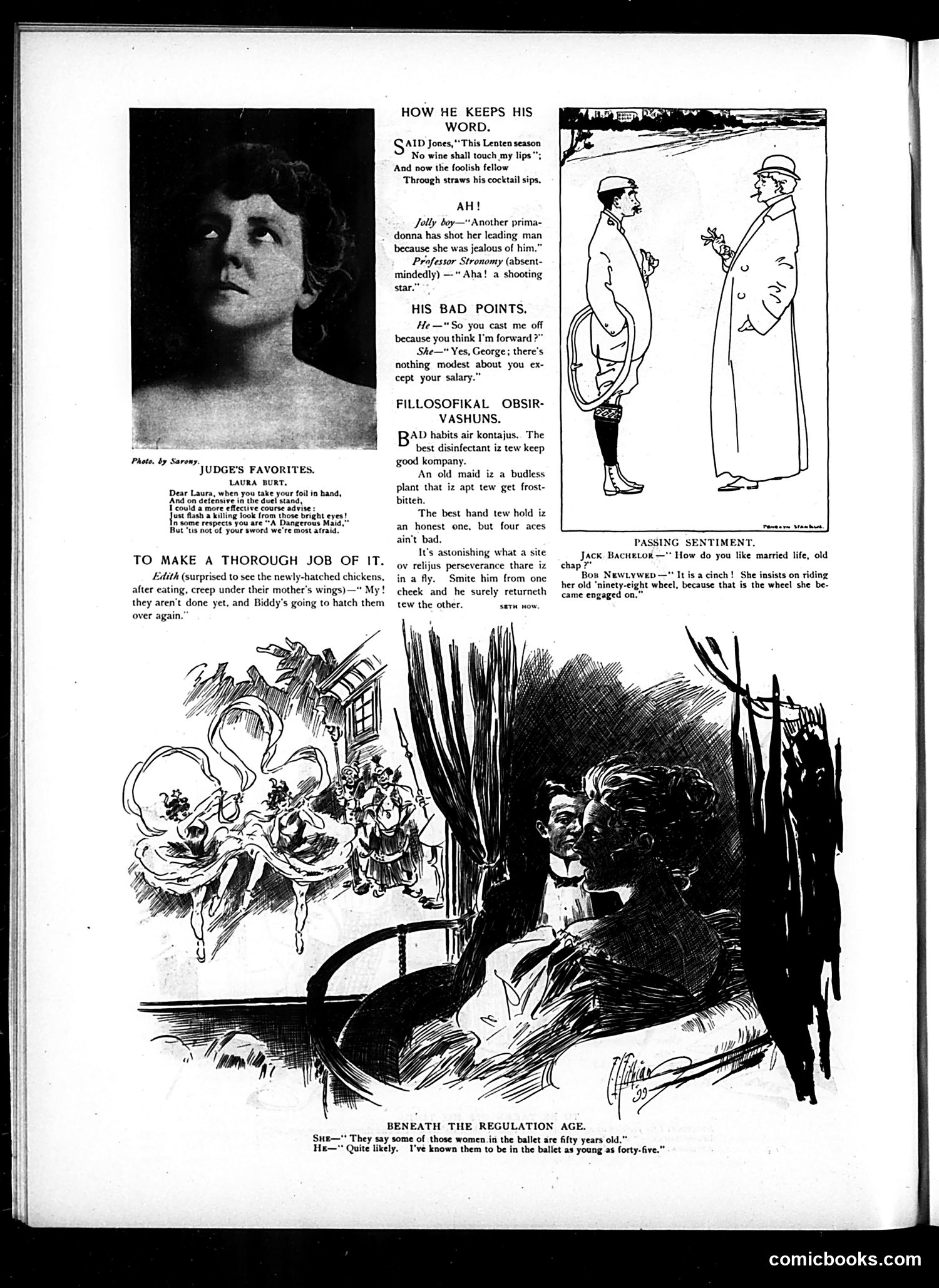
This page contains several satirical pieces about courtship, marriage, and social behavior: **"Judge's Favorites"** features Laura Burt, a photograph suggesting she's a public figure or actress the magazine endorsed. **"How He Keeps His Word"** mocks a man who promised abstinence during Lent but breaks his vow through cocktails—satirizing hollow religious observance. **"Philosophical Observations"** jokes about bad habits and tea-holding etiquette. **"Passing Sentiment"** presents a marital exchange where a new wife insists on controlling the automobile, suggesting early-20th-century anxieties about women's independence. **"Beneath the Regulation Age"** depicts men discussing young ballet dancers' ages, making an uncomfortable joke about age and eligibility that reflects period attitudes toward women's bodies and marriageability. The overall theme concerns gender relations and social propriety.
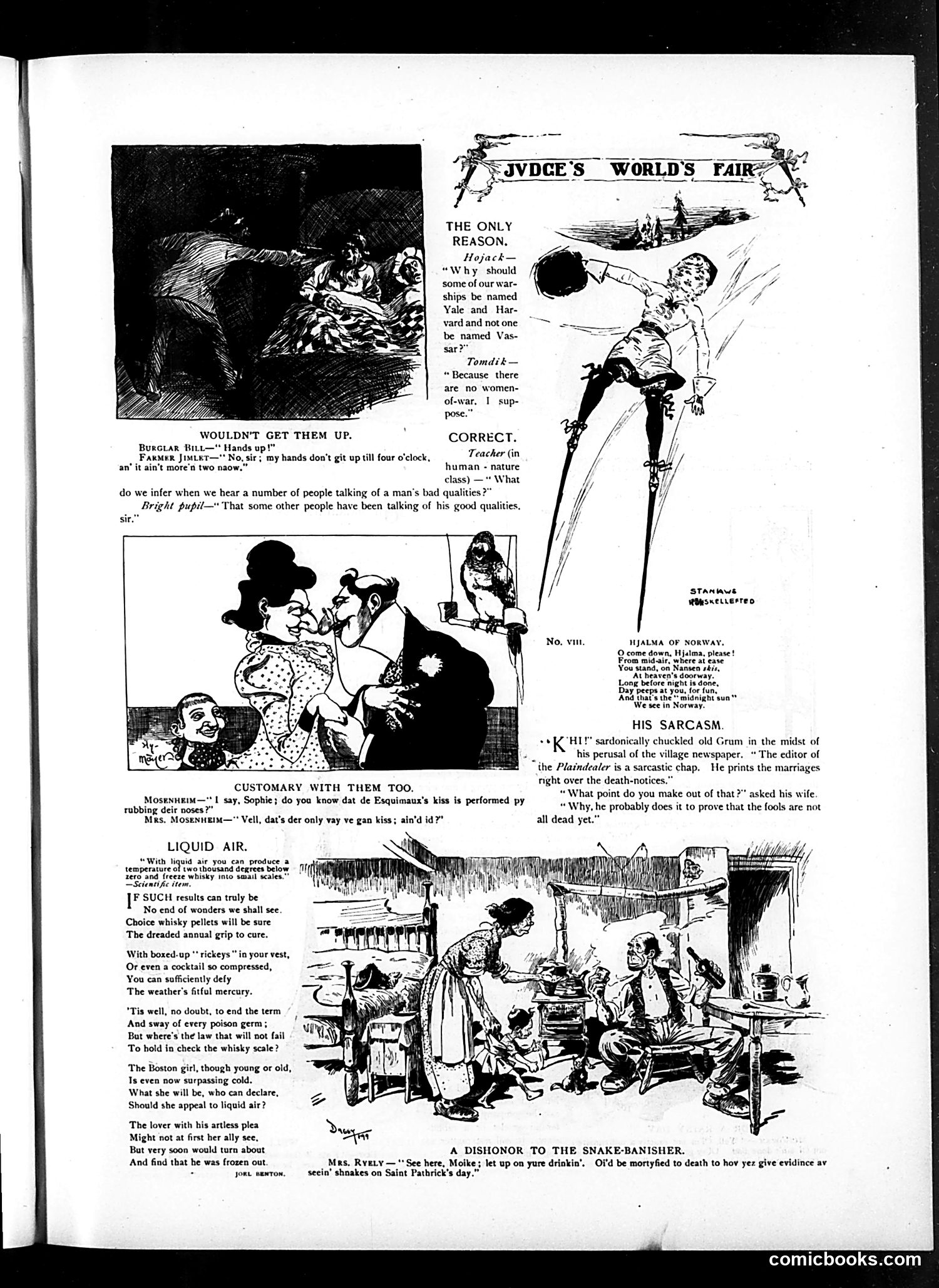
This page collects several brief satirical pieces typical of Judge's humor: **"The Only Reason"** mocks gender discrimination by having a character argue warships shouldn't be named after women's colleges (Vassar) because "there are no women-of-war"—absurd logic highlighting how women were excluded from military service. **"Wouldn't Get Them Up"** jokes about a farmer's laziness: he won't raise his hands for a burglar because his hands don't "get up" until 4 PM. **"Customary With Them Too"** uses ethnic stereotyping (the Mosennheims appear to be Germanic characters) for a joke about Eskimo nose-rubbing kisses. **"Liquid Air"** satirizes scientific progress by imagining freezing whisky and cocktails solid—suggesting Americans' alcohol consumption is so habitual they'd preserve drinks for portability. **"His Sarcasm"** presents a newspaper editor's dark humor: printing marriage announcements above death notices "proves the fools are not all dead yet." The page reflects early-1900s Judge style: topical humor, ethnic caricatures, and cynical observations about American life.
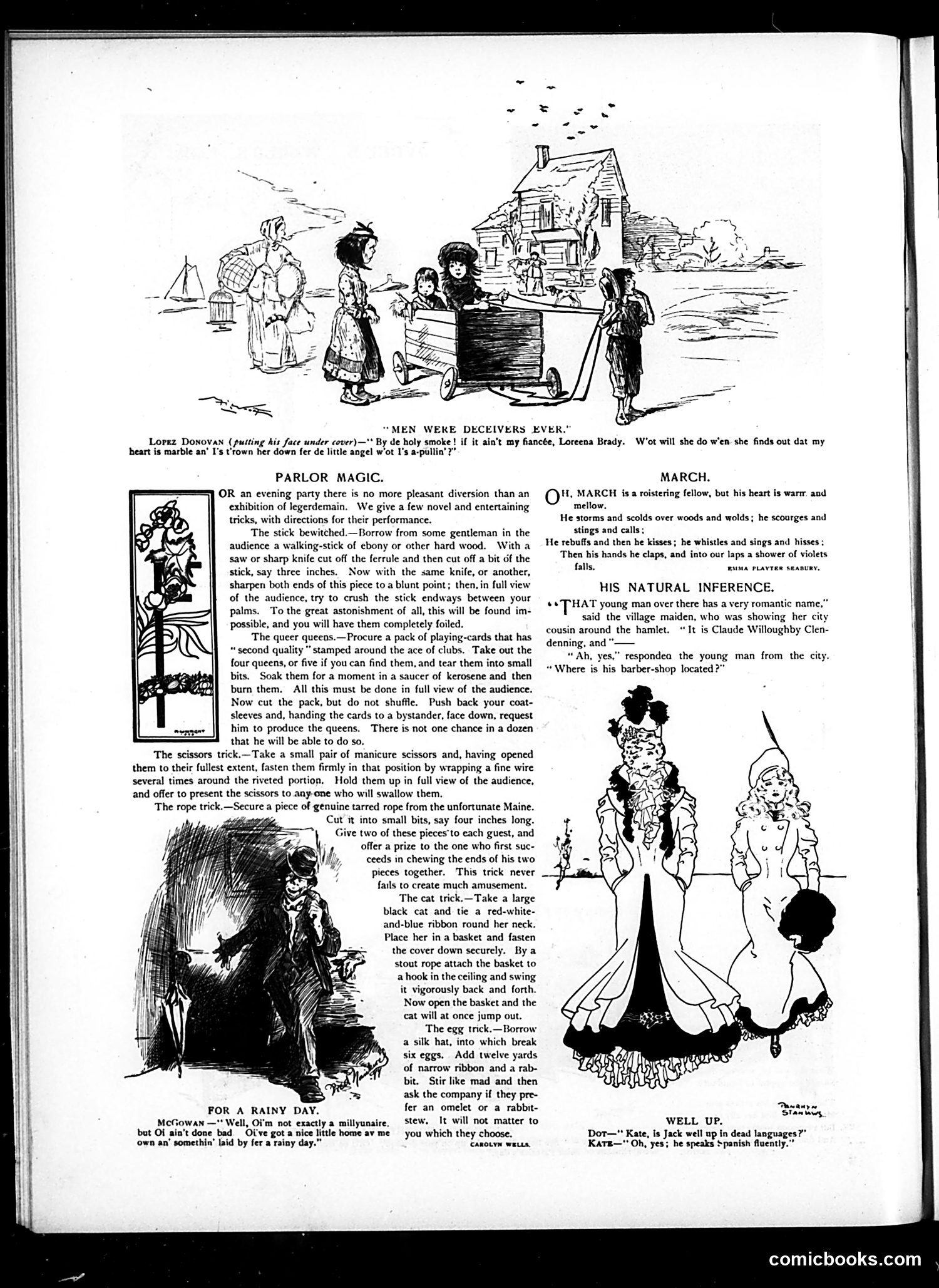
This page contains three satirical pieces typical of early-20th-century American humor: **"Men Were Deceivers Ever"** (top): A crude ethnic caricature of an Irish immigrant named Lopez Donovan, depicted with exaggerated dialect ("By de holy smoke"), revealing his infidelity to his fiancée Loreena Brady. The satire targets working-class Irish immigrants through stereotypical speech patterns and presumed moral failings. **"Parlor Magic"** (center): Instructions for drawing-room magic tricks presented as entertainment for social gatherings. These "tricks" are absurdist jokes (burning queens, chewing rope, cats in baskets with eggs and ribbons) rather than actual illusions—humor derives from the ridiculous premise that such stunts would fool audiences. **Bottom sections**: Brief humorous vignettes—one mocking rural poverty ("rainy day" savings), another playing on romantic name assumptions ("Claude Willoughby Clendenning" as a barber), and a pun about classical education ("dead languages"). The page reflects period class anxieties, ethnic stereotyping, and gentle social satire typical of Judge's entertainment-focused approach.
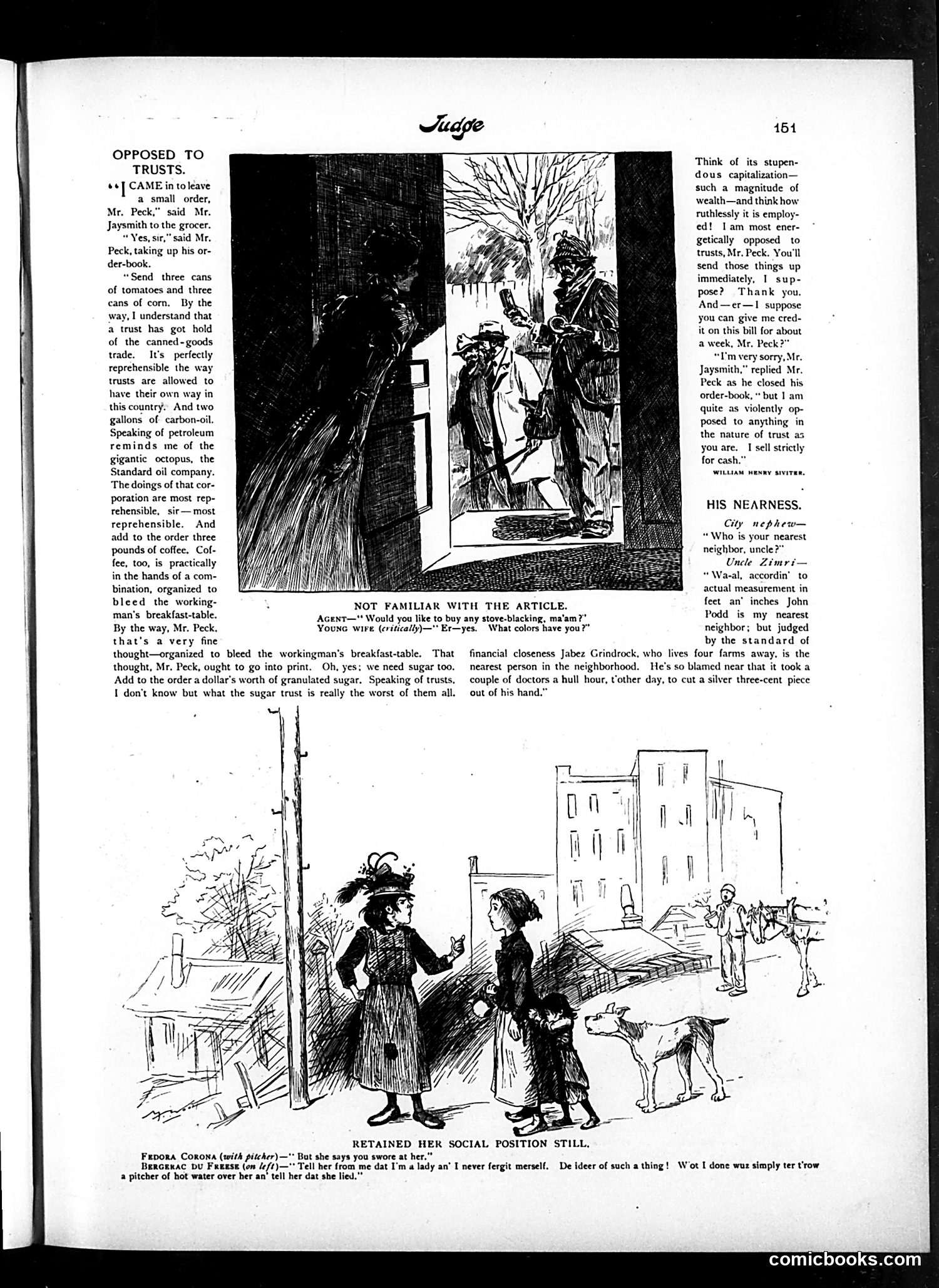
This page contains three distinct satirical pieces attacking monopolies and social hypocrisy circa early 1900s. **"Opposed to Trusts":** A grocer's customer (Mr. Jaysmith) lectures Mr. Peck about the evils of trusts—Standard Oil, canned goods monopolies, coffee combines—while simultaneously demanding credit and ordering goods. The satire mocks wealthy people who publicly denounce corporate monopolies while personally exploiting working people through debt and unfair dealings. Mr. Peck's response ("I sell strictly for cash") exposes the customer's hypocrisy. **"Not Familiar with the Article":** A shop assistant tries to sell stove-blacking, with the joke appearing to reference confusion about product varieties or sales techniques. **"Retained Her Social Position Still":** A working-class woman defends her dignity after throwing hot water on someone, insisting she remains "a lady" despite her rough behavior. The satire mocks how people maintain pretense of respectability regardless of their actual conduct. All three pieces critique class pretense and moral inconsistency in Gilded Age America.
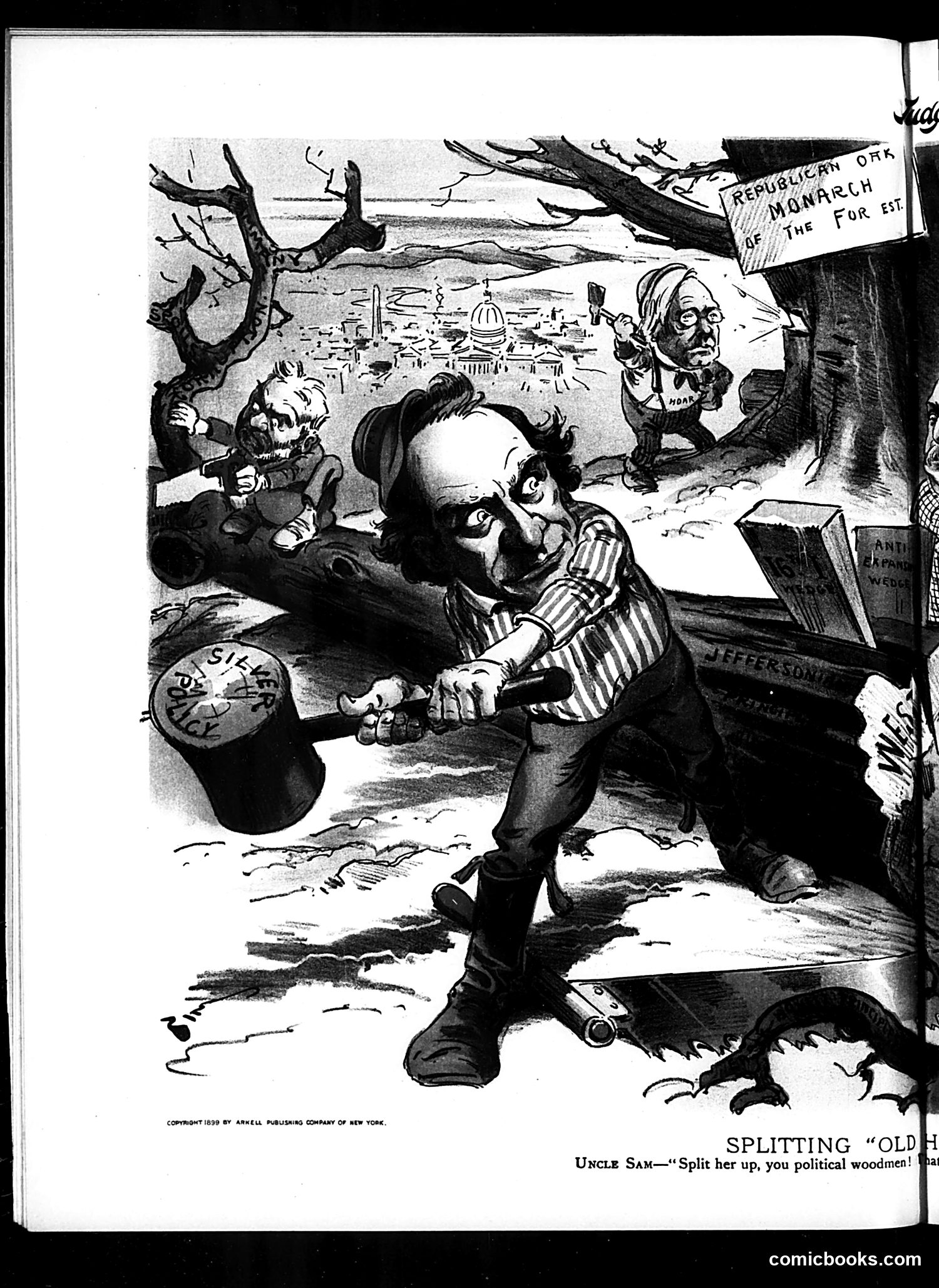
This 1899 Judge magazine cartoon depicts **Uncle Sam** (representing the U.S. government) as a woodcutter, wielding an axe to split a log labeled "REPUBLICAN OAK" and "THE FOREST EST[ate]." The cartoon satirizes **Republican Party factionalism**—internal political divisions splitting the party. The devilish figures in the background likely represent competing Republican interests or factional leaders. Signs visible include "ANTI-JAPANESE WERE[?]" and other policy references, suggesting disputes over specific issues divided Republicans. The title "SPLITTING 'OLD'" with the subtitle "Split her up, you political woodmen!" uses logging metaphor to mock Republicans destroying their own party unity through internal conflict rather than external threats. The barren, damaged landscape emphasizes the destructive nature of these divisions. This reflects late-1890s Republican party fracturing under President McKinley.
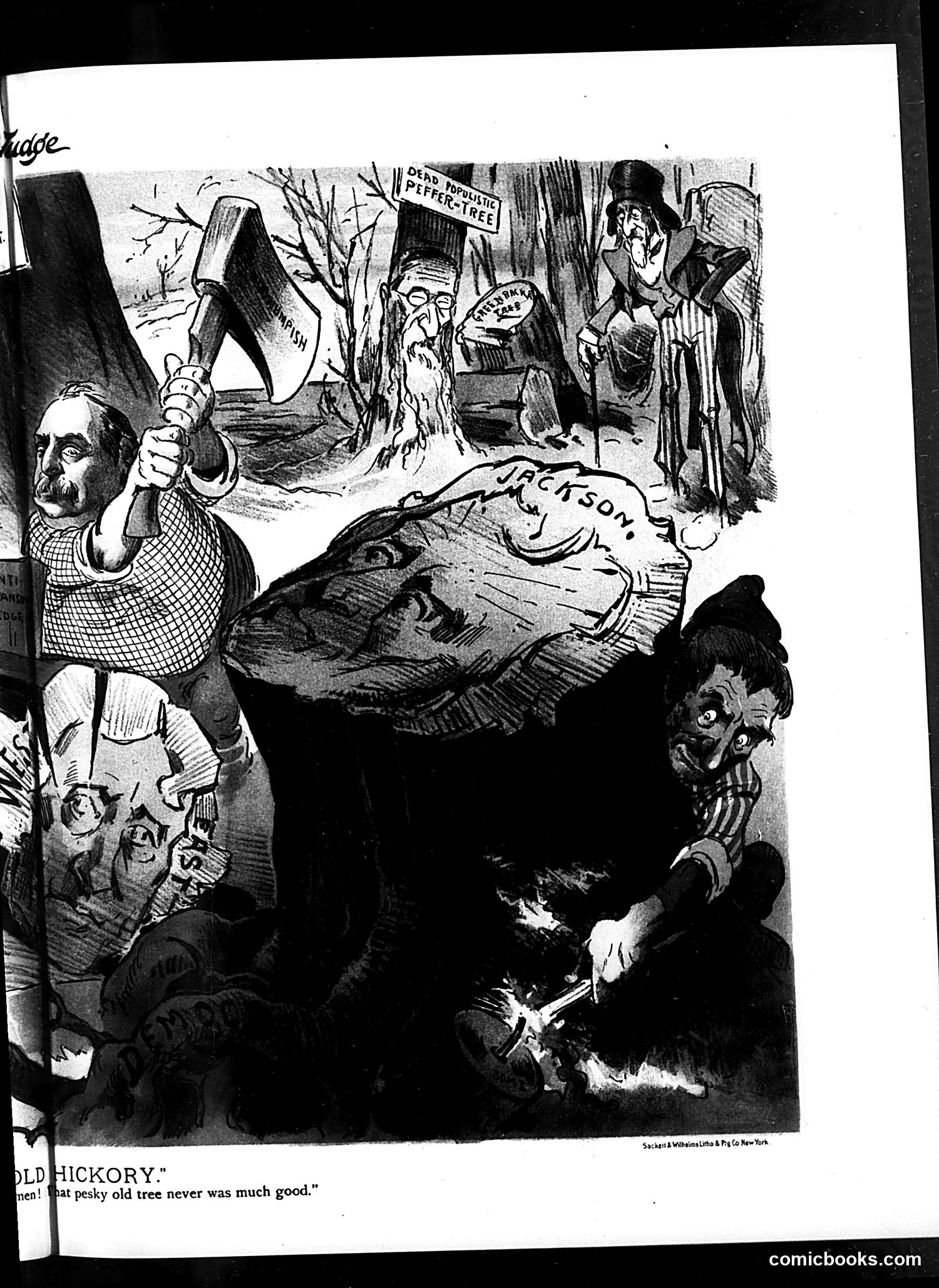
This Judge magazine cartoon appears to satirize Andrew Jackson ("Old Hickory," his famous nickname). The image shows Jackson being felled like a tree by figures in the background, with the caption suggesting the "old tree never was much good." The cartoon likely critiques Jackson's presidency or policies through violent imagery—his political opponents are depicted literally chopping him down. The dead tree labeled "Jackson" and the axe-wielding figure on the left suggest this is anti-Jackson political satire, common in Judge during the Jacksonian era or immediately after. The "pesky old tree" metaphor sarcastically dismisses Jackson's legacy, appealing to readers skeptical of his administration. Without a visible date, the specific political context remains unclear, but this represents typical 19th-century American political cartooning's hostile approach to controversial presidents.
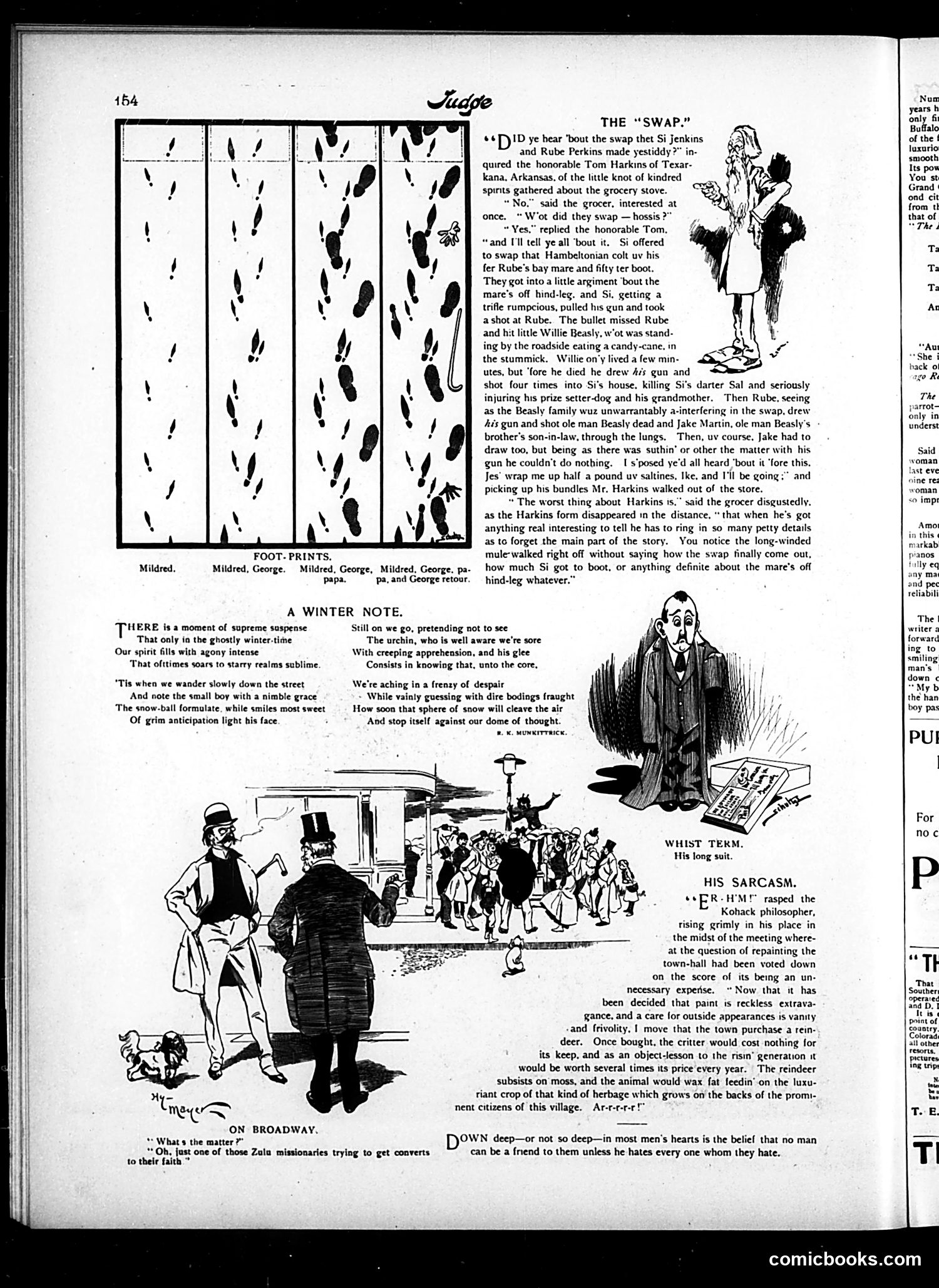
This page contains multiple satirical pieces typical of Judge's content: **"The Swap"** is a humorous tall tale narrated in exaggerated rural dialect. A grocer recounts an absurd story about a horse trade between Si Jenkins and Rube Perkins that escalates into a shooting spree, killing innocent bystanders. The satire mocks both the narrator's long-windedness and rural frontier violence—the grocer complains that Harkins got so lost in petty details he forgot the swap's actual outcome. The piece satirizes both storytelling incompetence and the casual brutality of frontier disputes. **"A Winter Note"** is a humorous poem about the universal dread of snowball-throwing boys attacking adults on winter streets. **"His Sarcasm"** depicts a town meeting where a character sarcastically proposes buying a reindeer to eat moss growing on citizens' backs—mocking the town's decision to forego painting the town hall as frivolous expense while suggesting the community is too morally bankrupt to care about appearances. The **"On Broadway"** cartoon (partially visible) appears to reference missionaries.
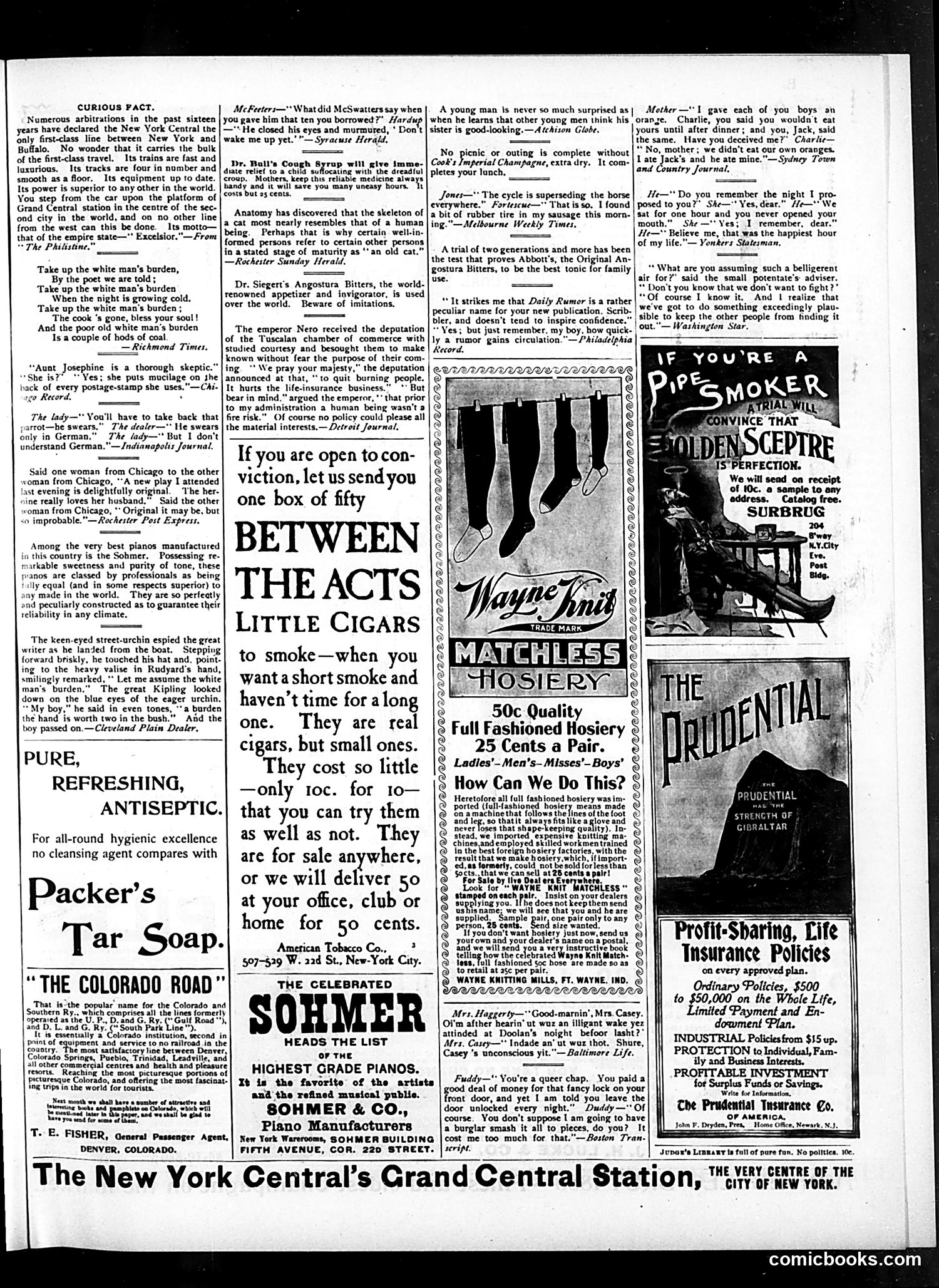
This page is primarily **advertising content** interspersed with brief humorous anecdotes and social commentary typical of early 20th-century American magazines. The notable satirical elements include: **"The White Man's Burden" jokes**: Multiple quips reference Rudyard Kipling's famous 1899 imperialist poem. One anecdote depicts a street urchin asking to "assume the white man's burden" (carrying Kipling's luggage), with Kipling deflecting the phrase back to the boy. The Richmond Times poem parodies the original, applying "burden" to domestic labor. This reflects contemporary skepticism about imperialist rhetoric. **Social humor**: A Chicago woman calling a play "original" because the heroine loves her husband satirizes Chicago society as cynical about marriage. Another joke mocks a skeptical woman who distrusts postage stamps. **Advertisements dominate**: Promoting Sohmer pianos, Packer's Tar Soap, the New York Central Railroad, and other products. The New York Central ad boasts superiority over competitors—reflecting the industrial competition of the era. The page captures early 1900s American attitudes: skepticism toward imperialism, domestic comedies reflecting gender roles, and aggressive commercial advertising.
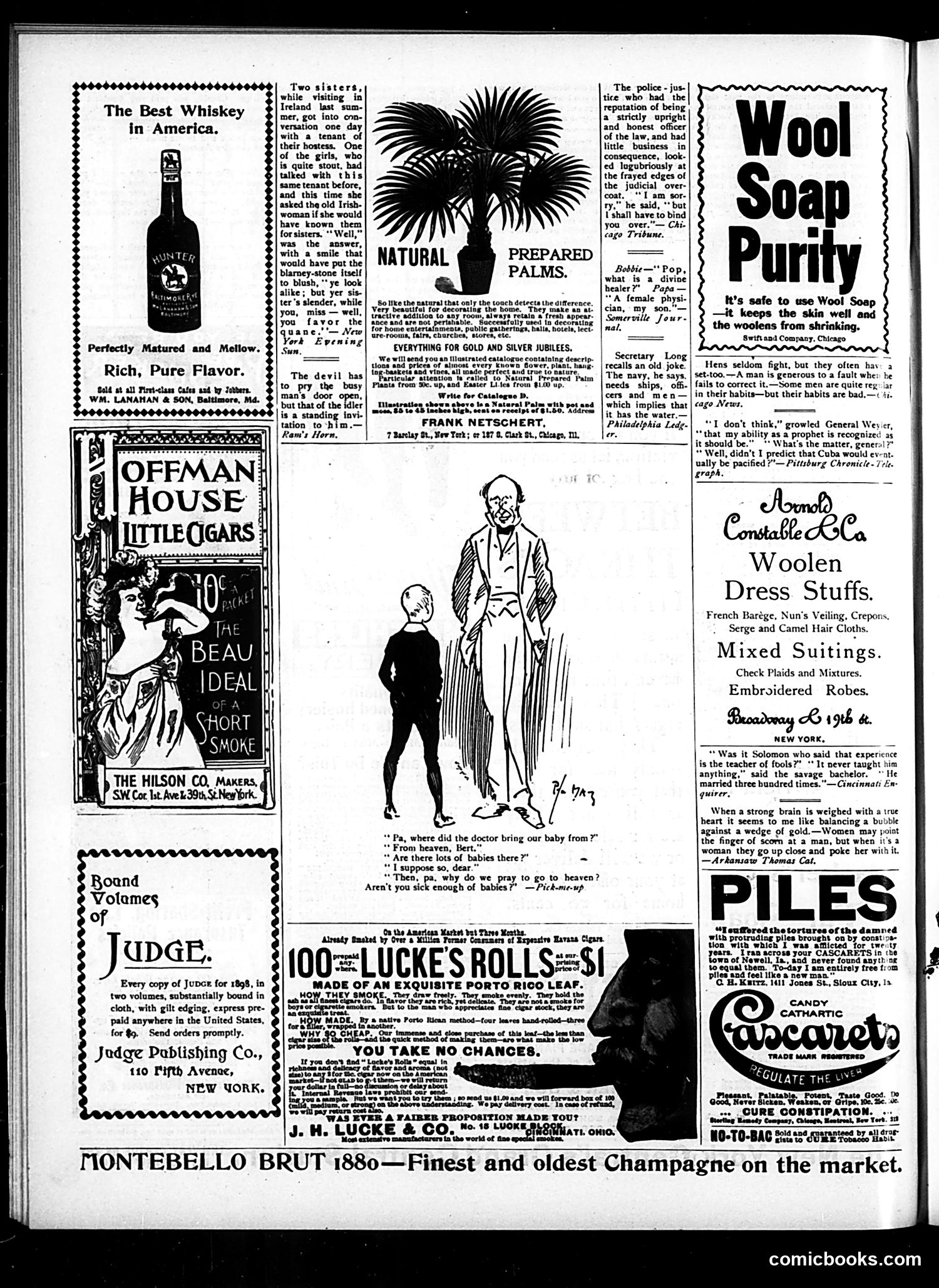
This page from Judge magazine is primarily **advertising with supporting humor content** rather than political satire. The main cartoon depicts a small boy confronting a tall, thin man, with dialogue about where babies come from—a domestic humor piece typical of the era's family-oriented jokes. The text anecdotes include: - An Irish dialect story about two sisters' appearances - A naval joke about Secretary Long needing ships - A general's complaint about his predictive abilities regarding Cuba **Historical context**: The Cuba reference likely alludes to the Spanish-American War (1898) and subsequent American involvement in Cuba, suggesting this page dates to that period. The bulk of the page advertises whiskey, cigars, champagne, wool soap, woolen fabrics, and patent medicines—reflecting fin-de-siècle consumer culture. The humor serves mainly to entertain readers between advertisements rather than to deliver sharp political commentary.
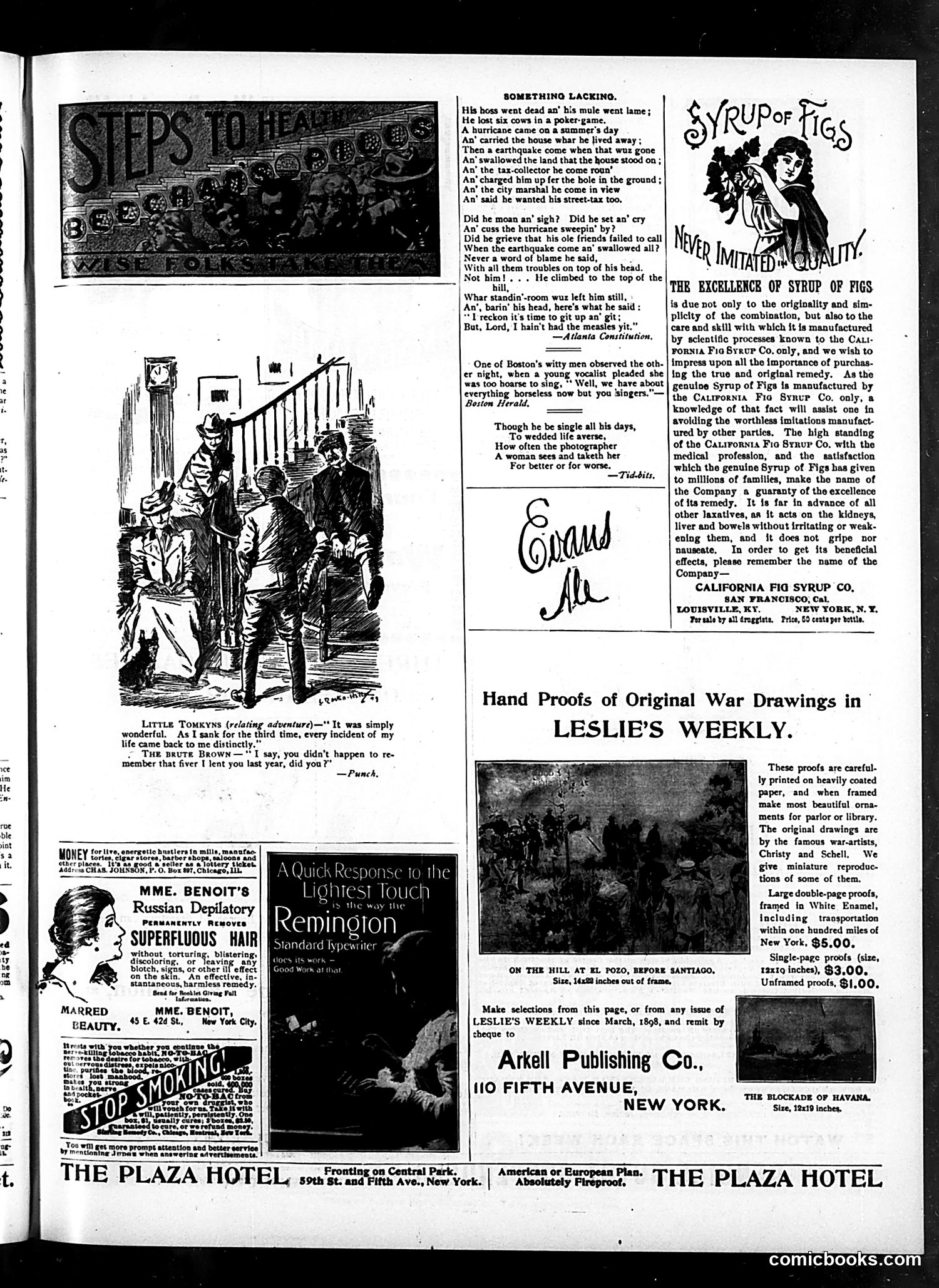
This page contains multiple items. The main cartoon, "Something Lacking," satirizes rural stoicism. A farmer suffers catastrophic losses—dead livestock, gambling debts, hurricane destruction, earthquake damage, and tax bills—yet complains about none of it. His only grievance? He hasn't had measles. The joke mocks exaggerated frontier resilience and fatalism: the man accepts genuine disasters philosophically but fixates on a trivial missing experience. The page also includes advertising (Syrup of Figs laxative, MME. Benoit's hair removal), reprinted war drawings from Leslie's Weekly, and various humorous anecdotes typical of Judge magazine's satirical format. The overall tone reflects turn-of-the-century American humor emphasizing character quirks and ironic acceptance of hardship.
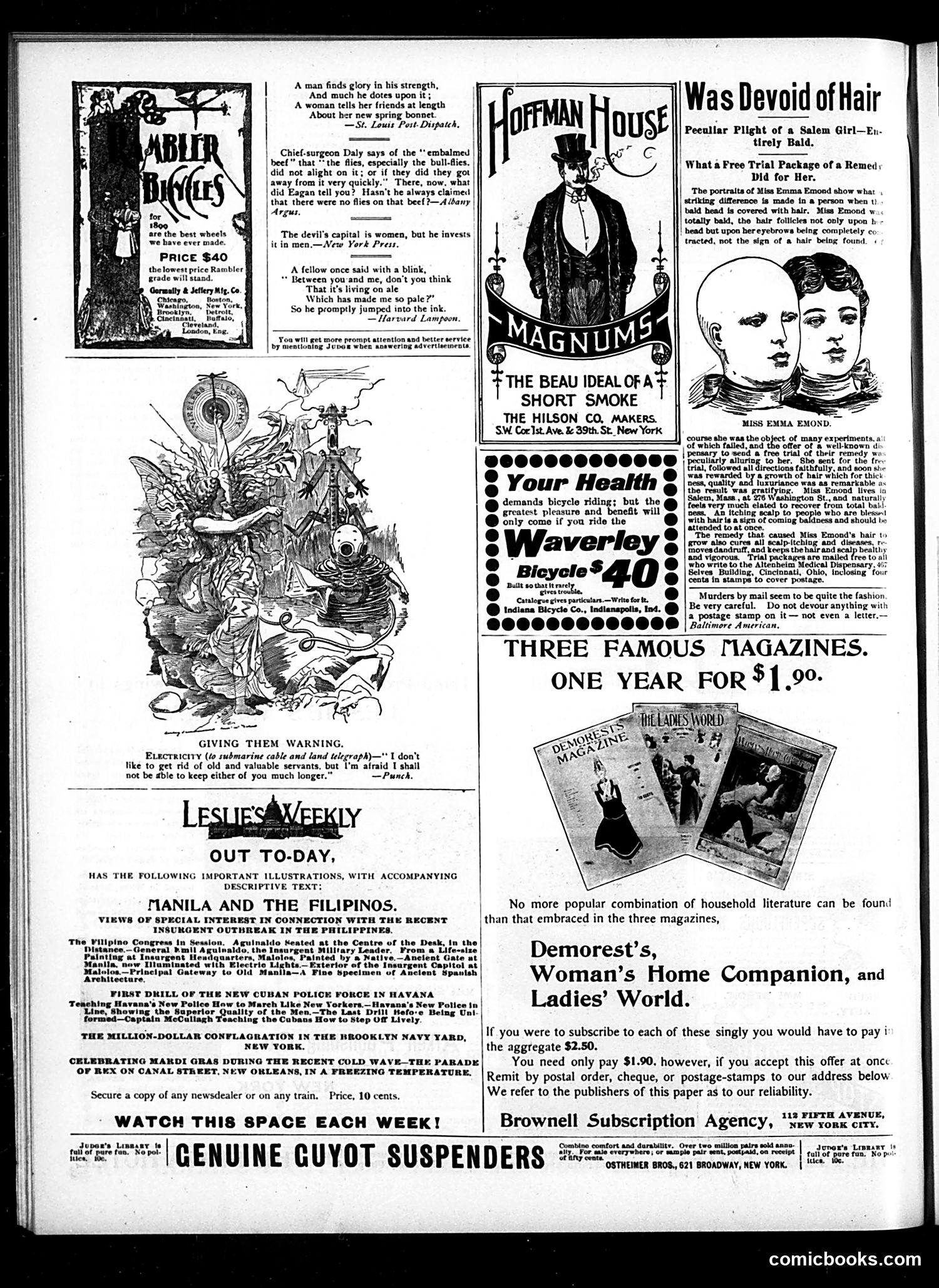
This page is primarily **advertising** rather than editorial content. The main feature is a testimonial ad for a hair-loss remedy, centered on "Miss Emma Emond" of Salem, depicted before and after treatment. The before image shows her entirely bald; the after shows full hair growth. The accompanying text describes how Emond tried various treatments before a Cincinnati medical dispensary provided a free trial that allegedly restored her hair "thick and luxuriant." **The satire/humor** appears implicit: Judge was a satirical magazine, yet this straightforward medical testimonial—a common advertising format of the era—sits alongside lighter content like bicycle ads and subscription offers. The juxtaposition itself may constitute gentle mockery of patent-medicine advertising's grandiose claims, typical of early 1900s publications. The page also advertises **Hoffman House Magnums** cigars and promotes a **Leslie's Weekly** special edition about the Philippines and Cuba, reflecting contemporary American imperial interests.
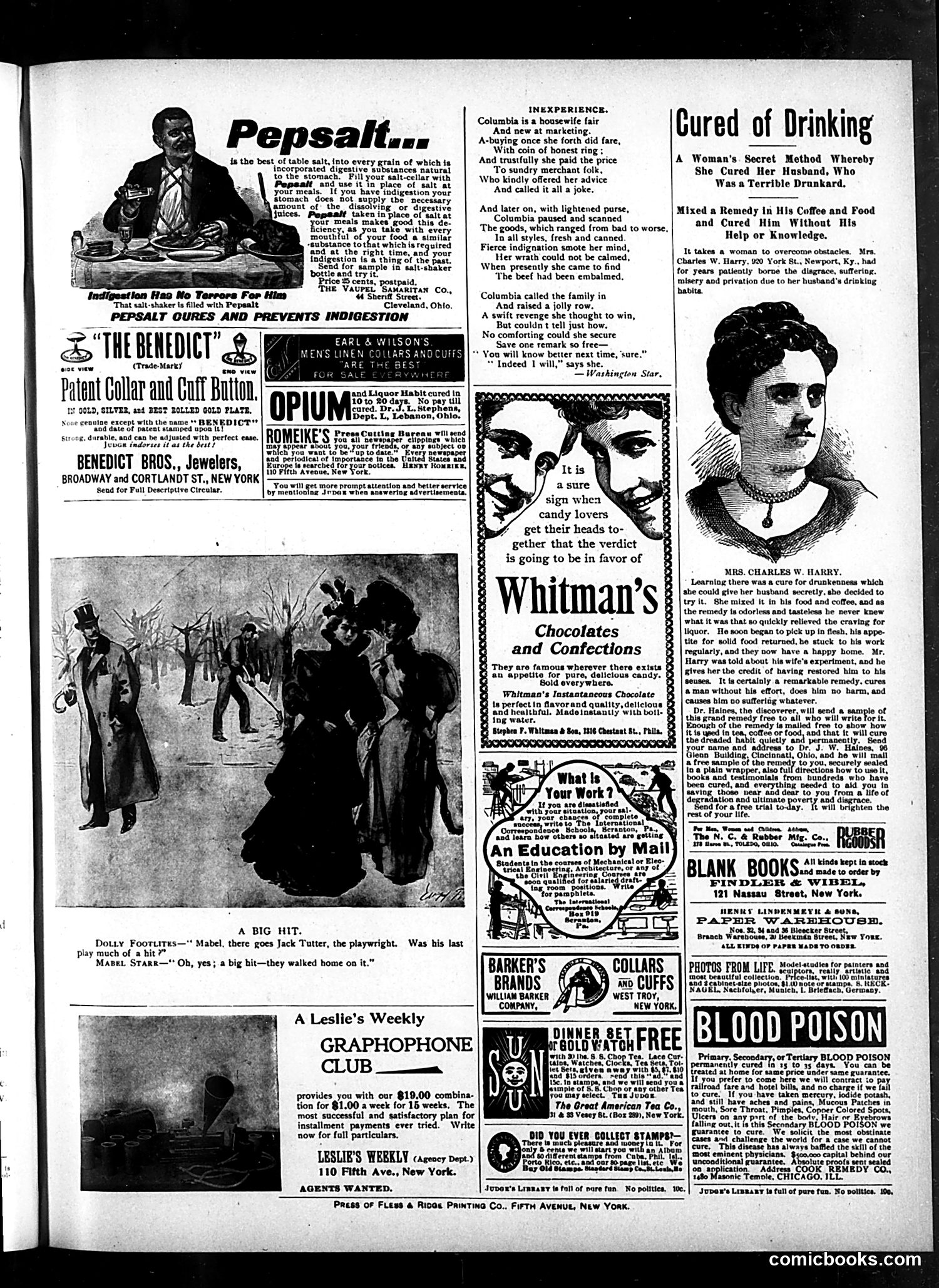
This page contains several distinct elements: **Main Political Cartoon ("Inexperience"):** The poem and accompanying illustration satirize a naive housewife (Columbia, personified symbol of America) who trusts merchants' false advice about household goods. She's swindled into buying inferior products, then grows angry when she discovers the deception. The satire critiques American consumer inexperience and merchant dishonesty—likely reflecting turn-of-century concerns about food adulteration and fraud. **Right Column Story:** "Cured of Drinking" describes a wife who secretly adds a remedy to her alcoholic husband's coffee and food, "curing" him without his knowledge. This appears promotional rather than satirical—advertising Dr. Haines' purported cure for alcoholism. **Advertisements:** The page is dominated by period product ads (Pepsalt for indigestion, Benedict jewelry, Whitman's chocolates, graphophone clubs, etc.), typical of Judge magazine's revenue model. The page reflects early 1900s anxieties about consumer fraud, domestic problems, and patent medicine solutions.
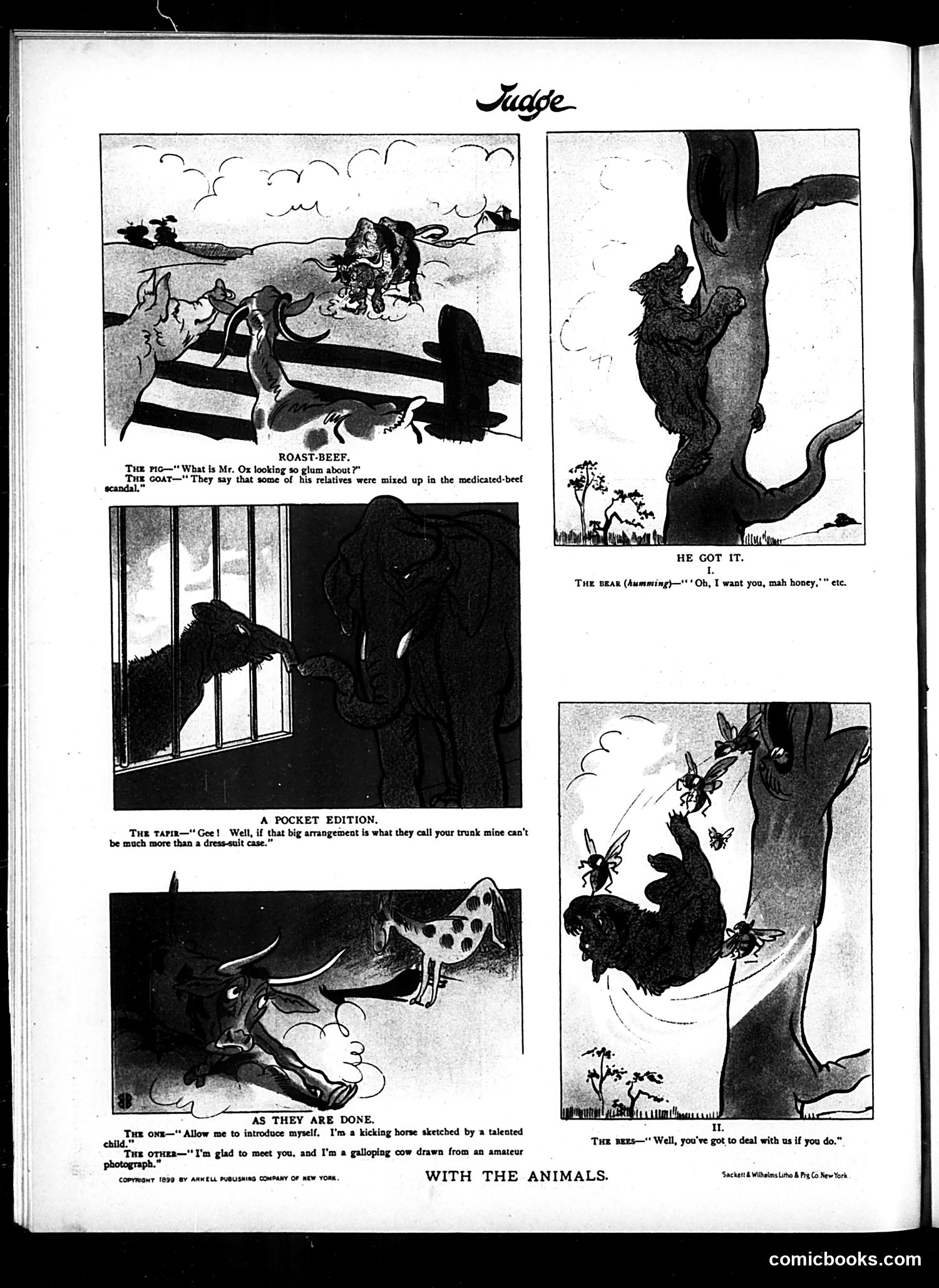
This 1899 page uses animal characters to satirize human social situations through humorous dialogue. **"Roast-Beef"** references the contemporary "embalmed beef" scandal—during the Spanish-American War, the U.S. military was supplied contaminated, chemically-treated beef, causing soldier illness. The joke has livestock embarrassed by relatives' involvement in this medical controversy. **"He Got It"** shows a bear courting, apparently successfully—a mild romantic humor. **"A Pocket Edition"** compares a tapir's trunk to luggage, playing on the animal's distinctive feature. **"As They Are Done"** satirizes amateur artists and photographers by having poorly-drawn animals (a "kicking horse" and "galloping cow") introduce themselves, mocking low-quality artistic reproduction common in publications. The overall theme mocks contemporary scandals, artistic incompetence, and social pretension by placing animals in human situations with deadpan comic effect. The cartoons rely on readers' familiarity with current events and artistic debates.