
A complete issue · 16 pages · 1899
Judge — January 21, 1899
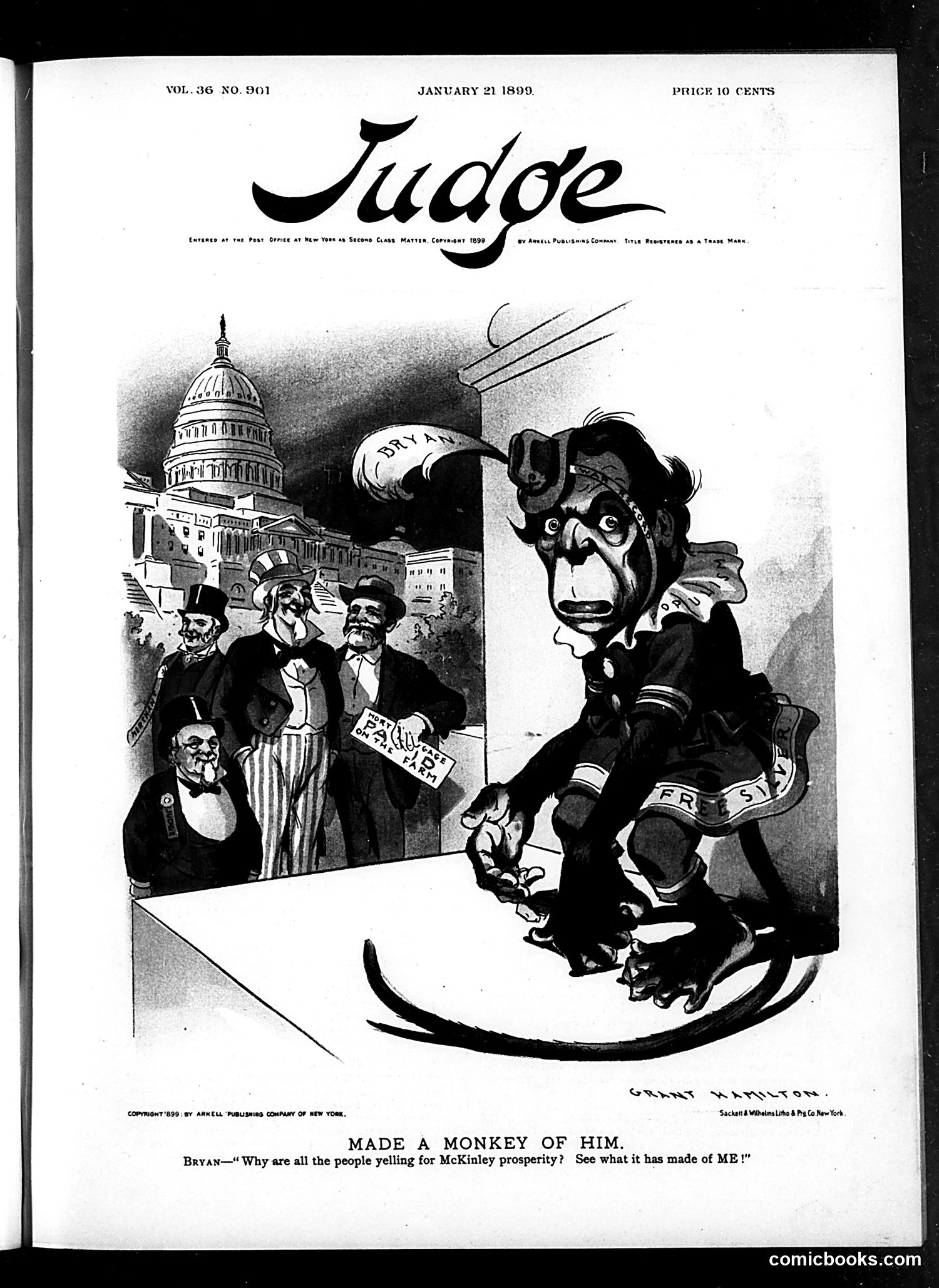
This 1899 *Judge* cartoon satirizes William Jennings Bryan, the Democratic presidential candidate who lost to William McKinley in 1896 and would run again in 1900. The caption shows Bryan complaining that McKinley's prosperity has made him look foolish—his supporters are celebrating McKinley's success instead of backing Bryan. The right side depicts Bryan as a literal monkey-faced figure, labeled "FREE S[ILVER]," referencing his signature campaign issue (free coinage of silver). The Capitol building and well-dressed figures in the background represent Republican political establishment and economic success. The cartoon's message: Bryan's free-silver platform appears absurd and outdated compared to McKinley's apparent economic success, making Bryan himself ridiculous to voters.
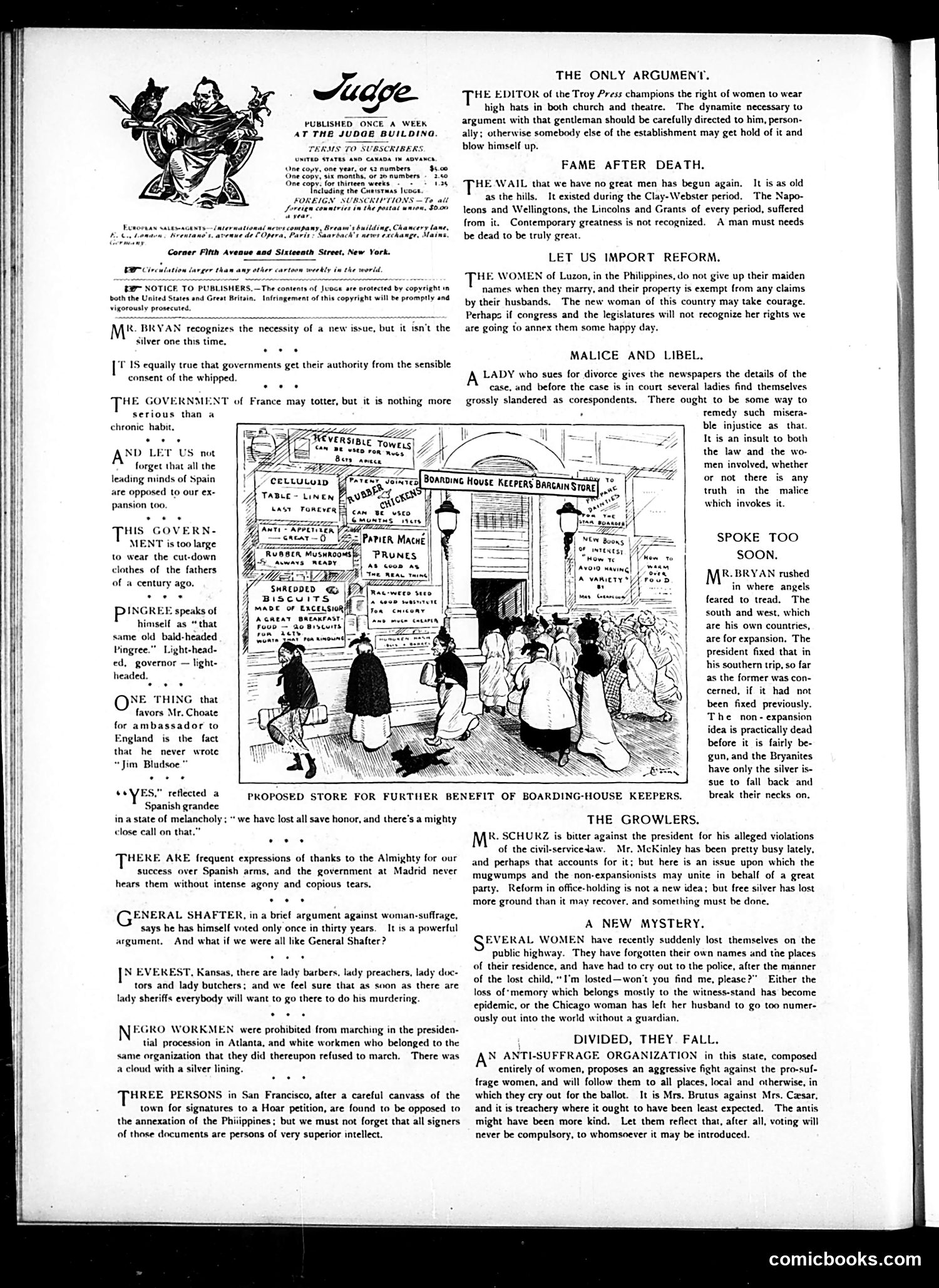
The main cartoon depicts a crowded urban street scene labeled "Proposed Store for Further Benefit of Boarding-House Keepers." It satirizes the proliferation of small shops and businesses operated by boarding-house proprietors trying to supplement income. The packed storefronts with hand-painted signs suggest commercialization of domestic spaces and the economic pressures on landlords. The surrounding editorial sections address contemporary issues: women's suffrage ("Let Us Import Reform"), legal concerns about divorce coverage in newspapers ("Malice and Libel"), and political disputes within the anti-suffrage movement ("Divided, They Fall"). The page reflects early-20th-century debates about women's rights, civil service reform, and the expanding commercial urban landscape.
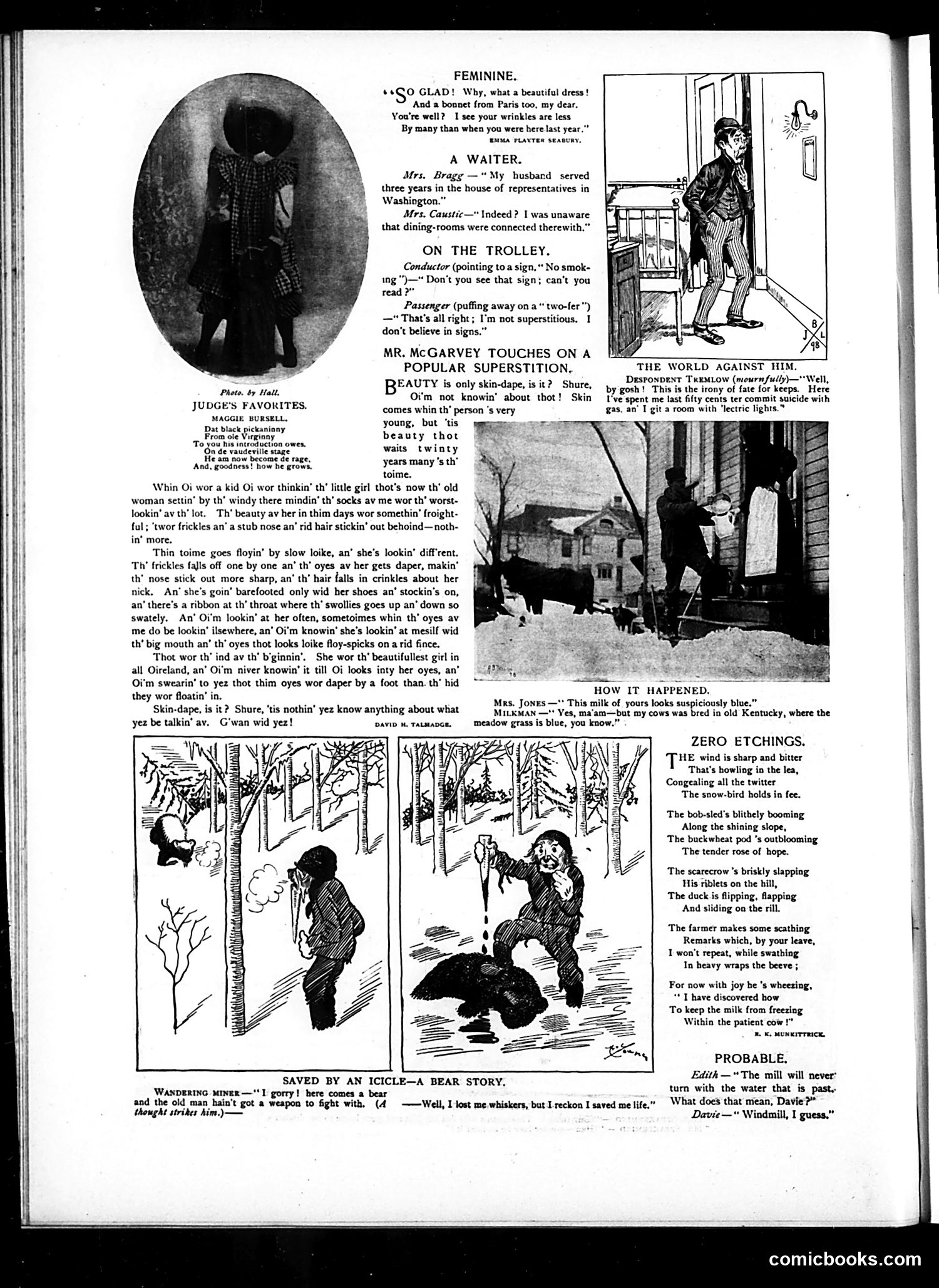
This page contains several humorous anecdotes and a comic strip rather than political cartoons. **"A Waiter"** and **"On the Trolley"** are brief joke exchanges about domestic servants and superstitions—typical period humor about class and folk beliefs. **"Mr. McGarvey Touches on a Popular Superstition"** is a lengthy poem mocking the folk belief that beauty requires skin-deep qualities, using dialect verse to describe a woman's fading appearance with age—common satirical subject matter of the era. **"Saved by an Icicle—A Bear Story"** is a comic strip showing a man escaping a bear attack by using icicles as weapons, ending with the punchline that he lost his whiskers but saved his life. The page also includes **"Zero Etchings,"** poetry about winter weather, and brief joke exchanges, representing typical Judge magazine humor content targeting middle-class American readers.
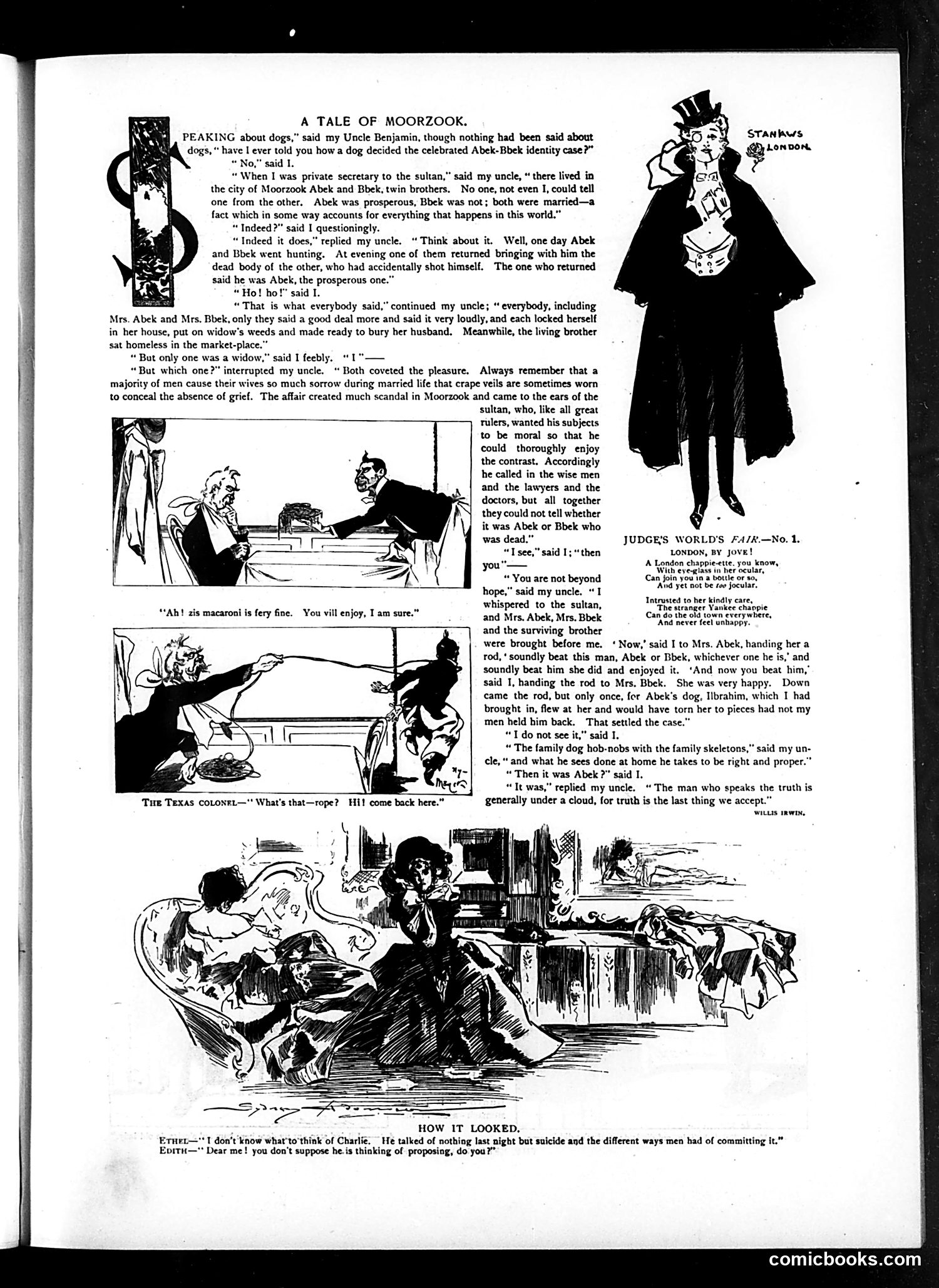
This is a humorous story-cartoon about bureaucratic absurdity and the unreliability of evidence. The narrator's uncle, supposedly a former sultan's secretary, recounts an impossible case: twin brothers Abek and Bbek are indistinguishable, one dies in a hunting accident, and the survivor claims to be the prosperous Abek. Both widows want the inheritance, and even "wise men, lawyers, and doctors" cannot determine which brother is actually dead. The resolution is absurd: the uncle beats both suspects with a rod, then lets in Abek's dog. The dog attacks one woman, "proving" her husband is Abek (since the dog knows its master). The satire mocks the pretense of logical deduction in solving impossible problems and suggests truth itself is irrelevant—what matters is whatever settles the case, however arbitrarily. The accompanying quip about London and a man obsessing over suicide methods as a marriage proposal joke completes the sardonic tone.
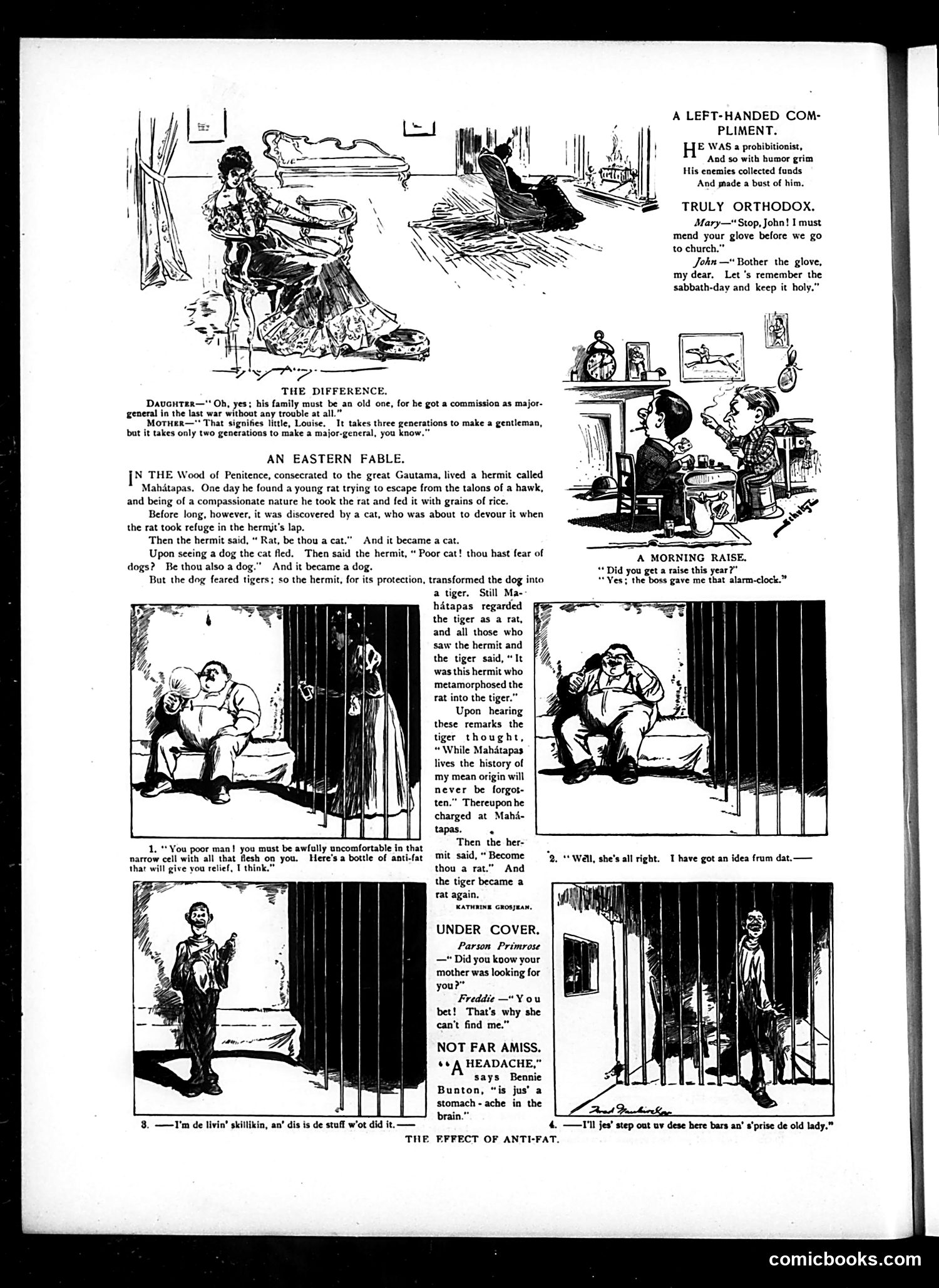
This page contains multiple unrelated satirical pieces typical of Judge magazine's format: **"A Left-Handed Compliment"** mocks prohibitionists by suggesting enemies of a prohibitionist raised funds for his bust—a backhanded "honor" that highlights his unpopularity. **"Truly Orthodox"** satirizes religious hypocrisy: a husband refuses to mend his glove before church, claiming Sabbath observance, while simultaneously breaking the spirit of the day through false piety. **"The Difference"** is a class-commentary joke: military rank requires only two generations to achieve, while gentlemanly status requires three—suggesting military commissions represent a lower social accomplishment than true breeding. **"An Eastern Fable"** uses Buddhist/Hindu mysticism to satirize the danger of helping the ungrateful: a hermit transforms creatures for their benefit, but the tiger (originally a rat) murders him out of shame over his origins—a cautionary tale about charity backfiring. The remaining items are brief jokes about raises, undercover activities, and weight-loss remedies—typical filler humor of the era.
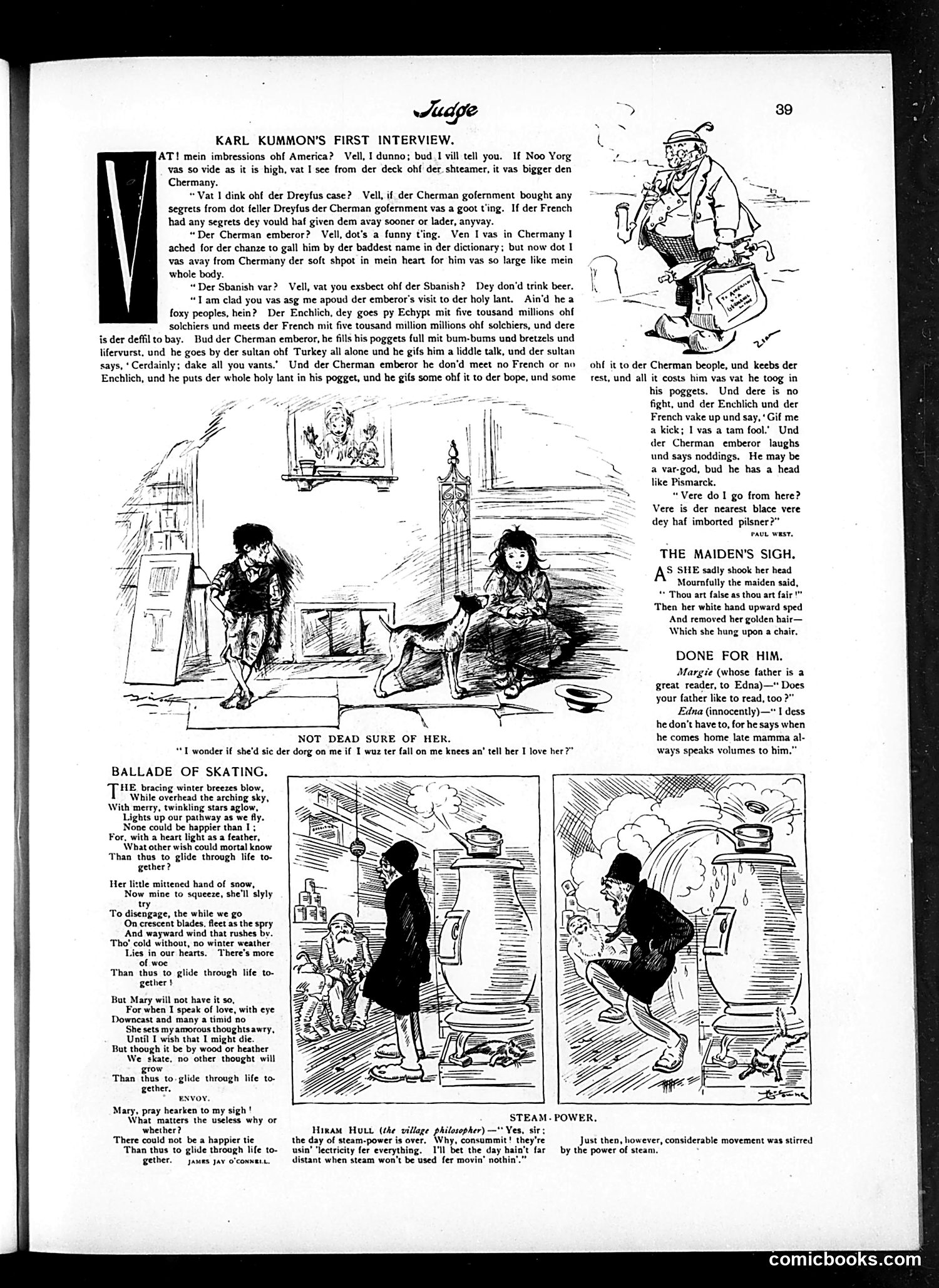
This page contains three distinct pieces: **"Karl Kummon's First Interview"** presents a German immigrant with thick dialect offering naive commentary on American affairs. The satire mocks both his provincial German perspective and contemporary events: he dismisses the Dreyfus affair (a major French scandal), makes crude generalizations about nationalities, and—most pointedly—admires German Emperor Wilhelm II's diplomatic maneuvering in the Middle East, where he supposedly outmaneuvered French and British interests while appearing uninvolved. The joke targets German imperial ambitions disguised as peaceful diplomacy. **"The Maiden's Sigh"** is a brief humorous piece about a woman removing her hairpiece, playing on period conventions of female appearance. **"Ballade of Skating"** is sentimental romantic poetry about winter courtship, ending with unrequited love—conventional Victorian sentiment with no apparent political content. The page exemplifies Judge's blend of immigrant-dialect comedy, foreign affairs commentary, and light verse typical of early 1900s American satirical magazines.
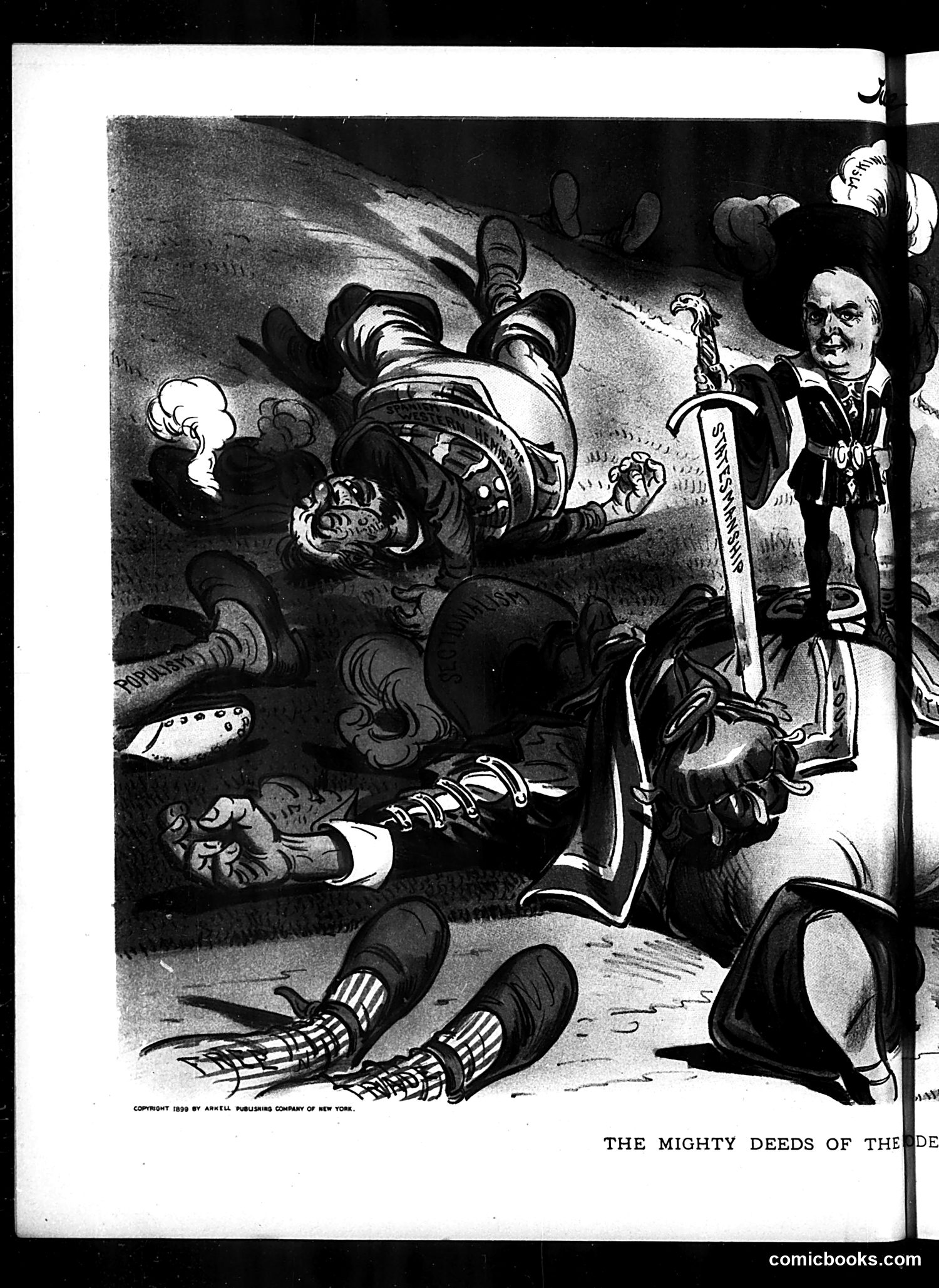
This is a political cartoon from Judge magazine (copyright 1899 by Arkell Publishing Company of New York). The caption reads "THE MIGHTY DEEDS OF THE" with the rest cut off. The image depicts a caricatured military or political figure lying on his back in an undignified position, legs up, appearing defeated or knocked down. A stern-faced man in formal attire stands over him holding what appears to be a sword or saber. Other figures observe in the background. Without the complete caption, the specific political reference remains unclear, but the cartoon satirizes someone's claimed military or political accomplishments by showing them literally laid out and humiliated. The style suggests late 19th-century American political satire, likely mocking a contemporary public figure's inflated reputation or failed actions.
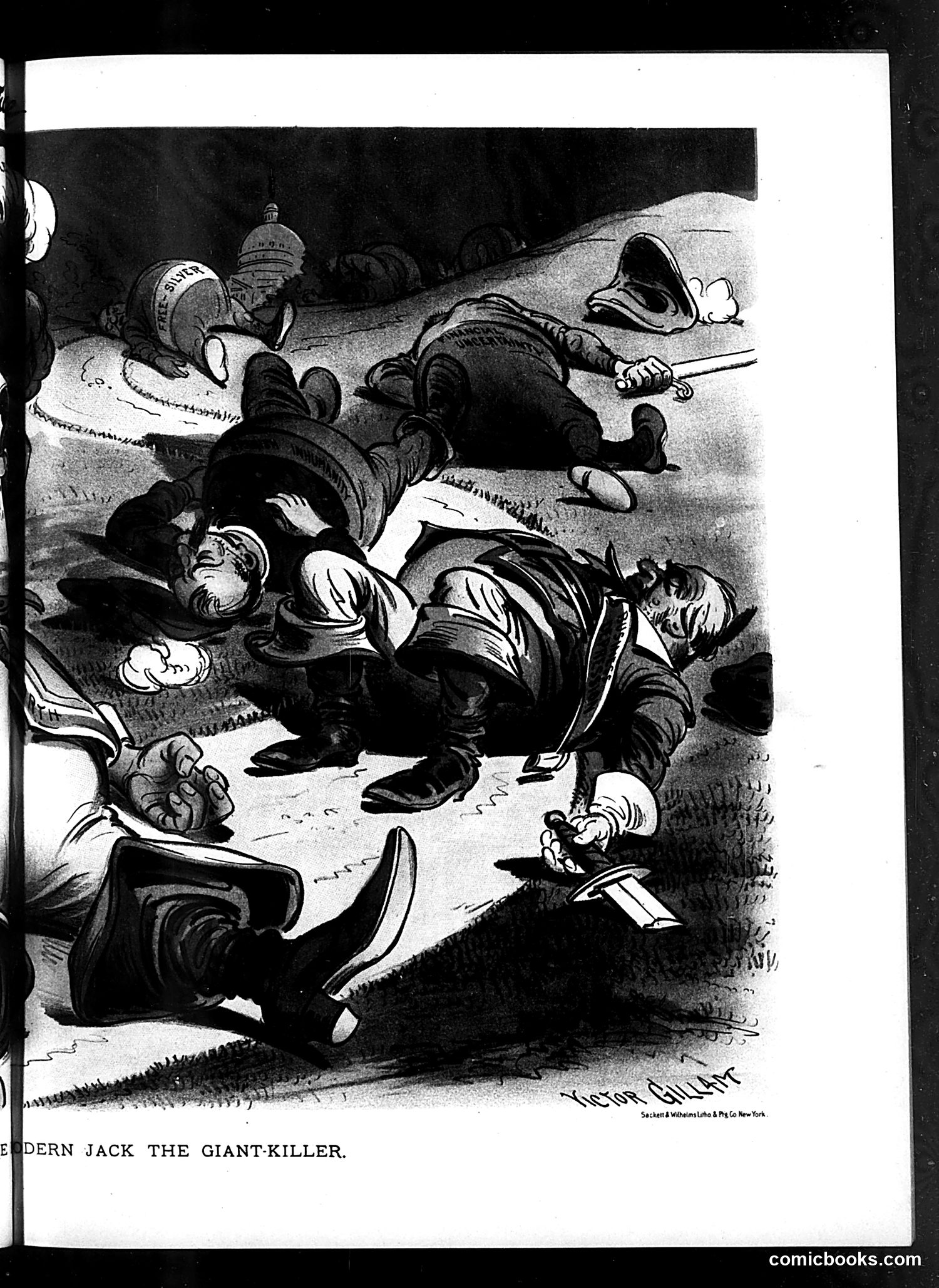
This political cartoon parodies the fairy tale "Jack the Giant-Killer," depicting a figure (likely representing a contemporary political or social figure) as "Jack" vanquishing giants. The scattered bodies of fallen "giants" on the ground suggest he has defeated powerful opponents or forces. Without clearer identifying labels or context, I cannot definitively name the specific figure or giants depicted. However, the cartoon appears to celebrate someone's triumph over large/powerful enemies—typical Judge magazine satire that used fairy tale imagery to comment on current events or political figures. The style and "giant-killer" framing suggest this comments on a David-versus-Goliath political struggle, though the specific historical reference remains unclear from the image alone.
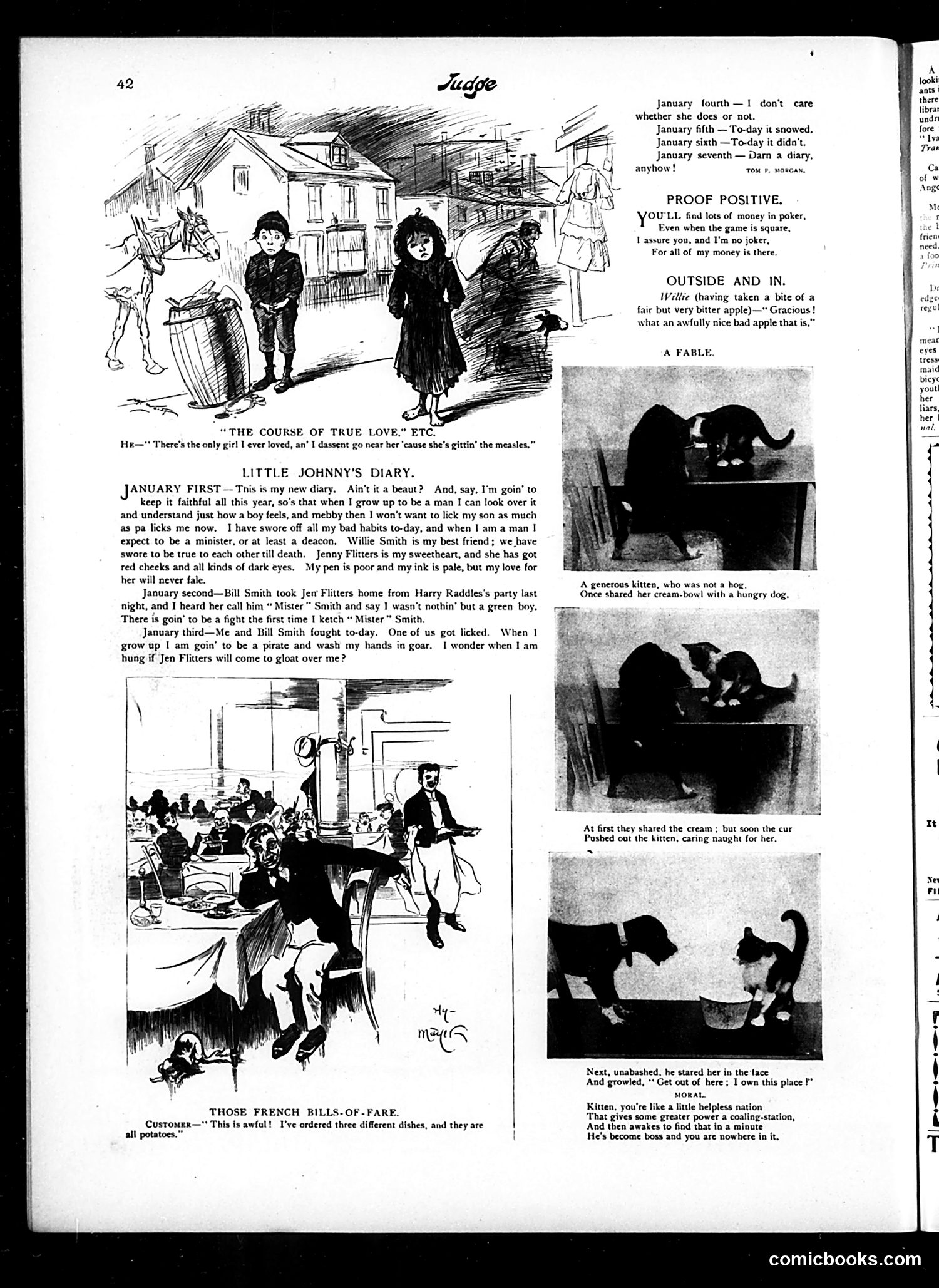
This page contains multiple satirical pieces typical of late 19th/early 20th-century American humor: **"Little Johnny's Diary"** is the main feature—a serial humor column where a boy documents his resolutions and juvenile dramas (lost love to a rival, a fight with best friend Bill Smith). The satire gently mocks childhood earnestness and the contrast between lofty diary ambitions and actual behavior. **"A Fable"** uses kitten-and-dog photographs to illustrate imperialism: a generous kitten shares with a hungry dog, but the dog then dominates and excludes the kitten. The moral explicitly compares this to smaller nations being colonized by larger powers seeking "coaling-stations"—a reference to imperial expansion. **"Those French Bills-of-Fare"** satirizes restaurant menus, where a customer ordered three different dishes only to receive potatoes in all forms—poking fun at either deceptive French cuisine or immigrant restaurant pretensions. The smaller poems ("Proof Positive," "Outside and In") are light verses about gambling and bitter apples, respectively.
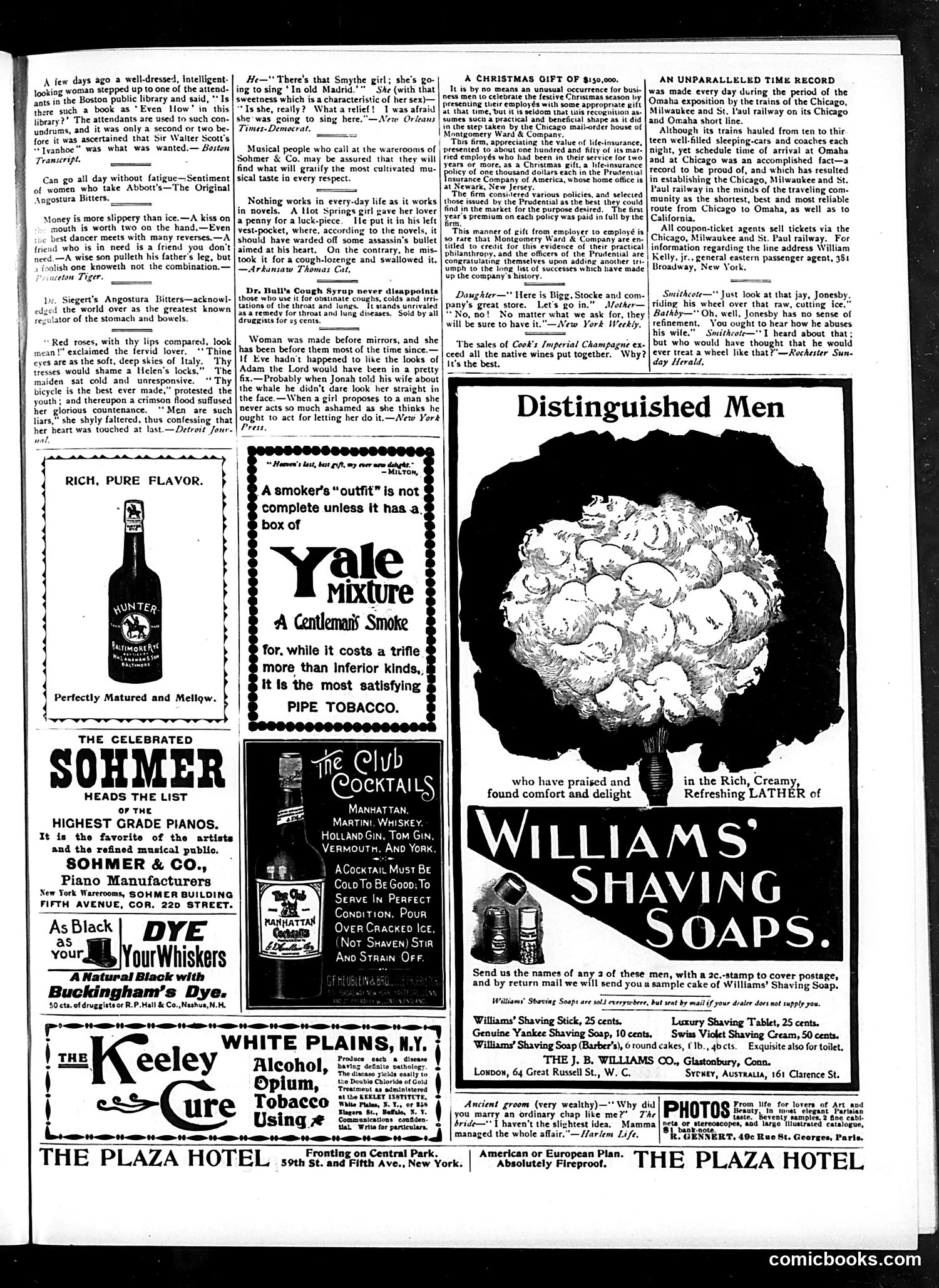
This page is primarily **advertisements and filler content** rather than editorial satire. The visible cartoon material is minimal. The main illustrated advertisement shows **Williams' Shaving Soaps** featuring a large decorative lather head labeled "Distinguished Men." The advertisement encourages readers to send in names of notable men in exchange for soap samples—a common promotional gimmick of the era. The scattered text snippets labeled as "jokes" or "witticisms" are brief, disconnected observations typical of Judge's formula: social commentary on courtship, consumer behavior, and gender dynamics. For example, one anecdote mocks the ineffectiveness of folk superstitions (a lucky penny failing to protect a lover as novels suggested it would). The remaining content consists of **commercial advertisements** for pianos, whiskey, tobacco, hotels, and other products—standard for magazines of this period, which relied heavily on advertising revenue. **No significant political satire or caricature is visible on this page.** It represents the formulaic filler and advertising that occupied much of Judge's space between major satirical pieces.
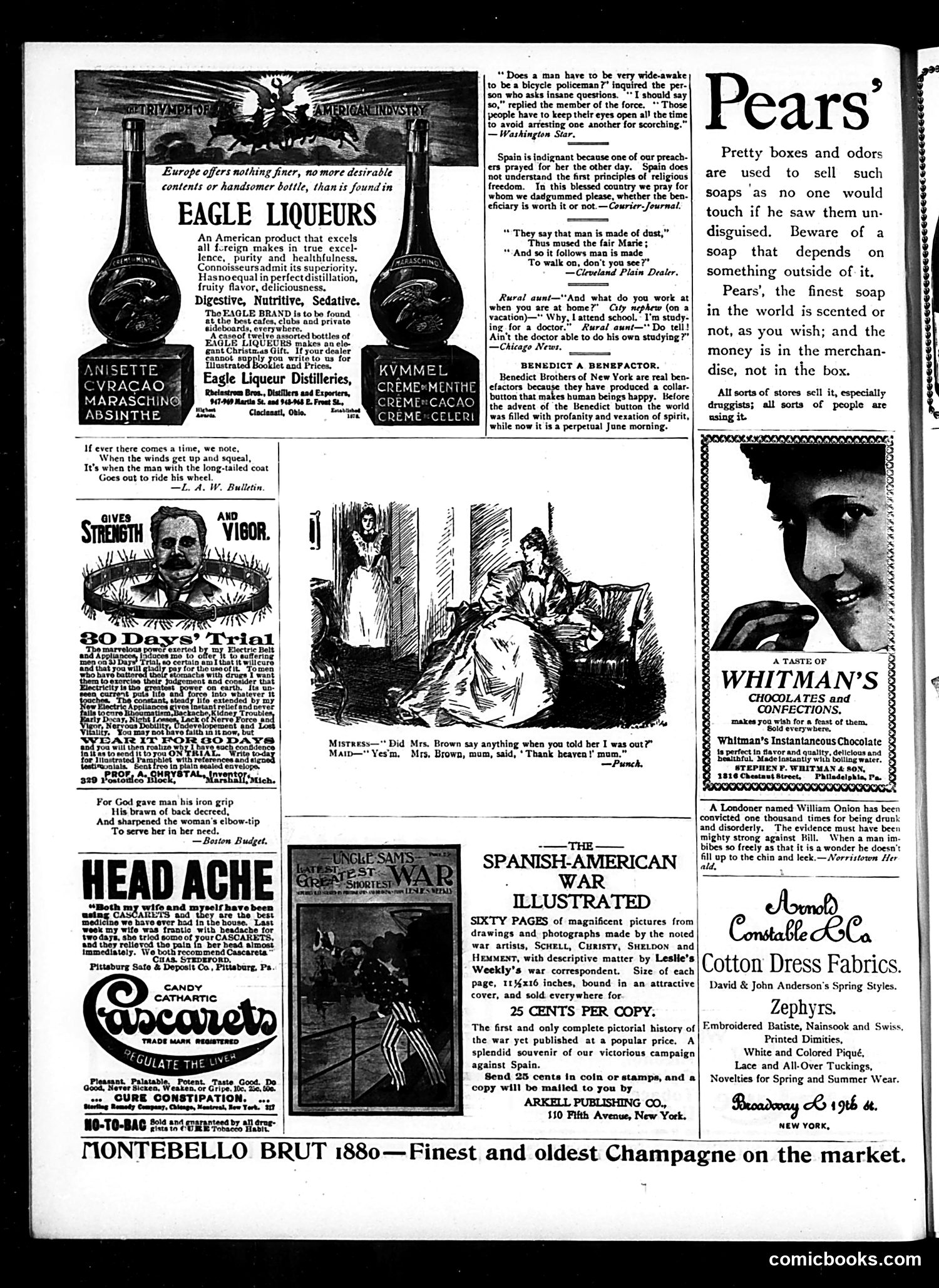
This page is primarily **advertising**, with scattered jokes and social commentary typical of Judge magazine's format. **Key Content:** The advertisements promote liqueurs, soaps, chocolates, and patent medicines—products marketed with exaggerated health claims (Eagle Liqueurs promise "purity," Cascarets promise headache relief). **Satirical Elements:** - A brief joke about "bicycle policemen" needing to stay alert to avoid arresting each other for "scorching" (reckless riding) - Commentary on Spain's indignation at American preachers critiquing Spanish lack of religious freedom—the text suggests Spain finds this hypocritical given America's own freedoms - A cartoon showing a maid and mistress, with accompanying domestic humor - A reference to a London man convicted 1,000 times for drunkenness **Historical Context:** The page reflects turn-of-the-century American consumer culture, with ads using pseudo-scientific claims common to that era. References to Spain likely relate to Spanish-American War tensions. The tone is light, focusing on domestic comedy and commercial pitches rather than hard political satire.
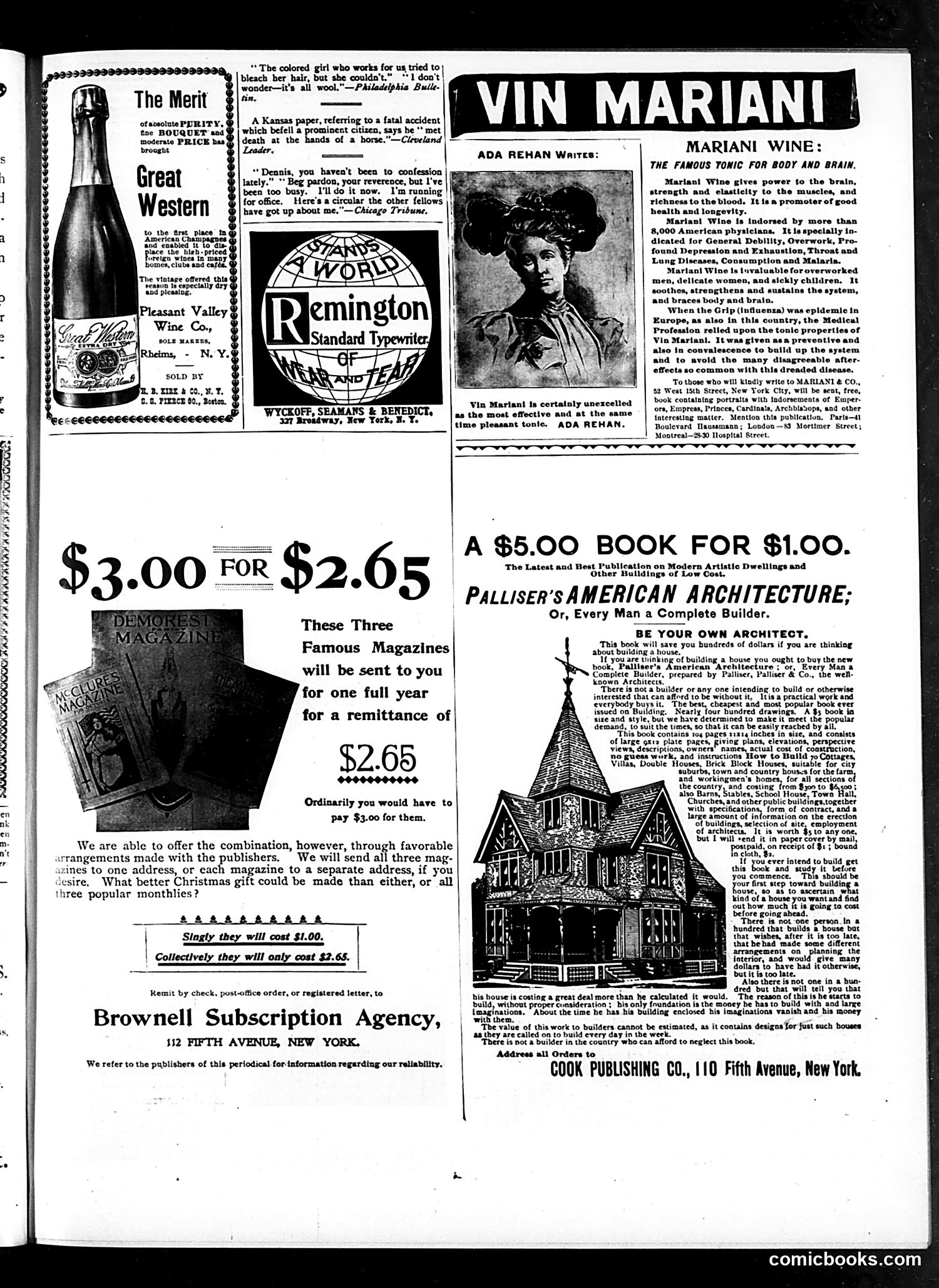
This page consists primarily of **advertisements and humor snippets**, not political cartoons. The small jokes at the top represent Judge's typical satirical format: - A racial stereotype joke about a Black domestic worker trying to bleach her hair - A political jab at a candidate who suddenly finds time for confession once running for office (mocking insincere religiosity among politicians) The dominant content is **product advertising**: Mariani Wine, a patent medicine heavily promoted with endorsements from actress Ada Rehan and claims of endorsement by "8,000 American physicians." This reflects the era's unregulated patent medicine industry, before FDA oversight. Other ads include a magazine subscription bundle and an architecture book. There is **no coherent political cartoon or social satire** on this page—it's a commercial magazine page mixing brief jokes with advertising, typical of early-20th-century American periodicals where advertising substantially funded publication.
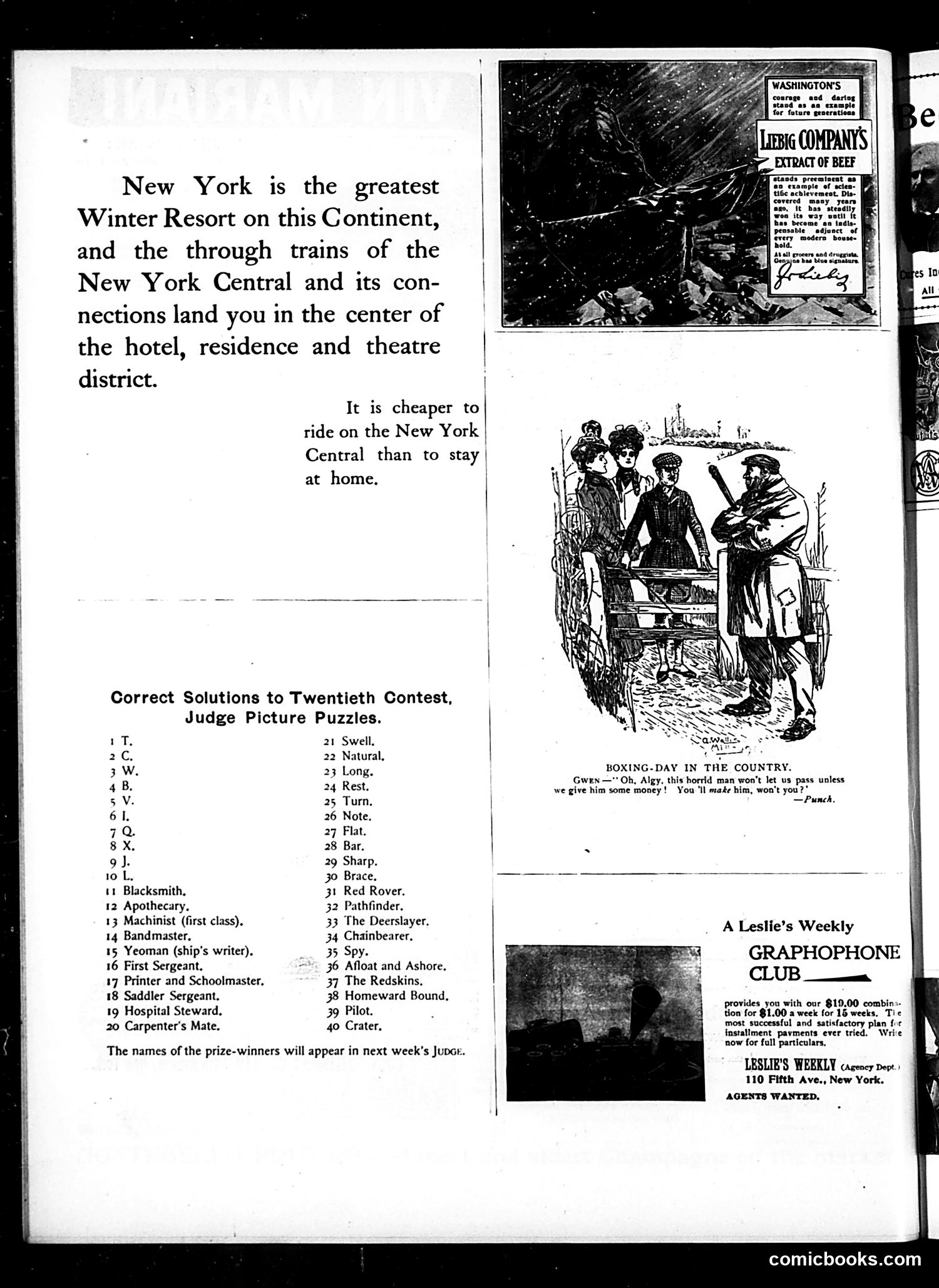
This page mixes advertising with puzzle solutions and one cartoon. **The Cartoon ("Boxing-Day in the Country"):** depicts a wealthy woman (Gwen) and her companion encountering a rural laborer or gatekeeper who demands payment for passage. Gwen appeals to her male companion (Algy) to intimidate the man into letting them pass without paying. The joke satirizes upper-class entitlement and the assumption that wealth and social status exempt one from normal obligations—she expects her companion to use masculine authority or threat to bully a working man. The term "Boxing-Day" (the day after Christmas) suggests this occurs during holiday travel, when such encounters might happen. **Context:** This appears to be from *Punch* magazine (credited in the caption), a British satirical publication. The satire targets class pretension and the arrogance of privileged travelers who believe rules don't apply to them. The page also contains puzzle solutions, a New York Central Railroad advertisement, and a phonograph club offer—typical magazine filler content.
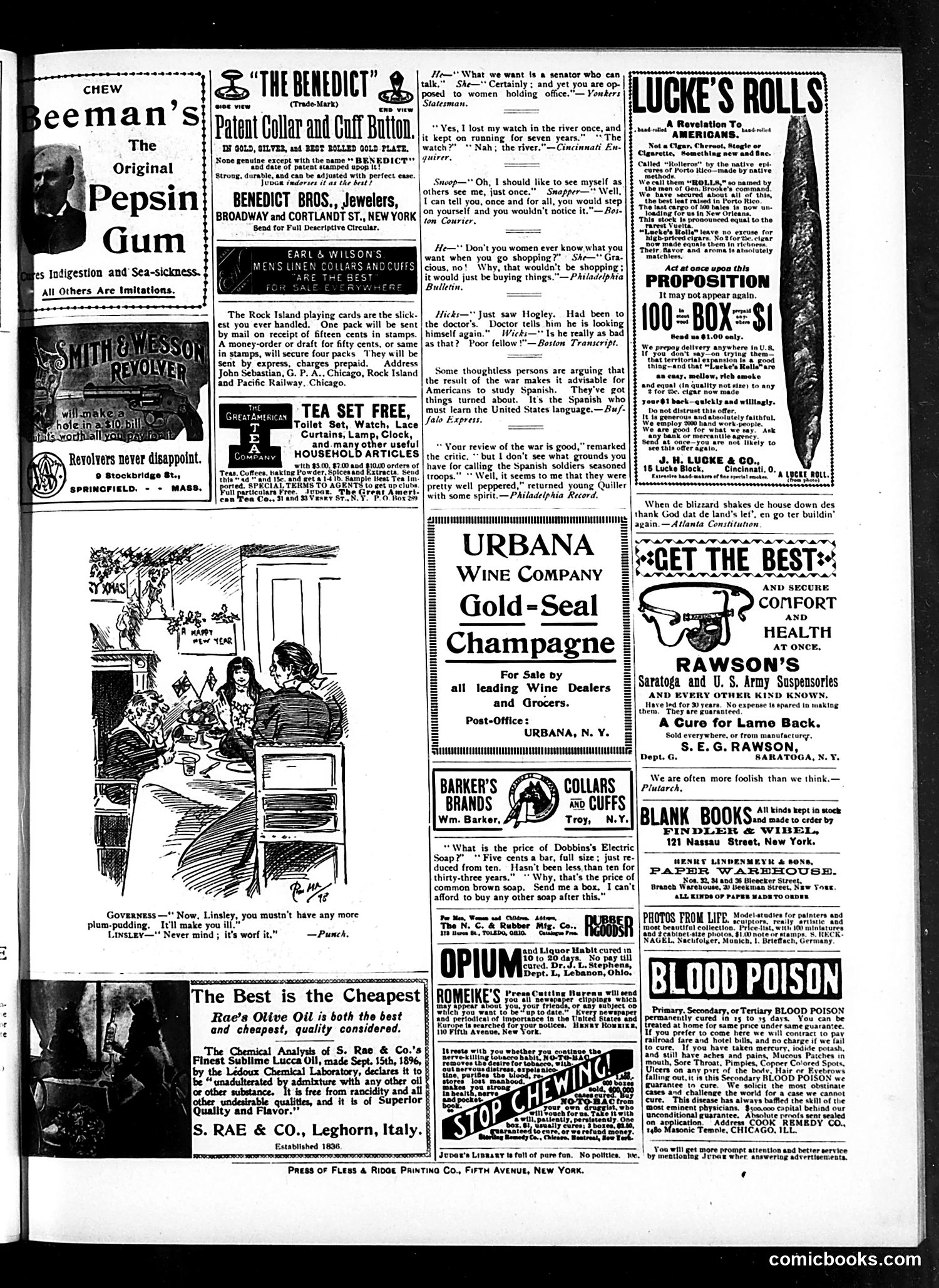
This page is primarily **advertisements and humorous short jokes** rather than political cartoons. The content reflects turn-of-the-century American life: **Main cartoon** (center-left): A domestic scene showing a couple at a table, illustrating a joke about shopping habits—satirizing women's supposed indecisiveness about purchases versus men's direct buying approach. The humor is gentle gender-role commentary typical of the era. **Jokes throughout** reference: - Spanish-American War aftermath (multiple references to Spain/Spanish soldiers being "peppered") - Gender relations and marriage dynamics - Urban life observations **Dominant content**: Advertisements for patent medicines, household goods, cigars ("Rollerox" from Puerto Rico—referencing recent U.S. territorial expansion), and consumer products. The ads reflect post-1898 American commercial interests, including new Puerto Rican imports. The page captures **Gilded Age consumer culture** and mild satirical commentary on gender and domestic life, with overt commercial messaging dominating the layout—typical of Judge's advertising-heavy format.
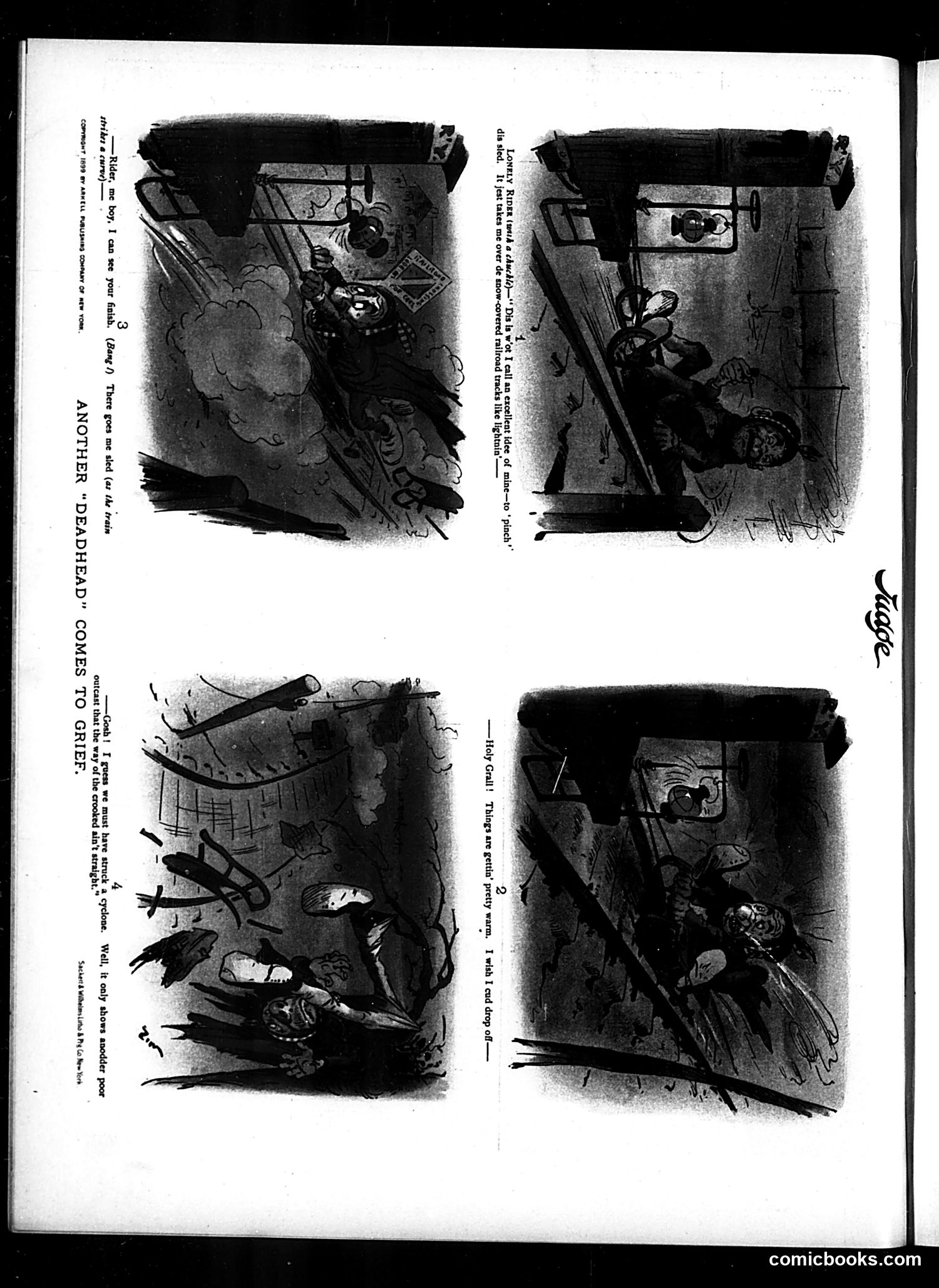
This four-panel comic depicts a street urchin ("Lonely Riper") stealing a sled and riding it across railroad tracks, where he's struck by a train. The term "deadhead" appears to reference a vagrant or homeless person. The satire targets the moral message common in 19th-century children's literature: crime doesn't pay. The boy's theft of the sled and reckless behavior lead directly to disaster—the train strike—illustrating the era's didactic lesson that dishonesty and poor choices have immediate, violent consequences. The final caption's pun ("the way of the crooked ain't straight") reinforces this moralizing tone. The comic uses dark humor and slapstick violence to deliver a cautionary tale typical of *Judge* magazine's satirical approach to social issues and character flaws.