
A complete issue · 18 pages · 1899
Judge — January 7, 1899
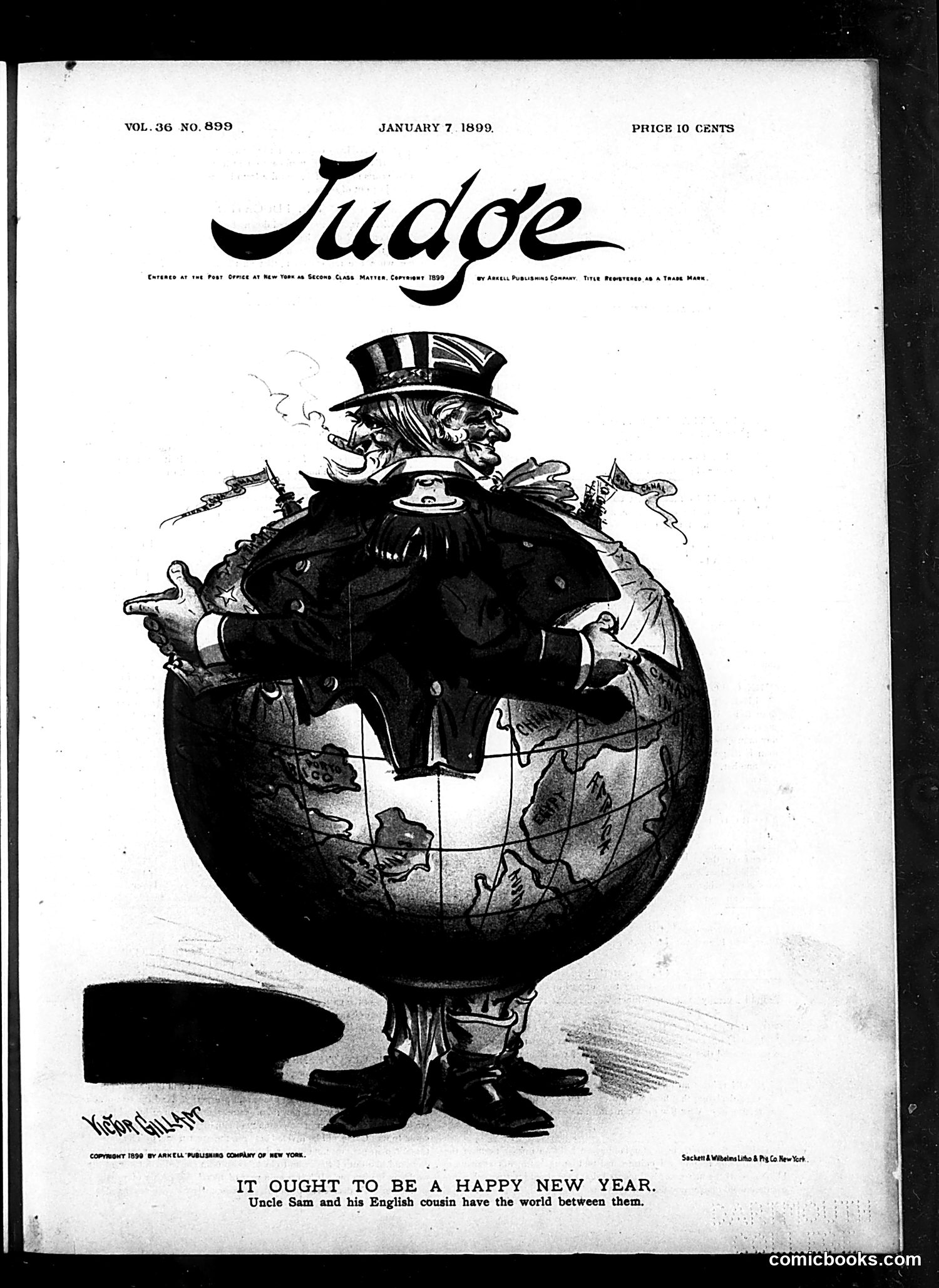
This cover cartoon by Victor Gillam depicts Uncle Sam (representing the United States) and John Bull (representing Britain) as a two-headed figure balanced atop a globe. The caption reads: "IT OUGHT TO BE A HAPPY NEW YEAR. Uncle Sam and his English cousin have the world between them." The satire comments on Anglo-American imperial power at the turn of the 20th century. Both nations controlled vast territories worldwide (shown on the globe). The two-headed composition suggests their combined dominance and shared interests, though the awkward positioning implies tension in their relationship. The cartoon reflects contemporary American attitudes about U.S. emergence as a global power alongside established British imperialism.
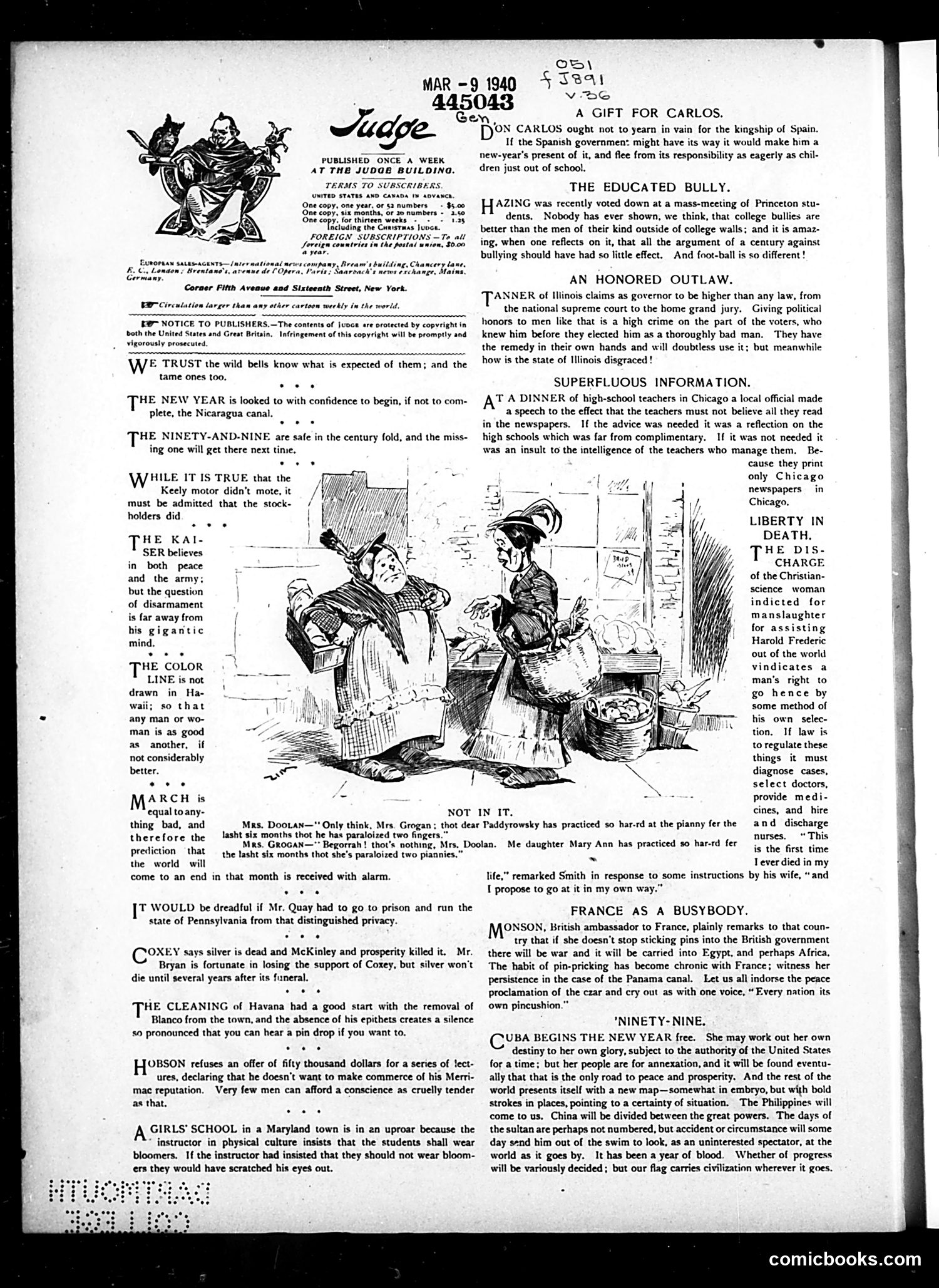
The central cartoon, titled "NOT IN IT," depicts two working-class women (Mrs. Doolan and Mrs. Congan) discussing their daughters' practice with a piano. The satire mocks Mrs. Doolan's pretension—she claims her daughter has practiced "so hard at the pianny," yet admits the girl has only practiced two pieces in six months. Mrs. Congan's daughter similarly shows minimal progress. The joke targets middle-class aspirations: working mothers invest in piano lessons as status symbols, but their daughters lack genuine dedication or talent. The cartoon satirizes both parental delusion and the false gentility such families adopt through arts instruction. The surrounding editorial text addresses diverse 1940 topics: Spanish politics, campus bullying, Illinois politics, and international affairs—typical Judge magazine fare mixing social commentary with political opinion.
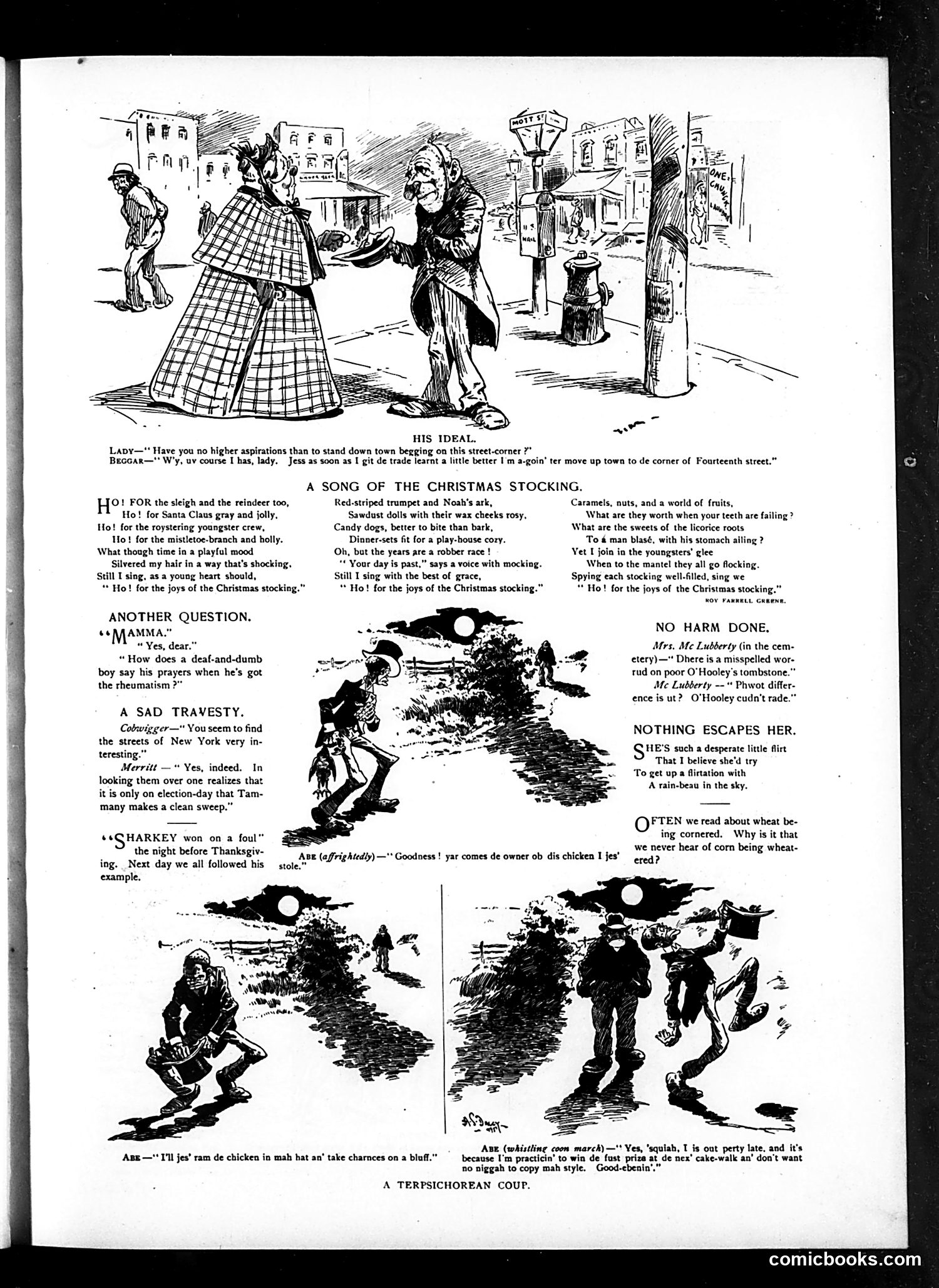
This page contains social satire and humorous vignettes rather than partisan political commentary. **Top cartoon** ("His Ideal"): A ragged beggar with exaggerated features addresses a well-dressed woman, claiming he has "higher aspirations" than street begging—he wants to learn a trade "up town" near Fourteenth Street. The satire mocks vagrancy and deception: the beggar's stated ambitions are transparently false. **"A Song of the Christmas Stocking"**: Verses satirizing poverty and the gap between Christmas ideals and harsh reality—children lacking teeth, food, warmth. **Lower vignettes**: Various brief jokes about rural life, election-day politics, and urban poverty. One depicts someone stealing chickens; another references Thanksgiving. The overall tone criticizes social inequality and urban poverty while employing period stereotypes and dialect humor typical of 1880s-90s American magazines.
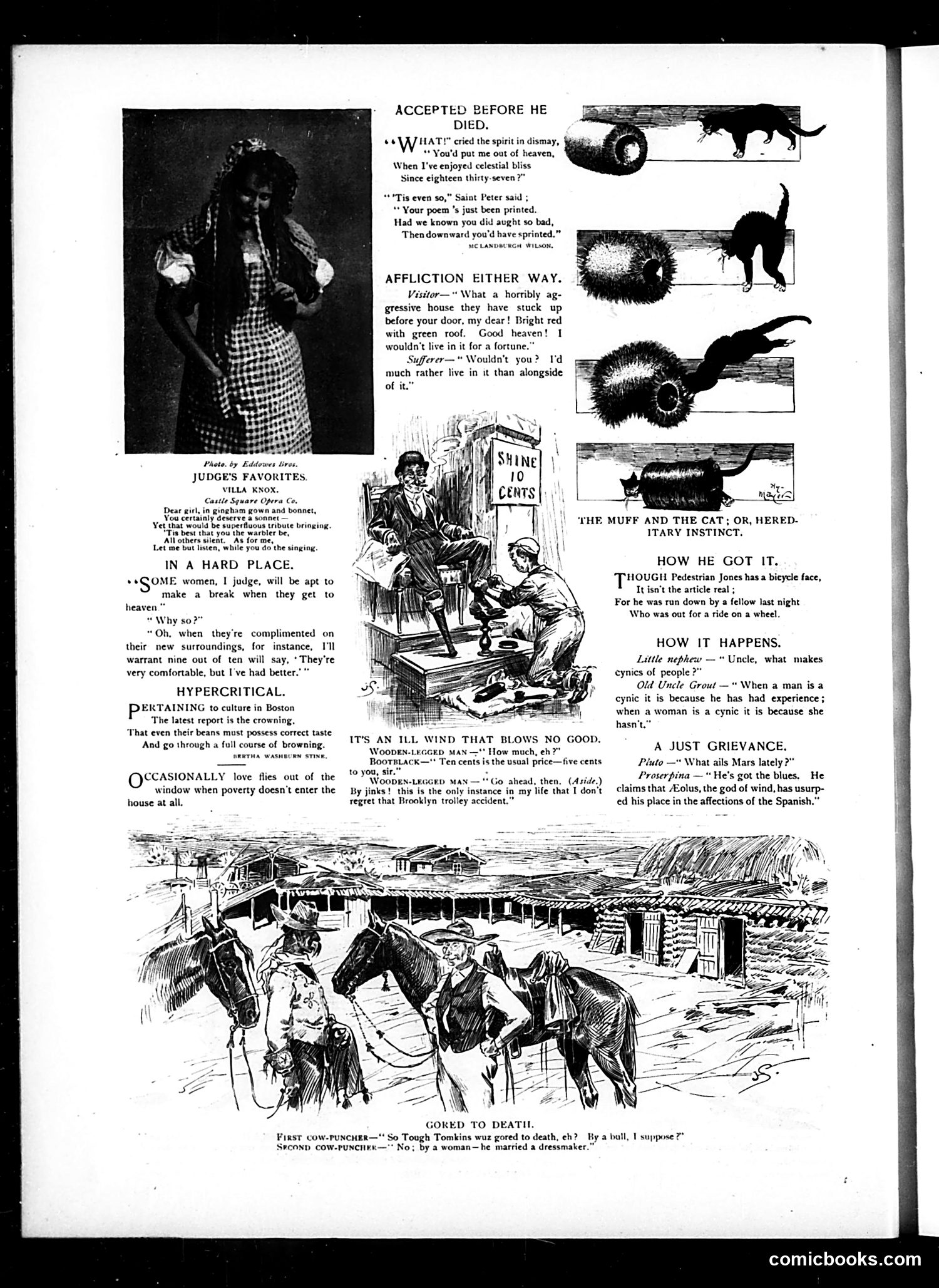
This page contains multiple unrelated humorous sketches and short comedic pieces typical of Judge magazine's format. Key content includes: **"Judge's Favorites"** - A poem about a gingham-dressed girl, likely sentimental verse. **"Affliction Either Way"** - A dialogue joke about housing complaints. **"The Muff and the Cat"** - Animal illustrations demonstrating "hereditary instinct," showing cats chasing prey. **Various short humor pieces** with titles like "How He Got It," "A Just Grievance," and "Gored to Death"—all brief satirical dialogues on everyday situations. **"Shine 10 Cents"** - An illustration showing a shoeshine scene, possibly social commentary on class. The page lacks coherent political satire; instead, it offers miscellaneous domestic humor, animal jokes, and social observations typical of early 20th-century American comedic magazines aimed at middle-class readers.
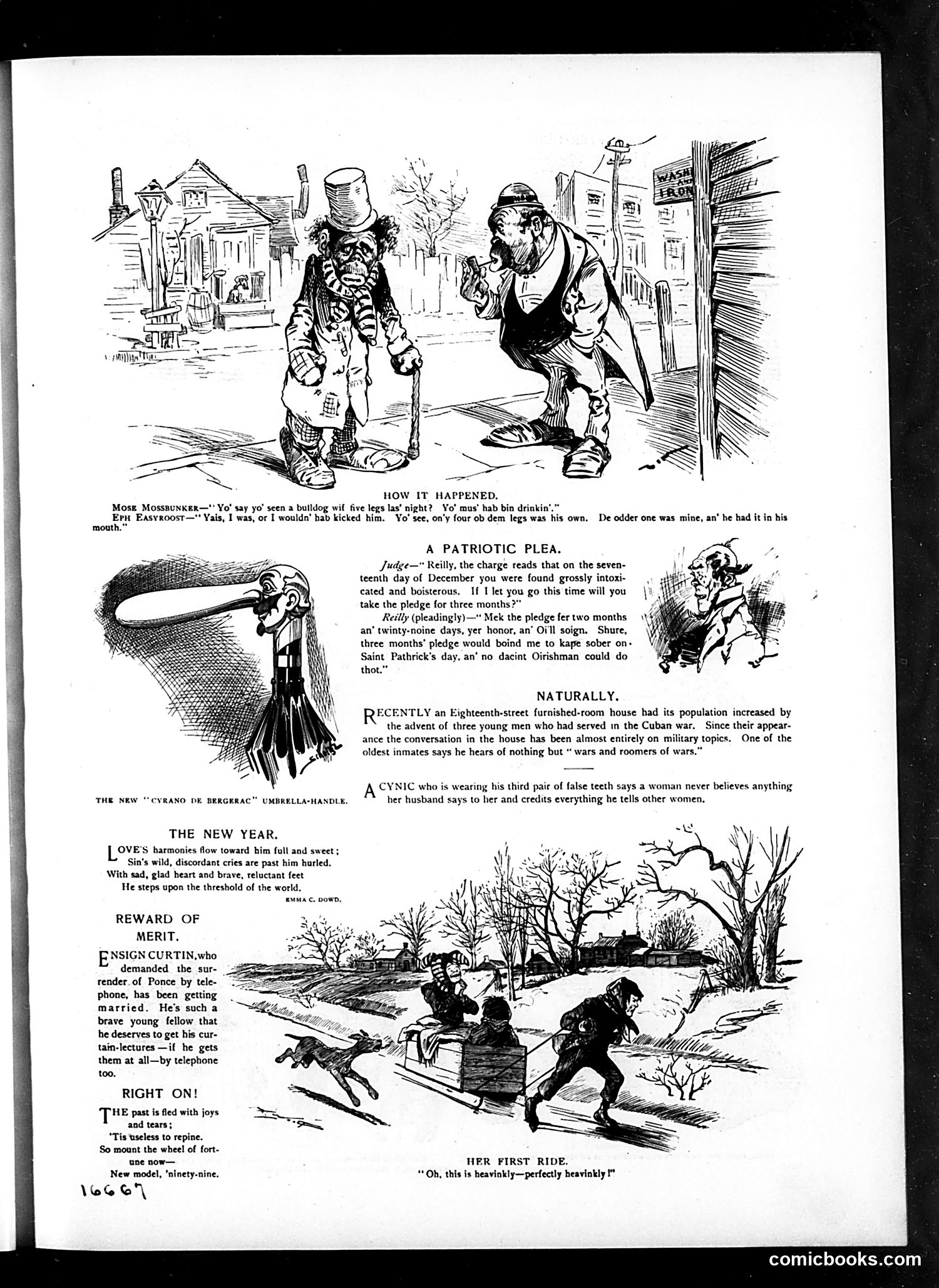
This page contains several satirical pieces typical of late-1890s American humor: **"How It Happened"** mocks Irish immigrant dialect through a drunk man's absurd logic—he kicked a bulldog so hard he detached its own leg because he was intoxicated. **"A Patriotic Plea"** satirizes an Irish drunk (Reilly) before a judge. When offered a three-month sobriety pledge, he negotiates for two months and 29 days to exclude Saint Patrick's Day—ridiculing Irish-American stereotypes about drinking and ethnic pride. **"Naturally"** is a brief joke about Cuban War veterans dominating boardinghouse conversation with military gossip. **"The New Year"** is sentimental poetry by Emma C. Dowd. **"Reward of Merit"** sarcastically praises Ensign Curtin (a Spanish-American War figure) for winning a woman's hand, joking he deserves domestic nagging delivered by telephone. **"Her First Ride"** shows a woman delighting in her new 1899 bicycle—reflecting contemporary amazement at female cyclists and the "New Woman." The page reflects period attitudes: ethnic caricature, military pride, and modern technology.
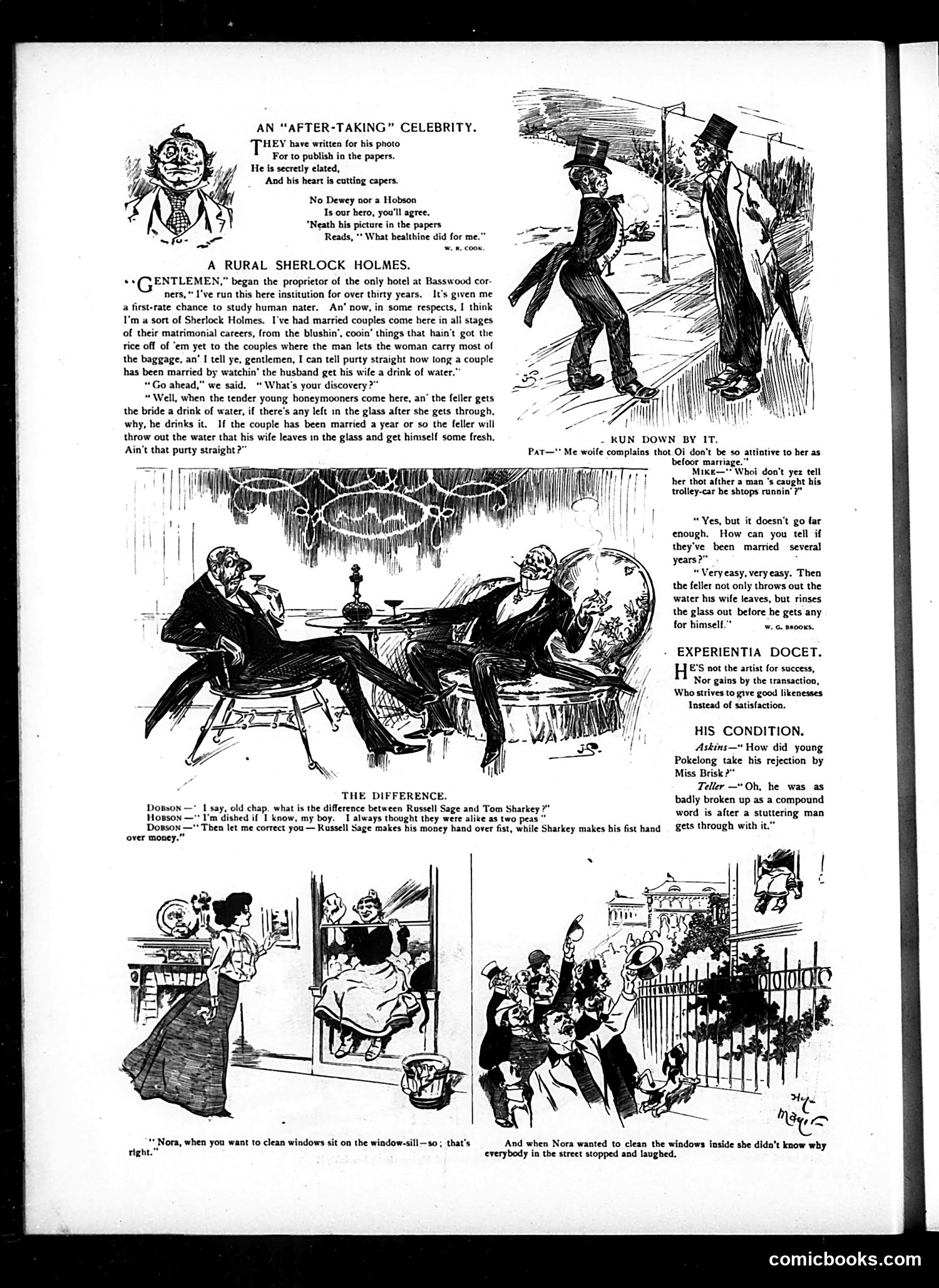
This page contains several satirical pieces typical of early 20th-century American humor: **"After-Taking Celebrity"** mocks patent medicine advertising—a man becomes famous merely by having his photograph appear in newspapers with a testimonial ("What Healthline did for me"), satirizing how celebrities were created through shameless self-promotion and dubious product endorsements. **"A Rural Sherlock Holmes"** presents a hotel proprietor's humorous theory: he claims to judge a couple's marital duration by observing whether the husband drinks leftover water his wife leaves in a glass. The joke is that romance diminishes over time—early newlyweds share everything; established couples don't. **"Run Down by It"** is an Irish immigrant joke (indicated by "Pat" and "Mike" stereotypes and phonetic dialect) about marriage: Mike quips that men stop "running" (being attentive) after catching their "trolley-car" (wife)—equating courtship to pursuing transportation. The lower cartoons mock window-cleaning mishaps, likely playing on servant/domestic help stereotypes of the era. Overall, the page reflects period attitudes toward marriage, advertising fraud, and immigrant humor.
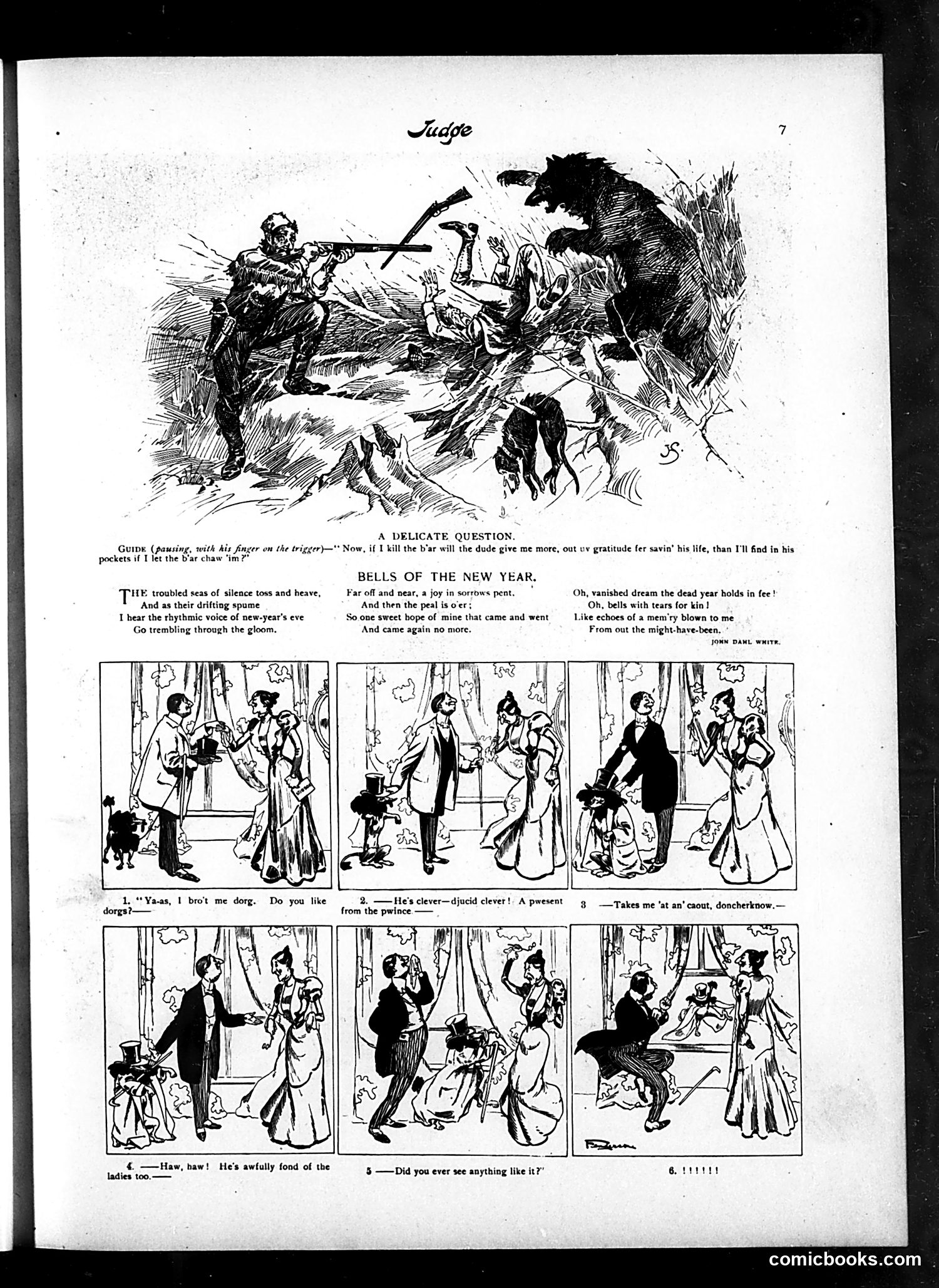
**"A Delicate Question"** (top): A backwoods guide contemplates whether to kill a bear attacking a wealthy "dude" (Eastern tourist), calculating whether gratitude money exceeds the victim's pocket contents. This satirizes rural stereotypes—the dialect ("b'ar chaw 'im"), crude pragmatism, and assumption that a dude carries cash. The joke hinges on the guide's mercenary indifference to the tourist's fate. **"Bells of the New Year"** (middle): A sentimental poem about New Year's Eve, touching on loss and unfulfilled hopes—typical turn-of-year melancholy literature. **Comic strip** (bottom): Six panels depicting a woman introducing a small man at a social gathering. The dialogue suggests he's presented as a "clever" guest from "the prince," and observers remark he's "awfully fond of the ladies" and are amazed by his behavior. The humor appears to play on the man's diminutive stature and forward behavior toward women—likely a dwarf or performer being treated as novelty entertainment at a society event.
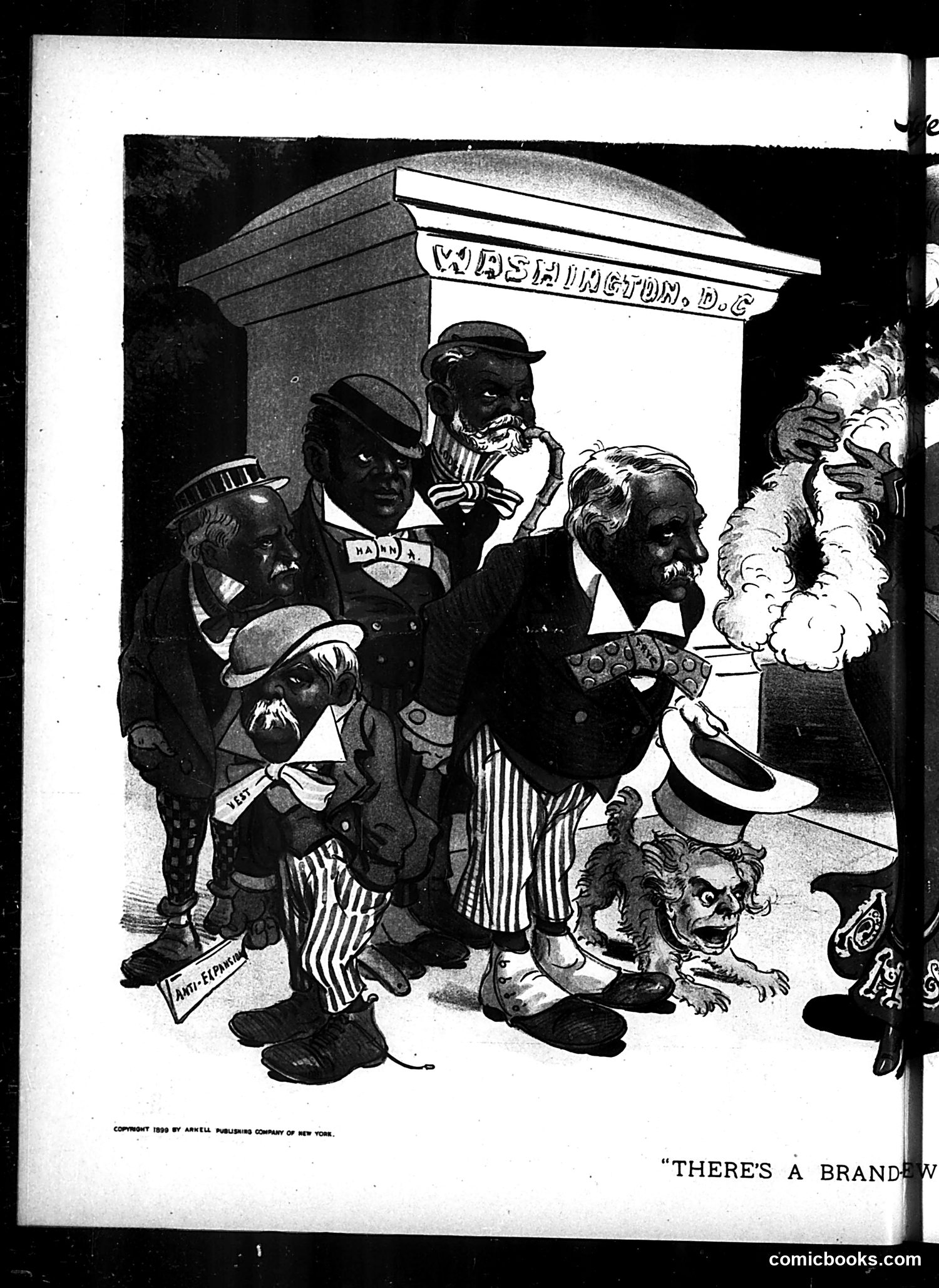
This 1930 Judge magazine cartoon depicts a satirical scene set at Washington, D.C. (labeled on the building). The image uses exaggerated caricatures—figures with darkened features in formal dress and military uniforms—gathered beneath a classical Capitol-style structure. The cartoon appears to critique Washington politics and government corruption or incompetence of the era. The figures' theatrical poses and grotesque styling suggest mockery of political figures or types. One figure holds what appears to be a label reading "Anti-Elephant" (possibly referencing the Republican Party symbol). The partial caption "THERE'S A BRAND—" is cut off, preventing full understanding of the intended message. Without the complete text, the specific political target or satirical point remains unclear, though the overall tone is derisive toward Washington establishment figures.
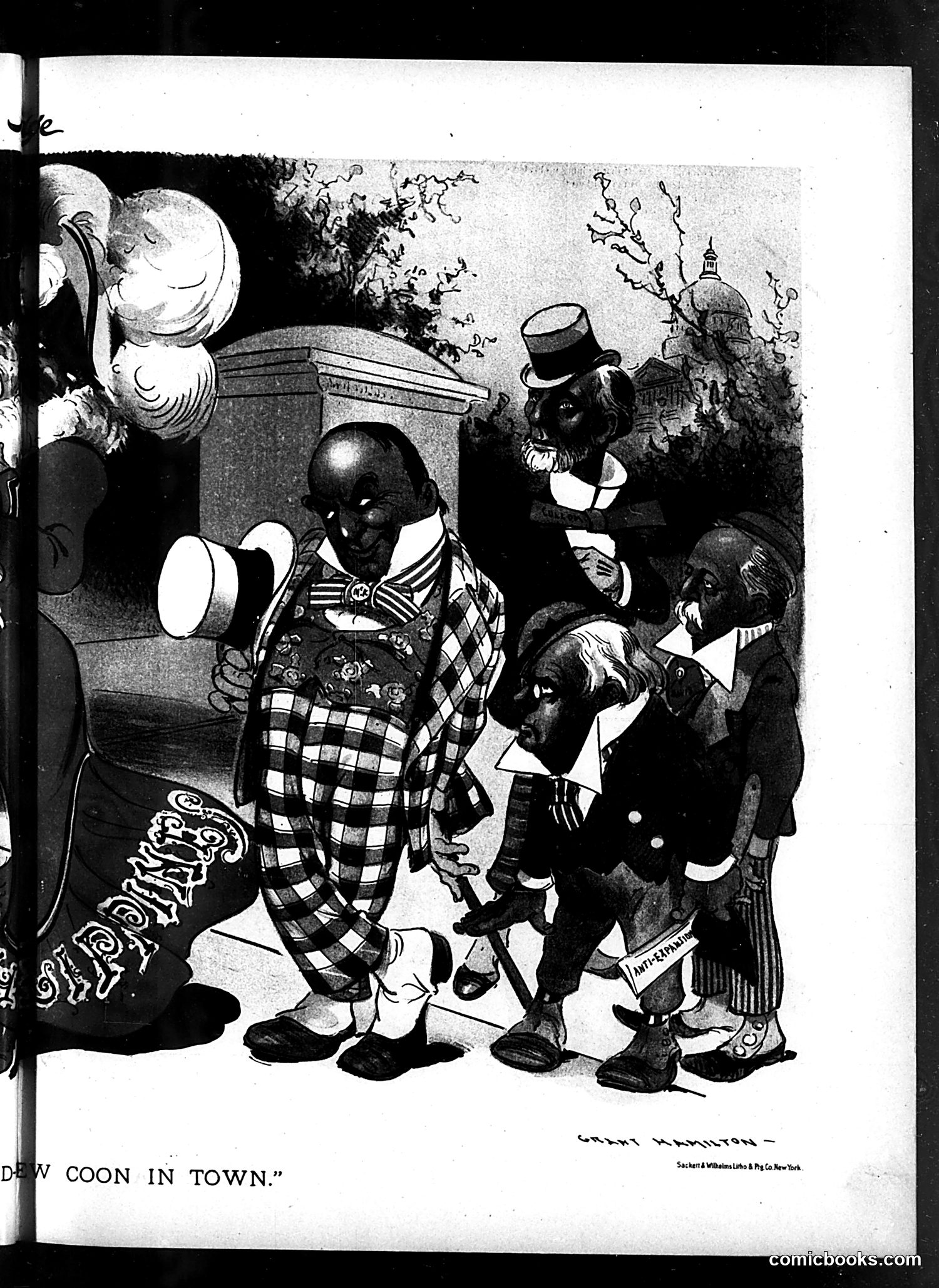
This cartoon, titled "Coon in Town," uses a racial slur in its caption that reflects the deeply offensive language of its era. The image depicts caricatured Black figures with exaggerated features in what appears to be a scene of social disruption or chaos. The satire appears to reference anxieties about African American presence in urban spaces during the late 19th or early 20th century. The formally dressed white figures' reactions suggest alarm or disapproval at this "intrusion." Without additional context about the specific historical moment, I cannot identify particular political figures or events referenced. The cartoon reflects the racist attitudes prevalent in *Judge* magazine during this period, when such imagery was considered acceptable satirical commentary on race and social change.
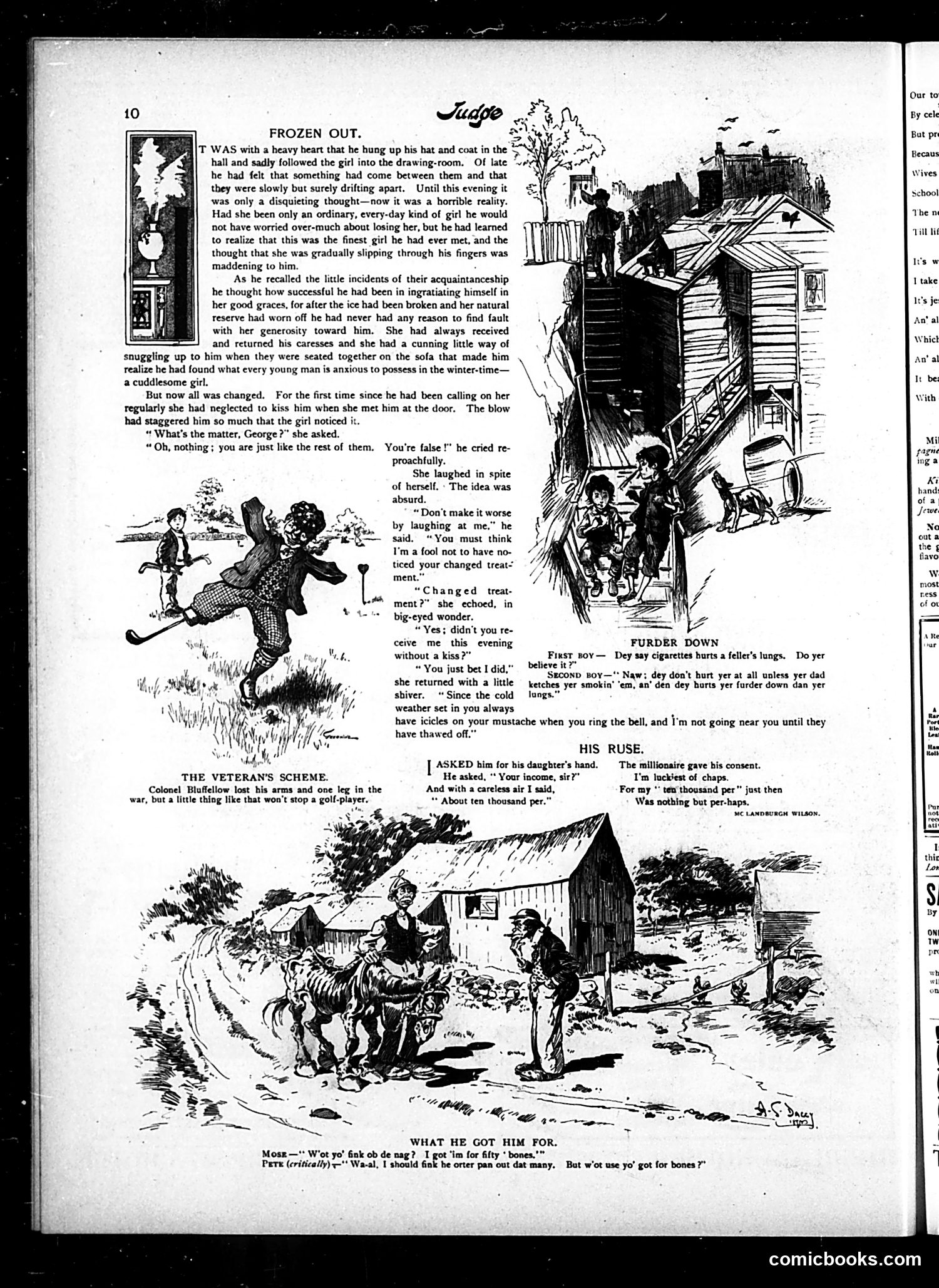
This page contains three separate humorous sketches about romantic and financial matters: **"Frozen Out"** depicts a young man distressed that his girlfriend has stopped kissing him hello. She explains she's avoiding his mustache, which has icicles on it from cold weather—a deflating, practical reason rather than emotional distance. **"The Veteran's Scheme"** shows a one-armed, one-legged Colonel playing golf, satirizing the notion that disabled war veterans can function normally at leisure activities despite their injuries. **"His Ruse"** presents a man who fibbed about his income (claiming "ten thousand" when asked about earnings, implying "per perhaps") to win a millionaire's daughter's hand—a joke about calculated deception in courtship. **"What He Got Him For"** shows a dialogue between two men about a horse, with humor deriving from dialect humor (common in period comics) regarding its practical worth. These represent typical Judge magazine content: genteel romantic comedy and social satire targeting middle-class concerns about courtship, wealth, and masculine performance.
This page is primarily **advertising and light humor** rather than political cartooning. The main content includes: **"Slightly Bewildered"** (Washington Star): A rural dialect poem satirizing the contradiction between peace advocacy and violent behavior. A small town organizes a peace demonstration, but the planning devolves into physical fighting among committee members, their families, and neighboring towns. The poet notes the paradox: the czar petitions for peace while simultaneously preparing for war. The satire mocks the gap between peaceful rhetoric and aggressive action—a common Progressive-era critique of hypocrisy in peace movements and international relations. **"Baby's Puzzle"** (Arthur Boswell): Humorous poem about a child unable to identify which man is her father—a tousled morning visitor, a well-dressed daytime caller, or a tired evening visitor. The gentle comedy plays on domestic confusion, possibly alluding to infidelity or unclear paternity, though the tone is lighthearted rather than harsh. The remainder consists of period advertisements (cigars, pianos, liquor, hotel services).
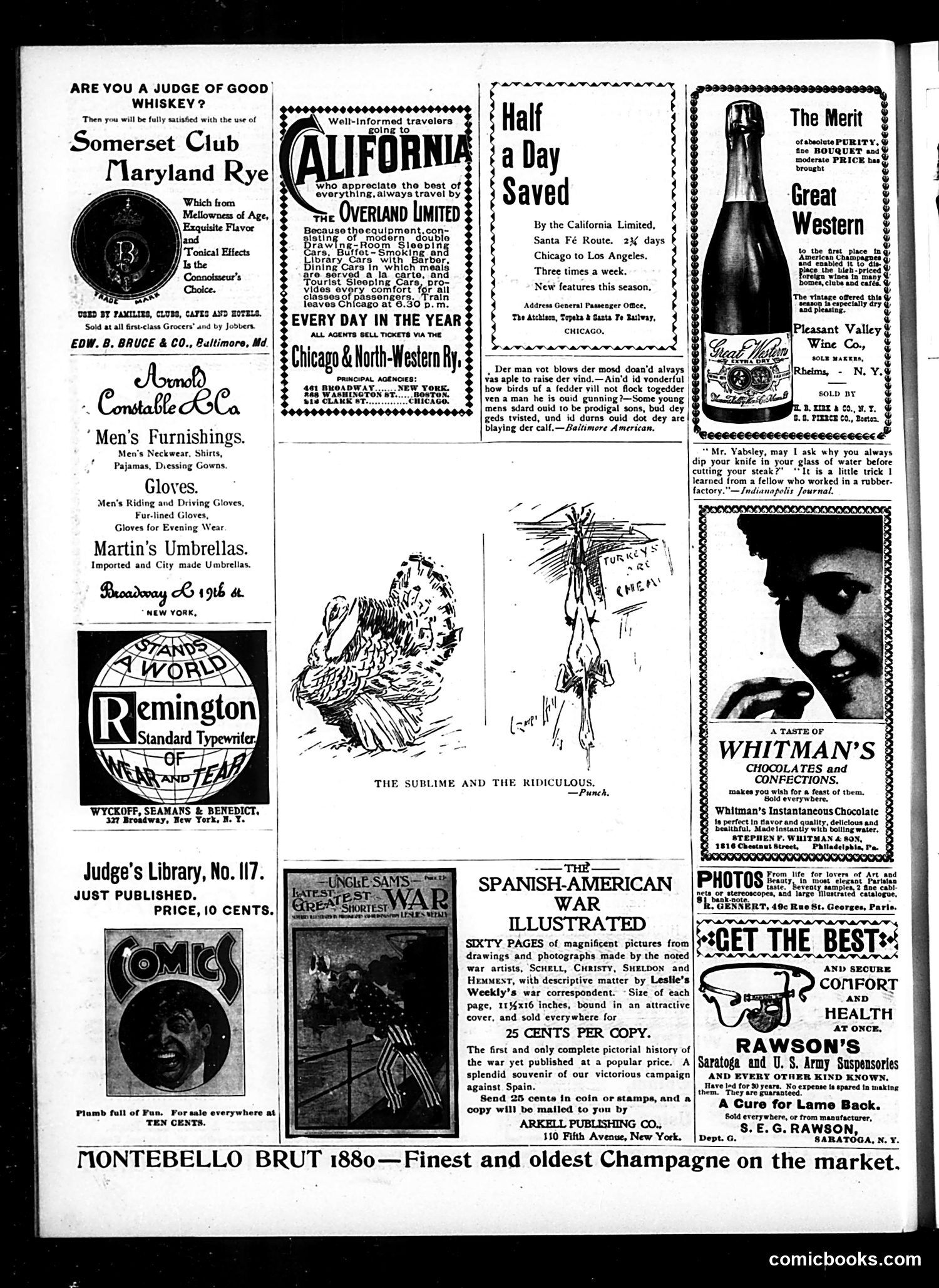
This page is primarily **advertising with minimal editorial content**. The dominant cartoon—"The Sublime and the Ridiculous" by Punch—depicts two figures in exaggerated poses, apparently contrasting refined versus crude behavior, though the specific satire is unclear from the image alone. The page's real interest lies in its **period advertisements** reflecting turn-of-the-century American consumer culture: whiskey, champagne, wine, and chocolate brands; train travel (the Overland Limited); men's clothing; and typewriters. Notably, it includes ads for "Whitman's Chocolates" and "Rawson's Suspensories" (men's medical supports). A small text excerpt mocking a German immigrant's dialect ("Der man vot blows...") represents the **ethnic humor common to the era**, often targeting recent immigrants with stereotypical speech patterns. The **Spanish-American War book advertisement** (25 cents) is historically significant—this magazine likely dates to 1898-1899, capitalizing on public appetite for war documentation.
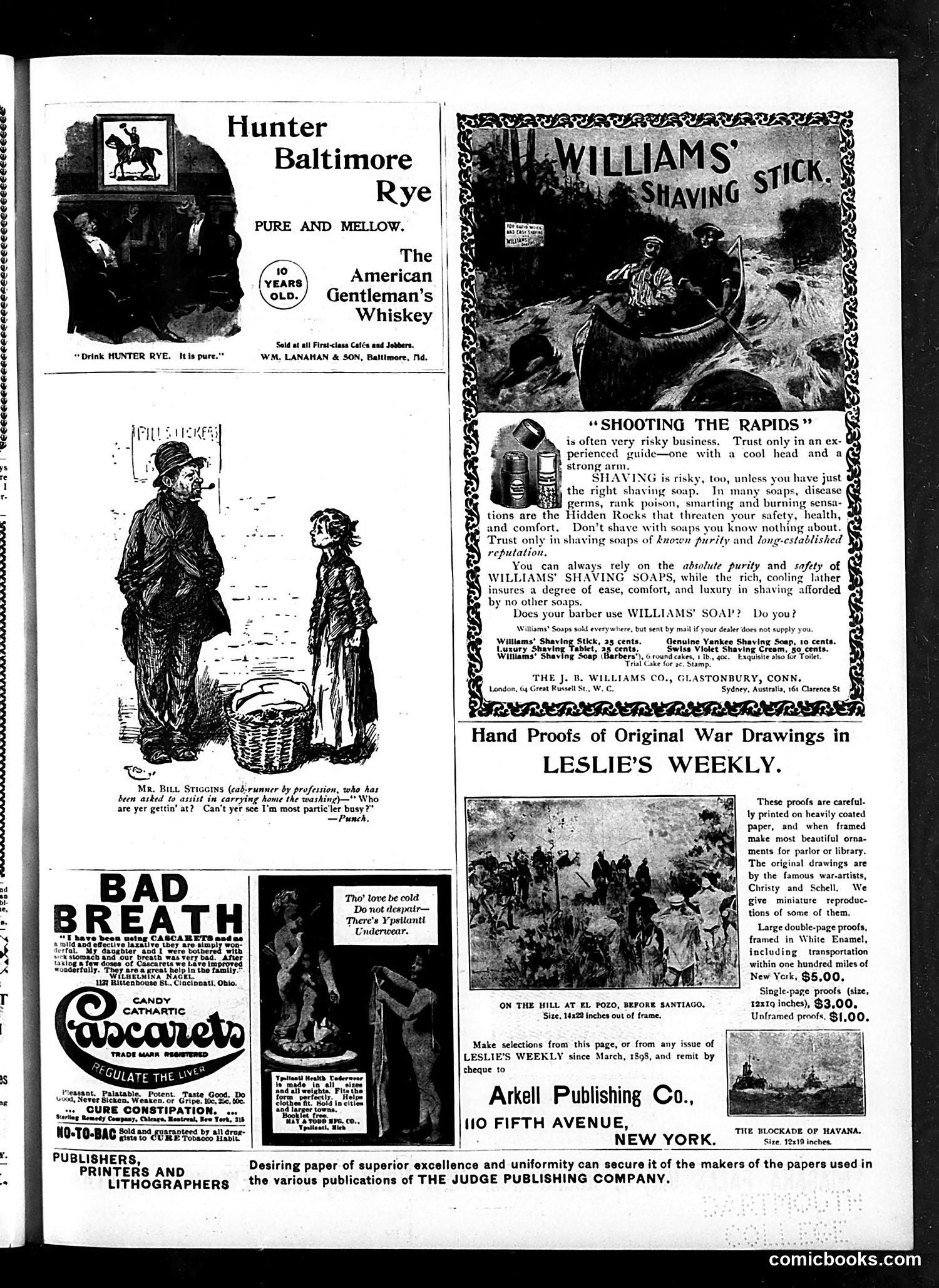
This page is primarily **advertising and promotional content** rather than political satire. It features: **Main advertisements:** - Hunter Baltimore Rye whiskey (top left) - Williams' Shaving Stick (top right) - uses a "shooting rapids" metaphor to promote safe shaving soap, warning against inferior brands with hidden dangers - Cascarets laxative (center left) - promotes digestive health - Leslie's Weekly war drawings (center/right) - selling framed reproductions of Spanish-American War artwork by artists Christy and Schell **Minor content:** A small comic sketch (left side) shows a cab-runner named Bill Stiggins, referenced as busy with washing delivery—a Punch magazine reprint. The page reflects turn-of-the-century advertising practices: metaphorical safety messaging, war-related commercial exploitation (the 1898 Spanish-American War), and medicinal product promotion. There is **no significant political cartoon or satire** to interpret here—it's a commercial publication page.
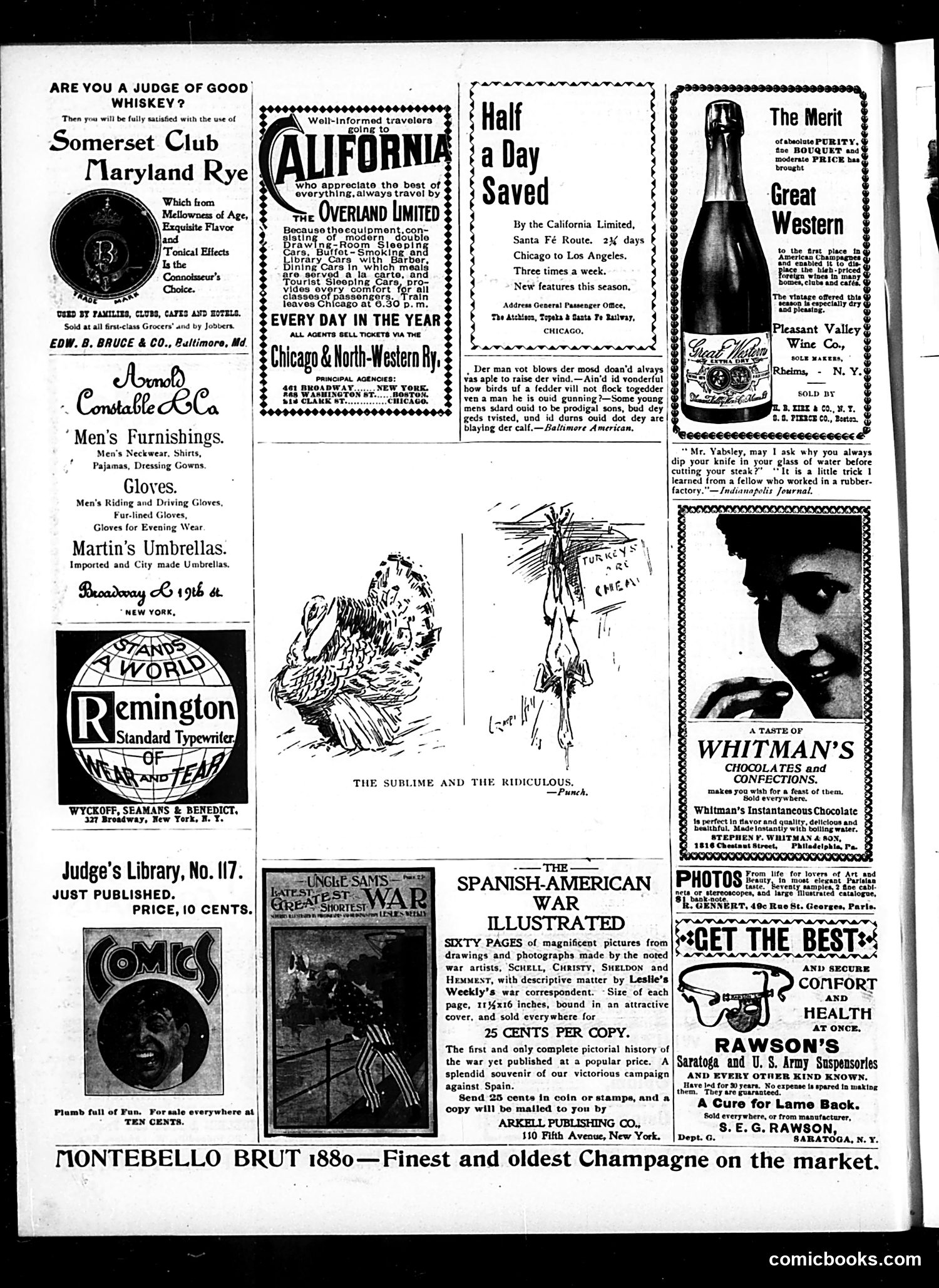
This page is primarily **advertisements** with minimal editorial cartooning content. The notable visual element is "The Sublime and the Ridiculous" — a two-panel sketch by Punch showing contrasting figures (one elegant, one disheveled), illustrating the juxtaposition of refined versus base behavior. The page advertises whiskey, railroad travel (Overland Limited to California), men's furnishings, typewriters, chocolates, and other consumer goods typical of the early 1900s. Interspersed are humorous dialect jokes—particularly one in German-accented English about foolish behavior—representing the period's common ethnic humor. A significant advertisement promotes an illustrated book about the **Spanish-American War** (1898), featuring artwork by noted war artists and priced affordably at 25 cents, capitalizing on recent public interest in that conflict. The page reflects Judge's dual function: satirical commentary mixed with commercial content targeting affluent, educated readers interested in travel, quality goods, and current events.
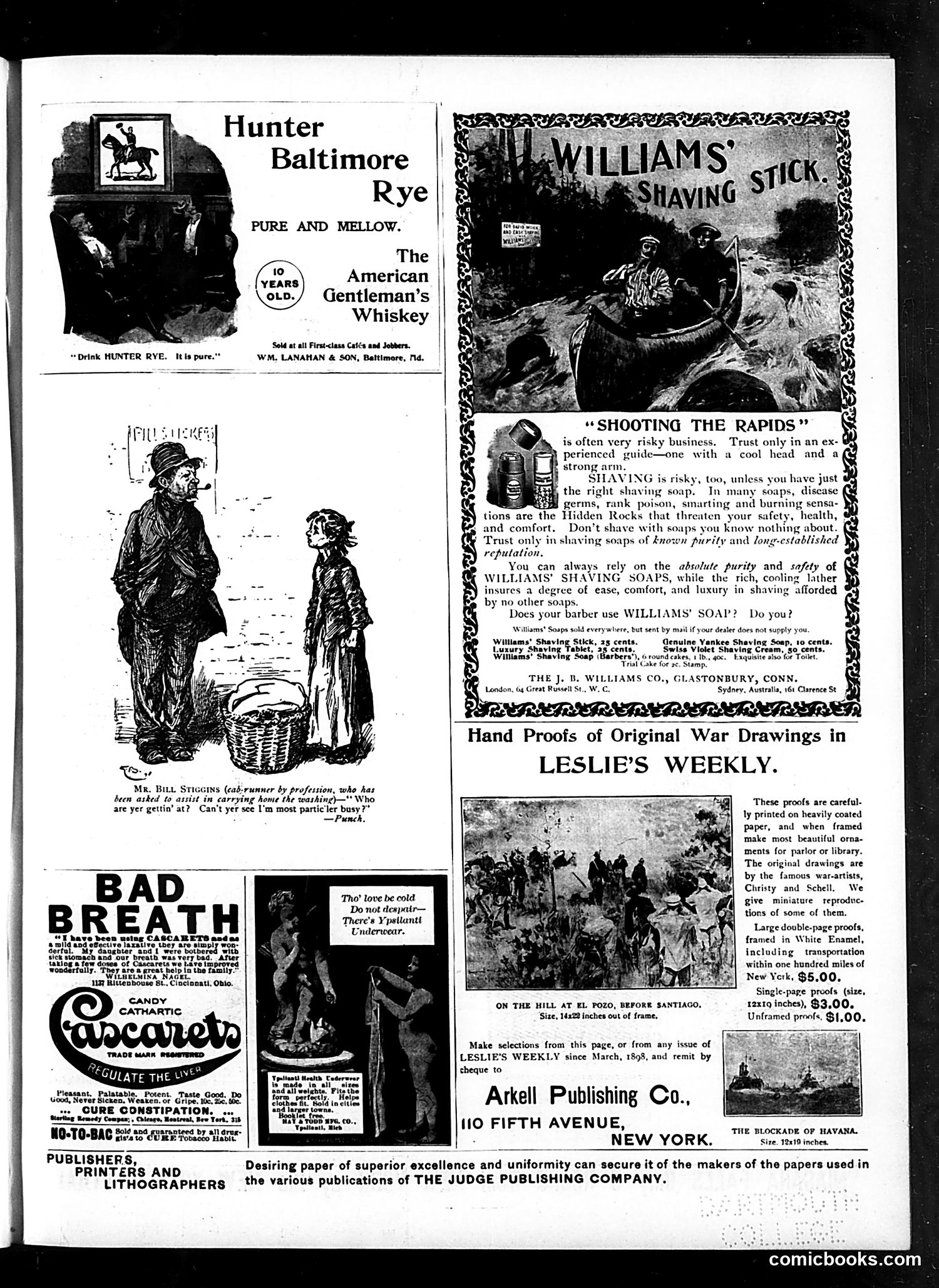
This page is primarily **advertising content** with minimal editorial material. The main items include: **Hunter Baltimore Rye whiskey** (top left)—a straightforward liquor advertisement emphasizing purity. **Williams' Shaving Stick** (top right)—uses a "Shooting the Rapids" metaphor, comparing shaving without proper soap to navigating dangerous rapids without an experienced guide. The ad warns of "disease germs" and "rank poison" in inferior soaps, reflecting early 20th-century anxieties about hidden health dangers. This appears to be genuine product marketing rather than satire. **Lower content** includes a small Punch cartoon (credited), a Cascarets laxative ad, and notices for **Leslie's Weekly's sale of hand-proof war drawings** from the Spanish-American War (1898), featuring work by war artists Christy and Schell. The page lacks significant political satire or caricature. It represents typical Judge magazine **advertising revenue** rather than editorial commentary. The date appears to be shortly after the 1898 Spanish-American War, based on the Leslie's Weekly war art promotion.
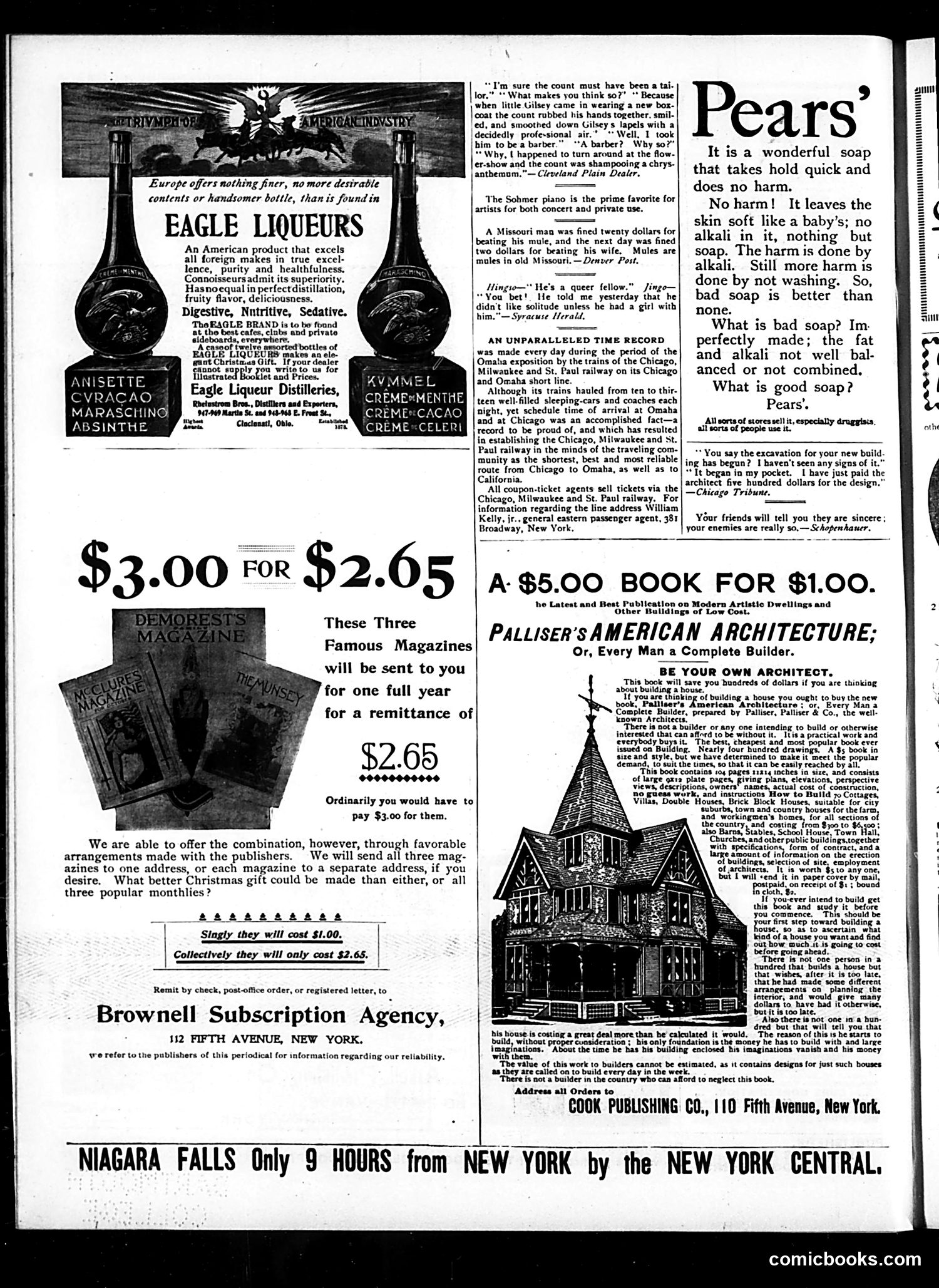
This page is primarily **advertisements and filler content** rather than political cartoons. The main elements are: 1. **Eagle Liqueurs ad**: Promotes an American distilled spirits brand, emphasizing its superiority over foreign competitors—typical nationalist marketing of the era. 2. **Magazine subscription offer**: Three magazines sold together at discount ($2.65 instead of $3.00)—a common promotional tactic. 3. **Pears' Soap ad**: Argues the soap is harmless and beneficial, addressing consumer concerns about alkali content in cleaning products—reflecting early 20th-century anxieties about product safety. 4. **Small humorous anecdotes**: Brief jokes about mistaken professions and a marital double-standard (man fined for beating mule *and* wife). 5. **Railway advertisement**: Chicago, Milwaukee & St. Paul railway boasts punctuality during the Omaha Exposition. **No political satire is present.** This is a typical page from *Judge*, the satirical magazine, but devoted to advertisements and light humor rather than editorial commentary.
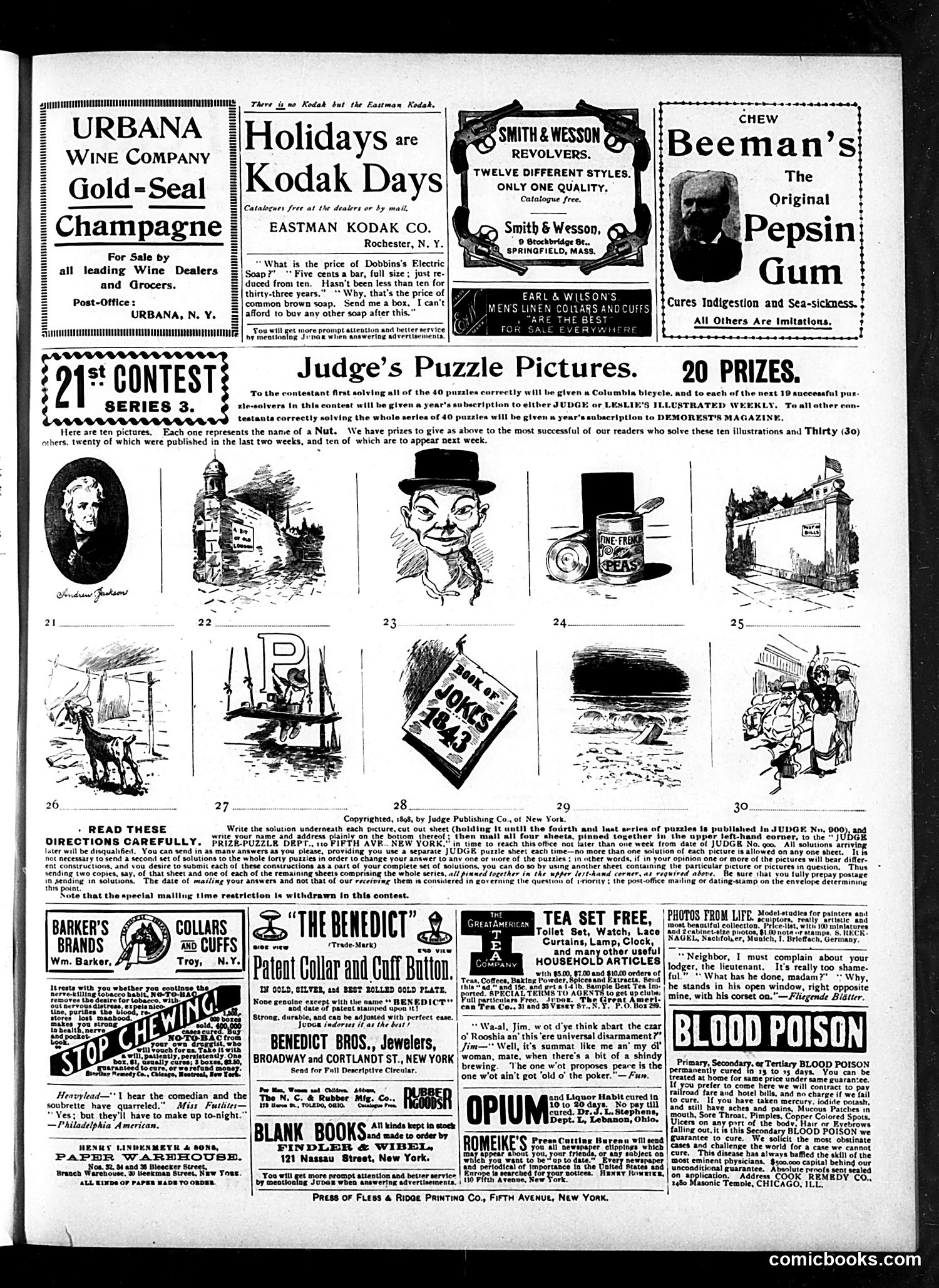
This page is primarily **advertising and a puzzle contest**, with minimal political content. The main feature is "Judge's Puzzle Pictures" (Series 3)—a contest where readers solve ten rebus-style visual puzzles numbered 21-30 to win prizes including a Columbia bicycle. The puzzles use simple visual puns and wordplay typical of early 1900s entertainment. The advertisements reflect period consumer goods: Kodak cameras (positioning holidays as "Kodak Days"), Smith & Wesson revolvers, Beeman's Pepsin Gum, patent collar buttons, and various household items. One ad references "the czar of Russia" and "universal disarmament," suggesting contemporary geopolitical awareness, though the text is partially cut off. The single cartoon dialog ("Heavylead") is a theater industry joke about comedians reconciling before a performance. This is **not a satirical or political commentary page**—it's a typical Judge issue mixing commercial advertising with reader-participation contests and light humor.
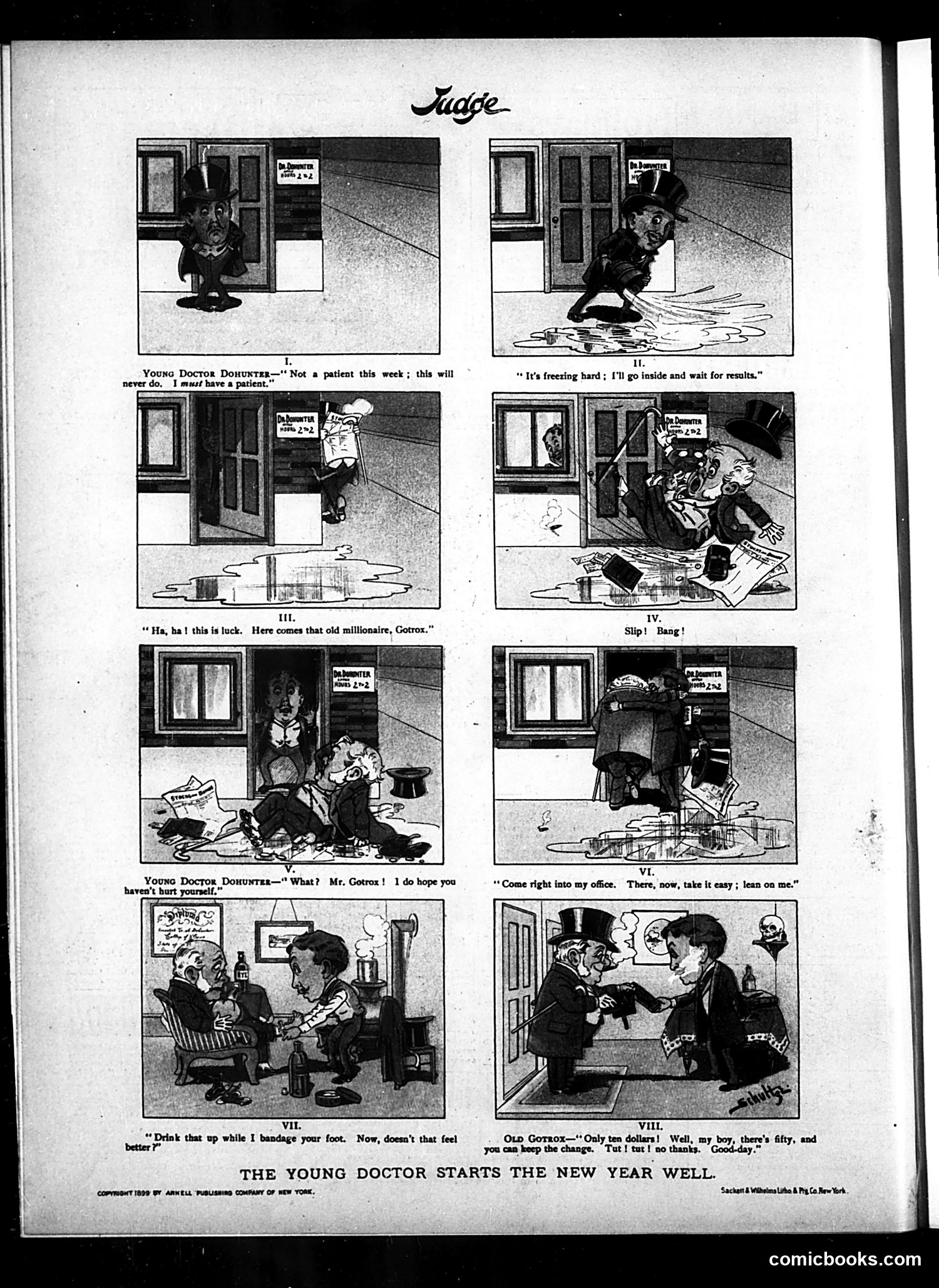
This eight-panel comic strip from Judge (copyright 1899) satirizes an ambitious young physician's unethical New Year's start. The "Young Doctor Donuxtae" (a made-up name) desperately needs patients but has none. When a wealthy man ("Old Gortox") arrives with a minor foot injury, the doctor deliberately worsens it—deliberately freezing his hands and causing injury—to create ongoing business and justify expensive treatment. The satire targets medical fraud and greed: the doctor profits from deliberately harming a patient, then manipulates the wealthy Gortox into overpaying ("fifty" dollars, keeping the change). The joke's cynicism reflects late-19th-century anxieties about unscrupulous doctors prioritizing profit over patient welfare. The final panel shows the doctor celebrating his unethical scheme with an older physician, suggesting this corruption is normalized in the profession.